INTRODUCTION
Cowpea (Vigna unguiculata [L.] Walp.) is an important food crop for millions of small-scale farmers living in the arid and semi-arid regions of the world (Osondu Reference Osondu1997). It is grown on c. 7–8 million ha, of which Africa accounts for 6 million/ha (Dadson et al. Reference Dadson, Hashem, Javaid, Joshi, Allen and Devine2005). It is a superior source of protein. The dried seeds, green pods and leaves are consumed as human food, whereas the dried stems are used for livestock feed. Cowpea is also widely intercropped with other important crops such as millet or sorghum. High salinity and drought are common stress conditions that adversely affect plant growth and crop production (Xiong et al. Reference Xiong, Schumaker and Zhu2002). In Sub-Saharan Africa, cowpea is well known for its outstanding ability to survive under conditions of water stress (Watanabe et al. Reference Watanabe, Hakoyama, Terao, Singh, Singh, Mohan Raj, Dashiell and Jackai1997) and, as a result, it plays an important role in regions where drought is the factor most limiting to crop yield. Many cultivars of cowpea are, nevertheless, adversely affected by drought and high temperatures, especially during floral development (Dadson et al. Reference Dadson, Hashem, Javaid, Joshi, Allen and Devine2005). It is known that water deficit induces damage to cell membranes and to the chloroplast membranes in particular (Torres-Franklin et al. Reference Torres-Franklin, Gigon, De Melo, Zuily-Fodil and Pham-Thi2007). An important strategy in the development of drought tolerance in plants is the maintenance of cell membrane integrity during drought stress.
Cultivars with a higher tolerance to drought are required to obtain higher and more stable yields. To achieve this, it is necessary to identify genotypes with good drought tolerance traits as well as developing efficient methods to evaluate levels of drought tolerance in germplasm. Since no single method is completely successful in discriminating between drought-tolerant genotypes and drought-sensitive genotypes, the combination of different methods to evaluate the same material is more likely to produce better results. The current paper presents the results of an evaluation of drought tolerance of cowpea accessions from Cameroon, Kenya and South Africa through physiological (stomata behaviour and cell membrane stability (CMS)) analysis.
MATERIALS AND METHODS
Twenty accessions from different ecological origins of Cameroon, Kenya and South Africa were used. Accessions from Cameroon comprised: MTA22, Balen, AS-94, Bafoussam1, Bafoussam2, Bafoussam3, Bafoussam4, Bafoussam5 and Bamougoum. The accessions, from Kenya were: Kamurugu1, Kamurugu2, M.66, Makueni, Kasuku, Ken-Kunde, K.80 and Gacaga, and from South Africa: Mpenbeni, Hluhluwa and Okhalweni.
The method of Watanabe et al. (Reference Watanabe, Hakoyama, Terao, Singh, Singh, Mohan Raj, Dashiell and Jackai1997) was adapted to conduct a controlled pot experiment in a glasshouse at the University of the Free State, Bloemfontein, South Africa (29°6′S, 26°18′E, 1351 m asl). The trial was laid out as a randomized complete block design with five replications. Seeds were planted in pots filled with 3 kg of sandy-sieved soil without fertilizer. After germination, plants were thinned to three fairly uniform plants per pot with five replicated pots for each accession. Plants were kept well watered until they had completed the development of primary leaves. Then 500 ml of water was given per day to each pot up to the flowering stage, when watering was withheld. The plants of each accession were scored three times (1, 2 and 3 weeks after watering was withheld) and scored each time using the scale (1–7) of the International Board for Plant Genetic Resources (IBPGR 1983) descriptors for cowpea, where 3=low susceptibility (plant alive with green leaves); 5=medium susceptibility (plant alive with most of the leaves yellow or wilting); 7=high susceptibility (plant dead and dry). The scores for the three plants in each pot were averaged, after which the scores of the five replicates of each accession were averaged.
Leaves were collected at the flowering stage on two different dates (6 and 14 days after watering was withheld) on a clear day. Healthy leaves of average size, representative of the genotype, were selected. The middle part of the leaves collected were sectioned into small pieces and fixed in 30 ml/l phosphate-buffered glutaraldehyde. The leaves were washed three times in phosphate buffer and then dehydrated in a graded ethanol series (20 min in 300 ml ethanol/l water; 20 min in 500 ml ethanol/l water; 20 min in 700 ml ethanol/l water; 20 min in 900 ml ethanol/l water; 30 min in pure ethanol and 30 min again in pure ethanol). The specimens were critical-point dried with carbon dioxide as the transition fluid. Each dried specimen was mounted on a stub using double-sided tape. All stubs were gold-coated in a Polaron Sputter Coater. Specimens were then examined using a Jeol Winsem 6400 scanning electron microscope operating at 5 kV. The length and width of 10 randomly selected stomata were measured on the upper side of the leaves at a magnification of ×500 using the measurement facility of the microscope. The values were then averaged. The number of stomata per unit area was calculated by counting the number of stomata present in the given area at a magnification of ×500. The counting was carried out on 10 randomly selected areas for each accession and the number of stomata recorded was averaged.
The CMS was determined by using the test system for detecting CMS developed by Sullivan (Reference Sullivan, Rao and House1972). Leaf samples of about 10 mm diameter were taken from fully expanded young leaves. The samples were washed with three changes of distilled water to remove surface-adhered electrolytes. Five leaf samples, taken randomly from three leaves, were placed in a test tube with 10 ml solution of 200 g/l polyethylene glycol 6000 (PEG). For the control treatment, five samples were placed in 10 ml of distilled water. All the samples were incubated at 10°C for 24 h and then equilibrated in a water bath at 25°C. Conductivity of the incubated medium was read using a conductivity meter. After the first readings, the samples were autoclaved for 15 min to kill the leaf tissues and a second conductivity reading was taken after the samples reached room temperature (25°C). Calculation of proportional injury due to desiccation was calculated as: 1−[1−(T1/T2)/1−(C1/C2)], where T and C refer to the mean of the treatment and control readings, respectively, and the numbers 1 and 2 refer to initial and final conductivities. A stepwise regression, correlation matrix and cluster analysis using unweighted pair-group (UPGMA) was carried out with NCSS (Hintze Reference Hintze1998). For the rest of the data, averages were compared.using the LSD from the ANOVA at P⩽0·05.
RESULTS
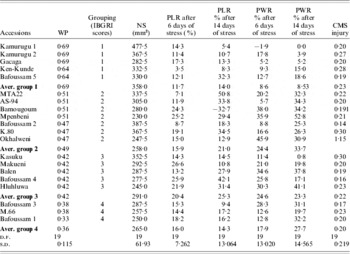
The accessions could be arranged in four groups according to their IBPGR drought symptom scores and corresponded to a pattern of observed values (Table 1). They were scored on a 1 to 7 scale, where 3 is low susceptibility (plant alive with green leaves); 5 is medium susceptibility (plant alive with most of the leaves yellow or wilting); and 7 is high susceptibility (plant dead and dry). The first group consisted of the accessions that scored 5 and over (Kamurugu1, Kamurugu2, Gacaga, Ken-Kunde, and Bafoussam5). In this group, 21 days after imposition of drought stress, the proportion of the plants which were wilted or dead was 0·67 and were the most susceptible to drought stress. The second group contained accessions that scored 4·2–4·6 and comprised MTA22, AS-94, Bamougoum, Mpenbeni, Okhalweni, Bafoussam2 and K.80. Here, 0·49 of the plants were wilted or dead after 21 days without water. The third group had accessions with a score of 3·8 and comprised Kasuku, Makueni, Balen, Bafoussam4, and Hluhluwa. In this group, 0·42 of the plants in each accession were wilted or dead after 21 days of water deficit. The fourth group was the most tolerant to drought stress and contained accessions scoring 3·0–3·4 (Bafoussam3, M.66 and Bafoussam1. The proportion of wilted or dead plants after 21 days of water-deficit stress in this group was 0·36.
Average value of measured characteristics

WP: proportion of wilted plants, NS: number of stomata, PLR: pore length reductions (%), PWR: pore width reductions (%), CMS: cell membrane stability, d.f.: degrees of freedom, s.d.: standard deviation.
The accessions were also ranked according to the number of stomata recorded. Mpenbeni (lowest), Hluhluwa, Okhalweni, Bafoussam1, M66, Bafoussam4, Bamougoum, Gacaga, Balen, Bafoussam3, Makueni and AS-94 had a relatively low stomata density compared with the others (Table 1).
The accessions were then grouped according to their ability to regulate stomatal opening during the stressed period. MTA22, Balen, AS-94, Bafoussam2, Mpenbeni, Hluhluwa, Bafoussam5, K.80, M.66 and Ken-Kunde consistently had shorter and narrower stomata throughout the stressed period than the others. MTA22 had the highest percentage of stomatal pore length decrease during the water stressed period, whereas Mpenbeni had the highest percentage of stomatal pore width decrease.
Okhalweni, Kamurugu2 and Makueni showed shorter and narrower stomatal pores between days 1 and 6 of the drought-stressed period; an increase was apparent between days 6 and 14. However, at day 14, the stomatal pores were still shorter and narrower compared with the control. The pore-length reduction from day 1 to 6 was highest in Makueni and the pore-width reduction was greatest in Okhalweni (Table 1).
Bafoussam1 and Bafoussam3 showed shorter stomatal pores between days 1 and 6 of the water-stressed period and then showed longer pores between days 6 and 14; however, their stomata also became narrower throughout the stressed period. At day 14, their stomatal pores were still smaller compared with the control.
For the first 6 days of stress, all the accessions (except Kamurugu1) had shorter and narrower pores than the unstressed controls, Bamougoum stomata were longer after 14 days of drought stress than those of the control plants (Table 1).
MTA22, Balen, AS-94, Bafoussam2, Mpenbeni, Bafoussam4, Hluhluwa, Bafoussam5, K.80, M66, Ken-Kunde and Kasuku showed a significant decrease of their stomatal aperture (length and width) between days 1 and 14 of the water-stressed period. Balen, Okhalweni, AS-94, Mpenbeni, Bafoussam4, Hluhluwa, M.66 and Makueni had a relatively low stomatal density as well as a greater ability to regulate stoma opening.
The accessions differed greatly in their CMS, which ranged from 0·14 to 0·31 and the five groups could be distinguished (Table 1). The first group had accessions with an injury level ranging from 0·25 to 0·31, the second group 0·22 to 0·25, the third group 0·19 to 0·22, the fourth group 0·17 to 0·19 and the fifth group of accessions had injury levels from 0·14 to 0·17.
Two characteristics were significantly correlated (P⩽0·05) with proportion of wilted plants: the number of stomata and the reduction in the width of the pores after 14 days of stress (data not shown). This was confirmed in the stepwise regression, where pore-width reduction after 14 days of stress explained the largest proportion (0·24) of variation in proportion of wilted plants (data not shown).
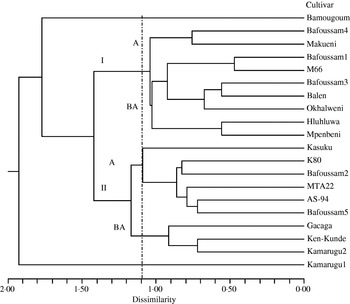
In the dendrogram compiled from a combination of the number of wilted plants as well as all the stomata measurements (Fig. 1), there was a strong similarity to the grouping according to the IBPGR scores. Of the five cultivars in group 1 according to IBPGR scores, four were present next to each other in cluster II, whereas the fifth cultivar, Kamarugu1, was an outlier. Of the seven cultivars in group 2, four were in subcluster IIA and one (Bamougoum) was an outlier. Mpenbeni and Okhalweni fell in a different cluster. Of the five cultivars in group 3, four were in cluster I. The three cultivars in group 4 were also grouped together, in cluster IB.
Dendrogram of the accessions for all measured characteristics, excluding CMS injury.

DISCUSSION
A high level of variation was found between the materials tested in response to drought stress. The effect of stress was seen as early as 1 week after watering ceased. Stomatal behaviour (sensitivity and frequency) has been suggested as a potentially useful trait in developing crop plants with improved water use efficiency (Maroco et al. Reference Maroco, Pereira and Chaves1997; Diallo et al. Reference Diallo, Samb and Roy-Macauley2002). White et al. (Reference White, Turner and Galbraith2000), in a study of leaf water relations and stomatal behaviour of four allopatric Eucalyptus, found that the lines which had the ability to effectively regulate their stomata during the water-stressed period were more tolerant to drought than the ones which could not. In the present study, MTA22, Balen, AS-94, Bafoussam2, Mpenbeni, Bafoussam4, Hluhluwa, Bafoussam5, K.80, M66, Ken-Kunde, Okhalweni and Kasuku may be able to effectively reduce water loss and become more drought tolerant by decreasing their stomatal opening. MTA22 had the highest decrease in its stomatal aperture between 6 and 14 days, indicating a greater ability than all the other accessions in regulating stomata opening. There was a significant correlation between the number of stomata (mm2) measured in this study and the proportion of wilted plants. In a similar study carried out on coffee, DaMatta (Reference DaMatta2004) found that lines with less stomata transpired less water than lines with more stomata. In the present study, the lines with a low number of stomata were also associated with greater drought tolerance.
The study of drought tolerance in food crops using the CMS test and its significant contribution as a screening method has been reported in crops, such as wheat (Sulc et al. Reference Sulc, Albrecht and Duke1991), groundnut (Venkateswarlu & Ramesh Reference Venkateswarlu and Ramesh1993) and turfgrasses (Van Rensburg et al. Reference Van Rensburg, Kruger and Kruger1993; Bandurska Reference Bandurska2000). These studies showed large ranges of electrolyte leakage in plants subjected to water-deficit, which indicates that the damage to the cell membrane is different under the same water-deficit pressure. Some plants resist better than others. The studies mentionedabove concluded that the genotypes exhibiting a low proportion of cell membrane injury during water stress could be considered as drought tolerant and those with a high-cell membrane injury could be considered susceptible to drought. In the present study, Okhalweni, Bafoussam2, and Bafoussam4 showed a low level of injury and can be considered as tolerant to drought-stress, whereas K.80, Kasuku, Ken-Kunde and Kamurugu2 showed high levels of injury and can be considered as drought-susceptible accessions.
Results obtained from studies using pots as a basis for drought tolerance screening were found to be significantly correlated with field results and these have been used to evaluate drought tolerance in many crops such as barley (Stanca Reference Stanca, Srivastava, Porceddu, Acevedo and Varma1987), sweet potato (Anselmo et al. Reference Anselmo, Ganga, Badol, Heimer and Nejidat1998), Eruca sativa (Sun et al. Reference Sun, Yang, Zhang, Zhang and Yun1999) and cowpea (Watanabe et al. Reference Watanabe, Hakoyama, Terao, Singh, Singh, Mohan Raj, Dashiell and Jackai1997). This also seemed to be an efficient method of identifying drought-tolerant accessions in the present study, although the results were not tested in the field. The grouping of the cultivars according to the scoring system of IBPGR was, to a large extent, reflected in a dendrogram compiled from all measured characteristics, excluding membrane injury levels.
To conclude, a number of the tested African cowpea (V. unguiculata) genotypes showed drought tolerance. It also showed the relative effectiveness of methods used to assess drought tolerance in crops. Drought-tolerant accessions had the lowest proportion of wilted or dead plants during the stressed period. Damage to the cell membranes caused by drought was smaller in these accessions, which helps the plant cells continue to carry out normal metabolic processes. They were also better able to regulate stoma opening so that it was smaller under drought conditions, thus reducing transpiration, maintaining a water balance inside the plants and becoming more tolerant to drought. The wide range of drought tolerance observed among the accessions suggests the possibility of breeding drought-tolerant cultivars in cowpea. Accessions of good drought tolerance included Bafoussam1, M.66, Bafoussam3, Hluhluwa, Bafoussam4, Balen, Makueni, Bafoussam2 and Okhalweni. These could be recommended to breeders as valuable material for drought tolerance improvement in cowpea.