Disasters are typically unpredictable events that cause physical, economic, and social losses in all or a certain part of society, and cease or interrupt normal life and human activities. Reference İlerisoy, Gökşen, Soyluk and Takva1 The factors that cause disasters are classified as either human or natural.” According to statistics on disasters in Turkey, earthquakes are one of the disasters with the most devastating effects Reference Adıgüzel2,Reference Taskiran and Baykal3 ; 45 089 people died on February 6, 2023, as a result of the earthquake, the epicenter of which was in the Pazarck district of Kahramanmaraş, which was called the “disaster of the century” and affected 10 cities. 4 Disaster-related issues change depending on the locations of the countries. These issues include difficulties in planning for the use of resources in the disaster region, difficulties in supplying clean water and food, heating issues, the risk of infectious disease transmission, accidents caused by worry and fear, and so on. Reference Alzahrani and Kyratsis5 The most fundamental fact regarding disasters, whether human or natural in origin, is that they create both physical and psychological harm in human life. The most significant component in reducing potential difficulties during a disaster is the development of action plans for the pre-disaster, peri-disaster, and post-disaster periods. Reference Brinjee, Al Thobaity, Almalki and Alahmari6 Even though disasters occur frequently in Turkey, inadequate preparedness and measures make disaster response difficult. Reference Işık, Aydınlıoğlu and Koç7 To prepare societies for disasters, state institutions, private institutions and organizations, non-governmental organizations, health institutions, and health staff working in these institutions must be ready. Reference Taskiran and Baykal3 Disaster preparedness among health care staff, particularly nurses, is critical for providing prompt intervention, medical care, and treatment during a disaster and efficiently managing the disaster. Reference Songwathana and Timalsina8–Reference Loke and Fung10 As a result, it is critical that all nurses, regardless of specialty, know crisis management and play an active part in all phases of disasters. Reference Taskiran and Baykal3 Disasters such as earthquakes, floods, and forest fires occur frequently in Turkey as a result of climate and surface shape. Reference Ceren11 Even larger disasters, like the Istanbul earthquake, are predicted to occur in the future. Therefore, it is necessary to determine the level of disaster preparedness and awareness of nurses. Reference Taskiran and Baykal3,Reference Chegini, Arab-Zozani and Kakemam12 Few studies have evaluated the knowledge and awareness levels of nurses about disasters in the literature. In these studies, it was determined that the knowledge and awareness levels of nurses were not sufficient. Reference Wang, Liu and Yu9,Reference Chegini, Arab-Zozani and Kakemam12–Reference Choi, Hyun and Oh18 This research was conducted to see the level of disaster knowledge and preparedness perceptions of nurses working in a tertiary university hospital.
Materials and Methods
Research Type
This descriptive cross-sectional study was conducted to determine the levels of knowledge and preparedness about disasters among nurses working in a university hospital in the Eastern Black Sea Region of Turkey.
Population, Sample, and Sampling Method
The population of the study consisted of nurses working in the relevant hospital (n = 340). The sample included 183 nurses who were determined to use the OpenEpi program and the sampling method. The study was conducted with the involvement of 183 nurses who worked at the hospital between the dates of the study, volunteered to participate in the study, and completed the data collection tools.
Data Collection Tools
The data were collected between February 20 and May 25, 2022, using the Sociodemographic Information Form and the Disaster Preparedness Perception Scale in Nurses.
The Sociodemographic Information Form
Developed by the researchers in line with the literature, Reference Taskiran and Baykal3,Reference Karakis15–Reference Şentürk, Büyükdavraz and Yıldırım Keskin17,Reference Ozcan19–Reference İytemur21 the form includes the socio-demographic characteristics of the nurses, like age, gender, and educational status, and their suggestions about receiving training on disaster, caring for victims of disaster, having a disaster plan in the institution where they work, the hazards that may cause an emergency in the institution where they work, and recommendations for the development of a disaster and emergency plan.
The Disaster Preparedness Perception Scale in Nurses (DPPSN)
The scale, consisting of 20 items and 3 sub-dimensions, was developed by Özcan in 2013 and aims to determine the disaster preparedness of nurses. The 3 sub-dimensions of the scale are the preparation phase (questions 1–6), the intervention phase (questions 7–15), and the post-disaster phase (questions 16–20). The scoring of the 5-point Likert type is as follows: “strongly disagree” = 1, “disagree” = 2, “partially agree” = 3, “agree” = 4, and “strongly agree” = 5. The Cronbach alpha internal consistency coefficient of the scale was found to be 0.90, and test-retest reliability was 0.98. Reference Ozcan19 High scores indicate that nurses’ perceptions of disaster preparedness are high.
Data Collection
The participants were verbally informed about the goal of the study prior to the collection of research data. Those who volunteered to participate in the study provided both verbal and written consent. Then, the data were collected from the participants who agreed to participate in the study via face-to-face interviews.
Ethical Considerations
Prior to the study, institutional permission was obtained from the relevant hospital to conduct the study. Ethics committee approval was obtained from the Artvin Çoruh University Scientific Research Ethics Committee, with the decision dated February 6, 2021, and numbered E-18457941-050.99-4984.
Statistical Analysis
SPSS 22 software was used to analyze the research data. The Kolmogorov–Smirnov test was used to determine whether the data conformed to a normal distribution. Numbers (n), percentages (%), means, and standard deviations were used in the analysis of descriptive data. The Mann–Whitney U test was used to analyze data that did not fit the normal distribution; P < 0.05 was considered statistically significant.
Results
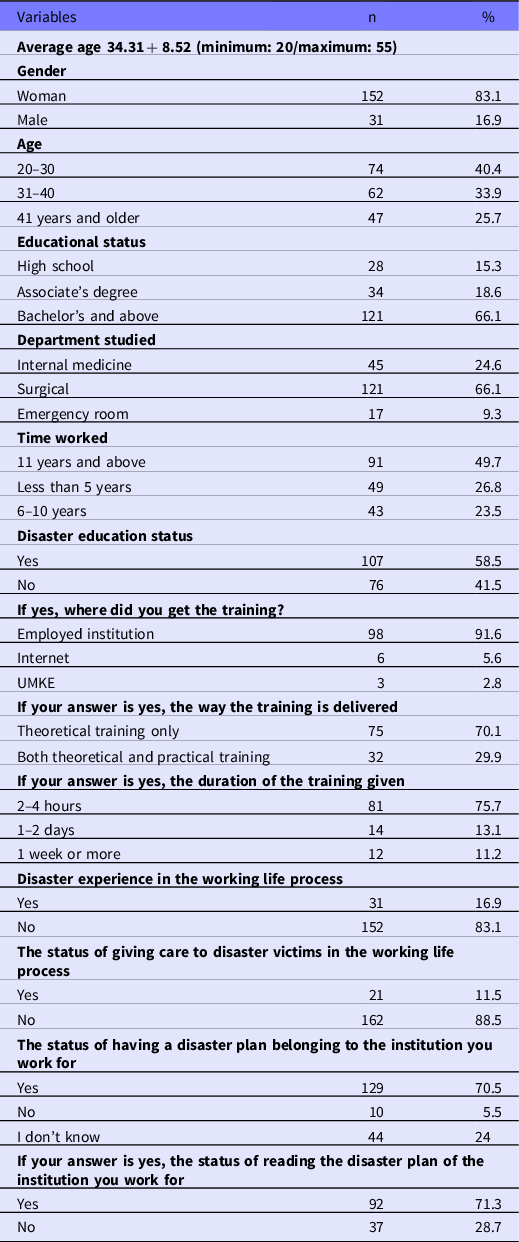
The socio-demographic characteristics of the participants and their level of knowledge about the disaster are shown in Table 1. The mean age of the participants was 34.31 + 8.52 years (minimum: 20; maximum: 55); 83.1% were female; 66.1% had at least a bachelor’s degree and worked in a surgical ward; 49.7% had been working for at least 11 years, and 58.5% had received training on disasters. Those who received disaster-related training received it mostly face to face (70.1%), from the institution where they worked (91.6%), and in the form of 2–4 hours of training (75.7%). During their working lives, 16.9% of the nurses experienced a disaster, 11.5% provided care to disaster victims, 70.5% were aware of the disaster plan in their institutions, and 71.3% read this plan (see Table 1).
Socio-demographic characteristics of the participants and their level of knowledge about the disaster situation (n = 183)

UMKE, National Medical Rescue Team Unit.
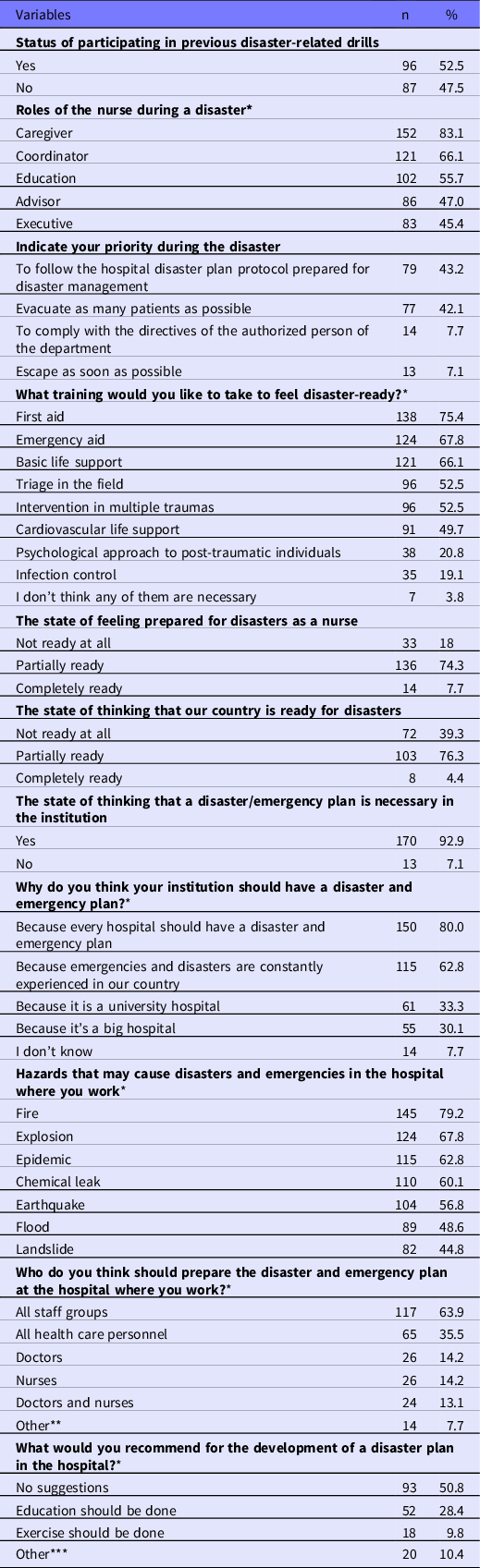
This study has a descriptive, cross-sectional, correlational, and methodological design. According to the results of the analysis of the participants’ views on emergency and disaster situations, 52.5% of them had previously participated in a disaster-related drill, 83.1% took on the role of caregiver during a disaster, and 43.2% believed that following the hospital disaster plan protocol created for disaster management was essential. It was determined that the participants mostly (75.4%) wanted to receive first aid training to feel ready for disasters, and 74.3% and 76.3% felt themselves and their countries were partially prepared for disasters, respectively. Participants thought that every hospital should have a disaster plan (92.9%), a fire was a potential hazard and emergency in the institution where they worked (79.2%), disaster and emergency plans should be made by everyone (63.9%), and that no suggestions were made for the development of the disaster plan in the hospital (50.8%) (Table 2).
Opinions of the participants about the emergency and disaster situation (n = 183)

* More than 1 answer was marked;
** Other: hospital administrators, chief physician;
*** Other: precautions should be taken, exercises and training should be done together, brochures should be distributed, and employees should be informed.
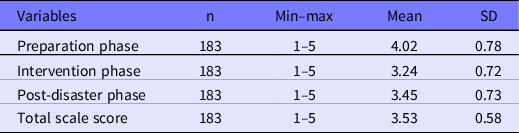
The scores of the DPPSN and sub-dimension scores of the nurses were found to be as follows: the preparation phase sub-dimension was 4.02 + 0.78, the intervention phase sub-dimension was 3.24 + 0.72, the post-disaster phase sub-dimension was 3.45 + 0.73, and the mean total score of the DPPSN was 3.53 ± 0.58 (Table 3).
Nurses’ perception of disaster preparedness scale and its sub-dimension scores (n = 183)

Min, minimum; max, maximum; SD, standard deviation.
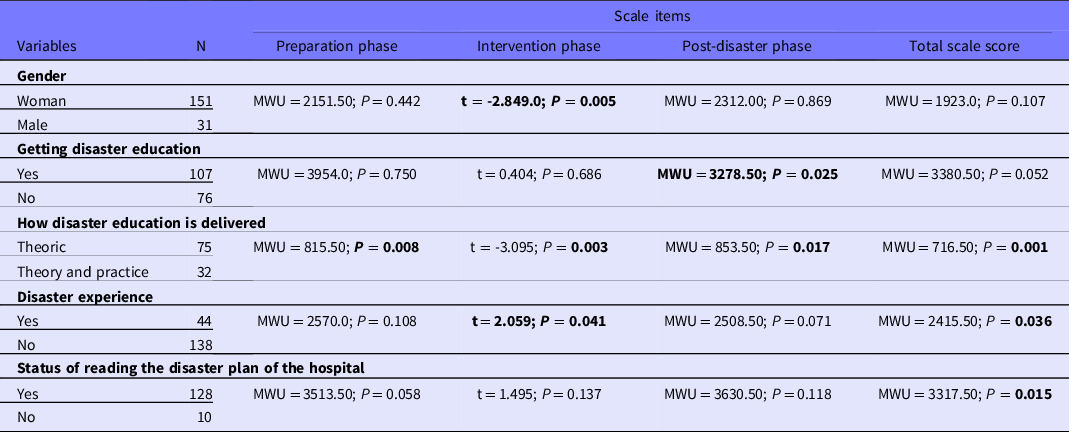
The sub-dimension and total scores of the DPPSN were compared with different variables, and a statistically significant difference was found between gender and the intervention phase sub-dimension of the scale, the post-disaster phase sub-dimension score of the scale in those who received disaster training, the total score and all sub-dimension scores of the scale in those who received theoretical disaster training, the intervention phase sub-dimension score of the scale in those who did not experience a disaster, and the total score of the scale in those who read the hospital disaster plan (P < 0.005) (Table 4).
Comparison of nurses’ Disaster Preparedness Perception Scale sub-dimension and total scores with different variables (n = 183)

MWU, Mann–Whitney U test.
Discussion
Health care personnel should be actively involved in all stages of disaster planning. The purpose of this study was to determine the preparedness of nurses, who are among the occupational groups that provide health services against disasters, and to measure their perceptions of preparedness throughout the disaster, and the findings were discussed in light of related literature.
More than half of the nurses in the study received theoretical training on disasters in their institutions. A statistically significant difference was found in the post-disaster phase sub-dimension of the disaster preparedness perception scale for the nurses who received training for disasters compared to those who did not receive training. In addition, it was determined that the perception of disaster preparedness among nurses who received only theoretical training was lower in all sub-dimensions than that of nurses who received both theoretical and practical training. In the study conducted by Mantono et al. (2019) in Indonesia to evaluate nurses’ perceptions of preparedness for disaster management, it was determined that the theoretical training given to nurses contributed positively to disaster management. Reference Martono, Satino and Nursalam22 It is well recognized that training that encourages practice and knowledge has a good effect on learning. The literature and the findings of the current study have confirmed that practice cannot be neglected in influencing the meaningfulness of disaster perception in individuals in extraordinary situations such as disasters. The influence of repeated training on permanent learning is well understood. The fact that the mean score on the Disaster Preparedness Perception Scale of the Nurses who got disaster-related training was higher than the mean score of those who did not receive training in this study supports this outcome. In similar studies, it was found that those who had received previous disaster-related training had higher scores in the total dimension of the disaster preparedness perception scale. Reference Brinjee, Al Thobaity, Almalki and Alahmari6,Reference Wang, Liu and Yu9,Reference Chegini, Arab-Zozani and Kakemam12,Reference Karakis15,Reference Choi, Hyun and Oh18 These results suggest that regular disaster training courses conducted in health institutions are successful in increasing disaster preparedness and disaster awareness.
Disasters are mostly unexpected crises. Reference Wang, Liu and Yu9 According to the results, few nurses had disaster experience and provided care to disaster victims. It was also discovered that nurses with disaster experience had a higher total score for the intervention phase and disaster preparedness perception. Similar to this research, Rizqillah and Suna (2018) examined the disaster perceptions of nurses working in the emergency room in Indonesia and discovered that those with disaster experiences had positive perceptions. Reference Rizqillah and Suna23 According to this viewpoint, the result of high perceived preparedness to confront disasters by nurses who experienced the disaster supports the findings of the literature. The nurses in the study were mostly informed about the disaster plan of the institution where they worked, and they read it. In addition, nurses who read the disaster plan have a higher perception of disaster preparedness. Nurses are health personnel who provide care, treatment, and rehabilitation to victims of disasters. Therefore, the nurses should read the disaster plan at their institutions. Reference Al Thobaity, Plummer and Williams24,Reference Habte, Addisie and Azazh25
Nurses have roles to undertake in the pre-disaster, peri-disaster, and post-disaster periods. In our study, it was determined that nurses had caregiver, coordinator, and educator roles during the disaster. Likewise, Özcan argued that nurses’ first 3 roles are caregiver, coordinator, and educator. Reference Ozcan19 A study with nurses in Saudi Arabia indicated that the most basic role of nurses was clinical assessment and care. Reference Alzahrani and Kyratsis5 The results obtained are consistent with the literature. Because nurses are one of the main health care provider groups involved in all stages of disasters, the roles and skills they perform at each stage are critical. The active engagement of nurses in disaster management is also dependent on their preparedness for this process. Reference Al Thobaity, Plummer and Williams24 According to the study’s findings, nurses are typically only partially prepared for disasters. Similarly, in the systematic evaluation of 17 studies by Labrague et al. (2018), nurses were not adequately prepared for disaster intervention in all studies. Reference Labrague, Hammad and Gloe26
The study demonstrates that nurses wanted disaster preparedness training, with the first 3 subjects being first aid, emergency aid, and basic life support. Similar research on the training needs of nurses for disaster preparedness revealed that nurses desired to learn about similar topics. Reference Taskiran and Baykal3,Reference Alzahrani and Kyratsis5,Reference Taskıran and Baykal27
Even though most of the nurses reported being only moderately prepared for disasters, their total scale scores for disaster preparedness were higher in the DPPSN. The total scale scores for disaster preparedness were found to be similar in the study conducted by Mantono et al. (2019) in Indonesia to evaluate nurses’ perceptions of disaster management preparedness. Reference Martono, Satino and Nursalam22 While the total scale score of the nurses’ perceptions of the DPPSN was at a moderate level in the intervention phase and post-disaster phase, their perceptions were better in the preparation phase. Tercan obtained similar results in a study conducted on nurses in 2015. Reference Tercan20 Taşkıran and Baykal examined nurses’ opinions, experiences, and perceptions of preparedness for disasters in 2017, and the mean score of nurses’ perceptions of preparedness for disasters was found to be moderate, Reference Taskiran and Baykal3 suggesting that nurses felt moderately prepared. Furthermore, while the higher disaster readiness scores correspond with the disaster training they received, the moderate level of scores in the intervention and post-disaster phases could be attributed to a lack of disaster experiences. This result indicates nurses had the perception that they could not be sufficient in the peri-and post-disaster periods.
Conclusions and Recommendations
As nurses are one of the main health care provider groups involved in all stages of disasters, their roles and skills at each stage are critical. The active engagement of nurses in disaster management is also dependent on their perceptions of preparedness for it. The study concluded that nurses wanted to be trained in a variety of areas to be prepared for disasters, with the first 3 being first aid, emergency aid, and basic life support. Although the majority of nurses reported being moderately prepared for disasters, their total scale ratings for disaster preparedness were higher in the DPPSN.
To increase nurses’ perceptions of disaster knowledge and preparedness, disaster training courses should be held at regular intervals in health institutions, training programs that support nurses’ roles should be designed, and drills should be held to improve disaster practical application. It is pivotal that everyone working in the institution, notably the nurses, read the disaster plan, which will serve as a guide at every stage of the disaster. In nursing education, applications should be carried out more frequently, in addition to theoretical knowledge in disaster-related courses, and disaster education should not be limited to undergraduate education. It is recommended that larger-scale research be performed to measure nurses’ perceptions of preparedness for disasters.
Funding statement
No funding was received for this article.