Introduction
Due to the demographic changes, with more and more adults attaining older ages, but, at the same time, also an increase of people suffering from cognitive impairments, the preservation of cognitive health in old age constitutes one of the major challenges in this century (Gouveia et al., Reference Gouveia2017; Suzman et al., Reference Suzman, Beard, Boerma and Chatterji2015). In this regard, the cognitive reserve concept postulates that cognitive stimulation (such as leisure activities) builds up a buffer that is instrumental for preserving cognitive functioning in aging (Stern, Reference Stern2009; Reference Stern2012). Empirically corroborating the predictions of the cognitive reserve concept, both cross-sectional and longitudinal evidence, for example, showed that engaging in leisure activities in old age contributes to the accumulation of cognitive reserve and is related to better performance and reduced decline in executive functioning in old age (Hertzog et al., Reference Hertzog, Kramer, Wilson and Lindenberger2008; Opdebeeck et al., Reference Opdebeeck, Martyr and Clare2016; Wang et al., Reference Wang2013).
According to recent conceptual frameworks, a second domain of reserves that is considered important for the maintenance of health and functioning in aging is social reserve (Cullati et al., Reference Cullati, Kliegel and Widmer2018). In this framework, the different reserve domains, cognitive reserve and social reserve, have been suggested to show a (yet still to be defined) interplay regarding their role in aging (Cullati et al., Reference Cullati, Kliegel and Widmer2018). Therefore, very recently, a novel angle in cognitive reserve research became to investigate the role of social reserve such as indicated by the number of an individual’s close friends (Ihle et al., Reference Ihle, Oris, Baeriswyl and Kliegel2018a). This seems reasonable since prior empirical studies showed that having a larger number of close friends is related to better cognitive status and reduced cognitive decline in old age (Barnes et al., Reference Barnes, de Leon, Wilson, Bienias and Evans2004; Ho, Reference Ho2016; Kimura et al., Reference Kimura, Takeda, Ohura and Imai2017; Wang et al., Reference Wang, He and Dong2015). In general, close friends can serve as or provide access to emotional support (companionship, positive interactions), instrumental support (financial support, domestic support), and informational support (exchange of knowledge and key information; Bourdieu, Reference Bourdieu and Richardson1985). Such support may, for example, help to stimulate and enhance an individual’s activity participation. As empirically revealed, individuals show a greater engagement in a variety of leisure activities if they have a larger number of close friends (Flora and Segrin, Reference Flora and Segrin1998; Hamilton et al., Reference Hamilton, Warner and Schwarzer2017; Huxhold et al., Reference Huxhold, Miche and Schuz2014).
Notably, empirically combining the interplay of the aforementioned relationships with the two reserve domains in one overarching framework, Ihle et al. (Reference Ihle, Oris, Baeriswyl and Kliegel2018a) found that greater activity engagement mediates the relation between having a larger number of close friends on the one hand and better performance status in executive functioning on the other. Yet, there is no longitudinal investigation to date regarding the mediating role of leisure activity engagement in the relation between close friends and cognitive decline. This gap in the literature is particularly troubling, as longitudinal research is needed to evaluate whether the outlined mediation framework not only holds for performance status in executive functioning at a given point in time but also for longitudinal changes in executive functioning with aging. To address this major gap in the literature, we investigated the mediating role of leisure activity engagement in the longitudinal relation between close friends and subsequent change in executive functioning over 6 years as measured through performance changes in the Trail Making Test (TMT).
Methods
Participants
We analyzed data from 897 individuals who participated in the two waves of the Vivre–Leben–Vivere (VLV) survey (Ihle et al., Reference Ihle2016; Reference Ihle2018b; Oris et al., Reference Oris, Oris, Roberts, Joye and Ernst-Stähli2016). VLV is a large interdisciplinary survey targeting the life and health conditions of individuals aged 65 and older living in Switzerland. VLV assessed multiple spheres of individuals’ life such as mental and physical health, social relations, and activity participation. For further details regarding the rationale, design, recruitment, materials, and procedures of the VLV survey, see, for example, Ihle et al. (Reference Ihle2016; Reference Ihle, Oris, Baeriswyl and Kliegel2018a; Reference Ihle2018b), Ludwig et al. (Reference Ludwig, Cavalli and Oris2014), and Oris et al. (Reference Oris, Oris, Roberts, Joye and Ernst-Stähli2016). Respondents were first interviewed during 2011 (Wave 1; W1) and again in 2017 (Wave 2; W2) using face-to-face computer-assisted personal interviewing and paper–pencil questionnaires. Mean age of these respondents in W1 was 74.33 years (SD = 6.50, range 65–96).
All participants gave their written informed consent for inclusion in the study before participating. The present study was conducted in accordance with the Declaration of Helsinki, and the study protocol had been approved by the ethics commission of the Faculty of Psychology and Social Sciences of the University of Geneva (project identification codes: CE_FPSE_14.10.2010 and CE_FPSE_05.04.2017).
Materials
Trail making test completion time
In both waves, we administered the TMT part A (TMT A; Reitan, Reference Reitan1958). After one exercise trail (connecting the numbers from 1 to 8), participants had to connect the numbers from 1 to 25 as fast as possible and without error in ascending order. The TMT A completion time was the time in seconds needed to correctly connect the 25 numbers.
In addition, we administered in both waves the TMT part B (TMT B; Reitan, Reference Reitan1958). After one exercise trail (connecting 1-A-2-B-3-C-4-D), participants had to connect the numbers 1–13 in ascending order and the letters A–L in alphabetic order while alternating between numbers and letters (i.e. 1-A-2-B-3-C … 12-L-13) as fast as possible and without error. The TMT B completion time was the time in seconds needed to correctly connect the 25 numbers/letters.
Leisure activities
We asked participants in W1 about their engagement in the following 18 leisure activities: (1) go for a walk; (2) gardening; (3) gymnastics or other physical exercises; (4) other sports; (5) go into a café, restaurant, etc.; (6) go to the cinema, theater, etc.; (7) excursions of 1 or 2 days; (8) journeys of at least 3 days; (9) play a musical instrument; (10) other artistic activities; (11) take courses, go to conferences, etc.; (12) party games (cards, scrabble, etc.); (13) crossword puzzles, sudoku, etc.; (14) needlework (knit, dressmaking, etc.); (15) handicrafts, repair, carpentry, pottery, etc.; (16) participation in political or labor union activities; (17) participation in municipality or district activities; and (18) participation in sporting events (e.g. visit a football match, etc.). These activities had been a priori selected with respect to different life domains such as cognitive activities, physical activities, or social activities comprising a large variety of leisure activities (e.g. Karp et al., Reference Karp, Paillard-Borg, Wang, Silverstein, Winblad and Fratiglioni2006). For each of the 18 activities, participants reported in W1 current frequency of engagement at that time, using a 5-point Likert-type scale with values of 0 (“never”), 1 (“at least once a year”), 2 (“at least once a month”), 3 (“at least once a week”), or 4 (“every day or almost every day”). To derive an overall measure of frequency of leisure activities in W1, we averaged frequency scores across all 18 leisure activities in W1 (possible range 0–4; for a validation, see, e.g., Jopp and Hertzog, Reference Jopp and Hertzog2010; see Paggi et al., Reference Paggi, Jopp and Hertzog2016 for the same approach).
Number of close friends
We asked participants in W1 to indicate the number of their close friends (Barnes et al., Reference Barnes, de Leon, Wilson, Bienias and Evans2004; Ho, Reference Ho2016).
Control variables
We conducted mediation analyses simultaneously controlling for the following covariates: marital status in W1 (married/partnership vs. single/separated/divorced/widowed), living status in W1 (living with others vs. living alone), retirement status in W1 (retired vs. not), overall number of chronic diseases participants suffered from in W1, total time in years spent for formal education (comprising primary school, secondary school, and university), age in W1, and sex.
Statistical analyses
We conducted latent change score modeling (McArdle, Reference McArdle2009) using the R package lavaan (Rosseel, Reference Rosseel2012). Specifically, we modeled latent executive functioning factors of TMT completion time in W1 (constructed from scores in TMT parts A and B in W1) and W2 (constructed from scores in TMT parts A and B in W2) as well as a latent change in executive functioning variable regarding change in TMT completion time from W1 to W2. We enforced strong factorial invariance on the factor loadings, with intercepts of all indicators being fixed to zero to assure that the same executive functioning factor was assessed at both waves (Meredith and Teresi, Reference Meredith and Teresi2006). We included the following covariates to predict latent change: frequency of leisure activities in W1, the number of close friends in W1, and the control variables (marital status in W1, living status in W1, retirement status in W1, the number of chronic diseases in W1, education, age in W1, and sex). We also included interrelations of all covariates to take the dependencies among them into account.
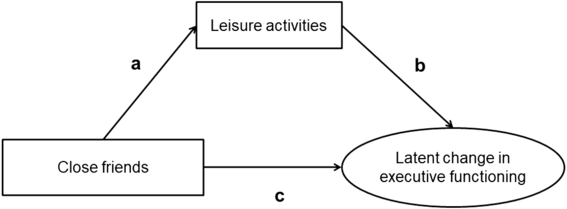
Regarding our specific goal, we investigated whether the longitudinal relation between the number of close friends in W1 and subsequent change in executive functioning from W1 to W2 was mediated via frequency of leisure activities in W1. To test this mediation pattern in the aforementioned latent change score model, we defined three paths (see Figure 1 for a general illustration): path a, the relation of the number of close friends in W1 to frequency of leisure activities in W1; path b, frequency of leisure activities in W1 predicting latent change in executive functioning; and path c, the number of close friends in W1 predicting latent change in executive functioning. Importantly for evaluating mediation, the applied approach allowed simultaneously estimating the residual direct (non-mediated) relation between the number of close friends and subsequent change in executive functioning (i.e. the coefficient of path c) and the indirect (mediated) relation via frequency of leisure activities (i.e. the product of the coefficients for paths a and b), including their significance. The proportion of the size of the mediated relation and the total relation (i.e. the sum of the mediated and the non-mediated direct relation) allowed quantifying the portion of the longitudinal relation between the number of close friends in W1 and subsequent change in executive functioning from W1 to W2 that was exerted indirectly via frequency of leisure activities in W1 as mediator.
General structure of the latent model applied to investigate whether the longitudinal relation between the number of close friends in Wave 1 and subsequent change in executive functioning from Wave 1 to Wave 2 was mediated via frequency of leisure activities in Wave 1. This model allowed simultaneously estimating the residual direct (non-mediated) relation between the number of close friends and subsequent change in executive functioning (c) and the indirect (mediated) relation via frequency of leisure activities (a*b).

For model estimation, we used full information maximum likelihood. We calculated bootstrapped standard errors (based on 1000 bootstrap draws). We additionally inspected the bootstrapped 95% confidence intervals (CIs). We evaluated model fit as follows: Given that with large study samples the χ 2 test often indicates a significant deviation of the model matrix from the covariance matrix despite good model fit (Hu and Bentler, Reference Hu and Bentler1999), we inspected several additional fit indices. Specifically, we used the following criteria: Comparative Fit Index (good models: CFI > 0.95), Incremental Fit Index (good models: IFI > 0.95), Root Mean Square Error of Approximation (good models: RMSEA < 0.06), and Standardized Root Mean Square Residual (good models: SRMR < 0.08; Hu and Bentler, Reference Hu and Bentler1999).
Results
Descriptive statistics
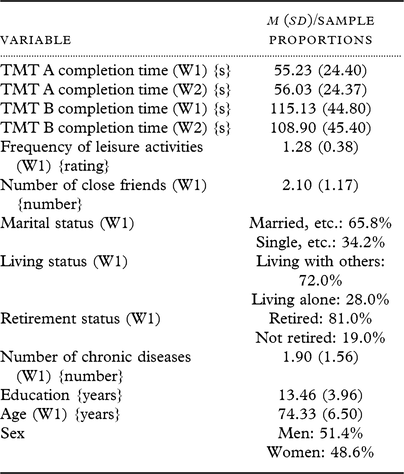
Table 1 shows descriptive statistics of analyzed measures in terms of means and standard deviations as well as sample proportions. Comparing both waves, there were no statistically significant differences in the average completion time in neither TMT A nor TMT B (ps > 0.145).
Descriptive statistics of analyzed measures

Note: Descriptive statistics for completion time in TMT parts A and B in Wave 1 (W1) and Wave 2 (W2), frequency of leisure activities in W1, the number of close friends in W1, marital status in W1, living status in W1, retirement status in W1, the number of chronic diseases in W1, education, age in W1, and sex in terms of means (standard deviations are given in parentheses) as well as sample proportions.
Latent change score modeling
The latent change score model provided a very good statistical account of the data (χ 2 = 22.25, df = 20, p = 0.327, CFI > 0.99, IFI > 0.99, RMSEA = 0.01, SRMR = 0.01).
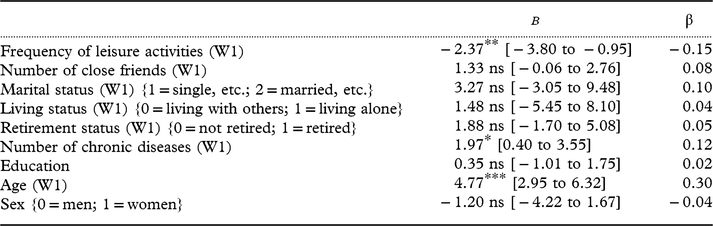
A higher frequency of leisure activities in W1 significantly predicted a smaller subsequent increase in TMT completion time from W1 to W2 (i.e. a smaller decline in executive functioning, see Table 2) (path b). A larger number of chronic diseases in W1 and older age in W1 significantly predicted a larger subsequent increase in TMT completion time from W1 to W2 (i.e. steeper decline in executive functioning). Marital status in W1, living status in W1, retirement status in W1, education, and sex did not predict changes in TMT completion time. There was no residual direct (non-mediated) relation between the number of close friends in W1 and subsequent changes in TMT completion time (path c). Yet, a larger number of close friends in W1 were related to a higher frequency of leisure activities in W1 (raw estimate b = 0.16, p < 0.001, 95% CI: 0.10–0.23, corresponding standardized estimate β = 0.16) (path a). Importantly, 41.3% of the longitudinal relation between a larger number of close friends in W1 and a smaller subsequent increase in TMT completion time from W1 to W2 (i.e. a smaller decline in executive functioning) was exerted indirectly via a higher frequency of leisure activities in W1 as mediator (b = −0.39, p = 0.010, 95% CI: −0.72 to −0.12, corresponding β = −0.02).
Longitudinal predictions of latent change

Note: Parameter estimates of latent change score modeling for longitudinal predictions of subsequent change in TMT completion time from Wave 1 (W1) to Wave 2 (W2). Raw estimates b (with the corresponding bootstrapped 95% CI in square brackets) and standardized estimates β are given.
*** p < 0.001; ** p < 0.01; * p < 0.05; ns = non-significant; p > 0.05.
Discussion
The present study investigated the mediating role of leisure activity engagement in the longitudinal relation between close friends and subsequent decline in executive functioning over 6 years as measured through performance changes in the TMT. First of all, regarding decline in executive functioning across 6 years, we observed that a higher frequency of leisure activities pursued in the first wave of data collection longitudinally predicted a smaller subsequent decline in executive functioning (i.e. indicated by a smaller increase in TMT completion time). Thus, our findings are consistent with studies that observed a longitudinal relation between greater activity engagement in old age and reduced decline in executive functioning (Wang et al., Reference Wang2013). Furthermore, these findings confirm the conceptual view that cognitive stimulation via leisure activities may be associated with cognitive reserve, thereby being related to better maintenance of executive functioning in aging (Hertzog et al., Reference Hertzog, Kramer, Wilson and Lindenberger2008; Opdebeeck et al., Reference Opdebeeck, Martyr and Clare2016; Stern, Reference Stern2012). Present results also confirm that those individuals who have a larger number of close friends show a greater engagement in a variety of leisure activities (Flora and Segrin, Reference Flora and Segrin1998; Hamilton et al., Reference Hamilton, Warner and Schwarzer2017; Huxhold et al., Reference Huxhold, Miche and Schuz2014).
Notably, and most importantly, with regard to the interplay of these relationships, we found that activity engagement mediated between close friends on the one hand and changes in executive functioning with aging on the other. Specifically, a higher frequency of leisure activities pursued in the first wave of data collection mediated almost half of the longitudinal relation between a larger number of close friends in the first wave and a smaller subsequent decline in executive functioning (i.e. indicated by a smaller increase in TMT completion time). In this regard, present findings confirm the recent empirical cross-sectional observation that greater activity engagement mediates the relation between having a larger number of close friends on the one hand and better performance status in executive functioning on the other (Ihle et al., Reference Ihle, Oris, Baeriswyl and Kliegel2018a). Importantly, our study extends such cross-sectional evidence with longitudinal data regarding decline in executive functioning over 6 years. Specifically, the longitudinal latent change score modeling approach in the present paper implies a highly important advancement since (as the very first study so far) we were now able to investigate the proposed social-reserve-cognitive-reserve mediation mechanism on subsequent decline in executive functioning over time.
Thus, the present findings confirm that close friends are an important reserve in old age (Barnes et al., Reference Barnes, de Leon, Wilson, Bienias and Evans2004; Bourdieu, Reference Bourdieu and Richardson1985; Cullati et al., Reference Cullati, Kliegel and Widmer2018; Huxhold et al., Reference Huxhold, Miche and Schuz2014; Kimura et al., Reference Kimura, Takeda, Ohura and Imai2017; Wang et al., Reference Wang, He and Dong2015). For instance, if maintaining a variety of activities or engaging in new activities in old age becomes difficult, with the help of support that close friends can provide, engagement in activities could be promoted, which in turn may have positive aftereffects on cognitive functioning. This also suggests that for cognitive functioning in old age it seems not only important to have several close friends but also to use the support offered by those friends such as encouragements to pursue an active life. In conclusion, present results suggest that social reserve such as having several close friends may be helpful to promote activity engagement in old age. By enhancing individuals’ cognitive reserve, this activity engagement may finally result in smaller subsequent decline in executive functioning in aging.
In the context of the latter notions, we acknowledge that the present correlative study does not allow drawing causal inferences. Thus, we cannot fully disentangle a potentially protective effect of activity engagement on subsequent cognitive decline from alternative explanations related to the potential self-selection of older adults with better cognitive abilities to maintain an active lifestyle. Yet, importantly, given that our analyses are based on cognitive longitudinal change scores and took into account baseline cognitive level in the first wave of data collection (when activity engagement was assessed), it is less probable that the observed relation between activity engagement and a smaller subsequent cognitive decline is due to individuals who reduced activity engagement because of cognitive decline. Furthermore, we acknowledge that the current study is limited by a relatively short assessment of executive functioning. Thus, future studies will have to examine whether the present pattern of results holds also for a broader range of executive functions. One may also argue that observed relationships (despite their statistical significance) were only of moderate to small size. This is because, in general, many factors affect cognitive aging and result in large interindividual differences in aging trajectories (e.g. Christensen et al., Reference Christensen, Mackinnon, Jorm, Henderson, Scott and Korten1994; Ghisletta and Lindenberger, Reference Ghisletta and Lindenberger2004; Lindenberger and Chicherio, Reference Lindenberger and Chicherio2008; Ram et al., Reference Ram, Gerstorf, Lindenberger and Smith2011). Therefore, in our study further factors may have influenced changes in executive functioning over time. Importantly, present findings were robust to adjustment for a wide array of potentially confounding variables including marital status, living status, retirement status, chronic diseases, education, age, and sex. Besides that, present results showed that there was a sufficient amount of interindividual differences in intraindividual change in TMT completion time to be able to detect differential relationship patterns with respect to close friends and activity engagement. Thus, given that activity engagement mediated almost half of the longitudinal relation between close friends and subsequent changes in executive functioning over 6 years, (despite its relatively small size on first glance) this mediation pathway is nevertheless meaningful.
Conflict of interest
None.
Description of authors’ roles
A. Ihle formulated the research question, analyzed the data, and wrote the manuscript. M. Oris, M. Baeriswyl, and M. Kliegel formulated the research question, conceptualized the study, supervised the data collection, and participated in writing. S. Zuber, S. Cullati, and J. Maurer were involved in writing the manuscript.
Acknowledgments
This publication benefited from the support of the Swiss National Centre of Competence in Research LIVES – Overcoming vulnerability: Life course perspectives, which is financed by the Swiss National Science Foundation (grant number: 51NF40-160590). A. Ihle acknowledges support from the Swiss National Science Foundation (grant number: 10001C_189407). The authors are grateful to the Swiss National Science Foundation for its financial assistance. The authors also thank the participants of the Vivre–Leben–Vivere (VLV) study, as well as all members of the LIVES project IP213 and LINK institute who contributed to the realization of the VLV study.