Introduction
According to a popular belief, bilingual children speak both their languages with a native-like accent. Yet, research into bilingual speech production patterns has generated mixed results. Some older studies show that bilingual children are able to keep their two phonological systems apart, and that early bilinguals and monolinguals follow similar patterns of phonological development (e.g., Holm & Dodd, Reference Holm and Dodd1999; Johnson & Wilson, Reference Johnson and Wilson2002). More recent evidence, however, demonstrates differences in speech production between bilingual and monolingual children, as well as cross-linguistic interactions between language systems of bilingual speakers (e.g., En, Brebner & McCormack, Reference En, Brebner and McCormack2014; Mayr, Howells & Lewis, Reference Mayr, Howells and Lewis2014). This is in line with theoretical frameworks put forward in the area of second language acquisition (SLA) and bilingualism such as Flege's (Reference Flege and Strange1995, Reference Flege, Burmeister, Piske and Rhode2002) Speech Learning Model or Dynamic Systems Theory (Herdina & Jessner, Reference Herdina and Jessner2002; de Bot, Lowie & Verspoor, Reference de Bot, Lowie and Verspoor2007). Speech Learning Model assumes that the phonetic categories from both languages occupy the same phonological space in the bilingual mind. Similarly, the Dynamic Systems Theory points to the existence of interactions between the pertinent languages.
If both languages indeed occupy the same phonological space and interactions between languages occur, it is still not clear what the directionality and strength of these cross-linguistic interactions are. For instance, Barlow's (Reference Barlow2014) study on Spanish–English bilinguals in the USA reported influence from Spanish, the home language of bilinguals, to English, the community language. Other studies evidenced interaction in the opposite direction, i.e., from the community language to the home language of bilingual speakers (Mayr et al., Reference Mayr, Howells and Lewis2014) or even cases of first language attrition in bilinguals (Schmid, Reference Schmid2013). Still, research investigating the nature, directionality and conditioning factors of cross-linguistic interactions in early bilinguals is scarce, especially as regards perceived accent in their speech. This study aims to fill this gap by exploring the concept of native accent in the home language of Polish–English bilingual children and investigating the predictors of their performance.
Foreign accentedness ratings
The literature on accent ratings in bilinguals to date focuses primarily on foreign accentedness in their L2 speech, to the exclusion of the L1. The phenomenon of foreign accentedness comprises a range of phonetic features detectable on multiple layers of speech, such as atypical realisation of speech segments, prosodic patterns, as well as speech rate, rhythm, disfluency markers and hesitations (Southwood & Flege, Reference Southwood and Flege1999). In other words, foreign accent refers to a range of segmental and prosodic deviations from the native norms of pronunciation in a given language and thus it is difficult to assess unidimensionally.
Studying this phenomenon is nevertheless important, because any explicit or implicit judgements of people's speaking performance or pronunciation skills inherently involve rating their accentedness (for overviews see Jesney, Reference Jesney2004 and Piske, MacKay & Flege, Reference Piske, MacKay and Flege2001). Therefore, foreign accentedness ratings (FARs) have been often applied in SLA research on adult learners (e.g., Flege, Reference Flege1988; Gallardo del Puerto, Gómez Lacabex & García Lecumberrri, Reference Gallardo del Puerto, Gómez Lacabex and García Lecumberri2007; Piske et al., Reference Piske, MacKay and Flege2001). This paradigm is very popular in SLA studies also because FARs are less time-consuming to obtain than output measurements (analysing acoustic or articulatory features), and they provide a global measure of talker's phonetic performance (Schmid & Hopp, Reference Schmid and Hopp2014).
However, this method is not without problems. FARs are usually performed by native-speakers of a given language (the so-called independent raters) who are asked to evaluate on a scale the degree of a foreign accent in a set of speech samples they are presented with. The rating techniques usually entail a Likert scale or a continuous measure with two extreme categories, such as “heavy foreign accent” vs. “native-like pronunciation” (Southwood & Flege, Reference Southwood and Flege1999). One problem with this paradigm is that there is no established norm regarding the number of raters performing the assessment, and thus studies vary widely in this regard, employing from one (Snow & Hoefnagel-Höhle, Reference Snow and Hoefnagel-Hohle1977) to over two hundred raters (Anderson-Hsieh & Koehler, Reference Anderson-Hsieh and Koehler1988). Employing only few raters can bias the results, since there might be individual differences in the rater's ability to perform the FARs accurately. For instance, lower familiarity with the foreign accent often leads to harsher and more variable ratings, while the linguistic training and expertise result in more consistent ratings (Thompson, Reference Thompson1991). For this reason, employing a large number of phonetically trained raters is crucial for the reliability of FARs.
Another potential problem with the FAR paradigm is that it is influenced by the number of speech samples provided by a control group of native-speakers that are mixed randomly into the set to serve as a benchmark for non-native speakers’ accent ratings. Usually monolingual controls comprise 20% to 40% of the sample in FARs. A larger proportion of monolingual controls may lead to a more severe assessment of the bilingual sample (Flege & Fletcher, Reference Flege and Fletcher1992) and skew the results, which is why it is so important to employ an appropriately sized control group.
Yet another issue is that the techniques of eliciting speech samples are likely to influence the outcomes of the study. Delayed repetition and other controlled techniques are recommended as more reliable measures of accentedness, because such speech samples were sometimes reported as more strongly accented than free speech (e.g., Oyama, Reference Oyama1976; Thompson, Reference Thompson1991). The problem with spontaneous speech samples is that some talkers might produce lexical, morphological and syntactic errors in them and these can introduce variability in the FARs that is not associated with the phonetic performance of the talker. However, it might be argued that using spontaneous speech samples is more ecologically valid and several studies employed such a technique, eliciting samples through picture descriptions or recounting personal experiences (e.g., Elliott, Reference Elliott1995). This trade-off between the ecological validity and reliability is a problem which can be solved by combining the two methods, but studies rarely employ such a paradigm.
The final problem with FAR is that raters in a foreign accentedness study may apply a contraction bias, i.e., overestimate small differences and underestimate large ones (Southwood & Flege, Reference Southwood and Flege1999). This is a problem that is not easily solved within the paradigm, unless the FARs are accompanied by another measure of phonetic performance.
Summing up, accentedness is a complex construct, difficult to assess unidimensionally or assign to specific categories, because it depends on multiple factors and there are no physical units in which accent can be measured. It is also sensitive to biases resulting from an inappropriate number of raters, the choice of raters, poorly balanced sampling of talkers, or improper speech elicitation techniques. Even when a FAR study is carefully constructed, a constriction bias can still skew the results. Consequently, although FARs is an established and widely used measure of global phonetic performance in bilinguals, caution should be taken when drawing firm conclusions about the nativeness or non-nativeness of speech samples based on FARs alone. Ideally, FARs should be conducted on a well-balanced sample of talkers, with a large number of trained raters, and the speech samples should be eliciting using methods that guarantee both reliability and ecological validity. However, to make FARs even more reliable, the method should be supplemented with more precise output measures, such as a phonetic analysis of bilingual speech samples. This is why in this study we employ a unique paradigm that combines a carefully controlled holistic accentedness assessment with a more objective phonetic analysis performed by trained raters.
Predictors of FARs in adults
The degree of foreign accentedness in non-native speech depends on several participant-related characteristics, the most important being the age of L2 acquisition, the amount of language experience (exposure), as well as the L1 background and use (Piske et al., Reference Piske, MacKay and Flege2001). The age of acquisition or the age of arrival to an L2-speaking country (AoA) are the most established and well-researched factors influencing the perceived accentedness in speakers with immigrant background. Research on the impact of AoA on accent generally supports the claim that ‘the earlier, the better’ (e.g., Asher & Garcia, Reference Asher and Garcia1969; Suter, Reference Suter1976; Oyama, Reference Oyama1976; Flege & Fletcher, Reference Flege and Fletcher1992; Flege, Munro Munro, M. J., & MacKay & MacKay, Reference Flege, Munro and MacKay1995; Moyer, Reference Moyer1999).
Other widely explored factors are the ones related to language experience or input. These are often operationalised as the length of residence (LoR) in a particular speech community, which might be assumed to be a proxy to the amount of input received in the L2 (see Haman, Wodniecka, Marecka, Szewczyk, Białecka-Pikul, Otwinowska, Mieszkowska, Łuniewska, Kołak, Miękisz, Kacprzak, Banasik & Foryś-Nogala, under review). LoR has been found significant in some studies on foreign accent in the L2 (e.g., Asher & Garcia, Reference Asher and Garcia1969; Purcell & Suter, Reference Purcell and Suter1980; Flege & Fletcher, Reference Flege and Fletcher1992), but not others (e.g., Oyama, Reference Oyama1976; Thompson, Reference Thompson1991; Moyer, Reference Moyer1999). As indicated in further research (Flege et al., Reference Flege, Munro and MacKay1995; Meador, Flege & MacKay, Reference Meador, Flege and MacKay2000), LoR is of importance only within the first few months of L2 acquisition as L2 speech patterns tend to become fixed later on. A related factor is the amount of L1 use (Guion, Flege & Loftin, Reference Guion, Flege and Loftin2000; Yeni-Komshian, Flege & Liu, Reference Yeni-Komshian, Flege and Liu2000). Speakers using their L1 on a more regular basis display a greater degree of foreign accent in their L2.
As for the predictors of FARs in the L1 of bilingual speakers and language attriters, data are scarce. The few studies conducted on the topic show, interestingly, that LoR did not correlate with the degree of the perceived foreign accent in the speech of language attriters (Hopp & Schmid, Reference Hopp and Schmid2013; Schmid & Dusseldorp, Reference Schmid and Dusseldorp2010), and that FAR's sole predictor turned out to be the amount of L1 contact without code-switching (de Leeuw, Reference de Leeuw2009; de Leeuw, Schmid & Mennen, Reference de Leeuw, Schmid and Mennen2010). Overall, research on factors influencing FARs in the L1 of bilingual speakers seems inconclusive, which is exacerbated by the fact that such studies are relatively infrequent. However, it seems that measures related to language input might be of importance here.
Research on FARs in children
The issue of foreign accent in child bilinguals is largely under-researched. Only a few investigations involved accent ratings performed on children's speech samples. In an early study, Asher and Garcia (Reference Asher and Garcia1969) examined over 70 Spanish–English bilingual children of Cuban immigrants in the USA. The children were aged 7 to 19 and had been living in the USA for about five years. The results of the accent ratings indicated that only children with very early age of arrival (1- 6 years of age) were perceived as near-native in English.
A longitudinal study by Snow and Hoefnagel-Höhle's (Reference Snow and Hoefnagel-Hohle1977) on English acquirers of Dutch also investigated age-related differences. Accent was measured on recordings of participants imitating Dutch sounds in individual words. The first testing session, which took place six weeks after the arrival to the Netherlands, showed a paradoxical effect: late learners (teenagers and adults) outperformed early learners (children) with respect to the nativeness of their accent. Nevertheless, ten months after the arrival to the Netherlands, younger children did better than the older learners in L2 pronunciation.
Summing up, only two studies examined foreign accentedness in bilingual children's L2 and they brought mixed results. However, they point to the AoA and language experience as the possible predictors of FARs that could be further investigated. As for foreign accentedness in bilingual children's L1, to the best of our knowledge there has been no research in the area. This is a serious oversight, because investigating this topic has both theoretical and practical importance. From the theoretical standpoint, detecting foreign accent in the L1 of bilingual children would be an ultimate challenge to the “earlier is better” assumption, which strongly suggests that for children the early start is a guarantee of success in mastering two languages. A study challenging this view would thus greatly further our understanding of factors involved in the development of native-like pronunciation. From the practical standpoint, investigating the FARs in the L1 of bilingual migrant children is important, since some families re-migrate to their home countries. Upon returning to the home country, bilingual children may experience stigmatisation and educational setbacks on account of their inferior knowledge of L1 and foreign accent (H. Grzymała-Moszczyńska, J. Grzymała-Moszczyńska, Durlik & Szydłowska, Reference Grzymała-Moszczyńska, Grzymała-Moszczyńska, Durlik and Szydłowska2015). Thus, a FAR study conducted on the L1 of bilingual children would both provide valuable insights to the field of bilingualism and be of high practical relevance.
Aims and research questions
Our study aims to fill the existing gap in research by investigating the degree of accent, acceptability, intelligibility and the perceived age in bilingual children's L1 speech samples. It also examines speaker- and rater-related predictors of foreign accentedness in the L1. To make our research more practically relevant, the accentedness ratings in our study were conducted by teachers or teacher trainees, since this group is likely to have contact with bilingual migrant children returning to their home countries and their perception of children's speech might influence the treatment of these children in educational settings. Apart from investigating an under-researched topic (the degree of accent in the L1) in an under-studied group (i.e., bilingual children), we also aimed to set a new standard for conducting FARs in a more reliable way. This was done by employing a large number of raters and by combining two data elicitation techniques. In the study, we use both the samples obtained from a repetition task and spontaneous speech samples, in which children narrated a picture story. We assume that the samples elicited in the two ways may be assessed differently due to their length and varying morpho-syntactic complexity. Further, to obtain more generalizable and robust results of our research, we combine an auditory phonetic analysis performed by expert raters (Study 1) with the traditional FARs (Study 2). This approach allows us also to investigate the relationship between atypical speech patterns in the L1 of bilingual children, identified by means of the phonetic analysis, and the global accentedness measures.
The major objective of the current study was to explore whether the speech of Polish–English bilinguals is perceived as different from that of Polish monolinguals matched for age and socioeconomic status and to investigate potential sources of cross-linguistic influence (henceforth CLI), as well as socio-linguistic predictors of the perceived foreign accent in children's Polish. The following research questions were asked to address these issues:
RQ 1: Does the Polish speech of bilingual Polish–English children living in the UK differ from the speech of Polish monolinguals? If so, in what aspects?
RQ 2: How are the degree of native accent, intelligibility, acceptability and perceived age related in the performed ratings?
RQ 3: How do accentedness ratings relate to a more objective measure of phonological performance, i.e., a detailed phonetic analysis of bilingual children's speech?
RQ 4: What background factors contribute to the perceived foreign accent in bilingual participants?
Our predictions about the potential areas of CLI in both studies were based on the existing phonological differences between Polish and EnglishFootnote 1. Polish is characterised by a relatively large repertoire of consonants and rich phonotactics. It allows for consonant clusters in all word positions that are more complex than those occurring in English. On the other hand, English has a broader vocalic inventory and a phonemic vowel length distinction, which is absent in Polish. There are also cross-linguistic differences concerning the realisation of laryngeal contrasts, vowel reduction in unstressed syllables, predominant word stress patterns and the rhythmical structure of both languages e.g., Jassem (Reference Jassem2003), Dziubalska-Kołaczyk and Walczak (Reference Dziubalska-Kołaczyk, Walczak, Delcourt and van Sterkenburg2011), Roach (Reference Roach2009), or Cruttenden (Reference Cruttenden2014), (see Footnote 1 for a more detailed discussion).
The differences between the children's two languages, as described above, led us to predict that transfer might occur in a number of the areas enumerated, particularly in the production of Polish consonants and consonant clusters. We also assumed that the amount of input received by the children in both languages would affect the direction of the influence, as suggested by previous research on FARs in bilingual speakers.
Participants
In order to avoid terminological confusion, in the following descriptions we use the term “Talkers” with reference to the children who provided the speech samples for the study. The same Talkers were used in Study 1 and Study 2 and they are presented below. The term “Raters” will be used with reference to the adults who assessed the speech samples, both in the auditory phonetic analysis (Study 1) and in the accentedness ratings (Study 2). Since different Raters were used in Study 1 and Study 2, their profiles will be presented in the respective sections describing both studies.
Talkers
The Talkers' speech samples used for this study come from a large-scale Polish project on linguistic and cognitive development of children conducted within the European COST Action IS0804. The database contains speech recordings and data from 173 bilingual children living in the UK who had at least one Polish parent, and 311 Polish monolingual children. A written parental consent was obtained for all the children participating in the research before they completed a large battery of language and cognitive tests. For the purpose of this study, 42 child Talkers were chosen for the analyses, including 32 Polish–English bilinguals and 10 Polish monolinguals, who served as controls. The samples were chosen based on the quality of the recordings, and they were representative for the bilingual and monolingual populations, respectively (for details of the selection procedure, see Marecka, Wrembel, Zembrzuski & Otwinowska-Kasztelanic, Reference Marecka, Wrembel, Zembrzuski and Otwinowska-Kasztelanic2015). The relatively small number of monolingual controls to bilingual participants is typical in FAR studies. As already mentioned, monolingual controls usually constitute 20% to 40% of the sample since a larger proportion might skew the results (see Flege and Fletcher, Reference Flege and Fletcher1992; Jesney, Reference Jesney2004). Following this proportion, we included 24% of monolingual controls in our sample. Since the design assumed having the same Talkers in Study 1 and 2, the number of children and, consequently, the 3:1 bilingual to monolingual ratio was constant across the studies. The bilingual children were recorded in the UK (London and Cambridge), while the monolingual children were recorded in Poland (Warsaw and Kraków). The monolingual controls can be treated as a homogenous group, since they spoke the Polish standard variety and did not exhibit any dialectal features. There is no significant variation in the monolingual Polish regiolects spoken in the major Polish cities due to the convergence of dialects and regional varieties in Polish urban areas (e.g., Kurkowska, Reference Kurkowska and Kurkowska1981; Wilkoń, Reference Wilkoń2000; Dubisz, Reference Dubisz2013). The convergence is motivated by the fact that standard Polish enjoys a high prestige, is spoken by the society at large and taught at schools, and is widely present in the mediaFootnote 2.
The background information about the children came from a questionnaire (PABIQ by Tuller, Reference Tuller, Armon-Lotem, De Jong and Meir2015 and its Polish adaptation by Kuś, Otwinowska, Banasik & Kiebzak-Mandera, Reference Kuś, Otwinowska, Banasik and Kiebzak-Mandera2012). The 32 bilinguals (20 females), whose L1 (home language) was Polish and L2 (community language) was English, were children of Polish migrants to the UK. Their mean age was 5.79 (SD = 0.64, range: 4.82 - 6.98), they all had been exposed to English before the age of three and all had at least one Polish parent. As far as their language use is concerned, they spoke Polish at home, but English at kindergarten or school. The socioeconomic status (SES) of children's families was measured based on the parents’ level of education. Their mothers had on average 16.03 years of formal education (SD = 3.09), their fathers 14.25 years (SD = 2.84). The parents of the migrant children originated from different regions of Poland; however, since they were well educated and mostly came from large cities, they were unlikely to display dialectal differences (see Footnote 2). The 10 Polish monolingual children (8 female), who served as controls, lived in Poland and their mean age was 5.98 (SD = 0.47, range: 5.18 – 6.81). Their mothers had on average 18 years of formal education (SD = 2.58), and fathers - 19.75 years (SD = 2.22).
Study 1: Phonetic analysis
In Study 1 the speech of monolinguals and bilinguals was analysed by trained phonetic Raters, who performed a detailed analysis of the recordings, pointing to specific features observed in the speech of bilingual children. The study follows the design of Marecka et al. (Reference Marecka, Wrembel, Zembrzuski and Otwinowska-Kasztelanic2015).
Raters
The study involved 8 native Polish Raters (5 females), university students of English, mean age 22.5 (SD = 1.2). Their proficiency in English was advanced (C1 according to the CEFR – Common European Framework of Reference for Languages, Council of Europe, 2001) and they all had had previous phonetic training. The Raters came from western Poland (the Wielkopolska region) and all spoke standard Polish without any dialectal features (see Footnote 2 for more information about standard Polish and the convergence of the dialects in towns).
Materials and procedure
The speech samples of the Talkers in Study 1 come from a Polish Sentence Repetition (SRep) task (Banasik, Haman & Smoczyńska, Reference Banasik, Haman and Smoczyńska2012). This task originated from a study initially designed to test morpho-syntax, but it was used in this research because it offered comparable phonological output across the Talkers. In the SRep, the Talkers were asked to repeat 68 sentences in Polish pre-recorded by two Polish native speakers. The sentences varied in length and grammatical complexity. Each sentence was presented to the participant through headphones and subsequent repetitions were recorded.
For the purpose of the auditory analysis, 14 sentences were chosen on the basis of three criteria: grammatical simplicity, completeness and a wide range of phonetic contexts. As for the grammatical simplicity and completeness, we excluded the sentences that contained complex grammatical structures such as passive voice, relative clauses, etc., because not all the children had been able to repeat them. We further excluded the sentences that had been omitted or produced incompletely by the Talkers. Out of the remaining set, we chose sentences that offered a wide range of phonetic contexts, including sibilant sounds, complex consonant clusters, nasal glides and plosives in stressed onset positions, i.e., features that are likely to cause problems for English speakers of Polish. This finally led to the selection of 14 sentences for the analysis. The order of the sentences as presented to the Raters remained the same for each child.
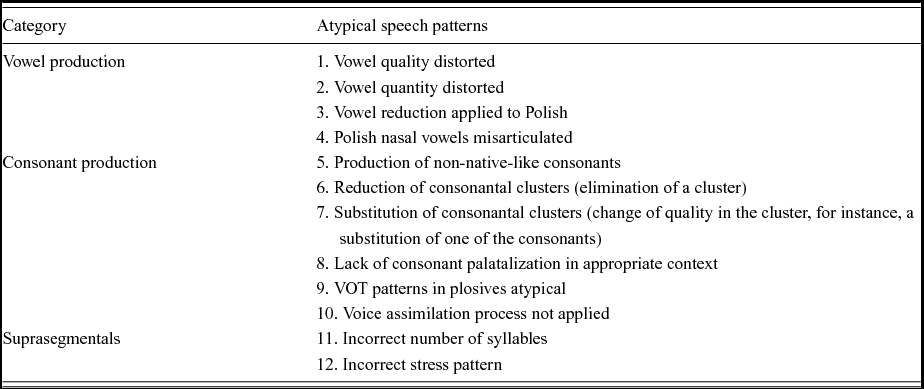
Prior to the analysis proper, three expert phoneticians conducted a detailed auditory phoneme-by-phoneme analysis of the speech samples from 5 bilingual children randomly chosen from the Talkers' pool. On the basis of the processes identified by these phoneticians, we created a diagnostic list of atypical speech patterns (see Table 1). It enumerated 12 problem areas found in the speech of Polish–English bilingual children that differed from monolingual production, presumably due to cross-linguistic influences (CLI). The diagnostic list constituted a list of focus areas for the subsequent auditory phonetic analysis.
Diagnostic list of atypical speech patterns

For the analysis proper, the speech sample (14 sentences) for each bilingual or monolingual Talker was assigned a code. Then each of the eight Raters recruited for the study received a randomly selected set of bilingual and monolingual recordings to analyse auditorily. Each sample was analysed independently by two Raters, and then cross-checked by a third phonetically-trained expert Rater recruited from the authors of the study. The expert Rater made a final decision in case of discrepancies. All the Raters (including the expert Raters) were blind to the fact of which samples were monolingual and which bilingual.
The Raters’ task was to pinpoint any articulatory alterations in the child's speech samples that were reflected in the diagnostic list. The 14 sentences for each child were treated as one continuous speech sample. Each Rater received a set of transcription cards (one per child), containing the transcriptions of the 14 sentences, and was asked to underline the fragments that were mispronounced by a particular Talker. Then the Raters had to transcribe how the speech sounds were altered and to categorise each speech alternation into one of the 12 categories from the diagnostic list. We then calculated how many instances of speech alterations corresponding to particular categories occurred in the speech sample for each child. Finally, for each sample we collapsed the speech alterations enumerated in the 12 categories into one cumulative number of atypical patterns (i.e., the total of all atypical patterns from our diagnostic list per child's speech sample). All the calculations were conducted per Talker and not per item sentence, since a phonetic analysis of larger speech samples is much more reliable and informative than that pertaining to short fragments of speech. This is because the latter contains a more limited range of phonetic contexts.
Statistical analysis
Based on the Raters’ analysis, within each category from the diagnostic list we compared the number of atypical phonological patterns occurring in the speech of the bilingual Talkers with the speech patterns attested in monolingual samples. We also compared the cumulative number of atypical speech patterns between the two groups. The non-parametric Mann-Whitney U tests were used for the comparisons due to an unequal size of the groups being compared. Bonferroni corrections with the number of comparisons set to 13 (12 for all the diagnostic categories and 1 for the cumulative number of atypical speech patterns) were used to make up for a large number of comparisons. This measure was chosen as it is one of the most conservative ones and thus minimizes the risks of type I errors.
Results
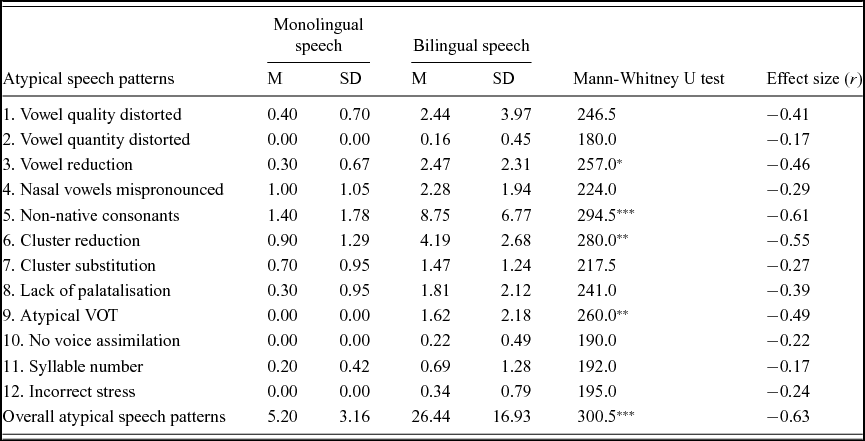
Overall, the study shows that the Polish speech of bilingual children differed significantly from the speech of their monolingual peers. The Raters reported on average 5.2 alterations per speech sample in the monolingual group (SD = 3.16), as opposed to 26.44 alterations per speech sample in the bilingual group (SD = 16.93). The difference was statistically significant, as indicated by the Mann-Whitney test with the Bonferroni corrections (U = 300.5, p < .001). As for the 12 areas of atypical speech patterns enumerated in the diagnostic list, the two groups differed in terms of vowel reduction, the production of non-native consonants, consonant cluster reduction and the application of atypical VOT patterns. The differences in the number of alterations between particular categories from the diagnostic list are presented in Table 2.
Results of phonetic analysis for monolingual vs. bilingual groups

* p < .05, ** p < .01, *** p < .001
Study 2: Accentedness ratings
While Study 1 focused on a detailed phonetic analysis, Study 2 aimed to verify whether the Polish speech of Polish–English bilingual children is perceived as different from that of their monolingual peers when rated holistically and impressionistically by teachers or teacher trainees. We also wanted to examine whether bilingual speakers could be perceived as younger or speech-delayed in comparison to monolingual speakers. To this aim, Study 2 reanalysed the SRep speech samples of the Talkers from Study 1 using the holistic FAR paradigm, as opposed to a detailed phonetic analysis. Apart from using the repeated speech samples from Study 1, Study 2 included also a second type of speech samples, i.e., spontaneous speech. The parameters assessed included the degree of Native Accent, Intelligibility, Acceptability and Perceived Age.
Further, we aimed to investigate whether the results of the holistic assessment in Study 2 were related to the more objective measures of atypical speech patterns obtained from Study 1. We also wanted to examine which category of atypical speech patterns was the most predictive of FARs. Finally, we probed the sociolinguistic predictors of foreign accentedness in bilingual speech. To establish this, Study 2 used data from the background questionnaire for each child.
Raters
Study 2 included 55 Polish Raters, in-service teachers or teacher trainees. The majority of the participants were female (52), stemming from the fact the teaching profession in Poland is dominated by women. Their mean age was 22.13 (SD = 4.69). Eight of the Raters were practicing primary-school teachers, 15 were pedagogy students, and 32 were pre-service English language teachers. With regard to their English proficiency, all the Raters but one were advanced in English (CEFR B1 or above). Moreover, 39 Raters were phonetically trained, whereas 16 Raters did not undergo any phonetic training. The Raters’ task in Study 2 was to perform accentedness ratings of L1 Polish speech samples and to assess the children's perceived age. The Raters came from the Wielkopolska and Mazowsze region, spoke Polish standard variety and did not display any dialectal features (see Footnote 2 for details).
Materials
The speech samples of the Talkers in Study 2 come from two tasks, one eliciting repeated speech, and another eliciting structured spontaneous speech. Repeated speech samples were taken from the SRep task (Banasik et al., Reference Banasik, Haman and Smoczyńska2012), as in Study 1. For the purpose of Study 2, we chose only 3 sentences from the SRep, due to required time limitations of the Accent Ratings procedure. The 3 sentences were selected from the 14 sentences that served as a basis of analysis in Study 1. Each of the sentences contained a wide range of phonetic contexts as defined in Study 1. For each child, the SRep sample consisted of the same 3 sentences, presented in exactly the same order and treated as one speech sample to be assessed holistically.
Children's spontaneous speech was elicited with the Polish version of the Multilingual Assessment Instrument for Narratives (MAIN) (Gagarina et al., 2012; Kiebzak-Mandera, Otwinowska & Białecka-Pikul, Reference Kiebzak-Mandera, Otwinowska, Białecka-Pikul, Gagarina, Klop, Kunnari, Tantele, Välimaa, Balciuniene, Bohnacker and Walters2012). In language elicitation with the MAIN, the child is presented with a specially designed, cross-culturally acceptable picture story and is asked to tell the story (narration). Then the child retells a different story after a model presented by the experimenter (re-narration). Samples from the re-narration mode were chosen for the accentedness ratings since re-narration generated more fluent speech than the narration mode. Further, re-narrations allowed us to control better for morphological, syntactic or lexical cues as to the children's native status, since the Talkers were able to base their stories on an adult model provided earlier, which facilitated the task performance. We aimed to choose the most coherent 20-second story fragments for each child to minimize Raters’ bias against children who produced less coherent stories. The 20-second fragments were obtained by removing pauses, fillers, and hesitation markers from the re-narration recordings. All the speech samples selected for the ratings (both SRep and re-narration) were equated for the overall RMS amplitude in the Audacity 2.1.2 software to ensure equal loudness (Audacity Team, 2016).
To establish the sociolinguistic and socio-demographic predictors of the bilingual Talkers' accent, we used the data from the background questionnaire (Kuś et al., Reference Kuś, Otwinowska, Banasik and Kiebzak-Mandera2012), a Polish version of the PABIQ questionnaire (Tuller, Reference Tuller, Armon-Lotem, De Jong and Meir2015). The questionnaire provided detailed information about the child's family background, language acquisition and use, language skills, as well as the quality and quantity of exposure to pertinent languages. On the basis of the questionnaire, for each bilingual child we calculated an index of Input in Polish, an index of Input in English and the Age of First Exposure to English (AoE). While the questionnaire contained information about several other factors that could potentially influence the accent of the children (such as language output etc.), only these three factors were included in our analysis, since variables associated with the age of L2 acquisition (such as Age of Arrival) and with language contact or exposure were most frequently associated with foreign accentedness in previous studies so far (see Introduction). The Input indices were calculated on the basis of the answers to the questions about the frequency with which the child was addressed in a given language by a particular person or in a particular context. For each language, the child could receive a maximum of 40 points for the home input (a maximum of 8 points each for the mother, father and siblings addressing the child exclusively in the assessed language, a maximum of 4 points for the grandparents and the potential babysitter addressing the child exclusively in the respective language, and a maximum of 8 points for the parents addressing each other exclusively in the language in the presence of the child). Additionally, the children could receive the maximum of 51 points for the outside input, depending on how often they were addressed in the language in a range of situations that were enumerated in the questionnaire (for instance, at the nursery, in conversations with friends etc.). Overall, the maximum score for each Input index was 91. The mean score for the Input in Polish for the bilingual participants was 43.17 (SD = 14.05), while for the Input in English it was 34.28 (SD = 14.06). The mean AoE was 14.07 months (SD = 15.01).
Procedure
The rating procedure had the form of an online questionnaire. The Raters' task was to assess each sample on the degree of native accent, intelligibility and acceptability as well as the perceived age of the child. We randomly divided the speech samples into two sets A and B, each consisting of 21 samples (5 monolingual and 16 bilingual). The division into two sets was introduced to optimise the time of the accentedness rating task from an hour to about 30 minutes and to avoid Raters' fatigue effect. The Raters were randomly assigned to one of the sets (A or B). For each set, an identical online questionnaire was created, consisting of two tasks. In Task 1 the Raters had to holistically assess one SRep speech sample (3 sentences) per each of the 21 children. In Task 2, the Raters were to assess 20-seconds-long fragments of the re-narration (spontaneous speech) for the same children. The order of recordings was randomised and the Raters were blind to which samples came from bilingual and which from monolingual children. They also did not know that they rated the same children in both tasks. The order of Tasks 1 and 2 in the online questionnaire was counterbalanced.
Prior to the experiment, the Raters were informed about the general aims of the study and asked to use headphones during the rating procedure. They were instructed to listen to each recording and then assess the degree of native accent in the Polish speech on a 7-point Likert scale (Native Accent: 1 - very strong foreign accent, and 7 - lack of foreign accent/sounds like a native speaker of Polish). Further, the Raters were asked to assess the intelligibility and acceptability of each recording on a 7-point Likert scale (Intelligibility: 1 - speech completely unintelligible, 7 - speech completely intelligible, Acceptability: 1 - speech completely unacceptable, 7 - speech completely acceptable), a methodology commonly used in FARs (see Piske et al., Reference Piske, MacKay and Flege2001 for an overview). Additionally, they were to assess the age of the children in years and months based on their speech performance (Perceived Age). The age assessment was conducted to test whether bilingual children are perceived as younger (and implicitly speech-delayed) when compared to their monolingual peers on the basis of their speech.
Analysis A: Reliability statistics and initial analyses
Before answering the research questions, we conducted a series of reliability statistics to check the quality of our data. First, the inter-rater agreement for the four parameters (Native Accent, Acceptability, Intelligibility and Perceived Age) was established using Cronbach's alpha and Krippendorff's alpha. The former measure is traditionally applied in accentedness rating studies, whereas the latter appears to be more robust and suitable for measuring inter-rater agreement in studies with multiple raters (see Hayes & Krippendorf, Reference Hayes and Krippendorff2007). Both analyses were conducted separately on each set (A and B) and for each Task (Narration and SRep).
Results
According to Cronbach's alpha, the inter-rater agreement was very high for all the parameters (ranging from .91 to .98). However, as indicated by Krippendorff's alpha, the assessments of the Perceived Age (ranging from .12 to .21) were much less reliable than the assessments of the remaining three parameters (ranging from .32 to .60). This result is consistent with the comments made by the Raters, who found it generally hard to assess children's age. Since we asked a research question about the relationship of Perceived Age and other rating parameters, we included Perceived Age in Analysis B conducted to answer this question. However, it was not included in any further analyses.
Analysis B: Relationships between the rating parameters
The next step following the reliability statistics was to check how the four rating parameters (Native Accent, Acceptability, Intelligibility and Perceived Age) related to each other. This was done to answer the second research question posed in the Introduction and also to establish whether the rating parameters could be collapsed into a single measure for the future analyses. To achieve this, we conducted four types of statistical analyses. First, we calculated the descriptive statistics for each parameter for the bilingual and monolingual group. Second, we conducted a series of correlation analyses between each pair of the rating parameters, separately for each group of Talkers (the monolingual group and the bilingual group), to obtain a general picture of the possible interrelations between the factors. Both of these analyses were conducted on the mean Rater assessment for each Talker and on the means between the two tasks. Third, for the most strongly correlated parameters, we created the Tukey mean-difference plots, which show the extent to which two variables might be considered essentially the same factor. Fourth, after finding out that the most important variables were indeed related, we conducted an Exploratory Factor Analysis (EFA) with the default orthogonal rotation (varimax) on the three strongly correlated parameters to obtain a single factor that could be used as the output in all the future analyses. The EFA was conducted using the factanal function in the basic stats R package.
Results
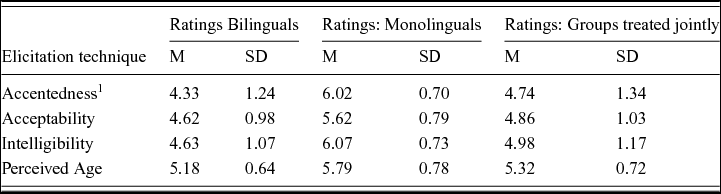
Table 3 presents the mean scores for Native Accent, Acceptability, Intelligibility and Perceived Age for the monolingual and bilingual groups. As can be seen, the scores for the first three parameters are similar within groups, ranging from 4.33 to 4.63 in the bilingual group, and from 5.62 to 6.07 in the monolingual group.
Accentedness ratings – descriptive statistics

Table 4 presents the correlations between the rating parameters for the two participant groups. In the bilingual group assessments, there were high correlations between Native Accent, Acceptability and Intelligibility. However, Perceived Age did not correlate significantly with any other parameter. Also, in the monolingual group assessments, there was a high correlation between Native Accent, Acceptability and Intelligibility; however, in this group, also Perceived Age correlated with the three basic parameters. In other words, the three basic rating parameters, Native Accent, Intelligibility and Acceptability were highly correlated for both the monolingual and bilingual group, but Perceived Age was related to the other three parameters only in the monolingual group.
Accentedness ratings – correlations between rating parameters

* p < .05, ** p < .01, *** p < .001
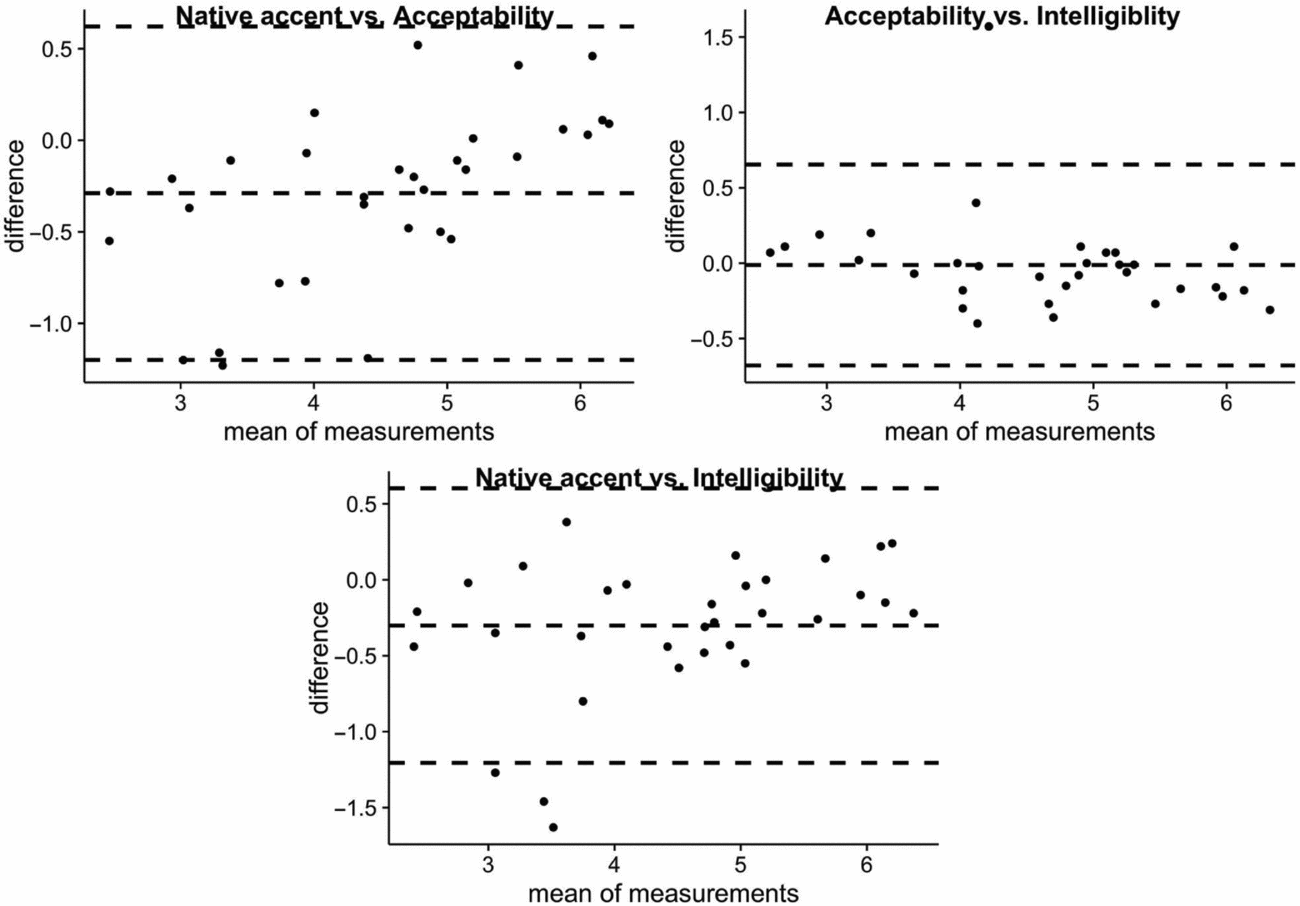
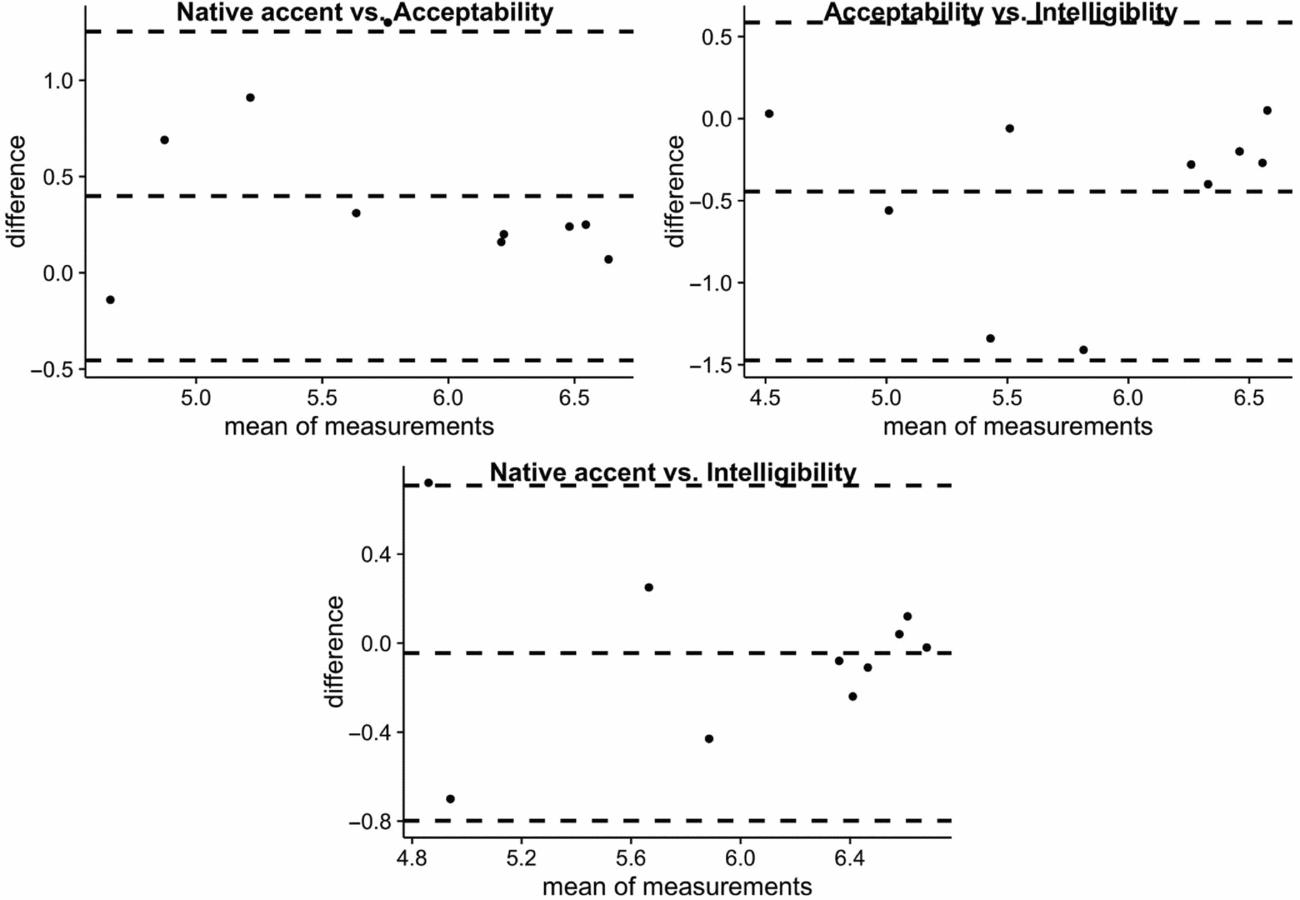
This relationship between Native Accent, Intelligibility and Acceptability is also visible in the Tukey mean-difference plots provided in Figures 1 and 2. Figure 1 shows the plots for the bilingual group, while Figure 2 for the monolingual group. The Tukey mean-difference graphs plot the mean of each pair of measurements (x axis) against the differences between the measurement (y axis). The middle horizontal line on the plot represents the mean differences, while the upper and lower lines represent the cut-off point of 2SD below and above the mean. If two variables are related, the pairs should cluster around the mean and stay within the cut-off points. This is the case for all the presented plots, showing, once again that the three parameters are closely related.
Tukey mean-difference plots for the bilingual group.

Tukey mean-difference plots for the monolingual group.

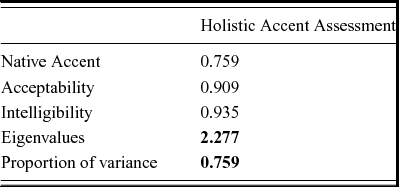
An Exploratory Factor Analysis (EFA) with the orthogonal rotation (varimax) conducted on the three most important parameters (Native Accent, Intelligibility and Acceptability) confirmed that these measures were closely related. The EFA rendered only one factor, which was heavily loaded by all three parameters, and which explained 75.9% of the variation (see Table 5). The resulting factor was called Holistic Accent Assessment (HAA), and it was used in all the subsequent regression models as the outcome variable.
Exploratory Factor Analysis on the four rating parameters

Analysis C: Bilingual vs. monolingual Talkers
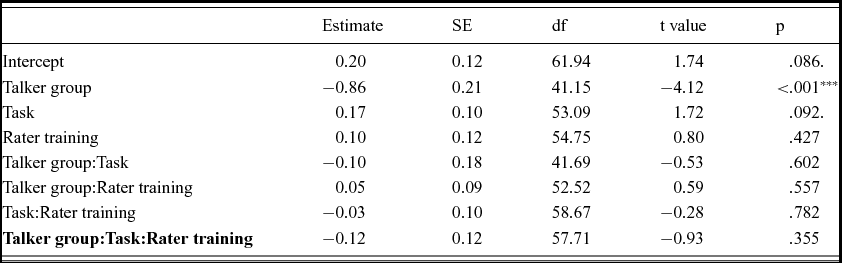
The aim of this analysis was to compare the bilingual and monolingual groups on Holistic Accent Assessment, while controlling for such factors as Task and Rater. To this end we ran a linear mixed effects model, which allowed us to control the individual variance introduced by each Rater and Talker and thus to minimize the type I error. The analysis was conducted with the lmer function in lme4 package (Bates, Maechler, Bolker & Walker, Reference Bates, Maechler, Bolker and Walker2015) with Satterthwaite approximation for p values implemented in the lmerTest package (Kuznetsova, Brockhoff & Christensen, Reference Kuznetsova, Brockhoff and Christensen2015). The fixed effects entered into the model were: Talker group (bilingual vs. monolingual), Task (re-narration vs. SRep), Rater training (trained vs. untrained), an interaction of Talker group and Task, Talker group and Rater training, Rater training and Task, as well as the three-way interaction of Talker group, Rater training and Task. Rater group was not included in the analyses as it closely correlated with phonetic training. We also did not include Age in the model, as the bilingual and monolingual groups were matched for age. The random effect structure in the model was initially maximal (see Barr, Levy, Scheepers & Tily, Reference Barr, Levy, Scheepers and Tily2013 for the discussion of the advantages of maximal random effect structure in linear mixed effects models). However, in the next step of the analysis we removed the random slopes whose variance equalled zero, as recommended by Bates, Kliegl, Vasisth, and Baayen (Reference Bates, Maechler, Bolker and Walker2015). We compared the models without the zero slopes to the maximal models with the likelihood ratio tests to make sure that we had not discarded any meaningful variables. Apart from the elimination of the zero slopes in the random effects no model selection was conducted. The model met the assumptions of the linear regression such as homoscedasticity and normally distributed residuals and had low collinearity as indicated by the variance inflation factor (VIF), which had a value below 2.5. In this and all the subsequent mixed-effects analyses, all categorical predictors were sum coded, while the continuous predictors were centred on the mean values.
Results
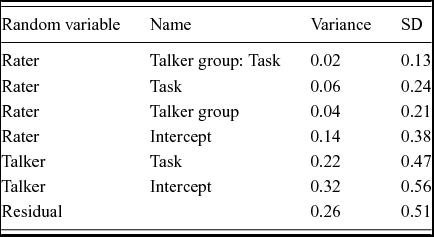
Table 6 presents the fixed effects in the model, while Table 7 presents the random effects. The model shows that the best predictors of the Holistic Accent Assessment was Talker group and (marginally) Task. Children's assessments were higher in the monolingual group and on the SRep task. There were no consistent effects of Rater training and no significant interactions.
The model predicting Holistic Accent Assessment with Talker group, Task, Rater training and the interactions: fixed effects.

. p < .1, *p < .05, ** p < .01, *** p < .001
The model predicting Holistic Accent Assessment with Talker group, Task, Rater training and the interactions: random effects

Analysis D: Phonetic predictors of accentedness in bilingual children
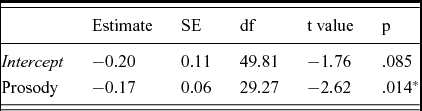
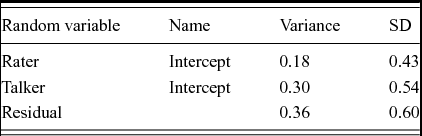
In this analysis, we aimed to answer the third research question, i.e., to assess whether accentedness ratings relate to the detailed phonetic analysis of bilingual children's speech. More specifically, we asked whether the number of atypical speech patterns identified in the phonetic analysis in Study 1 predicted the Holistic Accent Assessment, and we tested which types of atypical speech patterns were the best predictors of this variable. To this end, we ran a linear mixed effect model with the Holistic Accent Assessment as the outcome variable and the categories of atypical speech patterns from Study 1 as predictors. Because entering all L2 categories into the model would likely result in overfitting, we collapsed them into three groups: 1) Vowels – the number of atypical speech patterns related to vowels, 2) Consonants – the number of atypical speech patterns related to consonants, and 3) Prosody – the number of atypical speech patterns related to prosody (see Table 1 for the exact categories within each group). These three groups were entered into the model as fixed effects. At the beginning, we created a model with three fixed effects (Prosody, Consonants and Vowels) and maximal random effect structure. The model showed a degree of collinearity with VIF greater than 2.5. We therefore ran a stepwise backwards regression, eliminating the weakest fixed effects one by one and comparing them by looking at their Akaike Information Criterion (AIC) and the likelihood ratio tests. The new model, which had the lowest AIC of all the ones tested, had only one fixed effect: Prosody. Obviously, it had no collinearity and met other assumptions of linear regression such as homoscedasticity and normally distributed residuals. Following the regression, we removed random slopes with variance that were close to zero, so the final model is an intercept-only model. The likelihood ratio test did not show significant differences between the model with and without the random slopes. Below we report only the final model.
Results
Table 8 presents the fixed effects of the final model we obtained, while Table 9 presents the random effects. As evident from Table 8, there was a relationship between the atypical speech patterns identified in Study 1 and the holistic assessment conducted in Study 2. Specifically, the patterns related to prosody significantly predicted the Holistic Accent Assessment, i.e., the fewer atypical speech patterns related to prosody, the higher was the Holistic Accent Assessment.
The model predicting Holistic Accent Assessment with phonetic variables: fixed effects

p < .1, * p < .05, ** p < .01, *** p < .001
The model predicting Holistic Accent Assessment with phonetic variables: random effects

Analysis E: Sociolinguistic and sociodemographic predictors of accentedness
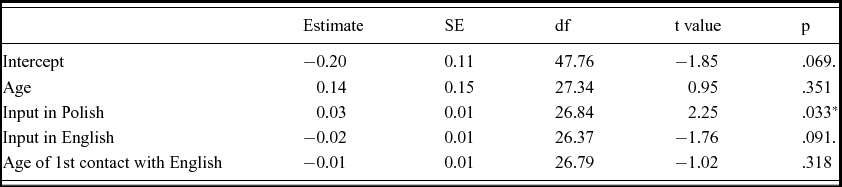
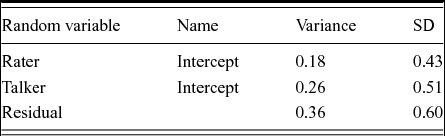
In the final analysis, we aimed to answer the fourth research question concerning the background factors that contribute to the perceived foreign accent in the bilingual participants. Thus, we created a mixed linear regression model with Holistic Accent Assessment as the outcome variable and three measures taken from the background questionnaire, i.e., Input in Polish, Input in English and AoE as the fixed effects. The Age of the child was entered as an additional fixed effect, as this was the most probable confounding variable. The model did not show collinearity (VIF below 2.5) and met other assumptions of the regression. As previously, we removed the random slopes whose variance equalled zero from the model and compared the models with and without the zero slopes with likelihood ratio tests. There was difference between the models, so the model without the zero slopes was selected. As a result of removing the zero slopes, the model contains only random intercepts.
Results
The resulting model is presented in Tables 10 (fixed effects) and 11 (random effects). As can be seen from Table 10, Input in Polish was the strongest predictor of Holistic Accent Assessment. The more Input in Polish our participants received, the better their Holistic Accent Assessment was. There was also a marginal effect of Input in English. Children who received more of such input, performed worse in terms of Holistic Accent Assessment.
The model predicting Holistic Accent Assessment with background (sociolinguistic) variables: random effects: fixed effects

p < .1, * p < .05, ** p < .01, *** p < .001
The model predicting Holistic Accent Assessment with background (sociolinguistic) variables: random effects: random effects

Discussion
Studies of phonological profiles of bilingual children are scarce (see Genesee & Nicoladis, Reference Genesee, Nicoladis, Hoff and Shatz2009). To date, only two investigations involving Accent Ratings have been performed on children (cf. Asher & Garcia, Reference Asher and Garcia1969; Snow & Hoefnagel-Höhle, Reference Snow and Hoefnagel-Hohle1977): none of them, however, explored accentedness in bilingual children's home language. This study on the Polish–English bilingual children aimed to fill the gap. First, we aimed to explore whether bilingual children's oral production is perceived as different from that of their monolingual peers. Second, we intended to investigate the phonological and sociolinguistic predictors of the perceived foreign accent.
Great care was taken to overcome methodological issues that affect the validity of Accent Ratings (see Piske et al., Reference Piske, MacKay and Flege2001; Schmid & Hopp, Reference Schmid and Hopp2014). First, possible rater effects were minimized, by recruiting a large number of raters who were proficient in English and were familiar with English-accented speech. We also controlled for the effect of raters in the mixed effect models we created. Second, while previous Accent Ratings studies varied considerably with respect to speech sample elicitation (e.g., Bongaerts, van Summeren, Planken & Schils, Reference Bongaerts, van Summeren, Planken and Schils1997; Elliott, Reference Elliott1995; Flege et al., Reference Flege, Munro and MacKay1995), we employed two elicitation techniques, namely sentence repetition (a more controlled and restricted task) and re-narration (a guided elicitation task), to offer a more reliable measure of the speakers’ phonetic performance. Third, we juxtaposed Accent Ratings with a detailed acoustic analysis performed by phonetically-trained raters. In this way, our procedures provided both detailed and holistic assessments of children's pronunciation in all aspects of speech, i.e., segmental, suprasegmental and extralinguistic, which added to the robustness of the results.
The first question we asked concerned the differences in the pronunciation of L1 Polish between the bilingual and the monolingual children. The results obtained in both Study 1 and Study 2 point to such differences. Study 1, where precise auditory analysis was performed, demonstrated that bilingual productions in Polish were characterised by a higher number of speech alterations, driven by CLI from L2 English (community language) to L1 Polish (home language). The alternations included atypical productions of Polish consonants, the reductions of consonant clusters that do not comply with English phonotactics, the productions of VOT values typical for English rather than Polish, and the application of vowel reduction (which is typical for English, but not for Polish speech). Similarly, in Study 2 the holistic assessment ratings performed were still significantly higher, i.e., better for the monolingual control group. This effect was equally strong for both tasks used (SRep and Re-narration), even though Re-narration was generally assessed more severely by the raters. This indicates that even if there were any lexical, syntactic and morphological patterns that differentiated monolingual and bilingual speech, they had no bearing on the assessment of accent. This finding suggests that the bilingual children were perceived by the Polish native raters as less native-like, less intelligible and less acceptable in their L1 than their Polish monolingual peers, despite having acquired Polish from birth. These results run counter to a popular belief that early bilinguals can speak both languages without a foreign accent because they keep the two phonological systems apart. Instead they support recent findings (e.g., En et al., Reference En, Brebner and McCormack2014; Mayr et al., Reference Mayr, Howells and Lewis2014; Marecka et al., Reference Marecka, Wrembel, Zembrzuski and Otwinowska-Kasztelanic2015; Wrembel, Reference Wrembel2015), suggesting that the two languages interact in the children's phonological system. This interaction can be explained by Flege's (Reference Flege and Strange1995, Reference Flege, Burmeister, Piske and Rhode2002) Speech Learning Model, which assumes that the phonetic categories from both languages in the bilingual mind occupy the same phonological space. It also conforms to the Dynamic Systems Theory of language acquisition stating that all the languages in the speaker's mind constantly influence each other (e.g., de Bot et al., Reference de Bot, Lowie and Verspoor2007).
Further, the results demonstrate that early bilingualism and extensive exposure to two languages do not guarantee a fully native-like performance in both language systems in the sphere of phonetics and phonology. Although Polish was chronologically the first language acquired by all the bilingual children in the study, in the migrant context it was influenced by English, the community language, to such an extent that the L1 was perceived as foreign-accented. This calls into question the often quoted ‘the earlier, the better’ assumption (e.g., Asher & Garcia, Reference Asher and Garcia1969; Suter, Reference Suter1976; Oyama, Reference Oyama1976; Flege & Fletcher, Reference Flege and Fletcher1992, Flege et al., Reference Flege, Munro and MacKay1995; Moyer, Reference Moyer1999), and indicates that the age factor is probably not the sole determiner of nativeness in the oral performance.
To answer our second research question, we investigated whether and how the parameters of Native Accent, Intelligibility, Acceptability and Perceived Age were related in the performed ratings. Although the Perceived Age measure had not been used in previous Accent Ratings studies, we conceptualized the assessment of age as an indicator of potential perceived delay in speech development. We hypothesized that bilingual children might be assessed as younger than monolinguals, due to the atypical speech patterns they exhibit. Thus, our raters were to identify the participants’ age based on their speech performance. However, it appears that raters had difficulties in assessing the talkers’ age, as evidenced in the very low interrater agreement with respect to this parameter (cf. Krippendorff's alpha scores). Moreover, Perceived Age was not related to the other three parameters in the bilingual group, which indicates that it was not influenced by the degree of foreign accent or speech intelligibility. Interestingly, the perceived age correlated with the Native Accent, Intelligibility and Acceptability in the case of the monolinguals, which suggests that FARs in this group were more related to the developmental patterns in the children's speech. When it comes to Native Accent, Intelligibility and Acceptability, we have found that these three parameters were tightly intertwined in both the bilingual and monolingual groups of participants. Since it was difficult to tease them apart, we concluded that they reflect the same concept. Thus, we obtained one global category of accentedness, the so-called Holistic Accent Assessment, as a consistent measure of perceived pronunciation performance.
Our third research question enquired how accentedness measures relate to the phonetic analysis of bilingual children's speech. To this end, we tested which groups of phonetic features (i.e., atypical speech patterns connected with the production of vowels, consonants, and prosody) had the greatest influence on the accentedness scores. The atypical prosody was the best predictor of Holistic Accent Assessment. In other words, children who had problems with retaining the syllabic structure of the words or applying accurate stress patterns were more likely to be perceived as non-native, unintelligible and unacceptable. This result is consistent with previous studies, which found that inserting non-native prosodic features into speech samples influences FARs conducted on these samples (de Mareüil & Vieru-Dimulescu, Reference de Mareüil and Vieru-Dimulescu2006; Liu & Lee, Reference Liu and Lee2012). At the same time, previous research indicates that the presence of non-native segmental features in speech samples is a stronger predictor of foreign accentedness than the presence of non-native suprasegmental features (Liu & Lee, Reference Liu and Lee2012; Lee, Reference Lee2014), while in our study this was not the case. This discrepancy might stem from the fact that our study was conducted on naturalistic data, while the studies by Lee and Liu utilised synthesised speech samples, which could have exaggerated the foreignness of segmental features.
Finally, we enquired what sociolinguistic factors contribute to the perceived foreign accent in bilingual children's speech. The results demonstrate that the quality and quantity of input in Polish was the strongest predictor of the Holistic Accent Assessment. In other words, the more Polish input children had received, the better their FARs were. There was also a marginally significant negative effect of input in English on the Holistic Accent Assessment. This means that the more input the bilingual children received in the community language, the lower was their assessment in the home language. At the same time, neither age nor AoE was related to children's FARs. The predictors of FARs in our study correspond to those evidenced by Flege et al. (Reference Flege, Munro and MacKay1995) and Piske et al. (Reference Piske, MacKay and Flege2001), who focused on the impact of the L1/L2 input on the nativeness of L2 accent.
Summing up, in contrast to previous studies, which accounted for the influence of L1 on the performance in L2, we investigated the impact of L1 and L2 exposure on the accent in L1. We have demonstrated that, under specific circumstances of bilingual acquisition, children's L1 (home language) can be phonetically influenced by their L2 (prestigious community language). Thus, our results evidence a different direction of phonetic cross-linguistic influence from that usually presented in SLA studies. Obviously, the impact of language use and status on bilingual children's speech production still requires further investigation. It is necessary to determine more precisely which conditions result in a phonetic drift towards the ambient language norms in bilinguals' speech, because, as demonstrated by Sancier and Fowler (1997), even a temporary change in language use patterns and input conditions may significantly influence bilinguals’ sound production in their languages. Still, we believe that the procedures applied in our study, which provided both detailed and holistic assessment of children's pronunciation skills, allowed us to accurately examine the L1 speech of early bilingual children. Our future research will involve a parallel investigation into the English language of the Polish–English bilingual children to establish the differences between the speech patterns observed in L1 and L2 in this population.
Conclusions
The major objective of the present study was to investigate the phonetic performance in the L1 speech of Polish–English bilingual children living in Great Britain. Crucially, we have demonstrated that the L2 of early bilinguals exerts cross-linguistic influence on the L1 in the area of phonology. Thus, Polish–English bilingual children are perceived as foreign-accented in their L1 Polish and as less intelligible and less acceptable in their L1 than their Polish monolingual peers, despite having acquired Polish from birth. Further, those children who received the smallest amount of Polish input were most severely assessed. This points to the importance of substantial amount and quality of input in the home language if the bilingual child is to develop native-like phonology in the L1.
The novelty of our contribution is threefold. Firstly, to the best of our knowledge, no previous research examined the global perceived accent in the L1 of child bilinguals. Secondly, our study focused on Polish, a language rarely investigated in SLA studies. Thirdly, our design combined accentedness ratings with a detailed phonetic analysis and an examination of the participant background factors and rater effects. Thus, this study bridges the existing gap in the literature and lays foundations for further investigations of accent in young bilinguals.
Supplementary material
To view supplementary material for this article, please visit https://doi.org/10.1017/S1366728918000044.