The study of motivation raises significant interest among researchers from sport, exercise, health and occupational sciences (Clancy et al., Reference Clancy, Herring and Campbell2017; Ennis, Reference Ennis2017; Keegan et al., Reference Keegan, Middleton, Henderson and Girling2016; Ntoumanis et al., Reference Ntoumanis, Stenling, Thøgersen-Ntoumani, Vlachopoulos, Lindwall, Gucciardi and Tsakonitis2017; Venhorst et al., Reference Venhorst, Micklewright and Noakes2017). Motivation typically refers to the reasons underlying whether, and how, an activity is pursued. The amount of energy one spends in a task and the direction of his or her effort are the main characteristics of this psychological construct (Sage, Reference Sage1977).
Motivation, in general, has been studied in many areas related to sport and physical activity, especially psychology and physical education (Clancy et al., Reference Clancy, Herring and Campbell2017; Ennis, Reference Ennis2017; Keegan et al., Reference Keegan, Middleton, Henderson and Girling2016; Ntoumanis et al., Reference Ntoumanis, Stenling, Thøgersen-Ntoumani, Vlachopoulos, Lindwall, Gucciardi and Tsakonitis2017; Venhorst et al., Reference Venhorst, Micklewright and Noakes2017). Knowing where motivation comes from -why it takes those forms that it does, and the factors or situations that increases or decreases- it has generated an estimated number of twenty-four different theories (Lacerda, Reference Lacerda2010; Reeve, Reference Reeve2006).
Theories of motivation applied to sport typically guide researchers to look upon cognitive, affective and behavioral variables as perceived by the participants (Roberts, Reference Roberts and Roberts2001). Scientists have noted that this approach poses some difficulties, mainly because participants with the same coach have distinct perceptions of the psychosocial variables entailed in motivation and subjective ratings of motivation often demonstrate little or no relation to objectively observed behaviors (Smith et al., Reference Smith, Smoll and Cumming2007; Papaioannou & Kouli, Reference Papaioannou and Kouli1999; Morgan et al., Reference Morgan, Sproule, Weigand and Carpenter2005). Motivational climate is assessed and measured in line with two predominant theoretical paradigms that define motivation, and what constitutes the ‘climate’ that influences athletes’ motivation. There are basically two main foundational ‘socio-cognitive’ theories used to understand and discuss the phenomenon of motivational climate (Lacerda, Reference Lacerda2010; Reeve, Reference Reeve2006) – although in recent years both theories continue to be evolve and be refined. The ‘foundational’ theories are the Achievement Goal Theory (AGT; Nicholls, Reference Nicholls1989) and the Self-Determination Theory (SDT; Deci & Ryan, Reference Deci and Ryan2000, Reference Deci, Ryan, Deci and Ryan2002). Those theories are important in the field of motivational climate research and it is fundamental to understand them for further discussion.
The SDT was developed by Deci and Ryan (Reference Deci and Ryan2000) to explain how internal psychological values, environmental variables and social interaction can influence one’s own motivation. This theory categorizes motivation as intrinsic and extrinsic: The first is that which satisfies the subject by their own participation in the activity, often divided into motivation by the ego (personal overcoming) and by the pleasure of the task (Harwood et al., Reference Harwood, Keegan, Smith and Raine2015). Intrinsically motivated people aim at competence, mastery of the task, competition, action, fun, and skill acquisition, and their level of expectation usually rises steadily (Deci & Ryan, Reference Deci, Ryan, Deci and Ryan2002). Extrinsic motivation, on the other hand, is related to rewards or punishments from other people. Examples of rewards include compliments, applause, awards, trophies, medals, money, travels, grades and school scholarships. As punishments, deprivation of privileges, criticism, ridicule, booing, exercises, extra work and salary discounts (Roberts, Reference Roberts and Roberts2001; Skinner, Reference Skinner1968). According to the authors of this theoretical framework (Deci & Ryan, Reference Deci and Ryan2000, Reference Deci, Ryan, Deci and Ryan2002), the intrinsic motives are more adaptive, compared to the extrinsic ones among children and young people with regard to the sport practice (Feliu, Reference Feliu1997; Franco, Reference Franco2000).
In the sport environment, studies related to the motivational climate highlight possible coexisting factors influencing extrinsic motivation such as: Behavior of parents and coaches, structure and support for training, interpersonal relationship between athletes and socio-environmental determinants (Cervelló & Santos-Rosa, Reference Cervelló and Santos-Rosa2001; Harwood et al., Reference Harwood, Keegan, Smith and Raine2015; Laparidis et al., Reference Laparidis, Papaioannou, Vretakou and Morou2003; Salselas & Márquez, Reference Salselas and Márquez2009; Ruiz et al., Reference Ruiz, Haapanen, Tolvanen, Robazza and Duda2016; Keegan et al., Reference Keegan, Middleton, Henderson and Girling2016). LaVoi and Stellino (Reference LaVoi and Stellino2008) found positive linear relationship between sport climate perceived regarding parents and the good sporting behaviors during competition among young hockey players. Salselas and Márquez (Reference Salselas and Márquez2009) also found a positive correlation between perception of the motivational climate of young swimmers and the use of rewards and feedbacks from parents.
Achievement-Goal Theory (Nicholls, Reference Nicholls1989) separates the underlying goals that regulate the pursuit of achievement, or competence, based in their orientation towards either normative success or mastery, in terms of skill execution, improvement and effort-investment. A task-oriented goal refers to a clear objective that can be reached by executing a task or a group of tasks. On the other hand, an ego-oriented goal entails an objective related to a person in an individual level of self-fulfillment, so, it is something important to someone to accomplish, whereas others may or may not share the same feeling. Task and ego orientation in AGT are important to understand the direction of the effort and the will to persevere until that goal is reached.
Beyond the individual factor, the social and environmental dimensions of motivation show central role to understand multiple layers of this phenomenon. Among athletes, recent data show that parents, peers and coaches are of great importance to explain motivational climate (Keegan et al., Reference Keegan, Middleton, Henderson and Girling2016). Climate refers to the social environment shared by athletes with peers, coaches, families and other possible actors such as media and managers, thus, motivational climate entails the close relationship between psychosocial environment of practice and competition in a given sport that influences motivation of an athlete (Keegan et al., Reference Keegan, Spray, Harwood and Lavallee2010, Reference Keegan, Spray, Harwood, Lavallee and Geranto2011, Reference Keegan, Spray, Harwood and Lavallee2014)
Recent attempts to develop instrument measures of the observed behaviors or more objective motivational climate variables have demonstrated low correlation between the observer ratings and the participants’ perceptions of social climate (Smith et al., Reference Smith, Tessier, Tzioumakis, Quested, Appleton, Sarrazin, Papaioannou and Duda2015), this difference in perspective remains a significant limitation to research that examines motivational climate in sport. Nevertheless, there is important value in attempting to understand how the objectively observable behaviors of coaches and teammates are perceived, experienced and translated into climate perceptions (Keegan et al., Reference Keegan, Spray, Harwood and Lavallee2010, Reference Keegan, Spray, Harwood, Lavallee and Geranto2011, Reference Keegan, Spray, Harwood and Lavallee2014). To increase understanding on motivational climate may allow more sophisticated management of athletes’ perception, improvement of strategies and systems for the optimization of motivational climate that leads to improved experiences, learning, persistence and performance (Harwood et al., Reference Harwood, Keegan, Smith and Raine2015).
A person rarely persists in learning or training behaviors long enough to succeed when surrounded by a negative or unfavorable environment (Bandura, Reference Bandura1971). Beyond the basic understanding of overall principles of socio-cognitive theories (Ames, Reference Ames1992; Epstein, Reference Epstein, Ames and Ames1989), and the demonstration of associations between climate perceptions and their correlates (Harwood et al., Reference Harwood, Keegan, Smith and Raine2015), the relationship between individual differences/traits and specific situations/context – perceived or actual – in determining motivation remains to be understood. In other words, one cannot understand the set of behaviors of an athlete by rigidly adhering to abstract theoretical concepts, since it varies according to the athlete’s traits and life history, and the contingencies of the environment (Figueiredo, Reference Figueiredo2000; Keegan et al., Reference Keegan, Harwood, Spray and Lavallee2009; Winterstein, Reference Winterstein and DeRose2002).
Keegan et al. (Reference Keegan, Middleton, Henderson and Girling2016) suggested an alternative framework: To develop research on motivational climate from a data-driven and less theoretically prescribed perspective, by collecting and interpreting data from a theoretically agnostic point of view (Harwood et al., Reference Harwood, Spray, Keegan and Horn2008; Keegan et al., Reference Keegan, Middleton, Henderson and Girling2016). Accordingly, Keegan et al. (Reference Keegan, Spray, Harwood, Lavallee and Geranto2011) proposed the explanation of the motivational climate in a sport environment based on the analysis of the interactions and influences of its social agents without the adoption of a prescriptive ‘guiding’ theoretical framework or model a priori – i.e., beforehand, in a way that controls and dictates what is measured and how. This proposal followed reflections on the progress of motivational climate research, and followed a series of qualitative studies demonstrating the motivational climate is much more complex than simple, broad characterizations offered by some theories (Keegan et al., Reference Keegan, Spray, Harwood, Lavallee and Geranto2011; Keegan et al., Reference Keegan, Spray, Harwood and Lavallee2014).
Measurement in psychology is an endeavor led by researchers to assess a latent construct (REFS). In order to build an instrument of measurement, psychometrics scientists are recommended to select and faithfully embody a foundational theory to build its items. It means that, the first step to create a new assessment tool is to dive deep into a theory and develop items from this specific theoretical approach according to the International Test Commission (ITC, 2001). However, recent and innovative research in motivational climate has argued that too few theoretical models have directed the development of measures for motivational climate, and instead researchers might benefit from being less dogmatically ‘wedded’ to guiding theories:, i.e., not pre-emptively selecting a theory beforehand to guide item and factor development, but rather adopting more of an agnostic framework instead (Keegan et al., Reference Keegan, Harwood, Spray and Lavallee2009, Reference Keegan, Spray, Harwood, Lavallee and Geranto2011, Reference Keegan, Middleton, Henderson and Girling2016). Even though there are guidelines for test development and use (Bartram, Reference Bartram2001; ITC, 2001) it is not rare to find instrument measures developed without such strict guidance by a foundational theoretical model (e.g., Filgueiras et al., Reference Filgueiras, Hora, Fioravanti-Bastos, Santana, Pires, Galvão and Landeira-Fernandez2014).
In a recent systematic review, Clancy et al. (Reference Clancy, Herring and Campbell2017) emphasized the existence of a large number of instruments to assess motivation in sport, but very few measures were intended to link perceived motivational climate and motivation. Reliable and objective observational systems used by coaching staff rather than self-reported measures can contribute to the development of intervention programs that aims to changing the motivational climate (Clancy et al., Reference Clancy, Herring and Campbell2017). In order to have good third-person observational systems, the psychometric characteristics of a measure should be investigated to guarantee validity and reliability (Filgueiras & Hall, Reference Filgueiras and Hall2017; Filgueiras, Reference Filgueiras2017).
Accordingly, Keegan et al. (Reference Keegan, Spray, Harwood and Lavallee2014) study suggested that a wider, and fuller, consideration of the motivational ‘atmosphere’ should contemplate the understanding of specific behaviors of social actors in the sport context (parents, coach, managers, media and peers), their interactions patterns and potential combinations at specific moments. Thus, a multidimensional and multi-level instrument measure would be the most efficient assessment model in motivational climate (Harwood et al., Reference Harwood, Keegan, Smith and Raine2015; Keegan et al., Reference Keegan, Middleton, Henderson and Girling2016). The present article intends to investigate the most widely used measures examining motivational climates. Two central questions will be addressed: (a) The main underpinning theoretical models used to build and develop instruments; and (b) the psychometric properties of those measures. Thus, to inform the potential implications of diversifying the suite of theoretical models that guide measure development, this paper sought to overview and characterize the existing, discrete, instruments and compare their foundations, compositions and psychometric properties.
Underpinning Theories of Motivation
Two predominant theories - i.e., AGT, SDT - were reported in most of the studies that Harwood et al. (Reference Harwood, Keegan, Smith and Raine2015) reviewed. Although those theoretical models can be applied in diverse context, they lack observation systems in the sporting context, the majority of grounded theory instrument measures are surveys or questionnaires based on the athletes’ self-reports about their perceptions of the environment (Duda & Balaguer, Reference Duda, Jowett and Lavallee2007; Ntoumanis, Reference Ntoumanis, Stenling, Thøgersen-Ntoumani, Vlachopoulos, Lindwall, Gucciardi and Tsakonitis2017). According to Ames (Reference Ames and Roberts1992a) and Keegan et al. (Reference Keegan, Spray, Harwood, Lavallee and Geranto2011) the motivational climate is multidimensional, which would suggest that diverse factors and dimensions should be identifiable, beyond the two-to-three commonly suggested by measures grounded in AGT or SDT. Not only might more diverse conceptualizations be required, but drawing from multiple sources (coaches, parents, peers, etc.) and potentially observing different factor structures from these different protagonists. The main purpose of the current study was to identify the most used instruments for climate measurement in sport: their underpinning models and factor compositions. From her ewe sought to enable to construction of more holistic, and this more informative scales in future research, in response to the call for less constraint from ‘guiding’ theoretical models: i.e., to be a little more theoretically agnostic.
Method
To address the above question we used the systematic review inspired by the Preferred Reporting Items for Systematic Reviews and Meta-Analyzes method PRISMA (Moher et al., Reference Moher, Liberati, Tetzlaff and Altman2009).
Three databases were used separately for article search on April 12, 2017. They were: (a) APA PsyNet-PsycInfo, (b) PubMed and (c) Oxford. Those databases were chosen because of limitations posed by the Pontifical Catholic University of Rio de Janeiro, Brazil, library search system. The keywords used for the research were: (i) Instrument; (ii) sport; (iii) motivational climate; (iv) athlete; (v) assessment; (vi) psychometrics; and (vii) measure and were combined in the following algorithms: [(i) + (ii) or (iii)] + [(iv) or (v) or (vi) + (vii)].
Inclusion Criteria
The criteria for inclusion of the articles were: (a) Double-blind peer-reviewed articles; (b) studies that address the theme of motivational climate in sport; (c) papers with clear theoretical background or an assumed empirical foundation with no grounded-theory; (d) published articles that developed a measure of motivational climates have been published since of January 1, 1997. Articles that were considered important, although not retrieved from the systematic search were included, such as: White et al. (Reference White, Duda and Hart1992) and Seifriz et al. (Reference Seifriz, Duda and Chi1992) due to its importance in the field.
Exclusion Criteria
The criteria for excluding retrieved articles were: (a) Repeated in databases; (b) case studies; (c) meta-analysis; (d) systematic reviews; (e) absence of a validated instrument measure; (f) qualitative research; (g) unpublished material; and (h) monographs, thesis or dissertations. Indeed, since the inclusion criteria considered only double-blind peer reviewed articles, then, it would not be necessary the exclusion criteria #7 and #8; nonetheless, some of the papers that the search yielded needed a closer look and some of them, although appeared to be regular peer-reviewed articles, came out to be opinion texts or editorial requests. Those exclusion criteria were added later to the procedure.
Procedure
Initially, keywords were developed during discussions among authors to reach a consensus. Then, rules for inclusion and exclusion criteria were debated and established. Considering the limitations of databases above mentioned, one of the authors who is expert in the field of motivational climate provided some necessary articles that were later included in the results. Those papers were used as reference to decide inclusion of articles based on criteria #2 and #3. In the next step, two of the authors were responsible to make the search in the databases independently. Each one decided which papers to include and exclude with no communication between each other. Then, four of the authors gathered both results and discussed which articles should be included and which should be excluded. Final results were reported according to the systematic review.
Results
The initial searches with the keywords resulted in 378 articles, three articles from other sources. Figure 1 describes in detail the results of the systematic search in accordance with the PRISMA guidelines (Moher et al., Reference Moher, Liberati, Tetzlaff and Altman2009). First, 203 duplicate articles were excluded, leaving 177 articles. After applying the inclusion and exclusion criteria, 138 articles were excluded, leaving 39. After reading the articles in full, there were 8 that used some instrument of evaluation of the sports motivational climate according to Figure 1.
PRISMA Flowchart (Moher et al., Reference Moher, Liberati, Tetzlaff and Altman2009) based on the Systematic Search that Yielded the Results of the Present Study.

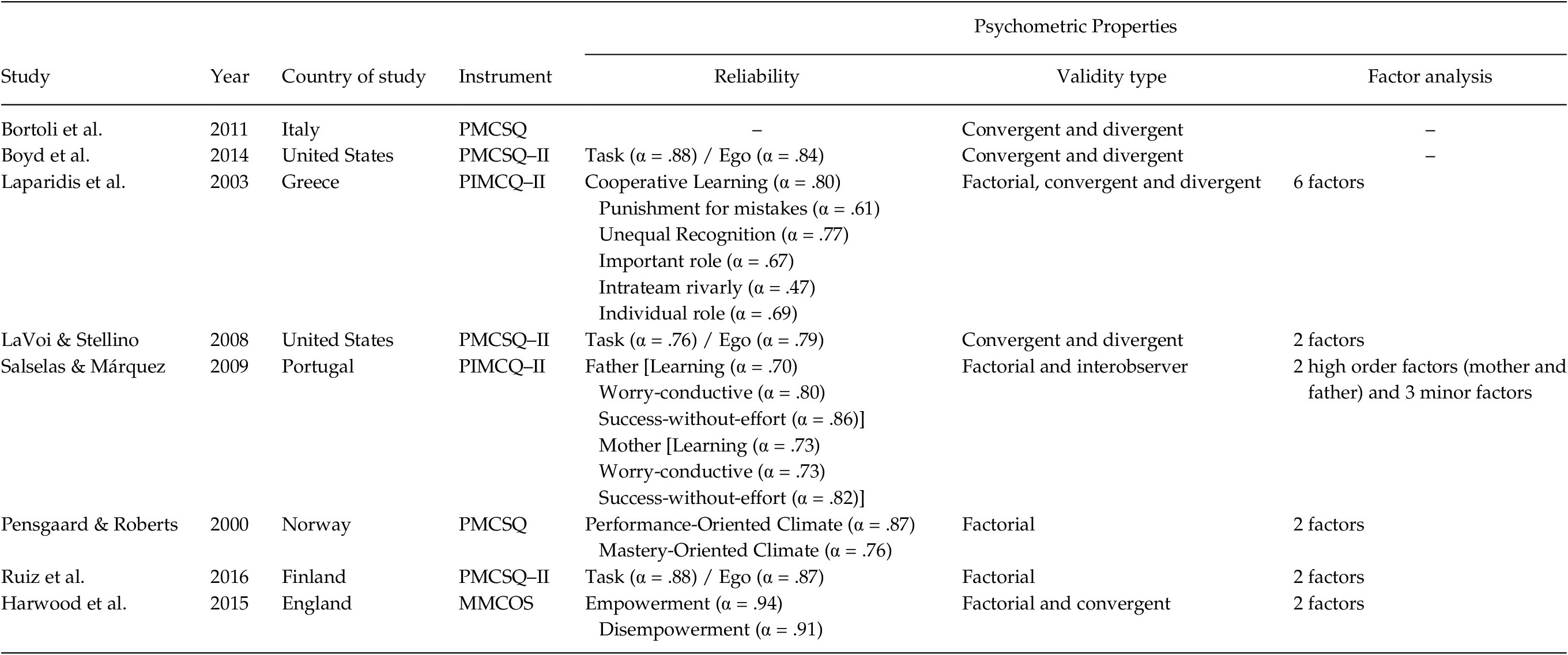
General information about the eight selected articles is presented in Table 1. In the first column, the authors’ list followed the alphabetical ordering. Regarding the year of publication of the material, one article was published in 2000, one in 2003, one in 2008, one in 2009 and one in 2011. The remaining articles were published in the period of 2014 to 2016. The total number of instruments for evaluation of motivational climate retrieved and included in the final results were four.
Name of Authors in Alphabetical Order, Year of Study, Instrument Name, Psychometric Characteristics and Correlations Found

Measures in Motivational Climate in the Sport Context
Perceived Motivational Climate in Sport Questionnaire (PMCSQ)—developed by Seifriz et al. (Reference Seifriz, Duda and Chi1992), the PMCSQ is grounded in the AGT social-cognitive approach. The original instrument was developed to measure the motivational climate perceived by physical activity and exercise participants. It measures the general motivational climate through 20 items in a 5-point Likert scale ranging from (1) totally disagree to (5) strongly agree divided in two factors: Mastery—task oriented items, and performance—ego oriented items. The Cronbach’s Alpha coefficient was .86 for the mastery subscale and .77 for the performance subscale which were considered acceptable. Even though the instrument showed good psychometric properties, authors agreed that changes in the questionnaire were necessary due its use among individual athletes who competed alone and trained among other athletes of the same sport.
Perceived Motivational Climate in Sport Questionnaire–II (PMCSQ–II)—developed by Newton et al. (Reference Newton, Duda and Yin2000) it is the second version of the original PMCSQ built by Seifriz et al. (Reference Seifriz, Duda and Chi1992), and became one of the most used in research on motivational environment. It kept the original two-factor structure (ego- and task-oriented goals), but increased the focus on orientation of motivation rather than the perceived results of practice itself. Task-oriented items focused in the perceived attempt of improvement rather than the ability in this task. In contrast, the ego-oriented items evaluated perceived success in contrast to peers. The PMCSQ–II is a 33-item self-reported questionnaire with two high-order factors (ego and task) and six lower-order correlated subscales. Responses were scored according to the Likert scale ranging from 1 (totally disagree) to 5 (totally agree) and Cronbach’s Alpha found for ego- and task-oriented items were .88 and .84 respectively.
Parent-Initiated Motivational Climate–II (PIMCQ–II)—developed by White (Reference White1996) it is an altered version of the first PIMCQ created by White et al. (Reference White, Duda and Hart1992). It assesses the perceived role of parents in motivational climate. White (Reference White1996) modified second version was created by adding four new items to measure the perception of pleasure. The final version of the PIMCQ–II is a 36-item self-reported questionnaire that assesses three dimensions of children’s perception of motivational climate generated by parents under the SDT framework. The three-factor structure entails different levels of extrinsic motivation: (i) Perception of a learning/enjoyment climate, (ii) perceptions of a worry-conducive climate and (iii) perceptions of a success-without-effort climate. Children and adolescents answer to a Likert-type scale ranging from 1 (totally disagree) to 5 (totally agree). Among the thirty-six items, eighteen refer to the mother and the other eighteen to the father (i.e., three factors for each parent). Cronbach’s Alpha for each subscale ranged from .81 to .94 and they were considered acceptable. Because of the complex nature of the perception of parental influence, further study was recommended.
Multidimensional Motivational Climate Observation System: MMCOS—developed by Smith et al. (Reference Smith, Tessier, Tzioumakis, Quested, Appleton, Sarrazin, Papaioannou and Duda2015), this instrument combines AGT and SDT theories to assess levels of empowerment of athletes as promoted by coaching staff behaviors. The MMCOS is a third-person observation system that assesses motivational climate according to seven factors (autonomy support, controlling, task involving, ego involving, relatedness supportive, relatedness thwarting, structured) spread through two high-order dimensions: Empowerment and disempowerment. Cronbach’s Alpha was high for all scales: Empowerment showed Cronbach’s alpha =.94, disempowerment had Cronbach’s alpha = .91 and the composite score (algorithm composed by empowerment and disempowerment) presented Cronbach’s alpha = .86.
Discussion
The present article set out to investigate through systematic review the theoretical underpinnings and psychometric qualities of the most used motivational climate measures in sport. The results obtained initially point to four different instruments with seemingly different theoretical foundations; however, the theoretical framework regarding the environment that generates motivation sport is quite clear: The social-cognitive approach (Bandura, Reference Bandura1971). All eight studies investigated are based on this perspective and its variations (i.e., AGT, and SDT) to develop and to validate the instruments. The elaboration of a measurement system that aims to assess the influence of different factors in the motivational climate is directed towards one of the already mapped sources: Parents, coaches and/or peers. Since the motivational climate is a multidimensional construct (Ames, Reference Ames and Roberts1992a), other environmental actors (such as managers, supervisors, coaching staff, etc.), institutional factors (e.g., facilities, infrastructure and equipment) and other psychological dimensions should also be considered, highlighting the need to assess them in its contexts. Those variables do not seem to appear among the constructs measured by the instruments yielded in the present review. In fact, these findings are coherent to Keegan et al. (Reference Keegan, Spray, Harwood, Lavallee and Geranto2011) who also highlighted the development of motivational climate measurement based on a priori theoretical approaches. The same criticism was made then; no instrument was built under an agnostic framework, although it is not an impossible endeavor (Filgueiras et al., Reference Filgueiras, Hora, Fioravanti-Bastos, Santana, Pires, Galvão and Landeira-Fernandez2014).
By observing the instruments closely, the PMCSQ evaluates three theoretical dimensions: Individual distractions (which may be of the subject itself, i.e., ego, or can be of the execution of a task, i.e., task), peers and coach (Seifriz et al., Reference Seifriz, Duda and Chi1992). In this case, ego refers to the intrinsic motivation, the will of the individual to practice the sport, whereas the task is associated with the level of difficulty and mastery that can lead to distractions if the challenge is not sufficiently balanced (Newton et al., Reference Newton, Duda and Yin2000). In this sense, ego and task were seen as independent of the athlete’s relationship with his peers and his coach (Seifriz et al., Reference Seifriz, Duda and Chi1992), but later these dimensions were considered as mediators of the ego and task, alongside the parents, which generated the creation of its second version: PMSCQ–II (Newton et al., Reference Newton, Duda and Yin2000). In this sense, both PMSCQ and PMSCQ–II consider parents, coaches and peers as environmental variables that affect ego (intrinsic motivation) and task (difficulty and dominance). Institutional dimensions such as clubs, leaders, fans, confederations, and other elements such as neighborhood, education and culture are not to be mentioned (Ames, Reference Ames1992b).
The same phenomenon occurs in PIMCQ–II, which focuses exclusively on parents as the source of the motivational climate (White et al., Reference White, Duda and Hart1992). Although the MMCOS (Smith et al., Reference Smith, Tessier, Tzioumakis, Quested, Appleton, Sarrazin, Papaioannou and Duda2015) seems to be a more complete instrument, it uses two dimensions of two theories to build its motivational climate model: Achievement of goals (ATG) in its social and assignment. The theoretical model proposed by Harwood et al. (Reference Harwood, Keegan, Smith and Raine2015) to evaluate the motivational climate adds a layer of complexity to the concept of ego and task proposed by Newton et al., Reference Newton, Duda and Yin2000). The social context referred to in MMCOS concerns social elements, more specifically parents and coaches (only the two), as well as in ego (which includes peers); on the other hand, when group integration theory is included as a layer, the pairs appear as mediators and result of the motivational climate. The major difference that the MMCOS brings with regard to the PMCSQ–II is the achievement of goals, related to the AGT. Achieving a goal motivates the individual to seek another (Nicholls, Reference Nicholls1989; Harwood et al., Reference Harwood, Keegan, Smith and Raine2015), which had not been previously considered in measures of motivational climate. Despite of this, however, other environmental variables are not considered (Ames, Reference Ames and Roberts1992a) and, therefore, this gap remains in the literature.
The fact that the instruments used for motivational climate assessment are based on pre-determined theoretical constructs, disregarding the use of qualitative data, entails the lack of measurement of motivational climate in its multidimensionality, as the results of the present study show. Even though, the MMCOS is the one that closest come to this endeavor. The theoretical paradigm of the studies can be limiting since there is a tendency to develop such instruments of evaluation based on few and limited strands (Keegan et al., Reference Keegan, Spray, Harwood, Lavallee and Geranto2011, Reference Keegan, Spray, Harwood and Lavallee2014).
Keegan et al. (Reference Keegan, Spray, Harwood, Lavallee and Geranto2011) show that, beyond what the instruments measures, there are at least ten psychological dimensions correlated with motivation generally neglected by motivational climate instruments: (i) Beliefs about success in sports; (ii) beliefs about the purpose of sport in one’s life; (iii) positive affect; (iv) negative affect; (v) self-perceived competence to perform the task; (vi) adoption of the learning perspective over competitiveness; (vii) goal orientation over task; (viii) moral development; (ix) development of motor skill; and (x) experience of the flow state during training. This is a valid hypothesis, that measures in a motivational climate still need to address other theories, or perhaps it should start from an agnostic and exploratory view to identify which social, environmental and intrinsic agents modulates the motivational environment (Keegan et al., Reference Keegan, Spray, Harwood and Lavallee2014).
In this paper, it is clear that instruments used for the measurement of motivational climate assess separately the influence of one of the social agents on the motivation of athletes (Deci & Ryan, Reference Deci and Ryan2000, Reference Deci, Ryan, Deci and Ryan2002; Nicholls, Reference Nicholls1989). In fact, five-in-eight studies (62%) refer only to peer influence from the individual perception of the team’s motivational climate. One study measures the influence of parents in this environment and another assesses the motivational climate from a method of external observation. The importance of understanding the complexities and interactions of the so-called motivational atmosphere (Keegan et al., Reference Keegan, Spray, Harwood, Lavallee and Geranto2011) and the ways in which they combine to influence the motivation of athletes was highlighted in this study.
Another limitation found in the results of this review was the divergence of the literature regarding the structure of the questionnaires. For example, the PMCSQ description in one of the articles (Boyd et al., Reference Boyd, Kim, Ensari and Yin2014) as containing 18 items, another article cites it with 12 items (Bortoli et al., Reference Bortoli, Bertollo, Comani and Robazza2011) and another refers to the first version as containing 21 items (Pensgaard & Roberts, Reference Pensgaard and Roberts2000). The same occurs with the second version of this same instrument, the PMCSQ–II is referenced containing 33 items and 2 high order factors in one of the studies (Boyd et al., Reference Boyd, Kim, Ensari and Yin2014), on another with 29 items and 6 factors (Laparidis et al., Reference Laparidis, Papaioannou, Vretakou and Morou2003), and yet another does not present the instrument’s structure (Ruiz et al., Reference Ruiz, Haapanen, Tolvanen, Robazza and Duda2016).
The PIMCQ–II, which evaluates the influence of parents in the motivational climate, is described in one of the articles as containing 36 items that examine 3 dimensions (LaVoi & Stellino, Reference LaVoi and Stellino2008) and in another it is presented containing 18 items for the 3 dimensions (Salselas & Márquez, Reference Salselas and Márquez2009). The heterogeneity of the results shows that researchers fail to keep the instruments stable throughout their different studies. This instability can be translated in the lack of reproducibility of statistical indicators derived from factor analyses or the internal consistency as measured by the Cronbach’s Alpha. Cross-cultural invariance studies seem to be the next step in the future of research with these instruments, parallel to the construction of a measure that is more stable and contemplates other variables that go beyond the social agents involved in the motivational environment.
Regarding the psychometric qualities of the investigated instruments, the strength is the internal consistency values measured by Cronbach’s Alpha. This statistical indicator is generated by the variance of the data in relation to the homogeneity of the items and the responses of the sample, its value varies between 0 and 1, the closer to 1 the better; the literature uses 0.7 as cut-off value. Despite this, it is known that the number of items and the repeatability of these items can positively distort the alpha, in other words, scales with many relatively redundant items tend to increase values (Filgueiras & Hall, Reference Filgueiras and Hall2017). Not knowing the exact number of items of each scale, such as PMSCQ–II and PIMCQ–II, makes it difficult to interpret the values of this internal consistency indicator, but based on the results, the most consistent scale is MMCOS (Harwood et al., Reference Harwood, Keegan, Smith and Raine2015) followed by PMSCQ –II (Newton et al., Reference Newton, Duda and Yin2000).
All studies presented convergent validity correlating motivational climate with psychological variables such as: performance (Bortoli et al., Reference Bortoli, Bertollo, Comani and Robazza2011; Harwood et al., Reference Harwood, Keegan, Smith and Raine2015; Pensgaard & Roberts, Reference Pensgaard and Roberts2000;), learning (Boyd et al., Reference Boyd, Kim, Ensari and Yin2014; Ruiz et al., Reference Ruiz, Haapanen, Tolvanen, Robazza and Duda2016), quality of life (Laparidis et al., Reference Laparidis, Papaioannou, Vretakou and Morou2003), adherence to goals (LaVoi & Stellino, Reference LaVoi and Stellino2008) and appropriate behaviors (Harwood et al., Reference Harwood, Keegan, Smith and Raine2015; Salselas & Márquez, Reference Salselas and Márquez2009). On the other hand, divergent validity was investigated in four of the eight retrieved articles, indicating low or non-existent correlation with bad behaviors (Boyd et al., Reference Boyd, Kim, Ensari and Yin2014; LaVoi & Stellino, Reference LaVoi and Stellino2008), physiological variables (Laparidis et al., Reference Laparidis, Papaioannou, Vretakou and Morou2003) and negative affect (Bortoli et al., Reference Bortoli, Bertollo, Comani and Robazza2011). These findings point to the importance of considering the multiplicity of psychological variables in relation to motivation in the sporting context.
The factorial analysis is used as an item grouping technique to confirm the theoretical hypotheses in the development of the scale (Filgueiras, Reference Filgueiras2017; Filgueiras & Hall, Reference Filgueiras and Hall2017). In fact, if a theory on which a measure was constructed establishes that the construct has two dimensions, then the empirical results must group the items according to these two theoretical dimensions, failure in that undertaking means lack of factorial validity or theoretical validity (Filgueiras, Reference Filgueiras2017). This is the case of PIMCQ–II (White et al., Reference White, Duda and Hart1992), which presupposes two high order factors (father and mother) with three underlying factors for each major dimension (learning, worry and success-effortless). The two studies found 6 factors, but one of them (Laparidis et al., Reference Laparidis, Papaioannou, Vretakou and Morou2003) did not find a hierarchical composition as suggested by the original authors. This compromises the organization of scores and the evaluation of the construct as idealized by theory. In this sense, both PMSCQ–II and MMCOS seem to be successful: Its factorability in two dimensions seems to support, but the MMCOS still needs future studies that confirm this factorial organization, since there is only one study (Harwood et al., Reference Harwood, Keegan, Smith and Raine2015) that tests its latent structure.
The present systematic review identified the MMCOS as the closest measure with one of the best psychometric properties in the literature. However, the retrieved instruments used in this field of research were developed from a priori theoretical frameworks and to assess certain social agents (coach, parents or peers). Previous qualitative research suggests the need to develop a more comprehensive understanding of the motivational aspects and its relation to the components of sport atmosphere first, because it seems that motivational climate is not limited to those actors (Keegan et al., Reference Keegan, Spray, Harwood, Lavallee and Geranto2011).
On the other hand, it can be said that the present study is limited due to the bases adopted in this review, since ScienceDirect, Scopus, SportDiscuss, Scielo, Redalyc, among other databases were left out for technical limitations (the databases used were the only ones the authors had open access); which leaves enough space to new review studies. Another limitation is that narrative-based reviews tend to leave behind some important studies that could answer other questions, however, this was authors’ choice for a better understanding and higher homogeneity.
Despite the limitations of the present study, the main conclusion is that the MMCOS seems the best instrument in terms of internal consistency to assess motivational climate. However, both MMCOS and PMSCQ–II meet the validity and latent structure criteria established by psychometric researchers. In this sense, the next step of future psychometric research is to identify the cross-cultural latent structure and invariance of these measures.
Based on the theories underlying the instruments used and developed, neither one proposes to identify and correlate the complexities and interactions present in the sports environment to favor the emergence of the motivational environment. From a theoretical perspective, the construction of a measure that uses a non-theoretical framework seems plausible, leaving the field for future researches to develop an instrument of motivational climate that undertakes greater complexity than those already built.