On July 2, 2014, the day after his country assumed the six-month Presidency of the Council of the European Union (EU) Italian Prime Minister Matteo Renzi declared in the European Parliament (EP): “The true, great challenge that our continent is facing today is to recapture the soul of Europe, to rediscover the deep sense of our togetherness.” He concluded that “this semester will be a gigantic opportunity to recover enthusiasm and passion … and revive not only our economy, but also our values, the most beautiful attributes we have.” The Italian Presidency program identified less lofty, but nonetheless ambitious objectives: “At this juncture, the main challenges continue to be: recovering from the economic and financial crisis, delivering more jobs, strengthening the fundamental rights and helping Europeans keep pace with a fast changing world. The Italian Presidency of the Council is determined to address these challenges and help the EU move forward.”Footnote 1
These statements illustrate that Member State governments and Prime Ministers have clear policy objectives in mind when dealing with the EU and see their six-month stints at the Presidency as means to achieve their objectives, or pretend to do so. They suggest that Member State governments consider the Council and its President as having an important impact on EU policy.
The typically ambitious Presidency programs stand in sharp contrast to the public attention they usually receive. Since the Treaty of Lisbon took effect in 2009 interest in the Presidents of the European Commission and European Council, and their selection processes, has dwarfed public awareness of the Council Presidents and their programs.Footnote 2
Are Prime Minister Renzi and his peers mistaken in their beliefs that their Presidencies of the Council matter? No, the Council is still the main legislative institution in the EU, with powers equal to those of the EP, under the ordinary legislative procedure, or greater, under the older and now less frequently used consultation procedure. Furthermore, scholarly research has shown that holding the Presidency affects a Member State’s voting behavior in the Council, as we discuss below. As Presidents, Member States vote in favor of policy initiatives under consideration more often, whether it be because Presidents get their way or because they feel compelled to vote with the majority.
In contrast to earlier work, this paper demonstrates that the Trio Presidency, rather than the single Presidency matters as far as voting behavior is concerned. Since 2007 Member States have formed Trios to co-ordinate the Council agenda for 18-month periods, with each Member State in the Trio taking six-month turns at the Presidency. We show that Member States in the Trio vote in favor more often, whether or not they hold the Presidency. Moreover, we find that the Trio effect increases as the Trio term progresses. This suggests that agenda-setting induces the effect rather than the Trio members’ role of broker and mediator. However, the Trios have received little attention, whether it be in the academic literature, in the media, or in Presidency communications. Prime Minister Renzi did not mention the Trio Italy belonged to with Latvia and Luxembourg even once during his statements in the EP, and neither did the Italian Presidency program.
Our paper studies the Trios and their impact on voting behavior. It is structured as follows. In the next section we present a brief overview of the literature on the Council and its Presidency. The third section discusses the concept of the Trio and formulates hypotheses. In fourth and fifth sections we discuss the data and empirical model, and present the results of our analysis, respectively. The final section concludes with a summary of our findings and suggests ideas for future research.
THE COUNCIL AND ITS PRESIDENCY
Together with the Commission and the EP the Council is one of the EU’s main policy-making institutions. No legislative decision can be taken without its approval. The EP, by contrast, used to have an advisory function only. With the introduction of the codecision procedure, now called the ordinary legislative procedure, in 1992, and its extension in later years, the EP has gained powers and is now at an equal footing with the Council on most important legislation.Footnote 3 However, there are still a number of policy areas in which the EP plays a merely advisory role, under the consultation procedure. So, regardless of the shift in legislative power toward the EP, the Council is still the principal legislative body in the EU. Thus the Council and its President continue to be major players in EU legislation and important topics for academic research.
One of the topics that have received most attention in the literature on the Council is Member States’ voting behavior, even though public information was not available until the mid-1990s.Footnote 4 The amount of available data has grown enormously due to increased transparency. Today, the Council’s website provides access to numerous Council documents, including timetables and agendas, monthly summaries of Council acts, Council minutes, and public votes.
The opportunity to obtain these data has allowed scholars to identify numerous patterns and variables that influence the decision-making of Member States. Studying these data, scholars have concluded, for example, that leftwing governments tend to vote less against the majority than do their rightwing counterparts (Mattila Reference Mattila2004; Hosli Reference Hosli2007). A more recent study, however, found the reverse (Hosli, Mattila and Uriot Reference Hosli, Mattila and Uriot2011). These opposite findings can be explained by the Council’s shift to the right during the periods studied. Earlier Aspinwall (Reference Aspinwall2002) concluded that both leftwing and rightwing extremists oppose European integration, while centrists favor it. Bailer, Mattila and Schneider (Reference Bailer, Mattila and Schneider2014) in turn did not find a significant left-right ideological effect on Council voting.
Member States that benefit financially from EU membership have been found to cast fewer “No”-votes than Member States that contribute to the EU budget (Hosli Reference Hosli2007; Bailer, Mattila and Schneider Reference Bailer, Mattila and Schneider2014). New Member States are also less likely to vote “No” (Mattila Reference Mattila2004; Hosli, Mattila and Uriot Reference Hosli, Mattila and Uriot2011). Similarly, governments with domestic audiences that are supportive of EU membership are less likely to contest decisions in the Council than are governments with more Eurosceptic audiences (Mattila Reference Mattila2004; Hosli, Mattila and Uriot Reference Hosli, Mattila and Uriot2011). Hagemann, Hobolt and Wratil (Reference Hagemann, Hobolt and Wratil2016) conclude that this is particularly true when European integration is salient in domestic politics. In addition, small Member States have been found to vote less often against the majority (Mattila Reference Mattila2004; Heisenberg Reference Heisenberg2005; Van Aken Reference Van Aken2012). Hagemann and De Clerck-Sachsse (Reference Hagemann and De Clerck-Sachsse2007) argue that this no longer holds after the 2004 enlargement.
Thomson, Boerefijn and Stokman (Reference Thomson, Boerefijn and Stokman2004) found empirical evidence for a North–South cleavage, and pointed out that this dimension is highly correlated with gross domestic product per capita. Their conclusions were later corroborated by Zimmer, Schneider and Dobbins (Reference Zimmer, Schneider and Dobbins2005). In contrast to the papers mentioned above which relied on voting data, both studies were based on the DEU data set.Footnote 5 Zimmer, Schneider and Dobbins (Reference Zimmer, Schneider and Dobbins2005) identified a conflict between North and South, and claimed that it comprises various subconflicts, the most important one being between net-recipients from and net-contributors to the EU budget. Another subconflict is on consumer policy, with the North usually advocating consumer-friendly legislation, while the South generally has a producer-friendly attitude. Hagemann and De Clerck-Sachsse (Reference Hagemann and De Clerck-Sachsse2007) found no evidence, however, that either Northern or Southern Member States vote “No” more often.
Finally, numerous studies have analyzed the effect of holding the Presidency on Member States’ voting behavior. The rotating Presidency is considered to be an office that is key to the smooth functioning of the Council (Westlake and Galloway Reference Westlake and Galloway2004, 326). It rotates every six months.Footnote 6 Every Member State gets an opportunity to organize the legislative business of the Council during the first or second half of a calendar year. A Member State typically starts its Presidential term with a list of policy priorities in mind. It puts these priorities on the Council agenda that guides the various meetings (Hix and Hoyland Reference Hix and Hoyland2011). The Presidency thus has agenda-setting rights, which it shares mainly with the Commission and the European Council.Footnote 7
Scholars (Wallace and Edwards Reference Wallace and Edwards1976; Quaglia and Moxon-Browne Reference Quaglia and Moxon-Browne2006; Allerkamp Reference Allerkamp2014, amongst others), distinguish four Presidency roles. First, the President plays the role of leader and shapes the agenda. The literature provides ample evidence that the Presidency does indeed offer unique opportunities for Member States to take initiatives, determine the agenda and show leadership (Tallberg Reference Tallberg2003). Second, there is the role of broker or mediator. The President mediates Council debates, searches for consensus, and makes deals. The two other roles are those of representative and administrator, but these are less important for the purposes of this paper. The President represents the Council both internationally and internally to other EU institutions, and co-ordinates the administrative and subsidiary bodies of the Council.
With regard to Presidents’ voting behavior there is agreement in the literature that Member States holding the Presidency moderate their voting behavior and vote “No” less often. Mattila (Reference Mattila2004), for example, shows that Member States’ “No”-votes decrease by almost 60 percent relative to when they are not President. Yet, no such agreement exists when it comes to explaining this moderation. One group of researchers argues that the President is expected to act as an honest broker and that this responsibility holds Member States back from casting dissenting votes out of self-interest (Mattila Reference Mattila2004; Hosli Reference Hosli2007).
Other scholars argue that Presidents enjoy agenda-setting powers, which allow them to obtain policy outcomes close to their own preferences (Sherrington Reference Sherrington2000; König and Proksch Reference König and Proksch2006; Schalk et al. Reference Schalk, Torenvlied, Weesie and Stokman2007; Thomson Reference Thomson2008; Warntjen Reference Warntjen2008).Footnote 8 Tallberg (Reference Tallberg2006) contends that the privileged access to information regarding other Member States’ preferences allows Presidents to identify outcomes the Member States are prepared to accept and they themselves want. Tallberg (Reference Tallberg2010) points at the rotating character of the Presidency and the resulting opportunities for logrolling as sources of Presidents’ powers. Novak (Reference Novak2013) argues that Presidents derive powers from the use of the qualified majority rule and the reluctance of Member States to register their dissent. Aksoy (Reference Aksoy2010) concludes that Presidents secure more EU funds per capita than other Member States. Golub (Reference Golub2012) finds that Presidents have more bargaining success than other Member States.Footnote 9
Häge (Reference Häge2016) studies a different form of agenda-setting powers: he focuses on scheduling rather than proposal making. His findings suggest that the Presidency has considerable impact in determining what issues the Council discusses and how much time it devotes to them. Warntjen (Reference Warntjen2013a) presents evidence that the attention the Council pays to issues is in line with the President’s priorities, and Warntjen (Reference Warntjen2013b) sees no indication that legislative continuity has improved since the Lisbon Treaty.
THE TRIO PRESIDENCY
Even though our understanding about how different variables shape decision-making in the Council has grown a lot, there are still important aspects of Council decision-making that have received little attention from academic researchers. One such aspect is the effect of the Trio. Trios have been operating in the EU since January 2007, and were formally introduced by the Lisbon Treaty later that year. The Treaty took effect in December 2009. In particular, Article 1 of Declaration 9 attached to the Treaty stipulates the following:
1. The Presidency of the Council, with the exception of the Foreign Affairs configuration, shall be held by pre-established groups of three Member States for a period of 18 months. The groups shall be made up on a basis of equal rotation among the Member States, taking into account their diversity and geographical balance within the Union.
2. Each member of the group shall in turn chair for a six-month period all configurations of the Council, with the exception of the Foreign Affairs configuration. The other members of the group shall assist the Chair in all its responsibilities on the basis of a common program. Members of the team may decide alternative arrangements among themselves.
The Trio program is an 18-month agenda set by the Trio with involvement of the Council Secretariat, the High Representative, the Commission, and the President of the European Council.Footnote 10 All members of the Trio need to agree on it.
When the idea of a Trio was put forward, one of the main objectives was to establish cooperation on setting long-term Presidency priorities, and thus ensure greater consistency among successive Presidencies during an 18-month period. The intention was to replace short-term-oriented Presidencies with more stable and somewhat longer-term-oriented Trios. Other important objectives of the introduction of the Trios were to assist new, less experienced Member States in managing their Presidencies (Udovic and Svetlicic Reference Udovic and Svetlicic2012) and prevent conflicts within a heterogeneous Council by putting Trios together that differ in size, length of membership and geographical location.
Some scholars have investigated the working of the Trio in depth. Vieira and Lange (Reference Vieira and Lange2012) analyzed the first Trio, which consisted of Germany, Portugal and Slovenia. Not unlike Wallace and Edwards (Reference Wallace and Edwards1976), and others, they identified four traditional (Trio) Presidency roles: the roles of provider of political initiative, broker, representative of the Council and the Member States, and manager. They found distinctive cooperation patterns among the first Trio members: patterns of communication and consultation, and efforts to avoid divergences of opinion within the Trio.
Batory and Puetter (Reference Batory and Puetter2013) discussed the ESBEHU Trio that consisted of Spain, Belgium and Hungary. Their results revealed even stronger effects:
It is striking that almost all interviewed officials involved in the ESBEHU Trio highlighted the fact that they considered themselves as part of a team, were conscious of acting jointly and aware of being perceived as a group rather than a succession of individual Presidencies. […] In this respect the ESBEHU group, the first one to operate after Lisbon, may well become a point of reference in future debates about the Presidency system as a Trio with an exceptional degree of internal cohesion (Batory and Puetter Reference Batory and Puetter2013, 102, 107–8).
Jensen and Nedergaard (Reference Jensen and Nedergaard2014) identified the ESBEHU Trio as a “United Trio” that displayed both scope and depth in its cooperation patterns. This cooperation led the three Member States to act as one during the 18-month period. It thus seems that Trios do indeed act as teams and create greater continuity. So, given that Presidents vote in favor of proposals more often, and Trios do indeed act as teams, it is plausible that belonging to the Trio reduces a Member State’s number of “No”-votes, whether it be because the Trio members act as brokers or because they have agenda-setting powers.
Surprisingly, no attempt has been made so far to analyze the Trio’s impact on voting behavior. This paper contributes to the literature by offering new findings on this aspect of decision-making. If Trios do indeed act as one, the Member States in them can be expected to display the same voting behavior during their Trio terms. In the remainder of this section we briefly present a theoretical argument for Member States to act as one and set the agenda together during their Trio Presidencies, and based on this argument we formulate three hypotheses that we test empirically in the fifth section.
In the absence of Trios Member States set the agenda during one six-month period every 14 years, given the current number of Member States.Footnote 11 During their six-month terms as Presidents Member States then successfully propose the policies they prefer most from among the policies that a qualified majority prefers to the status quo. During the other 27 terms they may or may not prefer the policies to the status quo, depending on whether the Presidents include them in the qualified majorities whose support they seek. Member States are then more likely to vote in favor of proposals when they are Presidents than when they are not.
The introduction of Trios has four important effects. First, if Member States propose policies together with the other two Member States in their Trios, they now have agenda-setting powers and prefer the new policies to the status quo during at least three of the 28 terms, as opposed to just one. Member States in the Trio are then more likely to vote in favor than they are when they are not in the Trio. Whether they hold the Presidency itself does not matter in this respect. The policies set during their own Presidencies may be worse for them than the policies they would set in the absence of Trios. However, this disadvantage may not outweigh the benefits from setting the agenda together with the other two Member States in their Trios during these two Member States’ terms as Presidents. This is particularly true for Member States that are preference outliers and thus would otherwise often not be part of the majority.
Second, to the extent that time constraints prevent Presidents from getting their policies adopted during their terms, Trio members stand a better chance of getting their proposals adopted during the longer Trio Presidencies, if they do indeed act as one and set the agenda together. Trio members are then more likely to vote in favor as the Trio term progresses and more proposals from their common program are voted on. Häge (Reference Häge2011) showed that the median duration of Council decision-making on legislative proposals increased over time and reached 303.5 days in 2007, well beyond a single Presidency term indeed. More proposals that were introduced during the Trio term are thus voted on as the term progresses. As a result, Trio members can be expected to vote in favor more often toward the end of the term.
Third, since heterogeneous Member States are put together in Trios, their joint policy proposals are likely to command broader support in the Council. Member States are then less likely to be outvoted by a qualified majority when they are not in the Trio. Again, this is particularly relevant for Member States that are preference outliers.
Fourth, preference outliers that are often not part of the majority may in the absence of Trios seek to render it more difficult for the EU to pass legislation or prevent it altogether, for example, by limiting its budget. To the extent that Trios lead to broader majorities the outliers have fewer incentives to hinder and prevent the passage of legislation. This is to the benefit of all Member States, whether or not they are outliers.
For these reasons Member States may thus prefer to set the agenda and vote together during their Trio terms. Based on this argument we formulate the following hypotheses.
Belonging to the Trio should lead to a decrease in the number of “No”-votes and abstentions, even when a Member State does not hold the Presidency itself.
Hypothesis 1: Being member of a Trio Presidency decreases the probability of abstaining or voting against the majority in the Council.
Moreover, belonging to the Trio rather than holding the Presidency determines voting behavior. The six-month Presidency has no additional impact.
Hypothesis 2: Holding the Presidency has no effect on voting behavior in addition to the effect of belonging to the Trio.
Furthermore, the Trio effect can be expected to be stronger at the end of a Trio’s tenure, if Trios set the agenda together. As a Trio’s term proceeds, more proposals are approved that were initiated or put on the Council’s agenda during it. Accordingly Member States in the Trio should have a higher probability of voting in favor of proposals at the end rather than the beginning of the Trio Presidency. We would not expect the effect to strengthen if the Trio acted as mediator rather than agenda-setter.
Hypothesis 3: The Trio effect increases as the Trio’s term progresses due to the duration of the Council decision-making process.
DATA AND MODEL
We constructed a data set of Council votes covering 7.5 years. The data are based on information published by the Council Secretariat. Through the Council website (http://www.consilium.europa.eu) we got access to the monthly summaries of Council documents that list all legislative and non-legislative acts approved by the Council in that month. These documents provide details on Council roll call votes, and record which Member States voted “Yes,” “No” and abstained from voting. Analyzing Council roll call votes is not a novelty. Prior work also used such information to determine patterns of decision-making and cleavages in the Council (see e.g., Hagemann Reference Hagemann2008).
We collected data for the period from January 1, 2007 till June 30, 2014. This period covers the first five Trios. The first Trio consisted of Germany, Portugal and Slovenia. France, the Czech Republic and Sweden formed the second Trio. Spain, Belgium and Hungary made up the third Trio. Trio four included Poland, Denmark and Cyprus, and finally the fifth Trio consisted of Ireland, Lithuania and Greece. During the 7.5-year period the Council decided on a total of 1303 acts.
We focus on 1038 legislative acts that were voted on by qualified majority. We study legislative acts, because they are binding and often more contested in the Council. We analyze acts approved under qualified majority rule, because the Council only releases information on adopted acts and obviously no Member State voted against acts approved under the Council’s other decision rule, unanimity.Footnote 12
In total our data set contains 28,127 observations.Footnote 13 Observations where a Member State did not participate were dropped from the analysis. This occurs because some Member States—Denmark, Ireland, Poland, Sweden and the United Kingdom—negotiated opt-outs for specific legislation and thus do not participate in votes on that legislation.
At first, we do not make a distinction between “No”-votes and abstentions in our main analysis, following the approach of Hayes-Renshaw, Van Aken and Wallace (Reference Hayes-Renshaw, Van Aken and Wallace2006) and, to some extent, Mattila (Reference Mattila2004), for example. We consider “No”-votes and abstentions as equivalent, because we only look at acts that are decided by qualified majority. Under qualified majority rule “No”-votes and abstentions have the same implications. Neither contributes to reaching the qualified majority threshold. Thus, we use the term “No”-votes to refer to “No”-votes and abstentions below, unless otherwise indicated.
Later on, and mainly for robustness reasons, we do present a model in which we briefly present the results of an analysis that treats abstentions as different from “No”-votes. Some authors, such as Hosli (Reference Hosli2007) and Hosli, Mattila and Uriot (Reference Hosli, Mattila and Uriot2011), also made a distinction between “No”-votes and abstentions, and performed ordered probit or logit regression analyses. We run an ordered probit regression, coding a “Yes”-vote as 0, abstentions as 1 and “No”-votes as 2.
In our main analysis we treat our dependent variable as dichotomous, taking the value 0 for “No”-votes and 1 for positive votes. Given the binary nature of the dependent variable we run probit regressions. Probit models can be interpreted as follows. When the dependent variable Y is binary, with possible values 0 and 1, the regression function yields the probability that Y is equal to 1 conditional on the regressors. The estimated effect of a change in the value of regressor X is a change in the probability that Y is equal to 1, that is, a change in the probability of a “Yes”-vote.
Our first models focus on the first two hypotheses and study the effects of the Presidency and Trio. The model that includes both these variables of interest then looks as follows:
 $${\rm Pr}\left( {Y\,{\equals}\,1} \right)\,{\equals}\, \iPhi \left( {\alpha {\plus}\beta _{1} Presidency{\plus}\beta _{2} Trio} \right).$$
In this equation Pr(Y=1) stands for the probability that a Member State casts a “Yes”-vote. The function Φ represents the cumulative normal distribution function. The dummy variables Presidency and Trio represent whether the Member State holds the Presidency and is in the Trio, respectively. They are equal to 1 if the Member State holds the Presidency (is in the Trio) at the time of the vote, and 0 otherwise. The coefficients of the variables of interest are β 1 and β 2, whereas α is a constant.
In subsequent models we consider the third hypothesis and study whether the Trio effect strengthens as the Trio term proceeds. To that effect we include the variable Trio_semester, rather than the variable Trio. The variable Trio_semester indicates whether an act was adopted in the first, second or third semester of a Trio the Member State belongs to, or in any other semester. The model then looks as follows:
 $${\rm Pr}\left( {Y\,{\equals}\,1} \right)\,{\equals}\,\iPhi \left( {\alpha {\plus}\beta _{1} \,Presidency{\plus}\beta _{2} Trio\_semester{\plus}{\bf \gamma } {\mib{x}} } \right).$$
The variable Trio_semester is coded as three dummy variables, each representing a Trio semester. The first (second, third) dummy is 1 if the vote takes place in the first (second, third) semester of a Trio that the Member State is in, and 0 otherwise. The vector x represents the control variables, and γ is a vector of coefficients.
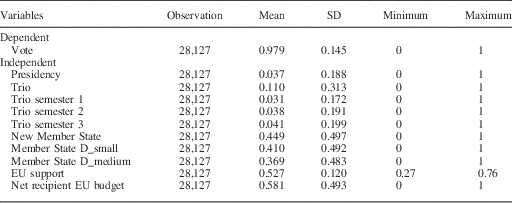
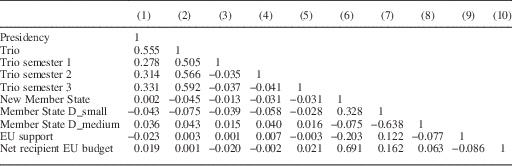
We consider four control variables that other scholars found to have an impact on Council voting: whether a Member State is “old” or “new,” its population size, Member State voter support for European integration, and whether it is a net-contributor to or net-recipient from the EU budget.Footnote 14 However, none of these variables correlate with the independent variables of interest. Thus they are not control variables strictly speaking, and do not need to be included in the analysis from a statistical point of view. Nonetheless, we include them to compare our conclusions to those of other scholars and contrast the effect of the Trio to their effect. Table A1 in the Appendix presents descriptive statistics, and Table A2 the correlation matrix of the independent variables.
The length of a Member State’s EU membership determines whether it receives the label old or new. We consider Member States that entered the EU before 2004, as old, whereas we regard the ten Member States that joined in 2004 and the three that joined later as new. Old Member States get value 0, whereas new Member States get value 1. Previous studies found that new Member States vote “No” less often. In our argument length of EU membership does not play a role.
The variable Member State size relates to a Member State’s vote weight in the Council. A higher vote weight could be expected to give a Member State more impact on Council decision-making. However, some scholars have found that large Member States vote “No” more frequently, as mentioned above, whether it be because they disagree with the majority more often or are less afraid to demonstrate their dissent in public. We divide the 28 Member States into three categories, small, medium and large, depending on their vote weights. Member States with large populations had 27–29 votes under the qualified majority rule used during the period of our analysis, the medium Member States had ten to fourteen votes, and small Member States had three to seven votes. We use two dummies to code this variable. One dummy equals 1 if the Member State is medium-sized and 0 otherwise. The other is 1 if the Member States is small and 0 otherwise. The group of large Member States is thus the reference category in the analysis.
The variable EU support measures the percentage of Member State voters that answer positively to the question whether they find EU membership a good thing. These percentages are based on Eurobarometer survey data. Standard Eurobarometer reports are published twice a year. We used data from the Spring reports, because data for EU support are not available in the Autumn reports in all years considered. The literature has found that Member States with higher support vote “Yes” more often.
The variable Net-recipient controls for the net budgetary contribution of the Member States to the EU budget, specifically whether they were net-recipients of (1) or net-contributors to (0) the EU budget in a given year, according to Commission estimates. Earlier studies have concluded that net-recipients vote “Yes” more often.Footnote 15
RESULTS
With 90 contested votes the United Kingdom is by far the most opposing Member State in the Council. It is followed by Austria (46), Germany (43) and Denmark (38). By contrast, Lithuania (5), France (7), Cyprus (7), Slovenia (10) and Romania (10) lead the Member States in opposing proposals the least often. Overall “No”-votes are rare. On average a Member State voted “No” or abstained about 22 times during the 7.5-year period studied, that is, only once for every 47 votes. The United Kingdom topped the list by contesting one proposal for about every ten that were on the agenda. In many votes only one single Member State opposed the majority. These numbers illustrate the culture of consensus in the Council, as a result of which unanimity is often reached even when qualified majority is the decision rule. Nonetheless, despite the fact that Member States individually did not oppose the majority often, almost 30 percent (296 out of a total of 1038) of all legislative acts were passed with contestation from at least one Member State.
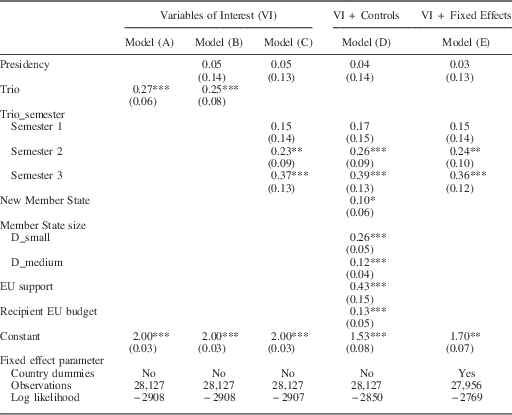
The results of the main regression analyses can be found in Table 1. In models A, B, and C we run regressions with the variables of interest only. Model A only includes the Trio variable and shows that being a member of the Trio significantly increases the likelihood of voting “Yes,” lending support to Hypothesis 1.Footnote 16, Footnote 17
Voting Behavior in the Council of the European Union (EU): Probit Regression Analyses

Note: Standard errors are clustered by legislative acts.
*p<0.1, **p<0.05, ***p<0.01.
Next, model B includes the Presidency and Trio variables. The coefficient for the Presidency variable is not statistically significant. The effect of the Trio, by contrast, is significant at the 1-percent level. Members of a Trio thus vote “Yes” more often whether or not they hold the Presidency. Moreover, the results show that whether a Member State holds the Presidency does not affect the probability that it votes in favor in addition to the effect of being a member of the Trio, lending support to Hypothesis 2. To understand voting behavior in the Council it is thus worthwhile to study Trios and the way they operate, rather than to focus on the Member State that holds the Presidency.
In model C we split the Trio terms into three semesters. The effect of the Trio increases as its term moves closer to its end, lending support to Hypothesis 3. In the first semester of the Trio the effect is relatively small and not significant. This suggests that voting then mainly occurs on issues proposed under a previous Trio. In the subsequent semester the coefficient increases and is significant at the 5-percent level. Finally, in the last semester the effect is strongest and significant at the 1-percent level.Footnote 18
Thus, our findings show that the Trio effect is mainly the result of the Trio’s agenda-setting powers. During the first six months of a Trio very few, if any, proposals are considered for final approval that were initiated or first considered in the Council during the Trio’s term. During these six months the Council gives final approval to proposals initiated and shepherded through the legislative process during earlier Trios. The Trio effect is not significant then. This indicates that the Trio members may not operate as brokers. During the two subsequent six-month periods, the Trio effect is increasingly significant. This suggests that the Trio does have agenda-setting powers and votes in favor more often as a result.
In models D and E we include the control variables and country fixed effects, respectively. The conclusions regarding the variables of interest remain the same.Footnote 19 The control variables all have the signs expected in the literature and are significant at the 1-percent level, except for length of EU membership. We see that small Member States, Member States with high voter support for EU integration, and net-recipients from the EU budget are less likely to vote against the Council majority.
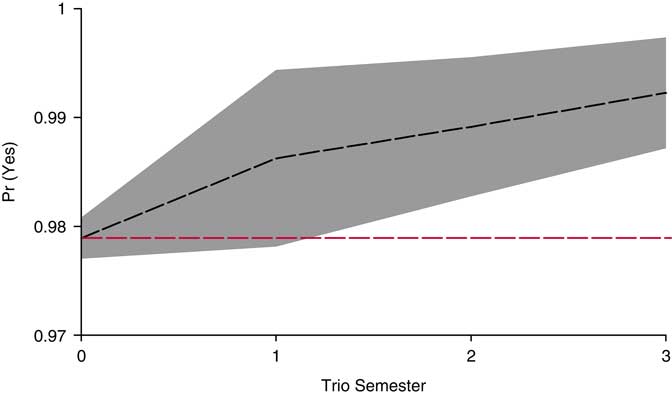
In Figure 1 we present the predicted marginal effects of being member of the Trio in the three semesters, holding the other variables from Model D constant at their means. The red line indicates the probability that a Member State votes in favor when it is not in a Trio. We see that when a Member State is in a Trio its probability of voting “Yes” goes up, but the increase does not reach statistical significance in the first Trio semester. In the second and third semesters, however, there is a significant increase in the probability of voting in favor.
The marginal effect of the Trio Note: The 95 percent confidence intervals are shown in gray.
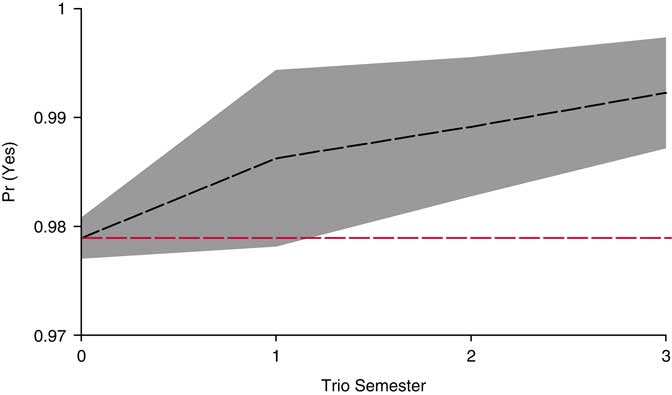
In particular, for a Member State that is not in a Trio the predicted probability of a vote in favor is 97.9 percent. During the first semester in a Trio this probability increases to 98.6, and it further rises to 99.2 in the third semester. Thus, the likelihood of voting against the majority decreases by more than 60 percent in the last Trio semester, from 2.1 to 0.8 percent. This is similar to the decrease Mattila (Reference Mattila2004) found for Presidents.
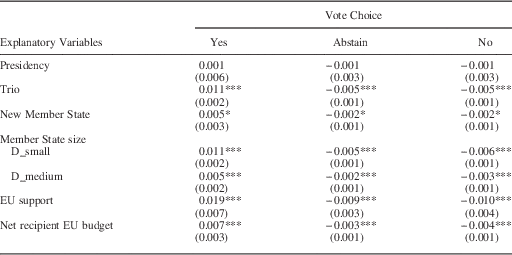
Finally, in Table 2 we distinguish abstentions from “No”-votes, and present the marginal effects of the ordered probit regression. The results for the Trio and Presidency variables remain the same as before. The effect of the Trio is significant at the 1-percent level, and the Presidency has no additional impact. When a Member State belongs to the Trio its probability of voting in favor is 1.1 percent higher than it otherwise is, while its probabilities of abstaining and voting against both are 0.5 percent lower.Footnote 20
Ordered Probit, Marginal Effects (Calculated at the Mean)
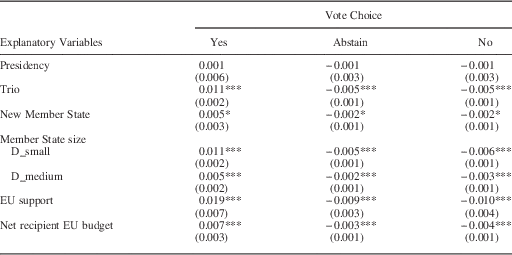
Note: N=28,127. Clustered standard errors are in parentheses.
EU=European Union.
*p<0.1, **p<0.05, ***p<0.01.
CONCLUSIONS
Empirical analyses of the effect of the Trio Presidency on voting behavior in the Council of the EU have thus far been absent in the literature. The Trios were not introduced until 2007.
In this paper, we launch a first attempt to empirically analyze the impact of the Trio on voting behavior. We use a newly constructed data set that covers the period from the introduction of the Trio in January 2007 until the end of the fifth Trio’s tenure in June 2014. Conducting probit regression analyses, we first present evidence for a moderation of Member States’ voting behavior during their time as Trio members: they vote “No” and abstain less often.
Second, we show that the six-month Presidencies have no additional impact on voting behavior. Trio members contest fewer votes even when they do not hold the Presidency. The reduction in a Member State’s “No”-votes is thus a result of its Trio membership rather than its role as President.
Finally, we find that the Trio effect is not constant during the Trio’s 18-month term, but rather increases toward the end of it. This suggests that Trio members set the agenda together and derive powers from that role. Early in a Trio’s term the Council mainly votes on proposals initiated and pushed through the legislative process under a previous Trio. There is no significant Trio effect during the first semester of a Trio’s tenure as a result. Later on the Trio effect strengthens.
This analysis is the first that studies the effect of the Trio on voting behavior. Our results show that Treaty reforms matter, and in particular that they affect voting behavior in the Council of the EU. In particular we find that, as far as their impact on voting behavior is concerned, Trios now play the role Presidents used to fulfill in the past and that this is the result of the Trio’s agenda-setting powers rather than its role as mediator. The Trios are thus powerful players and deserve more attention in the literature.
Our analysis can be expanded in the future by including more Trios, as they finish their terms and voting data become available. In addition the Trios’ impact on other aspects of EU policy-making could be analyzed, beyond their effect on voting behavior.
Furthermore some issues we briefly mentioned could be studied in more detail. For example, it would be interesting to study the impact of the Trios on Member States who are preference outliers and find themselves outvoted relatively often, such as the United Kingdom. Do the Trios affect the United Kingdom’s voting behavior? The formation of heterogeneous Trios can be considered as a way to achieve broader majorities, at a time that the increased use of qualified majority voting raises the prospects that outliers be systematically outvoted and find themselves worse off than they would if no new legislation were passed in the EU. Can the Trio system be considered as a way to keep outliers on board and prevent future Member State secessions? Can it be further developed to that effect in the aftermath of the Brexit vote?
APPENDIX
Descriptive Statistics

Correlation Matrix Independent Variables

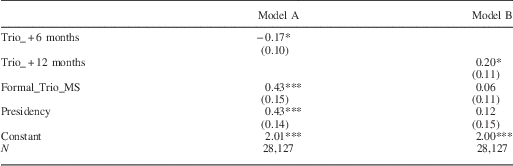
Probit Analyses With Artificial Trios