INTRODUCTION
Interventions to extend the life process can provide artificial life support for patients with chronic or acute illnesses who are expecting improvement. However, if applied to terminally ill patients (TIPs), such procedures may merely painfully prolong the process of dying.
The multidisciplinary practice of palliative care (PC) has a number of possibilities for relieving the pain and discomfort experienced by TIPs. It also provides an opportunity for such patients to take an active role in positioning themselves at the end of life, assisted by specialized professionals.
According to Maciel (Reference Maciel and Oliveira2008), the patients eligible for palliative care include those with a life expectancy of weeks to months as well as those with a prognosis ranging from hours to days.
Physicians should be prepared to limit treatment, be it in relation to decision making or to the appropriateness of management for a TIP in an intensive care unit (ICU).
The benefit obtained from medical interventions should be balanced with ethical considerations that lead to better care, according to the available resources and the overriding principles of bioethics: beneficence, non-maleficence, autonomy, and justice.
For Moritz et al. (Reference Moritz, Lago and Souza2008), the fundamental objectives of PC in the ICU are: (1) to accept death as a natural process at the end of life; (2) to prioritize the best interests of the patient; (3) to refute diagnostic and treatment futility; (4) to neither shorten life nor prolong the process of dying; (5) to ensure quality of life as much as quality of death; (6) to relieve pain and other symptoms; (7) to maintain clinical, psychological, social, and spiritual care of both patients and family members; (8) to respect the autonomy of the patient and their legal representatives; (9) to balance the cost and benefit of the medical decision; and (10) to stimulate interdisciplinary practice of care.
Furthermore, the autonomy of the patient must always be respected. Their consent or that of their legal representative should be recorded in the medical record and must precede any decision made by the medical team.
In the current context, believing that TIPs should neither occupy an ICU bed nor die in the ICU, the introduction of palliative care into the ICU may be associated with better quality of life for terminally ill patients.
Our main objective was to evaluate by means of a systematic review whether the introduction of palliative care teams reduces length of stay and mortality for terminally ill patients in intensive care units.
METHODS
Types of Studies
As we found only one small randomized clinical trial (RCT), retrospective studies were also considered.
Participants
Our participants were terminally ill adults in intensive care units.
Interventions
The intervention we employed was introduction of a palliative care team.
Control
The previous period of care, when there was no palliative care team, was utilized as our control.
Outcome Measures
Our outcome measures were (1) length of stay in the ICU, (2) mortality in the ICU, and (3) quality of life.
Search Methods
Electronic Databases
Our search included the following electronic databases: PubMed (1966 to December of 2015), Embase (1980 to December of 2015), LILACS (www.bireme.br/) (1982 to December of 2015), and Cochrane Library's Central Register of Controlled Trials (CENTRAL).
We employed the following search strategy: (“end of life care” OR “life care end” OR “life care ends” OR “terminal care”) AND (“intensive care unit” OR “intensive care units”) AND (“palliative care” OR “palliative treatment” OR “palliative treatments” OR “palliative therapy” OR “palliative surgery”).
Out search strategy was specifically adapted for each database. No restrictions were placed on language or publication status.
Searching Other Resources
The reference lists of relevant publications found in our search were screened for further studies, and experts in the field were contacted.
Data Collection and Analysis
Study Selection
Studies were grouped and duplicates removed. The titles and abstracts were examined to remove irrelevant items. We then recovered the full text of potentially relevant articles, which were examined by two reviewers to assess eligibility. The final decisions on inclusion into the study and data collection were made. Any disagreements were resolved by discussion. If a consensus was not reached, the opinion of the third author was decisive.
Data Extraction and Management
The details of the eligible studies were extracted independently and summarized. Two reviewers independently extracted all the data relating to the interventions studied. Disagreements were again resolved by discussion.
Assessment of Risk of Bias in Included Studies
If RCTs were recovered, we planned for two of our authors to independently evaluate each paper. As only one small RCT was found, the included studies were considered as having a high risk of bias, since they were observational retrospective studies covering different time periods.
Measures of Treatment Effect
Dichotomous outcomes were presented as risk ratios with a corresponding 95% confidence interval (CI 95%). For continuous outcomes, the average difference was analyzed with a corresponding CI 95%.
Statistical heterogeneity was primarily assessed using the I 2 test, which examines the percentage of total variation between studies due to heterogeneity rather than chance. Values of I 2 < 40% indicated a low level of heterogeneity and justified the use of a fixed-effect model for metaanalysis; values of I 2 between 30 and 60% were considered moderate, and a random-effects model was used; and values of I 2 > 75% indicated a high level of heterogeneity, in which case metaanalysis was not deemed appropriate. We assumed that statistical, methodological, and clinical heterogeneity would be present (Deeks et al., Reference Deeks, Higgins, Altman, Higgins and Green2008).
Data Synthesis
For the outcome “mortality in the ICU,” as the heterogeneity was not great (I 2 < 40%), we employed a fixed-effect model according to the Mantel–Haenszel method for metaanalysis (Mantel & Haenszel, Reference Mantel and Haenszel1959). For “length of stay in the ICU,” as the heterogeneity was high, metaanalysis was not proper. Mean differences were presented between the intervention and control groups in the studies. We utilized the Cochrane program (RevMan 5.3) for the metaanalyses.
RESULTS
Description of Studies
Results of the Search
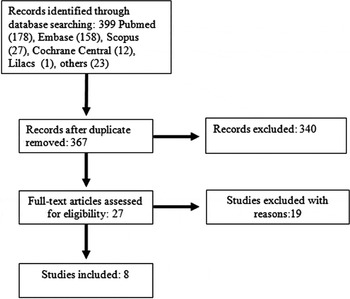
Conducted in December of 2015, the search recovered 399 papers. After exclusion of duplicates and analysis of titles and abstracts, 27 articles were selected, all of which were completely examined, and 8 which were selected for our review (Figure 1).
Flowchart for selection of included studies.

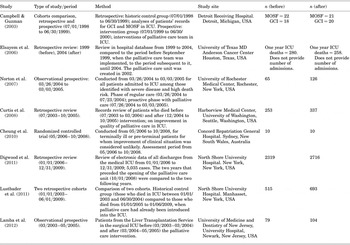
The main characteristics of the selected studies are summarized in Table 1. The 8 included studies involved 7.846 participants. Seven of the studies were observational in nature and compared retrospective data before and after implementation of a palliative care team. Only one small study with 20 participants (Cheung et al., Reference Cheung, Aggarwal and Fugaccia2010) was randomized.
Characteristics of the included studies

Types of Interventions
The interventions implemented by a PC team can be summarized as follows: offering family support, collecting perceptions of family members, encouraging family involvement in decision making, offering palliative care consultations in the ICU, and, when possible, transferring the patient to a PC unit. Only one study intended to improve medical care and quality of life with their intervention (Curtis et al., Reference Curtis, Treece and Nielsen2008).
Outcomes Measured
Campbell and Guzman (Reference Campbell and Guzman2003): in-hospital mortality; length of stay in the ICU; time interval from ICU admission to do-not-resuscitate (DNR); time between identification of critical condition and establishment of PC; time between identification of critical condition and death.
Elsayem et al. (Reference Elsayem, Smith and Parmley2006): mortality in the ICU and hospital wards in relation to global mortality in the hospital; length of stay in the ICU and hospital wards.
Norton et al. (Reference Norton, Hogan and Holloway2007): length of stay in the hospital and in the ICU; in-hospital and ICU mortality rate.
Curtis et al. (Reference Curtis, Treece and Nielsen2008): length of stay in the ICU; evaluation of quality of death; assessment of satisfaction experienced by family members and nurses.
Cheung et al. (Reference Cheung, Aggarwal and Fugaccia2010): mortality in the ICU and hospital; number of consultations by the PC team; mean length of hospital and ICU stays; satisfaction of patients, family members, and care team.
Digwood et al. (Reference Digwood, Lustbader and Pekmezaris2011): mortality and length of stay in the ICU.
Lustbader et al. (Reference Lustbader, Pekmezaris and Frankenthaler2011): length of stay in the ICU; hospital length of stay; number of patients with DNR status; number of patients with respiratory failure along with mechanical ventilation.
Lamba et al. (Reference Lamba, Murphy and McVicker2012): mortality in the ICU; rate of designation of DNR; duration of such determination; length of stay in the ICU.
A description of the included studies is provided in Table 1.
Excluded Studies
A total of 19 studies were excluded: 5 had conflicting objectives for the PC intervention in the ICU (Lin et al., Reference Lin, Chiu and Hsu2009; Lim et al., Reference Lim, Nam and Kim2013; Obermeyer et al., Reference Obermeyer, Makar and Abujaber2014; Kross et al., Reference Kross, Engelberg and Downey2014; Binney et al., Reference Binney, Quest and Feingold2014), and 14 employed an inappropriate methodology (Lonberger et al., Reference Lonberger, Russell and Burton1997; Nelson & Danis, Reference Nelson and Danis2001; Mularski & Osborne, Reference Mularski and Osborne2003; Paice et al., Reference Paice, Muir and Shott2004; Lloyd et al., Reference Lloyd, Nietert and Silvestri2004; Sprung et al., Reference Sprung, Ledoux and Bulow2008; Klein et al., Reference Klein, Heckel and Treibig2012; Strand & Billings, Reference Strand and Billings2012; Aslakson et al., Reference Aslakson, Curtis and Nelson2014; Hui et al., Reference Hui, Kim and Roquemore2014; Naib et al., Reference Naib, Lahewala and Arora2015; Barnato et al., Reference Barnato, Mohan and Lane2014; Jang et al., Reference Jang, Krzyzanowska and Zimmermann2015; Kim et al., Reference Kim, Friedman and Gracely2015).
Effects of Interventions
Length of Stay in the ICU
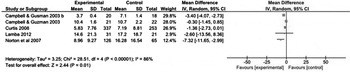
Length of stay in the ICU was presented as a mean and standard deviation in four studies. Two types of patients were evaluated in the study by Campbell and Guzman (Reference Campbell and Guzman2003): those with multiple organ system failure (MOSF) and those with global cerebral ischemia (GCI), with averages and standard deviations provided separately. A total of 81 patients were analyzed (43 with MOSF, 38 with GCI). Some 191 patients were presented by Norton et al. (Reference Norton, Hogan and Holloway2007), 590 by Curtis et al. (Reference Curtis, Treece and Nielsen2008), and 52 by Lamba et al. (Reference Lamba, Murphy and McVicker2012), for a total of 914 patients. There was a significant reduction of ~2.5 days in length of stay with application of the PC team intervention (average = –2.44 days, CI 95% = –4/41 to –0.48, p = 0.01). However, since there was considerable between-study heterogeneity (I 2 = 86%), a metaanalysis was not appropriate (Figure 2).
Length of stay in the ICU before and after implementation of a palliative care team.

In the study by Cheung et al. (Reference Cheung, Aggarwal and Fugaccia2010), length of stay in the ICU was given as a median and interquartile range (IQR): control with no intervention (n = 10), median = 5 (8) days; intervention group (n = 10), median = 3 (7) days. Digwood et al. (Reference Digwood, Lustbader and Pekmezaris2011) presented length of stay as an average but did not provide a standard deviation: before (n = 2,319, average = 4.6 days) and after (n = 2,716, average = 4 days). Elsayem et al. (Reference Elsayem, Smith and Parmley2006) presented their results as a median and as a minimum and maximum value for each patient who died in the ICU: for the year 1999 (before), n = 280, median = 12 days (1–75); for 2004 (after), n = 258, median = 11 days (1–156). Lustbader et al. (Reference Lustbader, Pekmezaris and Frankenthaler2011) presented their results as a median: 4 days both before (n = 515) and after (n = 693).
ICU Mortality
It was possible to conduct metaanalysis on mortality in the ICU for four studies: Norton et al. (Reference Norton, Hogan and Holloway2007), Cheung et al. (Reference Cheung, Aggarwal and Fugaccia2010), Digwood et al. (Reference Digwood, Lustbader and Pekmezaris2011), and Lamba et al. (Reference Lamba, Murphy and McVicker2012) (comprising a total of 5.429 patients). Mortality was significantly lower in the intervention groups: risk ratio = 0.78, CI 95% = 0.70–0.87, p < 0.00001, with little heterogeneity between studies (I 2 = 18%). The number needed to treat to prevent one death in the ICU was 23 (Figure 3).
Metaanalysis of mortality rates in the ICU before and after implementation of a palliative care team.

In the study by Elsayem et al. (Reference Elsayem, Smith and Parmley2006), the ICU mortality rate was given in relation to global mortality in the hospital, while the other studies—Campbell and Guzman (Reference Campbell and Guzman2003), Curtis et al. (Reference Curtis, Treece and Nielsen2008), and Lustbader et al. (Reference Lustbader, Pekmezaris and Frankenthaler2011)—did not present this outcome.
Quality of Life in the ICU
The study conducted by Curtis et al. (Reference Curtis, Treece and Nielsen2008) was the only one that considered quality of life in the ICU as an outcome. They utilized an instrument called the Quality of Dying and Death Questionnaire, which was administered to family members. However, they found no significant difference for this outcome before and after the intervention.
DISCUSSION
Summary of Main Results
From the studies analyzed, there is evidence that the introduction of palliative care teams can reduce mortality in the intensive care unit, as well as decrease length of stay. However, the great heterogeneity among our studies renders the evidence for the second outcome very weak.
Completeness and General Applicability of the Evidence
Most of the included studies examined length of stay, but some presented this outcome as a median or average without a standard deviation, which made inclusion in the metaanalysis impossible. Although the metaanalysis demonstrated a significant reduction in length of stay in the ICU, the heterogeneity among studies was very high, thus affecting the credibility of the metaanalysis.
Mortality in the ICU was analyzed in five studies (Elsayem et al., Reference Elsayem, Smith and Parmley2006; Norton et al., Reference Norton, Hogan and Holloway2007; Cheung et al., Reference Cheung, Aggarwal and Fugaccia2010; Digwood et al., Reference Digwood, Lustbader and Pekmezaris2011; Lamba et al., Reference Lamba, Murphy and McVicker2012), but one of them presented the percentage of all hospital deaths (Elsayem et al., Reference Elsayem, Smith and Parmley2006), so that it was not possible to include this study in the metaanalysis. Since mortality in the ICU was reduced in the metaanalysis due to the results of only a single study (Digwood et al., Reference Digwood, Lustbader and Pekmezaris2011), the general applicability of this evidence that implementation of a palliative care team can reduce mortality in the ICU is weakened.
In addition, four studies included a retrospective review of the data gathered from medical records, another compared two cohorts (retrospective and prospective), one was a randomized controlled trial, and one was a prospective observational study, which weakens our evidence even further.
Quality of the Evidence
The included studies were considered to have a high risk of bias, since most presented retrospective data in their analysis, thus lowering the quality of their evidence.
Potential Bias in the Review Process
We are confident that the comprehensive survey of the literature employed in our review captured most of the relevant studies published and minimized the likelihood that we missed any relevant publications.
However, there is the possibility that the included studies are the ones that show the effects of the intervention in a weak manner, which constitutes another potential source for weakening of the evidence.
Agreements and Disagreements with Other Studies or Reviews
No reviews on the subject were found, and nearly all of the articles that studied the outcomes evaluated in our review showed a trend toward reduction in length of stay in the ICU, as well as lower mortality. The one exception was the research by Lamba et al. (Reference Lamba, Murphy and McVicker2012), which found a trend toward higher mortality in the intervention group.
The study by Kim et al. (Reference Kim, Friedman and Gracely2015) at first appeared to be dissonant with the findings of our review. This is a retrospective analysis of patients admitted to the ICU from July to October 2010 who received a PC consultation, compared to those who did not. Some 41 palliative care patients were considered, and 80 patients not in PC were chosen for comparison. The PC patients had longer ICU stays (8 days, IQR = 4–15 vs. 4 days, IQR = 2–7 days, p < 0.001) and higher mortality rates (64.3 vs. 12.5%, p < 0.001). These results appear to disagree with our review, but one must take into consideration that the PC patients were older (64 ± 19.2 vs. 55.6 ± 14.5 years, p = 0.021) and had more comorbidities than the no-PC patients. Palliative care patients usually stay longer in the ICU and tend to have higher mortality rates than less seriously ill individuals.
CONCLUSIONS
The studies analyzed suggest that implementation of PC teams can reduce the suffering of patients receiving end-of-life care in an ICU and that of their family members, as this intervention leads to reduced mortality rates in the ICU and perhaps shorter lengths of stay. Transferring patients in end-of-life care from ICUs to palliative care units seems to generate a reduction in the use of costly procedures and intensive monitoring, and thus leads to overall cost savings, making effective management of the pain and suffering of patients and family members at the end of life more possible.
Implications for Practice
The examined studies point toward decreased mortality and perhaps reduced length of stay in an ICU via implementation of palliative care. This may represent a reduction in the use of nonbeneficial resources and concomitantly represent savings in treatment costs, aside from fostering the possibility of making more ICU beds available for patients whose needs are greater.
Implications for Research
The literature is still scarce when it comes to quantitative studies that analyze family satisfaction, quality of life, length of stay, and mortality with the use of a palliative care team for terminally ill patients in an intensive care unit. Further high-quality studies are needed to adequately address this issue.
ACKNOWLEDGMENTS
Our research was conducted at the Botucatu School of Medicine at São Paulo State University, Universidade Estadual Paulista, São Paulo, Brazil.
CONFLICTS OF INTEREST
The authors hereby declare that they have no potential conflicts of interest with respect to the research, authorship, and/or publication of this article.