Politics rather than historical research has guided a great portion of Taiwan's written ‘history’ during the past several decades. Only with Taiwan's democratization – beginning with the accession of Lee Teng-hui 李登煇 to the presidency in the 1988 – have scholars begun to re-evaluate Taiwan's history as a Dutch, Spanish, Chinese, Manchu, and Japanese colony from 1624 until 1988. Only with democratization has Taiwan begun a process of decolonization and Taiwanization.
This paper began with the topic, ‘Whither Taiwanization?’ In order to know where a people are headed, we must know where there are. And in order to know where they are, we must know from where they came. Thus, we begin with Taiwan's history, then explore Taiwanization at present, before finally considering the future.
Early Taiwan history
In examining Taiwan's history, let us first eliminate a prominent – but false – political view. In its White Paper issued in August 1993, the government of the People's Republic of China declared, ‘Taiwan has belonged to China since ancient times’ [original emphasis] (Taiwan Question, 1993). The February 2000 White Paper reiterated this line (One-China, 2000). The Chinese Nationalist or Kuomintang 國民黨 (KMT) authoritarian regime under Chiang Kai-shek 蔣介石 and Chiang Ching-kuo 蔣經國 made similar claims, ‘In history and culture, Taiwan is an integral part of continental China’ (China Yearbook, 1970: 94). These are Chinese colonial perspectives, but they lack any historical basis. In fact, neither the Chinese Nationalist Party nor the Chinese Communist Party even claimed Taiwan as part of China until 1942 (Wachman, Reference Wachman2007: 69–99).
Before the arrival of the Dutch in 1624, Taiwan was an island inhabited by its Austronesian aboriginal population. From about 7,000 to 5,000 BP (before present), Taiwan had only its Ta-pen-k'eng culture, which was distributed widely on the island. This culture's ‘primary means of transportation may still have been boats and rafts, and perhaps it also travelled back and forth to P'eng-hu, Fukien and the Guang-dong coast’ (Liu, Reference Liu and Blundell2009: 383). At the time, Han Chinese did not live in those places. From 3,500 to 2000 BP, the Ta-pen-k'eng culture spread widely throughout Taiwan and ‘these cultures had become quite variegated, as each showed different modes of coping with their environment . . . [By 2000 BP, the] level of diversity already approaches what is found in ethnological records’ (Liu, Reference Liu and Blundell2009: 383).
Pre-historic Taiwan became the source of one of the greatest migrations in human history, the spread of the Austronesian people from Taiwan to virtually every inhabitable island in the Pacific including New Zealand and all the way across the Indian Ocean to Madagascar.Footnote 1 Both biological and linguistic evidence confirm the Taiwan origins of the world's Austronesian peoples (Renfrew, Reference Renfrew2009; Gray et al., Reference Gray, Drummond and Greenhill2009; Moodley et al., Reference Moodley2009).
When the Dutch arrived in 1624, they found very few Chinese – and no permanent Chinese communities – in Taiwan. Estimates suggest at most several hundred to about 1,500 Chinese (Blussé, Reference Blussé, Kooiman, van den Muizenberg and van der Meer1984; Shepherd, Reference Shepherd1993: 85; Chiu, Reference Chiu2008: 28) came temporarily to Taiwan for three main purposes: fishing, trade with aborigines, and piracy. While in Taiwan, these Chinese lived in aboriginal villages. When the Spanish later came to northern Taiwan, they found virtually no Chinese there (Andrade, Reference Andrade2008: 83). Historically, Taiwan had been quite separate from China. While occasionally Chinese had visited Taiwan, Taiwan remained well outside Chinese imperial boundaries (Dreyer, Reference Dreyer and Chow2008; Tsai, Reference Tsai2009: 3–7). It was the Dutch who brought substantial numbers of Chinese to Taiwan to till the land, provide labor, and even to hunt deer (Andrade, Reference Andrade2008: 115–132). According to Keliher, by 1640 the total population of Chinese in Taiwan was 4,995, a number that increased to 15,000 in 1650 and 35,000 in 1661 with a maximum of 50,000 when the Dutch left in 1662 (Keliher, Reference Keliher2003: 98). Chiu gives somewhat higher estimates, 10,000–11,000 Chinese in Taiwan in 1640 and 20,000 adult male Chinese in 1648 (Chiu, Reference Chiu2008: 150).
Taiwan's colonial history
In recent years, this writer has argued that from the establishment of the Dutch colony in 1624 until the death of Chiang Ching-kuo in 1988, Taiwan was ruled by six colonial regimes: (i) the Dutch (1624–1662), (ii) the Spanish (1626–1642), who ruled in north Taiwan simultaneously with the Dutch, (iii) the Cheng family (1662–1683), (iv) the Manchu Ch'ing empire (1683–1895), (v) the Japanese (1895–1945), and (vi) the authoritarian Chinese Nationalist regime (1945–1988) (Jacobs, Reference Jacobs and Chow2008b; Jacobs, Reference Jacobs2012). In fact, this analysis was not new. Su Beng 史明 made this very point in his path-breaking history of Taiwan first published in Japanese in 1962 (Shi Mei 史明, 1962) and later published with revisions in Chinese (Shi Ming 史明, Reference Ming1980), and again, in a greatly abridged version, in English (Su Bing, Reference Bing1986).
What is a colonial regime? The writer simply defines the term: ‘a colonial regime is ruled by outsiders for the benefit of the outsiders’. This definition fits all of the six cases of Taiwan. Colonial regimes may also include migrants from the colonial motherland. Thus, from about 1909 until independence in 1962, 10% of Algeria's population were French colons.Footnote 2 In Taiwan during the Japanese colonial period, the Japanese accounted for 6% of the population (Chen, Reference Chen1970: 144n35) and under the Chinese Nationalists, Mainlanders accounted for 10–15% of the population.
Taiwan was not a ‘settler’ (qianzhanzhe 遷佔者) state. A ‘settler state’ means the arrival of substantial numbers of outsiders who subjugate the indigenous peoples, but who then run the state themselves. Thus, good examples of ‘settler states’ include the United States, Canada, Australia, and New Zealand. When substantial numbers of people migrated from China to Taiwan and subjugated the aboriginal peoples, at least to some extent, these very same migrants were still subject to rule by Dutch, Chinese, Manchu, Japanese, and again Chinese rulers who separated themselves from society at large. When the Chinese Nationalists arrived after 1945, they systematically oppressed both the aborigines and the Taiwanese who had arrived before 1895. Outsiders controlled the locals for the benefit of the outsiders. Thus, the writer strongly disagrees with the arguments of Ronald Weitzer that Taiwan is a settler state (Weitzer, Reference Weitzer1990: 24–27, 31–32, 255).Footnote 3 Rather, until early 1988, it was a colonial state.
No one will have difficulty with characterizing the Dutch, Spanish, and Japanese regimes as colonial. This leaves the Cheng family, the Manchus, and the Chinese Nationalists under Chiang Kai-shek and Chiang Ching-kuo as potentially more interesting cases.
The Cheng family regime as colonialists
Cheng Ch'eng-kung 鄭成功, also known as Koxinga 國姓爺, and his father, Cheng Chih-lung鄭芝龍, also known as Nicolas Iquan, had run huge trading empires from their bases in southern Fujian. With the fall of the Ming, Cheng Ch'eng-kung remained loyal – at least on the surface – and helped the Southern Ming continue its rebellion in southern China.Footnote 4 In other words, Cheng Ch'eng-kung did want to ‘restore the Ming’ and he did have some successes fighting against the Manchus until his failure to take Nanjing in 1659. But, Lynn Struve, the specialist in the Southern Ming, raises some questions about the relationship between the Southern Ming and Cheng Ch'eng-kung:
[I]n effect [Cheng's administration] constituted a special government for a special zone . . . it was his organization. The Yung-li court always was far away, and communications between the emperor and Cheng were both slow and intermittent. So, although Cheng was faultlessly conscientious on a formal level about remaining a loyal servant of the throne . . . actually he was free to do as he saw fit and, in effect, was king in his own sizable domain . . . Thus, in the Southeast the symbolic presence but actual absence of a Ming court gave Cheng Ch'eng-kung the flexibility and independence that he needed to successfully conflate his own interests with those of the Ming, and to perform at his best for the loyalist cause. (Struve, Reference Struve1984: 154, 156)
The last Ming pretender, the Yung-li 永曆 emperor, died in Yunnan probably on 19 or 25 May or 11 June 1662 (Struve, Reference Struve1986: 69). The Dutch surrendered to Cheng Ch'eng-kung on 1 February 1662, so the last Ming pretender was still alive when Cheng Ch'eng-kung took over Taiwan.Footnote 5 Cheng Ch'eng-kung died of illness at the age of 39 on 23 June 1662 (Crozier, Reference Crozier1977: 16), just a short time after the last Ming pretender died. The cause of his death remains unclear, but Tonio Andrade makes a good case that it might have been from tertiary syphilis (Andrade, Reference Andrade2008: 214, 224n42). In any case, Cheng seems to have become insane before he died (Wills, Reference Wills1974: 27–28).
Was Cheng Ch'eng-kung's decision to attack Taiwan on 1 May 1661 a simultaneous renunciation of his loyalties to the Ming? Tonio Andrade raises this question (Andrade, Reference Andrade2008: 238, 248n43) and cites John E. Wills as a source (Wills, Reference Wills1994: 228–229). Lynn Struve too raises questions:
[I]n the early spring of 1661 Cheng pressed his commanders to accept a proposal about which theretofore they had been unenthusiastic, that is, to remove the Cheng base to T'ai-wan. Again, few were happy about this, and one commander was punished for openly expressing what was on the others’ minds: that T'ai-wan was a wild, inhospitable, disease-ridden place too far at sea. Cheng's mind was set, however, because he needed a territory that was large and more secure from the Ch'ing, but which still was located proximate to the major East Asian maritime trade routes. (Struve, Reference Struve1984: 190)
In any case, the successors of Cheng Ch'eng-kung basically lost control of all their Mainland territory except for a small bit around Xiamen. They continued to build a commercial empire that traded widely (Wills, Reference Wills and Rubinstein1999: 100). In the words of a well-known Taiwan historian, the Cheng family operated ‘with the status of an independent nation and conducted foreign relations with Japan, Holland, Spain, England and other countries’ (Huang Fusan 黃富三, n.d.: 18). The Cheng regime also used Dutch colonial institutions, though they raised taxes. (The Chinese Nationalists did a similar thing following the defeat of the Japanese in 1945.) Finally, the Cheng regime at most doubled the population of Chinese in Taiwan from 30,000–50,000 to 50,000–100,000 (Wills, Reference Wills and Rubinstein1999: 33). With an aboriginal population of about 100,000 (Andrade, Reference Andrade2008: 30; Shepherd, Reference Shepherd1993: 7, 14), the Cheng regime constituted a minority of outsiders who ruled Taiwan.
The Manchus as colonialists
The Cheng regime fell in 1683 when the Manchus conquered Taiwan as part of their suppression of the Rebellion of the Three Feudatories (sanfan zhi luan三藩之亂) in southern China.Footnote 6 Cheng Ch'eng-kung's son, Cheng Ching 鄭經, had intervened on the side that opposed the Manchus. Originally, the Ch'ing 清 ‘court had never intended to send forces overseas but, in the aftermath of the rebellion, the Manchu rulers began devising a plan to eliminate’ Cheng Ching (Huang, Reference Huang2005: chapter 4, p. 3). In 1683, the powerful Manchu K'ang-hsi 康熙 Emperor himself declared that Taiwan had never belonged to either the Manchus or China: ‘Taiwan is a small pellet of land. There is nothing to be gained by taking it, and no losses in not taking it’ (Hsueh Hua-yuan et al., Reference Hsueh Hua-yuan and Mei-li2005: 56; Xue Hua-yuan 薛化元 et al., Reference Jintao2005: 59).Footnote 7 His son, the Yung-cheng 雍正 Emperor, stated in 1723: ‘From ancient times, Taiwan has not been part of China. My holy and invincible father brought it into the territory’ (Hsueh Hua-yuan et al., Reference Hsueh Hua-yuan and Mei-li2005: 132; Xue Hua-yuan 薛化元 et al., Reference Jintao2005: 135).Footnote 8
Most people who assert that Taiwan is ‘Chinese’ focus on the two centuries of Manchu control from 1683 to 1895. The Manchu empire was administratively and ideologically very complex. Its rulers were all Manchus as were many of its high officials. Manchus, for example, dominated the Grand Council (Crossley, Reference Crossley1999: 14n24). As Han Chinese accounted for over 90% of the empire's population, many high officials were naturally Chinese, but the ultimate sources of power rested with the Manchus, not with Chinese.
At the end of the eighteenth century the Qing empire encompassed an area twice the size of Ming China . . . The court handled this expansion in a range of fashions without any one model of incorporation and administration. Differentiation and heterogeneity came to be the keys to the division of space within the empire. As a conquest dynasty, Qing political culture and institutions derived as much from the traditions of Inner Asia as they did from traditional Confucian political theory. (Tighe, Reference Tighe2005: 21)
China, like Taiwan and many other places in East and Central Asia, had become part of the multinational Manchu Empire. And, Manchu rule in China differed from Manchu rule in Taiwan in at least a few respects such as the terms of office of local officials (Guy, Reference Guy2007).
As suggested by the statement of the K'ang-hsi Emperor quoted above, Ch'ing attitudes toward Taiwan remained ambivalent over their two centuries of rule. According to John Shepherd, ‘even after paying a high price to defeat the rebel Cheng regime, the court still had to be convinced that the strategic importance of Taiwan justified retaining the revenue-poor island within the empire’ (Shepherd, Reference Shepherd1993: 408). In Taiwan, ‘the state was saved the expense of initial pacification of the natives . . . because it inherited the system of taxation and control created by the Dutch and continued by the Chengs’ (Shepherd, Reference Shepherd1993: 409). This substantially reduced the costs of administering Taiwan, yet in its first century of rule, Ch'ing administration remained limited to the western plains of Taiwan (Shepherd, Reference Shepherd1993: 178–214, esp. maps 7.1–7.3, 188, 192–193, 196–197).
The situation changed somewhat early in the nineteenth century when Han migration into the isolated Ilan plain in Taiwan's northeast ‘began suddenly and on a large scale’. Ch'ing government administration only arrived in 1810 after Han Chinese colonization of the Ilan plain was well under way (Shepherd, Reference Shepherd1993: 358–359). Yet the Ch'ing government still did not claim the ‘uncivilized’ parts of Taiwan. This became clear when the Ch'ing government refused responsibility for protecting foreign seamen whose ships were wrecked in aboriginal areas of Taiwan.
In 1867, an American ship ran aground off Pingtung in southern Taiwan and aborigines killed most of the surviving crew. The US consul at Xiamen, General Charles William LeGendre, signed a treaty with the aboriginal Chief Tauketok rather than with the Ch'ing government (Huang, Reference Huang2005: chapter 5, p. 6).Footnote 9
In late 1871, matters became even more serious when Taiwan aborigines killed 54 shipwrecked Ryukyuan sailors. When the Ch'ing said that ‘it could not be held responsible for the behavior of [Taiwan] aborigines, because it always allowed them large measures of freedom and never interfered in their internal affairs’, Japan responded, ‘sovereignty over a territory was evidence[d] by effective control; since China [the Ch'ing] did not control the Formosan aborigines, they were clearly beyond its jurisdiction’ (Hsu, Reference Hsu1983: 316). It is clear that different people in the Ch'ing government had different perspectives. Li Hung-chang 李鴻章 wanted to accept responsibility for the actions of the Taiwan aborigines, but in July 1873, another group of Ch'ing leaders informed the Japanese foreign minister ‘that China [the Ch'ing] claimed no control over the savage tribes in the mountainous eastern half of Formosa’ (Morse, Reference Morse1918: 271).
In summary, the Ch'ing ‘record there [Taiwan] since the mid-eighteenth century was one of corrupt but minimal government, punctuated by periodic suppression of uprisings. The shelling of Keelung by British ships during the Opium War and the opening of Tamsui and Ta-kao (the present Kaohsiung) as treaty ports in the early 1860s barely began to awaken Peking to the importance of the island’ (Liu and Smith, Reference Liu, Smith, Fairbank and Liu1980: 260). The ensuing Japanese invasion of 1874–1875, as well as the later French attacks on Taiwan during Ch'ing-French war of 1884–1885, ‘did . . . convince a few statesmen of the urgent need to strengthen its [Taiwan's] defences’ (Liu and Smith, Reference Liu, Smith, Fairbank and Liu1980: 260). The Ch'ing established new administrative units in 1875 and 1887 (Shepherd, Reference Shepherd1993: 360) and made Taiwan a province in 1885 (Yang Bichuan 楊碧川, Reference Bichuan1997: 259). Nevertheless, despite this apparent last minute appreciation of Taiwan by at least some Ch'ing officials, such a view was apparently not unanimous. In the words of Taiwan's President Lee Teng-hui, at the end of the Ch'ing–Japan War in 1895, the first thing the Ch'ing Dynasty negotiators gave the Japanese was Taiwan. According to Lee Teng-hui, Li Hung-chang, the Ch'ing Dynasty lead negotiator, ‘implied he did not want Taiwan as it was land beyond civilization (huawai zhi di 化外之地)!’ (Shiba Ryōtarō 司馬遼太郎, Reference Ryōtarō1994: 489).Footnote 10 A Japanese source confirms that Li Hung-chang ‘surrendered nothing which he was not prepared and glad to get rid of, except the indemnity. He always considered Formosa [Taiwan] a curse to China and was exceedingly pleased to hand it over to Japan, and he shrewdly guessed that Japan would find it a great deal more trouble than it was worth’ (Hayashi, Reference Hayashi1915: 57 as quoted in Paine, Reference Paine2003: 291–292).
This analysis suggests two key points about Ch'ing control of Taiwan. First, Ch'ing control was – at best – loose, ‘minimal’, and partial. Substantial parts of Taiwan remained outside of Ch'ing control throughout whole period of Ch'ing rule in Taiwan (1683–1895). Secondly, this partial Ch'ing control was not Chinese, but Manchu. Thus, despite administration by some officials of Han Chinese ethnic origin, for Taiwan the Ch'ing period was another period of foreign colonial rule.
The Chinese Nationalists under Chiang Kai-shek and Chiang Ching-kuo as colonialists
As noted earlier, few would have difficulty characterizing the Japanese regime (1895–1945) as colonial.Footnote 11 Comparing the Japanese colonial regime with the Chinese Nationalist colonial regime (1945–1988) that replaced it, we find that the two regimes shared at least six characteristics in terms of their nature and in terms of the timing of their policies.
First of all, both regimes considered the Taiwanese natives to be second-class citizens and both systematically discriminated against the Taiwanese. Under the Japanese, for example, a Taiwanese never held a position above head of county (gun 郡) (Chen, Reference Chen1970: 134). In October 1934, after almost 40 years of colonial rule, the Japanese finally unveiled their ‘long-awaited reform of local autonomy’, but this ‘outraged the Formosans . . . because what had been granted was, in essence, a rigged system in favor of Japanese residents’ (Chen, Reference Chen1972: 493–494). Similarly, when the Chinese Nationalist Party took over from the Japanese in late 1945, Taiwanese were excluded from many jobs in both central and local government. In addition, under both Chiang Kai-shek and his son, Chiang Ching-kuo, Mainlanders, who account for less than 15% of Taiwan's population, always had a majority in the Cabinet and in the Chinese Nationalist Party's Central Standing Committee (Wu, Reference Wu1995: 44, 103). Right until the death of Chiang Ching-kuo, no Taiwanese ever held the position of Premier or Minister of Foreign Affairs, National Defence, Economics, Education, Finance, or Justice (Nianbiao, 1994: 231–233), Director of the Government Information Office or Chairman of the Economic Planning Commission or any senior military or security position. At least until 1983, no Taiwanese had ever such key Kuomintang positions as Secretary-General or Director of the Organization, Youth, Policy, and Culture departments (Lan Yiping 籃一平, Reference Yiping1983: 11–12).
Secondly, both regimes clamped down very hard at first, killing tens of thousands of Taiwanese. Davidson estimates that close to 8,000 Taiwanese died resisting the Japanese in 1895 (Davidson, Reference Davidson1903: 365–366). Lamley says that the Japanese killed 12,000 Taiwanese ‘bandit-rebels’ during 1898–1902 (Lamley, Reference Lamley and Rubinstein1999: 207), while a Japanese source states that the Japanese colonial regime executed over 32,000 ‘bandits’, more than 1% of Taiwan's population, in the same period (Ito, Reference Ito2004: 138–139). In March 1947, as a result of the 28 February 1947 uprising, Kuomintang armies came from the Mainland and slaughtered from 10,000 to 28,000 of Taiwan's leaders and educated youth.
Third, both regimes continued to rely on oppression for about 25 years. During the Japanese colonial period, this was a period of military governors, strong rule through the police, and continued repression. From 1907 to 1915, more than 800 Taiwanese were executed (Lamley, Reference Lamley and Rubinstein1999: 211). According to official figures, during the White Terror of the 1950s, the Kuomintang executed 1,017 people and during the whole period of martial law from 1950 to 1987 some 3,000 to 4,000 people were executed for political offenses (Qiu Rongju 邱榮擧, Reference Rongju and Yingtai 陳英泰2005: xiii).
Fourth, owing to international and domestic circumstances, both colonial regimes ‘liberalized’ after about a quarter century. Toward the end of World War I, Woodrow Wilson gave his speech about ‘self-determination’ and the Koreans had a major revolt called The March First (1919) Movement. The liberalization under ‘Taisho 大正 democracy’ at this time enabled public discussion in Japan of various policies. These discussions began to influence Japan's colonial policies in Taiwan and led to the appointment of civilian governors from October 1919 until September 1936. While police repression continued, this was also the period when Taiwanese, often in cooperation with liberal Japanese, began their political movements (Chen, Reference Chen1972). Similarly, under the Chinese Nationalist Party, in the early 1970s with Taiwan's defeat in the United Nations, the Diaoyutai 釣魚台 movement, the activities of The Intellectual Magazine (Daxue zazhi 大學雜誌), and the promotion of Chiang Ching-kuo to the premiership in 1972, Taiwan began to liberalize (Jacobs, Reference Jacobs2010b: 440–456; Jacobs, Reference Jacobs2012: 44–57).
Fifth, as both regimes came under pressure, they again stepped up repression. Under the Japanese the repression came with World War II, the appointment of military governors in 1936, and the push toward assimilation under the kōminka 皇民化 movement.Footnote 12 Under the Kuomintang, repression occurred following the Kaohsiung Incident of 10 December 1979.
Finally, both regimes tried to make Taiwanese speak their ‘national language’ (國語 Jap. kokugo, Chi. guoyu), Japanese and Mandarin Chinese respectively, as part of their larger cultural attempts to make Taiwanese second-class Japanese and Chinese.
Ultimately, the Allied Powers defeated the Japanese and forced them to leave Taiwan. The reforms in the last 18 months of Chiang Chiang-kuo's life, the accession of Lee Teng-hui to the presidency, and cooperation between the moderate elements in the Chinese Nationalist Party and the moderate elements in the new opposition Democratic Progressive Party (DPP) led to the end of the Chinese Nationalist Party's colonial dictatorship and to the island's democratization.
Under these colonial regimes, Taiwanization was impossible. Only with the development of democracy under President Lee Teng-hui could Taiwanization survive and thrive.
Taiwanization
Let us turn to ‘Taiwanization’ (bentuhua 本土化). The reason for our discourse on Taiwan history now becomes clear: under each of the colonial regimes, Taiwanese could not push their Taiwan identity without incurring the wrath of the ruling regime. Thus, for example, under both the Japanese and the Chinese Nationalist colonial regimes, Taiwanization was extremely limited both in its content and in its politicization. Furthermore, it was limited to relatively ‘liberal’ periods in both regimes (Chen Cuilian 陳翠蓮, Reference Cuilian2008).
What is ‘Taiwanization’? Let us start with what it is not. Taiwanization is not the same as democratization, though both processes have been very closely linked in Taiwan's political development. Taiwanization emphasizes identification with Taiwan, consciousness of Taiwan, and even a Taiwan nationalism. Under both the Japanese and Chinese Nationalist colonial regimes, which treated the Taiwanese as second-class citizens, appeals to Taiwan identity provided an important attraction to and source of strength for the opposition. Clearly, not all of those who promoted democracy in Taiwan favored a separate Taiwan, however, and this led to splits in the movement for democracy in Taiwan.
In addition, being Taiwanese increasingly means ‘I am not Chinese’. This is not immediately obvious. For example, the writer personally has no difficulty simultaneously identifying as an Australian, as a Victorian, and as a Melburnian (Melbourne is the capital of the Australian state of Victoria). But, as Taiwanization takes hold in Taiwan, identifying with Taiwan more and more means not identifying as Chinese. Under contemporary Taiwanization, being Taiwanese is being not Chinese.
This takes a variety of forms. For example, many Taiwanese reject considering their culture as a sub-culture of Chinese culture. Rather they say, ‘Taiwan culture has many elements including Austronesian aboriginal, Dutch, Spanish, Manchu, Japanese, Chinese and Western’. From the early 1990s under President Lee Teng-hui to the present, Taiwanization includes enjoying Taiwanese food such as sweet potato gruel (hanji muai 番薯糜 in Hokkien) and becoming interested in Taiwan's history, society, literature and language. As Wang Fu-chang notes, publications on Taiwan soared after the death of Chiang Ching-kuo (Wang, Reference Wang, Makeham and Hsiau2005: 70–71). Politically, the use of ‘Taiwanization’ in Taiwan's politics became more important in the early 1980s among the opposition dangwai 黨外, and it has increased substantially in importance since democratization began under the leadership of President Lee Teng-hui and the then opposition Democratic Progressive Party (Jacobs, Reference Jacobs, Makeham and Hsiau2005).
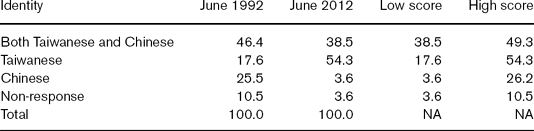
All evidence suggests that Taiwanization is an ever-increasing phenomenon in Taiwan. In 1992, the Election Study Center of National Chengchi University in Taiwan began examining identity in Taiwan.Footnote 13 In identical surveys conducted every six months, people could answer that they are ‘both Taiwanese and Chinese’, ‘Taiwanese’, or ‘Chinese’. With blips in the data, those replying that they are ‘Chinese’ in these surveys have shown a consistent downward trend from more than 25% to less than 4% of those surveyed. In other words, in 19 years, the number identifying as ‘Chinese’ is less than one-sixth of the earlier proportion. On the other hand, the number replying that they are ‘Taiwanese’ has increased from about one-sixth to over one-half the respondents, an increase of more than three times. The percentage of those claiming to be both Taiwanese and Chinese has dropped slightly from the mid-forties to the high thirties. The reduction in the non-response rate from more than 10% to less than 4% also demonstrates that these issues have been widely discussed in Taiwan and that people are no longer afraid to respond to surveys (see Table 1 and Figure 1).
Identity in Taiwan, 1992–2012

Source: See (Election, 2012a), http://esc.nccu.edu.tw/english/modules/tinyd2/content/TaiwanChineseID.htm.
Identity in Taiwan, 1992–2012 Source: See (Election, 2012a), http://esc.nccu.edu.tw/english/modules/tinyd2/content/TaiwanChineseID.htm.
Two scholars from National Chengchi University have analyzed these data in greater detail (Ho and Liu, Reference Ho, Liu, Wei-chin and Wang2003). They show that these trends have occurred among all ethnic groups in Taiwan, though Minnan (Hokkien) have higher rates of Taiwanese identification while Mainlanders have higher rates of Chinese identification. From 1994 to 2000, the numbers of Mainlanders identifying as only Chinese declined from 55.6% to 29.9%. Thus, and this is important, these trends have occurred among all of Taiwan's various ‘ethnic’ groups.
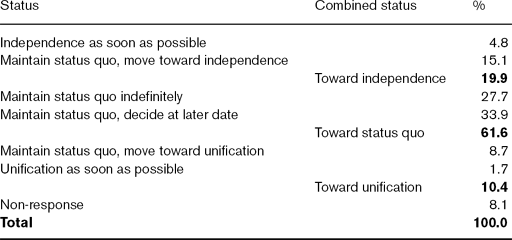
These changes in identification have important implications for Taiwan's future. As Table 2 shows, over 80% of Taiwan's population prefers maintenance of the status quo or independence, while 10% lean towards unification. If we exclude the non-response group from the sample, almost 90% support maintenance of the status quo or independence. Clearly, ‘unification’ lacks support among Taiwan's electorate. Thus, Taiwan's population has decisively indicated that it is Taiwanese and that it desires a future separate from China.
Taiwanese attitudes towards independence and unification (December 2012)
Sources: Data for Table 2, is from (Election, 2012b), http://esc.nccu.edu.tw/english/modules/tinyd2/content/tonduID.htm. The ‘Status’ column is from this source. The ‘Combined Status’ column has been calculated by the writer.
Whither Taiwan(ization)?
How do the landslide victories of the Kuomintang in the legislative and presidential elections of 2008 fit into this analysis? The vast majority of voters in 2008 did not vote on the basis of national identity. They voted for what they perceived as economic growth and government efficiency. They voted for local roads, schools, and hospitals. In addition, and this is very important, as a candidate Ma Ying-jeou 馬英九 emphasized his Taiwan identity. During his campaign, Ma changed his cross-Straits policies towards the policies of his opponent. Thus, in terms of China policy, there was very little difference between the candidacies of Ma Ying-jeou and his opponent, Frank Hsieh (Hsieh Chang-ting 謝長廷). In addition, Frank Hsieh suffered a stroke on 27 September 2007, which made it difficult for him to campaign with any vigor (Jacobs, Reference Jacobs2012: 235–236).
Upon his inauguration, Ma clearly changed the emphasis of these policies. In his inauguration speech of 20 May 2008, when addressing relations with China, President Ma emphasized the ‘Chineseness’ of Taiwan and made reference to both sides being Chinese.Footnote 14 The English text referred to ‘our common Chinese heritage’ (Ma Ying-jeou, Reference Ying-jeou2008), while the Chinese text said ‘the people of both sides belonging to the Chinese race (liang'an renmin tongshu Zhonghua minzu 兩岸人民同屬中華民族)’ (Ma Yingjiu 馬英九, Reference Yingjiu2008). In addition, in the Chinese text, the next sentence referred to ‘the high intelligence [or superior wisdom] of the Chinese race (Zhonghua minzu zhihui zhi gao 中華民族智慧之高)’, a phrase not included in the English translation. Of course, this content did not read well among Taiwan's aborigines or among the Taiwanese who do not consider themselves Chinese – about half of Taiwan's population at the time.
From a Taiwan perspective, perhaps the most disappointing statement was ‘the keystone for a final solution to the cross-strait problem is not in a conflict over sovereignty, but in ways of life and core values (liang'an wenti zuizhong jiejue de guanjian bu zai zhuquan zhengyi, er zai shenghuo fangshi yu hexin jiazhi 兩岸問題最終解決的關鍵不在主權爭議,而在生活方式與核心價值)’. (This is different from the official English translation: ‘In resolving cross-strait issues, what matters is not sovereignty, but core values and the way of life.’) Since Ma had previously stated that Taiwan is a sovereign country and since the sentence does not make much sense in either Chinese or English, it might better have been omitted.
It is important to note that President Ma's 2008 inauguration speech was not an unmitigated ‘we are Chinese’ rant. He also used language straight from the 28 February 2004 Democratic Progressive Party demonstration, when over two million people lined up the whole length of Taiwan to ‘hold hands to protect Taiwan’. Ma quoted words from the key song, ‘Hand Holding Hand, Heart United with Heart (shou qian shou, xin lian xin 手牽手, 心連心)’ and then concluded, ‘let us all strive together (dajia yiqi lai fendou 大家一起來奮鬥)’. This is all completely omitted from the official English text. In addition, Ma repeated these words in Hokkien, something that does not show in either the Chinese or English text.
One of President Ma's problems, to use an analysis from senior KMT leaders, is that he likes to work with people with whom he feels comfortable. Thus, especially in his first cabinet, that of Premier Liu Chao-shiuan 劉兆玄, Ma used many Mainlanders. A good number, who had been a deputy in the last cabinet under President Lee Teng-hui, became the premier or a minister in the Liu Chao-shiuan cabinet. Other long-lasting, but disastrous appointments, such as Su Chi 蘇起, the Secretary-General of the National Security Council, were like ‘brothers’ to President Ma (Jacobs, Reference Jacobs2010a). As the Liu Chao-shiuan cabinet lacked an ability to speak Hokkien and thus ‘could not speak to the people’, it had to resign following its failure to respond to Typhoon Morakot. The new cabinet under Premier Wu Den-yih 吳敦義 had a much stronger identification with Taiwan and much more experience working outside Taipei at local levels. However, even with this new emphasis on Taiwan, the Ma government has continued its strong policies of trying to have better relations with China, which some would call appeasement. This raises the question: ‘Is the Ma Ying-jeou government neo-colonialist?’ The answer would have to be: ‘At least in part.’ One would not have raised this question about either the Lee Teng-hui or the Chen Shui-bian governments.
Ma's inauguration speech raises another problem, the use of ‘racial’ or ‘blood and bones’ theories of nationalism. In their appeals to Taiwan, the Chinese have repeatedly used such outmoded racial theories.Footnote 15 China's White Paper on Taiwan published in 2000 makes such a ‘racial’ claim that Taiwan belongs to China. Thus, ‘the people of Taiwan are of the same flesh and blood with us’ (One-China, 2000: sec V). The Chinese text actually says ‘the Taiwanese people are our bones and flesh compatriots (Taiwan renmin shi women de gurou tongbao 台湾人民是我们的骨肉同胞)’ (Yige Zhongguo, Reference Zhongguo2000: sec 5). This racial claim has appeared in other Chinese texts concerned with Taiwan. The seventh of Jiang Zemin's ‘Eight Points’, delivered at a Chinese New Year function on 30 January 1995, stated, ‘Taiwan's 21 million compatriots, no matter whether they are from Taiwan province or other provinces, are all Chinese, they are all bones and flesh compatriots, they are brothers (2100 wan Taiwan tongbao, bulun shi Taiwan shengji haishi qita shengji, dou shi Zhongguo ren, doushi gurou tongbao, shouzu xiongdi 2100 万台湾同胞,不论是台湾省籍还是其他省籍,都是中国人,都是骨肉同胞、手足兄弟)’ (Jiang Zemin 江澤民, Reference Zemin1995). Hu Jintao's ‘Six Points’ of 31 December 2008, continued to raise racial claims repeating the phrase ‘bones and flesh compatriots’ and discussing how ‘the compatriots on both sides of the strait share the common destiny of shared blood vessels (liang'an tongbao shi xuemai xianglian de mingyun gongtongti 两岸同胞是血脉相连的命运共同体)’ (Hu Jintao 胡锦涛, Reference Jintao2008).
There are immense problems with the use of such racial logic in international affairs. These statements suggest that China has claims to any area in which substantial numbers of so-called racial Chinese live. Thus, this logic suggests that China can claim countries such as Malaysia and Singapore in addition to Taiwan. The last major world leader who made similar claims was Hitler prior to his invasion of the Sudetenland on 1 October 1938.
Ironically, modern genetics tell us that the Han Chinese are not one people tied by unique ‘bones and flesh’ or ‘shared blood vessels’. Rather, ‘China's dominant ethnicity, the Han, is actually two genetically distinct groups, the northern and the southern Han’ (Brown, Reference Brown2008). In addition to Han Chinese in China not sharing ‘bones and flesh’ or ‘blood vessels’, many of those who migrated to Taiwan also intermarried with local aboriginal people. Thus, such outmoded ‘racial theories’ need to be consigned to the dustbins of history.
But, despite the Ma government's toying with such outmoded racial theories and despite its possible attempt to restore a ‘neo-colonialist’ government in Taiwan, it is important to note that identification among Taiwan's population as Taiwanese has continued to rise. In fact, it has been since the Ma government came to power that the number of people saying they are solely ‘Taiwanese’ – and not Chinese – has broken the 50% mark in the Election Study Center surveys for the first time (see Figure 1). In other words, the coming to power of the Ma government has in no way shifted the ever-increasing trend of Taiwanization within Taiwan.
The Ma government's approach to China together with its own repeated incompetency in disasters, in international affairs, and in domestic affairs has given the Ma government very low approval ratings among Taiwan's voters. Numerous polls including those of very ‘blue’ pro-government media show that his approval rating through August 2011 has remained in the low 30% range (Yuanjian 遠見 [Global Views Survey Research Center], Reference Yuanjian2011a; Yuanjian 遠見 [Global Views Survey Research Center], Reference Yuanjian2011c; Yuanjian 遠見 [Global Views Survey Research Center], Reference Yuanjian2011b).
Since its landslide defeats in the legislative and presidential elections of 2008, the DPP has improved its electoral performance. Several elections, including the ‘three-in-one’ elections of 5 December 2009, which chose county executives, and by-elections caused by the 5 December elections as well as the disqualification of KMT victors for vote-buying in earlier elections, have led to several KMT losses and DPP victories.
In the 27 November 2010 elections for the mayors of the five special municipalities, the KMT won three mayoral elections, but the DPP polled 400,000 more votes – or 5% – in these elections. In the simultaneous city council elections, which the KMT has won in the past, the KMT and the DPP obtained the same number of seats, though the KMT outpolled the DPP by 3% in these more local elections.
The Central Election Commission combined the 2012 presidential and legislative elections with voters going to the polls on 14 January 2012. President Ma won re-election with 51.6% of the vote, a decrease of almost 7% compared with 2008. On the other hand, the DPP gained 7%, closing the gap in the presidential vote by half. In the legislative election, Ma's KMT also lost 17 seats compared to a gain of 13 seats to the DPP, three seats to the TSU, and two seats to the PFP. (Non-partisans lost one seat.) As in 2008, most of the presidential and legislative campaigns concerned competency and local issues. In the past, most Taiwan election campaigns had considerable excitement, but several Taiwan and foreign observers including the writer felt the 2012 campaign never ‘sparked off’.Footnote 16
Taiwan's democracy is blessed with having swing voters comprise some 15–20% of the electorate. These voters do not vote on the basis of party loyalty or ideology. Rather, they examine the candidates and their programs before each election and vote for whom they perceive to be the best candidate. For example, in 2008, many people who had voted for Chen Shui-bian in 2000 and 2004 told the writer in early 2008 that they were voting for Ma Ying-jeou. They said they hoped to fix the economy and improve government efficiency. But they also said, ‘If Ma doesn't do a good job, we'll vote the other way next time’. In 2012, many swing voters changed their votes from the KMT to the DPP, but the KMT retained sufficient votes to win re-election. But, as noted in the discussion of Figure 1 and Table 1, irrespective of partisan swings in elections, we can expect Taiwanization will continue its strong development in Taiwan.
Conclusions
Let us return to Taiwan's early history to make our final point. People both around the world and in Taiwan have been ensnared into defining Taiwan's future within a Chinese framework that only has the alternatives of ‘unification’ (sometimes falsely called ‘reunification’) and ‘independence’. The writer would argue that Taiwan's leaders need to think about Taiwan in terms of decolonization rather than in terms of unification and independence. By far the vast majority of countries around the world have experienced colonization and they often have expressed support for other countries undergoing the decolonization process.
Taiwan needs to explain to the world that Taiwan's so-called ‘one China’ policy was established under the colonial dictatorship of Chiang Kai-shek and Chiang Ching-kuo and that the Taiwanese people had no say in the matter. Taiwan also needs to explain to the world that it is undergoing a process of ‘decolonization’. The issues of ‘unification’ and ‘independence’, leftover from the colonial past, are irrelevant to Taiwan today.
Taiwan is Taiwan. It is a sovereign state that meets all of the requirements of current international law. According to Article 1 of the Convention on Rights and Duties of States, it has ‘a) a permanent population; b) a defined territory; c) government; and d) capacity to enter into relations with the other states’ (Convention, 1933). And, Article 3 emphasizes, ‘The political existence of the state is independent of recognition by the other states’ (Convention, 1933). Taiwan is not China. Should Taiwan's leaders begin to educate the world that Taiwan faces ‘decolonization’ and not questions of ‘unification’ or ‘independence’, then it should receive much more international support than at present.
About the author
J. Bruce Jacobs is Professor of Asian Languages and Studies at Monash University in Melbourne, Australia. Over the past 40 years, he has published numerous works on Taiwan and China as well as South Korea. His two most recent books are Local Politics in Rural Taiwan under Dictatorship and Democracy (Norwalk, CT: EastBridge, 2008) and Democratizing Taiwan (London and Boston: Brill, 2012). He has also edited and written an introduction to a four-volume work entitled Critical Readings in China–Taiwan Relations to be published by Brill in late 2013. Much of his writing relies on extensive field research.
This article is adapted from the keynote lecture given at a workshop hosted by the Taiwan Research Institute, Chang Jung University, Tainan, Taiwan, 23–24 April 2010. In addition to expressing appreciation to the Taiwan Research Institute, Chang Jung University and to the Ministry of Education in Taiwan, which supported the workshop, the author wishes to express appreciation to the Australian Research Council for a Discovery Grant on the History of Taiwan.