Introduction
There are numerous aetiologies of heart failure including myocarditis, cardiomyopathy, congenital heart defects, arrhythmias, premature coronary disease, infiltrative disease, and toxic exposures.Reference Hsu and Pearson1–Reference Rossano and Shaddy3 In children, the most common cause of heart failure in the absence of congenital malformations is cardiomyopathy,Reference Rossano and Shaddy3 and myocarditis-induced cardiomyopathy is often suspected, especially in cases of acute onset. However, additional aetiologies should be considered because correctly identifying the aetiology can provide important information regarding prognosis, treatments, extra-cardiac involvement, and risk for family members.Reference Rossano and Shaddy3 Specifically, patients with myocarditis have been shown to have lower rates of heart transplantation and death compared to individuals with idiopathic cardiomyopathy.Reference Foerster, Canter and Cinar4
Despite our advances in imaging and laboratory analyses, correctly identifying the underlying mechanism of heart failure can be difficult. Myocarditis, especially, can be challenging to diagnose. A definitive diagnosis requires an endomyocardial biopsy, which is often not a part of routine practice.Reference Canter and Simpson5 Therefore, in order to aid in accurate diagnosis of myocarditis, the European Society of Cardiology created diagnostic criteria for clinically suspected myocarditis which relies on imaging, clinical history, and laboratory results.Reference Caforio, Pankuwiet and Arbustini6 However, these findings can be seen in hereditary cardiomyopathies which can make it hard to differentiate between the two aetiologies.Reference Caforio, Pankuwiet and Arbustini6
Recently, it has been shown that 12% of children with acute myocarditis carried pathogenic autosomal recessive variants in cardiac genes.Reference Belkaya, Kontorovich and Byun7 These results suggest that either children with a hereditary cardiomyopathy are often misdiagnosed with myocarditis, or genetic mutations increase a child’s susceptibility to myocarditis, or both. Over the past few years, genetic testing has been increasingly incorporated into our inpatient cardiology practice for cases of acute onset heart failure. The purpose of this study is to describe the results and clinical implications of this change in practice.
Materials and methods
Subjects and participants
Cardiovascular genetic testing has been incorporated into our inpatient services since 2008, but the frequency has dramatically increased over the past few years as the field has become more robust. To describe the utility of genetic testing in this setting, we conducted a review of admissions of all children who presented in the Johns Hopkins’ Pediatric Intensive Care Unit with acute heart failure tentatively suspected to be acute myocarditis from 2008 to June 2017 in which cardiac genetic consultation was sought. Acute heart failure was defined based on the recent European Society of Cardiology Guidelines which define it as a rapid onset or worsening of heart failure. Heart failure was defined as a symptomatic reduction of cardiac output.Reference Ponikowski, Voors and Anker8 This review was conducted under IRB protocol for retrospective studies of genetic cardiomyopathies.
At the time of presentation, all probands underwent robust clinical evaluations which included evaluation for myocarditis. These evaluations typically involved an echocardiogram, electrocardiogram, cardiac MRI, clinical history, viral cultures, troponin-I levels, and pathological analysis of cardiac tissue. However, not all of these tests were performed on every patient due to clinical status and/or familial wishes. Electrocardiograms, echocardiograms, and troponin-I levels were obtained within 48 hours of admission. Pathological analysis was performed on a tissue biopsy, explanted heart or upon autopsy depending on the specific patient course.
For the cases where a genetic consult was sought, three-generation family histories were obtained by a genetic counsellor. When feasible, a geneticist performed a physical examination on the patients during their admission.
Genetic testing
Genetic testing was performed on DNA extracted from whole blood or cultured fibroblast cells at four commercial Clinical Laboratory Improvement Amendments-certified laboratories. The genetic testing panels selected depended on the tests and technology available at the time of presentation. Sequencing was performed using Sanger sequencing or next-generation sequencing with Sanger confirmation. Genetic test results were interpreted by a certified genetic counsellor and cardiologist with expertise in genetics using the 2015 American College of Medical Genetics’ guidelines, Reference Richards, Aziz and Bale9 and variants were reclassified using these criteria if results were from prior to 2015.
Results
Our retrospective review identified a series of eight patients who were admitted to the Pediatric Intensive Care Unit with new onset acute heart failure due to presumed myocarditis who underwent genetic testing either as part of their evaluation or posthumously. The demographics are listed in Table 1. The majority of individuals were female and either presented in infancy or adolescence. A variety of ethnicities are represented. All of the children presented with acute heart failure and two suffered cardiac arrests either prior to or during evaluation at the Emergency Department. At the time of presentation, none of the probands had a known personal or family history of cardiac conditions nor dysmorphic features suggestive of syndromic condition. The majority of patients (seven) were referred for cardiac genetic evaluation between 2013 and 2017. Only one patient was referred between 2008 and 2012.
Demographics and outcome data for patients who presented with acute heart failure and underwent genetic testing.

Myocarditis evaluation
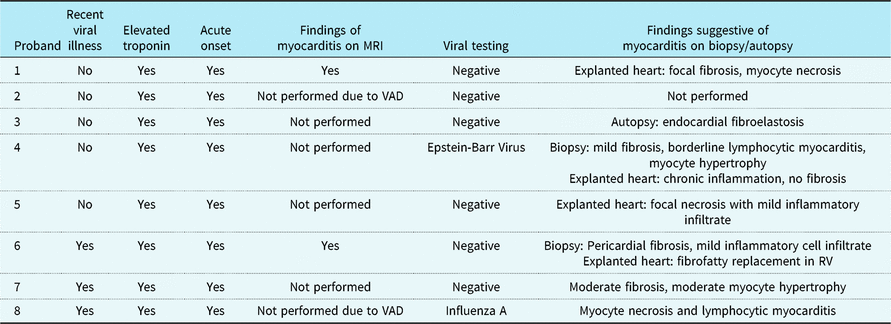
At the time of presentation, all eight individuals were presumed to have myocarditis due to the acute onset, apparent lack of a family history and no significant medical history to suggest another aetiology. All of the patients had decreased left ventricular systolic function typically in association with left ventricular dilation, and the probands all had elevated troponin-I levels. However, the majority of patients did not have a clinical history of a recent viral illness. Only Probands 4 and 8 had a positive viral culture and only Proband 8 had a positive cardiac biopsy (Table 2). Two other probands did reportedly have a history of viral illness.
Myocarditis evaluations at the time of presentation.

RV = right ventricle; VAD = ventricular assist device.
Genetic evaluation and test results
A geneticist performed physical exams on six of the eight patients. The rapid demise of the patient with Hurler syndrome prevented a physical exam during the admission, but a geneticist reviewed her X-rays and photographs posthumously and did not identify physical features suggestive of a lysosomal storage disorder. For the two other patients, a genetics consult was not requested.
The majority of probands (n=6) had comprehensive cardiomyopathy panels which included sequencing and deletion and duplication analysis of 51–81 cardiomyopathy associated genes. However, for Proband 5, the diagnosis of Hurler syndrome was based on information from parents. They underwent carrier screening and were both identified with heterozygous pathogenic variants in IDUA. Targeted post-mortem testing confirmed Hurler syndrome due to compound heterozygous IDUA pathogenic variants. When Proband 1’s sister presented with acute heart failure, which was not presumed to be due to myocarditis, sequence analysis of 18 genes associated with dilated cardiomyopathy and array comparative genomic hybridization were performed. Both tests were uninformative. Therefore, whole exome sequencing was pursued on the sister, and the two pathogenic variants were confirmed in Proband 1 via post-mortem DNA analysis.
Genetic testing was pursued in these eight patients for a variety of reasons despite the presumed diagnosis of myocarditis. Additional family members were diagnosed with cardiomyopathy for probands 1 and 2, suggesting a genetic aetiology. Proband 8 failed to recover for months after her initial presentation suggesting an additional aetiology to her heart failure. Finally, Probands 3, 4, 6, and 7 underwent genetic testing due to growing research suggesting hereditary aetiologies in myocarditis and after a clinical review by a cardiologist who specialises in genetics.
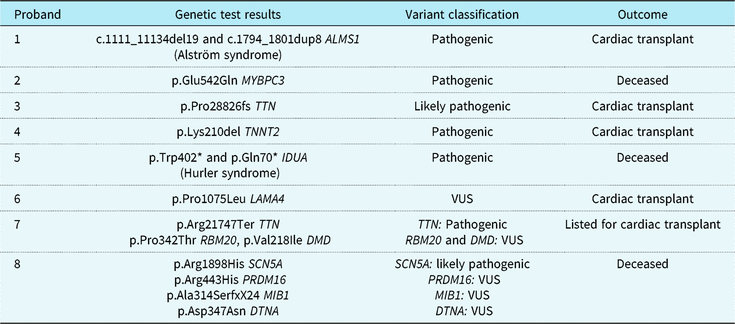
Genetic testing revealed pathogenic (n=5) or likely pathogenic (n=2) variants in seven of the eight probands (87%). None of the patients who underwent genetic testing had negative test results. Only Proband 6 had inconclusive results that revealed a variant of uncertain significance. Results are listed in Table 3. Two of the infants were subsequently determined to have hereditary genetic syndromes: Hurler syndrome and Alström syndrome. The five other patients with positive results had a pathogenic or likely pathogenic variant in a cardiac gene (62.5%).
Positive genetic test results were identified in the majority of patients. Individuals with positive results tended to have poor outcomes.

VUS = variant of uncertain significance.
Outcome
Patients with a pathogenic or likely pathogenic variant tended to have severe outcomes. None of the patients with pathogenic or likely pathogenic variants had hearts that were able to recover. Two infants died and the other five individuals either underwent cardiac transplant or are currently listed for transplant.
Discussion
Clinical cardiomyopathy genetic testing revealed pathogenic or likely pathogenic variants in seven of the eight probands (87%) in our study with 62.5% as non-syndromic cases. Given that only one case had a definitive diagnosis of myocarditis, the high prevalence of positive genetic test results indicates that often cases, which are initially presumed to be myocarditis, are instead genetic in origin. Specifically, the two cases, which were determined to be due to genetic syndromes, were unlikely to be related to myocarditis. However, it cannot be ruled out that the pathogenic or likely pathogenic variants in cardiac genes lead the heart to be more susceptible to cardiac decompensation with viruses. This theory may be the case for Proband 8 who had definitive myocarditis and a likely pathogenic variant in SCN5A. Previously, Belkaya et al. found a significant proportion of children with myocarditis were carriers for rare genetic variants in cardiac-related genes, supporting this idea of genetic mutations increasing an individual’s susceptibility to myocarditis.Reference Belkaya, Kontorovich and Byun7
It should be noted that Belkaya et al’s yield (12%) and the 40–50% yield identified in other studies of non-ischemic cardiomyopathyReference Morales and Hershberger10, Reference Ellepola, Knight and Fischbach11 were lower than our yield of 62.5% for non-syndromic forms. This discrepancy may be due to a variety of factors including sample size and study design. While patients in our sample were not specifically selected due to suspicion of a genetic aetiology, we cannot rule out the possibility of a selection bias. It is also possible that our high positive result rate may simply be due to our sample size. Of note, while Belkaya et al’s study utilised exome sequencing which is typically considered a comprehensive test, it does not include deletion/duplication analysis which was performed in our samples.
Of note, a negative or uninformative genetic test result does not eliminate the possibility of a genetic aetiology. Current clinical genetic testing detects a genetic aetiology in around 40% of individuals with dilated cardiomyopathy.Reference Morales and Hershberger10 There are most likely undiscovered genes and pathological variants in discovered genes that cannot be detected using our current technology. Of note, even though proband 6’s genetic test results were inconclusive, her pathology revealed fibrofatty infiltrate suggestive of arrhythmogenic right ventricular cardiomyopathy. Thus, in this case especially, an undetected genetic cause cannot be ruled out.
Identifying patients with genetic conditions or predispositions has important implications for these children and their family members’ management. Our results support the evidence that children with a hereditary cardiomyopathy who present in acute heart failure tend to have poorer outcomes compared to patients with idiopathic cardiomyopathy.Reference Rusconi, Wilkinson and Sleeper12 Of note, our study and previous research have not compared mutation-negative, familial cases compared to mutation-positive cases, and this would be of interest for further study. Furthermore, identifying patients who have genetic syndromes allows the health care team to provide appropriate anticipatory guidance to the family and appropriate medical care for the additional sequela that may develop.
In addition, determining a genetic aetiology provides clinical information to family members to undergo clinical cardiac screening and potentially begin interventions earlier than otherwise. These interventions may slow down the progression of the condition and could prevent sudden death.Reference Hershberger and Siegfried13 Overall, recognising genetic aetiologies provides key information in prognosis and familial risk for the family and care team.
There are a few limitations to our study. Most significantly this was a small, retrospective study, and not all patients who presented to the Pediatric Intensive Care Unit with acute heart failure from 2008 to 2017 underwent genetic testing. Therefore, we are unable to accurately assess the frequency of genetic aetiologies in the cases in which testing was not performed. Consequently, referral and selection bias cannot be excluded. Finally, the genetic testing performed was limited by technology available at the time of presentation, and it cannot be excluded that patients who had smaller cardiomyopathy panels may have had additional findings if a larger cardiomyopathy panel had been analysed.
Conclusion
Our findings suggest that genetic testing should be considered in children presenting with acute heart failure. This testing should be considered even in cases with negative personal and family histories and in cases where a physical exam performed by a geneticist did not reveal syndromic features. Our results also indicate that even in cases of confirmed myocarditis, there may be a contributing genetic factor and genetic testing could be considered. We do advise that while genetic testing should be implemented as routine workup in these cases, it is important that genetic tests are ordered and interpreted by clinicians with expertise in genetics given their possible complexity. The findings in this group of patients suggest that a prospective investigation should be conducted to identify genetic mutations in children with new onset acute heart failure using cardiomyopathy panel genetic testing or whole exome sequencing. The Pediatric Cardiomyopathy Registry is employing whole exome sequencing for evaluation of genotype–phenotype correlations and new gene discovery,Reference Wilkinson, Westphal and Bansal14 and their results in the subsection of patients with acute heart failure may help answer this question.
Acknowledgements
We are grateful to the patients and their families who allowed us to be part of their medical care.
Financial Support
This research received no specific grant from any funding agency, commercial or not-for-profit sectors.
Conflicts of Interest
Emily Brown is a consultant for Color Genomics and My Gene Counsel. Daniel P. Judge has received payments as a scientific advisor from Alnylam, Pfizer, and GlaxoSmithKline Pharmaceuticals and clinical trial support from Eidos Therapeutics. All other authors declare that they have no conflicts of interest.
Ethical Standards
The authors assert that all procedures contributing to this work comply with the ethical standards of the relevant national guidelines on human experimentation and with the Helsinki Declaration of 1975, as revised in 2008, and has been approved by the Johns Hopkins institutional committees.