In 1912, the nationalist writer, R. Barry O'Brien, posed the question ‘Who (or what) rules Ireland?’ and concluded that ‘It may be the English Cabinet; it may be Dublin Castle; it may be the “Irish” Boards; it may be all three combined, but it is not the Irish people.’Footnote 1 According to O'Brien, Ireland was governed by an administrative elite that was unrepresentative of the Catholic majority of the Irish population, and should therefore be replaced by an independent Irish parliament. Almost eighty years later, in 1991, Lawrence McBride presented a rather different view of ‘who ruled Ireland’ between 1892 and 1922. In his influential book, The greening of Dublin Castle, McBride suggested that – during this period – the Irish administration was becoming more representative of the ‘Irish people’:
In 1892 … [the Irish] administration was dominated by both a bureaucratic elite and rank and file civil servants who were Unionist in politics and Protestant in religion … Thirty years later, in 1921, the administration … [was] largely controlled by Nationalists and Catholics. This transformation was as comprehensive as it was complete because it extended across the whole spectrum of the Irish administration … from top to bottom.Footnote 2
According to McBride, both Conservative and Liberal administrations appointed Catholics and nationalists to senior positions in the Irish civil service. For the Liberal party, the aim of this policy was to prepare the Irish administration for the transfer of power that would inevitably follow the introduction of Home Rule. In their view, an established class of Catholic and pro-Home Rule civil servants would ensure a smooth transition from British to Irish rule. For the Conservatives, on the other hand, this policy was an attempt to legitimize the Act of Union (1801–1922), and to make the government of Ireland more representative and more acceptable to the Irish people. The appointment of Catholics to senior positions in the administration was, therefore, a key element of both Conservative and Liberal policy in Ireland in this period, and the result was – in McBride's view – the replacement of the old Protestant and unionist establishment in Dublin Castle with a new Catholic and nationalist administrative elite that was – broadly speaking – more representative of the Irish Catholic population. McBride's hypothesis has been largely accepted by historians, and his book illuminates a great deal about British policy in Ireland between the first Home Rule crisis of 1886 and the signing of the Anglo-Irish Treaty in 1921. However, McBride's arguments do not always tally with contemporary perceptions of the nature of Dublin Castle. For instance, when Anthony MacDonnell, a Catholic from a county Mayo landowning family, was appointed as under secretary for Ireland in 1902, he was surprised at the bigotry and suspicion that he encountered in Dublin Castle. In November 1902, he told his wife:
I went to the office at 11 am and made the acquaintance of the staff. The office is large: & some of the staff are able men: but I am not surprised at the popular idiom attacking the ‘Dublin Castle’ … In the Castle I see nothing but police police [sic]. There is an atmosphere of suspicion and espionage. I could not stand it for any length of time and if I cannot improve it I must go.Footnote 3
MacDonnell felt that he was ‘being watched’ and that ‘the landlord party view me with suspicion’,Footnote 4 explaining ‘Dublin is a big village and a dirty village in which gossip reigns supreme: and in which people are divided into sects & factions.’Footnote 5 After one meeting of the Local Government Board, he lamented that ‘No questions of importance were up for discussion: but those that were brought forward showed how the feud of Catholic & Protestant in the North of Ireland poisons the smallest relations of the people[.] The feud of Hindu & Mohamedan is not more bitter. Nor so enduring and persistent.’Footnote 6 Later, he told a dinner party that he had been informed on returning from Bengal to Ireland that sectarian animosity was on the wane: if so, he said, ‘it dies very hard’.Footnote 7 A less sympathetic commentator, D. P. Moran, the advanced nationalist and editor of the Leader newspaper, also claimed that senior positions in the Irish civil service were dominated by Protestants and unionists, and largely closed to Catholics and nationalists.Footnote 8
There are grounds, therefore, for revisiting McBride's hypothesis, and this article re-examines his conclusions in the light of new evidence and a new approach. The greening of Dublin Castle is a chronological account of the senior appointments made by each administration in Ireland between 1892 and 1921 based on a close reading of the correspondence of prime ministers, chief secretaries, lord lieutenants, under secretaries, Irish parliamentarians, and so on. My approach, on the other hand, is to examine systematically the social background of the top civil servants (the members of the Irish office, department heads, and their immediate subordinates) at two key points – 1891 (before the ‘greening’ process had got underway) and 1911 (by which point the introduction of Home Rule was inevitable) – and to assess the extent to which a ‘greening’ process had taken place over this period. The article, therefore, assesses which version of ‘who ruled Ireland’ best fits the evidence, and considers the extent to which the government of Ireland was representative of the majority of the Irish people in the period before the Irish revolution (1916–23).Footnote 9
It is worth mentioning that an article published by Gerald McElroy in 1995 also queried McBride's ‘greening’ hypothesis.Footnote 10 McElroy examined the 510 civil servants in Ireland in 1860 who earned more than £150 per annum, and also the 605 civil servants who were recruited between 1905 and 1912 (without competition) who earned more than £100 per annum. Based on this evidence, McElroy concluded that: ‘[w]hile the elite of the Civil Service was mainly Protestant in 1860, this situation had still not dramatically changed some fifty years later’.Footnote 11 However, McElroy's methodology differs from that adopted here in two critical respects. First, McElroy examined both the leading civil servants and the middle management level of the Irish civil service (510 individuals in 1860 and 605 individuals in 1905–12), whereas this article examines the composition of only the most powerful and influential civil servants in Ireland in 1891 and 1911 (77 individuals in 1891 and 91 individuals in 1911). Moreover, McElroy's sample of civil servants did not include all the top civil servants in 1912 since he only included those civil servants recruited between 1905 and 1912, and many of the leading civil servants in 1912 had been recruited a good deal earlier than 1905. McElroy was, therefore, analysing a quite different group of Irish civil servants from those examined here. Secondly, McElroy made use of only one source – the Returns (or lists) of names of Irish civil servants contained in parliamentary papers – and he used an unreliable methodology to assess the religious composition of the Irish civil service in 1860 and 1905–12. Since the Returns give only the names of the Irish civil servants at any given time, McElroy attempted to deduce the religious affiliation of these individuals from their names. He admitted that ‘this method is far from scientific’ but suggested that ‘it still provides us with an approximate religious breakdown of various samples of public servants’.Footnote 12 However, it is clear that some of McElroy's deductions are incorrect. Of the five county inspectors of the Royal Irish Constabulary in 1900 identified as Catholics, for instance, two (Thomas Hayes and J. A. McGuire) were, in fact, Episcopalians.Footnote 13 The general reliability of McElroy's evidence (and therefore his conclusions) must be called into question. My study makes use of a much broader range of sources – obituaries, directories, personal correspondence, and censal data – to identify not merely the religious affiliation of the civil servants under review, but also their world-view, their networks, and their social and educational background. This article, therefore, examines a different group of Irish civil servants to that considered by McElroy, and uses a more reliable methodology and a wider range of sources to assess the extent to which there was a ‘greening’ of the Irish civil service between 1891 and 1911.
I
Who were the top ranking civil servants? I have compiled a study of the highest-ranking civil servants including the members of the Irish office, the heads of departments, and their immediate subordinates. My study examines the social composition of the leading civil servants in two censal years – 1891 and 1911 – and I have been able to compile information about 77 of them in 1891, and 91 in 1911. Since there was a certain amount of overlap, I have compiled substantial biographical information around 165 of the highest ranking civil servants. Of the 165 civil servants under review, all were men except for Mary Dickie who was a commissioner of national health insurance. Women were not excluded from the civil service and there were many women among the rank-and-file and the professional staff. By 1914, about 60 women worked in the Irish departments as inspectors in the Local Government Board, inspectors of Reformatory schools, and officials in the National Health Insurance Commission.Footnote 14 However, there was resistance to the recruitment of women to higher positions as the under secretary, James Dougherty, explained in 1913: ‘public opinion in Ireland … [insisted] on the segregation of the sexes’.Footnote 15 The prevalence of this view among the top civil servants may explain why there was only one woman among the senior civil servants in Ireland between 1891 and 1911.
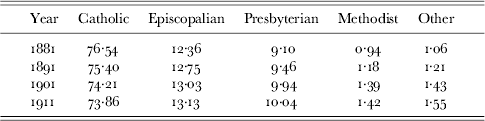
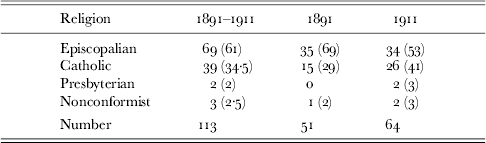
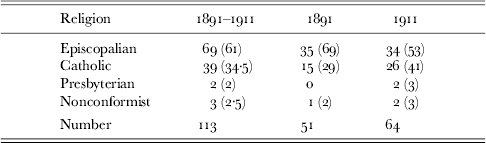
The vast majority of the elite of the civil service (79 per cent) were Irish-born, with just under one fifth (19 per cent) born in either England (15 per cent) or Scotland (4 per cent), and a couple born in Canada and Australia.Footnote 16 In terms of religious composition, almost two-thirds were Protestant (65·5 per cent) and slightly more than one third were Catholic (34·5 per cent). In 1891, the Irish population was more than 75 per cent Catholic and the Episcopalian population was almost 13 per cent (see Tables 1 and 2). This study demonstrates that Episcopalians were over-represented in the elite of the civil service comprising about 13 per cent of the total population, but 61 per cent of the highest-ranking civil servants. On the other hand, Catholics were under-represented, for although they accounted for 74–5 per cent of the total population, they accounted for only 34–5 per cent of the highest-ranking civil servants. Similarly, only 2 per cent of the highest-ranking civil servants were Presbyterians despite accounting for 9–10 per cent of the population.
Religious denominations in Ireland (all figures are percentages)
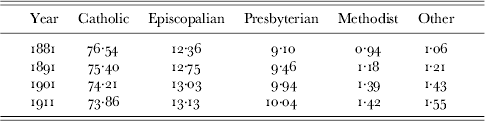
Source: W. E. Vaughan, Irish historical statistics: population, 1821–1971 (Dublin, 1978), p. 49.
The religious composition of the highest-ranking civil servants, 1891–1911 (percentage in brackets)
A significant proportion of the senior civil servants either owned land or were members of landed families (either by birth or by marriage). Twelve (7 per cent) of the civil servants owned land themselves: half owned estates of less than 5,000 acres, while one owned an estate of between 5,000 and 10,000 acres; and five (42 per cent) owned estates of more than 20,000 acres. A much higher proportion were from landed families: almost one third (31 per cent) were either born into, or married into, landed wealth. Almost one third (31·5 per cent), were members of landed families with less than 1,000 acres; while a quarter (24 per cent) were members of mid-range landed families; almost one fifth (17·5 per cent) owned between 5,000 and 10,000 acres; and more than one quarter (27 per cent) were in the elite of the landowning class with more than 10,000 acres. What is perhaps striking about these figures is the fact that most of the administrators (73 per cent) were from landed families with less than 10,000 acres. In general terms, administrators tended to come from the less well-off landed families. Indeed, very few of the great landlord families (with estates of more than 10,000 acres) were members of the civil service and it tended to be the less well-off landlords who sent their younger sons into the Irish civil service.
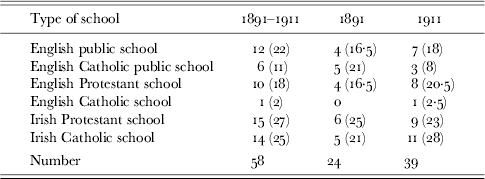
A significant proportion of the highest-ranking civil servants had been educated at both secondary and tertiary level, and possessed the necessary technical and professional skills to run their departments. Data was available on the secondary education of fifty-six individuals – although it is likely that most received some sort of secondary education – and the results are presented in Table 3. More than one fifth (22 per cent) went to English (Protestant) public schools, and more than one in ten (11 per cent) attended English (Catholic) public schools.Footnote 17 Altogether, then, one third of the top ranking civil servants had received an English public school education. A further fifth (18 per cent) had attended other English Protestant schools (Windermere College, Gosport, and Manchester grammar), and more than a quarter were graduates of Irish Protestant schools (Royal Belfast Academical Institution, St Columba's, Dublin, and Kilkenny College). One quarter (25 per cent) had been educated at Irish Catholic schools, and were graduates of Clongowes, Blackrock, and Belvedere, all of which groomed candidates for both the Indian and the Irish civil service.
Secondary education of senior civil servants, 1891–1911 (percentages in brackets)
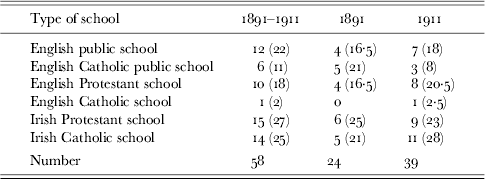
Note: Some attended more than one secondary school.
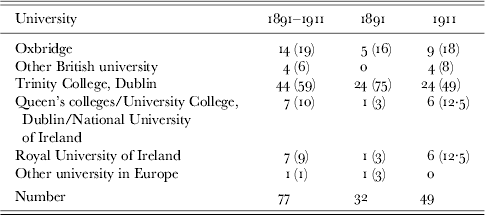
Almost half (45 per cent) of the civil servants under review had received a university education. As Table 4 demonstrates, Oxbridge was a popular choice, as were some of the other English and Scottish universities (King's College, London, St Andrews, Edinburgh, and Manchester), but the vast majority (59 per cent) were graduates of Trinity College, Dublin (established in 1591). Less than one fifth (19 per cent) attended the ‘new’ universities established in Ireland during the nineteenth and early twentieth centuries. These were the Queen's colleges, established at Belfast, Cork, and Galway in 1849; the Royal University of Ireland, established in 1879; the National University of Ireland, comprising the former Queen's colleges at Cork and Galway, and also University College, Dublin, established in 1908; and the Queen's University, Belfast which was composed of the former Queen's college at Belfast, and established in 1908. A significant proportion had also received a vocational or professional training (sometimes in addition to a degree but occasionally instead of a degree): 60 of the 165 civil servants under review (36 per cent) had some professional training in the fields of, among others, law, medicine, the armed forces, engineering, and accountancy, which provided them with expertise to oversee the work of their departments.
Third-level education of senior civil servants, 1891–1911 (percentages in brackets)
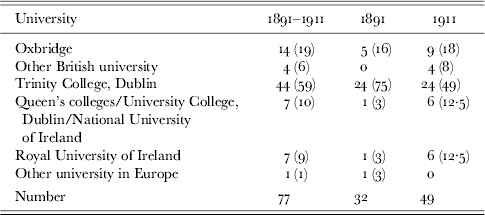
Note: Some individuals went to more than one university.
The majority of top ranking civil servants in the 1890s were aged in their forties or fifties, with a smaller number in their thirties or sixties.Footnote 18 Most were the first-born sons in their families (53 per cent), while just under one fifth were second-born (18 per cent) or third-born (16 per cent) sons. Almost half (47 per cent) had been born into ‘elite’ families, and were the sons of landowners, clergymen, professionals, civil servants, resident magistrates, doctors, army officers, journalists, and engineers.Footnote 19 Almost all were married (86 per cent), and one in six (16 per cent) married into families listed in Walford's county families (1879 and 1918 editions), thereby consolidating their elite status.Footnote 20 Like the rest of the Irish population, most married when they were aged in their twenties or thirties, although a small proportion married later in life.Footnote 21 In 1914, for example, Sir Lawrence Dowdall, the principal clerk in the chief secretary's office, married when he was sixty-three years old. On average, married civil servants had between one and four children, and comparatively few had childless marriages.Footnote 22 The average age at death was seventy-four, with most living into their sixties, seventies, and eighties, and a small proportion into their nineties.Footnote 23
The comparatively high age at death was undoubtedly influenced by the fact that top ranking civil servants were extremely well off. Their average salary was in excess of £1,000 (£1,096.68) at a time when other sections of Irish society earned substantially less. At the beginning of the nineteenth century, for instance, McDowell estimated that a skilled worker earned £20–30 per annum; a captain in the army earned £172; and a curate in the diocese of Dublin, £75.Footnote 24 At the other end of the social spectrum, a small tenant farmer on the Clanricarde estate at Woodford, county Galway, had an annual income of less than £39 in the 1890s.Footnote 25 The lowest salary of the civil servants under review was £364, and the highest was £2,000. Most lived in prosperous and comfortable parts of Dublin. In fact, many lived within walking distance of one another at addresses on Fitzwilliam Square, Upper Mount Street, Leeson Street, Leeson Park, Morehampton Road, Raglan Road, Percy Place, Herbert Park, Ailesbury Road, and Earlsfort Terrace. The top civil servants' houses became important meeting places to socialize and transact business. When John Dillon, the deputy leader of the Irish Parliamentary party, needed to meet Sir Matthew Nathan, the under secretary, in 1914, and was not prepared to set foot in Dublin Castle, they arranged to meet at Land Commissioner William Bailey's house at Earlsfort Terrace, one of the social centres of Dublin at the time, and described by the Irish Times as a ‘delightful rendezvous of diverse talents’.Footnote 26 Many also lived in the suburbs of Blackrock, Foxrock, Monkstown, Glenageary, Howth, Shankill, and Kingstown. Crosthwaite Park in Kingstown was a popular address where Robert Edwin Matheson, the registrar of the census office, lived next door to the family of the playwright, John Millington Synge.Footnote 27
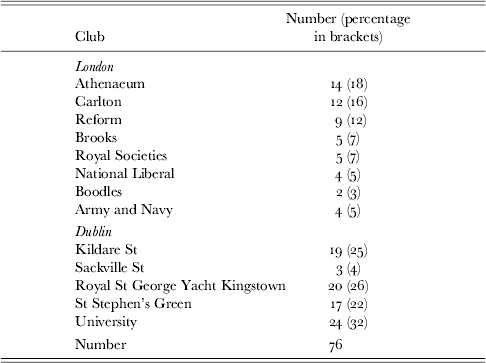
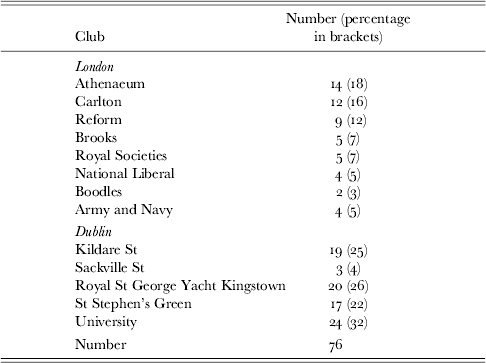
Senior civil servants often met one another at the various gentlemen's clubs in London and Dublin (see Table 5). Nearly half (46 per cent) were members of London or Dublin clubs, and almost one third (30 per cent) subscribed to more than one club. In London, the most popular clubs were the Athenaeum, Carlton, and Reform – according to the political inclinations of the civil servant in question. But since the majority of civil servants were Irish-born and lived permanently in Dublin, its clubs were the most popular. The Kildare Street Club, a popular haunt for the Irish landlord class, was also frequented by many senior civil servants. The Dublin University Club was also popular, and underlines the fact that a substantial proportion of senior Irish civil servants were graduates of Trinity. Yachting was a popular leisure activity among civil servants, and more than a quarter were members of the Royal St George Yacht Club at Kingstown. Finally, the St Stephen's Green Club was popular mainly among Catholic civil servants sympathetic to Home Rule, but also included Protestant members like William Moore Johnson, the solicitor general in 1881, and unionist Catholics such as Thomas O'Hagan, who was lord chancellor in 1881.Footnote 28
Club membership of top ranking civil servants
II
To what extent did the social composition of the civil service change between 1891 and 1911? The first point to note is a slight decline in the proportion of Irish-born civil servants between 1891 and 1911. In 1911, only 79 per cent of the top ranking civil servants had been born in Ireland compared to 86 per cent in 1891. The shortfall was taken up by English- and Scottish-born civil servants, the proportion of which increased from 11 to 19 per cent over the same period. In part, this was probably because Horace Plunkett, the vice president of the Department of Agriculture and Technical Instruction (established in 1899) had deliberately sought out experts on agricultural and technical matters from British and North American universities. However, the proportion of Catholic and dissenting civil servants did increase (see Table 2). The proportion of Catholic civil servants increased significantly by 12 per cent, even if Catholics were still under-represented in terms of the general population. Similarly, the proportion of Presbyterian civil servants increased by 3 per cent, as did that of nonconformists (by 1 per cent). These increases were at the expense of Episcopalians whose numbers declined markedly by 16 per cent (although they were still very much over-represented in terms of the general population). Certainly, McBride's ‘greening’ hypothesis seems to be at least partially supported by this data and it is clear that Barry O'Brien greatly overstated the unrepresentative nature of the Irish administration.
The new recruits to the top civil service jobs were educated at different schools and universities to their predecessors. Table 3 suggests two trends. Protestant civil servants in 1911 were more likely to have been educated at English public school or at English Protestant schools than at Irish Protestant schools. Catholic civil servants were more likely to have been educated at Irish Catholic schools (notably Clongowes, Belvedere, and Blackrock) than at English Catholic public schools. This data suggests a certain amount of social mobility as young Irish Catholics, groomed for the civil service at elite Irish Catholic schools, began to take their place among the administrative elite. There are also some significant changes in the tertiary education of top civil servants in 1891 and 1911 (see Table 4). Oxbridge retained its importance with broadly the same proportion of graduates in the Irish civil service in 1911 as in 1891. Graduates from other British universities increased significantly, however, primarily due to Plunkett's recruiting of technical and agricultural experts from British universities (King's College London, St Andrews, Edinburgh, and Manchester). However, the most significant change between 1891 and 1911 is the decline in importance of Trinity College, Dublin. Whereas three-quarters of Irish civil servants were graduates of Trinity in 1891; by 1911 less than half had been educated there. Recruits came instead from the new universities – the Queen's colleges (popular with Presbyterians and nonconformists) and the Royal University and National University of Ireland, which were popular with Catholics. This is real evidence of social mobility and a significant change in the composition of the administrative elite. Whereas 6 per cent of civil servants in 1891 had been to these universities, this had increased to 25 per cent by 1911.
As well as evidence of change, there is evidence of continuity. At the most fundamental level, twelve of the ninety-one civil servants in 1911 (13 per cent) had been civil servants in 1891 so that there was a thick strand of continuity in the administrative elite. Since the civil service was a job for life, once individuals were in position, they could not be easily removed unless they moved sideways or upwards. The high level of continuity is reflected in the steady increase in the age-profile of the Irish civil servants: whereas most were in their forties and fifties in 1891, the majority were in their fifties and sixties in 1911. Indeed, this underlines the fact that a significant number of the top civil servants in 1911 were already in post in 1891. Given that about one in eight of the top civil servants in 1911 were the same individuals who had held the top posts in 1891, there was much less scope for a general ‘greening’ than McBride suggested.
For McBride, Birrell's chief secretaryship (1907–16) was the critical turning-point in the ‘greening’ of the Irish civil service: ‘The period of Birrell's administration largely marked the greening of Dublin Castle. Irish civil servants were becoming more broadly representative of the people they served.’Footnote 29 The evidence presented here suggests, however, that the ‘greening’ process had a long way to go in 1911, after the most radical and innovative phase of Birrell's chief secretaryship.Footnote 30 In 1911, the majority of top civil servants were still Protestant, and more than half were Episcopalian, while Catholics were still under-represented. In other sectors of the administration, there was much greater Catholic advancement. Among the rank and file of the Irish civil service, for instance, which was opened to competitive examination in 1870, the proportion of Catholic officers and clerks increased from 39 per cent in 1861 to 61 per cent in 1911.Footnote 31 Why was there not a comparable change in the composition of the elite of the Irish administration?
III
Contemporaries frequently asserted that deficiencies in the provision of education for Catholics in late nineteenth-century Ireland explained why so few were appointed to senior positions in the Irish civil service. Arthur Balfour, for instance, commented that ‘there were no Catholic Irishmen sufficiently educated and qualified for government posts’, and that this explained the lack of ‘greening’ at the highest levels of the Irish civil service.Footnote 32 A survey of the provision of second- and third-level education for Catholics in late nineteenth-century Ireland, however, suggests the limitations of this analysis. The provision of Catholic secondary education had greatly improved in the second half of the nineteenth century. The number of Catholic secondary schools more than doubled from twenty-one schools in 1850 to forty-eight schools in 1870.Footnote 33 Similarly, the Intermediate Education Act of 1878 provided badly needed funding for Catholic secondary schools and, as a result, the number of Catholic pupils attending secondary school almost trebled from 12,274 pupils in 1871 to 31,742 pupils in 1911, and the proportion of Catholics receiving a secondary education increased from 50 per cent of the total number of Irish secondary school pupils to 73 per cent over the same period.Footnote 34
The provision of third-level education for Catholics had also improved dramatically during the late nineteenth century. Admittedly, Catholics tended not to attend Trinity College, Dublin, and the Queen's colleges at Belfast, Cork, and Galway, but the establishment of the Royal University of Ireland transformed the state of third-level education for Catholics in Ireland. The Royal University was an examining body, rather than a teaching institution. In other words, the university had the power to grant degrees to whoever passed its exams, irrespective of where they had been educated. Since a whole degree could cost between £3 and £10 in examination fees, this provided an inexpensive and accessible degree for Catholics, which had the blessing of the Catholic hierarchy. For the first time, the university provided the opportunity of university education to a large section of the Catholic population, and the numbers presenting for examination each year increased from 728 in 1881 to 4,136 in 1908.Footnote 35 The Irish Universities Act of 1908 further improved the provision of third-level education for Catholics by creating – as we have seen – the National University of Ireland and the Queen's University, Belfast. From 1908 onwards, the National University of Ireland provided Catholics with the first state-funded teaching university of which the Roman Catholic hierarchy approved. As a result of these reforms, an estimated 1,000 Catholic students were graduating each year from the Irish universities from the 1880s onwards. By 1900, there was therefore probably a pool of around 20,000 university-educated Catholics capable of taking up positions in the Irish civil service.Footnote 36 Arthur Clery, a young University College, Dublin-educated barrister, confirmed this in his 1910 essay entitled ‘The plague of B.A.'s’ when he wrote that: ‘[n]o greater nonsense was, indeed, ever uttered than to say there are no educated Catholics to fill public positions. The fact is, that the positions are there, the educated Catholics are there … [but they] are never introduced to one another.’Footnote 37 It would be incorrect, therefore, to assume that the low representation of Catholics in the top ranks of the civil service was due to a lack of educated Catholics in Irish society. By 1900, this argument could not be substantiated and it is necessary to look elsewhere to find an explanation of the slow pace of ‘greening’ at the highest levels of the Irish civil service.
IV
Many contemporary observers viewed the Irish administration as dominated by the Irish Protestant middle class. The Leader newspaper undertook a series of investigations into the composition of the elite of the Irish civil service, and found that the senior administrators were overwhelmingly Irish Protestants, usually Episcopalians. In an article on the prison service on 11 March 1905, for example, the Leader claimed that the four largest prisons were governed by Protestant officials and that only one had a Catholic serving as deputy governor. Of ten smaller prisons, seven had Protestant governors. According to Moran, the chief problem in the Irish administration was that department heads acted as ‘croupiers for their religion’:
In the past … the Irish were treated as nothing … At present … the spirit of serfdom and indifference which distinguished the older generation does still exercise a depressing influence over the younger men. There is a tendency with them to slip into the old groove. The great majority of the superior positions being in the hands of the anti-Irish, there is little encouragement to Irishmen, especially Catholics, to work for anything. The sceptre of authority is wielded by those people as if they appeared to be convinced that the Irish are really an inferior breed, and, therefore, not supposed to look above their present level.Footnote 38
Irish MPs held a similar view. According to John Redmond, the leader of the Irish Parliamentary party, ‘[l]arge masses of the Protestants are, no doubt, frightened by the [Home Rule] Bill. I do not wonder at it. They have had in their hands for generations a monopoly of all power and place and patronage.’Footnote 39 In a similar manner, T. W. Russell, the Liberal MP for south Tyrone who had organized an agitation on behalf of land purchase in Ulster in 1901–2, explained unionist opposition to the Irish council bill which was an unsuccessful scheme for Irish devolution introduced in 1907:
From the magistrates up through the whole gamut of officials these gentlemen [unionists] have occupied posts for the whole period of the Union. They oppose the Bill because they see that their privileges – they have no rights in the matter – are in danger. It is because the old system is going – the system of administration by patronage and jobs; that is the sole ground upon which they can logically oppose the Bill.Footnote 40
Since the Act of Union in 1801, the British state in Ireland had been largely based on an alliance with the Irish landlords and the Protestant middle class. Indeed, the Protestant middle class regarded themselves as members of a privileged, governing minority who were obliged to maintain their position in Irish society. Edward Stephens, a Protestant solicitor in Dublin during the early years of the twentieth century recalled that his grandparents:
By living very quietly … did not in any way detach themselves from the privileged minority, the Protestant governing class, which was held together by inter-marriage, by tradition, and by fear of the Roman Catholic majority in the country. This minority controlled the opportunities for rising professional men in Ireland. Its members were quick to recognize among their number, and to advance by their support, the conventional clever young men who were likely to prove useful in upholding their privileges.Footnote 41
The Protestant middle class thus appeared to regard Catholics as second-class citizens. According to Stephens, when his family moved to Crosthwaite Park in Kingstown, the home of a number of prominent civil servants including Robert Edwin Matheson and Stanislaus Murphy, a barrister and secretary of the commissioners for endowed schools:
The members of the family group felt themselves to be socially superior to many of their neighbours, and were very careful to avoid making friends quickly with anyone … [Our] new home … was well suited to the maintenance of their aloofness, except that our mother found an unforeseen difficulty in preventing my brother, my sister, and me from picking up young acquaintances. To her it seemed much more important that we should understand and be guided by class and religious differences, than that we should enjoy naturally the company of other children … It was inevitable that we should be taken frequently into the park, across which the houses of the two terraces confronted each other. Here we found nurses and other children with whom we should have been delighted to have played … but our mother thought that some of … [the] children might be vulgar, and a few might even be Roman Catholics.Footnote 42
It might be suggested that Stephens's mother, who was a member of the Plymouth Brethren as well as the sister of John Millington Synge, was particularly vociferous in her views, but, as we have seen, even Anthony MacDonnell found Dublin Castle steeped in sectarianism when he became under secretary in 1902. D. P. Moran believed that the only way to make Dublin Castle representative of the people of Ireland was to open the senior positions of the civil service to competition.Footnote 43 Although the rank-and-file of the civil service had been opened to competitive examination in 1870, the top posts in the civil service were still filled according to a complex procedure of nomination and appointment. Of 1,611 principal positions in the Irish administration, 622 (39 per cent) were made by direct nomination, and 766 (48 per cent) were made after limited competition examination. Only 219 (13 per cent) were made after open competition examination that admitted all candidates.Footnote 44 This system of recruiting to senior positions was very different to that in the rest of the United Kingdom after 1870.Footnote 45 In 1911, for instance, only about a dozen of 435 senior staff in eleven departments in the Home Civil Service had been recruited from outside the civil service.Footnote 46 The vast majority of senior civil servants in the United Kingdom (excluding Ireland) were recruited by open competition to first division clerkships.Footnote 47 If the British state had wanted substantially to ‘green’ Dublin Castle, the senior positions could have been opened to competitive examination as in the rest of the United Kingdom. Why did this not occur? To answer this question, it is necessary to examine the social background of those Irish Catholics appointed to influential positions in Dublin Castle.
V
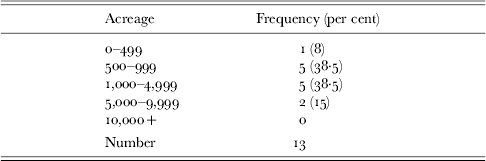
The first point to note about the Catholic civil servants under review is the large proportion from landowning families.Footnote 48 Fourteen of the Catholic civil servants in this survey (36 per cent of the total) were born into a landed family. Two more married into landed families, making a total of sixteen (41 per cent) with landed connections.Footnote 49 The sizes of the estates of the fourteen born into landed families are enumerated in Table 6. In general, they were from the lower end of the landlord class: almost half (46·5 per cent) were born into estates of less than 1,000 acres; and 85 per cent were from landed families who owned less than 5,000 acres. Admittedly, there were a minority (15 per cent) with estates of between 5,000 and 10,000 acres, but there were no Catholic civil servants born into the higher end of the landlord class who owned estates of more than 10,000 acres.
The size of estates of Catholic civil servants born into landed families (percentages are in brackets)
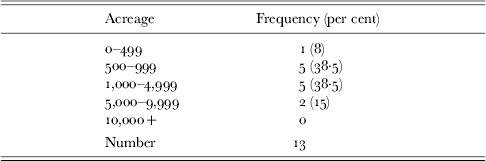
Note: Only thirteen individuals are recorded in this table because the data on the size of one individual's estate was unavailable.
Typical of the Catholic landlord class from which so many Irish civil servants were recruited were the Considines of Pallasgreen, county Limerick. Sir Heffernan Considine (1816–85) owned 950 acres (valued at £1,211 in 1876) in Limerick, and was a magistrate, deputy lieutenant and (sometime) high sheriff in the county. His eldest son, Heffernan, educated at Stoneyhurst and Lincoln College, Oxford, became a Royal Irish Constabulary officer, a resident magistrate, and assistant inspector general of the Royal Irish Constabulary. Considine's younger brother, Thomas Ivor, trained as a doctor and worked as assistant medical officer at Dundrum Asylum for the so-called ‘criminally insane’, before being appointed (without examination) to the top of the civil service as one of the inspectors of lunatic asylums in 1910 on a salary of £1,000 at the age of forty-two. A sister, Mary, married Lieutenant Colonel William MacCarthy-O'Leary of Millstreet, county Cork, and an officer in the South Lancashire Regiment, who was killed during the Boer War. Meanwhile two of Heffernan's sons fought in the Great War, one of whom, Heffernan James Considine of the Royal Irish Regiment, lost his life in 1916. The Considine family thus provided at least two generations of loyal servants to the crown in Ireland, and were intermarried with Catholic MPs, barristers, and landowners.Footnote 50 Thomas Ivor was, however, in many respects untypical of the Catholic population. He was from a prosperous landowning family although not sufficiently prosperous for him to not have to work, and he therefore shared the class interests of Irish Protestant landlords. Furthermore, his family had proved their loyalty to the British state and, to a certain extent, were duly rewarded and successful.
Most of the Catholics appointed to senior positions in the civil service appear to have come from backgrounds demonstrably loyal to the British state in Ireland. More than half (54 per cent) had been born into elite families, where their fathers were landowners, senior civil servants, resident magistrates, magistrates, lawyers, medics, military officers, engineers, and so on. Seven (18 per cent) had brothers who also held elite positions as landowners, police officers, judges, MPs, and barristers. A very large proportion of the Catholic civil servants, then, were not members of a newly mobile Catholic middle class, but members of an established Catholic landowning and professional elite. The positions held by these individuals before they were appointed to the civil service tended to demonstrate their loyalty to the British state. Two (John George MacCarthy and Henry Francis Doran) had been land agents and valuers. Two others had been army officers (John Ross of Bladensburg and Edgar Flinn), and one (William Joseph Maguire) had worked as a medical attendant to the Royal Irish Constabulary in Belfast. Three were already senior civil servants: John Houlihan was private secretary to the chief secretary before being appointed secretary of national health insurance; John Mulhall had been private secretary to the lord lieutenant before becoming vice chairman of the General Prisons Board (and was the vice president of the Catholic Truth Society); and Michael Finucane had already distinguished himself in the Indian civil service before becoming an estates commissioner. Two others came from the world of finance and business: Walter Kinnear had been the manager of a Dublin insurance company, and Stanislaus Joseph Lynch had been the manager of Sadleir's Bank in Clonmel.
Some had perhaps manifested the zeal of the convert in their loyalty to the British state. Peter O'Brien, the Catholic attorney general in 1888–9, was from a substantial landed family. His father, John, had been Liberal MP for Limerick city from 1841 to 1852 and made his fortune in business before buying into land. One brother, James, was a magistrate who inherited the family estate, and another brother, Jerome, was an army officer. Peter was educated at Trinity College, Dublin, before becoming a barrister at Middle Temple, and working as registrar to his uncle, a Queen's Counsel. This appears to have led to Peter becoming junior crown counsel, then 3rd serjeant, and then into the Irish office as solicitor general (in 1887–8). O'Brien's success, however, was predicated on the fact that he had become a staunch unionist following the introduction of the first Home Rule Bill. According to The Times: ‘Mr. O'Brien was unable, like a great number of educated Roman Catholics, to follow Mr. Gladstone in his conversion to Home Rule.’Footnote 51 Instead, O'Brien became a judge with the reputation for extensively using the crown's right to ask jurors suspected of sympathizing with the defendants to stand down, earning him the sobriquet ‘Peter the Packer’.Footnote 52 In one case, that of the trial of those accused of the Maamtrasna murders in county Galway in 1884, O'Brien had annotated a list of the prospective jurors with the letter ‘C’ next to those whom he believed to be Catholic.Footnote 53 Such blatant sectarianism, together with his assumption that all Catholic jurors were disloyal and sympathizers with the Maamtrasna murderers, suggests that O'Brien had internalized the British state's view of Irish Catholics. With the exception of those from landed and professional backgrounds, Irish Catholics were to be regarded as disloyal and potentially suspect.
VI
This survey of the composition and recruiting practices of the elite of the Irish civil service suggests a more complex pattern than that presented by McBride in The greening of Dublin Castle. Certainly, McBride was correct in identifying that successive British administrations appointed Catholics to senior positions during this period. The proportion of Catholics at the top level of the Irish civil service did increase significantly from 29 per cent in 1891 to 41 per cent in 1911, primarily due to the influence of both Liberal and Conservative chief secretaries who wished to make the Irish administration more representative of the population as a whole. However, the vast majority of Catholic recruits were not as representative of the Irish Catholic population as McBride suggested. There were approximately 10,000 landlords in Ireland from a population of almost five million, and so landowners constituted about 0·002 per cent of the Irish population. Yet almost half (41 per cent) of Irish Catholic civil servants had landed connections. This was because landowners were an extremely powerful class in nineteenth-century Ireland; because the younger sons of the smaller landlords did not have sufficient private income to sustain a lifestyle appropriate to their background; and because the British state regarded Catholic landowners as loyal servants of the crown. In the aftermath of the Land War (1879–82) and the rapid development of the Home Rule movement in the 1880s, the British state appears to have regarded Irish Catholics as suspect and potentially disloyal. Irish Catholic landowners, however, because they generally shared the interests of their class, rather than their ethnic group, were regarded as supporters of the British state and were thus much more likely to be recruited to the top of the Irish civil service than any other section of Catholic Irish society. The proportion of Catholic civil servants may have increased, but not all Catholics were Home Rulers. Indeed, a substantial proportion of senior Catholic administrators were both pro-landlord and unionist.
The elite of the Irish civil service had been dominated by members of the Irish landlord and protestant professional classes since the beginning of the nineteenth century. Given the nature of the civil service, where positions were held for life and where vacancies occurred only when existing members either died or retired, change in the composition of the elite of the civil service was always slow. However, government objections that there were insufficient educated Catholics capable of taking up senior positions must be regarded as a smokescreen. By 1900, there were perhaps 1,000 Catholic graduates emerging from the Irish universities each year, some of whom were already serving in top jobs. Moreover, by 1911, the majority of clerks and officials in the lower ranks of the civil service were Catholic, and if recruiting practices had been reformed, many could have been promoted from the ranks to more senior positions.
More generally, the Irish administration and the professions had been dominated by the Irish Protestant middle class for generations. By the end of the nineteenth century, however, there was an educated Irish Catholic middle class beginning to emerge. The members of this class were capable of taking their places in the administration and the professions, but were prevented from doing so by a subtle system of ethnic discrimination. Since the top jobs in the civil service and the professions were largely the preserve of young middle-class Irish Protestants who had access to the Ascendancy circles responsible for appointing candidates, educated Catholics were often prevented from gaining access to the professional positions for which their education had prepared them. Arthur Clery drew attention to this in his Dublin essays (1919) where he mourned the fact that many ‘really brilliant Catholic men’ had to content themselves with minor clerkships ‘at meagre salaries … just because this is almost the only piece of public patronage open to Catholics’.Footnote 54 Another Catholic university student recalled that: ‘[i]t was the sense of a dominating unionism as the influence frustrating the younger generation who had deliberately chosen to make their careers in Ireland that was the driving force of a generation’.Footnote 55 Hannah Skeffington, the feminist and graduate of the Royal University, explained that the situation was even worse for women: ‘I have known university graduates – exhibitioners, scholars, gold medallists – accept salaries which a competent cook would have scorned.’Footnote 56
This block on the upward social mobility of educated Catholics led to the formation of the Catholic Association in 1902 which aimed to campaign both for greater opportunities for Catholics and for the removal of discriminatory practices. According to the Catholic Association, ‘there was something working against us’, and its members resolved to ‘fight with all our might until we have laid our hands on as much of the power, place and position of this country, as our numbers and our ability demand’.Footnote 57 Other educated Catholics appear to have adopted a different strategy in order to achieve upward social mobility. Tom Garvin has examined the social composition of the elite of the republican movement in Ireland between 1913 and 1922 and found that the vast majority were young, well-educated, professional men.Footnote 58 Elsewhere, John Hutchinson has argued that impediments to Catholic social mobility in early twentieth-century Ireland encouraged young Catholic professionals to become republicans.Footnote 59 It would seem that the educated Catholics who were graduating from Irish universities from the 1890s onwards, and who were prevented from joining the professions or the elite of the Irish civil service, instead became involved in the separatist politics of Sinn Féin. Through their political activism, they hoped to force a transfer of power from British to Irish rule, and in an independent Ireland there would be increased career opportunities. The young educated Catholic professionals who joined Sinn Féin appear to have viewed a nationalist revolution as a route to upward social mobility. This might explain why so many junior members of staff in the Post Office were Sinn Féiners in 1914, as Sir Matthew Nathan observed to Charlie Hobhouse, the Postmaster General, in December 1914: ‘for some reason which I am unable to fathom a large proportion of the people treasonable to England (patriotic to Ireland, they would put it) are to be found in the lower ranks of the Government service and in this respect the Post Office has a bad prominence’.Footnote 60 It is possible that the existence of a glass ceiling for Catholics in the Irish civil service provided a powerful motive for revolution.Footnote 61 Certainly, there was a perception among Sinn Féiners that young Catholic professionals were being discriminated against. Kevin O'Shiel, a prominent Sinn Féin activist in 1917–18, for instance, quipped that conversion to Protestantism was the key to advancement to the senior officer class of the Royal Irish Constabulary.Footnote 62 Further research is required, however, to investigate the extent to which Sinn Féiners in 1917–21 had actually experienced blocked social mobility in their own careers.
If the British state had wanted to maintain itself in Ireland, it needed to do more at an earlier stage. Even the ‘greening’ of the late nineteenth century was piecemeal and did not effect a substantial change in the Irish administration. Barry O'Brien was clearly incorrect in his claim that the ‘Irish people’ played no part in ruling Ireland in 1912, but McBride also overstated the extent of ‘greening’ taking place in the administration between 1892 and 1922. Indeed, the impulse to legitimize the government by appointing Catholics was almost completely neutralized by a contradictory impulse to ensure that appointees were loyal.
The vast majority of senior civil servants in the rest of the United Kingdom were recruited by open competition to class I clerkships.Footnote 63 This system enabled the Home Civil Service to discriminate against candidates on a class, rather than ethnic, bias. The examination for first-division clerkships could only be passed by candidates who had received a third-level education, meaning that most first-division clerks were drawn from significantly higher social groups than second-division clerks.Footnote 64 In due course, it was the first-division clerks who tended to become the heads of departments, and their immediate subordinates, and promotion from second- to first-class clerkships was rare. According to one senior civil servant, Sir Albert Flynn, writing in 1928:
I say emphatically and with a full sense of responsibility that, in my experience, these conditions [of lower division clerks being given an opportunity to be promoted to the higher class], though admitted in theory, are most insufficiently observed in practice. The different classes of the Civil Service are treated as ‘castes’, determined by a man's entrance examination, and special promotion into the upper caste is very rare.Footnote 65
That the British state did not apply this recruiting system to Ireland suggests that the motivating impulse behind discriminatory recruiting practices in Ireland was ethnic, rather than class, discrimination. Had the government wanted to keep lower-class Irish men and women, both Catholic and Protestant, out of the top levels of the administration, the system of recruiting first-division clerks, as practised in the rest of the United Kingdom, could have been adopted. However, the government's determination to appoint senior civil servants in Ireland without competitive examination of any kind suggests that recruits were being vetted according to their ethnicity and perceived disloyalty, rather than class.
Had the British state wanted to ensure its domination in Ireland, the reforms of the land question and in the administration needed to be implemented at a much earlier date. If the administration had been dominated by Catholics in the 1860s, and extensive land purchase had been introduced before the Land War (1879–81), then it is possible that the British state in Ireland might have been maintained for a longer period. That this did not happen is partly because the government operated a policy of ethnic discrimination against Catholics in the administration and thereby sowed the seeds for the Irish revolution (1916–23).