Introduction
Hypertension is a major public health problem and an important modifiable risk factor for stroke, cardiovascular disease, and kidney disease.Reference Emma, Goldstein, Bagga, Bates and Shroff1,Reference Gauer2 High blood pressure values that begin in childhood tend to continue into adulthood.Reference Li and Chen3 It is often difficult to diagnose because it is asymptomatic. Therefore, by the time patients seek medical attention, it is highly probable that target organ damage has already occurred.Reference Prakash4 The most important thing is to detect hypertension before target organ damage develops and to improve cardiovascular prognosis. Hypertension-induced damage to endothelial tissue is associated with an inflammatory response and contributes significantly to target organ damage.Reference McMaster, Kirabo, Madhur and Harrison5
While many factors are involved in the pathophysiology of hypertension, the role of the immune system has been proven by numerous studies. Activation of the innate and adaptive immune systems leads to infiltration of immune cells, oxidative stress, and activation of the intrarenal angiotensin system.Reference Rodriguez-Iturbe, Pons and Johnson6
Systemic inflammation can be assessed using haematological and biochemical markers obtained from inexpensive and easily accessible blood tests and ratios derived from these tests.Reference Xu, Zeng and Zhang7,Reference Wu, Huang and Jin8 These inflammatory markers, particularly the neutrophil-to-lymphocyte ratio, platelet-to-lymphocyte ratio, lymphocyte-to-monocyte ratio, C-reactive protein-albumin ratio, and systemic immune-inflammation index, are particularly relevant in relation to cardiovascular and non-cardiovascular diseases.Reference Song, Kwon, Kim, Kim and Cho9–Reference Zhang, Wang, Liao, Liao, Fang and Shen11
Recent studies have emphasised complete blood count-derived inflammatory indices, including the systemic immune inflammation index, neutrophil-to-lymphocyte ratio, platelet-to-lymphocyte ratio, and lymphocyte-to-monocyte ratio, in relation to the diagnosis and prognosis of cardiovascular diseases.Reference Karaca, Karasu and Gelen12–Reference Jin, Huang and Hong14 It has been suggested that systemic immune inflammation index, which stands out as a practical indicator, may be a superior predictive parameter compared to other indicators.Reference Nøst, Alcala and Urbarova10
This study aimed to evaluate the predictive value of systemic immune inflammation index, neutrophil-to-lymphocyte ratio, platelet-to-lymphocyte ratio, and C-reactive protein-albumin ratio in children with primary hypertension by comparing their levels with healthy controls, assessing their association with disease severity and examining changes after treatment.
Materials and methods
Study design and data collection
This retrospective study included 49 patients diagnosed with primary hypertension and followed in the Paediatric Nephrology Department between January 2010 and January 2020. A control group of 50 healthy children matched for age, gender, and weight was included. Matching was performed using frequency matching to ensure comparability between groups. All control participants underwent a standardised screening protocol to exclude underlying inflammation or infection, including complete blood count, C-reactive protein, urinalysis, urine culture, and blood pressure measurement. Only children with normal blood pressure, no infection markers, and no chronic diseases were included in the control group.
Inclusion criteria were as follows: children under 18 years of age with newly diagnosed primary hypertension, no evidence of active infection or systemic inflammation, no history of comorbidities, no current medication use, and availability of informed consent from legal guardians. Exclusion criteria included the presence of secondary hypertension, comorbid cardiac, renal, or systemic diseases.
Clinical assessment and treatment
The demographic information, medical history, and family history of the patients and control group were retrieved from retrospective patient records. Height, weight, and clinic blood pressure were recorded. Body mass index was calculated as weight (kg) divided by the square of height (m2). The Child Metrics programme was used to assess the standard deviation scores of body mass index and clinic and 24-hour blood pressure values against reported normal ranges.Reference Neyzi, Bundak and Gökçay15,Reference Flynn, Kaelber and Baker-Smith16 Clinic blood pressure was measured using an aneroid sphygmomanometer with a 36–42 cm cuff (ERKA Perfect-Aneroid; ERKA, Bad Tölz, Germany), which was calibrated against a mercury sphygmomanometer every 6 months. Measurements were performed on three different days, and the average of three readings obtained after 5 minutes of rest was recorded.
Hypertension was classified according to the 2017 American Academy of Paediatrics guidelines.Reference Flynn, Kaelber and Baker-Smith16 For children aged 1 to <13 years, blood pressure <90th percentile was considered normal, 90th–95th percentile or ≥120/80 mmHg as elevated blood pressure, 95th percentile to 95th + 12 mmHg (or 130/80 to 139/89 mmHg) as stage 1 hypertension, and ≥95th + 12 mmHg or ≥140/90 mmHg as stage 2 hypertension. For children aged ≥13 years, thresholds of <120/80 mmHg (normal), 120–129/<80 mmHg (elevated), 130/80–139/89 mmHg (stage 1), and ≥140/90 mmHg (stage 2) were used.
Children with hypertension were managed according to the 2017 American Academy of Paediatrics guidelines.Reference Flynn, Kaelber and Baker-Smith16 Behavioural interventions, including dietary modification and regular exercise, were initially recommended. Pharmacological therapy with angiotensin-converting enzyme inhibitors, angiotensin receptor blockers, or calcium channel blockers was initiated in patients with stage 2 hypertension, symptomatic hypertension, or inadequate response to lifestyle changes. Diuretics (hydrochlorothiazide) were added when target blood pressure was not achieved. Follow-up evaluations, including blood pressure measurement and laboratory reassessment of inflammatory markers, were performed approximately three months after initiation of treatment to assess treatment response, consistent with the follow-up intervals recommended by the 2017 American Academy of Paediatrics Guidelines. Reference Flynn, Kaelber and Baker-Smith16
Ambulatory blood pressure monitoring
The 24-hour ambulatory blood pressure monitoring was performed in patients with elevated clinic blood pressure using a fully automated device (Contec ABPM50). Measurements were recorded every 15 minutes between 6:00 am and 10:00 pm and every 30 minutes from 10:00 pm to 6:00 am. Recordings with >30% invalid readings were excluded. Ambulatory blood pressure monitoring results were evaluated based on age-specific normative data.Reference Flynn, Kaelber and Baker-Smith16
Diagnostic work-up and staging
All patients with hypertension underwent a detailed assessment. The purpose of the advanced diagnostic evaluation was to differentiate between primary and secondary hypertension, exclude patients with secondary hypertension, detect target organ damage, and determine the stage of hypertension (stage 1 or 2). Initially, basic screening tests including complete blood count, urinalysis, renal function tests, electrolytes, serum lipid profile, C-reactive protein, albumin, renal ultrasound, and renal Doppler ultrasound were performed. For the evaluation of target organ damage, fundoscopic examination was conducted based on clinical indications and institutional practice.Reference Flynn, Kaelber and Baker-Smith16,Reference Lurbe, Agabiti-Rosei and Cruickshank17
Inflammatory marker assessment
Neutrophils, lymphocytes, and platelets were measured in blood samples taken from patients at the time of initial diagnosis and after treatment using a fully automated haematology analyser. The systemic immune inflammation index was then calculated using the formula systemic immune inflammation index = (platelets × neutrophils) / lymphocytes.Reference Yang, Chang, Meng, Gao and Wang18 The C-reactive protein-albumin ratio, platelet-to-lymphocyte ratio, and neutrophil-to-lymphocyte ratio were calculated using the corresponding haematological parameters.Reference Zhang, Wang, Liao, Liao, Fang and Shen11,Reference Jhuang, Kao and Peng13,Reference Kurtul and Ornek19
Statistical analysis
The Statistical Package for the Social Sciences for Windows, version 26.0, was used for statistical analysis. Continuous variables were presented as mean ± standard deviation and categorical variables as frequencies and percentages. Visual (histogram and probability graphics) and analytical methods (the Kolmogorov–Smirnov and Shapiro–Wilk tests) were used to assess the normal distribution of the variables. Student’s t-test or Mann–Whitney U test was used to analyse differences in continuous variables, while the chi-squared test was used to compare categorical variables. To assess the association between normally and non-normally distributed variables, Pearson and Spearman correlation analyses were performed. Statistical significance was defined as a p-value <0.05. To assess the association of systemic immune inflammation index and other parameters with subclinical inflammation in hypertension, receiver operating characteristic curve analysis was performed. Multivariable logistic regression analysis was conducted to evaluate the independent association of inflammatory markers (systemic immune inflammation index, neutrophil-to-lymphocyte ratio, C-reactive protein-albumin ratio, and platelet-to-lymphocyte ratio) with hypertension, adjusting for potential confounders including age, gender, body mass index, and lipid parameters. Variables with p < 0.05 in univariate analysis were included in the model.
Results
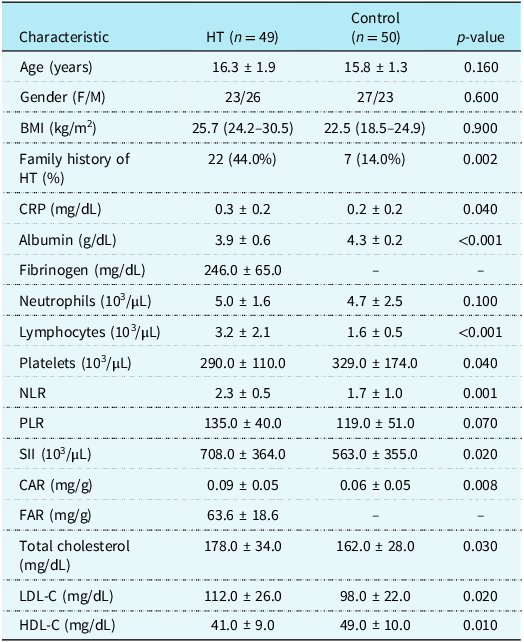
In this study, 49 children with hypertension and 50 healthy controls were analysed. The groups were comparable in terms of age, gender, and body mass index. A positive family history of hypertension was more frequent in the hypertension group (44.0% vs. 14.0%, p = 0.002). Compared to controls, hypertensive patients had significantly higher C-reactive protein (0.3 ± 0.2 vs. 0.2 ± 0.2 mg/dL, p = 0.040), lower albumin (3.9 ± 0.6 vs. 4.3 ± 0.2 g/dL, p < 0.001), and altered blood cell indices: higher lymphocyte counts (3.2 ± 2.1 vs. 1.6 ± 0.5 × 10³/µL, p < 0.001), lower platelet counts (290.0 ± 110.0 vs. 329.0 ± 174.0 × 10³/µL, p = 0.040), and higher systemic immune inflammation index (708.0 ± 364.0 vs. 563.0 ± 355.0 × 10³/µL, p = 0.020). Both neutrophil-to-lymphocyte ratio and C-reactive protein-albumin ratio were significantly elevated in the hypertension group (p = 0.001 and p = 0.008, respectively). Lipid analysis revealed higher total cholesterol and low-density lipoprotein cholesterol and lower high-density lipoprotein cholesterol levels in the hypertension group (p < 0.050 for all) (Table 1). In addition to inflammatory parameters, serum lipid levels also differed significantly between the groups. Moreover, hypertensive children with concomitant hyperlipidaemia demonstrated significantly higher levels of systemic inflammatory markers—including systemic immune inflammation index, C-reactive protein, neutrophil-to-lymphocyte ratio, and C-reactive protein-albumin ratio—compared with patients without hyperlipidaemia. Low-density lipoprotein cholesterol showed a positive correlation with systemic immune inflammation index (r = 0.32, p = 0.010) and C-reactive protein (r = 0.28, p = 0.020), while total cholesterol correlated positively with neutrophil-to-lymphocyte ratio (r = 0.30, p = 0.010). In contrast, high-density lipoprotein cholesterol was inversely correlated with systemic immune inflammation index (r = –0.29, p = 0.020) and neutrophil-to-lymphocyte ratio (r = –0.27, p = 0.030). Patients with hypertension were classified as stage 1 (n = 17) and stage 2 (n = 32) according to the 2017 American Academy of Paediatrics criteria.Reference Neyzi, Bundak and Gökçay15 The body mass index values were significantly higher in the stage 2 group (p < 0.001). Among ambulatory blood pressure monitoring parameters, systolic blood pressure-standard deviation scores were significantly higher in the stage 2 group (p < 0.001), whereas diastolic blood pressure-standard deviation scores did not differ between groups (p = 0.900). Although the average dipping percentage tended to be higher in individuals with stage 2 hypertension, the difference did not reach statistical significance (p = 0.170). Children with stage 2 hypertension had significantly higher levels of fibrinogen, C-reactive protein, C-reactive protein-albumin ratio, systemic immune inflammation index, post-treatment systemic immune inflammation index, platelet count, and platelet-to-lymphocyte ratio compared to stage 1 (p < 0.050 for all). In particular, systemic immune inflammation index levels were markedly higher in stage 2 patients (814.0 ± 376.0 × 10³/µL vs. 509.0 ± 240.0 × 10³/µL; p = 0.003), and although both groups showed a decrease after treatment, stage 2 patients continued to have significantly higher systemic immune inflammation index (729.0 ± 308.0 vs. 471.0 ± 196.0 × 10³/µL; p = 0.003). Fibrinogen levels were also elevated in stage 2 patients (272.0 ± 66.0 mg/dL vs. 198.0 ± 25.0 mg/dL; p < 0.001). Platelet counts were significantly higher in stage 2 hypertension (327.0 ± 97.0 × 10³/µL), accompanied by an increase in platelet-to-lymphocyte ratio (146.0 ± 37.0 vs. 116.0 ± 40.0; p = 0.011). and C-reactive protein-albumin ratio levels were likewise significantly higher in the stage 2 group (p = 0.023 and p = 0.014, respectively). Hypertensive retinopathy was detected in six patients with stage 2, whereas no ocular involvement was observed in stage 1 patients (p = 0.100).
Comparison of demographic and laboratory characteristics between the HT and control groups

HT = Hypertension; F = Female; M = Male; BMI = Body mass index; CRP = C-reactive protein; NLR = Neutrophil-to-lymphocyte ratio; PLR = Platelet-to-lymphocyte ratio; SII = Systemic immune inflammation index; CAR = CRP-to-albumin ratio; FAR = Fibrinogen-to-albumin ratio; LDL-C = Low-density lipoprotein cholesterol; HDL-C = High-density lipoprotein cholesterol.
Following antihypertensive treatment and lifestyle modification, systemic immune inflammation index levels significantly decreased from 708 ± 364 × 103/µL to 640 ± 299 × 103/µL (p < 0.001), while changes in neutrophil-to-lymphocyte ratio, C-reactive protein-albumin ratio, and C-reactive protein were not statistically significant.
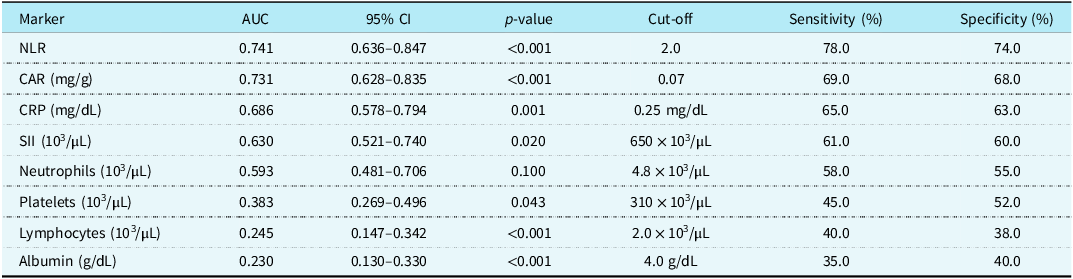
In receiver operating characteristic curve analysis, neutrophil-to-lymphocyte ratio demonstrated the highest diagnostic performance with an area under the curve of 0.741 (95% confidence interval: 0.636–0.847, p < 0.001). The optimal cut-off value for neutrophil-to-lymphocyte ratio was 2.0, yielding a sensitivity of 78% and a specificity of 74%. C-reactive protein-albumin ratio also showed strong predictive ability (area under the curve = 0.731, 95% confidence interval: 0.628–0.835, p < 0.001) with a cut-off of 0.07 (sensitivity 69%, specificity 68%). C-reactive protein had moderate discriminative power (area under the curve= 0.686, 95% confidence interval: 0.578–0.794, p = 0.001), with a cut-off of 0.25 mg/dL (sensitivity 65%, specificity 63%). Systemic immune inflammation index showed modest predictive utility (area under the curve = 0.630, 95% confidence interval: 0.521–0.740, p = 0.020), with a cut-off of 650 × 103/µL (sensitivity 61%, specificity 60%). In contrast, neutrophil and platelet counts demonstrated low accuracy (area under the curve = 0.593 and 0.383, respectively), while lymphocyte count and albumin levels were inversely associated with hypertension, both showing low area under the curves (0.245 and 0.230, p < 0.001) (Table 2).
Diagnostic performance of inflammatory and haematological markers in predicting HT based on ROC analysis

AUC = Area under the curve; CI = Confidence interval; NLR = Neutrophil-to-lymphocyte ratio; CAR = CRP-to-albumin ratio; SII = Systemic immune inflammation index; ROC = Receiver operating characteristics; CRP = C-reactive protein.
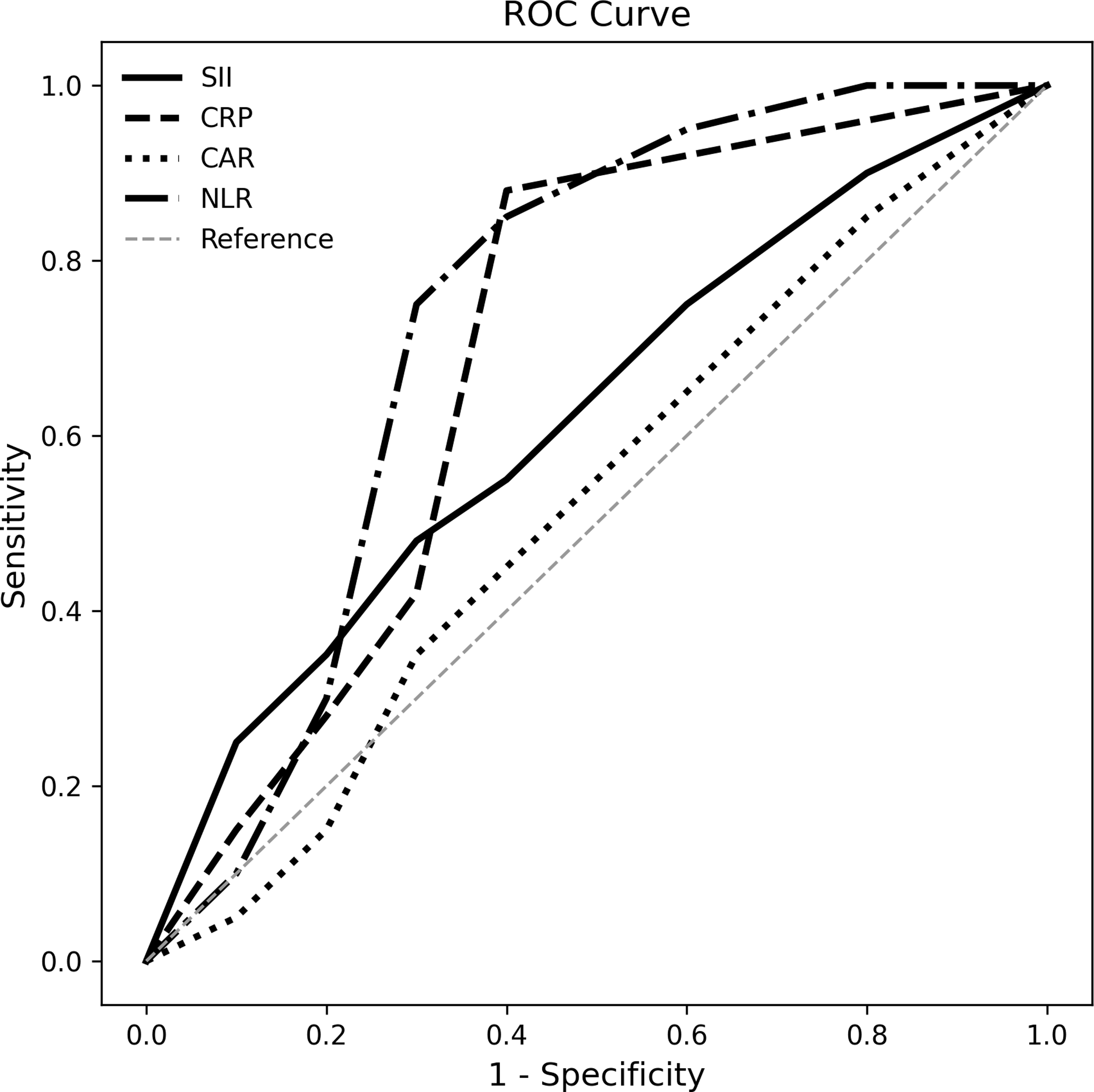
Figure 1 presents the receiver operating characteristic curves of systemic immune inflammation index, C-reactive protein, C-reactive protein-albumin ratio, and neutrophil-to-lymphocyte ratio for the prediction of subclinical inflammation in hypertensive patients. Neutrophil-to-lymphocyte ratio demonstrated the highest balance between sensitivity and specificity among the evaluated markers. C-reactive protein-albumin ratio showed a moderate but consistent discriminative ability, while C-reactive protein also exhibited moderate performance. In contrast, systemic immune inflammation index displayed a comparatively lower diagnostic utility, indicating more limited discriminatory power.
ROC curve for SII, CRP, CAR, and NLR for subclinical inflammation in hypertensive patients. ROC = Receiver operating characteristics; SII = Systemic immune-inflammation index; CRP = C-reactive protein; CAR = CRP-to-albumin ratio; NLR = Neutrophil-to-lymphocyte ratio.

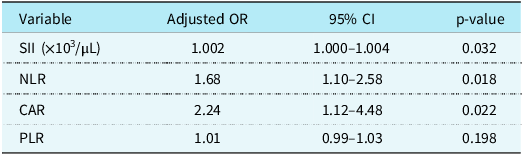
In the multivariable logistic regression analysis, after adjusting for age, gender, body mass index, and lipid parameters, neutrophil-to-lymphocyte ratio (odds ratio: 1.68, 95% confidence interval: 1.10–2.58, p = 0.018) and C-reactive protein-albumin ratio (odds ratio: 2.24, 95% confidence interval: 1.12–4.48, p = 0.022) remained independently associated with hypertension. Systemic immune inflammation index showed a modest but statistically significant association (odds ratio: 1.002, 95% confidence interval: 1.000–1.004, p = 0.032), whereas platelet-to-lymphocyte ratio did not retain significance (p = 0.198). The model demonstrated good calibration (Hosmer–Lemeshow p = 0.61) and explained approximately 42% of the variance (Nagelkerke R 2 = 0.42) (Table 3).
Multivariable logistic regression analysis of inflammatory markers associated with HT

SII = Systemic immune-inflammation index; NLR = Neutrophil-to-lymphocyte ratio; CAR = CRP-to-albumin ratio; PLR = Platelet-to-lymphocyte ratio; OR = Odds ratio; CI = Confidence interval.
Discussion
We investigated the role of systemic immune inflammation index and other inflammatory markers in the diagnosis of hypertension by comparing hypertensive and healthy children. We also re-evaluated the hypertensive patients after treatment and examined the role of inflammatory markers in the treatment. Our single-centre, cross-sectional study showed that children with primary hypertension had higher inflammatory markers than their healthy peers.
In our receiver operating characteristic analysis, we demonstrated that systemic inflammation contributes to the risk of hypertension. Neutrophil-to-lymphocyte ratio (area under the curve = 0.741) and C-reactive protein-albumin ratio (0.731) had strong diagnostic utility in predicting hypertension, whereas C-reactive protein (area under the curve = 0.686) and systemic immune inflammation index (area under the curve of 0.630) had moderate diagnostic utility. As shown in many studies, we demonstrated a relationship between immune system activation and hypertension and target organ damage in our patients.Reference McMaster, Kirabo, Madhur and Harrison5–Reference Xu, Zeng and Zhang7,Reference Zhang, Wang, Liao, Liao, Fang and Shen11,Reference Karaca, Karasu and Gelen12
C-reactive protein is associated with the burden of atherosclerosis and is an important cardiovascular risk factor.Reference Liu, Cao and Sun20 Children with cardiovascular risk factors such as dyslipidaemia and hypertension have also been reported to have elevated C-reactive protein levels.Reference Dziedzic-Jankowska, Bujanowicz, Szyszka, Stelmaszczyk-Emmel and Skrzypczyk21,Reference Assadi22 C-reactive protein was shown to be the most sensitive of all markers in predicting arterial hypertension by Dziedzic–Jankowska et al.Reference Dziedzic-Jankowska, Bujanowicz, Szyszka, Stelmaszczyk-Emmel and Skrzypczyk21 In one study, C-reactive protein levels were significantly associated with left ventricular hypertrophy in children with essential hypertension.Reference Assadi22 C-reactive protein levels were significantly higher in hypertensive children than in controls in our study. Our receiver operating characteristic analysis showed that C-reactive protein was moderately sensitive in predicting hypertension among the markers examined. However, the fact that C-reactive protein is influenced by many factors can reduce its specificity, so we recommend that it should be evaluated together with other biomarkers.
In line with our findings, Zhang et al. recently demonstrated in the National Health and Nutrition Examination Survey cohort that per-SD increases in systemic immune inflammation index and neutrophil-to-lymphocyte ratio were associated with higher odds of elevated blood pressure (odds ratio 1.11 and 1.08, respectively).Reference Zhang, Lu and Lin23 Likewise, a meta-analysis by Dziedzic–Jankowska et al. reported mean differences of 0.90 for neutrophil count and 0.48 for neutrophil-to-lymphocyte ratio between hypertensive and control groups.Reference Dziedzic-Jankowska, Kołodziej and Skrzypczyk24 These data support our receiver operating characteristic results, where neutrophil-to-lymphocyte ratio and C-reactive protein-albumin ratio provided the strongest diagnostic performance, while systemic immune inflammation index, despite modest accuracy, reflected disease severity, and treatment response.
An important role in the inflammatory process is played by neutrophils, lymphocytes, and platelets. For this reason, blood cell parameters and indices such as the neutrophil-to-lymphocyte ratio, platelet-to-lymphocyte ratio, and systemic immune inflammation index are being studied more and more in chronic inflammatory diseases. Hou et al. showed that leukocytes, neutrophils, and neutrophil-to-lymphocyte ratio were significantly higher in hypertensive children than in controls.Reference Hou, Cao and Ding25 Another study in adults showed that an elevated neutrophil-to-lymphocyte ratio is associated with an increased risk of cardiovascular mortality and all-cause mortality, and that neutrophil-to-lymphocyte ratio can be an independent predictor of outcomes in people with high blood pressure.Reference Hong, He, Fang, Liu and Chen26 Our study showed that neutrophils, lymphocytes, and platelets were higher in hypertensive patients than in controls. In the receiver operating characteristic analysis, we showed that the neutrophil-to-lymphocyte ratio had the highest sensitivity in the prediction of hypertension.
We showed that systemic immune inflammation index was significantly higher in the hypertensive group than in controls. This supports its potential utility as a marker of systemic inflammation in paediatric hypertension. The systemic immune inflammation index provides a more comprehensive measure of inflammation than individual blood parameters by integrating neutrophil, platelet, and lymphocyte counts. In a study conducted by cardiologists on adult patients, high systemic immune inflammation index levels independently predicted the presence and severity of target organ damage in newly diagnosed hypertensive patients.Reference Inanc and Sabanoglu27 Another cross-sectional study of 119,664 adults showed a positive association between inflammatory markers, including systemic immune inflammation index, and hypertension prevalence.Reference Jin, Huang and Hong14 In addition, the decrease in systemic immune inflammation index levels after treatment in this study demonstrates the clinical promise of systemic immune inflammation index as a potential biomarker for assessing treatment response.
In line with the literature, our study has shown that C-reactive protein-albumin ratio may play an important role in the development of hypertension. Zhang et al. demonstrated that a higher C-reactive protein-albumin ratio was associated with an increased risk of hypertension-related mortality among adults with hypertension.Reference Zhang, Wang, Liao, Liao, Fang and Shen11 The clinical use of C-reactive protein-albumin ratio in children has been the subject of studies in inflammatory bowel disease and neonatal sepsis.Reference Glapa-Nowak, Szczepanik and Banaszkiewicz28,Reference Khedr, Nabil, Abdelnaby, Abdulrazek and Lotfy29 Glapa–Nowak et al. showed that the C-reactive protein-albumin ratio was higher in children with severe inflammatory bowel disease than in children with quiescent inflammatory bowel disease.Reference Glapa-Nowak, Szczepanik and Banaszkiewicz28 Khedr et al. also showed that C-reactive protein-albumin ratio was superior to C-reactive protein in the detection of neonatal sepsis.Reference Khedr, Nabil, Abdelnaby, Abdulrazek and Lotfy29 The fact that C-reactive protein-albumin ratio levels are higher in patients with stage 2 hypertension is an indication that it may be a potential marker for the prediction of disease severity.
In contrast, albumin levels were significantly lower in the hypertensive group (3.9 ± 0.56 g/dL) compared to controls (4.3 ± 0.2 g/dL, p < 0.001). Hypoalbuminemia is a recognised marker of inflammation, as the synthesis of albumin can be downregulated in the context of chronic inflammatory activity. Hypoalbuminemia has also been associated with increased oxidative stress, endothelial dysfunction, and an increased risk of cardiovascular events, which may explain its pathophysiological role in hypertension.Reference Zhang, Wang, Liao, Liao, Fang and Shen11
Children with stage 2 hypertension had significantly higher levels of fibrinogen, C-reactive protein, C-reactive protein-albumin ratio, systemic immune inflammation index, post-treatment systemic immune inflammation index, platelet count, and platelet-to-lymphocyte ratio compared to stage 1 (p < 0.05). High levels of inflammatory markers in patients with stage 2 hypertension suggest that inflammation may have a role in the severity of hypertension.
Our study expands this evidence by demonstrating a statistically significant decrease in systemic immune inflammation index following hypertension treatment; from 708 ± 364 × 103/µL to 640 ± 299 × 103/µL (p < 0.001). This indicates that systemic inflammation in hypertensive children is not only associated with the presence of the disease but is also modifiable by treatment. Previous studies have consistently reported increased inflammatory activity in paediatric hypertension. For example, Zhang et al. analysed National Health and Nutrition Examination Survey data in a large paediatric population. They demonstrated that systemic immune inflammation index, neutrophil-to-lymphocyte ratio, and lymphocyte-to-monocyte ratio could be used as readily accessible early biomarkers for predicting and preventing high blood pressure risk in children and adolescents.Reference Zhang, Lu and Lin23 Similarly, a recent systematic review and meta-analysis by Dziedzic–Jankowska et al. confirmed that readily accessible markers such as high-sensitivity C-reactive protein, neutrophil counts, monocyte counts, neutrophil-to-lymphocyte ratio, and lymphocyte-to-monocyte ratio are significantly elevated in the primary hypertension population.Reference Dziedzic-Jankowska, Kołodziej and Skrzypczyk24 While previous reports have established the relationship between inflammation and paediatric hypertension, we demonstrate that inflammation can be reduced with effective treatment. This highlights the potential benefit of systemic immune inflammation index not only as a diagnostic marker but also as a biomarker for monitoring treatment response. Beyond inflammatory indices, our study also demonstrated significant alterations in lipid metabolism among hypertensive children, with higher total cholesterol and low-density lipoprotein cholesterol and lower high-density lipoprotein cholesterol compared with controls. Importantly, hypertensive patients with concomitant hyperlipidaemia exhibited elevated systemic inflammatory indices, including systemic immune inflammation index, C-reactive protein, neutrophil-to-lymphocyte ratio, and C-reactive protein-albumin ratio, suggesting that dyslipidaemia amplifies the inflammatory milieu in paediatric hypertension. This is in line with previous adult studies: Siripuram et al. reported that elevated low-density lipoprotein cholesterol, reduced high-density lipoprotein cholesterol, and higher high sensitive C-reactive protein were strong independent predictors of cardiovascular disease, underscoring the synergistic interplay between dyslipidaemia and systemic inflammation.Reference Siripuram, Gunde, Hegde, Ghetia and Kandimalla30 Similarly, Aljuraiban et al. showed that systemic immune inflammation index was significantly associated with both hypertension and elevated low-density lipoprotein cholesterol, reinforcing the role of lipid-driven inflammation in cardiovascular risk.Reference Aljuraiban, Alharbi and Aljohi31 Yan et al. further demonstrated that the novel pan-immune-inflammation value was positively associated with dyslipidaemia in a large National Health and Nutrition Examination Survey cohort, with predictive ability comparable to systemic immune inflammation index.Reference Yan, Jia and Huo32 Taken together, these findings, supported by our paediatric data, suggest that dyslipidaemia is not merely a metabolic derangement but may also intensify systemic inflammation and accelerate cardiovascular risk trajectories from childhood onwards.
The strengths of this study include the evaluation of multiple inflammatory markers in childhood hypertension, comparison with healthy controls, and examination of pre- and post-treatment changes; however, its main limitations are its retrospective design, limited number of patients, and lack of evaluation of long-term outcomes. Moreover, although we identified significant differences in lipid parameters and their correlations with inflammatory indices, data regarding other metabolic factors—such as insulin resistance, metabolic syndrome, and pre/type II diabetes—were incomplete and heterogeneous in our cohort, precluding a comprehensive analysis of their relationship with systemic inflammation. Additionally, the assessment of target organ damage was restricted to ocular findings based on fundoscopic examination, as other markers of target organ damage, such as cardiac or renal involvement, were not systematically evaluated due to the retrospective design.
Conclusion
This study demonstrates that systemic inflammatory markers are elevated in children with primary hypertension compared with healthy peers. Among them, neutrophil-to-lymphocyte ratio and C-reactive protein-albumin ratio showed strong diagnostic utility, whereas systemic immune inflammation index, despite modest discriminative accuracy, was significantly associated with disease severity and decreased after treatment. These findings suggest that systemic immune inflammation index may be particularly valuable as a prognostic biomarker, reflecting both disease burden and treatment response in paediatric hypertension. Future prospective, multicentre studies are warranted to validate these observations and further define the clinical role of systemic immune inflammation index in this population.
Financial support
The authors declared that this study has received no financial support.
Competing interests
The authors have no conflicts of interest relevant to this article to disclose.
Ethical standard
Ethics approval and consent to participate: The study was approved by the local ethics committee of the Celal Bayar University (decision number: 20.478.486 date: 29 March 2023). All participants were provided with a Participant Information Sheet and provided informed written consent.