INTRODUCTION
It is generally recognized that the distribution of modern humans in the Upper Paleolithic was closely related to climate change (Carto et al., Reference Carto, Weaver, Hetherington, Lam and Wiebe2009; Breeze et al., Reference Breeze, Groucutt, Drake, White, Jennings and Petraglia2016). Evidence from some regions show that the intensity of human activities increased during warm periods, including MIS 7 and MIS 5 (Tang et al., Reference Tang, Du and Liu2017), and that modern humans migrated to the warmer south due to the last glacial stage (MIS 3–2) dry and cold environmental changes (Sun et al., Reference Sun, Ke, Shi, Zhang, Chen, Wu and Zhang2000; Ren, Reference Ren2017; F. Li et al., Reference Li, Wang, Zhou, Wang, Long, Chen, Olsen and Chen2018; C.Z. Li et al., Reference Li, Li, Li, Wang and Li2019). However, human occupation and activity were not limited only to warmer periods and regions, and even during the last glacial maximum (LGM) (26.5 to ca. 19 cal ka BP; Ju et al., Reference Ju, Wang and Jiang2007; Clark et al., Reference Clark, Dyke, Shakun, Carlson, Clark, Wohlfarth, Mitrovica, Hostetler and McCabe2009) some regions of the world were still occupied by humans.
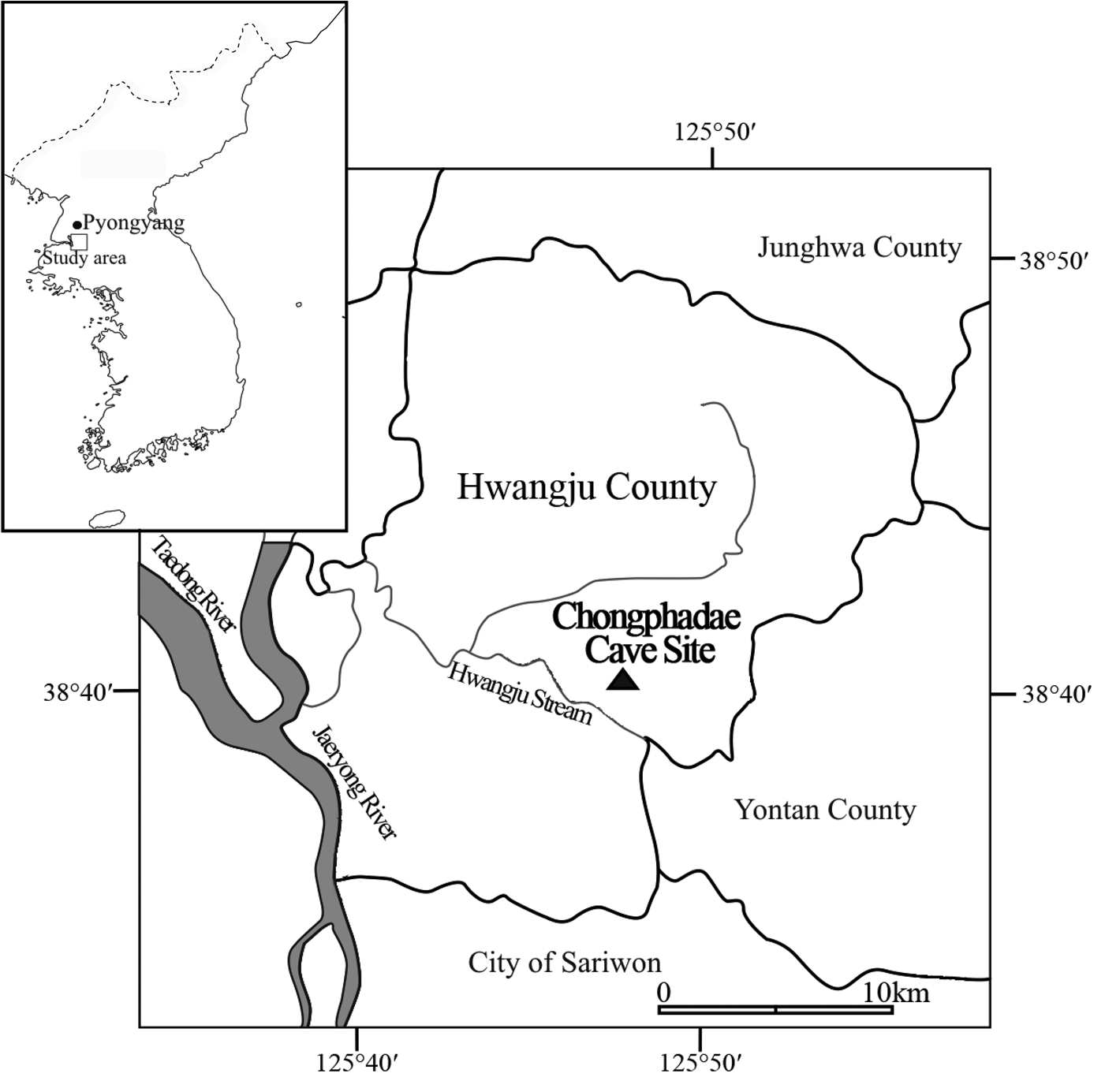
The Chongphadae Cave site (CPDCS)(Fig. 1), located northwest of the central part of the Korean Peninsula, was one of the endemic areas in northeastern Asia during the late MIS 3 and MIS 2 (especially MIS 2). The cave deposit consists of 15 layers and is ~8.6 m thick (Choe et al., Reference Choe, Han, Kim, Ho and Kang2020). The sediments contained several human fossils, a large number of stone tools, and mammal remains. Human fossils and fireplaces, representing human existence, and most of the faunal remains were excavated from Layers 12 and 13, reflecting the most active human subsistence and activities at the site during this time. Layers 12 and 13 of the Chongphadae sequence are associated with late marine isotope stage 3 (MIS 3) (59–27 cal ka BP; Rasmussen et al., Reference Rasmussen, Bigler, Blockley, Blunier, Buchardt, Clausen and Cvijanovic2014) and MIS 2, including the LGM (29 to ca. 14 cal ka BP; Lisiecki and Raymo, Reference Lisiecki and Raymo2005), respectively (Choe et al., Reference Choe, Han, Kim, Ho and Kang2020). This implies that the layers can provide new data (human occupation, ecological and environmental conditions) on environmental change, human subsistence, and activity in the central Korean Peninsula during the last glacial. Therefore, we focus only on Layers 12 and 13, and other layers are used only for some comparative purposes.
Generalized map of the Chongphadae Cave site.

The CPDCS is one of the most significant Paleolithic sites on the Korean Peninsula, however only the faunal study results have been published previously (Choe et al., Reference Choe, Han, Kim, Ho and Kang2020). Many studies have been published on global human subsistence, paleoenvironment, and their correlation during the last glacial period, but no studies have been published on the northern part of the Korean Peninsula.
The purpose of our paper is to provide a preliminary description of the environmental changes and human activities in the central Korean Peninsula during the late MIS 3 and MIS 2 through the study of remains discovered from Layers 12 and 13 of the Chongphadae Cave (CPDC) deposits. In other words, it is to explain the paleoenvironment, adaptations, and subsistence of human populations in an area of endemism during this period.
STUDY AREA
The Korean Peninsula, which links with the rest of the Asian continent to the north and is sea bound on three sides, is in the central part of the northern hemisphere latitudinally and in the eastern part of the eastern hemisphere longitudinally. It has four clear seasons, and warm and humid temperate climates. The average annual temperature is 10°C and the average annual precipitation is ~1000–1200 mm. In summer, there is a southwest (or southeast) wind, and in winter, there is a northwest wind. Because the Korean Peninsula is long in the direction of north and south, most of the region is dominated by climate of the south temperate zone, but some southern regions are affected by subtropical climate and the northern highlands are represented by subarctic climate. The topography is varied, including mountains, plateaus, plains and fields, basins, river valleys, coasts, karst, and eolian. Especially there are many mountains, ~79% of the total area, and most of them are <500 m asl. The mountains are concentrated in the northern area and the eastern coastal regions, and gradually fall towards the south and west, with the majority of the plains in the western and southern regions. Because the Korean Peninsula has many mountains and complex topography, the environment in the same region varies from valley to valley and from sunny to shady areas within a single valley.
The central part of the Korean Peninsula lies in the transition zone where the north and the south meet, and the mountains are low and middle elevation. This region, which has transitional landscape features of the north and south regions, consists of an intermediate natural zone where the temperate northern deciduous forest and the temperate southern deciduous forest are interchangeable. The plains are divided into several smaller plains by mountain chains of different orientations, without forming a single large plain due to complex tectonic movements. In the central part of the Korean Peninsula, special plants and animals are concentrated due to the diversity of environment.
The CPDCS (125°47′30″E, 38°40′54″N) is located 2 km southeast of the township of Hwangju County, North Hwanghae Province, in the northwestern part of the central Korean Peninsula (Fig. 1) (Choe et al., Reference Choe, Han, Kim, Ho and Kang2020). The Hwangju region consists mostly of hilly plains and is adjacent to the Pyongyang peneplain. The average annual temperature and precipitation are 9.8°C and 906 mm, respectively. Approximately 60% of the average annual precipitation falls as rain in summer. This region is rich in water resources, and there are >30 large and small rivers and streams, including the Taedong River, Jaeryong River, Hwangju Stream, and Maesang Stream. In the forest, which accounts for ~30% of the county area, the major trees and herbs are Pinus, Juniperus, Quercus, Castanea, Salix, Robinia, Pteridium, Platycodon, and Atractylodes. The major animals are roe deer, pheasants, and quail.
The CPDCS, a limestone cave, was discovered in the course of field survey of the Hwangju region by a group of researchers at Kim Il Sung University in May 1997. The cave was found at a height of ~8–9 m from the present surface of the foothill at the northeastern margin of Chongphadae village. A large part of the ceiling and wall of the cave had already collapsed, but most of the sediments were preserved. Before excavation, the top surface of the sediment gradually elevated as it entered the cave interior, resulting in a height difference of ~12 m. The excavated cave is ~6 m wide, 32 m long, and 13.7 m high at the entrance, and ~18 m wide at its widest point and ~5 m wide at its narrowest point.
The cave was systematically excavated during the field seasons of 1998–2005. The excavation was carried out by dividing the excavation block into 8 blocks at intervals of 4 m from the cave entrance to the inner end, and 79 square areas, 2 m on one side. The sediments were dry sieved (2 mm mesh), and a large number of stone tools and mammal remains were collected, along with several human fossils. Through excavation, 15 layers were confirmed, which were clearly divided by sediment sequence. Except for layers 1, 2, and 4, which had no archeological remains, the rest are cultural layers of different periods. Using paleomagnetic dating, the ages of the Layers 3 through ~7 were determined to be between 90 and 80 ka, those of layers 9 through ~11 between 60 and 40 ka, and the topmost level, Layer 15, is associated with the Holocene (unpublished data). The cave deposits consist of fluvial deposits (formed by changes of rivers and groundwater of the region), cave clay deposits, and the products of weathering and recrystallization of limestone. Layers 1–5 and 9 consist of fluvial deposits; the cave clay deposits appear in Layers 6–8 and 10–14. All layers are composed of yellow-orange clay mixed with different percentages of limestone breccia, slate debris, and platy limestone, and are relatively well stratified without macroscopic disturbance (Choe et al., Reference Choe, Han, Kim, Ho and Kang2020). The cave deposits lie almost horizontally, irrespective of the slope and shape of the cave floor, and the thickness of the layers is relatively uniform, although somewhat different with respect to the position. Particularly, the deposits of Layers 12 and 13, which are the focus of this paper, are composed of clayey cemented layers where atmospheric precipitation permeated into the clay along fine cracks in the cave ceiling or walls, creating stalagmites in Layer 12.
METHODS
Approximately 10,000 mammal fossils were collected from the deposited layers of the CPDCS (Choe et al., Reference Choe, Han, Kim, Ho and Kang2020). The bone fossils of the CPD fauna are well preserved, but many of them are unidentifiable because they consist of severely damaged fragments. Moreover, Layers 12 and 13 were highly cemented and it was difficult to collect all specimens without damage because almost all fragments were embedded in the limestone-recrystallized deposits. Although specimens were collected most carefully, some bones were damaged or lost. However, the samples collected are mostly representative of the fauna of this site and do not seem to affect our study.
Faunal analysis was performed using the identifiable specimens taxonomically and ecologically, based on the number of identified specimens (NISP) and minimum number of individuals (MNI). We use taxonomic evenness as a proxy to evaluate mammal species diversity (Starkovich and Ntinou, Reference Starkovich and Ntinou2017). In this study, the reciprocal of Simpson's Index, a commonly used method, is calculated to evaluate the evenness of zooarchaeological assemblages (Simpson, Reference Simpson1949; Jones, Reference Jones2004). The evenness of fauna, expressed as 1/D, is the reciprocal of the sum of squares of the proportions of each taxon in the total population: 1/Σ(ρi)2, in which ρi is the proportion of taxon i. The higher these values are, the higher the evenness and diversity of the fauna are.
Lithic artefacts from the CPDCS were classified morphologically and their technical features analyzed regarding techno-economical perspectives. Those that did not show clear evidence of morphology, utility stages, and manufacturing process were excluded from the analyses. In addition, blanks and stones are discussed in other papers, focusing on the stone tools closely associated with human subsistence activity (i.e., only stones with obvious use features, flake with only clear marks and retouched marks on the dorsal and edge parts, and continuously retouched complete products).
Dating of Layers 12 and 13 were performed at the Radiocarbon Dating Laboratory of Kim Il Sung University (Choe et al., Reference Choe, Han, Kim, Ho and Kang2020). The dated samples were bones of sika deer (Layer 12) and horse (Layer 13). Collagen was extracted from many bone samples (Longin, R., Reference Longin1971) and radiocarbon was measured by liquid scintillation (LS) method. All dating operations followed the procedures described by Gupta and Polach (Reference Gupta and Polach1985). Radiocarbon ages were calibrated using the IntCal09 terrestrial calibration curve (Reimer et al., Reference Reimer, Baillie, Bard, Bayliss, Beck, Blackwell and Ramsey2009).
RESULTS
Chronology
In general, bones are not very good samples for radiocarbon dating compared to charcoal or wood. However, when only bones are available, they can be used as dating samples, in which cases the collagen component of bone provides a reliable date (Longin, Reference Longin1971; Gupta and Poach, Reference Gupta and Polach1985). In the CPDS deposit, only fossil bones were recovered and collected as samples for dating. We were able to extract enough collagen for dating, which indicates that the bones seem to be relatively stable because Layers 12 and 13 of the CPDC were heavily cemented within a relatively short time after deposition. Calibrated age ranges of Layers 12 and 13 are constrained to ca. 34,770–27,800 cal yr BP (midpoint age: 31,285 cal yr BP) and ca. 24,980–21,340 cal yr BP (midpoint age: 23,160 cal yr BP), respectively, which corresponds to the late MIS 3 and MIS 2 (Table 1). Because charcoal or wood materials were not recovered from the same layers, the error caused by the reservoir effect could not be assessed. Therefore, the ages obtained may be older than the true ages of basement limestone obtained using old carbon in this region, and should be considered as the lower limits of the true ages.
Radiocarbon dates of Layers 12 and 13 at Chongphadae Cave site.

Fauna
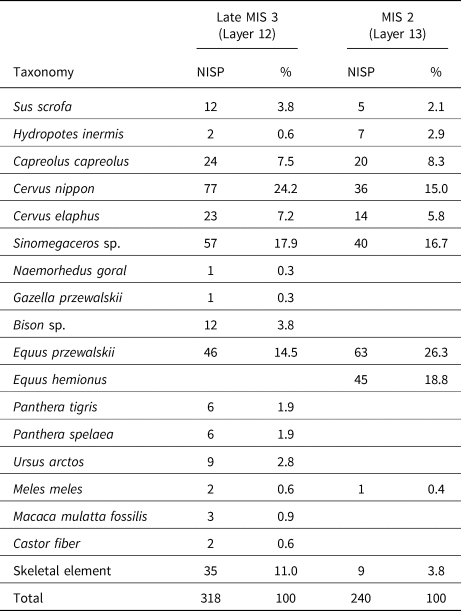
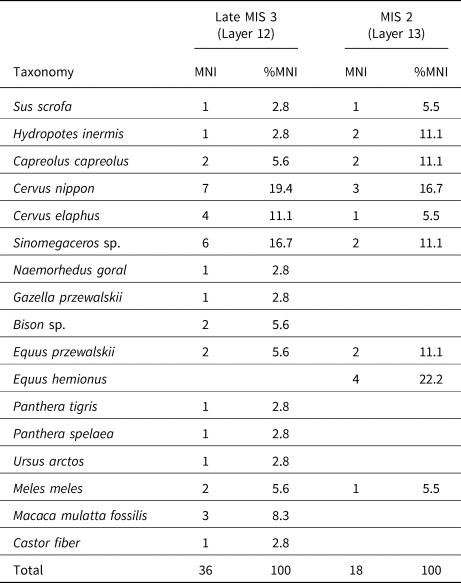
More than 10,000 mammal fossils were collected at the CPDCS; 1639 (15.1%) from Layer 12, and 3595 (33.2%) from Layer 13, associated with the late MIS 3 and MIS 2, accounting for 48.3% of the total fossils (Tables 2, 3). The large mammals identified in these layers are Equus przewalskii, E. hemionus, Sus scrofa, Hydropotes inermis, Capreolus capreolus, Cervus nippon, C. elaphus, Sinomegaceros sp., Bison sp., Naemorhedus goral, Gazella przewalskii, Macaca mulata fossilis, Panthera tigris, P. spelaea, Ursus arctos, Meles meles, and Castor fiber. The small mammals identified in these layers are Microtus oeconomus, M. brandtioides, Cricetulus barabensis obscurus, and Rattus norvegicus (Choe et al., Reference Choe, Han, Kim, Ho and Kang2020).
Taxonomical patterns of the Chongphadae large mammal fauna of Layers 12 and 13 according to the number of identified specimens (NISP).

Taxonomical patterns of Chongphadae large mammal fauna of Layers 12 and 13 according to minimum number of individual (MNI).

The number of specimens identified in Layer 12 is 318 (Table 2) and the MNI is 32 (Table 3), which is the highest among the faunal assemblages of each layer. In terms of the NISP and MNI, Cervus nippon was the most abundant taxon in this assemblage, followed by Sinomegaceros sp., Cervus elaphus, and Equus przewalskii. The faunal assemblage of Layer 13 represents a NISP of 240 (Table 2) and a MNI of 18 (Table 3). Equus hemionus and Cervus nippon dominate the assemblage, followed by Hydropotes inermis, Capreolus capreolus, Sinomegaceros sp., and Equus przewalskii. In terms of the NISP, Equus przewalskii is the most abundant, followed by Equus hemionus, Sinomegaceros sp., and Cervus nippon. Therefore, both layers are the richest in cervids and equids.
Taxonomic change between these layers is recorded, the assemblage of Layer 12 (16 species) is richer than Layer 13 (nine species), including among rodents, beaver remains, which are represented only in Layer 12. Carnivores are mostly found in Layer 12, suggesting that carnivores affected this assemblage. However, %MNI (13.9%) suggests that the effect would not be significant.
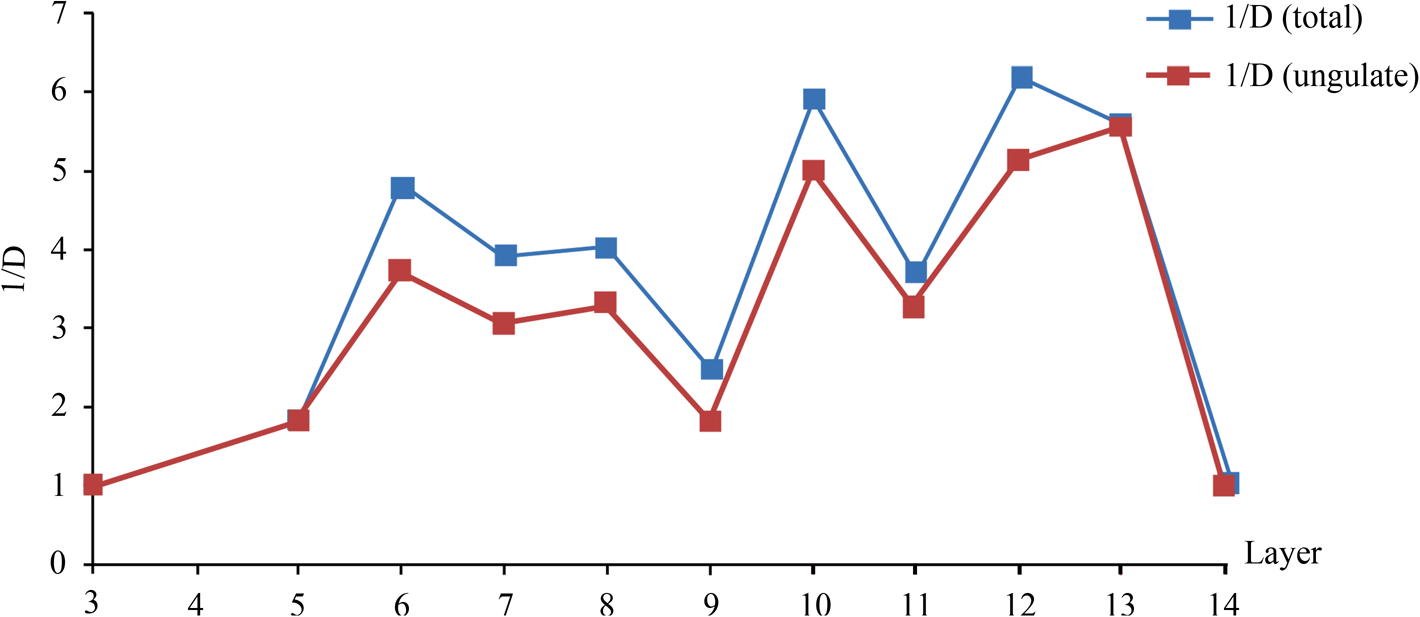
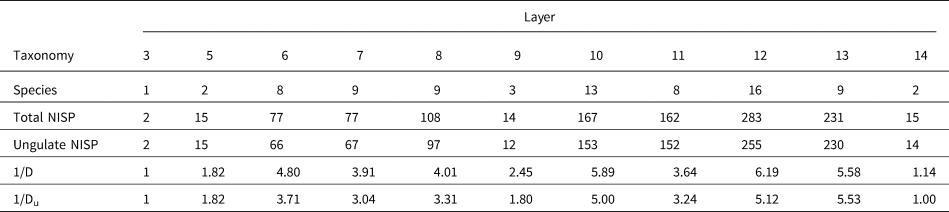
What is important in evaluating faunal diversity in the local environment is to evaluate evenness of zooarchaeological assemblages. We used the reciprocal of Simpson's Index, which is widely used in zooarchaeology (Berto et al., Reference Berto, Boscato, Boschin, Luzi and Ronchitelli2017, Reference Berto, Luzi, Canini, Guerreschi and Fontana2018). The evenness values of the faunal assemblages of the CPDCS are presented in Table 4 and Figure 2.
The total and ungulate evenness (1/D) values of the faunal assemblages from layers 3–14 at the Chongphadae Cave site

Total evenness per layer for the large mammals and evenness of ungulates according to NISP of the Chongphadae Cave

*1/D = total evenness; 1/Du = ungulate evenness.
Stone tools
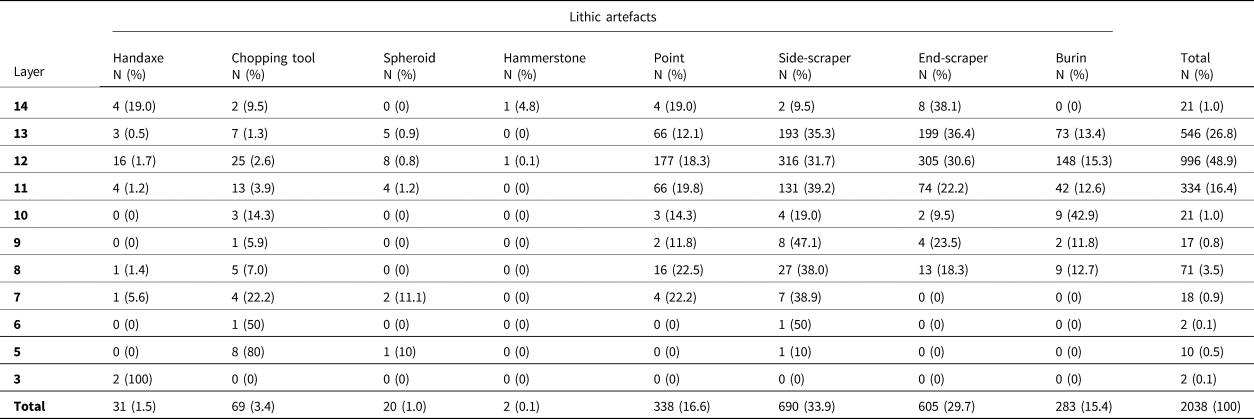
At the CPDS, 2038 stone tools in eight categories were analyzed through the sequence (Table 5). The lithic artefacts were concentrated in Layers 12 and 13, and those that were studied in this paper account for ~75.7% of the total number of stone tools, including 19 handaxes, 32 chopping tools, 243 points, 509 side-scrapers, 504 end-scrapers, 221 burins, and 13 spheroids (Table 5). These layers include all kinds of lithic artefacts discovered from the site.
Structure and distribution (%) of the lithic assemblage from Chongphadae Cave

N = number of identified specimens (NISP).
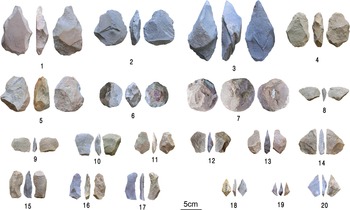
Handaxes (Fig. 3.1–3.3) are mostly triangle-, elliptical-, and pointed-shaped cobble fragments. The handle parts are thick and were processed as convenient tools to handle, but some natural surfaces also remain. The edge parts are sharp, and become gradually narrower and thinner toward the ends. The lithic fragments were reduced and processed several times, and two processed distal-edge faces are nearly symmetrical to each other. The handaxes were made mostly of quartzite cobbles. They were produced by reduction of large fragments from handle and edge parts of thick and long cobbles with hard-hammer technique and indirect percussion. The largest one is ~20.5 cm long and the smallest is ~7.3 cm long.
Stone tools from Layers 12 and 13 of the Chongphadae Cave site. (1–3) Handaxes; (4–6) bifacial chopping tools; (7) spheroids; (8–12) side-scrapers; (13, 14) burins; (15–17) end-scrapers; (18–20) points.

Chopping tools (Fig. 3.4–3.6) are classified as unifacial and bifacial tools according to the shapes of the edge parts, with bifacial tools the most abundant. In Layers 12 and 13, unifacial tools, which were made from flat cobbles, were found individually. Bifacial tools, which comprised most of the chopping tools, were manufactured by putting edges on both sides of thick and large cobbles. There are not many processing traces of the handle parts. The edge parts, however, have many processing traces, and were trimmed by detaching several flakes of ~3–4 cm in size with hard-hammer percussion at the striking points on both sides. Bifacial chopping tools were classified as tools with only only the edge parts processed and with both the handle and edge parts present. Bifacial chopping tools have edge parts that were processed in such a way that they were reduced by several flakes with hard hammer percussion on the underparts of both sides. Bifacial chopping tools have various shapes, such as ovals, squares, and trapezoids, with the majority of them being circular and oval. Bifacial chopping tools are ~12 cm in length, ~11 cm in width, and ~7 cm in thickness.
Side-scrapers (Fig. 3.8–3.12), which are among the most abundant lithic artefacts account for ~31.7% and 35.3%, respectively, of the lithic artefacts of Layers 12 and 13. The side-scrapers, which were made of flakes from cobbles and pebbles, have one part that is somewhat thick and the other flat, however they are mostly thick or have backs in the middle parts. Because the thick parts were used as handles, many natural surfaces remain. The ventral surfaces were obtained by reducing flat flakes or by retouching evenly with soft-hammer techniques. In edge parts, which are mostly wedge-shaped, the flakes were reduced by oblique percussion toward the end, so the sharp serrations resulted from reduction of small flakes of ~3–4 mm at the end. Side-scrapers are ~7–10 cm in length, ~6–8 cm in width, and ~2–3 cm in thickness. The shapes are varied, mainly triangle, oval, sectorial, and luniform, with a thick back, thick middle, and thin edges, with and without natural surfaces on the back. Depending on the shape, the edges also have various shapes, such as straight, concave, convex, saw, stria, etc.
End-scrapers (Fig. 3.15–3.17) were manufactured from long trapezoidal or oval flakes, and putted edges on one side. They have mostly a flat side, which was the ventral surface of the flake reduced from cobbles or retouched lightly, and edges were set by reducing flakes from the opposite side; thus the edges are unifacial. The shapes are mainly polygonal, oval, and circular, and the largest is ~10 cm, medium 7–8 cm, and the smallest ~4 cm.
Points (Fig. 3.18–3.20) were made on long trigonal pyramidal flakes, which were detached intentionally from cobbles. The tips are pointed, ridges are on the sides, and the angles are sharp from working the faces adjacent to the ridges. The edges are symmetrical or asymmetrical. The points have mainly triangular and triangular-pyramidal morphologies, tapered to make the sides triangular, and natural surfaces usually are not seen. The sizes are ~7–11 cm in length, 3.5–5 cm in width, and 2–2.5 cm in thickness.
Burins (Fig. 3.13, 3.14), which are also flake tools, have a knife-like edge in the distal part. The handle parts were processed as round or triangular shapes (some preserved the original cortex), and the edge parts are V-shaped or unifacial. The general lateral shape is an acute triangle. Most of the sharp parts of the burins were trimmed using thin and sharp flakes detached from cobbles, with the opposite side used as a handle. The shapes are polygonal, bill, and lanceolate, with the majority triangular and bill shapes. The sizes are ~3.5–5 cm in length, ~3 cm in width, and ~1.3 cm in thickness.
Spheroids (Fig. 3.7) were made from cobbles and characterized by working the whole surface, with some light retouching to keep the raw round surface intact, and processed on only one side. They have almost completely spherical shapes, with the largest ~11 cm and the smallest ~7 cm in diameter. It is possible that spheroids were used as a core for making other tools, such as scrapers, or as a hunting tool that could have been thrown.
Hammer stones were used for tool manufacture. Appropriate long-oval or round cobbles were used almost intact without special retouching. There are obtuse marks produced when using at the end; the size is 10.2 × 8.2 × 6.8 cm.
The raw materials used for stone tools are quartzite, quartz, sandstone, and limestone. Most of them were manufactured from quartzite (54.9%) and quartz (42%) cobbles and pebbles; limestone (3.1%) and sandstone (0.6%) were less common. The raw materials are common at the locality and of good quality. They were collected from nearby rivers and fluvial deposits rather than from outcrops. The blanks of large lithic artefacts, including handaxes and chopping tools, are rounded or oval cobbles, and small artefacts such as points, side-scrapers, and end-scrapers were made of flakes detached from cobbles. The flake tools here account for ~95.8% of all lithic artefacts. Thus, the stone technology shows characteristics of flake-based technology.
DISCUSSION
Regional paleoenvironmental and paleoecological reconstruction
The mammal remains from the CPDS allows us to reconstruct paleoenvironment and paleoecology of the region. The ungulates are very rich in Layers 12 and 13—cervids include Cervus nippon, C. elaphus, and Sinomegaceros sp., and equids include Equus przewalskii and E. hemionus. Deer is a species inhabiting some closed environments, such as wetland-woodland and forest-steppe, and red deer inhabits slightly higher areas than deer. Equids have high mobility and were generally adapted to open-steppe and open-grassland environments (Orlando et al., Reference Orlando, Mashkour, Burke, Douady, Eisenmann and Hänni2006). Asiatic wild ass (Equus hemionus) also appeared in Layer 13 with horse (Equus przewalskii) in Layers 12 and 13, which shows that the grasslands were expanded in the region. The presence of these ungulates in the CPD fauna indicates that during these periods, the region was mainly hills and grasslands. However, some species, such as wild boar (Sus scrofa), which require dense stands of forest and wetter conditions, suggest the presence of some dense forest as well as grasslands (Graves, Reference Graves1984; Baskin and Danell, Reference Baskin and Danell2003). The presence of such diverse inhabitants is also confirmed by small mammals, such as Castor inhabiting riparian environments, Microtus associated with open environments and grassland landscape such as bush, Clethrionomys preferring forest areas, and Ochotona correlated with steppe and semi-steppe environments. Finally, the diverse CPD fauna indicates the presence of an open mosaic landscape of different ecological conditions, such as wetland, steppe, semi-steppe, and forest, and such landscapes often supported a more diverse regional fauna (Cramer and Willig, Reference Cramer and Willig2002).
On the other hand, Layer 12 includes Bison sp., which was cold-adapted in northern China during the Late Pleistocene (Qiu, Reference Qiu2006), and Layer 13 contains Microtus oeconomus, which indicates cold climate (Popova, Reference Popova2015; Rhodes et al., Reference Rhodes, Ziegler, Starkovich and Conard2018; Choe et al., Reference Choe, Han, Kim, Ho and Kang2020). However, these are not extremely cold-adapted forms and their proportions are low. This does not actually indicate quite cold conditions, although it is likely that during the last glacial maximum (LGM) the Korean Peninsula was also influenced by some cold events. Such wet and slightly colder climatic conditions also are consistent with pollen analysis data (Choe et al., Reference Choe, Han, Kim, Ho and Kang2020), suggesting that deciduous-oriented mixed forest-steppe vegetation during Layer 12 changed to steppe-deciduous vegetation mixed with coniferous plants.
What is more useful for a detailed understanding of the faunal composition is the abundance of water resources. Considering that the beaver from Layer 12 is a riparian mammal, it suggests that water resources including rivers, streams, and wetlands in this region were somewhat abundant during this period. In addition, only Layers 12 and 13 of the CPDCS sequence were heavily cemented. Recrystallization of limestone by carbon dioxide-bearing water indicates that during this period, atmospheric precipitation was quite rich and thus wetlands were well developed. According to some evidence, such an increase in moisture could have resulted in higher species diversity (Brown, Reference Brown1973; Grayson, Reference Grayson1984, Reference Grayson1998; Fox, Reference Fox, Grigg, Jarman and Hume1989), so it is likely that the CDP region, which consisted of dense forests, grasslands, and wetlands, was quite rich in various species of mammals.
The ungulate evenness of the CPDCS fluctuates, but gradually increases, reaching the highest values in Layers 12 and 13 (Fig. 2). Low values counted here are indicative of a dry condition or prey selectiveness, whereas high values are represented by species diversity in wet conditions, with ecological heterogeneity consisting of different inhabitants. Comparing the faunal assemblages of Layers 12 and 13 with the highest total evenness and ungulate evenness, the total evenness of Layer 12 is higher than Layer 13, while ungulate evenness is slightly higher in Layer 13. This indicates that during the late MIS 3, the climate began to dry gradually, but also during MIS 2 the diverse and abundant ungulates inhabited the relatively wet conditions.
The ungulate diversity also indicates that the regional ecosystem was in a transitional zone with mosaics of different biomes. Such diverse resources would have contributed to enough diets for humans, and although it was slightly cold, humans, animals, and plants would have occupied the CPD region. Finally, the rich water resources and ecological heterogeneity of the CPD region would have promoted fertile grassland, forest, and rich fauna and flora, and therefore this region would have served as a favorable refugium for people, animals, and plants during this period.
In the northeastern part of North China, the forests disappeared and grasslands or desert grasslands expanded rapidly due to colder and dryer climate changes during early MIS 2 and onset of the LGM (Song et al., Reference Song, Cohen, Shi, Wu, Kvavadze, Goldberg, Zhang, Zhang and Ofer2017; Li et al., Reference Li, Li, Li, Wang and Li2019); consequently, the Paleolithic sites of the LGM period were found only in the warmer southern parts (Sun et al., Reference Sun, Ke, Shi, Zhang, Chen, Wu and Zhang2000; Barton et al., Reference Barton, Brantingham, Ji, Madsen, Chen and Gao2007; Ren, Reference Ren2017). In contrast, although grasslands were expanded in the central Korean Peninsula (as supported by existence of Asiatic wild ass [Equus hemionus]), the forests did not disappear completely, indicating that although the region was influenced by global climatic change, the regional climatic environment did not reach extremely cold and dry climaxes. It is likely that the temperate cold and wet climatic conditions rather attracted humans, animals, and plants by forming mosaic landscapes with mixed open and closed environments (Ivanova et al., Reference Ivanova, Gurova, Spassov, Hristova, Tzankov, Popov and Marinova2015; Belmaker et al., Reference Belmaker, Bar-Yosef, Belfer-Cohen, Meshveliani and Jakeli2016; Yravedra et al., Reference Yravedra, Julien, Alcaraz-Castano, Estaca-Gomez, Alcolea-Gonzalez, de Balbin-Behrmann, Lecuyer, Marcel and Burke2016; Starkovich and Ntinou, Reference Starkovich and Ntinou2017; Li et al., Reference Li, Li, Li, Wang and Li2019).
Some Paleolithic sites also existed elsewhere on the central Korean Peninsula at the same time, and their environmental contexts were like the CPDCS. For example, the upper layers of the Chongokri site and the nearby sites, and the deposits of Turubong Cave No. 2 in the southerly direction., which are located in the southeastern part of the central Korean Peninsula, indicate grassland-forest environments becoming cooler and dryer (Norton, Reference Norton2000). However, the duration of the upper cultural layers at those sites was limited to late MIS 3/early MIS 2 (Norton, Reference Norton2000). The duration was relatively short because most of the sites, including Chongokri, would not have become favorable localities for responding to gradually cooler/colder climatic changes due to being open-air sites. On the other hand, because the northwestern parts in the central Korean Peninsula are mostly limestone zones, there are many karst caves that would have been present during the Quaternary in the region. Such caves (and rock shelters) became another good ecological abiotic factor for Paleolithic human adaptation to the environments, as illustrated by the many cave sites in several parts of world, including the northwestern part of the central Korean Peninsula. In fact, because the caves and rich food sources existed in the region, perhaps humans could have lived continuously in the central Korean Peninsula even though it was during times of some cold and wet environments. Finally, our research suggests that the central Korea Peninsula, including the CPDCS region, served as a rich ecological system that could fully maintain human and animal communities, with diverse food and shelter resources.
Lithic technology and industry
The blanks of the stone tools were cobbles/pebbles and flakes with shapes suitable to produce intended lithic artefacts, rather than prepared cores. Because the stones available for manufacturing lithic artefacts were very common around the site, it is likely that humans of the site exploited cobbles and pebbles selected from the local resources without preparing blanks. The flake materials also were probably prepared by reducing or detaching the appropriate parts to manufacture the lithic tools from cobbles and pebbles. This can be shown by some natural surfaces that remained.
The stone tools were processed with different stages and methods, as shown by the presence of large tools such as handaxes and chopping tools, as well as small tools including side-scrapers, end-scrapers, and points. For the large tools, suitable cobbles were selected as the blanks, and then the rudimental shapes were primarily obtained by processing the handle or edge parts of selected cobbles by hard-hammer technique, and reprocessing again. All the edge parts were processed by hard- or soft-hammer techniques, in which the sharp-edged products were completed by reducing the flakes to ~2–5cm in size. In the case of the small tools, flake blanks were prepared by application of hard-hammer or punch techniques on appropriate parts of the selected pebbles, and the products were completed continuously by detaching small pieces 2–3 mm long from the back and edge parts of the flakes by pressure flaking.
In Layers 12 and 13 of the CPDCS, there are several features of lithic industry. (1) The lithic artefacts were mainly made of flakes. The flake tools were directly retouched, and completed flake fragments were made by employing various methods from cobbles and pebbles to produce essential tools without any preparation. (2) The abundant stone tools from the site show extensive use of various kinds and types. Although the lithic artefacts of the site are small in quantity, they consist of various kinds of lithic forms, from a small number of handaxes and chopping tools typical of the Lower and Middle Paleolithic to a great number of end-scrapers and side-scrapers typical of the Upper Paleolithic. A great number of side-scrapers are dominated by triangle pyramid, oval, and fan shapes, but apart from these, less-common shapes include square and amorphous. In addition, the shapes of edge parts include straight, concave, convex, and serrate types. (3) Lithic artefacts from the site were made of local raw materials. Although all the lithic artefacts, flakes, and blanks were represented by various kinds and shapes, all of them were made of quartz and quartzite cobbles and pebbles, which are very common in this region, and less-commonly made of sandstone and limestone, with no lithic fragments from other regions. (4) The lithic assemblage of the site has all the diverse artefacts needed for subsistence and activities of hunters-gathers, including points, spheroids, handaxes, and chopping tools suitable for hunting and gathering to procure foods in the field, as well as side-scrapers, end-scrapers, and burins available for domestic tools in the dwelling place. In addition, there are both large and small tools, which suggests that this site was not a temporary camp place, rather it was a dwelling place that was occupied by people over an extended period.
There are some clear differences between the lithic assemblages from the CPDCS and the Upper Paleolithic sites in northern China and Mongolia. The microlithic sites in northern China are characterized by microblade cores based on microblade core technology, and the lithic artefacts are quite small (Wang, Reference Wang1997; Beijing Institute of Archaeology et al., 2007; Tianjin Production Center of Cultural Heritage in Tianjin and Research Center of Chinese Frontier Archaeology of Jilin University, 2012; Shizitan Archaeological Team, 2013; Wang et al., Reference Wang, Wu, Song, Zhao and Li2013; Li and Ma, Reference Li and Ma2016).
In addition, some sites with flake-based technology were certain cultural mosaics with several techno-complexes and based on simple flake technology or microblade technology (Wang, Reference Wang2010; Du and Liu, Reference Du and Liu2014; Yi et al., Reference Yi, Bettinger, Chen, Pei and Gao2014; Niu et al., Reference Niu, Pei, Zhang, Zhou, Wang and Gao2016; Tang et al., Reference Tang, Du and Liu2017; Li et al., Reference Li, Li, Li, Wang and Li2019). Although the EUP-2 groups (attributed to MIS 3) in Mongolia are flake-based, they are characterized by bladelets (<6 mm and <12 mm in width) that were made by reduction of small cores from pebbles (Jaubert et al., Reference Jaubert, Bertran, Fontugne, Jarry, Lacombe, Leroyer, Marmet and Congres2004; Rybin et al., Reference Rybin, Gladyshev, Tsybankov and Medvedev2007; Gladyshev et al., Reference Gladyshev, Olsen, Tabarev and Kuzmin2010; Derevianko et al., Reference Derevianko, Rybin, Gladyshev, Gunchinsuren, Tsybankov and Olsen2013). The flake elements were almost absent from the lithic assemblages correlated with the LGM (Rybin et al., Reference Rybin, Khatsenovich, Gunchinsuren, Olsen and Zwyns2016).
Due to the nearly complete flake-based technology and diversity of kinds and shapes of tools, the lithic artefacts from the CPDCS provide new insights on lithic technology and development in Korea and northeastern Asia during the Upper Paleolithic period.
Environmental adaptation and subsistence strategies of humans at Chongphadae
The activity of Paleolithic humans was essentially closely related to adaptation to the environment, and the combination of remains from archaeological sites with the environment enabled us to fully understand the subsistence strategies. Human remains of five individuals in all were discovered from the CPDCS, and most of them (four individuals) came from Layers 12 and 13. These human remains provide significant evidence of human evolution and will be discussed in other papers.
Rivers and wetlands, which developed in the CPD region during deposition of Layers 12 and 13, might have been important for both humans and animals. Rivers and streams supplied essential water, while enabling people to easily use available cobbles and pebbles for manufacturing the lithic artefacts without difficult extraction from outcrops. All lithic artefacts made of cobbles and pebbles from the CPD clearly show that people collected and used the quartz and quartzite gravels as they moved along with the rivers and streams of this region. Although no evidence of fish use has been found from the site, we cannot exclude the possibility of catching fish from rivers and streams, and using them as food. Wetlands, characterized by standing water, high humidity, and rain, provided people with food gathered from low-growing plants, including Gramineae, as well as herbivores. In addition, wetland areas would have provided very favorable conditions for Paleolithic hunter-gathers to succeed in hunting, due to the reduction and disruption in the running speed of ungulates such as cervids and equids (Li et al., Reference Li, Li, Li, Wang and Li2019).
The mosaic environment, which consisted of steppe or grassland and forest with scattered trees, might have offered very suitable conditions for subsistence of the CPD population. The open environment would have increased the visibility of people and widened their vision. This allowed people to avoid or escape from threats of big game or predators, to easily detect wild game, and to hunt as well. Many faunal remains from Layers 12 and 13 show that hunting was active in the open environment during this period. In addition, the open environment enabled people to apply less dangerous and suitable hunting technologies. The points from the CPDC might have been used as certain hunting tools in an open environment. Those points were made of unilateral type available to access prey and use as weapons, and of bilateral type that can be thrown farther away to hunt without access. In addition, spheroids probably were tools for hunting that could have been threaded with string, either singly or in pairs, and thrown on prey in order to wrap their horns or bodies so that they could not move. Such hunting tools would have been usable only in open environments with no or few obstacles, and the use of these tools would have improved hunting efficiency, as well as allowing hunting with no contact. Hunting without contact using some projectile tools can be considered a certain progressive representation of adaptation and hunting skills to the open environment of Paleolithic hunters.
The forest and grassland might have been good resources of plant and animal foods for the CPD people. Various kinds of tools and their different functional edges might have been used for gathering as well as defleshing.
Human populations in the CPD likely used mainly ungulates, including deer and horses with great nutritional yield. Among prey species available to the CPD hunters, ungulates had the highest nutritional return rates and thus were likely to be have been preferred as prey due to their large bodies and high reproduction, as demonstrated by being in groups with high density. Ungulates would have been highly ranked resources in the prey choice model, because they have high nutritional values and generally would have been preferred as prey available to Paleolithic people (Gamble, Reference Gamble1986; Pellegrini et al., Reference Pellegrini, Donahue, Chenery, Evans, Lee-Thorp, Montgomery and Mussi2008; Britton et al., Reference Britton, Grimes, Niven, Steele, McPherron, Soressi, Kelly, Jaubert, Hublin and Richards2011; Broughton et al., Reference Broughton, Cannon, Bayham and Byers2011; Birch et al., Reference Birch, Miracle, Stevens and O'Connell2016). When population increased or prey resources declined, although small game was lower-ranked in comparison with ungulates, small-bodied game with rapid reproduction and high fertility, especially small game that were easy to catch and slow moving, were used in Europe (Stiner et al., Reference Stiner, Munro and Surovell2000). However, there is no evidence that small game was used as food resources in the CPD, where it is likely that the locally abundant and diverse ungulates fully provided occupants with food demands and nutritional support.
The central part of the Korean Peninsula, including the CPD and Ryonggok Cave No. 1 (Choe et al., Reference Choe, Han, Kim, Ho and Kang2020, Reference Choe, Han, Ri and Ri2021), is particularly rich in limestone caves with developed karst topography. These caves may have been used as good provisional camps or residential sites for Paleolithic humans. Layers 12 and 13 of the CPDCS include large numbers of domestic tools such as handaxes, picks, side-scrapers, and end-scrapers available for dismembering, skinning, and defleshing prey, which would have been hunted and transported into the cave. This suggests that during this period, the CPDC did not function as a provisional camp, but rather a residential site, where people existed and settled down for a long time.
CONCLUSIONS
The interactions between environmental changes and human behavior in the Upper Paleolithic (Late Pleistocene) make our understanding of human evolution richer and very interesting. In particular, due to environmental changes corresponding to extreme climate changes (e.g., glacial episodes) in various parts of the world, various patterns, including depopulation and migration, require more careful consideration of human evolution within the range of special localities and regions, and within very characteristic environmental contexts.
Our study of Layers 12 and 13 in the CPDCS suggests that during the late MIS 3 and MIS 2, the central Korean Peninsula may have served as a refugium for the Upper Paleolithic people. Lithic artefacts collected are based on flake technology, and raw material selection, stone technique, and lithic industry reflect predominantly local characteristics. In addition, analysis of faunal assemblages indicates that this region consisted of an ecosystem that could sustain an abundant and diverse mammal fauna, including ungulates. It is likely that the mosaic landscape of rivers, wetlands, grasslands, and forests provided favorable places for the subsistence of humans, as well as mammals and plants, and occupants of the site actively hunted and gathered in a relatively rich and temperate environment.
In conclusion, our study of Layers 12 and 13 of the CPDCS indicates that during the late MIS 3 and MIS 2, the Korean Peninsula might not have heavily affected by global dry and cold events, such as glacial episodes, and the central Korean Peninsula might have existed as an unknown, cryptic refugium in northeastern Asia.
Acknowledgments
We thank Drs. Pong Chan Jong (Kim Il Sung University) and Chun Jong Kim (Institute of Archaeology, Academy of Social Sciences, DPRK) for their helpful discussions and constructive suggestions to complete this paper.