Introduction
Mental health is an important foundation for the attainment of emotional, intellectual, economic, social and educational well-being. Accordingly, mental disorders are an important contributor to the worldwide burden of disease (WHO, 2001). However, little objective information exists on the true prevalence of mental disorders in some parts of the world. This is especially so in sub-Saharan Africa where only a handful of epidemiological needs assessment surveys have been carried out (Ovuga et al. Reference Ovuga, Boardman and Wasserman2005). Given the disadvantaged status of large segments of the population in many African countries, the prevlance of mental illness is expected to be high. However, a recent study from Nigeria found surprisingly low rates of mental disorders (Gureje et al. Reference Gureje, Lasebikan, Kola and Makanjuola2006).
Several factors suggest that the South African population may be at especially high risk of mental disorders. Prior to 1992, the racialized social policies of Apartheid and the political violence and victimization that grew out of the anti-Apartheid struggle created a context conducive to increased risks of mental disorders (Dawes, Reference Dawes1990). In the post-Apartheid era, rates of non-political violence, crime, and violence against women have remained high (Dunkle et al. Reference Dunkle, Jewkes, Brown, Yoshihama, Gray, McIntyre and Harlow2004; Dinan et al. Reference Dinan, McCall and Gibson2004). Other characteristics of the South African population that might be associated with an especially high prevalence of emotional distress include the pervasiveness of harsh economic circumstances (Seedat & Stein, Reference Seedat and Stein2000), the high risk of HIV/AIDS (Hughes et al. Reference Hughes, Hoyo and Puoane2006), and the unpredictable threat of trauma and life-threatening injuries from deep surface mining to miners, their families and communities (Maiden, Reference Maiden2005).
The limited available evidence suggests that rates of psychopathology are indeed high in South Africa. Suicide rates are high and increasing over time (Flisher et al. Reference Flisher, Liang, Laubscher and Lombard2004; Burrows & Laflamme, Reference Burrows and Laflamme2005). One study found that emergency service personnel in South Africa are exposed to higher levels of general psychopathology than their counterparts in the developed world (Ward et al. Reference Ward, Lombard and Gwebushe2006). Prior research has also reported high levels of risky drinking and symptoms of alcohol problems in South Africa (Parry et al. Reference Parry, Pluddemann, Steyn, Bradshaw, Norman and Laubscher2005).
However, we currently lack a clear picture of the prevalence of mental disorders in South Africa. Moreover, evidence is absent on patterns and correlates of obtaining treatment for mental disorders. The South Africa Stress and Health (SASH) study was a national psychiatric epidemiological survey completed as a part of the WHO World Mental Health (WMH) Survey aimed at obtaining such information. The SASH represents the first nationally representative survey of the prevalence, severity, correlates and treatment of mental disorders in sub-Saharan Africa.
Method
Sample
The SASH study was a national probability sample of 4351 adult South Africans living in both households and hostel quarters (Williams et al. Reference Williams, Herman, Kessler, Sonnega, Seedat, Stein, Moomal and Wilson2004). Hostel quarters were included to maximize coverage of young working-age males. The sample did not include individuals in institutions or in the military. Individuals of all race and ethnic backgrounds were included in the study. The sample was selected using a three-stage clustered area probability sample design. The first stage involved the selection of stratified primary sample areas based on the 2001 South African Census Enumeration Areas (EAs). The second stage involved the sampling of housing units within clusters selected within each EA. The third stage involved the random selection of one adult respondent in each sampled housing unit.
The data collection proceeded province by province with a cohort of 40–60 interviewers in each province. All SASH interviewers were trained in centralized group sessions lasting 1 week. The interviews were conducted face to face in one of six different languages: English, Afrikaans, Zulu, Xhosa, Northern Sotho, and Tswana. Interviews lasted an average of 3.5 hours, with many requiring more than one visit to complete. Data were collected between January 2002 and June 2004. Field interviewers made up to three attempts to contact each respondent. The overall response rate was 85.5%. Qualitatively, the response rate was very high in all areas, except for high socio-economic status, predominantly white, urban areas. All recruitment, consent and field procedures were approved by the Human Subjects Committees of the University of Michigan, Harvard Medical School, and by a single project assurance of compliance from the Medical University of South Africa (MEDUNSA) that was approved by the National Institute of Mental Health.
Measures
Diagnostic assessment
The WHO Composite International Diagnostic Interview Version 3.0 (CIDI 3.0) was used to assess the presence of DSM-IV disorders (Kessler & Ustun, Reference Kessler and Ustun2004). The CIDI is a fully structured diagnostic interview that is lay administered and can generate diagnoses according to both the ICD-10 and DSM diagnostic systems. The translation of the English version of the CIDI into the five other languages used in the SASH study was carried out according to WHO recommendations of iterative back-translation conducted by panels of bilingual and multilingual experts. Discrepancies found in the back-translation were resolved by consensus of an expert panel.
Good inter-rater reliability, test–retest reliability, and validity have been found in earlier versions of the CIDI (Andrew & Peters, Reference Andrew and Peters1998), while good validity of CIDI diagnoses compared to diagnoses based on blinded clinical reappraisal interviews have been found in WMH methodological studies (Haro et al. Reference Haro, Arbabzadeh-Bouchez, Brugha, de Girolamo, Guyer, Jin, Lepine, Mazzi, Reneses, Vilagut, Sampson and Kessler2006). The mental disorders assessed in the SASH study were: anxiety disorders (panic disorder, agoraphobia, social phobia, generalized anxiety disorder, post-traumatic stress disorder), mood disorders (major depressive disorder, dysthymia), substance use disorders (alcohol abuse, alcohol dependence, drug abuse, drug dependence), and intermittent explosive disorder. DSM-IV organic exclusion rules and diagnostic hierarchy rules were applied to all diagnoses, except in the case of substance use disorders where abuse was defined with or without dependence.
Severity
Cases that met 12-month criteria for at least one disorder were classified in terms of clinical severity into the categories serious, moderate, or mild. Cases rated serious had at least one of the following: substance dependence with a physiological dependence syndrome, a suicide attempt in the past 12 months, severe self-reported impairment in at least two areas of role functioning as assessed by the Sheehan Disability Scales (SDS), or overall self-reported functioning impairment at a level consistent with a Global Assessment of Functioning (GAF) score of ⩽50. Cases not classified serious were classified moderate if the individual had moderate role impairment in at least two domains of the SDS or had substance dependence without a physiological dependence syndrome. All other cases of 12-month disorder were classified mild.
Treatment
All respondents were asked if they saw any of an extensive list of treatment providers, including traditional healers and Western medicine professionals for problems with their emotions, nerves, mental health or use of alcohol or drugs in the past 12 months. Treatment providers were classified into general medical (general medical doctor, nurse or other health professional not in a mental health setting), mental health specialty (psychiatrist, psychologist, other mental health professional), and non-health care (religious or spiritual advisor, traditional healer, or other healer not in a health setting). The mental health and general medical sectors together were defined as the overall health-care treatment sector.
Sociodemographic correlates
Sociodemographic correlates include age, sex, race (African, Coloured, Indian, white), education (none, some primary, some secondary, some university or more), marital status (married, formerly married, never married), and income. Similar to other WMH countries, our measure of income was calculated by dividing household income by the number of household members and defining four income categories. The two lowest quartiles of per capita income were called low income, and low-average income. High-average income was defined as income between one and two times the median per capita income and high income was defined as greater than twice the median.
Data analysis
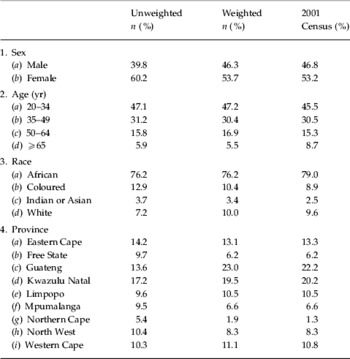
In order to account for the stratified multi-stage sample design, the data were weighted to adjust for differential probability of selection within households as a function of household size and clustering of the data, and for differential non-response. A post-stratification weight was also used to make the sample distribution comparable to the population distribution in the 2001 South African Census for age, sex, and province (Table 1). The weighting and geographic clustering of the data were taken into account in data analyses by using the Taylor series linearization method in the sudaan statistical package (RTI, Research Triangle Park, NC, USA). Logistic regression analysis was used to study sociodemographic correlates. Logistic regression coefficients and their design-corrected standard errors were exponentiated and are reported here as odds ratios (ORs) and 95% confidence intervals (CIs). Statistical significance was consistently evaluated using 0.05 level two-sided tests.
Sociodemographic distribution of the South African sample compared to the population

Results
Prevalence and severity
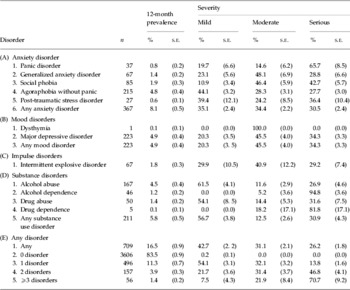
Major depressive disorder, agoraphobia, and alcohol abuse were the most prevalent 12-month DSM-IV/CIDI disorders in the sample (Table 2). The most prevalent class of disorders was anxiety disorders, followed by substance disorders. The 12-month prevalence of any disorder was 16.5%. Among persons with disorder, 70% met criteria for only one disorder, 22% for two disorders and 8% for three or more disorders.
Twelve-month prevalence and severity of DSM-IV/WMH-CIDI disorders

Percentages in the three severity columns are repeated as proportions of all cases and sum to 100% across each row.
Sample size is 4315.
Some 26.2% of respondents with a 12-month disorder were classified as serious, 31.1% moderate and the remaining 42.7% mild. Severity was especially high among the small proportion of cases who met criteria for more than one disorder. While 13.8% of respondents with one diagnosis were classified as serious, 46.8% with two diagnoses, and 70.7% with three or more diagnoses were also classified as serious. The distribution of cases classified as serious varied across disorders, with the highest percentage of serious classifications associated with alcohol dependence (94.8%), drug dependence (81.8%), panic disorder (65.7%), and social phobia (42.7%).
Sociodemographic correlates of disorder
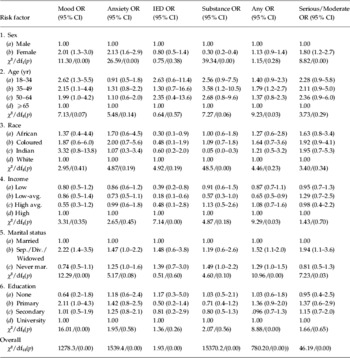
Table 3 shows the demographic correlates of disorders and of severe (serious and moderate) versus non-severe (mild) disorders. There were no gender differences in overall prevalence but women had higher risks of mood and anxiety disorders and men had an elevated risk of substance use disorders. Women were also more likely than men to report a severe disorder. Age was weakly related to disorder with younger persons more likely than their older peers to report mood and substance disorders. Income and education were generally unrelated to the severity and risk of disorder. The only exception to this pattern was that having primary education was associated with a twofold increase in relative odds of mood disorder compared to those with the highest level of education. Formerly married persons (separated, widowed and divorced) were more likely to report mood disorders and more severe disorders than the married. Compared to whites, Africans have a lower risk of intermittent explosive disorder and Indians have a lower risk of substance disorders.
South Africa demographic correlates of 12-month DSM-IV psychiatric disorders

OR, Odds ratio; CI, confidence interval; IED, intermittent explosive disorder.
With the exception of intermittent explosive disorder, the observed ORs for all disorders were consistently in the direction of whites having lower risks of disorder than the other racial groups, but these differences were not statistically significant.
Twelve-month treatment
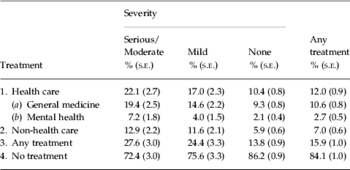
An estimated 15.9% of all respondents received some type of treatment in the 12 months before their interview (Table 4). A positive relationship was evident between the severity of disorder and receiving any treatment, with 28% of severe-moderate cases receiving treatment compared to 24.4% of mild cases. A relatively high proportion of respondents with no disorder (13.8%) also received treatment. Severe-moderate cases who received treatment were more likely than other patients to be treated in the health sector, while the prevalence of treatment in the non-health-care sector did not vary by disorder severity. The mental health sector provided care to a very small proportion of cases, with only 7.2% of severe-moderate cases and 4% of mild cases receiving treatment in this sector.
Association of 12-month disorder severity with treatment type

Correlates of treatment
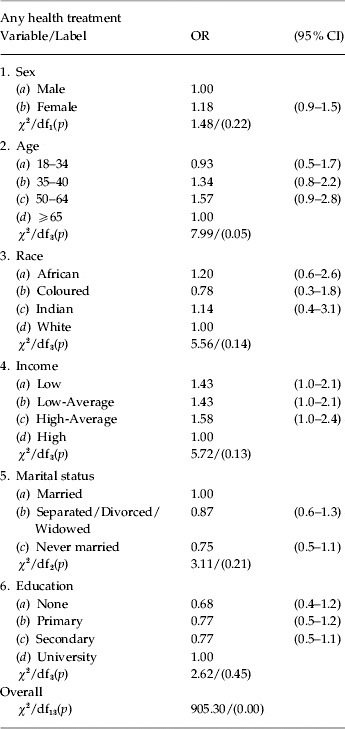
The demographic correlates of any 12-month health treatment (either general medical or mental health) are presented in Table 5. With the exception of income, demographic factors were generally unrelated to the receipt of treatment. Persons with lower levels of income and age, were more likely than their higher-income peers to report seeking health-care treatment.
Sociodemographic correlates of 12-month health-care treatment

Discussion
Prevalence and severity
The estimated prevalence of DSM-IV/CIDI psychiatric disorders is markedly higher in the SASH study than in a number of other WMH surveys, including those in Asia (China, Japan), Nigeria, Germany, Italy and Spain (Demyttenaere et al. Reference Demyttenaere, Bruffaerts, Posada-Villa, Gasquet, Kovess, Lepine, Angemeyer, Bernert, de Girolamo, Morosini, Polidori, Kikkawa, Kawakami, Ono, Takeshima, Uda, Karam, Fayyad, Karam, Mneimneh, Medina-Mora, Borges, Lara, de Graaf, Omel, Gureje, Shen, Huang, Zhang, Alonso, Haro, Vilagut, Bromet, Gluzman, Webb, Kessler, Merikangas, Anthony, Von Korff, Wang, Alonso, Brugha, Aguilar-Gaxiola, Lee, Heeringa, Pennell, Zaslavsky, Ustun and Somnath2004). The differences in prevalence between South Africa and Nigeria are striking (Gureje et al. Reference Gureje, Lasebikan, Kola and Makanjuola2006). With the exception of dysthymia, which was rare in both countries, the prevalence of every other diagnosis was strikingly higher in South Africa than Nigeria. The extent to which these very different profiles of mental health risk are due to South Africa's history of racial oppression and violence, differences between the two countries in the levels of economic development, differential exposure to risk factors for mental disorders and/or protective psychosocial or cultural resources is not known. Future research needs to better understand the sources of such marked variation in mental health risks in two African contexts.
The South African prevalence estimates are more comparable to those found in Lebanon and Colombia. This comparability is especially striking given that in an attempt to shorten the interview, several CIDI disorders assessed in those other countries were not assessed in South Africa (obsessive–compulsive disorder, specific phobia, bipolar disorder, eating disorders, adult persistence of three childhood-adolescent disorders: attention deficit hyperactivity disorder, conduct disorder and oppositional-defiant disorder). It is also noteworthy that consistent with prior reports of high rates of alcohol problems, the estimated prevalence of substance abuse in South Africa (5.8) was at least about twice as high as that in other WMH countries, with the exception of Ukraine which had a slightly higher rate (6.43; Demyttenaere et al. Reference Demyttenaere, Bruffaerts, Posada-Villa, Gasquet, Kovess, Lepine, Angemeyer, Bernert, de Girolamo, Morosini, Polidori, Kikkawa, Kawakami, Ono, Takeshima, Uda, Karam, Fayyad, Karam, Mneimneh, Medina-Mora, Borges, Lara, de Graaf, Omel, Gureje, Shen, Huang, Zhang, Alonso, Haro, Vilagut, Bromet, Gluzman, Webb, Kessler, Merikangas, Anthony, Von Korff, Wang, Alonso, Brugha, Aguilar-Gaxiola, Lee, Heeringa, Pennell, Zaslavsky, Ustun and Somnath2004).
The South African results were consistent with international data in that a higher proportion of cases are either moderate or mild rather than serious. At the same time, the proportion classified as serious is much higher in South Africa than in a regional study in Nigeria (the only other African country in the WMH Survey Initiative), where the majority of cases (77.1%) were classified as mild (Gureje et al. Reference Gureje, Lasebikan, Kola and Makanjuola2006). The SASH study was completed almost a decade after the end of Apartheid in a country that is still racially divided, has a large underclass, endemic violence and interpersonal crime. The contribution, if any, that these factors play in the high prevalence of serious disorders should be explored in future research.
There are marked socio-economic and racial variations in material and social privileges in South Africa that reflect some of the historical legacy of deeply structured discrimination. Surprisingly, these factors were not strong predictors of differences in mental health risk. Additional analyses explored the potential role of other demographic factors. We found, for example, that there were no urban versus rural variations in mental health risk.
Future research needs to identify the social variables, if any, that may be predictive of variation in the prevalence of disorders. One possibility is language use. Although our study was conducted in multiple languages, the language in which each interview was completed was not recorded. Moreover, our study did not collect information on language preferences and whether, across various social contexts, such preferences were for one or for multiple languages. Recent research shows that such indications of language orientation distinguish between advantaged and disadvantaged groups in South Africa and predict variations in identity, and perceptions of opportunities and barriers in South Africa (Franchi & Swart, Reference Franchi and Swart2003).
Utilization of services
The findings also suggest that there is a high level of unmet need for mental health services in South Africa. Irrespective of whether their mental disorder was classified as serious-moderate or mild, three out of four adults with a 12-month DSM-IV/CIDI disorder received no treatment in the year of the interview. Unlike in most other WMH countries, the receipt of health treatment for mental disorders was not strongly patterned by sociodemographic factors suggesting that there is considerable uniformity in the barriers to obtaining treatment for mental disorders.
In addition to the prevalence of mental health treatment being low, a question can be raised about the adequacy of the small amount of treatment that is received. Our analyses did not investigate the quality of mental health services or the adequacy of mental health care. However, some evidence from other sources suggests that non-whites receive poorer quality mental health treatment in South Africa than whites (Flisher et al. Reference Flisher, Fisher, Subedar, Crisp and Ntuli1999). Future research should explore the extent to which the quality of mental health services varies by race and other demographic characteristics.
A relatively high proportion of persons with no disorder (13.8%) reported receiving some kind of treatment and 10.4% received health-care treatment for emotional problems. This level was higher than that in the USA (8.1%) and the 13 other WMH countries reporting data so far (Demyttenaere et al. Reference Demyttenaere, Bruffaerts, Posada-Villa, Gasquet, Kovess, Lepine, Angemeyer, Bernert, de Girolamo, Morosini, Polidori, Kikkawa, Kawakami, Ono, Takeshima, Uda, Karam, Fayyad, Karam, Mneimneh, Medina-Mora, Borges, Lara, de Graaf, Omel, Gureje, Shen, Huang, Zhang, Alonso, Haro, Vilagut, Bromet, Gluzman, Webb, Kessler, Merikangas, Anthony, Von Korff, Wang, Alonso, Brugha, Aguilar-Gaxiola, Lee, Heeringa, Pennell, Zaslavsky, Ustun and Somnath2004), a finding that is especially striking in light of the fact that South Africa is resource-poor when it comes to mental health treatment (Flisher et al. Reference Flisher, Fisher, Subedar, Crisp and Ntuli1999). It is not clear if the observed pattern reflects help-seeking for elevated levels of psychological distress (due to high levels of victimization and trauma), non-optimal use of mental health services, people with successfully treated disorders receiving after care, or diagnostic errors in the CIDI. If the latter is true, then the persons classified by the CIDI as having no disorder might, in fact, actually have a disorder that is not detected by the CIDI. Even if this were the case, the CIDI data clearly show that these people have relatively low impairment, which would mean that they are probably mild cases. Such a high proportion of overall national treatment resources going to people with mild disorders is indicative of a suboptimal allocation of these resources in relation to need, an issue that needs to be the focus of future investigation in the SASH dataset.
South Africa has only one psychiatrist, eight psychiatric nurses, four psychologists, and 20 social workers per 100 000 population (WHO, 2005). These mental health professionals are disproportionately located in urban areas. In addition, existing public sector mental health services are least accessible to the most vulnerable sectors of the population and are concentrated in psychiatric hospitals (Flisher et al. Reference Flisher, Fisher, Subedar, Crisp and Ntuli1999). This resource-allocation pattern could help to explain some of the apparent suboptimal distribution of mental health services in the country. Thus, our findings highlight the importance of increasing the numbers and improving the distribution of community psychiatric clinics in South Africa, elsewhere in Africa, and in many other low- to middle-income countries. Although the number of mental health professionals is relatively low in South Africa, South Africa nonetheless has a higher rate of trained mental health professionals than most other countries in sub-Saharan Africa (WHO, 2005).
Equally important, our findings also emphasize the need to improve mental health services in primary-care settings. Since most mental health care is provided in the general medical sector, efforts to enhance the delivery of mental health services in these contexts are likely to have a large impact. In addition, efforts to improve access to mental health care and the use and acceptability of these services must also address the persisting stigmatization of mental disorders in order for the treatment resource-allocation changes to be cost-effective (Mkize & Uys, Reference Mkize and Uys2004). Low treatment is likely to remain if financial barriers alone are removed (Hugo et al. Reference Hugo, Boshoff, Traut, Zungu-Dirwayi and Stein2003).
Limitations
There are several limitations to the analyses reported here. First, the data are cross-sectional and it is not possible to identify the temporal ordering of the association between our sociodemographic factors and mental health status and treatment. Second, our assessment of psychiatric status relied on the memory of the respondents and there are limitations associated with impaired memory recall that could affect the validity of our assessment of psychiatric status. Moreover, we do not know if these processes differed across the racial, cultural, or language subgroups of our sample. Third, although CIDI 3.0 and the assessment of severity have been used in more than 20 countries worldwide, representing each of the WHO regions (Kessler & Ustun, Reference Kessler and Ustun2004), these instruments have not been validated in South Africa. Culture can affect both the clinical presentation of specific psychiatric disorders and the ability to recall or report particular symptoms (Gureje et al. Reference Gureje, Lasebikan, Kola and Makanjuola2006). Moreover, our analyses assumed that the CIDI is equally applicable across all subgroups of our sample. Future research should explore the extent to which the DSM-IV, as well as questions used to assess the presence and severity of specific psychiatric symptoms are applicable to South Africa in general, and to the various cultural subgroups that make up the South African population. A fourth limitation is the relatively small sample size for some sociodemographic groups of interest such as Indians, Coloureds, and whites, and the resulting reduced ability to detect significant differences in the analyses of racial differences.
Conclusion
In spite of these limitations, this first nationally representative psychiatric epidemiological study in sub-Saharan Africa provides a previously unavailable portrait of mental disorders in South Africa. These results indicate that there is an elevated risk of mental disorders in South Africa compared to several other high- and middle-income countries, and a markedly higher risk of almost every disorder assessed compared to Nigeria. Moreover, most disorders are moderate or serious in severity and they are usually untreated. Thus, mental disorders are making an important contribution to the burden of disease in South Africa. In light of evidence that common mental disorders can be effectively treated (Nathan & Gorman, Reference Nathan and Gorman1998; Hyman et al. Reference Hyman, Chisholm, Kessler and Patel2006), these findings of substantial prevalence and high unmet need for treatment argue that expansion of mental health services should be considered by South African health policy planners among the various innovations they consider in expanding the health-care resources to the population as a part of the development process.
Acknowledgments
The South African Stress and Health study was carried out in conjunction with the World Health Organization World Mental Health (WMH) Survey Initiative. We thank the WMH staff for assistance with instrumentation, fieldwork, and data analysis. These activities were supported by the United States National Institute of Mental Health (R01MH070884), the John D. and Catherine T. MacArthur Foundation, the Pfizer Foundation, the US Public Health Service (R13-MH066849, R01-MH069864, and R01 DA016558), the Fogarty International Center (FIRCA R01-TW006481), the Pan American Health Organization, Eli Lilly and Company, Ortho-McNeil Pharmaceutical, Inc., GlaxoSmithKline, and Bristol–Myers Squibb. The South Africa Stress and Health study was funded by grant R01-MH059575 from the National Institute of Mental Health and the National Institute of Drug Abuse with supplemental funding from the South African Department of Health and the University of Michigan. A complete list of WMH publications can be found at: http://www.hcp.med.harvard.edu/wmh/
Declaration of Interest
None.