





A growing body of research highlights the role of sensorimotor experiences in language processing (e.g., Hoeben Mannaert et al., Reference Hoeben Mannaert, Dijkstra and Zwaan2017; Kang et al., Reference Kang, Eerland, Joergensen, Zwaan and Altmann2020; Zwaan & Pecher, Reference Zwaan and Pecher2012). For instance, although the shape of an object is not explicitly mentioned in either of the sentences The ranger saw the eagle in the sky and The ranger saw the eagle in its nest, readers are likely to activate different mental representations of the eagle’s shape (Zwaan et al., Reference Zwaan, Stanfield and Yaxley2002). The former suggests an eagle with outstretched wings, while the latter implies an eagle with folded wings. This phenomenon extends beyond implied shapes to include other features, such as motion. For example, reading a verb activates brain regions associated with the motion described by the verb (e.g., Monaco et al., Reference Monaco, Mouthon, Britz, Sato, Stefanos-Yakoub, Annoni and Jost2023). These findings suggest that word meaning arises from both linguistic elements (e.g., letters and sounds) and sensorimotor interactions with the world (Barsalou et al., Reference Barsalou, Santos, Simmons, Wilson, de Vega, Glenberg and Graesser2008).
The question of whether second language (L2) knowledge is embodied has garnered significant attention (e.g., Ahn & Jiang, Reference Ahn and Jiang2018; Buccino et al., Reference Buccino, Marino, Bulgarelli and Mezzadri2017; Kogan et al., Reference Kogan, Muñoz, Ibáñez and García2020; Kühne & Gianelli, Reference Kühne and Gianelli2019; Norman & Peleg, Reference Norman and Peleg2022). Learning mechanisms for first language (L1) and L2 differ considerably (e.g., Jiang, Reference Jiang2000; Li & Jeong, Reference Li and Jeong2020; MacWhinney, Reference MacWhinney, Gass and Mackey2012). While L1 is acquired through direct associations between language and referents, L2 is often learned after L1 is established, primarily in formal settings through methods such as flashcards and word-for-word translations, especially in a foreign language context. Consequently, L2 learners may rely on sensorimotor grounding borrowed from their L1 equivalents (Kühne & Gianelli, Reference Kühne and Gianelli2019), potentially leading to a weaker degree of embodiment in L2 compared to L1.
Terai (Reference Terai2023) investigated the relationship between L2 embodiment and L2 proficiency using a semantic Stroop task. In the Stroop task, participants are presented with a color word (e.g., red) and are required to identify the color of the ink in which the word is printed. Stroop effects are observed in that responses are slower when the word meaning and the ink color are incongruent (e.g., the word red printed in blue ink) than when they are congruent (e.g., red printed in red ink).
A semantic Stroop task is a variation of the Stroop task that uses noncolor words whose meanings are strongly associated with specific colors (e.g., banana and yellow). Using this task, Terai (Reference Terai2023) found that the degree of L2 embodiment in object color representations was significantly related to learners’ L2 proficiency, such that higher-proficiency learners exhibited stronger embodiment effects, reflected in larger reaction time differences between typical and unrelated color conditions. However, the mechanisms underlying this relationship remain unclear.
One limitation of this line of research concerns the operationalization of L2 proficiency. Terai (Reference Terai2023) operationalized proficiency using vocabulary size test scores, yet linguistic proficiency can vary across different components within an individual learner. Because embodiment effects in the semantic Stroop task reflect lexical-level processing, a more precise investigation of L2 embodiment requires proficiency measures that are sensitive to word-level processing. Another limitation of existing studies is the lack of within-subject designs to compare embodiment in L1 and L2. To rigorously examine differences between L1 and L2 embodiment, studies should employ within-subject methodologies, controlling for individual variability in language processing.
The present study aims to address two objectives. First, it investigates the relationship between the degree of Stroop effects and the automatization of word recognition. Automatization is operationalized by reaction times in a lexical decision task. This analysis aims to provide a clearer understanding of embodied language processing in L2. Second, the study examines whether Stroop effects differ between L1 and L2. In Japan, where English is primarily learned in classroom settings, the degree of embodiment may vary between L1 and L2. To control for learning contexts, this study includes participants who have not studied abroad, enabling an analysis of the effects of classroom-based learning on embodied language processing. A within-subject design is employed to rigorously compare the effects of L1 and L2 on Stroop task reaction times.
Previous study
Embodied cognition framework in language processing
The embodied cognition framework posits that language processing is not purely symbolic but involves both the processing of linguistic forms and the reenactment of perceptual and motor knowledge. These forms of knowledge are acquired through interactions among the body, mind, and environment (Barsalou, Reference Barsalou2008), grounding symbols in their referents. This reenactment of perceptual and motor experiences is referred to as simulation. For example, reading the word lemon may trigger a mental simulation of a yellow, oblong object and the sourness of its taste. Barsalou et al. (Reference Barsalou, Santos, Simmons, Wilson, de Vega, Glenberg and Graesser2008) proposed the language and situated simulation (LASS) theory, which integrates the linguistic system and simulation processes. According to this theory, these two systems interact dynamically during language processing. The linguistic system focuses on linguistic forms (e.g., auditory or visual representations) without directly processing meaning. This stage is considered more superficial compared to simulation. Once a word is recognized through the linguistic system, it activates related simulations that represent conceptual information, which involves deeper processing. Although both systems are activated simultaneously, the linguistic system reaches its peak activity earlier than the simulation system. Moreover, the reliance on the linguistic and simulation systems varies depending on task conditions, suggesting a flexible interaction between these systems based on the context of language use.
Numerous empirical studies on language tasks have provided evidence supporting the embodied cognition approach (e.g., Connell & Lynott, Reference Connell and Lynott2009; Hoeben Mannaert et al., Reference Hoeben Mannaert, Dijkstra and Zwaan2017; Zwaan et al., Reference Zwaan, Stanfield and Yaxley2002). For instance, Connell and Lynott (Reference Connell and Lynott2009) explored whether L1 readers simulate objects’ typical and atypical colors during sentence comprehension. They examined whether readers mentally simulate the typical color of an object when the sentence implied typicality (e.g., Joe was excited to see a bear in the woods) and whether atypical colors were simulated when the sentence implied them (e.g., Joe was excited to see a bear at the North Pole). Using the semantic Stroop task, participants were presented with a sentence (e.g., Joe was excited to see a bear in the woods), followed by a target word from the sentence (e.g., bear), displayed in a typical (brown), atypical (white, for a polar bear), or unrelated (yellow) font color. Participants were required to name the font color. Faster response times in conditions where the implied color matched the font color (compared to mismatched conditions) would indicate simulation of the object’s color. Results revealed significantly faster responses for colors matching the typical color of the referenced object than for atypical or unrelated colors. Based on these findings, Connell and Lynott suggested that readers activate typical colors associated with objects referenced by words in their L1.
Similarly, Zwaan and Pecher (Reference Zwaan and Pecher2012) conducted a large-scale replication study involving 992 participants of diverse ages and educational backgrounds. They replicated sentence-picture verification tasks to examine simulations of visual traits, such as an object’s shape, color, and size. In this task, participants read a sentence and then determined whether a subsequent image matched the described content. For example, after reading The eagle was in the sky, participants responded faster when presented with an image of an eagle with wings stretched (matching) than one with wings folded (mismatched). Their findings supported the embodied cognition framework, demonstrating that simulations of color yielded a larger effect size than simulations of object orientation and a similar effect size to simulations of object shape.
Embodied language processing in second language
Compared to L1 acquisition, L2 learning is often more formalized, particularly in contexts where English is taught as a foreign language (e.g., Glasgow, & Paller, Reference Glasgow, Paller and Kirkpatrick2016). While L1 acquisition typically involves natural interactions with objects and contexts (Li & Jeong, Reference Li and Jeong2020), L2 learning tends to focus on mapping L2 forms and sounds to existing L1 meanings, resulting in less direct interaction with L2 and its referents. This difference has prompted studies comparing L1 and L2 processing to determine whether simulation occurs in L2 (e.g., Ahn & Jiang, Reference Ahn and Jiang2018; Chen et al., Reference Chen, de Koning and Zwaan2020; Kühne & Gianelli, Reference Kühne and Gianelli2019; Monaco et al., Reference Monaco, Mouthon, Britz, Sato, Stefanos-Yakoub, Annoni and Jost2023). These studies have generally concluded that simulation is possible in L2 (e.g., Ahn & Jiang, Reference Ahn and Jiang2018; Buccino et al., Reference Buccino, Marino, Bulgarelli and Mezzadri2017; Koster et al., Reference Koster, Cadierno and Chiarandini2018; Kühne & Gianelli, Reference Kühne and Gianelli2019; van Zuijlen et al., Reference van Zuijlen, Singh, Gunawan, Pecher and Zeelenberg2024; Vukovic & Williams, Reference Vukovic and Williams2014). Lexical models, such as the Revised Hierarchical Model (RHM; Kroll & Stewart, Reference Kroll and Stewart1994), suggest that the strength of the link between L1 and L2 varies depending on a learner’s L2 proficiency. RHM posits that the lexical connection from L2 to L1 is initially stronger than the connection from L1 to L2. At lower proficiency levels, learners access L2 concepts through L1 mediation. However, as L2 proficiency improves, the reliance on L1 diminishes, and the direct connection between L2 words and their associated concepts strengthens. This strengthening of the L2-concept link parallels the degree of simulation, as a robust connection is required for effective simulation. Consequently, while simulation can occur in L2 even at lower proficiency levels, its degree may vary based on proficiency.
Terai (Reference Terai2023) explored the relationship between the degree of simulation and L2 proficiency, addressing a gap in previous studies that did not emphasize proficiency as a critical factor. The study examined whether improving L2 proficiency enhances embodiment. Participants performed the semantic Stroop task in English, responding manually, and their L2 proficiency was assessed using the V_YesNo v1.0 test (Meara & Miralpeix, Reference Meara and Miralpeix2016). This vocabulary test presented 200 words or nonwords, instructing participants to select YES only if they knew a word’s meaning, with a maximum score of 10,000. Test scores ranged from 3,033 to 7,721 (M = 5,325.14, SD = 1,065.10). According to the criteria proposed by Meara and Miralpeix (Reference Meara and Miralpeix2016), participants’ L2 proficiency ranged from beginner to proficient levels. The study’s L1 task results confirmed that readers simulate the typical colors of objects. In the L2 task, a significant interaction between typicality and L2 proficiency was observed: higher L2 proficiency correlated with larger reaction time differences between typical and unrelated colors. This suggests that at higher proficiency levels (i.e., with a larger vocabulary size), readers more effectively simulate the typical colors of objects.
Recent studies on action words have further demonstrated embodiment in L2 processing. For instance, Garello et al. (Reference Garello, Ferroni, Gallese, Ardizzi and Cuccio2024) investigated this phenomenon among late bilinguals who acquired their second language after the age of 10. Using a within-subjects design, they compared reaction times during a semantic judgment task in participants’ L1 and L2. In this task, participants watched short videos (showing a hand performing an action), followed by sentences containing action verbs. They were instructed to judge whether the sentence made sense by pressing keys. The findings revealed significantly faster reaction times in L1 than in L2. Additionally, when the action in the video corresponded to the verb in the sentence (matched conditions), reaction times were faster than in mismatched conditions for both L1 and L2. These results support the embodied cognition framework for both L1 and L2, suggesting that action simulation contributes to processing verbs in both contexts.
An intriguing finding emerged regarding sentences containing idioms. Idiomatic sentences are not directly linked to the motor actions denoted by the verb. For example, John grasps at straws in the crisis does not mean literally grasping straws. Thus, if a reader stores idioms as single lexical units, action simulation may not occur, leading to no significant difference in reaction times between matched and mismatched conditions. In L1, reaction times for idiomatic sentences showed no significant difference between matched and mismatched conditions. Conversely, in L2, reaction times for idiomatic phrases were faster in matched conditions. Garello et al. (Reference Garello, Ferroni, Gallese, Ardizzi and Cuccio2024) suggested that this difference may stem from L2 learners’ lower familiarity with idiomatic expressions, leading them to engage in more compositional (i.e., analytic) processing. This finding highlights the importance of examining lexical processing and lexical proficiency across items, rather than averaging across participants.
Research gap
The previous research has highlighted that readers process more than linguistic forms and sounds in their L1, suggesting a deeper simulation process. However, the extent to which such simulation occurs in an L2 remains an open question. Specifically, it is essential to examine whether formally learned L2 words become embodied as L2 proficiency increases. Terai (Reference Terai2023) proposed that larger vocabulary sizes are associated with greater degrees of embodiment, indicating a closer link between lexical knowledge and embodied simulations. This finding is theoretically important because models of the mental lexicon, such as RHM, propose that increased proficiency is associated with more direct mappings between word forms and conceptual representations. The results of Terai (Reference Terai2023) provide empirical support for this assumption at a more fine-grained level by focusing on quantitative differences in vocabulary size. However, this raises a critical question: why are increases in vocabulary size associated with stronger embodied simulations in L2 processing, beyond mere quantitative growth in lexical knowledge? Addressing this question is crucial because it bears directly on how lexical development may qualitatively reshape conceptual representations in L2.
While proficiency was measured using a vocabulary size test, word-processing speeds likely differ among individual words, even within the same participant. The quality of lexical representation is known to vary both between and within speakers (Jiang, Reference Jiang2000; Perfetti, Reference Perfetti2007). This variability underscores the need to investigate L2 embodiment not only in terms of overall L2 proficiency but also at the level of individual word proficiencies. Since the frequency and quality of exposure to each word differ, exploring the development of vocabulary knowledge alongside the degree of embodiment is crucial. Additionally, the automatization of word processing may influence the degree of Stroop effects observed in L2 tasks.
A second critical point involves disentangling the effects of L2 proficiency from the study context. This includes comparing learners who study English in non-English-speaking countries to those in English-speaking countries. In contexts such as Japan, where exposure to L2 is typically restricted to classroom settings (Ionin & Montrul, Reference Ionin and Montrul2023), selecting participants who have never lived and visited in an English-speaking country is vital. Such participants provide a clearer perspective on whether embodiment in L2 is context-dependent. A participant with even short-term exposure to an English-speaking environment may have developed stronger associations between words and objects (Schwieter & Klassen, Reference Schwieter and Klassen2016), particularly for concrete nouns like apple or strawberry, which are generally easier to learn than abstract nouns. These stronger associations could confound the results, making it harder to isolate the effects of classroom learning on embodiment. This concern is further compounded by the fact that many prior studies on L1 and L2 processing have relied on between-subject designs (e.g., Terai, Reference Terai2023; van Zuijlen et al., Reference van Zuijlen, Singh, Gunawan, Pecher and Zeelenberg2024), which may fail to account for individual differences in proficiency and learning context. As embodiment emerges from the interaction between language and a speaker’s surroundings, within-subject designs, such as that used by Garello et al. (Reference Garello, Ferroni, Gallese, Ardizzi and Cuccio2024), are better suited for rigorously comparing L1 and L2 processing.
Building on these considerations and prior studies, the current study proposes three research hypotheses, focusing on word-level simulation, word-level proficiency, and learning context in L2 embodiment. These hypotheses aim to clarify the relationship between L2 proficiency, lexical automatization, and the embodied processing of language across different contexts.
Research hypotheses
-
1) The reaction times for typical color words are fastest, while those for unrelated and atypical words are slower, indicating the presence of the Stroop effect.
-
• The Stroop effect will be observed: typical colors elicited faster reaction times than atypical and unrelated colors. There will be no large differences between atypical and unrelated colors. Since Kang et al. (Reference Kang, Eerland, Joergensen, Zwaan and Altmann2020) and Sato et al. (Reference Sato, Schafer and Bergen2013) reported that readers simulated typical colors when they read a word.
-
-
2) As the reaction times in lexical decision tasks decrease, the Stroop effect becomes more pronounced.
-
• If linguistic processing involves embodied knowledge, linguistic forms are expected to develop strong mappings with their concepts (e.g., Barsalou, Reference Barsalou2008). Accordingly, words with stronger form-meaning mappings are expected to be recognized more rapidly (more automatized) than those with weaker mappings (less automatized). Therefore, recognition speed is predicted to be associated with the degree of embodiment.
-
-
3) The Stroop effect is larger in Japanese tasks compared to English tasks.
-
• The degree of embodiment is expected to be greater in an L1 than in an L2. This is because L1 is primarily acquired through rich interaction with the external world (e.g., Jiang, Reference Jiang2000; Li & Jeong, Reference Li and Jeong2020). In contrast, L2 is often learned in formal instructional settings such as classrooms, particularly in English as a foreign language contexts (Ionin & Montrul, Reference Ionin and Montrul2023). In such contexts, L2 learning tends to focus on mapping L2 forms to pre-existing L1 conceptual representations (e.g., Glasgow & Paller, Reference Glasgow, Paller and Kirkpatrick2016), which may result in weaker embodiment effects than those observed in L1.
-
The study
Ethical consideration
This study was approved by the Ethical Committee of Aichi University of Technology (Research Review Involving Human Subjects [23–10]). Prior to the experiments, participants were informed about the study’s objectives, data handling procedures, and privacy measures. As compensation for their participation, each participant received a 2000-yen gift card.
Participants
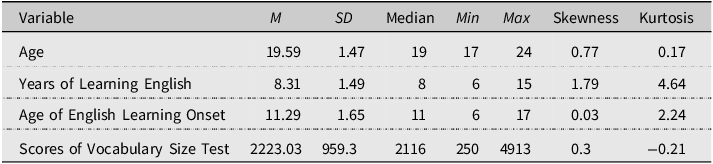
Seventy-four Japanese speakers were recruited for this study. All participants were university or junior college students residing in Japan. Four participants reported having experience visiting or studying in an English-speaking country, so they were excluded from the analysis. It is difficult to quantify and control all sources of English exposure. Therefore, experience of visiting or living in an English-speaking country was used as a practical exclusion criterion. Although this does not fully capture all sources of L2 exposure, it provides a relatively clear and objective indicator of more direct and immersive contact with English. Additionally, two participants indicated that Japanese was not their first language, and one participant’s data was not recorded due to technical issues. Data from these participants were also excluded. Sixty-seven participants learned English in Japan, within an English as a foreign language context, starting their English studies at an average age of 11.29 years (Table 1). English proficiency was measured using the V_YesNo v1.0 online vocabulary test (Meara & Miralpeix, Reference Meara and Miralpeix2016). The V_YesNo test measures receptive vocabulary knowledge rather than overall English proficiency. This measurement focus is nevertheless well aligned with the aim of the present study, which examines embodied knowledge activation during receptive lexical processing. Previous research has consistently demonstrated strong associations between vocabulary knowledge and L2 reading proficiency (e.g., Jeon & Yamashita, Reference Jeon and Yamashita2014), supporting the use of receptive vocabulary measures in this context. The test consists of 200 questions, requiring participants to indicate whether they recognize the meaning of a presented alphabetic letter string, which includes both real English words and pseudo-words. The test has a maximum score of 10,000. Based on the scoring criteria, participants’ scores ranged from 250 to 4913, placing them in the beginner level category (M = 2223.03, SD = 959.3). Because the V_YesNo v1.0 is scored externally on the test developers’ platform, item-level responses and scoring procedures are not accessible to researchers. Consequently, study-specific reliability estimates (e.g., internal consistency or item-level diagnostics) cannot be computed from the present dataset. While the test manual reports higher reliability than earlier Yes/No vocabulary tests such as X_Lex, the internal scoring algorithms are not fully disclosed. 92.53 percent of the participants (n = 62) reported being right-handed.
Descriptive statistics of the participants

Table 1. Long description
The table presents descriptive statistics of participants in a study on English learning and vocabulary size. It has four rows and seven columns. The columns are labeled as Variable, M, SD, Median, Min, Max, Skewness, and Kurtosis. The rows are labeled as Age, Years of Learning English, Age of English Learning Onset, and Scores of Vocabulary Size Test. Row 1: Age, M 19.59, SD 1.47, Median 19, Min 17, Max 24, Skewness 0.77, Kurtosis 0.17. Row 2: Years of Learning English, M 8.31, SD 1.49, Median 8, Min 6, Max 15, Skewness 1.79, Kurtosis 4.64. Row 3: Age of English Learning Onset, M 11.29, SD 1.65, Median 11, Min 6, Max 17, Skewness 0.03, Kurtosis 2.24. Row 4: Scores of Vocabulary Size Test, M 2223.03, SD 959.3, Median 2116, Min 250, Max 4913, Skewness 0.3, Kurtosis -0.21.
Note: One participant did not provide their age. The age at which they started learning English was calculated by subtracting the years of English learning from their current age.
Experimental materials
The same 15 nouns as in Terai (Reference Terai2023) were used in the present study to facilitate direct comparisons across studies: apple, ball, bear, cake, chameleon, cloud, horse, kiwi, leaf, onion, plum, popcorn, steak, strawberry, and tomato. For each noun, three color typicalities were established, as described in Terai (Reference Terai2023). For example, the word tomato was associated with red (typical), green (atypical), and white (unrelated) colors. These color-object typicality combinations were based on the results from Terai (Reference Terai2023) as well as the typicality ratings obtained from a task conducted at the end of the experiments (described below).
Design and procedure
The participants completed both the semantic Stroop task and the lexical decision task in both Japanese (their L1) and English (their L2). Both tasks were created using the Hot Soup Processor version 3.5.1 software (https://hsp.tv/). Unlike in previous studies, the Stroop task in this study did not present sentences before the color judgment phase. Terai (Reference Terai2023) did not find a significant interaction between sentence and word typicality, consistent with Connell and Lynott (Reference Connell and Lynott2009). These findings suggest that participants tend to simulate typical colors of objects regardless of the colors presented in the sentence. Therefore, it can be expected that participants in this study will simulate typical colors even without reading sentences. This was observed in previous studies that reported matched effects in the experiments of objects’ shape (Sato et al., Reference Sato, Schafer and Bergen2013). In addition, comparing results from word-level and sentence-level tasks provides insight into how strongly such simulations emerge in the absence of context. The order of tasks and languages was counterbalanced across participants. The tasks were performed in a quiet room under the supervision of the author.
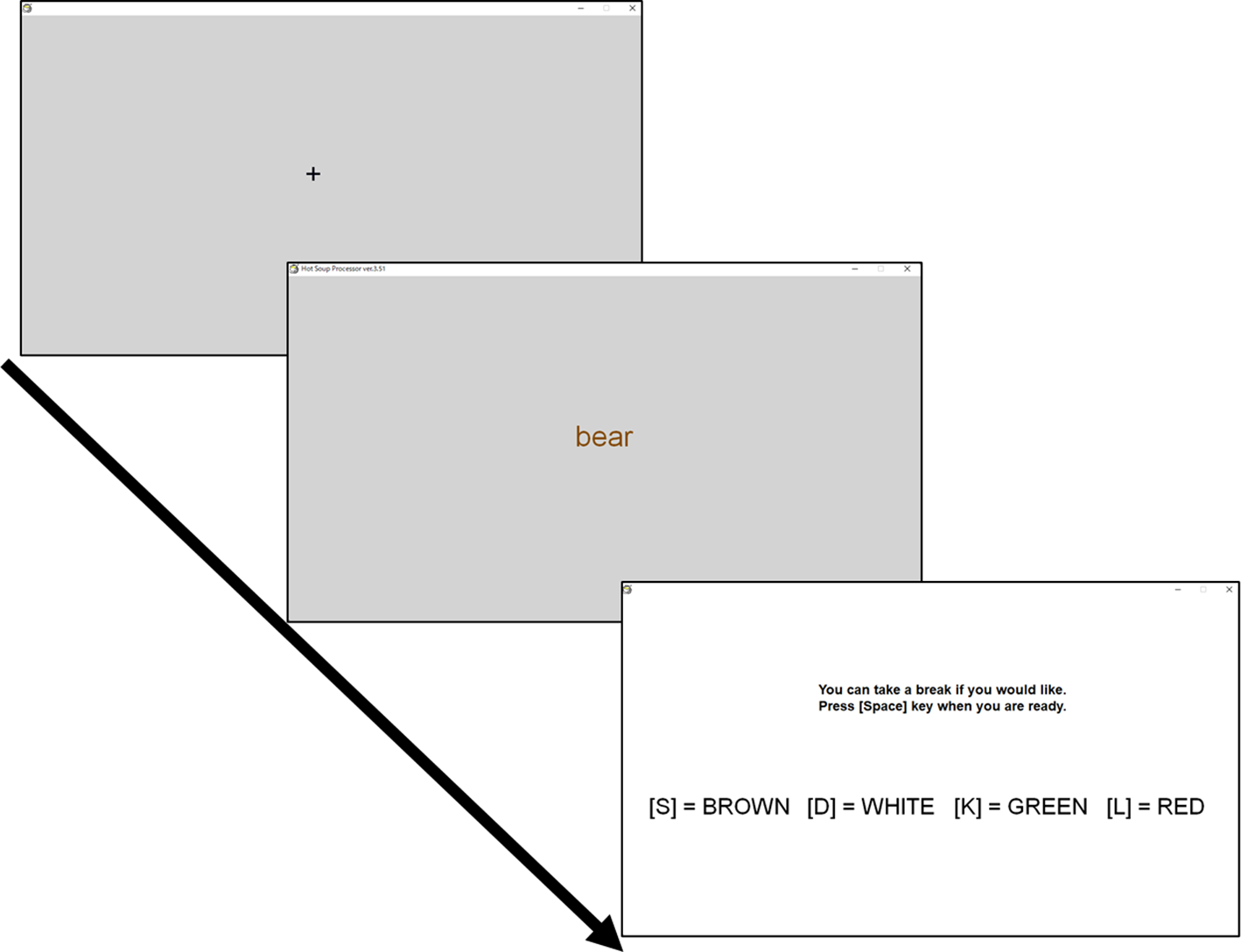
Before the semantic Stroop task, participants practiced pressing keys for 40 trials (10 trials for each color) to memorize the color-key correspondence: (S = BROWN, D = WHITE, K = GREEN, L = RED). In the semantic Stroop task, the procedure began with a plus sign displayed at the center of the screen for 500 milliseconds. Then, a colored word was shown in one of four colors—brown (132, 75, 0 in RGB), white (255, 255, 255 in RGB), green (0, 128, 0 in RGB), or red (255, 0, 0 in RGB)—in Arial, 50-point font, on a light gray background. Participants were required to identify the font color using the keyboard. Between each trial, a screen displaying the color-key correspondence (S = BROWN, D = WHITE, K = GREEN, and L = RED) appeared, allowing participants to pause (Figure 1).
Diagram of the semantic Stroop task.
Note: The instructions in this figure have been translated into English for clarity. During the experiment, all instructions were provided in Japanese.

The same nouns used in the Stroop task were also presented in the lexical decision task, with an equal number of filler items included to balance the number of yes and no responses. Participants were required to judge whether the presented noun was a real word or a pseudo-word by using the keyboard. A practice phase was included before the lexical decision task to help familiarize participants with the task.
In the present study, all participants used the same key assignments for both the semantic Stroop task and the lexical decision task, regardless of their dominant hand. Implementing a counterbalanced design, such as varying key positions across groups, is one way to reduce the influence of the dominant hand. However, this approach would have increased the number of experimental groups, thereby requiring a larger sample size to maintain sufficient statistical power. In addition, response key positions were not counterbalanced in the previous studies on which the present design was based (Terai, Reference Terai2023). To maintain consistency with these prior studies and given the primary focus of the study as well as practical constraints on participant recruitment, response key positions were therefore not counterbalanced.
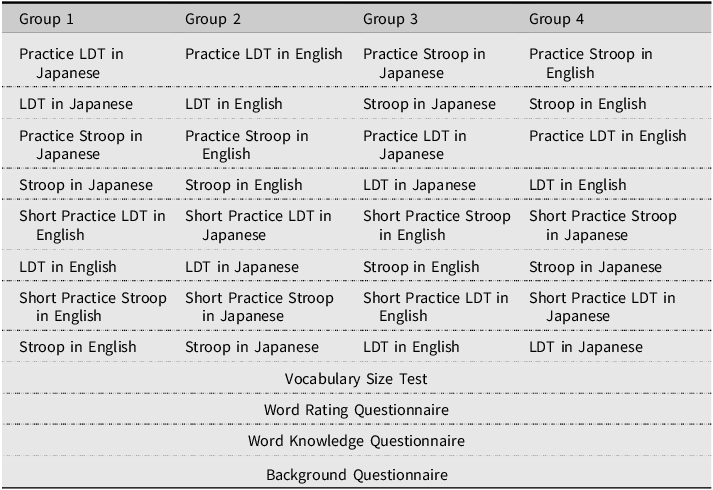
After completing the Stroop and the lexical decision task, participants proceeded to the vocabulary size test and the rating task. In the word-level typicality rating task, participants rated the typicality of the color-word associations (e.g., a BROWN bear) on a 6-point Likert scale (1: never comes to mind, 6: comes to mind first). The order of presentation was randomized. Additionally, a questionnaire was administered to identify any unknown words among the experimental items. After completing the tasks, participants filled out a background questionnaire. Table 2 provides an overview of all task patterns.
Procedures of the experiments in each groups

Table 2. Long description
A table comparing experimental procedures across four groups. The table has four columns labeled Group 1, Group 2, Group 3, and Group 4, and multiple rows detailing different tasks. Each group follows a specific sequence of tasks involving lexical decision tasks (LDT) and Stroop tasks in both Japanese and English. The tasks include practice sessions, short practice sessions, and the main tasks. Additionally, all groups complete a vocabulary size test, a word rating questionnaire, a word knowledge questionnaire, and a background questionnaire. Row 1: Group 1, Practice LDT in Japanese; Group 2, Practice LDT in English; Group 3, Practice Stroop in Japanese; Group 4, Practice Stroop in English. Row 2: Group 1, LDT in Japanese; Group 2, LDT in English; Group 3, Stroop in Japanese; Group 4, Stroop in English. Row 3: Group 1, Practice Stroop in Japanese; Group 2, Practice Stroop in English; Group 3, Practice LDT in Japanese; Group 4, Practice LDT in English. Row 4: Group 1, Stroop in Japanese; Group 2, Stroop in English; Group 3, LDT in Japanese; Group 4, LDT in English. Row 5: Group 1, Short Practice LDT in English; Group 2, Short Practice LDT in Japanese; Group 3, Short Practice Stroop in English; Group 4, Short Practice Stroop in Japanese. Row 6: Group 1, LDT in English; Group 2, LDT in Japanese; Group 3, Stroop in English; Group 4, Stroop in Japanese. Row 7: Group 1, Short Practice Stroop in English; Group 2, Short Practice Stroop in Japanese; Group 3, Short Practice LDT in English; Group 4, Short Practice LDT in Japanese. Row 8: Group 1, Stroop in English; Group 2, Stroop in Japanese; Group 3, LDT in English; Group 4, LDT in Japanese. Row 9: Vocabulary Size Test. Row 10: Word Rating Questionnaire. Row 11: Word Knowledge Questionnaire. Row 12: Background Questionnaire.
Note: LDT: Lexical Decision Task.
Analysis
All data treatment and statistical analyses were performed using R version 4.3.2 (R Core Team, 2023). Before the analysis, responses to the filler items and words that participants indicated as unknown were excluded.
Following the data cleanup, the results of the color-typicality rating task were reviewed to check for disagreements in color-typicality relationships. In cases of disagreement, adjustments were made based on participant ratings. For example, if red was initially coded as the typical color and green as atypical for tomato, but a participant rated green as more typical than red, then red was recorded as atypical and green as typical. These adjustments were made for each item and participant level. Items where participants rated all typicalities equally were excluded from the analysis. The mean (SD) rating was 5.80 (0.57) for typical colors, 3.38 (1.44) for atypical colors, and 1.64 (0.95) for unrelated colors.
Next, a series of Bayesian mixed-effects models were performed using the brms package 2.20.4 (Bürkner, Reference Bürkner2017). Before fitting the models, data with reaction times shorter than 200 ms or longer than the median plus three median absolute deviations (Leys et al., Reference Leys, Ley, Klein, Bernard and Licata2013) were excluded. This outlier treatment was also applied to the reaction times from the lexical decision task. As a result, a total of sixty-six participants’ data were analyzed with the model. All models used MCMC sampling with 4 chains of 20000 iterations and a warmup of 5000.
The models for analyzing the reaction times of the semantic Stroop task included color typicality, font color, groups of the task, scaled reaction times of the lexical decision task, the language of the task, and the number of the trials and their interactions (scaled reaction times of the lexical decision, color typicality, and the language of the task) as independent variables. Sum-contrasted coding was applied through the contr.sum function from the stats package to the typicality of color (unrelated: [1, 0], typical: [0, 1], atypical: [−1, −1]); font color (brown: [1, 0, 0], white: [0, 1, 0], red: [0, 0, 1], green: [−1, −1, −1]); groups of the task (group 1: [1, 0, 0], group 2: [0, 1, 0], group 3: [0, 0, 1], group 4: [−1, −1, −1]); and the language of the task (English: [1], Japanese: [−1]). Color typicality, scaled reaction times from the lexical decision task, task language, the interaction terms among these three variables, the number of trials, and font color were included as random effects for both participants and items, with correlation parameters. In addition, the random effects structure for items also included task groups. The models for analyzing the reaction times of the lexical decision task included the language of the task, which was sum-contrasted coded (English: [1]; Japanese: [−1]). The language of the task was also included for random effects of both subjects and items (intercept and slope), including correlation parameters. A posterior predictive check was performed using the pp_check function from the brms package to assess the fit of the final model. A post hoc test was conducted using the emmeans package 1.8.9 (Lenth, Reference Lenth2024). The significance of effects was assessed using the probability of direction (pd) with the bayestestR package 0.13.2 (Makowski et al., Reference Makowski, Ben-Shachar, Chen and Lüdecke2019). Pd values greater than 97.5% were considered indicative of significant effects, equivalent to a two-sided p-value of .05 in the frequentist approach. All parameter estimations converged, and all Rhat values were below 1.01.
Details of the analysis, including R scripts and data, are available in the OSF project (https://doi.org/10.17605/OSF.IO/6FDN5).
Results
The semantic Stroop task
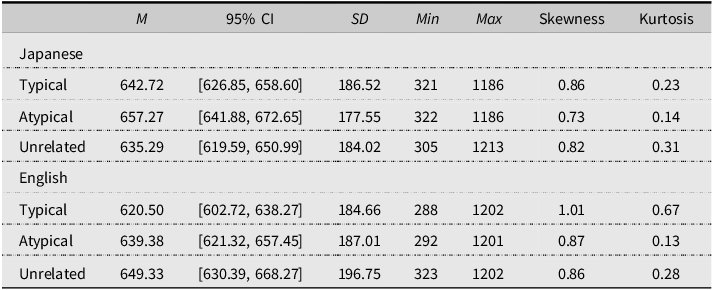
Descriptive statistics for reaction times in the Stroop task are summarized in Table 3. Accuracy rates exceeded 95% across all conditions in both Japanese and English tasks. The results indicated that in the Japanese task, the unrelated condition yielded the fastest reaction times, followed by the typical and atypical conditions. In contrast, in the English task, the typical condition resulted in the fastest reaction times, followed by the atypical and unrelated conditions.
Descriptive statistics of the reaction times

Table 3. Long description
The table presents descriptive statistics of reaction times in the Stroop task for Japanese and English tasks across typical, atypical, and unrelated conditions. It includes columns for mean (M), 95% confidence interval (95% CI), standard deviation (SD), minimum (Min), maximum (Max), skewness, and kurtosis. The table has two main sections: Japanese and English, each with three rows for typical, atypical, and unrelated conditions. For the Japanese task, the typical condition has a mean of 642.72, a 95% CI of [626.85, 658.60], an SD of 186.52, a minimum of 321, a maximum of 1186, a skewness of 0.86, and a kurtosis of 0.23. The atypical condition has a mean of 657.27, a 95% CI of [641.88, 672.65], an SD of 177.55, a minimum of 322, a maximum of 1186, a skewness of 0.73, and a kurtosis of 0.14. The unrelated condition has a mean of 635.29, a 95% CI of [619.59, 650.99], an SD of 184.02, a minimum of 305, a maximum of 1213, a skewness of 0.82, and a kurtosis of 0.31. For the English task, the typical condition has a mean of 620.50, a 95% CI of [602.72, 638.27], an SD of 184.66, a minimum of 288, a maximum of 1202, a skewness of 1.01, and a kurtosis of 0.67. The atypical condition has a mean of 639.38, a 95% CI of [621.32, 657.45], an SD of 187.01, a minimum of 292, a maximum of 1201, a skewness of 0.87, and a kurtosis of 0.13. The unrelated condition has a mean of 649.33, a 95% CI of [630.39, 668.27], an SD of 196.75, a minimum of 323, a maximum of 1202, a skewness of 0.86, and a kurtosis of 0.28.
Note: The reaction times are in milliseconds.
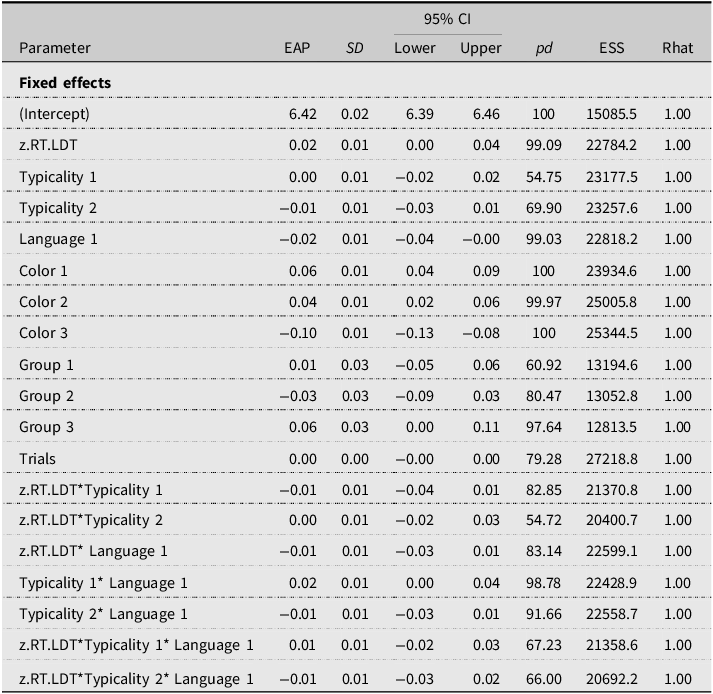
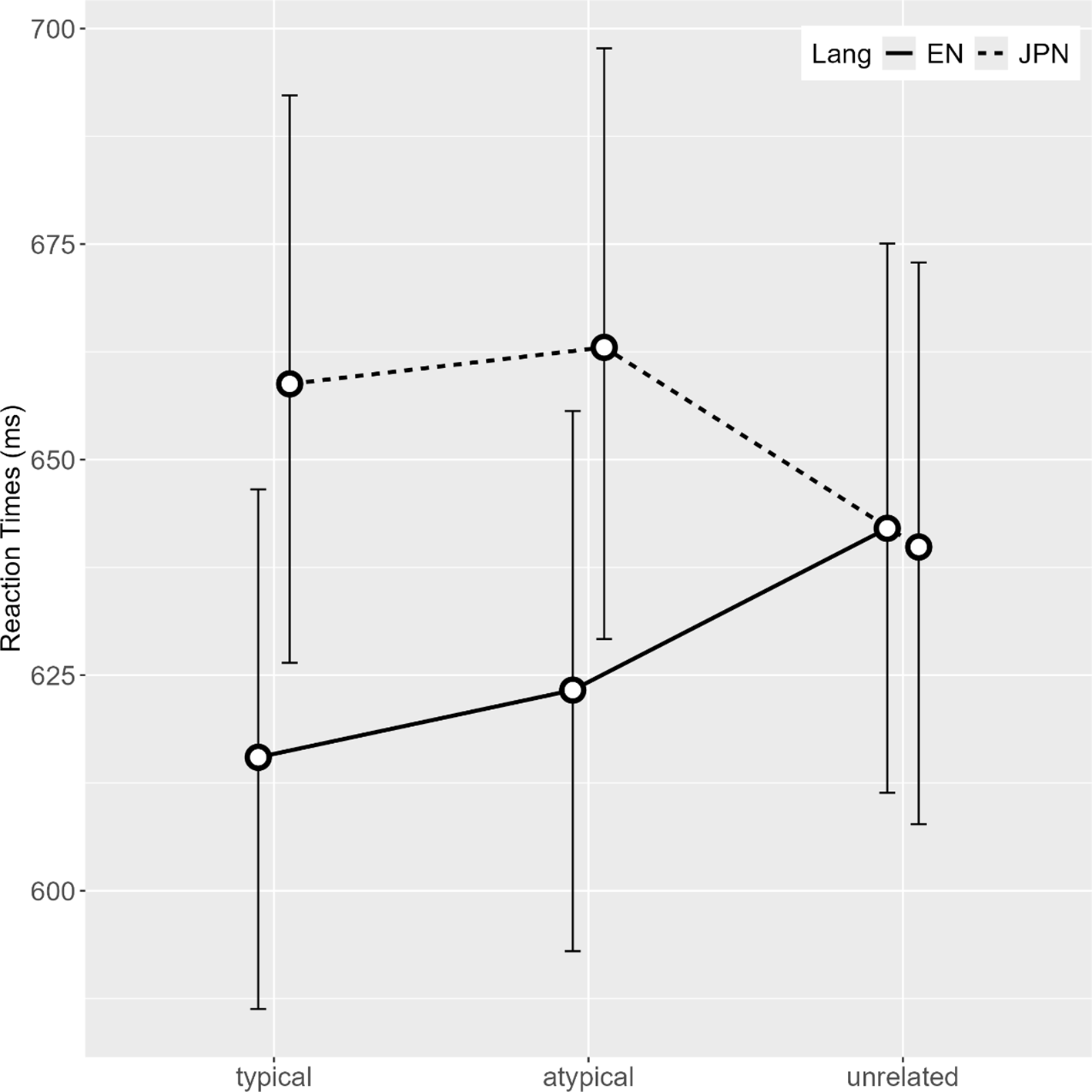
The regression results are summarized in Table 4. The main effect of scaled reaction times of the lexical decision task was significant (EAP = 0.02, 95% CI [0.00, 0.04], pd = 99.09%), suggesting that longer reaction times in the lexical decision task were associated with longer reaction times in the Stroop task. The task of language showed notable main effects (EAP = −0.02, 95% CI [−0.04, −0.00], pd = 99.03%). The results indicate that, compared to the task in Japanese, performing the task in English elicited faster reaction times than the grand mean. The interaction between typicality and language was also significant (EAP = 0.02, 95% CI [0.00, 0.04], pd = 98.78%). The estimated marginal means showed that reaction times in English were notably faster than those in Japanese for both the typical and atypical conditions (Typical: Median = −43.28 ms, 95% CI [−75.92, −10.47], pd = 99.52%; Atypical: Median = −39.66 ms, 95% CI [−74.36, −5.11], pd = 98.80%). Moreover, as shown in Figure 2, the pattern of differences among the three conditions was reversed: in English, the matched conditions (typical and atypical) elicited faster reaction times than the mismatched condition (unrelated), whereas in Japanese, the matched conditions resulted in slower reaction times.
Results of the bayesian mixed-effects regression

Table 4. Long description
The table presents the results of a Bayesian mixed-effects regression analysis. It includes fixed effects with parameters such as intercept, z.RT.LDT, Typicality, Language, Color, Group, Trials, and their interactions. The table has 21 rows and 8 columns. Column headers are Parameter, EAP, SD, 95% CI Lower, 95% CI Upper, pd, ESS, and Rhat. Row labels include various fixed effects and their interactions. Each row provides values for EAP, SD, 95% CI Lower, 95% CI Upper, pd, ESS, and Rhat. Notable trends include significant effects for z.RT.LDT, Language, and interactions between typicality and language.
Note: EAP: expected a posteriori (mean), SD: standard deviation of the posterior distribution, CI: credible interval, pd: probability of direction, ESS: effective number of MCMC samples, z.RT.LDT: scaled reaction times of the lexical decision task. Model formula: Reaction times ∼ z.RT.LDT * Typicality * Language + Color + Group + Trials + (1 + z.RT.LDT * Typicality * Language + Color + Trials | Participant) + (1 + z.RT.LDT * Typicality * Language + Color + Group + Trials | Word). Marginal R 2 = .083, 95% CI [.053, .123], Conditional R 2 = .338, 95% CI [.308, .367].
Median reaction times (ms) of the semantic Stroop task across conditions.
Note: The dots represent the estimated median of each condition. Error bars represent 95% credible intervals.

Several coefficients also showed notable effects. The results indicated that reaction times for Group 3 were slower than the grand mean (EAP = 0.06, 95% CI [0.00, 0.11], pd = 97.64%). Interestingly, all color coefficients were significant: brown and white elicited slower reaction times than the grand mean, whereas red was associated with faster reaction times. Estimated marginal means indicated that red elicited significantly faster reaction times than other colors. The only other significant difference was observed between brown and green, with green producing faster reaction times.
The lexical decision task
Descriptive statistics showed that reaction times were faster in Japanese (M = 598.79, 95% CI [593.35, 604.23], SD = 110.16) than in English (M = 931.88, 95% CI [914.44, 949.32], SD = 314.06). Accuracy was also higher in Japanese (M = 99.28%, 95% CI [98.87, 99.68], SD = 8.48) compared to English (M = 86.51%, 95% CI [84.65, 88.38], SD = 34.17).
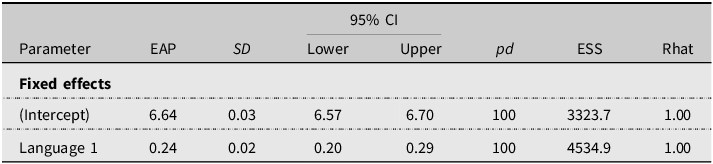
The results of the mixed-effects model are summarized in Table 5. The main effect of language was significant (EAP = 0.24, 95% CI [0.20, 0.29], pd = 100%).
Results of the bayesian mixed-effects regression

Table 5. Long description
A table summarizing the results of a bayesian mixed-effects regression analysis. The table has 2 rows and 8 columns. The columns are labeled Parameter, EAP, SD, Lower, Upper, pd, ESS, and Rhat. The row labels are (Intercept) and Language 1. Row 1: Parameter, (Intercept); EAP, 6.64; SD, 0.03; Lower, 6.57; Upper, 6.70; pd, 100; ESS, 3323.7; Rhat, 1.00. Row 2: Parameter, Language 1; EAP, 0.24; SD, 0.02; Lower, 0.20; Upper, 0.29; pd, 100; ESS, 4534.9; Rhat, 1.00.
Note: EAP: expected a posteriori (mean), SD: standard deviation of the posterior distribution, CI: credible interval, pd: probability of direction, ESS: effective number of MCMC samples. Model formula: Reaction times ∼ Language + (1 + Language | Participant) + (1 + Language | Word). Marginal R 2 = .416, 95% CI [.299, .516]; Conditional R 2 = .640, 95% CI [.623, .656].
The estimated marginal means showed that the task in Japanese elicited significantly faster reaction times than the task in English (Median = 383.34 ms, 95% CI [289.46, 485.44], pd = 100%). Notably, these results contrast with those of the Stroop task.
Discussion
Research Hypothesis 1 was not supported by the results, as no notable differences in reaction times were observed among the typical, atypical, and unrelated conditions. Previous research on object shape suggests that simulation can occur even without context (e.g., Sato et al., Reference Sato, Schafer and Bergen2013; Kang et al., Reference Kang, Eerland, Joergensen, Zwaan and Altmann2020), which may imply that shape simulation is more robust than color simulation at the single-word level. Although Tsaregorodtseva et al. (Reference Tsaregorodtseva, Frazier, Stolterfoht and Kaup2024) found evidence of color simulation both at the word and sentence levels, they suggested that such simulation is unstable and influenced by factors such as the number of filler items. Other studies also emphasize the importance of context in cognition (Huettig et al., Reference Huettig, Guerra and Helo2020; Yee & Thompson-Schill, Reference Yee and Thompson-Schill2016). Yee and Thompson-Schill (Reference Yee and Thompson-Schill2016) discuss the dynamic nature of our concepts, proposing that participants’ simulations of objects may vary depending on their recent or long-term experiences. Additionally, Huettig et al. (Reference Huettig, Guerra and Helo2020) suggest that color information is activated only when the context strongly supports its relevance. Therefore, embodied language processing may be more effective in contexts that define object features, with simulations of color and other aspects of embodied knowledge varying accordingly. At the single-word level, simulating an object’s color might not be robust enough to generate a Stroop effect.
One finding consistent with Terai (Reference Terai2023) was the effect of the color red, which consistently elicited faster reaction times than other colors. While one might assume that faster reaction times for red were due to its association with the L key (pressed by the dominant right hand, as most participants were right-handed), red still elicited faster reaction times than green, which was also mapped to the K key that was pressed by the right hand. If hand dominance were influencing reaction times, no significant difference would have been observed between green and brown. Moreover, no notable differences were found between brown and white. The consistent effect of red across experiments is intriguing, though the underlying reasons for its speed remain an open question for future research.
The modeling results did not support Research Hypothesis 2, as no significant interaction effect was found between typicality and reaction times of the lexical decision task. This suggests that the degree of automatization in word recognition may not be strongly related to the embodiment of each word. In the lexical decision task, participants likely focused on lexical processing, which is relatively superficial and less dependent on embodied knowledge. As a result, the words processed were less likely to simulate the referred objects, especially in tasks without contextual cues. This indicates that the degree of simulation may not be fully captured by measuring only the processing speed of a word.
The results did not support Research Hypothesis 3. Instead, the findings suggested an opposite trend: although not significant, the Stroop effect was observed only in the English task, where typical and atypical conditions, on average, elicited faster reaction times than the unrelated condition. However, this pattern was reversed in the Japanese task. This discrepancy with Terai (Reference Terai2023) may be attributed to task differences. In Terai (Reference Terai2023), participants were presented with sentences that provided context (e.g., Joe was excited to see a bear at the North Pole), which likely helped readers focus on the referred objects during reading, both in their L1 and L2. In contrast, the current study did not include contextual sentences, potentially resulting in more superficial processing, especially in participants’ L1. In their L2, processing may have been less automatized compared to Japanese. This was evident in the lexical decision task, where reaction times were faster and more accurate in Japanese than in English. Consequently, participants may have focused more on reading words in English, leading to simulation of the referred objects. The results are consistent with previous studies, such as Garello et al. (Reference Garello, Ferroni, Gallese, Ardizzi and Cuccio2024), which reported stronger embodiment effects in L2. These findings suggest that simulation may not occur routinely and can happen in both L1 and L2, depending on the processing demands and task context. If a task facilitates such activation (e.g., presenting colored pictures or sentences), color information may be utilized during L1 and L2 language processing.
The second possible explanation is that processing in L1 activates more information than in L2, leading to slower reaction times due to competition. This effect may be particularly pronounced when processing words without specific context. Models of lexical processing, such as RHM (Kroll & Stewart, Reference Kroll and Stewart1994) and the three-stage model (Jiang, Reference Jiang2000), propose that connections between L1 and conceptual representations are stronger than those in L2. This imbalance is especially pronounced for learners with lower L2 proficiency. Consequently, processing a single word in L1 may activate not only its direct reference but also related concepts. The current results found that reaction times differed only in the typical and atypical conditions, but not in the unrelated condition. This result supports the second possible explanation.
The third hypothesis is a combination of these two explanations. Both the increased reliance on superficial orthographic processing in L1 and the stronger conceptual connections in L1 may have contributed to the observed results. The findings of this study could support any of these hypotheses, underscoring the need for further research to investigate these mechanisms in greater depth.
Conclusion
The study found that color simulation at the word level may not always occur, possibly due to the absence of contextual cues, such as sentences, that promote color activation. Huettig et al. (Reference Huettig, Guerra and Helo2020) suggest that color information is activated when the context strongly supports its relevance. The present findings align with this view, indicating that sentence-level tasks may elicit stronger embodied language processing than isolated word tasks. Moreover, the degree of simulation may vary between a reader’s L1 and L2. The study observed opposite patterns in L1 and L2, suggesting three possible explanations: superficial processing in L1, stronger conceptual connections in L1, and the combination of the two. Future research could explore differences in the magnitude of the Stroop effect across various task types to uncover the simulation of color in L2 linguistic processing.
Replication package
The data that support the findings of this study are openly available in OSF at https://osf.io/6fdn5/overview.
Acknowledgments
The author utilized ChatGPT (OpenAI, 2026) only to refine the language in the manuscript. No single idea in the manuscript was generated with ChatGPT.
Financial support
This article was supported by JSPS KAKENHI Grant Number 24K16142.
Competing interests
The author declares no competing interest.

 Open access

