Opera, fame and the Enlightenment public sphere
Probing the socio-aesthetic processes involved in monumentalising renowned artists and their works, literary critic Frank Kermode offers a deceptively simple observation regarding canon formation: ‘Reception history informs us that even Dante, Botticelli, and Caravaggio, even Bach and Monteverdi, endured long periods of oblivion until the conversation changed and they were revived’.Footnote 1 The emphasis for Kermode is not on the intrinsic qualities of these seemingly static monuments of art but rather on ‘conversation’ concerning personalities and their works. Drawing upon the aesthetic writings of Czech critic Jan Mukařovský, Kermode effectively relocates the source of aesthetic value to the reader, observer or listener, paying particular attention to the pleasure emanating from the ephemeral aesthetic experience. In short, individuals, often enthusiasts rather than scholars, experience art and converse with others about it. Works can move in and out of the canon, depending on how long they are ‘kept alive by conversation’.Footnote 2 This intricate relationship between audience and ascriptions of value becomes most capricious, yet revealing, at pivotal moments in history during which new categories of readers, viewers, and listeners come forth. In this regard, the Enlightenment witnessed the rise of an unprecedented cultural and political force: the public, alongside which notions of public discourse, collective evaluations of artistic taste and celebrity arose.
The emergence of the public sphere during the eighteenth century inaugurated an era characterised by diverse communities that entered into conversations about opera. During the early decades of the eighteenth century, courts and aristocratic society still enjoyed their roles as prominent patrons and judges of the arts, viewing them as an extension and display of their absolute political power. The public's newly found role as arbiter of operatic taste by the end of the eighteenth century was a result of a progressive shift in power, both political and artistic, from the ruling classes in Old Regime Europe to a group of individuals of varying social classes, collectively viewed as the public. The seminal study detailing this complex cultural transition, Jürgen Habermas's The Structural Transformation of the Public Sphere, is as often critiqued as it is cited.Footnote 3 Habermas provides an essentially theoretical, though historically situated, model of the process, describing a courtly-noble society in which political power was represented not for but before the people, by means of large-scale staged public events such as court festivals, royal dances, processions, weddings, funerals, religious events and commemorations; this was gradually displaced by a public sphere of educated merchant-class citizens who promoted the political representation of the people alongside representational court society. He identifies two interrelated factors contributing to this transition: the distribution of goods and the commercialisation of information. According to Habermas, printed material, which was disseminated initially in order to facilitate the distribution of commercial goods, eventually became a commodity in itself.Footnote 4 His emphasis on the proliferation of publications such as newsletters, moral weeklies, newspapers and periodicals bought and sold by individuals other than from within the aristocracy, contributed, at least in part, to histories of the Enlightenment centred around the political impact of publishing, increased readership and public opinion by historians of print culture, most notably Robert Darnton and Roger Chartier.Footnote 5
Habermas's essentially Marxist leanings on the social composition of the public sphere are among the most contested aspects of his theoretical model. Political historians such as Tim Blanning and John Van Horn Melton have offered revisionist accounts of the Enlightenment public sphere, the former characterising it as ‘socially heterogeneous’ and ‘politically multifaceted’, thereby acknowledging that the nobility, at least initially, were among the prominent beneficiaries of this gradual transfer of power.Footnote 6 Similarly, Joan Landes has provided a narrative detailing the gendering of the public sphere,Footnote 7 and Nancy Fraser has pointed to the presence of ‘subaltern counterpublics’ occupying parallel discursive arenas.Footnote 8 There is however some consensus among scholars that despite the difficulties of social composition and the alleged opposition between the public and traditional authority, Habermas's model remains a useful paradigm and is perhaps most productively viewed, to use Tim Blanning description, as ‘a neutral vessel, carrying a diversity of social groups and ideologies’.Footnote 9 It would seem then that what united these individuals as a ‘public’ was neither their social composition nor the political ideals that they advocated. Far more importantly, they formed a conceptual space between the state and private home in which information was disseminated, discussed and debated, in effect, embodying Habermas's central theoretical definition of the public sphere.Footnote 10 Even though the social make-up of the public and the scope of the so-called ‘reading revolution’ are notoriously difficult to pin down, since geographic and national circumstances varied substantially, what remains evident is that the Enlightenment witnessed a substantial mobilisation of ideas and information through institutions such as reading societies, lending libraries, coffee houses, and, with respect to music, the public concert hall and opera house. As Dena Goodman puts it, ‘Habermas brought into focus a public sphere of literate men and women, who, through their participation in burgeoning discursive institutions of print and sociability, transformed the social and political landscape of eighteenth-century Europe while empowering themselves as autonomous individuals’.Footnote 11 Ultimately, the newly found sovereignty of public opinion, growing out of the rational-critical discourse that eventually replaced a more passive acceptance of authority, underpinned the democratisation of fame during the Enlightenment.Footnote 12
Given opera's long standing association with fame and renown, one might expect that the genre would occupy a central position in the changing nature of fame during the Enlightenment – a gradual shift in sovereignty from political rulers to public celebrities, including composers and performers. Martha Feldman's recent landmark study of the reorientation of sovereignty in opera seria illustrates a transition from ‘the monarch who reigns supreme among all his subjects … increasingly toward self-determining groups and their ideals, or the ideals of the citizen who is no longer subject but sovereign himself’.Footnote 13 In many ways, the plethora of evidence detailed by Feldman to illustrate this transition – the architecture of opera houses, new mechanisms of identification in opera, aesthetic reforms pertaining to the genre itself, and the impact of public opinion on operatic representation of sovereigns, to mention only a few – affirms Habermas's assertion that the emergence of the public sphere was most visible in the realm of music.Footnote 14 Habermas, however, places a much stronger emphasis on instrumental music and the concert-going public as compared to theatre audiences in Structural Transformation of the Public Sphere, a value that remained in early musicological paradigms of the public sphere, the first of which was articulated by Christoph-Helmut Mahling, and also informed musicological accounts of canon formation.Footnote 15
Most notably, Joseph Kerman, in his oft-cited essay on the formation of the musical canon gives credence to the ‘new social configuration’ of the late eighteenth and early nineteenth centuries, but he places greater emphasis on the role of criticism, which he argues depended on literary models. His famous assertion that ‘repertories are determined by performers, canons by critics – who are by preference musicians, but by definition literary men or at least effective writers about music’,Footnote 16 presupposes a public sphere in which musical works witnessed increased accessibility and which virtually institutionalised literary criticism.Footnote 17 However, Kerman foregrounds a very specific development in music journalism:
[E.T.A.] Hoffmann must be the first of many authors who have badgered journal editors with demands for more and more music illustrations; it is extremely important, he kept saying, for his readers to be able to see the scores … his famous Beethoven reviews were not of live performances but of published sheet music, texts dead on the page save for Hoffmann's internalized musical imagination and that of his readers.Footnote 18
Kerman's proposal that the presence of criticism featuring musical excerpts and bar-by-bar analysis signals a collective fixation on the composer, is perhaps a familiar narrative. Yet scholars such as Roger Parker and William Weber have remarked upon the precarious role of opera in accounts of canon formation.Footnote 19 To be sure, the genre is underrepresented in both Joseph Kerman's and Lydia Goehr's accounts of canon formation; indeed, the broader discursive relationships between court culture and the public sphere might well have contributed significantly to the model of music criticism exemplified by Hoffmann.Footnote 20 For instance, as I will demonstrate in the course of this article, opera seria was one of the first genres to receive in-text musical examples and bar-by-bar analysis in music reviews, starting in German periodicals published by Breitkopf in 1756.Footnote 21 More broadly, the aforementioned revisions to Habermasian paradigms of the public sphere, in which the alleged opposition between traditional authority and the public sphere is collapsed, open up fresh perspectives on canon formation in which court culture features more prominently. Consequently, the role of opera seria in the processes leading to ascriptions of musical value and fame in the Enlightenment public sphere is a significant dimension of canon formation that has yet to be fully investigated. Given the dominance of the Austro-German instrumental tradition in narratives of canon formation, it is perhaps fitting to begin by investigating the complex role of Italian opera seria and notions of musical fame in enlightenment Germany.
Maria Antonia of Saxony and the changing nature of fame in Enlightenment Germany
Within the German linguistic area, public access to opera performances came relatively late in comparison to other European regions:Footnote 22 Frederick II allowed the public access to the new Berlin opera house in 1743, and in Dresden opera tickets were available for purchase for the first time in 1746.Footnote 23 Music criticism during the first half of the eighteenth century was still relatively sporadic, featuring specialist periodicals such as Johann Mattheson's Critica Musica (1722–1725) and Der musicalische Patriot (1728), Christian F. Weichmann and Barthold H. Brockes moral weekly Der Patriot (1724–1726), which contained entries on music, as well as Lorenz Mizler's Musikalische Bibliothek (1736–1754) and Musikalischer Staarstecher (1739–1740), to mention only a few. The 1740s and 1750s saw increasingly widespread and frequent publication of criticism, featuring periodicals such as Das Neueste aus der anmuthigen Gelehrsamkeit (1751–1762) and Neuer Büchersaal der schönen Wissenschaften und freyen Künste (1745–1750), both edited by Gottsched and published by Breitkopf; and Marpurg's Historisch-Kritische Beyträge zur Aufname der Musik (1754–1762; 1778) and Kritische Briefe über die Tonkunst (1759–1763). Several of these review specific opera performances and opera scores available for purchase. From the 1740s to the 1760s – the formative period for opera reviews in German periodicals – an investigation into publicly perceived famous composers and works in opera reviews yields a somewhat unexpected result. Whereas one might expect court composers Hasse and Graun, or perhaps even Handel, to feature most prominently, another composer comes to the fore instead: Maria Antonia of Saxony.
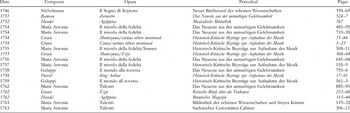
Maria Antonia Walpurgis Symphorosa (1724–1780) was the eldest daughter of Elector Karl Albert of Bavaria (later Emperor Karl VII) and Archduchess Maria Amalia of Austria. She married Frederick Christian, grandson of August the Strong, in 1747, and in 1763 the two became Electress and Elector of Saxony. Unfortunately, Frederick Christian died suddenly several months later and Maria Antonia's reign as Electress was therefore short-lived. A highly respected poet and composer, Maria Antonia was admitted to the renowned Arcadian Academy in Rome in 1747; her poetry and musical compositions, including two operas, were published under the pseudonym E.T.P.A. (Ermelinda Talea Pastorella Arcade). As indicated in Table 1, her operas Il trionfo della fedeltà (1754) (hereafter Il trionfo) and Talestri, regina delle amazzoni (1762) (hereafter Talestri), when compared to other operas, received by far the lengthiest and most numerous reviews between 1745 and 1765. Her fame, as one anonymous reviewer suggests, rivalled that of renowned opera composers.Footnote 24 The sheer popularity of her operas in itself may merit a re-evaluation of her work and its place in the canon. In recent decades, Maria Antonia's output and historical position has received much attention, including performances, recordings, modern editions, scholarly examinations of her work and, most notably, Christine Fischer's recent monograph, Instrumentierte Visionen weiblicher Macht.Footnote 25
Reviews of individual operas in North and Central German newspapers and journals between 1745 and 1765*
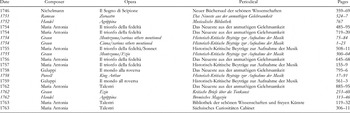
* Italics indicate reports of at least one paragraph in length forming part of a larger review. All others are reviews entirely devoted to a single opera. This information is based on a large-scale electronic research project, Die Musik in den Zeitschriften des 18. Jahrhunderts: Eine Bibliographie, Laurenz Lütteken, ed., (Kassel: Bärenreiter, 2004).
Fischer provides a much-needed assessment of previously known and new source material related to this important historical figure. In evaluating Maria Antonia's artistic contributions, she argues that ‘the key to Maria Antonia's works lies precisely in positioning her work in its original social contexts: in connection with court life, politics and art; in the judgement of her artistic activity, not in the first place as a means of artistic distinction, but as a means of political self-representation’.Footnote 26 Indeed, political self-fashioning forms the nexus of Fischer's study, as she draws upon a rich variety of manifestations of representational court culture. The literary and painterly court traditions of depicting aristocratic women as Minerva and Amazon warriors that informed Maria Antonia's self-stylisation as a goddess of wisdom, protectress of the arts and powerful ruler (at least within the context of her operas) are artfully detailed, as are the ‘systems of communication’, to use Fischer's phrase, of court theatre. These include a seating plan according to social rank, the hierarchical structure of operatic performances, and political meanings exhibited by the operas themselves, particularly Maria Antonia and Frederick Christian's enlightenment values. The unusual degree of involvement – as author of the librettos, composer and performer of the lead-roles – on the part of the Electress in shaping her own image, Fischer argues, makes the case of Maria Antonia exceptional.Footnote 27 By placing such a strong emphasis on what could be viewed as the ultimate operatic expression of representational court culture as described by Habermas, Fischer places most, if not all, of the agency in shaping the political images of Maria Antonia in the hands of the Electress herself. It is at the very least curious, for instance, that a substantial repertory of contemporary poems, plays and music exalting the qualities of Maria Antonia as a just, merciful and kind ruler, one of the usual avenues by which rulers received praise from their subjects, hardly figures into Fischer's argument.Footnote 28 Crucially, Maria Antonia's historical position as an Electress in the midst of a court culture complemented by new sites of authority emerging within the public sphere would suggest that questions of agency related to fashioning her various public images are likely to be considerably more complex.
Indeed, that which distinguishes Maria Antonia from other aristocratic musicians is precisely the seemingly paradoxical nature of her fame. The lion's share of Maria Antonia's audience comprised members of the public who discussed her operas within a newly formed public sphere. Public discourse with regard to opera prompted an irreversible change in the processes by which renown was bestowed upon opera composers, singers, and works. This vital cultural transition – involving new audiences, modes of dissemination and discourse, and mechanics of collective aesthetic evaluation – is unusually nuanced and perceptible in the case of Maria Antonia: she embodied measures of fame inherent to both the ancien régime and the Enlightenment, each in crossfire with the other. In what follows, I investigate Maria Antonia's unusual historical position as Electress and publicly celebrated composer. I will begin by examining questions of audience, reconstructing ‘who’ heard her operas and how various audiences became acquainted with them. Second, I will reconstruct the circumstances surrounding her relationship with the Breitkopf firm, including the first music examples (taken from her operas) and bar-by-bar commentary in opera reviews, effectively contextualising the emergence of music analysis in opera criticism. Finally, I will assess the relationship between the abstraction of excerpts of her operas from a performance context for discourse in periodical reviews and the formation of Maria Antonia's public image as a celebrated composer.
Questions of audience
Despite the advent of public attendance at opera houses within the German linguistic area during the 1740s and 1750s, Maria Antonia's operas received exclusively private court performances. These performances occupied a defined role within the political rituals of court culture, frequently forming an essential part in occasions of royal festivity. Manuscript evidence, revisions, and additions to the scores indicate that Maria Antonia's operas were often tailored for each event.Footnote 29 Moreover, her operas were staged within closely knit private family celebrations that frequently included members of the royal family, rather than paid court singers and instrumentalists, singing the main operatic roles or playing a sparse orchestral accompaniment.
The performance histories of Il trionfo and Talestri can be reconstructed using a variety of primary source documents. Detailed accounts of the rehearsals of Il trionfo are extant in letters from Graf von Wackerbarth, Privy Councellor to King Frederick Christian.Footnote 30 His letter dated 28 August 1754 reveals that the princess invited a few guests to one of her final rehearsals:
Dresden, the 28th of August 1754
Yesterday afternoon Madame the Princess Electoral rehearsed her beautiful Pastoral again. The two Bavarian Chamberlains Mr. le Comte de Minuzze and Mr. le Baron de Klingenberg were also admitted to it. At the end of the first act Mr. le Chevalier Williams, who had only just arrived in Dresden, came forward to render his respects to Their Royal Highnesses who received them in the most gracious manner in the world.Footnote 31
Although the size and social make-up of the audience for the 1754 summer premiere of Il trionfo remains unknown, it was believed to have been a closed court performance in which Maria Antonia sang the role of the protagonist, Nice.Footnote 32 In Gottsched's view, an opportunity to hear the princess singing the main role of her opera was the supreme operatic experience, though he admits that the audience given this privilege was rather select:
The ultimate [experience] of all is, when one has the fortune and grace, to hear the sublime author herself singing the main role of shepherdess Nice in concerts at court: this honour usually only happens to royal persons or to ambassadors.Footnote 33
The opera received several subsequent performances, all at occasions of royal festivity. Gottsched's Handlexicon also mentions a 1759 performance of Il trionfo in honour of Prince Frederick Christian's name day:
In this, the 1759th year, the first theatre performance took place on the high nameday of his royal highness, the illustrious royal prince; since then, the piece once again appeared in print, also with copper engravings of the theatrical décor.Footnote 34
Moreover, according to a letter from Prince Albert, Il trionfo was staged in January 1765 in Vienna in celebration of the marriage of Joseph II.Footnote 35 The opera was again used to celebrate Prince Xavier's name day on 3 December 1767 in the small court theatre in DresdenFootnote 36 for which Maria Antonia composed a new Licenza.Footnote 37
Similarly, Talestri received a number of closed court performances, primarily at occasions of royal festivity. Amongst the first performances were those at the small court theatre in 1762 and at the Reithaus (riding hall) in 1763:
In short, this opera hardly had its equals; it was seen only three times at the small court theatre in the presence of his majesty, the electoral prince, all the royal princes and in the presence of those of supreme aristocratic rank at court; and it should only be seen once more at the birthday celebrations of the King.Footnote 38
The cast at these performances is recorded in two reviews and included a number of members of the royal family: Maria Antonia sang the lead role of Talestri, Princess Cunigunda appeared as Antiope, Princess Elizabeth as Tomiri, Countess Mnischek sang Prince Oronte, and Baron von Rechenberg played Learco.Footnote 39 The 1763 performances were distinguished by an Epilogus to the King. Although a few other performances may have taken place in Dresden,Footnote 40 the only other documented performance of an excerpt from the opera is a well-known occasion at the Nymphenburg castle near Munich cited by Charles Burney in his travel reports on the state of music in Germany and the Netherlands. On 19 August 1772, he wrote about the rare and noteworthy occasion of meeting and dining in the presence of several members of the royal family who had travelled down from Dresden. In an extended after-dinner concert, Maria Antonia sang one scene from Talestri, accompanied by Naumann at the keyboard, and Prince Frederick Christian and ‘Mr. Kröner’ on the violin.Footnote 41
It is clear that the production and consumption of staged performances of Maria Antonia's operas were limited to festive royal occasions within closed court circles. Yet contemporary reviews indicate that her operas reached an audience far beyond that of the court: an anonymous reviewer exclaimed in 1766, ‘and who does not know the splendid opera Talestris that flowed from her quill?’Footnote 42 Evidently, audiences outside the court gained access to the operas by means other than attending performances. One of the Dresden reviews describing the closed court performance of Talestri in 1762 is suggestive of a broader audience, as the reviewer addresses those who have not yet seen the opera: ‘The musical world can however hope that it will shortly be available in Breitkopf's musical print, in the same manner that the Triumph of Fidelity [Triumph der Treue] was made available about ten years ago’.Footnote 43 Immediately striking is his use of the vernacular when referring to the title rather than the Italian used in court documents. The reviewer is not only addressing a different audience, i.e. ‘the musical world’, but he also suggests to this audience an alternative means of becoming acquainted with the opera: through the printed score. The reviewer's notion of an amorphous audience, one that went beyond courtly patrons and royalty, corresponds in essence with the notion of the public reached by print within what is now known as the public sphere.
The 1750s and 1760s were a period of marked visibility and expansion of the public sphere in the German linguistic area, which was both signalled and assisted by rapidly developing communication networks, growing urbanisation,Footnote 44 increased literacyFootnote 45 and altered reading practices,Footnote 46 which in turn fuelled the rise of reading and music societies,Footnote 47 as well as specialised journals and newspapers. At this time, the public – a newly formed cultural and political force – consisted of various social classes, including nobles, university professors and schoolteachers, high and medium-rank officials, army officers, and merchants and bankers, who would all benefit from the new cultural space of the public sphere.Footnote 48 Though still in its formative stages, this new audience became increasingly affluent and able to purchase cultural goods such as opera, sheet music, novels, and subscription-based periodicals.Footnote 49 One indicator of an ever-widening audience with increasing power to purchase operatic music is the Breitkopf firm's famous catalogue with musical incipits. In 1766, Breitkopf listed arrangements of Sinfonias for chamber groups; Maria Antonia's overtures to Il trionfo and Talestri are arranged for ten and eight orchestral ‘voices’ respectively.Footnote 50 By 1767, a number of keyboard reductions of opera overtures by Graun, Hasse, Piccini, Pallavicini, Galuppi and Maria Antonia were made available; additionally, Breitkopf advertised twenty-one arias from Hasse's Il trionfo di Clelia for voice and orchestra, a trend he continued in subsequent supplements.Footnote 51 By the fourth supplement to the catalogue in 1774, full scores and keyboard-vocal scores of twenty-six operas and four oratorios were for sale, a trend which was also continued in further supplements to the catalogue.Footnote 52 There seems to be a steady increase both in the availability of full operatic scores and presumably also in public interest and consumption.
Gaining a clear sense of precisely ‘who’ this public for operatic music was is notoriously difficult, in part because of a lack of available sources such as subscription lists and documents indicating print runs or the number of manuscript copies produced, but also, in view of changing reading practices, particularly the rise of reading rooms and lending libraries during the second half of the eighteenth century. One particularly interesting document indicating the social composition of consumers for opera scores is a subscription list for Johann G. Naumann's Cora och Alonzo, which was printed by the Dyckische Buchhandlung in 1780 and advertised for the price of five Reichstaler; unusually, the subscription list includes not only the names of subscribers but also their occupation. In a smaller first table, royal patrons (including Maria Antonia) and supporters are listed, and in a much longer second list, sixty individuals with professional designations including Cammerherrin, Kaufmann, Kauffrau, Kriegssecretair, Schauspieler, Tuchfabrikant, Hofrath, Stückjunker (military designation for a gunner), Cantor, Organist, Rechtsconsulent, and Comandeur are listed, to name only a few.Footnote 53 The second list of individuals is organised geographically and includes cities such as Berlin, Danzig, Bayreuth, Frankfurt am Main, Riga, Stettin, and Mannheim, among others. This ‘snapshot’ of an audience purchasing this particular opera score, consisting of those employed in court and military occupations as well as those belonging to a merchant class and professionals such as lawyers, is consistent with aforementioned descriptions of the public by political historians.
The elaborate full scores of Il trionfo and Talestri were certainly readily available for public consumption; however, no subscription lists or other complete statistical information on the total number of copies sold survive.Footnote 54 Maria Antonia paid for the first 300 printed copies of Il trionfo in 1756, of which many were sent to Italy, six were sent to Gottsched in Leipzig, and another three were sent to Abbé [Jean-Bernard] Leblanc, an art critic under the patronage of Madame de Pompadour in Paris.Footnote 55 Her payment for the first 300 copies is not unusual, considering that composers (including C.P.E. Bach, J.A. Hiller, G. Benda, and J.H. Rolle, among others) were expected to prepay or arrange for subscription as a means of reducing financial risk.Footnote 56 Christine Fischer has uncovered archival evidence identifying some 72 individuals, in cities such as London, Paris, Stockholm, Prague, Vienna, Rome, Milan, and Turin (among others), to whom Maria Antonia sent one or more printed copies of Il trionfo.Footnote 57 In analyzing this list of recipients, Fischer suggests that some were gifts to members of the aristocracy or high court officials, others were sent to family members in various courts as a means of facilitating diplomatic relations, and others still were sent to artists and intellectuals such as Gottsched for the purpose of disseminating her work.Footnote 58 Arranging for the distribution of her own operas was in keeping with contemporary business arrangements with the Breitkopf firm as described by Axel Beer: ‘in the early years, Breitkopf worked mainly as a printer. Dissemination of his output was the responsibility of his clients, that is, the composers or their publishers, usually booksellers’.Footnote 59 Moreover, according to Beer, Breitkopf's typeset editions even during the 1780s varied between 500 and 1,000 copies; thus, the size of Maria Antonia's print run for Il trionfo appears to be in keeping with similar large-scale works by other composers.
Alongside printed scores, manuscript circulation of musical works, either in their entirety or as a collection of excerpts, was still extremely common in the German-speaking lands during this time;Footnote 60 a number of manuscript exemplars, complete operatic scores and excerpts, survive in various libraries.Footnote 61 No complete printed keyboard-vocal editions of the operas were produced (the first keyboard-vocal score published by Breitkopf was an arrangement of a cantata by J.A. Hiller in 1765), though a printed keyboard arrangement of the Sinfonia of Il trionfo was made available in 1761 in a collection of 24 opera overtures for keyboard,Footnote 62 and, an aria from Il trionfo and a march from Talestri appeared in contemporary periodicals.Footnote 63
Thus, one might expect that the production of full scores, at least at the time that Il trionfo was printed (1756), would have been moderately sized (300 copies to begin with), particularly since the size of the public itself did not yet compare to the mass audiences of the nineteenth and twentieth centuries. By the time Talestri was printed (1765) and advertised for 10 Reichstaler (with engravings of the scenery) or 3 ducats (without engravings), a somewhat larger and socially more varied audience might well have been expected, particularly because the print was less expensive. More avenues of dissemination, combined with the overwhelming presence of Maria Antonia's operas in contemporary reviews as demonstrated in Table 1, suggest that operatic discourse and celebrity culture were quickly taking shape during the mid-eighteenth century. Indeed, Maria Antonia played a remarkable role in the emergence of opera criticism during the period which saw the inception of modern mass media.
The Breitkopf firm and the emergence of music analysis in opera criticism
The 1756 printed edition of Il trionfo is a landmark in the history of music printing: it is the first musical work to be printed with the Breitkopf firm's redesigned ‘moveable type’, which replaced copper engraving.Footnote 64 And Il trionfo itself was immediately hailed a musical masterpiece. This coincidence of double success lent itself to a joint venture from which both Breitkopf and Maria Antonia would benefit. The initial marketing strategy included a ‘trial run’ of the musical typeset: a short sonnet set to music by Mr. Kammersecretair Graefen in Braunschweig.Footnote 65 Naturally, the sonnet offers highest praise to Maria Antonia for her operatic masterpiece; she is said to have exceeded that which the muses were able to accomplish as individuals. Although Maria Antonia published the piece under her pseudonym E.T.P.A., the sonnet attributes the opera to the ‘Churprinzessin zu Sachsen’; this indicates that despite her supposed anonymity, it was well known that she was the author of Il trionfo. This ‘trial piece’ was not merely an experiment for Breitkopf or executed for the approval of the princess. Rather, it was intended for the public eye to view a sample of this new technological development, one that would find full realisation in the printing of the full score of Il trionfo. The sonnet was reviewed in the 1755 issue of Historisch-Kritische Beyträge zur Aufnahme der Musik, a music journal published by Breitkopf himself. The review contains a substantial announcement applauding Breitkopf's state-of-the-art printing method, which, as the critic remarked, ‘is much less costly than engraving has been thus far and will serve to make good taste much more widespread’.Footnote 66 Once again, there is a poetic dedication to Maria Antonia, echoing her illustrious artistic and musical accomplishments and subsequent immortalisation alongside Orpheus and Apollo.
Whether any contractual collaboration between the princess and the publisher was formally in place is unclear.Footnote 67 Ortrun Landmann has presented evidence for a connection between Breitkopf's catalogue offerings and Maria Antonia's personal library, as well as the potential for financial benefit from printing her work.Footnote 68 It is well known that the Breitkopf firm advertised the availability of printed and manuscript copies of a large body of musical literature, and that these prints were often made on demand. Access to Maria Antonia's ‘Secondogenitur’ library, which was described as having contained a great number of musical items, would have been a definite asset to Breitkopf in maintaining a leading role in the music printing industry.Footnote 69
Coupled with the mechanical capability to produce musical prints on an unprecedented scale, the use of Maria Antonia's extensive music collection allowed Breitkopf to sell not only full scores but also collections of popular overtures arranged for keyboard as well as aria collections from a wide variety of musical works. The firm advertised its merchandise in various periodicals, including its own Das Neueste aus der anmuthigen Gelehrsamkeit (1751–1762) and the widely read Historisch-Kritische Beyträge zur Aufname der Musik (1754–1762; 1778). As we have already observed, Breitkopf advertised full musical scores and various arrangements of opera excerpts in its well-known thematic catalogue.Footnote 70 Moreover, the inclusion of popular arias and marches at the end of periodical reviews, such as the March from Act II of Talestri published in keyboard reduction in the Wöchentliche Nachrichten und Anmerkungen die Musik betreffend, became increasingly popular.Footnote 71 In many ways, Breitkopf established practices for the printing and publishing of music and musical journalism that lasted well into the nineteenth and early twentieth centuries.
Yet the most important aspect of Breitkopf's role in promoting and disseminating Maria Antonia's operas via print has thus far been overlooked. Printing and distributing Il trionfo and Talestri in librettos, arrangements, and full score not only made them available to the reading public, but also, served as a catalyst for a new mode of operatic discourse in periodicals: criticism that included musical analysis. As Thomas Christensen insightfully remarks, ‘there was one very practical reason for the silence of most critics in the early eighteenth century concerning the details of operatic music: few of them had access to a score for consultation’.Footnote 72 Availability of musical scores enabled mid-eighteenth-century critics to engage in technical discussions, often with references to specific phrases and page numbers. Discussions included aspects of rhythm, metre, harmony, phrasing and text setting – including the repetition of words, cadences in arias, and instrumentation.Footnote 73
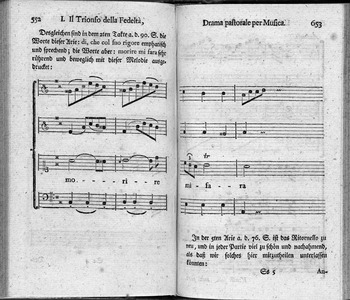
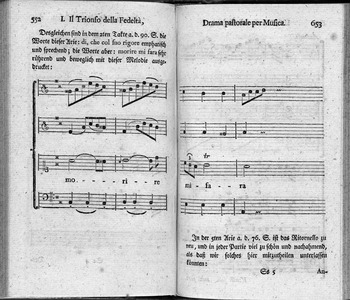
Breitkopf's redesigned ‘movable type’ facilitated the inclusion of music examples in periodical reviews. The first known example features six excerpts from Maria Antonia's Il trionfo, reviewed in 1756 in Das Neueste aus der anmuthigen Gelehrsamkeit (see Figure 1).Footnote 74 In this instance, the critic includes an excerpt from the score in order to highlight the sensitivity of the composer's text setting at a particular point in the aria: the words ‘morire mi farà’ are described as having received a tender melodic treatment (this excerpt is reproduced in the review).
Music example in an anonymous review of Maria Antonia's Il trionfo in Das Neueste aus der anmuthigen Gelehrsamkeit, 6 (1756), 652–3. GP7.N3947 (Bd. 6), Houghton Library, Harvard University. Used by permission.
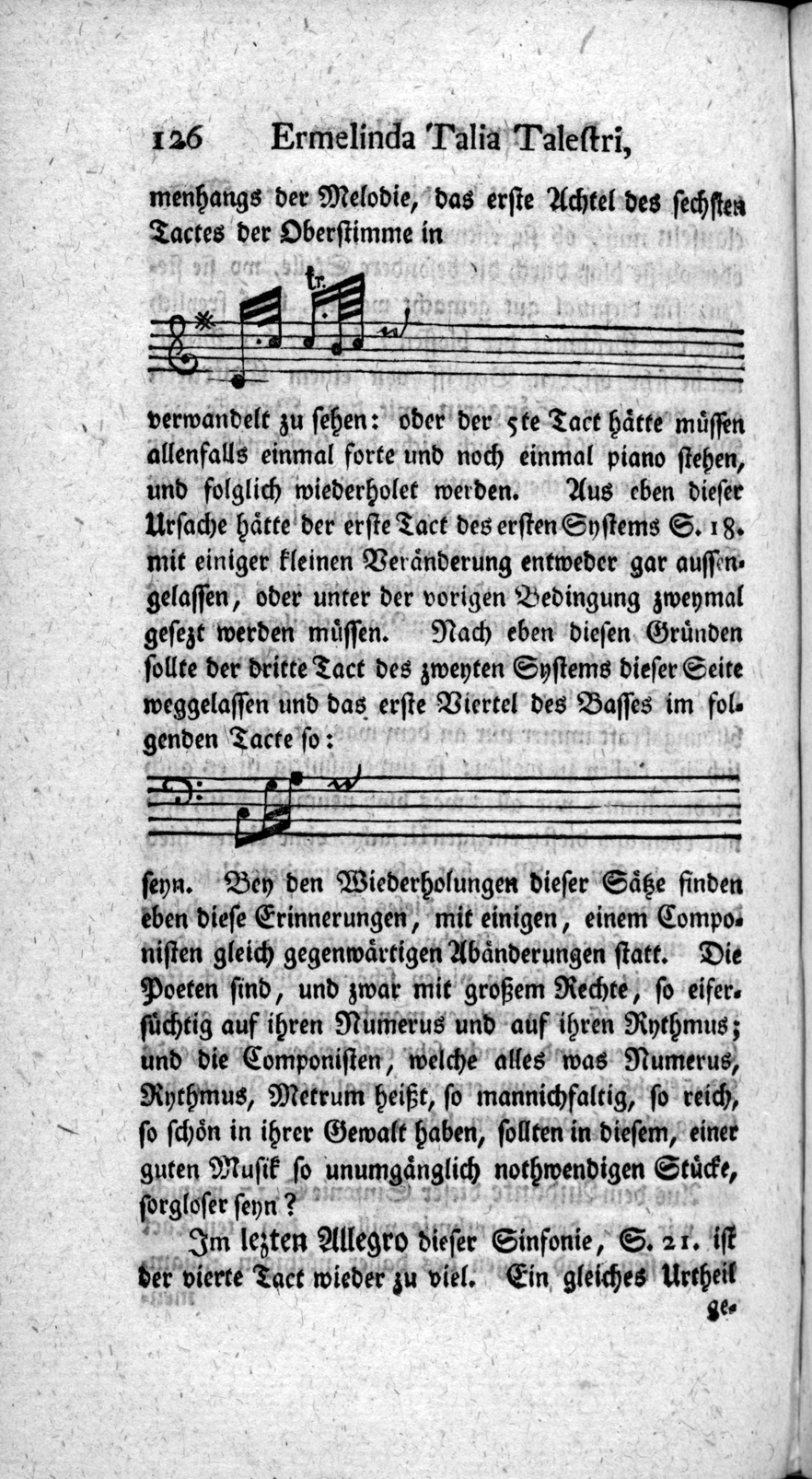
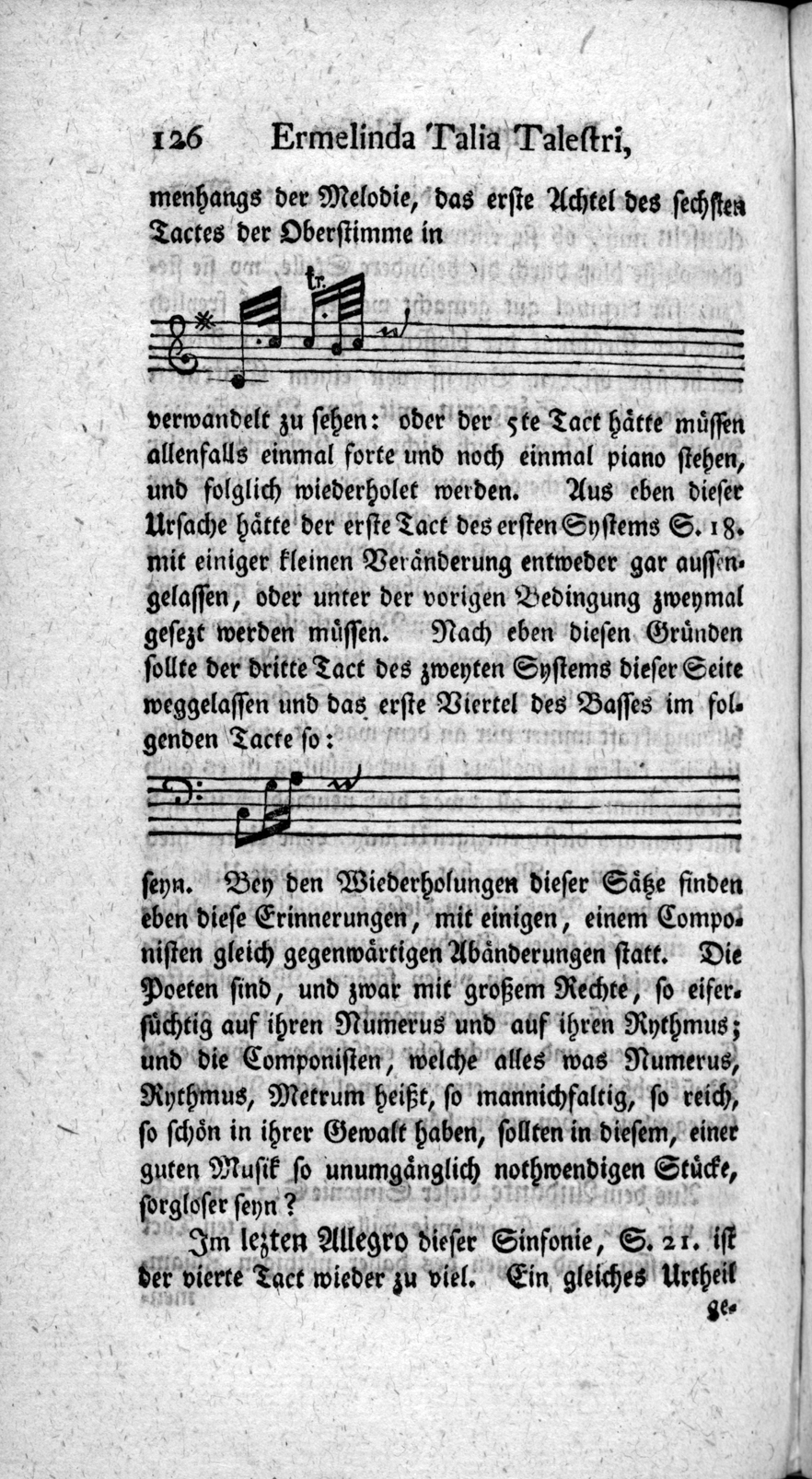
More abstract examples illustrating suggestions for improvement are employed in Agricola's meticulous review of Talestri in the Allgemeine deutsche Bibliothek in 1766 (see Figure 2).Footnote 75 For example, in order to facilitate melodic coherence in the upper voice, the author advocates the adjustment of a specific melodic segment at the beginning of bar 6 in the Andante of the overture (the suggested modification is demonstrated through a musical example in the treble clef). He also offers an alternate suggestion: the introduction of dynamics in the fifth bar (forte followed by piano), which are to be restated in the subsequent bar. Furthermore, Agricola recommends the omission of the first beat in the bass in the third bar of the second system, also on page 17, the replacement for which is illustrated with a musical example in the bass clef. Compositional principles such as melodic unity, variation and repetition of musical ideas feature prominently in his discussion of Talestri. To be sure, increased availability of full operatic scores within the public sphere expanded operatic discourse to include detailed textual and musical criticism.
Agricola's abstract music example in his review of Maria Antonia's Talestri in the Allgemeine deutsche Bibliothek, 3/2 (1766), 126. The Thomas Fisher Rare Book Library, University of Toronto. Used by permission.
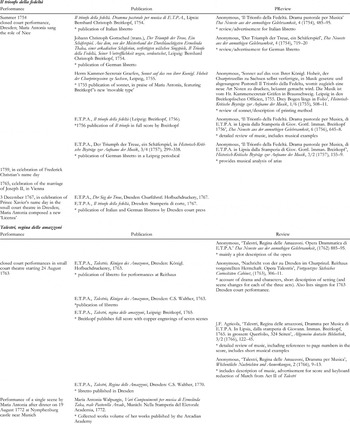
Moreover, reviews of Il trionfo and Talestri are unrelated to performances of the operas (the exception here is a 1763) review in the Sächsisches Curiositäten Cabinet documenting a court production of Talestri). Most reviewers who include detailed musical discussions do so having only read the score and not having seen the performance. Reviews centred on scores might well be tied to the growth of music periodicals in general, as many of these new serial publications needed good content to fill their pages. As demonstrated in Table 2, a direct correlation exists between the publication of an opera libretto or score and the content of opera reviews. The relationship between author (in this case Maria Antonia) and audience is thus dependent upon how various printed witnesses to her operas were distributed to and ‘read’ by different segments of the public; audiences ranged from those only able to read the libretto in a simple vernacular translation to those able to read the text in the original and analyze the musical score. A careful consideration of these reviews in relation to the various printed witnesses of Maria Antonia's two operas provides considerable insight into the ways in which operatic works were read, heard and assessed by eighteenth-century critics.
Performances, Publications and Reviews of Maria Antonia's Operas

Following Breitkopf's publication of the Italian libretto of Il trionfo in 1754, the anonymous author of the review and advertisement in Das Neueste aus der anmuthigen Gelehrsamkeit made the following remark:
This fable is in itself so charming; but to share all of its beauties, all of its expressions – our readers should not demand that. They must learn to understand the original itself, when they want to make correct judgements about it, since in every translation, infinitely much is lost.Footnote 76
Immediately striking is the notion that the reader is able, even expected, to make judgements concerning the beauty of a work. Also, studying a work in its original language is preferable, if not a prerequisite for ‘correct’ aesthetic appraisal. For those who were unable to read Italian, the work was translated into German:
It is well known that all masterworks lose much in translation; and also regarding this German translation of the Triumph of Fidelity, some of the beauty of the original has not been adequately expressed … Readers though, who are unable to read the Italian, owe thanks to the translator, who has made such a masterpiece by an illustrious poetess comprehensible and readable.Footnote 77
Furthermore, not one but several German translations were made available. The versified and highly florid German translation by Gottsched, for instance, is more difficult to read than the prose translation by Maria Antonia herself, which appeared in its entirety in the Historisch-Kritische Beyträge zur Aufnahme der Musik. Of medium difficulty, perhaps, is the 1767 Dresden translation, elegantly versified, entitled Der Sieg der Treue. Evidently, the translations vary according to their target audience, maintaining differing levels of detail that are ‘lost in translation’.
The review of the 1754 Italian libretto of Il trionfo offers readers a brief summary of Maria Antonia's previous literary accomplishments and provides a balance between a recounting of the main events of the plot, direct quotation from the text, and critical commentary on the work. Direct quotations from recitative passages in the libretto are translated into German whereas arias appear in Italian and German. The critic appears to be most concerned with convincing readers (by quoting extensively from the libretto) of the author's tremendous abilities to appropriately fashion the character. The anonymous author of the 1762 review of Talestri is more interested in subtly drawing readers’ attention to the generic distinctions between pastoral drama and tragedy: a checklist consisting of invention, action, characters, passions, and dispositions is provided for readers learning the art of opera criticism.Footnote 78 Once again, extensive space is devoted to describing particular scenes and quoting at length from the libretto, this time with the aim of illustrating to the reader how artfully the various twists of the plot are woven together and what heart-rending situations and circumstances come upon the characters.Footnote 79
Reviews of the printed scores of Maria Antonia's operas do not focus solely on music analysis for its own sake; rather, discussions of the musical score serve as a means by which reviewers who were not present at performances recreate operatic sound and envision its effect on the audience. With regard to the fourth aria in Act 1 of Il trionfo, for example, the reviewer in Das Neueste aus der anmuthigen Gelehrsamkeit (1756) remarks:
The words: Perfido! Amico indegno, and ma tu del traditore etc. are depicted with such emphasis and with such lively instrumental accompaniment, that they certainly must arouse anger and shuddering in the audience.Footnote 80
With regard to the fifth aria in Act 1, the same reviewer notes:
The fifth aria: Vado lieta dì mia sorte, likewise, has a well worked out accompaniment throughout that alternates: then with halting, then with dragging, then with pushing and then with playful phrases. Moreover, halfway through the second part the tempo and metre are changed in an unexpected alteration of the key, which inevitably makes the listener attentive and which should have a very good effect.Footnote 81
Another critic draws attention to the effect of a particular musical sound on the ear:
Incidentally, with regard to the word īdŏlŏ, I must remind [you] that a dactyl causes an unfitting musical expression in most arias; because of a flowing melody, one has no choice but to characterise the syllable “do” overly long, which the ear must nevertheless find offensive to a certain degree.Footnote 82
These reviews – especially the focus on imagining performative aspects of sound – seem to anticipate Kerman's assessment of nineteenth-century reviews, which he notes were ‘not of live performances but of published sheet music, texts dead on the page save for Hoffmann's internalized musical imagination and that of his readers’.Footnote 83
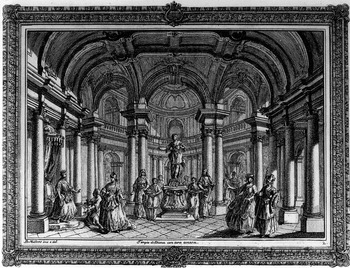
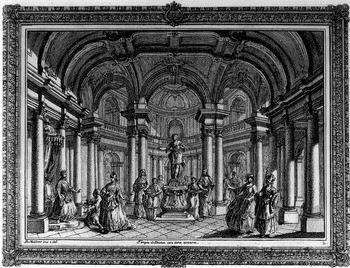
Whereas access to the full of score Il trionfo enabled reviewers to discuss aspects related to text and music, Breitkopf's 1765 printed score of Talestri added yet another dimension: the visual component of opera. The smallest details of the sets were described and stage directions were carefully included alongside the music. One of the crowning achievements of Breitkopf's printing of Talestri is the inclusion of engravings of the staging, precisely located at the points in the score where the change of scenery occurs. Christine Fischer has uncovered court documents linking these engravings to the Dresden performance of the opera.Footnote 84 From these engravings it is possible to see the set, the costumes, the staging of the characters and the name of each set-designer. For instance, Act I scene 4 depicts the scene immediately following Talestri's crowning as Queen of the Amazons (see Figure 3). She can be seen on the far left, receiving Oronte, recently captured and brought before her by Tomiri, the high-priest. In the centre, the Amazon choir, gathered around the statue of Diana, their protectress, sings a coronation anthem to the newly crowned Queen Talestri, while two guards in the right-hand foreground wait for the Queen's response to the prisoner. The name of the engraver, B. Müller, can be seen on the left corner and the inscription in the centre ‘Tempio di Diana con ara accesa’ gives a brief description of the scene; this inscription matches the one in the libretto. A total of eight engravings are included; seven depict the sets with characters in costume and the eighth is a portrait of Maria Antonia. This inclusion is advertised specifically in one of the reviews:
The print of the complete full score, in a manner worthy of the dignity of the work, has been arranged by the Breitkopf printing office. It consists of three parts or acts, of which the first amounts to twenty-nine sheets, without the pleasant title page, the second twenty-three [sheets], and the third twenty-seven sheets in large folio. The additional beautiful copper engravings, invented by Mr. Bibiena and Mr. Müller and engraved by Mr. Zucchi, are a decorous enhancement of the outer magnificence of this splendid work. Aside from the title copper-plate print and the bust portrait of the illustrious author, there are seven more images which represent the change of scenes in the theatre. The examplar with copper engravings costs 10 Reichstaler; without copper engravings, only three ducats.Footnote 85
Coronation scene in Breitkopf's 1765 printed score of Maria Antonia's Talestri, Act 1 scene 4. Dresden Sächsiche Landes- Staats- und Universitätsbibliothek, Mus. 3119-F-500. Used by permission.
Readers purchasing this luxurious print with engravings would thus have the opportunity to see the visual dimension of the staged production while reading through the opera. Certainly, extravagant scores such as these were often purchased (typically by members of the aristocracy) as presentation copies to adorn their shelves.
These sumptuous scores, when made publicly available, began to be used by a different group of people by the mid-eighteenth century and for another function: reviewers quoted heavily from the musical score to display as much music as possible to those unable to purchase these magnificent prints. In 1766, for instance, the Wöchentliche Nachrichten zur Aufname der Musik published reviews of Agricola's Achille in Sciro and Hasse's Romolo ed Ersilia, each containing ample musical examples: the reviews of these operas each contained 21 in-text musical excerpts across several continuations or Fortsetzungen.Footnote 86 The extent to which these two reviews featured extracts of music as part of the discussion surpasses even the 1756 review of Maria Antonia's Il trionfo, which contained six in-text musical examples. Reviews of Agricola's L'amore di Psiche and Hasse's Piramo e Tisbe followed in 1769.Footnote 87 In these subsequent reviews, the in-text music examples are arranged in keyboard-vocal score, often with only a melody and bass line, suitable for amateurs to play at the keyboard. Notably, in the case of Achille in Sciro, the review was prompted by the premiere of the opera in Berlin on 16 July 1765. Since the editors had secured a full score of the work, their explicit wish, articulated in the opening of the review, was to share it with their readers.
In his extensive review of Talestri, Agricola offered a similar perspective on the role of the reviewer:
We should just simply narrate to our readers, what we read in the full score, and what we envisage in the complete performance, in order that we might make them feel immediately all the musical beauties of this work.Footnote 88
Once again, the emphasis is for the reader to experience the musical beauties of the opera. Though here, Agricola reveals his bias as a critic: despite the presence of sumptuous engravings and precise stage directions in Breitkopf's elaborate print, he chooses instead to focus on aspects related to the music. His review is centred around the composer's musical development of the characters. The anonymous 1766 review of Talestri in the Wöchentliche Nachrichten also includes a brief description of the engravings as part of the advertisement, but the review is dedicated almost entirely to Maria Antonia's compositional style. This preference for music-centred discourse in opera reviews seems to be employed to bring readers closer to the mysterious workings of the ‘great composer’.
Despite Agricola's technical complaints concerning Talestri, his analysis led him to ascribe great artistic worth to Maria Antonia's opera, a notion which, significantly, was arrived at from studying the score:
The more we peruse this opera, the more we admire the great spirit of a Princess, who unites so many varieties of knowledge, and, especially regarding music, must be placed in a class with the greatest Masters.Footnote 89
An anonymous reviewer in Das Neueste aus der anmuthigen Gelehrsamkeit also contended that the sole means of perceiving the intricacies of an opera was through meticulous examination of the work itself:
Our Reader will also credit us with having encountered infinite beauties in these pieces, such that one can only truly perceive by means of a thorough reading-through of the entire opera.Footnote 90
The idea of perceiving the beauty of a musical work and becoming acquainted with the spirit of a great composer by means of studying the score signals the progressive musicalisation of the genre, and a newly formed public fascination with the composer (as opposed to the librettist, stage director, costume designer, and eventually even performers) of an opera.Footnote 91
More crucially, the conceptual space of the public sphere facilitated a work construct that floats freely from individual patronage or localised performances. The inclusion of in-text musical examples – itself an act that separates score excerpts from a performance context – represented a step toward the idea of a work-concept as independent of performances. This is not to imply that the idea of the work-concept originated during the Enlightenment. On the contrary, as Reinhard Strohm has argued, the presence of a work-concept formed a part of western European musical thought at least since the fifteenth century.Footnote 92 Nevertheless, the Enlightenment public sphere produced an expansive common intellectual space, amplifying the autonomy of the work-concept as separate from performance events, and providing an arena of unprecedented scope within which assessments of musical fame and value became an increasingly public affair.Footnote 93 As I will demonstrate in the final section, reviews focussing sharply on musical discourse ultimately served as a catalyst for collective evaluations of operatic fame, especially of the publicly celebrated composer.
Ascending Parnassus: images of Maria Antonia as celebrated composer
The public is a sovereign, on which all those depend who work for honour or profit.Footnote 94
The name of the illustrious author is not the only praiseworthy feature of this poetic work; the equally attractive composition, which the hearts of all listeners have granted acclaim; the splendid invention, layout, intrigue, realisation; the delicate situations, the sensitive language of the heart that reigns within it, and the simple and harmonious versification are already recommendations enough, and do not require the splendour of a Princess in order to be praised.Footnote 95
Whereas the mark of fame and honour in Old Regime Europe required that one be born into royalty, the making of a celebrated person within the public sphere would require public acclaim and merit alone. Maria Antonia, however, embodies measures of fame inherent to both representational court culture and the Enlightenment public sphere. Even though the anonymous reviewer emphasises the calibre of the Electress’ works as rationale for the extensive praise, the opening reference to her name, and by extension her exalted social status, exposes some of the complexities associated with the construction of her public image as a celebrated composer. The extraordinary praise heaped upon Maria Antonia for her musical and literary composition must be viewed, at least in part, as a result of her elevated social standing. For instance, Christine Fischer speculates that Gottsched would not have dared criticise Il trionfo in his 1754 review because he would be working for the Electress at court as soon as she came into power.Footnote 96
Yet it remains curious that despite Maria Antonia's indisputable renown as Electress of Saxony, reviewers sought, above all, to secure her stature as a celebrated composer.Footnote 97 By 1761 Maria Antonia was awarded first place in Finauer's Allgemeines historisches Verzeichniß gelehrter Frauenzimmer.Footnote 98 Her artistic capabilities led to her selection as the tenth muse during fair time in Dresden in 1763; the full text and music in celebration of this occasion were subsequently printed and disseminated.Footnote 99 Her reputation as famous composer was further secured in the publication of her collected works by the Arcadian Academy in 1772.Footnote 100 Even though Maria Antonia had a close hand in shaping her political image within the context of her operas, at the same time the dissemination of her operas and in-depth discussions of her works in reviews empowered critics to substantially shape her image as a composer within the public sphere. The consecration of Maria Antonia as a celebrated composer may reveal much about the complex processes by which fame was bestowed within the Enlightenment public sphere.
As is the case with most public celebrities, Maria Antonia was deemed to have a unique ‘claim to fame’: she had mastered both poetry and musical composition, and as a result displayed an unusual proficiency in composing opera. Critics viewed this double competency as the quality that set her apart from other poets and composers:
Thus we would like to mention at least that the duet is charming and pleasing, that the final chorus is set with full and magnificent harmonisation and that the work definitely provides one unmistakable proof: what a marked difference it makes, when the poet him- or herself can present and procure their own melody and musical emphasis to the words; or when he or she on the contrary must relinquish it to the approval and often inadequate insight of another composer.Footnote 101
But could one truly expect anything different, since the elevated author of the song was one and the same as the creator of the poetry? An advantage that she certainly has over all of the famous masters of composition.Footnote 102
The annals have preserved for us the names of various illustrious persons who have been skilled in the one or the other art. But only in this century and only Germany can show a heroine who is simultaneously exemplary in both Art-forms.Footnote 103
The anonymous critic in Das Neueste aus der anmuthigen Gelehrsamkeit, one of the periodicals with in-text musical examples, sought evidence for Maria Antonia's superior compositional prowess in the score itself, pointing to specific examples of her text-setting. Others substantiated their claims that Maria Antonia stood above other (presumably contemporary) musical masters by pointing to her double competency in poetry and musical composition. The anonymous reviewer for the 1757 Historisch-Kritische Beyträge zur Aufnahme der Musik, the third of the quotations above, draws a historic comparison demonstrating the rarity of her combined talents, which seems indicative of some desire to secure a place for the Electress in the annals of history.
Comparisons with ancient and contemporary masters followed, which were designed to further amplify Maria Antonia's artistic distinction. In her choice of poetic themes, she was said to have followed in the footsteps of Virgil and Torquato Tasso, and her Highness was further noted to have ascended Parnassus, competing with some of the great names of her own century: those of Metastasio and Apostolo Zeno.
The art critics have remarked that Virgil, the greatest poet of ancient Rome, has risen from the humble pastoral poetry to that of agriculture, and from this to the poetry of heroes in the Æneid. Precisely the same manner as Tasso too, following his pastoral drama Aminta, elevated himself to the Liberation of Jerusalem. Our illustrious Ermelinda has taken this same turn: by elevating herself from the charming pastoral meadows of her triumphant Fidelity to a tragic stage in a crowned Talestris.Footnote 104
The name of the illustrious author (and who does not know a certain Ermelinda amongst the Arcadians? since she, so often accompanied by Poetry and Harmony, stepped onto Parnassus, has competed for the award with Metastasio and Apostolo Zeno).Footnote 105
The anonymous reviewer of the Bibliothek der schönen Wissenschaften deliberately blends comparisons of contemporary masters such as Metastasio and Zeno with the muses; history and myth are seemingly conflated, blending contemporary momentousness with an appeal to transcendence. The recurring theme of Maria Antonia's ascent to Parnassus and association with the Muses and Apollo reaches beyond a publicly ascribed sense of greatness. The deeper association with the gods and muses of ancient mythology is their timelessness: Maria Antonia is being immortalised with them.
The sonnet composed to display Breitkopf's revolutionised ‘movable type’ and its accompanying review, highlighting Maria Antonia's completion of Il trionfo, spoke to this effort of assuring lasting fame:
The trusted relationship of the serene Ermelinda with the muses could however not remain indifferent to the sons of Apollo. The honour of the entire double mountain was interested in immortalising such an occurrence. A favourite of Orpheus united himself with them. The Forest nymphs listened in, the Naiads raised their watery heads. Everywhere, the praise of the Arcadian [Ermelinda] resounded. Apollo and Orpheus immortalised themselves with her.Footnote 107
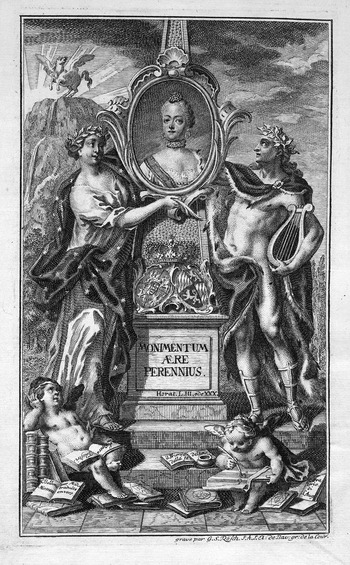
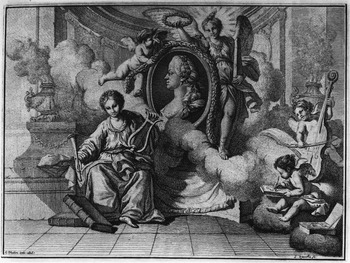
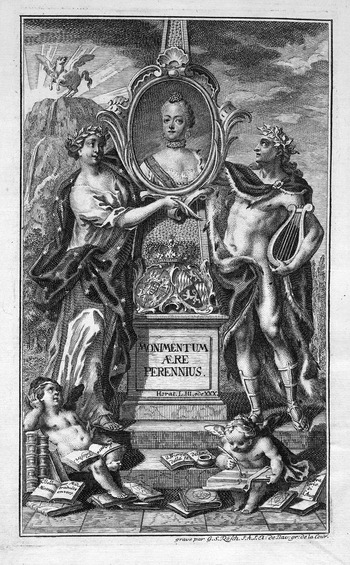
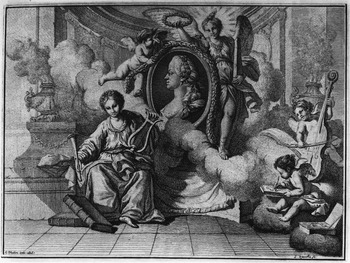
The act of immortalising and monumentalising a great composer within the public sphere during his or her lifetime was still relatively rare during the eighteenth century; Handel's monuments and portraits in public spaces as an expression of national identity are the most prominent example.Footnote 108 An attempt to capture Maria Antonia's public image as a great composer, in order for it to be preserved in history is perhaps most visible in the frontispiece of Finauer's Allgemeines historisches Verzeichniß gelehrter Frauenzimmer (see Figure 4). The portrait of Maria Antonia is presented as part of a monument; she is accompanied by Poetry on the left and Harmony on the right. The setting is Mount Helicon in Arcadia, the dwelling place of Apollo and the muses. Cherubs are transcribing her Il trionfo and Talestri scores and librettos. Indicative of her immortalisation is the Latin inscription on the monument: MONIMENTUM AERE PERENNIUS in Capitalis script, a script used during early Roman times for monumental works,Footnote 109 featuring a quotation from Horace's Ode 3.30: A MONUMENT MORE LASTING THAN BRONZE. Although her portrait in Breitkopf's score of Talestri does not feature a similar inscription, she is crowned by Harmony with a laurel wreath – a symbol of Apollo and of one who has achieved excellence in a chosen field – and Poetry accompanies her on the left (see Figure 5).
Frontispiece of Peter P. Finauer's Allgemeines historisches Verzeichniß gelehrter Frauenzimmer (1761). British Library Board: Shelfmark 10230.cc.13. Used by permission.
Portrait of Maria Antonia in the full score of Talestri. Dresden Sächsische Landes- Staats- und Universitätsbiblitothek, Mus. 3119-F-500. Used by permission.
These persistent appeals to timelessness were certainly not limited to Maria Antonia. Indeed, comparisons with contemporaries such as Hasse, Agricola and Gluck indicate that her public image can be situated in a broader movement characterised by a sacralisation of the composer. Constructions of operatic fame and renown within the public sphere were inextricably linked with opera criticism sharply focussed on the music itself. For instance, the critic reviewing the full score of Hasse's Romolo ed Ersilia in the Wöchentliche Nachrichten und Anmerkungen die Musik betreffend in 1766 provides an opening remark in praise of the composer: ‘Our great Hasse, for whom the number of completed operas exceeds thirty, has demonstrated also in this present opera that everywhere [in the score] the hand of a master is present and must be admired.’Footnote 110 The inclusion of in-text music examples serves in part to demonstrate various compositional techniques in support of the reviewer's opening assertion. By contrast, J.F. Agricola's 1771 review of a full score of Gluck's Alceste in the Allgemeine deutsche Bibliothek is centred around the composer's famous 1767 preface to the opera, and the effectiveness and execution of these newly articulated ideals (which are quoted in the review) are closely evaluated.Footnote 111 Agricola makes use of in-text musical examples to illustrate the accompaniment of Alceste's aria ‘Chi mi parla!’ and Gluck's text-setting for the Act 1 scene 2 recitative ‘Popoli di Tessaglia’ specifically to demonstrate compositional shortcomings and Agricola's suggested correction for the recitative. Although this was not Agricola's first negative review of an operatic passage (he also provided a moderately critical review of passages in Maria Antonia's Talestri) the famous bookseller Frederick Nicolai's remark concerning studying Gluck's 1767 Alceste in full score provides another perspective on the matter: ‘In this respect it will not help much that Gluck's full scores have appeared for posterity. That which will be respected as the most excellent musical features, cannot, as the composer says himself, be expressed with notes …’.Footnote 112 The shortcomings of gaining access to opera solely by studying the musical score were thus articulated at the outset of the public's having access to operatic scores; and many printed editions of Gluck's operas (and those of other composers as well) contain information about stage action, presumably to assist in overcoming the limitations of the musical score with respect to the genre of opera.Footnote 113 Nevertheless, Gluck's public image as a renowned composer appears not to have suffered much from Agricola's negative criticism; on the contrary, discussion and debate surrounding his operas continued fervently in print culture, in some cases with manifold in-text music examples, and, as was the case with Maria Antonia, comparisons with contemporary masters and mythological figures abound.Footnote 114 In many ways, these examples illustrate precisely the relationship between in-text music examples in music periodicals combined with the silent reading of musical scores and the emergence of canonic composers to which Kerman refers.Footnote 115
Yet these ascriptions of value embody yet another claim to authority. As William Weber aptly observes, ‘attribution of authority to music often carries with it a claim to authority by the persons doing it. In such a fashion did an empowered musical intelligentsia emerge in close relationship with the musical classics’.Footnote 116 As such, the impressive range of strategies by which reviewers sought to attribute extraordinary praise to the Electress are as indicative of the public's newly-found claim to sovereignty as arbiters of taste as they are suggestive of Maria Antonia's sovereignty as Electress, and perhaps to a lesser extent, indicative of the quality of her work. In other words, what these reviews underscore is the presence of a public that, having gained at least some access to Maria Antonia's works, are asserting their own authority as judges of opera, declaring her works masterpieces and promoting her as a celebrated composer in conjunction with her implicit renown as Electress of Saxony. One might presume that reviewers were keen to appropriate for Maria Antonia measures of fame particular to the public sphere, in which the rise of the composer, among other sites of authority, gradually supplanted measures of renown associated with representational court culture. This is a gesture which Maria Antonia might well have fuelled, given the inclusion of her image as celebrated composer in Breitkopf's printed score of Talestri.
Despite all of the attempts to ensure the survival and memory of her works and status as a celebrated composer, conversation concerning opera changed, and Maria Antonia, like many other eighteenth-century composers once granted fame and immortality, receded into relative obscurity. Her eclipse, following the extraordinary praise attributed to her by reviewers, should not necessarily be viewed as a reflection of the quality of her work; it is more likely due to the fact that the mid-century operatic style in which she, Hasse and Graun composed became outmoded toward the end of the eighteenth century. The ‘residue’, to borrow William Weber's term, that survives of Maria Antonia's contribution might not lie in her works but is embedded in the cultural processes that enabled a specific strand of music criticism, which, as Kerman argues, served as a prerequisite for collective ascriptions of greatness.Footnote 117 Ultimately, the Electress’ contribution in the history of music criticism suggests that court culture and opera, despite their precarious roles in narratives of canon formation, can substantially nuance our understanding of the processes by which musical fame and renown were negotiated during the Enlightenment.