1. Introduction
The family is the oldest and most fundamental institution. Prior studies establish that variations in the strength of family ties have far-reaching consequences for economic and social life. The strength of family ties is associated with more home production, lower female labor force participation, lower youth employment, lower-geographic mobility, and a gendered division of labor between market versus home activities (Alesina and Giuliano, Reference Alesina and Giuliano2010). Summarizing this body of work, Alesina and Giuliano (Reference Alesina, Giuliano, P and SN2014) find that strong family ties are linked to traditional values regarding the role of women, reluctance to change, and lower levels of innovation, trust, and gross domestic product (GDP).
Given the well-documented links between family ties and social outcomes, we ask: What determines the strength of family ties? Although family ties are commonly defined as ‘cultural patterns of family loyalties, allegiances and authorities’ (Alesina and Giuliano, Reference Alesina, Giuliano, P and SN2014), the potential cultural roots of family ties have not been formally investigated.
As emphasized by Gorodnichenko and Roland (Reference Gorodnichenko and Roland2012), individualism–collectivism reflect the importance of social relationships in an individual's fundamental understanding of the self. In individualist societies, the self is understood to be an independent entity, whereas in collectivist societies the self is interdependent, embedded in a web of social relationships. Understanding the self as interdependent will tend to increase the subjective importance of various collectives, including the family. As a result, we hypothesize that individualism reduces the strength of family ties.Footnote 1
We test this hypothesis at the national and individual levels using measures of family ties and individualism derived from the World Value Survey (WVS) (Inglehart et al., Reference Inglehart, Haerpfer, Moreno, Welzel, Kizilova, Diez-Medrano, Lagos, Norris, Ponarin and Puranen2018). We view the individual and national level analyses as complementary. Our within-country analysis allows us more convincingly to isolate the impact of individualism from potentially confounding effects, whereas the country-level analysis may capture channels of cultural influence that play out in part at the national level. In both cases, we find a strong, negative relationship between individualism and family ties.
To address the endogeneity of culture, we consider instruments for individualism motivated by historical roles of climate and disease in cultural selection and evolution, rainfall variation (Davis, Reference Davis2016) and the historical prevalence of infectious disease (Fincher et al., Reference Fincher, Thornhill, Murray and Schaller2008). Our instrumental variable analysis finds a robust, negative relationship between individualism and the strength of family ties at both the individual- and country-levels. We address potential concerns over instrumental validity by controlling for measures of social trust, religious attendance and affiliation, historical plough use, gendered grammar, and global languages.
This paper is the first to investigate cultural determinants of the strength of family ties. Overall, our work helps to explain the persistence of family ties by grounding it in highly persistent cultural values and identifies an important channel through which individualist–collectivist values may influence contemporary social outcomes. In addition, it raises significant questions about how the empirical associations between family ties and other social outcomes should be interpreted. In particular, it is possible that these relationships reflect the common influence of cultural values related to individualism–collectivism.
This paper also contributes to a substantial body of work documenting the social role of individualism–collectivism, which is widely viewed as the most important dimension of cultural variation (Heine, Reference Heine2010; Triandis, Reference Triandis1995). For example, individualism is causally related to economic and institutional development (Cline and Williamson, Reference Cline and Williamson2017; Davis, Reference Davis2016; Davis and Abdurazokzoda, Reference Davis and Abdurazokzoda2016; Gorodnichenko and Roland, Reference Gorodnichenko and Roland2011; Licht et al., Reference Licht, Goldschmidt and Schwartz2007; Pitlik and Rode, Reference Pitlik and Rode2017), innovation (Gorodnichenko and Roland, Reference Gorodnichenko and Roland2017), regulation (Davis and Williamson, Reference Davis and Williamson2016; Reference Davis and Williamson2018), the taste for social status (Davis and Wu, Reference Davis and Wu2019), and gender equality (Davis and Williamson, Reference Davis and Williamson2019).
2. Culture and the family
The task of arguing, as we do here, that culture has a causal impact on family ties is complicated by theories that highlight the coevolution of cultural values and the family. Here, we selectively review the literature on culture and the family in light of this interdependence. We then consider the direction of causation between culture and the family in light of the empirical associations between the family and other collective institutions.
Much of the scholarship on the effects of family ties is agnostic as to the primacy of culture or family. For example, none of the prominent papers on family ties by Alesina and Guiliano claim to identify a causal relationship between family ties and social outcomes. Most of this literature also fails to consider the potential causal role of culture in their findings. An important exception is Duranton et al. (Reference Duranton, Rodríguez-Pose and Sandall2009: 38), who acknowledge the possibility that ‘family structures are merely an outcome of a deeper, underlying determinant (such as religion or culture), which may represent the true cause of the variations we observe.’ In lieu of causality, some studies appeals to the apparent stability of family structures since the Middle Ages (Todd, Reference Todd1990); however, recent evidence suggests the origins of contemporary cultural values lie even further back (Roland, Reference Roland2017).
A few papers explicitly address interdependence between cultural values and the family. Greif and Tabellini (Reference Greif and Tabellini2017) develop a model of coevolution of institutions and cultural values to analyze the emergence of alternative institutions of social cooperation in China and Europe, the clan and corporation, respectively. In spite of this co-dependence, priority is given to the role of culture, which ‘influences what is socially acceptable and institutionally feasible’ (p. 4). Moreover, Greif and Tabellini (Reference Greif and Tabellini2017: 4) hold that ‘[h]istorically, the cultural distinctions prevailed long before the emergence of clans and corporations in China and Europe,’ a position they attribute to Weber (Reference Weber1968). In identifying a primary causal role for culture, they echo a central theme from work on the hierarchy of institutions, which holds that values are fundamental and that institutions, such as the family, conform to this deeper level of social reality, e.g. Williamson (Reference Williamson2000), Roland (Reference Roland2004), and Licht et al. (Reference Licht, Goldschmidt and Schwartz2007).
Enke (Reference Enke2019: 956) models the coevolution of family and systems of moral values that are closely associated with individualism and collectivism. He proceeds from the assumption that ‘societies exhibit initial heterogeneity in the strength of extended family relationships,’ so that cultural values reflect family structures, rather than vice versa. A potential criticism of this paper is that Enke does not discuss the possibility that cultural values, rather than family ties, influence social outcomes. Indeed, in his empirical analysis, Enke (Reference Enke2019) instruments for the strength of family ties with a measure of malarial ecology, an approach that is itself motivated by work on the pathogen stress theory of values developed by Fincher et al. (Reference Fincher, Thornhill, Murray and Schaller2008). However, Fincher et al. (Reference Fincher, Thornhill, Murray and Schaller2008) and others interpret their theory as predicting variations in individualism–collectivism rather than variations in the strength of family ties (Cashdan and Steele, Reference Cashdan and Steele2013; Murray et al., Reference Murray, Trudeau and Schaller2011, Reference Murray, Schaller and Suedfeld2013; Nikolaev and Salahodjaev, Reference Nikolaev and Salahodjaev2017; Van Leeuwen et al., Reference Van Leeuwen, Park, Koenig and Graham2012), raising questions regarding both the validity of Enke's instrument and the interpretation of his empirical findings.
Additional insight comes from social psychological literature, which finds that collectivism is strongly associated with external validation, adaptability, an emphasis on fitting in, greater attention to in-group values, and low relational mobility (Gorodnichenko and Roland, Reference Gorodnichenko and Roland2012). These cognitive dispositions arguably act to increase the influence of a wide range of collective social institutions, including but not limited to the institution of the family. From this perspective, individualism and collectivism are fundamental to an individual's psychological makeup and, thus, have social consequences that extend well beyond their impact on the strength of family ties. Any correlation between cultural values and family ties is thus likely to be causal.Footnote 2
An important source of evidence on the primacy of either culture or family ties comes from the empirical associations among different collective institutions. If variations in the strength of family ties play a key causal role in social evolution, then substitution across collectives ought to cause the strength of the family to vary inversely with the strength of other collective social institutions. That is, the state and church will tend to be weak where the family is strong, and vice versa. Substitution across collectives is evident, for example, in Greif (Reference Greif2006), who argues that changes in the religious regulation of marriage weakened the extended family networks, thereby increasing the relative advantage of voluntary, non-kinship-based institutions, such as city-states, guilds, monasteries, and the Church itself. Substitution across collectives is also central to concerns that the welfare state may undermine the strength of the family (Anderberg, Reference Anderberg2007).
Although substitution across collectives appears possible, in general the strength of family ties varies directly with that of other collectives, an outcome that is consistent with the idea that cultural values underlie these variations. This is true, for example, of variations in collective organization associated with rainfall variation, which is positively associated with collectivism (Davis, Reference Davis2016), with church membership (Ager and Ciccone, Reference Ager and Ciccone2018), and, as shown below, with family ties. Strong family ties are also associated with more authoritarian, less constrained states. For example, strong family ties are associated with lower levels of voter participation (Alesina and Giuliano, Reference Alesina and Giuliano2011) and lower institutional quality (Alesina and Giuliano, Reference Alesina, Giuliano, P and SN2014). The historical prevalence of infectious disease is positively associated with stronger family ties (Enke, Reference Enke2019), authoritarian government (Thornhill et al, Reference Thornhill, Fincher and Aran2009), and collectivist social values (Fincher et al., Reference Fincher, Thornhill, Murray and Schaller2008).
The theoretical literature on culture and the family acknowledges the interdependence between these variables, and the empirical association between them is open to multiple interpretations, including that offered by Enke. However, historical analyses, psychological evidence, and pre-existing work on the pathogen theory of values clearly favor the priority of culture, assigning it a primary causal role in this association. Evidence of a positive relationship between the family and other collectives is also consistent with the presence of a common underlying causal force, such as cultural values.
3. Data
Our primary measures of individualism and the strength of family ties are constructed using data from the WVS. The use of measures derived from this source allows a direct comparison of our results from the country- and individual-level analyses. We use data from all available six waves, 1981–2014, of the WVS, thereby providing the most comprehensive analysis of the impact of individualism on family values.
Following Alesina and Giuliano (Reference Alesina and Giuliano2010), we measure family ties using three questions from WVS, which capture beliefs on the importance of the family in an individual's life, the duties and responsibilities of parents and children, and the love and respect for one's own parents. A potential criticism of this approach is that it fails to capture important variation in the concept of family across societies, particularly regarding the role of extended family. In spite of this drawback, the index we construct has the considerable advantage of allowing direct comparisons to other work in this area.
The individual-level responses are combined by extracting the first principal component to create an individual-level family ties index. A higher number represents stronger family ties. To generate a country-level measure of the strength of family ties, we average the individual-level index across all respondents for a given country. A higher number indicates stronger family ties, and the index is standardized.
Our main independent variable is individualism, which is typically captured at the country-level (Hofstede, Reference Hofstede2001; Schwartz, Reference Schwartz, U, HC, Ç, S.-C and G1994). In order to create an individual-level measure, we utilize questions from WVS that capture characteristics of individualism as described by Hofstede (Reference Hofstede2001): individual responsibility, autonomy, the right to a private life, less conformity behavior, and market capitalism and competition.
Our construction of individualism largely follows Beugelsdijk et al. (Reference Beugelsdijk, Maseland and Van Hoorn2015), hereafter BMH, and includes three of the four questions they use: private versus government ownership of business and whether homosexuality or abortion is justified. The fourth question in BMH pertains to the priority of making parents proud, which may reflect the strength of family ties, making its use problematic here. We instead include a measure of the preference for individual versus government responsibility (Davis, Reference Davis2016), which does not have a direct conceptual link to family ties. The use of questions that are conceptually linked to individualism but not directly linked to family ties strengthens our analysis. We create an individual-level individualism–collectivism index by extracting the first principal component from these four WVS questions, which we standardize. A higher score reflects a greater level of individualism.Footnote 3
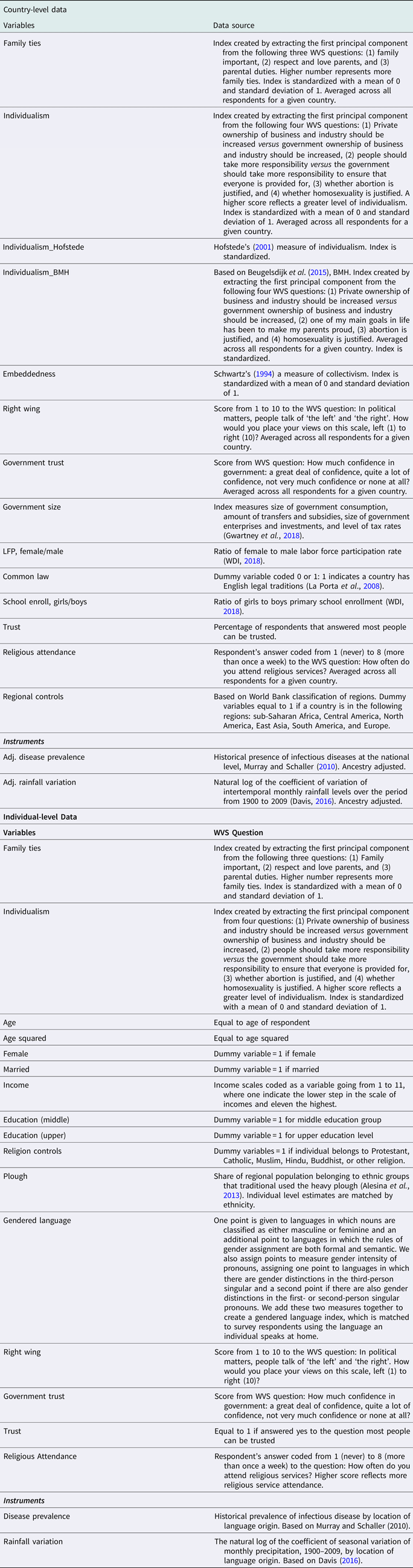
Appendix A lists each variable, data description, and corresponding WVS question for all individual-level and country-level data. Appendix C reports the individual-level summary statistics. The maximum number of observations is 110,274 from 68 countries. Appendix C also lists summary statistics for variables from the country-level data, which includes a number of controls that are not derived from the WVS but describe in Appendix A.
4. Country-level analysis
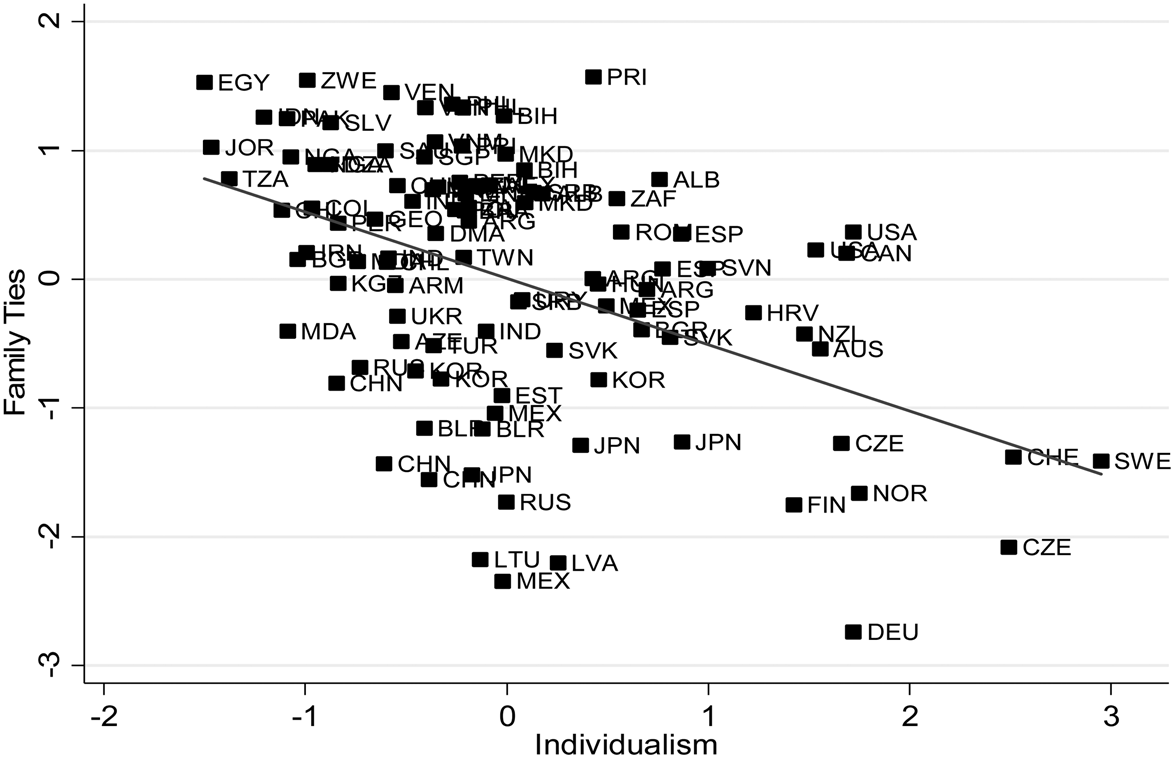
Figure 1 illustrates the correlation at the country level between family ties and individualism. As shown, individualism negatively relates to family ties with a significant correlation of −0.46. Individualistic countries, such as Sweden, Switzerland, and Germany also have weaker family ties. Collectivist countries with stronger family ties include Egypt, Zimbabwe, and Jordan.
Individualism and family ties, country-level correlation. Notes: Both indices are standardized.

4.1 Individualism measures and sensitivity checks
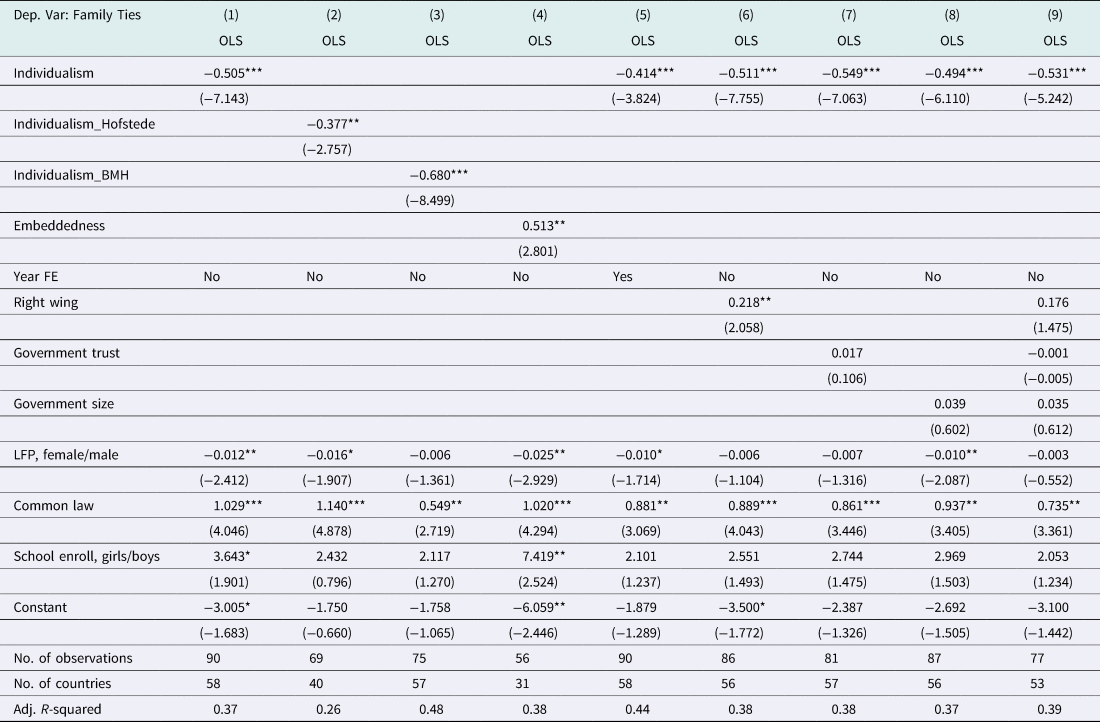
Table 1 provides evidence of the robustness to the relationship in Figure 1 by considering a series of regressions that includes alternative measures of individualism and control variables common in the family ties literature (Alesina and Giuliano, Reference Alesina and Giuliano2010; Reference Alesina, Giuliano, P and SN2014). In each specification, we include a dummy variable for common law (La Porta et al., Reference La Porta, Lopez-de-Silanes and Shleifer2008), and measures of female/male labor force participation rate and primary girls/boys school enrollment rate, collected from World Development Indicators (2018). Standard errors are double clustered by country and year.
Country-level analysis, individualism, and family ties

Notes: All indices are standardized. Standard errors are double clustered by country and year. T-statistics in parentheses. ***p < 0.001, **p < 0.05, *p < 0.10.
Column 1 reports the result using our constructed measure of individualism and finds a negative and significant correlation (at 1% level). A one standard deviation increase in individualism reduces family ties by 50% of a standard deviation. The adjusted R-squared suggests we are explaining 37% of the variation in family ties.
The next three columns use alternative measures of national individualism, including Hofstede's (Reference Hofstede2001) individualism–collectivism, BMH's (Reference Beugelsdijk, Maseland and Van Hoorn2015) individualism index, and Schwartz's (Reference Schwartz, U, HC, Ç, S.-C and G1994) embeddedness. We standardize each index for ease of comparison across specifications. As shown, all three alternative measures of individualism are negatively associated with the strength of family ties and significant at the 5% level or better. Column 5 includes period fixed effects.
Next, we address potential concerns about the manner in which we measure individualism. Two questions in our index reflect a preference for greater government involvement in economic life, and answers to these might reflect an individual's political ideology, trust in government, or current levels of public ownership in their country. Thus, we reconsider our baseline result controlling for measures of political ideology, trust in government, and government size (Gwartney et al., Reference Gwartney, Lawson, Hall and Murphy2018), first consecutively and then concurrently. As seen in columns 6 through 9, the coefficient on individualism is significant at the 1% level and highly stable in magnitude across these regressions.Footnote 4
This result holds if we include a measure for democracy (polity2 from Polity IV), landlocked, regional controls, or log GDP per capita (WDI, 2018). The coefficient on individualism remains negative and significant at the 5% level or better in each regression, and its magnitude is highly consistent across specifications. The results also hold if we restrict the sample to Old and New World countries, respectively, to address concerns over international migration patterns. We do not tabulate these findings to save space.
Combined, the results in Table 1 indicate that there is a significant negative association between individualism and family ties across countries. This relationship is robust across alternative measures of individualism, to controls for political ideology, trust in government and government size. This gives us confidence to move forward using our constructed measure of individualism, which has the advantage of being available at both national and individual levels.
4.2 Instrumental variable estimation
The ordinary least squares (OLS) estimates may be biased due to omitted variables, reverse causality, and measurement error. For example, economic development may give rise to more modern perspectives regarding the family, undermining collectivist social norms. In addition, our measure of individualism combines information on beliefs about abortion and homosexuality that are likely linked to social processes influencing attitudes toward the family. A second concern, which applies to any survey-based data, regards the potential impact of measurement error on coefficient estimates. Consequently, the OLS results should not be interpreted as measures of the causal effect of individualism on family ties.
We address these concerns through an instrumental variable estimation strategy, with instruments drawn from the existing work linking contemporary levels of individualism to historical climatic and epidemiological environments in which a culture developed. In particular, we instrument for individualism using measures of ancestral rainfall variation and the ancestral prevalence of infectious disease.
Davis (Reference Davis2016) demonstrates that historic rainfall variation is negatively associated with contemporary individualist values. Preindustrial societies subject to high levels of rainfall variation may develop collectivist values to facilitate informal arrangements for sharing agricultural risk. Collectivist attitudes increase the disutility of reneging on a risk sharing arrangement, and thus allow individuals to credibly commit to greater transfers in the face of an adverse income shock.
Historical prevalence of infectious disease is theoretical and empirically linked to the individualism–collectivism culture dimension (Cashdan and Steele, Reference Cashdan and Steele2013; Fincher et al., Reference Fincher, Thornhill, Murray and Schaller2008; Murray et al., Reference Murray, Trudeau and Schaller2011, Reference Murray, Schaller and Suedfeld2013; Nikolaev and Salahodjaev, Reference Nikolaev and Salahodjaev2017; Van Leeuwen et al., Reference Van Leeuwen, Park, Koenig and Graham2012). Thornhill and Fincher (Reference Thornhill and Fincher2014) argue that areas with more infectious disease prevalence adopt values and norms that discount individual rights of those outside their own network as a way to further prevent the spread of disease. Thus, societies with high prevalence of infectious diseases are more associated with collectivist values. Alternatively, regions experiencing low disease threat developed a value system associated with trust and tolerance of those outside their own network (Fincher et al., Reference Fincher, Thornhill, Murray and Schaller2008).
We construct measures of ancestral rainfall variation and disease prevalence by adjusting national measures of these variables for international migration during the modern period (Putterman and Weil, Reference Putterman and Weil2010). The resulting variables equal the expected levels of rainfall variation and disease prevalence in the country of ancestral origin of a randomly selected member of a country's current population. This approach reflects the deep historical roots of contemporary cultural values and is intended to control for the influence of international migration patterns on national cultural values.
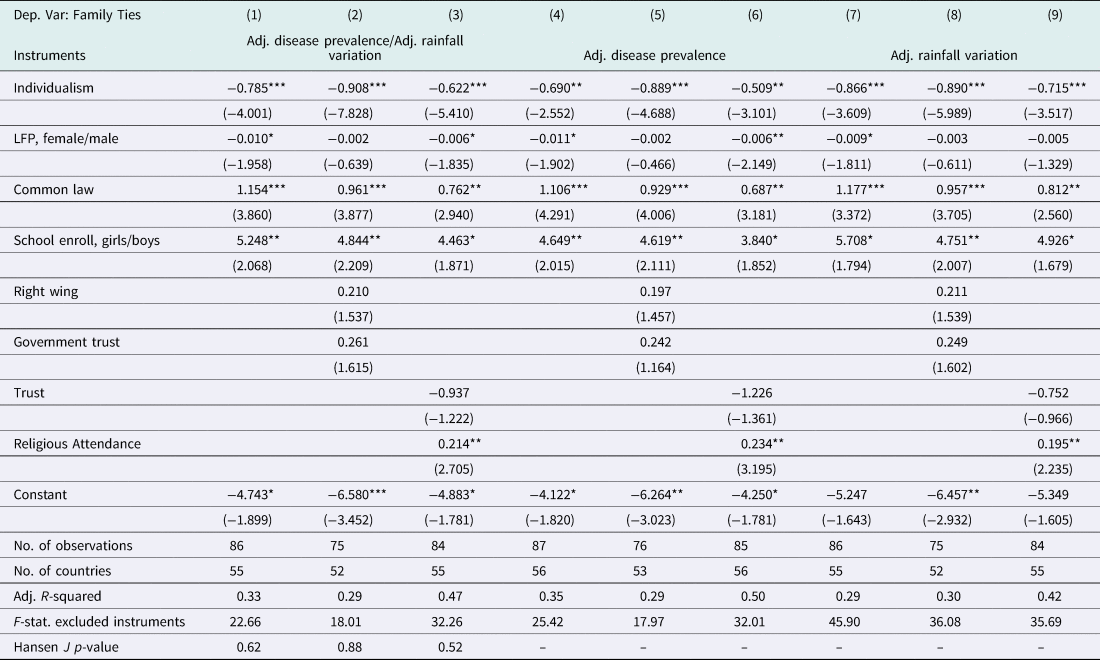
In Table 2, we reexamine the country-level analysis using IV estimation. Column 1 shows results for our baseline specification using ancestral rainfall variation and ancestry-adjusted historical prevalence of infectious disease to instrument for contemporary individualism. As seen, individualism's coefficient is negative and significant at the 1% level. This implies that the exogenous portion of individualism that is driven by disease prevalence and rainfall variation negatively predicts the strength of family ties. The estimated coefficient indicates that a one standard deviation increase in individualism reduces family ties by 79% of a standard deviation. This effect is larger than our OLS estimate, which is consistent with attenuation bias due to measurement error.
Country-level instrumental variable analysis, second stage results
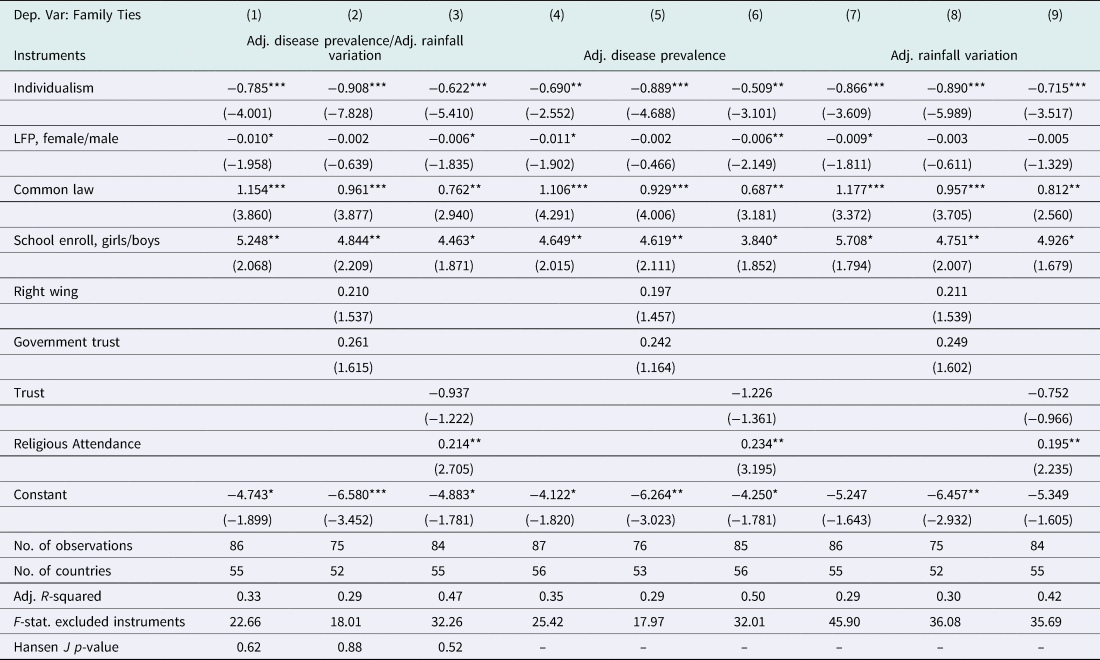
Notes: All indices are standardized. Instruments include ancestry-adjusted disease prevalence and ancestry-adjusted rainfall variation. Standard errors are double clustered by country and year. T-statistics in parentheses. ***p < 0.001, **p < 0.05, *p < 0.10.
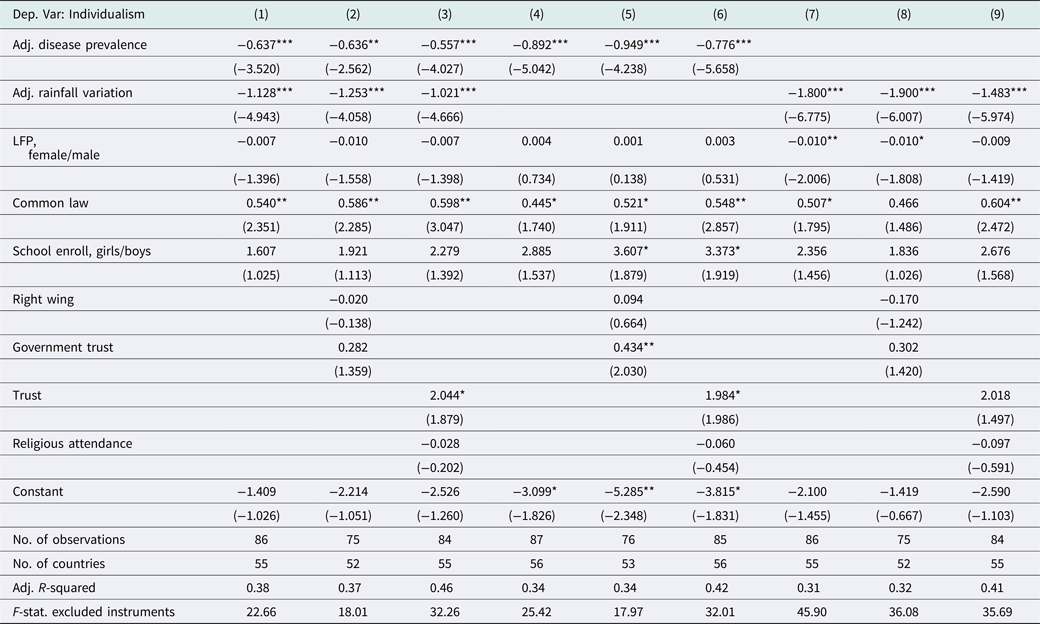
The penultimate row of Table 2 presents the first-stage F-statistic for the excluded instruments, which is comfortably above the conventional threshold for concern over weak instrument bias. Additional first-stage results are available in Appendix D.
Next, we address specific concerns regarding the exclusion restriction. One concern is that the instruments may be linked to attitudes toward government. For example, historical prevalence of infectious disease may increase the tolerance for the restriction of individual rights in the name of public health objectives. Similarly, rainfall variation may increase the demand for social insurance. To control for these possibilities, we include two measures of attitudes toward government, political ideology and government trust, discussed above. As seen in column 2, however, the inclusion of these variables has no appreciable effect on our findings.
Second, rainfall variation is linked to social outcomes that are plausibly correlated with the strength of family ties, including social trust (Buggle and Durante, Reference Buggle and Durante2017) and religiosity (Ager and Ciccone, Reference Ager and Ciccone2018). To address these concerns, we consider a specification that controls for national levels of social trust and the frequency of attendance at religious services. As seen in column 3, individualism's effect is robust to these inclusions.
The remaining columns of Table 2 present regressions using the two instruments individually. As seen, our results are consonant with those using the instruments simultaneously. In particular, we find that the exogenous component of individualism has a negative, statistically significant and highly stable relationship with family ties in all six regressions.
For our instruments to be valid, they must affect family ties indirectly, through their influence on individualism–collectivism, rather than through some other channel. Although the absence of an alternative channel of influence from our instruments to family ties cannot be proven, we believe the available evidence clearly indicates that the primary channel of influence runs from climatic and ecological variables to individualism–collectivism and then to family ties. As noted in Section 2, the evidence is particularly strong with respect to rainfall variation. Not only is rainfall variation positively correlated with the strength of non-family collectives, including religious and political institutions, but Buggle and Durante (Reference Buggle and Durante2017: 7) argue directly against a potential role for the family in mediating against agricultural risk, suggesting that ‘[family- and kin-related] networks are generally too small and spatially concentrated to provide insurance against climatic risk.’
The challenge with respect to disease prevalence is greater, as Enke (Reference Enke2019: 981) has argued that this variable is an acceptable instrument for family ties, on the basis that ‘under high pathogen threat, strong localized extended family ties are beneficial because they reduce the need to travel for cooperation and trade,’ and thereby reduce infection risk. Although plausible, we find this argument overly narrow. A plain reading of psychological and biological literature on the pathogen stress theory of values suggests that Enke's evidence linking pathogen stress and family ties is one expression of a more general relationship between disease prevalence and collectivism. Pathogen stress affects not just family ties, but the strength of in-group, out-group distinctions, including ethnocentrism and xenophobia (Fincher et al., Reference Fincher, Thornhill, Murray and Schaller2008), taste for social conformity and authoritarianism, and tolerance of dissent (Murray et al., Reference Murray, Schaller and Suedfeld2013).
Additional evidence in support of the exclusion restriction is found in the bottom row of the table, where we report p-values for the Hansen J statistic. Our results consistently indicate that we cannot reject the null hypothesis that the instruments are valid, conditional on at least one instrument being valid. Overall, the results of our IV regressions confirm and strengthen those from our OLS regressions. That is, there appears to be an economically significant, robust, negative relationship between individualism and the strength of family ties.
5. Individual-level analysis
A key strength of conducting individual-level analysis is that we can control for country fixed effects, and thus for the role of time-invariant country-level omitted variables. However, since national culture is itself a (largely) time-invariant country-level variable, doing so also changes the interpretation of our results. In this section, we investigate how individual variation in individualism is related to the strength of family ties, holding national culture constant. That is, we are observing the impact of variations in individual values in a uniform cultural environment. In spite of this more limited focus, individual-level analysis provides greater confidence that the empirical relationships identified are correctly attributed to individualism.
5.1 Individual-level OLS analysis
We follow Alesina and Giuliano (Reference Alesina, Giuliano, P and SN2014) in choosing the baseline controls: age, age-squared, and a dummy variable equal to 1 if female. Standard errors are double clustered by country and wave. Country and wave dummies are also included.
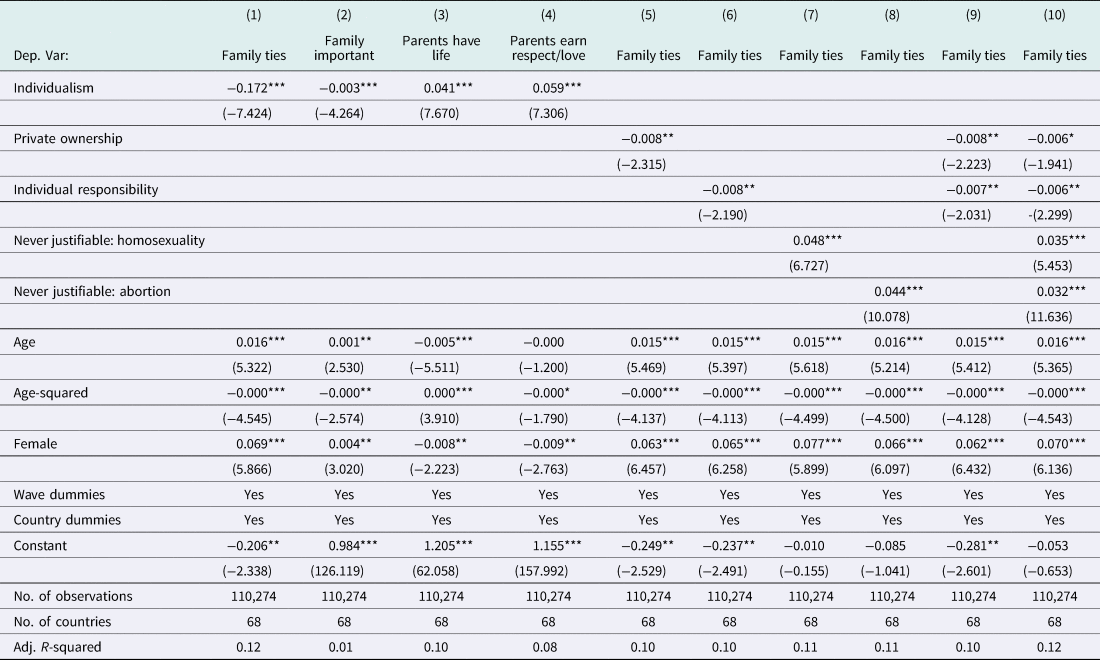
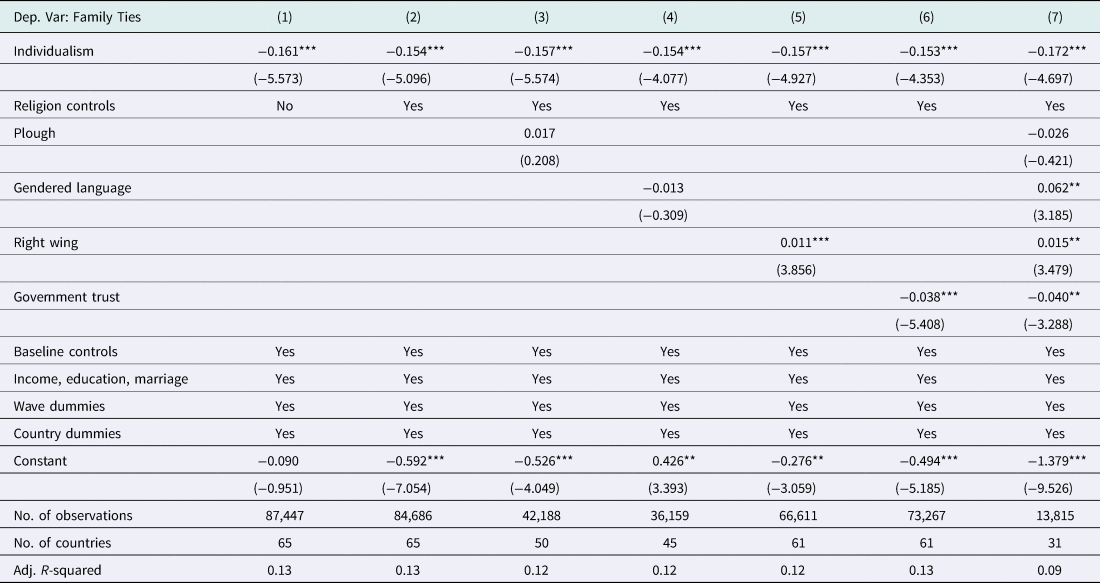
Table 3 presents the OLS results. As seen in the first column, individualism significantly reduces the strength of family ties. A one standard deviation increase in individualism is associated with 17.2% of a standard deviation reduction in the strength of family ties. The coefficient on individualism in this specification is also roughly one-third the size of that in the comparable cross-country regression, e.g. Table 1, column 1. Thus, roughly one-third of the relationship between individualism and family ties appears to reflect the role of individual values and roughly two-thirds reflects the impact of country-level mechanisms, including social norms and national institutions.
Individual-level results, OLS

Notes: All indices are standardized. Standard errors are double clustered by country and wave. T-statistics in parentheses. ***p < 0.001, **p < 0.05, *p < 0.10.
The next three estimations, columns 2–4, report a strong, statistically significant association between individualism and the individual components of family ties. Thus, the empirical relationship between individualism and family ties is not driven by any one component of our index.
In columns 5–8, we consider the relationship between family ties and each of the four subcomponents of our individualism index. All of subcomponents have the expected sign and are significant at the 5% level. In column 9, we consider the two state-oriented measures of individualism, which reflect tastes for private ownership and individual responsibility, simultaneously, and in column 10, we enter all four components simultaneously. Our results indicate that the independent variation in each component of the index is significantly related to the strength of family ties. Particularly important are our results in column 10, which are consistent with the idea that individuals apply a single set of values across very different social institutions, family and the state. More generally, these results bolster our confidence that our findings are related to individualism as a whole and not to any one component of our index.
Next, we check for omitted variable bias. We augment our baseline specification to control for additional demographic variables, including a dummy variable equal to 1 if married, income scale, and level of education. These variables may be view as ‘bad controls’ if they are in part determined by individualism. However, their inclusion increases our confidence that the relationship between individualism and family ties is not spurious. As reported in Table 4, column 1, our results are not sensitive to these inclusions.
Individual-level results, OLS, additional controls

Notes: All regressions include baseline controls: age, age-squared, dummy variable for female. Religion controls include dummy variables equal to 1 if individual belongs to Protestant, Catholic, Muslim, Hindu, Buddhist, or other religion. Standard errors are double clustered by country and wave. T-statistics in parentheses. ***p < 0.001, **p < 0.05, *p < 0.10.
Religion is associated with traditional views of the family (Guiso et al., Reference Guiso, Sapienza and Zingales2003; Seguino, Reference Seguino2011). Religious affiliation is also correlated with individualism (Davis, Reference Davis2019), raising the concern that our results are spurious. Thus, we include dummy variables for individual religious affiliation as Protestant, Catholic, Muslim, Hindu, Buddhist, or other religion. The reference category is non-religious. As seen in column 2, the association between individualism and family ties is robust to this inclusion. The magnitude of the estimated effect is not substantially affected.
We further check the sensitivity of our results by including two variables associated with patriarchal attitudes and gender inequality since these may affect family structure. First, we add a measure of historical plough use. Alesina et al. (Reference Alesina, Giuliano and Nunn2013) establish that historical plough use is associated with a preindustrial gender division of labor and lower levels of contemporary female labor force participation. Thus, historical plough usage could alter the structure of the family unit. To control for this potential impact, we include the share of the regional population belonging to ethnic groups that used the heavy plough. As reported in column 3, individualism is robust to this inclusion.
Next, we incorporate the effect of speaking a gendered language, defined as a language in which biological gender plays an important role in the grammar of nouns and pronouns. Speaking a gendered language is associated with traditional gender roles and gender inequality (Davis and Reynolds, Reference Davis and Reynolds2018; Gay et al., Reference Gay, Santacreu-Vasut and Shoham2013; Mavisakalyan, Reference Mavisakalyan2015), which may influence the strength of family ties. Thus, in column 4, we include an index that reflects the gender intensity of nouns and pronouns in the language an individual speaks at home. Individualism has the expected sign and is significant at the one percent level in this specification.
In columns 5 and 6, we include measures of political ideology and government trust, respectively, which helps us to distinguish between individualism and a taste for government, per se. In each specification, individualism retains its sign and significance. Finally, in column 7, we consider a specification in which we control for all additional variables simultaneously. As seen, our key result is robust to the inclusion of these additional controls. However, we also note the significant drop in the number of observations, which suggests caution in making direct comparison across specifications.Footnote 5
5.2 Individual-level IV estimation
Next, we address concerns over bias due to the endogeneity of individualism and errors in its measurement. As above, we address these issues by instrumenting for individualism with variables measuring aspects of the climatic and epidemiological environment of an individual's ancestors. We link information on rainfall variation and disease prevalence to WVS survey respondents using the language an individual speaks at home and information from Ethnologue (Lewis, Reference Lewis2009) on the geographic coordinates indicating the centroid of a language's point of origin. This provides measures of exogenous agricultural risk and disease prevalence faced by ancestors of those speaking a given language. The use of these instruments limits our sample because language information is only available for Waves 3–5 of the WVS, and the sample is limited to the overlap of languages covered by the WVS and Ethnologue. The resulting sample has up to 54,533 observations.
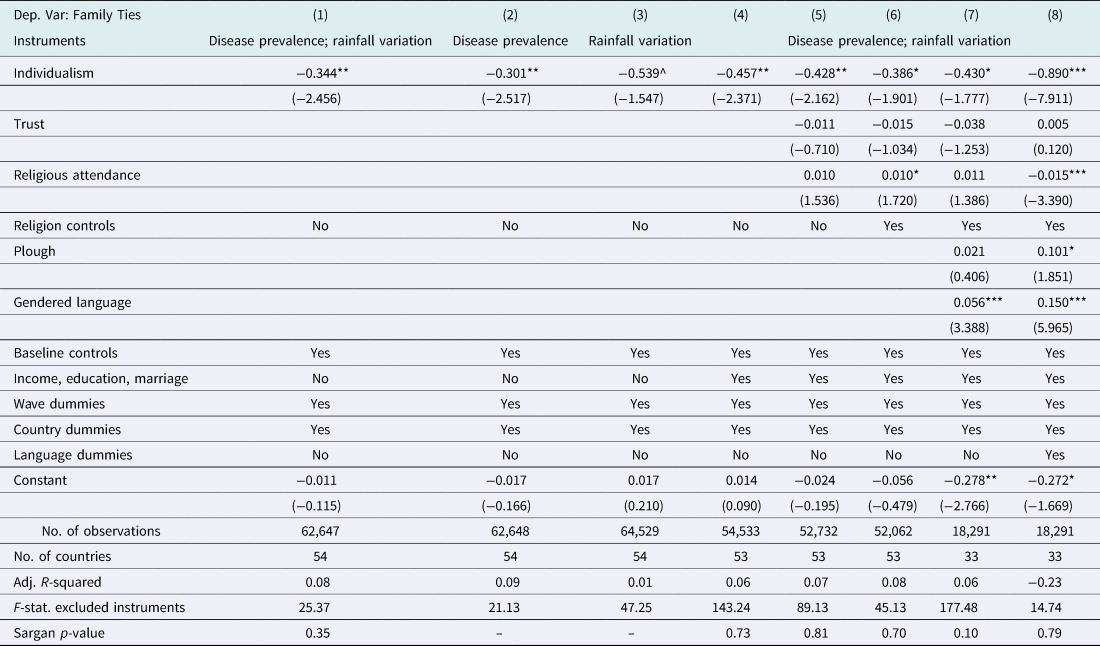
Table 5 presents our results. Column 1 reports the baseline specification. The coefficient of individualism is negative and significance. Thus, the exogenous portion of individualism that is driven by disease prevalence and rainfall variation is negatively related to family ties. The IV coefficient in our baseline specification is twice that in the equivalent OLS estimation. This finding is consistent with attenuation bias due to measurement error, but it may also reflect the local average treatment effects of the instruments. In particular, the IV regression restricts attention to variations in individual values that are uniform within a given language group and, thus, reflect variations in values that are consistent with social norms held by the language group. The IV coefficient is also about 44% of the equivalent cross-country coefficient, suggesting that roughly half of the effect of individualism acts through national channels.
Second stage instrumental variable results, individual-level analysis

Notes: Instruments for individualism are disease prevalence and rainfall variation in columns 1 and 4–7. Instrument in column 2 is disease prevalence, and instrument in column 3 is rainfall variation. All regressions include baseline controls: age, age-squared, dummy variable for female. Religion controls include dummy variables equal to 1 if individual belongs to Protestant, Catholic, Muslim, Hindu, Buddhist, or other religion. Language dummy variables equal to 1 if individual speaks English, French, Spanish, Arabic, or Russia. Standard errors are double clustered by country and wave. T-statistics in parentheses. ***p < 0.001, **p < 0.05, *p < 0.10, ^p < 0.12.
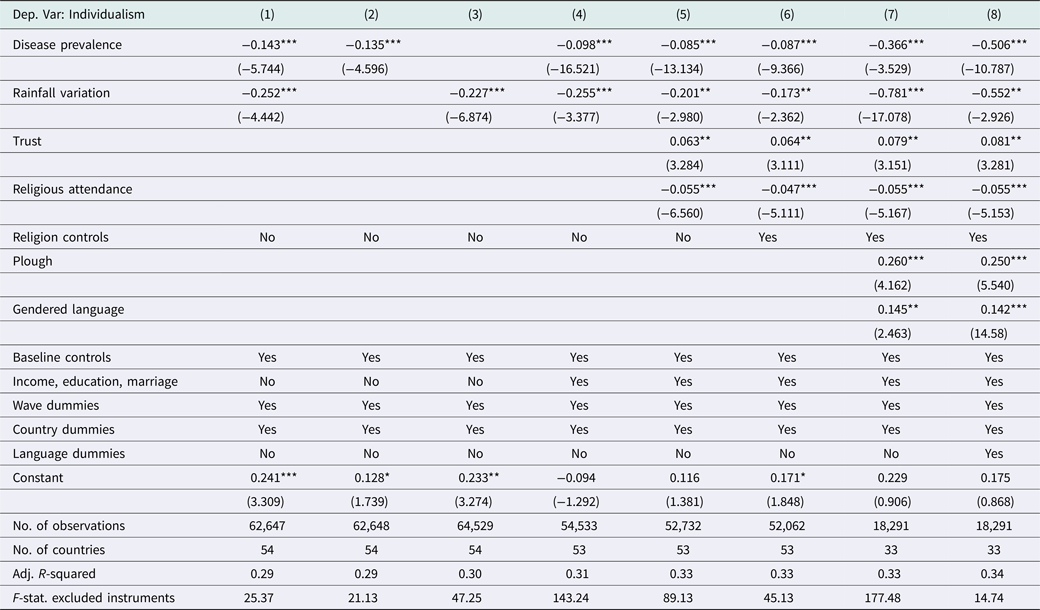
In columns 2 and 3, we present results using the two instruments individually. The coefficient on individualism is significant at the 5% level in column 2 and is marginally significant in column 3 (at 12% level). The final row of Table 5 presents first-stage F-statistics. These are all significantly above the threshold for concern over weak instrument bias. First-stage regressions are presented in Appendix E.
Column 4 reports the baseline specification with additional demographic controls. Individualism remains negative and significant.
Next, we consider specific concerns related to the exclusion restriction. As noted above, rainfall variation is linked to trust and church membership, raising concern over instrumental validity. We address these concerns in specification 5 by controlling for generalized trust and the frequency of attendance at religious services. Individualism's coefficient is virtually unaffected.
A second potential violation of the exclusion restriction concerns the relationship between language and religion. Certain languages, Spanish and Arabic, for example, are highly correlated with religious affiliation. Religious affiliation may have an independent effect on individualism and collectivism (Davis, Reference Davis2019), which raises the possibility that language-based instruments are simply proxies for religious affiliation. We address this concern by controlling for individual religious affiliation. As seen in column 6, the relationship between individualism and family ties is robust to this specification.
A third potential concern is that rainfall variation or disease ecology may be related to climatic conditions that give rise to patriarchal values and norms, which may have an independent effect on family ties. For example, Alesina et al. (Reference Alesina, Giuliano and Nunn2013) show that historical plow use is predicted by climatic and geographical conditions that favor plow-positive crops. More recently, Galor et al. (Reference Galor, Özak and Sarid2018) find the conditions conducive to the presence of plow-positive crops may also affect the development of gendered language structures. To address this possibility, we include both historical plough use and gendered language as controls. As seen in column 7, the significance of individualism is robust to the inclusion of these variables.
A final concern is that certain languages are over represented in our sample, having spread globally through migration and colonization, which may have independent effects on family ties, e.g. as a response to conquest. To control for this possibility, we include language dummy variables equal to 1 if an individual speaks English, Spanish, French, Arabic, or Russian, key global languages associated with colonization. As seen in column 8, individualism is remains negative and significant.Footnote 6
In summary, our IV results are robust to considerations of alternative channels of influence related to social trust, religiosity, religious affiliation, historical plow use, gendered language structures, and speaking a global language. However, it is always possible that there are confounding variables that we have not considered. Adding additional support for our instruments, Sargan p-values suggest that we cannot reject the null hypothesis that the instruments are valid, conditional on at least one valid instrument being valid. The fact that our instruments are motivated by different theoretical arguments strengthens the case that the exclusion restriction is in fact met. Finally, as argued in the previous section, existing work supports our contention that rainfall variation and disease prevalence affect family ties indirectly, through their impact on individualism and collectivism.
6. Conclusion
We present empirical evidence that variations in the strength of family ties reflect fundamental differences in cultural values. In particular, we find that individualism reduces the strength of family ties. This relationship holds at both the individual- and country-levels and is robust to the use of alternative measures of individualism and to a wide variety of controls. It is also robust to the use of instrumental variable methods to address concerns over the measurement and endogeneity of individualism.
Our findings link research on family structure to that on the role of cultural values in economic and social life. Our results help to explain the persistence of family ties and indicate an important channel through which individualist and collectivist values formed in the distant past may influence contemporary social outcomes. Finally, our findings may have implications for how the abundant evidence on the empirical relationship between family ties and other social outcomes is understood. In particular, it is possible that these associations primarily reflect the common influence of cultural values related to individualism–collectivism.
Appendix
Appendix A: Data description and source
Appendix B: Construction of individualism and family ties indices

Appendix C: Summary statistics

Country-level instrumental variable analysis, first stage results

Individual-level instrumental variable analysis, first stage results