Introduction
Antarctica is the most isolated continent on Earth, but it has not escaped the negative impacts of human activity. The unique marine ecosystems of Antarctica and their endemic faunas are affected on local and regional scales by overharvesting, pollution and the introduction of alien species (Aronson et al. Reference Aronson, Thatje, McClintock and Hughes2011).
Several contaminants, with a wide variety of deleterious effects well reported in the scientific literature, may reach the Antarctic environment via atmospheric long range transport, whilst secondary sources such as migrating organisms or redistribution and concentration of contaminants that were already present cannot be disregarded (Roosens et al. Reference Roosens, van Den Brink, Riddle, Blust, Neels and Covaci2007). Contaminants input via atmospheric transport is classically known as “global distillation”, since compounds evaporate in warmer low/medium latitude regions and when they reach colder (by higher altitude or latitude) regions, they condense and consequently enter the local food web. These evaporation/deposition cycles and the consequent fractionations are also known as the “grasshopper effect” (Gouin et al. Reference Gouin, MacKay, Jones, Harner and Meijer2004). The cold conditions of the Antarctic environment favour persistence of persistent organic pollutants (POPs) with respect to temperate and tropical environments. The storage of lipids as an energy source makes Antarctic food webs vulnerable to bioaccumulative chemicals, and top predators (as some of the birds sampled) are the species exposed to greatest risk (Loganathan et al. Reference Loganathan, Tanabe, Tanaka, Miyazaki, Amano and Tatsukawa1990, Loganathan & Kannan Reference Loganathan and Kannan1991).
The aim of the present work is to verify the occurrence and distribution patterns of PCBs (polychlorinated biphenyls), organochlorine pesticides and PBDEs (polybrominated diphenyl ethers) in invertebrates, fish and birds collected on King George Island, for which data on the occurrence of POPs is still scarce or nonexistent.
Material and methods
Area of study and sample collection
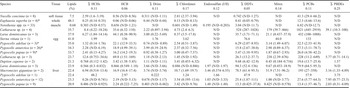
King George Island (62°05′S, 58°23′W), the largest one of the South Shetland Islands, is separated from the northern portion of the Antarctic Peninsula by the Bransfield Strait. Limpets (Antarctic limpet, Nacella concinna (Strebel) were manually collected (2004–05 summer) in the intertidal zone. Fish (marbled rockcod, Notothenia rossii Richardson) were collected (2006–07 summer) by mid-water nets or by line and hook. Only unhatched bird eggs (skua, Catharacta sp.; kelp gull, Larus dominicanus Lichtenstein; and Antarctic tern, Sterna vittata Gmelin) were collected (2004–05 and 2005–06 summers) so as not to interfere with breeding success. Bird livers (cape petrel, Daption capense (L.) and giant petrel, Macronectes giganteus (Gmelin) in addition to the previous species) were collected (from 2004–05 up to 2007–08 summers) only from already dead animals with no evident signs of disease, decomposition or emaciation. No further attempt to determine the cause of death was performed. Detailed sampling numbers and tissues can be seen in Table I.
Organic pollutants concentrations (ranges) in Antarctic biota (ng g-1 wet weight). Lowest method detection limit within the group is shown below the group. Data marked with an asterisk is taken from Cipro et al. (Reference Cipro, Taniguchi and Montone2010) for comparison purposes.

HCH = hexachlorocyclohexane, HCB = hexachlorobenzene, DDT = dichlorodiphenyltrichloroethane, PCBs = polychlorinated biphenyls, PBDEs = polybrominated diphenyl ethers.
N/D = not detected, or detected under the method detection limits.
All samples were kept in aluminium or glass containers (previously combusted at 420°C for 4 hours) and frozen at -20°C until analyses.
Chemical analyses
Organochlorine analyses were performed at University of São Paulo (Brazil). Laboratory protocol was based on MacLeod et al. (Reference MacLeod, Brown, Friedman, Burrows, Maynes, Pearce, Wigren and Bogar1986) and quality assurance/quality control (QA/QC) followed guidelines described by Wade & Cantillo (Reference Wade and Cantillo1994). Briefly, a wet sample (2.5 g for bird liver, 5 g for all of the others) was ground with anhydrous Na2SO4 and surrogate (PCB 103) was added before extraction in a Soxhlet apparatus for 8 hours with 80 ml of n-hexane and methylene chloride (1:1, v/v). The extract was concentrated to 1 ml and cleaned up in a column filled (from top to bottom) with 16 g alumina and 8 g silica gel (both 5% deactivated with water). The extract was eluted (80 ml methylene chloride:n-hexane 1:1 v:v) and subsequently concentrated to 500 μl. A further cleanup step was performed in a HPLC size exclusion column system: two Phenogel 100 A (22.5 x 250 mm) and a 7.8 x 50 mm pre-column. Methylene chloride was used as mobile phase. A new evaporation (up to 900 μl) followed and finally, internal standard (100 μl TCMX, used to estimate surrogate recovery) was added to the purified extract prior to injection in the gas chromatograph.
Organochlorine analyses were run in a gas chromatograph equipped with an electron capture detector (GC-ECD, Agilent Technologies, model 6890N). Hydrogen was used as carrier gas at constant pressure (13.2 psi, i.e. 91.01 kPa). The injector was operated in splitless mode and kept at 300°C. The capillary column used was a DB-5 (30 m length x 250 μm internal diameter x 0.25 μm film thickness). The detector operated at 320°C using N2 as makeup gas at a flow rate of 58 ml min-1. The oven was programmed as follows: 70°C for 1 min, 5°C min-1 to 140°C (1 min), 1.5°C min-1 to 250°C (1 min) and 10°C to 300°C (5 min). The investigated compounds were PCBs (IUPAC Nos. 8, 18, 28, 31, 33, 44, 49, 52, 56, 60, 66, 70, 74, 77, 81, 87, 95, 97, 99, 101, 105, 110, 114, 118, 123, 126, 128, 132, 138, 141, 149, 151, 153, 156, 157, 158, 167, 169, 170, 174, 177, 180, 183, 187, 189, 194, 195, 201, 203, 206 and 209), DDTs (dichlorodiphenyltrichloroethane) (o,p’-DDE, p,p’-DDE, o,p’-DDD, p,p’-DDD, o,p’-DDT, and p,p’-DDT), HCB (hexachlorobenzene), HCHs (hexachlorocyclohexane: α, β, γ and δ isomers), chlordanes (α- and γ-chlordane, heptachlor, and heptachlor epoxide), mirex and drins (aldrin, dieldrin, and endrin).
PBDEs analyses were performed in an Agilent 6890 Plus attached to the MS 5973N Mass Selective Detector (GC/MS) in SIM (selective ion monitoring) mode, with a HP-5MS column (30 m x 250 μm x 0.25 μm). PBDEs analysed were the IUPAC Nos. 28, 47, 99, 100, 153, 154 and 183. Injector operated at 270°C. Oven was programmed as follows: 130°C for 1 min, 12°C min-1 to 154°C (0 min), 2°C min-1 to 210°C (0 min), 3°C min-1 to 300°C (5 min).
Method detection limits (MDLs) were set as three times the standard deviation (σ) of seven method blank replicates. Spiked matrices were recovered within the acceptance ranges (i.e. 40–130% for at least 80% of the spiked analytes) suggested by Wade & Cantillo (Reference Wade and Cantillo1994). Method validation was performed using NIST SRM 1945. Blanks were included in every analytical batch (usually 10–12 samples) and all data were blank-subtracted. Surrogate recovery ranged from 58% up to 108%. Data from penguin eggs and krill were previously reported and detailed in Cipro et al. (Reference Cipro, Taniguchi and Montone2010) as well as the methodology and its respective Method Detection Limits.
Results
Mean results and ranges of organic pollutants analysed are shown in Table I. The lower MDL within a group is shown below the name of the group itself. The prevailing compounds were (in ng g-1 wet weight for species averages): PCBs (13.4–1821 for birds, 6.82 for fish and 41.3 for invertebrates), HCB (0.866–69.8 for birds, 0.66 for fish and 0.56 for invertebrates) and DDTs, (5.47–524 for birds, 3.04 for fish and 0.74 for invertebrates).
For fish, none of the samples were above the MDLs for PBDEs. Organochlorine data showed little intraspecific variation, except for DDTs which showed concentrations of the same order of magnitude as PCBs and both of them one order of magnitude greater than the other contaminants. The PCBs qualitative profile showed predominance of the tetra-chlorinated biphenyls (tetra-CBs), followed by penta- and hexa-CBs.
For bird egg samples, only Catharacta sp. (skua) samples were above the MDL for PBDEs, averaging 39.12 ng g-1 (wet weight) for ΣPBDEs and with a qualitative profile with deviations not greater than 10% (although individual level deviations could reach 17%) when compared to the qualitative profile of the Penta-BDE technical product. PBDEs were detected in bird liver in concentrations ranging from < 0.25–7.95.
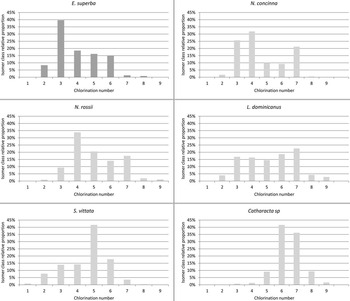
Qualitative PCBs profiles (i.e. sum of congeners according to the number of chlorine atoms in their molecules, normalized for the individual PCBs total) from bird eggs and invertebrates are shown in Fig. 1.
PCBs (polychlorinated biphenyls) distribution (%) in bird eggs, fish and invertebrate samples according to chlorination number. Euphausia superba data taken from Cipro et al. (Reference Cipro, Taniguchi and Montone2010).

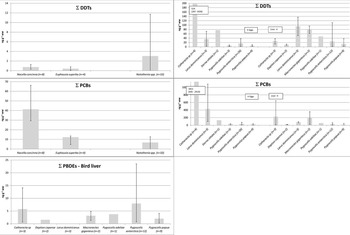
These data can now be graphically compared with quantitative results for the most representative groups (PCBs and DDTs and PBDEs as well) in Fig. 2. In general, skua eggs showed higher concentrations and more chlorinated congeners than those of the gulls and much more than the terns.
Quantitative data for the whole set of samples for PCBs (polychlorinated biphenyls), DDTs (dichlorodiphenyltrichloroethanes) and PBDEs (polybrominated diphenyl ethers) (ng g-1 wet weight). Euphausia superba and Pygoscelis spp. eggs data are taken from Cipro et al. (Reference Cipro, Taniguchi and Montone2010).

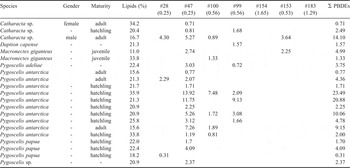
Individual and total PBDE concentrations for the bird liver samples are shown in Table II. The results for total PBDEs show a large variation among samples of the same species, as observed for Pygoscelis antarctica and Catharacta sp. The PBDE congeners found are mainly #47, #99 and #100.
Concentrations of individual PBDEs (polybrominated diphenyl ethers) in bird liver (ng g-1 wet weight) samples. The method detection limit for each congener is shown in brackets.

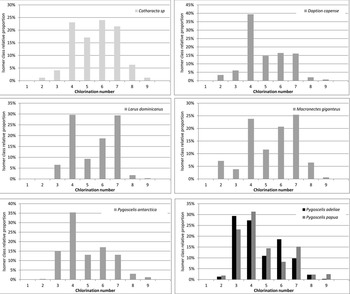
PCBs qualitative profiles for liver samples (Fig. 3) show Pygoscelis antarctica and D. capense with a predominance of tetra-CBs while Pygoscelis antarctica and Pygoscelis papua Forster have higher concentrations of tri and tetra congeners. Birds of higher trophic positions such as skua, giant petrel and kelp gull showed a relatively uniform distribution of light (tetra-CBs) and heavy (6-7-CBs) congeners.
PCBs (polychlorinated biphenyls) distribution (%) according to chlorination number in bird liver samples.

Discussion
The results found for fish could be due to the feeding status of the animals, which have a very slow metabolism and several mechanisms for energy conservation (Pörtner Reference Pörtner2001), which can affect the “growth dilution” effect, as well as both metabolic and excretion rates. Bargagli (Reference Bargagli2008) presented values for HCB and ΣPCBs in wet weight of, respectively, 1.35 and 9.25 ng g-1 for Trematomus bernacchii (Boulenger) (emerald rockcod) and 4.85 and 3.51 ng g-1 for Pleuragramma antarctica Boulenger (Antarctic silverfish). Both species belong to the same family (Nototheniidae) as N. rossii, but Pleuragramma artarctica is a pelagic species unlike the demersal T. bernacchii, with diet and habits more similar to N. rossii. In regard to PCBs qualitative (mass) patterns, (Fig. 1), the pattern in Notothenia rossii more resembled the pattern in the invertebrate N. concinna, but with heavier congeners, due to greater longevity and a higher trophic level, which leads to higher bioaccumulation.
Catharacta sp. egg samples showed a different PBDEs pattern from northern hemisphere birds, such as those reported by Naert et al. (Reference Naert, van Peteghem, Kupper, Jenni and Naegeli2007), and Voorspoels et al. (Reference Voorspoels, Covaci, Lepom, Jaspers and Schepens2006). Considerable variation has been found by Yogui & Sericano (Reference Yogui and Sericano2009), attributed to diet and migratory behaviour of this species and the consequent exposure to quantitative and qualitatively different contamination patterns from the ones faced by endemic Antarctic organisms, such as penguins. Using data from north-west Pacific Ocean birds (Watanabe et al. Reference Watanabe, Senthilkumar, Masunaga, Takasuga, Iseki and Morita2004, Wan et al. Reference Wan, Hu, Zhang and An2008), one could see that the differences presented are similar to the PBDE profiles found in this area, which could indicate that skuas (actually only Catharacta maccormicki Saunders, a transequatorial migrant, rather than Catharacta lonnbergi Mathews, which is restricted to the Southern Hemisphere) from the present study could occur in this area during the winter or feed on prey originating from this area. However, the use of different technical products in America and the preferential accumulation of some specific congeners also provide plausible explanations for these results as well.
Different diets and ranges can explain the contaminants distribution in birds (Figs 1 & 2). In general, the further north the species reaches and the more of an opportunistic/scavenger it is (Catharacta sp. > Larus dominicanus > Sterna vittata), the higher concentrations and qualitatively heavier PCBs profile it shows. This is due to a higher exposure of the adult females, which is reflected in egg concentrations as demonstrated by Tanabe et al. (Reference Tanabe, Subramanian, Hidaka and Tatsukawa1986), Bustnes et al. (Reference Bustnes, Tveraa, Varpe, Henden and Skaare2007) and Corsolini et al. (Reference Corsolini, Borghesi, Schiamone and Focardi2007).
This same effect can be seen in the qualitative PCBs profile. The comparison between birds eggs’ results shows a shift of the data (seen in Fig. 1) from L. dominicanus towards lighter congeners and therefore approaching N. concinna results, highlighting its role as a representative item of the gull's diet. In addition, there is another important fact: the time of the year when the limpet has a higher occurrence in L. dominicanus diet is just during the egg formation, as shown by Favero et al. (Reference Favero, Silva and Ferreyra1997).
In N. concinna the analyses show a predominance of lighter congeners that are more prone to long distance atmospheric transport, and therefore affect more directly the lower levels in the local trophic web. The similarity in the patterns of both invertebrates (krill from Cipro et al. Reference Cipro, Taniguchi and Montone2010) is noticeable, but the limpet showed concentrations two to three times higher than those for krill, but mostly within the same order of magnitude. Qualitative similarity can be explained by similar sources and mainly by similar trophic positions, but quantitative differences are better explained by the different life cycles and longevity of these species (see Picken Reference Picken1980).
The predominance of the #47, #99 and #100 PBDE congeners is due to the technical product used in the Americas (Yogui & Sericano Reference Yogui and Sericano2009). Concentrations for Catharacta specimens were lower in liver than eggs, which could be due to the growth dilution effect, i.e. a decrease in concentration due to an increase in body mass, given the abundance of food when the birds were sampled. Skua eggs are laid mainly in mid to late November (Aguirre Reference Aguirre1995) and penguins, which hatch from late November to late December (Aguirre Reference Aguirre1995), may represent the most frequent prey for skuas (Mund & Miller Reference Mund and Miller1995). Comparing the three samples, the highest concentration is seen in an adult male, which is to be expected (since transfer to an egg is not an option), but the hatchling shows values higher than the adult female, highlighting not only the growth dilution effect over the female, but also the female-offspring transfer firstly via egg and then via nourishment. Curiously, values for penguins also show this same pattern with concentrations in hatchlings higher than in adults even when lipid weight is considered (lipid weight averaged 26.2% in hatchling livers and 40% in adult livers). So, another hypothesis might be that metabolic rate, in spite of growing in absolute value as a function of body mass, decreases when normalized by body mass itself (McKechnie & Wolf Reference McKechnie and Wolf2004). In other words: the higher the mass, the lower the energy needed to maintain each mass unit. Obviously this assumption has two counterarguments: the considerable increase in adult energy consumption during the chick-rearing period (Culik Reference Culik1994) and POPs bioaccumulation as a function of the age.
In general the results obtained for PCB qualitative profiles in bird liver are quite consistent with the previous data and also with ecological differences for each species. Catharacta sp. and Macronectes giganteus, opportunistic birds that feed on anything from krill to carrion, show the heavier PCBs patterns, confirming the biomagnification of this pollutant group. In addition to that, both these species are migrants, giving them direct exposure in several areas besides Antarctica.
Larus dominicanus, in its turn, has not shown the light pattern resulting from the invertebrate's influence, which suggests two (non-mutually exclusive) hypotheses: the first one is the species-specificity in mother-egg transfer, already reported in several bird groups (Cipro et al. Reference Cipro, Taniguchi and Montone2010 and references therein). The second one is that lighter congeners are more prone to be excreted and/or metabolized and therefore they have, in general, shorter environmental residence times (Fuoco & Ceccarini Reference Fuoco and Ceccarini2001). Since the major predation to N. concinna occurs precisely during the egg formation period, there could be a synergy between these two effects.
Penguins presented the lightest liver profiles and also (D. capense apart) the quantitatively lowest concentrations, due to their trophic position close to the food web base, since krill represents more than 70% of their diet (Croxall & Lishman Reference Croxall and Lishman1987). As an additional factor, they are restricted to the Antarctic environment and therefore not exposed to more contaminated environments as Catharacta sp., for instance.
Finally, Daption capense has a widely variable diet, including mainly small fish and crustaceans (also amphipods in addition to euphausiids), as described by Coria et al. (Reference Coria, Soave and Montalti1997), which is reflected in its heavier pattern (with the exception of the tetra-CBs congeners), and due to the species migration behaviour. In regard to the quantitative result, in a highly seasonal environment, such as the Antarctic, growth dilution effects must be taken into account, in an analogous manner as has been done with previous data.
Comparing interspecifically the results with the ones presented in Taniguchi et al. (Reference Taniguchi, Montone, Bícego, Colabuono, Weber and Sericano2009), for fat samples of several bird species in the same area of study, there are quantitative values in the same order of magnitude in wet weight, with a general predominance of PCBs, DDTs and HCB. However, there is a constant difference between the tissues: qualitative PCBs profiles found in liver in the present work are lighter than the ones found in fat by Taniguchi et al. (Reference Taniguchi, Montone, Bícego, Colabuono, Weber and Sericano2009). According to Barron et al. (Reference Barron, Galbraith and Beltman1995), in spite of the structure itself seeming to be the prevailing factor in accumulation, metabolization and excretion of PCBs (verified by Taniguchi et al. Reference Taniguchi, Montone, Bícego, Colabuono, Weber and Sericano2009, in which only six congeners - 138, 153, 170, 180, 183 and 187 - represented roughly 65% of PCBs totals), the increase in chlorination level decreases the PCBs metabolization rates, and for this reason, one would expect lighter congeners in liver, where P450 cytochrome metabolization occurs (Barron et al. Reference Barron, Galbraith and Beltman1995) and heavier congeners in fat because of the higher accumulation trend of such congeners and also because of the metabolization of the lighter ones.
Conclusions
In general the prevailing compounds were PCBs, HCB and DDTs. PBDEs occurred at levels from one to two orders of magnitude lower than the organochlorines, probably due to the lower and more recent usage of PBDEs when compared to organochlorines. PBDEs data showed little difference in composition when compared to the technical product available in the Americas, especially in endemic species, which could indicate that fractionation has not played a major role for this contaminant group.
Analyses of the bird samples, due to their variety in diets, ranges, gender and ecological niches could show how each of these factors influences the accumulation of organic pollutants. Whenever comparison was possible, data was quantitatively in agreement with previous literature. The fact that a northward gradient appeared indicates lesser contamination in Antarctica but the concentrations found in endemic fauna support studies that no longer consider the continent pristine.
Invertebrate samples presented concentrations and profiles in accordance to their trophic levels, life cycles and ecological niches, notably in regard to the consumption of primary producers. In an analogous way, these results were reflected in their consumers: fish and birds. Future work with carbon and nitrogen stable isotope analyses is expected to provide a deeper insight into the accumulation and transfer of contaminants in these matrixes.
Acknowledgements
The present work is a result of the projects “Environmental Management of Admiralty Bay, King George Island, Antarctica: persistent organic pollutants and sewage” (CNPq No. 55.0348/2002–6), and “Modeling the bioaccumulation of organic pollutants throughout an Antarctic food web” (CNPq 550018/2007-7) and also contributes to the Brazilian National Science and Technology Institute on Antarctic Environmental Research (INCT-APA). Financial support was obtained from the Brazilian Antarctic Program (PROANTAR), Ministry of the Environment (MMA) and Conselho Nacional de Desenvolvimento Científico e Tecnológico (CNPq). Antarctic logistics was provided by Secretaria da Comissão Interministerial para os Recursos do Mar (SECIRM). C.V.Z. Cipro was funded by FAPESP (2007/55956-0) and CAPES. The first author also received financial support from the University of La Rochelle during the course of this publication. Special thanks to Prof Martin Sander and his team (Ana Paula Carneiro, César Rodrigo dos Santos, Erli Schneider Costa) for their help during sampling of seabirds, to Dr Edson Rodrigues for fish samples and to “eternal” members of the Lab-QOM (Dr César C. Martins, Dr Gilvan Y. Takeshi, Dr Juliana Leonel, Dr Rafael A. Lourenço and Vera Lúcia da Silva Campos) for their valuable collaboration in the fieldwork. The constructive comments of the reviewers are gratefully acknowledged.