Examining individual differences in the onset and trajectory of normal and atypical development is integral to advancing knowledge in the field of developmental psychopathology (Cicchetti, Reference Cicchetti1984; Sroufe, Reference Sroufe1990). Researchers can advance understanding of normal development by identifying processes and mechanisms that lead to deviations from the average trajectory, and vice versa, with a focus on high-risk populations (Cicchetti & Cohen, Reference Cicchetti, Cohen, Cicchetti and Cohen1995). Cultural development and psychopathology (the interplay of culture, development, and psychopathology) emphasizes cultural processes at individual and social levels that have influences on the ontology and continuity of behavior (Causadias, Reference Causadias2013). Socioeconomic status, as a relative indicator of social class position (Diemer, Mistry, Wadsworth, López, & Reimers, Reference Diemer, Mistry, Wadsworth, López and Reimers2013), is a social component of culture (Cohen, Reference Cohen2009) because it is associated with community practices, values, behaviors, and symbols at multiple levels (Causadias, Reference Causadias2013; Kraus, Piff, & Keltner, Reference Kraus, Piff and Keltner2011). Therefore, we can build on knowledge of how cultural processes affect behavioral development by more fully delineating the relation between socioeconomic status and behavior problems.
Substantial evidence links socioeconomic status to behavior problems at both ends of the socioeconomic gradient (e.g., Geisz & Nakashian, Reference Geisz and Nakashian2018; Luthar, Barkin, & Crossman, Reference Luthar, Barkin and Crossman2013; McLoyd, Reference McLoyd1998; Reiss, Reference Reiss2013; Wadsworth, Evans, Grant, Carter, & Duffy, Reference Wadsworth, Evans, Grant, Carter, Duffy and Cicchetti2016). However, current information on this relation lacks the kind of detail that is optimal for advancing both science and practice. The complex interconnections between socioeconomic status and the components used to represent it (e.g., income, educational attainment, and occupational prestige) make it difficult for scholars to determine with precision just how socioeconomic status is implicated in the development of behavior problems (Bradley, Reference Bradley and Friedman2016; Diemer et al., Reference Diemer, Mistry, Wadsworth, López and Reimers2013). In some cases, an observed relation with socioeconomic status could reflect a simpler relation between one aspect of socioeconomic status and the outcome of interest; in other cases, it could reflect the higher order interplay of several components. It may also be the case that socioeconomic status or its components such as income, educational attainment (henceforth, education), or occupational prestige (henceforth, occupation) show different associations with internalizing and externalizing problems for males and females or for different racial/ethnic groups (Duncan & Magnuson, Reference Duncan, Magnuson, Bornstein and Bradley2003; Shavers, Reference Shavers2007; Wadsworth et al., Reference Wadsworth, Evans, Grant, Carter, Duffy and Cicchetti2016).
No one study can fully resolve the uncertainties pertaining to research on socioeconomic status and behavior problems. Our goal is to move a step in that direction by synthesizing findings on this relation. In this study, we conducted a second-order meta-analysis to unpack the link between socioeconomic status and behavior problems by estimating the average association of income, education, occupation, and overall socioeconomic status with internalizing and externalizing problems. Consistent with prior research, we define internalizing as distress directed inward such as mood, anxiety, and somatic symptoms, and externalizing as distress projected outward, including conduct, antisocial, substance use, and attentional disorders (Cosgrove et al., Reference Cosgrove, Rhee, Gelhorn, Boeldt, Corley, Ehringer and Hewitt2010; Krueger, Reference Krueger1999).
What Is Socioeconomic Status?
Conceptualizing socioeconomic status is challenging because there is not a simple way to operationalize it (Bradley, Reference Bradley and Friedman2016; Cowan et al., Reference Cowan, Hauser, Kominski, Levin, Lucas, Morgan and Chapman2012). Historically, socioeconomic status has been conceptualized as a multifaceted construct that has substantial overlap with the notion of social class, a sense of status marked by power and prestige within a hierarchal cultural, social, and economic system (Diemer et al., Reference Diemer, Mistry, Wadsworth, López and Reimers2013). However, scores on a socioeconomic status index do not directly indicate the social class membership of an individual, family, or neighborhood (Diemer et al., Reference Diemer, Mistry, Wadsworth, López and Reimers2013). Socioeconomic status, rather, is defined by the relative position of an individual or family within the social class complex signaled by their access to financial, social, and cultural capital (Bradley, Reference Bradley and Friedman2016; Kraus et al., Reference Kraus, Piff and Keltner2011; Mueller & Parcel, Reference Mueller and Parcel1981). As a relative indicator of social ranking, socioeconomic status is also a cultural process. Resource-based aspects of socioeconomic membership are symbols of different living conditions, social clubs, and educational institutions (Kraus et al., Reference Kraus, Piff and Keltner2011).
In research, socioeconomic status has been modeled as a continuous and as a categorical variable. Researchers have often examined socioeconomic status on a continuum from low to high and assessed its covariance with internalizing and externalizing behavior problems (e.g., Nuru-Jeter, Sarsour, Jutte, & Boyce, Reference Nuru-Jeter, Sarsour, Jutte and Boyce2010). This covariance captures how levels of socioeconomic status and behavior fluctuate together, and can be standardized to compute a correlation coefficient. This approach, however, assumes there is a linear relation between socioeconomic status and maladaptive behaviors, one that is affected by the range of variability in a given sample. By contrast, other researchers have chosen to categorize members of a sample into socioeconomic groups that represent low, medium, and high (e.g., Poulton et al., Reference Poulton, Caspi, Milne, Thomson, Taylor, Sears and Moffitt2002).
Unpacking the Components of Socioeconomic Status
Numerous approaches have been employed to encapsulate the idea of socioeconomic status. The three most common components are income, education, and occupation, either individually (Cowan et al., Reference Cowan, Hauser, Kominski, Levin, Lucas, Morgan and Chapman2012; Diemer et al., Reference Diemer, Mistry, Wadsworth, López and Reimers2013) or as a composite (e.g., Hollingshead Four-Factor Index of Social Status; Hollingshead, Reference Hollingshead1975). Other components of socioeconomic status include wealth (e.g., Smith, Reference Smith1999), material and/or economic hardship (e.g., Conger, Conger, & Martin, Reference Conger, Conger and Martin2010), neighborhood and community level indices (e.g., Bradley & Corwyn, Reference Bradley and Corwyn2002), and material deprivation (e.g., Krieger, Williams, & Moss, Reference Krieger, Williams and Moss1997). Although reasonable arguments can be made for how each individual component of socioeconomic status, by itself or in combination with other components, contributes to overall socioeconomic status (or class), each component represents a unique aspect of family, household, and neighborhood dynamics. Despite the fact that these components (or aspects of context) tend to be correlated with each other and may share connections with processes that are implicated in maladaptive behaviors, it is unlikely they are isomorphic in this regard (Adler et al., Reference Adler, Boyce, Chesney, Cohen, Folkman, Kahn and Syme1994).
Ecological–developmental systems theories attempt to make clear that the influence of any environmental element on a developmental outcome depends both on the other influences, present in and through time, and on the developmental period in which the outcome is assessed (Bronfenbrenner & Evans, Reference Bronfenbrenner and Evans2000; Lerner, Johnson, & Buckingham, Reference Lerner, Johnson and Buckingham2015). A component of socioeconomic status or a blend of components could have a different effect on behavior problems during childhood than in adolescence or adulthood, partly due to the relative influence of genes at these different points (Hicks, DeRago, Iacono, & McGue, Reference Hicks, DeRago, Iacono and McGue2009; Tucker, Poulsen, & Luu, Reference Tucker, Poulsen and Luu2015). In addition, each component of socioeconomic status could have a different effect on internalizing versus externalizing because they reflect distinct underlying mechanisms (Assari & Lankarani, Reference Assari and Lankarani2016; Bauldry, Reference Bauldry2015; Evans, Reference Evans2017; Phillips, Carroll, & Der, Reference Phillips, Carroll and Der2015).
Income and behavior problems
Income is frequently assessed using annual individual, household, and family income, and is the most commonly investigated component of socioeconomic status in the social sciences (Diemer et al., Reference Diemer, Mistry, Wadsworth, López and Reimers2013). Household income is used as an indicator of one's access to resources (e.g., food, shelter, health care, and opportunities for learning) and can be manipulated for research using experimental designs such as boosting household income (Duncan & Magnuson, Reference Duncan, Magnuson, Bornstein and Bradley2003; Duncan, Magnuson, & Votruba-Drzal, Reference Duncan, Magnuson and Votruba-Drzal2017). Nonetheless, there are several drawbacks to assessing income, including the overreliance on parental reports among research on youth, nonresponse and response bias, and its volatility across time and variability across age (Diemer et al., Reference Diemer, Mistry, Wadsworth, López and Reimers2013; Duncan et al., Reference Duncan, Magnuson and Votruba-Drzal2017; Shavers, Reference Shavers2007). In addition, having information on annual income, most often used to represent a family's financial status, does not capture other sources of income and financial assets (e.g., government subsidies and other revenue). Therefore, researchers have suggested assessing wealth instead because it better represents economic resources more broadly and withstands the fluctuation in income (e.g., Bradley, Reference Bradley and Friedman2016; Diemer & Rasheed Ali, Reference Diemer and Rasheed Ali2009).
Not having sufficient income or wealth can make it difficult for individuals to cope with ongoing challenges or unexpected events (Ouwehand, de Ridder, & Bensing, Reference Ouwehand, de Ridder and Bensing2009). It can lead to stress and increased anxiety in both children and adults (Najaman et al., Reference Najaman, Hayatbakhsh, Clavarino, Bor, O'Callaghan and Williams2010; Yoshikawa, Aber, & Beardslee, Reference Yoshikawa, Aber and Beardslee2012). In addition, living in chronic poverty can lead to a sense of helplessness (Evans, Reference Evans2017) and hopelessness (Stoddard, Henly, Sieving, & Bolland, Reference Stoddard, Henly, Sieving and Bolland2011). Chronic, uncontrollable stress can lead to maladaptive forms of coping and serious psychiatric disorders among parents, particularly for individuals lacking the kinds of skills needed to manage challenges (Luthar & Sexton, Reference Luthar and Sexton2007; Wadsworth, Reference Wadsworth2015). Household income has been linked to mental health throughout the life course (Sareen, Afifi, McMillan, & Asmundson, Reference Sareen, Afifi, McMillan and Asmundson2011), with stress identified as a major contributor beginning in childhood (Yoshikawa et al., Reference Yoshikawa, Aber and Beardslee2012). Furthermore, Schwartz (Reference Schwartz2000) has argued that greater wealth implies a high degree of choice and autonomy, leading many to believe that wealthy people can live the kind of lives they want. Thus, there can be a tendency among wealthy individuals to attribute personal failures to their own shortcomings rather than to external factors, which can foster feelings of depression and shame (Schwartz, Reference Schwartz2000).
Research evidence supports that income is related to internalizing and externalizing (Evans, Reference Evans2017). In a sample of adults, lower household income was associated with higher levels of depressive symptoms over and above education and occupation (Ostrove, Feldman, & Adler, Reference Ostrove, Feldman and Adler1999). Likewise, lower family income in early childhood predicted more internalizing and externalizing in middle childhood (Votruba-Drzal, Reference Votruba-Drzal2006). In contrast, Dearing, McCartney, and Taylor (Reference Dearing, McCartney and Taylor2006) found that income was related to externalizing, but unrelated to internalizing. Moreover, Sorhagen and Wurster (Reference Sorhagen and Wurster2017) found that relative income (i.e., family income compared to neighborhood income) predicted internalizing and externalizing over and above family socioeconomic status. Though there is much research connecting income to internalizing and externalizing, the precise strength of the relation is hard to estimate. Importantly, household income has many cofactors that could also potentiate problems with maladaptive behavior, and income potentially connects to varied forms of behavior problems through different mechanisms and points in the life course (Yoshikawa et al., Reference Yoshikawa, Aber and Beardslee2012).
Education and behavior problems
Education is typically assessed as the number of years completed, highest level achieved in school, or academic credentials earned (e.g., high school diploma or bachelor's degree). Unlike income, education does not fluctuate much across adulthood because formal education is often completed in the first three decades of life (Ostrove et al., Reference Ostrove, Feldman and Adler1999; Shavers, Reference Shavers2007). Skills learned as part of the educational process can contribute to social and cultural capital, and years of formal education is predictive of income, occupation, housing and neighborhood conditions, and some lifestyles and behaviors later in life (Diemer et al., Reference Diemer, Mistry, Wadsworth, López and Reimers2013; Ostrove et al., Reference Ostrove, Feldman and Adler1999; Shavers, Reference Shavers2007).
In general, having a higher level of education enables people to make more informed choices that lead to more productive patterns of behavior and greater success (Chazelle et al., Reference Chazelle, Lemogne, Morgan, Kelleher, Chastang and Niedhammer2011; Hout, Reference Hout2012). In addition, higher education can contribute to a higher sense of personal control and more effective problem solving, which reduces the likelihood of depression and risky behavior (Hahn & Truman, Reference Hahn and Truman2015; Mirowsky & Ross, Reference Mirowsky and Ross1998). Indeed, in classic early models of developmental psychopathology, education was considered a major indicator of overall developmental competence levels (Zigler & Glick, Reference Zigler and Glick1986), because completing college involves high levels of continued persistence across diverse challenges over multiple years. However, this relation may weaken with age (Bjelland et al., Reference Bjelland, Krokstad, Mykletun, Dahl, Tell and Tambs2008), and there are likely diminishing returns pertaining to high levels of education and behavior problems (Bracke, Pattyn, & von dem Knesebeck, Reference Bracke, Pattyn and von dem Knesebeck2013). It can be difficult to determine both the primary mechanisms and the likely benefits of higher levels of education across groups given that there are structural barriers to education depending on location, sex, and race/ethnicity (Shavers, Reference Shavers2007).
Children's adaptive functioning is facilitated in settings that offer high levels of stimulation and socioemotional support and settings that have low levels of chaos (Bradley, Reference Bradley and Friedman2016). Previous studies suggest that maternal education is likely a more stable indicator of the availability of such resources than paternal education. Such resources remain even when mothers leave the work force during their children's early years (Hoff-Ginsberg & Tardif, Reference Hoff-Ginsberg, Tardif and Bornstein1995). This is true even among more educated mothers, where several do not return to work because of a lack of good childcare (Ciciolla, Curlee, & Luthar, Reference Ciciolla, Curlee and Luthar2017).
Researchers have shown that education is related to behavior problems beyond the effects of income and occupation (Ostrove et al., Reference Ostrove, Feldman and Adler1999). For instance, Miech and Shanahan (Reference Miech and Shanahan2000) found that lower education (i.e., high school compared to college degree) was associated with higher levels of depressive symptoms, which increased across adulthood. Evidence of this association has not, however, been consistent. In one study, lower parental education in childhood was related to the persistence and severity of mood, anxiety, behavioral, and substance use disorders in adulthood (McLaughlin et al., Reference McLaughlin, Breslau, Green, Lakoma, Sampson, Zaslavsky and Kessler2011), whereas in another study lower education was not associated with a greater odds of mood, anxiety, or substance use disorders (Muntaner, Eaton, Diala, Kessler, & Sorlie, Reference Muntaner, Eaton, Diala, Kessler and Sorlie1998). Although higher levels of education often contribute to a sense of agency, for some, higher education is associated with unrealistic expectations and perfectionism, which can increase stress and the likelihood of anxiety, depression, and substance abuse (Curran & Hill, Reference Curran and Hill2017; Geisz & Nakashian, Reference Geisz and Nakashian2018; Luthar et al., Reference Luthar, Barkin and Crossman2013).
Occupation and behavior problems
Occupation tends to be assessed by an adult's employment status (i.e., unemployed vs. employed), their specific occupational group as determined by US Census designations, and grouped into blue- and white-collar occupations (Shavers, Reference Shavers2007). Occupation tends to be reasonably stable for most adults and at least moderately correlated with individual income (Shavers, Reference Shavers2007), albeit less strongly correlated with household income and wealth. That said, compared to income and education, occupation can be difficult to measure (Braveman et al., Reference Braveman, Cubbin, Egerter, Chideya, Marchi, Metzler and Posner2005). For instance, more prestigious occupations should reflect similar levels of difficulty, authority, salary, and social status (Bradley, Reference Bradley and Friedman2016). It is also challenging to group individuals who are not employed in the standard work force (Braveman et al., Reference Braveman, Cubbin, Egerter, Chideya, Marchi, Metzler and Posner2005).
Whereas lower status occupations can involve monotony, low feelings of control, and stress related to low-income and limited power, in occupations with more prestige, stakes tend to be high and mistakes costly; the higher one's status, the greater the fall (actual or feared). Thus, higher occupational status can increase vulnerability to anxiety and depression (Luthar & Kumar, Reference Luthar, Kumar, McCullough and Whitakerin press). In addition, being in high-status jobs tends to afford individuals greater financial and social resources, assets that can promote good mental health. At the same time, the most lucrative jobs often require long hours, which can take time away from family and friends and impact personal well-being (Luthar & Kumar, Reference Luthar, Kumar, McCullough and Whitakerin press). Prevalence rates for depression and suicide are quite high in some prestigious professions (McIntosh et al., Reference McIntosh, Spies, Stone, Lokey, Trudeau and Bartholow2016; Wulsin, Alterman, Buhnell, & Shen, Reference Wulsin, Alterman, Buhnell, Li and Shen2014). Moreover, some high-prestige jobs are fraught with challenges that could increase stress for parents. For example, mothers who are in demanding occupations involving the care of others, such as physicians or nurse practitioners, are likely at higher risk for burnout and depression, as they are “first-responders” to many at work and also to their children and family (Luthar, Curlee, Tye, Engelman, & Stonnington, Reference Luthar, Curlee, Tye, Engelman and Stonnington2017).
The limited research on occupation and maladaptive behavior has been anything but consistent. Some studies show no association between parental occupation and internalizing and externalizing among children (Williams, Anderson, McGee, & Silva, Reference Williams, Anderson, McGee and Silva1990), whereas others demonstrate an association with depressive symptoms over and above income and education (Ostrove et al., Reference Ostrove, Feldman and Adler1999). Moreover, lower parental occupation in childhood was associated with the onset behavior disorders (i.e., mood, anxiety, and substance use) in childhood but not in adolescence or adulthood (McLaughlin et al., Reference McLaughlin, Breslau, Green, Lakoma, Sampson, Zaslavsky and Kessler2011). In contrast, a longitudinal study found that depressive symptoms were not related to parental occupation measured during childhood, but rather occupation in adulthood (Poulton et al., Reference Poulton, Caspi, Milne, Thomson, Taylor, Sears and Moffitt2002).
Overall socioeconomic status and behavior problems
Researchers often include overall socioeconomic status by averaging across components or using a standardized index, like Hollingshead Four-Factor Index of Social Status (Hollingshead, Reference Hollingshead1975). This approach captures multiple types of assets (or deficits) that may have implications for maladaptive behavior (Cowan et al., Reference Cowan, Hauser, Kominski, Levin, Lucas, Morgan and Chapman2012; White, Reference White1982). However, indices of socioeconomic status can potentially obscure the unique contribution of each component and may neglect which one is driving the association with behavior problems.
Researchers have provided evidence on the link between overall socioeconomic status and internalizing and externalizing. For instance, family socioeconomic status in kindergarten, as measured by the Hollingshead's Four-Factor Index, was related to teacher reports of internalizing and externalizing in kindergarten, but not their trajectories during elementary school (Lansford et al., Reference Lansford, Malone, Stevens, Dodge, Bates and Pettit2006). Wadsworth and Achenbach (Reference Wadsworth and Achenbach2005) computed a standardized sum of family income, parental occupation, and federal assistance and found that socioeconomic status was directly associated with internalizing and externalizing, but the relation varied across time.
Assets connected to each component of socioeconomic status are not assumed to have an inherent relation with one another or to combine in a simple additive manner to produce status or afford opportunities for well-being (Cowan et al., Reference Cowan, Hauser, Kominski, Levin, Lucas, Morgan and Chapman2012). Implicitly, there is an assumption of synergistic interplay among components that results in varied impacts on different people and developmental time points with respect to particular outcomes (Bradley & Corwyn, Reference Bradley and Corwyn2002; Cowan et al., Reference Cowan, Hauser, Kominski, Levin, Lucas, Morgan and Chapman2012; Kraus et al., Reference Kraus, Piff and Keltner2011). Research does not make clear how these resources actually combine to influence most outcomes for children or adults. There is very little in the canon of research on socioeconomic status to suggest that the resources associated with income, education, and occupation work in a mutually supportive fashion to foster the kinds of coping skills or motivational dispositions that would reduce the risk of behavior problems for children or adults. By comparison, there is some evidence to suggest an interplay between components, which may influence behaviors that lead to the development of academic competencies and learning (Calarco, Reference Calarco2014; Erola, Jalonen, & Lehti, Reference Erola, Jalonen and Lehti2016). Although some studies indicate that having limited education modestly increases the likelihood that those from poor households will manifest behavior problems (Comeau & Boyle, Reference Comeau and Boyle2018), there is less evidence that deficits in the kinds of resources associated with income, education, and occupation combine to create a developmental cascade leading to behavior problems (Masten & Cicchetti, Reference Masten and Cicchetti2010).
The failure to connect deficits associated with each component of socioeconomic status in an additive or multiplicative way, along with other areas, to propensities that increase behavior problems is not surprising. The limited research that speaks to the interplay of income, education, and occupation on maladaptive behavior suggests that resources connected to one component may serve to offset deficits in another component. For example, McLaughlin, Costello, Leblanc, Sampson, and Kessler (Reference McLaughlin, Costello, Leblanc, Sampson and Kessler2012) found that higher levels of parental education helped to reduce the impact of low income on maladaptive behavior in children, whereas it had little bearing on maladaptive behavior for children who lived in families with higher incomes. Likewise, Bauldry (Reference Bauldry2015) found that getting at least some higher education was protective for those from low-income backgrounds, and Ross and Mirowsky (Reference Ross and Mirowsky2006) found that education had a greater effect in reducing depression in low-income women compared to men. If substitution of resources is the case, then the influence of overall socioeconomic status on behavior problems is not likely to be greater than the influence of one component alone. Therefore, overall socioeconomic status may not be consistently connected to the individual skills and dispositions implicated in behavior problems, especially when it is measured at a single point in time (Hankin et al., Reference Hankin, Snyder, Gulley, Schweizer, Bijttebier, Nelis and Vasey2016).
One of the difficulties in evaluating research on socioeconomic status and behavior problems is the lack of an overarching theoretical framework that speaks to the nature of the relations between socioeconomic status (or its components) and particular aspects of internalizing and externalizing. Much of the research appears to have been guided by an implicit assumption of linear associations between components of socioeconomic status and behavior problems. The structure of most analyses conducted conveys that individuals of lower socioeconomic status are more likely to have higher levels of behavior problems compared to individuals from higher socioeconomic status. However, these associations may be curvilinear.
A range of studies, using different sampling methods, point to the potential for such curvilinear links between socioeconomic status and behavior problems (Luthar & Kumar, Reference Luthar, Kumar, Leschied, Saklofske and Flett2018). For instance, youth from more affluent schools (i.e., greater percentage of high-income peers) had a higher likelihood of externalizing problems, while those from schools with lower income had a higher likelihood of internalizing symptoms (Coley, Sims, Dearing, & Spielvogel, Reference Coley, Sims, Dearing and Spielvogel2017). Comparisons between students attending affluent versus inner-city schools have shown comparable levels of delinquent behaviors, but affluent students reported higher levels of substance use (Luthar & Kumar, Reference Luthar, Kumar, Leschied, Saklofske and Flett2018). These curvilinear patterns may be attributed to distinct pathways leading to behavior problems that differ for individuals from lower and higher socioeconomic status. Lower class youth have pressure to meet basic life needs and overcome institutional barriers, whereas upper-middle class youth experience pressure to adhere to peer norms, school performance, and perfectionism, the latter often seemingly “effortless” (Luthar & Kumar, Reference Luthar, Kumar, Leschied, Saklofske and Flett2018, Reference Luthar, Kumar, McCullough and Whitakerin press). This evidence underlines equifinality in cultural development and psychopathology (Causadias, Reference Causadias2013), showing how different developmental pathways can lead to similar outcomes (Cicchetti & Rogosch, Reference Cicchetti and Rogosch1996).
The Role of Moderators: Developmental Differences
Developmental periods likely impact the magnitude of association between overall socioeconomic status (or its components) and behavior problems because the latter have different patterns of onset and trajectory. Internalizing problems increase in the transition to adolescence whereas externalizing emerges in childhood and decrease thereafter, with some children showing additional increases in externalizing during adolescence (Lewis & Rudolph Reference Lewis and Rudolph2014). Internalizing and externalizing behaviors also tend to take on somewhat different forms over the life course, making it difficult to compare findings for younger and older individuals (Alonso et al., Reference Alonso, Angermeyer, Bernert, Bruffaerts, Brugha, Bryson and Haro2004; Chan, Dennis, & Funk, Reference Chan, Dennis and Funk2008; Zahn-Waxler, Limes-Dopugan, & Slattery, Reference Zahn-Waxler, Limes-Dopugan and Slattery2000). In addition, some behavior problems do not emerge until later in the life course and are likely to reflect cumulative rather than contemporaneous conditions associated with socioeconomic status.
Nonetheless, evidence suggests that the association between components of socioeconomic status and behavior problems are apparent in early childhood and remain stable in middle childhood, with a more consistent relation with externalizing (Achenbach et al., Reference Achenbach, Bird, Canino, Phares, Gould and Rubio-Stipec1990; Conger & Donnellan, Reference Conger and Donnellan2007; Letourneau, Duffett-Leger, Levac, Watson, & Young-Morris, Reference Letourneau, Duffett-Leger, Levac, Watson and Young-Morris2011; McLeod & Shanahan, Reference McLeod and Shanahan1993; Pastor, Reuben, & Duran, Reference Pastor, Reuben and Duran2012). For example, more studies have reported larger associations for younger children compared to adolescents (Reiss, Reference Reiss2013). Moreover, components of socioeconomic status often have larger associations with specific behavior problems at various points over the life course (Chen, Matthews, & Boyce, Reference Chen, Matthews and Boyce2002).
The Role of Moderators: Sex Differences
Research shows that the type of behavior problem, its onset and trajectory, and comorbidities tend to be different for males and females due to genetic, environmental, and socialization influences (Zahn-Waxler, Crick, Shirtcliff, & Woods, Reference Zahn-Waxler, Crick, Shirtcliff, Woods, Cicchetti and Cohen2006). Part of the difference may reflect culturally driven beliefs related to gender; that is, people are often more tolerant of misbehavior and aggression among boys and more accepting of shyness and dependency among girls (Luthar et al., Reference Luthar, Barkin and Crossman2013; Zahn-Waxler et al., Reference Zahn-Waxler, Crick, Shirtcliff, Woods, Cicchetti and Cohen2006). Such beliefs may connect to the patterns of maladaptive behavior manifested by boys and girls, or at least to adult perceptions of such behaviors.
It seems likely, then, that the association between components of socioeconomic status and externalizing would be larger in magnitude for males, and the association between components of socioeconomic status and internalizing would be larger for females (Albert & Trommsdorff, Reference Albert and Trommsdorff2014). However, there is mixed evidence on whether the association between each component of socioeconomic status and behavior problems is different for males and females. Some researchers have concluded that these associations differ by sex (Alonso et al., Reference Alonso, Angermeyer, Bernert, Bruffaerts, Brugha, Bryson and Haro2004; Bradley, Reference Bradley and Friedman2016; Shavers, Reference Shavers2007), whereas a qualitative review of studies on children and adolescents concluded that sex differences are inconsistent across studies (Reiss, Reference Reiss2013). Nonetheless, sex differences in behavior problems are likely to be small in magnitude (Zell, Krizan, & Teeter, Reference Zell, Krizan and Teeter2015), and may vary between racial/ethnic groups (McLaughlin, Hilt, & Nolen-Hoeksema Reference McLaughlin, Hilt and Nolen-Hoeksema2007).
The Role of Moderators: Racial/Ethnic Differences
Components of socioeconomic status likely contribute differently to internalizing and externalizing across racial/ethnic groups (Anderson & Armstead, Reference Anderson and Armstead1995; Braveman et al., Reference Braveman, Cubbin, Egerter, Chideya, Marchi, Metzler and Posner2005; McLaughlin et al., Reference McLaughlin, Hilt and Nolen-Hoeksema2007; Smith, Reference Smith1999; Williams & Collins, Reference Williams and Collins1995). Racial/ethnic minorities can be disproportionately affected by socioeconomic status due to the cumulative risk of additional cultural stressors. These cultural stressors include acculturative stress, immigration status, historical trauma, and racism (Obasi, Wilborn, Cavanagh, Yan, & Ewane, Reference Obasi, Wilborn, Cavanagh, Yan, Ewane, Causadias, Telzer and Gonzales2018). In addition, the effects of socioeconomic status and racism overlap because racial/ethnic minorities are more likely to experience socioeconomic disadvantage compared to Whites (McLoyd, Reference McLoyd1998).
Research on racial/ethnic differences on the link between socioeconomic status and behavior problems has been inconsistent. For instance, larger associations between socioeconomic status and psychopathology, including internalizing and externalizing, have been found for White compared to Black males (Williams, Takeuchi, & Adair, Reference Williams, Takeuchi and Adair1992). However, the opposite was found for females such that substance abuse was more prevalent among Black females (Williams et al., Reference Williams, Takeuchi and Adair1992). Other studies have reported more similarities than differences between Black and White participants and found no interaction between socioeconomic status and race/ethnicity on behavior problems (Malhotra et al., Reference Malhotra, Shim, Baltrus, Heiman, Adekeye and Rust2015; Ostrove et al., Reference Ostrove, Feldman and Adler1999). Elucidating differences in the magnitude of association between socioeconomic status and behavior problems between racial/ethnic groups is complicated by the fact that the prevalence rates of a maladaptive behavior is not the same as the likelihood of persistence in that behavior (Breslau et al., Reference Breslau, Aguilar-Gaxiola, Kendler, Su, Williams and Kessler2006).
The Importance of Research Synthesis
To advance research on the interplay of culture, development, and psychopathology, it is essential for scientists to make cumulative progress (Cumming, Reference Cumming2013). However, accumulating evidence on socioeconomic status has been limited because the distinction between its components and sample demographic characteristics (e.g., age range, sex, and race/ethnicity) is often overlooked. Meta-analyses are uniquely equipped to help organize research on socioeconomic status and behavior problems, and can help identify gaps and future directions. Meta-analyses can provide a more reliable, less biased estimate of an association because they summarize information across several primary studies (Card, Reference Card2012; Gurevitch, Koricheva, Nakagawa, & Stewart, Reference Gurevitch, Koricheva, Nakagawa and Stewart2018). For instance, Letourneau et al. (Reference Letourneau, Duffett-Leger, Levac, Watson and Young-Morris2011) aggregated across seven studies on externalizing and five studies on internalizing, and found small associations between low socioeconomic status and higher levels of externalizing (Hedges’ g = 0.06) and internalizing (Hedges’ g = 0.08). Similarly, Lorant (Reference Lorant2003) found that individuals from lower socioeconomic status had a higher likelihood of depression (odds ratio = 1.81) than those from higher socioeconomic status, across 51 studies.
In the past decade there has been a rapid increase in the number of meta-analyses (Gurevitch et al., Reference Gurevitch, Koricheva, Nakagawa and Stewart2018). Meta-analyses often estimate the mean of the distribution for the population of effect sizes (published, unpublished, and future studies). The estimate of any one meta-analysis, therefore, is likely to reflect the studies it includes, along with their biases, measures, samples, and outcomes. For this reason, it is also important to synthesize meta-analytic research to converge at a more representative mean of the distribution. A second-order meta-analysis can facilitate this accumulation because it averages across meta-analytic effects to provide the most comprehensive estimate of an association (see Causadias, Korous, & Cahill, Reference Causadias, Korous and Cahillin press).
The Present Study
We conducted, to our knowledge, the first second-order meta-analysis on the association between socioeconomic status and behavior problems to obtain a clearer picture of the research evidence. We addressed two research questions:
Research Question 1: What is the magnitude of the associations between income, education, occupation, and overall socioeconomic status and behavior problems? We estimated eight separate effect sizes to examine the overall relation of income, education, occupation, and overall socioeconomic status with internalizing (e.g., depression, low self-esteem, and loneliness) and externalizing (e.g., conduct disorder, substance use, and delinquency). We examined the average association between internalizing and income, education, occupation, and overall socioeconomic status. In addition, we examined the average association between externalizing and income, education, occupation, and overall socioeconomic status.
Hypothesis 1. We expected that the associations between income, education, and occupation and behavior problems would be larger in magnitude compared to overall socioeconomic status. We also expected income to have a smaller association than education and occupation.
Research Question 2: Are these associations moderated by age, sex, and race/ethnicity? We examined if the magnitude of association between each component of socioeconomic status and behavior problems varied by the age range of the meta-analytic sample (e.g., children, adolescents, and adults). We also examined the magnitude of association between components of socioeconomic status and behavior problems for meta-analytic samples composed of greater than 50% males or females. Finally, we examined the magnitude of association between components of socioeconomic status and behavior problems for samples composed primarily of European American/White participants (i.e., greater than 50%) compared to samples composed mainly of racial/ethnic minority participants (e.g., African American/Black, Asian American, or Latino). No hypotheses were proposed for the differences between racial/ethnic groups because we did not identify any clear patterns in the literature.
Hypothesis 2. We expected that there would be larger associations between components of socioeconomic status and behavior problems among children and adolescents compared to adults.
Hypothesis 3. We expected that the associations between components of socioeconomic status and externalizing would be larger in magnitude for males compared to females, but larger for females on internalizing, although these differences will be small.
We preregistered this study on Open Science Framework (https://osf.io/2e8kc/) on March 23, 2018, before conducting analyses, to embrace best research practices (Nosek et al., Reference Nosek, Alter, Banks, Borsboom, Bowman, Breckler and Contestabile2015).
Method
Literature search
The data included in this study was collected as part of a larger project on meta-analyses on poverty, economic disadvantage, and adjustment. A systematic search was conducted in PsycINFO, PubMed, Google Scholar, and Web of Science using the following string: (“poverty” OR “poor” OR “economic disadvantage” OR “wealth” OR “socioeconomic status” OR “low socioeconomic status” OR “SES” OR “low SES” OR “income” OR “low income” OR “income inequality” OR “economic inequality” OR “economic hardship”) AND (“meta-analysis” OR “quantitative systematic review”). In PubMed and Google Scholar the keywords were restricted to the title. Additional meta-analyses were identified by searching specific journals that publish meta-analyses in psychological sciences (e.g., Psychological Bulletin and PLOS ONE) and by examining reference lists of included meta-analyses. Unpublished meta-analyses were identified by searching ProQuest Dissertations and Theses Global. This search was finalized on July 13, 2017. After removing duplicates, 785 meta-analyses were assessed for fit using the inclusion and exclusion criteria (below) in Rayyan QCRI (Ouzzani, Hammady, Fedoroqicz, & Elmagarmid, Reference Ouzzani, Hammady, Fedorowicz and Elmagarmid2016). The first author and a trained undergraduate student independently evaluated each meta-analysis for fit. Discrepancies were resolved by the first author.
Inclusion criteria
Variables
Meta-analyses were included if they examined a component of socioeconomic status and their association with behavior problems. We included income, education, and occupation, and overall socioeconomic status. Other components of socioeconomic status were not included (e.g., wealth, financial assistance, or free/reduced lunch) because our goal was to examine the three most commonly utilized components. Meta-analyses were excluded if they focused on poverty or income inequality as these constructs are qualitatively distinct from socioeconomic status. Meta-analyses that employed social organizations and institutions as units of analysis (e.g., neighborhoods, nations, or schools) were excluded. Meta-analyses that examined components of socioeconomic status solely as a moderator of two variables (e.g., maltreatment and depression) were also excluded. Any behavior problem that could be categorized as internalizing or externalizing problems was included. For the purpose of this study, internalizing included depressive symptoms, anxiety, suicidal thoughts, somatic complains, low self-esteem, social withdrawal, or any other maladaptive behavior that is directed inward. Externalizing included any maladaptive behavior that is directed outward such as aggression, violence, conduct disorders, rule-breaking behavior, delinquency, alcohol and drug use, bullying, and psychopathy (e.g., antisocial personality disorder). We excluded meta-analyses on posttraumatic stress because it is not considered an expression of internalizing or externalizing (Krueger, Reference Krueger1999).
Participants
Meta-analyses were included regardless age, sex, and race/ethnicity.
Research design
Meta-analyses were not excluded based on the method of aggregating effects (e.g., fixed vs. random effects). Meta-analyses that examined intervention effects were excluded because interventions were beyond the scope of this study. Meta-analyses that did not provide sufficient statistics were also excluded, in addition to meta-analyses that only provided regression coefficients and other meta-analytic effect sizes that could not be converted into Pearson's r (i.e., risk ratios or hazard ratios). Qualitative reviews, primary studies, and meta-data analyses were excluded.
Time period
All meta-analyses regardless of publication date were included.
Geographic location
Meta-analyses were excluded if they focused on participants outside of the United States (e.g., Europe) as the meaning and relation of socioeconomic status and behavior problems vary by country (Wadsworth et al., Reference Wadsworth, Evans, Grant, Carter, Duffy and Cicchetti2016). For meta-analyses that did not report an effect size for the United States, we utilized the statistics provided in those meta-analyses to average across the individual effects (see Johnson, Scott-Sheldon, & Carey, Reference Johnson, Scott-Sheldon and Carey2010), if this information was provided. In cases that a meta-analysis provided an aggregate estimate for North America rather than the United States (i.e., included Canada) and did not provide study characteristics, we included these meta-analysis if greater than 80% of the primary studies were conducted in the United States. Meta-analyses not published in English were excluded.
Coding moderators and reliability
We created a coding manual to guide coding and facilitate replication (https://osf.io/ge2u3/). We coded Pearson's r (50% of extracted meta-analytic effects) as the meta-analytic effect for the relation between components of socioeconomic status and internalizing and externalizing. If a correlation was not provided, we coded Cohen's d (17% of extracted meta-analytic effects), Hedges’ g (8% of extracted meta-analytic effects), or odds ratio (25% of extracted meta-analytic effects). Effect sizes were coded so that a negative effect size indicates lower socioeconomic status is associated with more internalizing or externalizing behavior problems compared to higher socioeconomic status, and vice versa. The first author extracted effect sizes and other variables (e.g., moderators and descriptives) from meta-analyses that met the inclusion criteria. One trained graduate and one undergraduate student independently coded a subset of articles so that each included meta-analysis was coded twice. Complete agreement on coding was reached by cross-referencing effect sizes and relative characteristics between all coders.
Average associations
Meta-analytic research on socioeconomic status often reports an overall estimate by averaging across components (i.e., income, education, and occupation) and a correlate (e.g., internalizing or externalizing). In most cases, they also provide effect sizes disaggregated by individual components of socioeconomic status (e.g., Twenge & Campbell, Reference Twenge and Campbell2002a). In other cases, socioeconomic status is not the main focus of the meta-analysis and, therefore, is not disaggregated by individual components (e.g., Hubbard & Pratt, Reference Hubbard and Pratt2002). For this reason, we coded for the component of socioeconomic status and grouped effect sizes accordingly to provide one average association for each component of socioeconomic status and internalizing and externalizing. We also coded whether the socioeconomic status correlate was internalizing (e.g., depression, low self-esteem, or loneliness) or externalizing (e.g., conduct disorder, substance use, or delinquency). In the case that a meta-analysis reported associations separately for internalizing and externalizing problems, we coded each effect size.
Moderators
To examine if the associations between components of socioeconomic status and internalizing and externalizing differ by age, we coded the age composition of the meta-analytic sample. To do this, we coded the age range (i.e., minimum to maximum age) included in the meta-analysis. In the case that a meta-analysis did not report the age range, we extracted this information from the primary studies included in the meta-analysis (58% of meta-analyses). If a meta-analysis included over 30 primary studies, we randomly selected 30 primary studies to extract this information (8% of meta-analyses). We grouped meta-analyses that represented a particular developmental population: children and adolescents only (0–18 years), adults only (19 and older) and mixed developmental periods (any age).
The moderating role of sex was tested by coding the percentage of males included in the meta-analytic sample and grouping effect sizes associated with greater than 50% males or 50% females. To test the moderating role of race/ethnicity, we coded the racial/ethnic composition of the sample (e.g., percent European American/White vs. percent African American/Black). Then we grouped meta-analyses associated by sample compositions with greater than 50% European American/White participants and greater than 50% racial/ethnic minority participants (e.g., African American/Black, Asian American, Latino/Hispanic, or Native American/American Indian). If a meta-analysis did not report the sex or racial/ethnic composition of the sample, we extracted this information from the primary studies included in the meta-analysis (58% of meta-analyses). For these cases, if a meta-analysis included over 30 primary studies, we randomly selected 30 primary studies to extract this information (8% of meta-analyses).
Study treatment and analyses
For all research questions, we estimated the average associations between components of socioeconomic status and internalizing and externalizing by transforming coded effect sizes into a standard metric (i.e., Pearson's r) using common meta-analytic methods (Borenstein, Hedges, Higgins, & Rothstein, Reference Borenstein, Hedges, Higgins and Rothstein2009). Then we aggregated the effects using an unweighted (r) and weighted (r +) average. There is uncertainty as to whether unweighted or weighted averages more adequately represent the mean of the distribution of effect sizes (e.g., Johnson et al., Reference Johnson, Scott-Sheldon and Carey2010; Zell et al., Reference Zell, Krizan and Teeter2015). However, we argue that weighted averages provide a more accurate estimate of the mean association because studies with less standard error (i.e., more precision) are given more weight (Borenstein et al., Reference Borenstein, Hedges, Higgins and Rothstein2009; Card, Reference Card2012). Thus, we focus on the weighted averages.
To compute each weighted average, we used a random-effects meta-analytic approach by weighting each effect size by its corresponding inverse standard error that includes both within (v) and between (τ2) study variability. We used a random-effects model because it assumes that the meta-analytic effects represent a distribution of effect sizes rather than one true underlying effect. Each effect size was transformed to Fisher's Z to compute the random-effects average (Borenstein et al., Reference Borenstein, Hedges, Higgins and Rothstein2009). The standard error was estimated by summing the random-effect weights and computing the square root of its inverse. To examine the precision of our estimates, we used the standard error to compute 95% confidence intervals (CIs). Effect sizes and CI estimates were reverse-transformed (Zr to r) for interpretation.
We report an index of heterogeneity (I 2) and estimated population variance (τ2) of the overall weighted associations (Borenstein et al., Reference Borenstein, Hedges, Higgins and Rothstein2009). Values of I 2 indicate the amount of variability between meta-analyses that is not attributed to sampling error and τ2 represents the estimated variance of effect sizes from the distribution of meta-analyses on socioeconomic status and behavior problems. We refer to Cohen (Reference Cohen1992) to guide our interpretation of the magnitude of Pearson's r: large (r = .50), medium (r = .30), and small (r = .10).
To address our first research question, we aggregated effect sizes according to the component of socioeconomic status separately for internalizing and externalizing. For instance, we averaged meta-analyses that reported an association between income and internalizing. Only one effect size from a meta-analysis was included in each aggregate estimate. To address our second research question, we followed the same analytic plan to aggregate effect sizes, but within age ranges, sex composition, and racial/ethnic composition. First, we aggregated within components of socioeconomic status and internalizing and externalizing, separately for meta-analyses that included only children and adolescents, only adults, or a mixture of ages. Second, we aggregated within components of socioeconomic status and internalizing and externalizing, separately for samples with greater than 50% males or 50% females, and for samples compositions with greater than 50% European American/White participants or 50% minority participants. To assess if age, sex, and race/ethnicity moderated the magnitude of association between components of socioeconomic status and behavior problems, we followed meta-analytic techniques of categorical comparisons using the Q test based analysis of variance with random effects (Borenstein et al., Reference Borenstein, Hedges, Higgins and Rothstein2009). This method incorporates a pooled estimate of the population variance (τ2) into the within- and between-subgroup heterogeneity. We computed the between-subgroup heterogeneity (Q* between) by subtracting the total amount of heterogeneity (Q* total) across effect sizes from the within-subgroup heterogeneity (Q* within). The Q statistic follows a chi-square distribution, which we used to determine the significance level (Borenstein et al., Reference Borenstein, Hedges, Higgins and Rothstein2009). For each moderator analysis, we only included one effect size from each meta-analyses to avoid comparing dependent effect sizes. Analyses were conducted in SPSS 24.0 software (for data and syntax see, https://osf.io/49xyk/).
Furthermore, some meta-analyses were expected to have overlapping samples because meta-analyses can include some of the same primary studies, which would violate the meta-analytic assumption of independence (Becker, Reference Becker, Tinsley and Brown2000). In past research, an overlap less than or equal to 25% was considered acceptable (Causadias et al., Reference Causadias, Korous and Cahillin press; Zell et al., Reference Zell, Krizan and Teeter2015). Thus, we examined the overlap of studies included in each average association by cross-referencing the included primary studies and dividing the number of duplicate studies by the number of studies included in each meta-analysis. None of the included studies had an overlap greater than 25%. The highest overlap was 20%. In addition, in cases in which a precise sample size was not reported, we estimated the sample size by taking the midpoint of the reported range of sample sizes across studies or by multiplying the number of reported studies by 100 for weighting purposes.
Results
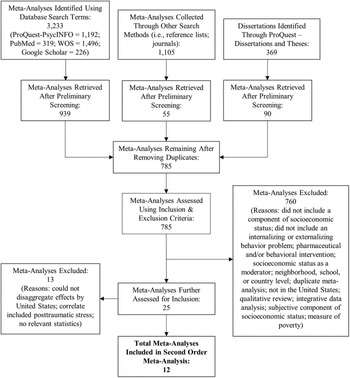
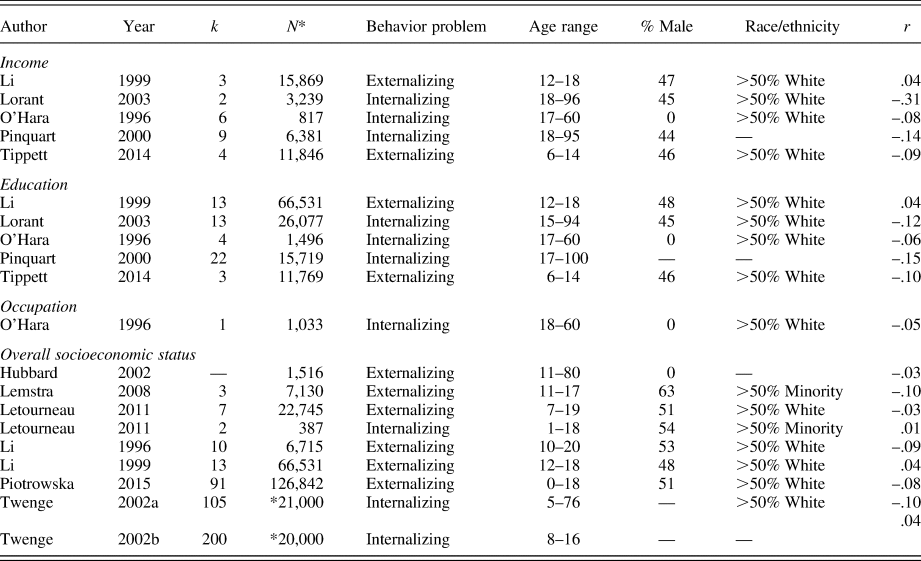
Twenty-five meta-analyses initially met our inclusion criteria (Figure 1). We later excluded 4 meta-analyses because they focused solely on posttraumatic stress disorder or symptoms, which are not generally considered internalizing or externalizing (Krueger, Reference Krueger1999). We also excluded 6 meta-analyses because we could not extract effect sizes that were specific to studies conducted in the United States. We excluded 3 additional meta-analyses because they did not provide sufficient statistics to compute Pearson's r. The remaining 12 meta-meta-analyses (17% unpublished), and approximately 474 primary studies and 327,617 participants, were included in our analyses. A list of the included meta-analyses and a description of their coded characteristics are provided in Table 1. The majority of effect sizes were estimated with overall socioeconomic status (47%), whereas 5 included income and education. We did not identify enough meta-analyses to estimate an average association between occupation and internalizing or externalizing. We were only able to extract one meta-analytic effect size associated with occupation.
Flow chart depicting screening and inclusion criteria.

Characteristics of meta-analyses included in second-order meta-analysis separated by component of socioeconomic status

Note: Author = last name of first author; k = number of primary studies included; N = number of participants included; asterisks = estimated number of participants; r = unweighted Pearson's r. Negative effect sizes indicate that lower income, education, occupation, or overall socioeconomic status is related to higher levels of internalizing or externalizing behavior problems. Dashes represent missing data.
Research Question 1: What is the magnitude of the associations between income, education, occupation, and overall socioeconomic status and behavior problems?
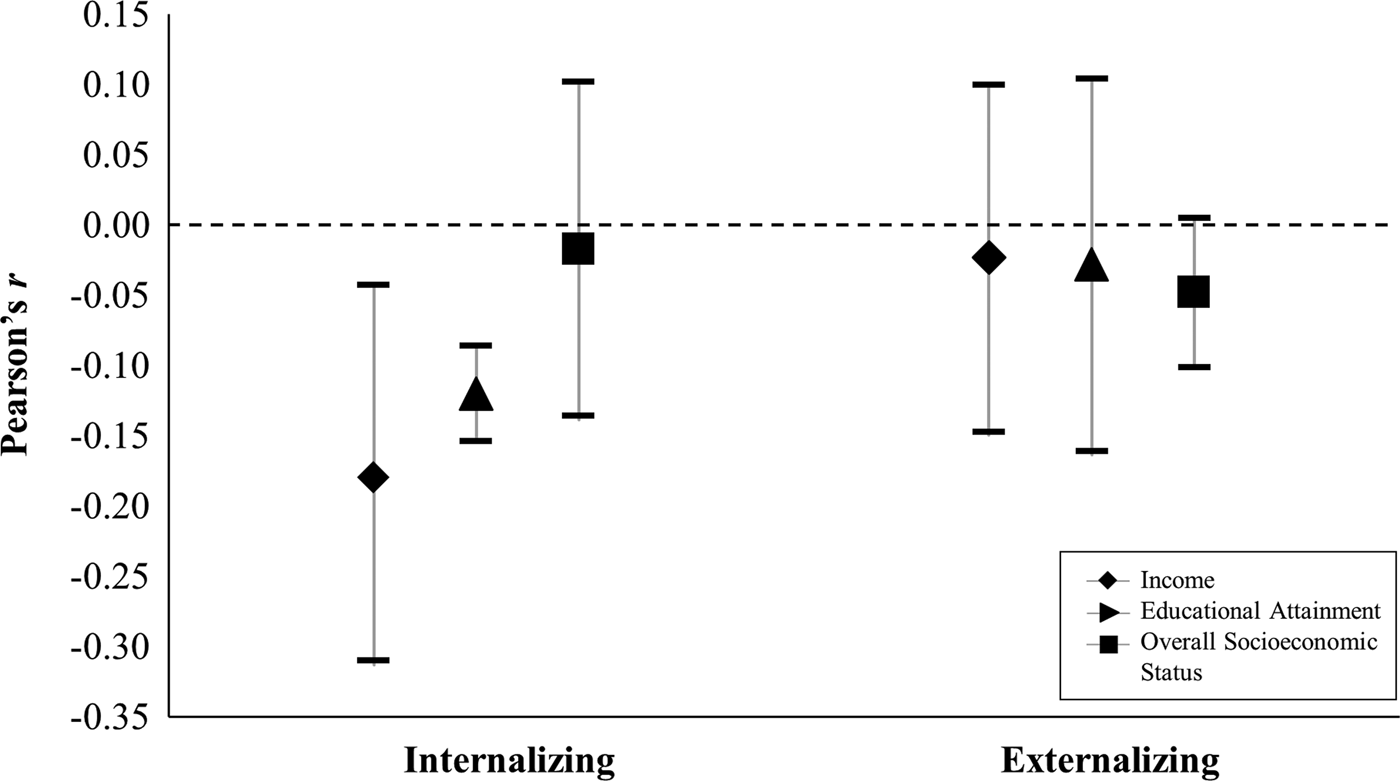
We examined the link between components of socioeconomic status and internalizing. We found a negative weighted average association between income and internalizing behavior problems, r + = –.18, τ2 = .015, I 2 = 97.53, 95% CI [–.31, –.04]. This suggests that lower income is associated with higher levels of internalizing, and vice versa. We also found a negative weighted average association between education and internalizing behavior problems, r + = –.12, τ2 = .001, I 2 = 89.14, 95% CI [–.15, –.09]. This suggests that lower education is associated with higher levels of internalizing, and vice versa. Relative to income and education, the weighted average association between overall socioeconomic status and internalizing behavior problems was smaller in magnitude and included zero in the CI, r + = –.02, τ2 = .010, I 2 = 99.10, 95% CI [–.14, .10]. The unweighted average associations were similar in magnitude to the weighted averages for income (r = –.18, SD = .121), education (r = –.11, SD = .050), and overall socioeconomic status (r = –.02, SD = .078). A comparison of the weighted average associations between components of socioeconomic status and internalizing is presented in Figure 2.
A comparison between components of socioeconomic status for internalizing and externalizing behavior problems. Solid vertical lines through markers represent the 95% confidence interval of the weighted average associations. The dashed horizontal line represents an association of zero. Negative values indicate that lower income, education, occupation, or overall socioeconomic status is related to higher levels of internalizing or externalizing behavior problems.

Next, we examined the link between components of socioeconomic status and externalizing. We found a smaller weighted average association between income and externalizing, r + = –.02, τ2 = .008, I 2 = 99.09, 95% CI [–.15, .10], relative to internalizing. Likewise, we found a smaller weighted average association between education and externalizing, r + = –.03, τ2 = .009, I 2 = 99.46, 95% CI [–.16, .10]. In regard to overall socioeconomic status, we found a small weighted average association with externalizing, r + = –.05, τ2 = .005, I 2 = 99.29, 95% CI [–.11, .01]. The unweighted average associations were similar in magnitude to the weighted averages for income (r = –.02, SD = .090), education (r = –.03, SD = .096), and overall socioeconomic status (r = –.05, SD = .052). It is noteworthy that the CIs of the associations between socioeconomic status and externalizing included zero. A comparison of the weighted average associations between components of socioeconomic status and externalizing is presented in Figure 2.
Research Question 2: Are these associations moderated by age, sex, and race/ethnicity?
We examined the role of moderators in the link between components of socioeconomic status and internalizing. Among the meta-analyses we identified on the association between income and internalizing behavior problems, all included samples of mixed ages (i.e., children, adolescents, and adults) and greater than 50% females. Two were primarily composed of European American/White participants (i.e., greater than 50%). We could not extract sufficient information to estimate the racial/ethnic composition of one meta-analysis. In relation to education and internalizing, all meta-analyses included samples of mixed ages and two included samples with a majority of female and European American/White participants. We could not extract sufficient information to estimate the sex and racial/ethnic composition of one meta-analysis.
Of the meta-analyses on the association between overall socioeconomic status and internalizing, two included samples composed of adolescents and children only and one included a sample of mixed ages. Due to the limited number of meta-analyses between the two age groups (i.e., children and adolescents only vs. mixed ages), we did not compare the magnitude of effect sizes between the subgroups. However, to examine the average association among children and adolescents only, we excluded the meta-analysis composed of mixed ages and found a more precise estimate of the weighted average association between overall socioeconomic status and internalizing, r + = .04, τ2 = .000, I 2 = 0.0, 95% CI [.03 .06], compared to the weighted average association across age ranges, r + = –.02, 95% CI [–.14, .10]. Among meta-analytic samples composed of children and adolescents only, higher overall socioeconomic status was related to higher levels of internalizing. We could not extract sufficient information to estimate the sex and racial/ethnic composition of one meta-analysis.
Next, we examined the role of moderators in the link between components of socioeconomic status and externalizing. Among the meta-analyses we identified on the association between income and externalizing, all included samples of children and adolescents only, and greater than 50% females and European American/White participants. Sample compositions were similar for the included meta-analyses on education and externalizing.
Among meta-analyses on the association between overall socioeconomic status and externalizing, four included samples composed of adolescents and children only and two included samples of mixed ages. We did not find a difference between the magnitude of weighted average associations, Q* between = 0.06, p = .806, for meta-analytic samples composed of children and adolescents only, r + = –.04, τ2 = .005, I 2 = 99.56, 95% CI [–.11, .03], and for mixed ages, r + = –.06, τ2 = .001, I 2 = 73.89, 95% CI [–.16, .05].
In regard to the sex composition, four meta-analyses included samples of greater than 50% males and two included samples of greater than 50% females. We found differences in the magnitude of associations, Q* between = 8.45, p = .004. Meta-analytic samples with greater than 50% males had a larger weighted average association between overall socioeconomic status and externalizing, r + = –.07, τ2 = .001, I 2 = 95.07, 95% CI [–.11, –.04], compared to samples with greater than 50% females, r + = .01, τ2 = .002, I 2 = 85.90, 95% CI [–.04, .06].
Finally, three meta-analytic samples were composed of greater than 50% European American/White participants and one included a majority of racial/ethnic minority participants. For this reason, we could not test moderation by race/ethnicity. However, we explored how the effect size changed when we excluded the meta-analysis composed mostly of racial/ethnic minority participants. We found that the weighted average association between overall socioeconomic status and externalizing was reduced in magnitude, r + = −.02, τ2 = .003, I 2 = 98.68, 95% CI [–.09 .04], compared to the weighted average association across all racial/ethnic compositions (r + = –.05).
Discussion
While ample evidence supports a general association between socioeconomic status and behavior problems (Wadsworth et al., Reference Wadsworth, Evans, Grant, Carter, Duffy and Cicchetti2016), it is unclear how internalizing and externalizing relate to specific components of socioeconomic status (Diemer et al., Reference Diemer, Mistry, Wadsworth, López and Reimers2013). For this reason, we synthesized meta-analytic research using a second-order meta-analysis to aggregate across approximately 474 primary studies and 327,617 participants on the association between components of socioeconomic status and internalizing and externalizing behavior problems. In relation to internalizing, we found small average associations for income and education, and a smaller average association for overall socioeconomic status. Moreover, we found that the average associations of income, education, and overall socioeconomic status with externalizing were small in magnitude. Only the association between overall socioeconomic status and externalizing behavior problems was moderated by the sex composition of the meta-analytic sample. These findings contribute toward building a cumulative discipline on the link between components of socioeconomic status and psychopathology.
As we hypothesized, the associations between income and internalizing, as well as education and internalizing, were both larger in magnitude than the association of overall socioeconomic status and internalizing. However, in contrast to our hypothesis, the associations of income and education with internalizing were similar in magnitude. Such findings lend further credence to the idea that it is worthwhile to more deeply examine pathways through which each component of socioeconomic status connects to various types of internalizing (Duncan & Magnuson, Reference Duncan, Magnuson, Bornstein and Bradley2003). One advantage to such an approach is that it could elucidate which environmental factors to target in policy and interventions. For instance, for those interested in addressing the problems associated with socioeconomic status, composite indices present a conundrum. On one hand, a negative association between indices of socioeconomic status and certain behavior problems may reflect a type of higher order effect of resources (or deficits) connected to power and prestige. On the other hand, indices of socioeconomic status may obscure more specific lower order effects linked to a particular component.
Determining the more precise connections between behavior problems, socioeconomic status, and its components, thus, becomes critical if one is to effectively target prevention and intervention efforts. It is best practice to examine components independently as well as collectively (American Psychological Association, Task Force on Socioeconomic Status, 2007; Duncan & Magnuson, Reference Duncan, Magnuson, Bornstein and Bradley2003). Estimating the associations of specific components, however, is complicated because these associations can vary by age, sex, and race/ethnicity (Bradley, Reference Bradley and Friedman2016; McLoyd, Reference McLoyd1998; Reiss, Reference Reiss2013; Shavers, Reference Shavers2007). Moreover, individual perceptions of these experiences are also likely to impact the development of abnormal behavior (Cicchetti & Cohen, Reference Cicchetti, Cohen, Cicchetti and Cohen1995). Therefore, focusing on specific components of socioeconomic status is likely to be useful in delineating how access to particular resources are implicated in various types of internalizing at different points in the life course across demographic groups.
The need for additional research on specific components of socioeconomic status and on overall composites is further supported by the wide CIs observed for the relations of income and overall socioeconomic status with internalizing. The range of these associations suggests that processes associated with income may function differently for various demographic subgroups and there might be trade-offs that occur between resources in different groups. Moveover, there are multiple types of internalizing behavior problems, some of which are more likely present in females versus males, in younger versus older individuals, and for individuals living in different geographic regions (Fiske, Wetherell, & Gatz, Reference Fiske, Wetherell and Gatz2009; Rosen et al., Reference Rosen, Targum, Terman, Bryant, Hoffman, Kasper and Rosenthal1990; Shim, Baltrus, Ye, & Rust, Reference Shim, Baltrus, Ye and Rust2011; Thapar, Collishaw, Pine, & Thapar, Reference Thapar, Collishaw, Pine and Thapar2012). In addition, internalizing problems are often comorbid with other health and psychological problems (Kang et al., Reference Kang, Kim, Bae, Kim, Shin, Yoon and Kim2015; Luthar & Sexton, Reference Luthar and Sexton2007; Maier & Falkai, Reference Maier and Falkai1999). Thus, pathways connecting socioeconomic status to various internalizing behavior problems are likely to vary (Hankin et al., Reference Hankin, Snyder, Gulley, Schweizer, Bijttebier, Nelis and Vasey2016).
Our findings regarding the relation between education and internalizing contrast with the findings for income and overall socioeconomic status; specifically, the CIs were quite narrow. This suggests that education may have a more consistent influence on reducing the likelihood of internalizing compared to income and overall socioeconomic status. Having more education typically enables individuals to make more informed choices and to exercise more effective problem solving, both of which should reduce anxiety and feelings of hopelessness (Hahn & Truman, Reference Hahn and Truman2015; Hout, Reference Hout2012). More education also increases the likelihood that one will have sufficient income to meet life's needs. Therefore, a useful policy for reducing anxiety and depression may be to increase opportunities for formal education, as a preventive mechanism and as part of treatments for those who display internalizing. At the same time, we acknowledge the possibility that there can be bidirectional effects. For instance, appropriate, early intervention for depression and anxiety could give young people the added motivation and strength to persevere through the process of pursuing higher education.
In addition, we found that the average associations between income, education, and overall socioeconomic status and externalizing were similar in magnitude. However, we found wider CIs for the effect sizes of income and education compared to the CI for overall socioeconomic status. This pattern of variability reflects, in part, that some types of externalizing behavior problems are more susceptible to the influence of socioeconomic status (Piotrowska, Stride, Croft, & Rowe, Reference Piotrowska, Stride, Croft and Rowe2015). There is evidence that perceived social status may sometimes be a bigger factor for some types of externalizing behaviors (e.g., aggression) than objective components of socioeconomic status (Greitemeyer & Sagioglou, Reference Greitemeyer and Sagioglou2016). Another part of this complexity may be attributed to the nonlinear relation between components of socioeconomic status and externalizing across multiple levels (e.g., family, neighborhood, and school). For instance, students in affluent suburban schools have reported similar levels of delinquency as compared to students in low-income, inner-city schools (Ansary & Luthar, Reference Ansary and Luthar2009). Students in affluent suburban schools tended to indicate random acts of rule breaking (e.g., stealing from a parent or defacing property), whereas the students in low-income schools endorsed items potentially implicated in self-defense (e.g., getting into fights or carrying a weapon; Ansary & Luthar, Reference Ansary and Luthar2009). Similarly, as previously noted, research has shown that average school-level income was a more consistent predictor of externalizing for students in schools with a higher average income level, whereas family and neighborhood income were less consistent (Coley et al., Reference Coley, Sims, Dearing and Spielvogel2017). Among males, however, family income was predictive of externalizing, but at low- and high-income levels (Coley et al., Reference Coley, Sims, Dearing and Spielvogel2017). Overall, the results suggest the importance of the sample used in studies and the range of income or education present in a sample.
Heterogeneity is also likely to contribute to the wide range of CIs among some of our findings. We found a large amount of heterogeneity between the meta-analytic effects as noted by the I 2 estimates (range 89.14–99.46). These estimates suggest that between 89% and 99% of variability across the included meta-analyses is attributed to systematic error, which may be ascribed to the potential role of moderators. Unfortunately, we could not fully examine these differences to address our second research question because the age, sex, and racial/ethnic composition of meta-analytic samples were similar across the meta-analyses included in this study. The majority of the meta-analyses on the association between components of socioeconomic status and internalizing were of samples with mixed ages, and with more than 50% female and European American/White participants. Likewise, the meta-analyses on the association between components of socioeconomic status and externalizing consisted of samples of children and adolescents only, and over 50% of female and European American/White participants.
Nonetheless, we found that when meta-analytic samples with only children and adolescents were included in the association between overall socioeconomic status and internalizing behavior problems (excluding one meta-analytic sample of mixed ages), the estimate of the average association had a narrower CI, thus, was more precise. The association between overall socioeconomic status and internalizing was positive, suggesting that among children and adolescents higher socioeconomic status was related to more depressive symptoms, for instance. This is not surprising given the accumulating literature on the effects of family affluence on development. There is increasing evidence of high levels of anxiety and depression among youth in schools serving mostly affluent families (Geisz & Nakashian, Reference Geisz and Nakashian2018). In high-achieving settings, students experience pressures to achieve and distinguish themselves from their (also very accomplished) peers in the race for acceptance to the very best colleges (Luthar & Kumar, Reference McLaughlin, Breslau, Green, Lakoma, Sampson, Zaslavsky and Kessler2018). It also connects to studies showing increasing episodes of major depression among teens, especially girls, over the past decade (Mojtabai, Olfson, & Han, Reference Mojtabai, Olfson and Han2016). Of note, the increase in depression has been accompanied by an increase in the use of alcohol and drugs as well. Among suburban youth followed longitudinally through the age of 28, psychiatric diagnoses of dependence on drugs or alcohol were found at rates two to three times higher than those in national normative samples (Luthar, Small, & Ciciolla, Reference Luthar, Small and Ciciolla2018). These disparate patterns are consistent with relational developmental systems theory in that they show how multiple aspects of context interplay to affect development (Lerner et al., Reference Lerner, Johnson and Buckingham2015). Thus, research on children and adolescents that includes socioeconomic status as a potential contributor to internalizing should consider the nonlinearity of this association because individuals throughout the gradient (i.e., low and high) are likely at risk. Studies would also do well to include measures of other aspects of context that may be implicated in internalizing problems.
We also found a difference in the magnitude of association for overall socioeconomic status and externalizing between sex sample compositions. In line with our third hypothesis, we found that the average association between socioeconomic status and externalizing for samples with more male participants was larger in magnitude compared to samples with more females. This finding provides some support for evidence of sex differences in the associations with socioeconomic status and behavior problems (e.g., Bradley, Reference Bradley and Friedman2016; Shavers, Reference Shavers2007). Males of lower socioeconomic status are likely at an increased risk for developing externalizing problems compared to females, which is consistent with the idea that socialization pressures may influence the onset and trajectories of externalizing differently for males and females (Zahn-Waxler et al., Reference Zahn-Waxler, Crick, Shirtcliff, Woods, Cicchetti and Cohen2006). However, more evidence is needed to support these findings because this pattern was not detected in meta-analyses with samples composed exclusively of male participants. Furthermore, externalizing problems among high socioeconomic status males may be somewhat underestimated in the current literature, because many can be of more covert nature and less likely to be detected and reported (e.g., cheating in school and white-collar crimes in adulthood).
Considering culture in future research is also important in light of findings showing an increased prevalence of depression for Whites (Mojtabai et al., Reference Mojtabai, Olfson and Han2016). This is central given that socioeconomic status, as a cultural processes, shapes the development of psychopathology among all racial/ethnic groups, including European Americans/Whites (Causadias, Reference Causadias2013). Recognizing this issue is important, given that many psychologists and developmental scientists subscribe to the unsupported assumption that culture is more important for racial/ethnic minorities than for Whites (Causadias, Vitriol, & Atkin, Reference Causadias, Vitriol and Atkin2018a, Reference Causadias, Vitriol and Atkin2018b). For this reason, future research should examine how specific dimensions of social status and behavior problems are connected to biological systems in general (Causadias, Telzer, & Gonzales, Reference Causadias, Korous, Causadias, Telzer and Gonzales2018; Causadias, Telzer, & Lee, Reference Causadias, Telzer and Lee2017), and genes in particular (Causadias & Korous, Reference Causadias, Telzer, Gonzales, Causadias, Telzer and Gonzales2018). After all, cultural, ecological, and biological processes are engaged in reciprocal causation at different points in time with probabilistic implications in the development of psychopathology and adaptation (Causadias, Reference Causadias2013). Because this study focused on data from studies conducted in the United States, future research should investigate how socioeconomic status, as a cultural process, is related to the development of psychopathology in other nations. Moreover, studies should inquire how American values, related to individual success and status, can be transmitted to individuals through acculturation processes. After all, with increased globalization over the years and greater access to prestigious universities, it is possible that the pressures to achieve and accomplish ever more may affect youth across various parts of the world (Luthar & Kumar, Reference Luthar, Kumar, Leschied, Saklofske and Flett2018).
Moreover, a clear pattern emerged across these findings. Regardless of the component of socioeconomic status, its association with internalizing and externalizing behavior problems was small in magnitude by Cohen's (Reference Cohen1992) conventions. It is important to acknowledge though that even small effect sizes can be meaningful for policy and interventions because a small overall effect size in a broad population may obscure a stronger effect in particular subpopulations. In addition, Rosenthal (Reference Rosenthal1990) discussed that small associations can have practical importance, as the relation between aspirin and reduced heart attacks would be considered small in magnitude (r = .04). Therefore, despite the magnitude of our estimates, it is necessary to investigate how to buffer the associations between components of socioeconomic status and behavior problems because the accumulation of small effects over time can have considerable impact (Thompson, Reference Thompson2007). For example, a biological response to stressors can be beneficial in the short term because it distributes resources throughout the body to facilitate adaptation, although repeated activation of this response by chronic exposure can lead to structural and functional changes of the brain that reduce self-regulatory capacities (McEwen & McEwen, Reference McEwen and McEwen2017). Furthermore, the effect size estimates obtained in this study have practical implications, as they can be useful in planning future investigations on socioeconomic status and behavior problems. These effect sizes can be used to conduct power analyses to determine optimal sample sizes and reach more valid conclusions (Cumming, Reference Cumming2013).
There are several limitations to our study related to the effect size metric and meta-analytic methodology. First, the magnitude of our estimated average associations can be attenuated by a lack of linearity (Goodwin & Leach, Reference Goodwin and Leech2006). This is likely a concern for meta-analyses using Pearson's r as an index of the relation between components of socioeconomic status and behavior problems. Using indices of mean-level differences (i.e., Cohen's d or Hedges’ g) or dichotomous distributions (e.g., odds ratio) to examine differences between subgroups (e.g., low vs. medium, low vs. high, or medium vs. high socioeconomic status) could overcome this limitation. Future work could also assess Pearson's r within clusters of socioeconomic subgroups. For instance, one approach would be to examine the association between income and behavior problems separately for individuals with low, medium, and high education. Such study could help elucidate whether resources associated with components of socioeconomic status act in an additive or multiplicative way. Furthermore, correlations do not provide evidence of directionality, that is, if low socioeconomic status increases or decreases internalizing or externalizing, or if these behavior problems lead to lower or higher socioeconomic status. This is important for evaluating the causation versus selection hypothesis (Dohrenwend et al., Reference Dohrenwend, Levav, Shrout, Schwartz, Naveh, Link and Stueve1992). The causation hypothesis argues that low socioeconomic status, which limits access to resources, contributes to psychological distress and deviant behavior, whereas the selection hypothesis suggests that those with poorer physical and mental health drift down from high to low socioeconomic status (Dohrenwend et al., Reference Dohrenwend, Levav, Shrout, Schwartz, Naveh, Link and Stueve1992). There is empirical evidence for both hypotheses, which has led to alternative frameworks such as the interactionist perspective, which posits a reciprocal relation between individual characteristics (e.g., behavior problems) and socioeconomic context (Conger & Donnellan, Reference Conger and Donnellan2007). Future research should test these hypotheses using experimental designs and interventions (see Duncan et al., Reference Duncan, Magnuson and Votruba-Drzal2017).
A second set of limitations is related to meta-analytic methods. Meta-analyses can only examine what has been published or can be accessed. In our study, we used meta-analyses as a unit of analysis and, therefore, could only examine what has been previously meta-analyzed. For this reason, we could not examine the association between occupation and internalizing and externalizing. This leaves a gap in the current literature for future meta-analyses to address. We were also not able to test our moderators fully. For instance, across the meta-analyses we identified, none included a sample composed of adult participants only. Therefore, we could not test our second hypothesis. It remains unclear how age, sex, and race/ethnicity impact the magnitude of our estimated associations between components of socioeconomic status and internalizing and externalizing. Second-order meta-analyses can contribute to advancing meta-analytic research because they can increase awareness of full and transparent reporting of results, similar to the impact of meta-analyses on reporting standards of primary studies (Gurevitch et al., Reference Gurevitch, Koricheva, Nakagawa and Stewart2018). Moreover, future studies can take advantage of additional methodologies to examine moderators more specifically such as meta-analysis using individual participant data (Stewart et al., Reference Stewart, Clarke, Rovers, Riley, Simmonds, Stewart and Tierney2015). For instance, individual participant data meta-analyses can assess how increments in age moderate the association between education and internalizing, and income and internalizing. Future research using this approach can also model curvilinear associations with behavior problems and examine them across other components of socioeconomic status (e.g., subjective socioeconomic status, wealth, and free or reduced lunch) and multiple levels (e.g., school, neighborhood, and country) in comparison to the common components.
Despite these shortcomings, this study makes a valuable contribution to our understanding of the association between socioeconomic status and behavior problems. Primary studies on this topic over the last decades have improved our knowledge on the interplay of culture, development, and psychopathology (Causadias, Reference Causadias2013). However, the rapid proliferation of this research can be challenging to integrate into theory, policy, and interventions. Forscher (Reference Forscher1963) used a construction metaphor to criticize how pressures for scientific productivity can lead to the rapid production of primary studies (fabrication of bricks), resulting in the growth of the number of publications (bricks). Instead of advancing the field by creating a cohesive body of work (buildings), this increased number of publications can lead to confusion and fragmentation of knowledge (chaos in the brickyard; Forscher, Reference Forscher1963). Our second-order meta-analysis on the link between socioeconomic status and behavior problems is an important step toward organizing this growing body of research. By putting order in the brickyard, we believe our study underscores the complex ways in which culture relates to the development of psychopathology.