Introduction
Smoking cessation appears to result in increased happiness and life satisfaction in most cases (Steuber & Danner, Reference Steuber and Danner2006; West & Jarvis, Reference West and Jarvis2005; Shahab & West, Reference Shahab and West2009). The question arises as to whether smoking reduction might have a similar effect – albeit to a lesser degree. This is an important question given that a much larger proportion of smokers at any one time are attempting to reduce the amount they smoke rather than quit (Beard, Fidler & West, Reference Beard, Fidler and West2011a; Beard et al., Reference Beard, McNeill, Aveyard, Fidler, Michie and West2011b; Beard et al., Reference Beard, McNeill, Aveyard, Fidler, Michie and West2011c; Levy, Thorndike, Biener & Rigotti, Reference Levy, Thorndike, Biener and Rigotti2007; Hammond et al., Reference Hammond, Reid, Driezen, Cummings, Borland, Fong and McNeill2008) and as smoking reduction has been mooted as a potential approach for those suffering from psychiatric disorders who often find it difficult to stop smoking abruptly.
Substantial evidence is accumulating from clinical trials and population-based studies that under certain circumstances smokers attempting smoking reduction experience significant declines in cigarette consumption and to a lesser extent toxin intake; with NRT augmenting these effects (Moore et al., Reference Moore, Aveyard, Connock, Wang, Fry-Smith and Barton2009; Beard et al., Reference Beard, McNeill, Aveyard, Fidler, Michie and West2011b; Beard et al., Reference Beard, McNeill, Aveyard, Fidler, Michie and West2011c; Hughes, Reference Hughes2000; Hughes & Carpenter, Reference Hughes and Carpenter2006; Fagerstrom, Reference Fagerstrom2005; Tonnesen, Reference Tonnesen2002; Zellweger; Wang et al., Reference Wang, Connock, Barton, Fry-Smith, Aveyard and Moore2008; Stead & Lancaster Reference Stead and Lancaster2007; Asfar, Ebbert, Klesges, & Relyea, Reference Asfar, Ebbert, Klesges and Relyea2011).
It is plausible that such declines in intake could have a positive impact on mental health. This could occur if smoking reduction leads to increased self-confidence and feelings of control, positive social effects (i.e. reduced feelings of stigmatisation) and/or improvements in general health. If smoking reduction does have positive effects on mental health, this may be one mechanism through which cutting down, and the use of NRT for smoking reduction, promotes subsequent cessation (Beard et al., Reference Beard, McNeill, Aveyard, Fidler, Michie and West2011b; Beard et al., Reference Beard, McNeill, Aveyard, Fidler, Michie and West2011c). A positive experience of cutting down may enhance well-being and make smokers feel more positive about complete abstinence.
Previous research suggests that there may be slight improvements in several quality of life domains in those cutting down as part of a formal smoking reduction intervention, but NRT does not appear to enhance this (Bolliger et al., Reference Bolliger, Zellweger, Danielsson, Biljon, Robidou and Westin2000; Joseph et al., Reference Joseph, Hecht, Murphy, Lando, Carmella and Gross2008; Rennard et al., Reference Rennard, Glover, Leischow, Daughton, Glover and Muramoto2006; Tonnesen et al., Reference Tonnesen, Pisinger, Hvidberg, Wennike, Bremann and Westin2005; Wennike, Danielsson, Landfelt, Westin & Tonnesen, Reference Wennike, Danielsson, Landfeldt, Westin and Tonnesen2003; Wood-Baker, Reference Wood-Baker2001). Those cutting down during a smoking cessation intervention have also demonstrated improvements in psychotic symptoms and mental health functioning (Morris et al., Reference Morris, Waxmonsky, May, Tinkelman, Dickinson and Giese2011). It is currently unclear whether similar findings occur outside of that clinical setting, where no behavioural support is provided. Moreover, no study has assessed the association with what one may call ‘positive mental health’: the ‘hedonic’ psychological components of ‘well-being’ (for example, happiness; Ryff & Keyes, Reference Ryff and Keyes1995; Hird, Reference Hird2003). This is despite the recognition that personal happiness is an important factor for mental health (James, Reference James1902). Although there are caveats with measuring these ‘hedonic’ variables, including their operationalisation (Shahab & West, Reference Shahab and West2009), research has found simple measures of happiness to predict physical health outcomes (Pressman & Cohen, Reference Pressman and Cohen2005; Steptoe, Wardle & Marmot, Reference Steptoe, Wardle and Marmot2005).
This study examined in a cross-sectional survey the associations of self-reports of smoking reduction and use of NRT for smoking reduction with standard ratings of happiness and life satisfaction. These findings will be of interest to the UK National Institute of Clinical Evidence committee on harm reduction, who recently called for evidence assessing the mental health impact of smoking reduction and the use of NRT for such purposes (http://guidance.nice.org.uk/PHG/Wave23/23/EvidenceConsultation), and all other countries who are considering licensing NRT for smoking reduction. Currently the UK is the only country where NRT is indicated for cutting down without an intention to quit, and in the near future aims to offer smoking reduction as an alternative treatment option in Stop Smoking Services (Medicines and Healthcare products Regulatory Agency, 2010; Croghan & Chambers, Reference Croghan and Chambers2011). A number of countries, including the US, are more reluctant due to a concern that it may have a negative population level impact.
Methods
Recruitment
Data for this study were obtained between January 2009 and April 2009 from the Smoking Toolkit Study (www.smokinginengland.info). This study consists of monthly cross-sectional household computer-assisted interviews of adults aged 16+ in England, carried out by the British Market Research Bureau. The baseline survey uses a form of random location sampling, with respondents drawn from 165,665 aggregated output areas, each containing 300 households. These output areas are stratified by ACORN characteristics (http://www.caci.co.uk/acorn/acornmap.asp). See Fidler et al. (Reference Fidler, Shahab, West, Jarvis, McEwen and Stapleton2011) for further details of the Smoking Toolkit Study design and methodology.
Measures
Current smokers were asked questions about socio-demographic and smoking characteristics (i.e. gender, age, social-grade and time to first cigarette of the day). Smokers were also asked: Are you currently trying to cut down on how much you smoke – (yes; no; don't know). If they answered ‘yes’, then they were asked: Which, if any, of the following are you currently using to help you cut down the amount you smoke? – (nicotine patch; nicotine gum; nicotine lozenges/tablets; nicotine inhaler; nicotine nasal spray; I don't know, none of these; other). To measure happiness, smokers were asked: ‘Some people are generally very happy. They enjoy life regardless of what is going on, getting the most out of everything. To what extent does this characterisation describe you?’ – (scale was given from 1 (not at all) to 7 great deal)’. Those reporting 1‒3 were categorised as ‘unhappy’, those reporting 4 as ‘neither unhappy nor happy’ and those reporting 5‒7 were categorised as ‘happy’. Finally, to measure quality of life, smokers were asked: ‘All things considered, how satisfied are you with your life as a whole? – (very satisfied; moderately satisfied; no feelings either way; moderately dissatisfied; very dissatisfied).
Analysis
Using SPSS version 18.0, associations between smoking reduction and the use of NRT for smoking reduction with happiness and life satisfaction, were assessed by least squares regression analyses; controlling for potential confounding variables as appropriate. Least squares regression analyses were also used to assess the extent of any reduction in daily cigarette consumption as a function of happiness and life satisfaction; 95% confidence intervals were used unless stated otherwise.
Results
Between January 2009 and April 2009 2011, 6,971 adults were surveyed; of whom 1,532 reported that they were current smokers. Fifty-two per cent of smokers were male (n = 793), with a mean age [Standard Deviation (SD)] of 39.8 (16.20) years. The percentages of participants residing in each social-grade were as follows: AB (13.2%; n = 203), C1 (26.6%; n = 408), C2 (25.0%; n = 382), D (21.7%; n = 333) and E (13.5%; n = 206). The mean (SD) daily cigarette consumption was 12.8 (8.02), with 25.2% (n = 386) reporting smoking after 61 minutes of wakening, 21.4% (n = 328) between 31‒60 minutes after wakening, 34.7% (n = 531) within 6‒30 minutes of wakening, and 18.7% (n = 286) less than 5 minutes after wakening. A total of 55.4% (n = 848) participants reported that they were attempting to cut down; with 15.4% (n = 235) using NRT for smoking reduction.
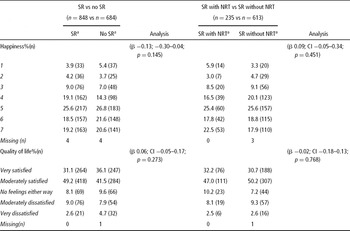
Table 1 shows the percentages of smokers reporting that they were ‘happy’ and ‘satisfied’ with their quality of life, as a function of attempts to cut down and the use of NRT for smoking reduction. There was no evidence of an association between attempts to cut down and either reported ‘happiness’ (β −0.13; −0.30–0.04; p = 0.145) or ‘life satisfaction’ (β 0.06; CI −0.05–0.17; p = 0.273). Nor was there any evidence of a difference in either ‘happiness’ or ‘life satisfaction’ amongst those using and not using NRT for smoking reduction [(β 0.09; CI −0.05–0.34; p = 0.451) and (β −0.02; CI −0.18–0.13; p = 0.768), respectively].
Reported Happiness and Life Satisfaction Among Respondents

Note: n = number; NRT = Nicotine Replacement Therapy; SR = smoking reduction.
a Data were weighted to match the 2001 census.
There was no evidence of an association between cigarette consumption and ‘happiness’ or cigarette consumption and ‘life satisfaction’ amongst those cutting down [[(β −0.00; CI −0.18–0.13; p = 0.768) and (β −0.00; CI −0.01–0.01; p = 0.991), respectively], and amongst those using NRT for smoking reduction [(β −0.00; CI −0.03–0.02; p = 0.693) and (β −0.00; CI −0.01–0.02; p = 0.510), respectively].
Discussion
Smoking reduction and the use of NRT for such purposes did not appear to be associated with either ‘happiness’ or ‘life satisfaction’. This suggests that complete cessation is necessary to achieve positive mental health benefits (Steuber & Danner, Reference Steuber and Danner2006; West & Jarvis, Reference West and Jarvis2005; Shahab & West, Reference Shahab and West2009), and makes it extremely unlikely that improved well-being mediates the association between smoking reduction or NRT use for smoking reduction and subsequent cessation (Beard et al., Reference Beard, McNeill, Aveyard, Fidler, Michie and West2011b; Beard et al., Reference Beard, McNeill, Aveyard, Fidler, Michie and West2011c; Moore et al., Reference Moore, Aveyard, Connock, Wang, Fry-Smith and Barton2009).
This study, to our knowledge, is the first study to assess the impact of attempts at smoking reduction, and the use of NRT for this purpose, on smokers’ ‘happiness’ and ‘life satisfaction’ at a population level. These findings will be of importance to the UK National Institute of Clinical Excellence who recently called for research on the association between mental health and attempts to cut down. These findings will also be of interest to other countries who are considering licensing NRT for smoking reduction and/or offering smoking reduction as a treatment option.
From these results it can be concluded that smoking reduction, with or without NRT, is unlikely to have any detrimental effects on smokers’ mental health. By contrast, smoking reduction leads to decreased toxin intake and promotes attempts to quit smoking (Moore et al., Reference Moore, Aveyard, Connock, Wang, Fry-Smith and Barton2009; Beard et al., Reference Beard, McNeill, Aveyard, Fidler, Michie and West2011b; Beard et al., Reference Beard, McNeill, Aveyard, Fidler, Michie and West2011c; Hughes, Reference Hughes2000; Hughes & Carpenter, Reference Hughes and Carpenter2006; Fagerstrom, Reference Fagerstrom2005; Tonnesen, Reference Tonnesen2002; Zellweger, Reference Zellweger2001; Wang et al., Reference Wang, Connock, Barton, Fry-Smith, Aveyard and Moore2008; Stead & Lancaster Reference Stead and Lancaster2007; Asfar, Ebbert, Klesges, & Relyea, Reference Asfar, Ebbert, Klesges and Relyea2011). Therefore, cutting down appears to be a viable and potentially lifesaving treatment option for smokers who are unwilling or unable to quit smoking.
It is of interest that these findings are in contrast to the slight improvements in several mental health measures reported in the clinical trials (Bolliger et al., Reference Bolliger, Zellweger, Danielsson, Biljon, Robidou and Westin2000; Joseph et al., Reference Joseph, Hecht, Murphy, Lando, Carmella and Gross2008; Rennard et al., Reference Rennard, Glover, Leischow, Daughton, Glover and Muramoto2006; Tonnesen et al., Reference Tonnesen, Pisinger, Hvidberg, Wennike, Bremann and Westin2005; Wennike, Danielsson, Landfelt, Westin & Tonnesen, Reference Wennike, Danielsson, Landfeldt, Westin and Tonnesen2003; Wood-Baker, Reference Wood-Baker2001). One explanation for this may be the cross-sectional nature of this study, in that those attempting smoking reduction could have been starting from a lower baseline level of happiness and life satisfaction, which resulted in any effect being masked. Prospective data would be needed to assess this. The current study also only examined smokers’ reports that they were attempting reduction. Previous research has found that outside of clinical trials such attempts are less effective (Beard, Fidler & West, Reference Beard, Fidler and West2011a; Beard et al., Reference Beard, McNeill, Aveyard, Fidler, Michie and West2011b; Beard et al., Reference Beard, McNeill, Aveyard, Fidler, Michie and West2011c). Therefore, it remains possible that if smokers were able to achieve more substantial reduction they could experience some benefit in positive mental health. There is some preliminary evidence for this. Moore (Reference Moore2009) reported that smokers who significantly reduced their cigarette consumption over an 11-year period, regardless of the reasons for this reduction, were more likely to report that they had ‘recently been feeling reasonably happy all things considered’. The reason that attempts are less effective at a population level may be that smokers under-use NRT or do not use it for long enough. This is something which requires consideration in the future. Finally, it is likely that other confounding factors in smokers’ lives may be suppressing any positive effects of smoking reduction, including poor physical health, inadequate social relationships and unemployment or money issues (Diener & Seligman, Reference Diener and Seligman2002; Ryff, Singer & Dienburg, Reference Ryff, Singer and Dienburg2004; Layard, Reference Layard2005)
Conclusion
Overall this study failed to find any benefit from attempting to reduce cigarette consumption or use of NRT for cutting down on happiness or life satisfaction. It seems likely that such benefits only occur from cessation or greater reduction than is currently achieved in the smoking population.
Funding
Data collection was funded by the English Department of Health, Cancer Research UK, Pfizer, Glaxo-SmithKline, and Johnson and Johnson, who had no involvement in the design of the study, the analysis or interpretation of the data, the writing of the report, or the decision to submit the paper for publication. EB is funded by a fellowship from the UK Centre for Tobacco Control Studies. RW is funded by Cancer Research UK.
Declaration of interests
RW undertakes research and consultancy and receives fees for speaking from companies that develop and manufacture smoking cessation medications. He also has a share of a patent for a novel nicotine delivery device. JB and EB have received an unrestricted research grant from Pfizer.
Ethical Standards
The authors assert that all procedures contributing to this work comply with the ethical standards of the relevant national and institutional committees on human experimentation and with the Helsinki Declaration of 1975, as revised in 2008.