Introduction
The disparity between otolaryngology undergraduate medical educational provision and frequency of exposure to patients presenting with otolaryngology/ear, nose and throat (ENT) pathologies in medical practice is well established.Reference Morris and Pracy1, Reference Donnelly, Quraishi and McShane2 ENT pathologies make up a significant proportion of general practitioner workload, representing 25 per cent of adult and 50 per cent of paediatric consultations respectively.Reference Griffiths3 Lack of exposure to otolaryngology in the undergraduate medical curriculum in the UK is a long-standing issue, making up an average of one week of the five-year undergraduate medical course.Reference Powell, Cooles, Carrie and Paleri4 Surveys of general practitioners, who make up the majority of the medical workforce, have consistently identified lack of ENT experience in undergraduate and postgraduate medical education as an issue, given the frequency with which these pathologies are encountered in clinical practice.Reference Clamp, Gunasekaran, Pothier and Saunders5 As such, advancements in the delivery of otolaryngology content in the undergraduate curriculum could bridge the gap between current exposure and the knowledge base required for safe clinical practice.
Previous systematic reviews pertaining to undergraduate medical education in ENT undertaken in the pre-coronavirus disease 2019 (Covid) era have consistently called for improvements in the delivery of undergraduate educational content. Ferguson et al.Reference Ferguson, Bacila and Swamy6 undertook a systematic review in 2016 and found the majority of fifth-year medical students and junior doctors did not feel adequately prepared for practice in their ENT rotation. Yip et al.Reference Yip, Soh and Lim7 undertook a further systematic review aimed at establishing innovations in otolaryngology undergraduate and postgraduate medical education. They found that while some interventions were effective in objectively improving participant skills and knowledge, these were primarily aimed at postgraduate learners. Furthermore, they called for further research and innovation in the field of medical education provision in otolaryngology.Reference Yip, Soh and Lim7
The coronavirus disease 2019 (Covid-19) pandemic has been highlighted in the medical education literature as a significant opportunity for implementation of novel, technology-led teaching adjuncts to improve the quality of undergraduate medical education.Reference Mehta, Sayed, Sharma and Do8 There is a growing body of literature pertaining to the advances already made in medical education in surgical specialities during the Covid-19 pandemic.Reference Koljonen, Puolakkainen and Helenius9–Reference Luck, Gosling and Saour11 However, there have been no attempts known to us to document these advancements in undergraduate otolaryngology training, following the Covid-19 pandemic. Here we present an updated systematic review of the literature with narrative analysis to establish recent advancements in otolaryngology undergraduate medical education following the Covid-19 pandemic.
Methods
Literature search
A literature search was undertaken using four databases (MEDLINE, Embase, Cochrane and Education Resources Information Center (ERIC)) to establish all studies pertaining to undergraduate medical education provision in otolaryngology. The search was undertaken on 31 December 2024. Reference lists of manuscripts included for review were appraised to establish additional potential articles eligible for inclusion. The keyword search terms used during the search are outlined in Table 1.
Keyword search terms

Inclusion criteria and data extraction
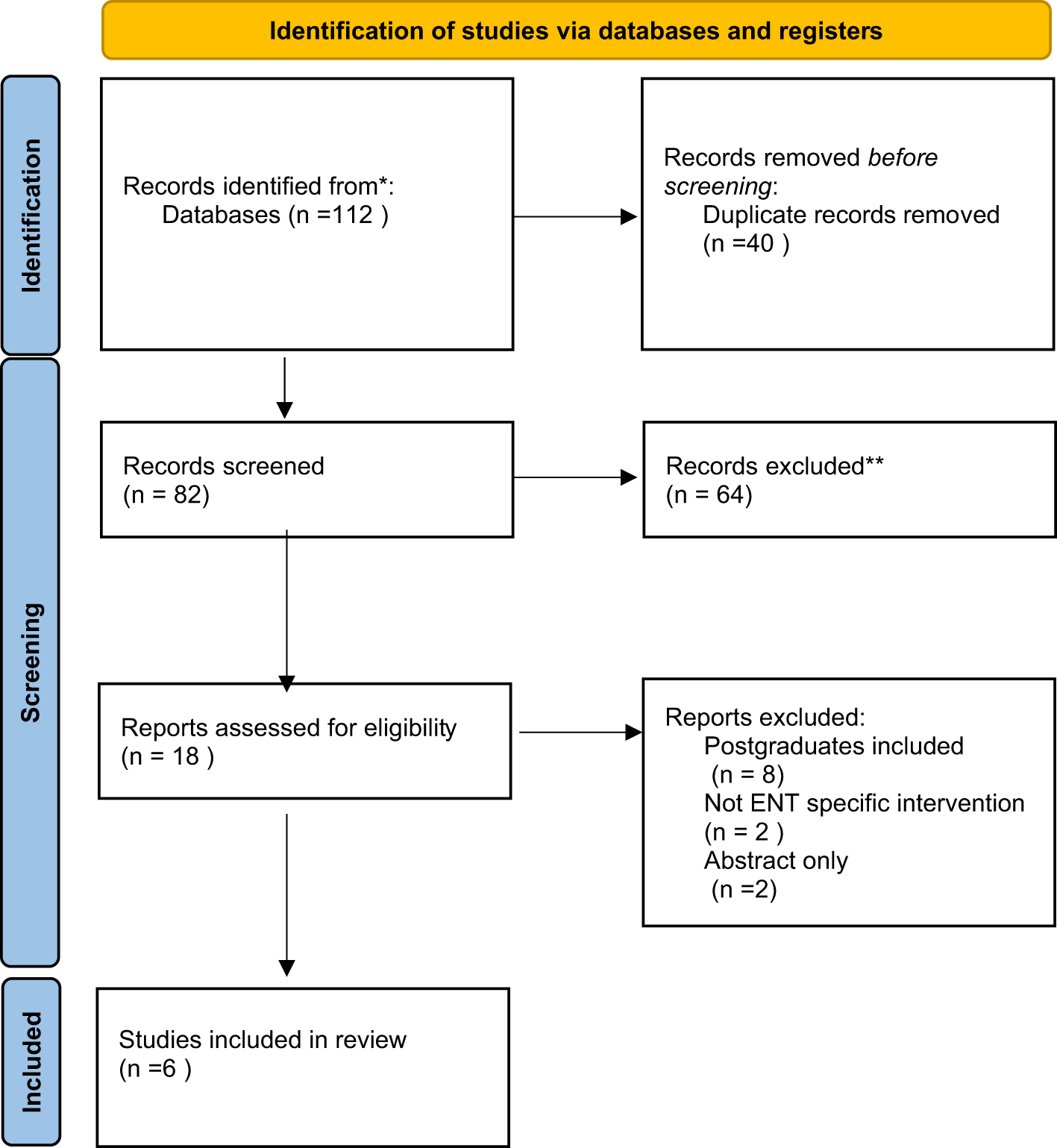
Inclusion and exclusion criteria were formulated following a consensus discussion by all authors. Abstract review was undertaken by two independent reviewers (TD + TH) using the inclusion criteria outlined in Table 2. Full text review was then undertaken, and eligible manuscripts were identified for data extraction. The Preferred Reporting Items for Systematic Review and Meta-Analyses (‘PRISMA’) guidelines were adhered to in reporting outcomes of literature search and review (Figure 1). A data extraction tool was formulated and following data extraction, included studies were subject to critical appraisal.
Inclusion and exclusion criteria

Prisma diagram to demonstrate outcomes of search and literature review.

Bias assessment and qualitative synthesis
Bias assessment was undertaken for non-randomised interventional studies using the Risk of Bias in Non-randomised Studies (ROBINS-1) tool.Reference Sterne, Hernán, Reeves, Savović, Berkman and Viswanathan12 Risk of bias was assessed for randomised control trials using the Cochrane bias assessment tool.Reference Sterne, Savović, Page, Elbers, Blencowe and Boutron13 The Newcastle–Ottawa scale was used to assess risk of bias in questionnaire studies. Included studies were subdivided into educational advancements and medical-student perspectives.Reference Stang14 A narrative analysis was undertaken to present the results of included studies.
Results
Search results
We identified112 papers following the initial literature search. At the time of search formatting, 40 duplicate publications were excluded. Initial abstract review of 82 papers yielded 18 papers for full manuscript review. Reasons for exclusion are outlined in the ‘PRISMA’ diagram shown in Figure 1. Following full manuscript review of 18 manuscripts, six papers met inclusion criteria for bias assessment and narrative analysis (Tables 3, 4).Reference Malik, Abbas, Jayarajah, Bruce and Tolley15–Reference Patel, Parmar, Gera, Hannan and Saeed20
Included manuscripts detailing an intervention in undergraduate otolaryngology medical education

Included manuscripts detailing questionnaires aimed at establishing current educational practices in undergraduate otolaryngology education

Assessment of bias
Six included studies were assessed for risk of bias using the tools outlined above. There were some concerns regarding risk of bias in the randomised control trial by Malik et al. The limitations included lack of details on allocation concealment, unclear missing data handling, and assessors may not have been blinded, risking measurement bias.Reference Malik, Abbas, Jayarajah, Bruce and Tolley15 The cohort study performed by O’Hagan and Sunnucks was found to have a moderate risk of bias. The limitations of their study lay in not addressing key confounders, selection bias due to self-selection of students, and the use of subjective outcome measures.Reference O’Hagan and Sunnucks16 The cohort study by Pandya et al. also had high risk of bias. Key limitations included lack of adjustment for confounding variables, potential selection bias, possible missing data bias, and self-reported outcome bias.Reference Pandya, Mistry and Owens17 The questionnaire cohort study by Lancaster et al. was found to have a moderate risk of bias (Newcastle–Ottawa scale 6/9) The study has strong selection and comparability but lacks follow-up data and sample size justification.Reference Lancaster, Salih and Tolley18 The questionnaire cohort study by Mayer et al. was found to have a high risk of bias (Newcastle–Ottawa scale 3/9) due to limited sample justification, non-response bias, lack of confounder control, and no long-term follow-up.Reference Mayer, Smith and Carrie19 The questionnaire cohort study by Patel et al. was found to have a moderate risk of bias (Newcastle–Ottawa scale 6/9). Strengths of their study included a good sample representation, confounder control, and structured assessment. Weaknesses of their study included lack of sample size justification and follow-up data.Reference Patel, Parmar, Gera, Hannan and Saeed20
The authors felt that none of these six studies warranted pre-analysis exclusion based on bias score even though levels of bias were heterogenous. Instead, we present the narrative review below for increased transparency, but comments on quality of research also are raised in the discussion.
Narrative analysis
Advances in undergraduate education provision
Malik et al. undertook a randomised control trial aimed at utilising HoloLens (Microsoft, Redmond, Washington) mixed reality in distance learning in the undergraduate medical setting.Reference Malik, Abbas, Jayarajah, Bruce and Tolley15 Students were randomised to a mixed-reality versus conventional distance-learning teaching arm. Seventy-three pre-clinical medical students were recruited from four UK medical schools. HoloLens was found to significantly improve student performance (p < 0.001) on a pre- and post-teaching quiz, when compared to conventional distance-learning methods. Students warned that they felt that mixed reality should not replace in-person undergraduate teaching sessions, and lack of long-term data limits applicability of the study findings in the design of future otolaryngology curricula. The strengths of this study included the use of objective assessment as its primary outcome measure, as well as its design.Reference Malik, Abbas, Jayarajah, Bruce and Tolley15
O’Hagan and Sunnucks undertook a prospective cohort study aimed at assessing the utility of anatomical models and videos as an intervention for improving medical student understanding of middle-ear anatomy.Reference O’Hagan and Sunnucks16 This follows a recent move away from anatomical teaching with cadaveric models to use of plastic models and online teaching of anatomy. Forty-five students were recruited into the study, with 15 students included in the ‘primary stream’ analysis following all elements of pre- and post-intervention testing and feedback. O’Hagan and Sunnucks demonstrated that the use of cadaveric models resulted in a statistically significant improvement in medical student knowledge on an anatomy spotter examination (p < 0.01), as well as student satisfaction with the quality of teaching on middle-ear anatomy that they had received (p < 0.001).Reference O’Hagan and Sunnucks16 The limitations of their study lay in its unrandomised study design, as well as potential selection bias primarily due to a lack of detail pertaining to student selection for the primary stream. Furthermore, a potential confounding factor was not addressed: the disparity between students in the intervention group, where five students had their teaching session in person and 15 students had the same session virtually.Reference O’Hagan and Sunnucks16
Pandya et al.Reference Pandya, Mistry and Owens17 undertook a prospective cohort study aimed at establishing the importance of tactile elements of in-person teaching and their effect upon student satisfaction of teaching. Twenty-two medical students were recruited, with 16 students allocated to the non-tactile group and six allocated to the tactile group. Pandya et al. used a model of a larynx as the centre point of the teaching sessions, with the tactile group given the model for examination and interaction, and the control group allowed to see the teacher interact with the model. While no objective assessment of student knowledge of laryngeal anatomy was undertaken, subjective outcomes using student satisfaction questionnaires demonstrated a significant improvement in student perception of their anatomical knowledge (p = 0.017) by the tactile group of students. The limitations of this study lay in its design, as well as a lack of detail about student selection and the disparity between the number of participants in the tactile and non-tactile arms. Furthermore, there were unaddressed confounding factors, namely that the tactile group had an in-person teaching session, while the non-tactile group had a virtual teaching event. This is likely to have been a factor that would have affected individual student’s feedback, as well as the tactile elements of the session.Reference Pandya, Mistry and Owens17
Surveys to assess undergraduate otolaryngology provision
Lancaster et al. surveyed practices in undergraduate medical education delivery and assessment in ENT across all UK medical schools. They received responses from 40/44 medical schools, including schools awaiting General Medical Council accreditation. The primary survey points were ENT teaching, ENT attachments and assessment of ENT knowledge. Lancaster et al.Reference Lancaster, Salih and Tolley18 found that 37/40 medical schools had compulsory ENT teaching as a component of their curriculum, with 32/40 provided mandatory ENT clinical attachments, and 40/40 medical schools assessed student knowledge in otolaryngology. The mean duration of medical school placements reported was 7.4 days. The strengths of the study lay in the representative sample of 40/44 medical schools recruited as well as the comprehensive assessment of elements of otolaryngology curricula at contributing medical schools.Reference Lancaster, Salih and Tolley18
Mayer et al.Reference Mayer, Smith and Carrie19 surveyed undergraduate medical students to establish the association between the syllabus of the ENT undergraduate medical curriculum and current UK medical school learning outcomes. Curricula were reviewed at 16 out of 34 eligible medical schools. Learning outcomes, present in a previously defined national curriculum for ENT, were met by less that 60 per cent of included medical schools. The areas where the highest proportion of learning outcomes were met were ENT anatomy and physiology and adult otology. The areas where the lowest proportion of outcomes were met were procedural skills including surgical procedures. The limitations of this study lay in the relatively unrepresentative sample size of less than 50 per cent of approached medical schools. As such, it is difficult to draw meaningful conclusions as to the uptake of otolaryngology curricula nationally.Reference Mayer, Smith and Carrie19
Patel et al. surveyed medical students across all UK medical schools to establish changes to the undergraduate provision of otolaryngology teaching and training following the Covid-19 pandemic. Thirty-eight respondents completed the survey, representing 28 out of 30 UK medical schools. All students reported a change to the undergraduate provision of ENT teaching and training following onset of the Covid-19 pandemic. All respondents reported a reduction in the in-person elements of otolaryngology teaching and training with only 16 per cent of students satisfied with the provision post-Covid of ENT training. A strength of this study lies in the representative sample size that the authors were able to achieve, with 38 respondents from 30 medical schools approached. Limitations of the study lie in its real-world applicability, as the interventions taken during the pandemic are likely to have now been at least in part, reversed.Reference Patel, Parmar, Gera, Hannan and Saeed20
Discussion
Here we present the results of a systematic review and narrative analysis of recent innovations in undergraduate medical education in otolaryngology and medical student perspective on their teaching in otolaryngology in the post-Covid era. Various interventions have been made in medical schools across the UK aimed at improving the quality of medical education. A theme of the outcomes and interventions across all of the included interventional studies was the importance of taught and tactile elements of education, which is reflected in the preferences of medical students and junior doctors.Reference Wilson, Choy, Nunney, Ta, Tailor and Smith21 The randomised control trial by Malik et al.Reference Malik, Abbas, Jayarajah, Bruce and Tolley15 had a robust methodology and demonstrated a novel approach to delivery of distance teaching and training in otolaryngology. Both Malik et al. and O’Hagan and SunnucksReference O’Hagan and Sunnucks16 used objective assessment measures as the primary outcome measures in their groups. Pandya et al.Reference Pandya, Mistry and Owens17 used student satisfaction as a primary outcome measure, which has been shown to have a poor correlation with understanding and effect upon clinical practice.Reference Heydari, Taghva, Amini and Delavari22
Questionnaires pertaining to current otolaryngology provision and medical student perspective on their exposure to ENT provided an interesting insight. Patel et al.Reference Patel, Parmar, Gera, Hannan and Saeed20 found that medical student satisfaction of their ENT experience has fallen following the Covid-19 pandemic. This cause for this is likely multifactorial and may be attributed to the falling rates of in-person and clinical elements of otolaryngology placements, which students and postgraduate doctors have been shown to prefer when compared to didactic teaching.Reference Wilson, Choy, Nunney, Ta, Tailor and Smith21 Lancaster et al.Reference Lancaster, Salih and Tolley18 demonstrated that 20 per cent of medical schools do not provide any mandatory ENT clinical placements. Furthermore, the mean duration of otolaryngology placement was 7.4 days, demonstrating there have been no advances since 2004 and 2011, despite multiple calls for an increase in the clinical experience of medical students in otolaryngology.Reference Powell, Cooles, Carrie and Paleri4, Reference Mace and Narula23 Lancaster et al.Reference Lancaster, Salih and Tolley18 also demonstrated the variation in undergraduate exposure to ENT as a whole, with variety existing in the method of teaching delivery as well as the competency assessed. This was further corroborated by Mayer et al.,Reference Mayer, Smith and Carrie19 who assessed changes to otolaryngology teaching and training following the pandemic. They found that less than 60 per cent of the national curriculum for otolaryngology is taught in medical school. This disparity between schools and distance from the national otolaryngology curricula is cause for concern given the recent standardisation of medical student assessment with the UK Medical Licensing Assessment.Reference McKechnie, Parmar, Armstrong, Pratt, Pope and Alberti24 It is conceivable that this disparity in provision of otolaryngology education will disadvantage students with limited ENT exposure during their licensing examinations. As such, consideration should be given to standardisation of otolaryngology exposure during medical school, to reflect the standardisation of assessment now faced by undergraduate medical students.
When compared to the previous reviews of the literature pertaining to advances in otolaryngology undergraduate provision, there has been limited progress reported in the literature following the Covid-19 pandemic.Reference Ferguson, Bacila and Swamy6, Reference Yip, Soh and Lim7 This is despite the pandemic being hailed as a potential golden opportunity to harness virtual reality and remote learning in the teaching and training of undergraduates on surgical placements.Reference Mehta, Sayed, Sharma and Do8, Reference Luck, Gosling and Saour11 It appears that this disparity is also seen in other surgical subspecialities including urology, plastic surgery and cardiothoracic surgery.Reference Gnanalingham, Gnanalingham and Limbachia25–Reference Fonseka, Ellis, Salem, Brennan and Terry27 The effects of the Covid-19 pandemic on advancing undergraduate education is likely to be most acutely felt in smaller surgical specialties. A limited consultant pool means that the effects of redirection of clinical resource towards addressing rising waiting lists following the pandemic will also most likely be felt in smaller specialities. The waiting-list burden in otolaryngology is well documented, with ENT having the second-highest list median waiting time for planned care by speciality in 2024.28
• Although ENT (Otolaryngology) pathologies are highly prevalent in primary care, UK undergraduate medical students receive limited formal training in ENT
• Pre-Covid-19 reviews consistently identified insufficient ENT teaching and called for educational reform
• This is the first systematic review focused on UK undergraduate ENT education following the Covid-19 pandemic
• Twenty per cent of UK medical schools still do not offer mandatory ENT placements and the average placement duration remains short (7.4 days)
• This review highlights an urgent need for national standardisation and research to align ENT teaching with future clinical and licensing requirements
Study limitations
While the study design attempts to collate all literature pertaining to advances in undergraduate otolaryngology provision following the Covid-19 pandemic, there are two limitations. Firstly, the heterogeneity of reported outcome measures in included studies precluded statistical analysis. Secondly, the quality of included studies is relatively poor with regard to the level of bias of included studies.
Conclusion
We have presented the first systematic review known to us pertaining to the provision of undergraduate ENT medical education in the UK following the Covid-19 pandemic. There have been limited advances in the educational opportunities available to medical students during this time, and this has been an issue in several allied surgical specialities. With the incoming rise in UK medical school places, as well as the UK medical licensing assessment implementation this year, it is essential that further research is conducted to assess the acceptability, efficacy and effect of teaching available to medical students when studying otolaryngology.
Financial and competing interests disclosure
The authors declare none.