Introduction
Integrating sustainability into agricultural production has been gaining swift momentum within the renewable food system community since the late 1980s, following the 1987 United Nation's ‘Our Common Future’ Bruntland report and the 1989 National Research Council's ‘Alternative Agriculture’ (USDA, 2012). Since that time, agricultural sustainability has been defined by four goals: (1) satisfying human food, fiber and biofuel needs; (2) enhancing environmental quality; (3) sustaining economic viability; and (4) increasing quality of life for farmers, farm workers and society (National Research Council, 2010). Adoption of sustainable practices into one's operation are driven by varied motivations, including science, knowledge and skills, public policies, market demand, economic incentives, personal values and resources (Darnhofer et al., Reference Darnhofer, Schneeberger and Freyer2005; National Research Council, 2010). While the incorporation of sustainability does not necessarily equate to reduced yields or profits (Godfray et al., Reference Godfray, Beddington, Crute, Haddad, Lawrence, Muir, Pretty, Robinson, Thomas and Toulmin2010), some of the same categories of influence, such as science and technology, market uncertainty, government policies, changing rural infrastructure, certification bureaucracy and personal crises, can be disincentives to introduce measure that promote sustainability (Bell, Reference Bell2004; Darnhofer et al., Reference Darnhofer, Schneeberger and Freyer2005). Consequently, holistic comparative studies of production systems are needed to identify the performance of each system with respect to the four goals of sustainable agriculture (National Research Council, 2010). This study aims to compare the biological efficiency of two systems of swine production, conventional commodity pork and alternative niche pork, and understand the social reasoning and barriers of raising swine in an alternative manner. To understand how differentiated pork production developed, a brief overview of conventional swine industry is presented. Then, the niche pork system is described as well as the research objectives for this comparative analysis.
Conventional swine system transformation
The pork industry has dramatically changed since the middle of the last century. The operations of today are larger than those of previous decades, even though they are fewer in number. In 1965, there were nearly 1.058 million swine operations in the USA, raising an average of 47.8 hogs per farm per year (Plain et al., Reference Plain, Lawrence and Grimes2001). By 2012, the number of farms with sales in hogs and pigs dropped to 46,747 operations, marketing 193,308,725 hogs and pigs at a value of US$21.7 billion (USDA, 2014). In addition, the hog farms are more specialized, replacing farrow-to-finish with individual phases of production located on different farms. For instance, specialized finishing operations (post-weaning feeder-to-finish) increased from 22 to 77% of their share of production between 1992 and 2004; while farrow-to-finish decreased from 65 to 18% during the same time period (McBride and Key, Reference McBride and Key2013).
Technical and economic factors contributed to the transition to hog production on a small number of large, specialized farms (Dimitri et al., Reference Dimitri, Effland and Conklin2005). Technically, there were improvements to genetics, nutrition, housing and handling equipment, veterinary and medical services, and efficiency (Key and McBride, Reference Key and McBride2007; Mench, Reference Mench2008). These technical innovations improved hog performance, such as edible meat yield, while reducing risk of premature loss through death (Key and McBride, Reference Key and McBride2007). Economically, there were record low commodity hog prices in the 1990s (Honeyman et al., Reference Honeyman, Pirog, Huber, Lammers and Hermann2006). Around the same time period, there was also the expansion of contract production arrangements. Through this business model, production contracts specify inputs provided by hog producers (‘grower’) and contractors (‘owner’ or ‘integrator’) and compensation is based on fee-for-service arrangements (McBride and Key, Reference McBride and Key2013). Typically, the growers experience significant capital costs, such as production facilities and labor, and benefits from reduced risk of changes to hog and feed prices, while contractors provide feed and retain hog ownership (McBride and Key, Reference McBride and Key2013). As stated in McBride and Key (Reference McBride and Key2003), capital accumulation through contract production contributed to the expansion of hog operations and adoption of new technologies, thus reaching unprecedented economies of size. Such scale economies developed from vertically integrated contracts with pork packers (McBride and Key, Reference McBride and Key2013). Other livestock classes, such as beef and poultry, have experienced increased use of production contracts and vertical integration (Hayenga et al., Reference Hayenga, Schroeder, Lawrence, Hayes, Vukina, Ward and Purcell2000). Within the livestock sector, the most extensive use of contracts and vertical integration is found in the poultry industry (Hayenga et al., Reference Hayenga, Schroeder, Lawrence, Hayes, Vukina, Ward and Purcell2000).
For these reasons, the hog industry was restructured, resulting in operations that are large scale (50% have more than 5000 head), specialized finishing (77%), organized under production contracts (28%) and geographically concentrated (the Heartland and Southeast of the USA) (Key and McBride, Reference Key and McBride2007). Beyond the farm gate, the pork packers also consolidated; the largest firms, Smithfield, Tyson Foods, Swift and Company, and Cargill or Hormel, have controlled 61–66% of sales between 2003 and 2007 (Howard, Reference Howard2005; Hendrickson and Heffernan, Reference Hendrickson and Heffernan2007; USDA GIPSA, 2008). Such concentration in the pork packing industry has nearly doubled since the 1980s, when the historic concentration ratio of the largest four firms (CR4) ranged between 34 and 37% (Hendrickson and Heffernan, Reference Hendrickson and Heffernan2002). Similar concentration has been experienced in other livestock sectors. The historic CR4 has increased for beef packers (from 72% in 1990 to 84% in 2007) and for broilers (from 35% in 1986 to 59% in 2007) (Hendrickson and Hefferman, Reference Hendrickson and Heffernan2007).
Alternative swine system: Niche pork
Given these structural changes in the commodity pork supply chain, along with low prices and narrow profit margins for US pigs, some farmers began to develop alternative operations through niche pork (Honeyman et al., Reference Honeyman, Pirog, Huber, Lammers and Hermann2006). For these producers, the conversion to a niche operation was in reaction to their existing situation, a characteristic common to other niche commodities (Hamlin et al., Reference Hamlin, Knight and Cuthbert2015). Niche pork is differentiated from conventional pork by claimed quality or credence attributes, which may relate to price premiums for the meat (Honeyman et al., Reference Honeyman, Pirog, Huber, Lammers and Hermann2006; National Pork Board, 2017). Quality attributes develop from the breed of the animal, as well as the meat quality in terms of freshness, taste or tenderness. Credence attributes embrace social welfare characteristics, including natural, organic, outdoor access, humane treatment, environmentally friendly production methods, feed without sub-therapeutic antibiotics, growth hormones or animal by-products, and support of local, small- to medium-scale farms with known origin (Honeyman, Reference Honeyman2005). In addition, the niche pork supply chain can differ from commodity pork by marketing locally/regionally grown and processed meat either directly to consumers (National Pork Board, 2017) or wholesale buyers through meat aggregators and food hubs. Such intermediaries coordinate the aggregation, packaging, branding, distribution and marketing of primarily locally/regionally produced food products from multiple producers going to various markets (Barham et al., Reference Barham, Tropp, Enterline, Farbman, Fisk and Kiraly2012). By working with intermediaries, infrastructural and market barriers may be reduced for small- to mid-size farmers (Barham et al., Reference Barham, Tropp, Enterline, Farbman, Fisk and Kiraly2012). Such barriers often develop from costly transactions for wholesalers purchasing directly from individual farmers, as well as small-scale operations’ inability to provide adequate product quantity and quality to meet wholesaler demand. For the mid-size operations, also referred to ‘agriculture of the middle,’ they are typically too large for direct marketing, too far from population centers for such marketing or not large enough to experience economies of scale such as larger commodity operations (Stevenson and Pirog, Reference Stevenson, Pirog, Lyson, Stevenson and Welsh2008; Diamond and Barham, Reference Diamond and Barham2012). Addressing these challenges, aggregators and food hubs can also add value to differentiated meat products through group branding, process attributes certification and traceability (Barham et al., Reference Barham, Tropp, Enterline, Farbman, Fisk and Kiraly2012).
By integrating these environmental and social attributes into a value-based supply chain, niche pork has the potential to be a sustainable approach to meat production. This potential rests on farm profitability and quality of life for pork producers. Conversely, quality and credence attributes may have alternative production practices that could limit pork supply and availability (National Pork Board, 2017). Niche producers need to evaluate whether environmental and social attributes reduce production potential. Since such comparison data are not currently available, a major focus of this study was to determine niche performance metrics and analyze possible differences between niche and commodity pork to better understand the technical and sociological implications of niche pork as part of a sustainable food system.
On the opposite end of the meat supply chain, consumers are becoming more aware of the methods used to raise animals (Dickinson and Bailey, Reference Dickinson and Bailey2002; Innes and Cranfield, Reference Innes and Cranfield2009; Umberger et al., Reference Umberger, Thilmany-McFadden and Smith2009; Gracia et al., Reference Gracia, de Magistris and Nayga2012). Such awareness is tied to concerns over animal welfare, environmental impacts, food quality and nutrition (Lusk et al., Reference Lusk, Nilsson and Foster2007; Gwin and Hardesty, Reference Gwin and Hardesty2008; McKendree et al., Reference McKendree, Olynk Widmar, Ortega and Foster2013; White and Brady, Reference White and Brady2014). Accordingly, interest in alternative livestock methods is gaining from both producers and consumers as livestock products with socio-environmental credence attributes are becoming more readily available with growing consumer demand (O'Donovan and McCarthy, Reference O'Donovan and McCarthy2002; Wheatley, Reference Wheatley2003; Honeyman et al., Reference Honeyman, Pirog, Huber, Lammers and Hermann2006; Martinez, Reference Martinez2010; Greene, Reference Greene2013). For example, US organic meat sales have increased by 360% in the last decade with an estimated 2014 value of US$1.1 billion (USDA ERS, 2015). Likewise, differentiated meat products within the restaurant sector are also emerging. Locally sourced meat and seafood were rated as the top food item from a list of 231 foods to be served in restaurants in 2015 (National Restaurant Association, 2015).
The rising demand of niche meat by consumers has been accompanied by an increased use of eco-labeling. Claimed quality and credence attributes of niche pork can be voluntarily included on the meat product label. Inclusion of alternative process characteristics, such as improved animal welfare or environmental-friendly practices used to raise the animal, on a product label are in addition to the eight specific labeling requirements set by the United States Department of Agriculture (USDA) for meat, poultry and egg products (USDA FSIS, 2007). Eco-labels are a typical market instruments used by food suppliers to potentially reduce information asymmetry between the consumer and the producer (van Amstel et al., Reference van Amstel, de Brauw, Driessen and Glasbergen2007). As a policy instrument, the eco-label has the ability to increase market transparency by verifying the product claims (quality and/or credence attributes) that cannot be determined or experienced directly by the consumer. However, the label's information about the quality or credence attributes is not always clear to the consumer (van Amstel et al., Reference van Amstel, de Brauw, Driessen and Glasbergen2007). Additional ambiguity develops with overlapping production method claims (credence attributes), such as being certified organic and raised without antibiotics (Brooks and Ellison, Reference Brooks and Ellison2014). Therefore, the efficacy of establishing a meat label specifically for ‘niche’ is unknown. Thus, one research objective of this study was to determine, from the producers’ perspective, which quality and credence attributes should be prioritized for inclusion into a future niche meat label.
There are many considerations for farmers deciding whether to convert to an alternative production system. Alternative production may have challenges that diminish benefits received. Previous studies indicated a variety of obstacles for conversion, ranging from technical challenges on the farm, price and market uncertainty, to regulatory constraints and certification record keeping for participation in organic or animal welfare programs (Guthman, Reference Guthman2004; Darnhofer et al., Reference Darnhofer, Schneeberger and Freyer2005). Broadening beyond the farm gate, there are social epistemic barriers to adopting sustainable agriculture because benefits are neither visible nor immediate and require new social ties for both producers and consumers to understand such benefits (Carolan, Reference Carolan2006).
Focusing on niche pork challenges, one consideration for alternative meat production is the difference in performance between conventional and niche pork; performance can be measured in edible yield of meat per animal during a given period of time. System-specific parameters are used to understand the biological and economic efficiency of livestock systems. For instance, biological efficiency centers on sow litter size, cull and mortality rates, and meat yield; whereas economic efficiency focuses on the amount and cost of inputs compared with the price received for the product. Farmers are interested in such benchmarks to evaluate their on-farm efficiency, whereas planners may use the metrics to run land use analyses or life-cycle assessments. Although performance metrics for conventional production are readily available (Haley, Reference Haley2014; USDA APHIS 2015), a complete set of analogous values for alternative production for all life phases does not exist. For instance, previous studies typically focused on one or two life phases, such as gestation and weaning (see Lammers et al., Reference Lammers, Honeyman, Mabry and Harmon2007), weaning and finishing (see Gentry et al., Reference Gentry, McGlone, Miller and Blanton2004) or finishing (see Honeyman and Harmon, Reference Honeyman and Harmon2003; Morrison et al., Reference Morrison, Johnston and Hilbrands2007).
In order to determine the biological efficiency of alternative pork, this study established a framework to gather data on niche performance within reproduction, herd management and mortality and compare these findings against conventional averages for all major life phases in pork production. In addition, the study aimed to understand common attributes among niche farmers in an effort to delineate practices that comprise alternative, niche swine production. The characteristics under consideration in this study included animal breeds, scale of operation, marketing outlets, benefits and barriers of non-commodity pork production. These attributes may impact herd performance and therefore be used to contextualize potential differences in performance between niche and conventional pork systems. Furthermore, the production characteristics, rewards and limitations of raising swine in an alternative manner may help characterize the niche meat label, which is currently an unregulated claim by the USDA. Because effective labeling can be a useful tool for conveying different management practices used in alternative agriculture, it may be advantageous for niche pork to be recognized as a differentiated meat product and labeled as such. In order to gain a better understanding of niche pork inputs and productivity, this study examined farm efficiency through the qualitative lens of common production characteristics, benefits and challenges.
Methods
Farmer survey
A farmer questionnaire was designed to focus on performance metrics and producer rationale for adopting alternative production methods. Of particular importance for assessment of niche swine systems and comparison with conventional swine production were the metric categories concerning reproduction, mortality, culling and growth characteristics. The survey was pre-tested with 15 pork producers and academic specialists in the summer and fall of 2013, and their feedback was incorporated to improve the survey instrument. Once finalized, the 46-question survey instrument took approximately 10–15 min to complete. It contained five sections that included questions on feeding, breeding, finishing, housing and agricultural experience. The first section focused on feed rations, feed record keeping, access to the outdoors, breeds and manure management. For those operations with breeding pigs, the second part concentrated on various aspects of their breeding programs, such as productivity record keeping, cycles of farrowing, pre- and post-wean litter sizes, weaning age and weight, breeding herd size, gilt age for first breeding, culling, mortality and artificial insemination. In the third section, farmers provided information pertaining to the growing and finishing life phase, such as record keeping, age and weight of finished hogs, number finished, marketing outlets, culling and mortality, cull reasoning and destination. The fourth part centered on housing type and space allocation for major life phases as well as bedding materials. The fifth section concluded with personal farming experiences and transitioned into qualitative responses to open-ended questions pertaining to benefits and challenges of niche production. In this final part, producers were also asked to define success and production characteristics for the niche meat label. Approval for this primary data collection was attained through Tufts University Social Behavioral & Educational Research Institutional Review Board. A copy of the questionnaire is provided in the Supplemental Materials.
Survey implementation
One complication with administering this survey was the lack of a large-scale database of alternative pork producers. Likewise, for privacy purposes, USDA does not release information at the farm level, while state agencies and aggregating companies protect their producers’ confidentiality. Given these two challenges, we utilized a snowball sampling technique for data collection (Babbie, Reference Babbie2007; Trochim and Donnelly, Reference Trochim and Donnelly2008). A network of niche pork research and production specialists was recruited to help with promotion of the survey. These individuals were found through niche pork publications and gray literature, as well as producer cooperatives and meat aggregators. Most of the specialists work in the two pork centers of the USA (Iowa and North Carolina). Others are based in New England or the Upper Midwest. As experts in the niche pork field, this volunteer network reviewed the survey questions and suggested outlets, such as niche producer conferences or cooperatives, to recruit farmers to participant in the study. The goal of the sampling frame was to seek out producers across the USA, from small- to mid-scale operations, with heritage and conventional breeds, utilizing a range of marketing outlets.
The survey was administered from November 2013 to May 2014 at six regional and national conferences. Farmers who participated in the study self-identified as niche pork producers. In addition to recruiting participants at conferences, surveys were sent to producers who have marketing agreements with meat aggregators or who participate in organizations associated with alternative livestock production. Because the intermediaries and organizations administered the survey, the number of refusals to participate was not shared and could not be calculated without additional producer information from the same groups. The survey was made available in both paper and online formats.
The producer instrument gathered information from 176 niche pork producers, who completed the survey using a combination of production records and memory recall. The paper version worked well for in-person conferences, as well as mailed surveys. The online version utilized Qualtrics Research Suite software. To maintain privacy, farmers were contacted via electronic mail and sent a web link to the Qualtrics survey by their organization, such as a producer cooperative or aggregator. Of the 111 surveys that were completed, 51% of participants utilized the paper version and 49% accessed the survey through the Internet. Details of survey response are summarized in the ‘Results’ section.
Data analysis: Performance metrics
The niche pork survey data performance metrics was analyzed using STATA 13 software by StataCorp LP (College Station, Texas, USA). For comparison with the niche pork data, the majority of conventional swine performance metrics data were gathered by the USDA. In particular, the USDA Animal and Plant Health Inspection Service Swine 2012 report was a random sample of 4600 targeted operations with at least 100 pigs across 13 states (USDA APHIS, 2015). Table 2 includes a complete list of conventional parameter sources.
Data analysis: Niche production motivation, success, challenges and labeling
Participants were asked via structured, open-ended questions to describe their top three reasons for raising swine in an alternative manner. Another question focused on personal definitions of success for their swine operations. After defining success, farmers described their top three barriers for raising and marketing niche pigs successfully.
These qualitative data were analyzed by first coding the verbatim responses using an inductive process. In other words, this approach was data-driven and did not attempt to fit the responses into a predetermined theoretical framework (Fade and Swift, Reference Fade and Swift2010). The codes were used to develop specific themes that summarize the ‘essence’ of related responses (Morse, Reference Morse2008; Fade and Swift, Reference Fade and Swift2010). Themes with shared characteristics coalesced to form larger categories. Thus, the thematic coding built hierarchical categories as the analysis progressed and resulted from two (for motivations) or three (for barriers) rounds of iterative coding. With regard to motivations for raising niche swine, categories formed around food system components, such as the producer, consumer and environment. For barriers to successful production, the categories developed largely from a niche/conventional dichotomy. Within the niche group, the barriers were further grouped by their function within a values-based supply chain, such as alternative inputs, production, processing, marketing and customer relations. The themes and categories were summarized for quantitative descriptive purposes. Finally, the producers were stratified to examine possible associations among the quantitative and qualitative data, including by state, size of operation, breed and marketing outlet.
With regard to the niche eco-label, the survey asked the participants which production characteristics should be included in a ‘niche meat’ label. They were provided with 13 process attributes and given space to write-in additional responses. Their responses were totaled and ranked by percentage of farmers who indicated that attribute for inclusion into the eco-label.
Results
Survey participants and their operations
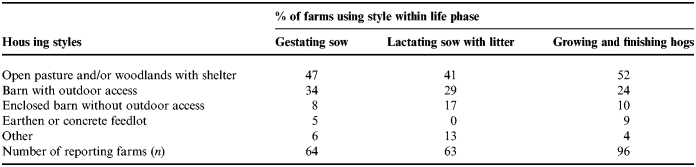
Niche pork farmers from 23 states participated in this study, with the largest responses came from North Carolina (15%); Pennsylvania (14%); Michigan (11%); and Iowa, Massachusetts and New Hampshire (8% each). Regarding the type of operation, 63% of farms have a breeding program in addition to growing and finishing (n = 109). Nearly half (49%) of producers in this survey raise either purebred heritage or cross-heritage breeds. The most common breeds, either as purebred or crossbred, were Berkshire (49% of the reporting 99 farmers who answered this question use this breed), followed by Duroc (33%), Tamworth (27%), York (23%), Hampshire (22%) and Gloucestershire Old Spots (21%). Pertaining to living conditions, 90% of the 125 reporting farmers provide outdoor access to their hogs. More specific housing styles by life phase are detailed in Table 1.
Type of housing used within major swine life phases.

In regard to market outlets, farmers participate in four major categories: 72% of producers directly market to consumers, 40% work with intermediaries (aggregators or food hubs), 26% sell to restaurants and 17% market to retailers. Hog production is the primary income for 28% of the farms (n = 100). In addition to swine, study participants raise other livestock classes or grow various commodities to supplement their income (n = 92). For instance, respondents also raise beef (51% of those who answered this question), broiler chickens (40%), eggs (25%), lamb/sheep (21%), grow fruits and vegetables (18%) and produce corn or soybeans (17% each). Finally, the average number of years raising niche pork was 7 yrs (n = 102), within a range of 0.5–42 yrs. The characteristics described above are reflective of the study's sample from self-identified niche producers. Not knowing the true population of niche pork producers, these results may not be applicable to other niche hog farmers outside of the study. Moreover, this niche sample should not be considered representative of organic pork production.
Performance metrics
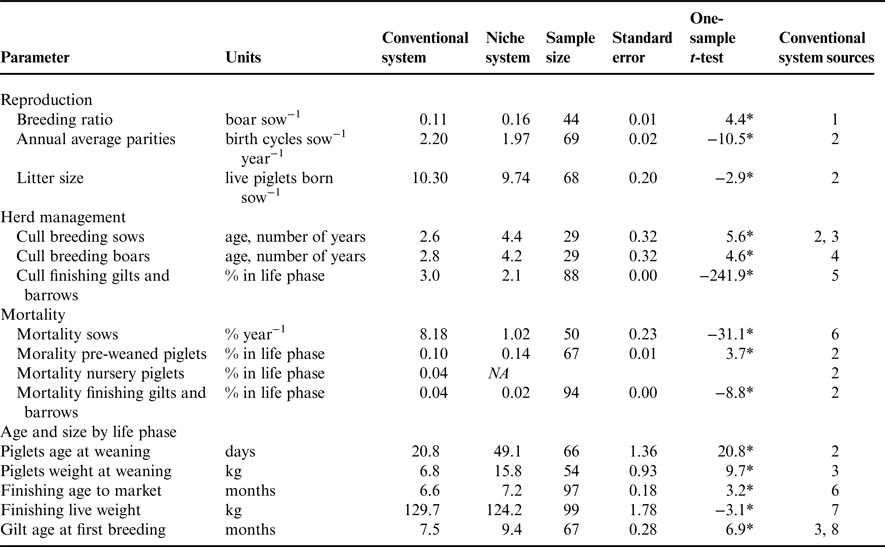
Niche and conventional swine systems are compared across common measures of productivity in Table 2. All directly comparable metrics across the various life phases were found to be statistically significant with 95% confidence for the one-sample test of means. This test statistic was utilized because performance data representing the entire niche pork production population were not available. Therefore, this statistic tests whether the average of the niche sample (study's respondents) is representative of a population (conventional producers) with a known mean. The one-sample t-test was calculated by taking the difference in means of a given performance metric divided by the standard error of the niche metric. Looking more closely at these results, many of the largest differences between the two systems center on age benchmarks. For example, piglets were weaned nearly 2.5 times faster in conventional operations. A niche piglet, having been with its mothers for 28 additional days, weighed 9 kg more at weaning than its conventional counterpart. Niche finishing gilts and barrows require 9% more time to reach market weight. Standardizing to 124 kg, the conventional system finished hogs 18 days faster than niche production. Likewise, there was a difference of 58 days between the time of first breeding of niche and conventional gilts.
Performance metrics comparison.

*Indicates 95% confidence level for one-sample test of means. (1) Bounds (Reference Bounds2013). (2) USDA APHIS (2015). (3) Haley (Reference Haley2014). (4) Assumed cull rate is identical to breeding sows. (5) Lawrence and Ellis (Reference Lawrence and Ellis2008). (6) Picardy et al. (Reference Picardy, Pietrosemoli, Parmenter, Griffin and PetersForthcoming). (7) USDA NASS (2014). (8) DeVires (Reference DeVries2011).
With regard to breeding and herd management, there were mixed findings. On average, niche systems had 12% fewer breeding cycles per sow per year. Once bred, niche litters were 5% smaller compared with conventional breeding programs; likewise, niche litters had 10% fewer piglets that survived through weaning. Integrating these metrics together on an annual basis led to approximately 19% fewer weaned niche piglets per bred sow per year than the conventional system. However, niche producers outperformed conventional on the other aspects of herd management, as evident with lower cull and mortality rates. For instance, conventional breeding sows and boars were culled 1.5 yrs earlier than niche stock. One drastically different metric was annual sow mortality, which was eight times greater in conventional than niche production.
These performance metrics results suggest the comparison variability within and between niche and conventional pork productivity depending upon the life phase under review. For this reason, the authors of this study further explored system differences in a subsequent analysis; the metric comparisons were used to determine the overall number of finished gilts and barrows going to their intended markets along with the meat output from the two systems. Initial results indicate that the conventional system finishes 13% more gilts and barrows per year than the niche system, which leads to 35% additional kilograms of edible meat per year for one breeding sow in a conventional system as compared with a niche pork production system (Picardy et al., Reference Picardy, Pietrosemoli, Parmenter, Griffin and Petersforthcoming).
Niche production reasoning, success and barriers
Producers’ reasoning for raising niche swine can be grouped into three intra-related categories: (1) farm and producer viability, (2) animal and environmental welfare, (3) consumer preference and taste. Ninety-seven farmers responded to the question that asked for their top three reasons for raising niche pigs as opposed to commodity pork. Of the 265 total responses, 46% addressed farm and producer viability; i.e., either profitability, appropriate scale potential, personal enjoyment, family participation and tradition, or aversion to commodity pork. The second largest category, animal and environmental welfare, was covered in 26% of the responses and included individual themes of animal and herd health, heritage breeds conservation and ecological responsibility. The third category, consumer preferences and taste, was included in 19% of the responses and centered on meat quality and taste, as well as customer relationships, preference and satisfaction. Thematic distribution by category is shown in Figure 1.
Reasons for niche pork production.

For the survey respondents, success in niche pork production equates to high welfare for the pigs, economic viability for the operation, personal enjoyment for the farmer, customer satisfaction with meat flavor and quality, and responsible environmental practices. Of the 89 who responded to this open-ended question, 57% defined success in terms of benefiting more than one component of the food system, such as the producers, the consumers, the livestock or the environment. For example, one producer defined niche success as ‘a significant number of people that are positively affected by the niche pork operations including consumers, workers, and suppliers [that] enhances the environment and ensures good welfare conditions for the animals.’ The other 43% focused on one factor for defining success in niche operation, such as profitability, herd performance or consumer preference.
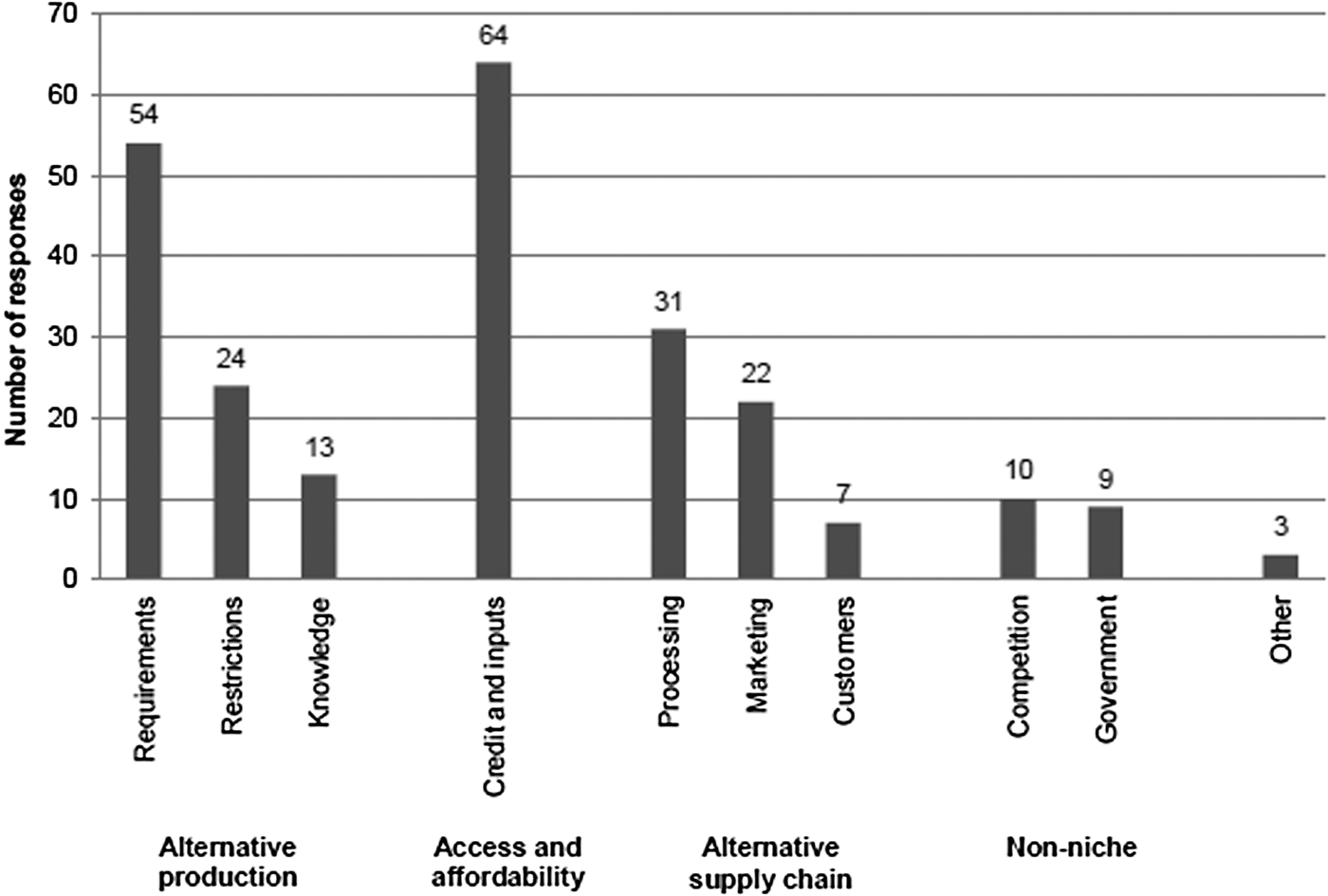
Despite these perceived benefits, niche pork producers, such as other farmers, deal with substantial challenges. Each survey participant was asked to describe their top three barriers, which resulted in 237 total responses. These responses, classified as themes, were grouped into four intra-related categories: (1) alternative production requirements, restrictions or knowledge, with 38% of the responses; (2) access and affordability of credit and inputs other than land (27%); (3) alternative supply chain for processing, marketing and customers at (25%); and (4) non-niche production competition and governmental policies (8%). Figure 2 depicts the specific thematic answers. The most common barrier, representing 27% of all 237 responses, centered on the access and affordability of inputs and credit. For this analysis, inputs included hog feed, piglets and breeding herd replacements, and labor. Additional land for outdoor raising of swine was captured in the second most reported barrier, requirements for niche production, by 23% of responses. Besides additional land, this theme also included the challenges of year-round consistent performance, weather, fencing, bedding, transportation and pasture management. The third top barrier, reported in 13% of responses, concentrated on the difficulties associated with slaughter and processing in terms of access, cost, timing, scale, trust or value-added product ability. Other challenges included themes of niche restrictions (described in the following section), specialty marketing and distributing, knowledge of niche pork production, competition with commodity and other producers, governmental policies that support commodity meat and customer relationships.
Barriers to successful niche pork production.

Outcomes by marketing stratification
When organizing the data by certain characteristics, such as the marketing outlet, additional patterns emerge. For this study, the most notable differences were seen with the group of participants who market their finished hogs through a form of aggregation, such as a branded company or food hub, compared with those who do not work with intermediaries. For example, farmers who sell their pork through an aggregator finished 4.4 times more hogs than those who do not work with aggregators (410 versus 93 hogs per year). Finished hogs raised on farms working with aggregators traveled 3.5 times further distances for slaughter (368 versus 106 km). With regard to performance metrics, farmers marketing through aggregation had higher mortality for piglets, finishing hogs, breeding sows and boars. Culling was higher for finishing hogs for the aggregation group, although culling percentages were lower for the breeding herds.
Distinctions can also be observed in the qualitative data. In particular, farmers selling to aggregators or food hubs were five times more likely to identify production restrictions as one of their most critical barriers to success. Niche restrictions include the inability to administer antibiotics, certain vaccinations, clip pig tails or feed grain that has not been trans-genetically altered (GMO-free). In summary, available marketing avenues may direct certain management practices for the pork producers in terms of breed, scale and program restrictions, which may in turn influence overall performance and output. However, comparisons should be carefully interpreted as results depend upon the sampling frame, recruitment and participant response.
Niche labeling
Given these tangible barriers and the additional land, labor and knowledge required to raise niche swine, farmers’ profitability should reflect the differentiated product they are bringing to the market. In addition to brand recognition and producer/consumer relationships, labeling on the meat package is another method to convey management practices used to develop the value-added product. As previously stated, niche meat currently does not have a clear definition or label recognized by USDA. For this reason, producers were asked about production characteristics that may be part of a future ‘niche meat’ definition used for labeling purposes.
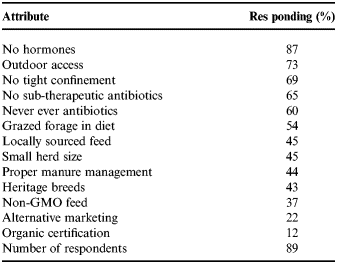
Out of the 89 farmers who responded to this question, the top three most favorable requirements for a niche definition were no use of hormones (87% of respondents), outdoor access (73%) and no tight confinement (69%). Additional rankings are in Table 3. Interestingly, the least popular requirement was organic certification (12% of respondents). This survey question allowed participants to enter additional production characteristics that should be part of the niche meat definition. Some mentioned that access to the outdoors did not differentiate niche production; rather, they recommended niche production require raising animals entirely outdoors or on pasture. Several voiced their resistance to an additional label. In their opinion, labels could be ‘deceptive to the consumer,’ ‘niche meat is not monolithic’ and ‘USDA should be kept out of niche meat labeling.’ Others wanted the inclusion of nutrient density as well as humane raising verification.
Ranked production requirements for niche meat label.

Discussion
Differentiated livestock is viewed as an opportunity with strong promise to revive small- and mid-sized farms (Conner et al., Reference Conner, Campbell-Arvai and Hamm2008). Niche pork producers in this study identified economic viability with lower capital entry for smaller scale operations while providing high animal welfare as their top reasons to raise diversified pork. These findings augment previous research that highlights niche pork as a viable alternative with greater flexibility, decreased market volatility and lower capital requirements (Wheatley, Reference Wheatley2003; Honeyman et al., Reference Honeyman, Pirog, Huber, Lammers and Hermann2006). Additional benefits reported within this study extend beyond the farm gate to conserving heritage breeds and connecting with consumers; such motivations are reported in the literature as ‘good farming’ with moral responsibility for the land and people (see Stock, Reference Stock2007). Yet, success is not guaranteed as producers must overcome various challenges in order to build and sustain their niche meat operations.
One such challenge identified by the participants is consistent high productivity of the herd. This reported barrier was also measured by performance metrics in terms of number and age of finished hogs for market. As highlighted in the results, smaller litter size (9.7 born alive piglets) and higher pre-weaning mortality (14.3%) reduce the total number of finished hogs when compared with conventional production. On the other hand, lower mortality (1.9%) and cull (2.1%) rates of growing and finishing niche swine contribute to more hogs going to market. These findings are similar to other niche pork studies. For instance, Lammers et al. (Reference Lammers, Honeyman, Mabry and Harmon2007) reported a litter size of 10.0 live piglets and pre-weaning mortality of 15.0% within hoop barn niche pork system. Honeyman and Harmon (Reference Honeyman and Harmon2003) observed mortality rates ranging between 1.8 and 3.8% and culling rates 1.7–1.8% for finishing pigs in hoop structures.
In contrast, other studies (Honeyman and Harmon, Reference Honeyman and Harmon2003; Gentry et al., Reference Gentry, McGlone, Miller and Blanton2004) found growth rates to be similar or even faster for niche as compared with conventional production systems. For this reason, producers participating in this study who experience slower growth potential could enhance management through various avenues such as: (1) select breeding stock with strong sow maternal characteristics; (2) shared knowledge on housing and environment to reduce piglet crushing and increase feed efficiency; and (3) more detailed recording keeping of breeding, feed and growth patterns. As indicated by the niche pork survey respondents, improved breeding stock and advanced knowledge of niche meat production are not always available and therefore a challenge for operations. Lack of technical knowledge for alternative production continues to be a barrier of success, as previously identified in the literature (Darnhofer et al., Reference Darnhofer, Schneeberger and Freyer2005). However, producers can exert more individual control over record keeping. Only 64% of participants reported keeping feed records. Breeding and finishing record keeping were higher at 88 and 80%, respectively.
Additional barriers identified by this study's participants are relevant to other small- to mid-scale meat producers, whether they raise animals in alternative or conventional systems. Many of the top producer concerns in this study, such as the cost and availability of inputs, slaughter facilities, value-added meat processing and markets, are also reported in the literature (see Gwin and Hardesty, Reference Gwin and Hardesty2008; Bardot Lewis and Peters, Reference Bardot Lewis and Peters2011; Dunning et al., Reference Dunning, Blacklin and McKissick2013; Gwin et al., Reference Gwin, Thiboumery and Stillman2013). Although assessing the capacity and accessibility of infrastructure is beyond the scope of this research, individual producers may be able to reduce the impact of these barriers through advance scheduling of multi-animal slaughter while building solid working relationships with intermediaries, processors and customers. Through established trusted business relationships, farmers can be supported by other supply chain partners with distribution, marketing and customer growth (Gwin et al., Reference Gwin, Thiboumery and Stillman2013).
With regard to creating a niche label for differentiated meat, the study's participants strongly identify niche production with restricting the use of growth-promoting substances such as hormones and antibiotics, while providing high welfare living conditions with outdoor access. There was however, great diversity in responses for inclusion into a potential label. This lack of consensus for defining ‘niche’ by the producers is problematic given consumer confusion of existing meat eco-labels (Yiridoe et al., Reference Yiridoe, Bonti-Ankomah and Martin2005; van Amstel et al., Reference van Amstel, de Brauw, Driessen and Glasbergen2007; Gwin and Hardesty, Reference Gwin and Hardesty2008; Abrams et al., Reference Abrams, Meyers and Irani2010). Current eco-labels for meat products do not make the market more transparent because consumers typically do not have sufficient knowledge about them (van Amstel et al., Reference van Amstel, de Brauw, Driessen and Glasbergen2007). With regard to the organic label, consumers have some knowledge of the broad issues, but lack consistency in their interpretation of organic production (Yiridoe et al., Reference Yiridoe, Bonti-Ankomah and Martin2005; Brooks and Ellison, Reference Brooks and Ellison2014). Similarly, consumers expressed confusion for the all-natural label of pork products (Abrams et al., Reference Abrams, Meyers and Irani2010). For these reasons, information asymmetry may not be reduced because consumers do not understand the complexities of agricultural practices or food quality attributes represented by the eco-label. Given the current labeling complexity over terminology, perhaps the niche claim would not adequately convey alternative process attributes that distinguish niche meat from conventionally raised meat and thereby would be unable to justify a price premium. As recommended by previous research, all-encompassing claims, such as ‘niche’ may not be beneficial for niche meat producers; rather, they may be better served by incorporating a few credence attributes most important to their consumers into the product packaging (Brooks and Ellison, Reference Brooks and Ellison2014).
Conclusion
This study highlighted the potential of an alternative manner to raise swine. Depending upon the life phase, niche metrics outperformed conventional pork production, demonstrated with lower cull and mortality rates for breeding stock and growing/finishing gilts and barrows. Aside from system comparisons, the findings suggest that qualitative data can contribute to a deeper understanding of niche performance in view of overall goals for the farm. In particular, success within a niche pork operation is not merely measured by quantitative metrics, but rather incorporates numerous aspects, including animal and environmental welfare, personal enjoyment and customer satisfaction. Yet for those niche farmers looking to improve productivity, outreach and dissemination of this study's results can provide an opportunity to compare their production against alternative and conventional operations. Such assessment begins, however, with detailed and accurate record keeping of feeding, breeding and finishing operations. Patterns may begin to emerge with on-farm documentation of specific practices with performance outcomes. Working with producers, further research and extension of successful management practices are needed to close the yield gap by improving the feed efficiency, litter size and pre-weaning mortality, while reducing the barriers to sustainable, economically viable niche pork production.
Supplementary material
The supplementary material for this article can be found at https://doi.org/10.1017/S1742170517000230.
Acknowledgements
The authors thank the farmers who participated in this study. The authors also appreciate the guidance provided by Barbara Parmenter, Sean Cash, Dave Stender, Sarah Blacklin, Lori Lyon, Justeen Hyde, Chelsea Bardot-Lewis, Craig Haney, Edward Epsen, Rich Pirog, Niki Whitley, Stewart DeVries, Doug Bounds, Karen Lubbers, Ariane Daguin, Margaret Stephens, and Fred and Mary Reusch. They assisted with research design and offered helpful feedback on the questionnaire and data analysis. This research was funded in part by the Tufts University's Institute of the Environment in Medford, Massachusetts and the Friedman School of Nutrition Science and Policy in Boston, Massachusetts. These funding sources at Tufts University had no involvement in study design, in the collection, analysis and interpretation of data, in the writing of the report, or in the decision to submit the article for publication. Finally, any aspect of the work covered in this manuscript that involved human subjects has been conducted with the ethical approval of the Tufts University Institutional Review Board for Social, Behavioral and Educational Research. Informed consent was obtained for experimentation with human subjects who participated in this research.