Introduction
Glauconite is a dioctahedral, 2:1 interlayer-deficient green mica with a representative chemical formula of K0.8 R3+1.33R2+0.67Al0.13Si3.87O10(OH)2 (Rieder et al., Reference Rieder, Cavazzini, Dyakonov, Frank-Kamenetskii, Gottardi, Guggenheim, Koval, Müller, Neiva, Radoslovich, Roberts, Sassi, Takeda, Weiss and Wones1998). The term ‘glauconite’ is defined by the IMA (International Mineralogical Association; Rieder et al., Reference Rieder, Cavazzini, Dyakonov, Frank-Kamenetskii, Gottardi, Guggenheim, Koval, Müller, Neiva, Radoslovich, Roberts, Sassi, Takeda, Weiss and Wones1998) and by the AIPEA (Association Internationale Pour I’Étude des Argiles; Bailey, Reference Bailey1980) as an Fe-rich, interlayer-deficient mica with low Al tetrahedral substitution and K+ as the dominant interlayer cation (>0.6 atoms per formula unit, apfu). The mineral glauconite exhibits a basal reflection (001) between 14 and 10 Å, (020) reflection at 4.53 Å, (003) reflection at 3.33 Å, and (060) reflection at 1.51 Å (AIPEA; Bailey, Reference Bailey1980). Structurally, glauconite consists of a 2:1 layer (two tetrahedral sheets facing one octahedral sheet) connected with interlayer K+ cations. Si(IV) cations occupy the tetrahedral sites with the occasional substitution of Al(III) and Fe(III), whereas Fe(III) occupies the octahedral sites, along with Al(III) and significant amounts of divalent cations (Mg(II) and Fe(II)) (Bentor & Kastner, Reference Bentor and Kastner1965; Hassan & Baioumy, Reference Hassan and Baioumy2006; Srasra & Trabelsi-Ayedi, Reference Srasra and Trabelsi-Ayedi2000).
Glauconite is considered as a common authigenic mineral which forms generally during marine transgressive events (Amorosi, Reference Amorosi1995; Banerjee et al., Reference Banerjee, Bansal, Pande and Meena2016a; Bansal et al., Reference Bansal, Banerjee, Pande, Arora and Meena2017, Reference Bansal, Banerjee, Ruidas and Pande2018). Occurrences of glauconite in lacustrine and alluvial deposits have also been found, however (McRae, Reference McRae1972). The origin and evolution of glauconites have been explained by multiple theories such as “layer lattice” theory, “pseudomorphic replacement” theory, and “verdissement” theory (Banerjee et al., Reference Banerjee, Farouk, Nagm, Choudhury and Meena2019; Burst, Reference Burst1958; Dasgupta et al., Reference Dasgupta, Cahudhuri and Fukuoka1990; Hower, Reference Hower1961; Odin & Matter, Reference Odin and Matter1981). The evolution and maturation of glauconite is a diagenetic phenomenon that depends on the K2O wt.%, as K content evolves with maturation. At the nascent stage, glauconite contains ~2–4 wt.% K2O, and, subsequently, the K2O content reaches >8 wt.% for highly evolved glauconites (Amorosi, Reference Amorosi1995; Odin & Matter, Reference Odin and Matter1981). Glauconitic rocks release potassium during pedogenesis and weathering processes which help in maintaining soil fertility. Glauconitic rocks with large K2O contents, therefore, are considered potential sources of potash fertilizers. High soil-water holding capacity and cation exchange capacity compared to other K-bearing silicate rocks such as nepheline syenites (El-Habaak et al., Reference El-Habaak, Askalany, Faraghaly and Abdel-Hakeem2016; Manghnani & Hower, Reference Manghnani and Hower1964a, Reference Manghnani and Hower1964b; Rahimzadeh et al., Reference Rahimzadeh, Khormali, Olamaee, Amini and Dordipour2015) make it an alternative resource of potassium. Other than the direct application of glauconitic rocks as a fertilizer, several methods have been suggested for effective recovery of potassium as a highly soluble salt from glauconitic rocks (Karimi et al., Reference Karimi, Abdolzadeh, Sadeghipour and Aminei2012; Rudmin et al., Reference Rudmin, Banerjee, Mazurov, Makarov and Martemyanov2017, Reference Rudmin, Banerjee, Makarov, Mazurov, Ruban, Oskina, Tolkachev, Buyakov and Shaldybin2019; Shekhar et al., Reference Shekhar, Mishra, Agrawal and Sahu2017a, Reference Shekhar, Mishra, Agrawal and Sahub; Shekhar et al., Reference Shekhar, Sinha, Mishra, Agrawal and Sahu2020).
India’s limited availability of potassium-rich sea brine and evaporite-hosted potash deposits makes it dependent on foreign countries to meet its potassium fertilizer demand. Due to the lack of conventional potash resources and increasing demand, glauconitic rocks are now being exploited as an alternative indigenous source of potassium in India (Kumar & Bakliwal, Reference Kumar and Bakliwal2005; Soni, Reference Soni1990). The wide occurrence of glauconite deposits is reported from Precambrian rocks of Karnataka, Andhra Pradesh (A.P.), Uttar Pradesh (U.P.), Madhya Pradesh (M.P.), Rajasthan, and Uttarakhand. The Cretaceous rocks of Gujarat, especially those of the Bhuj Formation, contain significant amounts of of glauconite. In addition, the Cretaceous, Eocene (Ladakh, Guajarat, Garhwal, Rajasthan, and Assam), and Recent rocks (Trivandrum coasts, Bay of Bengal, and the coasts of Andaman Nicobar Island) also contain glauconites. Many studies have been carried out to understand the mineralogy, morphology, occurrence, nature, and other physicochemical properties of glauconitic rocks (Amorosi, Reference Amorosi2013; Baldermann et al., Reference Baldermann, Grathof and Nickel2012; Banerjee et al., Reference Banerjee, Farouk, Nagm, Choudhury and Meena2019; Dooley, Reference Dooley, Koger, Trivedi, Barrer and Krukowsky2006; Drits et al., Reference Drits, Ivanovskaya, Sakharov, Zvyagina, Derkowski, Gor'kova, Pokrovskaya, Savichev and Zaitseva2010; Essa et al., Reference Essa, Ahmed and Kurzweil2016; Franzosi et al., Reference Franzosi, Castro and Celeda2014; Harder, Reference Harder1980; Hower, Reference Hower1961; Huggett & Gale, Reference Hower and Gale1997; Kelly & Webb, Reference Kelly and Webb1999; McRae, Reference McRae1972; Odin & Matter, Reference Odin and Matter1981; Schimicoscki et al., Reference Schimicoscki, Oliveira and Avila-Neto2020; Stille & Clauer, Reference Stille and Clauer1994; Tang et al., Reference Tang, Shi, Jiang, Zhou and Shi2017a, Reference Tang, Shi, Ma, Jiang, Zhou and Shib; Thompson & Hower, Reference Thompson and Hower1975; Van Houten & Purucker, Reference Van Houten and Purucker1984; Wigley & Compton, Reference Wigley and Compton2007). Few published studies exist about glauconitic rocks from India in this context (Banerjee et al., Reference Banerjee, Kumar and Eriksson2008, Reference Banerjee, Chattoraj, Saraswati, Dasgupta and Sarkar2012a, Reference Banerjee, Chattoraj, Saraswati, Dasgupta, Sarkar and Bumbyb; Bansal et al., Reference Bansal, Banerjee and Nagendra2020; Choudhuri et al., Reference Choudhuri, Balagopal and Banerjee1973; Rawlley, Reference Rawlley1994; Soni, Reference Soni1990). The glauconitic rocks of Rajasthan, M.P., U.P., and A.P. have been studied in detail in terms of characterization (Banerjee et al., Reference Banerjee, Mondal, Chakraborty and Meena2015, Reference Banerjee, Bansal, Pande and Meena2016a, Reference Banerjee, Bansal and Thoratb; Bansal et al., Reference Bansal, Banerjee and Nagendra2020; Janardhana Rao et al., Reference Janardhana Rao, Srinivasarao and Ramakrishnan1975; Mandal et al., Reference Mandal, Banerjee, Sarkara, Mondal and Choudhury2020; Mishra et al., Reference Mishra, Jayaprakash, Hans and Sundaram1987); the glauconite deposits of Gujarat have so far only been studied for other aspects such as their composition, origin, and age (Banerjee et al., Reference Banerjee, Chattoraj, Saraswati, Dasgupta and Sarkar2012a, Reference Banerjee, Chattoraj, Saraswati, Dasgupta, Sarkar and Bumbyb; Bansal et al., Reference Bansal, Banerjee, Pande, Arora and Meena2017, Reference Bansal, Banerjee, Ruidas and Pande2018; Chattoraj et al., Reference Chattoraj, Banerjee and Saraswati2009; Kuran & Sahiwala, Reference Kuran and Sahiwala1999).
The glauconitic belts occurring in the Ukra Member (Bhuj Formation) are abundant in the Kutch area. The glauconites from the type locality have been studied for information on the composition and origin, with limited characterization work to explore the economic potential of the glauconites. In addition, the glauconitic horizons of the Ukra Member exposed in other areas such as the Guneri and Umarsar remain uninvestigated for their physicochemical characteristics. The aim of the present study, therefore, was to characterize the glauconitic rocks exposed near the Guneri and the Umarsar area of the Kutch district, Gujarat, India, and to explore their geological, mineralogical, and geochemical attributes to gain a better insight into the occurrence, nature, and stage of maturation of the glauconites, which is an essential step in determining their potential to serve as a source of potash fertilizer.
Geological Background
The Kutch basin is a pericratonic rift basin that evolved in the western margin of the Indian subcontinent during the end of the Triassic period. The onset of the breakup of Gondwanaland in the Late Triassic–Early Jurassic period caused reactivation of pre-existing discontinuities along the Aravalli-Delhi trend and opening of the Kutch basin (Biswas, Reference Biswas1987). The basin is asymmetric in geometry with a southward slope and several uplands as well as low land features (Biswas, Reference Biswas1987). The riftogenic basin has hosted predominantly Mesozoic sedimentary sequences (~3000 m) and Post-rift Cenozoic sediments. The Mesozoic rift-fill sediments constituting a major part of the basin were deposited in both marine and non-marine settings (Biswas, Reference Biswas2005). Apart from these sedimentary fills, the basin exposes Deccan traps formed by the emplacement of magma through the faults generated under the extensional settings (Paul et al., Reference Paul, Ray, Das, Patil and Biswas2008). The litho-stratigraphic succession of the Kutch basin comprises the Jhurio, Jumara, Jhuran, and the Bhuj formations (Biswas, Reference Biswas1977). The Mesozoic sequence started with the non-marine siliciclastic facies followed by marine siliciclastics, carbonates, and mixed carbonate-siliciclastic sediments (Fürsich & Pandey, Reference Fürsich and Pandey2003). Bhuj Formation is the stratigraphically youngest unit composed dominantly of feldspathic and ferruginous sandstone deposited in marine to non-marine environments (Desai, Reference Desai2013; Desai & Saklani, Reference Desai and Saklani2012). The Bhuj sediments are deposited in a deltaic environment with a pulse of marine transgression. The Bhuj Formation is further subdivided into three members: Guneri, Ukra, and Upper Member.
The siliciclastic rocks of the present study belonging to the Ukra Member of the Bhuj Formation are exposed near the Guneri (23°46'55.3"N, 68°52'17.4"E) and the Umarsar (23°46'5.6"N, 68°50'17.7"E) areas (Fig. 1). However, the type section of the Ukra Member is a 34 m-thick exposure at the base of the Ukra hill (Desai, Reference Desai2013). The Ukra Member consists primarily of calcareous glauconitic shales and sandstones, which are rich in ammonites, belemnites, gastropods, and wood-log remains (Bansal et al., Reference Bansal, Banerjee, Pande, Arora and Meena2017). Based on the facies association and paleontological evidence, this member is considered as a transgressive tongue in a prograding deltaic sequence (Desai, Reference Desai2013).
a Geological map of Kutch basin showing the location of the study area; inset map of India shows the study area (map adapted from Bansal et al., Reference Bansal, Banerjee, Pande, Arora and Meena2017). b Detailed geological map of the study area showing the sampling locations, which fall in a part of Toposheet No. 41 A/13. The dashed line marks the extent of glauconite-bearing rocks associated with the Bhuj Formation (adapted from Jain, Reference Jain1997)

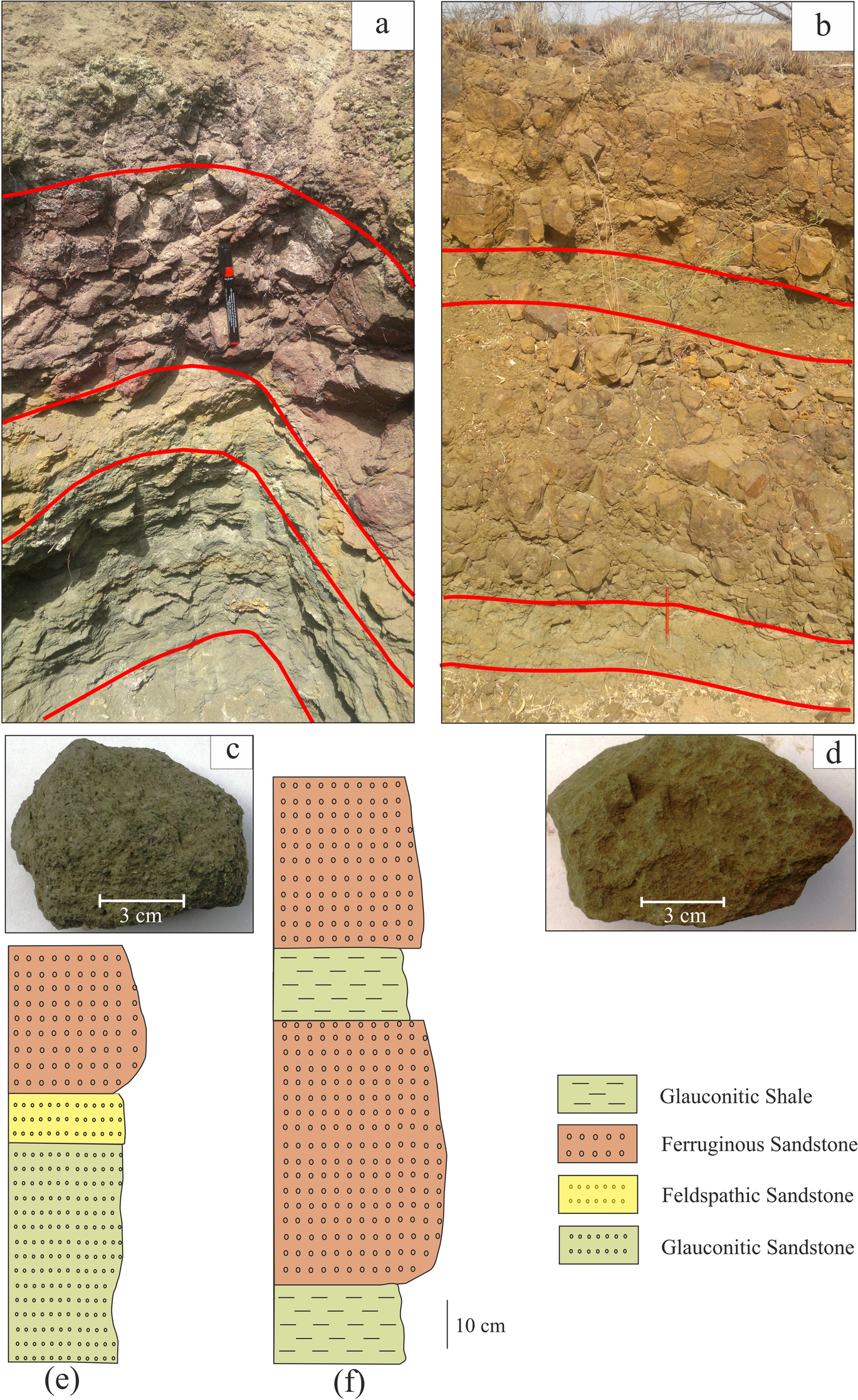
In the Guneri area, the vertical section (~85 cm) exposed in a pit (Fig. 2a) has a well developed glauconite-bearing, fine-grained sandstone which is overlain by hard bands of feldspathic and ferruginous sandstone (Fig. 2e). In contrast, a ~1.2 m-thick sequence near the Umarsar area is characterized by alternating bands of ferruginous sandstone and glauconitic shale (Fig. 2b and f). Generally, the bedded sandstone is the host rock for the glauconites of the Guneri area and the ~1.5 m-thick glauconite band is traceable for up to 3–4 km along the strike (Jain, Reference Jain1997).
a ~85 cm-thick section exposed near Guneri (sampling site 1 of Fig. 1b) (Shekhar et al., Reference Shekhar, Mishra, Agrawal and Sahu2017b). The litholog e corresponds to this particular section. b The exposure at sampling site 2 (Fig. 1b) has a thickness of ~1.2 m. The lithocolumn for this section is shown in Fig. 2f. c Glauconitic sandstone sample collected from the site near Guneri. d Glauconitic shale sampled from the Umarsar area

Materials and Methods
Materials
The glauconite-bearing rock samples collected from the Guneri and Umarsar areas of the Kutch district, Gujarat, were investigated in the present work. The glauconitic rock samples studied were collected from pits and a trench at depths of 0.8 and 1.2 m, respectively (Fig. 2a, b). The glauconite sample collected from Guneri occurs in sandstone whereas the sample from Umarsar occurs in shale. Chemicals such as sodium carbonate, sodium bicarbonate, sodium dithionite, sodium citrate dihydrate, acetic acid, hydrofluoric acid, nitric acid, and hydrogen peroxide used for the characterization were of analytical grade and were obtained from Merck (Darmstadt, Germany).
Methods
Thin-section preparation for petrographic and electron probe microanalysis
The collected rock samples were cut into small chips. The fragile rock chips were hardened by epoxy solution in a vacuum impregnation unit. The samples were kept in a vacuum chamber for 10 min under 80–100 kPa and cured for 12 h (Innes & Pluth, Reference Innes and Pluth1970). The hardened rock chips were cut, ground, and smoothed with 220, 600, 800, and 1000 grit carborundum. The chips were mounted on borosilicate glass slides, 4.7 cm×2.5 cm in size, using epoxy as the adhesive. The mounted samples were processed using a PetroThin instrument (semi-automatic thin-sectioning device) to cut the thin section and then ground with 1000 grit carborundum to attain the correct thickness (30 μm). Grinding of the thin section was followed by polishing using 6, 3, and then 1 μm diamond pastes (Innes & Pluth, Reference Innes and Pluth1970). The final polished thin section was then ready for petrographic and electron probe microanalysis.
Clay fraction (<2 μm) separation
The rock samples were crushed, ground, and sieved using a 300 μm (50 mesh ASTM) sieve. A representative sample was selected from the bulk by coning and quartering. The separation of clay fractions from the bulk sample required pre-treatments for the removal of iron oxide, carbonate, and organic matter, followed by the fractionation procedure. To yield ~5 g of clay fraction, a 20 g portion of each sample was transferred to 250 mL beakers. Iron oxide was removed from the samples using the citrate bicarbonate dithionite (CBD) method (Jackson, Reference Jackson1979). The residues were further treated with 10% acetic acid to remove carbonates, and the organic particles were removed by treating the residue with 30% H2O2. Each treatment step included washing the residues using double distilled water. The final residue obtained after treatment was transferred to a 1000 mL graduated cylinder filled with distilled water, dispersed well, and then allowed to sediment following Stokes law. The clay fractions (<2 μm) were separated after the appropriate time interval (~6 h) by removing the suspension, following the method of Soukup et al. (Reference Soukup, Buck and Harris2008). The removed suspension was used to prepare oriented mounts for analysis by XRD and for other characterization studies.
Characterization techniques
The hand specimens collected were subjected to mild grinding using a mortar and pestle followed by treatment with anhydrous sodium carbonate. The samples were washed and oven dried for 12 h. Grains were broken and a stereo zoom microscope (Leica-wild M8, Wetzlar, Germany) was used to identify the glauconite and other associated minerals. Microscopic analysis of petrographic thin sections was carried out using a Leica DM 4500P polarizing microscope (Chiyoda-ku, Japan) connected to a Leica DFC420 camera under both transmitted and reflected light. The polished thin section after carbon coating was analyzed using a JEOL-JXA-8230 EPMA (JEOL, Toyko, Japan) with an attached EDX detector; the accelerating voltage was 15 kV, beam current was 4 nA, and the working distance was fixed at 11 mm. The XRD patterns for the bulk-rock samples and the clay fractions were obtained using a Bruker D8 Discover X-ray diffractometer (Bruker GmbH, Bremen, Germany), using Ni-filtered CuKα radiation at a voltage of 40 kV and a current of 40 mA. Bulk samples and clay fractions were scanned over the ranges 5–80 and 0–45°2θ, respectively, with a step size of 0.02°2θ at a scanning speed of 1 s/step. The XRD analysis of oriented samples (clay fractions) was perfomed on samples which were air-dried (AD), exposed to ethylene glycol (EG) vapor, and heated at 550°C. All samples were analyzed under the same operating conditions. The PANalytical X'Pert HighScore Plus Software and the JCPDS database were used for mineral identification. Clay fractions were scanned using an FEI Nova NanoSEM 430 (Waltham, Massachusetts, USA) scanning electron microscope (SEM) to study the morphology. The SEM was operated in high-vacuum mode (10-3 Pa) with 15 kV operating voltage. Infrared vibrational spectra were recorded using an Alpha-Bruker FTIR spectrometer (Billerica, Massachusetts, USA) in the middle infrared (MIR) range (4000–500 cm–1).
Major oxides of bulk samples were determined using X-ray fluorescence spectrometry (Bruker SRS 3400, Bremen, Germany) with analytical uncertainties of <5%. Trace-element concentrations of glauconitic sandstone and shale were measured using an inductively coupled plasma mass spectrometer (ICP-MS, Agillent, Santa Clara, California, USA). For ICPMS analysis, ~25 mg of each powdered whole-rock sample was digested using a mixture of HF+ HNO3 for 48 h at 120°C. The digested samples were diluted to 100 mL in 2% HNO3 solution which was spiked with 10 ppb In, Cs, Re, and Bi (internal standards). The USGS standard reference materials (SRMs) BCR-2, BHVO-2, GSP-2, and AGV-2 were used for calibration. BCR-2 (basalt) and GSP-2 (granite) USGS rock standards were run as unknowns for the estimation of accuracy. The analytical uncertainties (2σ error) were <5% for trace elements.
Results and Interpretation
Petrographic Study of Glauconitic Rocks
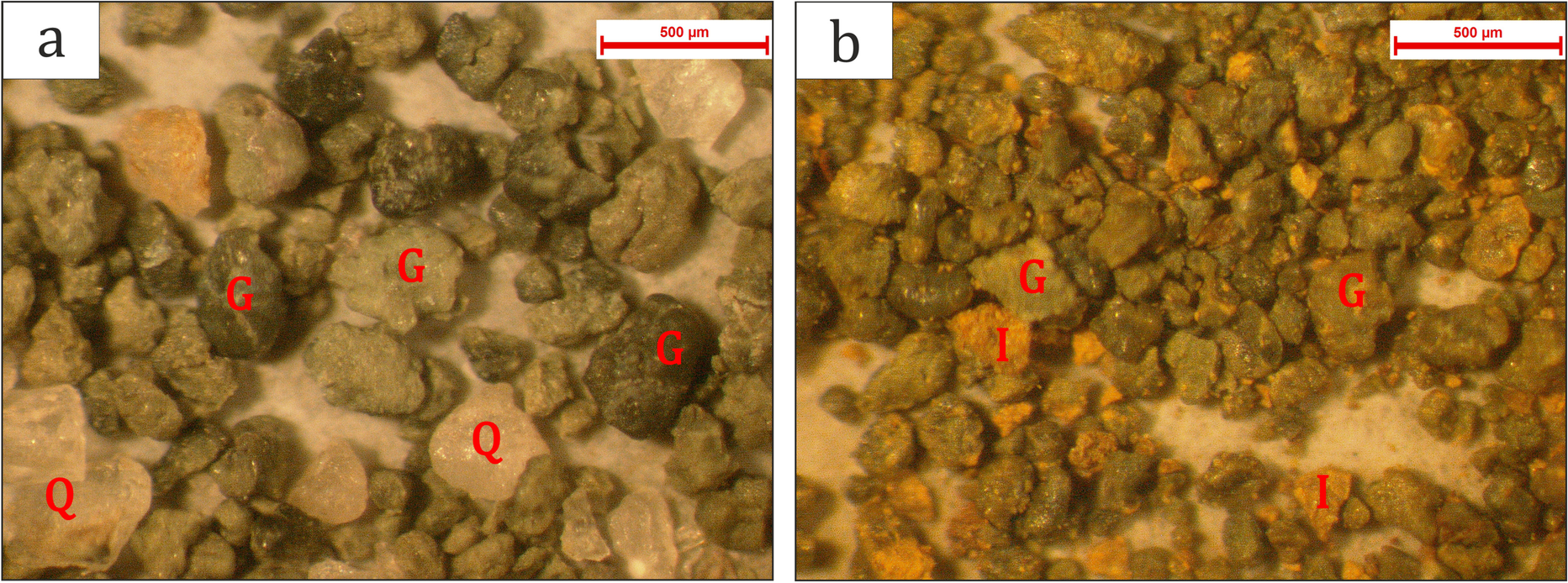
Petrographic observation indicated that glauconite occurs in medium- to fine-grained sandstone as well as in shale. Glauconite occurs as pellets that are mainly globular, irregular, oval, ellipsoidal, or lobate in shape. The thinly laminated glauconitic sandstone is composed primarily of sub-angular to sub-rounded quartz and glauconite (Fig. 3a). Glauconitic sandstone contains mostly monocrystalline quartz which floats in the matrix and constitutes 60 to 65% of the sample by volume (Fig. 3a).
Stereo zoom microscope image of a glauconitic sandstone and b glauconitic shale. G: Glauconite, Q: Quartz, I: Iron oxide

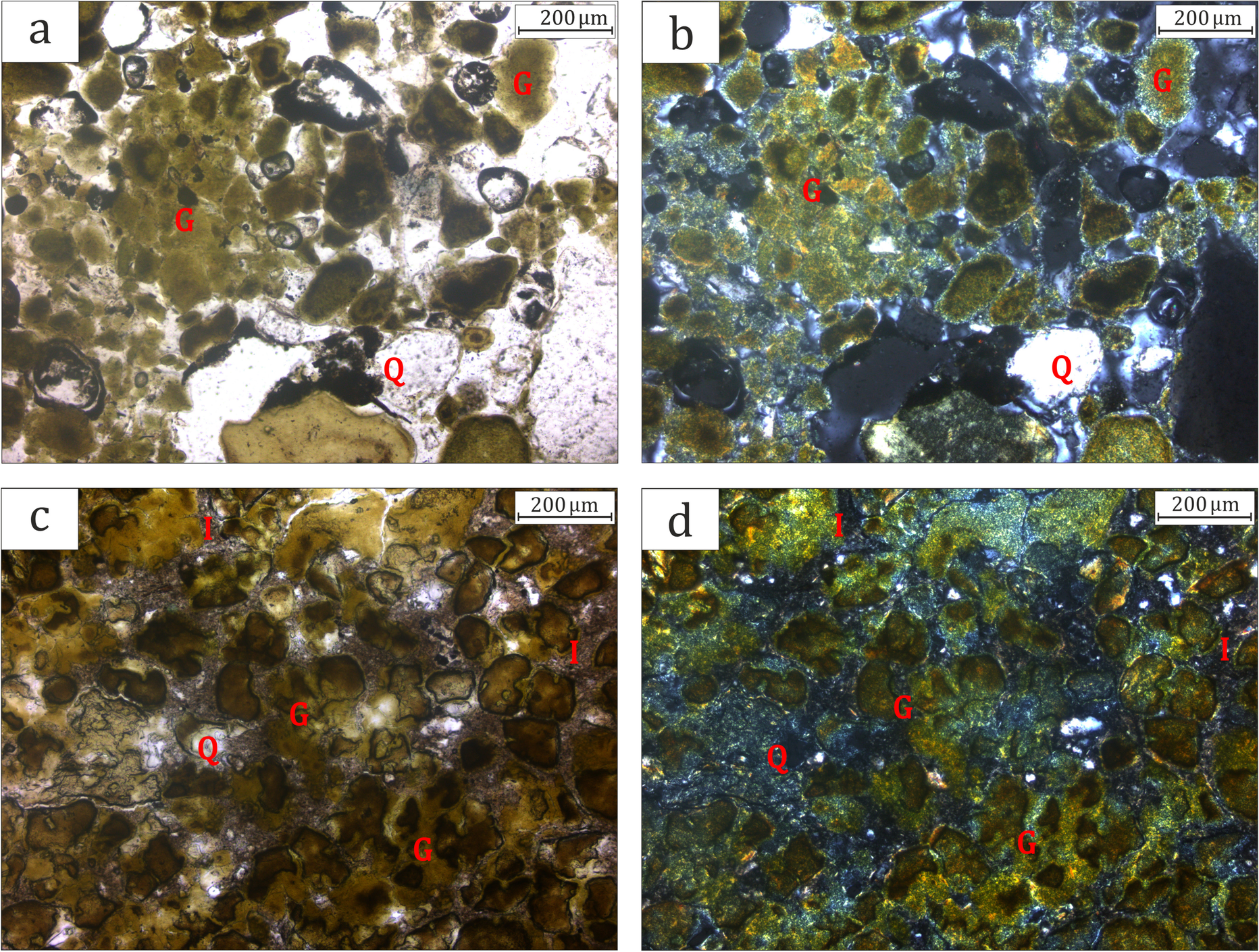
Glauconite constituting ~25–30% of the sample can be considered as the second major component after quartz in glauconitic sandstone. Well rounded glauconite pellets have diameters ranging from 0.25 to 0.5 mm (Fig. 4a, b). The light to dark green-colored glauconite present in sandstone exhibits pleochroism from yellowish green to dark green (Fig. 3a). It shows high-order yellowish green to dark green interference colors under crossed polars (Fig. 4b). Glauconitization was observed along the cleavage planes and fractures of feldspar grains. Glauconitic pellets filling the voids indicated their formation by replacement of K-feldspar (Baldermann et al., Reference Baldermann, Dietzel, Mavromatis, Mittermayr, Warr and Wemmer2017; Bansal et al., Reference Bansal, Banerjee, Pande, Arora and Meena2017). A few grains of glauconite had toothed or lacerated margins, which ruled out long-distance transport of these grains in the sandstone (Fig. 4a, b). The presence of fractured and broken pellets in the sandstone indicated the highly evolved nature of the glauconite (Amorosi, Reference Amorosi2012; Baldermann et al., Reference Baldermann, Grathof and Nickel2012, Reference Baldermann, Dietzel, Mavromatis, Mittermayr, Warr and Wemmer2017; Bansal et al., Reference Bansal, Banerjee, Pande, Arora and Meena2017; Chamley, Reference Chamley1989; Odin & Matter, Reference Odin and Matter1981). The relative abundance of dark green glauconite grains in the sandstone also indicated the evolved nature of glauconite (Baldermann et al., Reference Baldermann, Grathof and Nickel2012, Reference Baldermann, Warr, Grathof and Dietzel2013, Reference Baldermann, Dietzel, Mavromatis, Mittermayr, Warr and Wemmer2017). The highly fractured and highly evolved nature of the glauconite suggests an autochthonous origin of the glauconite in the sandstone (Baldermann et al., Reference Baldermann, Dietzel, Mavromatis, Mittermayr, Warr and Wemmer2017; Li et al., Reference Li, Cai, Hu, Huang, Wang and Christidis2012).
Photomicrograph of glauconitic sandstone in a plane polarized light (PPL) and b cross polarized light (XPL) showing glauconite pellets (G) and floating quartz grains (Q). Photomicrograph of glauconitic shale in c (PPL) and d (XPL) showing glauconite pellets (G), quartz grains (Q), and ferruginous matrix (I)

In contrast, glauconitic shale was composed of 25–35% of moderately sorted, sub-rounded fine grains of quartz, 20–25% of iron oxide, and 35–40% of sub-angular to sub-rounded, ellipsoidal to elongated glauconite pellets by volume (Fig. 3b). Glauconitic shale had a predominance of yellowish green (light green) glauconite pellets 0.15–0.52 mm in size (Fig. 4c, d). Glauconite in shale shows faint pleochroism under PPL and third-order interference colors under XPL (Fig. 4d). Compositionally, the two varieties are similar except for the proportion and size of glauconite pellets, which vary significantly in thinly laminated glauconitic sandstone and fine-grained glauconitic shale. Glauconite pellets are quite elongate and ellipsoidal in shape and embedded as randomly oriented pellets within quartz in glauconitic shale. Fractured glauconite pellets are very similar to the glauconite present in the sandstone layer, which also indicated formation by replacement of K-feldspar. The relatively large amount of glauconite in shale further supports this interpretation. The highly fractured and evolved nature suggests that these glauconites must have formed in situ (Amorosi, Reference Amorosi1995; Baldermann et al., Reference Baldermann, Dietzel, Mavromatis, Mittermayr, Warr and Wemmer2017; Li et al., Reference Li, Cai, Hu, Huang, Wang and Christidis2012).
Whole-Rock Mineralogical and Chemical Compositions
The XRD patterns show that quartz (3.34, 4.26, 2.28, 2.13, 1.98, 1.82, 1.54, 1.38, 1.37 Å), glauconite (10.1, 4.53, 3.63, 3.09, 2.58, 2.41, 1.51 Å), feldspar (3.18, 4.13 Å), and iron oxide (3.66, 2.69, 1.69 Å) constitute the bulk mineralogy of the glauconitic rocks (Fig. 5). Semiquantitative estimation based on the method proposed by Kübler (Reference Kübler1983) revealed that the sandstone has an abundance of quartz (~65%) followed by glauconite (~30%) and feldspar (5%), whereas the shale sample contained ~40% glauconite. XRD peaks indicated that shale contains relatively less quartz (30%) and showed peaks of iron oxide (hematite ~25%).
X-ray diffraction pattern of the bulk glauconitic sandstone and shale of Ukra Member

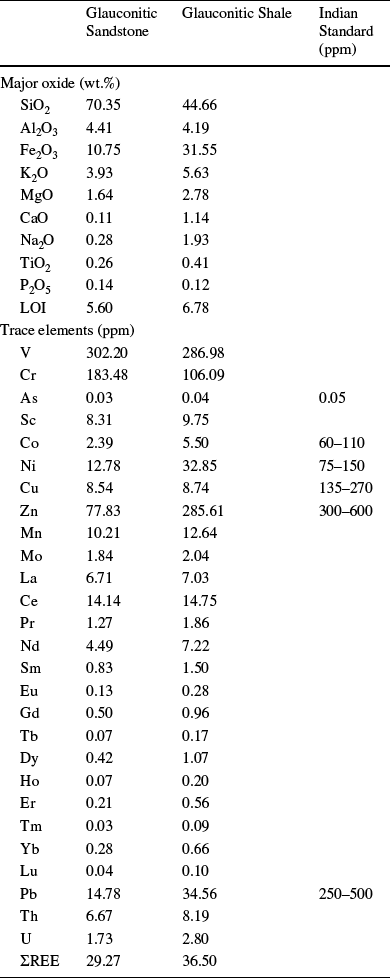
Major- and trace-element concentrations of glauconite-bearing sandstone and shale are listed in Table 1. The sandstone contains a large proportion of SiO2 (70.35 wt.%), a moderate amount of Fe2O3 (10.75 wt.%), Al2O3 (4.41 wt.%), and K2O (3.93 wt.%), and small amounts of MgO (1.64 wt.%), CaO (0.11 wt.%), Na2O (0.28 wt.%), and TiO2 (0.26 wt.%). The glauconitic shale consists of SiO2 (44.66 wt.%), Fe2O3 (31.55 wt.%), K2O (5.63 wt.%), Al2O3 (4.19 wt.%), MgO (1.64 wt.%), Na2O (0.28 wt.%), TiO2 (0.26 wt.%), P2O5 (0.14 wt.%), and CaO (0.11 wt.%), in decreasing order of their abundance. The sandstone is relatively enriched in SiO2 (70.35 wt.%) compared to the shale (44.66 wt.%). The large SiO2 content of sandstone can be attributed to the dominance of quartz in the sample. The shale sample shows an abundance of Fe2O3 (31.55 wt.%) which is consistent with the microscopy study. The sandstone and shale samples contain moderate amounts of K2O i.e. 3.93 and 5.63 wt.%, respectively. The glauconitic sandstone and shale contain trace elements such as Cu, Zn, Mn, Co, Cr, Ni, V, and Mo in considerable amounts. Trace-element analysis of glauconitic sandstone and shale revealed that the concentration of V is greatest, followed by Zn, Cr, Pb, Ni, Mn, Cu, Co, and Mo; the total REE contents are 29.27 ppm and 36.50 ppm, respectively (Table 1).
Chemical compositions of the glauconitic rocks of Ukra Member of the Bhuj Formation, Gujarat, and and permissible levels of heavy metals in soils, based on Indian standards (Bhatnagar & Awasthi, Reference Bhatnagar and Awasthi2000)

Mineralogical, Textural, and Chemical Characterization of the Clay Fraction
Mineralogical study of the clay fraction of glauconitic rocks
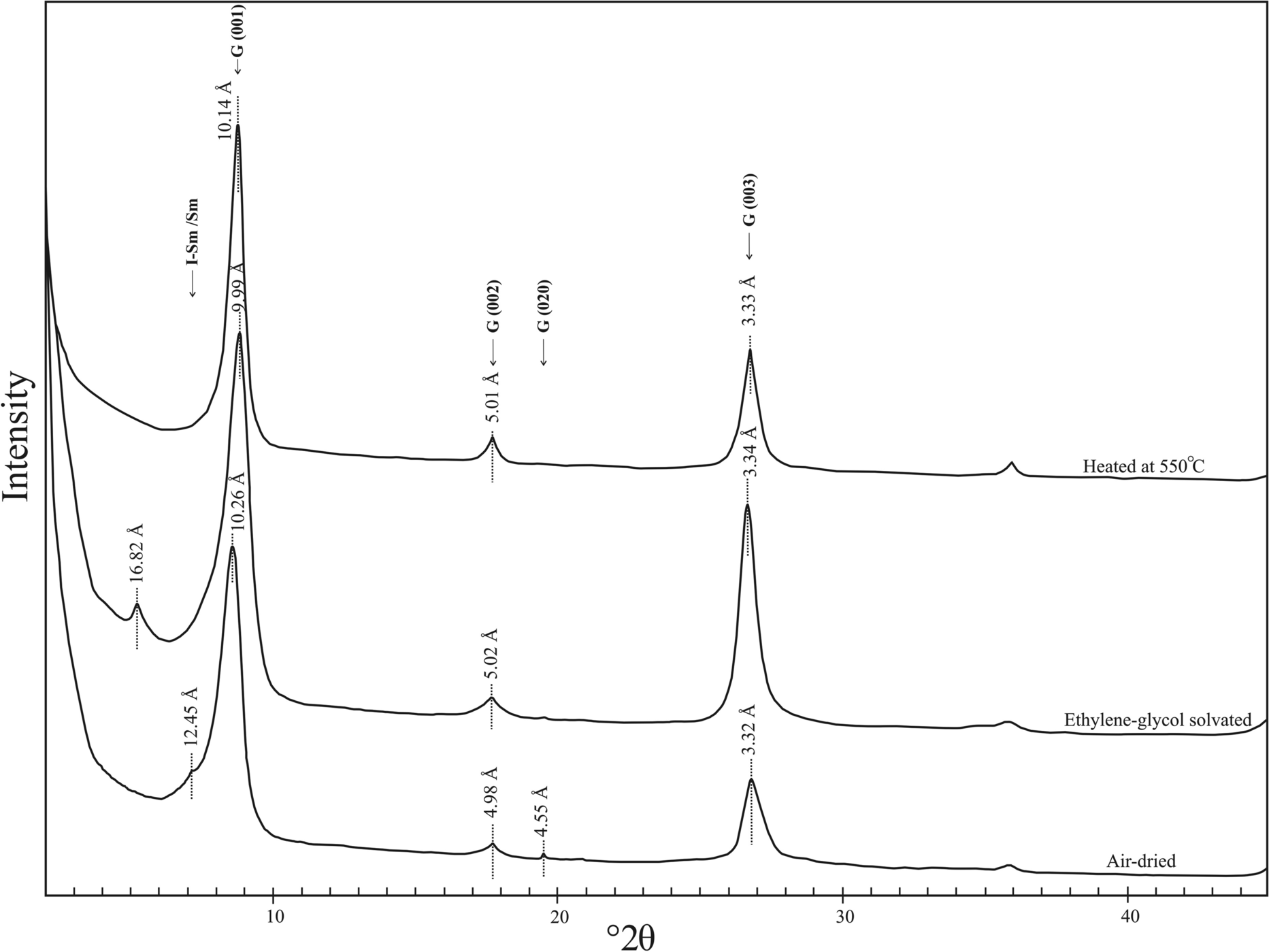
The XRD analysis of the clay fraction (<2 μm) of the glauconite-bearing rock samples was carried out using oriented mounts. The sandstone’s glauconite is characterized by a basal diffraction peak at 10.26 Å (001), and non-basal diffraction peaks at 4.98 Å (002), 3.32 Å (003), and, 4.55 Å (020) (Fig. 6). The (112) and (11
 ) diffractions were absent from glauconite associated with sandstone indicating that the glauconite is slightly disordered (Thompson & Hower, Reference Thompson and Hower1975). The basal (001) diffraction (10.26 Å) was shifted to 9.99 Å upon EG treatment, which indicated the presence of expandable (smectitic) layers in glauconite. The appearance of a narrow, sharp, and symmetrical peak at (001) after heating is further support for the presence of expandable smectitic layers in the glauconite. The AD sample showed an additional diffraction at 12.46 Å, shifted to 16.98 Å after the EG treatment, suggesting the presence of discrete smectite or illite-smectite (López-Quirós et al., Reference López-Quirós, Sánchez-Navas, Nieto and Escutia2020). The d 001 value (10.86 Å) calculated based on the distance between the (001) and (020) peaks indicated the highly evolved nature of the glauconite (Amorosi et al., Reference Amorosi, Sammartino and Tateo2007).
XRD patterns of an oriented mount of clay separated from sandstone in air-dried state, after glycolation, and after heating at 550°C. The peak shift can be observed upon glycolation and heating. Abbreviations are as follows: G = Glauconite, Sm = Smectite, I-Sm = mixed-layer Illite-Smectite

The AD sample of glauconite present in the shale, exhibited a broadened basal diffraction (001) at 10.18 Å, and other diffractions at 4.56 Å (020), 3.32 Å (003), and 2.58 Å (130) (Fig. 7). A poorly developed peak was observed at 3.09 Å (11
 ) whereas the (112) diffraction was absent from the XRD pattern of the shale sample. The oriented XRD pattern treated by EG shows a slight shift of broadened basal diffraction at 9.98 Å of an asymmetrical shape, with incorporated, poorly developed feature at 10.61 Å (Fig. 7). Two diffractions at 9.98 and 10.61 Å after EG treatment indicate that glauconite contains expandable (smectitic) layers (López-Quirós et al., Reference López-Quirós, Sánchez-Navas, Nieto and Escutia2020). No diffraction was detected at lower angles than the glauconite’s basal diffraction, which indicated the absence of discrete smectite in the shale sample (López-Quirós et al., Reference López-Quirós, Sánchez-Navas, Nieto and Escutia2020). On the other hand, a sharp and intense diffraction with a narrow base appeared at 10.14 Å on heating at 550°C. The distance between the (001) and (020) peaks (d 001 = 10.76) indicated the evolved nature of the glauconite present in the shale (Amorosi et al., Reference Amorosi, Sammartino and Tateo2007).
XRD pattern of an oriented mount of clay separated from shale in air-dried state, after glycolation, and after heating at 550°C. The peak shift can be observed upon glycolation and heating. Abbreviations are as follows: G = Glauconite, Sm = Smectite, I-Sm = mixed-layer Illite-Smectite

The near symmetrical basal diffraction (001) and the poorly developed and/or absence of peaks at (112) and (11
 ) in the sandstone and shale indicated slight disordering in the structure (Bentor & Kastner, Reference Bentor and Kastner1965). Such disordered glauconites generally contain 10–20% expandable layers (Bentor & Kastner, Reference Bentor and Kastner1965; Hower, Reference Hower1961; Odin & Matter, Reference Odin and Matter1981). A weak response to glycolation was observed in both samples, which indicated that the glauconite contained nearly 10% expandable layers (López-Quirós et al., Reference López-Quirós, Sánchez-Navas, Nieto and Escutia2020). The d 001 value of glauconite present in sandstone and shale indicated a ‘highly evolved to evolved’ nature of glauconite (Amorosi et al., Reference Amorosi, Sammartino and Tateo2007).
Major-element composition and structural formula of glauconite
The major-element composition of glauconites present in sandstone and shale was obtained using EPMA. The micrograph of the glauconitic sandstone is represented in Fig. 8a. The BSE image shows different textures for the different minerals present in the sample. Based on the texture of minerals, a specific location for point EDX over the thin section was selected for analysis. In the sandstone sample, two points for each mineral category were analyzed by EDX (Fig. 8b). The location points 001 and 002 were selected for quartz and 003 and 004 for glauconite. The EDX at points 001 and 002 showed that Si and O are the main elements whereas the other two points (003 and 004) show Si, O, Fe, K, Al, Mg, Ca, Na, and Ti to be major elements (Fig. 8b). The first two points correspond to quartz and the other two points present in the BSE image were identified as glauconite based on their chemical compositions.
a EPMA-BSE image of a thin section of a representative glauconitic sandstone and b its corresponding EDX chemical analysis at points 001, 002, 003, and 004. c EPMA-BSE image of a representative glauconitic shale with d its corresponding EDX chemical analysis at points 001, 002, 003, and 004

Similarly, two points for quartz and two points for glauconite were identified from a thin section of shale (Fig. 8c). The EDX analysis at points 001 and 002 confirmed the presence of quartz (only Si and O are major elements) whereas the other two points 003 and 004 showed Si, Fe, K, Al, Mg, Ca, and Na as characteristic major elements for glauconite (Fig. 8d). The elemental weight was converted to oxide percent. The K2O content of glauconite present in sandstone was 8.4 wt.%, whereas the glauconite in shale contained 7.4 wt.% of K2O. The total Fe2O3 content was high for both samples. The estimated Fe2O3 content of glauconite in the sandstone was 26.2 and 27.13 wt.% in the shale. The Al2O3 content was slightly lower (6.94 wt.%) in the sandstone glauconite than in the shale (7.32 wt.%). The SiO2 content was almost the same in both samples, i.e. 50.08 and 50.30 wt.%, respectively. The MgO content was also similar for glauconites present in both types of rock (Fig. 8b, d). The concentration of CaO and Na2O in both varieties of glauconite was <1 wt.%.
Based on the potassium oxide and aluminum oxide contents, glauconite maturation was divided into four stages: (1) nascent stage (2–4 wt.% K2O; 20–16 wt.% Al2O3); (2) slightly evolved stage (4–6 wt.% K2O; 16–11 wt.% Al2O3); (3) evolved stage (6–8 wt.% K2O; 11–7 wt.% Al2O3); and (4) highly evolved stage (>8 wt.% K2O; <7 wt.% Al2O3) (Odin & Matter, Reference Odin and Matter1981). The maturation of glauconite increased with increase in the concentration of potassium with a simultaneous decrease in aluminum content (Odin & Matter, Reference Odin and Matter1981). The K2O and Al2O3 contents of the glauconite concentrate suggested that the glauconite in sandstone belongs to the highly evolved category, whereas the glauconite present in shale had an evolved nature. The residence time of evolved glauconite is 104–105 years and 105–106 years for the highly evolved type (Harding et al., Reference Harding, Nash, Petersen, Ekdale, Bradbury and Dyar2014; López-Quirós et al., Reference López-Quirós, Sánchez-Navas, Nieto and Escutia2020; Odin, Reference Odin1988).
The stoichiometric formula calculation for both types of glauconite (sandstone and shale) was carried out based on 22 anionic charges per half unit cell. The oxide percent required for calculation was based on the chemical analysis of point 003 of Fig. 8b and d, and gave the chemical formulae (K0.77 Na0.04 Ca0.01)0.83 (Fe1.42 Ti0.01 Mg0.32 Al0.20)1.95 (Si3.61 Al0.38)4 O10(OH)2. nH2O and (K0.67 Na0.01 Ca0.01)0.71 (Fe1.46 Mg0.31 Al0.22)1.99 (Si3.60 Al0.39)4 O10 (OH)2. nH2O for the glauconite present in sandstone and shale, respectively. The total iron (Fe) was the dominant octahedral cation with the value of 1.42 and 1.46 apfu for glauconite present in sandstone and shale, respectively. The other octahedral cations, Mg2+ and Al3+, were 0.32 and 0.20 apfu, respectively, in the sandstone glauconite, whereas these values were 0.31 and 0.22 apfu, respectively, in the glauconite of shale sample. The Si4+ and Al3+ contents in the tetrahedral sites were 3.61 and 0.38 apfu, respectively, in the glauconite present in sandstone. In contrast, Si4+ and Al3+ contents in shale glauconite were 3.60 and 0.39 apfu, respectively. The interlayer K+ was 0.77 and 0.67 apfu in the sandstone and shale glauconites, respectively. The percentage of non-expandable (glauconite/mica type) and expandable layers present in glauconite was calculated using the interlayer K+ value (Fernández-Landero & Fernández-Caliani, Reference Fernández-Landero and Fernández-Caliani2021; López-Quirós et al., Reference López-Quirós, Sánchez-Navas, Nieto and Escutia2020), revealing ~91% (9% expandable layers) mica-type layers in glauconite from sandstone and ~85% (15% expandable layers) in shale.
Micro-textural analysis of the clay fractions
High-magnification FEG-SEM analysis revealed the morphological features of glauconite present in both types of siliciclastic rocks, i.e. sandstone and shale. Glauconite in sandstone as well as in shale was characterized by well developed ‘rosette’ or ‘flaky honeycomb’ structures (Fig. 9a, b). Glauconite present in sandstone exhibits aggregates of curved lamellar glauconite particles ranging in size from 1 to 2 μm. The lamellar structure was a characteristic feature of highly evolved glauconite grains (Fig. 9a). Glauconite present in shale shows irregular flat flakes 0.5–1 μm in size dispersed throughout the matrix, which corroborated the evolved nature of glauconite (Fig. 9b) (Bansal et al., Reference Bansal, Banerjee, Pande, Arora and Meena2017; Wright et al., Reference Wright, Schrader and Holser1987). Thus, the FEG-SEM analysis was consistent with the maturity evaluation observed in the petrographic, XRD, and EPMA analyses.
SEM image showing the internal structure of glauconite from a sandstone and b shale

Infrared spectra of the clay fractions
The FTIR spectra of two clay fractions observed over the range 4000–500 cm–1 revealed the existence of five high-frequency absorption bands (Fig. 10). The prominent peak at 3540 cm–1 was related to the stretching vibrations of structural hydroxyl groups (–OH), which were attached to Al3+, Mg2+, Fe2+ , and/or Fe3+ in the octahedral sheet (Odin, Reference Odin1988; Petit et al., Reference Petit, Madejová, Decarreau and Martin1999; Selim et al., Reference Selim, Youssef, Abd El-Rahiem and Hassan2014). The other feature at 1630 cm–1 was due to the H–O–H bending vibration present in the interlayer space (Russell et al., Reference Russell, Farmer and Velde1970). The most intense peak at 960 cm–1 was assigned to in-plane Si–O–Si lattice vibrations (Sanchez-Navas et al., Reference Sanchez-Navas, Martín-Algarra, Eder, Reddy, Nieto and Zanin2008; Selim et al., Reference Selim, El-Tawil and Rostom2018). The other absorption peaks at 812 cm–1 and 665 cm–1 were attributed to the out-of-plane bending vibration of Fe3+MgOH/Fe3+Fe2+OH and structural vibrations of –OH groups, respectively (Bishop et al., Reference Bishop, Lane, Dyar and Brown2008; Haaland et al., Reference Haaland, Friesem, Miller and Henshilwood2017). The absorption peak at 960 cm–1 for glauconitic sandstone had more band depth due to less substitution of Al3+ for Si4+ in the tetrahedral structure of glauconite (Chattoraj et al., Reference Chattoraj, Banerjee, Meer and Ray2018; Younes et al., Reference Younes, Mahanna and El-Etriby2019). This observation agreed with the EPMA results which showed that less Al3+ had substituted for Si4+ in the sandstone glauconite.
IR spectra of clay fractions from both the shale and the sandstone

Discussion
The integrated mineralogical and geochemical investigations of glauconitic rocks belonging to the Ukra Member (Bhuj Formation) at Kutch highlight an important aspect of glauconite maturation. Glauconite occurs mainly in sandstone and shale horizons of the Ukra Member. The petrographic and bulk XRD analyses indicated that quartz, glauconite, feldspar, and iron oxide are the major mineral constituents of the rock samples. Glauconitic shale contains more glauconite than glauconitic sandstone. The trace-element study strengthened the interpretation as the observed higher concentration of trace elements (V, Co, Ni, Cu, Zn, Mo, and REE) in shale can be attributed to a large clay content (glauconite). The penetrating fractures in glauconite indicate the in situ formation of glauconite along the cleavage and fracture planes of feldspar grains (Amorosi, Reference Amorosi1995; Baldermann et al., Reference Baldermann, Dietzel, Mavromatis, Mittermayr, Warr and Wemmer2017; Bansal et al., Reference Bansal, Banerjee, Pande, Arora and Meena2017; Li et al., Reference Li, Cai, Hu, Huang, Wang and Christidis2012). The analytical results obtained from XRD and EPMA show that the glauconites present in sandstone and shale are slightly disordered and contain small proportions (9–15%) of interstratified expandable (smectite) layers. The results also showed the glauconites to be mature. The K2O contents (7.5–8.5%) and d 001 (10.76–10.86 Å) values for the glauconites of the Ukra Member are comparable with the values proposed by Amorosi et al. (Reference Amorosi, Sammartino and Tateo2007) for evolved to highly evolved glauconites. The glauconite associated with sandstone and shale containing high K+ (0.77 and 0.67 apfu) at interlayer sites also indicated the highly mature stage of glauconite development (Baldermann et al., Reference Baldermann, Warr, Grathof and Dietzel2013, Reference Baldermann, Dietzel, Mavromatis, Mittermayr, Warr and Wemmer2017). The high degree of maturity was further confirmed by the position of a Si–O absorption band near 1000 cm–1 in the FTIR spectra (Li et al., Reference Li, Cai, Hu, Huang, Wang and Christidis2012). The autochthonous and highly evolved nature of glauconite suggested a low rate of sedimentation and its formation during transgression (Bansal et al., Reference Bansal, Banerjee, Pande, Arora and Meena2017; Li et al., Reference Li, Cai, Hu, Huang, Wang and Christidis2012; López-Quirós et al., Reference López-Quirós, Escutia, Sánchez-Navas, Nieto, Garcia-Casco, Martín-Algarra, Evangelinos and Salabarnada2019).
Glauconitic rocks which contain at least 2.2–4 wt.% K2O are considered as potential potash fertilizer (Franzosi et al., Reference Franzosi, Castro and Celeda2014; Karimi et al., Reference Karimi, Abdolzadeh, Sadeghipour and Aminei2012; Rudmin et al., Reference Rudmin, Banerjee, Mazurov, Makarov and Martemyanov2017) for countries where conventional sources of potassium are unavailable. Glauconitic rocks containing ~3–6 wt.% K2O have been beneficiated to enhance their potassium contents (Shekhar et al., Reference Shekhar, Mishra, Agrawal and Sahu2017a; Shekhar et al., Reference Shekhar, Mishra, Agrawal and Sahu2017b; Sontakkey et al., Reference Sontakkey, Aehdi, Mohanram, Aruna, Lal and Ravindran2017) for direct application and conversion into a soluble, commercial fertilizer product (Castro & Tourn, Reference Castro and Tourn2003; Mohammed et al., Reference Mohammed, Brandt, Gray, White and Manning2014; Rudmin et al., Reference Rudmin, Banerjee, Makarov, Mazurov, Ruban, Oskina, Tolkachev, Buyakov and Shaldybin2019; Shirale et al., Reference Shirale, Meena, Gurav, Srivastava, Biswas, Thakur, Somasundaram, Patra and Rao2019). The K2O content of glauconitic sandstone and shale of the Ukra Member (Bhuj Formation) is 3.93 and 5.63 wt.%, respectively (Table 1). The glauconite fraction associated with the rocks of the Ukra Member contains 7.4–8.4 wt.% K2O. Moreover, the glauconitic rocks contain micronutrients such as Zn, Mn, Cu, Co, Mo, and Ni, which are beneficial for plant growth (Tripathi et al., Reference Tripathi, Singh, Singh, Mishra, Chauhan and Dubey2015) (Table 1). The concentrations of heavy metals present in the glauconitic rocks are less than the permissible levels (Bhatnagar & Awasthi, Reference Bhatnagar and Awasthi2000) and, hence, are not toxic to plant and human health. The glauconitic rocks of the Ukra Formation containing mature glauconite pellets, have large K2O contents (~4–5.6 wt.%) and essential micronutrients and can, thus, be considered as a source of fertilizer after appropriate beneficiation.
Conclusions
(1) In the present study, the occurrence of glauconite was observed in siliciclastic rocks belonging to the Ukra Member of the Bhuj Formation, which are exposed in the Guneri and Umarsar area of the Kutch District, Gujarat. The host rock for the glauconite in Guneri is sandstone whereas glauconite occurs in shale in the Umarsar area.
(2) The glauconite showed a greenish appearance in sandstone while it was brownish in shale. Glauconite occurred as pellets exhibiting variable external morphologies ranging from ovoid or spheroidal to ellipsoidal in sandstone as well as shale samples. In addition, glauconite showed significant fractures indicating an in situ origin.
(3) Based on the XRD analysis of the clay fraction recovered from the bulk-rock samples, the glauconite in sandstone and shale was identified as being of slightly disordered type with few interstratified expandable layers. The distance between the (001) and (020) XRD peaks (d 001 = 10.76–10.86 Å) indicated a high degree of maturation of the glauconites associated with sandstone and shale.
(4) The mineral chemistry determined by EPMA showed that the glauconite grains present in sandstone were relatively enriched in K2O (8.4 wt.%) compared to that of the glauconite in the shale (7.4 wt.%). In both cases, however, the degree of maturity is high. The sandstone contained highly evolved glauconite and the glauconite present in shale was of an evolved nature.
(5) The ‘curved lamellar’ internal morphology of the glauconite present in sandstone indicated its highly evolved (highly matured) nature. In contrast, the glauconite in shale shows an irregular, flaky structure confirming an evolved (matured) nature.
(6) The highly evolved and autochthonous glauconite, indicating the low rate of sedimentation, must have formed during the period of transgression. The glauconite-bearing siliciclastic rocks (Ukra Member) from the Guneri and Umarsar areas were, therefore, likely to have been deposited during the high stand. This study supports the other sedimentological and paleontological studies which considered the Ukra Member to be a transgressive tongue in the Bhuj Formation of the Kutch Basin.
(7) The glauconitic rocks containing evolved to highly evolved glauconite along with other micronutrients can be considered as a potential alternative source of potash after appropriate physicochemical beneficiation and reserve estimation.
Acknowledgments
The authors thank the director, CSIR-National Metallurgical Laboratory, for his permission to publish this paper. This research work was supported and funded by the In-House Research Project (OLP 0294) of the National Metallurgical Laboratory. The authors are grateful to Mr. Hajaj Basheer, Geologist (Sr.) of the Geological Survey of India (GSI), Gujarat, for providing the glauconitic rock samples.
Funding
Funding sources are as stated in the Acknowledgments.
Declarations
Conflict of Interest
The authors declare that they have no conflict of interest.