Introduction
Perhaps life has evolved only once. But there may be other life, perhaps it's even common. Perhaps, even, elsewhere in our solar system. If so, surely it will not all be like earth life. What will alien life be like? Like the famous story, will it be the lady or the tiger – or something so different from us that no words will do? Peter Ward (Reference Ward2005, p. XI).
The implications of finding any form of extraterrestrial life, intelligent or not, will be profound for a great extent of human activities, either in science, philosophy, ethical, metaphysics or religion (Dick, Reference Dick2012; Dunér et al. Reference Dunér, Parthemore, Persson and Holmberg2013). Despite its obvious social and scientific importance, a research area organized around the search for extraterrestrial life in all of its possible forms remained inexistent until the 1940s. According to Morrison (Reference Morrison2001), the term astrobiology appears for the first time in Lafleur (Reference Lafleur1941). Exobiology programs maintained by North-American and Soviet governments during the Cold War (1945–1991) were the common grounds to the development of current astrobiology projects. The growth of aerospace technology and industry after the launch of probes to Venus and Mars and the manned flights to the Moon gave impetus to the area. In this sense, the 1976 Viking missions on Mars were the first in situ searches for extraterrestrial life (Ezell & Ezell, Reference Ezell and Ezell1984; Cleland & Chyba, Reference Cleland and Chyba2002).
The early exploration of the Solar System has put astrobiological initiatives on a more solid scientific foundation. The academic community and the general public is now capable of drawing a line between astrobiology and popular but unscientific accounts on the theme such as science fiction and ufology, a prototypical New Age religion (Hanegraaf, Reference Hanegraaf and Woodhead2002) (especially during Cold War, UFO religions assumed that the extraterrestrial intelligences were the heralds of a peaceful era that would rise after the nuclear holocaust). After the interruption of the Moon landings and the relative failure of the missions to Mars in the 1970s, unable to return any material evidence of extraterrestrial organisms, public interest in astrobiology diminished. Only after 1996, with NASA's announcement of presumed Martian fossils in ALH84001 (McKay et al. Reference McKay, Gibson, Thomas-Keprta, Vali, Romanek, Clemett, Chillier, Maechling and Zare1996) meteorite, and the discovery of exoplanets (planets orbiting different stars than our Sun), and recently detected flow of salty water on slopes of the surface of Mars (Ojha et al. Reference Ojha, Wilhelm, Murchie, McEwen, Wray, Massé and Chojnacki2015) there was a revival of astrobiology as a genuine scientific research field.
In 1998, NASA created its Astrobiology Institute, gathering North-American universities and research centres in order to promote research and education in themes covering from the origin and evolution of life on Earth to the possibility of cosmic exploration of extraterrestrial living forms (Morrison, Reference Morrison2001; Blumberg, Reference Blumberg2003, Reference Blumberg2011; Des Marais et al. Reference Des Marais2008). Nowadays, there are similar research centres all over the world in Europe – European AstRoMap, the Astrobiology Road Mapping (Horneck et al. Reference Horneck, Rettberg, Walter and Gomez2015) –, Asia, Australia and Latin America. In Brazil, the Research Unit in Astrobiology, NAP/Astrobio, is maintained by the Instituto de Astronomia, Geofísica e Ciências Atmosféricas (Astronomy, Geophysics and Atmospheric Sciences Institute) of Universidade de São Paulo, with close collaborations with other Brazilian institutes and universities (Rodrigues et al. Reference Rodrigues, Galante, Paulino-Lima, Duarte, Friaça, Lage, Janot-Pacheco, Teixeira and Horvath2012), and, since 2011, it is an international partner of both the NASA Astrobiology Institute and the European Astrobiology Network Association.
The landscape of astrobiology research is expanding significantly. Hence, in an emerging area such as this, it is important to build a theoretical framework able to assure its scientificity. The main aim of the present paper is to discuss the scientific status of astrobiological studies, based on the view that every kind of life, Earth-based or not, should be considered in a cosmic context. Also, we would like to comment some strong parallels between cosmology and astrobiology, reinforcing the notion that the astrobiological research is much more robust when it considers multiple theoretical and experimental approaches.
Historical survey
The philosopher Epicurus (341–270 BCE), in his ‘Letter to Herodotus’, argues that life should be found everywhere in the universe:
…Moreover, we may believe that in all the worlds there are animals, plants, and the other things we see; for no one can show that the seeds from which grow animals, plants, and the other things we see might or might not have been included in one particular world and that in another kind of world this was impossible. ( Epicurus, Reference Epicurus and Geer1964, p. 22).
These early reflections testify that questions related to the origin of life here on Earth and other planets have been a source of fascination, since antiquity (Goldsmith, Reference Goldsmith1980; Dick, Reference Dick1982; Crowe, Reference Crowe1986). Such topics were considered as philosophical and religious themes for centuries. In the 20th century, the new discipline of astrobiology has arisen with the purpose of studying life in the universe using the current scientific methodology and tools, taking as a starting point the terrestrial life perspective. It is not even clear whether astrobiology could be called a discipline or a transdiscipline, since it explicitly transcends disciplinary boundaries (Staley, Reference Staley2003). Astrobiological investigations use an integrative approach and recent developments in fields such as astronomy, biophysics, biochemistry, genetics, systematics and paleontology to search for answers to some of the most profound questions ever made: What is life? How to recognize it? When did it begin? Are there living beings outside the Earth? How to detect them, if they really exist? (Des Marais & Walter, Reference Des Marais and Walter1999; Chyba & Hand, Reference Chyba and Hand2005). Astrobiology is not a research area created to explain a particular discovery or problem.
The debate on life beyond Earth dates back to Ancient Greece. The ubiquity of life in Epicurus thinking is the logical consequence of his atomist cosmology. The atomism developed by Leucippus and his disciple Democritus in the 5th century BCE argues that tiny, indivisible units, the atoms, are the most basic components of matter. According to this theory, the random motions of infinite atoms had created the world. The atomist doctrine does not make a sharp distinction between heaven and Earth, since both are made of the same atoms. In the atomistic cosmology, the universe (‘the sum of things’) is infinite, and there are infinite atoms, infinite bodies and infinite worlds. The atomists assumed common processes creating worlds anywhere in the cosmos (including the Earth). Hence, if there is life in our world, life must also exist in other worlds. Therefore, the Epicurean philosophy implies both a cosmology – an infinite universe cosmology – and an astrobiology – the universe should be teeming of life, or at least of the ‘seeds’ from which life arises.
In opposition to the atomists, Aristotle (387–322 BCE) proposed a finite universe centred on Earth. He also formulated a theory to explain the origin of life on Earth based on his four elementals (earth, wind, fire, water) and on the observation of nature guided by the common sense. Therefore, it is possible to say that there is an Aristotelian cosmology (a closed world, Earth-centred cosmology) and an Aristotelian negative astrobiology (there are no other worlds hosting life similar to the one found on Earth, because the physics of the superlunary world would be completely different of the terrestrial physics). From a strictly Aristotelian perspective, there is no astrobiology. The contemporaneous opposition to astrobiology could be thought as part of the Aristotelian legacy, in which there is a discontinuity between life as found on Earth and celestial life (Falcon, Reference Falcon2005, p. 93). This is a consequence of Aristotle's double physics, implying that only circular, Earth-centred motions are allowed for the skies while the ‘motions’ of alteration and growth are present on Earth. It follows a double biology. The plants, animals and humans of terrestrial life are perishable, because they are subject to the generation and corruption of the sublunary world, while the celestial life is constituted by the everlasting celestial bodies.
In the middle Ages, the debate on the plurality of worlds seemingly came to a halt, but a cosmological revolution was in preparation. In fact, the question of life beyond Earth was part of the natural evolution of the Scholastic tradition (Dick, Reference Dick1982, p. 42). When Alberto Magnus (c. 1206–1280) wondered: ‘Do there exist many worlds, or is there but a single world? This is one of the most notable and exalted questions in the study of nature’ (Mackay, Reference Mackay1991, p. 3), he was not considering other planets similar to the Earth since the Earth was not even imagined as a planet. At the time, the whole set of a central Earth, the Sun, the five planets and the firmamentum – the surrounding sphere of stars – were the ‘world’. Actually, the great question of Alberto Magnus is a metaphysical one: is this world we know the one world or it is only one among several others? In modern language, we replace world by universe and many worlds by multiverse.
The cosmological revolution matured during the Middle Ages, which would allow imagining the Earth as a planet and other planets as other Earths, has a double origin: the image of the universe as a machine and the notion of infinity. The invention of the mechanical clock, the medieval machine par excellence, gave rise to the metaphor of the universe as a gigantic clock. Thus, Nicholas Oresme (1320/25–1385) compared the universe with a clock set in motion by God (Fraser, Reference Fraser1990). The considerations of Christian theology on the divine infinitude opened the road to discussions concerning infinity in metaphysical, mathematical and astronomical perspective. The ideas of a machine-like universe and of an infinite deity converge in the cosmological conception of Nicholas of Cusa (1401–1464): ‘Hence, the world-machine will have its center everywhere and its circumference nowhere, so to speak’ (Cusa, Reference Cusa and Hopkin1981, p. 33). The scenario was set for the Copernican Revolution.
The publication of De revolutionibus orbium coelestium (Copernicus, Reference Copernicus1543) inspired a wake of cosmic optimism. If other planets are analogous to Earth, why not do they harbor life? Johannes Kepler also treated the issue fictionally in a science-fiction novel (Kepler, Reference Kepler1609). In his Somnium, highly intelligent creatures, interested in astronomy, inhabit the Moon. In 1686, Bernard le Bovier de Fontenelle published one of the first great popular successes of scientific literature, Entretiens sur la pluralité des mondes, which discussed the plurality of worlds, space flight and the existence of other habitable worlds (Fontenelle, Reference Fontenelle1998).
The Copernican Revolution only become fully mature with the Galilean Revolution set after the publication of Sidereus Nuncius (Galilei, 1609/1610). However, with the new astronomy, physics gained the status of the most fundamental science, and the interest in cosmology waned. As Koyré (Reference Koyré1966) put it, the Galilean Revolution led to the destruction of Cosmos and to the complete geometrization of space. This would represent the elimination of privileged places, and all the extension of the universe would be thought as the repetition of identical space cells. Therefore, to talk about the structure of the universe and its origin was meaningless.
Parallels with cosmology
Because of the ‘destruction of the Cosmos’ by the Galilean Revolution, from the 17th century to the beginning of the 20th, there was little room for cosmology in science. Such ostracism ended with the publication of ‘Cosmological Considerations on the General Theory of Relativity’ (Einstein, Reference Einstein1917). For the first time since Sidereus Nuncius, science considered the universe as a whole. The return of cosmology was possible within a new paradigmatic corpus represented by the general theory of relativity. Even though, the early criticism against cosmology – that there is only one Universe – remained unaffected. If there is nothing outside this single universe, which is the object of study, the scientific method could not be applied. Cosmology, according to this perspective, lacks the reproducibility of laboratory results in experimental science or the statistical tools of astronomical observations (Disney, Reference Disney2000).
Many of the common criticisms against astrobiology echoes the disapproval of cosmology before its status as valid science was widely accepted. In Weber's (Reference Weber and Whims2004, p. 81–100) sociology, the cosmological thinking is characteristic of magical cultures, representing an underdeveloped stage of rational thought of a primitive mentality. Other objection, which appeared after the discovery of the expansion of the Universe by Lemaître (Reference Lemaître1927) and Hubble (Reference Hubble1929), is that cosmology actually deals with the origins of everything observable in the universe. Such a topic was considered by many philosophers and theologians as belonging to their respective disciplines and not to natural sciences. However, even before Darwin's On the Origins of Species (Darwin, 1859), with Buffon, Lamarck and Chambers thesis and speculations (Bowler, Reference Bowler2009), the origin and diversification of life is a fundamental theme in natural scientific investigations. It is not coincidence that several cosmologists interested in the origins of the universe have turned to astrobiology (e.g. Davies, Reference Davies1998).
As aforementioned, the conflicts during the rise of modern cosmology could shed light on some of the present-day arguments against the scientific status of astrobiology. At the beginning of the 1960s, cosmology was hardly recognized as a legitimate research field. People who were actively working with it were known as astronomers, not cosmologists (Hawking, Reference Hawking2013). In the early 1960s, two alternative cosmological scenarios were put forward. Hoyle was the main supporter of the steady-state theory, in which new matter was continually created to keep the density constant on average as the universe expanded. The other scenario was the hot Big Bang theory (Alpher et al. Reference Alpher, Bethe and Gamow1948), strongly criticized by Hoyle, who has coined the term ‘Big Bang’ for the BBC radio's Third Programme in 1949. Hoyle and others opposed to the idea that the universe had a beginning. Hoyle pointed out flaws in the nuclear physics of the original paper discussing the Big Bang theory and rejected the whole idea of primordial nucleosynthesis. Based on his criticisms, Hoyle and collaborators strengthened a detailed theory of stellar nucleosynthesis that culminated in the B2FH paper (Burbidge et al. Reference Burbidge, Burbidge, Fowler and Hoyle1957). The results were so compelling that they discredited the idea that virtually all elements were synthesized during the Hot Big Bang.
However, by 1961 the steady-state theory was already in trouble. Martin Ryle's radio astronomy group at the Cavendish Laboratory found that there were too many faint sources, indicating that their density had been higher in the distant past, which is inconsistent with Hoyle's predictions (Ryle & Clarke, Reference Ryle and Clarke1961). The definitive dismissal of the steady-state theory came in 1965 with the discovery of a faint background of microwave radiation through radio astronomy techniques, (Penzias & Wilson, Reference Penzias and Wilson1965). Both the theory of nucleosynthesis and the radio astronomy represent the theoretical and observational backgrounds that led to the recognition of cosmology as a scientific discipline. The correlation between the dates of these developments and the coming of age of cosmology is presented in Fig. 1. It shows the frequency of occurrence of the word ‘cosmology’ between 1900 and 2008 in the text corpus of digitized documents of the Google Ngram Viewer (2014).
Frequency of occurrence of the word ‘cosmology’ on Google Books (based on Google Ngram Viewer). Light grey area represents a period when the development of areas such as nucleosynthesis theory and radio astronomy correlate positively with the rise of citations of the word ‘cosmology’ on the scientific literature.

In the case of astrobiological research, we propose to draw a parallel with these two major developments in astrophysics: the consolidation of the theory of nucleosynthesis and the advancements of radio astronomy. They have had a significant importance on laying the foundations for many areas of modern astrophysics, improving our understanding of the physical Universe, its origin, constitution, structure and evolution, leading to a better acceptance of cosmology as a well-based scientific research field, as is suggested in Fig. 1.
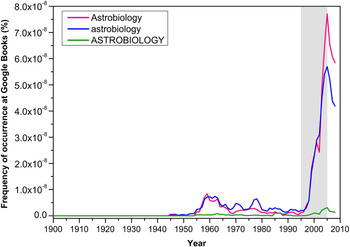
These two are compared here with the more recent and still uprising fields of exoplanets (detection and characterization) and microbiology of extreme environments, which can be said to have triggered the coming of age for astrobiology. Figure 2 exhibits the frequency of occurrence of the word ‘astrobiology’ between 1900 and 2008 text database of the Google Ngram Viewer (2014). A rapid increase in the use of the term is clear around the years 1990–2000. There was a clear catalytic effect due to the 1996 announcement of the potential microfossils present on the Martial ALH84001 meteorite (McKay et al. Reference McKay, Gibson, Thomas-Keprta, Vali, Romanek, Clemett, Chillier, Maechling and Zare1996), but there is a more long-term correlation with the accumulating results on the research on exoplanets and extremophiles, which represent two major research axis in astrobiology focusing on particular objects rather than big questions (as origins of life, history of complexity in the universe, habitability, evolution of biospheres, etc.). Studies on exoplanets and extremophiles had important developments in the 1990s. By 2000, a critical mass of results allowed a comprehensive appraisal of its astrobiological implications. The paper on extremophiles by Rothschild & Mancinelli (Reference Rothschild and Mancinelli2001) and the work on terrestrial planets by Lineweaver (Reference Lineweaver2000) represent a breakthrough. ‘Astrobiology’, the first peer-reviewed scientific journal dedicated to astrobiology, was established in 2000.
Frequency of occurrence of the word ‘astrobiology’ on Google Books (based on Google Ngram Viewer). Light grey area represents a period when the development of the fields of exoplanets and extremophiles correlate positively with the rise of citations of the word ‘astrobiology’ on the scientific literature.

Transdisciplinary space and falsifiability
Since its beginnings, astrobiology strives to cross the frontiers between traditional sciences. In designing strategies for the recognition of extraterrestrial life, it encompasses philosophical reflection, biological and biochemical fieldwork on extremophiles, astronomical observations of exoplanets and theoretical and experimental studies of the subatomic content of the universe. The rise of astrobiological studies in the second half of the 20th century, explicitly based on a transdisciplinary approach, reminds the Copernican Revolution, which not only exploded the boundaries of a closed Aristotelian worldview but also blurred the frontiers between scientific disciplines, namely, geometry, astronomy and physics (Koyré, Reference Koyré1957). The very name astrobiology is a chimera – the fusion of astronomy and biology. The first of the four basic principles of the NASA Astrobiology Roadmap (Des Marais et al. Reference Des Marais2008) states that astrobiology ‘is multidisciplinary in its content and interdisciplinary in its execution’. The former part of this statement concerns the ‘object’ of astrobiology while the latter part is related to how the astrobiological research is conduced. The first principle also stresses the necessity of a close coordination of several scientific programs in order to achieve a real interdisciplinarity. It seems that such goal has been reached, as suggested by the recent history of astrobiological research (Brazelton & Sullivan, Reference Brazelton and Sullivan2009). In fact, the degree of cross-disciplinarity and dialogue among the scientists and students involved with astrobiology has been so high that astrobiology could be characterized as truly transdisciplinary and not only as interdisciplinary.
The distinction between interdisciplinarity and transdisciplinarity could be traced back to the seminar Interdisciplinarity: problems of teaching and research in the university, held in Nice in 1970 by the Organization for Economic Cooperation and Development. Two contributions to the seminar, one by the Austrian physicist and philosopher Jantsch (Reference Jantsch1970) and another by the Swiss psychologist Piaget (Reference Piaget, Apostel, Berger, Briggs and Guy Michaud1972), presented a hierarchical model, in which multidisciplinarity – the mere sum of the contributions of individual disciplines – is the most basic approach to research or curricula, and interdisciplinarity is one level above, coordinating and integrating several disciplines. Transdisciplinarity is on the top of the framework, transcending the frontiers between disciplines and sciences and providing a higher level of understanding.
The theme of boundaries between disciplines receives special attention in transdisciplinarity. Piaget (Reference Piaget, Apostel, Berger, Briggs and Guy Michaud1972) proposes that the stage of interdisciplinary relations will be followed by the transdisciplinary stage, in which those connections would be situated ‘within a total system without stable boundaries between the disciplines’. In the same paper, he suggests that transdisciplinarity is required to understand the relations between the organization of life and physical-chemical structures. Therefore, astrobiology would be particularly fitted to the Piagetian transdisciplinary program since, as a first step in the search for life in the universe, it asks about the origins and nature of life.
The core astrobiological questions are deep and ambitious. What is life? How did life begin on Earth? How has life evolved? How will it continue? Is there life elsewhere? Where should we look for it? Given that astrobiology is the study of the living universe, it has two objects, universe and life. They are so encompassing that astrobiology mandatorily operates in a transdisciplinary space. Such an approach goes beyond the objects under study to consider the environment, which embraces the objects. In contrast to the interdisciplinary research, which surrounds its object from several points of view, the transdisciplinary approach allows the expansion of its object into an enveloping space. There is an interdisciplinary object and a transdisciplinary space. Transdisciplinarity integrates and includes diverse methods in scientific problem solving (Jaeger & Scheringer, Reference Jaeger and Scheringer1998). The approach has been used in complex multifactorial contexts, for instance in shaping university curricula (Ernst, Reference Ernst, Sommerville and Rapport2008) and in preventive medicine (Kessel & Rosenfield, Reference Kessel and Rosenfield2008). One early use of the expression ‘transdisciplinary space’ occurs in transdisciplinary approaches to human health. The all-embracing and highly complex character of the object (human health) requires that this space encompasses from deeply subjective and intersubjective human interactions to the impact of global climate changes (Albrecht et al. Reference Albrecht, Freeman and Higginbotham1998).
Transdisciplinarity does not suppress the discipline boundaries but provides a perspective from a level above, in which those boundaries are anchored. The transdisciplinary space adds a third dimension to the domain, in which multidisciplinarity and interdisciplinarity operate. The fact that transdisciplinary space is beyond the disciplines prevents a transdisciplinary endeavour from becoming a hyperdiscipline (Nicolescu, Reference Nicolescu1985). In this way, transdisciplinary contributes to strengthen disciplines and at the same time to make them more flexible. This transdisciplinary trait is present in astrobiology, as revealed by a comparative analysis of citation pattern of geology papers published in the first half of the 19th century and astrobiology papers during 2001–2008 (Brazelton & Sullivan, Reference Brazelton and Sullivan2009). While geology became a highly specialized and largely isolated discipline, astrobiology has remained open to contributions coming from several disciplines.
However, while transdisciplinarity does not seek to eliminate the boundaries between individual disciplines, it affects the boundaries of the disciplines involved, either making them more permeable or shifting their limits. Astrobiology has proven its transdisciplinary effectiveness of by the inclusion of a biological dimension in the astronomical studies of the universe (see Dick, Reference Dick1996). On the other hand, astrobiology has helped to push the limits of biology by stimulating researches on the origins of life (Strick, Reference Strick2004; Scharf et al. Reference Scharf2015) and addressing the big question ‘what is life?’ (Helmreich, Reference Helmreich2011), also generating many other questions (Luisi & Kuruma, Reference Luisi and Kuruma2014). The question ‘what is life?’ allows areas apparently not contiguous to astrobiology to enter in its transdisciplinary space. That is the case, for example, of psychology when investigating the role of subjectivity in the recognition of alien life (Friaça, Reference Friaça2010).
Transdisciplinarity not only leads to the expansion of the horizons of disciplines, promoting their interaction, but also transforms and empowers the actors of the transdisciplinarity research, which have a variety of backgrounds (Rosenfield, Reference Rosenfield1992). It is exactly what happens in astrobiology. The transdisciplinary execution involves not only assembling several specialists working in the same transdisciplinary space, but also requires that these researchers go beyond their original background knowledge and disciplines. An astronomer has to learn some biology, or a biologist, some astronomy. It is quite common that the interest in astrobiology leads to a sort of double life or a multiple-choice carrier to researchers (Ehrenfreund, Reference Ehrenfreund2011).
It is not trivial to define, a priori, what is and what is not legitimate in scientific research. This is mostly a historical decision. One can question whether astrobiology is indeed science (Bada, Reference Bada2005) with the commonly used argument that it lacks an object of study, as no unquestionable evidence of extraterrestrial life was found yet. Nevertheless, this does not diminish the importance of searching for non-terrestrial life, as well as the philosophical empirical questions it raises (Chyba, Reference Chyba2005; Jakosky et al. Reference Jakosky, Anbar, Des Marais, Morrison and Pace2005). Moreover, astrobiological research is consistent with the definition of science as fundamentally a problem-solving activity (Laudan, Reference Laudan1977), and, as it is being developed on the last two decades worldwide, it departed from the sole purpose of searching of extraterrestrial life. As a young field of research, astrobiology is very dynamic, and the activities or interests of the researchers that relate to it encompass many important scientific questions on the origin, evolution and distribution of life on the Universe. Self-defined astrobiologists are leading the way for the consolidation of this field as they work on real scientific problems with academic rigor, producing data, testable models and publishing the results on peer-reviewed journals. These are the same activities that scientists from other, more consolidated fields, perform, but with a novel, integrative, multi and interdisciplinary approach. Through the imitation principle (Turing, Reference Turing1950), this should be enough to say that astrobiology is a scientific activity. However, only time and history will be able to confirm astrobiology as a consolidated science.
According to the Austrian philosopher Karl Popper, only falsifiable hypotheses, based on empirical evidences such as observations and experiments, should be treated as scientific (Popper, Reference Popper1959, Reference Popper1962). If a proposition is not falsifiable because it does not have any empirical basis or does not make any predictions, it is not scientific. The Popperian criterion has its value for demarcating science from pseudoscience but it must be considered carefully in historical sciences such as biology (Mayr, Reference Mayr1982; Rieppel et al. Reference Rieppel, Rieppel and Rieppel2006; Vogt, Reference Vogt2008). The same is valid for entire research fields that use biological evidences, such as astrobiology. The study of organic evolution is concerned with past tense scenarios and it is practically mute about the future; therefore, strictly considering a naïve criterion of falsifiability, evolution – understood in terms of its historicity – would not be a proper object for scientific enquiry. Although Popper himself had later relativized his standards to include sciences with historical trends (Popper, Reference Popper1972), his previous over-simplistic criterion is still considered to many as the sine qua non condition for any hypothesis to be scientific. Anyway, Popper's criterion of scientificity consists in the possibility – even if only theoretical – to conceive the hypothesis test, and not in the effective realization of it.
Deduction and hypothesis testing has a central role in any science theoretical and empirical approach. As pointed out by Vogt (Reference Vogt2008), hypothesis testing is not exclusive to Popperian falsifiabilty. Any science is about hypothesis testing, and astrobiology is not an exception (although not in a strict Popperian view). According to Crother & Murray (Reference Crother and Murray2015, p. 574, our emphasis):
Hypotheses can be formulated where they are testable but seemingly not falsifiable. The hypothesis “there is life on other planets in the universe” is easily accepted if life is found, but what do we say after 50 planets are sampled and nothing is found? Have we rejected the hypothesis? We could answer yes, temporarily, as even this claim is falsifiable with subsets of planets despite the impossible task of sampling every planet in the universe.
In the quote above, the keyword is temporarily – in sum, a falsified theory is not useless and should not be simply discarded. The Popperian view, however, is not the only guide toward what is valid in scientific research. Laudan (Reference Laudan1977) claims that science is concerned with empirical and conceptual problems. Explaining those issues presupposes the existence of a proper language to define concepts and a logical articulation among them. The merit of a scientific theory or hypothesis is based on its potential to be an appropriate solution to significant problems (even if such evaluation is subjective). Astrobiology, in our opinion, deals with some of the most important questions ever raised by humankind. To Laudan, scientific progress is achieved through the advent of new theories that are able to transform unsolved and anomalous problems in solved ones. The aim of any research area is to create theories with high problem-solving effectiveness. In Laudan's context, the theory is positively tested if it provides a satisfactory solution to certain important problems. Astrobiology is frequently searching for the best solution to its significant problems, based not on the falsifiability of its hypotheses but in congruence.
We could make a similar case here for prebiotic chemistry. Experiments, simulations and field works are corroborating, on the last decades, to produce a coherent and testable scenario for the origin of life-as-we-know-it, using conditions that are known or thought to be present on early Earth. However, as elaborate and elegant as these experiments can be, there is no way of testing them against natural facts. And that is because there are very few unaltered evidences or rocks from the first hundreds of millions of years of the Earth. All was melted, broken and changed with time, volcanism, tectonism, weathering. The histories that are being told about the origin of life are histories of possible lives, but not necessarily of the life that is present on Earth. And that should remain so, unless we find a clever way of getting samples from the early Earth. Maybe preserved on the Moon or flying through space, after a massive shock on the turbulent early Solar System. Even with these caveats, it is generally accepted by the academic community that prebiotic chemistry and approaches based on chemical systems (Ruiz-Mirazo et al. Reference Ruiz-Mirazo, Briones and de la Escosura2014; de la Escosura et al. Reference de la Escosura, Briones and Ruiz-Mirazo2015; Sadownik et al. Reference Sadownik, Mattia, Nowak and Otto2016), and its newer cousin, synthetic biology (Peretó & Catalá, Reference Peretó and Catalá2007; Serrano, Reference Serrano2007; Ruiz-Mirazo & Moreno, Reference Ruiz-Mirazo and Moreno2013), are valid branches of the scientific endeavour, producing valid knowledge on its development.
Another example is within biological evolution itself, as we are not able to rerun it, it is impossible to directly falsify statements of universal evolutionary laws (Vogt, Reference Vogt2008), since a device such as a time machine does not exist (in vitro evolutionary experiments are not the ‘real deal’ because of the prohibitive time scale required to emulate evolution in laboratory). Anyway, to observe history is unnecessary. Every scientific hypothesis is a tentative statement towards the unattainable truth. What biological and astrobiological studies demand, particularly those ones related to historical scenarios, are congruence among hypotheses: different kinds of evidence suggesting similar stories increase the explanatory power of heuristic hypotheses (Santos & Capellari, Reference Santos and Capellari2009; Capellari & Santos, Reference Capellari and Santos2012).
We are not solely guided by Popperian falsifiability. In fact, astrobiology is interested in building trustworthy and reliable scenarios about the evolutionary history on Earth and everywhere else based on the maximum amount of evidence and congruent assumptions. Hence, a philosophy of science oriented to solve-problem activity and to congruence seems to be a proper philosophical background to astrobiological research. Criticisms upon astrobiology often consider the difficulty in defining its object of study (e.g. Bada, Reference Bada2005). As mentioned above, astrobiological research has not only one but two objects of study, life and the universe. Astrobiology is based on the perspective that life should be treated as a cosmic phenomenon (Darling, Reference Darling2001; Ward, Reference Ward2005; Dick, Reference Dick2012; Chela-Flores, Reference Chela-Flores2013; Santos & Alabi, Reference Santos and Alabi2013). When taking into account not only the interactions of living organisms with each other but also with the planet and other celestial bodies and astrophysical events, it is clear that terrestrial life is itself an object of astrobiological research. The modern view of astrobiology covers not only the search for life beyond our planet, but also the understanding of the phenomenon of life in the universe as a whole. The exploration of Earth is therefore crucial to the astrobiological effort, regardless of any labels that we may put in the research areas.
Learning from the terrestrial biosphere
As aforementioned, the discovery of exoplanets and extremophiles were decisive for astrobiology. They both suggest the diversity of biotic environments may be much larger than previously suspected. In addition to the researches on exoplanets and extremophiles, two other recent major contributions to astrobiology came from astronomy and biology: the determination of the molecular content of several astronomical environments, and the investigations on early terrestrial life. Comparing the present astrobiological efforts with the early 20th century cosmology, astrobiology would be in the stage of gathering data before the discovery of the expansion of the universe. In the same way that redshifts of galaxies indicating their velocities have been painstakingly obtained in the 1910s and 1920s, astrobiologists are now trying to figure out how to get biosignatures.
Biosignatures are any kind of markers, substances or patterns that provides evidence for the existence of life on Earth or anywhere beyond (Allamandola & Zare, Reference Allamandola and Zare2002; Pilcher, Reference Pilcher2003; Seager et al. Reference Seager, Schrenk and Bains2012; Hegde et al. Reference Hegde, Paulino-Lima, Kent, Kaltenegger and Rothschild2015). They can be of different natures, such as molecular (gases on the atmosphere, macromolecules such as DNA, chlorophyll, biological pigments, lipids, etc), morphological (fossils, microfossils, ichnofossils, biologically induced structures, biominerals, etc), isotopic (due to direct processes, through enzymes, or indirect, by alterations on the environment), enantiomeric (as life as we know ends up using chiral molecules) and technological (radio or light signals, planetary alterations, probes or other structures on space or planets). The search for biosignatures in extraterrestrial material is normally performed (1) through orbiters or probes sent for remote sensing or in situ measurements of planets and moons, on the Solar System, (2) through the analysis of samples returned from manned or unmanned space missions and (3) via spectroscopic analysis of planetary atmospheres or of reflected light from the surface. In most cases, astrobiologists look for evidences of chemical or morphological modifications caused by life forms. Despite the plethora of criticisms (Sheridan, Reference Sheridan2011), it is worth mentioning the search for technosignatures performed by projects such as SETI (Search for Extraterrestrial Intelligence), which scan the cosmos with radiotelescopes for radio signals that might confirm the existence of non-terrestrial technological civilizations.
We propose another analogy between the developments in cosmology and in astrobiology. Future work on biosignatures should represent in astrobiology the same revolution brought to cosmology by the measurements of the cosmic microwave background radiation (CMBR). Before the discovery of the CMBR by Penzias and Wilson in 1965, cosmological tests have been performed (e.g. radio source counts, above mentioned). However, the CMBR completely redefined the tests, and further technological developments lead to measurements of CMBR fluctuations in the 1990′s, providing as much as 20 cosmological parameters (Efstathiou & Bond, Reference Efstathiou and Bond1999). In the same way, the detection of biosignatures will allow testing not only the presence of life, but also some astrobiological propositions, and for that a deeper understanding of the mechanisms of life is required, as well as many technological advances.
However, the current knowledge makes difficult a consensual decision on which would be the better candidates to biosignatures. Pragmatically, extremophile terrestrial microorganisms and their metabolic byproducts are the main models used in this search. Extreme environmental conditions, including high pressure, radiation, temperature, salinity, pH and humidity, are life threating for the vast majority of living systems. The physiological capacities of a wide variety of microorganisms to colonize such extreme environments suggest the existence of an almost unlimited amount of terrestrial habitats suitable for life (Rampelotto, Reference Rampelotto2010). Extremophiles are present in practically every hostile terrestrial environment, from the bottom of the seas to the stratosphere, which are, sometimes, analogous to extraterrestrial environments (Rothschild & Mancinelli, Reference Rothschild and Mancinelli2001; Des Marais et al. Reference Des Marais2008). Most of them do not simply tolerate extreme conditions for living, since those are absolutely necessary conditions for their survival. The underlying reasoning to adopt extremophiles as models in the search for extraterrestrial life is straightforward: given the observed existence of extreme environments in other planets, and considering the widespread distribution of extremophiles on Earth, it seems a legitimate expectation to find some sort of extraterrestrial extremophiles when scanning for such kind of organisms outside terrestrial environments.
Obviously, the search for ‘life as we know it’ is limiting: exotic or unknown biochemistries would be excluded. It is impossible to escape this reality. Hitherto, the evolution of terrestrial biology is the only source of information about the possibilities of life elsewhere in the galaxy. Consequently, the only feasible way to do astrobiological research is based on organisms found on Earth and scenarios that fit our current understanding about biospheres. According to Darling (Reference Darling2001, p. 12–13):
Life elsewhere could be so strange that if we base our expectations too rigidly on terrestrial standards we might even have trouble recognizing it. Astrobiologists are well aware they have no way yet of putting constraints on the outer limits of life. Having only one data point to work with, they're compelled to be open-minded. Maybe there are star-dwelling communities, interstellar behemoths, energy-based life-forms, and other exotica that would put the Star Trek universe to shame. But while such speculation is entertaining (…) the approach adopted by the scientific community is simple, straightforward, and practical: to look for the kind of life we know, allowing for possible adaptations to different environments.
Actually, some research projects deal with the possibility of alternative biochemistries and other microbial life forms living on our own planet (Cleland & Copley, Reference Cleland and Copley2005; Davies & Lineweaver, Reference Davies and Lineweaver2005; Ward, Reference Ward2005; Davies et al. Reference Davies, Benner, Cleland, Lineweaver, McKay and Wolfe-Simon2009). If life arises under terrestrial conditions, it is not a theoretical impossibility to think in multiple origins of life on Earth. Maybe some of these organisms have survived but remain undetected. They might have distinct biological configurations and unusual metabolisms, in a sort of shadow biosphere (Davies et al. Reference Davies, Benner, Cleland, Lineweaver, McKay and Wolfe-Simon2009). Such kind of organisms could produce uncommon biosignatures. To recognize them would probably have great implications in the search for extraterrestrial life.
As said above, to better understand Earth is fundamental in constructing extraterrestrial life scenarios (Simpson, Reference Simpson1964). The existence of terrestrial extremophiles or even of a shadow biosphere in our planet extends the range of possible celestial bodies capable of harbouring life. Outside the Earth, as on Jupiter's moon Titan, analogous extreme conditions may exist (Marion et al. Reference Marion, Fritsen, Eicken and Payne2003). Thus, the comprehension of any astrobiological issue demands a deep understanding of the evolution and diversification of the unique kind of life over which we have some certainty. This way, it is not exaggerated to say that every biologist is somewhat an astrobiologist (Santos & Alabi, Reference Santos and Alabi2013).
Perspectives
Neither physics, nor chemistry or biology exists independent of human perception. There is only the natural realm and its related processes. The main goal of science would be to uncover the hidden reality of nature. Given the intrinsic complexity of the astrobiological conundrum, with its multifactorial evidences and approaches, multi- and interdisciplinary perspectives are mandatory. Isolated experts cannot resolve astrobiological issues – there is truly a requirement for transdisciplinarity. This need for integration among disciplines and research areas is obviously antagonistic to academic specialization and compartmentalization. Here lies one of the main contributions of astrobiology to scientific literacy: it demonstrates that science is, by definition, an inherent holistic and cooperative human endeavour (Oliveira & Barufaldi, Reference Oliveira and Barufaldi2009). On themes such as the origin, evolution and distribution of life in the universe, including the Earth, concepts and theories from biology, physics, chemistry, astronomy and philosophy are essential. A single mechanism or scientific language cannot explain the natural world.
However, as pointed by Tomaska (Reference Tomaska2011, p. 359), ‘if even individual disciplines are becoming increasingly impenetrable for scientists, owing to temporal and cognitive constraints, how can we expect that even the best students will be able to tackle and grasp additional, difficult subjects?’. One possible solution is to educate specialists with deep theoretical backgrounds in individual disciplines, but who are also able to apply their particular set of techniques, methods and skills in issues outside its own specialties. Astrobiology fits perfectly well to this scenario: it is a relatively new-born transdisciplinary field (in its modern formulation) and it carries, among its core propositions, the dynamism and the intention of pointing to broad questions demanding multiple talents. It is not just a tool to unite researchers or a fashionable label to obtain research grants, but a new kind of emerging science, in which the whole is greater than the sum of its parts.
The relentless pursuit of an intimate connection between the origin of terrestrial life and the rest of the cosmos may be the beginning of a general theory of biology, a structure of concepts able to explain the development of life wherever it exists (Darling, Reference Darling2001; Chela-Flores, Reference Chela-Flores2013). This cosmic connection could help enlighten some of the basic problems of our own biology. It may also suggest that other life forms in the universe share much of our chemical basis and universal properties, especially if we consider the possibilities raised by self-organization, autonomy and emergence (Kauffman, Reference Kauffman1993, Reference Kauffman1995, Reference Kauffman2014; Ruiz-Mirazo et al. Reference Ruiz-Mirazo, Etxeberria, Moreno and Ibáñez2000; Kauffman & Clayton, Reference Kauffman and Clayton2006; Weber, Reference Weber2010; Bich & Damiano, Reference Bich and Damiano2012; Moreno & Mossio, Reference Moreno and Mossio2015). As the physical properties of the molecules are the same everywhere, the existence of self-organization in complex biological systems may indicate that life in the universe would follow at least part of the evolutionary paths that had occurred on Earth. To Weber (Reference Weber2010), defining life and the possibility of its emergence outside its known terrestrial boundaries holds the promise of developing a more general biology. Maybe life is a distinct type of organization of matter. Biology, therefore, is as universal as physics and chemistry, corresponding to something greater than the sum of its physical-chemical terms. As well as life is a property of matter emerging from the interaction between physics and chemistry, astrobiology is a new science emerging from the interaction between distinct traditional natural sciences.
If we want to push forward our efforts of searching for life elsewhere, we need to be able to conceive biological systems radically different than life-as-we-know-it. And this effort demands a deep understanding of the very bases of what defines life. What is the border between a pure chemical and an autopoietic (Maturana & Varela, Reference Maturana and Varela1973), living entity? What are the minimum conditions (the most basic forms of autonomy) enabling conditions for open-ended evolution (Ruiz-Mirazo et al. Reference Ruiz-Mirazo, Peretó and Moreno2004; Ruiz-Mirazo et al. Reference Ruiz-Mirazo, Umerez and Moreno2008)? In which condition this type of transition happens? Can we have life that is made purely of information, such as Artificial Intelligence (AI) or Artificial Life (AL)? (Fernández & Moreno, Reference Fernández and Moreno1992; Emmeche, Reference Emmeche1994; Langton, Reference Langton1998) What is the ultimate nature of what we call life?
Such bold questions about the definition of life are just starting to be directly attacked with scientific methodology: experimental, numerical simulations, field work. They may hold the potential to open our eyes and unlock our creativity to envision forms of life different from the terrestrial one. In fact, one of the most promising developments in this direction is coming from AI and AL, as we are coming closer to producing thinking computer codes that may become self-aware and use computers, smartphones and sophisticated robots to manifest themselves. We may soon have to deal with the ethics of creating another form of life on Earth, and maybe a digital one.
We have to be humble when describing the possibilities of life beyond Earth. It seems very unlikely to respond in toto what are the conditions for life in the universe. Our own planet is still not completely known. Astrobiology will not affirm peremptorily how any kind of life appears in the cosmos. It discusses whether we can extrapolate to other places the conditions recognized on Earth as essential to the existence of life. This attempt to universalize our biology is extremely interesting, with great social and philosophical implications. In this sense, astrobiology gives us the exact dimensions of our ignorance.
Acknowledgements
The authors would like to thank PRP-USP for its continuing support of the Brazilian community working with astrobiology-related subjects through NAP/Astrobio. COST Action TD1308 Origins and evolution of life on Earth and in the Universe support for Summer School 2015 ‘Life on Earth and beyond: the history and philosophy of origins of life’ and IAS-Research Group, Centre for Life, Mind and Society, University of the Basque Country. They also thank the comments of Leonardo Bich, visiting fellow Center for the Philosophy of Science (University of Pittsburgh), Associate Researcher Biology of Cognition Lab (Universidad de Chile) and collaborator IAS-Research, and two anonymous reviewers.