Introduction
Dysthymic disorder was a diagnosis created originally in DSM-III to describe a depressive syndrome of mild to moderate severity that did not meet the threshold criteria for major depressive disorder and with symptoms continuing for two years or longer. The minimum criterion of two years has not been established by empirical research and chronic depressive syndromes vary widely in their duration. Subsequently, the DSM-IV field trials in patients with dysthymic disorder revealed high rates of cognitive and social symptoms, including low self-esteem, hopelessness, social withdrawal and lack of interest, fatigue, low productivity, poor concentration, and indecisiveness. The neurovegetative symptoms of changes in sleep, appetite disturbance, and decreased libido were less frequent than expected, but the symptom criteria were not changed materially from DSM-III to DSM-IV.
The diagnosis of dysthymic disorder was removed in DSM-5 and replaced by the diagnosis of “persistent depressive disorder” that includes both dysthymia and chronic major depressive disorder as defined in DSM-IV. Part of the rationale is that in young to middle-aged adults there is little difference between dysthymic disorder and chronic major depression in the prevalence of family history of mental illness, clinical course, and treatment response (Moore and Brown, Reference Moore and Brown2012). In the 2001–2002 U.S. National Epidemiologic Survey on Alcohol and Related Conditions (NESARC), which evaluated a broad population-based sample of 43,093 adults, chronic major depressive disorder and dysthymic disorder shared many sociodemographic correlates, comorbidity patterns, risk factors, and had a similar clinical course (Blanco et al., Reference Blanco, Okuda, Markowitz, Liu, Grant and Hasin2010). There is evidence to support the use of the diagnosis “persistent depressive disorder” to include dysthymic disorder and chronic major depression in young to middle-aged adults, but the changing terminology over time suggests that the definitions of these syndromes may remain in flux.
There are no recent comprehensive reviews of dysthymic disorder in the elderly population. The goal of this review is to clarify the epidemiology and clinical characteristics of dysthymic disorder in older adults and how it differs from dysthymic disorder in young adults, its overlap with subsyndromal depression and chronic major depression in older adults, the putative mechanisms underlying this illness, and the therapeutic strategies that have been evaluated in systematic clinical trials in elderly patients. Dysthymic disorder and related depressive disorders are often unrecognized and undertreated in older adults. These disorders can be difficult to treat and an improved awareness and understanding of the evidence base for these syndromes is important to guide clinical practice. In this review that focuses on elderly patients, the term “dysthymic disorder” will be used to refer to a chronic depressive illness of mild to moderate severity that does not meet diagnostic criteria for major depressive disorder (DSM-IV criteria). The DSM-5 term of “persistent depressive disorder” or the term “chronic depression” will be used to include dysthymic disorder and chronic major depression.
Epidemiology
In the elderly community-residing population in the United States, the prevalence of dysthymic disorder is approximately 2% (Blazer et al., Reference Blazer, Hughes and George1987) and similar rates have been reported in European countries (Stefansson et al., Reference Stefansson, Lindal, Bjornsson and Guomundsdottir1991; Carta et al., Reference Carta, Carpiniello, Kovess, Porcedda, Zedda and Rudas1995). In the U.S. National Comorbidity Survey of over 30,000 adults, comorbid depressive and anxiety disorders in the elderly population seemed to be as common as in young adults (King-Kallimanis et al., Reference King-Kallimanis, Gum and Kohn2009). Dysthymia was not separated from major depression in these analyses, and the results may apply more to patients with chronic major depression than dysthymic disorder. Other epidemiological findings show that prevalence rates of mood and anxiety disorders in late life decline with age, but remain common, especially in women (Byers et al., Reference Byers, Yaffe, Covinsky, Friedman and Bruce2012b).
In an Australian survey of 8,841 households of participants ages 16–85 years, chronic depression of at least two years’ duration had a lifetime prevalence of 4.6% and was found in 29.4% of individuals with a lifetime depressive disorder (Murphy and Byrne, Reference Murphy and Byrne2012). Higher rates of psychiatric comorbidity, older age, a younger age of onset, and more frequent episodes of depression were significant correlates of chronic depression. The first episode of depression for individuals with chronic depression often developed after the death of someone close, with an odds ratio of 2.38. Overall, it appears that older individuals with persistent depressive disorder have considerable psychiatric comorbidity, but this may apply more to chronic major depression than dysthymic disorder.
Dysthymic disorder in young versus older adults
In young adults with dysthymic disorder, there is a high prevalence of comorbid psychiatric disorders including anxiety and personality disorders, a fluctuating clinical course between dysthymia and major depression, and high rates of alcohol and substance use disorders (Kocsis et al., Reference Kocsis, Frances, Voss, Mann, Mason and Sweeney1988; Klein et al., Reference Klein1998). In contrast to the high levels of psychiatric comorbidity in young adults, in older adults there is evidence that dysthymic disorder commonly presents in a relatively “pure” form without comorbid psychiatric disorders or history of major depression, and with a relatively low rate of family history of mood disorders (Devanand et al., Reference Devanand1994; Reference Devanand2004). Comorbid axis I psychiatric disorders, particularly anxiety disorders, are more common in early-onset than in late-onset patients (Devanand et al., Reference Devanand1994; Reference Devanand2004). There is an equal gender distribution in older adults with late-onset dysthymic disorder, especially when higher female longevity is taken into account, in contrast to the predominance of females in young adults with major depression and dysthymic disorder (Devanand et al., Reference Devanand2004). Personality disorders in elderly patients are less common than in young adults with dysthymic disorder and tend to be of the obsessive–compulsive and avoidant subtypes (Abrams et al., Reference Abrams, Spielman, Alexopoulos and Klausner1998; Devanand et al., Reference Devanand2000). Borderline, histrionic, narcissistic, and antisocial personality disorders are common in young adults with dysthymic disorder (Klein et al., Reference Klein1998) but are relatively rare in elderly patients with this condition (Devanand et al., Reference Devanand1994; Reference Devanand2004).
The majority of elderly patients with dysthymic disorder who present clinically have an age of onset above the age of 50 years without a history of recurrent or chronic major depression (Devanand et al., Reference Devanand1994; Reference Devanand2004). Patients with major depression with onset of their first depressive episode after 50–60 years of age (there is no consensus on what defines late age of onset of depression in older adults) have less family history of mood disorder and more evidence of cerebrovascular disease and cerebral atrophy than elderly patients with early onset depressive illness in most, but not all, studies (Naismith et al., Reference Naismith, Norrie, Mowszowski and Hickie2012). These features also appear to be present in the majority of elderly patients with dysthymic disorder (Devanand et al., Reference Devanand1994; Reference Devanand2004; Kumar et al., Reference Kumar, Jin, Bilker, Udupa and Gottlieb1998).
Therefore, the majority of elderly patients with dysthymia with late age of onset have psychosocial stressors such as loss of social support and bereavement or a cerebrovascular or neurodegenerative etiology, and a minority have persistent depressive disorder dating from adolescence or young adulthood with features of psychiatric comorbidity not dissimilar to young adults with dysthymic disorder. The assessment of dysthymic disorder in elderly patients can benefit from the use of the Cornell Dysthymia Rating Scale, which emphasizes cognitive and social and motivational difficulties over neurovegetative symptoms (Mason et al., Reference Mason1993). In older adults, family member proxies who are close to the patient can provide information that has been shown to be reliable with patient reports of depressive symptoms (Chen et al., Reference Chen, Liu and Liang2009).
Subsyndromal depressive disorders in the elderly population
Subsyndromal depression is defined as the presence of depressive symptoms that fall below the threshold needed to diagnose major depression or dysthymic disorder. In the older age population residing in the community, dysthymia and subthreshold depressions are more common than major depression. Epidemiological surveys show that subsyndromal depression is present in 8%–20% of the elderly population (Blazer et al., Reference Blazer, Hughes and George1987; Stefansson et al., Reference Stefansson, Lindal, Bjornsson and Guomundsdottir1991; Carta et al., Reference Carta, Carpiniello, Kovess, Porcedda, Zedda and Rudas1995) and is therefore of considerable public health importance. Subsyndromal depression includes “minor depression,” a term used to describe patients with occasional depressed mood with few other depressive symptoms. Subsyndromal depressive disorders commonly occur in patients with comorbid medical illness, cognitive impairment, and other axis I and II psychiatric disorders. Subsyndromal depression is associated with functional disability in older adults (Meeks et al., Reference Meeks, Vahia, Lavretsky, Kulkarni and Jeste2011). The vast majority of older patients with subsyndromal depression present to primary care physicians rather than psychiatrists (Fann et al., Reference Fann, Fan and Unützer2009). In a sample of 617 elderly patients in primary care, subsyndromal depression was common (Lyness et al., Reference Lyness, Yu, Tang, Tu and Conwell2009). In 405 of these patients followed for at least one year, a combination of risks, including minor or subsyndromal depression, impaired functional status, and history of major or minor depression, identified a group in which fully effective treatment of five individuals would prevent one new case of incident major depression (Lyness et al., Reference Lyness, Yu, Tang, Tu and Conwell2009). These findings highlight the importance of prompt identification and effective treatment of subsyndromal depressive disorders in older adults.
In a literature review of 181 studies, subthreshold depression in elderly individuals typically was at least two to three times more prevalent (median community point prevalence 9.8%) than major depression (Meeks et al., Reference Meeks, Vahia, Lavretsky, Kulkarni and Jeste2011). Approximately 8%–10% of older persons with subthreshold depression developed major depression each year. The course of late-life subthreshold depression was more favorable than that of late-life major depression, but far from benign, with a median remission rate to non-depressed status of only 27% after a year or longer (Meeks et al., Reference Meeks, Vahia, Lavretsky, Kulkarni and Jeste2011). Risk factors for chronicity included female gender, medical burden, disability, and low social support; adverse outcomes included increased disability, greater healthcare utilization, and increased suicidal ideation (Meeks et al., Reference Meeks, Vahia, Lavretsky, Kulkarni and Jeste2011). Similar results were reported in a survey of 17 studies conducted in Brazil (Barcelos-Ferreira et al., Reference Barcelos-Ferreira, Izbikci, Steffens and Bottino2010), with a strong association between symptoms across the depressive spectrum and cardiovascular disease. The high prevalence and adverse health outcomes of late-life subthreshold depression indicate the major public health significance of this condition and suggest a need for further research into its pathogenesis and treatment.
Inter-relations among chronic depressive disorders
As stated in DSM-5, the common feature of depressive disorders is the presence of sad, empty, or irritable mood, often accompanied by somatic and cognitive changes that significantly affect the individual's capacity to function. Duration, timing, and presumed etiology distinguish the subtypes of depressive disorders.
In DSM-5, as in DSM-III and DSM-IV, for depressive disorders early onset is defined as onset <21 years and late onset as onset ≥21 years. However, late-life depression involves associations with neurodegeneration, cerebrovascular disease, and psychosocial stressors that differ markedly from those in young adults, and a more appropriate threshold for late age of onset in older adults is in the range of 50–60 years (Alexopoulos et al., Reference Alexopoulos, Meyers, Young, Hull, Sirey and Kakuma2000; Devanand et al., Reference Devanand2004). Therefore, in older adults, DSM-5 “persistent depressive disorder” requires a different conceptualization from the DSM-5 description that is based on chronic depression in young adults, and it can be considered as comprising the following categories of patients:
1. Chronic major depression with onset early in life, strong genetic loading (2- to 4-fold increased familial risk of depressive disorder), and an increased rate of comorbid anxiety and alcohol/substance use disorder.
2. Chronic major depression and dysthymia with symptoms fluctuating between these two categories during the course of illness. These patients may have less severe symptoms than pure chronic major depression, but psychiatric comorbidity remains high.
3. Pure dysthymic disorder, often lifelong, comprising a minority of elderly patients with dysthymic disorder. These patients are more likely to have psychiatric comorbidity with anxiety and alcohol/substance use disorder. Personality disorders are typically of the borderline, histrionic, and antisocial subtypes.
4. Pure dysthymic disorder with onset of dysthymia in middle age or later, comprising the majority of patients with dysthymia among older adults. These patients do not have an increase in comorbid psychiatric disorders or a family history of mood disorder compared with the general population but tend to have a high rate of comorbid medical illnesses. They are also more likely to have evidence of vascular depression with executive impairment, and some may have cognitive decline as a precursor to subsequent dementia. Psychosocial stressors, e.g. bereavement, social isolation, commonly occur in this group and in all subcategories of depression in older adults.
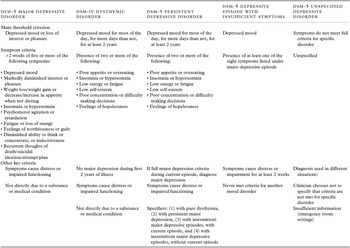
For chronic depressive illness of mild severity, the terms subsyndromal or subthreshold or minor depression are not used in DSM-5. Instead, “Depressive mood with insufficient symptoms” is the diagnosis that is used to cover the constructs of subsyndromal or subthreshold or minor depression (Table 1). There is evidence that a large minority of elderly patients with minor depression also meet criteria for dysthymic disorder and major depression at various time points during the course of illness (Lyness et al., Reference Lyness, Yu, Tang, Tu and Conwell2009). Antidepressant treatment with partial response is common, and this can change the diagnostic picture in depressed patients over time (Hybels et al., Reference Hybels, Blazer and Steffens2006). The frequent fluctuations in clinical status in many patients with chronic depression, both related and unrelated to treatment, create problems in categorization, e.g. the same patient may meet criteria for major depression, dysthymic disorder, and subsyndromal depression at various time points during their course of illness. For these patients, a dimensional approach focused on ranges of symptoms and severity, as discussed in DSM-5, may be more useful than a classification based strictly on mutually exclusive categories.
Key criteria for dysthymic disorder (DSM-IV) and related depressive disorders (DSM-5)

Neuropsychiatric and medical comorbidity
The long-term prognosis and level of functioning in dysthymic disorder may be worse than in episodic major depression, largely as a result of chronicity (Rhebergen et al., Reference Rhebergen2010). Cognitive disorders, increased physical impairment, poor psychosocial support, and frequent adverse life events, e.g. bereavement, can complicate the diagnosis and worsen the course of dysthymic disorder (Kirby et al., Reference Kirby, Bruce, Coakley and Lawlor1999).
Patients commonly present with both depression and cognitive impairment, which are the most common neuropsychiatric disorders in the elderly population. A significant proportion of these individuals meet criteria for dysthymic disorder (Byers et al., Reference Byers, Yaffe, Covinsky, Friedman and Bruce2012b). Many symptoms are common to both depression and cognitive impairment, leading to difficulty in diagnosis: apathy, anhedonia, insomnia, agitation, irritability, memory loss, and difficulty concentrating. Specific symptoms increase the likelihood of future dementia: forgetting of recent events, forgetting where things are located, problems in finding the right word to say, getting lost in familiar places, forgetting appointments and taking medications, and difficulty in managing finances such as balancing the checkbook or paying for items in a store (Brown et al., Reference Brown, Devanand, Liu and Caccappolo2011).
Most studies show that depressive syndromes in older adults with cognitive impairment are associated with a high conversion rate to dementia (Devanand et al., Reference Devanand1996; Byers et al., Reference Byers, Covinsky, Barnes and Yaffe2012a). In a U.S. cohort study of 281,540 veterans age 55 years and older and without dementia at baseline evaluation, the presence of dysthymia doubled the risk of incident dementia and it increased mortality during follow-up (Byers et al., Reference Byers, Yaffe, Covinsky, Friedman and Bruce2012). Most converters to dementia are diagnosed with Alzheimer's disease, but cerebrovascular disease contributes to the clinical presentation of dementia in many cognitively impaired patients (DeCarli, Reference DeCarli2013). There is a paucity of data on treatment response in patients with comorbid depression and cognitive impairment. Selective serotonin reuptake inhibitor (SSRI) treatment may improve depression but cognitive deficits may persist (Devanand et al., Reference Devanand2003). In a small double-blind placebo-controlled trial, adding a cholinesterase inhibitor to antidepressant treatment improved cognitive test performance compared with placebo plus antidepressant treatment (Pelton et al., Reference Pelton2008). In the study of 769 patients with mild cognitive impairment that compared treatment with donepezil, vitamin E, and placebo, only the subgroup with high Beck Depression Inventory scores showed an advantage for donepezil over placebo (Lu et al., Reference Lu2009). Major depression was excluded in that sample and presumably many patients in the depressed subgroup had dysthymia. Further work is needed to clarify if donepezil and other cholinesterase inhibitors can moderate the increased risk of Alzheimer's disease (may delay conversion) conferred by even mild depressive symptoms in patients with mild cognitive impairment.
Depressive disorders, including dysthymia, are more prevalent in vascular dementia than in unspecified dementia and Alzheimer's disease (Castilla-Puentes and Habeych, Reference Castilla-Puentes and Habeych2010). There is some evidence that antidepressant treatment has limited efficacy in patients with vascular depression and executive dysfunction (Alexopoulos et al., Reference Alexopoulos, Meyers, Young, Hull, Sirey and Kakuma2000), and initial evidence that problem-solving therapy may be helpful to some degree in these patients (Areán et al., Reference Areán, Raue, Mackin, Kanellopoulos, McCulloch and Alexopoulos2010).
The vast majority of older patients with dysthymic disorder are seen in primary care settings (Fann et al., Reference Fann, Fan and Unützer2009; Piek et al., Reference Piek2012). In 484 patients seen by general practitioners in Holland, nearly half the patients with depressive disorders were not recognized as having depression (Piek et al., Reference Piek2012). In a study of 200 patients with diabetes types 1 and 2, 5.5% had major depression while 15% had dysthymia (Maia et al., Reference Maia, Braga Ade, Brouwers, Nardi and Oliveira e Silva2012). Dysthymia before myocardial infarction may predict poor cardiac outcome at 2.5 years of follow-up (Rafanelli et al., Reference Rafanelli, Milaneschi, Roncuzzi and Pancaldi2010). In older adults, depressive episodes in patients with chronic medical conditions such as diabetes and cardiovascular disease are more likely to become chronic depression. Pain and chronic physical illness are associated with major depression and decreases in physical, social, and role functioning. Clearly, there remains a need to improve the identification and treatment of depressive disorders, including dysthymic disorder, in primary care (Fann et al., Reference Fann, Fan and Unützer2009; Piek et al., Reference Piek2012).
Mechanisms underlying dysthymic disorder in the elderly population
Late-onset depressive disorders are often associated with psychosocial stresses such as social isolation and bereavement (Chou et al., Reference Chou, Liang and Sareen2011). Neurodegenerative (Kumar et al., Reference Kumar, Jin, Bilker, Udupa and Gottlieb1998) and cerebrovascular factors (Alexopoulos et al., Reference Alexopoulos, Meyers, Young, Hull, Sirey and Kakuma2000) play an important role in late-life depression, and a genetically driven diathesis for mood disorder is more likely to be present for early-onset than for late-onset dysthymia. A Norwegian twin study in a mixed-age adult population showed some common heritability for non-major depressive disorders and major depression (Edvardsen et al., Reference Edvardsen2009), but there is a lack of such data in elderly depressed patients.
In a study of 1,372 older women, depressive symptoms were assessed in relation to MRI conducted eight years later (Goveas et al., Reference Goveas2011). Depressive symptoms at baseline were associated with lower MRI volumes in specific frontal lobe regions but not in medial temporal lobe structures. Antidepressants have been shown to normalize the brain's default mode network evaluated with fMRI in young adults with dysthymic disorder (Posner et al., Reference Posner2013). In a small sample of older adults evaluated with fMRI, dysthymic patients exhibited increased activation in the amygdala, anterior cingulate, and insula compared with controls and these differences were more evident when processing negative than positive images that were presented as stimuli in the scanner (Ravindran et al., Reference Ravindran2009). The findings suggest the involvement of the prefrontal cortex, anterior cingulate, amygdala, and insula in the neural circuitry underlying dysthymia. Altered activation in some of these neural regions may be a common substrate for depressive disorders in general while other findings may relate to specific symptoms and the chronic course of dysthymia. A cerebrovascular pathogenesis often underlies the manifestation of depressive disorders, including dysthymia, in elderly patients, particularly those with a late age of onset of depression (Kumar et al., Reference Kumar, Jin, Bilker, Udupa and Gottlieb1998; Alexopoulos et al., Reference Alexopoulos, Meyers, Young, Hull, Sirey and Kakuma2000). Inflammatory mechanisms have been shown to underlie major depression (Maes et al, Reference Maes, Kubera, Obuchowiczwa, Goehler and Brzeszcz2011), though whether this applies to elderly patients remains unclear. In a mixed-age sample, C-reactive protein was elevated in patients with dysthymic disorder (Elovainio et al., Reference Elovainio2009).
In summary, psychosocial factors, particularly social isolation and loss of significant others, and neurobiological mechanisms including cerebrovascular disease and neurodegenerative processes, appear to be pathogenic pathways in elderly patients with dysthymic disorder, particularly in those with late-onset illness. A genetic diathesis may be more important in patients with lifelong persistent depressive disorder.
Treatment strategies
In adults with major depression, comorbid psychiatric disorders, especially panic, generalized anxiety, substance use, and dysthymic disorder, accelerate help-seeking behavior (Olfson et al., Reference Olfson, Liu, Grant and Blanco2012). In Wave 2 of the NESARC survey of 34,653 adults, help-seeking was highest for panic disorder (45.3%) and dysthymia (44.5%) and lowest for specific phobias (7.8%). However, in that study, help-seeking for dysthymia was least among older adults, with women slightly more likely to seek treatment (Mackenzie et al., Reference Mackenzie, Reynolds, Cairney, Streiner and Sareen2012). In older adults, persistence of symptoms after the treatment of major depression is predicted by a higher number of symptoms at diagnosis, presence of comorbid dysthymia, health problems, high levels of perceived stress and low levels of perceived social support, limitations in mobility or instrumental activities of daily living, poorer self-perceived health, finding life not satisfying, and regrets when looking back over one's life (Hybels et al., Reference Hybels, Blazer and Steffens2006). There remains an unmet need to treat a large proportion of elderly patients with dysthymic disorder and chronic major depression, and successful treatment may improve outcomes for not only depressive symptoms but also overall health more broadly. Unfortunately, the few well-controlled, published treatment trials have not shown strong results for any treatment strategy.
Psychopharmacological treatment
In a randomized, double-blind trial of 90 elderly patients with dysthymic disorder, 27.3% of patients responded to the SSRI fluoxetine compared with 19.6% who responded to placebo in the intent-to-treat sample (Devanand et al., Reference Devanand2005). In a randomized, controlled trial of 415 primary care patients of whom 211 patients had dysthymia and 204 patients had minor depression, remission rates for the SSRI paroxetine or problem-solving therapy were only 5%–10% greater than the 40% remission rate on placebo in all analyses (Williams et al., Reference Williams2000). In 12 elderly patients with dysthymic disorder who maintained response to fluoxetine over an average of 8 months, after fluoxetine discontinuation 6 of these 12 patients relapsed over the subsequent 6 months (Devanand et al., Reference Devanand, Kim and Nobler1997). The results suggest that caution should be exercised in discontinuing effective antidepressant treatment after maintenance of response in elderly patients with a chronic condition such as dysthymic disorder. In a sample of middle-aged male patients with dysthymic disorder and low testosterone levels, testosterone treatment was superior to placebo (Seidman et al., Reference Seidman2009). Testosterone topical gel 1% was not superior to placebo in hypogonadal men with major depression who had a partial response to antidepressant treatment (Orengo et al., Reference Orengo, Fullerton and Kunik2005). In addition to the uncertainty about testosterone's efficacy in depression, its clinical use is limited by the risk of hormonal effects with potential long-term adverse consequences.
Other medications have been shown to be equivalent to SSRIs in the treatment of dysthymic disorder in elderly patients, e.g. l-acetylcarnitine did not differ from fluoxetine in one study (Bersani et al., Reference Bersani2013). However, drug–drug comparison studies are difficult to interpret in the absence of a placebo control condition, particularly because high placebo response rates in some controlled trials (Williams et al., Reference Williams2000) have made it difficult to demonstrate superior efficacy for the active treatment condition. Even in elderly patients with major depression, antidepressant medications show only a mild to moderate efficacy advantage over placebo, and there is limited information available in antidepressant treatment-resistant patients (Cooper et al., Reference Cooper2011).
Cognitive enhancers rarely have been studied in elderly patients with major depression without cognitive decline. In a sample of elderly patients with major depression who received antidepressant treatment plus add-on donepezil (n = 67) or placebo (n = 63) for two years, at initial evaluation most patients had normal cognition and few patients had MCI (Reynolds et al., Reference Reynolds2011). There was no effect of donepezil treatment in the cognitively normal group. In secondary analyses, donepezil enhanced cognition in the small subgroup with cognitive deficits and reduced conversion to dementia over two years. Interestingly, donepezil did not improve depression and there was even the suggestion that it may have worsened depressive symptoms, indicating that a cholinesterase inhibitor like donepezil is not an effective antidepressant treatment.
Psychosocial treatment
There is equivocal evidence on whether psychotherapy or SSRIs should be the first-line treatment in older patients with dysthymic disorder, with both treatment strategies showing marginal superiority over placebo in a large-scale study in primary care, as noted earlier (Williams et al., Reference Williams2000). Problem-solving therapy has shown modest efficacy in patients with late-life major depression and executive function deficits (Areán et al., Reference Areán, Raue, Mackin, Kanellopoulos, McCulloch and Alexopoulos2010). Of note, in the large-scale primary care study of dysthymia and minor depression, there was marked inter-site variability in the efficacy of problem-solving therapy (Williams et al., Reference Williams2000). Clinicians need systematic training before they can effectively use this method of therapy in clinical practice.
Combination treatment
In elderly patients with dysthymic disorder, there is limited information available on intensive combined, multimodal treatment strategies. Collaborative treatment using the IMPACT model involves a depression care manager providing supportive care and brief psychosocial intervention plus antidepressant treatment supervised by a psychiatrist. These studies show that approximately 20% more patients improve with active combined treatment compared with patients who receive usual care which typically involves no specific treatment for depression (Fann et al., Reference Fann, Fan and Unützer2009). The cost-effectiveness of an intensive multifaceted approach can be a limitation in some clinical settings. In a study of 64 patients with chronic depression randomized to a combination of medication management and interpersonal psychotherapy and occupational therapy versus treatment as usual, the combined treatment approach showed a modest advantage (Murray et al., Reference Murray2010). During treatment, quality of life is important to assess because it provides information about clinical improvement that is not always correlated with improvement in depressive symptoms (Swan et al., Reference Swan, Watson and Nathan2009). Long-term functional impairment is a key feature of depression (Brockow et al., Reference Brockow2004), but there is limited information from controlled trials in older adults with dysthymic disorder about the impact of specific treatments on long-term functioning and disability (Williams et al., Reference Williams2000; Devanand et al., Reference Devanand2005).
Summary
Dysthymic disorder in DSM-IV was replaced in DSM-5 by the diagnosis of persistent depressive disorder that includes both dysthymic disorder and chronic major depression. In patients with dysthymic disorder, social and cognitive symptoms are more common than neurovegetative symptoms. The use of the term dysthymic disorder remains useful for elderly patients. In contrast to young adults with dysthymia, older adults often present with a late age of onset and a relatively “pure” form of dysthymia without comorbid psychiatric disorders or history of major depression, and with a relatively low rate of family history of mood disorders. Avoidant and obsessive–compulsive personality disorders are common in older adults with dysthymic disorder and borderline and antisocial personality disorders are rare in late-onset dysthymic disorder. Psychosocial stresses including bereavement and loss of social supports are associated with chronic depression in older adults. In addition, neurodegenerative and cerebrovascular disease mechanisms may underlie the syndrome in some patients, particularly those with onset of dysthymia or major depression in late life. Both dysthymic disorder and subsyndromal depressions have been shown to lead to poor medical outcomes and increased disability; the clinical picture can fluctuate among the categories of subsyndromal depression, dysthymia, and major depression over time. The majority of older adults with dysthymic disorder are seen in primary care settings where identification and treatment of depressive syndromes are often inadequate. Treatment with antidepressant medication has modest efficacy with marginal superiority over placebo in controlled trials, and problem-solving therapy may have a similar degree of efficacy. Combined and collaborative treatment approaches have modest utility but cost-effectiveness is a concern. Identification and treatment of dysthymic disorder in older need to be improved, and these issues remain as research and clinical challenges for the future.
Conflict of interest
Dr. Devanand has received support for an investigator-initiated research grant from Eli Lilly.