State leaders regularly go to great lengths to portray their actions as resting on a base of legitimacy, rather than relative power. The reasoning behind such behavior, as argued by social scientists since Max Weber, is that preserving order through coercion alone is costlier than obtaining it through voluntary compliance, and leads to less stable orders.Footnote 1 In an international system devoid of a central authority, however, it remains unclear exactly what those costs should result from.
Despite widespread beliefs linking legitimacy and the effective wielding of state power, there is surprisingly little evidence for any relation between the two. Nor is there a clear theoretical understanding of the mechanism behind the working of legitimacy. Such a disparity between conventional wisdom and evidence provides this study's puzzle: in the realm of international trade, is state coercion that is perceived as (il)legitimate more or less likely to be successful?
The legitimacy of coercion is best determined by examining the means through which it is exerted. Accordingly, I consider that state threats formulated multilaterally are legitimate; unilateral threats in the presence of a multilateral option are not. This reflects a broad literature that argues that channeling power through a multilateral institution has been the predominant means of obtaining legitimacy in the last half century.Footnote 2 Nonetheless, I devote an entire section of this article to justifying this operationalization of legitimacy, relying both on theory and archival evidence.
Rather than taking the familiar approach of considering the costs of illegitimacy imposed by third-party states,Footnote 3 I examine the impact that the legitimacy of threats has on the response of targeted states themselves. I argue that the signal sent by targets' concessions to threats varies according to the perceived legitimacy of those threats. States that concede to extra-legal, illegitimate coercion incur a reputational loss. With only material power undergirding a threat, concessions signal weakness, in keeping with classic realist expectations, and increase the expected value to the sender from further unilateral threats. Indeed, senders want to change the target's policy but would prefer to achieve this without the constraints imposed by a multilateral institution. If the sender believes that material power alone will not sway the target—a belief formed by the target's past actions—then it is more likely to trade off autonomy for increased pressure through a multilateral instrument. Concessions to legitimate threats made in keeping with international rules, conversely, signal the target's willingness to play by international rules even when those rules happen to go against its immediate interests. In sum, seeking to strategically control the signals they send pushes states, all things constant, to concede to legitimate threats and resist illegitimate ones.
I test these claims by comparing the success of two instruments through which the United States tried to influence foreign countries' trade practices from 1975 to 2000. The first is a domestic legislative measure, Section 301, which allowed the United States to take a number of retaliatory actions against any foreign measures violating existing agreements or otherwise impeding its interests. Section 301 was universally condemned by foreign states as “aggressive unilateralism” that undermined international trade rules.Footnote 4 The second instrument is the multilateral World Trade Organization (WTO) and its predecessor, the General Agreement on Tariffs and Trade (GATT), through which the United States could bring foreign measures to dispute settlement. The GATT-WTO is a long-standing multilateral agreement that enjoys legitimacy flowing from its internationally shared principles. The simultaneous existence of these two options of divergent perceived legitimacy but similar objectives presents a unique opportunity for isolating the role of legitimacy by comparing their success in getting targets to concede to U.S. demands.Footnote 5 The comparison is all the more compelling given that the material sanctions behind the unilateral Section 301 were by all accounts as credible, if not more so, than those behind GATT.
The results of the statistical analysis strongly corroborate this study's claims, showing that U.S. trade pressure is significantly less likely to elicit concessions when it is perceived as illegitimate. Moreover, the results provide strong evidence for the signaling mechanism I point to as the explanation behind legitimacy effects: I find that if a given country resists U.S. unilateral threats, then it is 25 percent less likely to encounter similar unilateral threats (rather than being brought to legitimate multilateral dispute settlement) in the following five years. The United States, indeed, prefers not to give up its autonomy with regards to a given threat, but will accept institutional constraints if unilateral power alone is deemed unlikely to elicit concessions. In other words, it pays to resist illegitimacy: despite a high immediate cost (in the form of likely U.S. trade sanctions), countries with a history of resistance are much less likely to become targets of unilateralism in the future.
I go to considerable lengths to guard against a possible selection problem. It is essential to verify that cases that end at Section 301 are not somehow fundamentally different from those that went to GATT directly, or those that started as Section 301 measures and went on to GATT. To be clear, the selection of trade instrument need not be random, but it should not be correlated with potential concessions.
One implication of this article for the study of international relations is that taking legitimacy seriously need not entail abandoning a rationalist view of politics. There is a norm against unilateralism in the presence of a multilateral option, and I illustrate how member states appeal to it, but it is by no means removed from state interests, which allows one to hypothesize on the conditions under which such a norm will emerge.
Legitimacy and Power Among States
In large measure inspired directly by the work of Weber, political scientists have long been interested in the observation that state leaders seek to portray their actions—if not to their citizenry as a whole, then at least to their subordinates—as resting on a base of legitimacy. A consensus of sorts has developed around the Weberian view of legitimacy that suggests that material power alone is often insufficient to establish a stable order, and that it relies in part on some form of voluntary compliance.
Scholars have examined the effect of perceived illegitimacy in the success of foreign policy,Footnote 6 humanitarian intervention,Footnote 7 use of force,Footnote 8 and environmental reforms.Footnote 9 These studies all treat multilateralism as a proxy for legitimacy, and unilateralism in the presence of a multilateral option as a proxy for illegitimacy. Existing research thus not only shows that power is sometimes crippled by its illegitimate exercise, but also that legitimate coercion backed by weak power is often successful in achieving its ends.Footnote 10 While there is a prevalent sense that legitimacy plays some role in pushing others to act in a certain way, there is, however, little quantitative evidence to support such an effect, much less an understanding of the mechanism through which legitimacy affects the exercise of power.
Behavioral economics has perhaps been most successful in this regard, providing some support for nonmaterial decision-making factors through controlled experiments that show how individuals will sometimes turn down a positive sum rather than accept an “unfair” allocation. In other words, when individuals perceive that they are treated unfairly, the norm of fairness sometimes trumps cost-benefit calculations, and they are willing to “punish” unfairness even at a cost to themselves.Footnote 11 Equivalent studies of state behavior have proven more problematic.
If there is any consensus around the concept of international legitimacy, it is in regards to its changing nature, and to the way it is derived from the perception of the actors involved.Footnote 12 While this allows for strategic behavior to play some role in the rise of certain norms, scholars also agree that when powerful actors design and buy into institutions that engender a certain view of (il)legitimate action, they become bound by that view in a way that is not easily reversible. Hurd provides an especially compelling account of how Libya succeeded in delegitimizing United Nations (UN) sanctions against it by strategically using existing norms of liberal internationalism.Footnote 13 Precisely because such clashes occur in the normative sphere, they are likely to be fought without recourse to material power.
Though I do not deal explicitly with the emergence of norms of legitimacy, this study's findings nonetheless hold important implications in this regard. Constructivists, who have long been examining how norms affect state behavior, are sometimes faulted for not elaborating on which norms gain in importance, and which ones do not.Footnote 14 Here, I show that in some cases, the emergence of one norm over another can be traced to state interests: examining the signal sent by conceding to unilateral pressure in the presence of a multilateral option leads one to expect the emergence of a norm against such unilateral behavior. Recognizing rationalist explanations of norm emergence, however, need not reduce them to interests. Appeals to norms belong to a special category of state behavior. They rally support more easily than expressions of transparent self-interest: most GATT members reacting against Section 301 were never targeted by it. They lead to ostensibly disproportional, emotion-laden reactions: the usually reserved GATT representatives branded U.S. actions as “a Damocles' sword,” “an irreparable act of folly,” “suicidal logic,” “war against all,” and so on.Footnote 15 As Hurd's work aptly demonstrates, successful appeals to norms need not rely on preponderant material power. My own work thus amounts to a particular cross-fertilization of “isms.” As I show, norms have a unique means of directing state behavior, which cannot be reduced to purely rationalist accounts; yet their emergence is by no means divorced from the interests of states.
Scholars looking specifically at why states channel coercive measures through multilateral institutions usually point to the “political costs” imposed by third-party states on governments acting unilaterally. In this vein, Thompson considers the “active sanctions” imposed by third-party states on governments exerting force without Security Council approval.Footnote 16 When he turns his attention to the same Section 301 threats I examine here, he again points to the “political backlash” from third-party states that resulted from the exercise of this trade instrument.Footnote 17 Similarly, Martin examines the benefits of imposing sanctions through multilateral institutions by pointing to the increased likelihood of cooperation by third-party states.Footnote 18
This article departs from these approaches by focusing not on the consequences inflicted by third-party states, but on those resulting from the behavior of the target itself. Indeed, I argue that in economic agreements especially, where states have some latitude in their choice to resist or concede, the channel through which coercion is conducted accounts for much of the variation in targets' behavior. I am as interested, therefore, in the incentives of states choosing between channels of coercion, as in the incentives of those states targeted by such coercion. The latter is, moreover, causally prior to the former. It is precisely the expectation of how targets will respond to unilateral versus multilateral coercion that will determine a coercing state's choice between the two.
Of the scholars looking at U.S. trade measures over the relevant period, Bayard and Elliott conduct the most comprehensive empirical study on the evolution and variation in effectiveness of Section 301.Footnote 19 Among other tests, the authors look for the effect of legitimacy by checking whether those cases that received a favorable ruling at GATT were any more likely to elicit concessions. The belief is that a guilty verdict may portray U.S. pressure as valid, and push defendants to concede. They find no significant effect, suggesting that legitimacy of U.S. measures plays a negligible role in their success.
This result comes as no surprise. By confining their analysis to GATT rulings, Bayard and Elliott overlook most of the action of dispute settlement, which, as Busch points out, occurs prior to a ruling.Footnote 20 This is true of all credible threats: by the time sanctions are implemented, threats have exhausted all their deterrent effect.Footnote 21 Indeed, only about 45 percent of GATT-WTO cases ever make it to a panel, 39 percent to a ruling; strikingly, even positive rulings are shown to decrease the probability of full concessions.Footnote 22
Schoppa picks up where Bayard and Elliott left off, claiming that the variation in the effectiveness of U.S. trade pressure on Japan can be explained in part by variation through time of the perceived legitimacy of U.S. trade measures.Footnote 23 Schoppa presents an insightful depiction of U.S. trade measures and Japanese reactions, but because the variation in his independent variables occurs at the tail end of Section 301 activity (post 1992), his analysis can rely on only four cases for evidence. Schoppa discusses three of these—two of which do follow his expectations—yet he glosses over the one case in that period that did not, Japan—Agricultural Products, where Japan conceded on all issues. Schoppa's argument moreover rests on the problematic assumption that the weakness of GATT “justified” American unilateral measures, which, as I argue, does not square with erstwhile perceptions. Correcting for this, by relying on recently declassified GATT archives to give a more accurate image of the perception of Section 301 throughout its history, yields a model that provides a better fit between theory and evidence.
Theory
How does variation in the perceived legitimacy of threats sent by states affect the outcome of those threats, if at all? The answer lies in the link between the perceived legitimacy of a threat and the signal conveyed by conceding to it. If concessions to legitimate threats are interpreted by the rest of the world differently from concessions to illegitimate threats, then one should expect that a rational target would respond differently to each. In trade as in other issue-areas, the consequences of concessions are not limited to the period of the threat; they affect the future of the conceding states. The way in which states seek to control the signal sent by their response to threats drives much of the variation in the success of U.S. trade measures between 1974 and 2000.
The fundamental difference between the two instruments used by the United States to influence foreign trade practices over this period is in their source of compliance pull. The GATT-WTO relies primarily on decentralized enforcement: it regulates state behavior by creating a dispute resolution mechanism where members can file complaints against purported violations by other members. The ruling over the accuracy of the violation is delegated to a panel, which may then authorize retaliation against the defendant if the established violation persists. Importantly, the same process also allows defendants to strike down invalid claims by the complainant. Section 301, by contrast, relied only on the (credible) threat of retaliation as a source of compliance pull.
It is worth recalling that the GATT was created as an institution based not on threats and enforcement, but on agreement and diplomacy. Tellingly, targets of complaints could legally block the dispute settlement process at three stages: panel formation, panel ruling, and retaliation request.Footnote 24 The GATT was fundamentally devoid of teeth, and it is in part its alleged ineffectiveness in prying open foreign markets that led a frustrated U.S. Congress to push for a unilateral alternative.
The introduction of Section 301 in 1974 resulted from the coincidence of many factors.Footnote 25 An overvalued dollar in the early 1970s led to a growing trade deficit, while imports from Asia, and especially from Japan, were growing independently, and leading to what many saw as the deindustrialization of the United States.Footnote 26 The U.S. global economic position was visibly declining, creating domestic pressure for import protection and expansion of foreign markets. Since the GATT was thought too weak to fix a perceived imbalance in the openness of the United States versus that of other countries, a unilateral pressure mechanism was seen as a necessity.Footnote 27 Section 301 was not limited by the procedural weaknesses of GATT, where a defendant could block proceedings at any stage of the dispute. Importantly, especially from the point of view of members of Congress responding to domestic interest groups, Section 301 also worked on a fast clock, as opposed to dispute settlement, which was prone to multiple delays.Footnote 28 Here was a mechanism that leveraged U.S. economic power in a way that GATT dispute settlement alone could not. This becomes evident when one observes that while the economic power undergirding unilateral retaliation and GATT retaliation was the same, the rate of retaliation under Section 301 was far higher.Footnote 29 Following either a petition by an industry group or “self-initiation,” the USTR would launch an investigation into purported unfair trade practices. Retaliation was mandatory if no concessions were forthcoming from the target, unless a GATT panel found no violation of U.S. rights. In all cases, however, retaliation remained at the discretion of the U.S. president and U.S. trade representative (USTR).Footnote 30
The fundamental reason the United States adopted Section 301, then, was that it could. Thanks to its size and economic power, the United States was uniquely capable of affording a tool of extra-legal, unilateral enforcement. This one-sidedness is also the main reason behind the widespread condemnation of Section 301. Hudec described it as a mechanism where “the United States plays both prosecutor and judge, [and] in which the defendants are tried in absentia”;Footnote 31 a representative of India at a GATT meeting employed a similar analogy when he claimed that Section 301 appointed the United States as “judge, jury and executioner.”Footnote 32 The reasons countries concede to unilateral and multilateral coercion differ, and this difference constitutes the first step toward understanding the variation in concessions to the two U.S. trade instruments. The reason states concede to the demands of GATT-WTO complainants is not only to avoid retaliation, which in practice occurs rarely, but also to avoid the reputational cost that comes from being branded a violator.Footnote 33 When countries concede to an unfavorable ruling today, or when they preempt that ruling by conceding early, they are more likely to elicit reciprocal compliance from a target in the following period when the tables are turned, and more likely to obtain cooperation in future trade rounds. Indeed, cooperation over trade barrier abatement is contingent on cooperation over enforcement; otherwise, the benefits of reaching a deal are devalued. Stated generally, the factor that compels states to concede to threats legitimately conducted through an institution is the benefit they expect to derive from remaining a compliant member of the institution.
The corollary is that GATT not only increases the costs of cheating, it also binds the arbitrary nature of coercive action. GATT members expect to be made to modify their trade measures only if they can be shown to be in violation of the institution's rules, in a process during which the defendant's arguments are assessed against the complainant's claims. Indeed, the defendant's ability to strike down a threat by appealing to shared rules is in part what renders the process legitimate. That is, it was precisely the inability to contest Section 301 claims that made the United States “both prosecutor and judge,” and drew the allegation of illegitimacy. That being so, the absence of a ruling does not undermine perceived legitimacy. Indeed, the legitimacy of threats channeled through GATT resides not in the occurrence of the verdict, but in its existence as a means of countering invalid claims. If the ruling is preempted through early concessions, it is the result of a rational decision by the defendant to avoid what it expects will be an adverse ruling, and the reputational costs that entails.Footnote 34 This expectation is most often correct: even among the 39 percent of cases that do make it to a verdict (where the defendant presumably believes that the chances of a favorable ruling are relatively high), only three out of forty-one rulings are strongly in favor of the defendant.Footnote 35 To draw a direct comparison with the unilateral option, it is useful to translate the multilateral process to the language of threats and promises that is most often used with respect to Section 301. GATT-WTO proceedings can be thought of as representing the following conditional statement: I will impose trade sanctions against you if the panel upholds my claims and your noncompliance persists.Footnote 36
In other words, the constraints that the GATT puts on countries' behavior not only cover their own trade policies, but also the means they can employ to coerce other states to change theirs. A state wishing to open foreign markets and protect its own can do so only by working through the existing rules, or by negotiating new ones during trade rounds, usually by offering reciprocal concessions. Taken together, these two sets of constraints attain the major GATT objective of increasing “security and predictability” in trade among its members.Footnote 37 To sum up, targeted states always prefer to face coercion conducted multilaterally, since the formal constraints regulating such coercion put a limit on the amount and type of retaliation threatened, and importantly, offer targets the opportunity to challenge the complainant's claims before a panel. For the same reasons, all things constant, senders prefer not to give up their autonomy, and send threats unilaterally.Footnote 38
Unilateral threats under Section 301, indeed, are made outside of the GATT. Thus they rely entirely on classic realist variables such as relative economic power and signaled resolve to compel states to behave in a certain way.Footnote 39 They do not benefit from the GATT's compliance pull to elicit concessions. States that concede to such unilateral threats do so only to avoid incurring the material cost with which they are being threatened. This also implies that the use of unilateral measures is bound only by their expected success. Indeed, Section 301 targets not only violations of formal rules, but any measure that impedes U.S. trade interests; it is precisely this flexibility and autonomy that makes unilateral instruments attractive to states.Footnote 40 The United States can employ unilateral measures as long as it expects targets to concede to them.Footnote 41 As realists commonly argue, “aggressors disproportionately challenge those they expect will back down.”Footnote 42
This expectation, in turn, is derived from observing the target's past behavior. Hence the importance of reputation. At this point in the argument, it comes as no surprise that targets would resist unilateral threats as a means of decreasing the likelihood of being unilaterally targeted again in the future, either by the sender or by other states. This logic may be restated from the sender's point of view: when the United States encounters resistance from a target, it downgrades its expectation of future concessions, and is more likely to employ the more legitimate, though less aggressive and more institutionally constrained, GATT option against that target in the future. If a target cannot be swayed to concede by force alone, then the United States is more likely to trade off autonomy and flexibility for increased pressure through a legitimate, multilateral instrument. It is no coincidence that the country least likely to be swayed by force alone, the European Commission (EC), was rarely targeted with Section 301 actions unaccompanied by GATT dispute settlement.
Having outlined the reputational dynamic in both instruments, it is useful to recall that the material element ultimately undergirding them is in essence identical. In both cases, the material threat is retaliation through “suspension of concessions,” or some form of heightened trade barriers, backed by American market power. Most often, these trade barriers take the form of tariffs put on the products concerned, though both the WTO agreements and Section 301 envisaged targeting other products if necessary. For the purposes of the argument, it is also important to recall that these sanctions are no more likely under GATT than under Section 301—if anything, the opposite is true.
The above reasoning provides the logic for this study's main theoretical claim: threats are (less) more likely to elicit concessions from targets when they are perceived to be (illegitimate) legitimate, even as the material power backing them remains constant. This argument is not unfamiliar; a similar mechanism explains seemingly irrational behavior in a wide range of contexts. Insurance companies aggressively prosecute fraudulent claims in court and publicize their outcomes, often spending far more than the size of the initial claim in the process, as a way of staving off future attempts at fraud.Footnote 43 State leaders vow they will not negotiate with terrorists, regardless of the immediate costs, as a means of deterring future incidents.Footnote 44 Similarly, when states resist illegitimate coercive pressure from other states, even at an immediate cost to themselves, they do so with an eye to the future. Applying this claim to the two instruments of pressure used by the United States yields a pair of eminently testable hypotheses, which correspond to expected behavior by the target and the sender, respectively.
H1: Cases that end at the unilateral Section 301 are less likely to lead to the target conceding than cases that go on to the multilateral GATT.
The hope behind Section 301 and its increasingly aggressive amendments was that it would be credible enough in the sanctions it threatened to get other countries to liberalize their trade with the United States, but not so threatening that it would lead to counterretaliation and trade war.Footnote 45 Yet judging from the widespread condemnation it faced throughout its history, the effectiveness of this powerful but illegitimate instrument of pressure in eliciting concessions is unclear.
H2: If states resist unilateral threats by offering no concessions, then they are less likely to encounter unilateral pressure—as opposed to legitimate pressure through multilateral dispute settlement—in the near future.
Resistance to unilateral threats should yield an observable reputational gain. In other words, if states resist an illegitimate threat by weathering retaliation, they should benefit from it in the future. Past resistance by a target should lead the United States to decrease its expected value for unilateralism. This change should be observable in the decreased likelihood for that country of being targeted unilaterally, that is, outside of GATT.
An Alternative Explanation
The main alternative explanation that gets at the link between legitimacy of threats and their effectiveness is the role of threat credibility. If low legitimacy is associated with a disproportionate cost to the sender of exercising the threat, as it often is,Footnote 46 then the target may well question the likelihood of the sender doing so, conclude that the threat is “cheap talk,” and choose to ignore it as a result. Applying this logic to a somewhat different issue-area, Martin argues that economic sanctions exercised through international institutions are more likely to elicit concessions, since the sender raises the audience costs against backing away from the proposed sanctions by making them within an institutional forum.Footnote 47 By making the abandonment of sanctions costly to itself, a state appears more credible in its commitment, and others are more likely to join it by implementing parallel sanctions against the target, which increases the likelihood of success for the sanctions. In Martin's explanation, legitimacy is correlated with credibility, since it happens to be associated with the type of forum that increases audience costs, but it has no causal effect of its own.
For a number of reasons, however, it is unlikely that a link between legitimacy and credibility plays a significant role in responses to unilateral versus multilateral U.S. threats. Because enforcement in international trade institutions such as the GATT-WTO relies on the complainant to impose sanctions, retaliation is nearly as costly to the sender as it is to the target.Footnote 48 As a result, it occurs rarely. Related, one could claim that the reputational costs from working outside the multilateral system would affect the credibility of U.S. unilateral threats. Again, it does not seem that these costs were high enough to dissuade the United States from making and exercising unilateral threats. If anything, the record shows that retaliation following unilateral trade measures such as Section 301, where it is unencumbered by multilateral rules, occurs more often than in multilateral trade institutions.Footnote 49 The credibility of retaliation is not Section 301's weak point. An explanation centered on credibility would thus point to Section 301 leading to more concessions than GATT-WTO rather than less. Along these lines, Reinhardt goes so far as to argue that taking a dispute to GATT is a signal of the complainant's lack of resolve.Footnote 50 Finally, my two hypotheses are self-reinforcing. Rejecting the null for the second hypothesis, by showing that resistance to unilateral threats significantly reduces the likelihood of being targeted unilaterally in the future, would also undermine alternative explanations based on threat credibility. Indeed, if it pays to resist unilateralism, it becomes less likely that the success and failure of unilateral threats by the United States is due mainly to variation in credibility.
Operationalizing Legitimacy
Much of the work on legitimacy suffers from a weak definition of its central concept. There are two ways to operationalize legitimacy, each of which suggests disparate empirical approaches.Footnote 51 While a first group of scholars considers the legitimacy of an action to be determined by the content of state actions and their end-result,Footnote 52 the other argues that the legitimacy of actions is reflected in the process and means through which they are conducted.Footnote 53 In a recent exploration of legitimacy in international politics, Clark draws a similar distinction between, respectively, substantive and procedural legitimacy.Footnote 54
Given that the first definition relies mostly on ex post valuations of the end-result of an action, including its unintended consequences, the second definition, which reflects an ex ante perception of legitimacy, appears better suited for an examination of the immediate outcome (resistance or concessions by the target state) of coercive pressure.Footnote 55 Hudec may well be right in arguing that in retrospect, Section 301 appears as a necessary evil; what concerns us here, however, is only whether the rest of the world viewed it as an evil at that time.Footnote 56
The concept of legitimacy is therefore employed in its procedural sense throughout my empirical discussion: it refers to the means used by states to achieve their objectives. Coding the perception of legitimacy is always a thorny issue, but the recent availability of declassified transcripts of GATT meetings throughout the existence of Section 301 is tremendously helpful in this regard, and provides an unambiguous portrayal of the world's view of Section 301 versus that of GATT.
Perceptions of Section 301
Not only was Section 301 universally condemned as a unilateral measure per se, but it was widely seen as “jeopardiz[ing] the entire process of multilateral negotiation.”Footnote 57 It is difficult to overstate just how distressed GATT's membership was over its existence: at a Special Meeting on Dispute Settlement, and referring directly to Section 301, the EC began by saying that “it did not intend to go into other important subjects such as protectionism, sectoralism or managed trade. Unilateralism had become the burning topic.”Footnote 58 GATT members repeatedly concurred that the United States had every right to pursue its interests forcefully, but had to do so within the GATT rules, using the same mechanisms that were available to all.Footnote 59
Member countries early on saw U.S. unilateral threats, made outside of the multilateral system, as a means of improving the U.S. bargaining position within it.Footnote 60 The GATT membership had targeted precisely such behavior through the “standstill commitment,” made at Punta del Este, under which a member could “not take any trade measures in such a manner as to improve its negotiating positions.”Footnote 61 Members then protested that Section 301 hung as “Damocles' sword” over them, skewing bargaining power in favor of the United States.Footnote 62 Such reactions from the membership lend support to the observation by economic bargaining scholars who argue that negotiations do not end at an agreement's conclusion, but also follow from it, and that compliance is not a dichotomous variable, but rather is itself the product of bargaining. These same authors point out that the type of bargaining that occurs in the postagreement phase may be more susceptible to power politics than the negotiations leading up to the agreement.Footnote 63
In my perusal of GATT archives of the period, I have not come across a single non–United States statement that would reflect Schoppa's belief that Section 301 was seen as “justified” by GATT's lack of enforcement teeth;Footnote 64 numerous statements, conversely, express precisely the opposite view. As India unambiguously voiced, “the dispute settlement mechanism under GATT was where complaints among contracting parties should be brought.” Further in the same session, the Indian representative added: “it did not seem that the U.S. had convinced any contracting party that the multilateral and bilateral approaches were consistent.”Footnote 65 In an important 1989 GATT Special Meeting, over a dozen members, most of them not targeted by Section 301, echoed this feeling.Footnote 66 The EC representative, in turn, referred to Section 301 as a “commercial nuclear bomb,” leading to a potential “apocalypse” where the United States itself “would not be spared.”Footnote 67
The discussions of GATT members amount to a generalizable view: legitimate threats are exercised through shared mechanisms constructed by a plurality of actors, and allow for reciprocal action in future, symmetrical situations.Footnote 68 Illegitimate coercion, in turn, relies for its effectiveness on an advantageous distribution of power. It follows that, as per the argument of several institutionalist scholars, the distinction in this case between legitimate and illegitimate becomes possible only once a multilateral option exists.Footnote 69 For all these reasons, I consider any action where the United States relies on Section 301 alone as illegitimate, and any action that is coupled with GATT dispute settlement as legitimate. Anecdotal evidence also suggests such a view to be consistent with erstwhile state perceptions: as a EC official claimed, once a U.S. trade investigation makes it to dispute settlement, “there is no longer the fear of getting hit by unilateral sanctions.”Footnote 70 The historical record provides further support for this view: once the United States began GATT proceedings, it did not turn back to unilateralism. The United States never retaliated unilaterally nor threatened to do so after a panel finding against it, and it never blocked a panel report following from a Section 301 investigation.Footnote 71
Looking at discussions among members in the GATT, it is undeniable that the reactions of both targets and other member states were motivated in great measure by normative considerations. To be sure, existing regulations (such as the “standstill commitment,” and more explicitly, the subsequent Article 23 in the WTO Agreement) prohibited recourse to unilateralism, but members' reactions appealed to more than these formal violations. Countries expressed outrage at the U.S. reliance on power even as an institution existed precisely to bind such power, and explicitly appealed to norms against such behavior when publicly vowing to resist unilateralism. That these appeals were of a normative nature, rather than purely self-interested, also explains why countries that were never targeted by Section 301 (for example, Yugoslavia) reacted with equal vehemence.
There is therefore no easy partition between norm-based and interest-based reactions in this case. What I attempt to show, however, is that the norm that had already arisen in GATT, and one that exists in many institutions—namely that once an international agreement is reached, working outside of that agreement is considered illegitimate—is by no means removed from the rational considerations of states. Once a multilateral option exists, unilateral threats carry added information about the sender's intent. As a result, conceding to unilateralism signals weakness, while resisting it signals strength. And it is in great measure based on targets' past behavior that the United States chooses the instrument through which to channel its power.
The Data
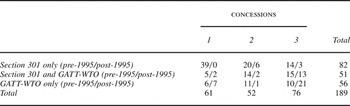
The data I use cover all 189 trade threats made by the United States from 1975 to 2000, and can be thought of as constituting three categories of cases. The first is made up of cases investigated under Section 301 that are not sent to dispute settlement (eighty-two cases); the second encompasses cases that start as a Section 301 investigation and are then sent to GATT (fifty-one cases); the third is made up of those cases sent directly to GATT (fifty-six cases).Footnote 72 The first category contains all unilateral cases; the last two contain all multilateral cases. Keeping with common practice, the unit of observation is a case filed against a given country, so that when in 1976 the United States files a dispute against both Japan and the EC on steel products, this is counted as two separate cases, since I am interested in the reaction of each target separately.
The first variable of interest is concessions, that is, the degree to which target countries comply with U.S. pressure. Concessions is first coded on a full {1, 2, 3} scale, as per Bayard and Elliott, with 1 denoting no concessions, and 3 denoting full concessions; this score is then reduced to a dummy variable in two ways: 1 if the full score equals 2 or 3, and 0 otherwise; and 1 if the full score equals 3, and 0 otherwise. I refer to these variables as concession1, concession2, and concession3, respectively. The breakdown of all the data by concession level can be seen in Table 6.
The main explanatory variable, multilateral, indicates whether the case eventually goes to GATT or not, either directly or by way of a Section 301 investigation. It is coded 1 if the United States brings the case to multilateral dispute settlement, either at the GATT or later at the WTO (and regardless of whether the case then goes to a panel or is settled beforehand) and 0 otherwise.
The two main control variables, market power and export dependence, account for power differentials between the United States and the target, in a manner similar to Bayard and Elliott.Footnote 73market power (which corresponds to the U.S. relative market power) is the ratio of U.S. gross domestic product (GDP) over the total GDP of the United States and the target country, for the first year of any given case. export dependence is coded as bilateral exports from the target to the United States over the target's GDP. Materialist expectations would lead one to believe that the more targets depend on the U.S. market for their exports, the greater the threat represented by sanctions, and the more likely one is to see compliance with United States demands, all things equal.
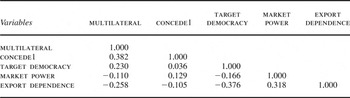
Bivariate correlations for key variables

To denote the shift from GATT to the WTO, with the change in dispute settlement it entails, I code a variable, post-1995, where all cases from years after 1995 are coded as 1, and 0 otherwise. The other period of interest is the one between 1988 and 1992, which covers the period during which the Omnibus Act of 1988, perceived as particularly aggressive and illegitimate by other members, was in force. I control for it using a dummy variable coded 1 for the relevant years, and 0 otherwise. I control for the level of democracy of the target, using Polity IV data, which codes democracy on a scale from −10 to 10, since regime type may plausibly influence either vulnerability to threats or compliance with trade rules. I also add dummy variables for cases where the target is the EC or Japan, since some anecdotal evidence on Section 301 suggests that these states were especially targeted by the USTR, which may therefore influence the likelihood of concessions.Footnote 74 Finally, I use a variable to control for cases that were self-initiated by the USTR,Footnote 75 since self-initiation may proxy for some internal characteristic of cases, and these may be treated differently by targets as a result.
Analysis
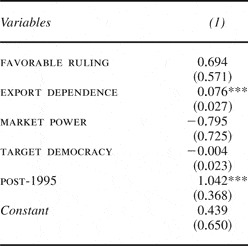
I begin by reproducing the Bayard and Elliott test for legitimacy effects, by seeing whether a favorable GATT ruling has any effect on concessions. The underlying belief is that cases that receive a favorable ruling by a multilateral panel are viewed as more legitimate, and benefit from greater normative pressure on the target to concede.Footnote 76 The sample used here contains all Section 301 cases, but it does not contain cases that went straight to the GATT or WTO. I run a simple probit model, as did Bayard and Elliott, and control for similar variables as they did: the democracy level of the target, the target's export dependence on the United States, and relative market power. Since my data goes up to 2000, I also add a dummy for threats formulated after 1995.Footnote 77
The effect of rulings, seen in Table 2, turns out to be insignificant, as per Bayard and Elliott's results.Footnote 78 In other words, a favorable ruling supporting U.S. pressure indeed does little to move targets to concede. Again, this is unsurprising and tends to be true of all threats. Concessions are most likely to occur in the shadow of penalties, before those penalties are implemented.Footnote 79
Probit model of concessions, based on Bayard and Elliott Reference Bayard and Elliott1994

Notes:
n = 133. Robust standard errors in parentheses. In two-tailed tests:
* p < .10;
** p < .5;
*** p < .01.
After confirming the insignificance of favorable rulings, I go on to test my first hypothesis: are cases conducted through Section 301 alone more or less likely to result in concessions than cases that are coupled with GATT dispute settlement? To avoid the risk of finite sample bias, I use a rare events correction for the logistic regressions in this section, since my sample tends to be small (n = 133 for the most part) and is slightly unbalanced in some of the tests, with far less “success” than “failure” counts on the dependent variable.Footnote 80 I control for relative market power and the target's export dependence on the United States, the democracy level of the target, whether the case was conducted after 1995 or during the Omnibus Trade Act period, whether the case was USTR-initiated, and whether the target is Japan or the EC.
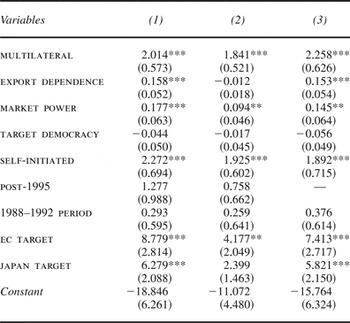
The results strongly corroborate the main hypothesis. As seen in column (1) of Table 3, the effect of GATT is positive and significant. That is, controlling for relative economic variables, cases that go to multilateral dispute settlement are significantly more likely to elicit concessions from the target. Interpreting the coefficients to obtain substantive resultsFootnote 81 shows that going to GATT, rather than relying only on Section 301, increases the probability of obtaining concessions from 56.7 percent to 91.0 percent, keeping all other variables at their mean. The added legitimacy of GATT thus increases the likelihood of concessions by 34.3 percent. As expected, market power and export dependence are positively signed and significant, meaning that the greater the relative market power of the United States, and the more the target depends on the U.S. market for exports, the higher the likelihood of concessions. The significance of export dependence offers support to Bayard and Elliott's main findings.Footnote 82 What is striking from this study's point of view, however, is that controlling for these material variables, the effect of legitimacy is so important. Similarly, holding other variables at their mean, cases that are self-initiated by the USTR are 34.3 percent more likely to lead to concessions, as are cases against both Japan and the EC. Overall, the model displays excellent fit for the data, as it correctly predicts the level of concessions in 83.1 percent of cases.
Rare events logit model of concessions to U.S. trade threats

Notes:
n = 133 for columns (1) and (2); and n = 106 for column (3), which covers the pre-WTO period. Robust standard errors in parentheses. In two-tailed tests:
* p < .10;
** p < .5;
*** p < .01.
I rerun the model using concede3, which identifies only full concessions, and considers partial concessions as resistance by the target; the results are shown in column (2) of Table 3. The significance of multilateral is not affected, and its substantive effect is slightly higher: going to multilateral increases the likelihood of full concessions by 39.3 percent. Interestingly, however, the dummy for Japan cases is no longer significant, and that for EC cases loses effect and statistical significance as well. Moreover, the effect of export dependence disappears.
Next, I rerun the regression on a sample limited to GATT (pre-1995) cases, on my original dependent variable concede2. The results are presented in column (3) of Table 3. The effect of multilateral is equally significant, and substantively stronger. When looking at only the period from 1975 to 1994, corresponding to 106 cases, taking an investigation to multilateral dispute settlement increases the likelihood of concessions from 43.8 percent to 88.0 percent, a change of 44.2 percent. The greater effect in the period preceding the WTO is expected: after 1995, the incentive to resist illegitimacy decreases, since there are enough constraints on unilateralism in the WTO to decrease the threat of rampant unilateral coercion, and so a reputation for resistance to unilateralism loses much of its value. Further, 1999 saw the ruling on the case brought by the EC against the U.S. Section 301, during which the United States committed itself, through a Statement of Administrative Action, to employ Section 301 in a manner consistent with GATT-WTO rules, after which the trade instrument lost much of its unilateral bite.Footnote 83
For added robustness, I rerun the regression using a multinomial probit model, which includes no correction for limited sample bias, but does allow me to use the full concession1 variable, and see the effect of going multilateral separately for partial and full concessions. The results, not reported here, are equally significant, and the effect on partial and full concessions appears linear, with a slightly higher effect for full concessions. An added control variable for whether a country was a GATT member at the time of the Section 301 investigation is insignificant and does not affect the results. I also add a variable corresponding to the trade balance between the United States and the target to every relevant model, as per some of Bayard and Elliott's regressions: it is insignificant throughout, and does not affect the results. Finally, I add time fixed effects to all three regressions; the findings are unchanged.
While Tables 2 and 3 confirm the legitimacy effect predicted in my first hypothesis, they do little to test the specific mechanism I identify. Indeed, if legitimacy acted through a perception of credibility—as in Martin's argumentFootnote 84—rather than a signaling mechanism, one would expect to observe much the same effect, and would have little means of differentiating between the two mechanisms. To test my story against possible alternative explanations, I use the following model to get at my second hypothesis.
If states resist illegitimate threats with an eye on the future, as a means of lowering the likelihood of future illegitimate threats, then one would expect to be able to observe this deterrence effect at work. I code a variable, resist301, as 1 if any Section 301 case against the target of the current threat met with resistance during the five preceding years, and 0 otherwise. This variable functions as an indicator of past resistance to unilateralism, and a summary of the beliefs that the United States has about the target's likely behavior given past actions. I take out the thirteen cases that targeted nonmembers, since they lead to a determined outcome, and am left with 120 cases. With multilateral now as my dependent variable, I run a rare events logit model to see whether such past resistance has any effect on the likelihood of being taken to GATT, rather than being threatened unilaterally. I also control for the target's export dependence on the United States, which was significant in the preceding models; the level of democracy of the target, since there is some reason to believe that the United States may target more (less) democratic targets differently; whether the case is self-initiated by the USTR, which may have some influence over how a case is conducted; and whether the dispute occurred before or after 1995, since the WTO's improved dispute settlement understanding will likely affect the likelihood of a case going to dispute settlement.
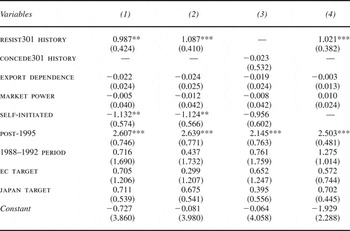
The results, presented in the first two columns of Table 4, are convincing. Resisting a unilateral threat makes a given country significantly less likely to be threatened unilaterally during the following five years. Specifically, a history of resistance makes a country 25 percent less likely (from 59.7 percent to 34.9 percent) to encounter a unilateral threat, rather than be taken to GATT dispute settlement, keeping other variables at their means. When I extend the period of observation to seven years, as shown in column (2), the effect is increased slightly, to a 27 percent decrease in the likelihood of being targeted again unilaterally, while other results remain unchanged. In other words, once a unilateral threat falls flat, the United States modifies its strategy for a time, and tends to deal with the country multilaterally. As Thompson and others have argued, the United States would prefer to conserve its autonomy, and avoid institutional constraints in the formulation of threats.Footnote 85 But when “political costs”—in this case, the higher likelihood of resistance by the target, become too high, the United States prefers to trade off some lost autonomy against a higher likelihood of success. As for other variables, threats past 1995, as might be expected, are more likely to be formulated multilaterally. This may also be due to a backlog of cases that were awaiting the improvement of the dispute settlement understanding before being brought to GATT. The fact that self-initiated investigations by the USTR are more likely to go to dispute settlement offers some insight into USTR preferences.
Rare events logit model of USTR decisions to formulate threats multilaterally

Notes:
n = 120 for columns (1), (2), and (3); and n = 176 for column (4). Standard errors in parentheses. All errors indicated are robust standard errors. In two-tailed tests:
* p < .10;
** p < .5;
*** p < .01.
Not only does legitimacy affect the likelihood of a target conceding, but the behavior of targets resisting illegitimate threats is rational: doing so once, even at a considerable immediate cost, makes a country less likely to face unilateral threats in the future. The model provides good fit for the data, correctly predicting the forum in which the United States pursues targets in 77 percent of cases.
In column (3) of Table 4, I replace the measure of resistance with an equivalent measure of concession. According to the implications of my second hypothesis, not only should past resistance deter the United States from making further unilateral threats against a given country, but past concessions should have the opposite effect, by leading the United States to update its expectations of concessions upward. Yet concede301 here appears to have no significant effect. A likely explanation comes from taking a closer look at the data. There are simply few instances of full concession to unilateralism (which is in keeping with the main argument, that countries tend to resist unilateralism disproportionately) and as a result, there is not much opportunity to observe a history of concession at work. Specifically, there are thirty-nine cases of resistance to Section 301 threats, compared to only seventeen cases of full concessions (see Table 6). Data idiosyncrasies aside, existing theory also accounts for a lack of symmetry between the effect of a history of resistance and one of concessions. In his influential study of reputation, Mercer argues that actors tend to update their beliefs only when observed behavior by others (allies or adversaries) goes against the actor's interests.Footnote 86 Accordingly, observed resistance would lead to change in Foreign's reputation and thus Home's behavior, but observed concessions would not have a similar effect. Once again, however, the available data do not allow for a reliable comparison of the effects of histories of retaliation and histories of concession, for lack of the latter. For a similar reason, when I test the previous model looking at the effect of resistance in the past three years (not shown), the effect becomes insignificant. The history is too short to “grip” the data, given the relatively low frequency of interaction, and as a result, that history shows little effect.
Column (4) of Table 4 adds the fifty-six cases that went straight to dispute settlement. The results remain much the same: not only does past resistance do a good job of predicting the choice between Section 301 and coupling Section 301 with GATT, but it also does a good job of predicting the choice of sending a case straight to dispute settlement.
Guarding Against Bias
One concern may be that the cases that do not go beyond Section 301 are somehow fundamentally different from the cases that eventually go to GATT, or those that are sent to dispute settlement directly, resulting in a selection bias driven by an omitted variable. To be clear, the selection of pressure instrument need not be random, but it should not be correlated with potential concessions.Footnote 87
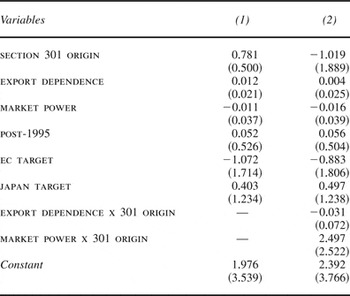
To test for this possible bias, I use the set of all GATT and WTO disputes brought by the United States from 1975 to 1999, which contains both cases that went straight to dispute settlement and cases that began as a Section 301 action, for a total of 107 cases. Using this portion of the data, I run a parsimonious rare events logit model to see whether disputes that originated in Section 301, as opposed to cases that went straight to dispute settlement, are any more or less likely to elicit concessions. The underlying belief is that if cases that went straight to dispute settlement are fundamentally different in any way, then those cases that first went through Section 301 should be “tainted” by the selection factor. The results, presented in Table 5, suggest the absence of any selection bias. What I find is that section 301 origin, a dummy coded 1 if a GATT-WTO dispute originated in Section 301, and 0 otherwise, is both substantively and statistically insignificant. Interaction variables made up of the section 301 origin dummy and the two economic variables are equally insignificant. That is, among GATT-WTO disputes, whether a case started out in Section 301 does not affect the probability for concessions in either direction. This test does not rule out the possibility of bias entirely, since the regression covers only cases that ended up in dispute settlement, but the insignificance of section 301 origin is a good indication that any selection between cases that go on to dispute settlement and those that end at Section 301 is not correlated with the ex ante likelihood of concessions. I analyze the same data with a multinomial probit model (not shown here), and the effect of section 301 origin is insignificant for both partial concessions and full concessions.
Rare events logit of concessions to all U.S. GATT-WTO disputes, 1975–1998

Notes:
n = 107. Robust standard errors in parentheses. In two-tailed tests:
* p < .10;
** p < .5;
*** p < .01.
Distribution of cases by level of concession, forum, and period, 1975–2000

Notes:
concessions is first coded on a full {1, 2, 3} scale, as per Bayard and Elliott, with 1 denoting no concessions, and 3 denoting full concessions. Pre-1995 cases correspond to the relevant GATT period (1975–1994); post-1995 cases correspond to all cases initiated after the WTO's inception in 1995.
An argument could be made that Section 301 cases that targeted areas not yet covered under GATT, such as intellectual property (IP) rights, may bias the likelihood of concessions downward, since it reflects a harder area for trade pressure. I thus include controls for all Section 301 cases targeting IP rights; the coefficient is insignificant, and other variables are unaffected. I also rerun all regressions in Tables 2 and 3 with an IP dummy, which remains insignificant. The models also show unchanged results when those cases are taken out entirely.
Moreover, a likely unobservable selection factor that accounts in some measure for the choice between Section 301 and GATT, but which is unlikely to be correlated with concessions, further serves to undermine the possibility of selection bias. As Busch demonstrates in a recent study, countries choose which forum to raise trade disputes in largely on the basis of the size and nature of the audience in which a dispute's precedent is set.Footnote 88 Countries will often shy away from too resounding a victory, if such a win will result in a net loss when the precedent they establish is used against them.Footnote 89 Conversely, they will bring even minor cases to dispute settlement if they represent a valuable precedent for the country. Section 301 led to bilateral cases that did not set a precedent in the same way that multilateral dispute settlement, with published rulings and transparent reasoning, did. Once a ruling is made in GATT, it belongs to that body of law, from which future reasoning is drawn.Footnote 90 Accordingly, it is likely that in the case of certain trade measures, the United States would prefer a mechanism of smaller echo that would not come back to haunt it. In either case, it becomes plain that despite the benefit of legitimacy, the United States sometimes could not or would not bring cases to multilateral dispute settlement. Since I can think of no valid argument linking the selection factor of precedent to the ex ante likelihood for concessions, the importance of precedent in this case reduces the probability of bias.
The evidence for my second hypothesis—that the United States is more likely to turn to legitimate, multilateral coercion if it encounters resistance to its unilateral threats—also gives a good indication of the decision process at the USTR. The evident swiftness with which the United States switches from one mechanism to the other based on even a single past failure in eliciting concessions suggests that there is no fundamental difference between cases that end at Section 301 versus cases that go on to multilateral dispute settlement. Finally, as existing literature makes clear, legal merit or the nature of the issue at hand does not seem to be a good predictor of the decision to litigate.Footnote 91 The United States litigated IP cases before clear law existed on the matter, and conversely, kept cases with considerable legal merit out of the GATT.Footnote 92
While eliminating the possibility of bias entirely in these cases is often unfeasible, these observations raise the confidence that what is affecting the variation in concessions are not the fundamental characteristics of the cases themselves, but the perceived legitimacy attached to the means through which those cases are conducted.
“Aggressive Unilateralism”: A Net Loss for the United States?
This study suggests an upper bound for the extent to which a superpower can coerce weaker states unilaterally. In the presence of a multilateral option, unilateral action provides strong incentives for targets to resist coercion, and goes against a norm that targets and potential targets can rally around. These findings might be read as suggesting U.S. irrationality in creating and exercising Section 301. Certainly, U.S. backtracking immediately following the announcement of Section 301's most aggressive provisions, in 1988, would seem to support conclusions of a policy miscalculation.Footnote 93
Evidence of disproportional resistance to unilateralism, however, should not be read as suggesting that Section 301 resulted in a net loss for the United States. Indeed, states with an eye on the future may react to illegitimate coercion in two (not mutually exclusive) ways: by resisting disproportionately to unilateral threats, or by sweetening the multilateral deal. While I have shown evidence for the former, anecdotal evidence suggests that the latter also took place.
By way of illustration, in 1989 the EC trade representative scolded the United States for its unilateral actions, saying “we have made crystal clear that this unilateral way of dealing with trade matters is not what we are ready to accept.”Footnote 94 That same week, however, the EC ceased blocking panel proceedings in a dispute over its farm subsidies, suddenly agreeing that the panel should “proceed immediately,” thus giving in to long-standing U.S. demands in the multilateral forum.Footnote 95 Hudec's discussion of “justified disobedience” also suggests that one should consider the effect of Section 301 on the negotiation outcome of the Uruguay Round.Footnote 96 Five years before its conclusion, Hudec pointed out that Section 301, especially in its more aggressive form, may prove to be a necessary evil if it achieves a desirable conclusion in otherwise lagging negotiations. In the end, countries reached an agreement, which on the one hand covered many of the issues that the United States had been pushing for, such as intellectual property rights and investment measures, and on the other hand included explicit measures against unilateral recourse by members, in the form of Article 23.Footnote 97 In many ways, Article 23 became the formal embodiment of the normative condemnation of unilateralism in the presence of a multilateral option.
Moreover, the analysis does not take into account the deterrence effect of Section 301. It may be that states resisted domestic protectionist pressure more than they would have otherwise because of the fear of being targeted by American unilateralism had they raised barriers. This was most clearly the case with South Korea in 1989, which suddenly made significant concessions to U.S. demands as a means of avoiding a Section 301 investigation in the first place.Footnote 98 In order to get at the overall effect of Section 301, one would thus have to net the preemptive concessions and any increased cooperation within GATT that resulted from the existence of Section 301 with the increased resistance it incited.
Conclusion
Power alone is often insufficient to push other state actors to act in a specified way. This also explains why power rarely shows itself unadorned: state leaders put much care into couching their actions in the trappings of legitimacy, because the way in which their threats are perceived by the rest of the world in great measure determines their effectiveness.Footnote 99
As this study demonstrates, statistical methods may be especially well suited for handling situations where some of the actors have good reason not to reveal their preferences, making the collection of qualitative evidence all the more difficult. U.S. trade officials would likely not offer many observable cues demonstrating a tendency to shift to multilateralism when faced with resistance to Section 301, lest it provide further incentives for targets to resist unilateralism. Statistical analysis allows one to pick up on such behavior by looking at outcomes in the aggregate.
That being so, statistical methods are inherently limited, since they do not allow one to trace causality in the way that, for instance, in-depth case studies do. Specifically, this study leaves some questions unanswered. The finding that cases self-initiated by the USTR are more likely to get compliance by targets, but less likely to go to GATT dispute settlement, raises questions about how the process through which firms petition for trade measures affects the credibility of these measures, and foreign responses to them. On the one hand, trade measures may gain in credibility, and thus in effectiveness, when they are taken directly in reaction to demands by interests groups, benefiting as they do from real domestic support.Footnote 100 On the other hand, such cases have been portrayed as a means of using a panel ruling to tie one's hands vis-à-vis a domestic industry, which could suggest the opposite effect.Footnote 101 Case studies are likely better suited than statistical methods to weigh such possibilities by tracing causal mechanisms, and would thus provide a valuable complement to this study's results.
A broad implication of the findings is that countries do sometimes consider past actions of other states in determining their own behavior. A recent crop of scholars have questioned this premise in the case of military interstate disputes,Footnote 102 but the evidence presented in this study supports the significance of past actions in the realm of international trade and economic threats. Parsing out where investments in reputation pay off and where they do not promises to be a fruitful area of future empirical study.
Finally, this study leads to a somewhat unconventional view of the GATT. Rather than the weak diplomatic agreement devoid of “teeth” that the GATT is often portrayed as, I show it to have been an effective constraint on state behavior, including that of its most powerful member. While Section 301 is sometimes taken as evidence that states are never truly constrained by the institutions they set up, findings in this article suggest otherwise. An effort on the part of the United States to go against the normative framework that emerged from the GATT's inception fell short of its immediate objectives. In this case, the United States ultimately found it in its interest to reverse course, and push for greater formal constraints in the Uruguay Round that ultimately raised the costs of unilateralism further.
This study therefore goes much beyond showing that a now outdated trade measure proves not to have been as effective in coercing trade partners as might have been thought; the broader implication is that taking legitimacy seriously need not entail abandoning a rationalist view of politics. By examining how the legitimacy of threats affects the signal that is sent by conceding to them, one can account for how targeted states vary their responses to coercive pressure.