The Japanese health system has two parts. The Employees Health Insurance (EHI) is organized for employees by companies that tend to be large in size or it is organized by the federal government (Government Managed Health Insurance) when employers choose not to organize such “health insurance societies” (13). A second major system, National Health Insurance (NHI) is organized by the national government to cover the self-insured, fisherman, farmers, the retired, and the unemployed. Dependents follow the system in which their caretakers are enrolled (13). Regardless, the government maintains great control over all types of insurance by setting minimum coverage policies, maximum out-of-pocket costs per enrollee, and many other features (16). Therefore, Japan has a universal health insurance system that covers comprehensive and uniform services, including inpatient, outpatient, and dental care. The reimbursement is basically on national uniform fee schedule. However, premiums are different between EHI and NHI. The employer directly deducts insurance premiums, based on the insured person's standard monthly wages, from employee salaries in EHI (Reference Okimoto and Yoshikawa19). In principle, premium contributions for EHI are shared equally by an employer and an employee. Otherwise, premiums are collected mostly in the form of a local tax, based on each household income, other fixed assets, and savings in NHI (Reference Okimoto and Yoshikawa19).
The Japanese government guarantees universal access to medical care. However, national medical expenditures jumped from 410 billion yen ($1.1 billion) in 1960 to 31,124 billion yen ($259.4 billion) in 2002, an exponential increase (13). As a result, the government initiated stepwise copayments for all medical services starting in 1984, growing from negligible amounts in the early 1980s to 30 percent in April, 2003 (Reference Babazono, Miyazaki and Imatoh4;Reference Babazono, Ogawa and Babazono7;Reference Babazono, Toshihide and Yamamoto8). The 30 percent copayment rate now applies to all services, except children aged less than 3 years and the elderly older than 70 who have somewhat lower rates.
Each health insurance society issues a monthly bill to the government that includes all medical services performed during that month for each enrollee or dependent. Of interest, introduction of the 10 percent copayment did not impact the relationship between an enrollee's mean monthly salary and medical service use (Reference Babazono, Ogawa and Babazono7). However, after the copayment rate was raised to 20 percent, lower income groups used fewer outpatient and dental visits and the number of days per inpatient admission increased, probably due to the delay of admissions while the patient grew sicker (Reference Babazono, Toshihide and Yamamoto8).
The objective of sharing costs with enrollees is to slow the overwhelming increases in total medical costs by reducing unnecessary consultations (Reference Folland, Goodman and Stano10). When payment is based on the amount of service provided, small copayments may be an incentive for overtreatment by providers of medical services (Reference Folland, Goodman and Stano10). However, large copayments may inhibit patients from visiting physicians, even when they are truly ill, possibly leading to more serious disease when they finally do access the healthcare system.
Copayments in the United States have greater impact in people with lower incomes (11, 17), and they result in fewer physician visits overall, even when patients have symptomatic diseases (1;11;12;17;18;20–22). In addition, households with lower income in the United States tend to have partial insurance, poor insurance, or no insurance at all (Reference Keeler and Rolph11;Reference Newhouse, Manning and Morris17), thus guaranteeing a relationship between income and demand for health services.
We examined the impact of household income on the use of medical services in Japan, where there is a “health care for all” policy, with important, centralized influence by the national government designed to ensure universal access. If higher copayment rates cause consultation gaps among lower income enrollees and their dependents, then equal access to medical care, for which Japan has been praised, could be collapsing.
SUBJECTS AND METHODS
All societies listed in the Annual Report of Health Insurance Societies, 2003, were included in the study, representing 14,776,193 insured adults and 15,496,752 insured dependents. A total of 1,152,332 enrollees were less than 3 years of age.
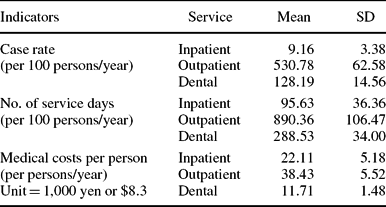
Each health insurance society issues a monthly bill to the government, which includes all medical services performed for each enrollee or dependent. The mean case rate (the total number of bills of the insurer/the number of the insured), the mean number of service days per person (the total number of service days of the bills/the number of the insured), and the mean medical cost per person (the total cost of bills of the insurer/the number of the insured) were used as indicators of medical service use. The study began on April 2003 and ended on March 2004, thus the indicators of medical service use reflected 1 full year of experience.
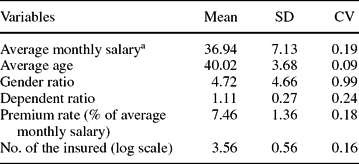
We used Health Society characteristics to control for consultation behavior that was not related to average monthly salary, our main predictor variable. These variables included average age of the insured, gender ratio (number of male insured divided by the number of female insured), dependent ratio (number of dependents divided by the number of the insured), premium rate (proportion of average monthly salary dedicated to health insurance), and the number of the insured in each Health Insurance Society (Reference Babazono, Ogawa and Babazono7;Reference Babazono, Toshihide and Yamamoto8). Among the 1,640 Health Insurance Societies in existence, we collected a complete data set from 1,628.
Statistical Analyses
First, the mean, standard deviation, and coefficient of variation were calculated for average monthly salary, average age, gender ratio, dependent ratio, premium rate, and the number of the insured. Next, the mean case rate, the mean number of service days per case, and the mean medical costs per person were calculated. Multiple regression analysis was performed by the forced entry method using case rate, the number of service days, and medical cost as the outcome, or dependent variables, and average monthly salary, average age, gender ratio, dependent ratio, premium rate, and the number of the insured as the predictor, or independent variables. There was no multicollineality among the explanatory variables (Reference Babazono, Ogawa and Babazono7;Reference Babazono, Toshihide and Yamamoto8). R 2 served as the indicator of how well the model fit the data. The significance of indicators was tested with t-tests and F-tests. The magnitude of the effect of each explanatory variable on the objective variable was compared according to the standardized partial regression coefficient. Therefore, we used the standardized partial regression coefficient of average monthly salary to reflect any possible income effect that may be present. We also performed a sensitivity analysis to test how the results would be impacted if a common logarithmic transformation was applied to the number of insured, which has log-normal distribution.
Finally, as a second sensitivity analysis, we estimated the effect on medical service demand if the mean monthly salary were 20 percent or approximately 1 SD less than the mean, reporting the results for insured and dependents separately because of the observed linear relationship between mean monthly salary and medical demand indicators. A level of p < .05 was taken as significant. We used a conversion rate of 120 yen to the dollar.
Mean, SD, and CV of Society Characteristics (N = 1,628)
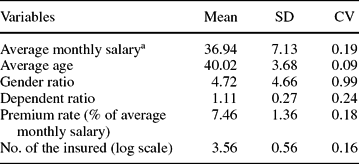
a Unit = 1,000 yen or $8.3.
CV, coefficient of variation.
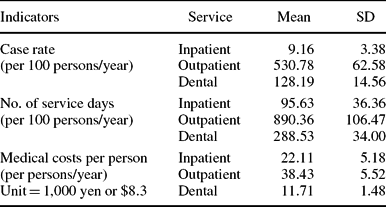
Case Rate, Number of Service Days, and Medical Costs (N = 1,628)
RESULTS
Table 1 shows the demographic profile of the health societies we studied. The means (SDs) of average monthly salary, average age, gender ratio, dependent ratio, premium rate, and the number of the insured (common logarithmic transformation) were 36.94 (7.13) thousand yen or $3,075 (592), 40.02 (3.68) years, 4.72 (4.66), 1.11 (0.27) dependents to insured, 7.46 (1.36) percent of average monthly salary, and 3.56 (0.56), respectively.
Table 2 shows the means and standard deviations of the case rates, the number of service days per person, and medical costs per person for inpatient, outpatient, and dental services. The case rate (per 100 persons) was 9.16, 530.78, and 128.19, for inpatient, outpatient, and dental services, respectively. The number of service days per person was 95.63, 890.36, and 288.53, for inpatient, outpatient, and dental services, respectively. The medical cost per person was 22.11, 38.43, and 11.71 thousand yen or $ 184, $320, and $98, for inpatient, outpatient, and dental services, respectively.
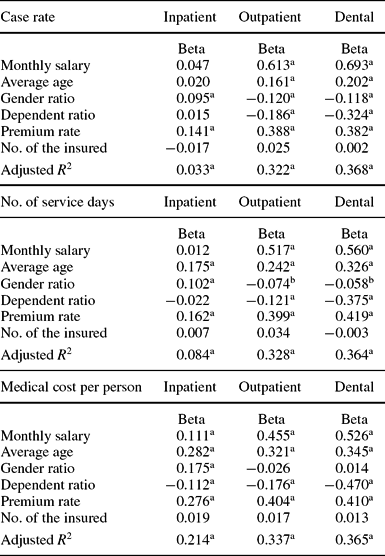
Results of Multiple Regression Analyses to Estimate Case Rate, the Number of Service Days per Person, and Medical Costs per Person (N = 1,628)
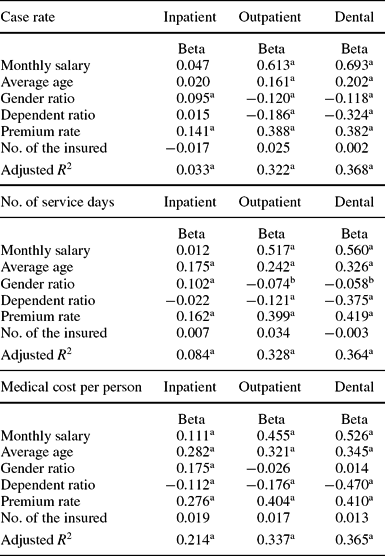
a p < .001.
b p < .01.
Table 3 shows the results of the multiple regression analysis to estimate case rates, the number of service days per person, and medical costs per person. All models were significant. Average monthly salary and the premium rate showed a high positive correlation of outpatient and dental indicators including case rate, the number of service days, and medical cost. Average age had a high positive correlation of dental number of service days, outpatient and dental medical costs, while dependent ratio had a high negative correlation of dental case rate, number of service days, and medical cost. The application of the common logarithmic transformation for case rates, the number of service days per person, and medical costs did not materially affect our results.
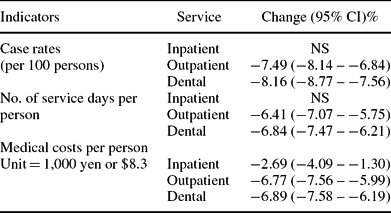
Estimated Effect on Medical Service Demands Caused by a 20 Percent Reduction in the Mean Average Monthly Salary (N = 1,628)
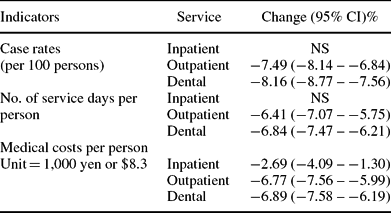
CI, confidence interval; NS, not significant.
Table 4 shows the estimated effect on medical service demand if the average monthly salary were reduced 20 percent lower than the mean. The estimated changes (95 percent CI) in case rate for the insured were −7.49 (−8.14 ∼ −6.84) percent for outpatient visits and −8.16 (−8.77 ∼ −7.56) percent for dental services. The estimated changes (95 percent CI) in the number of service days per person were −6.41 (−7.07 ∼ −5.75) percent for outpatient days and −6.84 (−7.47 ∼ −6.21) percent for dental service days. The estimated change in medical costs per person (95 percent CI) for the insured were −2.69 (−4.09 ∼ −1.30) percent for inpatients, −6.77 (−7.56 ∼ −5.99) for outpatients, and −6.89 (−7.58 ∼ −6.19) percent for dental services. Similar results were obtained from analyses of the insured and dependents separately.
DISCUSSION
Average monthly salary intensifies the effects of copayments on the case rate, the number of service days, and medical cost in the “Employees Health Insurance” in Japan. Heretofore, few analyses have evaluated economic status with respect to healthcare demands in Japan (4;6–9). In 1984, we used time-sequential analysis to evaluate the impact of the introduction of 10 percent copayments on the visit rate of hypertensive patients (Reference Babazono3). The initial 10 percent copayments, introduced that year, substantially decreased the mean number of visits to a health insurance society, as well as increasing the mean number of inpatient days per admission (Reference Babazono, Toshihide and Yamamoto8). In addition, we later showed an exacerbation of the poor fiscal condition of the “Employees Health Insurance” system due to aging-related increases in medical costs and decreases in the amounts of premium collected because of the country's economic distress at the time (Reference Babazono, Weiner, Tsuda, Mino and Hillman9).
The increase in patient copayments from 10 percent to 20 percent enabled insurers to substantially reduce medical costs by shifting those costs from the insurer to the insured, with resultant decreases in the number of visits per patient and increases in the number of inpatient days per admission (Reference Babazono, Toshihide and Yamamoto8). Medical service demands decreased significantly for both hypertension and diabetes mellitus, even when we controlled for the possible impact of secular trends (Reference Babazono, Miyazaki and Une6). The effect of the increase in the copayment rate from 20 percent to 30 percent differed according to the disease and the presence or absence of complications (Reference Babazono, Miyazaki and Imatoh4). Similarly, after the increase in copayments to 30 percent, the compliance rate of chronically ill patients with visits to their physicians decreased significantly only in diabetic patients with no complications (Reference Babazono, Miyazaki and Imatoh4). Thus, the interaction of copayments and income level on the demand for medical services is complicated.
However, various governmental legal requirements to provide medical services, such as impartiality in access to medical services regardless of salary, have been enacted. Compulsory affiliation to public medical insurance and prohibitions on combining insured and noninsured services are other such requirements (Reference Babazono2). Indeed, Japan was rated highly by a World Health Organization (WHO) report in 2000 on the Organisation for Economic Co-ordination and Development's (OECD's) scales of efficiency and impartiality. The OECD defines impartiality as permitting everyone to consult physicians without inhibitors in access to medical services, and they define efficiency, as appropriate placement of, and free access to, medical facilities. The WHO and the OECD believe that these grades enhance early examination and treatment of patients, possibly reducing medical costs overall.
However, we found a strong relationship between average monthly salary and consultation behavior by multiple regression analyses. It is essential to clarify the threshold copayment rate at which the salary level begins to enhance the reduction in the case rate.
Our multiple regression analyses to estimate the case rate, the number of service days per person, and medical costs, showed that inpatient services were not significantly related to the average monthly salary. The sensitivity of medical service demand to price is low for serious diseases. This finding also may be due to the “high-medical cost refunding system” in Japan, which covers the costs of catastrophic illnesses. Under this system, the maximum out-of-pocket payment by an insured is 80,000 yen ($670) per month, with somewhat higher out-of-pocket costs for employees with higher salaries (13). Fortunately, physicians seem to pay little attention to patients’ financial status when they judge the necessity for hospitalization.
However, the case of outpatient and dental services is different. In our multiple regression analyses to estimate case rate, number of service days, and monthly salary, the standard partial regression coefficient of mean monthly salary was significant. Thus, a low salary appears to discourage patients from seeking medical and dental services.
Finally, we estimated the effect of a 20 percent reduction of average monthly salary from the mean on medical service demands. The estimated changes in the case rate, number of service days, and medical costs for outpatients and for dental services was also significant, suggesting that access to medical facilities would be reduced by 7–8 percent and medical costs would be reduced by 7 percent, if one's monthly salary was 20 percent less than average!
Little association was observed between average monthly salary and the outpatient or dental case rate when the 10 percent copayment was started (Reference Babazono, Ogawa and Babazono7). However, under the 20 percent copayment system, mean monthly salary showed a clear positive correlation with the outpatient case rate and the dental case rate (Reference Babazono, Toshihide and Yamamoto8). Now, in the presence of 30 percent copayments, average monthly salary is even more significantly and positively related to outpatient and dental case rates. Moreover, this income effect intensifies as copayments are increased!
We studied health insurance societies in the “Employees Health Insurance” system. We believe that the income effect we found would be even more profound in the “Government Managed Health Insurance” and “National Health Insurance” systems, because they have a higher percentage of lower income insured. In particular, unemployed patients may be particularly less likely to visit physicians in the setting of high copayments, despite the supposed availability of “health care for all.” In the United States, where private insurance systems are dominant and there is no universal safety net for health care, the obvious differences in access to medical services associated with income gaps are easy to explain.
But, in Japan, there is supposed to be universal access to health care for all citizens. Unfortunately, we found that increasing the copayment rate intensifies an income effect wherein lower income patients use less medical services. Such effects also have been observed with respect to necessary consultations due to hypertension and diabetes mellitus (Reference Babazono3;Reference Babazono, Miyazaki and Imatoh4). Because symptoms are often obscure in chronic diseases, patients may tend to refrain from consulting the medical system for economic reasons. Further increases in the copayment rate may discourage patients with acute conditions from accessing the healthcare system.
We used an individual monthly salary as a proxy of household income. The typical salary system in Japan has been based on seniority, professional licenses, and experiences. However, recently, an increasing number of businesses are introducing ability-based and duty-based pay systems. The mean number of family member is 2.55, and the mean number of workers each family is reported to be 1.49 (15). Therefore, the mean monthly household income can be estimated to be the mean individual income multiplied by 1.49. The “employment state of the spouse” and the “number of dependent children” significantly affect visits to physicians in the setting of 30 percent copayments (Reference Babazono, Miyazaki and Une5). The analysis of the upper limit expenditure of copayments per month for diabetes mellitus revealed that the proportion of an upper limit expenditure of ≤5,000 yen ($42) for “≥ 4” dependent children was 2.36 times that for “0” dependent children, and the proportion for “2 or 3” dependent children was 1.46 times that for “0” dependent children. In the study, ratio had a high negative correlation of dental case rate, number of service days, and medical cost (Reference Babazono, Miyazaki and Une5). It could be considered being an income effect.
We examined the relationship between individual incomes and demands for healthcare services among the insured. We could not control potential confounding factors including healthcare needs and demands between income groups because the data were not available. However, there were no uninsured groups because we have a universal health insurance system.
In the present structural reform of the Japanese medical system, the government is expected to reduce social costs such as medical and disability care expenditures by implementing policies emphasizing “primary prevention,” rather than allocating medical resources to the discovery and treatment of acute diseases alone (14). To most efficiently used limited resources, the allocation of medical care for preventive programs, must remain a priority. Moreover, the phenomenon wherein insured patients with lower salaries are less likely to access the high copayment healthcare system than insured patients with more resources must be reversed.
CONTACT INFORMATION
Akira Babazono, MD, MS, Ph.D (babazono@hcam.med.kyushu-u.ac.jp), Professor, Kazuaki Kuwabara, MD, MPH, DPH (kkuwabar@hcam.med.kyushu-u.ac.jp), Associate Professor, Akito Hagihara, MPH, PhD (hagihara@hsmp.med.kyushu-u.ac.jp), Professor, Health Care Administration and Management, Graduate School of Medical Sciences, Kyushu University, 3-1-1 Maidashi Higashi-ku, Fukuoka City, 812-8582, Fukuoka, Japan
Eiji Yamamoto, PhD (eiji@mis.ous.ac.jp), Professor, Department of Information Science, Okayama University of Science, 1-1 Ridai-cho, Okayama City, Okayama, 700-005, Japan
Alan Hillman, MD, MBA (garnetla@mail.med.upenn.edu), Professor, Division of General Internal Medicine, Department of Medicine, School of Medicine, University of Pennsylvania, 3641 Locust Walk, Philadelphia, Pennsylvania 19104-6218