INTRODUCTION
In the last two decades, shark populations around the world have experienced unprecedented declines, driven largely by target fisheries that supply the shark fin trade (Baum et al., Reference Baum, Myers, Kehler, Worm, Harley and Doherty2003; Dulvy et al., Reference Dulvy, Baum, Clarke, Compagno, Cortés, Domingo, Fordham, Fowler, Francis, Gibson, Martínez, Musick, Soldo, Stevens and Valenti2008; Ferretti et al., Reference Ferretti, Myers, Serena and Lotze2008). According to the United Nations’ Food and Agriculture Organization (FAO), Indonesia has the world's biggest shark fishery, with a reported average yearly catch in excess of 100,000 tons over the last decade (FAO, Reference FAO2014).
Global efforts to protect sharks from overexploitation have been informed and recommended in recent years by a substantial rise in the number of scientific studies on various aspects of shark biology and fisheries (Momigliano & Harcourt, Reference Momigliano, Harcourt, Klein and Techera2014). However, this global trend of increased scientific, government and non-government attention to the plight of sharks has largely eluded Indonesia for various reasons, such as the size of the Indonesian archipelago, the logistics of accessing remote fishing grounds, the difficulty of obtaining research permits and insufficient allocation of government resources (Momigliano et al., Reference Momigliano, Jaiteh, Speed, Stow, Holwell and Maclean2014). The published scientific studies from the region (e.g. White, Reference White2007a; White et al., Reference White, Bartron and Potter2008; Blaber et al., Reference Blaber, Dichmont, White, Buckworth, Sadiyah, Iskandar, Nurhakim, Pillans and Andamari2009; White & Dharmadi, Reference White2010) have focused on relatively easily accessible parts of Indonesia, or were based on fish market surveys where the location of capture was not always known. As a result, essential data on the diversity, biology and distribution of fishery-targeted shark species remain sparse or lacking for large parts of Indonesia, impeding effective management and conservation efforts. Where data are scarce and rigorous fishery-independent assessments not possible, catch data can provide critical information on the status of a species, for example as part of species assessments (Froese et al., Reference Froese, Zeller, Kleisner and Pauly2012). Determining the distribution range of a species and the geographic extent of the fisheries targeting it are important components of a species assessment, allowing managers to develop location-specific strategies to protect populations from anthropogenic pressures.
The fossil shark Hemipristis elongata (Klunzinger 1871) is a tropical shark known to occur in shallow waters to depths of at least 130 m (Stevens & McLoughlin, Reference Stevens and McLoughlin1991) in coastal regions of the Indo-western Pacific, including south-eastern Africa, the Red Sea, India, South-East Asia and Australia (White, Reference White2003; Last & Stevens, Reference Last and Stevens2009). Due to the high quality of its meat and fins, H. elongata is targeted by intensive and largely unmanaged coastal fisheries throughout its range, with the exception of Australia, where it has little commercial value (White, Reference White2003). Fish market surveys in the Gulf of Thailand and on Java in Indonesia have indicated that the species has declined where it was once common (White, Reference White2003). Despite the strong likelihood that H. elongata has experienced significant population declines in the last two decades, biological information for the species is limited. It grows to about 240 cm and females are thought to have 2 to 11 young every other year (Stevens & McLoughlin, Reference Stevens and McLoughlin1991). Size at maturity and growth is not well understood (White, Reference White2007b).
Based on the most recent species assessment (White, Reference White2003), the IUCN classifies H. elongata as globally Vulnerable with a decreasing population trend (IUCN, Reference IUCN2014). Indonesia is one of the countries in which fossil sharks are likely to be heavily exploited, but to date, they have only been recorded from fish markets on Java (White, Reference White2003, Reference White2007b). The author of the IUCN assessment of H. elongata suggested that market surveys are likely to provide a relatively good representation of the population of this species in Indonesia (White, Reference White2003). However, fish market surveys are unlikely to yield reliable data in eastern Indonesia, where sharks are rarely landed whole and sold at markets; instead, fishers often discard the carcasses at sea, bringing back only the fins which they dry and sell directly to traders close to their homeports (Momigliano et al., Reference Momigliano, Jaiteh, Speed, Stow, Holwell and Maclean2014). If not accounted for, this ‘invisible’ fishing pressure can limit the accuracy and usefulness of regional population assessments for local management purposes. One way to obtain fishery data in the absence of carcasses for species identification is to work directly with fishers to collect catch data at sea. Recent fishery surveys with the objective of describing the species composition of eastern Indonesian shark fisheries (V. Jaiteh, unpublished data) suggested the presence of H. elongata in a region outside of its currently known range. Here we report a range extension of >2000 km for H. elongata into far eastern Indonesia from genetically validated catch data collected by shark fishers in the Halmahera, Seram and Arafura Seas. We discuss the implications of this species’ occurrence and exposure to fishing pressure in three distinct fishing grounds from where it was not previously described, and recommend a review of the IUCN species assessment for H. elongata.
MATERIALS AND METHODS
Fishers from Seram island and the Aru archipelago in Maluku province, Indonesia recorded 19 specimens of Hemipristis elongata during four fishing trips between March and December 2012 in their usual fishing grounds: the Halmahera sea surrounding Halmahera island in North Maluku province; the Seram sea in the Raja Ampat regency of West Papua province; and the Arafura sea around Aru regency, Maluku province (Figure 1). All three fishing grounds are at a distance of 2000–2500 km from the island of Java. Fishers who agreed to take part in this study were trained in data collection and recorded the following information for each longline or gillnet set: the local species names of the first ten sharks caught, their total length and sex. For males, clasper length and a basic assessment of calcification (yes/no) were noted, females were checked for embryos. After each fishing trip, local species names were matched to scientific names using identification guides (White et al., Reference White, Last, Stevens and Yearsley2006; Last & Stevens, Reference Last and Stevens2009). Fishers also recorded water depth and, if a GPS was available, the coordinates of each set. Samples of muscle and fin tissue were collected from sharks caught in bottom-set gill nets or baited longlines with a soak time of 10–15 h overnight. Fishers collected tissue samples from 14 specimens: all individuals caught in Halmahera (N = 3) and Raja Ampat (N = 5), and six individuals from Aru, where a further five specimens were recorded from which no samples are available (Figure 1). Fishers from Aru collected tissue samples during their normal fishing activities and stored them in vials that they labelled with the local species name. Fishers in Halmahera and Raja Ampat took tissue samples from the underside of dried fins that they identified to species-level immediately after the respective fishing trips. In all cases, samples were stored in a NaCl saturated solution containing 20% dimethyl sulphoxide and 0.25 M ethylenediaminetetraacetic acid.
Map showing the fishing grounds (red circles 1–3) where 19 individuals of Hemipristis elongata were recorded, 14 of which were sampled and genetically verified. Fishing grounds are numbered: 1 = Halmahera Sea in North Maluku province; 2 = Seram Sea, Raja Ampat in West Papua province; 3 = Arafura Sea, Aru in Maluku province. The 200 m bathymetric depth contour is shown in blue.

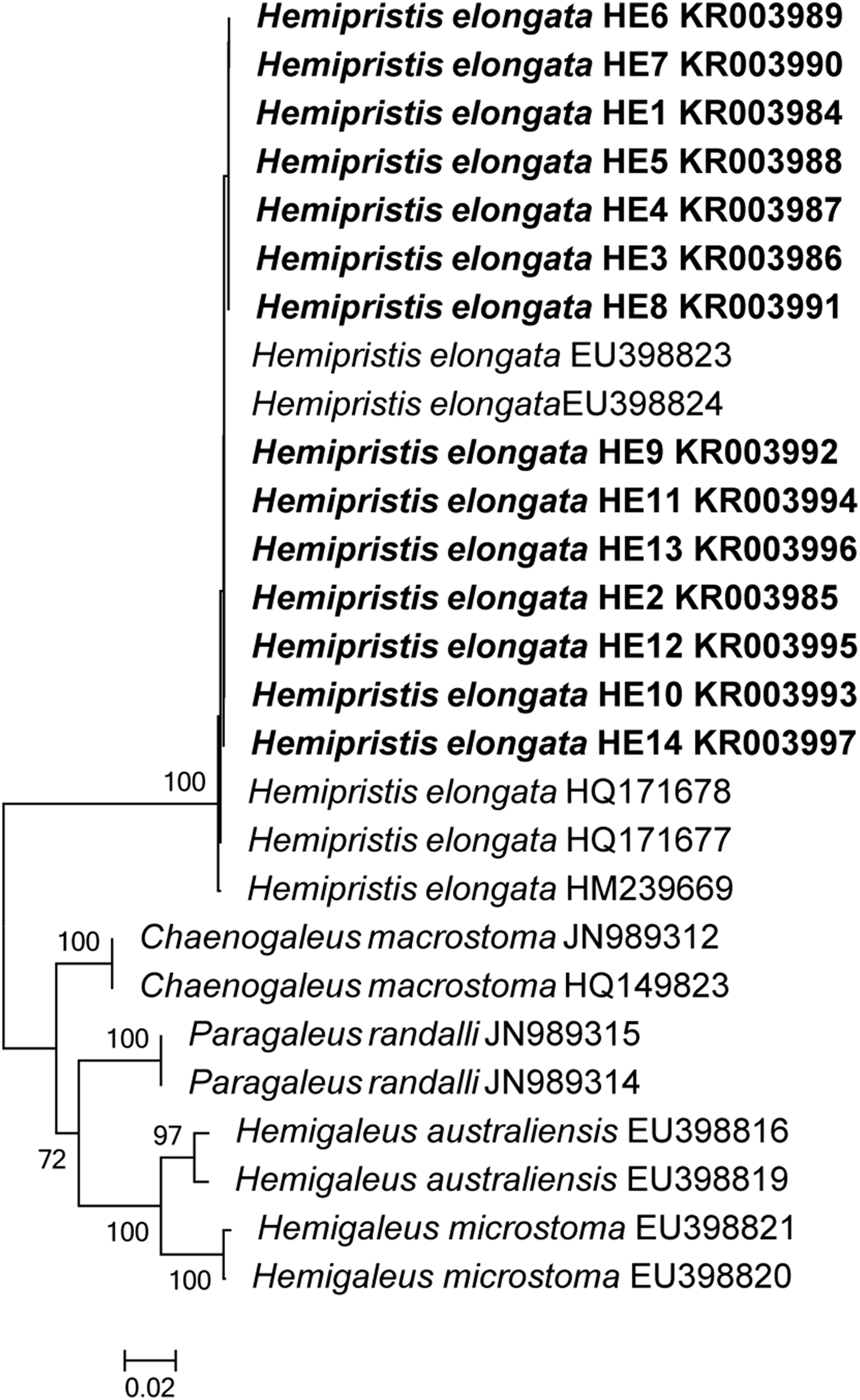
DNA was extracted from the 14 specimens following the modified chelex protocol (Walsh et al., Reference Walsh, Metzger and Higuchi1991) described by Ward et al. (Reference Ward, Holmes, White and Last2008). A 652 bp long fragment of the Cytochrome Oxidase 1 gene was amplified following the protocol outlined by Ward et al. (Reference Ward, Holmes, White and Last2008), using the primer pair FishF1 and FishR1 (Ward et al., Reference Ward, Zemlak, Innes, Last and Hebert2005). PCR products were sequenced using the forward primer FishF1. All sequencing reactions were carried out by a commercial company (Macrogen Inc.). The obtained sequences were deposited in GenBank (accession numbers: KR003984–KR003997) and matched with sequences deposited in the Barcode of Life Data System (BOLD, http://www.boldsystems.org/) database using the BOLD Identification System (IDS). Sequences from these specimens were aligned with sequences from other Hemigaleidae obtained from BOLD. A neighbour-joining tree was constructed, as outlined in Momigliano & Jaiteh (Reference Momigliano and Jaiteh2015).
RESULTS
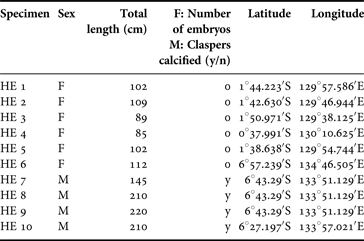
All of the 14 samples for which genetic analysis was carried out were unambiguously identified as Hemipristis elongata by the BOLD IDS system. In the phylogenetic tree, all individuals were grouped with 100% bootstrap support with known sequences of H. elongata (Figure 2), therefore verifying the suspected occurrence of this species in far eastern Indonesia. Fishers identified the species as hiu putih, or ‘white shark’ when referring to identification images of H. elongata in White et al. (Reference White, Last, Stevens and Yearsley2006) and Last & Stevens (Reference Last and Stevens2009). All fossil sharks recorded by the fishers were caught at depths between 17 and 125 m. Of the ten genetically verified individuals that were measured and sexed by the fishers, all females (N = 6) were immature with no embryos, while all males (N = 4) were mature with calcified claspers (Table 1).
Neighbour-joining tree of the family Hemigaleidae based on a 652 bp long fragment of the Cytochrome Oxidase 1 gene. Individuals analysed in this study are shown in bold. Internal branch labels represent bootstrap support based on 1000 pseudo replicate datasets. Scale bar represents number of changes per base pair.
Sex, lengths and geographical coordinates recorded by fishers in eastern Indonesia for ten genetically verified specimens of Hemipristis elongata.
DISCUSSION
In Indonesia, fossil sharks have previously only been recorded from Java (White, Reference White2003), which is bounded by the Indian Ocean to the south and the Java Sea to the north (Figure 1). This study provides new information on the distribution of Hemipristis elongata across the archipelago, extending its known range by >2000 km into the Halmahera, Seram and Arafura seas. The IUCN assessment for H. elongata states that ‘the intensive and largely unmanaged net and trawl fisheries that occur throughout its range (…) fish heavily in its known habitat and are likely to catch this species if present’ (White, Reference White2003). Our results confirm that this is the case in eastern Indonesia, where H. elongata has not been documented before and shark fisheries have barely been described. This has important implications for the management and conservation of H. elongata and other species caught in the eastern Indonesian shark fishery, where catches are generally not reported.
Shark management has been slow to develop in Indonesia, partly due to a lack of information about the species occurring in Indonesia's waters, their distributions and the level of threat they are exposed to through target fisheries and bycatch (Blaber et al., Reference Blaber, Dichmont, White, Buckworth, Sadiyah, Iskandar, Nurhakim, Pillans and Andamari2009; White & Kyne, Reference White and Kyne2010). Their more charismatic relatives, manta rays (Mobulidae), have the same IUCN threat status as fossil sharks but owing mostly to their value for tourism, are now protected throughout Indonesian waters with violation of the law incurring a fine of 250 million rupiah (approx. US$20,000). Hemipristis elongata, however, along with the majority of species caught in Indonesia's shark fisheries, is not protected by national law, and there are currently no fisheries management plans in place for this species. The Raja Ampat shark sanctuary, declared in 2012, is the exception to the current lack of effective shark protection in Indonesia, and the fishers that provided data for this study from their Raja Ampat fishing grounds no longer fish there.
Species assessments are important sources of information for management plans, making the availability of accurate biological and fisheries data essential for effective conservation of threatened species. The IUCN assessment for H. elongata outlines that, as recommended Conservation Actions, ‘Recent species composition and catch data for fisheries within its range are required to assess the population trends, especially in areas where there is a very high level of fishing pressure’ (White, Reference White2003). This study contributes recent catch data from eastern Indonesia, a region with extensive shark fisheries from which H. elongata was not previously known to occur. The length and sex data collected by the fishers imply that all caught females were immature, with lengths <120 cm and no embryos, while all males were mature at lengths >136 cm (Last & Stevens, Reference Last and Stevens2009) and calcified claspers (Table 1). Our results highlight the value of catch data recorded by fishers, in combination with genetic verification of their species identifications, to provide fundamental information on the distribution and status of a Vulnerable species. This information calls for an update of the IUCN species assessment, as well as improved fisheries management strategies in one of the world's most significant shark fisheries.
Indonesia lies within the global centre of tropical marine biodiversity known as the Coral Triangle. Despite this, the available data suggest that this region harbours a surprisingly lower biodiversity of elasmobranchs than its neighbour Australia (White & Kyne, Reference White and Kyne2010), which is regarded to have the highest abundance of elasmobranch species in the world (Last & Stevens, Reference Last and Stevens2009). However, Indonesia has far less resources to study the shark species in its waters and the threats they face. Nevertheless, in recent years previously unobserved species have been reported from various parts of the island archipelago (e.g. White et al., Reference White and Last2005; White & Last, Reference White and Last2006; Allen et al., Reference Allen, Erdmann and Dudgeon2013), suggesting that elasmobranch biodiversity in the region has likely been underestimated. A more extensive study of the catch composition of eastern Indonesian shark fisheries would help to identify further knowledge gaps and support the development of management plans for these fisheries.
ACKNOWLEDGEMENTS
We sincerely thank the fishers who gave their time to provide tissue samples, identify sharks and answer our questions. N. Mahardika, Aji and Andre from the Indonesian Biodiversity Research Centre generously allowed us to use their laboratory space. Data collection and analyses were conducted under ethics permits 2012/010 and O2484/12, respectively, to V. Jaiteh, Indonesian Research Permits #13/EXT/SIP/FRP/SM/I/2013 to V. Jaiteh and #03B/TKPIPA/FRP/SM/III/2014 to P. Momigliano, issued by RISTEK Indonesia. This work was supported by a Prime Minister's Australia-Asia Endeavour Award (V. Jaiteh); the Graduate Women of Western Australia (V. Jaiteh); the Department of Biological Sciences at Macquarie University (P. Momigliano) and the Sea World Foundation (P. Momigliano, project SWR/7/2013).