On October 29, 2012, Hurricane Sandy hit the East Coast of the United States, with the potential to deeply impact the health and well-being of more than 50 million people and touching the lives of many New York residents. The greater New York City area was heavily affected, with more than 370,000 people evacuated and almost 3 million people left without power. Also, 660 miles of subway tracks closed, 1 thus making impossible the transportation of people, aid, and goods within the city and among the boroughs and Long Island and creating a barrier to access to necessary medical care. 1 - Reference Sebek, Jacobson and Wang 4 With an unprecedented National Oceanic and Atmospheric Administration-verified storm tide (3.4 m vs a typical tide of 2.3 m) and surge (2.8 m vs a typical surge of 2.4 m), flooding to the area was devastating, impacting thousands of area residents over a 51-square-mile area.Reference Brandon, Woodruff and Donnelly 5 After Hurricane Katrina, Hurricane Sandy was one of the deadliest storms in US history, with at least 162 deathsReference Blatchford 6 and numerous storm- and evacuation-related injuries.Reference Brackbill, Caramanica and Maliniak 7
The psychological devastation of the hurricane, along with the long-term physical consequences of being displaced, major loss of property, flooding, mold, and prolonged lack of heat, water, and power have not been well studied. Estimates can be drawn from anecdotal reports from health care providers, first responders, hospitals, and shelters; however, reliable data are lacking in terms of the incidence of psychological effects specifically. Given the paucity of research on the impact of hurricanes on the NY metropolitan area, public health agencies rely on the results of empirical studies conducted during other natural disasters, such as Hurricanes Katrina, Ike, Hugo, and Andrew, to assess the health effects of such catastrophic events and to subsequently make decisions regarding preparedness for future events.Reference Galea, Nandi and Vlahov 8 However, the health and psychological effects produced by Hurricane Sandy in the greater New York City area cannot be completely extrapolated from existing literature owing to the uniqueness of the event, which has affected for months an extensive, highly populated, mixed suburban-urban area that is home to socioeconomically diverse families who have been traditionally living in the area for generations. New York City has experienced both domestic and international positive net migration in the last 4 years, resulting in a continually shifting and growing population of both migrants and immigrants, which poses a unique set of challenges in the face of a natural disaster, 9 including insufficient outreach/communication by governmental agencies, increased economic hardship, and unmet relief needs leading to increased mental health symptoms. 10
Research on the impact of previous hurricanes indicates that some subpopulations may be at higher risk for mental health difficulties following a natural disaster.Reference Galea, Nandi and Vlahov 8 , Reference Neria, Nandi and Galea 11 - Reference Beaudoin 18 Studies have reported that those of low-income, black race, and women, in particular, tend to be at highest risk for mental health issues,Reference Sastry and Gregory 19 - Reference Sastry and Van Landingham 21 although the findings could be an indirect reflection of concomitant conditions such as poverty and previously undiagnosed mental health problems.Reference Abramson, Stehling-Ariza and Garfield 22 In a study of 724 Katrina survivors, over 56% of black participants indicated that the hurricane was responsible for poor emotional well-being, as compared to 43% of white participants, a statistically significant difference.Reference Toldson, Ray and Hatcher 20 In addition, those with preexisting mental health issues, including substance abuse, were at greatest risk for post-hurricane mental health difficulties and were least likely to be psychologically resilient after a disaster.Reference Bonanno, Galea and Bucciarelli 23 - Reference Rutkow, Vernick and Mojtabai 25 Furthermore, studies found that suspensions of mental health services as a result of a hurricane had the greatest impact on vulnerable subgroups, including those without health insurance and ethnic minorities, and that lack of treatment of new-onset cases of mental health difficulties after the hurricane was related to younger age (18–39 years old) and lower income (at or below the federal poverty line).Reference Wang, Gruber and Powers 26 However, some research suggests that certain ethnic minority groups, such as the Vietnamese community in New Orleans, fare better during times of disaster, with low rates of certain mental health difficulties, such as post-traumatic stress disorder.Reference Fussell, Sastry and Vanlandingham 27
Studies specific to Hurricane Sandy have reported findings similar to those for other natural disasters. Although the study design and conduct of these studies differ significantly in some instances, one common finding is that higher exposure to hurricane-related stressors, as well as exposure to past trauma, is correlated with poorer mental health outcomes.Reference Gruebner, Lowe and Sampson 28 - Reference Lowe, Sampson and Gruebner 30 One study on Hurricane Sandy found that non-Hispanic black race and Asian ethnicity were vulnerability factors for poorer mental health.Reference Gruebner, Lowe and Sampson 28 Although these findings were limited to the borough of Queens in New York City, a study across New York City boroughs also found non-Hispanic black race to be a risk factor for poor mental health.Reference Lowe, Sampson and Gruebner 30 Other vulnerability factors in this study were poor physical health, physical limitations, unemployment, and lower education level. In terms of gender, some research indicates that among individuals exposed to the hurricane, there were no differences between men and women on certain mental health outcomes,Reference Hamama-Raz, Palgi and Shrira 31 whereas other research found female gender to be protective.Reference Boscarino, Hoffman and Adams 29 A study conducted on New Jersey residents found similar results, in that white race and high social support were protective for post-traumatic stress disorder symptoms after Hurricane Sandy. Female gender and older age were protective for depression, whereas poor physical health, physical limitations, and previous mental health difficulties were predictors of mental health difficulties.Reference Boscarino, Hoffman and Adams 29
Review articles that focused on the impact of different types of disasters on victims indicated that approximately 90% of the 160 studies reviewed reported that disasters resulted in, at a minimum, moderate impairment, indicative of prolonged stress, although results varied based on disaster type, location, and sample demographics.Reference Norris, Friedman and Watson 32 , Reference Norris, Friedman and Watson 33 We report here the result of a study on the impact of Hurricane Sandy exposure on perceived stress among residents of Nassau, Suffolk, Queens, and Richmond counties, a large suburban area comprising roughly 8 million residents.
Methods
This was a population-based, cross-sectional study of the levels of perceived stress among residents in Nassau, Suffolk, Queens, and Richmond counties, which are all located geographically in Long Island, struck by Hurricane Sandy. In conjunction with community and government partners, recruitment venues were identified by using convenience sampling techniques. Participants were asked to complete a self-administered survey including validated measures on possible mental health conditions as a result of Hurricane Sandy.
Participants
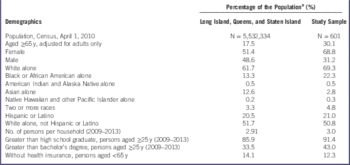
The current study included 601 volunteer participants aged 18 and older who were recruited in the field with the help of community leaders and organizations. Exclusion criteria were being a non-English or Spanish speaker and cognitive impairment that resulted in difficulty understanding consent. The research team collected survey data from each individual who consented to participate in the study. Our team traveled to libraries, community centers, senior centers, gyms, and faith-based institutions across the region in both heavily and less affected areas and accepted all the volunteers who offered to participate in the study. Given that a convenience sampling strategy was used, the demographic characteristics of the participants were periodically compared to the census data for that county to assess the comparability of the convenience sample to the actual residents (Table 1). Generally, the study sample was congruous to the 2010 census data for the study’s target region. Efforts were made to target recruitment to specific demographics in a particular region when a lack of comparability was noted.
Demographics of the Study Sample in Comparison with US Census

a Population aged ≥18 years.
Recruitment Strategy
The sampling procedure was guided by the Nassau County Department of Human Services (DHS), which currently oversees the post-hurricane mental health response in the area, and by those responsible for the North Shore-Long Island Jewish (NSLIJ) Hurricane Sandy response effort, in collaboration with established partners at Staten Island University Hospital, Rockaway coalition community leaders, Southside Hospital in Suffolk County, and the Nassau County Department of Health.
The NSLIJ Health System has a long-standing history of engaging and working with communities throughout Long Island, Staten Island, and Queens. The NSLIJ Health System and the Nassau County DHS were actively involved in the Hurricane Sandy rescue and response efforts, as well as the post-hurricane intervention efforts, so that community ties in hurricane-affected areas were made prior to the initiation of the study. The investigators attended numerous community-based coalition meetings to expand community ties. Extensive support for the project was garnered at these meetings and their sites were willing participants in the study. Additionally, investigators held study-initiated quarterly Project Advisory Committee meetings consisting of key leadership in the affected communities. Advisory board members include key stakeholders from local departments of health, Hurricane Sandy community-based organization leaders, local health care providers, and researchers and practitioners with experience in mental health and disaster preparedness. The Project Advisory Committee represented their community members’ needs on matters of study recruitment and implementation and gave input on community outreach, dissemination and translation of study findings, and evaluation of the project as a whole.
In addition to sites provided by these local community agencies and contacts, the research team contacted libraries, community centers, senior centers, and faith-based institutions across the region to recruit potential participants. There were additional community contacts throughout Queens, Staten Island, Nassau, and Suffolk that facilitated recruitment in the less affected areas, thereby allowing for comparisons across exposure levels.
Survey
The self-administered survey contained validated measures of behavioral and psychological health, questions regarding mental health history before and after the hurricane, and an instrument specific to Hurricane Sandy exposure including questions regarding exposure to flooding and mold and questions as to whether the participant was exposed in a first responder capacity. Participants also completed a section on demographic information such as address during the hurricane, current address, education, gender, race/ethnicity, place of birth, and occupation. The survey took approximately 20 minutes to complete. At the conclusion of the study, all participants received a comprehensive list of local health resources, important information regarding benefits for victims of the hurricane, as well as small monetary compensation for the time spent participating in the study. The survey was translated into Spanish, and a Spanish-speaking research assistant was available for consent/study administration when necessary. Data were collected from November 2013 through March 2014.
Exposure Variables
Investigators modified the hurricane exposure tool used in previous research (eg, Hurricanes Katrina and Andrew)Reference Norris, Perilla and Riad 34 , Reference Harville, Xiong and Smith 35 to include the known impacts specific to Hurricane Sandy. Participants completed a 30-point list in which they checked off all possible hurricane experiences that they underwent, including power outage, displacement from home, length of displacement, location to which the participant was displaced (family, friends, hotels, shelters), flooding in the home, property loss, and loss of life (family/friends). The self-report measure also included specific questions regarding flood damage. The total exposure score was based on the sum of a possible 30 hurricane experiences and did not include follow-up questions such as the amount of water in the home or the number of days without power.
Outcome Variable
Perceived stress was assessed by using the 10-item Perceived Stress Scale (PSS),Reference Cohen, Kamarck and Mermelstein 36 , Reference Hyre, Benight and Tynes 37 which is a reliable and validated indicator of self-reported stress that has been used in previous hurricane-associated trauma research.Reference Brackbill, Caramanica and Maliniak 7 , Reference Norris, Perilla and Riad 34 Perceived stress was used as a continuous variable with higher scores indicating greater perceived stress.
Field Study Standardization
The recruitment of participants and the facilitation of their completion of the survey protocol were performed by research assistants who had numerous years of experience collecting similar data. The research assistants were trained to review the questionnaire upon completion and to make sure that all items were answered before reimbursing the participants for their time and effort. This obtained a completion rate close to 100% for all key variables. There were 4 questionnaires with missing hurricane exposure data, and those were excluded. A psychologist provided additional training to research staff on the various mental health measures included in the questionnaire to familiarize the staff with the measures should participants have questions or concerns. In addition, study research assistants were given a refresher training course on the administration of consent and on updated regulations pertaining to confidentiality in research. Supervision of the staff included weekly meetings during which the staff logs completed after each field study visit were reviewed. Additionally, investigators visited field sites regularly to observe and obtain feedback from the staff and the participants.
Statistical Analysis
Data are presented as means±standard deviations (SDs) for continuous variables and as percentages for discrete variables. Comparisons between means were performed by t-test, and those between frequencies by chi-square. A principal components analysis was conducted by using the Hurricane Sandy exposure tool; such analysis indicated that 2 main exposure clusters existed: “personal exposures” (such as “life in danger” or “separated from family”) and “property exposures” (such as “home damaged/destroyed” or “lost vehicle”). These 2 clusters were subsequently used in the analyses on the association between exposure and PSS score. Univariate analyses were conducted by using ANOVA and multivariable models used linear regression in which parameter estimates, standard errors, and F values were generated. All significant findings are reported at the level of P<0.05.
Results
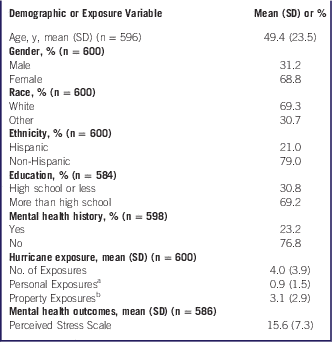
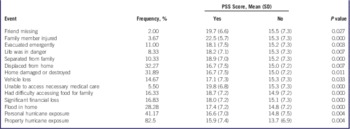
A convenience sample of Nassau, Suffolk, Staten Island, and Queens residents (n=601) was recruited from areas affected by Hurricane Sandy and asked about their exposure to the hurricane (Table 1). The study sample is described in Table 2. The sample consisted of a large number of women (68.8%) and was mostly white (69.3%); roughly two-thirds of the sample had completed more than high school. Twenty-three percent of the sample self-reported a history of mental health issues. There was a high rate of multiple exposures to the hurricane, with an average number of exposures per person of 4. Of the total participants, 8.3% perceived their life to be in danger, 11.0% evacuated emergently during Hurricane Sandy, 10.3% separated from family members, and 72.7% lost electricity. Of those who lost electricity, the mean number of days with no power was 16.29, and 5.5% became unemployed (Table 3).
Sample Demographics, Hurricane Exposure and Perceived Stress

a Personal exposure variable includes exposures such as “life in danger” and “separated from family.”
b Property exposure variable includes exposures such as “home damaged/destroyed” or “lost vehicle.”
Associations Between Hurricane Sandy Adverse Events and Mean Perceived Stress Scale (PSS) Scores

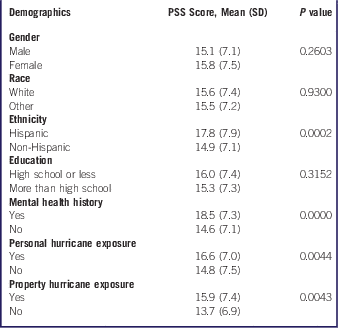
There were relatively high rates of stress among participants, with a mean score of 15.6 (SD=7.3; vs general population mean of 13.0,Reference Cohen and Janicki-Deverts 38 with 30.14% of the sample categorized as “high stress” [mean≥20]). Univariate analysis of variance indicated that PSS scores were significantly higher among Hispanics, participants with a high school diploma or lower level of education, and among those with a previous history of mental health issues (Table 4). Total exposure to Hurricane Sandy was significantly positively associated with PSS score in the univariate analysis. Further, when the hurricane exposure scale was examined by specific exposure, PSS scores were statistically significantly higher among participants who had a family member experience physical harm, who were separated from family, who were displaced from their home, whose home was flooded, who had difficulty accessing medical care or food for their family, and who had experienced financial loss (Table 3).
Mean Perceived Stress Scale (PSS) Score by Sample Demographics (N=586)

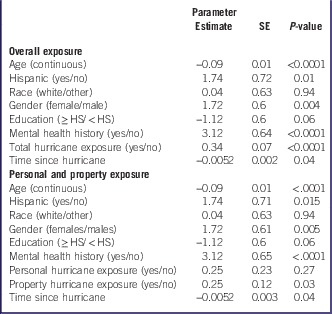
Multivariable regression analysis indicated that age was significantly negatively associated with PSS score (P<0.0001), whereas female gender (P=0.004), Hispanic ethnicity (P=0.01), a reported history of mental health issues (P<0.0001), and overall exposure to hurricane Sandy (P<0.0001) were statistically significantly associated with perceived stress in a positive direction (Table 5). When exposure to Sandy was categorized as personal versus property exposure, the same associations with demographics reported previously were observed and in the same directions, but only property exposure remained statistically significantly associated with perceived stress (Table 5). When the analysis was stratified according to place of birth, the predictors of PSS in US-born subjects were similar to what was observed in the overall sample, whereas in the small sample of foreign-born individuals (n=108), only age and previous mental health issues were associated with PSS scores (data not shown).
Association Between Hurricane Exposure and Perceived StressFootnote a

a Abbreviation: HS, high school. All variables were dichotomized except for age (continuous), time since hurricane (continuous), and hurricane exposure (personal/property). R2=0.18 for overall exposure. R2=0.1644 for personal and property exposure.
Discussion
The current analysis indicates that perceived stress was high in areas of Nassau, Suffolk, Queens, and Staten Island affected by Hurricane Sandy and that individual hurricane exposure was significantly associated with perceived stress even after adjustment for factors known to be associated with stress, such as having a positive mental health history.Reference Pbert, Doerfler and DeCosimo 39 In addition, demographics such as younger age and lower education were associated with increased levels of perceived stress. The multivariate analysis was able to disentangle the relative contribution of all the possible factors affecting perceived stress and confirmed that exposure to Hurricane Sandy was independently associated with stress, with loss of property being the main exposure factor associated with perceived stress. This finding is interesting in that it appears that the main driver of stress within total hurricane exposure was damage to property as opposed to personal factors such as separation from family. It is likely that, by the time the participants were interviewed, the lasting stressful impact of the hurricane was the effect on property and finances because the issues regarding separation from family may have been resolved. Given these results, our study suggests that stress-reduction interventions among hurricane-affected community members may be particularly useful if implemented at venues such as job fairs and forums on post-hurricane construction, in addition to more typical settings for post-disaster interventions such as mobile clinics in the immediate aftermath, as well as community mental health centers, faith-based organizations, and school settings.Reference Kanter, Abramson and Redlener 40 - Reference Goldman, Bauer and Newman 42
The geographic distribution of the participants shown in Table 1 seems to support the fact that the present study covered a wide geographic area of Long Island, Queens, and Staten Island and involved area known to have had a wide variation in exposures to Sandy. The finding regarding younger age being significantly associated with greater perceived stress confirms previous literature suggesting that younger disaster victims suffer greater impairment than do older adults.Reference Bonanno, Galea and Bucciarelli 23 , Reference Norris, Friedman and Watson 32 Bonanno and colleagues found that participants aged 65 and older were 3 times as likely to be resilient in the aftermath of the September 11 attacks as were participants between the ages of 18 and 24 years.Reference Bonanno, Galea and Bucciarelli 23
We have to note that in the present study a number of older participants resided in senior housing, providing an additional level of support against stress, in general, and especially when faced with a natural disaster. One finding of this analysis is that specific demographic factors appeared to be associated with high stress after exposure to Hurricane Sandy (ie, younger age, Hispanic ethnicity, lower educational attainment, a positive history of mental health issues, and female gender). These may represent subgroups that are more vulnerable to the negative mental health effects of the hurricane. Future research will involve investigating the associations between hurricane exposure and specific mental health diagnostic symptoms and potential demographic vulnerability factors in relation to high and low exposure levels. Such future research aims to readily inform current intervention efforts as well as future mental health emergency preparedness efforts. A few methodological issues may exist in the study design and implementation. Because convenience sampling was used, the entire spectrum of exposure to Hurricane Sandy may not have been covered in the population represented in this study. It is possible that there was a bias toward more highly affected individuals agreeing to participate in the study because they were more willing to speak about their ordeal and because community partners reached out to those most in need. However, ongoing process evaluation comparing the present sample with census data allowed us to determine whether there were geographic regions or particular demographic groups that were not participating at the expected rate and to make our best attempts to adjust sampling accordingly.
Conclusions
Although publications on other US natural disasters exist, the current study represents one of the early efforts to characterize the mental health impact of Hurricane Sandy on the greater New York City region. 9 Research on mental health trauma and stress in the New York region has largely been confined to research on acts of terror, which are inherently different in terms of health and mental health impact and are more narrowly defined in terms of the geographic scope of environmental exposures. However, the findings regarding increased exposure being associated with increased perceived stress further supports previous studies that found similar associations between disasters and stress in other regions.Reference Norris, Friedman and Watson 32 Our findings that lower education and younger age were associated with poorer mental health in the region also add to the mixed literature regarding demographic vulnerabilities to mental health difficulties. Further, although the effects of hurricanes in other parts of the United States can readily inform population-based hurricane research, the current study results can be an initial step toward informing mental health care professionals, researchers, and policy makers so that they can make informed decisions that are relevant and specific to the needs of this region in the wake of future natural disasters. The results of this study can help to direct ongoing efforts regarding Hurricane Sandy mental health relief, as well as inform the mental health care service delivery system in the event of another disaster.
Acknowledgments
We thank Peta-Gaye Reid and Alexis Watson for completing the participants’ recruitment and interviews and Glenn Murawski for bioinformatics assistance. We are grateful to all the participants who agreed to join the study.
Funding
This study was partially funded by CDC UO1 TP000573-001.