Introduction
Psychosis and psychotic symptoms have been associated with various traumatic life events (TLE) (Matheson et al. Reference Matheson, Shepherd, Pinchbeck, Laurens and Carr2013), but it has been hypothesized that associations were stronger in case of intention to harm (Arseneault et al. Reference Arseneault, Cannon, Fisher, Polanczyk, Moffitt and Caspi2011; van Nierop et al. Reference van Nierop, Lataster, Smeets, Gunther, van Zelst and de Graaf2014a, Reference van Nierop, van Os, Gunther, van Zelst, de Graaf and ten Haveb). Psychosis outcomes have been linked with exposure to unfavourable social situations like childhood trauma (Varese et al. Reference Varese, Smeets, Drukker, Lieverse, Lataster and Viechtbauer2012; Matheson et al. Reference Matheson, Shepherd, Pinchbeck, Laurens and Carr2013), minority group position (Bourque et al. Reference Bourque, van der Ven and Malla2011) and urbanicity (Vassos et al. Reference Vassos, Pedersen, Murray, Collier and Lewis2012). This evidence supports the idea that the social environment is a particularly important risk factor for psychosis (van Os et al. Reference van Os, Kenis and Rutten2010). According to the social defeat hypothesis of psychosis, the chronic experience of being socially excluded can influence how individuals appraise the social world, leading them to overestimate potential threats (Selten & Cantor-Graae, Reference Selten and Cantor-Graae2005). Thus, the high rates of psychotic experiences (PE) found in children and adolescents may provide evolutionary benefit in hostile environments, where it would be advantageous to overestimate rather than to ignore a potential threat. This hypothesis is supported by data showing that negative beliefs about the self and others may mediate the relationship between social defeat and early symptoms of psychosis (Stowkowy & Addington, Reference Stowkowy and Addington2012). The social defeat hypothesis is also consistent with biological models of social stress; for instance, rats that develop social avoidance after exposure to social defeat experience sensitization of the mesolimbic dopamine system, leading to an exaggerated dopamine release to subsequent social stress (Krishnan et al. Reference Krishnan, Han, Graham, Berton, Renthal and Russo2007).
Despite such arguments supporting the importance of the social environment for the aetiology of psychosis, the association between social adversity and psychosis can alternatively be attributed to the stress caused by such adversity, independently of the social component of these events. Stress (independent of its nature) can exacerbate psychotic symptoms in patients diagnosed with schizophrenia (Norman & Malla, Reference Norman and Malla1993a, Reference Norman and Mallab), and it can activate dopaminergic firing in the ventral tegmental area resulting in dopamine release in prefrontal cortex, amygdala and nucleus accumbens (Thierry et al. Reference Thierry, Tassin, Blanc and Glowinski1976; Herman et al. Reference Herman, Figueiredo, Mueller, Ulrich-Lai, Ostrander and Choi2003).
The study of TLE provides an opportunity to disentangle social defeat from trauma as a risk factor for psychosis. Social defeat is defined as situations where one is forced, by the use of confrontation or aggression, into a situation of reduced access to resources or low social position. TLE with intention to harm, like physical abuse, verbal abuse and others, are thus a good model of social defeat. One could test the differential association between PE and TLE with and without intention to harm, by using intention to harm to examine the ‘social defeat’ hypothesis on the one hand, and using unintentional harm to explore the ‘stress only’ hypothesis, on the other. To date, very few investigations have tested this distinction. The only available meta-analysis on the association between childhood adversity and psychosis provides indirect evidence; the association with psychosis was significant for all types of trauma with the exception of parental death, a severe TLE that nevertheless does not involve intention to harm (Varese et al. Reference Varese, Smeets, Drukker, Lieverse, Lataster and Viechtbauer2012). However, the authors of this meta-analysis identified very few studies that covered TLE without intention to harm. To our knowledge, only two research papers specifically tested the association between trauma with and without intention to harm on the one hand, and PE on the other. Arseneault et al. showed that TLE with intention to harm increased the risk for psychotic symptoms (relative risk = 2.47 and 3.16 for bullying and maltreatment, respectively) while accidents were only weakly associated with psychotic symptoms (relative risk = 1.47) (Arseneault et al. Reference Arseneault, Cannon, Fisher, Polanczyk, Moffitt and Caspi2011). Consistent with these findings, a community study found intention to harm experiences to be strongly associated with psychosis than trauma without intent to harm (van Nierop et al. Reference van Nierop, Lataster, Smeets, Gunther, van Zelst and de Graaf2014a). Although these two studies managed to cover many possible confounders, both had an important limitation, associated with the fact that events with intention to harm, like verbal and physical abuse, tend to be inter-related and are likely to represent process exposures that take place over extended periods of time, while events without intention to harm, like accidents, disasters or shocks, are usually incidental, sharply delimited in time and less likely to co-occur (Turner et al. Reference Turner, Finkelhor and Ormrod2010). Considering that trauma has a cumulative negative effect on mental health (Suliman et al. Reference Suliman, Mkabile, Fincham, Ahmed, Stein and Seedat2009), the differential association of certain types of trauma with PE could be a consequence of exposure ‘dose’ rather than of exposure ‘type’.
Other factors can confound the trauma–PE association. There is consistent evidence that traumatic events do not happen at random and that demographic and other characteristics can predispose to different types of trauma exposure (Breslau et al. Reference Breslau, Kessler, Chilcoat, Schultz, Davis and Andreski1998). For example, boys and children with a low socioeconomic background are more often exposed to assaultive violence, while girls are more often exposed to sexual abuse (Breslau et al. Reference Breslau, Kessler, Chilcoat, Schultz, Davis and Andreski1998). On the other hand, PE are more frequent in children with certain characteristics, such as younger age (Kelleher et al. Reference Kelleher, Connor, Clarke, Devlin, Harley and Cannon2012), unfavourable social situation, family liability for psychosis and lower intelligence quotient (IQ) (Kelleher & Cannon, Reference Kelleher and Cannon2011; Linscott & van Os, Reference Linscott and van Os2013). It is consequently relevant to probe if demographic characteristics that predispose to certain types of traumatic victimization may confound the observed association between TLE and PE. Family liability is a particularly important confounder, as parents who experience PE may be more prone to misreport children's PE and exposure to trauma. Finally, it is important to address whether or not the effect of intention to harm events on PE is independent of increased overall level of psychopathology of the child. If TLE with intention to harm are specifically associated with psychosis, it is likely that early intervention targeting children with this type of trauma can decrease the likelihood for conversion to psychosis in those with established risk factors for schizophrenia.
In order to disentangle the association between PE and TLE with and without intention to harm, we studied the association between TLE and PE in a large sample of children and adolescents in Brazil. Assessment included multiple sources of assessment of PE and trauma (e.g. child report, parent report and clinician rating) as well as multiple types of traumatic events and assessment of confounders. Brazil is a suitable place for studying the effect of trauma on mental health given its high rates of TLE and, in particularly, of violence (Ribeiro et al. Reference Ribeiro, de Jesus Mari, Quintana, Dewey, Evans-Lacko and Vilete2013). Our research questions were: (1) Do characteristics such as mean age and socioeconomic status (SES) differ between the various types of TLE?; (2) Is PE more strongly associated with exposure to TLE with intention to harm?; (3) Is evidence for a stronger association consistent across different sources of assessment of PE?; (4) Is evidence for a stronger association independent of demographic confounders and overall levels of psychopathology?; (5) Is the association between TLE and PE mediated by the number of TLE?; (6) Is the association also present in a subsample of children only incidentally exposed to trauma? We hypothesized that the association of PE with TLE with intention to harm would be stronger than the equivalent association with events without intention to harm. Additionally, we hypothesized that associations would remain after controlling for confounders and number of TLE as well as when analysing the subsample of children only incidentally exposed to trauma.
Methods
Subjects
This study reports the baseline results of the High-Risk Cohort Study, a community-based study in two main urban centres in Brazil, São Paulo and Porto Alegre. Details about the study protocol can be found elsewhere (Salum et al. Reference Salum, Gadelha, Pan, Moriyama, Graeff-Martins and Tamanaha2015). The project was approved by the ethic committee of the University of São Paulo. Verbal consents were collected with parents before the screening phase and both parents and children provided written informed consent before enrolment in the study. Children were considered eligible if, in the year 2009: (1) children were aged between 6 and 12 years; (2) children were registered in one of the 54 public schools selected by convenience to participate in this project; and (3) if a biological parent consented to participate. Nine-thousand nine-hundred thirty-seven eligible children and their family members were screened for the presence of mental disorders using the Family History Screening (FHS) (Weissman et al. Reference Weissman, Wickramaratne, Adams, Wolk, Verdeli and Olfson2000), a structured interview conducted by lay interviewers using proxy reports (biological parents were queried about the presence of DSM IV major mental disorder symptoms for each of the first-degree biologically related family members of each eligible child). Of the 9937 children, 1500 randomly selected participants were invited and 958 were included. Children not included in the random sample who had screened positive for mental health problems of interest were ranked according to the proportion of members in their families presenting symptoms of a mental disorder. Children ranked highest were recruited first and enrolment continued until the predefined maximum of 2512 high-risk subjects was reached. This resulted in high rates of prevalence and familial liability for attention-deficit hyperactivity disorder, anxiety disorders, obsessive–compulsive disorder, PE, and learning difficulties in the high-risk sample.
In 2010 and 2011, the 1554 children from the high-risk group and the 958 children from the random sample as well as their biological parents were interviewed (n = 2512). At that moment, children were aged 6–14 years. Psychologists interviewed the children at schools or at home and lay interviewers interviewed the parents at home.
Assessments
The present analysis included the following instruments:
Traumatic life events
The child's lifetime exposure to TLE was assessed using parents’ report to five questions frequently used in other survey research (Caspi et al. Reference Caspi, McClay, Moffitt, Mill, Martin and Craig2002; Caspi et al. Reference Caspi, Sugden, Moffitt, Taylor, Craig and Harrington2003; Kieling et al. Reference Kieling, Hutz, Genro, Polanczyk, Anselmi and Camey2013), close to the constructs evaluated by other instruments that assess child maltreatment more comprehensively, such as the Childhood Trauma Questionnaire (CTQ) (Bernstein et al. Reference Bernstein, Ahluvalia, Pogge and Handelsman1997). The psychometric properties of these questions were tested and showed good validity and reliability (Salum et al. Reference Salum, DeSousa, Manfro, Pan, Gadelha and Brietzke2016). Questions included peer victimization, physical abuse, emotional abuse, sexual abuse and neglect. Additional information about TLE was extracted from parents’ answers to the post-traumatic stress disorder section of the Development and Well Being Assessment instrument (DAWBA) (Goodman et al. Reference Goodman, Ford, Richards, Gatward and Meltzer2000a; Fleitlich-Bilyk & Goodman, Reference Fleitlich-Bilyk and Goodman2004). DAWBA questions were made available to parents that answered positively on a screening question. Using all TLE information, four categories of lifetime trauma exposure were created (hereafter TLE categories: not exposed, exposed only to TLE without intention to harm, exposed only to TLE with intention to harm, exposed to both). Examples of TLE with intention to harm were: peer victimization, verbal and physical abuse, assaultive violence. Examples of TLE without intention to harm were: being the victim of a serious accident, witnessing a fire and loss of one of the parents (see online Supplementary Material for the complete list of questions used for the assessment of TLE with and without intention to harm). Parents were asked to rate frequency of physical neglect and physical, sexual and verbal abuse (‘once or twice’, ‘sometimes’ and ‘frequently’) and peer victimization (‘once or twice’, ‘sometimes’, ‘once a week’, ‘almost daily’ and ‘daily’) (see online Supplementary Tables S1 and S2 for the complete list of trauma variables and their frequencies). For events unlikely to recur, frequencies were not queried and they were considered incidental. Such events were: a severe traumatizing accident, a fire, witnessing a sudden death, suicide, overdose, a serious accident or a heart attack, armed robbery or a serious threat by a robber or a gang, witnessing a family member or friend being seriously attacked or threatened, by robbers or a gang. In order to define a group of children who were only incidentally exposed to trauma, we excluded all children whose frequency of exposure to TLE was higher than ‘once or twice’. Children who witnessed domestic violence were also excluded because we did not assess the frequency of this TLE. Children who lost their parents were considered chronically exposed to TLE because although the event of the death of a parent is limited in time, the actual stressful experience of loss and the ensuing consequences of the loss are extended over time.
Psychotic experiences
To avoid the possibility of literacy levels interfering with self-report, trained psychologists read the questions to the children. Questions assessed the presence, frequency and distress of 20 PE from the Community Assessment of Psychic Experiences (CAPE) (Konings et al. Reference Konings, Bak, Hanssen, van Os and Krabbendam2006). PE covered by the CAPE are, among others, auditory hallucinations, thought insertion and delusional perception. Additionally, psychologists explored the clinical significance of each PE, and based on this information, psychologists performed a clinical judgement differentiating PE from experiences that were reducible to developmental, physiological, demographic and other contextual issues (e.g. imagination, fantasy, religion, sleep-related phenomena). For each reported experience, psychologists rated the likelihood that the experience was psychotic; (1) improbable, (2) a little likely, (3) very likely and (4) certainly a symptom. When psychologists were in doubt about which rating to choose, the experiences reported by the child were transcribed and the coordinator of the clinic for children and adolescents with psychotic disorders from the Federal University of São Paulo, a child psychiatrist with expertise in the evaluation of children and adolescents with psychotic symptoms, reviewed the psychologist ratings. A total of 1019 experiences were transcribed and associated ratings were reviewed. Parental rates of children's PE were obtained using questions on hallucinations from the Child Behaviour Checklist (CBCL) (Bordin et al. Reference Bordin, Rocha, Paula, Teixeira, Achenbach and Rescorla2013). For the analyses, sum scores of the CAPE (self-report, psychologist report) and the hallucination items from the CBCL (parent report) were calculated, weighted for partial missing data.
Parental PE
Parental PE was assessed in one of the parents of each participant, preferentially the child's main caregiver, using the Mini International Psychiatric Interview (MINI) and the MINI Plus (Amorim et al. Reference Amorim, Lecrubier, Weiller, Hergueta and Sheehan1998; Sheehan et al. Reference Sheehan, Lecrubier, Sheehan, Amorim, Janavs and Weiller1998). A parental PE score was obtained by summing the seven items of the MINI used for the screening of psychosis, including items on paranoia, delusions of influence and reference, as well as auditory and visual hallucinations.
Intelligence quotient
IQ was estimated using the vocabulary and block design subtests of the Wechsler Intelligence Scale for Children, Third edition – WISC-III (Wechsler, Reference Wechsler2002), using the Tellegen and Briggs method (Tellegen & Briggs, Reference Tellegen and Briggs1967) and Brazilian norms (Figueiredo, Reference Figueiredo2001).
Socioeconomic status
SES was obtained from household assets and education of the household head according to the Brazil Criterion for Economic Classification proposed by Associação Brasileira de Empresas de Pesquisa (2012). The resulting score varies between 0 (poorest) and 46 (wealthiest).
General psychopathology
General psychopathology was measured using parents’ ratings of the Strength and Difficulties Questionnaire (SDQ) (Goodman et al. Reference Goodman, Ford, Simmons, Gatward and Meltzer2000b), a 25-item scale enquiring after behavioural and emotional difficulties.
Statistical analysis
Stata/SE 13.1 was used for the analyses (StataCorp, 2013). The data have a cross-level structure. Because the same pool of psychologists visited all schools, assessments are clustered within both psychologists and schools. Data were also clustered by site (São Paulo v. Porto Alegre city), but because only two cities were included, we avoided the use of an extra level by adding a dummy for city to the analyses (Snijders & Bosker, Reference Snijders and Bosker1999). The Stata xtmixed and xtmelogit commands were used for the multilevel (cross-level) linear and logistic regression models.
To test for differences in characteristics between the different types of TLE, the dependent variable (TLE categories) and the independent variables (mean age, SES, IQ, family history of PE, overall levels of psychopathology) were reversed. This was done because the previously described cross-level models are the only correct method to analyse the present data, and within this framework, a categorical dependent variable, such as TLE categories, cannot be accommodated.
To test the association between TLE with or without intention to harm on the one hand, and PE on the other, PE was included as the dependent variable in all models and TLE categories was the main independent variable. TLE categories were recoded into dummies, using ‘not exposed’ as the reference category. The following covariates were added to the models: IQ, SES, age, sex and parental history of PE. In the last step, overall psychopathology was added to the models in order to check whether or not the association between TLE and PE was independent from general psychopathology and thus to assert the specific effect of TLE on PE.
To test whether the association between PE and TLE was confounded by number of TLE, we included number of events to which the child had been exposed as a covariate to the crude models. To test whether the association between PE and TLE was modified by chronicity of exposure, sensitivity analyses were performed. For this, analyses were repeated for a subsample of children who were only incidentally exposed to trauma.
In all analyses, regression coefficients obtained from regression models were compared using postestimation Wald test.
Results
Sample characteristics
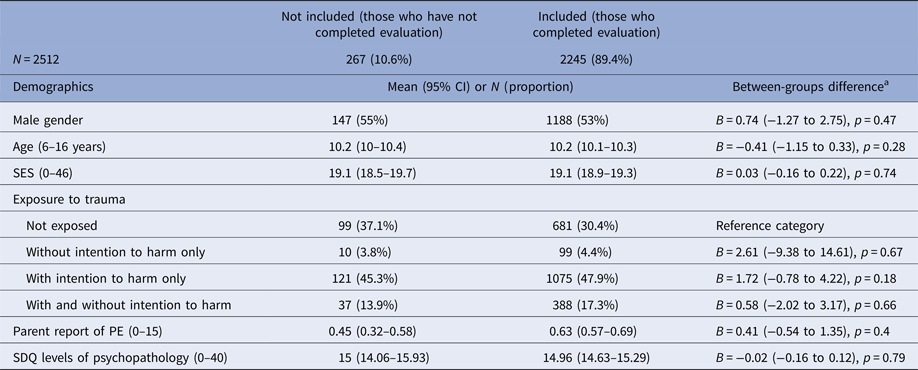
In 2245 children (89%), both household parental interview and school-based psychological evaluation were obtained. The 267 participants who did not complete the psychological evaluation and were consequently excluded did not significantly differ from those who were included with respect to demographic variables (Table 1).
Comparison between those who completed and who did not complete the study

a Modelled according to sample structure: multilevel logistic regression models, cross-level structure with schools and clinicians as levels and state as a confounder.
Demographic and clinical characteristics of children by trauma exposure
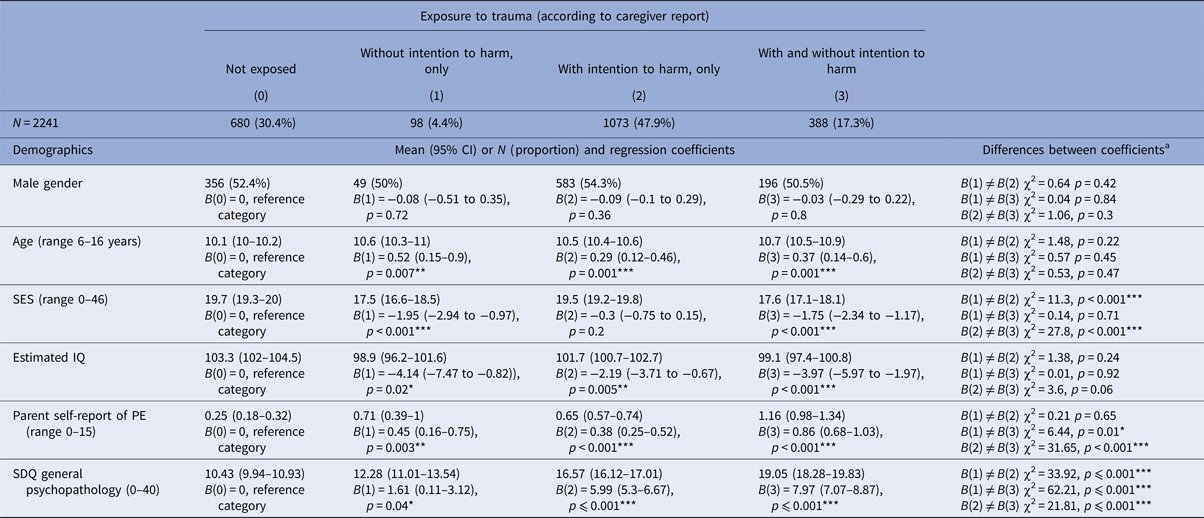
Children not exposed to any trauma type were significantly younger, had higher IQs and had lower scores of parental PE than children in the three other categories of trauma exposure (Table 2). SES levels were different across the different strata of TLE. Children exposed to TLE both with and without intention to harm had parents with significantly higher PE scores than children exposed exclusively to one type of trauma. The four groups of trauma exposure were not significantly different with respect to sex. When compared to children not exposed, all categories of TLE were significantly associated with increased levels of psychopathology. Children exposed to TLE with and without intention to harm had significantly higher scores of psychopathology than children exposed to TLE with or without intention to harm only, and children exposed to TLE with intention to harm had higher scores than children exposed only to TLE without intention to harm.
Demographic and clinical characteristics of the sample according to trauma exposure

a Modelled according to sample structure: multilevel, mixed effect linear or logistic regression models, cross-level structure with schools and clinicians as levels and state as a confounder.
*p value ⩽ 0.05; **p value ⩽ 0.01; ***p value ⩽ 0.001.
Association between types of trauma and PE
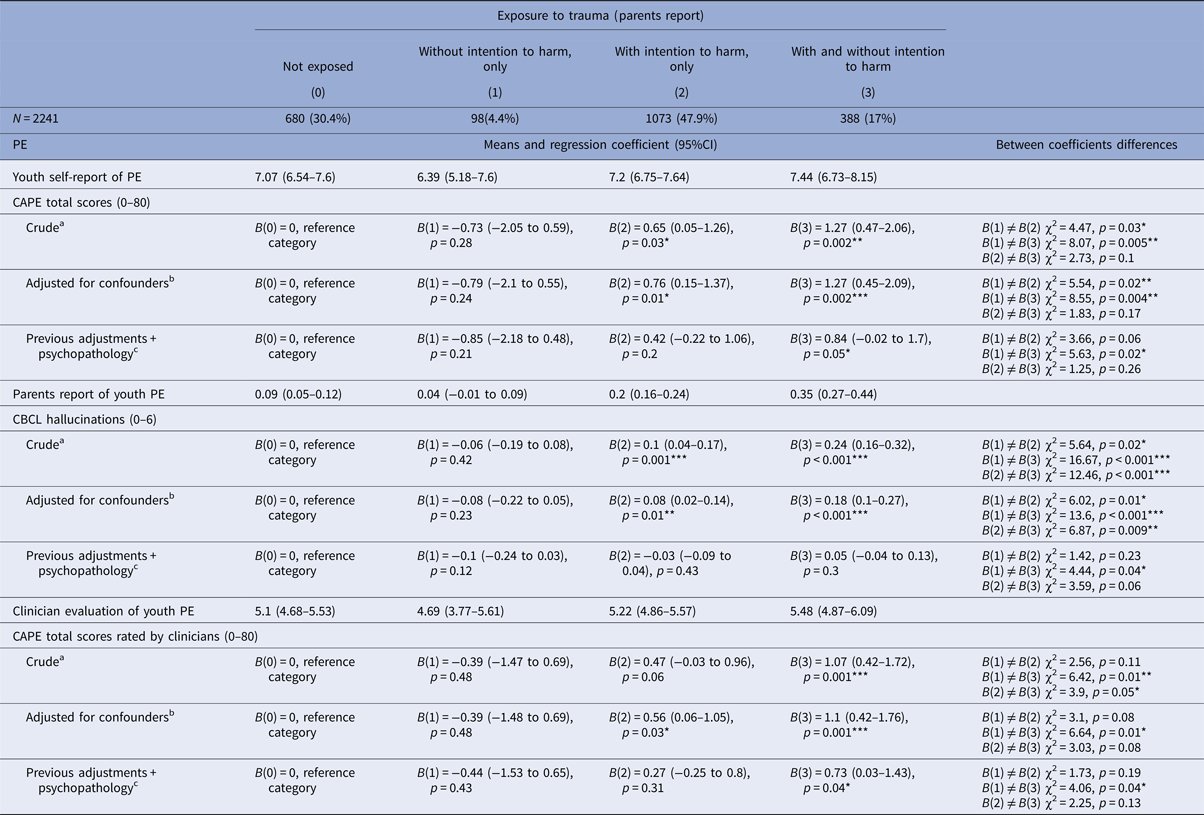
There was no significant association between TLE without intention to harm only and PE, and these results were consistent across different assessment methods (parents, children and clinicians; Table 3). On the other hand, there was a positive association between TLE with intention to harm and with and without intention to harm and PE, after controlling for confounders. After adjustment for overall psychopathology, only the association of TLE with and without intention to harm remained significantly associated with self-reported PE [B = 0.86, 95% confidence interval (CI) 0–1.72] and clinician's rated PE (B = 0.75, 95% CI 0.05–1.45), all other regression coefficients were non-significant.
Association between traumatic life events (TLE) and psychotic experiences (PE) obtained from multiple informants

a Modelled according to sample structure: multilevel logistic regression models, cross-level structure with schools and clinicians as levels and city as an independent variable.
b Previous model adjusted for possible confounders: age, gender, IQ, SES, caregiver report of psychotic experiences.
c Previous model adjusted for overall psychopathology (SDQ).
Significance of difference between crude β coefficients was obtained from postestimation Wald tests of linear hypotheses.
*p value ⩽ 0.05; **p value ⩽ 0.01; ***p value ⩽ 0.001.
Dose of exposure to traumatic events in the three trauma categories
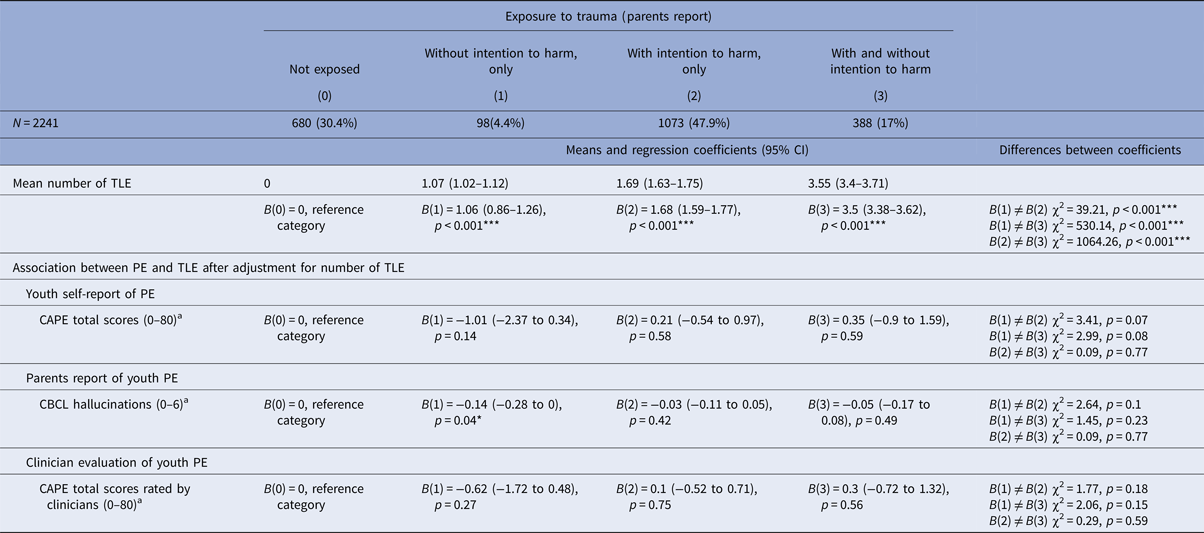
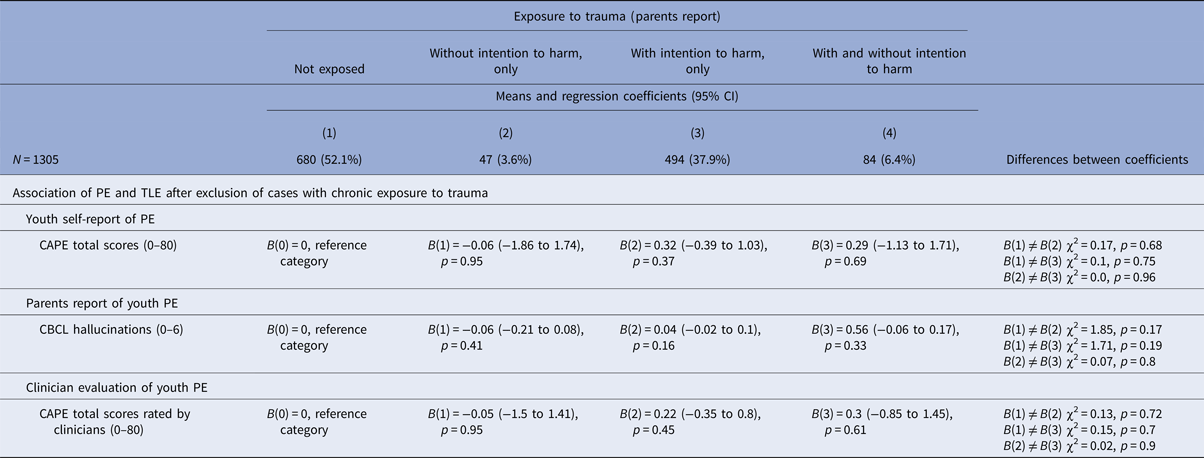
The mean number of TLE differed significantly between the three groups of trauma exposure (Table 4); children exposed only to TLE with intention to harm had significantly more TLE than children exposed only to TLE without intention to harm. As expected, children exposed to TLE both with and without intention to harm in turn had been exposed to more traumatic events than the other two groups. Adjustments of the models for the number of TLE resulted in a non-significant coefficient for the association of all categories of trauma and PE, with the exception of a significant negative association between parental report of their child's PE and exposure to TLE without intention to harm. When cases with chronic exposure to trauma were excluded, no significant association between type of trauma and PE was found (Table 5).
Mean number of traumatic life events (TLE) per group of exposure to trauma and association between TLE and psychotic experiences (PE) after adjustment for number of TLE

a Modelled according to sample structure: multilevel logistic regression models, cross-level structure with schools and clinicians as levels and city as an independent variable.
Significance of difference between crude β coefficients was obtained from postestimation Wald tests of linear hypotheses.
*p value ⩽ 0.05; **p value ⩽ 0.01; ***p value ⩽ 0.001.
Association of traumatic life events (TLE) and psychotic experiences (PE) after exclusion of children chronically exposed to trauma

Significance of difference between crude β coefficients was obtained from postestimation Wald tests of linear hypotheses.
Modelled according to sample structure: multilevel logistic regression models, cross-level structure with schools and clinicians as levels and city as an independent variable.
*p value ⩽ 0.05; **p value ⩽ 0.01; ***p value ⩽ 0.001.
Discussion
The association between different types of TLE and PE was investigated in a large non-clinical sample of 2245 school-based children and adolescents, including multiple sources of assessment of PE. In sum, while the present data did show an association between TLE with intention to harm and PE, this association was absent in TLE without intention to harm. Adjustments for individual characteristics that could confound this association, namely age, sex, IQ, SES and family liability for psychosis, did not significantly change the results. However, when frequency of exposure was taken into account, the association of PE and TLE was no longer significant. Our results are in line with a previous study reporting increased levels of PE among children exposed to TLE with intention to harm (Arseneault et al. Reference Arseneault, Cannon, Fisher, Polanczyk, Moffitt and Caspi2011; van Nierop et al. Reference van Nierop, Lataster, Smeets, Gunther, van Zelst and de Graaf2014a). Nevertheless, this study extends previous knowledge by showing that this association can, at least in part, be attributed to a higher dose of exposure to trauma among those that experience TLE with intention to harm. Our findings reinforce the idea of a possible link between social stress and PE, nevertheless we cannot exclude the possibility that dose of exposure to trauma may be more important than type of trauma in the association with PE, thus it highlights the importance of understanding social stress under the perspective of stress itself, when examining effects on psychosis risk.
Addressing confounders in the association of PE and TLE
The information of which background characteristics would predispose to trauma with and without intention to harm is of relevance because if risk factors for PE differentially predispose to trauma with or without intention to harm, such variables can confound the association between types of trauma and PE. In our sample, we found small differences between children exposed and not exposed to TLE, but adjustment for demographic confounders did not significantly change the direction of results, showing that the association between TLE with intention to harm and PE did not result from confounding effects.
Parental PE
The fact that parental PE was associated with TLE in the children is noteworthy and can be explained by different mechanisms. The first possibility is reporting bias. Parents with higher scores of PE may misreport their children's exposure to TLE, and consequently the reported association can be a result from the misreport of TLE by parents with PE. Another possibility is gene–environment correlation. This is the case when genetic influences control the likelihood of exposure to an environmental factor like trauma. Thus, children with psychosis liability can induce reactions from the environment that subsequently are reported as traumatic. Alternatively, parents with PE can create a home environment that predisposes children to TLE. Finally, behavioural characteristics related to PE and other behavioural traits that tend to co-occur with PE, like being socially withdrawn and displaying antisocial behaviours (Polanczyk et al. Reference Polanczyk, Moffitt, Arseneault, Cannon, Ambler and Keefe2010), can influence the selection of environment increasing the likelihood of TLE exposure. Although we found that children exposed to TLE had parents with higher PE scores, parental PE did not differ across children exposed to trauma with or without intention to harm and adjustment for scores of parental PE did not significantly change the results. Thus, the association between childhood trauma with and without intention to harm, on the one hand, and PE, on the other, are independent of parents’ PE score. In conclusion, independently of the mechanisms linking TLE and parental PE, it does not influence the main finding of this analysis.
General psychopathology
Childhood maltreatment increases the risk of a number of mental health problems, like depression, anxiety, substance misuse, eating disorder, personality disorder and suicide attempts, (Norman et al. Reference Norman, Byambaa, De, Butchart, Scott and Vos2012). Therefore, it is relevant to probe whether TLE with intention to harm has a specific association with PE or whether such experiences emerge as part of a broader effect of these events on mental health. A meta-analysis showed that childhood adversity increases the risk of schizophrenia compared to controls and anxiety disorders, but not to other mental health problems like depression and personality disorders (Matheson et al. Reference Matheson, Shepherd, Pinchbeck, Laurens and Carr2013). Some authors found the association between victimization and children's PE to be independent of overall levels of psychopathology (Kelleher et al. Reference Kelleher, Harley, Lynch, Arseneault, Fitzpatrick and Cannon2008; Arseneault et al. Reference Arseneault, Cannon, Fisher, Polanczyk, Moffitt and Caspi2011). In the present study, the adjustment for general psychopathology explained a substantial part of the association between TLE with intention to harm and PE. Previous studies used mediation analysis and identified various mediators in the association between TLE and PE: neuroticism (Barrigon et al. Reference Barrigon, Diaz, Gurpegui, Ferrin, Salcedo and Moreno-Granados2015), high levels of anxiety and depression (Mackie et al. Reference Mackie, Castellanos-Ryan and Conrod2011; Fisher et al. Reference Fisher, Schreier, Zammit, Maughan, Munafo and Lewis2013), substance misuse (Harley et al. Reference Harley, Kelleher, Clarke, Lynch, Arseneault and Connor2010; Mackie et al. Reference Mackie, Castellanos-Ryan and Conrod2011; Barrigon et al. Reference Barrigon, Diaz, Gurpegui, Ferrin, Salcedo and Moreno-Granados2015) and certain characteristics related to social defeat (van Nierop et al. Reference van Nierop, van Os, Gunther, van Zelst, de Graaf and ten Have2014b). Indeed, Guloksuz & colleagues (Reference Guloksuz, van Nierop, Lieb, van Winkel, Wittchen and van Os2015) recently provided evidence that the presence of PE in non-psychotic disorders is environment-dependent and mediated by severity of non-psychotic psychopathology. Thus, environmental factors may increase the likelihood of PE through an increase in general psychopathology (van Os & Guloksuz, Reference van Os and Guloksuz2017). These findings are compatible with a relational model of psychopathology in which more severe clinical states are the result of environment-induced disturbances spreading through a psychopathology network, PE arising as psychopathology becomes more severe (Guloksuz et al. Reference Guloksuz, van Nierop, Lieb, van Winkel, Wittchen and van Os2015; Isvoranu et al. Reference Isvoranu, Borsboom, Van Os and Guloksuz2016).
Dose of exposure to TLE
Trauma is suggested to have a cumulative effect on mental health and, consequently, frequency of exposure and number of traumatic events may be more important in determining mental health outcome than the type of trauma (Suliman et al. Reference Suliman, Mkabile, Fincham, Ahmed, Stein and Seedat2009; Ribeiro et al. Reference Ribeiro, de Jesus Mari, Quintana, Dewey, Evans-Lacko and Vilete2013). Childhood adversities tend to be inter-related (Dong et al. Reference Dong, Anda, Felitti, Dube, Williamson and Thompson2004) and this is particularly true for traumatic events with intention to harm, as a large proportion of youth exposed to maltreatment are the victims of four or more types of aggression (Finkelhor et al. Reference Finkelhor, Ormrod and Turner2007; Turner et al. Reference Turner, Finkelhor and Ormrod2010). For most mental health outcomes, poly-victimization explains a large part of the associations between victimization and the severity of symptoms (Turner et al. Reference Turner, Finkelhor and Ormrod2010). Frequency of exposure to childhood victimization was shown to increase PE or risk for psychosis (Lataster et al. Reference Lataster, van Os, Drukker, Henquet, Feron and Gunther2006; Schreier et al. Reference Schreier, Wolke, Thomas, Horwood, Hollis and Gunnell2009) as well as the combined occurrence of different traumatic events (Arseneault et al. Reference Arseneault, Cannon, Fisher, Polanczyk, Moffitt and Caspi2011). Our data are in agreement with the above-mentioned studies and reinforces the importance of poly-victimization as a risk factor for PE.
Limitations
The present study has many strengths, including: (1) large sample size; (2) use of school-based children rather than a clinical population; (3) multiple sources of assessment of PE; (4) the evaluation of informants’ mental health; (5) adjustment for multiple confounders. However, some limitations are also apparent.
First, although three different types of assessment of PE were available, it should be highlighted that the procedure for the assessment of PE in children and adolescents is not standardized and there is insufficient data showing the validity of CAPE self-ratings for young children (Lee et al. Reference Lee, Chan, Chang, Lee, Hui and Chen2016). Furthermore psychologists’ ratings relied exclusively on children's report, which likely contributed to the correlation between child and psychologist scores. There is the possibility that some children who did not report PE would have been considered PE-positive if psychologists had interviewed the parents (false negatives).
Second, we used parents as the main source of information about TLE, nevertheless having parents as a source of report of domestic violence may be problematic. It is hard to decide which source of information is more reliable for the assessment of TLE when studying its association with PE. While parents were expected to under-report their own abusive behaviours, leading to type 2 error, children presenting PE could be more likely to misreport maltreatment but not accidents, leading to type 1 error. To assess whether or not the source of information about domestic violence would interfere in the association of TLE and PE, for one question investigating verbal abuse and the another investigating physical abuse, both parents and children were interviewed separately, using exactly the same question. We found that physical and verbal abuse reported by the parents but not by the children were not significantly associated with any of the measurements of PE. On the other hand, physical and verbal abuse reported by the children but not by the parents was significantly associated with self-reported PE and clinically rated PE, but not with parent reports of PE. When both children and their parents confirmed abuse, all measures of PE were positively associated with TLE (for detailed results check online Supplementary Tables S3 and S4). Taking together, these findings suggest that a stronger association between PE and TLE with intention to harm could have been found if we had used child instead of parent reports of TLE. Nevertheless it does not invalidate our findings, since it is not expected to interfere with the direction of results.
Third, although lifetime TLE were assessed, only current levels of PE were measured. As PE vary over time (Bartels-Velthuis et al. Reference Bartels-Velthuis, van de Willige, Jenner, van Os and Wiersma2011), it is possible that we may have analysed some children with transitory PE after trauma exposure in the past as not having PE. Additionally, there was a time lag between parent interview (when exposure to TLE was collected) and child evaluation (when self-report and clinician ratings of PE were collected). Consequently, the association between PE and TLE may be stronger than reported in the present study.
Fourth, it should be highlighted that the number of individuals in the group without intention to harm only was relatively small (N = 99). Although regression coefficients were not statistically significant, for all three measurements of PE, the association was negative and very close to zero and, consequently, the lack of association between TLE and PE in this group is unlikely to result from a type II error.
Fifth, although we found a positive association between TLE with intention to harm and PE, no inference of causality can be drawn from the results due to the cross-sectional nature of the study. A previous cohort study showed that childhood trauma preceded the onset of newly incident PE (Kelleher et al. Reference Kelleher, Keeley, Corcoran, Ramsay, Wasserman and Carli2013). Furthermore, a previous study showed that social defeat is likely to mediate the association of childhood trauma and PE (van Nierop et al. Reference van Nierop, van Os, Gunther, van Zelst, de Graaf and ten Have2014b).
Sixth, it is important to mention that some of our linear models did not meet assumptions for linear regression due to heteroscedasticity. To certify that our results were valid, we performed permutations. For almost all results, p values obtained from 1000 permutations were very similar to the results presented here and these sensitivity analyses do not significantly impact the main findings from this paper.
Finally, although we studied a large sample size, participant schools were selected by convenience, consequently our sample may not be fully representative.
Final considerations
The findings confirmed results from previous work that showed a positive association between TLE with intention to harm and PE. In addition, we extended previous knowledge by showing that dose of exposure can be more important than type of trauma as a risk factor for PE. In addition, we showed that this association is not a spurious result of demographic confounders and is unlikely to result from reporting bias or gene–environment correlation. Thus, we may tentatively conclude that adolescent PE can be exacerbated by frequent exposure to traumatic events. Interrupting the cycle of re-exposure to trauma can potentially prevent the emergence of PE and associated mental disorders.
Supplementary material
The supplementary material for this article can be found at https://doi.org/10.1017/S0033291717003762.
Acknowledgements
This work is supported by the National Institute of Developmental Psychiatry for Children and Adolescents, a science and technology institute funded by Conselho Nacional de Desenvolvimento Científico e Tecnológico (CNPq; National Council for Scientific and Technological Development; grant number 573 974/2008-0) and Fundação de Amparo à Pesquisa do Estado de São Paulo (FAPESP; Research Support Foundation of the State of São Paulo; grant number 2008/57896-8). It was also supported in part by the European Community's Seventh Framework Program (grant agreement No. HEALTH-F2-2009-241909, Project EU-GEI). The author's scholarships are supported by the following Brazilian government institutions: CNPq, FAPESP, Coordenação de Aperfeiçoamento de Pessoal de Nível Superior (CAPES; Brazilian Federal Agency for Support and Evaluation of postgraduate education) and Fundação de Amparo a Pesquisa do Estado do Rio Grande do Sul (FAPERGS; Research Support Foundation from the State of Rio Grande do Sul). Tais S. Moriyama received a sandwich scholarship from CAPES (process number 10553/12-6) and a PhD scholarship from CAPES; Ary Gadelha received a CAPES PhD scholarship; Pedro M. Pan received a CNPq/CAPES master's degree scholarship; Giovanni A. Salum received a CAPES/FAPERGS post-doctoral scholarship; Gisele G. Manfro, Jair J. Mari, Eurípedes C. Miguel (302463/2011-9), Luis A. Rohde, Guilherme V. Polanczyk (311135/2011-0) and Rodrigo A. Bressan are in receipt of a senior research CNPq scholarship.