Projectile points made of chipped stone or bone are one of the most commonly preserved artifacts at archaeological sites worldwide. They are also the only element that remain from the complex compound weapon-delivery system for which they were hafted (Christenson Reference Christenson1986; Gramsch Reference Gramsch2000; Hughes Reference Hughes1998; Knecht Reference Knecht1997; Langley Reference Langley2016; Petillon Reference Petillon2006). Systematic excavations carried out on Late period archaeological sites in Sierras de Córdoba, Argentina (around 1220–330 cal BP), showed that arrow points constitute one of the most numerous tools generated by people with a mixed foraging and cultivation economy who inhabited this neighboring Andes low-altitude mountain range (see Medina et al. Reference Medina, Pastor and Recalde2016; Pastor et al. Reference Pastor, Medina, Recalde, López and Berberián2012). Bone arrow points were well preserved and represent more than 10% of the projectile points recovered from these archaeological sites, exhibiting a wide range of morphological and size diversity and likely performing different functional tasks (Berberián Reference Berberián1984; González Reference González1943a; Marcellino et al. Reference Marcellino, Berberián and Pérez1967; Medina and Balena Reference Medina, Balena, Belardi, Bozzuto, Fernández, Moreno and Neme2021; Medina et al. Reference Medina, Buc and Pastor2014; Outes Reference Outes1911; Rivero et al. Reference Rivero, Balena, Costantino, Lallami, Álvarez, Medina, Pastor and Sario2024; Serrano Reference Serrano1945). Since the first bone arrowheads were reported by Weyenbergh (Reference Weyenbergh1880) and Ameghino (Reference Florentino1885), it has been argued that the diversity of bone arrow points was crucial for shooting small to large game at different distances and land cover.
However, their diversity has never been studied in depth, given the priority of archaeology in answering chronological questions based on the temporal analysis of artifact typologies (Pastor et al. Reference Pastor, Rivero and Pautassi2005; Pauttassi and Rivero Reference Pauttassi and Rivero1999; Rivero and Recalde Reference Rivero, Recalde, Martínez and Bozzuto2011; Rivero et al. Reference Rivero, Balena, Costantino, Lallami, Álvarez, Medina, Pastor and Sario2024). In a move away from bone arrow points’ study as a chronological marker, recent studies claimed that bone arrow points were part of a specialized mechanism system designed to kill or wound enemies (Medina and Balena Reference Medina, Balena, Belardi, Bozzuto, Fernández, Moreno and Neme2021; Medina et al. Reference Medina, Lallami and Pastor2024): this helped unsettle the romantic premise that people in the Late Holocene were inherently peaceful. Except for these isolated studies, little attention has been paid to the functional characteristics of bone projectile technology and the role that performance plays in morphological variation, a topic that needs further research in Sierras de Córdoba and neighboring regions where similar bone points were found (Arias et al. Reference Arias, Mariana and Korstanje2023; Buc Reference Buc2012; Cabral Reference Cabral2018; Cena Di Mateo et al. Reference Di Matteo, Malena, Morey and Aizpitarte2018; Couso et al. Reference Couso, Moralejo, Giovannetti, del Papa, Páez, Gianelli, Giambelluca, Arnosio and Raffino2011; Fabra et al. Reference Fabra, González and Robin2015; Hernández Llosas Reference Hernández Llosas2006; Medina and Balena Reference Medina, Balena, Belardi, Bozzuto, Fernández, Moreno and Neme2021; Medina and Pastor Reference Medina and Pastor2021; Medina et al. Reference Medina, Balena and Rivero2019, Reference Medina, Sario and Pastor2022; Mendonça et al. Reference Mendonça, Bordach and Grosso2003; Messineo et al. Reference Messineo, Álvarez, Dubois, Steffan and José Colantonio2013; Moreno and Revuelta Reference Moreno and Revuelta2010; Pastor et al. Reference Pastor, Rivero and Pautassi2005; Pauttassi and Rivero Reference Pauttassi and Rivero1999; Reichlen Reference Reichlen1940; Rivero and Recalde Reference Rivero, Recalde, Martínez and Bozzuto2011; Rusconi Reference Rusconi1933).
To improve our understanding of the Late period weaponry system, this article presents a techno-typological analysis of a large bone arrow point assemblage recovered at different sites in the Sierras de Córdoba. It also considers implications of the various alternatives presented and suggests critical areas for future research. Bone spears or dart heads were analyzed by Medina and others (Reference Medina, Sario and Pastor2022) and are not considered here. We define bone arrow points as pointed tools made from long bones that are suitable for hafting to a shaft of no more than 10 mm in diameter, which corresponds to the size of archaeological and ethnographic arrow shafts (Charlin et al. Reference Charlin, Augustat and Urban2016; Christenson Reference Christenson1986; Gramsch Reference Gramsch2000; Grayson et al. Reference Grayson, French and O’Brien2007; Odar Reference Odar2011; Petillon et al. Reference Jean-Marc, Bignon, Bodu, Cattelain, Debout, Langlais, Laroulandie, Plisson and Valentin2011; Ratto Reference Petillon Ratto1991, Reference Ratto2003; Rousselot and Grahammer Reference Rousselot and Veronika2004; Thomas Reference Thomas1978; Verhart Reference Verhart2000; Weniger Reference Weniger1992; Zhilin Reference Zhilin2015). We assume that the points’ design was a result of a process in which the most appropriate alternatives were selected to provide a solution to an identified problem and that their particular characteristics help infer some aspects of the weapon system from which the points came and may be related to the projectile’s accuracy, flight stability, range, and killing power (Bleed Reference Bleed1986; Christenson Reference Christenson1986; Loendorf et al. Reference Loendorf, Plumlee and Tiedens2017). Penetration of the target is not the only performance standard for projectile points, especially given the studies of Ikäheimo and colleagues (Reference Ikäheimo, Joona and Hietala2006) and Petillon and coworkers (Reference Jean-Marc, Bignon, Bodu, Cattelain, Debout, Langlais, Laroulandie, Plisson and Valentin2011) suggesting that bone arrow points have excellent performance characteristics for inflicting deep wounds, destroying essential organs, and causing a severe loss of blood.Footnote 1 Other variables that are more difficult to address through experimentation, including stopping power (the “shock” power), hemorrhage size (the capability to produce broad, bleeding wounds), and the retention capacity (the ability to support a deeper penetration), need to be considered when discussing the ability of the weapon to bring down the target (Hughes Reference Hughes1998; Petillon et al. Reference Jean-Marc, Bignon, Bodu, Cattelain, Debout, Langlais, Laroulandie, Plisson and Valentin2011; Tomka Reference Tomka2013; Weniger Reference Weniger1992; Zhilin Reference Zhilin2015).
We argue that bone-tipped projectiles have a higher knockdown power at close range and a remarkable ability to create serious bleeding wounds than smaller chipped-stone arrow points that dominate Late period assemblages. We also claim that bone-tipped projectiles were designed to be used in warfare or occasionally to finish off prey previously wounded by light stone-tipped arrows. Thus, the average bone points’ hafting area and cross-sectional perimeter are anticipated to be greater than the average values of stone arrow points. Further, those bone points were used predominantly against people and not for hunting, as shown by human skeletal remains with wounds related to bone-tipped arrows as the cause of death. Our findings will enhance our understanding of the sophisticated set of weapons used for hunting or warfare by groups organized as seasonal or occasional food producers who moved around the mountain landscape to take advantage of domestic and wild resources.
Materials and Methods
The 83 bone projectile points selected for the analysis were considered arrow points based on the correspondence between the size of the hafting area and the diameter of the shaft (Charlin et al. Reference Charlin, Augustat and Urban2016; Christenson Reference Christenson1986; Gramsch Reference Gramsch2000; Marsh et al. Reference Marsh, Llano, Cortegoso, Castro and Yebra2023; Odar Reference Odar2011; Petillon et al. Reference Jean-Marc, Bignon, Bodu, Cattelain, Debout, Langlais, Laroulandie, Plisson and Valentin2011; Ratto Reference Petillon Ratto1991, Reference Ratto2003; Thomas Reference Thomas1978; Verhart Reference Verhart2000; Weniger Reference Weniger1992; Zhilin Reference Zhilin2015). The defining criterion for arrow points is the thickness of the arrow’s wooden shaft: the most suitable thickness is no more than 1 cm (Odar Reference Odar2011). Archers worldwide came to this finding through centuries of experience using metal, bone, wood, and stone-tipped arrows (Grayson et al. Reference Grayson, French and O’Brien2007). The hafting area of arrowhead bases or stems was considered to be no more than 10 mm wide, as suggested by Zhilin (Reference Zhilin2015) and supported by the research of Gramsch (Reference Gramsch2000), Odar (Reference Odar2011), Verhart (Reference Verhart2000), and Weniger (Reference Weniger1992). For stemmed projectile points, the neck width was expected to be the same size or slightly larger than the shaft (Christenson Reference Christenson1986; Snarey and Ellis Reference Snarey and Ellis2010). The discriminant analysis proposed by Shott (Reference Shott1997), based on the shoulder width or maximum width of stone points, was only used for arrow assignation in the three bone pieces with concave bases for hafting, until a more specific method for bone arrow points can be found. Following the threshold approach by Flores-Blanco and colleagues (Reference Flores-Blanco, Cuellar, Aldenderfer, Stanish and Haas2024) and Kitchel and others (Reference Kitchel, Aldenderfer and Haas2022), these unstemmed arrow points were also expected to have a width less than 18 mm, a threshold established for stone arrow points from Andean South America. The study only considered complete or nearly complete bone projectile points.
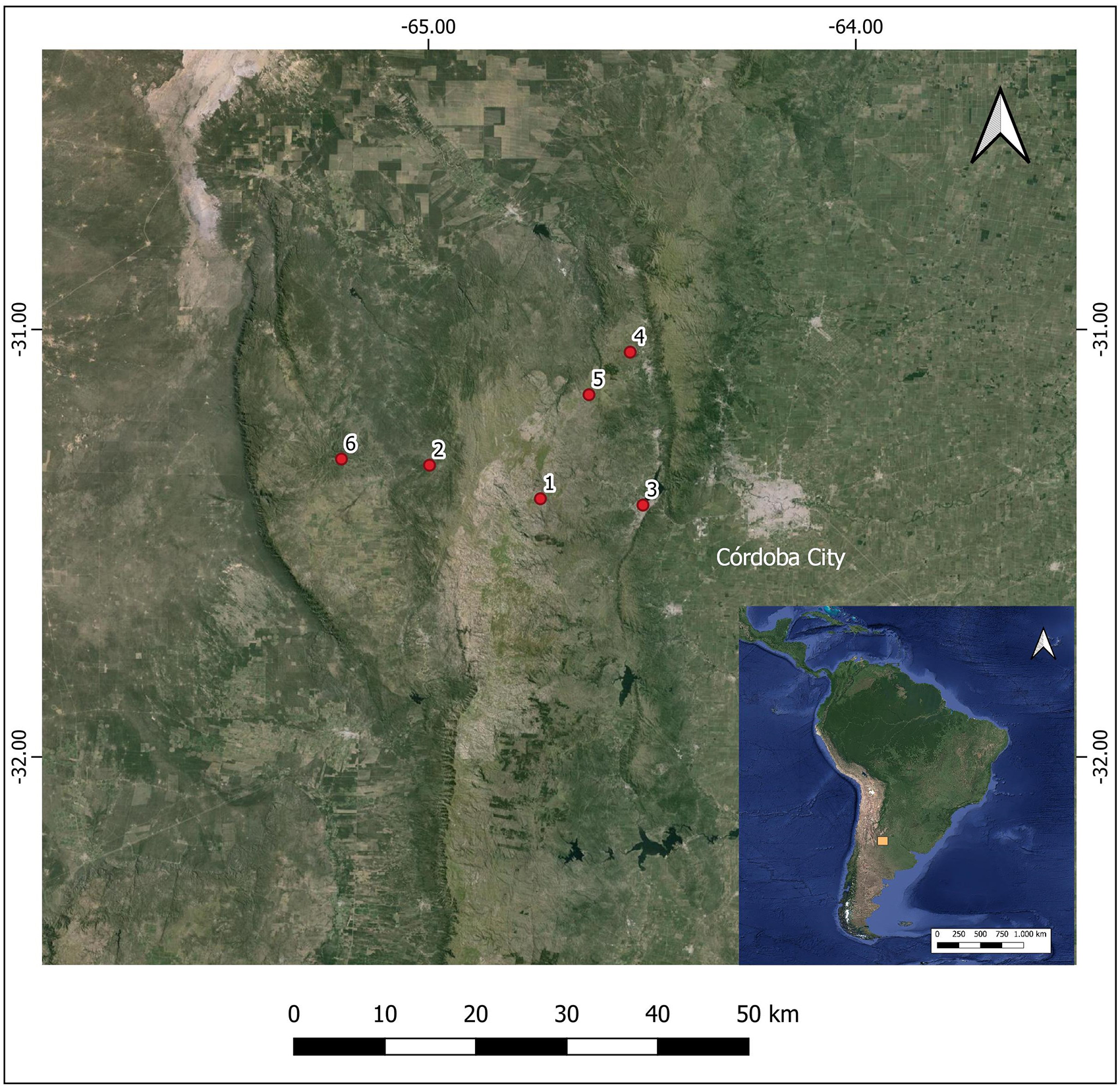
Sixty-seven arrow points come from surface sites located in southern Punilla Valley (Figure 1). The collection is curated at the Museo Arqueológico Numba Charava (Villa Carlos Paz, Argentina). Although the arrow points had imprecise stratigraphic associations, all were assigned to the Late period based on their similarity with those published or recovered in the well-dated sites that were included in the study (Berberián Reference Berberián1984; Medina and Balena Reference Medina, Balena, Belardi, Bozzuto, Fernández, Moreno and Neme2021; Medina et al. Reference Medina, Buc and Pastor2014; Sario et al. Reference Sario, Traktman and Costantino2024). Given that bone arrow points are commonly listed as minor findings in excavation reports compared to chipped-stone arrow points, this large assemblage represents one of the most significant assemblages available for the Late period, providing valuable data for technological analysis. One arrow point was found embedded in the T-11 dorsal vertebra and six in the rib cage of the Burial 1 of El Alto 5 (Pampa de Achala, Córdoba) dated directly on human bone from around 550 cal BP (see Díaz et al. Reference Díaz, Barrientos, Pastor and Salazar2015; Medina et al. Reference Medina, Lallami and Pastor2024).
Geographic locations of the archaeological sites referred to in the text. Key: (1) El Alto 5; (2) Boyo Paso 2; (3) Southern Punilla Valley; (4) C.Pun.39; (5) Puesto La Esquina 1; and (6) Arroyo Talainín 2. (Color online)

Bone points—and points in general—embedded or in close association with human remains are scarce within the Late period contexts of Sierras de Córdoba. The assemblage from El Alto 5 provides direct evidence of the weapon system used to kill enemies, which can be used to identify violence in sites where arrow points were not associated with human skeletal remains (see Medina et al. Reference Medina, Lallami and Pastor2024). The other pieces were found in the open-air sites C.Pun.39 (∼720–520 cal BP), Puesto La Esquina 1 (∼390 cal BP), and the rockshelter Arroyo Talainín 2 (∼840–640 cal BP), stratigraphically associated with a dense concentration of pottery, faunal remains, lithic debris, and scattered wood charcoal.Footnote 2 The bone arrow points recovered in those sites were initially reported by Medina and coworkers (Reference Medina, Buc and Pastor2014), Medina and Balena (Reference Medina, Balena, Belardi, Bozzuto, Fernández, Moreno and Neme2021), Medina and colleagues (Reference Medina, Lallami and Pastor2024), and Díaz and coauthors (Reference Díaz, Barrientos, Pastor and Salazar2015), but they were never studied from the perspective of a whole worked bone assemblage. We did not analyze fragments of blades or stems, even those that were identified in the collection and the sites excavated by the authors.
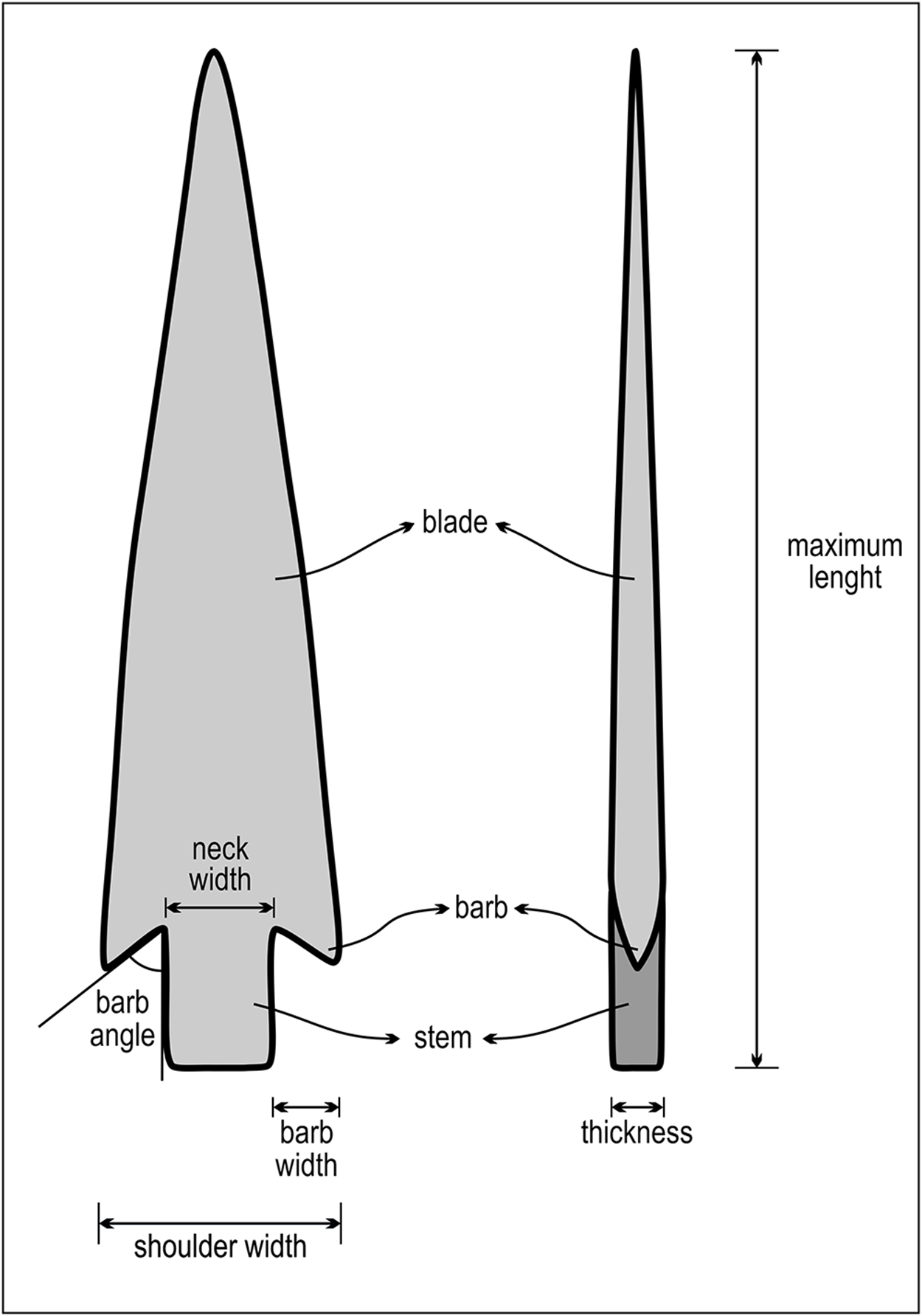
The bones used to make the tools were identified anatomically and taxonomically using modern reference collections collected by the authors and found in atlases. Taxonomic keys published by Pacheco Torres and coauthors (Reference Pacheco Torres, Altamirano and Porras1979) and Sierpe (Reference Sierpe2015) were crucial for camelids’ bone identification. Pieces were examined with a 10–20× hand lens to determine the manufacturing techniques used to produce bone points and the damage resulting from postdepositional processes, although these techniques and damage were not the focus of the article and require further research (Buc Reference Buc2012; Christensen Reference Christensen2016; Orłowska Reference Orłowska and Vitezović2016; Zhilin Reference Zhilin2015). We documented evidence of decoration, mastic, and other residues. Basic point shapes and features, as well as metric attributes (weight, length, neck width, blade width, thickness, the angle of barbs, and so on; Figure 2), were evaluated using the protocol described for projectile point technology (Buc Reference Buc2012; Julien Reference Julien1982; Langley Reference Langley2018; Loendorf and Rice Reference Loendorf and Rice2004; Petillon Reference Petillon2006). Then, arrow points were classified into typological groups or subgroups to assess their hafting method, morphological variability, and specific function (how effective the weaponry works for certain tasks). Basic point shape, the presence of barbs, and the morphology of the hafting area were considered during this analysis and provided a good summary of the data. Because the length of the projectile affects the mass and thereby the penetration of the projectile into the target (see Buchanan and Hamilton Reference Buchanan and Hamilton2021), arrow points were divided into three categories: short (<40 mm), medium (41–80 mm), and long (>80 mm) following Vinayak (Reference Vinayak, Wild, Thurber, Rhodes and St-Pierre2021:20).Footnote 3
Metric attributes of bone projectile points.

Differences in arrow shaft diameters were related to the range of distances from the target to which the projectiles would be aimed (see Christenson Reference Christenson1986). Smaller arrow shaft diameters were designed to travel long distances with a flattened trajectory (Christenson Reference Christenson1986; Hughes Reference Hughes1998). Conversely, larger-diameter arrow shafts were used when archers wanted to achieve a high-impact force at a relatively close range (see also Witthoft Reference Witthoft1968). The proxy data of shaft diameter and gross weight were used to roughly assess the mass and velocity of the bone-tipped projectiles (Tomka Reference Tomka2013), in comparison to those tipped with the tiny lithic arrow points that dominated Late period assemblages. Those tiny points are only included here to provide a frame of reference for the ensuing discussion. Descriptive statistics and Mann-Whitney tests were used for these comparisons. The differential capability for bone and chipped-stone arrow point tissue damage was also compared using the blade tips’ cross-sectional perimeter (TCSP), based on the assumption that those arrow points with higher TCSP values possess a higher potential for tissue damage, independently of the sharpness of their flaked or abraded edges (Hughes Reference Hughes1998; Sisk and Shea Reference Sisk and Shea2009). The TCSP came from ballistics and was calculated from the maximum width and thickness of the projectile point blade (TCSP = 4 × √[width/2]2 + [thickness/2]2; Hughes Reference Hughes1998; Sisk and Shea Reference Sisk and Shea2009).
The metric attributes of lithic arrow points were taken from triangular-shaped blades, contracted stems, and barbed-shoulders stone projectile points nonsystematically collected from the southern Punilla Valley (N = 272) and southern Traslasierra Valley (N = 43); these points are curated at the Museo Arqueológico Numba Charava (Villa Carlos Paz, Córdoba) and Museo Comechingón (Mina Clavero, Córdoba), respectively (Supplementary Figure 1; Supplementary Table 1).Footnote 4 Moreover, the angles and the width of barbs were used to assess the capacity of bone points to resist removal from the wound (Julien Reference Julien1982:30). Shoulders were considered barbed when the angles were less than 90°: it was assumed that when the angle decreases, the capacity of the barb to resist removal increases. The correlation between neck width and barb angle was checked using Pearson´s correlation coefficient. It was expected that thicker neck widths would tend to have a more acute angle, adding a high-retention capacity to their knockdown power. Finally, the system of hafting was inferred by the morphology of the proximal end, ethnographic technologies, and additional technological elements associated as serrated edges or traces of glue preserved at stems (Weniger Reference Weniger1992).
Results
Significant modifications during manufacturing made the anatomical and taxonomical identification of the bones used to shape the projectile points difficult. The identification of element-diagnostic features of Lama sp. metapodials indicates that this skeletal part of camelids was specially selected for point manufacturing because of its long, straight shape (Supplementary Tables 2 and 3; Figure 3a).
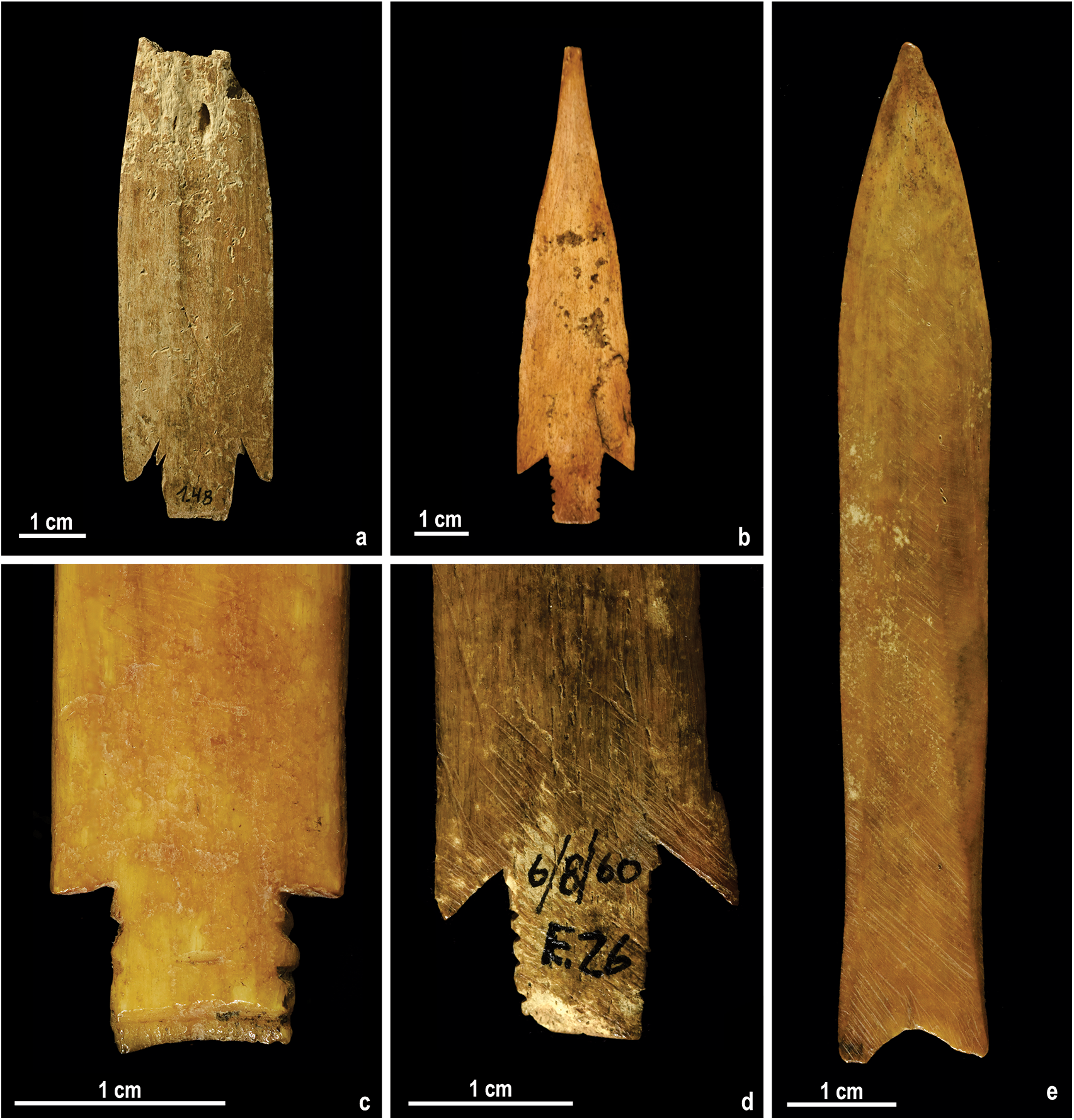
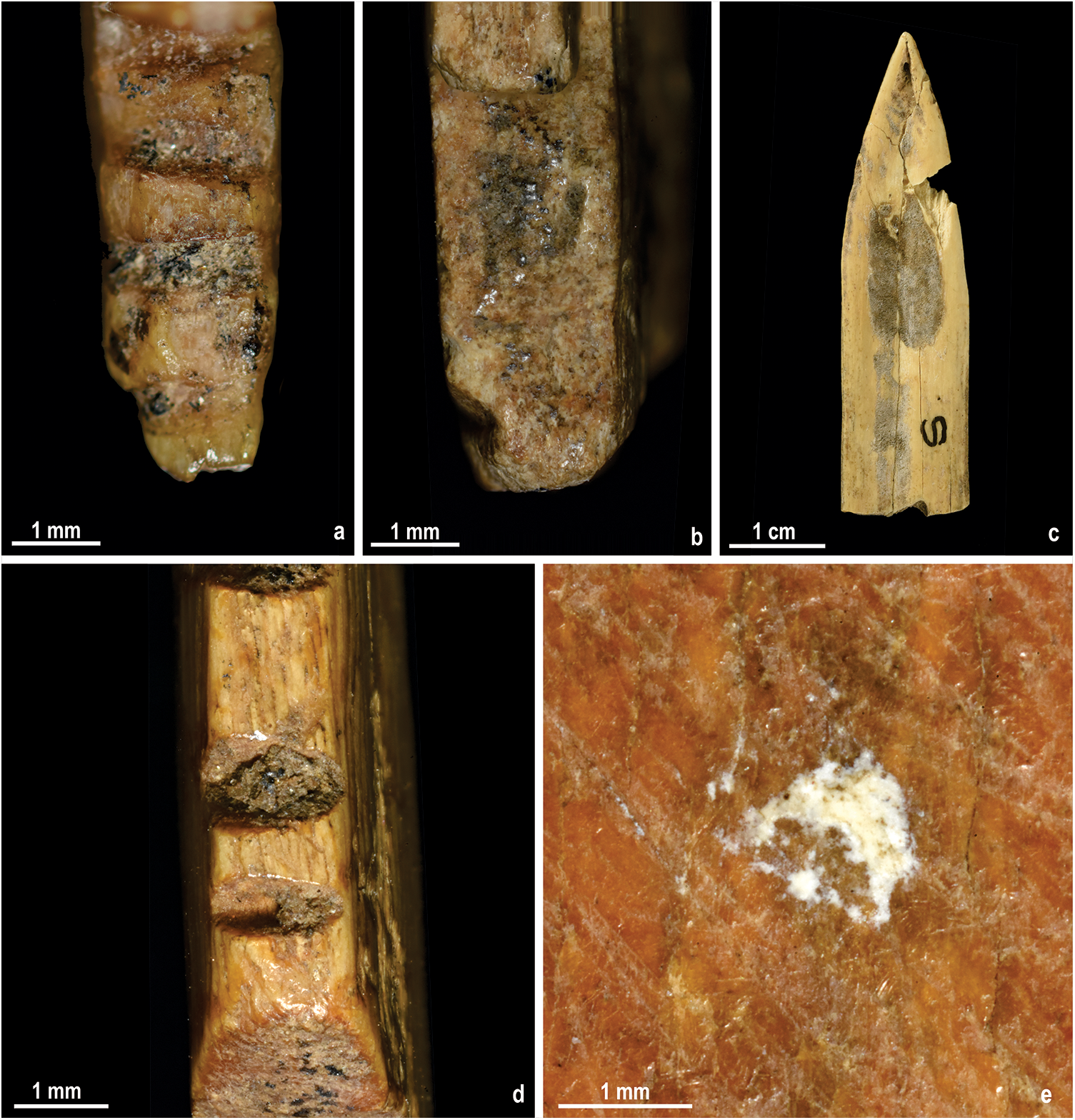
Manufacture traces observed on the bone arrow point assemblage: (a) cut-and-break technique observable on the base of the stem of piece 47 (see also Figure 4g); (b) impact scar on the piece EA5-5, which is also curated near the tip; (c) detail of the cut-and-break technique observable on the base of the stem on piece 04-04-023; (d) traces of scraping and grinding observable on piece 04-04-007; and (e) traces of scraping and grinding observable on piece 04-04-038. (Color online)

The techniques used to manufacture the arrow points are described here briefly because they are not the article’s focus. Blanks were obtained by direct percussion and grooving (Buc Reference Buc2012; Christensen Reference Christensen2016). Direct percussion was observed in an impact scar on the piece EA5-5 (Figure 3b). The cut-and-break technique was most commonly observed on the base of stems (Figures 3a and 3c). After the blank was obtained, pieces were shaped by scraping with the cutting edge of a stone tool in a longitudinal motion and abraded obliquely against an abrasive surface to smooth out irregularities, as suggested by the set of subparallel, closely spaced striations across the blades and stems, which are clearly visible to the naked eye (Figure 3d–e). Whittling was used to fashion the concave bases, barbs, stems, and the small notches of the stems in the barbed subgroups, removing small portions of material with the working edge of a lithic tool. The blades of some pieces were more finely abraded to reduce resistance and secure a deeper penetration in the target. A very fine-grained abrasive was used to carry out this work.
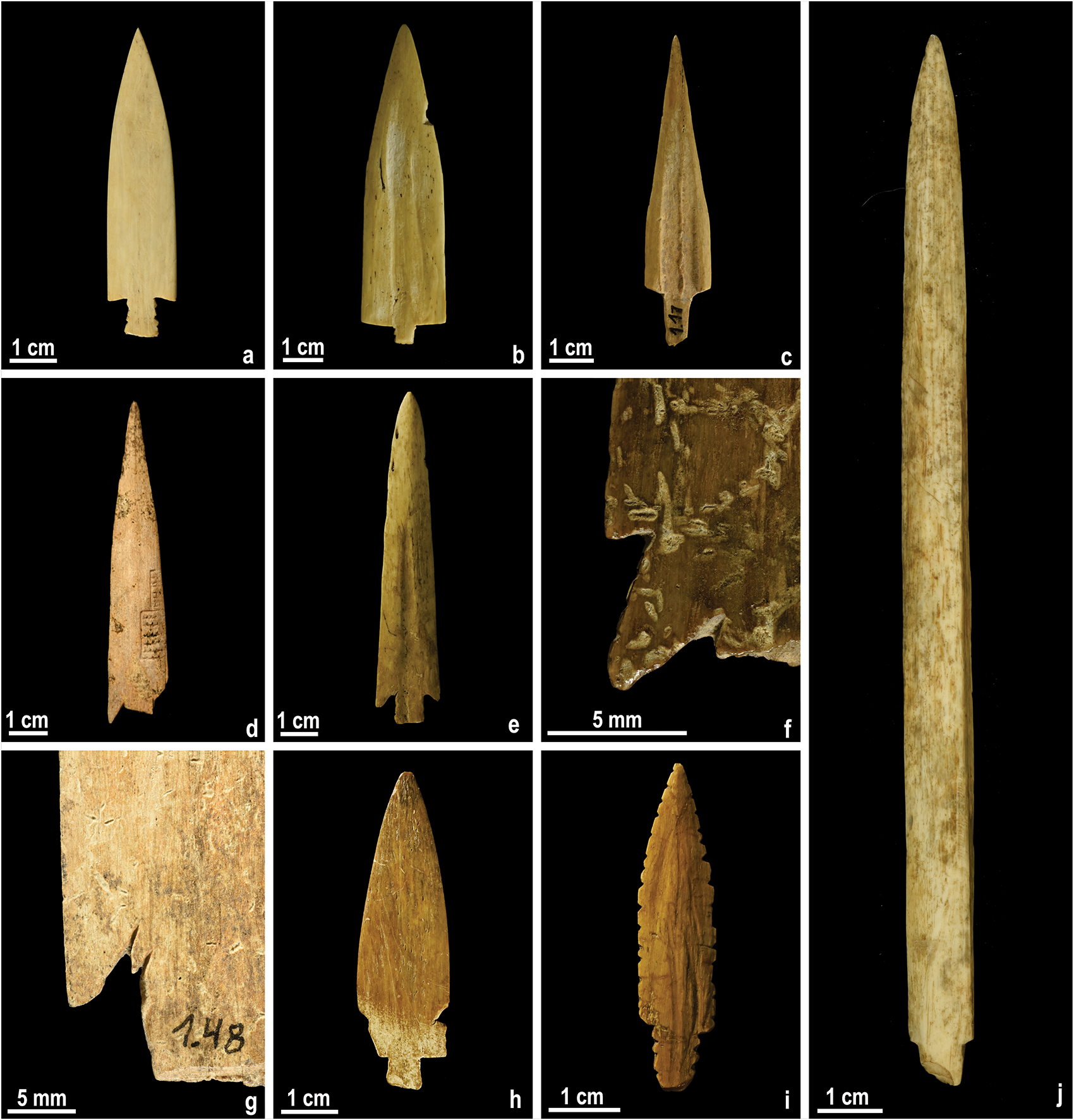
Examples of stemmed bone arrow points: (a) piece NC-67 with expanded stem; (b) broadhead piece 04-04-010 with a straight stem and a channel that may have served to add poison; (c) piece 04-04-021 with tapered shoulders, unnotched contracted stem, and a channel that may have served to add poison; (d) point EA5-3 with incised decoration and a black residue spattered over the blade; (e) piece NC-64 made on Lama sp. metapodial conserving the vascular groove that may have served for adding poison; (f) detail of the extra barb and the roots etching on piece 54; (g) detail of the extra barb on piece 47; (h) notched blade of piece 55; (i) serrated blade of piece NC-26; and (j) long needle-like arrowhead 04-04-33. (Color online)

Examples of residues observed on arrow points: (a) black mastic on the stem of piece 04-04-023; (b) black mastic on the stem of piece 47; (c) dark residue on the vascular groove of piece NC-16; (d) black residue trapped in the area between the notches of the blade; and (e) white substance on the piece 04-04-34. (Color online)

The pieces in the assemblage showed a great variability of design and were classified into stemmed (typological groups A and B) and unstemmed (typological groups C and D) groups. Typological group A was divided into four subtypological groups based on minimal technological attributes. The other groups only had one subgroup each. Typological groups and subgroups were functional for delineating accuracy, flight stability, and killing power of the projectiles from which points came.
• Typological Subgroup A.1: Bone points with a long triangular–shaped blade, serrated stem, and tapered-to-barbed shoulders. The number of projectile points in this category was 71. They were also the most common bone arrowheads observed in readings and a regional synthesis (Aparicio Reference Aparicio1925; Berberián Reference Berberián1984; Laguens and Bonnin Reference Laguens and Bonnín2009; Outes Reference Outes1911; Serrano Reference Serrano1945). The subgroup presents variations in length, width, stem morphology, and weight (Supplementary Table 2). Shoulders show angles ranging from 26° to 117° (see the later discussion). Seven arrow points are short, 51 are medium, and 12 are long. It was impossible to measure the length of Point 11 of Arroyo Talainín 2 (see Supplementary Table 2). Flattened, flattened-convex, and biconvex cross sections dominate the assemblage. Stems are mainly straight or contracted and have subrectangular cross sections (Figure 3d; Figure 4a–c), with neck widths ranging from 4.5 to 11.5 mm. The edges of the stems have notches transversally oriented to the axis of the bone to create a serrated edge for hafting (Figure 3d). The notches of piece NC-19 were exceptionally in V, resembling those observed in neighboring Sierras de San Luis (Cena Di Matteo et al. Reference Di Matteo, Malena, Morey and Aizpitarte2018). Only arrow point 04-04-021 does not have a serrated stem or was an unfinished piece, sharing characteristics with the bone arrow points from neighboring regions described by Buc (Reference Buc2012), Messineo and others (Reference Messineo, Álvarez, Dubois, Steffan and José Colantonio2013), Reichlen (Reference Reichlen1940), and Rusconi (Reference Rusconi1933). Point EA5-3, found in El Alto 5, has incised decoration on the blade, mainly lines and small-sized triangles (Figure 4d) that look like those on decorated pin-shaped subtype spatulas and ornaments from central Argentina (Marcellino et al. Reference Marcellino, Berberián and Pérez1967; Pastor and Moschettoni Reference Pastor and Moschettoni2018; Serrano Reference Serrano1945). Points 04-04-010, 04-04-018, and 04-04-002 have broad heads (Figure 4b), with a maximum width of 21.6 mm, which caused heavy bleeding after penetrating the target. Traces of black, white, or semitransparent glue on the stems show that they were firmly fixed to the arrow shaft (Figure 5a) and that some additional sinew cords were used. A relatively hard, dark-brown, and shiny resinous residue was spattered over the surface of most of the blades (Supplementary Table 1; Figures 3b, 4d, and 5c). Despite being finished tools, some points conserve a small portion of the medullary cavity or the vascular groove, creating a channel that may have served to add poison (Figures 4b, c, and e). Similar features were used ethnographically to prolong the contact of poisons with the blood inside the victims, improving its potency (Borgia et al. Reference Borgia, Carlin and Crezzini2017; Jones Reference Jones2007; Osborn Reference Osborn and Johnson2004).
• Typological Subgroup A.2: Bone points with a long triangular–shaped blade, serrated stem, and two adjacent barbs in each wing: The two points in this subgroup are long- to medium-length projectile points with two barbs at the end of the wings (Figures 3a and 4f–g). Piece 54 has a flattened cross section. Piece 47, made of Lama sp. metatarsal, conserves the vascular groove, perhaps to afix some poison. The angle of the central barb is too acute (50°), and the barb width is wide, creating an arrowhead with a high-retention capacity once the projectile strikes the target (Supplementary Table 1). Because projectiles kill by cutting and causing bleeding, the extra barbs of this subgroup help hold the point on the wound to increase the effectiveness of this process. Neck width ranges from 6.3 to 11.1 mm, with the latter a large-diameter shaft having a high knockdown power (see the later discussion). A black residue interpreted here as mastic was identified on the stem of piece 47 (Figure 5b).
• Typological Subgroup A.3: Bone point with a long triangular-shaped blade, expanded stem, horizontal shoulders, and a notched blade: Only one medium-length piece was found with these features (Figure 4h). It has horizontal shoulders with a notch on both sides of the blade that has an unknown function. The stem was not notched but did not look like an unfinished piece because we identified black mastic on the edge of the stem.
• Typological Subgroup A.4: Bone point with a long triangular–shaped blade, serrated stem, horizontal shoulders, and a blade with a serrated edge: Only one bone arrow point had these features. It is medium in length and light in weight (<2 g), resembling the small stemmed stone arrow points. Closely spaced notches were incised on the blade’s edge to create a serrated edge (Figure 4i). The serrated edge has been poorly studied in bone arrow point technology because they occur rarely in the record. Serrated edges observed in NC-26 perhaps had a similar function to the barb in bone barbed points (see Weniger Reference Weniger1992). In this regard, studies of lithic arrow points suggest that a serrated edge was used as a stylistic trait or to allow deeper penetration into the target, acting as a barb to prevent the easy withdrawal of the point from the wound (Ferdianto et al. Reference Ferdianto, Suryatman, Hakim, Sutikna and Lin2022; Hughes Reference Hughes1998; Loendorf et al. Reference Loendorf, Plumlee and Tiedens2017). A black residue was trapped in the area between the notches of the blade (Figure 5d).
• Typological Subgroup B.1: Long needle-like arrow point. A piece was found in the museum collection with this characteristic (Figure 4j). It has a long (162 mm) and slender (10.2 mm) blade with a biconvex cross section and weighs 11.5 g. The stem has a subcircular cross section and a neck width of 6.9 mm. It was made on a long bone splinter, probably obtained from a Lama sp. tibia. The whole surface of the point was polished and appeared shiny to the naked eye. The absence of roughness or any protrusion breaking the transition between the point and the shaft indicates that traits maximizing penetration were selected in this design. A black substance spattered over the blade was also identified. When used at close range, an arrow point with this characteristic has high knockdown power and can create a deep, lethal wound. The arrow point looks similar to those described by Zhilin (Reference Zhilin2015) and Rousselot and Grahammer (Reference Rousselot and Veronika2004) for hunting large and dangerous prey such as moose (Alces alces), wolf (Canis lupus), or caribou (Rangifer tarantus) at close distances.
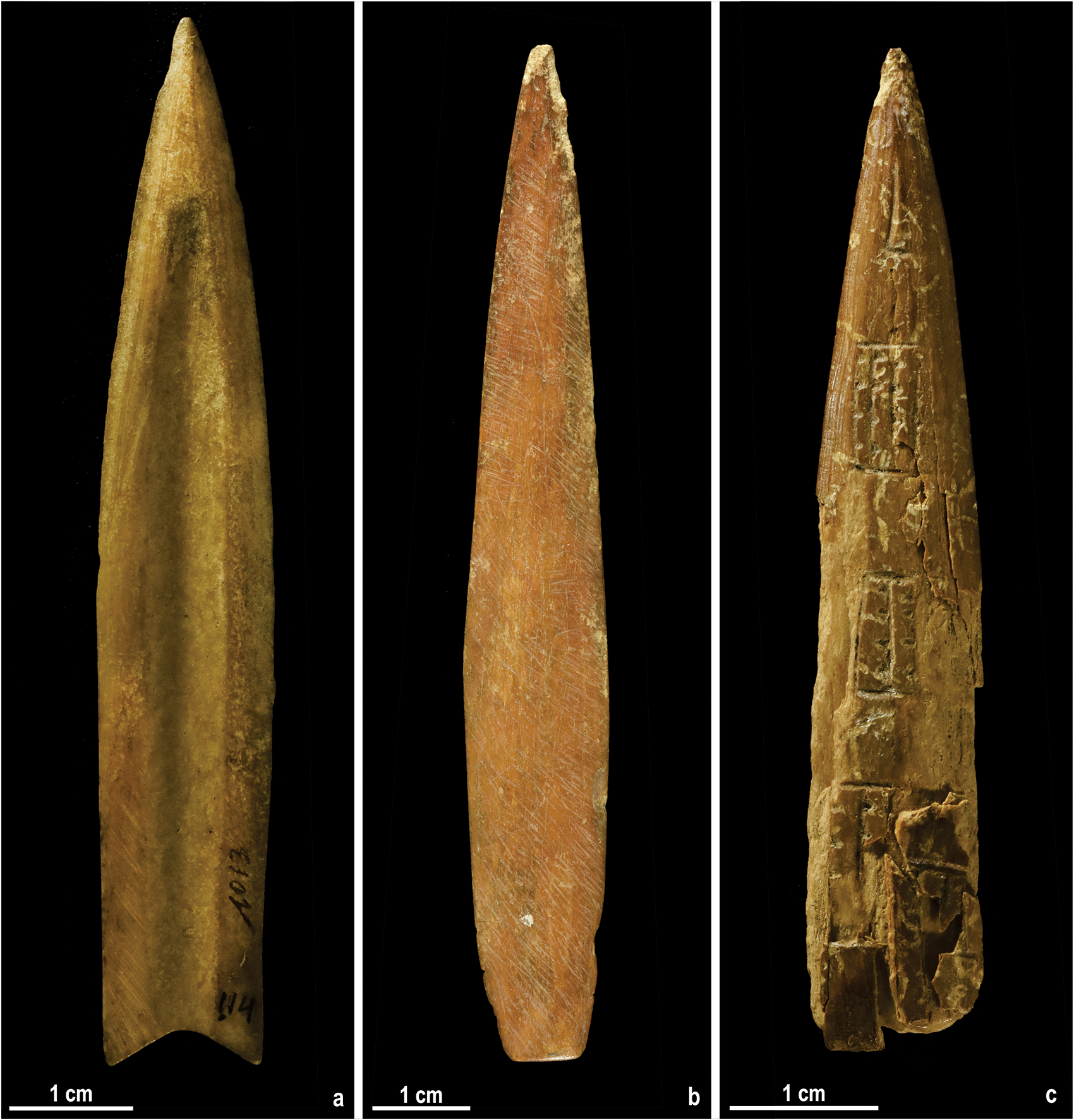
• Typological Subgroup C.1: Swallowtail arrow points. Three projectile points were documented in this subgroup: they are long, nonstemmed projectile points with lanceolate-shaped blades and concave bases (Figures 3e and 6a). The pieces present manufacture traces along the blades, but they are focused near the proximal end to reduce thickness for hafting. The marrow cavity is identifiable on the ventral side of piece NC-1 (Figure 6a), perhaps used when adding poison. The tips of pieces NC-2 and 49 have the reddish-brown or black coloration of burned bones commonly used to harden the piece and secure a deeper penetration (see Buc Reference Buc2012; Newcomer Reference Newcomer1974). Piece 49 also has a dark residue spattered over the blade. The points’ shoulder width or maximum width is 13.7–9.6 mm, which, according to the discriminant analysis of Shott (Reference Shott1997) and the threshold approach proposed by Kitchel and others (Reference Kitchel, Aldenderfer and Haas2022), correspond to arrow points. Their weights are 5.6 g, 4.7 g, and 2.79 g, indicating heavy arrow points. Swallowtail points have been documented in Potrero de Garay (around 870–330 cal BP), Soto, and Rumipal (Aparicio Reference Aparicio1925; Berberián Reference Berberián1984; González Reference González1943a, Reference González1943b; Tavarone et al. Reference Tavarone, Colobig and Fabra2020). Moreover, they were common in the Andean regions, related to the Inkas or the early colonial period (Ambrosetti Reference Ambrosetti1902; Ampuero Brito Reference Ampuero Brito1969; Arias et al. Reference Arias, Mariana and Korstanje2023; Bárcena Reference Bárcena2010; Boman Reference Boman1908; Bruch Reference Bruch1913; Cabral Reference Cabral2018; Couso et al. Reference Couso, Moralejo, Giovannetti, del Papa, Páez, Gianelli, Giambelluca, Arnosio and Raffino2011; Debenedetti Reference Debenedetti1917, Reference Debenedetti1921; Durán et al. Reference Durán, Novellino, Menéndez, Gasco, Marsh, Barberena and Frigolé2018; Gheggi Reference Gheggi2019; Haber and Lema Reference Haber and Lema2006; Hernández Llosas Reference Hernández Llosas2006; Mendonça et al. Reference Mendonça, Bordach and Grosso2003; Moreno and Revuelta Reference Moreno and Revuelta2010; Reichlen Reference Reichlen1940; Rusconi Reference Rusconi1933). There, some swallowtail bone points were recovered in close relation to human remains—some with evidence of violent death (Bruch Reference Bruch1913; Cabral Reference Cabral2018; Gheggi Reference Gheggi2019)—or hafted in arrow shafts that were nearly 100 cm long (Debenedetti Reference Debenedetti1917): these features indicate that the pieces from Sierras de Córdoba were arrow points hafted in powerful projectiles to kill enemies.
• Typological Subgroup D.1: Leaf-shaped flat arrow points: This subgroup comprises four lanceolate-shaped projectile points. The hafting areas of leaf-shaped flat points are less than 10 mm, indicating they were arrow points. Three have straight bases (Figure 6b) and a maximum width and length of 15.3 and 112.2 mm. However, there is also a nonstandard flattened point with an acute base for hafting, with a maximum width of 21.1 mm. The weight of the four points ranges from 2.56 to 7.68 g. The smooth transition of the points and shafts shows that the points have a high penetration power into the target and were not designed to keep the weapon in the wound, as were barbed subgroups. A white substance has adhered to the blade on pieces 04-04-34 (Figure 5e) and NC-28. The last one (NC-28) has a black mastic on the proximal end. Piece 56 has incised decoration on the blade, mainly lines and small-sized triangles (Figure 6c). However, it was highly affected by root etching or other postdepositional processes, making it difficult to describe the decoration. Ameghino (Reference Ameghino1915), González (Reference González1943a), and Heath and Chiara (Reference Heath and Chiara1977) explained that similar grooves of decoration were used to prevent the poisonous substance from being pushed off the blade at the moment of penetration.
Generally, the hafting area of the bone projectile points indicates that they were hafted to a bow-and-arrow weapon delivery system. The neck width of 11 stemmed arrow points exceeded by 0.3–1.5 mm the criteria of Zhilin (Reference Zhilin2015) and Odar (Reference Odar2011) for arrow identification (see Supplementary Table 1). However, in some instances the neck width is expected to be slightly larger than the shafts (see Christenson Reference Christenson1986; Snarey and Ellis Reference Snarey and Ellis2010), especially when the stem is fixed into a central or lateral slot of the shaft (see Weniger Reference Weniger1992) and the serrated edge of the stem needs to extend out from the shaft for a better tie. Likewise, ethnographic examples of arrow shafts tipped with long organic points of >10 mm in diameter are not uncommon in South America, supporting that they were bow-delivered projectile points (see Grayson et al. Reference Grayson, French and O’Brien2007; Palavecino Reference Palavecino and Levene1939; Vivante and Gancedo Reference Vivante and Gancedo1972). Moreover, the width of the hafting areas also indicates that hafting bone projectile points require shafts to be a few millimeters thicker than stone-tipped arrows (Table 1).
Examples of unstemmed bone arrow point: (a) Swallowtail bone arrow-point 04-04-37 conserving the marrow cavity, which may have served for adding poison; (b) lanceolate-shaped piece 04-04-34 (see also Figure 4e); and (c) incised piece 56. (Color online)

Descriptive Statistics and Mann-Whitney Test of the Neck Width (mm) of the Stemmed Bone Arrow Points (A.1 to B.1) and the Small-Stemmed Lithic Triangular Arrow Points from the Museum Collections of Sierras de Córdoba.

Notes: U = 751.5; p < 0.001.
Finally, arrow points with thick neck widths have a strong and significant tendency to have barbed shoulders (Pearson’s r = −0.5862371, p = <0.005), as occurred in El Alto 5. Projectile points found in the burial of El Alto 5 have acute barbs ranging from 70° to 35°, indicating a high resistance to removal and a large capacity to create internal severe hemorrhaging. Similar barbed bone arrow points were found embedded or in close association with burials by González (Reference González1943a), Fabra and others (Reference Fabra, González and Robin2015), and Weyenbergh (Reference Weyenbergh1880); in all cases, they outnumbered the single arrow in each individual, indicating a certain degree of fury or viciousness against the victim (see González Reference González1943a).
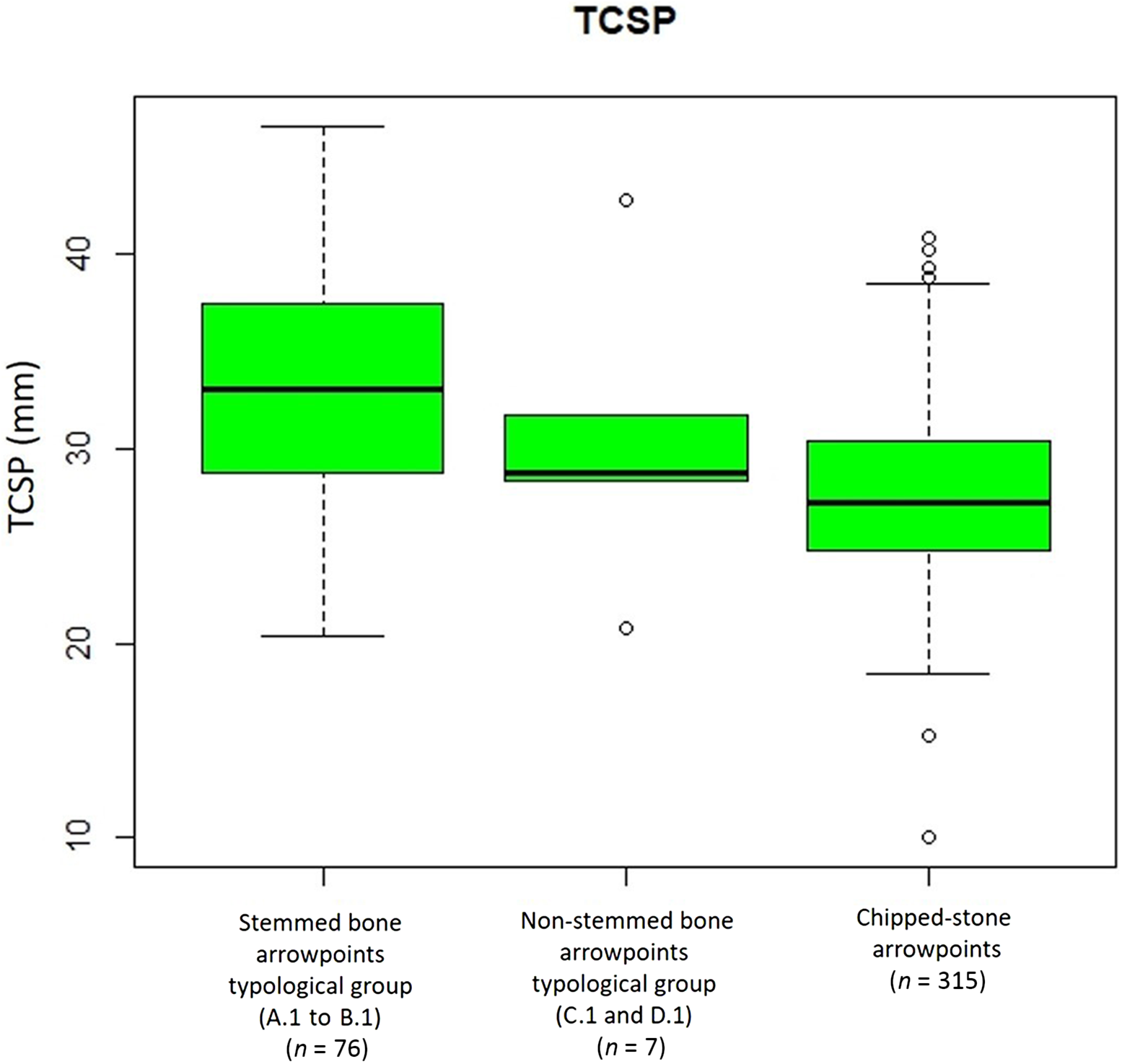
In addition, most of the bone arrow points present higher values of TCSP than chipped-stone arrow points (Figure 7), which, in conjunction with their weight (Table 2) and large arrow shaft diameter, produced more kinetic energy and more capacity to inflict severe injuries after the projectile reached the target, especially at close range (see Tomka Reference Tomka2013). The presence of small notches along the edge of the stems and the mastic residues show that stemmed arrow points were firmly fastened to the distal end of shafts using sinew cords overlaid with glue (see Medina and Balena Reference Medina, Balena, Belardi, Bozzuto, Fernández, Moreno and Neme2021:Figure 2.3). This robust hafting method, together with barbed tangs, high kinetic energy, and penetration power at a short distance, helped ensure that the projectile could not be quickly withdrawn from the wound, even with the point rigidly attached to the arrow shaft. Wounds under such circumstances were fatal, even if the lung or heart were not injured. Moreover, the resinous residue observed in some blades resembled the black tar-like poison described for neighboring regions of Sierras de Córdoba (Lozano Reference Lozano1754:425) and ethnographic foragers around the world (see Borgia et al. Reference Borgia, Carlin and Crezzini2017; Heath and Chiara Reference Heath and Chiara1977). Subgroups B.1 and D.1 also can produce a deep and lethal wound because of their high-penetration power, but they were easier to extract from the target after impact because they had no barbs.
Box plots of TCSP index of bone and chipped-stone arrow points (in mm). The graph shows the minimum and maximum values (whiskers), the first and third quartiles (bounds of box), and the median (center line).

Descriptive Statistics and Mann-Whitney Test of the Gross Weight (g) of the Bone Projectile Points (A.1 to A.4) and the Small-Stemmed Lithic Triangular Arrow Points from the Museum Collections of Sierras de Córdoba.

Notes: U = 962.5; p < 0.001.
Discussion
Hunting in the open environments of Sierras de Córdoba required a light, fast weaponry system in which mass was kept to a minimum and velocity was stepped up to the maximum (see Hughes Reference Hughes1998; Loendorf et al. Reference Loendorf, Plumlee and Tiedens2017). This type of projectile would have a flatter trajectory and more extended range than those tipped with tiny lithic arrow points. Conversely, warfare or hunting in forested environments dominated by small trees and shrubs, where contact with enemies would be close or dense vegetation might deflect a light shaft, required heavier weaponry with a significant bone point set into a heavy shaft of large diameter to produce a high-mass, low-velocity projectile with more shock on impact. Although the bone points were heavy, they were also very thin. Hence, their weight was distributed over a more extended portion of the total length of the arrow (see Fenenga Reference Fenenga1953). These heavy arrows were used mainly to wound or kill enemies during raids. Still, they were occasionally turned against wild camelids or cervids when hunters could get close to their game and thought a kill was likely, mainly because points were too expensive to be replaced if the shot was missed (see the later discussion). Thus, the high diversity of arrow points, in contrast to the low-diverse variability of dart points used by archaic foragers (see Rivero et al. Reference Rivero, Balena, Costantino, Lallami, Álvarez, Medina, Pastor and Sario2024), suggests that Late period people adjusted their weapon systems to their diversified use of the landscape, prey characteristics (including humans), and the distance over which projectiles had to travel, in a context where interpersonal violence was not uncommon and hunting small to large game was not a complementary activity. Therefore, bows were flexible enough to launch arrows of different masses related to changes in the target range. A large and heavy bone-tipped projectile was used when a high impact at a relatively close range was needed. A different type of point was needed if the projectile had to travel a long distance with a low trajectory, as probably happened during hunting in open patches created by land clearing. In this case, a light stone-tipped arrow was the best option, reducing the projectile weight and drag for maximum velocity.
Most of the bone arrow points analyzed here were part of a specialized mechanism system designed to severely wound enemies from a short distance or occasionally finish off previously wounded prey. The sub-typological group A.1 was preferred for this purpose, probably for practical reasons because their long blades and narrow tips had the potential to inflict serious injuries, even with adversaries who were wearing armor. If the point was able to penetrate to a sufficient depth, the barbs of the stemmed subgroups would keep it stuck in the wound, creating a lethal wound regardless of how long this might take. Even if the wound were not fatal for humans, the removal of the barbed arrow would take time and cause great pain, immobilizing the target. Some of the bone points have incised decoration or other stylistic attributes that express social identity and leave a potent reminder of the maker’s cultural affiliation on wounded enemies. However, they did not alter the performance of the points. Moreover, the weight of the bone-tipped projectiles has a higher knock-down power at close range and the ability to open a broader, severe bleeding wound than the smaller chipped-stone arrow points that dominated Late period assemblages, being able to wound or kill enemies during close contact encounters. The lethality of the wound would increase if a slow-acting poison was placed on the arrows. Indeed, early colonial documents from central Argentina cited poisoned arrows that caused the death of injured individuals within a few days (see Bixio and Berberián Reference Bixio and Berberián2017:66). However, residue analysis should be conducted before any decisive functional label is assigned to this substance (see Borgia et al. Reference Borgia, Carlin and Crezzini2017).
Manufacturing bone projectile points required a greater manufacturing effort than creating the low-cost and more common stone arrow points, showing that Late period groups elaborated costly, standardized, and reliable tools for warfare. Incised decoration, extra barbs, or other functional or stylistic attributes were also added to arrowheads, as observed on pieces EA5-3, 54, 55, 56, and 47. Experiments by Zhilin (Reference Zhilin2015) showed that, once the bone had been softened in water for two months, it took about three to four hours to produce a needle-like arrow point. A similar amount of time was proposed for the bone arrow points analyzed here by Rivero and colleagues (Reference Rivero, Heider, Medina, Pastor, Laguens and Bonnin2019). Even though this proposed time is speculative, it clearly took longer to create bone arrow points than to fashion tiny lithic arrow points: stone arrow points required from start to finish eight minutes of knapping at the most (Bourke Reference Bourke1890:57). In addition, suitable rocks for flaking were easy to access across the mountain landscape (see Heider et al. Reference Heider, Suarez, Rivero, Baldo, Pastor, Ramos and Borgo2020; Sario et al. Reference Sario, Costantino, Traktman, Salvatore and Rivero2022).
Bone arrow points were collected widely across Late period sites from Sierras de Córdoba but always in lower numbers compared to stone arrow points. This indicates the adoption of a broad-spectrum foraging and cultivation base around 1220 cal BP was accompanied by the development of new types of weapons for hunting and warfare (Berberián Reference Berberián1984; González Reference González1943a; Marcellino et al. Reference Marcellino, Berberián and Pérez1967; Medina and Balena Reference Medina, Balena, Belardi, Bozzuto, Fernández, Moreno and Neme2021; Medina and Pastor Reference Medina and Pastor2021; Medina et al. Reference Medina, Buc and Pastor2014; Pauttassi and Rivero Reference Pauttassi and Rivero1999; Serrano Reference Serrano1945). In this regard, the design of the bone projectile points is consistent with a period during which social tensions increased after the onset of farming activities, which is evidenced by the record of human burials with signs of violent death and rock art depicting fighting scenes similar to those described by early colonial documents (Díaz et al. Reference Díaz, Barrientos, Pastor and Salazar2015; Fabra et al. Reference Fabra, González and Robin2015; González Reference González1943a; Paulotti Reference Paulotti1943; Rivero and Recalde Reference Rivero, Recalde, Martínez and Bozzuto2011; Weyenbergh Reference Weyenbergh1880). The fact that the bone arrow points were found embedded in human bones, as occurred in El Alto 5, is irrefutable evidence of their direct use in incidents of interpersonal violence. Further, this direct or close association between human bodies and bone arrow points is replicable. That means other burials may be excavated in central Argentina to confirm the association, as occurred with sites in the region where bone arrow points were closely associated with human skeletal remains (see Fabra et al. Reference Fabra, González and Robin2015; González Reference González1943a; Weyenbergh Reference Weyenbergh1880). Conversely, the small and light lithic arrow points were probably used daily for hunting, especially when they were not securely hafted to enable the quick recovery of the costly arrow shafts (see Medina and Balena Reference Medina, Balena, Belardi, Bozzuto, Fernández, Moreno and Neme2021). A similar hunting function is proposed for the less abundant unbarbed—but heavier—bone arrow points, which were not designed to keep the weapon in the prey, despite the magnitude or depth of the wound. However, all arrow points kill, and the classification of hunting and warfare weapons is subjective. Warfare arrowheads could be used in hunting and vice versa (Vinayak Reference Vinayak, Wild, Thurber, Rhodes and St-Pierre2021).
Conclusion
Fragments of bone projectile points were always recorded in low frequency in archaeological deposits compared to the easy-to-make stone arrow points (see Medina and Balena Reference Medina, Balena, Belardi, Bozzuto, Fernández, Moreno and Neme2021). Because of their potential to inflict severe injuries on enemies and their high manufacturing costs, they were likely used only intermittently or occasionally and not on a day-to-day basis, as probably occurred with stone-tipped projectiles. The record of Late period human skeletal remains in Sierras de Córdoba, with clear evidence of death caused by bone-tipped projectiles similar to those described here, reinforces the functional hypothesis that they were used in raids against other groups (Fabra et al. Reference Fabra, González and Robin2015; González Reference González1943a; Weyenbergh Reference Weyenbergh1880). Ethnohistorical and a few archaeological observations indicate that village raids and punitive attacks were relatively common in the past and may have played a crucial role in shaping the social and political landscape of the Sierras de Córdoba at the end of the Holocene (Bixio and Berberián Reference Bixio and Berberián2017; Díaz et al. Reference Díaz, Barrientos, Pastor and Salazar2015; Fabra et al. Reference Fabra, González and Robin2015; González Reference González1943a; Paulotti Reference Paulotti1943; Rivero and Recalde Reference Rivero, Recalde, Martínez and Bozzuto2011; Weyenbergh Reference Weyenbergh1880). However, their use in close contact hunting must also be considered, especially when forested land cover dominates the mountain landscape.
While the study of bone arrow point technology presented here needs to be considered a starting point toward addressing more complex issues concerning a tool type that has been poorly studied in technological terms, this should not hinder the communication of the results to the archaeological community interested in understanding how Late period mixed foraging and cultivation economies dealt with hunting and warfare through the use of a sophisticated set of weapons. At least, it contributes to the first conclusions, primarily viewed as hypotheses until more technological and experimental approaches can be established, providing data to shed light on the cause of arrow point variability in the Sierras de Córdoba or elsewhere.
Acknowledgments
We thank Museo Arqueológico Numba Charava, Silvia Ledda, Mario Mora, Mallku Cubria, Ivana Mlakar, María Torrado, Alejandra Pérez, Alberto Cubria, Bruno Pianzola, Diego Gobbo, Marcus Hamilton, Hugo Yacobaccio, Luis Borrero, and ImanolContracted Stems, and Barbed Shoulders Balena, who provided professional advice and equipment and replied to our numerous requests to improve the original text.
Funding Statement
Funding for this research was provided by Secretaría de Ciencia y Tecnología de la Universidad Nacional de Córdoba (Proyecto CONSOLIDAR 33620190100011CB), the Consejo Nacional de Investigaciones Científicas y Técnicas (PIP 11220200100770CO), and the Agencia Nacional de Promoción Científica y Tecnológica (2016-201-0677).
Data Availability Statement
The bone arrow points analyzed are curated in the Museo Arqueológico Numba Charava (Villa Carlos Paz, Argentina).
Competing Interests
The authors declare none.
Supplementary Material
The supplementary material for this article can be found at https://doi.org/10.1017/laq.2024.40.
Supplementary Figure 1. Examples of small-stemmed lithic triangular arrow points that were recovered at the San Roque locality and housed in Museo Arqueológico Numba Charava (Villa Carlos Paz, Argentina).
Supplementary Table 1. Neck Width, Weight, and Raw Material of Chipped-Stone Arrow Points with Triangular-Shaped Blades, Contracted Stems, and Barbed Shoulders. Notes: Stones originally described as chalcedony and opal, which have much in common in terms of their high-quality stone tool manufacture, were grouped into the broader category of “Siliceous Rock,” according to Heider and others (Reference Heider, Suarez, Rivero, Baldo, Pastor, Ramos and Borgo2020). Key: MC = Museo Comechingón; NC = Museo Arqueológico Numba Charava.
Supplementary Table 2. Main Characteristics of the Stemmed Bone Arrow Points Sub-Typological Groups. Note: Length, width, and weight are approximate measures in near-complete pieces.
Supplementary Table 3. Main Characteristics of the Unstemmed Bone Arrow Points Sub-Typological Groups.