INTRODUCTION
Moderate to severe traumatic brain injury (TBI) produces heterogeneous short- and long-term cognitive deficits (e.g., Iverson & Lange, Reference Iverson and Lange2011; Rabinowitz & Levin, Reference Rabinowitz and Levin2014). Early recovery is characterized by a transitory state of impaired consciousness and cognition, sometimes including delirium. Although TBI recovery patterns vary, typical course includes a transition from a confused state to a relatively alert, oriented, and non-confused state, marking the end of this phase of recovery. This transitional phase often includes a period of mental status fluctuations between confused and non-confused states. However, once confusion resolves, other associated symptoms, including low arousal, inattention, disturbed sleep–wake cycles, incoherent speech, and visual hallucinations/illusions also appear to resolve (American Psychiatric Association, 2013; Loring & Meador, Reference Loring and Meador1999; Meagher et al., Reference Meagher, Moran, Raju, Gibbons, Donnelly, Saunders and Trzepacz2007; Sherer, Yablon, & Nakase-Richardson, 2009; World Health Organization, 1992).
Some individuals with TBI experience persisting severe memory and other cognitive impairments following resolution of this period (Vanderploeg, Donnell, Belanger, & Curtiss, Reference Vanderploeg, Donnell, Belanger and Curtiss2014). Memory impairments may contribute to poor orientation secondary to an inability to learn and consolidate accurate information about person, place, or time. In other words, there can be dissociation between recovery from confusion and recovery of day-to-day memory and orientation.
The period of altered consciousness was initially identified by Russell in Reference Russell1932 as “loss of full consciousness,” but was quickly renamed posttraumatic amnesia (PTA; Russell & Smith, Reference Russell and Smith1961; Symonds & Russell, Reference Symonds and Russell1943). The original PTA literature characterized this period by alterations in consciousness, including emergence from coma with subsequent reductions in alertness, confusion, and other neurobehavioral dysfunction (Russell & Smith, Reference Russell and Smith1961; Symonds & Russell, Reference Symonds and Russell1943). PTA came to be conceptually defined as a period of stark impairments in new memory formation, consolidation, and retrieval (i.e., anterograde amnesia; Lezak, Reference Lezak1995; Loring & Meador, Reference Loring and Meador1999).
Traditionally, this period has been assessed clinically by determining the interval between the injury date and time in which the individual is consistently able to form and retain new memories (Russell & Smith, Reference Russell and Smith1961; Symonds & Russell, Reference Symonds and Russell1943). Common measures for evaluation of PTA tap primarily orientation, although some measures contain items evaluating anterograde memory. These include the Galveston Orientation and Amnesia Test (GOAT), Orientation-Log (O-Log), and Westmead Post-Traumatic Amnesia Scale (WPTAS) (Levin, O’Donnel, & Grossman, Reference Levin, O’Donnell and Grossman1979; Marosszeky, Ryan, Shores, Batchelor, & Marosszeky, Reference Marosszeky, Ryan, Shores, Batchelor and Marosszeky1997; Novack, Reference Novack2000). Examination of amnesia, rather than other aspects of the confusional state, is emphasized.
Use of the term PTA continues to permeate the scientific literature and clinical practice. In doing so, it is also being used to describe primarily confused presentations, such as what is seen in individuals who are not solely amnestic. Because use of the term PTA may miscommunicate the clinical presentation and underrepresent the range of clinical symptoms, some have suggested that “PTA” be used exclusively for describing presentations characterized by persistent posttraumatic anterograde amnesia. The term posttraumatic confusional state (PTCS) has been proposed to describe the broader state of altered mental status, confusion, and other neurobehavioral symptoms (Katz & Alexander, Reference Katz and Alexander1994; Nakase-Richardson, Yablon, & Sherer, Reference Nakase-Richardson, Yablon and Sherer2007; Sherer, Nakase-Thompson, Yablon, & Gontkovsky, Reference Sherer, Nakase-Thompson, Yablon and Gontkovsky2005; Stuss et al., Reference Stuss, Binns, Carruth, Levine, Brandys, Moulton and Schwartz1999). In this study, we refer to this period of recovery as PTCS.
Few studies have examined the neuropsychological characteristics associated with PTCS (Stuss et al., Reference Stuss, Binns, Carruth, Levine, Brandys, Moulton and Schwartz1999; Wilson et al., Reference Wilson, Evans, Emslie, Balleny, Watson and Baddeley1999). Stuss et al. (Reference Stuss, Binns, Carruth, Levine, Brandys, Moulton and Schwartz1999) evaluated recovery from PTCS using simple attention and memory tasks. Across mild to severe TBIs, emergence from PTCS was associated with improved attentional “mental control” as assessed by the ability to recite months backward and count by threes. Three-word free recall recovered after individuals emerged from PTCS. In contrast, recognition memory recovered as individuals with moderate or severe TBIs emerged from PTCS, but following resolution of PTCS in those who sustained mild TBIs. These findings suggest that PTCS is perhaps better characterized by impairment in mental control than in memory, at least with regard to free recall processes.
However, the studies used bedside cognitive measures (Versus traditional neuropsychological measures), precluding examination of fundamental neuropsychological constructs such as memory consolidation, retrieval, and recognition discrimination. It is also possible that the differential recovery patterns reflected relative difficulty of the various tasks, rather than recovery of different cognitive processes.
Few studies have sought to cognitively differentiate individuals in the early posstinjury recovery period. The current investigation aimed to expand the aforementioned findings by examining level and pattern of performance for participants in PTCS compared to those who have emerged from PTCS using standardized and normed neuropsychological measures across multiple cognitive domains. We used a large sample of individuals tested for a previous study (Hanks et al., Reference Hanks, Millis, Ricker, Giacino, Nakese-Richardson, Frol and Gordon2008; Kalmar et al., Reference Kalmar, Novack, Nakase-Richardson, Sherer, Frol, Gordon and Ricker2008), who were administered a battery of neuropsychological measures at a fixed point early after injury, regardless of cognitive status. Additionally, specific cognitive processes (e.g., memory consolidation, retrieval, and executive mental control) were examined by comparing groups on within-subject dependent measures. This approach helped control for group differences across level of difficulty on cognitive tasks.
The aims of the current study were to determine if PTCS is neuropsychometrically characterized by: (1) primarily a global cognitive impairment affecting all cognitive abilities; (2) a core memory impairment that underlies the disorientation and confusion (i.e., an amnestic disorder); (3) a core deficit in executive control processes; or (4) a combination of globally impaired cognition with additional deficit(s) in specific cognitive domain(s). Current hypotheses were developed using findings from the aforementioned limited existing literature (i.e., Stuss et al., Reference Stuss, Binns, Carruth, Levine, Brandys, Moulton and Schwartz1999 and Wilson et al., Reference Wilson, Evans, Emslie, Balleny, Watson and Baddeley1999) as well as the evolving historical practices and theoretical foundations that strive to clarify the nature of PTCS. Given pervasive global deficits in the early recovery postinjury period, it was hypothesized that individuals remaining in PTCS would have global cognitive impairment, but could be differentiated from their emerged PTCS counterparts by their relatively greater impairments in executive control. Thus, it was believed that the PTCS state could be viewed as a confusional disorder (i.e., delirium) rather than primarily an amnestic disorder.
METHODS
Participants
Five hundred forty-three participants with complicated mild to severe TBI in the National Institute on Disability and Rehabilitation Research (NIDILRR) funded TBI Model System (TBIMS) program at seven TBIMS centers from July 1, 2004, through July 30, 2006, were considered for inclusion. Data were collected as a part of the Cognitive Module, which was developed to evaluate feasibility and predictive utility of neuropsychological testing during inpatient rehabilitation following moderate to severe TBI (Dijkers, Harrison-Felix, & Marwitz, 2010; Hanks et al., Reference Hanks, Millis, Ricker, Giacino, Nakese-Richardson, Frol and Gordon2008). (See Dijkers et al., 2010 for additional information regarding TBI National Database.)
TBIMS program inclusion criteria includes: (1) medically documented TBI, (2) treatment at an affiliated trauma center within 24 hr of injury, (3) receipt of inpatient rehabilitation within the Model System, (4) admission to inpatient rehabilitation within 72 hr of discharge from acute care, (5) at least 16 years of age at time of injury, and (6) provision of informed consent by the person with injury or legal proxy (Gordon, Mann, & Willer, Reference Gordon, Mann and Willer1993). Emergence from minimally conscious state (Giacino et al., Reference Giacino, Ashwal, Childs, Cranford, Jennett, Katz and Zasler2002) or vegetative state (Jennett & Plum, Reference Jennett and Plum1972) was also required. With respect to severity of TBI, emergency department admission Glasgow Coma Scale (GCS) score was collected via available records. Scores ranged from 15 to 3. Scores in the 15 to 13 range reflected complicated mild injuries and had evidence of trauma-related intracranial abnormality on clinical neuroimaging and had a severe enough injury to warrant inpatient rehabilitation. Participants were enrolled in a research project stipulating neuropsychological assessment at 4 weeks ± 2 weeks postinjury, regardless of the level of cognitive capability at that time.
Individuals were excluded who were: (1) non-English speaking, (2) discharged from inpatient rehabilitation before 2 weeks postinjury, and/or (3) admitted for initial inpatient rehabilitation greater than 6 weeks postinjury. Consistent with prior Cognitive Module TBIMS studies (e.g., Hanks et al., Reference Hanks, Millis, Ricker, Giacino, Nakese-Richardson, Frol and Gordon2008; Kalmar et al., Reference Kalmar, Novack, Nakase-Richardson, Sherer, Frol, Gordon and Ricker2008), participants were included in the present study if they sustained complicated mild to severe TBIs, were 14–43 days posstinjury, and also had available data for: key demographic variables (e.g., age, gender), number of days until able to follow commands, length of “PTA,” and a GOAT score on the day of neuropsychological testing.
As a part of the Cognitive Module, participants were assigned an overall “Battery Completion Code” (BCC). The codes were: (1) the full battery was administered, (2) some tests were administered from the battery, (3) none of the battery was administered due to factors that made the participant incapable of participating (e.g., coma or other medical status), and (4) the battery was not administered due to external factor (e.g., participant was discharged before the “testable window,” English not the primary language). Of the 543 TBIMS participants, only participants with a BCC of 1 or 2 were included in the present study, which resulted in 349 included participants.
Data Collection Procedures
This study was reviewed and approved by the institutional review boards at all participating institutions. Research assistants collected information regarding demographic characteristics (e.g., sex, education, age), cause of injury, injury severity (e.g., emergency department admission GCS), PTCS, and length of acute care and rehabilitation stays from medical service records and interview with participants and family members. PTCS for the parent TBIMS module was defined as the interval from injury until two consecutive GOAT scores of ≥76 or Orientation Log scores of ≥25 (Novack, Dowler, Bush, Glen, & Schneider, Reference Novack, Dowler, Bush, Glen and Schneider2000) were obtained within a period of 24 to 72 hr per clinical observation or acute care medical record review (Levin et al., Reference Levin, O’Donnell and Grossman1979). The current study used the GOAT score for group classification (see Table 1 for description of the GOAT).
Description of neuropsychological measures and order of test administration

Study participants were administered a battery of neuropsychological tests at 4 (±2) weeks postinjury. If possible, testing was completed in one session. The test battery was chosen based on previous research literature (see Table 1 for test descriptions), with an attempt to include tests from major domains of cognition typically affected by TBI. All neuropsychological tests were administered and scored according to manual instructions. T-score conversions were calculated based on the revised comprehensive norms for an Expanded Halstead-Reitan Battery (Heaton, Miller, Taylor, & Grant, Reference Heaton, Miller, Taylor and Grant2004) and norms found in manuals for the Symbol Digit Modalities Test (SDMT; Smith, Reference Smith1973), California Verbal Learning Test-II, Standard Form (CVLT-II; Delis, Kramer, Kaplan, & Ober, Reference Delis, Kramer, Kaplan and Ober2000), and Wechsler Test of Adult Reading (WTAR; Wechsler, Reference Wechsler2001).
Test completion was operationally defined as: (1) finishing the test per manual instructions or (2) discontinuation due to the level of the individual’s cognitive impairment. Examples of the latter are (a) an individual who initially connected circles in numeric order on Trail-Making Test Part A (TMT-A), but discontinued connecting circles with an inability to be redirected to the task, or (b) an individual producing a few words on verbal fluency, but then rambled with an inability to continue despite encouragement. In such cases, the examiner assigned the most impaired possible score. However, test discontinuation rules applied on TMT measures that exceeded 90 s for TMT-A and 300 s for TMT-B. Only non-imputed test scores were included for the purposes of the present study (e.g., we excluded TMT-A and TMT-B imputed scores of 90 (24.8% of the sample) and 300 s (31% of the sample), respectively, because individuals with imputed scores were not seen as representative of their respective PTCS groups since truncated scores would be unable to capture the severity of impairment.
Study Groups
Of the 349 participants in the current sample, 258 (74.1%) completed one or more tests and had emerged from PTCS (E-PTCS), with 91 (25.9%) remaining in PTCS. This group was further subdivided into Low Performing PTCS (L-PTCS; n=46) and High Performing PTCS (H-PTCS; n=45) using a median split of 29 GOAT error points. Sample sizes for the three groups differed across test measures because different numbers of participants could complete the various tests with non-imputed scores.
Statistical Analyses
PTCS groups (L-PTCS, H-PTCS, and E-PTCS) were compared on demographic and injury characteristics using Chi-square analyses for categorical variables, Kruskal-Wallis analysis of variance (ANOVA) for ordinal data, and ANOVAs for interval data with Dunnett’s T3 post hoc procedure to examine group pairwise differences (due to unequal sample sizes and error variances). Multivariate ANOVA (MANOVA) was used to control for multiple comparisons to explore neuropsychological performance differences across the three PTCS groups via each neuropsychological measure. Because the tests had different sample sizes based on test completion (ranging from 273 to 349), follow-up ANOVAs were conducted separately for each neuropsychological measure using Dunnett’s T3 post hoc procedure to examine group pairwise differences to retain the greatest possible number of participants.
Finally, to explore pattern of performance differences on specific cognitive processes, a series of mixed model analyses of covariance (ANCOVAs) were used covarying for demographic and injury characteristics that differed among PTCS groups. By using mixed model analyses, level of performance differences across the three PTCS groups were controlled by the within-subject measure. The statistical comparison characterizing pattern of performance was the interaction effect between PTCS groups and the within-subject measure examining the neurocognitive process under consideration. All analyses were conducted using SPSS version 20.0.
Neurocognitive Processes
The approach used for each of the neurocognitive processes described in the following sections was adapted from previously published studies that examined similar constructs of memory consolidation, memory retrieval, as well as memory-based and non-memory based executive control (Duchnick, Vanderploeg, & Curtiss, Reference Duchnick, Vanderploeg and Curtiss2002; Vanderploeg, Crowell, Curtiss, Reference Vanderploeg, Crowell and Curtiss2001; Vanderploeg et al., Reference Vanderploeg, Donnell, Belanger and Curtiss2014; Wixted, Reference Wixted2004; Wright, Schmitter-Edgecombe, & Ellen Woo, Reference Wright, Schmitter-Edgecombe and Ellen Woo2010). Please refer to these studies for detailed explanations of the approaches used to evaluate the following neurocognitive processes.
Memory consolidation
Rate of forgetting was used as an inverse measure of memory consolidation. Even if the three PTCS groups differed in the amount of learned information, consolidation differences could be detected by determining if PTCS groups differed on their rate of forgetting, as reflected in the interaction effect. Consolidation was assessed in the current analyses by examining rate of forgetting using CVLT-2 Trial 5, short delay free recall (SDFR), and long delayed free recall (LDFR) as within-subject measures. Because these CVLT-2 scores all assess free recall, retrieval issues should be relatively constant across these comparisons. Thus, any differences would reflect different rates of forgetting (i.e., problems with memory consolidation).
Memory retrieval
Memory retrieval abilities were assessed using two methods that examine whether recall improves with the provision of retrieval cues: (1) using CVLT-2 LDFR and long delay cued recall (LDCR) and (2) using LDFR and the proportion of recognition hits [i.e., proportion of hits compared to total affirmative responses on Recognition Trial: Hits * (Hits / (Hits + False Positives)] as within-subject measures. A proportional measure was used to control for Yea- or Nay-say biases. A significant interaction effect would indicate differential memory retrieval problems.
Executive control (memory)
Memory executive control was assessed using two approaches examining the number of memory errors relative to memory performance: (1) using CVLT-2 Trial 5 (general level of memory ability) and total Intrusion errors and (2) using Recognition Hits and False Positive errors as within-subject measures. A significant interaction effect would indicate differential executive memory control problems.
Executive control (non-memory)
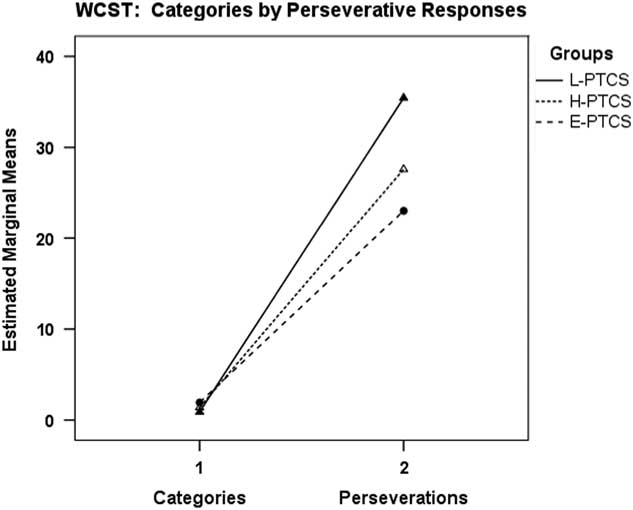
Non-memory executive control problems were assessed by examining Wisconsin Card Sorting Test (WCST) Categories Completed (as a measure of overall WCST performance) and WCST Perseverations as the within-subject measures. A significant interaction effect would indicate differential executive control problems across groups.
RESULTS
Demographic and Injury Characteristics by PTCS Groups
Age of these participants ranged from 16 years to 87 (mean±standard deviation [SD], 37.85±18.56) and educational level ranged from 3 to 20 years (mean, 12.22±2.67). Race was 67.7% white, 25.7% black, 4.6% Hispanic, and 2.0% other. With respect to severity of TBI, emergency department admission GCS scores ranged from 15 to 3 (median±SD; 11±4.10). Time to follow commands (i.e., number of days to obtain a GCS Motor subscale score of 6) ranged from <1 to 38 days (median, 3±6.49 days).
Table 2 presents basic demographic and injury characteristics of the three PTCS groups. Groups differed on age, Disability Rating Scale (DRS) score upon rehabilitation admission, days to follow commands, and days postinjury to neuropsychological assessment. The L-PTCS group was older (p<.05), took longer to follow commands than the E-PTCS group (p<.05), and had a longer interval between injury and neuropsychological evaluation (p<.01) than the H-PTCS and E-PTCS groups (who did not differ from one another). L-PTCS and the H-PTCS groups had comparable rehabilitation admission DRS scores, which were significantly lower (p<.001) than E-PTCS. The three groups were comparable on sex, race, and level of education. Based on these analyses, age, days to follow commands (i.e., TBI severity), and days postinjury to evaluation (i.e., time to recover) were used as covariates in subsequent analyses.
Descriptive information for the groups by posttraumatic confusional state status

Note. L=Low Performing PTCS group, H=High Performing PTCS group, E=Emerged from PTCS group, DRS=Disability Rating Scale; PTCS=posttraumatic confusional state.
a DRS scores were compared using the Kruskal-Wallis ANOVA.
Overall Cognitive Impairment and Level of Specific Test Performance by PTCS Groups
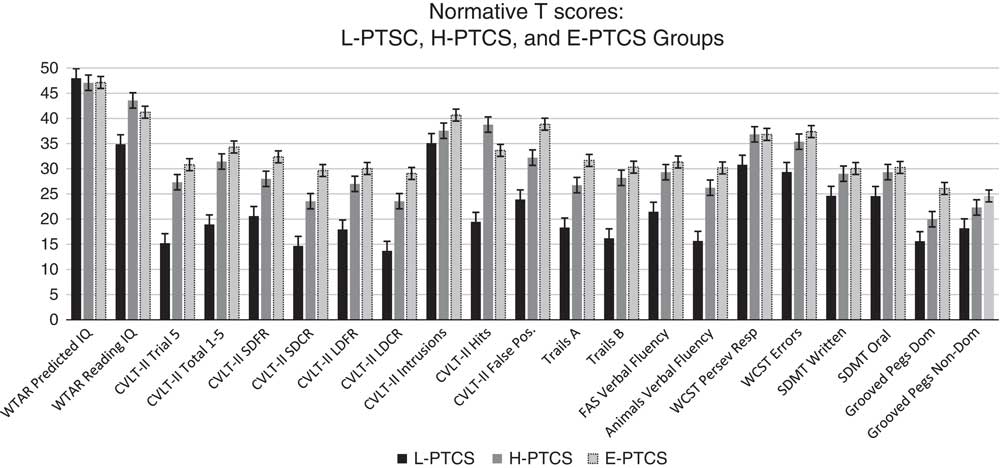
Mean normative T score levels of performance of the three groups across neuropsychological tests are presented in Figure 1. As all scores were converted to normative T scores, standardized comparisons can be made to determine how participants performed compared to a normative sample. Mean performances for all three TBI groups were below expectations (T score range: 14–41) across all measures (see Figure 1). The sole exception is WTAR performance, which is typically very robust to brain insult and often preserved in individuals with declines in other cognitive domains (Green et al., 2008; Kashluba, Hanks, Casey, & Millis, 2008). MANOVA comparing the three PTCS groups across the non-WTAR neuropsychological measures was significant (F(40,502)=3.44; p<.001; ŋp 2=.215).
Normative T-scores for neuropsychological measures for the groups by posttraumatic confusional state status. With the exception of WTAR Predicted IQ and WTAR Reading IQ, these data are normative T-scores (M=50; SD=10). WTAR variables were converted from SS to T scores for comparison purposes. Use of T-scores inherently allows for standardized normative comparisons. L=Low Performing PTCS group, H=High Performing PTCS group, E=Emerged from PTCS group, WTAR=Wechsler Test of Adult Reading, CVLT=California Verbal Learning Test, TMT=Trail Making Test, WCST=Wisconsin Card Sorting Test, SDMT=Symbol Digit Modalities Test. The bars included in this figure are standard error bars.

Subsequent pairwise MANOVAs revealed that the L-PTCS group had overall lower cognitive performance than the E-PTCS group (F(20,262)=4.69; p<.001; ŋp 2=.264), and was marginally lower than the H-PTCS group (F(20,50)=1.71; p=0.063; ŋp 2=.406). The H-PTCS and E-PTCS groups had comparable overall levels of cognitive performance (F(20,228)=1.46; p=.096; ŋp 2=.114).
Subsequent ANOVAs revealed that the WTAR demographically predicted IQ score was the only measure on which the three groups were comparable. With this exception, the L-PTCS group consistently had the poorest performance, followed by the H-PTCS group. Although still impaired in reference to normative values, the E-PTCS group had the highest scores.
Per Dunnett’s T3 post hoc analyses, the L-PTCS group’s performance was statistically significantly lower than H-PTCS and E-PTCS groups on all measures except CVLT-2 Intrusions, where there were no group differences, and CVLT-2 False Positives, Non-Dominant Grooved Pegboard, and WCST Categories and Perseverative Responses, where L-PTCS was comparable to H-PTCS.
H-PTCS and E-PTCS groups were comparable in level of performance on all measures except CVLT-2 SDCR and LDCR, and Dominant Grooved Pegboard. H-PTCS group performed more poorly on these measures.
Cognitive Process Differences across the PTCS Groups
Memory consolidation
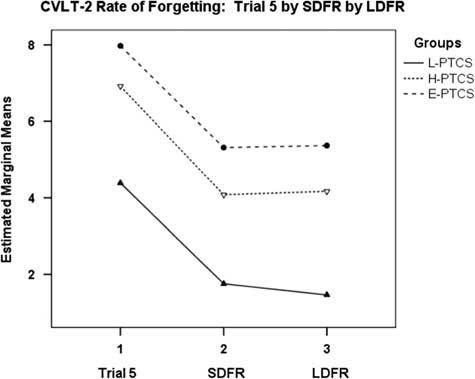
A mixed-model ANCOVA (controlling for age, time to follow commands, and days postinjury) examining rate of forgetting from Trial 5 to SDFR to LDFR across the PTCS groups was significant for group (F(2,343)=28.97; p<.001; ŋp 2=.145), but the interaction between group and the within-subject factor was not significant (F(4,684)=0.46; p=.762; ŋp 2=.003). Thus, although there were level-of-performance differences across the three groups, there were no differences across groups in rate of forgetting (see Figure 2).
Group Differences on Memory Consolidation by Posttraumatic Confusional State Status. L=Low Performing PTCS group, H=High Performing PTCS group, E=Emerged from PTCS group, CVLT=California Verbal Learning Test, SDFR=Short Delay Free Recall, LDFR=Long Delay Free Recall.

Memory retrieval
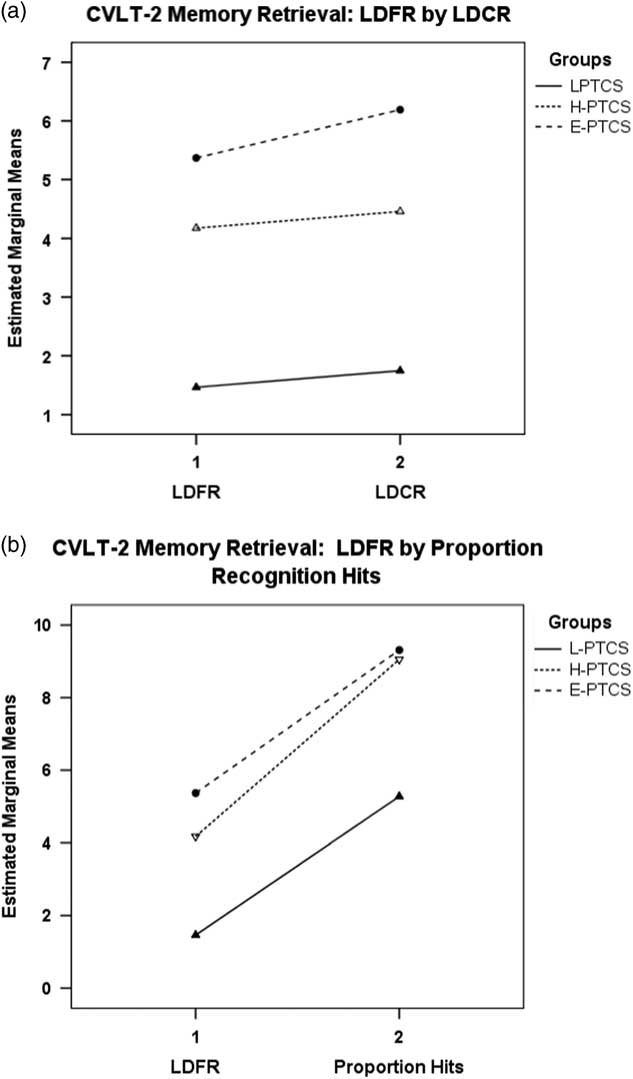
For the mixed model ANCOVA examining memory benefit from semantic cues, the group effect was significant (F(2,343)=29.48; p<.001; ŋp 2=.147), as was the interaction between group and free versus cued recall (F(2,343)=3.36, p<.05, ŋp 2=.019). However, examination of group pairwise interactions did not show significant interactions (L-PTCS Versus H-PTCS: F(1,96)=0.49; p=.488; ŋp 2=.005; L-PTCS Versus E-PTCS: F(1,355)=2.36; p=.125; ŋp 2=.007; H-PTCS Versus E-PTCS: F(1,308)=2.72; p=.100; ŋp 2=.009).
The group effect was significant (F(2,343)=26.57; p<.001; ŋp 2=.134) for the mixed-model ANCOVA examining memory benefit from recognition cues; however, the interaction between group and Free versus proportion of Recognition Hits was not significant (F(2,343)=2.82; p=.06; ŋp 2=.016). Thus, although level of memory performance differed across the three groups, there were no differences across groups in memory retrieval difficulties (see Figures 3a and 3b).
(a,b) Group differences on memory retrieval by posttraumatic confusional state status. L=Low Performing PTCS group, H=High Performing PTCS group, E=Emerged from PTCS group, CVLT=California Verbal Learning Test, LDFR=Long Delay Free Recall, LDCR=Long Delay Cued Recall.

Executive control (memory)
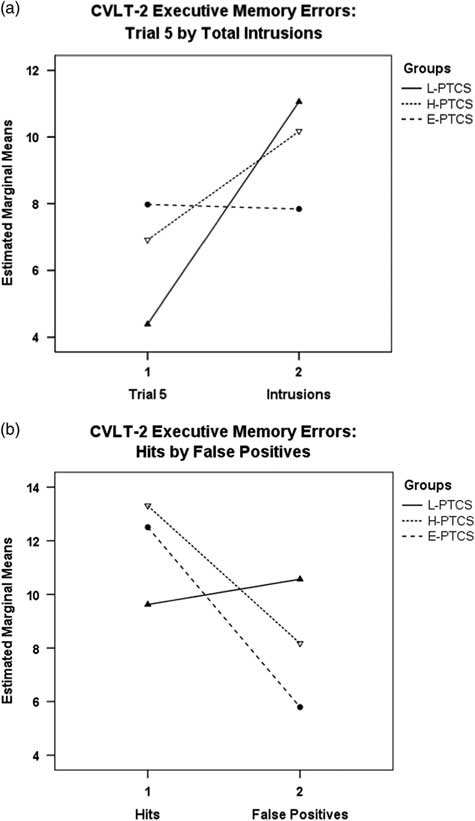
A mixed-model ANCOVA compared groups on CVLT-2 Trial 5 versus total Intrusion errors. The group effect was not significant (F(2,343)=0.49; p=.61; ŋp 2=.003). However, the interaction was significant (F(2,343)=8.78; p<.001; ŋp 2=.049). Examination of group pairwise interactions revealed significant interactions between the two PTCS groups and E-PTCS (L-PTCS Versus E-PTCS: F(1,355)=5.84; p<.02; ŋp 2=.016; H-PTCS Versus E-PTCS: F(1,308)=10.66; p<.001; ŋp 2=.033). Notably, the two PTCS groups did not differ from each other (L-PTCS Versus H-PTCS: F(1,96)=1.50; p=.224; ŋp 2=.015). See Figure 4a.
(a) Group differences on executive control of produced memory errors by posttraumatic confusional state status. (b) Group differences on executive control of memory errors by posttraumatic confusional state status. L=Low Performing PTCS group, H=High Performing PTCS group, E=Emerged from PTCS group, CVLT=California Verbal Learning Test.

Examination of Recognition Hits and False Positive errors as within-subject measures revealed a significant group effect (F(2,343)=3.70; p<.05; ŋp 2=.021), with a significant interaction effect (F(2,343)=26.57; p<.001; ŋp 2=.134). Group pairwise interactions demonstrated significant interactions in all post hoc comparisons: L-PTCS versus H-PTCS: F(1,96)=4.36; p<.05; ŋp 2=.043; L-PTCS versus E-PTCS: F(1,355)=12.67; p<.001; ŋp 2=.034; H-PTCS versus E-PTCS: F(1,308)=14.99 p<.001; ŋp 2=.034). Both L-PTCS and H-PTCS groups had more executive memory control problems than the E-PTCS group. However, the L-PTCS had the most difficulty with executive control (see Figure 4b).
Executive control (non-memory)
A mixed-model ANCOVA was used to examine non-memory executive control across PTCS groups using WCST Categories Completed and WCST Perseverations as within-subject measures. The group effect was significant (F(2,328)=9.53; p<.001; ŋp 2=.055), as was the interaction (F(2,328)=10.79; p<.001; ŋp 2=.062). Examination of group pairwise interactions revealed that L-PTCS had significantly more executive control deficits than E-PTCS (F(1,338)=5.02; p<.05; ŋp 2=.034). However, H-PTCS did not differ significantly in executive control from either L-PTCS (F(1,85)=1.40; p=.241; ŋp 2=.016) or E-PTCS (F(1,291)=1.56; p=.213; ŋp 2=.005). These findings suggest that non-memory executive control problems are most impaired in L-PTCS, but that H-PTCS is recovering and performs at an intermediate level between L-PTCS and E-PTCS (see Figure 5).
Group differences on executive control by posttraumatic confusional state status. L=Low Performing PTCS group, H=High Performing PTCS group, E=Emerged from PTCS group, WCST=Wisconsin Card Sorting Test.

DISCUSSION
The purpose of the present study was to characterize the neuropsychological performance patterns that distinguish individuals with TBI who have emerged from PTCS from those who remain in PTCS. The study capitalized on a large sample from a previous study (Hanks et al., Reference Hanks, Millis, Ricker, Giacino, Nakese-Richardson, Frol and Gordon2008; Kalmar et al., Reference Kalmar, Novack, Nakase-Richardson, Sherer, Frol, Gordon and Ricker2008) who completed a battery of neuropsychological measures at a fixed point early after injury, regardless of their cognitive status. The current study explored multiple possibilities regarding the underlying neuropsychological features that differentiate the PTCS group. The present study hypothesized that PTCS would be characterized by co-occurring executive control impairments in the context of global cognitive deficits based on the evolving theoretical understanding of PTCS in clinical practice and the current literature.
As expected for individuals within 6 weeks of TBI, global deficits in most cognitive domains were found across all three groups. Figure 1 reflects that all groups were greater than 1 and 1.5 SDs below normative performance on most measures (i.e., 14/19 non-WTAR scores). However, this global pattern of impairment did not discriminate individuals in PTCS from those who had emerged. In fact, overall performance was comparable between the H-PTCS and E-PTCS groups on many measures, while the L-PTCS group was significantly more impaired. The PTCS groups were not statistically differentiated from the E-PTCS group on other specific neuropsychological measures used in this study.
Rather, the current results found that PTCS was characterized neuropsychologically by the combination of global cognitive impairments compared to normative data, with specific disproportionate deficits in executive control aspects of memory using normative. Both the L-PTCS and H-PTCS groups had significantly more executive memory control problems, characterized by intrusions and false positives, than the E-PTCS group. Furthermore, the L-PTCS group had the most difficulty on executive memory control, even more so than the H-PTCS group.
In addition, the present study demonstrated that PTCS is not characterized solely by global cognitive impairments or an isolated core executive memory control deficit. That is, if an individual in the acute recovery period following a TBI only had executive control deficits, they would not necessarily be confused, disoriented, and in a state of PTCS. They would simply be described as having executive dysfunction. The current study suggested that the acute recovery period that differentiates those in PTCS from those emerged from PTCS following a TBI can be characterized by the combination of executive control problems in the context of global cognitive impairment.
Similarly, although memory performance was impaired in all three PTCS groups, measures of memory consolidation (assessed through rate of forgetting) and retrieval (assessed as benefit from memory retrieval cues) failed to differentiate the PTCS groups. The three groups showed comparable rates of forgetting and benefit from retrieval cues.
Although a greater degree of executive memory control deficits differentiated PTCS from emerged TBI groups in the current study, non-memory executive control did not differentiate those in and emerged from PTCS. For example, the L-PTCS group had more perseverative errors than high-H-PTCS and E-PTCS groups, when accounting for number of categories completed on the WCST. But the H-PTCS group fell at an intermediate range not significantly different from either the L-PTCS or the E-PTCS groups.
The current findings were generally consistent with the sparse literature examining neuropsychological performance in acute PTCS. Past studies found that PTCS was notable for global cognitive impairments (Kalmar et al., Reference Kalmar, Novack, Nakase-Richardson, Sherer, Frol, Gordon and Ricker2008; Stuss et al., Reference Stuss, Binns, Carruth, Levine, Brandys, Moulton and Schwartz1999; Wilson et al., Reference Wilson, Evans, Emslie, Balleny, Watson and Baddeley1999) and impaired attentional mental control (Stuss et al., Reference Stuss, Binns, Carruth, Levine, Brandys, Moulton and Schwartz1999). Stuss and colleagues also found some measures of memory recall and recognition improved before emergence, while others resolved after PTCS resolution, and differed in recovery patterns between individuals with mild versus moderate to severe TBI. Stuss and colleagues were not able to assess the construct of memory retrieval while controlling for the global cognitive deficits seen in PTCS.
The current study found a similar executive control problem, but used a more complex and standardized clinical memory task, the CVLT-2. The mixed model analyses in the current study also allowed for more direct examination of specific cognitive processes while controlling for level of task difficulty, which was a confound in prior studies. Using this approach, we found that while those in both PTCS groups had severe normative memory impairment, they did not have disproportionate memory consolidation or retrieval deficits compared to those who have emerged from PTCS.
Although Wilson and colleagues (Wilson et al., Reference Wilson, Evans, Emslie, Balleny, Watson and Baddeley1999) also found evidence of global cognitive impairment, their findings diverged from the current study in that reaction time and timed verbal fluency measures also differentiated ongoing versus emerged PTCS groups. They compared individuals in PTCS to those with severe TBIs who were approximately 1-year postinjury. These disparate postinjury timeframes stand in contrast to acute postinjury timeframes for participants in the current study. Wilson and colleagues also were unable to control for level of task difficulty or distinguish level of difficulty from underlying speed or fluency issues.
Although slow processing speed is often a characteristic of TBI cognitive impairment (Mathias & Wheaton, Reference Mathias and Wheaton2007), speed did not differentiate the PTCS groups in the present study. The L-PTCS group had poorer SDMT-Written and -Oral performance, as well as poorer FAS and Animal fluency scores than both the H-PTCS and the E-PTCS groups, who did not differ in level of performance on these speed and fluency measures. Thus, processing speed was not a distinctive characteristic of PTCS in the current study.
The study’s neuropsychological findings of global cognitive and executive control difficulties in PTCS are consistent with expectations based on mechanism of injury as well as typical neuroanatomical correlates of moderate and severe TBI. While the pattern of traumatic brain damage is often heterogeneous, global and executive control deficits correspond with evidence of frontal lobe and diffuse cortical lesions often seen in TBI. For example, TBI often includes contusions to the orbitofrontal cortex, anterior temporal lobe, and other regions (Fontaine, Azouvi, Remy, Bussel, & Samson, Reference Fontaine, Azouvi, Remy, Bussel and Samson1999; Iverson & Lange, Reference Iverson and Lange2011; Levin, Williams, Eisenberg, High & Guinto, Reference Levin, Williams, Eisenberg, High and Guinto1992). Such damage can hinder executive control performance. Furthermore, “shearing” mechanisms due to rotational or linear acceleration/deceleration shifts of the brain, can lead to diffuse traumatic axonal injuries (Iverson & Lange, Reference Iverson and Lange2011). Future studies may consider using novel neuroimaging methods to further understand neuroanatomical correlates of PTCS in TBI (e.g., diffusion tensor imaging, functional connectivity; see Mahoney et al., Reference Mahoney, Simpson, Nicholas, Fletcher, Downey, Golden and Fox2015, Nowrangi et al., Reference Nowrangi, Okonkwo, Lyketsos, Oishi, Mori, Albert and Mielke2015, and Roberts, Mathias, & Rose, Reference Roberts, Mathias and Rose2016, for examples).
It is important to consider the role of injury severity as a possible explanation for the differences between groups in the current study. Although injury severity is likely a contributor to the current study’s findings, it cannot explain all of the results. First, as seen in Table 1, TBI severity, as measured by initial GCS score, was equivalent among the groups. Although GCS scores were unfortunately unavailable for several participants, there is a similar rate of missing data for all groups. Furthermore, the present study’s pattern of results is not consistent with severity differences as the primary explanation for differences between groups. Instead, a divergent pattern based on executive control abilities differentiated the PTCS groups such that the H-PTCS and L-PTCS had comparable performance to one another on executive memory control measures, but performed significantly more poorly than the E-PTCS group. Thus, this pattern points to the presence/absence of the PTCS as the most logical explanatory factor, rather than solely injury severity.
The current study has limitations. Although the use of standardized neuropsychological measures was beneficial to document both the level and pattern of complex neuropsychological processes, the use of these measures resulted in some measures being excluded because a large proportion of participants’ performance was poorer than discontinuation cutoffs used in clinical practice and the TBIMS protocol. Some of these measures were sensitive to processing speed, attention, and executive functioning (e.g., Trails A and B). Because of the need to impute a large portion of data for these measures, which could impact interpretation of the underlying neuropsychological processes, we excluded these measures from analyses.
To truly understand the neuropsychological nature of PTCS, participants should include the full range of TBI severity, including those individuals who are unable to compete these tasks in the standardized administration time. These data were collected in the context of inpatient rehabilitation, which could potentially limit the generalizability of the sample. However, TBIMS participants have been found to be relatively representative of individuals within the United States that attend inpatient rehabilitation (Corrigan et al., Reference Corrigan, Cuthbert, Whiteneck, Dijkers, Coronado, Heinemann and Graham2012). Additionally, normative T-scores were used in place of a healthy comparison group, which was not available for the current study. Although T-scores offer a normative comparison, it is likely that effect sizes might differ if a matched comparison group was used for these analyses.
With regard to cognitive assessment, the TBIMS protocol did not include measures of several aspects of attention such as attentional capacity (Baddeley, Reference Baddeley2012), arousal or energization (Mesulam, Reference Mesulam1981, Reference Mesulam1990; Stuss, Reference Stuss2011), motivational or valence aspects of attention (Mesulam, Reference Mesulam1981, Reference Mesulam1990), engagement (Mesulam, Reference Mesulam1981, Reference Mesulam1990; Posner, Peterson, Fox, & Raichle, Reference Posner, Peterson, Fox and Raichle1988), or sustained attention (Mirsky, Anthony, Duncan, Ahearn, & Kellam, Reference Mirsky, Anthony, Duncan, Ahearn and Kellam1991), which restricted the present study from exploring the possibility that other attentional processes could play an important role in characterizing individuals in PTCS from those who have emerged.
However, it did include measures of mental control, which have been characterized as the “central executive” in Baddeley’s working memory model (Baddeley, Reference Baddeley2012) or as a combination of “monitoring” and “task setting” or “criterion setting” by Stuss (Reference Stuss2011). It would be beneficial for future research to replicate the current study using measures of other aspects of attention. Furthermore, examination of longitudinal outcomes could also assist in determining whether characterizing and distinguishing patients in PTCS and those who have recovered from PTCS makes a contribution to developing improved predictive outcome models.
One potential concern is related to use of the GOAT for group classification given the potential cognitive fluctuations in scores that are often expected in the early TBI recovery stages. Importantly, despite the inherent instability of GOAT scores in the acute recovery period, a clear neuropsychological pattern emerged; thus, the current findings can be interpreted with greater confidence. Additionally, the time postinjury when testing took place was kept constant regardless of group classification.
Lastly, one might have concern about partially overlapping constructs given that group classification was made based on a behavioral measure of orientation and memory (i.e., GOAT scores on 2 consecutive days) and behavioral outcome measures that also assess memory. However, it was not memory per se that was associated with PTCS, but rather executive memory control difficulties.
Despite limitations, this study replicated and extended the literature using a standardized evaluation to examine specific neurocognitive processes. Additionally, using the mixed model within-subjects design helped control for task difficulty of various measures. A better understanding of the neuropsychological characteristics of PTCS is important to the field of neuropsychology; thus, future research should incorporate alternative methods or more lenient discontinuation rules to evaluate cognition across the full range of cognitive functioning postinjury.
In addition, knowing that executive control differentially distinguishes individuals in PTCS from their emerged counterparts may assist providers in making accurate diagnoses and rehabilitation plans. It is also important to accurately communicate information about patient’s mental status when educating medical teams and families so that they understand that individuals in PTCS are experiencing several cognitive deficits, not just confusion and disorientation. Additional knowledge of the underlying characteristics and classification of PTCS performance group (e.g., High Versus Low) could also assist with prognostication about functional outcomes such as returning to gainful employment, quality of life, and independent living.
These findings may be useful to help investigators develop and validate innovative assessment tools for PTCS that measure the full range of impairments (e.g., extended floors and ceilings). Unfortunately, these measures are currently somewhat incomplete as they predominantly examine memory and orientation. Newly developing measures, such as the Confusion Assessment Protocol, do address the limitations of tapping the range of abilities; however, it heavily weights memory and orientation items and does not adequately assess aspects of executive control or memory-based executive control, which the present study identified as a hallmark neuropsychological characteristic of PTCS.
Given that the recovery rate and pattern of specific cognitive domains can often serve as an early indicator of a potentially persistent problem that may or may not resolve with clearing from confusion, neuropsychological tracking and assessment can benefit from a tool that aides in serial, systematic, and comprehensive assessment of cognition that begins while patients remain in PTCS. As the present study demonstrated, this classification and tracking tool will benefit from including items that tap memory and non-memory based executive control.
Currently, there are few evidence-based therapies that are effective for PTCS, which limits rehabilitation goals and treatment options for a large number of acute rehabilitation inpatients. Enhanced knowledge of the underlying cognitive profile of PTCS could contribute to development of individualized and targeted rehabilitation interventions that are tailored to individuals based on their “stage” of recovery (e.g., High Performing, Low Performing, or emerged) from PTCS. Thus, cognitive rehabilitation exercises focusing on working memory and strategies focused on increasing structure or reducing memory errors may be more appropriate or effective. Providers and family members may also benefit from learning adaptive techniques to improve memory cuing for individuals in different stages of PTCS.
ACKNOWLEDGMENTS
The authors have no financial, consultant, institutional, or other conflicts of interest to declare. Participating agencies’ institutional review boards approved this study, and informed consent was obtained after details of the study were thoroughly explained to participants. The Polytrauma Rehabilitation Center Traumatic Brain Injury (TBI) Model System collaboration is a funded collaboration between the Department of Veterans Affairs and the Department of Health and Human Services (National Institute on Disability, Independent Living, and Rehabilitation Research). This research is sponsored by VHA Central Office VA TBI Model System Program of Research, and Subcontract from General Dynamics Health Solutions (W91YTZ-13-C-0015) from the Defense and Veterans Brain Injury Center within the Defense Health Agency. The contents of this publication were developed under grants from the National Institute on Disability, Independent Living, and Rehabilitation Research: Grant numbers: 90DPTB0004 (Hart), 90DPTB0016 (Sherer), 90DPTB0015 (Novack), 90DPTB0038 (Dams-O’Connor), 90DPTB0011 (Giacino). NIDILRR is a Center within the Administration for Community Living (ACL), Department of Health and Human Services (HHS). Other grant support included: New York Traumatic Brain Injury Model System Grant 90DPTB0009-01-00 (Dams-O’Connor) and National Institute of Child Health and Development (NIH-NICHD) Comprehensive Investigation of the Clinical Course of TBI 1 K01 HD074651-01A1 (Dams-O’Connor). The contents of this publication do not necessarily represent the policy of NIDILRR, ACL, HHS, NIH-NICHD, Veterans Affairs, and you should not assume endorsement by the Federal Government.