Introduction
Hospice and health care professionals (HHCP) caring for clients experience a powerful phenomenon: feeling good, about doing good—compassion satisfaction. However, exposure to stressful situations that constellate around the dying process can cause compassion fatigue. Mindfulness, as a form of self-care, is an intervention aimed to reduce compassionate fatigue and increase compassion satisfaction. Mindfulness is practiced both formally (e.g., meditation, yoga, Tai-Chi, other mind-body practices) and informally (bringing mindfulness into daily activities such as walking, doing the dishes, and being with others) to engage more fully and bodily, in the present moment (Cook-Cottone, Reference Cook-Cottone2015). Both formal and informal mindfulness practices aim to nurture a stronger degree of positive embodiment and serenity while disengaging from distracting stimulus which pull one away from the present (Cook-Cottone & Guyker, Reference Cook-Cottone and Guyker2018; Ludwig & Kabat-Zinn, Reference Ludwig and Kabat-Zinn2008; Shapiro & Carlson, Reference Shapiro and Carlson2009). In this study, mindfulness is defined as “paying attention to what's happening in the present moment in the mind, body and external environment, with an attitude of curiosity and kindness” (MAPPG, 2015).
Mindfulness and self-care
Before the influence of mindfulness on self-care, traditional self-care models for helping professionals have been useful but provided limited present-moment integration and have sometimes presented self-care as a task, rather than a way of living (Alkema, Linton, & Davies, Reference Alkema, Linton and Davies2008; Jones, Reference Jones2005; Norcross & Guy, Reference Norcross and Guy2007; Richard & Shea, Reference Richard and Shea2011). Efforts have been made to turn Mindfulness Based Interventions (MBIs) into evidence-based techniques that individuals can leverage for discrete results, such as improved mental and physical health (Gotink et al., Reference Gotink, Chu and Busschbach2015; McCusker et al., Reference McCusker, Cole and Yaffe2016; Pickens, Reference Pickens2013). Although MBIs have demonstrated numerous self-care benefits for patients and clinicians, this study focused on healthcare professionals. Meta-analyses demonstrate growing evidence that MBIs are associated with improvement of well-being among healthcare professionals (Burton et al., Reference Burton, Burgess and Dean2017; Lomas et al., Reference Lomas, Medina and Ivtzan2017; Raab, Reference Raab2014). Yet, two self-care studies conducted between May 2016 and August 2017 have shown that MBIs were not widely and regularly experienced by HHCP, even in California, where mindfulness offerings and resources are widely available (Hotchkiss, Reference Hotchkiss2018; Hotchkiss & Lesher, Reference Hotchkiss and Lesher2018). Informal mindful self-care that could be practiced while at work and in the process of everyday life was more widely endorsed.
Development of the Mindful Self-Care Scale (MSCS)
From the salient features of traditional self-care and arising out of the theory of attunement and embodied self-regulation (Cook-Cottone, Reference Cook-Cottone2015; Piran, Reference Piran2015), Cook-Cottone and Guyker (Reference Cook-Cottone2015) recently integrated mindfulness and traditional self-care in the development of the MSCS. Mindful self-care is an iterative process that involves (1) mindful awareness and assessment of one's internal needs and external demands and (2) intentional engagement in specific practices of self-care to address needs and demands in a manner that serves one's wellness and personal effectiveness. The development of the MSCS has arisen out of this need to assess mindful self-care in everyday life and also to assess planned mindfulness meditation or other mind-body practices (Cook-Cottone & Guyker, Reference Cook-Cottone and Guyker2018).
A growing body of research indicates that activities that focus on mindfulness may serve to enhance quality of life, as well as mental and physical health (Linehan, Reference Linehan1993; McCusker et al., Reference McCusker, Cole and Yaffe2016; Riegel, Jaarsma, & Stromberg, Reference Riegel, Jaarsma and Stromberg2012). Mindfulness includes many different facets within the context of stress management and self-care such as self-awareness, self-regulation, or coping. Especially in the emotionally intense area of healthcare, the ability to peacefully inhabit one's body, maintain good boundaries, and be fully present during the compassionate care for clients is essential.
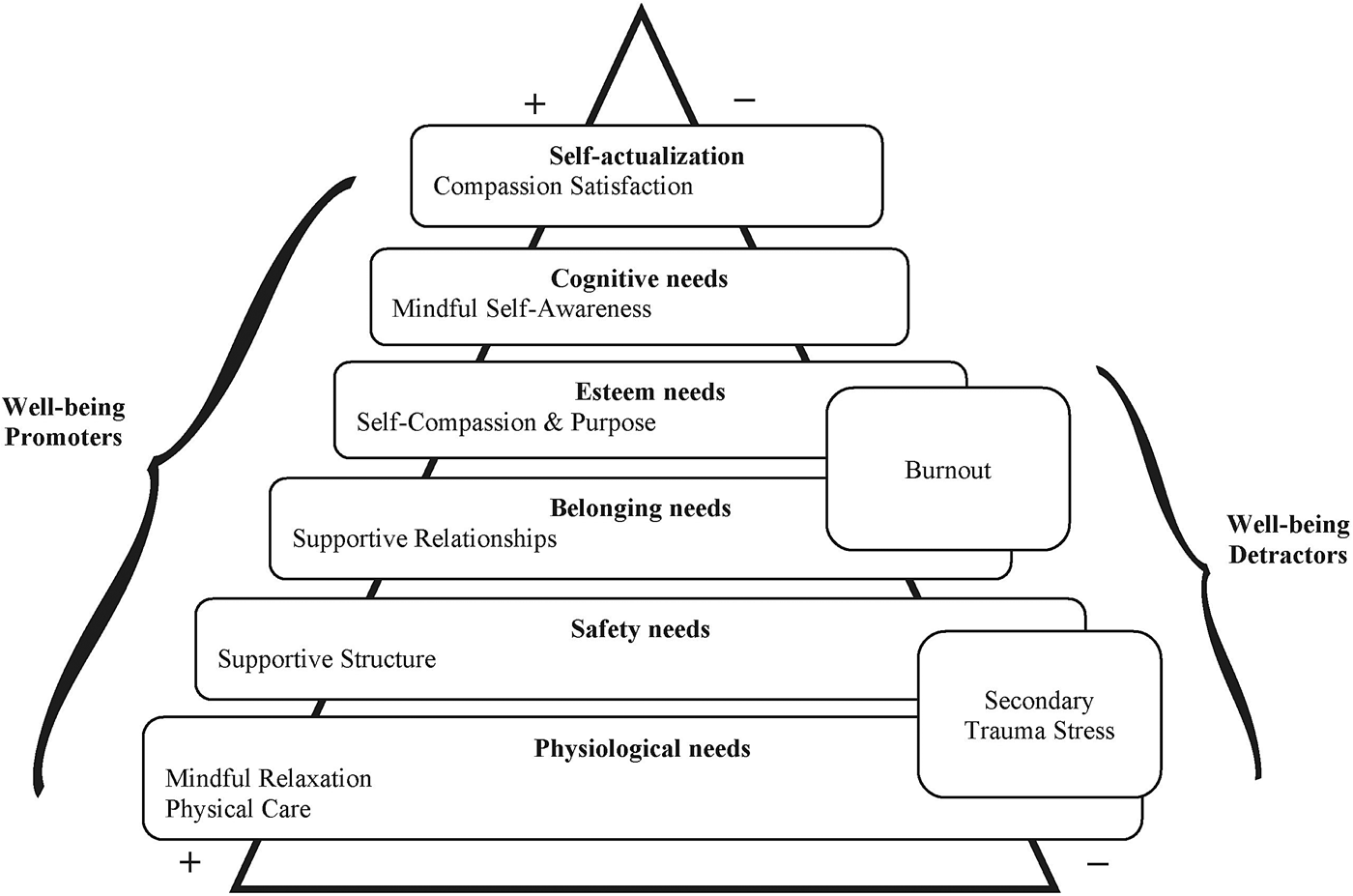
The MSCS assesses for mindfulness practices—formal and informal. Formal mindfulness, such as self-care practices, typically require setting aside time for practice (e.g., going to yoga class, time aside to meditate), whereas informal practices can be integrated into individual personal and professional behaviors. For both mindfulness and mindful self-care, formal and informal practices are believed to support a gradual shift from effortful practice to effortless, mindful living (Chiesa & Malinowski, Reference Chiesa and Malinowski2011; Cook-Cottone, Reference Cook-Cottone2015). The MSCS was developed in the context of body image research among university students (Cook-Cottone & Guyker, Reference Cook-Cottone and Guyker2018). With the aim of further grounding professional self-care theory in evidence, this study sought to validate the scale among HHCPs. The MSCS is intended to help individuals identify areas of strength and weakness in mindful self-care to improve strategies. The subscales fit well with Maslow's (Reference Maslow and McClelland1968) theory (see Figure 1). Six self-care domains and corresponding Maslow needs are: physical care and mindful relaxation (physiological needs), supportive structure (safety needs), supportive relationships (belonging needs), mindful awareness (cognitive needs), and self-compassion & purpose (esteem needs).
Healthcare professional wellness model adapted from Hotchkiss (Reference Hotchkiss2018).

Purpose
This study aimed to validate the recently developed Mindful Self-Care Scale (Cook-Cottone & Guyker, Reference Cook-Cottone and Guyker2018) among HHCPs and develop a brief version of the 33-item MSCS through confirmatory factor analysis (CFA) for item reduction using a rigorous methodology by Goetz, Lemetayer, and Rat (Reference Goetz, Lemetayer and Rat2013) The aim of CFA is to support the development and testing of theory. Because the MSCS was developed in the context of body image studies and not tested among HHCP, validation of the scale provides the empirical basis to empower HHCP with evidence-based, self-assessment tools to support compassion satisfaction, effective self-care, and reduction of compassion fatigue.
Methods
Data
This validation study used data sources from two studies: (1) a study of 364 hospice professionals (Hotchkiss, Reference Hotchkiss2018) and (2) a study of 534 chaplains (Hotchkiss & Lesher, Reference Hotchkiss and Lesher2018) for a total of 858 participants after removal of incomplete surveys, missing one or more items, from the datasets. These two studies were reviewed and approved by their respective institutional review boards: VITAS Healthcare and the Association of Professional Chaplains. All participants were directed to the survey hosted on surveygizmo.com. Hospice professionals were recruited by e-mail, presentations, and invitations at interdisciplinary team meetings. A self-care and wellness assessment was offered on completion and hospice participants were directed to self-care and wellness resources on betterselfcare.com, a resource created by one of the authors. Most hospice participants (83%) opted into the assessment e-mail. Chaplains were recruited through a single e-mail from the research director of the Association of Professional Chaplains, who declined on the assessment e-mail to chaplains.
Measures
Demographics. Common demographic data gathered in the two studies were: age, gender, ethnicity, highest education attained, and years of experience in healthcare.
MSCS. The MSCS is a 33-item scale that measures the self-reported frequency of self-care behaviors with Likert-type response anchors (1 = never; 5 = always). This scale is the result of an exploratory factor analysis and CFA with two large samples (Cook-Cottone & Guyker, Reference Cook-Cottone and Guyker2018). The subscales are: Physical Care, Mindful Relaxation, Supportive Structure, Supportive Relationships, Mindful Awareness, and Self-Compassion & Purpose. The MSCS total scale and subscales have strong internal consistency and reliability. Cronbach's coefficient alphas for the MSCS and brief MSCS are reported in the results below.
Formal mind-body practices. The weekly frequency of formal mind-body practice such as yoga, meditation, or tai-chi was assessed with the single item from Physical Care: “I practiced yoga, mindfulness meditation or another mind-body practice (e.g., Tae Kwon Do, Tai Chi, Pilates).” Just as all MSCS items, the choices were: never (0 days per week), rarely (1–2 days), sometimes (2–3 days), often (5–6 days), or daily (6–7 days).
Professional Quality of Life (ProQOL). Stamm's approach to operationalizing Compassion Satisfaction, Secondary Traumatic Stress (STS), and Burnout was selected (Stamm, Reference Stamm2010). The scale has been used internationally and has been psychometrically validated in various populations. It contains 30 items in total, 10 items for each variable with five-point, Likert-type anchors (1 = never; 5 = very often). Each scale has a maximum of 50 points. This sample had the following Cronbach alpha reliabilities: Compassion Satisfaction (α = .87), STS (α = .82), and Burnout (α = .82).
Life Satisfaction (SWLS). The SWLS (Diener, Reference Diener, Emmons and Larsen1985) is a five-item scale of global well-being. This measure was included to complement compassion satisfaction, which is well-being specific to the domain of caring. Participants rated the degree to which they agreed with each item (1 = strongly disagree; 7 = strongly agree). This sample had the following Cronbach alpha reliability for SWLS (α = .87).
Analysis
This CFA followed the rigorous, scale revision approach of Goetz (Reference Goetz, Lemetayer and Rat2013) to produce a shorter scale while maintaining the psychometric and conceptual properties of the existing version. The analysis consisted of three main steps. In step 1, a data screening was conducted. The sample data, analyzed in SPSS 24 and Amos 23, was found to meet the requirements of conducting a valid CFA: normal distribution and sufficient sample size.
In step 2, the existing MSCS model was tested using CFA to provide a baseline model. Step 3 involved removing items with low loading, empirical, and conceptual overlap with other items. For the current model testing, four goodness-of-fit indexes were used: the χ2, comparative fit index (CFI), Tucker and Lewis's index of fit (TLI), and root mean square error of approximation (RMSEA).
Several parameter criteria were used to assess model goodness-of-fit: (1) chi-square divided by degrees of freedom (chi square/df); with large sample sizes, this value should be 4.00 or smaller; the lower this value, the better the fit; (2) RMSEA values <0.08 “acceptable” fit (Awang, Reference Awang2012) and <0.05 “good” fit (Brown, Reference Brown2006); (3) CFI and TLI >0.90 indicated an “acceptable” fit, >0.95 indicating “good” fit (Hu & Bentler, Reference Hu and Bentler1999). These cut-offs are best interpreted as rules-of-thumb rather than golden rules (Marsh, Hau, & Wen, Reference Marsh, Hau and Wen2004).
A list of candidate items for removal was created based on poor factor loadings (<0.40), large interitem correlations and conceptual overlap with other items (>0.30). Overlapping item pairs were identified by examination of modification indices (MI > 10), expected parameter change values (EPC > 0.4), and large standardized residual covariances (SRC > 0.4). Although these cut-points were used as a guide, the focus of interpretation is primarily on the relative size of these indicators to inform choices around item retention and removal, in conjunction with changes in model fit following item removal, and the overall concept of the MSCS. For each subscale, at least three items were retained to facilitate model accuracy.
Finally, in step 4, model 2.4 was refined by assessing whether a sufficient number of items have been removed. Mean scores and SD for each brief factor were calculated by multiplying the brief factor score by the ratio of the total items over the number of retained items so that the scores for the MSCS and the B-MSCS would be comparable.
Reliability, construct, and concurrent validity of the MSCS and B-MSCS
Once the shortened scale was developed, the internal consistency and concurrent and construct validity of the existing scale and the shortened version were compared to ensure that psychometric properties were preserved. The internal consistency and reliability of each of the subscales was examined using Cronbach's alpha (Cronbach, Reference Cronbach1951) and compared across the two versions. Construct validity was initially assessed by comparing correlations between the MSCS and B-MSCS subscales. Then concurrent and construct validity were assessed by examining associations with theoretically relevant constructs. Measures were scored using the prescribed coding methods in their manuals. A missing value analysis was performed. A combined total of 119 surveys (47 hospice and 72 chaplain) missing one or more items from the 64-item questionnaire were removed from the analyses. These accounted for 12.5% of all surveys.
Ethical approval
All procedures performed in studies involving human participants were in accordance with the ethical standards of the institutional and/or national research committee and with the 1964 Helsinki Declaration and its later amendments or comparable ethical standards.
Results
Demographics
Females (60.7%) were the majority among the 858 respondents. The mean age was 54.2 years (SD = 9.64). Most HHCPs served in a hospice (54.1%) or a hospital (39.6%). The mean years of professional experience was 15.5 (SD = 9.88, ranging from 1 to 40 years). Most attained graduate (67.5%) or undergraduate education (22.5%); followed by high school (5.7%) and some college education (3.5%). The racial and ethnic background of participants was: 0.3% identified as American Indian or Alaskan Native; 4.8% Asian or Pacific Islander; 9.6% black or African American; 11.1% Hispanic or Latino; 75.4% white or Caucasian; and 5.2% other or preferred not to answer.
Step 1: Data screening
In step 1, a data screening was conducted. The criterion for normal distribution was met—that the univariate skewness and kurtosis were lower than 2 and 7, respectively (Chou & Bentler, Reference Chou and Bentler1990). No substantial outliers were identified. The sample size of 858 was much larger than the recommended minimum of 200 to perform a CFA (Wolf et al., Reference Wolf, Harrington and Clark2013).
Step 2: Testing of the existing MSCS model
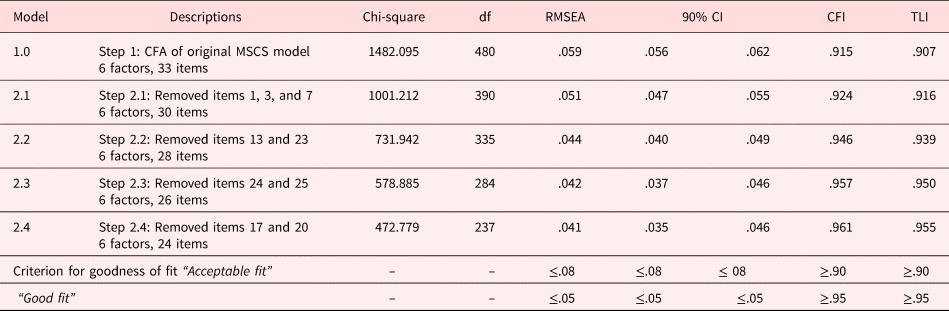
The existing model, 33-item MSCS with 6 subscales, had acceptable fit to the data (model 1.0). All indicators of fit were within acceptable ranges (χ2/df = 3.08, df(480), p < 0.01, RMSEA = 0.059, CFI = 0.915, TLI = 0.907). RMSEA was within the acceptable range (0.059 < 0.08), chi square/df was <4. The CFI and TLI were in the range of acceptable fit for these indices (>0.9). Although the 33-item MSCS had acceptable fit, there were elevated modification indices and EPC values indicating that several items were closely related, or loaded on to more than one factor of the scale.
Step 3: Item removal
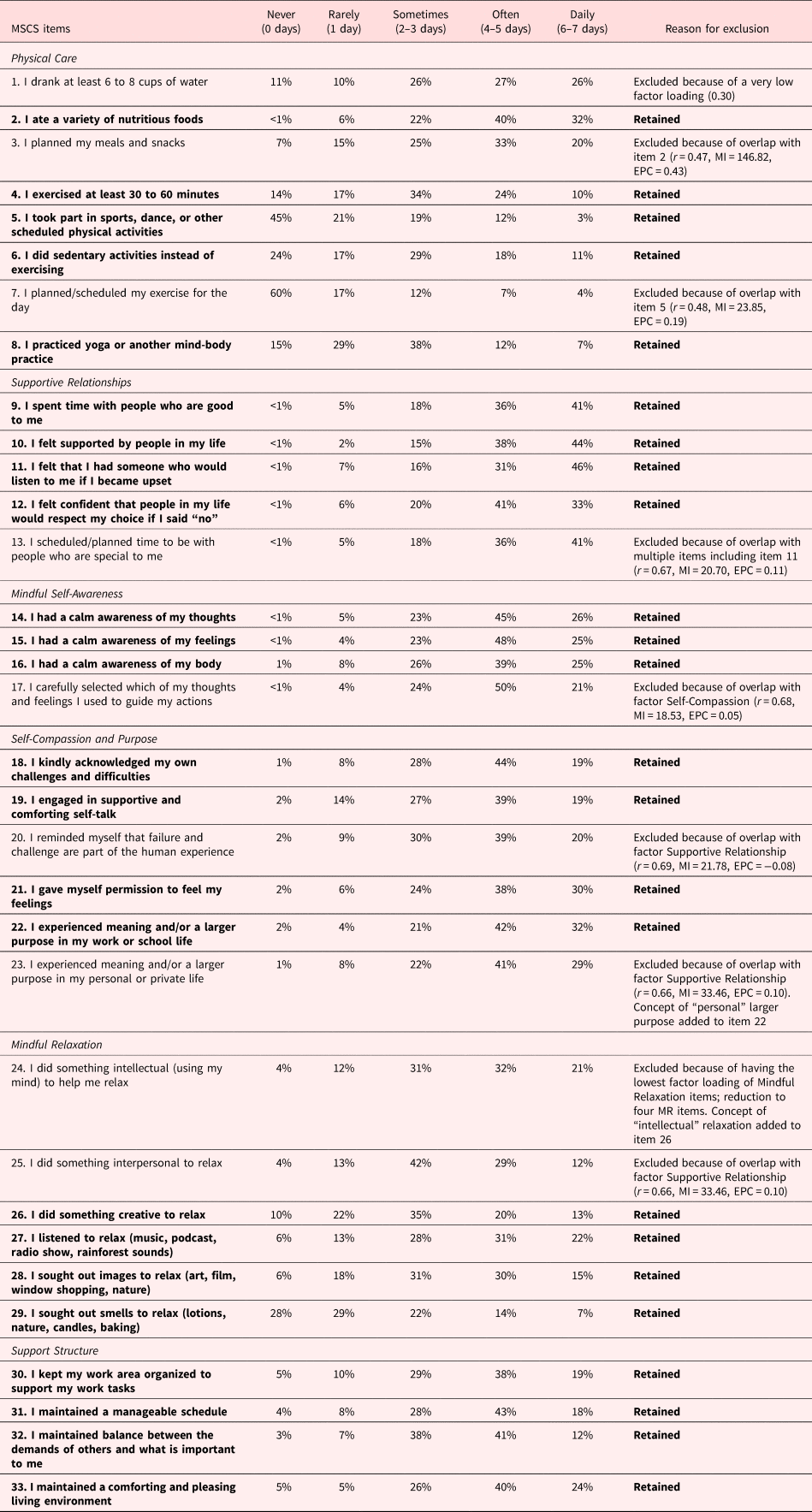
Inspection of modification indices, residual variances and EPCs revealed a number of items that overlapped with other items. Table 1 displays which items were removed and the reasons for exclusion. All items with poor loadings on their factor (<0.40) were removed. Only item 1 (0.30) fit this criterion and was dropped. In model 2.1, items 1 and 3, which were related to nutrition behaviors, were removed because of poor loading (item 1) and item 3 overlapping on item 2. Item 7 was removed because of overlapping on item 5.
Mindful Self-Care Scale: item content, response frequencies, and reasons for item exclusion (N = 858)

Notes: Items retained in the final scale are in bold.
EPC = Expected Parameter Change; MI = Modification Index.
From model 2.2 to 2.4, items were removed in pairs—beginning with the items drawing the highest modification indices. Item 13 overlapped with multiple items and was thus redundant. Item 17 overlapped with factor Self-Compassion. Items 20, 23, and 25 overlapped with factor Supportive Relationships. Each were dropped from the brief-MSCS. From model 1.0 to 2.4, the RMSEA, CFI, and TLI gradually improved. In total, nine items were removed from the six dimensions. Removal of these poorly fitting items was associated with improved fit of the model (model 2.4, Table 2). The final model, model 2.4, demonstrated better fit to the data (chi-square/df = 1.99, df(237), p < 0.01. RMSEA = 0.041, CFI = 0.961, TLI = 0.955) than model 1 (existing MSCS). The RMSEA, CFI, and TLI indices improved from acceptable to good fit.
Model fit statistics step-wise through the model revision (N = 835)

Notes: To demonstrate improvement of fit, values are reported to three decimal places.
CFI = comparative fit index; RMSEA = root mean square error of approximation; TLI = Tucker-Lewis index.
Step 4: Model refinement
Refinements were made to increase conceptual range in the shorter 24-item measure. Item 22, “I experienced meaning and/or a larger purpose in my work or school life,” (SC5) was generalized to “I experienced meaning and/or a larger purpose in my work or personal life” to assess meaning globally. In summary, the final 24-item measure was more parsimonious with nine fewer items and a better model fit.
Reliability, construct, and concurrent validity of the MSCS and B-MSCS
To assess the reliability and internal consistency of the MSCS and B-MSCS measures in the sample, Cronbach's alphas were computed and reported together below. For the MSCS and B-MSCS subscales, alphas respectively were nearly identical: Physical Care (0.76, 0.77); Supportive Relationships (0.79, 0.77); Mindful Awareness (0.82, 0.86); Self-Compassion and Purpose (0.84, 0.78); Mindful Relaxation (0.79, 0.74); and Supportive Structure (0.79, 0.79).
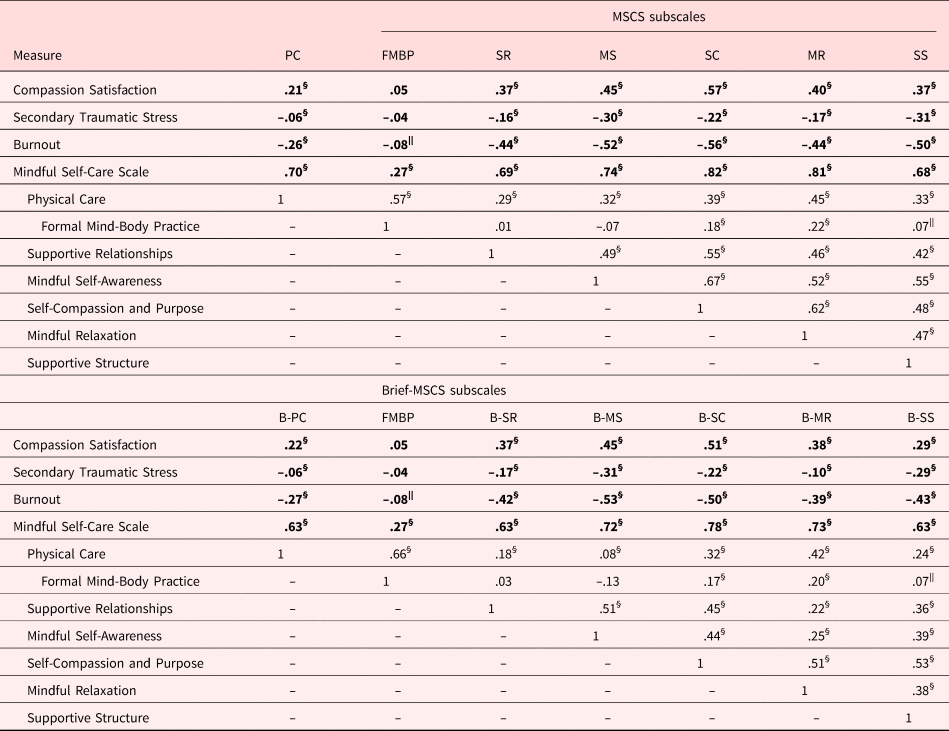
To inspect the construct and concurrent validity of the MSCS and B-MSCS measures, correlations of the subscales to MSCS total and to other well-being measures were computed. Correlations between the subscales of the MSCS, B-MSCS, SWLS, and ProQOL measures were calculated in the sample. The resulting correlations coefficients are displayed in Table 3. All the brief subscales correlated to the existing MSCS with nearly the same magnitude.

ProQOL = Professional Quality of Life (includes BO = Burnout; CS = Compassion Satisfaction; STS = Secondary Traumatic Stress); MSCS = Mindful Self Care Scale (includes FMBP = Formal Mind-Body Practice; MR = Mindful Relaxation; MS = Mindful Self-Awareness; PC = Physical Care; SC = Self-Compassion and Purpose; SR = Supportive Relationships; SS = Supportive Structure); SWLS = Satisfaction with Life Scale.
* Cook-Cottone and Guyker (Reference Cook-Cottone and Guyker2018).
† Stamm B. (Reference Stamm2010).
‡ Diener et al. (Reference Diener, Emmons and Larsen1985).
§ Correlation is significant at the 0.01 level (2-tailed).
|| Correlation is significant at the 0.05 level (2-tailed).
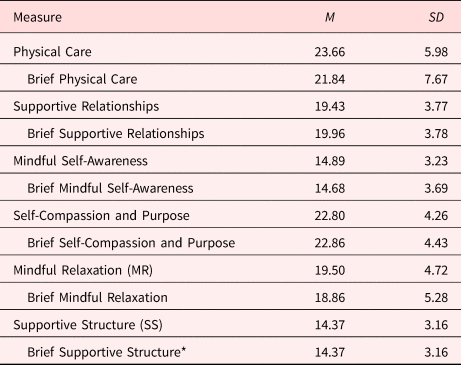
As expected, compassion satisfaction and life satisfaction had moderate-to-strong positive correlations with all MSCS factors. The negative well-being factors: secondary traumatic stress had weak negative correlations and burnout had moderate-to-strong negative correlations with all mindful self-care factors except physical care that had a weak negative correlation. The B-MSCS correlations followed the same pattern. Although there were some changes in magnitude within ± 10%, the relative strength of the relationships of the B-MSCS subscales to these other measures of well-being were comparable to MSCS. Thus, construct validity was maintained in the B-MSCS. Table 4 displays the mean scores and SD for each subscale and its corresponding brief subscale. The B-MSCS scores effectively, approximated the full MSCS scores.
Mean and SD of MSCS and B-MSCS subscale scores (N = 854)

* No items are removed from Supportive Structure.
Informal mindful self-care and formal mind-body practice
Informal mindful self-care, self-care that could be practiced while at work or home in the process of everyday life, was more frequently practiced than formal mind-body practices such as yoga or meditation. Among participants, on at least two days per week, 95.0% found support through relationships, 94.5% practiced mindful self-awareness, 90.8% had supportive structure; 90.5% practiced self-compassion, and 74.1% relaxed mindfully. However, only 57% practiced yoga or another mind-body practice at least two days per week.
Informal mindful self-care practices also had stronger associations to burnout risk reduction: self-compassion and purpose (r = –.56, p < .001), mindful self-awareness (r = –.52, p < .001), supportive structure (r = –.50, p < .001), supportive relationships (r = –.44, p < .001), and mindful relaxation (r = –.44, p < .001) than did formal mind-body practices (r = –.08, p < .01) such as yoga or meditation.
This study had a good representation of females (60.7%) and males (39.3%). The racial and ethnic groups had sufficient magnitudes to exceed the sample size criterion in all categories (Johnson, Reference Johnson2004). The sample showed a measure of diversity and representation of the healthcare workforce and thus a good representative sample of the larger population of healthcare workers.
Discussion
This study described the development of the B-MSCS using rigorous CFA methodology and considered both psychometric and conceptual criteria. The CFA of the existing 33-item MSCS was replicated in this study (Cook-Cottone & Guyker, Reference Cook-Cottone and Guyker2018). The results were similar: chi-square/df was nearly identical, RMSEA was slightly lower. Thus, the existing 33-item MSCS was replicated in this study with acceptable goodness-of-fit.
The brief MSCS model had improved fit relative to the longer version, and provided validation, and thus stronger evidence for, the developing theoretical model of healthcare professional wellness (Figure 1). It covers the six key dimensions of mindful self-care–physical care, supportive relationships, mindful self-awareness, self-compassion and purpose, mindful relaxation, and supportive structure. It has good conceptual coverage while eliminating redundant items. Reliability, in terms of internal consistency, was preserved in the brief version. Concurrent and construct validity were also preserved.
The existing MSCS was developed in the context of body image and eating disorder research among whom nutrition and hydration behaviors could have played a more significant role in self-care (Cook-Cottone & Guyker, Reference Cook-Cottone and Guyker2018). However, in this factor analysis with HHCPs, nutrition behavior items showed themselves to be weaker factors in the model. Not because nutrition behaviors do not play an important role in general health, but because the HHCPs in this study appear to be consuming adequate food and water. In the context of assessment of self-care and burnout among HHCPs, nutrition behaviors were not a significant factor and hence including the single nutrition behavior item in the Physical Care factor seemed adequate. HHCPs basic needs for hydration and a reasonably healthy diet were met and physical care had small effect on the well-being variables: compassion satisfaction, secondary traumatic stress and burnout.
In contrast to nutrition behaviors, HHCPs were not consistent in the self-care practice of exercise. HHCPs showed a preference for individual exercise, but the majority missed the positive accountability associated with participating in a scheduled group or team exercise. Formal mind-body practice was never or rarely practiced by more than one-third of HHCPs. Fifty-seven percent “practiced yoga or another mind-body practice” two or more days per week. Exercise is a well-established means of reducing stress and lifting one's mood, so exercise in the physical care factor is a vital and holistic measure of self-care.
Informal mindful self-care, in the process of everyday life, was practiced more regularly and associated with increased burnout risk reduction than formal mind-body practices such as yoga or meditation. However, research has shown that formal mind-body practices lead to more effortless, informal mindful behaviors in everyday life (Chiesa & Malinowski, Reference Chiesa and Malinowski2011). Those HHCPs who take the time for formal mind-body practice are likely to find increasing well-being benefits. As the practice deepens, the need for effortful processes are greatly reduced, resulting in a form of “effortless” meditation (Chiesa & Malinowski, Reference Chiesa and Malinowski2011) and further strengthening mindful living skills in general.
All three factors on the theme of planning or scheduling self-care overlapped with other items. These items included “planned my meals and snacks” (item 3); “planned/scheduled my exercise for the day” (item 7); and “scheduled/planned time to be with people who are special to me” (item 13). Although planning self-care is important, the actual practice of self-care is a more important conceptual factor than the intention of practicing self-care. Self-care that is practiced regularly (three days or more per week) has been explicitly (or implicitly) scheduled and prioritized in the life of HHCP. By removing these planning and scheduling items from the B-MSCS, the measure was more parsimonious with stronger validity without losing conceptual strength.
As expected, associations with relevant theoretical constructs were also preserved in the shorter version of the scale. Compassion satisfaction and life satisfaction had positive correlations with each MSCS factor and its corresponding B-MSCS factor in nearly identical magnitude. Likewise, secondary traumatic stress and burnout had negative correlations with each MSCS factor and its corresponding B-MSCS factor in nearly identical magnitude. Finally, the B-MSCS scores well approximated the full MSCS scores to facilitate comparison to normed data.
Limitations and further research
As with any study, this study had a number of important limitations. Participants self-selected to participate in each of the study datasets and the response rates were slightly low. Hospice staff who are practicing or interested in mindfulness and self-care might be more likely to take the assessment. Social acceptability might bias the results of the study. Although the sample showed a measure of diversity and representation congruent with the current healthcare workforce, the generalizability of these findings has some limits because of convenient sampling.
It is planned that future mindful self-care and wellness studies in healthcare will use this shorter version, facilitating further validation. Wellness research among hospice professional research could benefit from the rigors of randomized controlled trials, future hospice studies are encouraged to use the ProQOL, MSCS, or B-MSCS for measuring wellness and self-care that follow interventions, delivered in randomized controlled trials, to increase self-care, well-being and wellness.
Conclusions
Developed in the context of body image and eating disorder research, the MSCS appears to have utility in other clinical and research contexts, including healthcare. The existing (33-item) MSCS appears to be an excellent instrument for measuring factors of mindfulness and self-care. The B-MSCS is a concise measure (24-item) that will be particularly useful for large-scale surveys and studies of physicians who experience survey fatigue more acutely than other participants from time demands. It is likely to be useful in other research settings because of low respondent burden. It examines all dimensions of the existing MSCS. Furthermore, the 24-item B-MSCS version appears to have several advantages relative to the 33-item version, including fewer items, a cleaner factorial structure, and smaller interfactor correlations when studied among HHCPs. Together, the B-MSCS (24 items), the MSCS (33 items), and the Clinical MSCS (84 items) provide a range of options from which the clinician and researchers can select to suit their specific needs and the needs of the population they are serving or studying.
Disclosures
This research received no specific grant from any funding agency in the public, commercial, or not-for-profit sectors. No conflict of interest has been declared by the author.
Author ORCIDs
Jason T. Hotchkiss, 0000-0002-6856-7439.
Acknowledgements
Many thanks to Wendy Guyker, PhD, who helped develop the Mindful Self-Care Scale. Appreciation to Stephen D. King, PhD, who sponsored the study within the Association of Professional Chaplains, and Robin Fiorelli, Senior Director of VITAS Healthcare, who sponsored and sought VITAS’ approval for this study. Much gratitude to Julie Hotchkiss who made many editorial suggestions.