In 1942, British and American armed forces began a campaign against malaria among Allied troops in Accra. To better understand the biting habits of Anopheles gambiae (the species of mosquito that carries the malaria parasite), the Allies employed the British entomologist Lieutenant C. R. Ribbands to track the flight of mosquitoes around the city. Ribbands instructed British army engineers to build 18 mosquito traps, about the size of small sheds, and install them along the Korle watershed, a lagoon and river system that is sacred to the Ga people of Accra. To attract mosquitoes into the sheds, he hired migrant workers from the Northern Territories of the Gold Coast to sleep in them overnight, and, each morning, army crews doused the sheds with pesticides and collected the dead mosquitoes inside, so that Ribbands could compile an index of the biting and flight patterns of Anopheles gambiae.Footnote 1
During the course of the study, Ribbands had to deal with some resistance from his employees. He initially equipped the sheds with raffia mats, but when the ground became wet during the rainy season the men inside requested beds. Ribbands complied and distributed US Army cots to each test location.Footnote 2 The test subjects also complained that they suffered from multiple mosquito bites because they had been instructed to blow the mosquitoes off their skin rather than kill them by slapping them. They requested mosquito netting for their bedsFootnote 3 and Ribbands agreed, but, when he found that the nets made it difficult to collect the dead mosquitoes in the morning, he had them removed.Footnote 4 Another difficulty was that some of the test subjects seemed to attract more mosquitoes than others, prompting Ribbands to rotate the men through each trap, one week at a time, so that each made a circuit of the lagoon before returning to their original shed.Footnote 5 After several months of data collection, Ribbands was able to map out a ‘Malaria Control Area’ along the perimeter of the Korle Lagoon, and the Allies dispatched crews to spray the waterway with pesticides and larvicides.Footnote 6 By 1945, after months of fogging the lagoon with chemicals, Ribbands declared that all of the anopheline larvae in the control area had been destroyed and that only one live mosquito had been found in the entire eradication zone.Footnote 7
The Allied malariologists compiled their ‘Accra Anopheline index’ during an era of biomedical supremacy on the Gold Coast, a historical moment when discourses of biopower were reified through the practices of colonial technocrats. In the 1940s, Ribbands and his fellow entomologists regarded the Africans living in the city as a reservoir of disease that could be cleansed with the help of chemical pesticides.Footnote 8 In their efforts at disease vector control, they discounted the religious attachments to the Korle Lagoon held by the Ga people and unceremoniously doused the sacred waterway with pyrethrum and DDT. Surprisingly, the official history of the anti-malaria campaign differs substantially from local memories of the event. In fact, the depredations suffered by the residents of Accra during the 1942–5 anti-malaria campaign are almost forgotten. Over sixty years after the event, the memories of the spraying campaign and the use of human bait in mosquito traps are a mere footnote in the larger history of the colonial era.
The official history of the anti-malaria campaign is detailed in a report compiled by the Inter-Allied Malaria Control Group (hereafter IAMCG), an ad hoc body of British and American scientists brought together to fight malaria in Accra from 1942 to 1945. Their records describe in detail their attempts to control mosquitoes using entomological experiments, spraying campaigns, and engineering projects, laid out as a tale of biomedical triumphalism that celebrated short-term achievements in vector control. To supplement the documents of the IAMCG, this article will include interview evidence from people who worship at the shrine of the lagoon goddess Korle, the remembrances of veterans who were stationed in Accra, and the recollections of elders who lived through the anti-malaria campaign. These oral sources are not to be read simply as a counter-perspective to the official history of the anti-malaria campaign because, surprisingly, the residents of Accra today do not recall the campaign as a significant event. The veterans and elders who bear the memories of the ‘Hitler War’ (as it is popularly known in Accra) have trouble remembering the specifics of the anti-malaria campaign, and the religious elites who worship the goddess Korle do not even recall it happening. These oral sources cannot be used to form a counter-narrative; rather, they expose a substantial difference in the consciousness of the past that exists between official history and local memory. This type of cleavage between history and memory in Africa has been identified recently in the work of Filip De Boeck, who has shown how the postcolonial period in the Democratic Republic of the Congo has been characterized by a ‘fragmentation of a collective consensus’ regarding historical truths,Footnote 9 and by Richard Werbner, who has pointed out the tensions between collective rememberings and state-produced commemorations in Africa.Footnote 10 Jennifer Cole has also presented the stark contrasts between official histories of Madagascar's struggle for independence (as determined by histories adopted by the majority Merina) and the experientially based oral memories of people living in the Sakalava minority.Footnote 11 The story of the Korle Lagoon during the Second World War offers an opportunity to study differences between official histories and popular memories, and to contemplate the ways in which memory environments are formed and ruptured.
What the discrepancy between written and oral sources about the anti-malaria campaign shows is that the activities of the IAMCG can be contextualized in two distinct ways. From a historical point of view, the event was a parenthetical moment of hegemony in a longer struggle by colonial medical officers to implement plans to sanitize the city and re-engineer the Korle Lagoon.Footnote 12 In a region where healing was dominated by herbalists and spiritualists, the Second World War provided an opportunity for biomedical technocrats to demonstrate their abilities, and permitted them to transform Accra into a laboratory where they could study the relationships between race, environment, and disease. But this unified vision of the bodily and spatial relations of illness in the tropics is difficult to align with the fractured recollections of the event held in the minds of the Ga-speaking population. Local memories of the event in Accra today are couched within a longue durée of Ga cultural and religious survival. The parts of the anti-malaria campaign that are remembered are framed within a chronology that marks time based on an endurance of colonial overrule, one that stresses the forbearance and wisdom of the spiritual entities that reside within the topography of Accra. These are not just parallel perspectives, but divergent ontological reckonings of past events.
NAA KORLE ONAMEREKO: GA DISCOURSES ABOUT THE KORLE LAGOON
The Korle Lagoon is an important node in the topography of Accra, both geographically and spiritually. Its watershed demarcates the geography of Ga-speaking territory (an area that stretches north from the Atlantic Coast to the foot of the Akwapim Ridge), and the lagoon has provided water, fish, and salt to the people near its shores for hundreds of years. It is also a sacred member of a local pantheon of deities, a goddess worshipped at a shrine house in the oldest quarter of Accra. According to oral traditions passed down through the clan House of Korle, the goddess is an indigenous water spirit that was discovered when some hunters found two large pots containing beads on the shore of the lagoon. When the hunters took the beads home to their encampment, a woman named Dede saw them and became filled with the spirit of the lagoon goddess.Footnote 13 Afterwards, Korle became the tutelary deity of the people who lived around the lagoon.Footnote 14 Gendered as a woman, Korle is related to the other major deities of the city, as the daughter of Nai (goddess of the sea) and the wife of Sakumo (god of war). According to stories about the Ga sacred order, Korle is the guardian of the waters of the lagoon, and the priest of the Korle shrine holds title to the Korle watershed.Footnote 15 Additionally, oral traditions told at the Korle shrine represent the lagoon goddess as a moral force in the city, a haughty spirit remote from the petty rivalries of humans, as suggested by her slogan: Naa Korle Onamereko – Elder woman Korle, you will see me walking away (aloof and above everyone).Footnote 16
The Korle Lagoon is also a palimpsest of memories for the people of Accra, a place where, to use Pierre Nora's phrase, ‘memory crystallizes and secretes itself’.Footnote 17 Korle and her associated lesser gods are said to dwell in the shelter of the trees and shrubs in the deepest part of the lagoon.Footnote 18 In addition, spiritual forces related to Korle express themselves at smaller nodes of rock piles and concrete mounds known as otutui, which are tucked in and around the neighbourhoods surrounding the lagoon and dotting the seashore. These are the ‘children’ of Korle, who can be visited by walking around the lagoon with the priest or an elder from the House of Korle. They are also touchstones of memory that release historical information held within the minds of the followers of the goddess.Footnote 19 For example, a rocky outcrop near the lagoon's shore reminds the priest of Korle of a story about how the goddess allowed the destruction of the city by the armies of the Akwamu in the 1660s, in revenge against the Portuguese merchants who built salt pits on her shores.Footnote 20 Another site triggers memories of a time when Accra was surrounded by the armies of the Ashanti, who threatened to sack the city. Korle took human form as a woman and saved the Ga from defeat by cooking a meal that satiated the Ashanti and enabled the Ga to vanquish them.Footnote 21 More broadly, the lagoon remains a sacred space where performances in honour of the deity must be conducted in order to placate her, and to win her approval for any industrial or commercial activity around the body of water.
Like many of the lagoons along the coast of West Africa, Korle recedes during the dry season, forming mud flats and stagnant pools of water. Then, in June and July, it swells with rainfall and floods the low-lying parts of the city. Before the British dredged a channel between Korle and the Atlantic Ocean in 1927, the lagoon burst its sandy banks after heavy rainstorms every year, rushing into the sea. The breaking of the bar signalled adequate rainfall for the staple crop of corn, and prompted the Korle priest to perform a ceremony to inaugurate the planting season and to pray for the health of the community.Footnote 22 The lagoon was also a source of seafood for the people living in the area, and the residents of Accra cast nets from the shore to catch mud fish and waded along its banks to collect crabs and river snails. The goddess Korle allowed fishing in the lagoon with the exception of a two-week hiatus in late July and August, during the annual Ga Homowo harvest festival, when the Korle priest appealed to the goddess to continue supplying water and fish for the rest of the year. To lift the ban on fishing, the priest walked to the shore with an entourage from the shrine, and symbolically threw a net into the lagoon three times, collecting the fish and sharing them with the royal and priestly houses of the city.Footnote 23 Though the lagoon is no longer a major source of food for the people of the city today, it remains an annual site of pilgrimage for followers of Korle, and it is still a source of spiritual nourishment for those who worship the pantheon of Ga deities.Footnote 24
ENGINEERING KORLE: SANITATION AND COMMERCE IN THE EARLY TWENTIETH CENTURY
In 1877, when the British made Accra the capital of the Gold Coast, they believed the Korle Lagoon to be a reservoir of miasmatic gases that caused deadly tropical fevers.Footnote 25 Government medical reports linked filth and contamination to the local Ga population, in line with theories of racial ecology that located sources of illness within African bodies.Footnote 26 In 1897, when Ronald Ross discovered that mosquitoes transmitted the parasite that causes malaria, miasma theory began losing currency in Accra,Footnote 27 and instead the lagoon was reviled as a breeding pond for mosquitoes. European merchants were allowed to work in the central business district during the day because it was near the port of Accra, but they were required by law to live in a European ‘reservation’ situated half a mile to the east, a distance calculated to be more than a mosquito flight away from the Korle Lagoon.Footnote 28 Governor Nathan, who initiated the policy of segregation at the turn of the twentieth century, believed that the domestic quarters of colonial officials had to be set apart from Ga dwellings because Africans formed ‘native reservoirs’ of disease.Footnote 29 Europeans, according to the governor, were not racially adapted to tropical climates, and Nathan believed that keeping them at a distance from the Ga inhabitants of the city was the most practical way to preserve their health.Footnote 30 Despite the vilification of the lagoon, however, the religious significance of the watershed was perpetuated by the House of Korle, and the sacred and secular meanings of the waterway coexisted for several decades without significant conflict.
After the First World War, the boom in the cocoa industry led to an exponential growth in traffic at the port of Accra, and the Gold Coast government planned to eliminate the costly use of surf boats to deliver goods to freighters moored offshore by dredging the Korle Lagoon and transforming it into a deep-water harbour.Footnote 31 In 1919, the Public Works Department tendered the contract to a British engineer, who made a down payment of £50 to the House of Korle for permission to survey the lagoon and promised an additional £15,000 for the future lease of the waterway. The project quickly ran into difficulties, however, when the engineer discovered that the rights to the lands surrounding the lagoon were contested by the political authorities in the city. The chiefs of the various quarters of Ussher Town were interested in claiming some of the lease payments for the project so they challenged the rights of the Korle priest to collect the harbour fees in colonial courts. The case was tied up for several years, forcing the contractor to abandon the project.Footnote 32
The failure to convert Korle into a harbour was a blow to British aspirations to sanitize the city. Dr Selwyn-Clarke, a physician who guided public health policy on the Gold Coast in the 1920s, believed that the lagoon continued to produce a ‘plague of mosquitoes’, and he pressed the government to re-engineer it.Footnote 33 In the mid-1920s, the Public Works Department did fill some marshy areas of the lagoon with refuse (with the approval of the priest of Korle), but they still awaited approval for dredging.Footnote 34 In 1929, after two years of lobbying the Colonial Office for funding, Governor Slater received official consent for a £195,000, six-year scheme to create a sea outfall that would flush the waters of Korle into the Gulf of Guinea, and colonial engineers set to work building tidal sluice gates to regulate the flow of water.Footnote 35 They also had plans to dredge the lagoon and construct dwarf walls all the way up the watershed but, after spending three years and £27,000, the British were forced by financial retrenchment during the 1930s to abandon the scheme.Footnote 36 British engineers did build a causeway over the sandbar, but the sea outfall slowly began to fill with sand owing to seasonal flood patterns, and the Director of Medical Services admitted ten years later that the whole scheme ‘might never have been undertaken at all’.Footnote 37
COLONIZING KORLE: THE IAMCG ANTI-MALARIA CAMPAIGN OF 1942–5
During the Second World War, the arrival of British and American armed forces in Accra renewed interest in sanitizing the Korle watershed. In 1941, Allied troops fighting in North Africa were cut off from Mediterranean supply routes and had to be supplied by air from West Africa. Accra became a staging area for troops recruited in the colonies, and the city quite suddenly found itself playing a role as a stopover point for British and American aircraft.Footnote 38 During the peak years of 1942–3, 200–300 aircraft stopped daily at Accra for refuelling and maintenance.Footnote 39 In order to deal with potential casualties of war, and to treat soldiers, sailors, and airmen who suffered from tropical diseases, the British built the first hospital dedicated specifically to military personnel near the Accra airfield, a segregated facility (with 200 European beds and 800 African beds) that was known officially as the 37th General Hospital of the British Empire. The hospital was badly needed because, by 1942, malaria rates among soldiers and airmen in Accra were startlingly high. Both white and black servicemen suffered, but the disease was particularly bad among the white soldiers (who had never been exposed to the disease climate of West Africa), reaching morbidity rates of over 50 per cent per annum. Additionally, epidemic flare-ups crippled whole camps at a time, such as during the rainy season of 1942 when 62 per cent of the soldiers in one British camp were hospitalized.Footnote 40 The Allies, who had not counted on investing so heavily in operations in West Africa, were thus compelled to take steps to control malaria in Accra.Footnote 41
Concomitant to Allied concerns about illness among their personnel was the fear of the loss of valuable war materiel. According to a US Air Force report, 25 per cent of the pilots flying from West Africa to Egypt were landing in Cairo with malarial symptoms.Footnote 42 Since planes were in such short supply, the Allies stationed in Accra strongly advocated the need for a mosquito vector control scheme around the airport, claiming that:
Malaria control of an airfield (especially in the case of an essential airfield) shows a large credit, for the loss of only two or more heavy bombers, resulting from a poor landing by a pilot attacked with malaria during the flight (a thing very liable to happen in high altitudes of flying when the pilot has parasites in his blood), more than pays for the cost of the scheme. The cost of a Superfortress is in the region of $600,000 …Footnote 43
Malaria was not only a threat to the health of servicemen; it was a financial drain on the war effort.
In the British colonies of Malaya and Singapore, British engineers had undertaken drainage schemes that targeted the mosquito vector and had reduced instances of malarial fevers dramatically,Footnote 44 while, in French West Africa, colonial governments had dredged and drained swamplands in an effort to contain malaria and yellow fever.Footnote 45 In British West Africa, efforts to fight the mosquito had been less vigorous, mostly relying on the relocation of colonial officials to European reservations and hill stations,Footnote 46 and in Accra the vector control project for the Korle Lagoon had been left to languish.Footnote 47 Most of the Gold Coast-born residents of Accra would have had an acquired partial resistance to the illness if they had survived malaria as children. This reduced the likelihood that malaria could develop into a life-threatening illness, but it did not make people immune. As British medical exams conducted during the war showed, malaria was widespread among all population groups in Accra.Footnote 48 Most of the Ga inhabitants of the city probably managed the illness with antimalarial herbal febrifuges, made from the leaves, roots, and tree barks of local flora, without recourse to pharmaceuticals produced in Britain.Footnote 49 British colonial officials, on the other hand, had used quinine as a check against malaria since the nineteenth century,Footnote 50 and, in the 1930s, the Medical Department made quinine pills available at colonial post offices for a moderate price of 6d for 16 doses (a course sufficient to cure malaria infection).Footnote 51 As a chemical prophylactic, quinine was effective, but it was only reliable if the individual followed instructions to take the pills every day. Any lapse in dosage could mean days or even weeks of illness, and, in some cases, death. Additionally, the Japanese invasion of the island of Java in the Dutch East Indies in March 1942 cut off the Allies from their source of natural quinine, which meant that a new strategy for controlling malaria was desperately needed.Footnote 52
As Accra became an increasingly significant transit point for the US Air Force, the British hoped that the Americans would see the benefits of financing the re-engineering of the Korle watershed. The British Area Malariologist, Major Macdonald, argued strenuously that the lagoon and its tributary streams were ‘swarming with Anopheline larvae’, in the hope that the United States might assist in a vector control project.Footnote 53 Before the Americans would sign on to a joint drainage programme, however, they brought their own malariologist to the city to investigate the situation. Dr Coggelshall, a specialist in tropical medicine at Michigan University, proposed a plan to prevent malaria in the city that included changes to the way that soldiers were housed, changes to soldiers' attire, and, most importantly, the excavation of 45 kilometres of viaducts and ditches around the city. Coggelshall joined forces with Major Macdonald to initiate the IAMCG and, by the end of 1942, both the US Army and the British Colonial Office had agreed to fund the scheme.Footnote 54
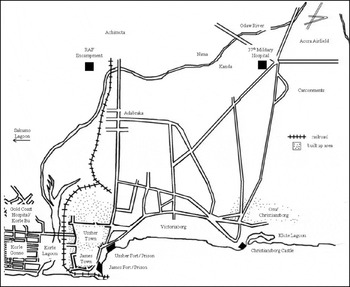
The initial step taken by the IAMCG to reduce incidences of malaria was to house Allied troops in accordance with past patterns of segregation. Two camps near the airport – the British barracks and the ‘American Lines’ barracks – were specifically built at a distance of a quarter of a mile from the village of Nima, and the temporary Royal Air Force camp near Achimota was similarly distant from any Ga villages (see Fig. 1).Footnote 55 The IAMCG also made efforts to instil the need for vigilance among the soldiers against mosquito bites. Allied troops were instructed to wear mosquito repellent, cover their skin at night, and sleep in screened buildings under mosquito nets.Footnote 56 They were also subjected to a propaganda campaign that depicted the mosquito as a ‘fifth column’ that threatened the war effort. On a series of cartoon slides projected before film screenings at the barracks, the mosquito was betrayed as a traitor that, in collusion with a careless soldier who left a door open or a window unscreened, could attack the troops in their sleep.Footnote 57 In Accra, where there were no Axis soldiers to fight, the mosquito became the enemy.
Accra during the Second World War. This map shows the interior of the Malaria Control Area of the IAMCG, depicting the Korle Lagoon and its major tributary, the Odaw River. Allied efforts to eradicate mosquitoes also targeted the smaller Klote Lagoon at Osu and the larger Sakumo Lagoon, several kilometres to the west. The village of Nima, which the British and Americans claimed to have evacuated during the war, is also depicted, at the top of the map.

Until 1942, Allied doctors had distributed a daily dosage of five grains (one-third of a gram) of quinine to all army personnel but, when supplies ran low, they started to experiment with synthesized versions of the drug.Footnote 58 They tested two new versions on the Gold Coast: quinacrine (reverse-engineered from a captured German I.G. Farben product by Sterling Winthrop Co. in 1941)Footnote 59 and mepacrine (synthesized by Imperial Chemical Industries in 1939).Footnote 60 Quinacrine was a superior product because it had few side-effects but mepacrine was in greater supply, so the Allied doctors in Accra settled on a daily dose of the latter by mid-1943. The soldiers disliked mepacrine because it caused a yellowish pigmentation of the skin, but they were required to take it every morning with their breakfast.Footnote 61 African soldiers took the drug too, but it was never handed out to the labourers working at the Allied camps, and the broader Accra community still had to buy antimalarial pills at the post office. Though African bodies were thought of as reservoirs of disease, the chemotherapy to combat malaria was mostly restricted to white bodies.
As the campaign commenced, the Allies hoped that chemical insecticides might save them from the expense of re-engineering the Korle watershed. The Americans were especially interested in using a ‘silver bullet’ approach to eradicate the local mosquito population because they did not want to fund infrastructure projects in places that they would abandon after the war. In April 1942, the US Army began spraying dust containing the larvicide paris green on any open water surrounding the camps, and started trucking pyrethrum aerosol bombs into the nearby British camps to clear the buildings of mosquitoes.Footnote 62 They then coordinated with the British to commence spraying all buildings within a one-mile radius of their camps, three times a week. In July 1944, when adequate supplies became available, they switched to the more effective dichloro diphenyl trichloroethane (DDT) and, by the end of the year, they were spraying all villages within an eight-mile radius of their camps, including the city centre of Accra.Footnote 63 Because the toxicity of DDT was understood to be very low, the Allies extended aerial spraying to the Korle and Klote Lagoons, and even attempted some experimental spraying to the west of the city, at the Sakumo Lagoon.Footnote 64
The IAMCG spraying campaigns of 1942–5 were conducted at great expense in labour and materiel. During a three-month attempt to eradicate mosquitoes around the airport in 1944, the Americans sprayed over 1,000 pounds of paris green, 2,000 pounds of pyrethrum, and 500 pounds of DDT, and they still found larvae in some of the streams leading into the lagoon.Footnote 65 The British had always believed that it would be more cost-effective to take the time to build drainage systems that confined water to ditches and ponds, where smaller amounts of insecticides could be used, and, as the war dragged on, the Americans, too, began to see the necessity of long-term planning.Footnote 66 In 1944, the Allies organized a British–American Malaria Task Force, which conjointly began to re-dredge the sea outfall and employ African crews to clear ditches and streams all the way up the Korle watershed.Footnote 67 The Royal Army Medical Services followed up by spraying and oiling the waterways on a regular basis, a method that reduced the amount and cost of the pesticides used.Footnote 68
While the drainage scheme proceeded, Lieutenant C. R. Ribbands of the Malaria Field Laboratory and his fellow malariologists continued to monitor the mosquito population in the camps and surrounding villages. An expert on Anopheles gambiae, Ribbands had already researched the flight and biting habits of mosquitoes through a variety of experiments in India and West Africa.Footnote 69 Replicating a study that he had conducted in Sierra Leone, he started collecting mosquitoes from the tents where the soldiers of the Gold Coast Regiment slept.Footnote 70 The mosquito crews spread sheets on the floors of the tents, and sprayed the air with pyrethrum or DDT to kill any insects inside. Afterwards, Ribbands hired local men to pick up the mosquitoes from the floor and bring them to a central laboratory for identification. With samples of mosquitoes from over 100 different tents, or ‘catching stations’, Ribbands was able to create an ‘Anopheline index’ for each part of Accra.Footnote 71
When the malariologists of the IAMCG analysed the results, they realized that, even with regular spraying at the army camps, the health of soldiers might be compromised by the in-flight of mosquitoes who had bitten infected residents in nearby villages. This fear of contagion spurred an immediate military response, summarized in the findings of a post-war American military report on the campaign:
a serious problem was the presence of numerous native villages in and near the camp area. These threatened to provide a potent source of malaria infection for military personnel. However, through the cooperation of the British Commissioner of Lands and the Inter-Allied Malaria Control Group all of these villages were moved outside the one mile zone.Footnote 72
Apparently the Malaria Control Group had extended their estimation of how far a mosquito could fly from the standard quarter-mile to a full mile. By this calculation, the village of Nima, which was connected to the airfield by pathways through trees and scrub brush, suddenly posed a threat to Allied troops as an indigenous ‘reservoir of disease’.Footnote 73 The statement also implies that the inhabitants of Nima were either moved or evacuated, without any particular details about how this happened.Footnote 74
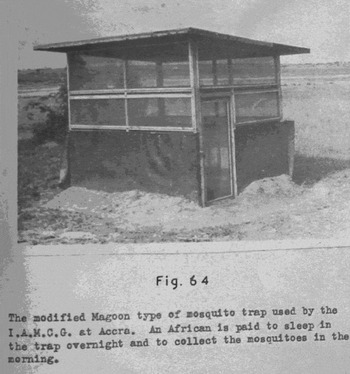
Once the IAMCG had established a Malaria Control Area around the periphery of the Korle Lagoon, Ribbands devised a system to collect information on the flying and biting habits of the mosquitoes that passed through it. To track the movements of Anopheles gambiae through the bushes of the Accra Plains, he created a system of mosquito sheds along the perimeter of the cordon surrounding the airport.Footnote 75 Built by African labourers in the employ of the British Army, the traps – single-room, timber-frame structures based on a model developed by the American entomologist E. H. Magoon – were covered with screens and tarpaper, and fitted with baffles to let mosquitoes in at night and trap them inside at dawn (see Fig. 2).Footnote 76 During his research in Jamaica, Magoon had used horses and mules to attract mosquitoes and had never employed human beings as bait. Ribbands, however, was specifically interested in monitoring the attraction of Anopheles gambiae to human hosts.Footnote 77 Since he was largely concerned with studying the attraction of mosquitoes to the white population, it would have been logical to assign an American or British soldier to live in the traps, but the Allies were shorthanded and Ribbands did not want to put white soldiers at risk of catching malaria. Instead, he hired 19 migrant workers from the Northern Territories of the Gold Coast to act as human bait in the traps.Footnote 78
Africans selected as bait were chiefly men from the Northern Territories of the Gold Coast. They were chosen because most of them were homeless and it was felt that they would welcome the fine shelters provided by the mosquito traps, however only those who could speak a few words of English were hired because they had to be able to understand the simple instructions. That the traps were home to these men was soon obvious when it was seen that they preferred to remain in the vicinity even during the daytime when they were not working.Footnote 79
A photo of one of 18 sheds that the IAMCG placed around the Korle Lagoon to monitor the flight of mosquitoes. Source: PRAAD, ADM 5/3/46, Malaria Control, fig. 64.

It was not surprising that migrant workers had the most difficult or degrading jobs in the colonial service. Favoured as members of so-called martial races, recruits from the Northern Territories made up over 60 per cent of the Gold Coast Regiment.Footnote 80 They were known as ‘Hausas’ in Accra because Hausa was the common language of the Regiment, but they came from a diverse range of ethnic backgrounds.Footnote 81 As migrants to the coast, they were geographically marginalized because they lived in villages on the outskirts of the city, and socially marginalized because they were not ethnically Ga. If they were ‘homeless’, it probably did not mean that they had nowhere to live, but rather that they were only intending to stay temporarily in Accra.Footnote 82 And, even if they did lack permanent residences, it is difficult to believe that they would have thought of the traps as desirable places to sleep. The sheds were small, filled with bugs, and lacking the benefit of the slightest breeze to cool the skin. It is also implausible that they thought of the traps as ‘home’, considering that Ribbands rotated each worker through the network of sheds along a perimeter of several kilometres.
The personnel used for bait were required to stay in their sheds from sunset to sunrise. When they awoke, they were to leave the traps, carefully closing the baffles to catch the mosquitoes inside as they left, so that the spraying crews could lay down a tarpaulin on the floor of the trap, spray the shed, and collect the insects. To monitor the sleeping patterns, soldiers in jeeps were sent around to ensure that the men serving as bait were actually sleeping in the traps and to prevent a reported ‘tendency to sit outside the trap at night’, which suggests that Africans who took part in Ribbands's studies were not always willing and forthright participants.Footnote 83 Though there is no record of outright resistance by the migrant workers hired as human bait, it appears that they took measures to preserve their dignity, and, especially, to avoid mosquito bites.
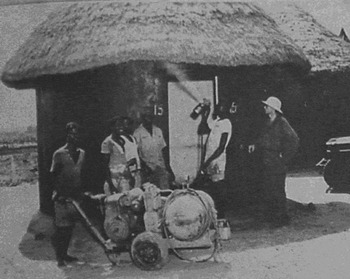
Though Ribbands and his fellow malariologists set out to fight the spread of malaria, they were not particularly interested in whether their test subjects contracted the disease. The extant military documents do not name the human subjects nor discuss their medical records. What the entomologists who compiled the anopheline index were interested in were the sources of mosquito breeding, and, once they had collected this data, they began to target locations around the Korle Lagoon for spraying with pesticides and larvicides. They also dispatched malaria crews around Accra to douse the thatch roofs of the houses with pesticides (Fig. 3), and they routinely sprayed DDT into the shallow wells that supplied drinking water to the city.Footnote 84 The IAMCG crews purposely sprayed African residences and water supplies because, according to Army malariologists, it was the only way to break the 14-day larvae–mosquito–human cycle of malaria transmission:
By spraying the houses of native Africans in the area with pyrethrum and DDT the mosquitoes were killed at the point where they became infested and before they could incubate and transmit the plasmodia they had extracted from the African bloodstream.Footnote 85
Ribbands and the Allied malariologists envisaged the bodies of the inhabitants of Accra as part of an urban reservoir of disease that could be cleansed with the liberal application of chemicals.
‘Spraying an Army hut with DDT’. This photo places the disinfecting machine in the foreground, emphasizing the primacy of technology in the fight against malaria. An unnamed, pith-helmeted, white supervisor watches the spraying, while the African employees pose for the camera. No personal health precautions were taken to protect people from the insecticides used because the long-term effects of chemicals such as DDT were not known at the time. Source: PRAAD, ADM 5/3/46, Malaria Control, fig. 53.

The Ga-speaking residents of the old quarters of Accra did not share Ribbands's enthusiasm for malaria vector control. Since the 1920s, the Gold Coast Sanitation Department had been inspecting urban water supplies for mosquito larvae,Footnote 86 but they had never used pesticides and the extension of the spraying campaign into urban areas generated discontent among the population. Details about local resistance are sparse, but there is some evidence that the worshippers of Korle protested the desecration of the lagoon, a sentiment reflected in a short but revealing passage from an American report on the anti-malaria campaign:
The application of larvacide to [lagoon] areas was strongly resented by the local native population who associated a high religious significance to these lagoons … [but the] natives [were] placated through negotiation by British authorities with the African chiefs.Footnote 87
This passage offers evidence that the residents of Accra were quite aware of the impact of a city-wide spraying campaign and were concerned about encroachment on their sacred spaces. But it also shows how indirect colonial rule allowed the British to curry favour with local chiefs as a way of disenfranchising the religious authorities of the city. How exactly the British appeased the chiefs is unknown but it probably involved sums of money to pay for the temporary rights to spray the lagoon, distributed in a manner that would allay any resistance to the campaign.Footnote 88 It also happened that the anti-malaria campaign occurred during a period of fierce chiefly disputes among the Ga, and at a time when the office of the priest at the House of Korle was vacant; these coincidences may have prevented the political and religious elites of the city from pressing their concerns about the spraying campaign.Footnote 89
FORGETTING THE ANTI-MALARIA CAMPAIGN
Few people in Accra today can remember the IAMCG campaign, which can only be recalled through interview evidence provided by ex-soldiers. Not all of the veterans who are still alive can recollect the anti-malaria campaign, but most can bring to mind bits and pieces of the event, such as being locked inside their barracks while the Americans fogged the buildings, being forced to take yellow ‘mosquito tablets’, and being ordered to dig through river beds with iron bars and rakes.Footnote 90 Only a few of them remember the mosquito traps. Otia Badu, a veteran who fought with the Gold Coast Regiment in Burma, recalled that the traps were set up near the Achimota forest, and that the British also tested ‘mosquito capes’ – overcoats with holes in the cloth that were covered with sticky glue to trap insects.Footnote 91 Badu claimed that the soldiers were ordered to wear the capes outside at night to attract mosquitoes, but there are no military records that back up this claim.Footnote 92 One former member of the Gold Coast Regiment, Oblitey Commey, recollected seeing mosquito traps near Nima and at points surrounding the airport, and made the offhand comment that if the British wanted to catch mosquitoes they should have slept in the traps themselves.Footnote 93 Another veteran recalled that the residents of Accra were not happy to see their homes doused in chemicals, and that rumours had circulated that the British were trying to poison the local population.Footnote 94 What each of the veterans emphasized was that, despite the indignities that the subjects of the Gold Coast faced under British rule, no one ever dared to challenge the ‘colonial masters’ during the ‘Hitler War’.Footnote 95 As the veteran John Borketey bluntly asserted, resistance was never an option: ‘Whatever they tell you, you do it. Colonial days. You have no choice.’Footnote 96
Beyond the recollections of elderly veterans, memories of the IAMCG among the general population of Accra are sparse. No one within the House of Korle remembers the aeroplanes that sprayed the lagoon with DDT, and the story of the house-to-house spraying campaign is largely unknown to older residents of Accra.Footnote 97 In Nima, the suburb close to the airfield that might have been a temporary home to migrant workers used as human bait during the campaign, religious leaders and elders have no recollection of the spraying campaign, the mosquito traps, or even the evacuation of their suburb.Footnote 98 This is surprising because the forced removal of residents in Accra in the past had always resulted in vociferous resistance that resonated in the collective memory. The inhabitants of the city rioted against British attempts to fill in a reservoir in 1889,Footnote 99 and in 1908 the residents of Ussher Town stoned doctors and sanitation officials who entered the city to demolish houses as part of a colonial anti-plague programme.Footnote 100
So why does the anti-malaria campaign fail to resonate within the collective memory of the people of Accra? The answer lies in the way that wartime memories were fragmented. The migrant workers who suffered the most by participating in the campaign were drawn from a labour pool of sojourners, men who left no mark on the memory landscape of Accra. They were unable to influence recollections about the war in Accra because they did not have a close relationship with the majority Ga speakers of the city, and as such were disconnected from the memory storage devices of the shrines.Footnote 101 In addition, the absence of memories among the Ga-speaking population of the city can be attributed to the lack of a priest at the House of Korle, owing to succession disputes. During the 1930s, the chiefly houses of the city had contested legal rights to lands surrounding the Korle watershed, and the ownership of the property remained unresolved until 1946, when the Korle elders installed Priest Nummo Ayiteh Cobblah II. In the interim, there was a rupture within the ‘memory environment’ of the House of Korle.Footnote 102 Since the priest and other clan members were not actively worshipping the goddess during the war, the spraying and re-engineering campaign was never apprehended as a meaningful event in her biography.Footnote 103 The annual customs of the shrine that served the purpose of sedimenting traumatic occurrences into ritual memories were put on hold, and the event of the anti-malarial campaign was never reborn as a revelatory memory, or as a ‘child’ of Korle. As a result, events of the ‘Hitler War’ are mnemonically orphaned within the collective consciousness of the Ga speakers of Accra.Footnote 104
Another reason why the anti-malaria campaign in Accra might have been forgotten is that it was overshadowed by the traumatic experiences of the war. As part of a six-year build-up of soldiers, planes, and munitions, the anti-malaria campaign might have seemed insignificant when compared to stories of U-boats off the Gold Coast, dispatches from the soldiers fighting in Burma, and accounts of atrocities in Europe. It is also possible that British wartime propaganda normalized the intrusions of the IAMCG. As Werbner and de Boeck have argued, interventions by the state (both colonial and postcolonial) can create memory crises, times when recollections about past traumas are submerged under official histories.Footnote 105 In 1939, the Gold Coast government created a Department of Information to disseminate news about the war in Europe, and they produced programmes in African languages to be broadcast on radio.Footnote 106 The colony also produced a weekly newspaper entitled The Empire at War, and the Governor of the colony held weekly news conferences with newspaper editors.Footnote 107 Most importantly, British propaganda co-opted the fight against malaria as part of the wartime struggle. In 1945, newspaper advertisements portrayed mepacrine as a weapon of war to be used against the mosquito, which was described as ‘more deadly than a dive bomber’.Footnote 108 And, in a radio broadcast during the same year, the British epidemiologist G. M. Findlay declared that malaria killed one-quarter of all children born in West Africa (an accurate statistic according to prior data) and warned the subjects of the Gold Coast that mosquitoes prefer black skin to white skin (a fallacious assertion unsupported by scientific evidence).Footnote 109 Findlay exhorted residents to destroy the breeding places of mosquitoes as part of the war effort and encouraged them to take a daily dosage of mepacrine or quinine, drugs that had, he asserted, had no ‘poisonous effects’ on the human body.Footnote 110
Wartime propaganda might have convinced many of the city's inhabitants to welcome the eradication of mosquitoes and other pests,Footnote 111 an assertion supported by Stephen Addae, a historian of medicine in the Gold Coast, who has argued that the subjects of the Gold Coast might not have known the science of malaria transmission but were certainly made aware that mosquito bites led to symptoms such as aches, chills, and fevers.Footnote 112 However, while this official version of the battle against malaria may have been internalized by some inhabitants of the Gold Coast, it is difficult to see how the African residents of Accra, who acquired partial immunity to the disease as children and were able to treat the illness with local herbal remedies, would have enthusiastically supported a mass spraying campaign that polluted their water supplies and desecrated the lagoon. Substantial gaps remain between the official history of the war and local memories of the event.
KORLE AFTER THE WAR
After more than a year of spraying, oiling, and draining the Korle Lagoon, the Allied forces declared the anti-malaria campaign a success,Footnote 113 citing the absence of mosquitoes and their larvae within the Malaria Control Area.Footnote 114 But, just as the malariologists declared victory over the insect, the Mediterranean shipping lanes opened up again, marginalizing Accra as a transit point for war materiel. In 1945, the number of troops stationed in the city dwindled rapidly, and the Allied forces hastily terminated their involvement in the anti-malaria campaign.Footnote 115 The departure of the American forces left the Gold Coast government unsure about whether they could sustain malaria vector control in the city. From 1942–5, the government had been responsible for funding only 8 per cent of the work done by the IAMCG, while the rest had been covered through the American lend lease programme (65 per cent) and the British armed forces (25 per cent).Footnote 116 After the war, the Allied forces left the Gold Coast Public Works Department with the cost of maintaining the massive drainage works built on the Korle watershed and with the responsibility of continuing to spray DDT around the city.Footnote 117 It quickly became evident that such a small department would never have a sufficient budget to conduct a perpetual campaign against malaria,Footnote 118 and the Public Works crews were further disheartened when new aerial photos of the city revealed dozens of quarries, salt pans, and borrow pits around Accra, too numerous to monitor and too expansive to spray regularly.Footnote 119 The effects of human habitation in the area had created a niche for mosquitoes to flourish, and it became obvious that the eradication programme could not be sustained. The British returned to a modest reliance on quinine prophylaxis, accompanied by occasional spraying to prevent epidemics. In the short term, the effects of DDT made the city notably healthier, and use of the chemical became commonplace in Accra, even in domestic situations where people wanted to control lice and bedbugs.Footnote 120 Kingsway, the largest department store in Accra, dispensed the drug at their chemist department, advertising it with the claim that DDT was ‘available for general use and to the eternal benefit of mankind’.Footnote 121 However, the mosquito population of the city quickly developed a resistance to the chemical, as happened in many other parts of the world. By the 1960s, the Korle Lagoon and its tributaries were once again mired in silt and malaria was endemic once more.Footnote 122
CONCLUSION
During the colonial period, the residents of Accra had often resisted biomedical reckonings of the unhealthiness of African urban spaces. However, the anti-malaria campaign of 1942–5 offered Allied medical technocrats a unique opportunity to turn Accra into a laboratory for testing the transmission of disease through the so-called African ‘bloodstream’. Allied fears of the infectious capacity of the population of Accra allowed British and American malariologists to pathologize the African body as a vector of disease, and to reduce disenfranchised migrants to the status of entomological test subjects. They were also able to overwrite the spiritual topography of the Korle Lagoon with a military medical geography that emphasized the control of mosquitoes over the health of the colonized. This was the apex of colonial medical power. Even at its peak, however, the Allied forces were not able to re-engineer the city completely. The British simply lacked the resources or the authority permanently to eradicate the local population of Anopheles gambiae in Accra. While they did briefly remove mosquito larvae from the Korle watershed, they could not afford to re-engineer the lagoon in a manner that would impose their vision of urban health on the Ga residents of the city. The limits of technocratic control over the medical landscape were especially obvious at the end of the war, when the anti-malaria campaign was left to the under-funded Public Works Department and the drainage scheme for Accra was maintained only at minimum cost.
But what is most striking about the anti-malaria campaign of 1942–5 is that it has faded from popular memory. Where it is remembered, it is bundled together with recollections of the ‘Hitler War’, a time when, as people recall, resistance against colonial authority was futile. During the technocratic supremacy of the IAMCG, the ritual control of the Korle Lagoon by the priestly House of Korle lapsed because of a struggle over succession, and as a result the events of the anti-malaria campaign were never stored away within the ritual habitus of worshippers at the shrine. But the identity of the lagoon as a deity re-emerged when the spraying crews left. In 1946, after several years of bitter disputes, Nummo Ayiteh Cobblah II was installed as the priest of Korle and he quickly rose to prominence during anti-colonial riots of 1948, as a participant in colonial government functions and as a friend of Kwame Nkrumah.Footnote 123 After his installation, the House of Korle once again began to participate in the annual harvest festival of Homowo by performing rites at the shores of the lagoon, asserting their association with the power of the lagoon goddess. In the post-war period, Naa Korle reclaimed her role as a moral force in the city, maintaining her reputation as a goddess aloof from human schemes to manipulate her watery form.