


The government-guided investment fund (zhengfu yindao jijin 政府引导基金, GGIF hereafter) has grown in popularity among China's governments at various levels as a policy tool for promoting development. As stated in one recently published document, “According to the needs of development, various funds … should be set up according to law to give full play to the guiding role and magnifying effect of government capital.”Footnote 1 All the funds mentioned in this document can be classed as GGIFs – a category which covers government-guided private equity funds and venture capital funds – which provide equity investment to support entrepreneurial activities, strategic industries and infrastructure. Central and local governments consider GGIFs to be an effective financial tool for promoting development, which has led to their rapid uptake throughout the country in a relatively short space of time.
This trend echoes the increasing financialization of the state globally, with both central government and local governments using financial tools to achieve policy goals.Footnote 2 Although the concept of “financialization” is controversial and has its limits,Footnote 3 state-led financialization in this study refers to the state's growing use of financialized policies. This broad definition of financialization is different from that used in many existing studies based on Western economies, as those studies largely consider financialization to be the result of neoliberalism and the diminishing role of the state.Footnote 4 However, this is not the case in countries like China.Footnote 5 While we agree that the forms and consequences of the financialization of the state are variegated, largely owing to different social and institutional settings,Footnote 6 this study aims to investigate how state-led financialization has occurred in China's institutional contexts.
We argue that two key institutional factors are crucial for understanding the financialization of the state in China. The state plays an important role in economic development and China has significantly reformed its economic and financial systems and adopted various “market tools”Footnote 7 or “capitalist tools”Footnote 8 in policy practices to encourage growth and development. This change in governance has led to fierce inter-regional competition among local governments to apply financialized policies. At the same time, the financial system in China is largely controlled by the state, as most key financial firms including banks, securities firms and insurance companies are state-owned. These state-owned financial institutions have also been actively involved in state-led financialization.
Drawing on the case of GGIFs, this study seeks to explore how the central government, local governments and state-owned enterprises have together shaped the development of this financialized policy tool in China. The rise and spread of GGIFs are not the result of “the collusion between the power of the state and the magic of finance.”Footnote 9 Rather, the massive uptake of GGIFs is the result of state planning and a policy of using financialized tools to achieve development goals. More importantly, unlike in Western economies where state financialization has reduced the role of the state, in China the central and local governments have significantly increased their influence over the economy through this financialized policy.
Although it is still too early to evaluate whether these development goals are being achieved, China's financialized policy is more “government guided” and less “market oriented” than expected, which is a reflection of the limitations of China's state-led financialization. The capital raised by GGIFs has come mainly from the government or state-owned enterprises. As a result, the key policy objective of using government capital to leverage the private sector capital has yet to be accomplished. Meanwhile, as we show below, as the state is heavily involved in the management of GGIFs, either directly or indirectly, the boundary between investments made by GGIFs and those made by traditional state-owned firms is blurred.
The rest of the paper is organized as follows. The second section provides a framework through which to understand state-led financialization in the Chinese context. The article then describes how GGIFs have spread all over the country and introduces the “government guided and market-oriented operation” model of the GGIF. We then analyse the role of the state in the spread of GGIFs and present our conclusions in the final section.
State-led Financialization in the Chinese Context
The state is the key actor in any financialization process.Footnote 10 “Financialization is arguably an opportunity for state entities,”Footnote 11 although scant research attention has been paid to the financialization of public and semi-public institutions.Footnote 12 In fact, the state is not only transformed by the process of financialization but also actively promotes financialization through the deregulation of financial markets.
It has been widely observed that the state plays a very active role in “facilitating, pushing and engag[ing] in the financialization of real estate”Footnote 13 and many different financialized tools have been used by the state to accomplish all sorts of goals.Footnote 14 Governments “may use finance to legitimize, empower and depoliticize the use of state policies, regulations and funding in order to prioritize the interests of private investors and financial actors or simply to ‘get by’ in a context of urban austerity, fiscal crisis, and policy devolution and rescaling.”Footnote 15 Financialization indeed has transformed government.Footnote 16 Urban policies rely on financial instruments,Footnote 17 and financialization tools are used for state management.Footnote 18 It is also argued that the state may use finance to extend its power.Footnote 19 In reality, various financial instruments are used by governments at different levels in many countries, including Western economies.Footnote 20
One stream of literature has linked financialization to neoliberalism and privatization in Western economies, defining financialization of the state “broadly as the changed relationship between the state, understood as sovereign with duties and accountable towards its citizens, and financial markets and practices, in ways that can diminish those duties and reduce accountability.”Footnote 21 It is even argued that neoliberalization has been realized through financialization.Footnote 22 Thus, the financialization of the state is understood as a result of neoliberal policies that tend to reduce welfare provision.Footnote 23 In this sense, the state has been captured by financialized capital.Footnote 24 However, financialization is not a continuation of privatization or necessarily neoliberal policies.Footnote 25 For instance, as shown in Mexico and Turkey, “private ownership is no longer necessary under emerging finance capitalism.”Footnote 26
Despite its market-oriented transformation,Footnote 27 China's unique characteristics make the financialization of the state there a case beyond Western experience.Footnote 28 In practice, the central government, local governments and state-owned enterprises are key to understanding the financialization of the state in China. First, the state has a very strong capacity to mobilize political and financial resources to achieve development goals by using and promoting financial tools. The Chinese state still continues to play a crucial role in the economy and the pursuit of economic growth. Policies are understood to be very “proactive towards its growth agenda.”Footnote 29 With the continuing opening up and reform of financial markets, more financial tools have become available to governments for the financing of development. For instance, stock exchanges are used by the central government to help state-owned firms reform and raise capital.Footnote 30 Recently, the rise of the “shareholding state,” as illustrated by the case of the giant state-owned financial institution Central Huijing Investment Ltd, indicates that the financialization of economic management has taken place in China.Footnote 31 Similarly, asset management companies have been used by the state as a “spatial–temporal strategy.”Footnote 32 In addition, the central government not only uses financial tools itself but also requires local governments to do so. Local governments are even more active in applying financialized tools to achieve development goals. Struggling to find funds and with land financing no longer a sustainable option for most looking to raise capital, local governments are eager to try new ways of financing development.Footnote 33 Moreover, local governments have strong incentives to learn from and compete with each other in the adoption of financialized tools.Footnote 34
Second, state-owned firms are seen as crucial in the financialization of economic management in China.Footnote 35 They are the source of key funding, investors, project managers and other important players in the financialization of development policies. Major banks, key securities companies and large asset management companies are state-owned and hold a dominant position in the financial market. State-owned firms, and in particular financial institutions, are controlled by the state and guided to provide finance for or to invest in projects relevant to national or local development goals. In this context, the whole financial system is required to support government policy directions. Thus, the circulation of capital in China can be driven by policy direction rather than by market forces. For instance, the China Development Bank plays a key role in financing urban development.Footnote 36 State-owned enterprises and financial institutions are the main investors or providers of loans for investment related to national strategies such as the “open up the west” development programmeFootnote 37 and the Belt and Road Initiative.Footnote 38 Inevitably, key financial institutions are drawn into the process of government-led financialization of development.
As shown above, the financialization of the state in China is significantly different to that in other economies. This study uses the case of GGIFs to explore the rapid implementation of a financialized policy across the country in this unique institutional setting. In addition, we examine the GGIF business model and the roles played by the central government, local governments and state-owned enterprises in the development of this financialized policy.
The Rise of the GGIF as a Financial Tool
The predecessor of the GGIF
In China, the GGIF was preceded by the public venture capital fund, which has been widely adopted by governments across the world. This financial tool has become more popular since the success of the Yozma Group, a government-sponsored venture capital firm established in Israel in 1993.Footnote 39 After 2000, many Western economies turned to government co-investment funds (CIFs), as a mainstream policy scheme, to support start-ups.Footnote 40 CIFs are designed to encourage the matching of public and private investment, with the private sector taking the lead in investment selection.Footnote 41 Overall, CIFs have been used by governments in Western countries in a modest way. First, the investment area of these funds is limited to supporting start-ups and is considered to be complementary to the seed and early-stage entrepreneurial finance market.Footnote 42 Second, the money provided by the government is also limited. The London Co-Investment Fund is a typical case.Footnote 43 This fund was set up in 2015 and raised £25 million to co-invest in seed rounds of between £250,000 and £1 million.
China introduced CIFs at the end of the 1990s in much the same way as its Western counterparts. In 1999, the Ministry of Science set up the SME Technology Innovation Fund, which was the first public venture capital fund sponsored by the central government.Footnote 44 The fund was primarily aimed at investing in high-tech start-ups with a small volume of money for each firm. This was an early version of the GGIF and only focused on entrepreneurial activities in the high-tech sector. However, this financial tool was not widely used by governments for a long time and only a very limited number of funds were set up in earlier years.
The post-2008 GGIF boom
The concept of the GGIF as a financial tool gained traction only after the central government formally proposed to develop government-guided venture capital funds in 2008.Footnote 45 Since then, it has undergone significant development. The number of GGIFs and size of funds have mushroomed and this financial tool is now widely used by governments at various levels to support entrepreneurial activities, strategic emerging industries and, more recently, infrastructure development in China.
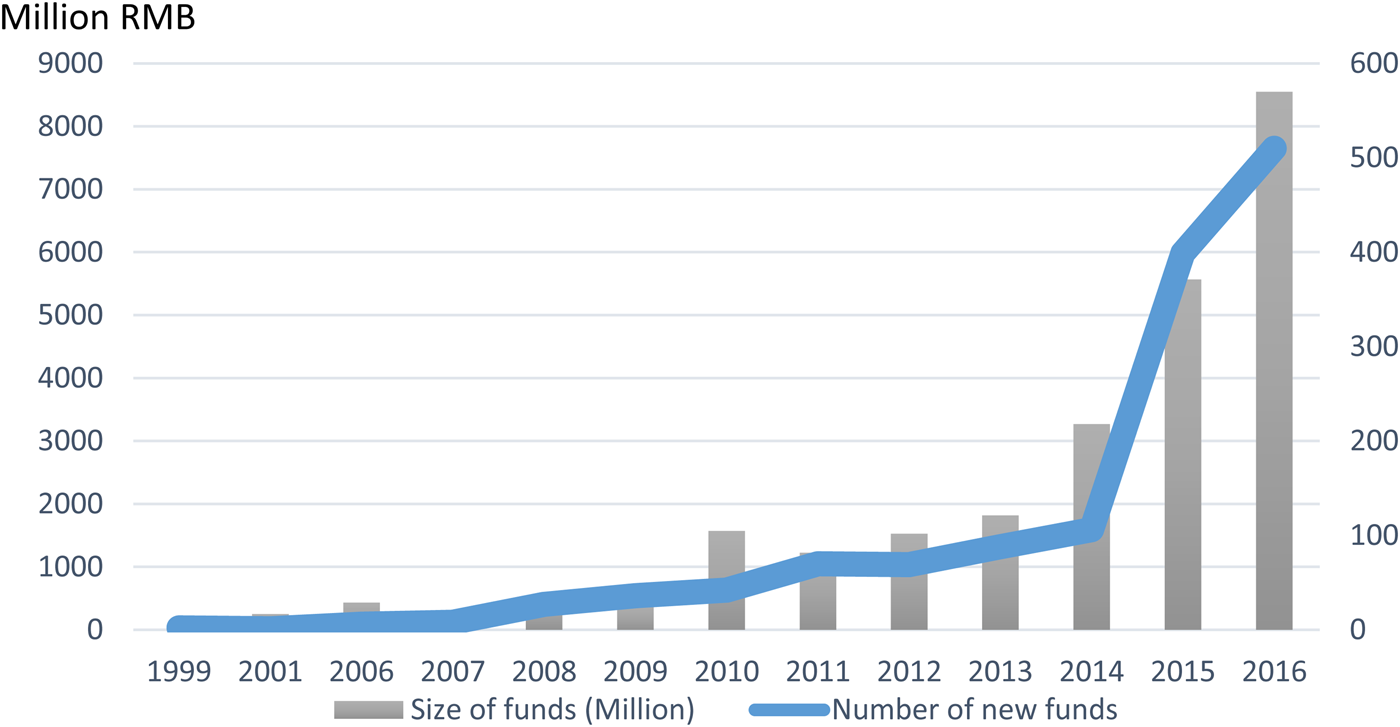
We used the Zero2IPO dataset to gather information on all GGIFs to the end of 2016.Footnote 46 As can be seen in Figure 1, the number of GGIFs increased very quickly from 2008 after a long period of stagnation. In 2007, there were only eight GGIFs, while the number grew from 27 in 2008 to 106 in 2014. In 2015, the number of GGIFs increased sharply: 399 new GGIFs were set up in a single year. The following year, 510 new GGIFs were established. Meanwhile, the average fund size of the new GGIFs also grew dramatically, from below 1 billion yuan before 2009 to over 8 billion yuan in 2016, indicating its increasing potential to shape economic development.
The Number and Size of GGIFs over Time
Source:
Zero2IPO.

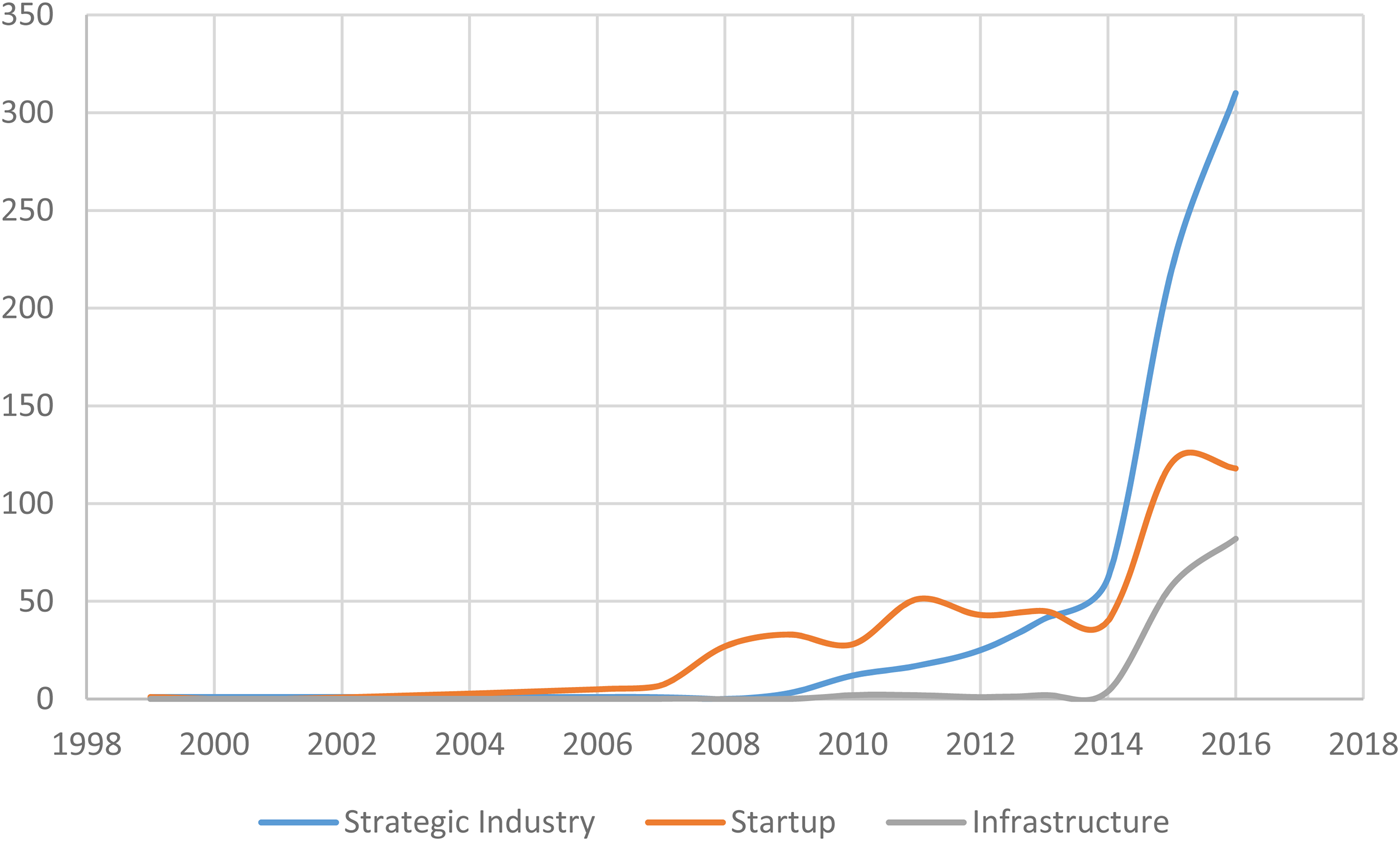
GGIFs have been used to invest in more diversified areas over time (see Figure 2). Before 2010, GGIFs were set up by governments mainly to support entrepreneurial activities. From 2010, the number of GGIFs targeted for strategic and emerging industries began to multiply and, in 2014, they overtook GGIFs aimed at start-up funds and subsequently became the predominant type of GGIF. Prior to 2013, infrastructure funds accounted for a very marginal proportion of all GGIFs; however, in 2015, 58 infrastructure GGIFS were established and another 82 in 2016. More and more GGIFs have been established to invest in public projects in recent years.
Number of GGIFs for Different Purposes
Source:
Zero2IPO.

The Operation Model of the GGIF
The state has purposely designed and promoted the GGIF in China. In order to achieve policy goals, the central government has defined the overall operation model of GGIF as a “government-guided and market-oriented operation.”Footnote 47 This idea is not new. In 2008, three regulatory bodies jointly issued a document to regulate and promote the development of the “government-guided venture capital fund,” defining it as “a policy fund set up by government but operated based on market rules.”Footnote 48 This idea has been firmly adhered to over time.
Government guided
It is not surprising that the GGIF is “government guided,” as its name suggests. According to the regulatory bodies’ definition of the GGIF, there are two important and related features that ensure that the fund is government guided.Footnote 49 First, any government which launches a GGIF must inject its own money to set up the fund. In 2015, the Ministry of Finance (MOF) defined GGIFs as “funds set up solely by governments at all levels through budgetary arrangements or jointly by governments together with the private capital.”Footnote 50 Similarly, the National Development and Reform Commission (NDRC) in 2016 defined GGIFs as “those private equity funds and venture capital funds guided by governments.” Further, government funds for GGIFs must come from budgetary investments, special funds of the central and local governments, and other fiscal funds.Footnote 51
Second, the investment areas (and purposes) of GGIFs are determined by the government. Given that the GGIF is a policy tool, each GGIF is assigned a purpose by the government before it is established. As the regulatory entity, the MOF has requested that GGIFs invest in “key and emerging areas of economic and social development,” including entrepreneurial and innovation activities, small and medium-sized firms, industrial upgrading and transformation, infrastructure and public services.Footnote 52 Similarly, the key investment areas for GGIFs as defined by the NDRC include “non-basic public services, infrastructure, affordable housing, ecological and environment, regional development, strategic emerging industries and advanced manufacturing, entrepreneurial and innovation activities.”Footnote 53 All in all, GGIFs are used in almost all areas related to development at various geographical scales.
In fact, the name of the GGIF can reflect the investment area (and purpose) of the fund. For instance, if a specific industry such as robotics, the internet or big data is mentioned in the name of the GGIF, the fund mainly invests in projects related to this particular industry. Similarly, any GGIF that aims to invest in start-ups is labelled as an “entrepreneurial fund” or “start-up fund.” GGIFs aimed at drawing in investment for infrastructure and housing are similarly given a title designed to reflect their purpose.
Market oriented
Although government guided, GGIFs are designed to conform with “market-oriented operations” in that they use venture capital and private equity funds. As previously mentioned, venture capital and private equity funds are typical capitalist tools and have been used by governments in Western economies. In this sense, China is not different from Western economies in using market tools to achieve development goals.
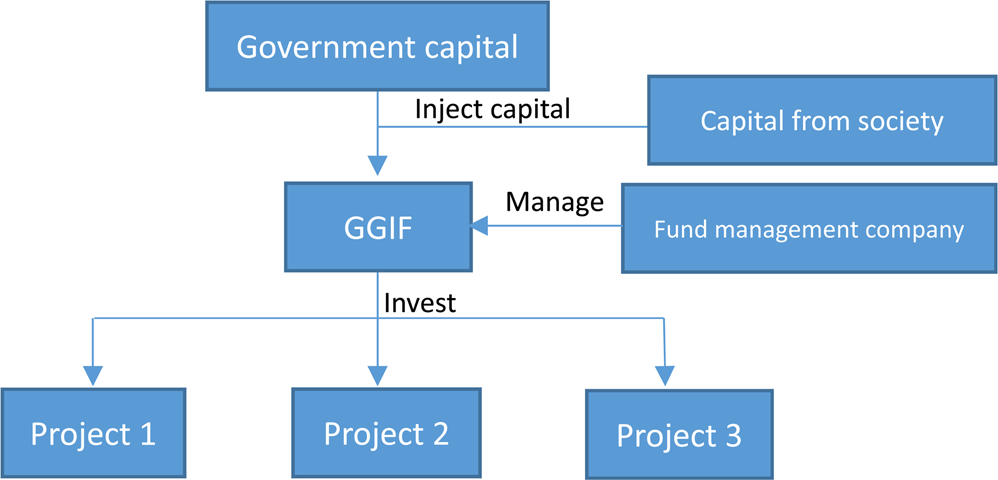
In practice, the GGIF in China applies a seemingly market-operated model in several ways. First, in addition to the direct inputs from governments, the GGIF seeks to raise more capital from other sources, just like normal venture capital and private equity funds (as shown in Figure 3). The process of raising capital is considered to be market oriented, although private capital may be reluctant to join a GGIF. Second, the funds are run by professional fund management companies, rather than the government itself, even though the fund management companies can be state-owned or controlled indirectly by the government. Third, although providing the funds for the GGIF, the government does not bear unlimited financial responsibility for the GGIF-invested project. In other words, if the project fails, the government only suffers a loss proportionate to its capital share in the GGIF. However, with more investments being made in infrastructure projects, the government has had to find another solution if a project fails. Recently, many GGIFs have adopted a “fund of funds” (FOF) model, which allows them to make investments and attract capital in a more flexible way.
Operational Structure of GGIFs
Source:
Authors.

As such, the GGIF in China is different from its Western counterparts in several ways. In particular, Chinese GGIFs are aimed at promoting start-ups, cultivating strategic emerging industries and supporting infrastructure and public services, while Western public venture capital funds aim only to invest in start-ups. In addition, GGIFs aimed at strategic industries and infrastructure are much larger in terms of capital than those aimed at supporting entrepreneurial activities in Western economies. Finally, in order to make sure that a GGIF is government guided, the fund management companies that make decisions on investments are mostly directly or indirectly controlled by the state, while fund management companies are usually independent in their decision-making processes in Western economies.
The Spread of the GGIF
From the very start, the Chinese state has designed the GGIF business model and the government retains a dominant position in the operation of GGIFs, despite claims that they are market oriented. In practice, in addition to the government, state-owned firms, as major funders, have played a key role in the wide uptake of GGIFs, as private capital has been reluctant to participate in the business for certain reasons. In this section, we will elaborate why and how the central government, local government and state-owned firms have together shaped the development of GGIFs.
Central government as initiator, promoter and regulator of the GGIF
The central government in China has vigorously promoted GGIFs at different stages for different policy goals, reflecting the increasing financialization of the state in economic management.Footnote 54 In addition, the central government has not only issued many documents to promote the GGIF as a development tool but also has set up and endorsed several GGIFs.
As mentioned above, the central government introduced government-guided venture capital funds in the late 1990s as a way to boost entrepreneurial activities and innovation but these funds were slow to take off at first. Partly in response to the booming venture capital market and inflows of international venture investments,Footnote 55 in 2008 the central government made a formal proposal to develop government-guided venture capital funds.Footnote 56 As a result, the “National guidance fund for science and technological application” was set up by the central government in 2011.
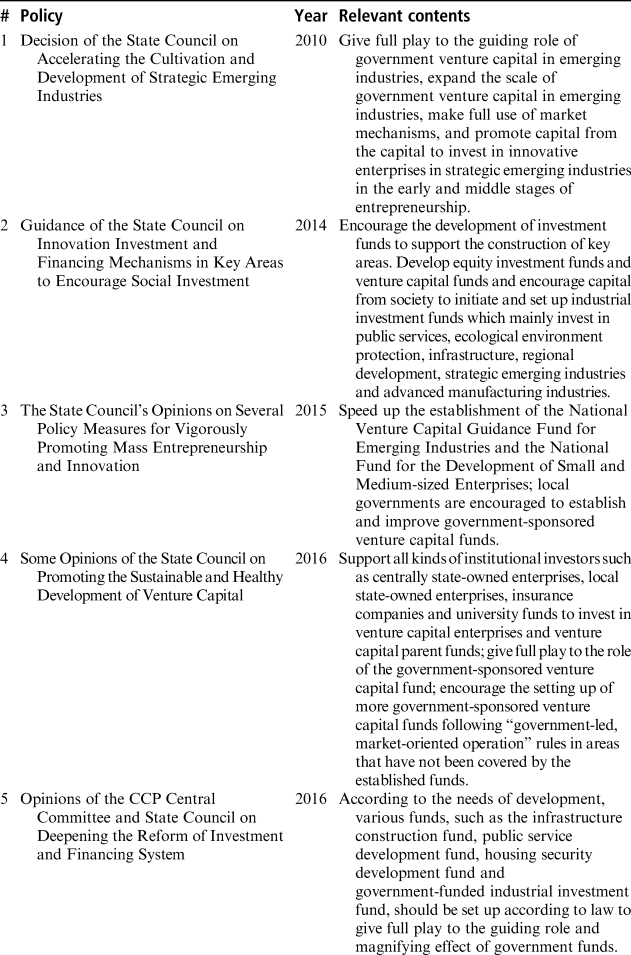
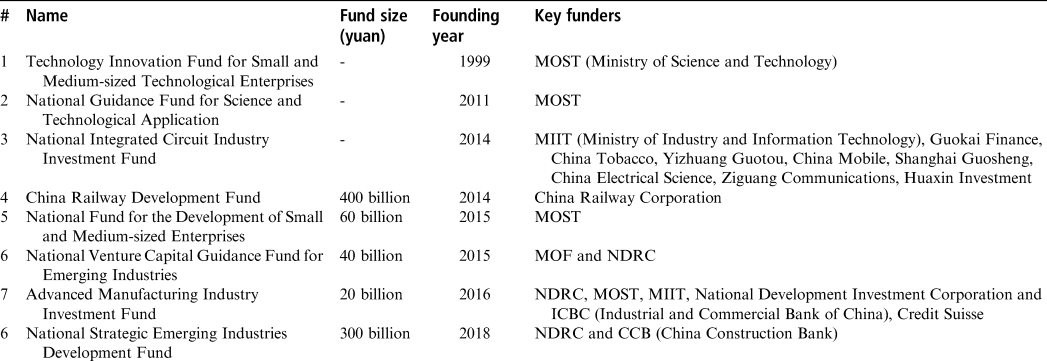
Not long after, the central government realized the further potential of GGIFs beyond only financing entrepreneurial activities, and it started to use GGIFs for other purposes. In 2010, the central government encouraged the setting up of GGIFs to achieve its policy goal of developing strategic and emerging industries.Footnote 57 The State Council issued a document that advocated “giving full play to the guiding role of GGIF in strategic and emerging industries and expanding the scale of GGIFs.”Footnote 58 (See Table 1.) Consequently, the central government launched a number of GGIFs including the National Integrated Circuit Industry Investment Fund and the Advanced Manufacturing Industry Investment Fund (see Table 2). In line with the government's recent policy to boost infrastructure development, the State Council issued a document to encourage the establishment of more GGIFs focusing on investment in this area in 2014.Footnote 59 Further, a document jointly issued by the CCP Central Committee and the State Council in 2016 indicated that the importance of the GGIF as a multi-function policy tool was fully endorsed by the central government. The Railway Development Fund was founded in 2014, while more infrastructure GGIFs were subsequently issued by local governments. With such backing, the number of GGIFs aimed at attracting investment for strategic industries and infrastructure grew quickly from then on (see Figure 2).
The Role of GGIFs in Central Government Policies

Sources:
Data gathered by authors.
Selected GGIFs Established by the Central Government

Sources:
Data gathered by authors.
In the meantime, mass entrepreneurism and innovation once again gained a placed on the national agenda, and the central government regained its enthusiasm for adopting the GGIF as a policy tool to promote start-up activities and innovation. The 2014 document issued by the State Council encouraged giving “full play to the role of GGIFs” and “local governments were encouraged to set up more GGIFs to support entrepreneurial activities.”Footnote 60 Against this background, the National Fund for the Development of Small and Medium-sized Enterprises and the National Venture Capital Guidance Fund for Emerging Industries were established (see Table 2), signalling the resurgence of start-up GGIFs in 2015 and 2016 (see Figure 2).
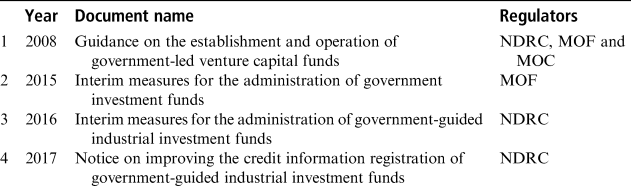
The central government regulates GGIFs established by local governments. In response to the rapid spread of GGIFs and the potential risks, the central government, in its role as regulator, has issued many regulatory documents on GGIFs (Table 3). In 2008, the first regulation document on GGIFs was jointly issued by the NDRC, MOF and Ministry of Commerce. The NDRC and MOF issued regulations on GGIFs in 2015 and 2016, respectively. Interestingly, the key ministry in charge of guiding the development of the GGIF as a financial tool has changed over time. In the early years, the Ministry of Science and Technology was in charge of government-sponsored venture capital funds. Later, the MOF and NDRC became the key regulators and promoters of GGIFs, reflecting this financial tool's increasingly important role in national development beyond supporting entrepreneurial activities.
Regulatory Policies on GGIFs

Source:
Data gathered by authors.
The GGIF case demonstrates how the central government has planned, practised and regulated the financialized approach to development in China. The role of the central government and its regulatory functions show that “planning centrality is a salient feature of state entrepreneurialism.”Footnote 61 Many large state-owned enterprises, in particular financial institutions, are involved. Also, local governments are encouraged to use this financial policy to boost development, as we show in more detail in the following section.
Local governments as key players in setting up GGIFs
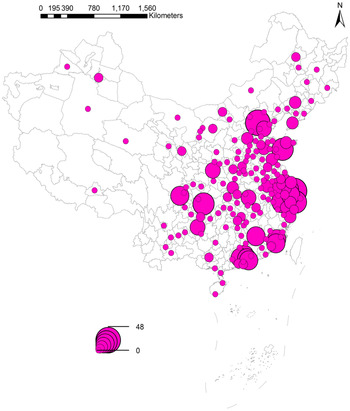
According to the dataset, 1,334 of all 1,369 GGIFs were founded by local governments of various levels during the study period. In addition, more governments of lower administrative levels have started to use GGIFs in recent years, reflecting the growing popularity of this financialized approach. As shown in Figure 4, the GGIF has become popular across the whole of the country, irrespective of significant regional differences. This spatial expansion has taken a while. In the earlier development stage, during 1999–2007, GGIFs were only launched in Beijing, Shanghai, Shenzhen and neighbouring cities and the number of GGIFs in these cities was quite small. Between 2008 and 2013, many provincial capital cities and cities located in more economically developed regions began to launch GGIFs but it was not until after 2014 that GGIFs spread across the country.
The Spatial Distribution of GGIFs in China
Source:
Zero2IPO.

Not surprisingly, the continued promotion of GGIFs by the central government has had a great impact on local governments, which have set up many GGIFs to boost development in recent decades. While GGIFs are primarily used to support industrial development and finance infrastructure, growth-oriented governments in China are also willing to use any policy tool that might help boost the local economy in a bid to stay ahead in inter-regional competition and because of the cadre evaluation system.Footnote 62
Local governments established GGIFs for similar purposes as those established by the central government. Initially, GGIFs were used by local governments in developed areas to support entrepreneurial activities. The first local GGIF, the Zhongguancun Venture Capital Guidance Fund, was set up at the end of 2001 in Beijing.Footnote 63 This fund was aimed at investing in start-ups with high growth potential. Local GGIFs then stagnated for a while until the central government encouraged their use to support more areas from 2010 onwards.
The number of GGIFs issued by local governments for specific industries increased rapidly following the central government's encouragement to use GGIFs to develop strategic emerging industries in 2010. Of those GGIFs established by provincial (including centrally administrated municipal) governments, 68 per cent are industrial development funds, while 58 per cent of GGIFs established by city governments are industrial development funds. Local governments mostly support industries with high growth potential or advanced technology – for example, Shanghai Big Data Fund and Shenyang Robot Industry Development Fund are typical GGIFs set up by local governments.
Similarly, the number of GGIFs set up to invest in infrastructure projects such as new town developments, express roads, the environment, public housing and so on increased quickly after the central government promoted the use of GGIFs for such aims in 2014. The Beijing Sub-centre Development Fund and Quanzhou City Construction Fund are examples in point. In addition, some GGIFs have been set up by local governments to boost both industrial and infrastructure development in a specific region. For instance, there is the Fund for the Rise and Revitalization of Central Hunan and Hubei Yangtze River Economic Belt Guidance Fund. Moreover, in 2015 with mass entrepreneurism and innovation becoming a national priority, GGIFs supporting start-up activities were widely established by local governments.
The rapid take up of GGIFs by local governments has proved that central government guidance has a great influence on the behaviour of local governments. Local governments’ eager adoption of GGIFs shows that “local officials who demonstrate entrepreneurial behaviours are a constituent of the state apparatus,” as there has been an obvious top-down rapid spread of this financialized development policy.Footnote 64
Local governments, however, are incentivized to set up many GGIFs for their own sake. In fact, the widespread uptake of GGIFs shows that China's growth machine has been characterized by a global parallel trend in which cities adopt “coercive applications of financially driven and technocratically managed restructuring.”Footnote 65 Start-up activities, strategic industries and infrastructure are all key drivers of economic growth and so local governments look to use GGIFs to meet their local economic growth targets. As such, local government GGIFs are commonly required to invest in local projects.
Another explanation for why local governments in China have embraced GGIFs to fund infrastructure projects is because many are heavily in debt and the central government has imposed increasingly strict regulations on their borrowing.Footnote 66 GGIFs have certain advantages: first, they are supported by the central government, and second, owing to their business model, any capital attracted to a GGIF is not considered as local government debt. Consequently, GGIFs have provided local governments with a new means to finance urban development. One piece of evidence is that local government financing platforms are very active as investors in GGIFs that raise capital for infrastructure projects.
State-owned enterprises as a major funder of GGIFs
One long-standing policy objective of the GGIFs has been to attract capital from wider society to invest in relevant projects. A document issued by the State Council in 2008 stipulated that the “government-guided fund should mainly attract capital from society to co-sponsor the establishment of funds.”Footnote 67 This policy objective has been repeated in all key policy documents on GGIFs issued by the central government since then.Footnote 68 GGIFs that support entrepreneurial activities, strategic industries and infrastructure, whether they are established by the central government or local governments, are all advised to look to society for co-investors.
This idea of attracting capital from wider society to co-invest in projects in key areas is quite similar to the CIF in Western countries. However, in the Chinese context, the government is willing to take the lead role in the investment process and ensure that the GGIF is “government guided.” It is argued that “the state apparatus is not equivalent to a business establishment, no matter how it behaves entrepreneurially,”Footnote 69 and this is true for the GGIF as a financialized tool which is “not just for profit.”Footnote 70 In reality, achieving a balance between “economic benefits” and “social benefits” is one principal rule for such GGIFs when making investment decisions, which can be seen in many of their public profiles. Thus, financial profits are not the top concern of the investments made by a GGIF. Rather, the development goals defined by governments are more important concerns, even though it is difficult to measure how these policy objectives are achieved.
The government-guided nature of the GGIF has had a detrimental impact on attracting capital from the private sector. In practice, private capital may hesitate to join a GGIF as the decision-making process is directly or indirectly controlled by the government. Although achieving policy goals and making profits are not necessarily always in contention, there are too many uncertainties for private capital and it is reluctant to become involved in such projects, especially infrastructure projects.
If private capital is not willing to invest in GGIFs, how is it that GGIFs have become so widespread? In practice, the major funders attracted to GGIFs are state-owned enterprises, including financial institutions, large industrial firms and local government financing platforms. As key capital funders, state-owned firms seem to exercise more patience regarding investment, but can prove unpredictable at times owing to political reasons.Footnote 71
National banks and large state-owned firms are key contributors to the GGIFs issued by the central government. For instance, the National Development Bank (NDB) and the Industrial and Commercial Bank of China (ICBC) are the co-founders of the Advanced Manufacturing Industry Investment Fund, which was set up in 2014. Many flagship state-owned financial and non-financial firms, including Guokai Finance, China Tobacco, Yizhuang Guotou, China Mobile, Shanghai Guosheng, China Electrical Science, Ziguang Communications and Huaxin Investment, have invested in the National Integrated Circuit Industry Investment Fund.
This is also the case for GGIFs issued by local governments. In addition to local government capital, local state-owned firms, including local government financing platforms, non-financial firms and banks, are the major investors in GGIFs. In some cases, centrally owned financial institutions and non-financial state-owned firms also invest. The structure and composition of investors differs for GGIFs with different functions. For GGIFs focusing on start-ups, the size of funds is smaller and usually governments are the only investors. However, for GGIFs issued to promote strategic industries, financial institutions and state-owned firms are the primary sponsors. The lead firms in the specific industry are usually invited to invest in such GGIFs. For those GGIFs established by governments at a higher administrative level, state-owned enterprises and central banks are more likely to be involved. GGIFs focusing on infrastructure tend to have much larger funds and are commonly sponsored by large state-owned financial institutions. For example, the Beijing Sub-Centre Development Fund was set up by the Beijing Municipal Government to invest in infrastructure in Tongzhou District 通州区, a newly designated sub-administrative centre for Beijing. The Agricultural Bank of China (ABC) and the Municipal Government of Beijing co-invest in this fund, with the ABC providing 80 per cent of the total investment. Local government financing platforms have become the major investors in infrastructure GGIFs.
All in all, the state-owned sponsors of GGIFs are the key component of state-led financialization in China, and the involvement of state-owned financial institutions, leading industrial firms and local government financing platforms, as co-funders of GGIFs, has been crucial in shaping the rapid expansion of this new financial tool.
Conclusion
Using GGIFs as an illustrative case, this paper explores how state-led financialization has taken place in the Chinese context. It underscores the crucial roles of the central government, local governments and state-owned enterprises in the uptake of this financialized policy. Despite market-oriented reform, GGIFs are used “not for the market but for using market means” to solve problems in development.Footnote 72 State-led financialization in China has not resulted in a diminishing role for the state, as has been the case in many Western economies. On the contrary, “rather than being replaced by market power, state power is reinforced by its use of market instruments.”Footnote 73
This study has enriched the existing literature by highlighting the role of the state in the financialization of development policies in the Chinese context. Financialization can be “a state-driven process” in a liberal market economy such as the US,Footnote 74 but the role of the state in the financialization of development policies in China is different as the policies seem to internalize finance in state management by using state capital directly or indirectly.Footnote 75
As we have shown, the central government has played a key role in designing and promoting financialized policyFootnote 76 and has promoted new policy tools that are “proactive towards its growth agenda.”Footnote 77 By guiding investments towards designated key areas, the state has strengthened its influence and control over the economy. In addition, the central government has strengthened its control over local governments through central state-owned financial institutions investing in the GGIFs established by local governments.
Local governments in China have been enthusiastic in implementing GGIFs as a financialized development policy, as was the case in many Western economies. However, there are some distinctive Chinese characteristics. On the one hand, local governments have been following guidance from the central government. Owing to strong encouragement by the central government, local governments have been pressured into adopting this tool promptly. On the other hand, urban entrepreneurialism with Chinese characteristics may have accelerated the spread of this approach to financialization.Footnote 78 In particular, inter-jurisdictional competition may be the key driving force in the diffusion of this policy.Footnote 79 Furthermore, with the tightening regulation on local government financing platforms, the GGIF has become an alternative way for local governments to finance regional development.
One negative consequence of financialization in urban development policies in Western economies is that “the locus of power and control has been shifting from growth coalitions to debt machines and from local business leaders to more distant financial-market interests.”Footnote 80 In the case of GGIFs established by governments in China, the key funders are state-owned firms controlled by the local or central government. Thus, the approach again reinforces the role of the state in urban development. In reality, local governments and the central government sometimes have different policy goals when issuing GGIFs. As the regulator, the central government cares about the systematic financial risks brought by this tool, while local governments seek short-term growth. Therefore, the interactions between the central and local governments have a strong influence on how GGIFs are developed.
However, the unexpectedly important role of state-owned enterprises, especially state-owned financial institutions such as banks, as the key providers of funding for GGIFs might bring systematic financial risks to the economy. The GGIF is a market tool promoted by the state, and so it is assumed that investors need to bear the risks themselves when they put money into GGIFs. However, state-owned firms might make investments in GGIFs under political pressure from governments at various levels. For these state-owned firms, seeking profit is not the most important motivation for investing in GGIFs. Given the operation rules and investment areas of GGIFs in China, it is difficult to realize proper investment returns on projects guided by the government, despite financialization happening in such a strong growth environment.Footnote 81 Consequently, state-owned firms may be in trouble in the long term.
Since GGIFs have largely failed to attract capital from the private sector, the central role of the state in this new approach has blurred the distinction between GGIFs and traditional state investments to some extent, despite the market-oriented design of this policy tool. In this sense, more empirical studies are needed to fully understand and evaluate the GGIF as a new financialized tool. For instance, the effectiveness of this policy tool remains to be seen and the relationship between state-owned firms and governments is not clear in the GGIF setting.
Acknowledgements
We acknowledge the joint funding support for the project, “The financialization of urban development and associated financial risks in China,” from the UK Economic and Social Research Council (ESRC) (ES/P003435/1) and Natural Science Foundation of China (NSFC) (NSF71661137004). We also are grateful for funding support for a project entitled “Global financing and regional development: a study based on global financial network perspective” from the NSFC (No. 41871157).
Conflicts of interest
None.
Biographical notes
Fenghua PAN is an associate professor at Beijing Normal University. He was a research associate of the ESRC project, “The financialization of urban development and associated financial risks in China,” at University College London. His research interests are Chinese financial geography.
Fangzhu ZHANG is an associate professor at University College London. Her research interests include China's innovation and sustainable development.
Fulong WU is Bartlett Professor of Planning at University College London. His research interests include urban development in China and its social and sustainable challenges.