

INTRODUCTION
The study focuses on two archaeological prehistoric sites in a restricted geographical area in the southern Levant (Fig. 1): the Hula Valley, Israel, which is situated in the northern and most elevated segment of the Jordan Valley (Dead Sea Transform, part of the Syrian–African Rift System). This area has yielded important archaeological records of human occupations dating from the early to late Pleistocene, found in association with bodies of water (lakes, streams, and springs) in this flourishing environment, which is rich in flora and fauna (Sharon et al., Reference Sharon, Feibel, Belitzky, Marder, Khalaily and Rabinovich2002, Reference Sharon, Grosman, Fluck, Melamed, Rak, Rabinovich and Oron2010; Goren-Inbar and Speth, Reference Goren-Inbar and Speth2004; Marder et al., Reference Marder, Biton, Boaretto, Feibel, Melamed, Mienis, Rabinovich, Zohar and Sharon2015; Goren-Inbar, Reference Goren-Inbar2017; Valla et al., Reference Valla, Khalaily, Samuelian, Bocquentin, Bridault and Rabinovich2017).
(color online) Location of Gesher Benot Ya’aqov (GBY) and Nahal Mahanayeem Outlet (NMO) prehistoric sites.

The Hula Valley
The Hula Valley (70 m asl, 22 km long, and 7 km wide) is part of the northernmost extension of the Syrian–African Rift System. It is a 4 Ma pull-apart basin bounded by two left-stepped segments of the Dead Sea Transform (Schattner and Weinberger, Reference Schattner and Weinberger2008; Heimann et al., Reference Heimann, Zilberman, Amit and Frieslander2009). The climate today is Mediterranean, having hot dry summers and cool rainy winters, with annual precipitation varying from 400 mm a year in the south to 800 mm a year in the north (Dimentman et al., Reference Dimentman, Bromley and Por1992; Horowitz, Reference Horowitz2001; Almogi-Labin et al., Reference Almogi-Labin, Bar-Matthews and Ayalon2004; Feibel et al., Reference Feibel, Goren-Inbar and Frumin2009; Heimann et al., Reference Heimann, Zilberman, Amit and Frieslander2009). The valley is surrounded by mountains and hills: the Golan Heights to the east (~1000 m asl), the Naftali Mountains rising 600–700 m above the basin floor to the west, the Metula High and Mount Hermon (peak at 2814 m asl) in the north and northeast, and the basalt hills of the Korazim Plateau to the south. The soils in the eastern and southern edges of the valley are brown volcanic soils, while the soils at the western margins are rendzina. The northern soils are mainly the result of the drainage of Mount Hermon and are therefore dominated by coarse mineral soils (Feibel et al., Reference Feibel, Goren-Inbar and Frumin2009; Mischke et al., Reference Mischke, Ashkenazi, Almogi-Labin and Goren-Inbar2014).
Until recently, the Hula Valley encompassed a complex of distinct water bodies, including Lake Hula, its surrounding swamps, and many springs and streams. Lake Hula was fed by the Jordan River and artesian springs all related to karstic aquifers of the surrounding hills and mountains. The upper Jordan River is the result of the union of three streams all fed in different proportions by the Hermon aquifer: Nahal Dan, an emerged subterranean stream with little seasonal fluctuation, supplies 50% of the flow of the upper Jordan; the Banias (Nahal Hermon); and the Hasbani (Nahal Snir). The upper Jordan River then enters the Hula Valley from the north (Por, Reference Por2004). Lake Hula was a shallow fresh-water lake in the southern Hula Valley with a large, seasonally fluctuating, swampy area to the north. The fresh-water lake apparently persisted in this area, with its complex and active geological history, at least from the early Pleistocene (Horowitz, Reference Horowitz1988, Reference Horowitz2001; Dimentman et al., Reference Dimentman, Bromley and Por1992). In the early 1950s the drainage of Lake Hula began, and by 1958 it had been completely drained, apart from a small remnant preserved in the Hula Nature Reserve (Dimentman et al., Reference Dimentman, Bromley and Por1992). Based on measurements conducted before the drainage, the total area of the lake and its associated swamps fluctuated annually between 21 km2 in summer and 60 km2 in winter. The water depth varied between 1.5 m and 4 m, and its temperature fluctuated between 38°C and 4°C (Dimentman et al., Reference Dimentman, Bromley and Por1992). The Hula Valley drains southward through the middle Jordan River. The archaeological assemblages described in this paper were all exposed on the Jordan River banks as it cuts its way south into the Sea of Galilee (Fig. 1).
The Gesher Benot Ya’aqov site
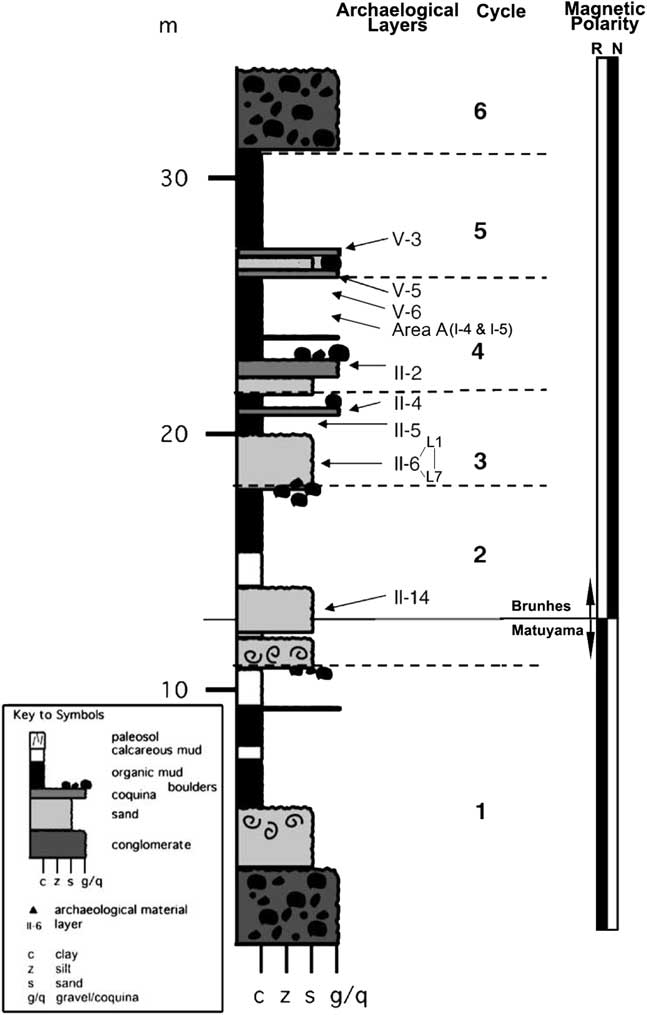
The Acheulian site of Gesher Benot Ya’aqov (GBY) is an open-air site situated 3.5 km south of the Hula basin within the Benot Ya’akov Formation (Belitzky, Reference Belitzky2002; Fig. 1). It consists of a 34-m-thick exposed sedimentary sequence (Fig. 2), including a reversed polarity zone followed by a normal polarity zone assigned to the Brunhes/Matuyama Boundary and therefore to the early to early middle Pleistocene. This sequence represents approximately 100 ka of accumulation within Marine Isotope Stages (MIS) 20–18 and includes, among others, 15 distinct archaeologically rich levels all assigned to MIS 18 (Goren-Inbar et al., Reference Goren-Inbar, Belitzky, Verosub, Werker, Kislev, Heimann, Carmi and Rosenfeld1992, Reference Goren-Inbar, Feibel, Verosub, Melamed, Kislev, Tchernov and Saragusti2000; Feibel, Reference Feibel2001, Reference Feibel2004; Alperson-Afil et al., Reference Alperson-Afil, Sharon, Kislev, Melamed, Zohar, Ashkenazi and Rabinovich2009).
Gesher Benot Ya’aqov (GBY) composite stratigraphy (modified from Spiro et al., Reference Spiro, Ashkenazi, Mienis, Melamed, Feibel, Delgado and Starinsky2009): archaeological layers, the sedimentary cycles (Feibel, Reference Feibel2001), and the magnetic polarity (R, reversed; N, normal).

The archaeological assemblages were recovered in lake-margin sediment deposits rich in lithic artifacts and diverse floral and faunal remains (Goren-Inbar et al., Reference Goren-Inbar, Belitzky, Verosub, Werker, Kislev, Heimann, Carmi and Rosenfeld1992, Reference Goren-Inbar, Lister, Werker and Chech1994, Reference Goren-Inbar, Feibel, Verosub, Melamed, Kislev, Tchernov and Saragusti2000, Reference Goren-Inbar, Sharon, Melamed and Kislev2002a, Reference Goren-Inbar, Werker and Feibel2002b; Goren-Inbar, Reference Goren-Inbar1992, Reference Goren-Inbar2011; Rabinovich et al., Reference Rabinovich, Gaudzinski-Windheuser and Goren-Inbar2008, Reference Rabinovich, Gaudzinski-Windheuser, Kindler and Goren-Inbar2012; Alperson-Afil et al., Reference Alperson-Afil, Sharon, Kislev, Melamed, Zohar, Ashkenazi and Rabinovich2009; Alperson-Afil and Goren-Inbar, Reference Alperson-Afil and Goren-Inbar2010, Reference Alperson-Afil and Goren-Inbar2016; Melamed et al., Reference Melamed, Kislev, Weiss and Simchoni2011, Reference Melamed, Kislev, Geffen, Lev-Yadun and Goren-Inbar2016; Rabinovich and Biton, Reference Rabinovich and Biton2011). The various assemblages at the site had been rapidly sealed after deposition in waterlogged conditions, resulting in excellent preservation of organic matter.
The site of Nahal Mahanayeem Outlet
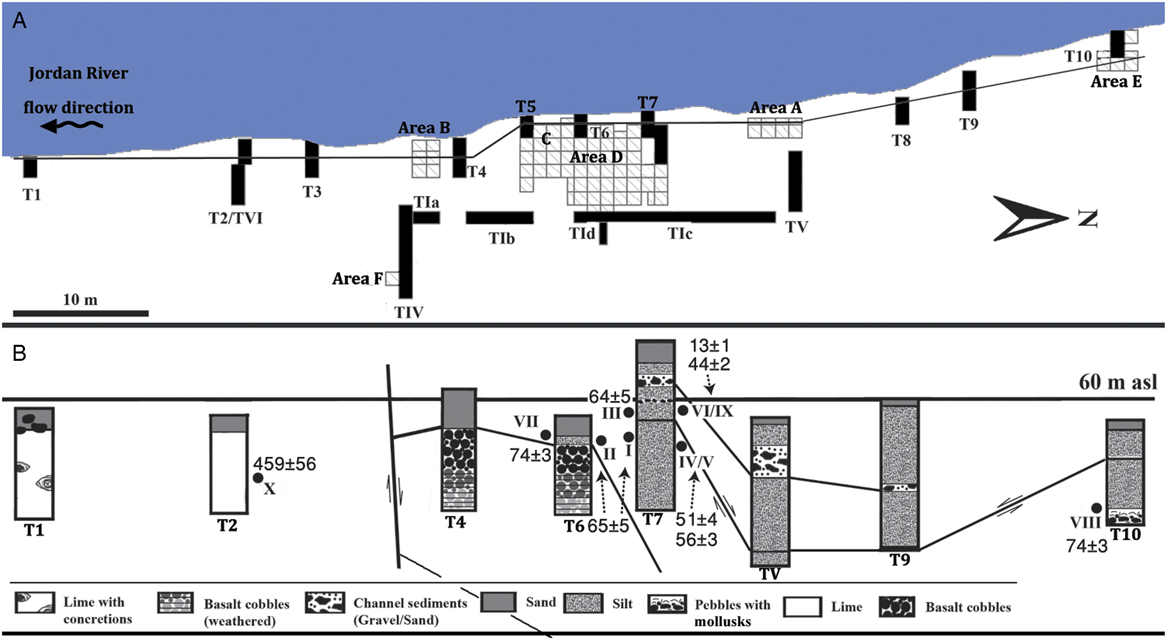
The Mousterian site of Nahal Mahanayeem Outlet (NMO) is situated at the southern edge of the Hula Valley (Fig. 1), on the eastern bank of the Jordan River at the outlet of the Mahanayeem stream into the Jordan River (Fig. 3A). The site was discovered in 1999 during a drainage operation. The excavations exposed an open-air site dated to the middle Paleolithic, based on the lithic assemblage ascribed to the Mousterian tradition (Sharon et al., Reference Sharon, Grosman, Fluck, Melamed, Rak, Rabinovich and Oron2010; Kalbe et al., Reference Kalbe, Sharon, Porat, Zhang and Mischke2014, Reference Kalbe, Mischke, Dulski and Sharon2015; Sharon and Oron, Reference Sharon and Oron2014). The primary archaeological horizon within the Ashmura Formation yielded optically stimulated luminescence ages of a late Pleistocene age between 65 and 55 ka (Fig. 3B; Kalbe et al., Reference Kalbe, Sharon, Porat, Zhang and Mischke2014) corresponding to the MIS 4 to 3 transition. NMO, like GBY, is a waterlogged site with excellently preserved floral and faunal remains (Sharon et al., Reference Sharon, Grosman, Fluck, Melamed, Rak, Rabinovich and Oron2010; Aharonovich et al., Reference Aharonovich, Sharon and Weinstein-Evron2014). Excavation focused on Area D (Fig. 3A). Based upon the findings, it was suggested that the site was a lakeshore-accumulation environment in which short-term human occupation activities occurred (Sharon and Oron, Reference Sharon and Oron2014). The remains of such activities were rapidly covered by rising water levels that deposited fine, silty mud, sealing the archaeological horizons, which were probably not subjected to significant postdepositional movement (Kalbe et al., Reference Kalbe, Sharon, Porat, Zhang and Mischke2014; Sharon and Oron, Reference Sharon and Oron2014; Biton et al., Reference Biton, Sharon, Oron, Steiner and Rabinovich2017).
(color online) Nahal Mahanayeem Outlet (NMO) stratigraphy and optically stimulated luminescence dates. (A) Location map of excavation areas and trenches; (B) stratigraphy of Jordan River east bank at NMO (modified from Kalbe et al., Reference Kalbe, Sharon, Porat, Zhang and Mischke2014).

Reconstruction of the middle and late Pleistocene climate in the southern Levant
Climatic fluctuations play an important role in prehistoric research. The middle and late Pleistocene climatic regime in the southern Levant is believed to have been highly variable, with intervals that were more humid or more arid (Frumkin et al., Reference Frumkin, Ford and Schwarcz2000; Bar-Matthews et al., Reference Bar-Matthews, Ayalon, Gilmour, Matthews and Hawkesworth2003; Almogi-Labin et al., Reference Almogi-Labin, Bar-Matthews and Ayalon2004, Reference Almogi-Labin, Bar-Matthews, Shriki, Kolosovsky, Paterne, Schilman, Ayalon, Aizenshtat and Matthews2009; Robinson et al., Reference Robinson, Black, Sellwood and Valdes2006; Enzel et al., Reference Enzel, Amit, Dayan, Crouvi, Kahana, Baruch and Sharon2008; Rambeau, Reference Rambeau2010); cultural dynamics during the Paleolithic were therefore often associated with these climatic changes (e.g., Rak, Reference Rak1993; Tchernov, Reference Tchernov1998; Vaks et al., Reference Vaks, Bar-Matthews, Ayalon, Matthews, Halicz and Frumkin2007; Shea, Reference Shea2008; Frumkin et al., Reference Frumkin, Bar-Yosef and Schwarcz2011; Bar-Yosef, Reference Bar-Yosef2017).
There is no consensus regarding the interpretation of the south Levantine Pleistocene climatic data. For example, the high levels of paleolakes in the Jordan Valley basin and the presence and isotopic reading of the speleothems in today’s arid or semiarid areas imply increased precipitation during glacial periods and more arid conditions during interglaciations (Vaks et al., Reference Vaks, Bar-Matthews, Ayalon, Schilman, Gilmour, Hawkesworth, Frumkin, Kaufman and Matthews2003, Reference Vaks, Bar-Matthews, Ayalon, Matthews, Frumkin, Dayan, Halicz, Almogi-Labin and Schilman2006; Kolodny et al., Reference Kolodny, Mordechai and Machlus2005; Waldmann et al., Reference Waldmann, Torfstein and Stein2010). There is also evidence of short events of wetter conditions during interglaciations in those arid environments (Vaks et al., Reference Vaks, Bar-Matthews, Ayalon, Matthews, Halicz and Frumkin2007, Reference Vaks, Bar-Matthews, Ayalon, Matthews and Frumkin2008; Waldmann et al., Reference Waldmann, Torfstein and Stein2010) and of short events of drier conditions during glacial periods (Bartov et al., Reference Bartov, Goldstein, Mordechai and Enzel2003; Torfstein et al., Reference Torfstein, Goldstein, Stein and Enzel2013). However, in Mediterranean northern and central Israel, isotope records of speleothems indicate the opposite: wetter periods during interglaciations and drier periods during glaciations (Bar-Matthews et al., Reference Bar-Matthews, Ayalon and Kaufman1997, Reference Bar-Matthews, Ayalon, Kaufman and Wasserburg1999, Reference Bar-Matthews, Ayalon, Gilmour, Matthews and Hawkesworth2003).
To make things even more complex, the same data have been interpreted in different ways, as shown by the inconsistency in interpreting oxygen isotope records from speleothems as either indicating precipitation amounts (Bar-Matthews et al., Reference Bar-Matthews, Ayalon and Kaufman1997, Reference Bar-Matthews, Ayalon, Kaufman and Wasserburg1999) or as documenting changes in the east Mediterranean sea-water isotopic composition and not representing precipitation amounts (Frumkin et al., Reference Frumkin, Ford and Schwarcz1999, Reference Frumkin, Ford and Schwarcz2000, Reference Frumkin, Bar-Yosef and Schwarcz2011; Kolodny et al., Reference Kolodny, Mordechai and Machlus2005).
Reconstruction of Pleistocene paleoecology based on herpetofaunal remains
Certain groups of vertebrates, especially micromammals, are widely used to reconstruct Pleistocene paleoclimate and environments (e.g., Tchernov, Reference Tchernov1982, Reference Tchernov1986; Avery, Reference Avery1988; Fernández-Jalvo, Reference Fernández-Jalvo1995; Cuenca-Bescós et al., Reference Cuenca-Bescós, Straus, Gonzalez-Morales and Garcia-Pimienta2009; Belmaker and Hovers, Reference Belmaker and Hovers2011; Maul et al., Reference Maul, Smith, Barkai, Barash, Karkanas, Shahack-Gross and Gopher2011, Reference Maul, Bruch, Smith, Shenbrot, Barkai and Gopher2016; Belmaker et al., Reference Belmaker, Bar-Yosef, Belfer-Cohen, Meshveliani and Jakeli2016; Nel and Henshilwood, Reference Nel and Henshilwood2016; Piñero et al., Reference Piñero, Agustí, Blain and Laplana2016; Stoetzel and Montuire, Reference Stoetzel and Montuire2016). Micromammals are useful as an indicator, particularly for the late Pleistocene onward, because most of the species identified in archaeological assemblages from this period onward have extant representatives (Cuenca-Bescós et al., Reference Cuenca-Bescós, López-García and Blain2016) and their ecological requirements are known and can be used to reconstruct past environments.
Osteological remains of amphibians and squamates (i.e., lizards and snakes) are recovered at many archaeological sites where fine-mesh sediment sieving is performed. Yet, because microvertebrate research has focused primarily on micromammals, amphibians and squamates have often been investigated less vigorously. As there are considerable microvertebrate assemblages from archaeological sites available for study, research focusing on amphibian and squamate remains holds great potential, particularly for providing significant information on a variety of environmental topics. Most amphibian and squamate species from Pleistocene localities onward are currently extant (Bailon and Rage, Reference Bailon and Rage1992), and their present habitat preferences are known. These two factors facilitate reconstruction of past conditions. In addition, amphibians and squamates depend on the environment to regulate their body temperature, because they are ectothermic and therefore highly sensitive to temperature and humidity within their immediate surroundings, both of which affect their metabolic rates, reproductive physiology and population dynamics (Bailon and Rage, Reference Bailon and Rage1992; Walther et al., Reference Walther, Post and Bairlein2002; Blain et al., Reference Blain, Bailon, Cuenca-Bescos, Arsuaga, Bermudez de Castro and Carbonell2009; Vitt and Caldwell Reference Vitt and Caldwell2014, pp. 232–254). Thus, within their chronological contexts, they are a good reflection of the conditions of past occupations and their surroundings. Finally, the home ranges of squamates and amphibians are affected by both intrinsic and extrinsic factors (Vitt and Caldwell Reference Vitt and Caldwell2014, pp. 255–290), but overall they have limited territories and, therefore, if taphonomic evidence excludes the possibility of transportation to the site from a distance, they can contribute to reconstruction of the immediate surroundings of the archaeological occupation.
Paleoherpetological research based on material originating from archaeozoological assemblages is a rapidly evolving field. Research on amphibians and squamates has led to major findings and publications seeking to reconstruct paleoenvironments and paleoclimate, particularly in the last two decades (Bailon and Aouraghe, Reference Bailon and Aouraghe2002; Vigne and Bailon, Reference Vigne and Bailon2000; Barroso Ruiz and Bailon, Reference Barroso Ruiz and Bailon2003; Blain et al., Reference Blain, Bailon, Cuenca-Bescos, Arsuaga, Bermudez de Castro and Carbonell2009, Reference Blain, Bailon, Cuenca-Bescos, Bennàsar, Rofes, López-García and Huguet2010, Reference Blain, López-García and Cuenca-Bescos2011, Reference Blain, Bailon, Burjachs, López-García, Lozano-Fernández and Rosell2013a, Reference Blain, Gleed-Owen, López-García, Carrión, Jennings, Finlayson, Finlayson and Giles2013b, Reference Blain, Agustí, Lordkipanidze, Rook and Delfino2014a, Reference Blain, Santonja, Pérez-González, Panera and Rubio-Jara2014b, Reference Blain, Lozano-Fernández, Agustí, Bailon, Menendez Granda, Espígares Ortiz and Ros-Montoya2016, Reference Blain, Rubio-Jara, Panera, Uribelarrea, Laplana, Herráez and Pérez-González2017; Stoetzel et al., Reference Stoetzel, Denys, Bailon, El Hajraoui and Nespoulet2012).
Research focusing on amphibians and squamates from archaeological sites in the southern Levant is the exception and is not yet well developed, although several comprehensive studies do report amphibian and squamate taxa in detail (Stekelis and Haas, Reference Stekelis and Haas1952; Haas, Reference Haas1963, Reference Haas1966, Reference Haas1967, Reference Haas1968; Bar-Yosef and Tchernov, Reference Bar-Yosef and Tchernov1966; Heller, Reference Heller1978; Tchernov, Reference Tchernov1984; Valla et al., Reference Valla, Bar-Yosef, Smith, Tchernov and Desse1986; Biton et al., Reference Biton, Geffen, Vences, Cohen, Bailon, Rabinovich and Malka2013, Reference Biton, Boistel, Rabinovich, Gafny, Brumfeld and Bailon2016; Smith et al., Reference Smith, Maul, Barkai and Gopher2013, Reference Smith, Maul, Flemming, Barkai and Gopher2016). Nevertheless, the potential contribution of these groups to paleoenvironmental and paleoclimatic reconstruction in the southern Levant has already been demonstrated in Pleistocene–Holocene contexts (Stekelis and Haas, Reference Stekelis and Haas1952; Tchernov, Reference Tchernov1994; Delfino et al., Reference Delfino, Bar-Oz and Weissbrod2007; Maul et al., Reference Maul, Smith, Barkai, Barash, Karkanas, Shahack-Gross and Gopher2011, Reference Maul, Bruch, Smith, Shenbrot, Barkai and Gopher2016).
OBJECTIVES
The goal of the present study was first to identify which amphibian and squamate taxa were present in the Hula Valley during the Pleistocene. The next step was to reconstruct their deposition modes at the sites, and only then to explore whether there was evidence of any major climatic alterations in the Hula Valley within the chronological contexts of both sites (e.g., MIS 20–18 and MIS 4/3). This high-resolution objective was possible, as the archaeological sites were well dated and well excavated and the sediments were sieved with a 0.5 to 2 mm mesh.
MATERIALS AND METHODS
Recovery methods and data collection
The excavations at both sites were conducted using a unit system of a quarter square meter (0.25 m2), 5 cm deep. All finds larger than 2 cm (bones, lithic artifacts, wood, and other finds) were spatially recorded during excavation. Sediments were then wet sieved using a 2 mm mesh and further sorted in the laboratory. At NMO, all sediments were wet sieved on site, and as the site was still undergoing excavation when the study began, unsieved soil samples were also collected to recover most skeletal elements, particularly those of the smallest species. More than 150 samples of 1 L each originating from all areas of the stratigraphic layers within the NMO sequence, with particular attention paid to well-preserved areas, were subsequently wet sieved with a mesh of 0.5 mm (as recommended by Bailon [Reference Bailon1997], Pinto-Llona and Andrews [Reference Pinto-Llona and Andrews1999], and Blain [Reference Blain2005]).
All amphibian and squamate remains consisted of disarticulated elements. Each bone received an individual number, and all variables regarding taxonomic and anatomic definitions, completeness, and surface modifications were recorded in databases. The remains are all housed at the National Natural History Collections at the Hebrew University of Jerusalem (NNHC-HUJ).
Taxonomy
Body parts were defined first, after which they were assigned to the lowest taxonomic rank possible. To identify the bones, we used the comparative collections at the NNHC-HUJ and Muséum National d’Histoire Naturelle Paris (MNHN).
The anatomic terminology for Urodela follows mainly Haller-Probst and Schleich (Reference Haller-Probst and Schleich1994); for anurans, Sanchiz (Reference Sanchiz1998); for snakes, Szyndlar (Reference Szyndlar1984); and for lizards, Rauscher (Reference Rauscher1992).
Systematics and taxonomy (and hence nomenclature) are constantly changing, primarily due to advances in phylogenetics. While keeping in mind that there are usually no osteological justifications for the many new species, genera, and families, we decided to follow the most recent taxonomic nomenclature for the extant species of Israel, as we relied mostly on comparative extant specimens collected from northern Israel to identify the bones from the archaeological sites. The current nomenclature follows two periodically updated websites: AmphibiaWeb (http://amphibiaweb.org) for amphibians and the Reptile Database (http://www.reptiledatabase.org) for squamates.
Quantification
The number of identified specimens (NISP) was recorded for all taxa. The minimum number of elements (MNE) and minimum number of individuals (MNI) were recorded for the anuran species only. The MNE was calculated after considering size and completeness. MNI calculations were based on the highest count of the MNE standardized by the bone side for paired elements.
The number of identified genera was used to measure genus richness. Because the identification of some of the remains was less certain, the higher-taxon term “genus richness” was used here rather than “species richness.”
Because the various assemblages differ in size (NISP), a cumulative abundance curve, also referred to as a k-dominance plot, was produced. To do so the cumulative abundance (%) of genera was plotted against their decreasing order of abundance (genera rank) to compare the effect of assemblage size on community structure between assemblages (Magurran, Reference Magurran2004; Magurran and Dornelas, Reference Magurran and Dornelas2010).
Taphonomy
Each bone was examined under a 10× to 40× light microscope for surface modifications caused by abiotic processes, carnivores, raptors, and human predation (Fernández-Jalvo and Andrews, Reference Fernández-Jalvo and Andrews2016). Surface modification in anurans was inspected following Pinto-Llona and Andrews (Reference Pinto-Llona and Andrews1999) and Rey and Sanchiz (Reference Rey and Sanchiz2005). Actualistic taphonomic studies directed toward raptors preying on amphibians and reptiles were also consulted (Lloveral et al., Reference Lloveral, Nadal, Moreno-García, Thomas, Anglada, Baucells, Martorell and Vilasís2014, Reference Lloveral, Cosso, Solé, Claramunt-López and Nadal2017; Sanchis Serra et al., Reference Sanchis Serra, Real Margalef, Morales Pérez, Pérez Ripoll, Tormo Cuñat, Carrión Marco, Pérez Jordá, Ribera Gómez, Bolufer Marqués and Villaverde Bonilla2014).
As both GBY and NMO accumulated near fresh-water sources, water-related deposition was also considered as a possible agent of redistribution of faunal components (Fernández-Jalvo, Reference Fernández-Jalvo1995; Brand et al., Reference Brand, Hussey and Taylor2003).
Data on the ecology and distribution of the species recovered
A qualitative approach based on presence/absence was employed for the comparison of GBY and NMO assemblages with current Hula basin amphibians and squamates. Data for extant amphibians and squamates in the Hula basin was provided by the Israel Nature and Parks Authority (© Data, Scientific Data Department, Israel Nature and Parks Authority), and based on BioGIS 2017 (Israel Biodiversity Information System [http://www.biogis.huji.ac.il]) and the literature (Dimentman et al., Reference Dimentman, Bromley and Por1992; Bar and Haimovitch, Reference Bar and Haimovitch2011; Werner, Reference Werner2016; Perl et al., Reference Perl, Gafny, Malka, Renan, Woodhams, Rollins-Smith, Pask, Bletz, Geffen and Vences2017).
RESULTS
Because the data on amphibian and squamate remains from GBY were published (Rabinovich and Biton, Reference Rabinovich and Biton2011), the data were revised and updated, resulting in a significant increase in the number of fossils and taxa. The following taxonomic section describes diagnostic elements required to support taxonomic identification for both archaeological sites, GBY and NMO.
Taxonomy
Urodela Duméril, 1805
Salamandridae Goldfuss, 1820
Ommatotriton cf. vittatus (Gray, 1835)
Two southern banded newt presacral vertebrae were recovered at GBY (Fig. 4A). The vertebrae are opisthocoelus and elongated. The neural spine is moderately high, and the neural arch is vaulted in posterior view. In ventral view, the anterior ventral crests are moderately expanded anteriorly, while the posterior ventral crests are barely developed.
(color online) Amphibian bones from Gesher Benot Ya’aqov (GBY) and Nahal Mahanayeem Outlet (NMO). (A) GBY-1420, Ommatotriton cf. vittatus, ventral, dorsal, and lateral views of trunk vertebra; (B) GBY-18, Hyla sp., ventral view of right humerus; (C) NMO-5420, Hyla sp., lateral view of right ilium; (D) GBY-358, Bufotes cf. variabilis, dorsal view of right scapula; (E) NMO-6940, Bufotes cf. variabilis, anterior, posterior, and lateral views of atlas; (F) NMO-6891, Bufotes cf. variabilis, lateral view of left ilium; (G) GBY-186, Latonia nigriventer, ventral view of right humerus; (H) NMO-5488, Latonia nigriventer, lateral and posterior views of right ilium; (I) NMO-4960, Pelophylax cf. bedriagae, ventral view of right humerus; (J) GBY-152, Pelophylax cf. bedriagae, lateral and posterior views of right ilium.

Based on these characters the vertebrae can be distinguished from those of Salamandra and assigned to Ommatotriton cf. vittatus.
Anura Fischer, 1813
Alitydae Fitzinger, 1843
Latonia nigriventer (Mendelssohn & Steinitz, 1943)
Various cranial and postcranial remains were recovered at GBY (NISP=34) and NMO (NISP=49). The osteology of the Hula painted frog is thoroughly described by Biton et al. (Reference Biton, Geffen, Vences, Cohen, Bailon, Rabinovich and Malka2013, Reference Biton, Boistel, Rabinovich, Gafny, Brumfeld and Bailon2016). The main osteological characters are: dentate maxilla with a long, straight, and dorsally enlarged processus zygomatico-maxillaris, a well-developed pterygoid process, and a large posterior depression on its inner surface; the angular has two well-separated coronoid processes; presacral vertebrae opisthocoelus; sacral vertebra with moderately enlarged sacral processes; urostyle with a pair of tranverse processes; humerus with ventral and paraventral crests and laterally and well-developed condyle (Fig. 4G); and ilium with a dorsal crest, a tuber superior, an interiliac tuber, and an elongated pars ascendens (Fig. 4H).
Bufonidae Gray, 1825
Bufotes cf. variabilis (Pallas, 1769)
A small number of remains are attributed to Bufotes (GBY NISP=8; NMO NISP=3; Fig. 4D–F) according to the characters established by Bailon (Reference Bailon1999) and Blain (Reference Blain2010). Among these remains, the ilium is characterized by the absence of a dorsal crest and by the presence of a rather low, unilobated tuber superior and a deep preacetabular fossa. B. variabilis is the only Bufonidae currently present in Israel.
Hylidae Rafinesque, 1815
Hyla sp. (Laurenti, 1768)
Tree frogs are rare finds at both sites (GBY NISP=10; NMO NISP=1). The ilium is characterized by the absence of the dorsal crest and the presence of a bulbous tuber superior and an anteroventrally expanded preacetabular area (Fig. 4C). The humerus (Fig. 4B) has a straight diaphyse and a laterally shifted condyle (Bailon, Reference Bailon1999).
Based on nuclear and mitochondrial DNA variation, Gvoždík et al. (Reference Gvoždík, Moravec, Klütsch and Kotlík2010) suggested that two Hyla species, Hyla savignyi and Hyla felixarabica, were present in northern Israel; osteological features that differentiate both species are unknown so far.
Ranidae Batsch, 1796
Pelophylax cf. bedriagae (Camerano, 1882)
Many cranial and postcranial remains of the Levant green frog were recovered at both sites (GBY NISP=203; NMO NISP=315). In Pelophylax, the maxilla is dentate and elongated, and the processus zygomatico maxillaris is absent; the angular has a well-developed coronoid process; the vertebrae are procoelus; the sacral vertebra has two cylindrical tranverse processes; the humerus (Fig. 4I) has a circular condyle in the axis of the straight diaphyse; and the ilium (Fig. 4J) bears a well-developed dorsal crest and tuber superior. In posterior view, no interiliac tuber is visible for this bone.
There are no clear-cut distinctive morphological traits differentiating between the various Pelophylax species (Blain et al., Reference Blain, Lozano-Fernández and Böhme2015, and references therein). Moreover, as far as we are aware, no morphological traits have been published for Pelophylax bedriagae. We therefore identified our finds as Pelophylax cf. bedriagae, the sole Pelophylax represented locally.
Squamata
Agamidae Gray, 1827
Stellagama cf. stellio (Linnaeus, 1758)
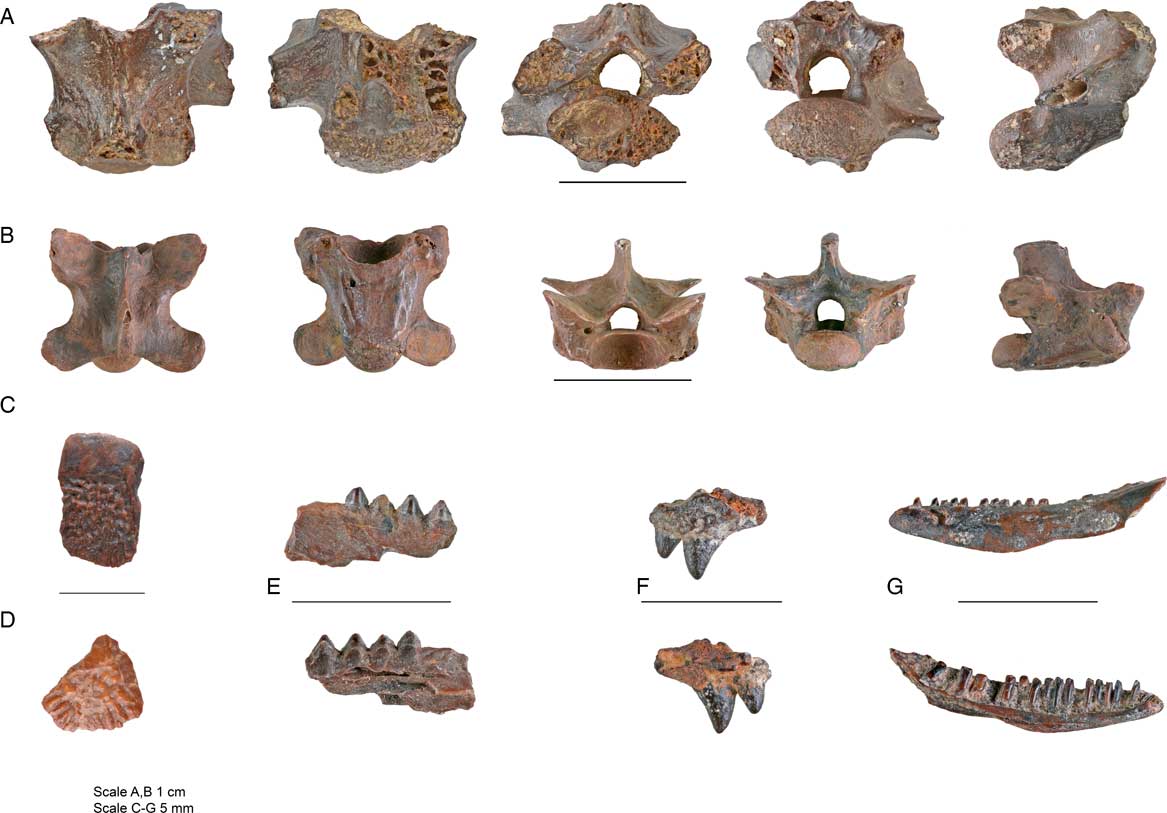
The roughtail rock agama was rare at both sites (GBY NISP=5; NMO NISP=1). It is represented by characteristic jaw fragments (Fig. 5E and F) with two pleurodont, caniniform teeth followed by acrodont, triangular, mediolaterally flattened teeth (Smith et al., Reference Smith, Maul, Flemming, Barkai and Gopher2016).
Lacertidae Batsch, 1788
Lacertidae indet.
(color online) Lizard bones from Gesher Benot Ya’aqov (GBY) and Nahal Mahanayeem Outlet (NMO). (A) GBY-7074, Varanus sp., dorsal, ventral, anterior, posterior, and right lateral views of caudal vertebra; (B) NMO-6801, Pseudopus apodus, dorsal, ventral, anterior, posterior, and right lateral views of praesacral vertebra; (C) NMO-4910, Pseudopus apodus, external view of laterodorsal osteoderm; (D) GBY-502, Pseudopus apodus, external view of mediodorsal osteoderm; (E) NMO-6936, Stellagama cf. stellio, lateral and medial views of right dentary; (F) GBY-1957, Stellagama cf. stellio, lateral and medial views of left maxilla; (G) GBY-1933, Lacertidae indet., lateral and medial views of left dentary.

An almost complete left dentary was recovered from GBY (Fig. 5G). It bears cylindrical, pleurodont, and bicupsid teeth, an open Meckel groove, and an impression of the coronoid on the posterodorsal area.
An accurate attribution was impossible, but based on the size and morphology, two species currently present in northern Israel are suitable candidates: the large Lebanon lizard (Phoenicolacerta laevis) or the Balkan emerald lizard (Lacerta media).
Anguidae Gray, 1825
Pseudopus apodus (Pallas, 1775)
Some osteoderms and vertebrae are assigned to Pseudopus apodus (GBY NISP=1; NMO NISP=106). The presacral vertebrae (Fig. 5B) display a flattened and triangular centrum; the condyle is depressed, and no precondylar constriction is present. The caudal vertebrae have fused haemal arches, and the precondylar constriction is always absent. The osteoderms (Fig. 5C and D) have a dermal vermiculate ornamentation, and the mediodorsal osteoderms bear a longitudinal carina.
Varanidae Merrem, 1820
Varanus sp. (Merrem, 1820)
Two procoelous caudal vertebrae of a monitor lizard from GBY (Fig. 5A) are attributed to a Varanus species. They differ from those assigned to Pseudopus by the presence of a well-defined pars tectiformis and precondylar constriction.
Snakes
Snakes at both sites were represented primarily by vertebrae. Unfortunately, the caudal and cloacal vertebrae are of low taxonomical value for most snake species. Hence, caudal vertebrae were described only in the case of Eryx sp.
Boidae Gray, 1825
Eryx sp. (Daudin, 1803)
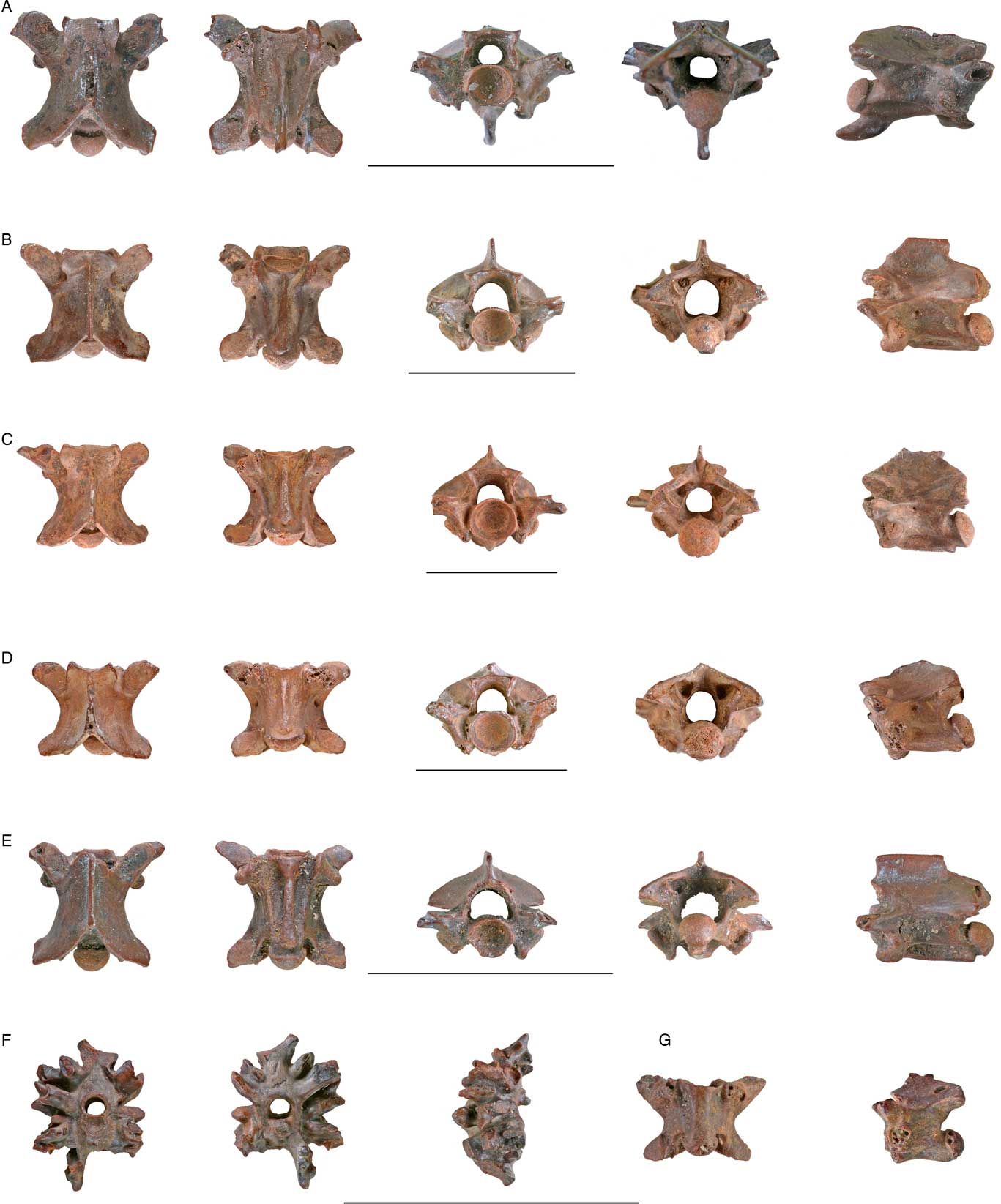
Old World sand boas are represented only at NMO by a trunk vertebra and a caudal vertebra. Eryx (and Erycinae in general) are characterized by a highly complex caudal vertebral morphology, which bears additional processes (in addition to the prezygapophysis, postzygapophysis, and hemapophysis, there are also the pterapophysis and the pleurapophysis; Fig. 6F). The trunk vertebra is short, with a depressed neural arch and a wide and diffuse haemal keel (Fig. 6G).
Lamprophiidae Fitzinger, 1843
Malpolon insignitus (Geoffroy Saint-Hilaire, 1827)
(color online) Snake vertebrae from Nahal Mahanayeem Outlet (NMO). (A–F) Dorsal, ventral, anterior, posterior, and lateral views of trunk vertebrae. (A) NMO-4483, Natrix sp.; (B) NMO-4632, Malpolon insignitus; (C) NMO-5715, Dolichophis jugularis; (D) NMO-5496, cf. Elaphe sauromates; (E) NMO-4951, Psammophis cf. schokari; (F) NMO-5246, Eryx sp., caudal vertebrae. (G) NMO-5617, Eryx sp., ventral and lateral views of trunk vertebra. All scale bars=10 mm.

Eastern Montpellier snake vertebrae were recovered at both sites (GBY NISP=3; NMO NISP=11). Typically, in this species, the neural arch is vaulted and, in posterior view, the posterior borders are usually straight, the haemal keel is prominent and sharp, the condyle is slightly compressed laterally, and the prezygapophyseal processes are long (Fig. 6B).
Psammophis cf. schokari (Forskål, 1775)
Only four vertebrae from NMO are assigned to a probable Schokari sand racer snake. The vertebrae are quite long and thin; the haemal keel is prominent and wide, the neural arch is moderately vaulted, and the neural spine is rather low (Fig. 6E).
Colubridae Oppel, 1811
Natrix sp. (Laurenti, 1768)
Water snake vertebrae are abundant at NMO (NISP=481) and rarer at GBY (NISP=20). In Natrix, all trunk vertebrae possess a sigmoid hypapophysis, and the neural arch is vaulted; the condyle and the cotyle are small, and the prezygapophyseal processes are well developed (Szyndlar, Reference Szyndlar1984). In fossil remains, poor preservation was the major obstacle for distinguishing between N. tesselata and N. natrix (Szyndlar, Reference Szyndlar1984). However, the hypapophysis, when preserved, was mostly pointed (i.e., N. tesselata Fig. 6A) but occasionally obtuse distally (i.e., N. natrix; Supplementary Fig. S1B). Today, only Natrix tesselata is found in Israel, but there is a possibility that Natrix natrix was also present in the recent past (Grillitsch and Werner, Reference Grillitsch and Werner2009). Venczel (Reference Venczel2000) already noted that identification of Natrix species based exclusively on vertebrae cannot be fully confirmed. Therefore, we assigned the remains to Natrix sp.
Dolichophis jugularis (Linnaeus, 1758)
Thirteen large whip snake vertebrae were recovered at NMO (Fig. 6C). The neural arch is vaulted but not straight in posterior view; the haemal keel is prominent and sharp throughout most of its length (gladiated), but slightly enlarged posteriorly, and the condyle is big and rounded with a small ventral notch.
cf. Elaphe sauromates (Pallas, 1811)
Two vertebrae belonging to a large colubrid were retrieved at NMO (Fig. 6D). They are shorter and more robust than the vertebrae of Dolichophis jugularis and Malpolon insignitus and have a flattened haemal keel with indistinct lateral edges. However, the rarity of these finds and their incompleteness prevented a more accurate specific attribution.
Viperidae Oppel 1811
Daboia Gray 1842
cf. Daboia palaestinae (Werner, 1938)
A large, short vertebra from GBY (Supplementary Fig. S1C), with a depressed neural arch, a very large round condyle, a straight hypapophysis, and a large rectangular prezygapophyseal articular facet is tentatively assigned to the Palestine viper.
Quantification
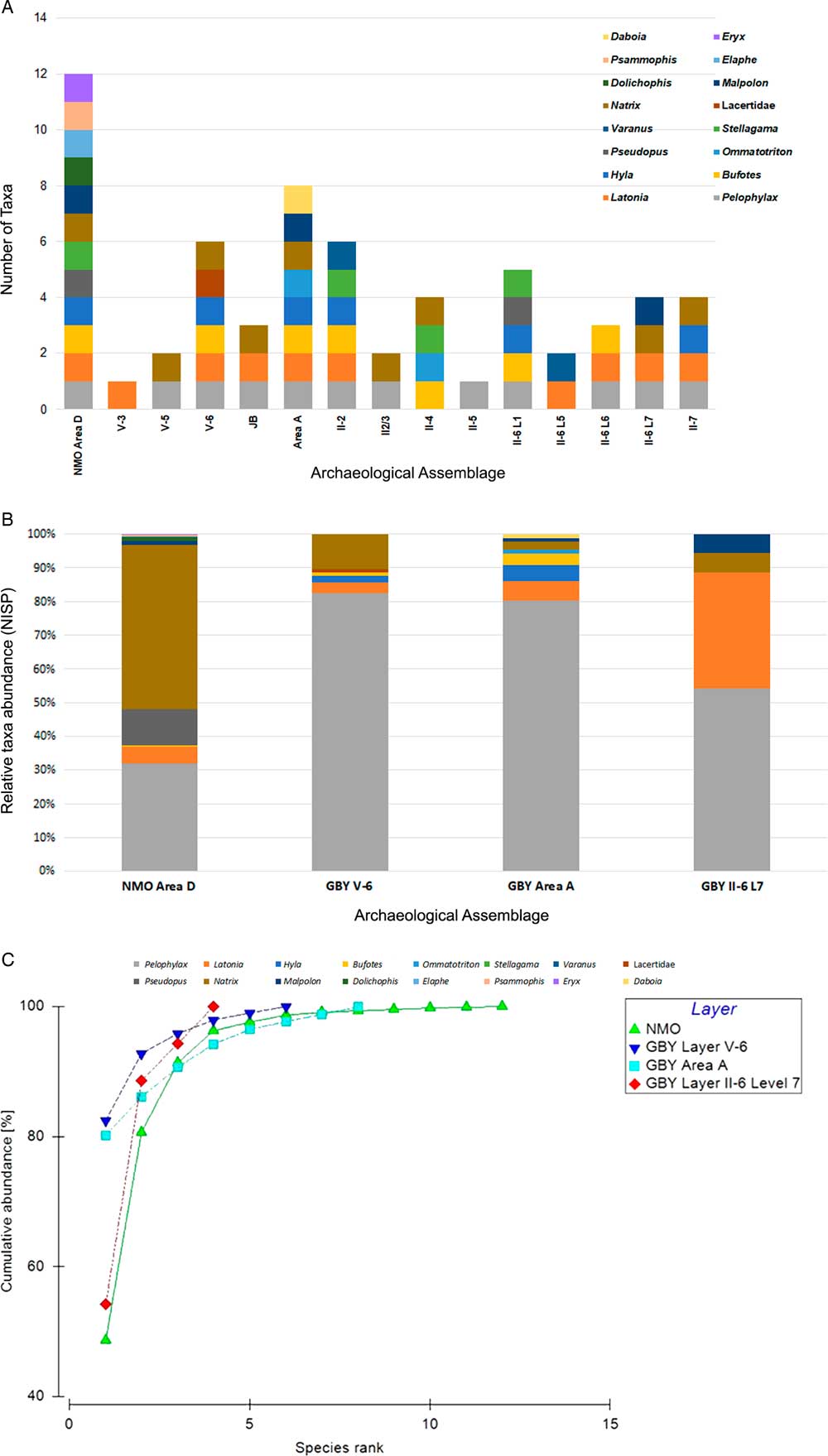
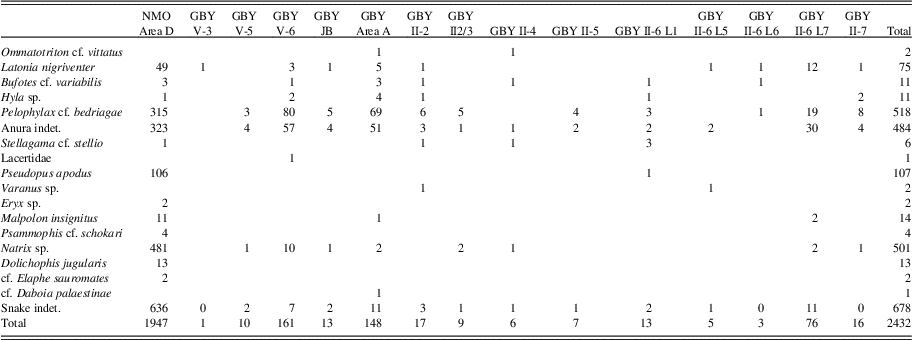
NMO comprises a single Mousterian assemblage from Area D, while GBY comprises 14 amphibian and squamate assemblages from different archaeological horizons. The results are represented in stratigraphic order, starting from the youngest assemblage to the oldest assemblage (Table 1). All assemblages discussed originated from archaeological horizons with lithic, faunal, and floral findings of varying abundance. The assemblages from both sites include a total of 2432 amphibian and squamate bones, of which more than half (1271), were identified at least to the genus level. A total of 16 different genera were identified. When all GBY assemblages are combined, they yield 12 genera, as does the NMO assemblage. However, no single assemblage at GBY reaches this number. The GBY assemblage with the highest number of genera is GBY Area A with eight genera, followed by GBY II-2 and GBY V-6 (Fig. 7A).
(color online) Genus richness, relative abundance, and cumulative abundance curves. (A) Genus richness for all studied assemblages from Gesher Benot Ya’aqov (GBY) and Nahal Mahanayeem Outlet (NMO). (B) Relative abundance of all genera based on number of identified specimens (NISP) for selected assemblages, with more than 20 elements identified to the genus level. (C) Cumulative abundance curves of genera for selected assemblages with more than 20 elements identified to the genus level.

Amphibians and squamate taxa (number of identified specimens) from Gesher Benot Ya’aqov (GBY) and Nahal Mahanayeem Outlet (NMO).

Amphibians
Amphibians were retrieved from GBY (14 horizons) and from NMO. When comparing genus richness, GBY Area A is the richest, with all five amphibian genera present, followed by GBY II-2, GBY V-6, and NMO, with four genera each (Fig. 7A, Table 1). Taxonomic abundance of anurans was calculated based on NISP, with MNI also used only for those assemblages with more than 20 bones identified to the genus level, that is, NMO, GBY V-6, GBY Area A, and GBY II-6 L7 (Supplementary Fig. S2A and B). In these assemblages, Pelophylax cf. bedriagae is always the most abundant species (>60% of the specimens), followed by Latonia nigriventer. Bufotes cf. variabilis and Hyla sp. are present in NMO, GBY V-6, and GBY Area A, but not in GBY II-6 L7.
Lizards
Lizards were retrieved from GBY (five horizons) and from NMO. All of the assemblages are remarkably poor, with only one or two taxa present. NMO, with the largest lizard assemblage, contained 106 Pseudopus apodus remains and one fragment of a Stellagama cf. stellio jaw. Although the NISP of Pseudopus apodus is high in this assemblage, the MNI is of a single animal, because most of the remains are osteoderms (NISP=91) and the remaining are vertebrae that could easily belong to a single lizard.
Snakes
Snakes were retrieved from 11 horizons at GBY, but only in 8 horizons could vertebrae be identified to the level of genus or species. Snakes were also retrieved from NMO. NMO is the richest assemblage, with six taxa present, followed by GBY Area A with three taxa and GBY II-6 L7 with two taxa (Fig. 7A, Table 1). Natrix sp. is present in all assemblages. Hence, NMO has the largest assemblage of snake bones identified to the genus/species level (NISP=507), with Natrix sp. comprising more than 94% of the assemblage based on NISP (Supplementary Fig. S2C). Three assemblages include more than a single snake taxon (NMO, GBY Area A, GBY II-6 L7). Interestingly, they all include Malpolon insignitus.
Quantification Summary
Amphibians were recovered from all the assemblages studied at both sites, snakes from most of them, and lizards only rarely (Table 1). A striking difference between the GBY assemblages and the NMO assemblage is the relative abundance of snakes. The relative abundance of all taxa identified was calculated for assemblages with more than 20 bones identified to the level of genus/species, that is, NMO, GBY V-6, GBY Area A, and GBY II-6 L7 (Fig. 7B). In all three GBY assemblages, anurans are the most abundant group, and Pelophylax cf. bedriagae is the most abundant species. At NMO, snakes are the most abundant group and Natrix sp. is the most abundant species.
The cumulative abundance curves (Fig. 7C) for the assemblages, produced by plotting the cumulative abundance of genera against their decreasing order of abundance, demonstrate that the NMO, GBY V-6, and GBY Area A assemblages reach a plateau, whereas GBY II-6 L7 does not. Cumulative abundance curves tend to reach a plateau if the assemblage or sample size is sufficient to assess species richness (Magurran, Reference Magurran2004). The significance of this is that the majority of abundant taxa were sampled for NMO, GBY V-6, and GBY Area A, despite the high variation in the NISP recorded for the different assemblages (Table 1). Therefore, the differences between the NMO and GBY assemblages (Area A and V-6) as expressed by the abundance of Natrix sp. in NMO versus Pelophylax cf. bedriagae at GBY are valid and not a result of assemblage size bias.
Taphonomy
Species representation and their relative distribution in an assemblage can significantly differ from the original living population at a site due to accumulation and preservation biases. A reduction in species richness can be the result of a selective predator, or enhanced preservation of the bones of larger species, or of species with more compact bones. Increases in species richness in an assemblage may occur when species deposited at the site by a predator or by abiotic transportation (water, wind) originated from more than a single geographic area (Andrews, Reference Andrews2006). Therefore, assessment of the origins of archaeological bone accumulations through taphonomic studies is important.
Anuran Taphonomy
The taphonomy of GBY anurans was previously discussed by Rabinovich and Biton (Reference Rabinovich and Biton2011) and by Goldstein (Reference Goldstein2011). All areas were analyzed following the Pinto-Llona and Andrews (Reference Pinto-Llona and Andrews1999) methodology. Goldstein (Reference Goldstein2011) showed that there were hardly any signs of digestion on the bones from Area A at GBY. As for breakage, the level of breakage in this assemblage was categorized as breakage degree 4 and was thus reminiscent of damage caused by mammalian carnivores. The plausible explanation for this contrast was that the bones were not digested, but demonstrated typical signs of weathering, and thus it was concluded that the GBY Area A anuran assemblage originated in natural death at the shore of the paleo-Lake Hula (Goldstein, Reference Goldstein2011).
Anuran bones from other horizons in GBY (V-5, V-6, II-2, II2/3, II-5, and II-6 L1) lack intensive digestion marks, and their fragmentation varies from breakage degree 1 to 5, according to Pinto-Llona and Andrews (Reference Pinto-Llona and Andrews1999). This suggests, therefore, that the most probable scenario was natural death and relatively rapid burial, with some subsequent sediment movement after their deposition. In contrast, horizons with higher fragmentation and apparent digestion marks (JB, II-6 L6, and II-6 L7) were probably formed by an abiotic factor that created modifications similar to digestion marks. The reasoning was that modification pattern of anuran assemblages with higher fragmentation and digestion marks greatly resemble those found on medium mammal bones in the same horizons, inferring that the same postdepositional processes affected the bones (Rabinovich and Biton, Reference Rabinovich and Biton2011).
At NMO, the degree of breakage of anuran bones corresponds to breakage category 4 according to Pinto-Llona and Andrews (Reference Pinto-Llona and Andrews1999); that is, most of the bones were heavily broken. However, the digestion category fits category 2 or 3, with slight alterations observed on more than 50% of the bones (Supplementary Table S1). Thus, a share of the anuran assemblage could be the result of predation by a mammalian carnivore, such as an otter, which produced a high degree of breakage and a digestion level suitable to category 3 according to Pinto-Llona and Andrews (Reference Pinto-Llona and Andrews1999). The anuran accumulation can be explained by a mixture of different origins. Some of the anuran remains may result from natural death followed by biostratinomic and diagenetic modifications, resulting in noncorroded broken bones (Figs. 4E and I), while others are remains of carnivore predation, probably mammalian (Supplementary Fig. S3F).
Squamate Taphonomy
Squamates are subjected to predation by birds of prey, mammalian carnivores, other squamates, and even by the same species (cannibalism) (Werner, Reference Werner2016). Actualistic taphonomic studies are essential if we want to identify the possible predators of the squamates in an assemblage, but these are scarce (Bailon, Reference Bailon2011). Lately, taphonomic research on squamate bones subjected to vulture predation, among others, was published (Lloveral et al., Reference Lloveral, Nadal, Moreno-García, Thomas, Anglada, Baucells, Martorell and Vilasís2014, Reference Lloveral, Cosso, Solé, Claramunt-López and Nadal2017; Sanchis Serra et al., Reference Sanchis Serra, Real Margalef, Morales Pérez, Pérez Ripoll, Tormo Cuñat, Carrión Marco, Pérez Jordá, Ribera Gómez, Bolufer Marqués and Villaverde Bonilla2014). Lloveral et al. (Reference Lloveral, Cosso, Solé, Claramunt-López and Nadal2017) showed that snake vertebrae accumulated by golden eagle (Aquila chrysaetos) remained complete, without any beak punctures, and only one vertebra showed light corrosion. The taphonomic signature of the Egyptian vulture (Neophron percnopterus) is apparently more complex. While one study reported the presence of almost complete snake remains consisting mainly of vertebrae and some ribs without any corrosion signs (Lloveral et al., Reference Lloveral, Nadal, Moreno-García, Thomas, Anglada, Baucells, Martorell and Vilasís2014), another reported highly modified reptile bones, including snakes and lizards, with heavy signs of digestion on articulars and polished surfaces (Sanchis Serra et al., Reference Sanchis Serra, Real Margalef, Morales Pérez, Pérez Ripoll, Tormo Cuñat, Carrión Marco, Pérez Jordá, Ribera Gómez, Bolufer Marqués and Villaverde Bonilla2014).
Based on our observations, most lizard remains (Stellagama cf. stellio and Varanus sp.) from GBY are very partial and show signs of corrosion that might be related to digestion (Fig. 5A and F). At NMO, the only lizard bone, other than Pseudopus apodus, is a Stellagama cf. stellio dentary heavily broken and not well preserved, possibly as a result of predation (Fig. 5E). In contrast, the many legless lizard (Pseudopus apodus) vertebrae and osteoderms were nearly complete and lacked corrosion (Figs. 5B and C).
In the case of snake remains, completeness and corrosion are variable. Intact or almost intact snake vertebrae were extremely rare at both sites. Snake vertebrae are compact bones but have several processes that tend to break first, as they extend from the more robust body of the vertebra. These processes are often important for taxonomic identification. Therefore, even light or moderate fragmentation may affect the possibility of identifying snakes to the lowest taxonomic level. Most assemblages exhibit variable degrees of fragmentation. GBY II-6 L7 and GBY Area A feature a high degree of fragmentation, while GBY V-6 and the NMO assemblage display moderate fragmentation rates. As such, there is a certain level of correlation between the degree of fragmentation in an assemblage and the number of vertebrae identified to the species level.
Almost all snake vertebrae at GBY have moderate to very heavy signs of corrosion. Assemblages from layers V-5, II-2, II-2/3, II-4, II-5, II-6 L5, and II-6 L7 consisted of very heavily corroded vertebrae (Supplementary Fig. S3C), while assemblages from layers V-6, JB, and II-7 consisted of moderately to heavily corroded vertebrae (Supplementary Fig. S1B). Only vertebrae from GBY Area A had no to very light surface corrosion (Supplementary Fig. S1C).
At NMO, the degree of corrosion shows a discrepancy between species, indicating, in our opinion, a different taphonomic history. This is best exemplified by the large colubrid snakes, Malpolon insignitus and Dolichophis jugularis. Both species have vertebrae very similar in size and shape but with completely different preservation. The vertebrae assigned to Dolichophis jugularis show very light corrosion, mainly on the diapophysis and parapophysis and hardly ever on the condyle as well (Supplementary Fig. S3A), except for one vertebra that is moderately corroded. The vertebrae of Malpolon insignitus, on the other hand, are all broken; the zygosphene and part of the neural arch are almost always missing; and the vertebrae show moderate signs of digestion, mainly on the diapophysis, parapophysis, and the condyles (Supplementary Fig. S3B). As a result of the poor degree of preservation, some large colubrid vertebrae could not be assigned to species level, as they were heavily broken and corroded and were missing the condyle (Supplementary Fig. S3C–E).
Taphonomy Summary
Overall, at both sites, elements or parts of elements with the greatest degree of ossification were those usually recovered: the distal parts of ilia and humeri for anurans, vertebrae for snakes, and osteoderms for Pseudopus apodus. At GBY, snakes were represented only by vertebrae; at NMO, ribs (NISP=11) and some cranial elements (NISP=4) were also recovered, although extremely infrequently.
No indication of human exploitation was recorded. Cut marks were not expected on these relatively small animals, as they would probably have been disarticulated simply by tearing the elements apart. However, no evidence of tearing was found. Burn marks are frequently used as evidence of human consumption, because sometimes bones get burned in the process of roasting the meat. Unfortunately, no burn marks were observed. The waterlogged preservation conditions (i.e., dark and shiny surfaces) might have masked burn marks on bones (Turner-Walker, Reference Turner-Walker2008; Rabinovich and Biton Reference Rabinovich and Biton2011; Biton et al., Reference Biton, Sharon, Oron, Steiner and Rabinovich2017), if any were present.
Nonhuman faunal accumulations at archaeological sites usually represent more than a single source. GBY and NMO assemblages could have been accumulated at least partially due to natural death on the lakeshore. This is particularly relevant for the aquatic taxa: Pelophylax cf. bedriagae, Latonia nigriventer, Hyla sp., and Natrix sp. The more uncommon terrestrial taxa, Bufotes cf. variabilis, Stellagama cf. stellio, and the various snake species (except Natrix sp.), could have died naturally slightly offshore or could have been deposited at the sites by predators, as could be the case with the accumulation of Malpolon insignitus at NMO.
None of the assemblages studied were accumulated by water or wind transportation, and all were buried rapidly. Still, predation is proposed as the source of some taxa deposited at NMO, and this calls for some caution when interpreting the paleoclimate and paleoenvironment at the site. The taphonomic history of the snake vertebrae is inconsistent and suggests multiple origins. This could tentatively explain the higher species richness of snakes at NMO compared with the GBY assemblages, as the snakes could have originated from a larger geographic area and been brought to the site by a predator before undergoing rapid burial.
Comparison of GBY and NMO amphibians and squamates with the current Hula Valley species
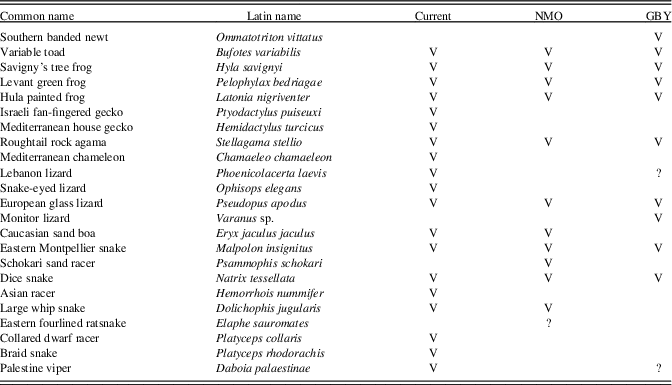
The comparison of assemblage composition is discussed in relation to possible environmental and climatic fluctuations in a very similar geographic setting, at almost the same geographic location, as less than 2.5 km separate GBY and NMO. As the number of identified specimens per assemblage is low (Table 1), we applied a qualitative approach of presence/absence to track possible changes throughout the chronological frame and to compare the archaeological data with the present-day fauna of the Hula Valley (Table 2).
Amphibians and squamates from the Hula Valley based on Table 1, data provided by the Israel Nature and Parks Authority (©Data, Scientific Data Department, Israel Nature and Parks Authority) and based on BioGIS 2017 (Israel Biodiversity Information System [http://www.biogis.huji.ac.il]); Dimentman et al. (Reference Dimentman, Bromley and Por1992); and Perl et al. (Reference Perl, Gafny, Malka, Renan, Woodhams, Rollins-Smith, Pask, Bletz, Geffen and Vences2017). V, present; ?, possibly present; blank cell, absent.

Because the complex taphonomic history of each site and each assemblage affects specimen preservation and our ability to identify species, similar taphonomic conditions are recommended for comparison. Unfortunately, this is seldom the reality in archaeozoological research. Therefore, caution is always required when interpreting past environmental conditions, particularly because the typically complex taphonomic history encompassing the entire history of deposition of all archaeological components of a single site is never fully revealed. That said, all assemblages under study were waterlogged and were buried rapidly, they all have different degrees of surface modification, and signs of water transportation were detected in none of them.
The modern distribution of the Hula Valley amphibians and squamates has most probably been affected by local and regional geographic and climatic history, as well as by the presence of bodies of water, at least from the early Pleistocene (Horowitz, Reference Horowitz1988, Reference Horowitz2001; Dimentman et al., Reference Dimentman, Bromley and Por1992). The most abundant species in all archaeological assemblages under study are the aquatic species: the Hula painted frog (Latonia nigriventer), the Levant green frog (Pelophylax cf. bedriagae), a tree frog (Hyla sp.), and a water snake (Natrix sp.). Their ecological requirements indicate the presence of permanent bodies of water. More terrestrial taxa are less represented and include: the variable toad (Bufotes cf. variabilis), the roughtail rock agama (Stellagama cf. stellio), the European glass lizard (Pseudopus apodus), the Eastern Montpellier snake (Malpolon insignitus), the large whip snake (Dolichophis jugularis), the eastern fourlined ratsnake (cf. Elaphe sauromates), the Schokari sand racer (Psammophis cf. schokari), an Old World sand boa (Eryx sp.), and the Palestine viper (cf. Daboia palaestinae) (Tables 1 and 2). All the terrestrial species are typical inhabitants of the Mediterranean region in Israel. Psammophis schokari is the only species that can be found throughout Israel, both inside and outside the Mediterranean region, mainly on light soils. Eryx jaculus, the sole Eryx sp. represented locally, also inhabits mainly light soils. Both were recovered only at NMO and not at GBY. The presence of Pseudopus apodus is an indication of maquis and garrigue in the vicinity of the sites, and Malpolon insignitus implies abundant vegetation (Werner, Reference Werner2016).
When the current fauna is compared with the archaeological faunal assemblages (Table 2), it can be seen that some species present in the Pleistocene Hula Valley are no longer present in this area. A varanid, represented by two poorly preserved vertebrae, was recovered at GBY (GBY- 7074, GBY-501; Fig. 5A). The poor preservation state of the vertebrae prevented more accurate identification. The only varanid present in modern Israel is Varanus griseus, found in sandy areas of the Negev and the coastal plain (Werner, Reference Werner2016). However, based on the large size of the vertebrae and the association with the paleolake accumulation environment of GBY, we suspect this taxa is related to a semiaquatic Varanus sp. reported by Haas (Reference Haas1966, Reference Haas1968) at ‘Ubeidiya, an early Pleistocene site in the Jordan Valley. The newt Ommatotritton cf. vittatus was found at GBY but is currently absent from the Hula Valley, although it inhabits immediately adjacent areas to the east and the west (Bar and Haimovitch, Reference Bar and Haimovitch2011), as confirmed by tadpoles detected in Rosh Pina a few kilometers southwest of the Hula Valley (Gafny, Reference Gafny1986). The snake Psammophis schokari, recovered at NMO, has not been currently observed in the Hula Valley (Table 2), although its geographic distribution is reported to be throughout Israel (Werner, Reference Werner2016). An additional snake species recovered at NMO and not reported today in the Hula Valley is cf. Elaphe sauromates. The current distribution range of this species in Israel is on the Mount Hermon heights up to at least 1800 m asl and the Golan Heights (Werner, Reference Werner2016). Its tentative presence at NMO, 60 ka at the transition from MIS 4 to 3 suggests, if valid, a slightly colder climate at the time of occupation than the present Hula Valley climate. A few terrestrial, nonaquatic species inhabit the current Hula Valley but were not recovered from the archaeological sites. These include: two gecko species (Ptyodactylus puiseuxi and Hemidactylus turcicus), a chameleon (Chamaeleo chamaeleon), a lizard (Ophisops elegans), and three snake species (Platyceps collaris, Platyceps rhodorachis, and Hemorrhois nummifer) (Table 2).
DISCUSSION
The two Hula Valley Pleistocene sites, GBY and NMO, have yielded, to our knowledge, the most taxonomically diverse assemblages of amphibians and squamates from the south Levantine Pleistocene. Most species recovered from both sites have a current geographic distribution far beyond northern Israel. An exception is the endemic Hula painted frog (Perl et al., Reference Perl, Gafny, Malka, Renan, Woodhams, Rollins-Smith, Pask, Bletz, Geffen and Vences2017). Latonia nigriventer is the sole surviving species of an ancient clade Latonia spp. that was widespread throughout Europe and reached as far as Asia Minor during the warmer and more humid Miocene (Claessens, Reference Claessens1995; Rage and Roček, Reference Rage and Roček2003; Biton et al., Reference Biton, Geffen, Vences, Cohen, Bailon, Rabinovich and Malka2013). Climatic degradation accompanied by decreased temperatures during the Pliocene (Bailon and Blain, Reference Bailon and Blain2007), followed by pronounced climatic fluctuations at the beginning of the Pleistocene brought Latonia to extinction in Europe. Latonia is apparently a taxon with narrow climatic tolerance; therefore, the survival of Latonia nigriventer from at least 780 ka at GBY to the present day is a good indicator of the persistence of relatively stable climatic conditions in the Hula Valley from the early middle Pleistocene to the present. This is further reinforced by the various species recovered from the archaeological assemblages under study. Almost all of the species that were present at GBY were also found at NMO and exist today in the Hula Valley, indicating that the species composition of the region has remained relatively stable, based on observations of the hominin occupation layers of GBY and NMO.
In many aspects, Israel’s geographical location is a hot spot for animals originating from various zoogeographical regions. The distributional patterns of extant squamate species can roughly be divided into two areas: the northern Mediterranean area, where the global distribution of most species extends from Israel northward; and the southern, more arid area, where the global distribution of most species is southwest or southeast of Israel. As for amphibians, all species, except for the endemic Latonia nigriventer, have a global distribution from Israel northward (Werner, Reference Werner1988, Reference Werner2016). Our paleoherpetological data from the Pleistocene Hula Valley fit with the current distribution pattern. Needless to say, a significant climatic change would not have preserved this geographical distribution pattern.
Based on micromammal presence/absence results from the 15 ka sequence of Amud Cave (ca. 70 to 55 ka), coinciding with NMO and situated approximately 30 km southwest of it, Belmaker and Hovers (Reference Belmaker and Hovers2011) concluded there was no major environmental change throughout the Amud Cave sequence. Paleoecological analysis based on a pollen core from the Hula Lake implies a relatively cool and wet environment for this time interval, as suggested by Weinstein-Evron (Reference Weinstein-Evron1983, Reference Weinstein-Evron1990). If the tentative attribution of two vertebrae to cf. Elaphe sauromates at NMO is correct, then it too suggests a slightly cooler climate during the occupation at NMO.
Other proxies from NMO are generally in agreement with our findings. Based on the ostracod record recovered from the site, a nearby shallow lake with brackish or saline springs existed during human occupation (Kalbe et al., Reference Kalbe, Sharon, Porat, Zhang and Mischke2014). Plant species also indicate a lakeshore environment with a moderate slope and springs (Sharon et al., Reference Sharon, Grosman, Fluck, Melamed, Rak, Rabinovich and Oron2010). Palynological results suggest the presence of wet habitats surrounded by Mediterranean maquis and minor fluctuations in humidity and temperature (Aharonovich et al., Reference Aharonovich, Sharon and Weinstein-Evron2014).
Multidisciplinary studies at GBY have produced high-resolution environmental and habitat records documenting tens of thousands of years. The rich plant and faunal assemblages point to a diverse environment composed of lakeshore and offshore habitats alongside typical Mediterranean riparian habitats, grassland, parkland, woodland, and forests (Goren-Inbar et al., Reference Goren-Inbar, Feibel, Verosub, Melamed, Kislev, Tchernov and Saragusti2000, Reference Goren-Inbar, Werker and Feibel2002b; Ashkenazi et al., Reference Ashkenazi, Motro, Goren-Inbar, Biton and Rabinovich2005, Reference Ashkenazi, Klass, Mienis, Spiro and Abel2009; Melamed et al., Reference Melamed, Kislev, Weiss and Simchoni2011, Reference Melamed, Kislev, Geffen, Lev-Yadun and Goren-Inbar2016; Mienis and Ashkenazi, Reference Mienis and Ashkenazi2011; Rabinovich and Biton, Reference Rabinovich and Biton2011; Zohar and Biton Reference Zohar and Biton2011; Rabinovich et al., Reference Rabinovich, Gaudzinski-Windheuser, Kindler and Goren-Inbar2012; Mischke et al., Reference Mischke, Ashkenazi, Almogi-Labin and Goren-Inbar2014; Zohar et al., Reference Zohar, Goren and Goren-Inbar2014; Biton et al., Reference Biton, Boistel, Rabinovich, Gafny, Brumfeld and Bailon2016).
The long GBY sequence estimated to have accumulated over 100 ka was divided into six different environmental cycles (Feibel, Reference Feibel2001). These cycles were associated with fluctuating water levels and climate conditions changing from cold and dry in the earlier cycles (1–2) to a warmer climate and finally a cold cycle 6 (Spiro et al., Reference Spiro, Ashkenazi, Mienis, Melamed, Feibel, Delgado and Starinsky2009, Reference Spiro, Ashkenazi, Starinsky and Katz2011; Almogi-Labin, Reference Almogi-Labin2011; Melamed et al., Reference Melamed, Kislev, Weiss and Simchoni2011; Mienis and Ashkenazi, Reference Mienis and Ashkenazi2011). The different climatic proxies at GBY indicate that the most abrupt change throughout the GBY sequence occurs around the Brunhes/Matuyama boundary, identified in Layer II-14, cycle 2 (Fig. 2). All amphibian and squamate assemblages studied here originated from horizons postdating this event in cycles 3 to 5 (Fig. 2).
Melamed et al. (Reference Melamed, Kislev, Weiss and Simchoni2011) pinpointed an extinction of three water plant species at GBY at the onset of cycle 3. Based on strontium isotope analyses of Melanopsis shells, Spiro et al. (Reference Spiro, Ashkenazi, Starinsky and Katz2011) suggested a warming after the Brunhes/Matuyama boundary and claimed cycle 3 was the warmest cycle, with weather similar to present-day climatic conditions (Spiro et al., Reference Spiro, Ashkenazi, Starinsky and Katz2011). Based on ostracod data, cycle 3 is also the cycle with the lowest abundance of Candona neglecta, almost similar to the abundances of this species in the present Hula basin bodies of water (Mischke et al., Reference Mischke, Ashkenazi, Almogi-Labin and Goren-Inbar2014). GBY cycle 3 includes several archaeological horizons with amphibian and squamate remains (II-6 L7, II-6 L6, II-6 L5, II-6 L1, II-5, II-4), none of which includes unique species not present at least in one of the younger horizons studied.
The overall predominance of the C. neglecta ostracod in the GBY sequence was interpreted as indicating cooler climatic conditions than currently (Mischke et al., Reference Mischke, Ashkenazi, Almogi-Labin and Goren-Inbar2014), as was also concluded from the fish remains at the site (Zohar et al., Reference Zohar, Goren and Goren-Inbar2014). It should be noted, however, that the presence of the endemic fish species of Lake Hula, Tristramella simonis intermedia and Mirogrex hulensis, do imply continuity of the fish community from GBY onward (Zohar et al., Reference Zohar, Goren and Goren-Inbar2014).
Thus, fluctuations of several proxies were recorded along the GBY sequence, but continuity of many species in the Hula Valley was also demonstrated. Most of the tree species recovered at GBY are still part of the current site surroundings (Werker and Goren-Inbar, Reference Werker and Goren-Inbar2001; Goren-Inbar et al., Reference Goren-Inbar, Werker and Feibel2002b), as are the ostracods (Mischke et al., Reference Mischke, Ashkenazi, Almogi-Labin and Goren-Inbar2014) and fish (Zohar et al., Reference Zohar, Goren and Goren-Inbar2014). There is also a continuity of the fresh-water turtle population (Hartman, Reference Hartman2004), all positive indicators of environmental stability.
The GBY and NMO amphibian and squamate analyses presented here offer unique windows into two crucial time slots of human occupation in the Hula Valley. The persistence of most species along the middle and late Pleistocene until the present, as presented here, indicates a certain level of stability in the environmental conditions throughout this long period of time. Even if some climatic fluctuations occurred, they were not drastic enough to change the typical species composition of the Hula Lake shoreline, nor were they of sufficient magnitude to bring about the extinction of Latonia nigriventer, an endemic frog with narrow ecological requirements.
Speleothems from Mediterranean-type climates in Israel (Peqi’in, Soreq, and Jerusalem Caves) grew continuously for at least the last 240 ka, suggesting that annual precipitation was consistently higher than 250–300 mm throughout glacial and interglacial cycles (Bar-Matthews, Reference Bar-Matthews2014; Bar Matthews et al., Reference Bar-Matthews, Ayalon, Vaks and Fraumkin2017). The southern Levant, and more specifically the Upper Rift Valley and the Hula Valley, may have served as a climatic refugium during the Pleistocene, particularly for aquatic species, because of the presence of permanent bodies of water. The abundant Hula Valley springs are artesian springs that drain aquifers rather than collecting runoff and therefore show little variation in response to climatic fluctuations (Por, Reference Por2004). Some even have a constant year-round temperature, such as ‘Enot ‘Enan (Ain Mallaha), one of the most important springs feeding Hula Lake; it has a temperature of 21°C–22°C with little seasonal and multiannual output fluctuations and even in the recent past provided a thermal refuge for the lake biota (Dimentman et al., Reference Dimentman, Bromley and Por1992; Por, Reference Por2004). Therefore, the comparability of the Hula Valley record and regional climate proxies can, in our opinion, be somewhat inconsistent. The Hula basin was probably an exceptional location for hominins, with water availability throughout the year and temperate Mediterranean weather.
CONCLUSIONS
Hominin groups camped on the lakeshores in the Hula Valley at different intervals during the early middle and late Pleistocene, in favorable conditions comparable to the current ones. This agrees with the ectothermic amphibian and squamate species composition at the Acheulian and the Mousterian occupations layers of GBY and NMO, which has changed little over time. The majority of the taxa present at GBY were also recovered at NMO and are still currently present in the Hula Valley.
To the extent of our knowledge, GBY and NMO have yielded the most taxonomically diverse record of amphibians and squamates from archaeological sites in the southern Levant, but despite the many taxa/species available to the hominins, no indication of human exploitation was found at either site.
ACKNOWLEDGMENTS
Some ideas in the present article were presented at the first meeting of the ICAZ Microvertebrate Working Group Alcalá de Henares (Madrid) in 2016. The CARE Archaeological Foundation (2014), the Ruth Amiran Fund for Archaeological Research in Eretz Israel (2015/2016), the EU SYNTHESYS project (FR-TAF-1986), and the Jack, Joseph and Morton Mandel School for Advanced Studies in the Humanities provided RB with financial support for the research. The GBY study was carried out with the support of a grant awarded by the Israel Science Foundation (grant no. 300/06) to the Center of Excellence for the project titled “The Effect of Climate Change on the Environment and Hominins of the Upper Jordan Valley between ca. 800 ka and 700 ka ago as a Basis for Prediction of Future Scenarios” and an Israel Science Foundation grant to NG-I (grant no. 27/12). Field and laboratory work at NMO were supported by grants from the CARE Foundation (2008, 2012, 2014), the Leakey Foundation (2007, 2009), the National Geographic Society (8680-09), the Wenner-Gren Foundation (grant no. 7986), and in particular by a grant from the Israel Science Foundation (grant no. 645-09). The authors wish to thank H.-A. Blain and an anonymous reviewer for their valuable and helpful comments and the following people for their help: A. Uzan for photographing the specimens and compiling the figures; Esther Lachman and G. Beiner for editing the manuscript; O. Kolodny, T. Fried, and R. Ganc for helping with the comparative collections; Y. Leshno for statistics advice; T. Oron, Y. Artzi, B. Shacham, S. Gafny, O. Steinitz, R. Talbi, and D. Hawlena for their help with data and for providing insights into the current Hula Valley herpetofauna.