Introduction
The determination of the mode of entry into entrepreneurship, particularly the choice between full-time entrepreneurial entry and hybrid entrepreneurship alongside paid employment, is a topic of significant scholarly interest. Existing literature predominantly examines the individual characteristics of prospective entrepreneurs to shed light on this decision-making process. These characteristics include factors such as employment status (Folta, Delmar, & Wennberg, Reference Folta, Delmar and Wennberg2010; Raffiee & Feng, Reference Raffiee and Feng2014), prior experience (Kacperczyk & Younkin, Reference Kacperczyk and Younkin2017; Kim, Aldrich, & Keister, Reference Kim, Aldrich and Keister2006), and available employment opportunities (Klyver, Steffens, & Lomberg, Reference Klyver, Steffens and Lomberg2020). While these individual antecedents undoubtedly play a crucial role, the family household, often considered a fundamental unit of analysis in entrepreneurship research, has received inadequate attention in the investigation of the mode of entry into entrepreneurship (Huang, Chen, Xu, Lu, & Tam, Reference Huang, Chen, Xu, Lu and Tam2020; Jayawarna, Marlow, & Swail, Reference Jayawarna, Marlow and Swail2021).
In particular, from the family embeddedness perspective, families and businesses are inextricably intertwined institutions, with entrepreneurial opportunities emerging from and explored in the complex family systems and their dynamics (Aldrich & Cliff, Reference Aldrich and Cliff2003; Jayawarna et al., Reference Jayawarna, Marlow and Swail2021). Given the shared values, knowledge, and experiences among family members, the family plays a role in shaping entry decisions in entrepreneurship. Within the family systems, the diversity (or differences) of family members has been a central research focus linked to various entrepreneurial decisions and processes, such as the causation logics in family firms (Randolph, Fang, Memili, & Nayir, Reference Randolph, Fang, Memili and Nayir2021), entrepreneurial exit decisions (Jayawarna et al., Reference Jayawarna, Marlow and Swail2021), and the probability of a family member starting a business (Wang, Eddleston, Chirico, Zhang, Liang, & Deng, Reference Wang, Eddleston, Chirico, Zhang, Liang and Deng2023). In line with traditional diversity research (Harrison, Price, & Bell, Reference Harrison, Price and Bell1998; Harrison, Price, Gavin, & Florey, Reference Harrison, Price, Gavin and Florey2002), family diversity in age and gender (visible characteristics at the surface level) and in work experience and education (invisible work-related features at the deep level) may encourage or prevent hybrid entrepreneurial entry by affecting value conflicts, learning, and risk attitudes toward entrepreneurship among family members.
Moreover, the family embeddedness perspective underscores the need for a more systematic examination of the intricate family systems and households’ dynamics (Aldrich & Cliff, Reference Aldrich and Cliff2003; Jayawarna et al., Reference Jayawarna, Marlow and Swail2021). In this sense, the effects of family diversity can be moderated by how families are embedded or stratified within the broad social milieu. Income stratification, viz. the categorization of families into different economic strata based on their income levels, can reshape the patterns family members navigate through family diversity (Lim, Oh, & De Clercq, Reference Lim, Oh and De Clercq2016; Perry-Rivers, Reference Perry-Rivers2016). Given these family dynamics, an intriguing yet significant research question arises: How does family diversity affect the choice of hybrid entrepreneurship across different income classes?
Centering on this research question, we contend that (1) the diversity of the family members at both surface and deep levels directly impacts individuals’ preferred mode of entry into entrepreneurship, and (2) the income classes of the family households moderate the impact of family diversity on the choice of hybrid entrepreneurship. We test our hypotheses by using data from 1,320 individual-wave observations from the China Health and Nutrition Survey (CHNS). The Chinese context is selected because of the prominent family role in all aspects of social life (Ahlstrom, Young, Chan, & Bruton, Reference Ahlstrom, Young, Chan and Bruton2004; Fang, Singh, Kim, Marler, & Chrisman, Reference Fang, Singh, Kim, Marler and Chrisman2021; Liu, Qian, & Au, Reference Liu, Qian and Au2023). The context also features significantly changing patterns of family systems since China's reform and opening up.
Our study offers two key contributions. First, departing from prior studies that explore individual antecedents of hybrid entrepreneurs, we develop an integrative approach that includes the dynamics between within-family structure and the stratification of the focal family household in a broader social context. Such an approach responds to the call by Folta et al. (Reference Folta, Delmar and Wennberg2010), Schulz, Urbig, and Procher (Reference Schulz, Urbig and Procher2016), and Gänser-Stickler, Schulz, and Schwens (Reference Gänser-Stickler, Schulz and Schwens2022) to explore individuals’ values along with traditions or institutional norms in the field of hybrid entrepreneurship. Second, this study explores both surface and deep-level diversity within family households to elucidate the different influencing mechanisms, including the social categorization and information-sharing mechanisms, that shape their entrepreneurial journeys. It reveals an important boundary condition, income stratification, which variably moderates the effect of family surface and deep-level diversity on the mode of entry into entrepreneurship. Our findings contribute to enriching the family embeddedness perspective and advancing our understanding of the dynamics of complex family systems in the decision-making process of entering entrepreneurship (Aldrich & Cliff, Reference Aldrich and Cliff2003; Cruz, Justo, & De Castro, Reference Cruz, Justo and De Castro2012; Pittino, Visintin, & Lauto, Reference Pittino, Visintin and Lauto2018).
Theoretical Background and Hypotheses
The Family Embeddedness Perspective and Modes of Entry Into Entrepreneurship
Existing studies have highlighted the significant contribution of family factors to economic growth in many countries around the world, especially in Asia, and have identified the distinct features of family-backed firms (Ahlstrom & Ding, Reference Ahlstrom and Ding2014; Fang et al., Reference Fang, Singh, Kim, Marler and Chrisman2021; Wu, Chirico, Fan, Ding, & Su, Reference Wu, Chirico, Fan, Ding and Su2024). As such, various theoretical perspectives, such as social capital theory (Lu, Huang, Xu, Chung, & He, Reference Lu, Huang, Xu, Chung and He2022), socioemotional wealth theory (Huang et al., Reference Huang, Chen, Xu, Lu and Tam2020), and the mixed gamble perspective (Liu et al., Reference Liu, Qian and Au2023), have been increasingly incorporated in explaining the founding of new ventures. Despite these theoretical insights, the family embeddedness perspective, first proposed by Aldrich and Cliff (Reference Aldrich and Cliff2003), is highlighted by entrepreneurship scholars for considering the role of the family in affecting the exploitation of business opportunities and new venture creation (Burt, Opper, & Zou, Reference Burt, Opper and Zou2021; Cruz et al., Reference Cruz, Justo and De Castro2012; Sieger & Minola, Reference Sieger and Minola2017). As an extended theoretical lens of social embeddedness, the family embeddedness perspective focuses on analyzing how changing family systems and the diverse set of family compositions affect family members’ entrepreneurial behaviors (Aldrich & Cliff, Reference Aldrich and Cliff2003). With increasing research attention being paid to family dynamics and variations of family systems, family embeddedness becomes a vital theoretical lens for examining family members’ entrepreneurial decisions (Pittino et al., Reference Pittino, Visintin and Lauto2018), and notably any decision on the mode of entry into entrepreneurship.
Due to the high frequency of failure in entrepreneurial activities, understanding the mode of entry into entrepreneurship is of great importance, since it implies how individuals manage uncertainties when starting a new business (Raffiee & Feng, Reference Raffiee and Feng2014). With different attitudes toward risk, some individuals tend to adopt a full-time mode of entry that involves quitting their paid job and devoting themselves fully to the new business, whereas others prefer a hybrid mode to create a new business while maintaining their paid employment (Gänser-Stickler et al., Reference Gänser-Stickler, Schulz and Schwens2022; Raffiee & Feng, Reference Raffiee and Feng2014). Compared to full-time entrepreneurship, hybrid entrepreneurship offers several advantages: it reduces risk and uncertainty (Folta et al., Reference Folta, Delmar and Wennberg2010; Gänser-Stickler et al., Reference Gänser-Stickler, Schulz and Schwens2022; Raffiee & Feng, Reference Raffiee and Feng2014), lowers opportunity costs (Folta et al., Reference Folta, Delmar and Wennberg2010; Klyver et al., Reference Klyver, Steffens and Lomberg2020), and often leads to a higher survival rate for businesses (Raffiee & Feng, Reference Raffiee and Feng2014). Additionally, it allows entrepreneurs to test ideas and assess their personal fit for entrepreneurship (Folta et al., Reference Folta, Delmar and Wennberg2010; Liu & Wu, Reference Liu and Wu2022; Petrova, Reference Petrova2012). However, it also poses challenges, such as complex resource and time management to balance multiple roles (Parasuraman & Simmers, Reference Parasuraman and Simmers2001) and diverse knowledge and expertise requirements (Kurczewska, Mackiewicz, Doryń, & Wawrzyniak, Reference Kurczewska, Mackiewicz, Doryń and Wawrzyniak2020; Schulz et al., Reference Schulz, Urbig and Procher2016).
In the family household context, the decision-making process of entrepreneurship entry becomes more complicated, as the different characteristics of family households and the related family embeddedness conditions can lead family members’ attitudes toward entry decisions to vary (Pittino et al., Reference Pittino, Visintin and Lauto2018). Although existing studies have found that changes in governance systems (Calabrò, Chrisman, & Kano, Reference Calabrò, Chrisman and Kano2022), family resources (Fang et al., Reference Fang, Singh, Kim, Marler and Chrisman2021), intergenerational features (Criaco, Sieger, Wennberg, Chirico, & Minola, Reference Criaco, Sieger, Wennberg, Chirico and Minola2017), and risk-tolerance of entrepreneurs (Ahlstrom & Ding, Reference Ahlstrom and Ding2014) account for family members’ heterogeneous strategic behavior, limited attention has been paid to investigating the sources of heterogeneity at the surface and deep levels that can alter family members’ decisions. Therefore, in this study, we aim to explore how diversity among family households affects an entrepreneur's propensity to select a full-time or hybrid entrepreneurship mode.
Diversity of Family Households and Modes of Entry Into Entrepreneurship
According to the family embeddedness perspective, the cohesion of family relationships changes in many circumstances, such as when individual members exhibit great diversity in viewpoints, thereby affecting entrepreneurial entry decisions (Wiklund, Nordqvist, Hellerstedt, & Bird, Reference Wiklund, Nordqvist, Hellerstedt and Bird2013). More diversified family characteristics generally imply different values and beliefs, risk preferences, and entrepreneurial cognition among family household members (e.g., Aldrich & Cliff, Reference Aldrich and Cliff2003; Cruz et al., Reference Cruz, Justo and De Castro2012; Jansen & Searle, Reference Jansen and Searle2021; Raffiee & Feng, Reference Raffiee and Feng2014). As such, the characteristics of the entrepreneur's family play an important role in influencing the process of new venture creation, including, for instance, a launch decision and the way that the entrepreneur implements the founding strategy (Aldrich & Cliff, Reference Aldrich and Cliff2003). To capture the influence of family heterogeneity, this article considers the distinctive diversity of a family household at both the surface level, such as age and gender variation of members, and at the deep level, such as varied work experience and education backgrounds of members (Harrison et al., Reference Harrison, Price and Bell1998; Harrison et al., Reference Harrison, Price, Gavin and Florey2002).
Research indicates that surface and deep-level diversity in groups impacts individuals’ behavior through diverse mechanisms. Surface-level diversity is defined as ‘differences among group members in overt, biological characteristics that are typically reflected in physical features’ (Harrison et al., Reference Harrison, Price and Bell1998: 97), such as age and gender differences, that are immediately observable. Surface-level diversity involves social categorization, which fosters the development of outgroup bias (i.e., differential attitudes toward members of other groups) toward individuals lacking specific demographic distinctiveness (e.g., age and gender) (Mohammed & Angell, Reference Mohammed and Angell2004; Phillips & Loyd, Reference Phillips and Loyd2006). Individuals tend to use surface-level differences to assign themselves to different social groups, which creates a prejudice or initial perception of others (Harrison et al., Reference Harrison, Price and Bell1998). In order to maintain or enhance social identities, individuals are more inclined to positively evaluate other members sharing overt characteristics while negatively perceiving those lacking such features (Harrison et al., Reference Harrison, Price, Gavin and Florey2002). Therefore, researchers often employ a social categorization paradigm to investigate the impact of surface-level diversity on individual behaviors (Phillips & Loyd, Reference Phillips and Loyd2006).
In contrast, deep-level diversity encompasses the intrinsic cognitive dimensions of individuals, including their values and abilities, which are essential for forming a pool of cognitive resources that group members can access (Harrison et al., Reference Harrison, Price and Bell1998; Jansen & Searle, Reference Jansen and Searle2021). It reflects unobservable characteristics of individuals that are not readily discernible at the surface level (Mohammed & Angell, Reference Mohammed and Angell2004). Unlike age or gender, deep-level diversity such as work experience and educational background is more difficult to observe directly, resulting in obstacles for individuals to categorize group members based on deep-level features (Schubert & Tavassoli, Reference Schubert and Tavassoli2020). According to existing studies, deep-level diversity impacts individual behavior mainly through an information-sharing paradigm – group members with different work and education backgrounds tend to have a diverse set of skills and knowledge, allowing them to explore new opportunities by recombining information sources (Schubert & Tavassoli, Reference Schubert and Tavassoli2020; Van Knippenberg, De Dreu, & Homan, Reference Van Knippenberg, De Dreu and Homan2004). Considering the above, we suggest that the surface and deep-level diversity of a family household will affect entry decisions in different ways (see Table 1).
A theorizing logic of family diversity and hybrid entrepreneurship

Surface-level diversity and entrepreneurship entry
Existing research generally considers age and gender as important demographic dimensions when examining the effects of surface diversity (Harrison et al., Reference Harrison, Price, Gavin and Florey2002; Jansen & Searle, Reference Jansen and Searle2021). Age diversity in a family household implies the existence of varying perceptions of risks and levels of social integration (Harrison et al., Reference Harrison, Price and Bell1998). From a social categorization perspective, age diversity within a family household complicates the alignment of perspectives and values, due to categorization biases that often cause individuals to view members from similar age groups in more familiar and favorable ways (Van Dijk et al., Reference Van Dijk, Meyer, Van Engen and Loyd2017). Prior work on family studies has found that, compared with older members, younger generations tend to deviate from traditional family values and are less likely to follow the institutionalized practices of the business (Fang et al., Reference Fang, Singh, Kim, Marler and Chrisman2021). Research shows that age differences between members may lead to conflicting values and beliefs about risk-taking, especially when facing opportunities to start a new business (Zhao, O'Connor, Wu, & Lumpkin, Reference Zhao, O'Connor, Wu and Lumpkin2021). For example, older generations may target creating a stabilized environment that enables family stability, whereas younger generations often exhibit a stronger desire to try new business models and elevate family goals (Sieger & Minola, Reference Sieger and Minola2017; Wiklund et al., Reference Wiklund, Nordqvist, Hellerstedt and Bird2013).
Accordingly, approaching different age groups in a family household requires the individual to embrace different values and become more flexible in dealing with conflicting values. As a result, the hybrid entrepreneurship approach is preferred in age-diversified households, given that is a less risky mode and allows individuals to change their commitments to the new venture during the value conflict process (Gänser-Stickler et al., Reference Gänser-Stickler, Schulz and Schwens2022; Raffiee & Feng, Reference Raffiee and Feng2014). Additionally, to accommodate potentially conflicting perspectives and provide a flexible transition between paid employment and entrepreneurship (Folta et al., Reference Folta, Delmar and Wennberg2010; Petrova, Reference Petrova2012), hybrid entrepreneurship accommodates these different generational priorities. We propose:
Hypothesis 1 (H1): Age diversity in a family household is positively related to a family member being a hybrid entrepreneur rather than a full-time entrepreneur.
Gender diversity is rooted in the differences in gender roles (Glass & Cook, Reference Glass and Cook2018; Zhang, Reference Zhang2020), which, in this study, indicates having both men and women (including sons and daughters) involved in a family household. Research on gender diversity in the workplace highlights the differences in risk-taking and social role expectations between men and women (Glass & Cook, Reference Glass and Cook2018; Filippin & Crosetto, Reference Filippin and Crosetto2016). First, existing studies emphasize the differences between men and women in risk-taking, suggesting that women are more risk-averse and tend to be less confident in decision-making than men (Filippin & Crosetto, Reference Filippin and Crosetto2016). In the entrepreneurship context, conflicts in a family household are likely to arise when gender diversity increases, because men tend to take more risks while women prefer to ‘test the waters’ of hybrid entrepreneurship to judge their adaptability to entrepreneurial activities (Liu & Wu, Reference Liu and Wu2022).
Second, since all family members are embedded in social relationships, as emphasized by the family embeddedness perspective (Aldrich & Cliff, Reference Aldrich and Cliff2003), differences in social role expectations will create gender stereotypes that impact individuals’ behaviors. For instance, men in a family household often carry a normative assumption of having more power and responsibility (Nelson & Constantinidis, Reference Nelson and Constantinidis2017). Yet women are perceived to lack competitiveness in leadership positions compared with men, and the toughness or aggressiveness of women in the workplace is likely to be considered as violating gender norms (Yarram & Adapa, Reference Yarram and Adapa2021). Moreover, it is a taken-for-granted norm in a family household that men should have more power control over the business, which diminishes female participation in the decision-making process (Nelson & Constantinidis, Reference Nelson and Constantinidis2017). Considering gender-role expectations, when gender diversity increases, the control of decision-making by father and sons will lead to female members (e.g., mother and daughters) becoming less satisfied with the common rules about what they can and should do (Lyngsie & Foss, Reference Lyngsie and Foss2017; Nelson & Constantinidis, Reference Nelson and Constantinidis2017).
While hybrid entrepreneurship requires entrepreneurs to devote more time and effort to resource allocation and task management (Parasuraman & Simmers, Reference Parasuraman and Simmers2001), it remains a better option for gender-diversified households because full-time entry implies a greater risk of loss of family wealth. This is because differences in gender identity and conflicting gender role expectations require entrepreneurs as family members to be able to coordinate internal contradictions. Research shows that a hybrid mode of entry enables the entrepreneur to leverage the diverse perspectives of male and female members to create new ideas and coordinate gender-role conflicts, thus offering a more flexible way for them to manage entrepreneurial risk and family responsibilities (Gänser-Stickler et al., Reference Gänser-Stickler, Schulz and Schwens2022; Kurczewska et al., Reference Kurczewska, Mackiewicz, Doryń and Wawrzyniak2020; Petrova, Reference Petrova2012). As a result, in gender-diversified households, individuals are more likely to adopt a flexible mode of entrepreneurship entry. Considering the above, we propose the following hypothesis:
Hypothesis 2 (H2): Gender diversity in a family household is positively related to a family member being a hybrid entrepreneur rather than a full-time entrepreneur.
Deep-level diversity and entrepreneurship entry
The literature on deep-level diversity posits that individuals’ work experience and education diversity are two critical job-related elements that can facilitate the integration of a variety of perspectives to affect decision-making efficiency (Schubert & Tavassoli, Reference Schubert and Tavassoli2020) and prevent premature decisions (Van Knippenberg et al., Reference Van Knippenberg, De Dreu and Homan2004). Work experience diversity refers to individuals having experience in different functional backgrounds, which indicates their stock of knowledge that is the key to evaluating the prospect of a strategic decision (Protogerou et al., Reference Protogerou, Caloghirou and Vonortas2017; Zahra & George, Reference Zahra and George2002). Previous studies often use work experience diversity as a sophisticated measure of individuals’ diverse cognitive endeavors, since a diverse group possesses a broader range of skills and more comprehensive knowledge structures compared with those working for non-diverse groups (Jansen & Searle, Reference Jansen and Searle2021). Kurczewska et al. (Reference Kurczewska, Mackiewicz, Doryń and Wawrzyniak2020) suggest that individuals with more work experience are more likely to approach hybrid entrepreneurship because they encounter more business opportunities. When a family household encompasses more diversified work experience, members tend to adopt a more flexible way to create a new business, such as through a hybrid approach, and so such an approach allows them to communicate the best knowledge about a particular area (Protogerou et al., Reference Protogerou, Caloghirou and Vonortas2017).
Moreover, work experience diversity may cause information overload (Li, Reference Li2017), which makes individuals hesitant to commit to full-time entrepreneurship. To better communicate with family members and glean more insights from their past work experiences, entrepreneurs will tend to use a less risky mode of entry that does not require a full-time commitment. Individuals can reduce the perceived risk of full entrepreneurial commitment by using hybrid entrepreneurship as a buffer against this by sharing and processing diverse information (Raffiee & Feng, Reference Raffiee and Feng2014). According to Eliasson and Westlund (Reference Eliasson and Westlund2013), parents’ and spouses’ experience of self-employment significantly affects individuals entering hybrid entrepreneurship. In such a diverse family household, being a hybrid entrepreneur allows individuals to obtain benefits from learning by doing, explore the benefits of autonomous expertise, and increase the success of new venture creation (Colombo & Grilli, Reference Colombo and Grilli2005; Protogerou et al., Reference Protogerou, Caloghirou and Vonortas2017). Hence, we propose:
Hypothesis 3 (H3): Work experience diversity in a family household is positively related to a family member being a hybrid entrepreneur rather than a full-time entrepreneur.
Research shows that variation in family governance systems mainly derives from the intrinsic differences of the individual members, especially their knowledge of utilizing family-based resources for decision-making (Calabrò et al., Reference Calabrò, Chrisman and Kano2022). Education diversity highlights that members’ prominence in different functional areas can lead to strategic changes in firms (Carpenter, Reference Carpenter2002; Hambrick & Mason, Reference Hambrick and Mason1984). Family members with diverse educational backgrounds often show a higher level of skill complementarity, which creates more opportunities for intra-firm knowledge spillover (Karlsson, Rickardsson, & Wincent, Reference Karlsson, Rickardsson and Wincent2021). According to the family embeddedness perspective, individuals possess varying knowledge and skill sets within the family system that influence the venture process (Mari, Poggesi, & De Vita, Reference Mari, Poggesi and De Vita2016). Education diversity enables team members to better elaborate task-relevant information and show higher creativity with different thinking styles and a larger pool of cognitive resources (Jansen & Searle, Reference Jansen and Searle2021). When members’ knowledge is less redundant or overlapping, they become more efficient in collaboration and information sharing, resulting in more chances to find other potential business projects and alternatives (Jansen & Searle, Reference Jansen and Searle2021; Su, Song, Lu, Fan, & Yang, Reference Su, Song, Lu, Fan and Yang2023). Additionally, education diversity allows members to explore new applications of existing internal capabilities and identify potential recombinations in resources and business models (Van Knippenberg et al., Reference Van Knippenberg, De Dreu and Homan2004). In such circumstances, individuals are likely to become hybrid entrepreneurs in order to invest in low-risk settings, and this allows them to learn each other's capabilities, increase their person-entrepreneurial fit, and explore the prospects of new business ideas prior to committing to a new venture full-time (Gänser-Stickler et al., Reference Gänser-Stickler, Schulz and Schwens2022; Raffiee & Feng, Reference Raffiee and Feng2014). Hence, we propose:
Hypothesis 4 (H4): Education diversity in a family household is positively related to a family member being a hybrid entrepreneur rather than a full-time entrepreneur.
The Moderating Effect of Income Stratification
The family embeddedness perspective posits that the income levels, representing financial resources and social classes, of a family household, can revise members’ perceptions of risk and information processing approaches for new venture creation (Aldrich & Cliff, Reference Aldrich and Cliff2003; Lim et al., Reference Lim, Oh and De Clercq2016). These changes may facilitate or impede the genesis of full-time or hybrid entrepreneurship among diverse groups. A number of studies have discussed the impact of individual income on hybrid entrepreneurship. Folta et al. (Reference Folta, Delmar and Wennberg2010) find that the higher the entrepreneurs’ income level, the higher the probability that they will select a hybrid mode rather than a full-time mode, because hybrid entrepreneurship does not require them to give up their previous high-income job and thus has a lower opportunity cost than full-time entrepreneurship. However, Tong, Tzabbar, and Park (Reference Tong, Tzabbar, Park, Tzabbar and Cirillo2020) reach a different conclusion, finding that individuals with relatively higher incomes are more likely to choose a full-time mode, because those with relatively higher incomes may be exposed to more or better external opportunities, which require full-time commitment, but also have greater potential rewards.
Therefore, the income level of a family household can moderate the relationship between member diversity and hybrid entrepreneurship selection. In literature, research finds that individuals from low-, medium-, and high-strata family households are not only endowed with different financial resources, but also have dissimilar capabilities in handling uncertainties involved in the entrepreneurial process (Lim et al., Reference Lim, Oh and De Clercq2016; Perry-Rivers, Reference Perry-Rivers2016; Su et al., Reference Su, Zahra and Fan2022). Following this logic, we argue that a family household's income stratification, which refers to the division of a population into different income groups or strata based on their levels of income (Carter, Reference Carter2011), affects the relationship between family household diversity and the mode of entry into entrepreneurship. Due to the varying influencing mechanisms of surface and deep-level diversity on entrepreneurship decisions, we suggest that, compared with those from lower- or middle-income classes, individuals from high-income classes are more likely to choose a hybrid mode facing surface-level diversity, but are less likely to adopt a hybrid mode of entry in households with deep-level diversity.
Surface-level diversity, income stratification, and entrepreneurship entry
As noted previously, surface-level diversity impacts entrepreneurial behaviors through the social categorization paradigm, which is based upon relatively static traits (individuals’ age and gender roles) among family members (Perry-Rivers, Reference Perry-Rivers2016). Considering that income stratification is associated with the social dominance aspect, high-income levels will lead to enhanced perceptions of social status and power among groups (i.e., old vs young; men vs women) (Barrett et al., Reference Barrett, McEachin, Mills and Valant2021; Perry-Rivers, Reference Perry-Rivers2016; Zacharias & Vakulabharanam, Reference Zacharias and Vakulabharanam2011). Although high-income levels imply financial resource advantages (Lim et al., Reference Lim, Oh and De Clercq2016), in family households enacting social categorization, the preconditions of treatment and control for individuals in different age ranges and men and women will also be intensified (Barrett et al., Reference Barrett, McEachin, Mills and Valant2021), resulting in greater difficulties in coordinating conflicting views, prejudices and stereotypes, and unfair perceptions toward power distributions in the family. In contrast, in low-income-class families, individuals struggling to overcome poverty and stereotypes are more likely to undertake a full-time entrepreneurial entry due to their desire for a resolution of superficial identity bias and upward social mobility (Su et al., Reference Su, Zahra and Fan2022). Therefore, we suggest that high-income class increases the likelihood of individuals selecting the hybrid entrepreneurship mode among age- and gender-diverse family households. The following hypothesis is proposed:
Hypothesis 5 (H5): The positive relationship between family (a) age and (b) gender diversity and a family member choosing hybrid entrepreneurship becomes more salient in higher income-class families.
Deep-level diversity, income stratification, and entrepreneurship entry
Income stratification moderates the relationship between deep-level diversity and hybrid entrepreneurship decisions in different ways. The entrepreneurship literature documents that human and financial capital are the most important individual resources that help reduce obstacles in seizing entrepreneurial opportunities (Lim et al., Reference Lim, Oh and De Clercq2016). Unlike the influencing mechanisms of surface-level diversity, the information sharing paradigm in which deep-level diversity affects individual behavior, operates through the exchange of diverse perspectives, skills, and ideas (Schubert & Tavassoli, Reference Schubert and Tavassoli2020; Van Knippenberg et al., Reference Van Knippenberg, De Dreu and Homan2004). Continued communication with deep knowledge implies a wider range of human capital, which is critical to obtaining cognitive information processing benefits (Lim et al., Reference Lim, Oh and De Clercq2016; Tasheva & Hillman, Reference Tasheva and Hillman2019). Due to the lack of financial resources to test different knowledge recombinations through trial and error, individuals from low-income families rely more on information sources shared by family members to guide entrepreneurial decisions and are therefore less likely to choose a full-time commitment to entrepreneurship. Conversely, high-income-class families provide financial capital for these capable individuals (i.e., with rich work experience and diverse education backgrounds) to engage fully in entrepreneurship without depending on family informational variety. This is also evident in previous research that household income level is often considered a key lever to determine whether individuals can transform their entrepreneurial competence to success (Lim et al., Reference Lim, Oh and De Clercq2016). That is, when financial resources are sufficient, these entrepreneurs (with access to diverse sources of knowledge and skills) are more likely to increase their commitment to entrepreneurship through a full-time mode, which enables them to show proactiveness and professionalism based on their diverse work experience and education (Deephouse & Jaskiewicz, Reference Deephouse and Jaskiewicz2013; Koellinger et al., Reference Koellinger, Minniti and Schade2007). Considering the above, we propose the following:
Hypothesis 6 (H6): The positive relationship between family (a) work experience and (b) education diversity and a family member choosing hybrid entrepreneurship becomes less salient in higher income-class families.
Figure 1 provides an overview of our theoretical framework, which posits the main effect of family diversity on the mode of entry into entrepreneurship (H1, H2, H3, and H4), as well as the moderating effects of income stratification (H5a, H5b, H6a, and H6b).
The theoretical model

Methods
Data and Sample
We tested our hypotheses using a matched dataset of Chinese entrepreneurs from the China Health and Nutrition Survey (CHNS) and the National Bureau of Statistics of China (NBSC). The CHNS is a key outcome of a collaborative project between the Carolina Population Center at the University of North Carolina and the National Institute for Nutrition and Health at the Chinese Center for Disease Control and Prevention. To date, the CHNS has completed ten rounds of data collection in 1989, 1991, 1993, 1997, 2000, 2004, 2006, 2009, 2011, and 2015. Nine Chinese provinces with broad regional and economic representation are involved: Liaoning, Heilongjiang, Jiangsu, Shandong, Henan, Hubei, Hunan, Guangxi, and Guizhou. The CHNS dataset is widely used in conducting Chinese management research, such as on poverty (Alkire & Fang, Reference Alkire and Fang2019), labor re-allocation (Mu & Van de Walle, Reference Mu and Van de Walle2011), and entrepreneurship (Wu & Eesley, Reference Wu and Eesley2022). The survey adopts a multistage, random-cluster approach to draw the samples from each province randomly: first stratifying counties in the nine provinces by low-, middle- and high-level income, and then using a weighted sampling scheme to randomly select counties, villages, and townships within these counties. The second source was China's National Bureau of Statistics – a data source widely used in Chinese management research (Su et al., Reference Su, Zahra and Fan2022).
Our matched dataset has several merits for investigating the research question. First, it enables us to learn about entrepreneurship practices in China, since China is an appropriate context to study widespread entrepreneurship in general and in business start-ups in particular (He, Lu, & Qian, Reference He, Lu and Qian2019). Second, the Chinese value their families as an enduring and essential input source to individuals’ decision-making, including the start-up of a new business (Wang et al., Reference Wang, Eddleston, Chirico, Zhang, Liang and Deng2023). One of our key data sources, CHNS, captures information on each individual's family members, i.e., all the spouses, blood relatives, in-laws, other relatives and non-relatives who live in the same household (Alkire & Fang, Reference Alkire and Fang2019), thus ensuring that family diversity is accurately calculated. Third, the CHNS-based database features specifically a longitudinal representative design on individuals’ employment and occupational status, which makes it suitable and reliable to test our model (Su et al., Reference Su, Song, Lu, Fan and Yang2023).
In order to ensure a representative sample, we employed the following procedures: (1) matching the CHNS databases with other data sources; (2) keeping our focus on those individuals who responded in a wave that also responded in the subsequent wave; (3) selecting individuals who are 16 years old or older (Liang & Yu, Reference Liang and Yu2022); (4) excluding farmers, since they are different from entrepreneurs who are self-employed (Liu & Zhang, Reference Liu and Zhang2018); and (5) dropping from the sample individuals who did not provide relevant information on the key variables. In total, we constructed a sample of 1,248 individuals from 1,023 households, with an unbalanced panel of 1,320 individual-wave observations, for analysis.
Measurements
Hybrid entry
The measure was based on four CHNS questions: ‘Are you presently working?’, ‘What is your employment position in this occupation?’, ‘What is your primary occupation?’, and ‘What is your secondary occupation?’. An individual is considered a hybrid entrepreneur if the following conditions are met: first, he/she is presently working; and second, he/she is both a wage worker and an owner-manager with employees or self-employed without employees. An individual is considered a full-time entrepreneur if the following conditions are met: he/she is presently working, and he/she is an owner-manager with employees or self-employed without employees (including secondary occupation, if any). Following previous research (Folta et al., Reference Folta, Delmar and Wennberg2010; Gänser-Stickler et al., Reference Gänser-Stickler, Schulz and Schwens2022; Su et al., Reference Su, Zahra and Fan2022), we coded hybrid entry as 1 if he or she is a wage worker in the current survey year but becomes a hybrid entrepreneur in the next survey year, and 0 if he or she is a wage worker in the current year but becomes a full-time entrepreneur in the next survey year.
Family diversity
We calculated the diversity of individual family members’ age, gender, work experience, and education. First, following prior research (García-Granero, Fernández-Mesa, Jansen, & Vega-Jurado, Reference García-Granero, Fernández-Mesa, Jansen and Vega-Jurado2018; Zhu & Shen, Reference Zhu and Shen2016), the standardized coefficient of variation in age was taken to measure age diversity. We applied Blau's index of heterogeneity – one of the most common approaches to measuring diversity among categorical attributes (Blau, Reference Blau1977) – to calculate diversity for gender, work experience, and education in accordance with prior studies (Faems & Subramanian, Reference Faems and Subramanian2013; Zhu & Shen, Reference Zhu and Shen2016). Blau's index of heterogeneity is calculated as 1–∑(Pi)2, where Pi is the proportion of a category for a categorical variable. We computed the index based on gender (female = 0 and male = 1), work experience (in seven categories of background classification: production-operations; R&D and engineering; accounting and finance; management and administration; small business; farmer; others) and education (0 = none; 1 = graduated from primary school; 2 = lower middle school degree; 3 = upper middle school degree; 4 = technical or vocational degree; 5 = university or college degree; 6 = master's degree or higher).
Income stratification
In order to identify class membership across household members consistently, we used per capita household income as a means of capturing income stratification (e.g., Quadrini, Reference Quadrini1999; Su et al., Reference Su, Zahra and Fan2022). We defined three classes of income stratification based on two sets of threshold incomes. One threshold was the relative poverty line. This refers to the inequality of a particular society and employs the low-income level of the relevant society as a benchmark. Following the World Bank (2012), we calculated 60% of the annual median per capita household income of all individuals in the specific province where the focal individual resided. The other threshold was the high-income line. We calculated the 90th percentile of annual per capita household income in the specific province where the focal individual lived. Income stratification equals 1 if a person's per capita household income is less than the relative poverty line, 2 if a person's per capita household income is equal to or more than the relative poverty line and less than the high-income line, and 3 if a person's per capita household income is equal to or higher than the high-income line.
Control variables
We controlled for several demographic variables (Åstebro & Chen, Reference Åstebro and Chen2014; Su et al., Reference Su, Zahra and Fan2022): age (the number of years since birth), gender (female = 0 and male = 1), married (never married, divorced, widowed, separated = 0 and married = 1), education (0 = none; 1 = graduated from primary school; 2 = lower middle school degree; 3 = upper middle school degree; 4 = technical or vocational degree; 5 = university or college degree; 6 = master's degree or higher), individual income (total net individual income adjusted by Consumer Price Index (CPI), in thousands Chinese Yuan), household size (the number of people in one focal household), unban (0 = rural; 1 = urban). We also controlled province-level variables: coastal area (1 if province is coastal; 0 otherwise), provincial Gross Domestic Product (GDP) (in trillion Chinese yuan) and Foreign Direct Investment (FDI) density (the value of total FDI over the local GDP yearly).
Modeling
We traced each individual across waves by individual ID to construct a panel data structure with all the independent and control variables lagged by one wave. Given the binary dependent variable, we followed Hoetker (Reference Hoetker2007) to apply a logit model to test the relationships between family diversity and hybrid entry:

in which y is the binary dependent variable and x indicates the explanatory variables.
Results
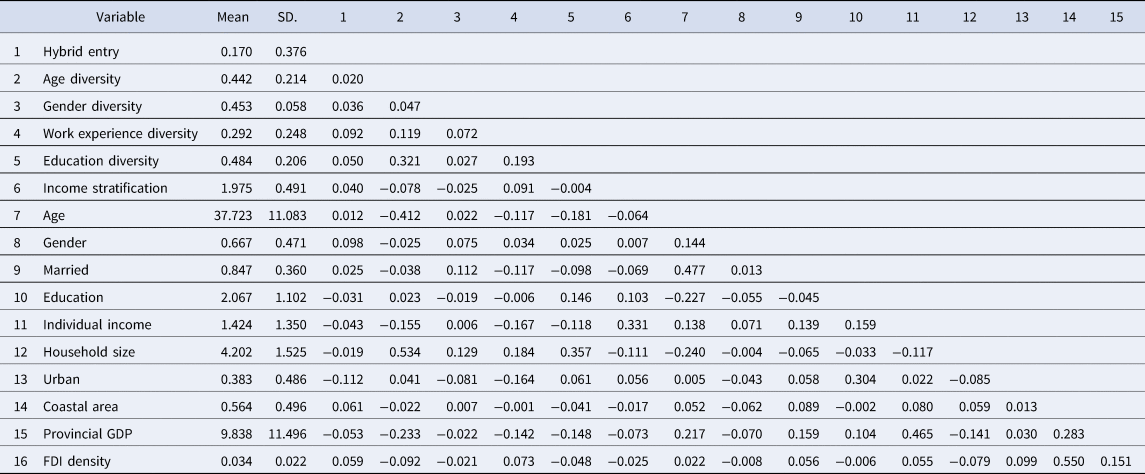
Table 2 reports the means and standard deviations of the variables and their correlations with the full sample. We observe that the percentage of hybrid entry is 17.0%, which is consistent with previous studies. Family diversity and income stratification have low correlations with each other and with the control variables. Overall, the magnitudes of the correlations are small. In the regression models, we computed variance inflation factors (VIFs), which range from 1.05 to 1.83 and are well below the cutoff of 5. Therefore, multicollinearity is not a concern in our regression analysis.
Descriptive statistics and correlations

Notes: N = 1,320. Two-tailed tests. Significant at the 0.05 level when correlation coefficient > 0.055 or < −0.055.
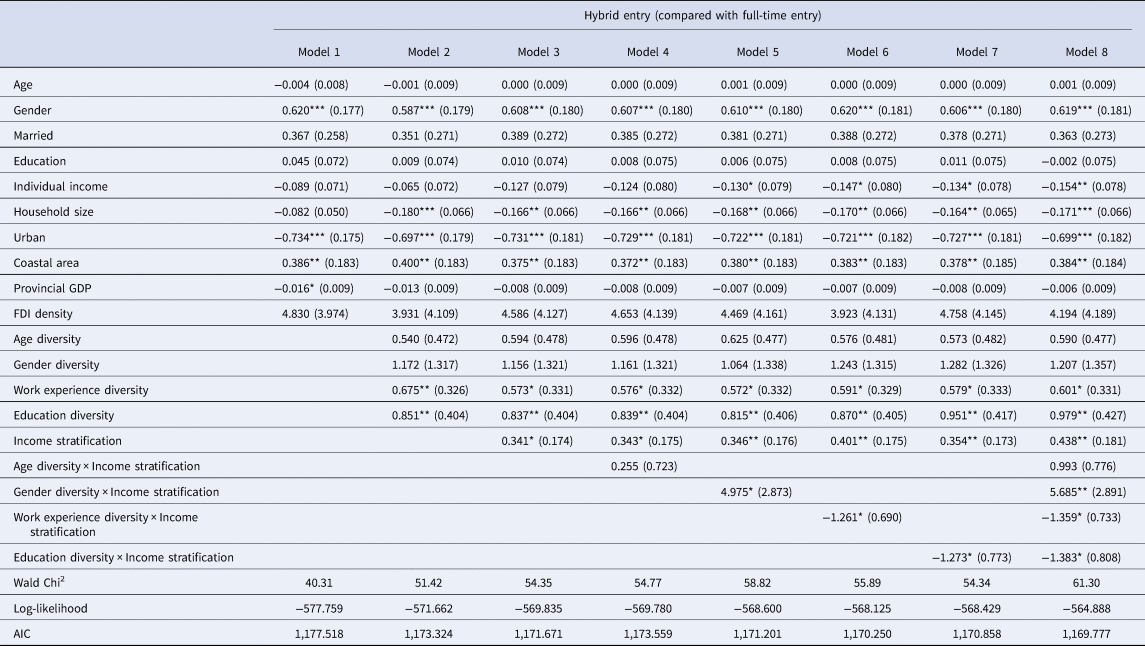
Table 3 shows the results of testing Hypotheses 1–6. Model 1 includes all the control variables. Males are more likely than females to be a hybrid entrepreneur (β = 0.620, p < 0.01). Individuals who live in urban areas (β = −0.734, p < 0.01) or in areas with high GDP (β = −0.016, p < 0.10) are less likely to become hybrid entrepreneurs, whereas individuals living in coastal areas (β = 0.386, p < 0.05) are more inclined to pursue hybrid entrepreneurship. In Model 2, the family diversity variables are included as predictors without the interaction terms. The main effect of age diversity on hybrid entry is insignificant. Thus, H1 is not supported. While gender diversity does not have a significant impact on hybrid entry, a positive effect of gender diversity does exist in the presence of high-income families (see Models 5 and 8, below). Thus, H2 is partially supported. Model 2 also shows that work experience diversity (β = 0.675, p < 0.05) and education diversity (β = 0.851, p < 0.05) have positive relationships with being a hybrid entrepreneur. Therefore, H3 and H4 are supported.
Results for hypotheses testing (N = 1,320)

Notes: Number of hybrid entry events: 225; full-time entry events: 1,095. AIC, Akaike's information criterion. Robust standard errors in parentheses; ***p < 0.01, **p < 0.05, *p < 0.1.
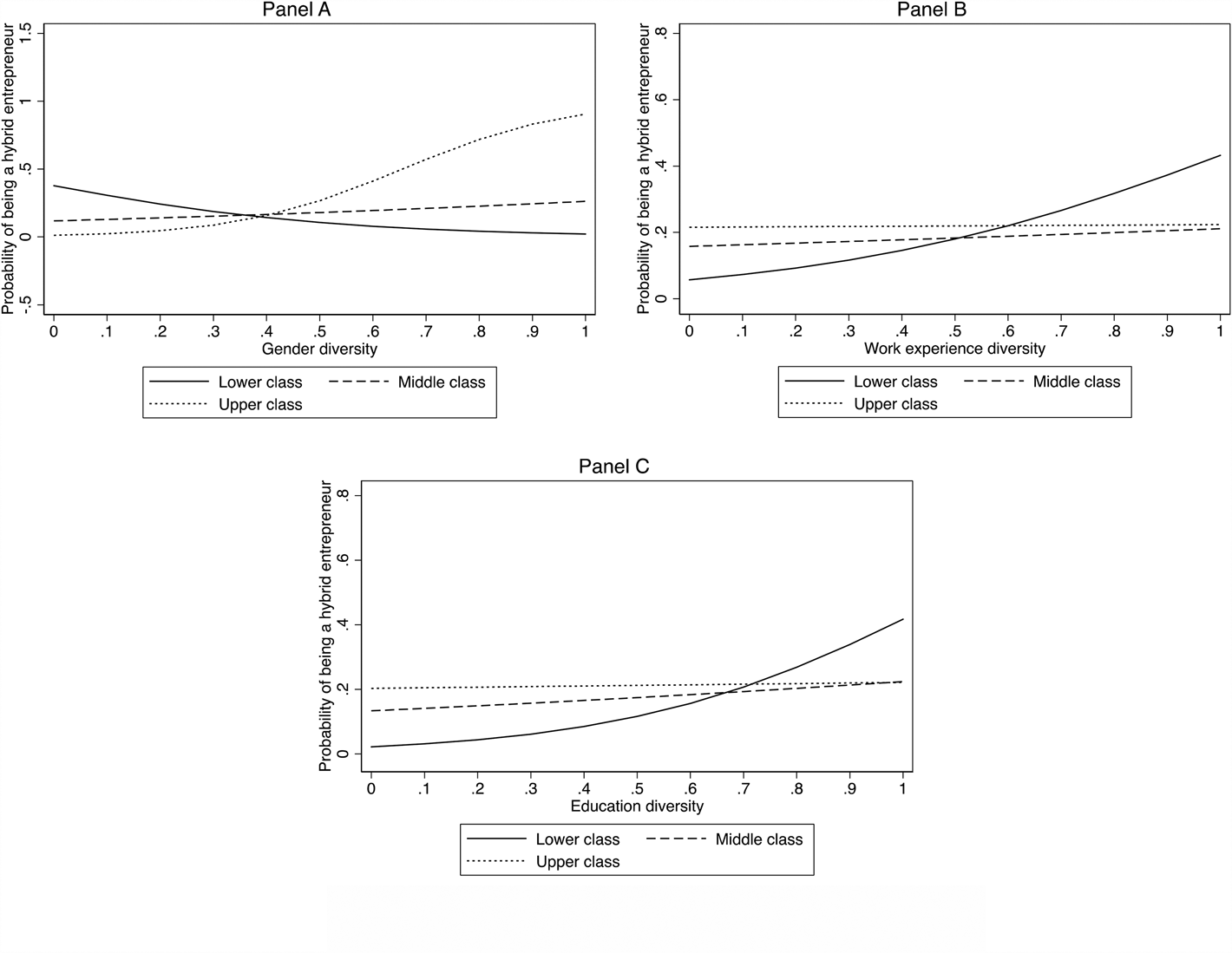
Model 3 adds income stratification as the moderator. Models 4, 5, 6, and 7 add the interaction terms separately. Model 8 presents the full model with all the moderating terms of income stratification. The effect of age diversity on hybrid entry is not influenced by variations in income levels. Thus, Hy5a is not confirmed. The effects of gender diversity (β = 5.685, p < 0.05) on being a hybrid entrepreneur are positive for individuals with higher-income class, supporting H5b. As shown in Figure 2A, the slope is positive and maximum when the individual is in the upper class. The results show that the relationship between work experience (β = −1.359, p < 0.10) and education diversity (β = −1.383, p < 0.10) and hybrid entry is strongest for individuals with lower income class, supporting H6 (a and b). As shown in Figure 2B and C, the slope is positive and maximum when the individual is in the lower class. Of the eight hypotheses, five are supported.
The moderating effects of income stratification

The magnitude of the effects confirms the size effects of our results. The effect of family work experience and education diversity on hybrid entry is significant. A standard deviation increase in family work experience and education diversity can be estimated to lead to a 16.7% and 17.5% increase, respectively, in hybrid entry. Regarding the moderation effects, one standard deviation increase in income stratification leads to a 2.791 unit increase in the direct effects of gender diversity on being a hybrid entrepreneur. However, one standard deviation increase in income stratification leads to a 0.667 and 0.679 unit decrease in the direct effects of work experience and education diversity on being a hybrid entrepreneur.
Robustness Test
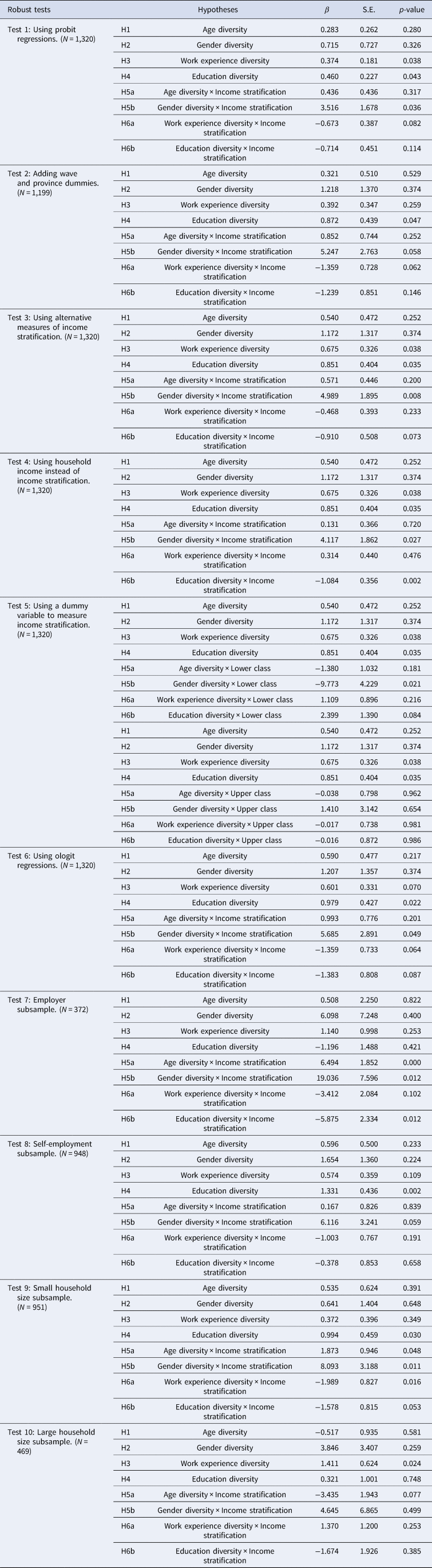
We performed a series of robustness tests. Table 4 summarizes the robustness test results. First, we tested the hypotheses using probit regressions. Except that H6b was not confirmed, the results were consistent, supporting the main results based on a logit model. Second, we controlled the wave and province fixed effects to eliminate possible bias caused by omitted variables. H3 and H6b were not supported. The other results were unchanged. Third, we used an alternative measure of income stratification. Following Thurow (Reference Thurow1987) and Ravallion (Reference Ravallion2010), we calculated 75% of the annual median per capita household income of all individuals in the specific province where the focal individual resided as the low-income line, and 125% of the annual median per capita household income in the specific province where the focal individual lived as the high-income line. Except that H6a was not confirmed, the results aligned with the main findings. Fourth, we used household income instead of using income stratification as the moderator. The results were unchanged, except that the p-value of H6a is insignificant. Fifth, we created three dummy variables to represent the three classes of income stratification. The results remained in line with the main findings. The results showed that family work experience and education diversity all encourage individuals to become hybrid entrepreneurs. The moderating effect showed that the lower class weakened the positive effect of gender diversity on hybrid entry, supporting H5b, while enhancing the positive effect of education diversity on hybrid entry, supporting H6b. Sixth, we conducted an ordinal logistic regression treating income stratification as a category variable. Results of regression analyses confirm that the influence of income stratification follows a continuous monotonic relationship, validating our decision to treat it as a continuous measure in our empirical analysis.
Summary of robustness test results

Also, we conducted subsample tests for employer entrepreneurs and self-employed entrepreneurs. In the subsample of employer entrepreneurs, H5(a and b) and H6(a and b) were supported; in the subsample of self-employed entrepreneurs, H4 and H5b were supported. Finally, we conducted a subsample test for household size. In small size family (size ≥ 2 and ≤ 5), education diversity was positively related to being a hybrid entrepreneur. Moderating effects were all supported, meaning that income stratification strengthened the relationship between surface-level diversity and hybrid entry, whereas it weakened the relationship between deep-level diversity and hybrid entry. In large size family (size > 5), work experience diversity was positively related to being a hybrid entrepreneur. For the moderating effect, H5a was supported.
Discussion
An emergent theme of entrepreneurship research has been considering how family dynamics, especially the changes in family systems, affect the entrepreneurial activities of family members (Calabrò et al., Reference Calabrò, Chrisman and Kano2022; Liu et al., Reference Liu, Qian and Au2023; Lu et al., Reference Lu, Huang, Xu, Chung and He2022). Despite the fact that the linkages between family characteristics and entrepreneurship have been increasingly discussed (Aldrich & Cliff, Reference Aldrich and Cliff2003; Burt & Burzynska, Reference Burt and Burzynska2017; Sieger & Minola, Reference Sieger and Minola2017), only a few studies have paid attention to the diversity of family households that affect individuals’ entrepreneurial propensity (Wang et al., Reference Wang, Eddleston, Chirico, Zhang, Liang and Deng2023). It is also important to understand whether the dissimilarity in a family household can lead to family members’ decisions to start a new business, as the changing pattern of family members’ entrepreneurial activities is indeed a result of varying family systems (Pittino et al., Reference Pittino, Visintin and Lauto2018; Wang et al., Reference Wang, Eddleston, Chirico, Zhang, Liang and Deng2023). This study aims to fill the research gap and advance our understanding of entrepreneurship in family households.
Theoretical Implications
This study contributes to family dynamics and entrepreneurship research in several ways. A key contribution lies in our adoption of the family embeddedness perspective (Aldrich & Cliff, Reference Aldrich and Cliff2003; Cruz et al., Reference Cruz, Justo and De Castro2012; Pittino et al., Reference Pittino, Visintin and Lauto2018), which enables us to delve into the intricate interplay between distinct family systems and the entrepreneurial pursuits of family members. In essence, we propose an integrative perspective calling not only for the explicit considerations of household effects, but also for their integration with the mode of entry into entrepreneurship. This study thus responds to the call articulated by Aldrich and Cliff (Reference Aldrich and Cliff2003), Jayawarna et al. (Reference Jayawarna, Marlow and Swail2021), and Lu et al. (Reference Lu, Huang, Xu, Chung and He2022) for greater integration between family households and entrepreneurship. We achieve this integration by focusing on a pivotal concept common to both theoretical frameworks: the trade-off of family households in balancing entrepreneurial risk and family responsibilities. Specifically, we examine how individuals choose between two modes of entry involving family diversity: full-time and hybrid entry. Our work explains how different types of diversity can promote the advantages of hybrid entrepreneurship while mitigating its disadvantages, thereby making family members more inclined toward hybrid entry. With these findings, this study enriches the family diversity literature and extends prior work on modes of entry into entrepreneurship.
Moreover, our findings add to the literature by examining how diverse family conditions at the surface and deep levels affect family members’ preferred mode of entry into entrepreneurship. By unraveling how surface-level (age and gender) and deep-level (work experience and education) diversity within the family context influence preferences toward hybrid vs full-time entrepreneurship, we illuminate the dual paradigms of social categorization and information sharing. This bifurcation reveals the complex dynamics in entrepreneurship decisions, where surface-level diversity tends to navigate toward hybrid entrepreneurship as a means to mitigate outgroup biases and reconcile internal contradictions, whereas deep-level diversity fosters a cohesive familial environment conducive to entrepreneurial ventures through the exchange of diverse information. Regarding the unsupported hypotheses, we speculate that the influence of surface-level diversity on hybrid entrepreneurship is not salient in certain family contexts. For example, in low-income-class families, the desire to resolve identity bias and achieve upward social mobility eliminates the social categorization mechanism. Only in higher-income-class families, surface-level diversity plays a significant role in promoting hybrid entrepreneurship, because these families may place more importance on individual differences. Our findings enrich the family diversity literature by highlighting the intricate ways in which diverse family conditions shape the entrepreneurial landscape (Pittino et al., Reference Pittino, Visintin and Lauto2018; Wang et al., Reference Wang, Eddleston, Chirico, Zhang, Liang and Deng2023), providing a theoretical framework that emphasizes the crucial role of family diversity in entrepreneurial decision-making processes. It contributes to a broader understanding of how family dynamics influence entrepreneurship and lays the foundation for future research into how diversity plays a role in entrepreneurship (Liu et al., Reference Liu, Qian and Au2023; Lu et al., Reference Lu, Huang, Xu, Chung and He2022).
Furthermore, we consider how income stratification, an important factor facilitating resource mobilization and sharing within a family household (Perry-Rivers, Reference Perry-Rivers2016), changes the relationships between family diversity and entrepreneurs’ decisions on the mode of entry. Our findings provide additional support to previous research on income stratification and equality, implying that the high-strata position of a family household functions more like an intangible resource (Penrose, Reference Penrose1955; Perry-Rivers, Reference Perry-Rivers2016). Better utilization of such resources requires individual members to possess diverse skills and knowledge. The results also offer new insights into entrepreneurship research by showing that income stratification in diverse groups of family households interacts differently with surface and deep-level diversity in the mode of entry into entrepreneurship (Lim et al., Reference Lim, Oh and De Clercq2016).
Managerial Implications
Findings from this study provide several practical implications, in particular for entrepreneurs and policymakers. Considering the intersection of family embeddedness and venture creation, individuals aspiring to become entrepreneurs must navigate their connections with family members and their involvement in entrepreneurial endeavors (e.g., Wang et al., Reference Wang, Eddleston, Chirico, Zhang, Liang and Deng2023). To support this process, relevant development programs can be implemented to facilitate the accumulation, integration, and utilization of family resources, thereby enhancing individuals’ capacity to engage effectively in the planning phase prior to embarking on entrepreneurship. Within the family context, discussions regarding the rationale and significance of each business objective can take place, which are critical to creating an environment where members can identify the essential elements necessary to achieve family goals (Cruz et al., Reference Cruz, Justo and De Castro2012). This proactive strategy is particularly valuable for exploring new opportunities and realizing the full potential of entrepreneurial activities within the family sphere.
Additionally, entrepreneurs should interact more with other members of the family household on a daily basis, given that the different characteristics of members and the composition of the household affect their ability to take risks in entrepreneurship entry (Wang et al., Reference Wang, Eddleston, Chirico, Zhang, Liang and Deng2023). Beyond visible characteristics, entrepreneurs should also pay attention to invisible aspects, such as members’ personability, life and work-related preferences, and other idiosyncratic features and social relationships (Triana, Kim, Byun, Delgado, & Arthur, Reference Triana, Kim, Byun, Delgado and Arthur2021).
Our findings about the moderating effect of income stratification offer policy implications for the demand for entrepreneurship among different income groups. In this study, we find that a high-strata family that possesses diverse skills and knowledge tends to have more chances to take on high-risk, full-time entrepreneurship entry. Low-strata groups lack the ability to access entrepreneurship-facilitating resources in order to deal with deep-level family diversity and thus may choose a hybrid mode (Perry-Rivers, Reference Perry-Rivers2016). Indeed, income stratification within the same environment may lead to unfair competition among entrepreneurs, as some entrepreneurship opportunities may not be accessible for low-strata groups, and these groups tend to focus on fulfilling basic needs (Pathak & Muralidharan, Reference Pathak and Muralidharan2018). Therefore, we encourage policymakers to design supporting policies that enable low-strata groups to participate better in potential entrepreneurial activities and fulfill their social mission. Policymakers can also consider providing training and information programs for entrepreneurs working in less-diverse groups that can better facilitate resource mobilization and help reduce social inequalities.
Limitations and Future Research Directions
Our study contains several limitations, which can serve as a foundation for future research. First, since our study focuses on some kinds of surface and deep-level diversity, we encourage future researchers to examine other sources of diversity that potentially influence the mode of entry into entrepreneurship, such as industry diversity, as other studies suggest (Bengtsson, Raza-Ullah, & Srivastava, Reference Bengtsson, Raza-Ullah and Srivastava2020). Additionally, methodological approaches could be enriched by incorporating additional measures; for example, instead of using an education degree to measure educational diversity, education majors could also be considered. Second, although we only considered the mode of entry into entrepreneurship, our theoretical framework may also be applicable to other entrepreneurial choices and outcomes, such as opportunity assessment and exploitation, entrepreneurial exit, and venture growth (Pittino et al., Reference Pittino, Visintin and Lauto2018). Thus, future research exploring the additional consequences of family diversity would enrich our understanding of how family embeddedness works in different facets. Third, our study examines the moderating effect of income stratification on the relationship between family diversity and the mode of entry into entrepreneurship. However, the workings of family diversity may be affected by other family characteristics, e.g., family meals (Wang et al., Reference Wang, Eddleston, Chirico, Zhang, Liang and Deng2023), as well as regional socio-cultural environments (Zahra, Reference Zahra2007). We advocate future research to explore the boundary conditions that strengthen or weaken the effects of family diversity. Finally, we have chosen China as the research context, which may limit the generalizability of our study. Recent changes in China, such as shifts in family size due to policy adjustments, an aging population, and changing gender-role expectations, are reshaping traditional family dynamics (Ahlstrom & Ding, Reference Ahlstrom and Ding2014). It is important to note that such family dynamics may also be observed in other contexts. Therefore, we suggest future research to consider testing our model using different contexts or comparing the unique family household features between developed and emerging countries to further expand our understanding of entrepreneurial decision-making.
Conclusion
Building upon a family embeddedness perspective, we investigate the variations of family diversity at the surface and deep levels in affecting family members’ propensity to choose a full-time or hybrid mode of entry into entrepreneurship. Based on a sample of entrepreneurs in China, the empirical findings of this study reveal that the choice of hybrid entrepreneurs is affected more by deep-level diversity than by the surface-level diversity of the family household. An intriguing finding is that the positive effect of deep-level diversity is weakened in higher-income-class families, while the positive effect of age diversity is valid in higher-income-class families. Thus, our findings not only open a new arena to discuss the heterogeneous family systems that affect the patterns of entrepreneurial activities, they also highlight the nuanced interactions between family diversity and income stratification within a family household that may lead to their family members’ entrepreneurial decisions.
Data availability statement
The data that support the findings of this study are available from the China Health and Nutrition Survey (CHNS) database, for which we do not hold the copyright. An access to this data is governed by the CHNS administrators, and we encourage interested researchers to obtain the data directly through the official CHNS channels, adhering to their access protocols and copyright guidelines.
Acknowledgement
We are grateful for the financial support from National Natural Science Foundation of China (NSFC) (72372119) and Special Fund of Fundamental Scientific Research Business Expense for Higher School of Central Government (22120240563).
Jialin Song (sdsongjialin@tongji.edu.cn) is a research candidate in management at the School of Economics and Management, Tongji University, China. Her research centres on entrepreneurship and Chinese firm strategy. Her research has appeared in journals such as Journal of Business Research and Chinese Management Studies.
Yiyi Su (suyiyi@tongji.edu.cn) is a professor of management at the School of Economics and Management, Tongji University, China. Her research centres on innovation and entrepreneurship, internationalization and Chinese management. Her recent research has appeared in journals such as Entrepreneurship Theory and Practice, Management and Organization Review, Human Resource Management, Regional Studies, Public Administration Review, and Journal of World Business.
Zhujun Ding (zhujun.ding@kcl.ac.uk) is a senior lecturer at King's Business School, King's College London, United Kingdom. Her research interests include entrepreneurship, emerging market firm strategy, and international business. Her research has appeared in journals such as Journal of International Business Studies, Journal of Business Venturing, Journal of World Business, European Journal of Marketing, Asia Pacific Journal of Management, and International Small Business Journal.
Sihong Wu (sihong.wu@auckland.ac.nz) is a senior lecturer in the Department of Management and International Business, University of Auckland, New Zealand. Her research centers on international business strategies, specifically exploring how multinationals respond and adapt to global disruptions, such as wars, climate change, sanctions, and other forms of crises. Her publication appears in journals such as Journal of World Business, Journal of Product Innovation Management, International Business Review, Transportation Research Part E, Management and Organization Review, Management International Review, World Development, Journal of Knowledge Management, Technological Forecasting and Social Change, and Journal of International Management.
Di Fan (david.fan@rmit.edu.au) is a professor of management at the School of Management, RMIT University, Australia. His current research interests include international business strategies and international human resource management. His publications appear in journals such as Organization Studies, Journal of Management Studies, Entrepreneurship Theory and Practice, Journal of World Business, International Business Review, Academy of Management Learning & Education, Industrial Marketing Management, Long Range Planning, Global Strategy Journal, Technovation, and Journal of Business Ethics.