Cognitive impairment as a characteristic of schizophrenia is currently well established and documented (Barch & Ceaser, Reference Barch and Ceaser2012; Kahn & Keefe, Reference Kahn and Keefe2013; Nielsen, Reference Nielsen2011; Sponheim et al., Reference Sponheim, Jung, Seidman, Mesholam-Gately, Manoach, O’Leary and Schulz2010). A specialized cognitive domain that has recently been a focus of attention in connection to schizophrenia is that of social cognition, that is, the set of processes by which we draw inferences about the beliefs and intentions of others (e.g., Green & Horan, Reference Green and Horan2010; Sergi et al., Reference Sergi, Rassovsky, Widmark, Reist, Erhart, Braff and Green2007; Widen & Russell, Reference Widen and Russell2010). Due to its recognized importance in schizophrenia and the evidence suggesting that impairments in social cognitive processes may be a mediator between neurocognitive deficits and functional outcome, social cognition had been included as a domain in the MATRICS Consensus Cognitive Battery (MCCB; Marder & Fenton, Reference Marder and Fenton2004; Nuechterlein et al., Reference Nuechterlein, Barch, Gold, Goldberg, Green and Heaton2004; Nuechterlein et al., Reference Nuechterlein, Green, Kern, Baade, Barch, Cohen and Marder2008; Rodriguez-Jimenez et al., Reference Rodriguez-Jimenez, Bagney, Garcia-Navarro, Aparicio, Lopez-Anton, Moreno-Ortega and Palomo2012). Deficits in a main component of social cognition, the recognition and interpretation of facial expressions of emotion, are well documented in schizophrenia (for reviews see Edwards, Jackson, & Pattison, Reference Edwards, Jackson and Pattison2002; Kohler, Walker, Martin, Healey, & Mober, Reference Kohler, Walker, Martin, Healey and Mober2010; Mandal, Pandey, & Prasad, Reference Mandal, Pandey and Prasad1998). This finding is of potential clinical relevance because there is evidence that impaired emotion recognition of faces is specifically related to social competence and function in this disorder (e.g. Hooker & Park, Reference Hooker and Park2002; Rassovsky, Horan, Lee, Sergi, & Green Reference Rassovsky, Horan, Lee, Sergi and Green2011). Moreover, the study of impaired emotion recognition by schizophrenia patients might provide clues with respect to the relationship between deficits in the social/emotional domain and variations in brain function in schizophrenia. For example, there is evidence from neuroimaging studies suggesting that failure to activate brain regions involved in perceptual and affective processing during emotional valence discrimination might underlie impaired recognition of facial expressions in schizophrenia (Gur et al., Reference Gur, Schroeder, Turner, McGrath, Chan, Turetsky and Gur2002; Johnston, Stojanov, Devir & Schall, Reference Johnston, Stojanov, Devir and Schall2005; Phillips et al., Reference Phillips, Williams, Senior, Bullmore, Brammer, Andrew and David1999).
Although the deficit in recognition of facial affect by patients with schizophrenia is well established (Amminger et al., Reference Amminger, Schäfer, Papageorgiou, Klier, Schlögelhofer, Mossaheb and McGorry2012; Lee, Gosselin, Wynn, & Green, Reference Lee, Gosselin, Wynn and Green2011), some aspects remain unclear. With respect to emotional expressions, a key controversial issue is the extent of the deficit (Lee et al., Reference Lee, Kern, Harvey, Horan, Kee, Ochsner and Green2013; Pomarol-Clotet et al., Reference Pomarol-Clotet, Hynes, Ashwin, Bullmore, McKenna and Laws2010). While a general deficit in the identification of facial expressions of emotion has been reported in some studies (e.g., Kohler, Turner, Gur, & Gur, Reference Kohler, Turner, Gur and Gur2004), a more frequent pattern is that of preserved recognition of positive expressions and impaired recognition of negative ones (e.g., Bediou et al., Reference Bediou, Franck, Saoud, Baudouin, Tiberghien, Daléry and dÁmato2005; Combs, Michael, & Penn, Reference Combs, Michael and Penn2006; Janssens et al., Reference Janssens, Lataster, Simons, Oorschot, Lardinois, van Os and Myin-Germeys2012; Kohler et al., Reference Kohler, Turner, Bilker, Brensinger, Siegel, Kanes and Gur2003). This finding might be related to the fact that while the smile is the only facial signal universally perceived as expressing approachability and positive affect (e.g., Ekman & Keltner, Reference Ekman, Keltner, Segerstrale and Molnar1997) negative emotion can be expressed in multiple ways through facial expressions that are less easily discriminated. This relatively poorer discrimination of negative expressions is found in non-clinical samples (e.g. Palermo & Coltheart, Reference Palermo and Coltheart2004) and is more pronounced in patients with schizophrenia (e.g. Bryson, Bell, & Lysaker, Reference Bryson, Bell and Lysaker1997; Kohler et al., Reference Kohler, Turner, Bilker, Brensinger, Siegel, Kanes and Gur2003). An explanation based on the different discriminability of positive and negative expressions has been proposed by Johnston, Katsikitis, and Carr (Reference Johnston, Katsikitis and Carr2001), and Johnston, Devir, and Karayanidis (Reference Johnston, Devir and Karayanidis2006). These authors interpret the deficits shown by patients in terms of a gradation in task difficulty due to the lower discriminability of negative expressions. What these authors propose is that the facial expressions of negative emotions overlap to a high degree, thus increasing their confusability and leading to reduced accuracy. A similar argument has been put forward by Adolphs (Reference Adolphs2002), who has pointed out that negative expressions are more difficult to recognize and more easily confusable because the corresponding facial configurations include facial movements that are common with other expressions. This characteristic of negative expressions would pose additional problems to patients with schizophrenia due to aberrant processing in neural networks involved in perceptual analysis (Johnston, Stojanov, Devir, & Schall, Reference Johnston, Stojanov, Devir and Schall2005) or higher noise of internal representations (Bach, Buxtorf, Grandjean, & Strik, Reference Bach, Buxtorf, Grandjean and Strik2009).
In the present study we explore the hypothesis that the internal representations of emotional expressions are less differentiated and have poorly defined boundaries in patients with schizophrenia than in controls, leading to more frequent confusions between different expressions in the case of negative emotions. A possible way to explicitly test this prediction would be to allow the participants to rate each expression in terms of different labels. We used a multiple emotion-rating task in which each expression was presented on several trials accompanied each time by a different emotion label. The participant´s task was to give a rating of the extent to which that specific expression represented the emotion corresponding to the present label. This procedure allows the collection of multiple responses for each individual expression based on which the degree of clarity or ambiguity with which it is perceived can be estimated. Our specific prediction was that patients with schizophrenia would show more distributed attribution profiles, with high ratings on emotion labels that do not correspond to the emotion portrayed by the face. This should be especially so in the case of faces expressing negative emotions, showing the higher confusability of these expressions in the patient´s sample.
Method
Sample
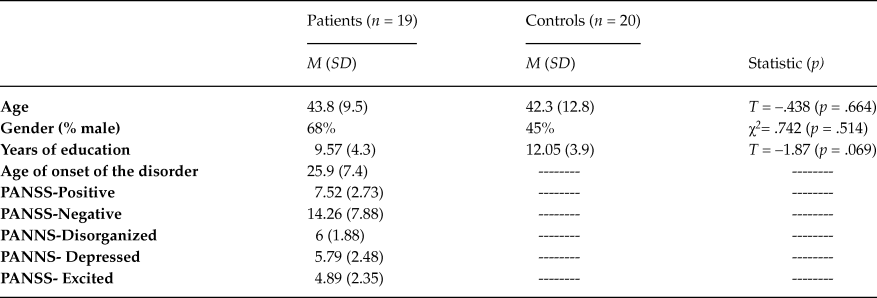
The present study was carried out with nineteen clinically stable outpatients, who were consecutively referred by their treating psychiatrists, and with twenty controls with no self-reported history of psychiatric illness. All patients had been diagnosed with schizophrenia including 16 with paranoid schizophrenia, one with residual schizophrenia and two patients with schizophreniform disorder according to DSM-IV criteria (APA, 1994), using the Structured Clinical Interview for DSM-IV Axis I Disorders (SCID-I; First, Spitzer, Gibbon, & Williams, Reference First, Spitzer, Gibbon and Williams1995). All patients were on atypical antipsychotic treatment and had been clinically stable (no hospital admissions, no changes in treatment and no significant psychopathological changes) for at least six months before inclusion. Clinical status was evaluated using the Spanish version of the Positive and Negative Syndrome Scale (PANSS; Kay, Fishbein, & Olper, Reference Kay, Fishbein and Olper1987; Peralta & Cuesta, Reference Peralta and Cuesta1994) following the five-factor model proposed by Wallwork, Fortgang, Hashimoto, Weinberger, and Dickinson (Reference Wallwork, Fortgang, Hashimoto, Weinberger and Dickinson2012) and confirmed by Rodriguez-Jimenez et al. (Reference Rodriguez-Jimenez, Bagney, Mezquita, Martinez-Gras, Sanchez-Morla, Mesa and Palomo2013). See Table 1 for patient and control's demographics. Written informed consent was obtained from all participants prior to their inclusion in the study.
Sample demographics and clinical status. The PANSS factors were calculated using the consensus five-factor model of Wallwork et al., 2012.

Materials
Forty pictures from the NimStim face set (Tottenham et al., Reference Tottenham, Tanaka, Leon, McCarry, Nurse, Hare and Nelson2009) were used as stimuli. The faces corresponded to eight different models (four female, four male) each showing neutral, happy, angry, fearful or sad expressions. Pictures were converted to grey scale, cropped to conceal most of the hair and equated in contrast energy (crms = 0.2). The stimuli were presented on a 15” LCD monitor (refresh rate 60Hz).
Procedure
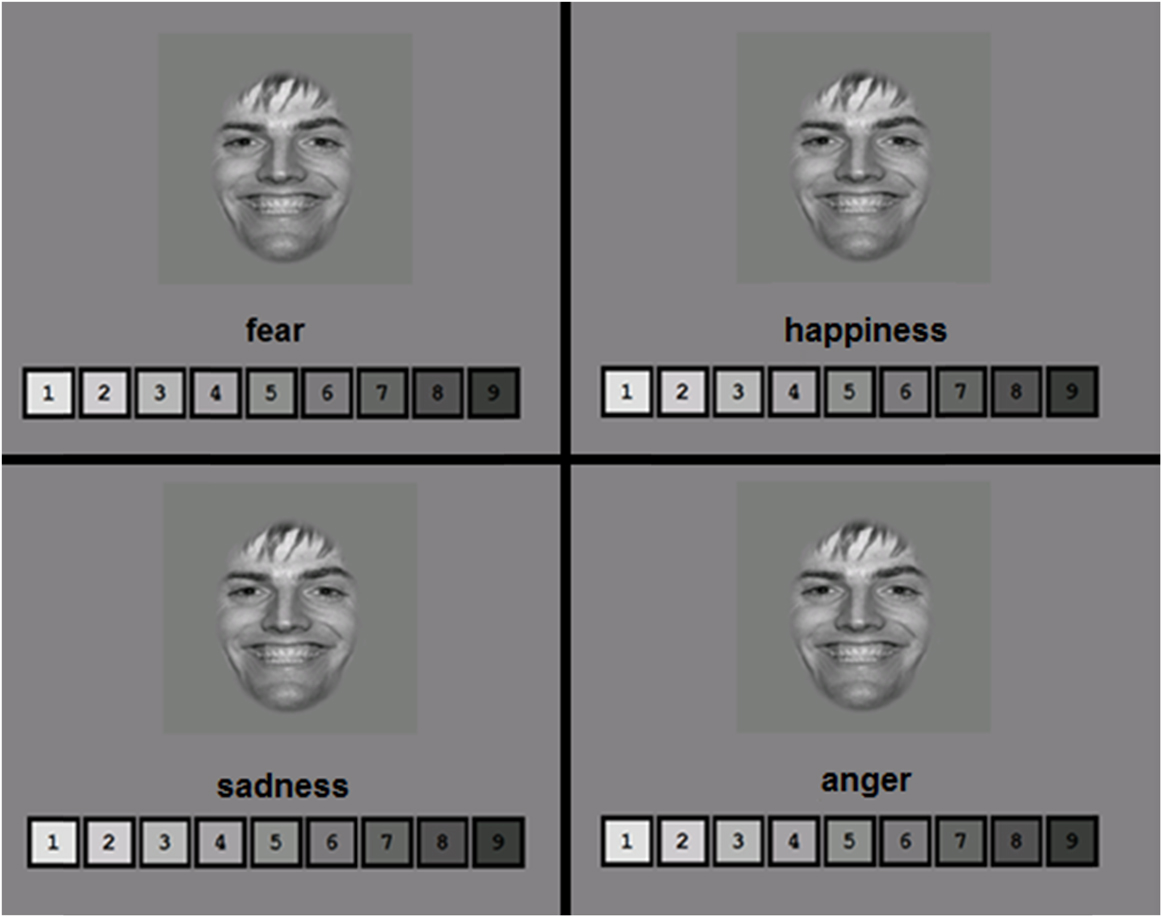
The task was designed with the aim of allowing the participants to evaluate each expression in terms of different emotions. To this end, each picture was presented four times on randomly distributed trials. On each trial a face appeared centered on the screen and below it an emotion label (“happiness”, “anger”, “sadness” or “fear”) with a continuous 1 to 9 scale (See Figure 1). The participant was instructed to indicate, by clicking on the appropriate section of the scale, how much of each emotion was expressed by the face. This procedure allowed the participants to attribute different emotional meanings to the same face at different times and with similar or different levels. More clearly defined or easily discriminated expressions should receive low ratings on all emotion categories except the correct one. On the other hand, less discriminable expressions should show a more distributed profile, with high ratings on incorrect categories.
Example of 4 different trials in the Multiple-Emotion Rating Task.

Data Analysis
As a first analysis, a Student´s t-test was performed to study that patients and controls were not different in age or years of education. A chi-square analysis was performed to investigate differences in gender distribution.
After that, the patterns of emotion attribution to the different expressions by the patient and control groups are presented. These profiles can be understood as representing the extent to which participants discriminated between different expressions. Steeper profiles with maximum rating in the “correct” emotion label (i.e. fear for fearful faces) and very low ratings in the other labels would indicate accurate discrimination.
Two different analyses were performed with the data obtained in the multiple-rating task. Patients and controls were compared in two repeated measures analyses of variance (ANOVA) model with diagnosis as a between group factor (patients, control subjects). First, the attribution profiles of the different facial expressions were submitted to a 2×5×4 mixed ANOVA with participant Group (patient versus control) as the between-subjects factor and Expression (angry, fearful, happy, neutral and sad) and Emotion Label (anger, fear, happiness and sadness) as the repeated measures factors.
Second, groups were compared in a summary index that provided an estimation of the perceived emotional ambiguity of each expression. A 5 x 2 ANOVA was performed on the ambiguity results, with Emotion Label and Group as factors. Perceived emotional ambiguity was computed into an index for each expression and participant (Fernandez-Cahill, Reference Fernandez-Cahill2012). This ambiguity index (AI) was calculated by averaging the ratings for all emotion labels except the one with the maximum rating (
 ${\bar X_i})$
, usually the one corresponding to the portrayed emotion and dividing this mean by that maximum rating (
 ${X_{max}})$
, as indicated by the following formula:
 $AI{\rm{ = }}\,{{{{\bar X}_i}} \over {{X_{max}}}}$
Using this formula, higher AI values are obtained when ratings are more evenly distributed across different emotion labels, that is, when a given expression receives relatively high ratings on different emotion labels. Values closer to 1 denote higher expressive ambiguity and those closer to 0 denote lower expressive ambiguity. This index was correlated in the clinical group with the depressed factor of the PANSS, calculated following the model given by Wallwork, Fortgang, Hashimoto, Weinberger, and Dickinson (Reference Wallwork, Fortgang, Hashimoto, Weinberger and Dickinson2012) in order to control mood effects on the performance of the patients, which could explain some of the results.
For all repeated measures ANOVA analyses reported in the present paper, the Greenhouse-Geisser correction was applied when the sphericity assumption was violated. Post-hoc analyses were performed according to Bonferroni (significant when p ≤ .05). Tests were carried out with the statistical package IBM SPSS Statistics 20.
Results
Firstly, no differences between controls and patients were found on socio-demographic characteristics such as age t = –.438, (p = .664), distribution of gender χ2= .742 (p = .514) or years of education, t = –1.87, (p = .069) (See table 1).
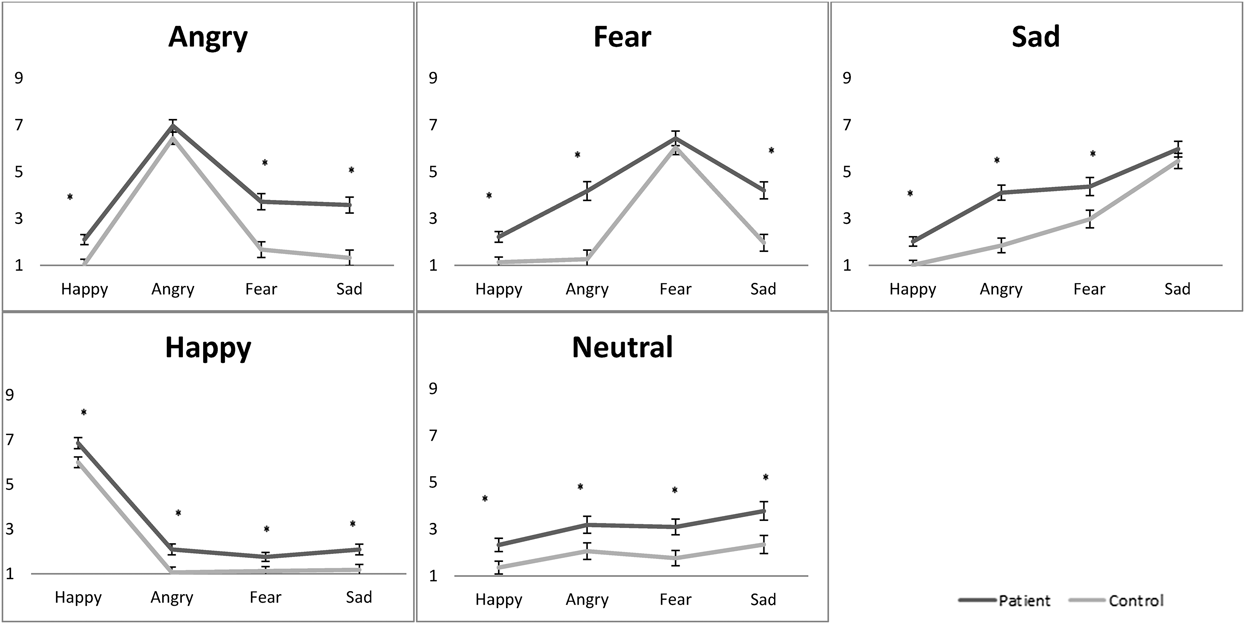
Figure 2 presents the patterns of emotion attribution to the different expressions by the patient and control groups.
Mean rating attributed for each facial expression.
*p < .05.

As a first analysis, ratings of each facial expression on the different Emotion Labels were compared between the patient and control groups. The results of the analysis showed a main effect of Group, F(1, 37) = 20.59 p < .001, η2 = .358, with patients with schizophrenia giving significantly higher ratings (M = 3.75, SEM = .2) than controls (M = 2.45, SEM = .19). Significant two-way interactions of Expression x Group, F(4, 148) = 2.68, p = .034, η2 = .068 and of Emotion Label x Group were also found, F(3, 111) = 3.53 p = .026, η2 = .079. Finally, the three-way Expression x Emotion Label x Group interaction was also significant, F(12, 444) = 5.575 p < .001, η2 = .131. In order to explore this interaction, ratings of each expression on each emotion label were compared between groups in the post-hoc analysis. These comparisons revealed a common pattern for the three negative expressions (anger, fear and sadness). In this case, patients and controls gave similar ratings on the “correct” emotion label. However, patients gave significantly higher ratings to the three negative expressions than the controls on the “incorrect” labels (p s < .05).
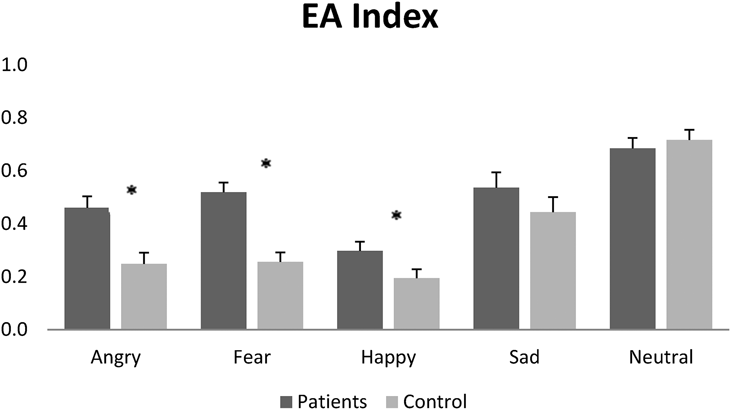
As a second analysis, mean AI values for the patient and control groups are presented in Figure 3. The analysis performed on the AI results, revealed main effects of Group, F(1, 37) = 9.05 p = .005, η2 = .197 with higher AI values for patients (M = .5, SEM = .03) than controls (M = .37, SEM = .03). Also a significant Emotion x Group interaction, F(4, 148) = 5.75 p < .001, η2 = .135 was found. Paired comparisons in post-hoc analysis showed differences between groups, with higher AI values in the patient’s group for the faces showing angry, fearful and happy expressions (p s < .05). No differences were found in the case of sad and neutral faces. Finally, within-group comparisons showed that for controls both sad and neutral faces were perceived as more ambiguous than angry (p = .016 and p < .001 respectively), fearful (p = .009 and p < .001 respectively) and happy faces (p = .001 and p < .001 respectively). In the case of patients, happy faces were less ambiguous than angry (p < .001), fearful (p < .001), sad (p = .001) and neutral faces (p < .001). At the same time, neutral faces were perceived as more ambiguous than angry (p = .001) and fearful faces (p = .023).
Mean ambiguity index calculated with EA Index for each facial expression. Error bars denote Standard Error Mean.
*p < .05.

Finally, there wasn’t any correlation between the Ambiguity Index of each emotion and the depressed factor of the PANSS (p s > .05) for the patient’s group.
Discussion
The aim of the present study was to evaluate the patterns of emotion attribution to faces showing different expressions in patients with schizophrenia. To this end a new multiple-rating task that allowed the participant to rate each expression on different emotion labels was used. The results obtained revealed a different pattern of attribution of emotion to faces between patients with schizophrenia and controls. While both patients and controls gave similar ratings on the “correct” emotion label, patients gave significantly higher ratings to the three negative expressions than the controls on the “incorrect” labels. As was predicted, patients showed more distributed patterns of emotion attribution to faces showing negative expressions (Combs et al., Reference Combs, Michael and Penn2006; Kohler et al., Reference Kohler, Turner, Bilker, Brensinger, Siegel, Kanes and Gur2003).
An ambiguity index was computed as a summary measure of the extent to which a given expression was perceived as showing different emotions and thus could be said to be perceived as emotionally ambiguous. According to this measure, patients tended to perceive angry, fearful and happy expressions as more ambiguous than the controls did. However, no differences between groups were observed in the case of sad and neutral faces. Within-group comparisons also showed differences between patients and controls. Patients perceived all negative expressions as more ambiguous expressions than happy ones. However, in the case of controls sad and neutral faces were perceived as more ambiguous than angry, fearful and happy faces. There were no correlations between this index and the depressed factor of the PANSS, suggesting that differences in the clinical sample’s mood were not a main determinant of the results.
A more detailed picture of the patterns of emotion attribution can be obtained by comparing the attribution profiles of the patient and control groups. This comparison showed first that the patients tended to give significant higher ratings than controls on all emotion labels to happy and neutral faces. For example, in the case of happy faces patients gave higher ratings in both correct and incorrect emotion labels. This result might be interpreted as showing a general trend to overestimate the emotional expressiveness of faces. However, the more differentiated pattern that emerged in the case of negative expressions (anger, fear and sadness) does not fit with this interpretation. In this case, patients gave higher ratings on the “incorrect” emotion labels but did not differ from the controls in their ratings on the “correct” label. The patient group was especially more likely to give each negative expression higher ratings on other “incorrect” negative emotions. For example, although both groups of participants gave similar fear ratings to fearful faces, patients also attributed more anger and sadness than did the controls to those same faces. Thus, the patient group was perfectly accurate in their estimate of the extent to which fearful, angry or sad faces expressed the corresponding emotions. Nonetheless, they were more likely to attribute different negative emotions to each single negative expression.
As it was discussed in the introduction (Bach et al., Reference Bach, Buxtorf, Grandjean and Strik2009; Johnston et al., Reference Johnston, Stojanov, Devir and Schall2005), it has been proposed that the cognitive representation of facial expressions of emotion is characterized by a relative lack of clarity and the presence of internal noise. These characteristics would lead to impaired discrimination between different expressions, affecting especially the ability to differentiate the expressions corresponding to negative emotions that have a higher degree of overlap. Consistently with this explanation, the results of the present study confirmed that patients with schizophrenia are less accurate than controls in their emotional attributions to faces showing negative expressions (Bediou et al., Reference Bediou, Franck, Saoud, Baudouin, Tiberghien, Daléry and dÁmato2005; Janssens et al., Reference Janssens, Lataster, Simons, Oorschot, Lardinois, van Os and Myin-Germeys2012). The methodology employed, with a multiple rating task and a continuous response format allowed us to show that this inaccurate performance was not due to an under-attribution of the correct emotion (i.e., the degree of fear attributed to fearful faces) but to an over-attribution of the incorrect ones (i.e., anger attributed to fearful faces). Thus, this result is consistent with the idea that poor recognition of negative expressions is due to a poor differentiation among this category of emotional expressions. On the other hand, the low rating of the faces showing negative expressions on the “happiness” label indicates that patients were perfectly capable of differentiating between negative and positive expressions. These results, of course, are consistent with the repeated finding of a specific deficit in the recognition of negative expressions by patients with schizophrenia (for reviews see Edwards et al., Reference Edwards, Jackson and Pattison2002; Mandal et al., Reference Mandal, Pandey and Prasad1998). However, most previous studies have used procedures that allow only one single response to each facial expression. The specific pattern of errors that would give a more detailed picture of the deficit is usually not reported. One exception is the study by Kohler et al. (Reference Kohler, Turner, Bilker, Brensinger, Siegel, Kanes and Gur2003), where the analysis of the misattribution patterns showed that patients over-attributed negative emotions to neutral faces. Still in this case the use of a single-response procedure might have underestimated the extent to which the patient and control samples differed in their attribution pattern for other facial expressions. One main advantage of the multiple-rating task is precisely that its more open format allows for such differences to emerge, allowing a more in-depth estimation of emotion recognition deficits in patients with schizophrenia.
The findings of the current study have potential clinical relevance and provide some clues to understanding some difficulties experienced by patients with schizophrenia in social situations. In daily situations mistaking negative expressions could lead patients to misidentify the feelings of others. Some symptoms such as distrust, hostility, poor rapport or apathetic social withdrawal could be partially explained by the inability to discriminate appropriately among negative expressions. Also, these results are consistent with functional neuroimaging studies in which a failure to activate brain regions involved in affective processing could explain impaired recognition of facial expressions (Gur et al., Reference Gur, Schroeder, Turner, McGrath, Chan, Turetsky and Gur2002; Johnston et al., Reference Johnston, Stojanov, Devir and Schall2005).
It should be noted that studies comparing patients with schizophrenia –even more with chronic schizophrenia- with controls present some limitations. Due to the many ways in which patients and controls differ in cognitive and emotional domains it is difficult to attribute to definite causal factors the differences found in the present study. Also, it would be highly reductionist to attribute the differences only to the diagnosis. For example, in the chronic phase of schizophrenia there are many external variables that can contribute to the deficits showed by patients like general psychopathology, overall distress or long term use of antipsychotics. Although not without problems either, one way to minimize the influence of factors associated to chronicity would be to test the rating task in a first-onset schizophrenia group of patients. Some attempts in this direction have been already made (e.g. Addington et al., Reference Addington, Penn, Woods, Addington and Perkins2008, Comparelli et al., Reference Comparelli, Corigliano, De Carolis, Mancinelli, Trovini, Ottavi and Girardi2013 and Pinkham, Penn, Perkins, Graham, & Siegel, Reference Pinkham, Penn, Perkins, Graham and Siegel2007). While this is true, it must also be said that studying the performance of chronic patients is interesting in itself because it gives us a picture of how the disorder together with the additional factors associated to chronicity influence their behavior.
We finish by noting other limitations and possible further developments of our study. First it would be suitable to evaluate a bigger sample size in order to increase the generalization of our conclusions. Another limitation was that we did not carry out a structured evaluation of the mental status of the control sample. Ideally, this group without a self-reported history of psychiatric illness should have been assessed with some structural interview in order to appropriately establish the absence of mental disorders. Further developments of this study will concentrate on exploring the specific conditions under which patients with schizophrenia show preserved or impaired attribution of emotion to human faces. Finally, the study of the differences between first-onset and chronic schizophrenia on face recognition and the possible relationship of this domain with functional outcome might open up new lines of cognitive remediation and prevention of social isolation in patients with schizophrenia.
We thank the Instituto de Investigación Hospital 12 de Octubre and the Centro de Investigación Biomédica en Red de Salud Mental (CIBERSAM) of the Instituto de Salud Carlos III. This work was supported in part by the Spanish Ministerio de Ciencia e Innovación (grant number PSI2010–18682) to Luis Aguado. This research was supported in part by grant PI080514 (Fondo de Investigaciones Sanitarias, FIS) and by the Centro de Investigación Biomédica en Red de Salud Mental (CIBERSAM) of the Instituto de Salud Carlos III. Participation of M. Verónica Romero-Ferreiro was made possible by a pre-doctoral fellowship from the Complutense University of Madrid, Spain.