Lost in Translation
Uday Shankar's career as a dancer and choreographer has been under frequent inspection by dance historians and scholars in both the South Asian and Euro-American worlds. To date, some articles, books, and biographies have documented various aspects Shankar's life, which provide factual details about his performance career (Banerji Reference Banerji1982; Khokar Reference Khokar1983; Mukhopadhyay Reference Mukhopadhyay2004; Singha and Massey Reference Singha and Massey1967). While these biographies serve as an important source in their delineation of Shankar's life and his works, there have been few attempts at critical analyses and evaluation of Shankar's body of choreographic works. Scant scholarly interests in Shankar have mostly described him as one of the many exotic “oriental” dancers in Europe.Footnote 1
Noteworthy exceptions, however, are Joan L. Erdman (Reference Erdman1987, Reference Erdman and Morris1996a), Ruth K. Abrahams (Reference Abrahams2007), and Urmimala Sarkar Munsi's (Reference Sarkar Munsi and Munsi2008) work on Shankar. Elucidating the theory of translation of performance of one culture (oriental/Indian) into another (occidental/Euro-American), Erdman argues that Shankar achieved a fine balance between the translation of Indian narratives on the one hand and interpretation of such narratives for a Western audience on the other:
The structure of the source text must be preserved and yet re-created in the second language so that the resulting work has an identifiable or comfortable shape, an architectonic design and order. The narrative sense must reflect the conventions of both the source culture and the culture of translation—the work must be “from” and yet be “at” home on a foreign stage. Thus the balance between a western performance with an Indian theme or veneer (an interpretation) and an eastern performance accessible to western audiences (a translation) must be calculated and strategically determined. (1987, 68)
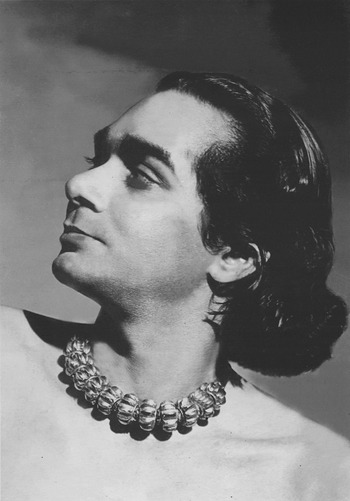
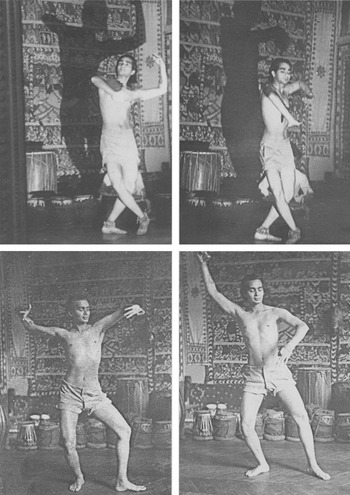
According to Erdman, what Shankar presented before his audiences in the West, i.e., narratives from his source culture, was channeled through a recognizable Western language of dance. When Shankar danced, his body carried out a negotiating process in which a text and its presentation came from two different cultures and yet were being made to converge. At the same time, Shankar made use of his identity as an “authentic” Indian, playing on his foreignness and his exclusivity as a dancer from the Orient (Photo 1). In Erdman's terms, Shankar's intelligent use of translation and interpretation gave his dance works potency and meaning in Europe and America (1987).
Uday Shankar (1900–1977). Reprinted, with permission, from Sunil Kothari's collection.

At home too, Shankar's biographers state that his shows were considered huge box-office hits in cities like Bombay and Calcutta during his 1934 India tour. Critics adored his dance, and audiences flocked to the theaters to see his productions. It was also around this time that the Nobel Laureate poet and pedagogue Rabindranath Tagore (1861–1941) saw Shankar's performance in Calcutta and praised him highly for his creative potential and his efforts to resuscitate the art of dance in India.Footnote 2 In some parts of India, therefore, particularly in the western and eastern regions, Shankar's dance communicated well with audiences. Yet, to say that Shankar's India tour in 1934 was wholly successful is a statement that needs to be carefully examined and qualified.
As Khokar's (Reference Khokar1983) biography documents, the southern Indian reception of Shankar's work was quite different. E. Krishna Iyer, one of the pioneers of India's renaissance and revival of dance and a major voice in dance criticism in Madras (present-day Chennai), commented in the Indian Republic: “With his genius for originality and superbness in presentation Uday Shankar can do a great deal, if only he can improve his faith in the best of our classical traditions and utilise them effectively (Quoted in Khokar Reference Khokar1983, 79).” The Triveni-Journal of Indian Renaissance in its July-August issue of 1933, made the following observation on Uday Shankar's works:
Were Uday Shankar to stay in India for a few years and put himself to systematic training under a master like Narayanswamy Iyer of Nallur and assimilate everything that the living traditions can impart, and then apply himself to the task of recovering the forgotten dances of ancient India with the aid of texts, literary and sculptural, then indeed Uday Shankar would not have striven in vain. In a matter like this, appreciation from [the] West is not everything, for the public there knows little about the genius and scope of our art forms. Uday Shankar is ambitious and complete success in the dances he attempts is possible only if he equips himself with a thorough knowledge of the art. (ibid.)
Perhaps the cruelest cut of all came from a critic named G. K. Seshagri, whose article published from Madras prompted Shankar to respond defensively and make a case for his art. The issue was taken up by John Martin, the well-known American dance critic. Martin had been impressed by Shankar's 1934 American tour and decided to publish the ensuing debate, adding his own support for Shankar in an article for The New York Times (Martin Reference Martin1934). Seshagri had written that Shankar's dance, “considered as some kind of dance, was tolerable. But considered as Indian dance, either as Bharata Natya, or Nrittya, or Nritta, it was absolutely unconvincing except for the costumes, the décor and the music” (ibid.). To Seshagri's accusation that Shankar breached “the canons of the Indian classic dance,” Shankar's reply was:
Does he expect that we should go back to 200 years or 500 years ago and blindly imitate what our forefathers were doing at that particular period? The traditions of Indian art have been changing from time to time, and it is impossible to fix upon a particular tradition prevailing at a certain time in the past and call that the only authentic Indian tradition. (ibid.)
In Shankar's defense, John Martin raised some equally pertinent questions in the same article:
[…] Is the dance to be a specialty of the scholar and the aesthete or does it belong to the general ranks? If there are those who believe that it is the former, must they in defense of their belief make it impossible for those who disagree with them to practice their own beliefs? Must we fight for every sort of tolerance except artistic tolerance, every sort of democracy except artistic democracy? (ibid.)
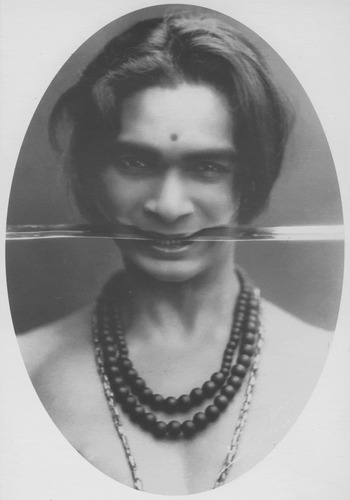
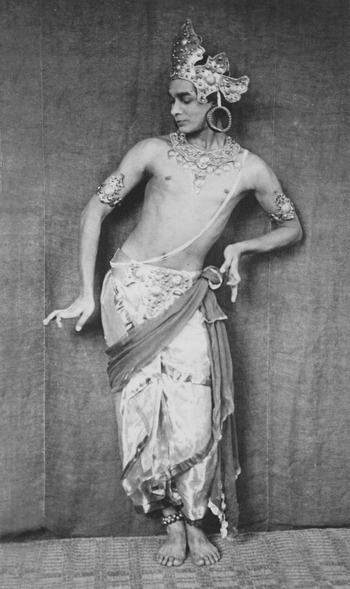
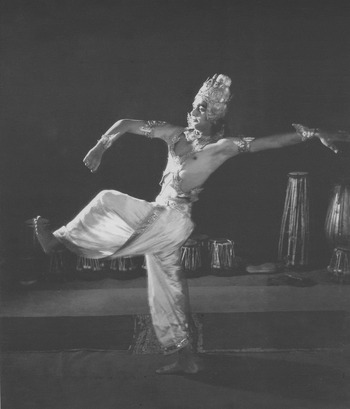
Shankar's (and Martin's) response to Seshagri is emblematic for various reasons. First, it clearly indicates the trajectory of experimentation and originality that Shankar took when creating his dance works (Photo 2). This trajectory defied the hegemonic tendencies of the classicism project of the Indian nationalists, making Shankar's dance works appear nonclassical both in terms of vocabulary and presentation.Footnote 3 Second, and consequently, it marks the wide fissure that took place between Shankar's brand of modern creative dance and the Madras Music Academy's brand of modern classical Indian dance in 1930s India. The critical reviews and the defensive tone in Shankar's and Martin's writings reveal the failure of Shankar's work to match up to the expectations of the national cultural revival movement that was led by southern India from 1932 onwards, following the Madras Music Academy's resolution to reinstate the banned temple dances as “Bharatanatyam,” India's classical dance form. Thus, despite Shankar achieving relative success in some regions of India, he fell short of being endorsed by the key protectors of national culture whose verdict on “authentic” dance and culture was the one that most mattered to national cultural circles and many artists during that time (Photo 3).
Uday Shankar in Sword Dance (1925). Photo courtesy of Amala Shankar.

Uday Shankar as Indra (1927). Photo courtesy of Amala Shankar.

More recently, Ruth K. Abrahams’ (Reference Abrahams2007) article has provided a finely detailed history of Shankar's early career. Analyzing the reasons behind his artistic and commercial success as a dancer and choreographer in the early Depression-fraught America, Abrahams writes:
While Hollywood and Broadway provided fanciful economic escapes into societies based on popularized Depression clichés where “pennies fell from heaven” and the streets were “paved with gold,” or where the average “John Doe” could become a national hero, Shankar and his company provided an escape into a new exotic world infused with the Hindu spirit, where serenity triumphed over chaos and harmony reigned over dissonance. The effect was powerful and lasting. Many decades later, those who attended Shankar's concerts still vividly recalled the “magic” of his performances, “the godlike image” or “larger than life” persona he projected. Adjectives like “exquisite,” “mesmerizing,” and “unforgettable” repeatedly infused interview after interview with people who were there, so that there remains little doubt that Uday Shankar was unique in the history of concert dance on the American stage. (2007, 409)
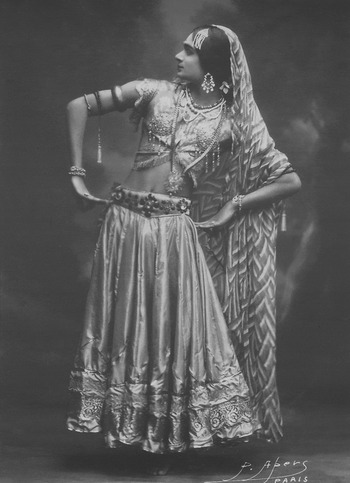
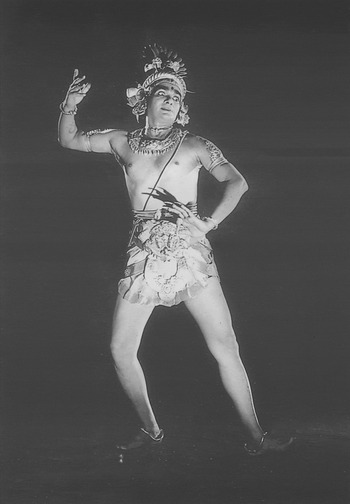
Abraham's examination of Shankar's artistic triumph in Europe and America, gained through his offerings of lush, larger-than-life, fantastic narratives to a financially crippled America, provides an interesting reading of the effects of performances given by a “native” Indian (Photo 4).
Uday Shankar in Woman's Dance (1927). The costume was stitched by Shankar himself, and indicates his eye for presentation and opulence in his earlier works. Photo courtesy of Amala Shankar.

I acknowledge the importance of existing research by Erdman and Abrahams and their appraisal of Shankar's success in Europe and America. I also recognize the significance of Sarkar Munsi's (Reference Sarkar Munsi and Munsi2008) essay, which highlights Rabindranath Tagore's and Shankar's contributions to modern dance in India. However, what seems to be lacking in existing literature is a close examination of local and national critiques of Shankar's dance, and Shankar's response to such criticism. In this article, I have revisited and privileged the 1933–1934 local reception of Shankar's work in southern India because it opens up some pertinent issues about nationalism, transnationalism, and processes of identity construction in the dance arts. As we have noticed, the nationalist identification of Bharatanatyam with “pure” and “authentic” Indian culture in southern India decried Shankar's “impure” and “inauthentic” dance renaissance (Photo 5). Therefore, even though Shankar's translations for Europe and America of Indian-themed dances did work, his dance performances as translations of themes of Indian origin for Indian audiences via the medium of Western presentational formats were not always so successful. In the following section, I propose an alternative reading of Shankar's dancing body. Using postcolonial theories of identity, I shall attempt to unravel meanings perhaps lost or hidden in Shankar's translating process.
Uday Shankar rehearsing before his first group ballet show in Paris (1930). Photo courtesy of Amala Shankar.

Shankar: Floating Artist, Native Other
I would like to suggest that Shankar's early work displays a tendency to play to the popular European imaginary of the Empire. This is evidenced in the orientalism of his early 1930s career in Europe, after leaving Anna Pavlova's company, through mythology-inspired works such as Indra, Tandava Nrittya, Kalia Daman, Gandharva, and Kartikeya (dates unknown) (Photo 6). I see this as Shankar “performing Empire,” a phase in which he willingly identifies, as a native of India, with Euro-American expectations of the exotic oriental dancer.Footnote 4 However, as I argue later, Shankar's Almora institute and his 1948 film Kalpana are products of a performance of a different identity, that of otherness. Here, I use “otherness” to refer to Shankar's peculiar situation of being an “other” even in his own home country, India, particularly when his works are deemed inauthentic and not the “real” Indian dance by the nationalist cultural establishment. This shift from performing Empire to performing otherness becomes even more crucial when we view Shankar, not as an Indian male dancer, but as a transnational artist whose movements between continents and creative mind perhaps confounded any straightjacket definition of nationalist culture in India.
Uday Shankar in and as Kartikeya in Madan Theatre, Calcutta, 1935. This was the only classical dance that Shankar learned from the Kathakali guru Shankar Nambudaripad. Photo reprinted, with permission, from Sunil Kothari's collection.

I am therefore interested in positioning Shankar as an outsider within the framework of South Asian cultural nationalism. I see him as a floating figure who travelled between two worlds, the Euro-American and the Asian, without ever wholly belonging to either one. This quality of “in-betweenness,” explained by authors such as Homi Bhabha (Reference Bhabha1994) as being peculiar to the postmodern diasporic condition, thus finds a much earlier echo in the mid-twentieth century work of a South Asian male dance artist. Purists belonging to the Indian nationalist cultural project read this “in-betweenness” as inauthentic. This quality alienated Shankar from South Asian audiences, giving him a place neither “there” in the world nor “here” in his native India. If diasporic space, as Jim Clifford (Reference Clifford1994) suggests, is composed of genealogies of displacement as well as genealogies of staying put, and is between localism and transnationalism, then I see Shankar as occupying that peculiar, nebulous space, which we currently often associate with the diaspora, a space from which his dancing body negotiated local and transnational identities even as long ago as the 1930s. I am not proposing here that Shankar was a diasporic artist in an age when “diaspora” was not yet a reality. Instead, I am suggesting here that Shankar's travels and movements between the Euro-American and Asian worlds and his resulting work eluded nationalist constructions of identity, perhaps making him a harbinger of what we now know as diasporic hybridity.
On foreign turf, and during his early years as an emerging dance artist in Europe and America, Shankar's lack of formal training in dance was subordinated by his confidence of being an original Indian. When Shankar brought his successful Euro-American tour to India, the novelty of his colored body was lost on local audiences. Shankar's masculine, native body was expected to conform to the normative category of the Indian classical dancing body that was being produced by nationalist and anti-colonialist discourse. Since it did not comply with these dominant networks of power by presenting “pure” classical dance, Shankar's actively resisting dancing body ironically generated an altogether “other” cultural text within the imposed and hegemonic normative culture. I therefore view Shankar's dancing body as a site where multiple identities were simultaneously performed: native, foreign, insider, outsider. In particular, I see the complexity of Shankar's journey as a floating artist, who begins life in India, develops his early career in Europe and America, and then returns to India to claim his native roots, in a zigzag movement that troubles any straightforward understanding of identity construction.Footnote 5
We notice then that the notion of identity and nuances in its meaning begin to play a crucial role in the performance of dance in twentieth-century India. During the anti-colonial period of the 1920s and 1930s, leading up to India's independence from British rule in 1947, diverse forms of cultural nationalisms were at play in the different regions of India. This is exemplified in the different reception of Shankar's works in northern and southern India. Cultural nationalism in India was not one single homogenous project of re-inventing classicism; it produced its regional variants. In Bengal, for instance, it gave rise to the modern art movement (Mitter Reference Mitter1995). Shankar, in spite of defensively arguing for his dance, probably sensed the problem that this perception of his works could pose for his company. He began to assert himself and his art as being consciously Indian and yet different from any of the other reformulated classical Indian models of performance. In the following section, I examine the founding of the Uday Shankar India Culture Centre (USICC) in Almora (in the Indian Himalayas) as Shankar's performance of an alternative Indian identity.
Almora and the Performance of Otherness
In order to understand the significance of Shankar's Almora experiment in India, one has to begin, paradoxically enough, in 1930s Britain. I therefore begin this historical narrative from a point of suture. This is the distinct shift in Shankar's dance career that occurred when his momentous meeting with Leonard and Dorothy Elmhirst of Dartington Hall in Devon, England, turned into a beneficial and fruitful collaboration (Nicholas Reference Nicholas2007). In April 1933, Shankar's company was performing at the Arts Theatre Club in London when Margaret Barr, then Head of Dance and Drama at Dartington Hall, saw them and recommended Shankar to the Elmhirsts. Dartington's cultural policy from 1934 until World War II had included the supporting of European artist-émigrés and providing a platform for international artists such as Shankar to showcase their works (ibid.). In May 1933, Shankar along with some of his musicians performed at Dartington. This was followed by a full company performance a year later on May 26 at Dartington's Open Air Theatre.
It has been well-recorded that Shankar's talent and personality made a significant impact on Dartington's students and its illustrious faculty members, including the German modern ballet dancers Kurt Jooss and Sigurd Leeder, and the Russian theater director Michael Chekhov. Shankar also impressed Beatrice Straight, daughter of Dorothy Elmhirst from her previous marriage. It was largely owing to Beatrice that Shankar was able to strengthen his ties with Dartington further—it was here that Shankar and his company performed, first at the opening of the Chekhov Theatre Studio in October 1936 and then again in 1937; it was here that Shankar's company found space to rehearse in between its tours; and it was here that Shankar got the opportunity to closely observe and share ideas about theatre and performance and its teaching methods with Chekhov. This experience was to have a strong impact on Shankar's own movement training methods as they evolved in the next decade. Finally and most importantly, it was from Dartington that Shankar secured substantial funds to set up his very own dance institute in India in 1938—the Uday Shankar India Culture Centre in Almora (USICC).Footnote 6
There is a clear and significant link between the philosophy behind the foundation of institutions such as Rabindranath Tagore's Shantiniketan in Bengal, India (where Leonard Elmhirst spent considerable time in rural reconstruction projects), Leonard and Dorothy Elmhirst's Dartington Hall in Devon, England, and Shankar's Almora Centre in northern India, although the connections between them are only sporadically acknowledged.Footnote 7 Like Shantiniketan and Dartington Hall, Shankar's Centre was an enquiry into an alternative system of education, which would impart knowledge of the arts and studies on past as well as contemporary culture. This system of teaching was designed to encourage creativity and innovation chiefly in the performing arts context while supporting and nurturing individual talent. What needs to be asked is why Shankar believed it necessary to create and establish such an institution in India at this point? What was his intent, and where did this need or urge come from? In his letter to G. B. Pant, the Premier of the United Provinces, Shankar outlined his Centre's overall aim:
It is my plan to take a group of thirty to forty students, selected with regard to ability but without regard to caste, religion or social status, and train them first of all in dancing and music, but also in other forms of artistic expression. These students, like those who will follow them, will later be able to enrich our national life. They in turn will start centres of their own or be available as professional teachers and musicians, radio performers, etc. Although I have already received a large number of applications for admission to the proposed centre from Western students, it is my intention not to take any new students except Indians for probably five years, so that we may establish the centre on a firm Indian basis, before widening the scope of our activities. One of the features of the centre will be its all-India character. We shall have as a nucleus the members of my present organisation, which includes Bengalies, Mahrattas, Malabaries and two Muslims from the U.P., and we shall also invite, as soon as possible, special teachers and experts from different parts of India to join the teaching staff. Thus the centre, in its organisation, its emphasis and its sources of inspiration, will be truly national and non-communal in character. (Shankar Papers, File LKE India 19/A: 1932–38)
It becomes evident from his letter that in its organization, faculty and staff composition, student body, and ideological emphasis, Shankar's Centre in Almora would seek to encourage diversity as well as national unity in the arts—two of the favorite catchwords of nationalists during India's struggle for independence from British rule (achieved on August 15, 1947) and also in the post-independence era. Shankar astutely negotiates and even panders to nationalist tropes; notice the repetitive use of the word “national,” as well as the ironic decision to exclude “Western students” initially (“probably five years”), even though his center relied heavily on funds and administrative help from England.
However, in spite of this evidence of nationalist insularity in the letter above, Shankar does make clear through his correspondence his own individual and alternative need for self-articulation. One can read in this act of creative entrepreneurship an individual expression of identity that plays a complex game with the national. Shankar simultaneously aligns and distances himself from nationalist notions of culture. As a returned native who participates in this complex relationship with the nation state, Shankar shows symptoms, as Kaplan suggests, not of being an immigrant who is seen to replace one nationalist identification with another, but of a diasporic émigré who confounds “territorial and essentialist nationalisms in favour of transnational subjectivities” (Kaplan Reference Kaplan1996, 136).
The USICC in Almora may therefore be seen as a strong political statement made by an independent dance artist in pre-independence India. It was meant to provide an alternative reading of Indian arts and culture, a counter-force acting alongside the hegemonic discourses on the “classical-national” model of art forms. For Shankar, there could not exist a singular and exclusive reality of the performing arts in India dependent on the largely reconstructed classical models of performance. There were other realities too—other methods, other approaches, and other pathways to the creation of dance works. His Centre in Almora would present one of them. One must not misconstrue Shankar's project as a complete denial of southern India's revival of classicism. He invited well-known gurus in Bharatanatyam and Kathakali to teach at Almora, as the following section will clarify. Yet, in spite of the inclusion of training in classical dance, there was a clear distinction between Shankar's USICC-national model and the classical-national model of dance.
Memory in Shankar's Dance Technique
The difference between Shankar's and southern India's approach to historical recuperation, the recovery of things lost, and the reconstruction of dance in India essentially lay in their relationship with the past and in their use of memory. Nationalist scholars and cultural historians in the south of India came up with a meticulous and highly analytic process of sifting through extant indigenous models of performance, and channeling these through endorsed theories on dance and dramaturgy available in ancient texts on theater and performance. Therefore, the sadir nautch and its revamped version “Bharatanatyam” became the “authentic” Indian dance since it was sanctioned, authorized, and legitimized by textual theory. It complied in essence and practice with rules of performance and presentation that had been in existence as written word for centuries (see Meduri Reference Meduri1996; O'Shea Reference O'Shea2007; Srinivasan Reference Srinivasan1985). Shankar's dance, on the contrary, would not comply with any ancient theory of either performance or its presentation. It is true that he was inspired by Ananda Coomaraswamy's Mirror of Gesture (Reference Coomaraswamy1918),Footnote 8 and drew heavily upon postures and images from ancient Indian sculpture and art in his choreographies by using footwork, hand gestures, and movement phrases from recognizable Indian dance forms (Photo 7). Yet, Shankar never attempted or claimed to be presenting “classical” Indian dance. He was essentially a storyteller, and he told his stories through dance in a language that was non-codified, improvisatory, and open-ended.
Uday Shankar as Shiva in his dance drama Nritya Dandha (1939). Photo courtesy of Amala Shankar.

In his early career (the 1930s), Shankar's dance drew upon “impressions”—a technique that allied him with impressionism in dance as evidenced in the works of early modern dancers in Europe and America such as Ruth St. Denis. His later works, however, and particularly his Almora years, showed the development of a self-conscious “Shankar style,” combining recognizable Indian pose and gesture with free movement. When he opened his Centre in Almora, Shankar created syllabi that focused on improvisation, originality, innovation, and the use of personal or autobiographical rather than historical memory only in dance, music, theater, fine art, and filmmaking. This took place alongside training in Bharatanatyam, Kathakali, and Manipuri. Guru Kandappa Pillai, who trained none other than Balasaraswati, the noted Bharatanatyam dancer, was invited to teach at Almora, along with Guru Shankaran Nambudiri for Kathakali and Guru Amobi Singh for Manipuri. In music too, Shankar had on his faculty list one of India's celebrated classical music exponents, the sarod maestro Ustad Alauddin Khan, as a visiting teacher, alongside the talented Vishnudas Shirali who was also Shankar's company music director.
With a generous fund of £20,000 from the Elmhirsts of Dartington, and with the advice of scientist Boshi Sen and his wife Gertrude Emerson who became the Centre's executive committee members, Shankar set up his USICC in the town of Almora. Ninety-four acres of land called Simtola was given to him by the United Provinces government; nestled in the Himalayan mountains, the area lies in the present-day Indian state of Uttaranchal. A studio that doubled as a stage was built on Ranidhar Ridge with a view of the Himalayas; a prospectus with a program of training for a five-year diploma course and a two-month summer course was meticulously planned, printed, and distributed; and the Centre was ready to receive its first cohort of twenty-one students from across India and Ceylon in March 1940.Footnote 9
Those who gravitated to Almora to train in Shankar's Centre proved to be a highly eclectic mix of dance, acting, and music enthusiasts, many of whom later became stalwarts in their respective fields of work. Narendra Sharma (1924–2008), the New Delhi–based modern dancer-choreographer and founder-director of Bhoomika, was all of fourteen when he arrived in Almora from Aligarh and had to produce a consent letter from his uncle to gain admission to the Centre (personal interview, March 13, 2006, New Delhi). Sharma noted that in terms of dance and music technique, Shankar's Centre offered a range of classes from some of the best teachers in the country who were recognized for their contribution to what soon became known as the Indian “classical” forms of performance. Yet, there were also intensive classes such as the General class that took place early in the morning. During this class, students would be asked to walk and move in different ways. There was also the Technique class, where students would be asked to create geometrical patterns using hand and foot movements, lessons in theory (possibly Sanskrit texts on dramaturgy) taught by Mrs. Shastri, and art and painting lessons given by Shankar himself. The last class of the day and one of the most important ones was the Improvisation class, conducted by Shankar, which would have students creating and presenting their own dances. According to Narendra Sharma, Shankar's brief to his students during improvisation class was to feel, recollect, and then embody their memories in movement. Recollection became the first stage of choreography, and a combination of memory and observation of real life became the essential ingredients of new forms of movement (ibid.; also see Sharma Reference Sharma and Vatsyayan1978).
I find this observation by the late Narendra Sharma as being quite critical and pertinent to my understanding of the process of Shankar's performance of identity. Recent theories of memory, such as those by Jose van Dijck, have suggested that personal memory arises out of “the altercation of individual acts and cultural norms—a tension we can trace both in the activity of remembering and in the object of memory” (van Dijck Reference van Dijck2007, 6). The author further explains how “memory products invite subversion or parody, alternative or unconventional enunciations. Products of memory are first and foremost creative products, the provisional outcomes of confrontations between individual lives and the culture at large” (van Dijck Reference van Dijck2007, 7). Shankar's insistence on his students’ accessing personal memory in his dance training methodology seems to suggest the subversive quality of his creative work, in which personal memory confronted the historical memory of Indian nationalist culture.
Shankar's Almora Centre was in many ways similar to Rabindranath Tagore's Visva Bharati University in Shantiniketan, an alternative educational space that encouraged experimentation in the visual arts, music, drama, and dance. Both institutions focused on imparting training in dance techniques from India and also emphasized a creative re-construction of movements taken from such techniques (for more on Tagore, see Bose Reference Bose2001; O'Connell Reference O'Connell2002; Purkayastha Reference Purkayastha2009; Sarkar Munsi Reference Sarkar Munsi and Munsi2008). However, Shankar went one step further and pushed the boundaries of choreography by introducing elements of improvisation, underlining the importance of a conscious relationship between the gestures of daily life and dance movements. He established a training system in which prominence was given to an in-depth knowledge of the body and its various components. Shankar emphasized the isolated movements of body parts and the symbiotic relationship of the body to space and spatial patterns. He blended South Asian movement dynamics with principles of early modern dance and theater as found in the works of Dartington-based practitioners such as Kurt Jooss and Michael Chekhov.
The Almora Centre also becomes a significant chapter in an analysis of Shankar's career, as it signals the beginning of his realism-inspired choreographic works. It was here that he created Rhythm of Life and Labor and Machinery, dance works that tackled real contemporary issues in India. While Rhythm of Life mirrored uneasy landlord–peasant relationships and voiced the need for freedom from servility in both local and national senses, Labor and Machinery explored the mechanized labor of mill workers, the inhuman factory conditions in which they worked, and mirrored exploitative human relationships in an industrial setup. This move from mythological to non-mythological storytelling through dance indicates a significant shift in Shankar's career. Shankar, through these dance works, was perhaps making the statement that it was possible to remain Indian and at the same time embrace modernism by tackling and mirroring contemporary socio-political issues of the day.Footnote 10
The delving into a personal past in Shankar's work during the Almora years is perhaps indicative of his yearning to belong to the modern present. The term “belonging,” as expounded by Probyn (Reference Probyn1996), further nuances the term “identity.” In Probyn's words, “belonging” sums up “the desire for some sort of attachment, be it to other people, places, or modes of being, and the ways in which individuals and groups are caught within wanting to belong, wanting to become, a process that is fuelled by yearning rather than the positing of identity as a stable state” (Probyn Reference Probyn1996, 19). The use of autobiographical memory in Uday Shankar's dance methodology in the 1940s, and particularly in his film Kalpana, may perhaps be read as a strategy that attempted to connect personal with historical memory. Memory in Shankar's dance therefore becomes a locus from which he shifts his position of a returned misfit émigré to one who truly belongs to India, and whose work could be seen as part of his re-found native home.
Almora Versus Kalpana
The Uday Shankar India Culture Centre was a landmark in the history of performing arts academies in India, because it was the first and only one of its kind in the country during the 1940s that offered such a comprehensive training program in the performing arts that drew from both Indian and European models of pedagogy. It held great promise as an institution, and had it continued to function efficiently, would perhaps have given a concrete shape and reality to the modernist movement in the realm of Indian dance. However, the Centre failed to achieve such a goal, owing primarily to three reasons.
First, it seems that the Centre's start happened in a rather turbulent period in the world's political history. The Second World War loomed not just over Europe and America, but also extended to the colonies, and the repercussions were felt in India. There was a shortage of financial capital in every business enterprise, and the arts industry suffered the impact too; clearly, it was not an auspicious period for a center, which depended heavily on international funding. The Almora Centre had to lose two of its administrators at its inception, and over time had to grapple with a shortage of funds somewhat unsuccessfully. Second, Almora did not turn out to be as idyllic a space as imagined by Shankar. He wrote in a letter to Beatrice Straight that there was no water, electricity, good communication links, or medical facilities, and that five years in, Almora had made him realize that it was not the ideal place for the Centre (Shankar Papers, File LKE India 19/D: 1943–46). Third, and to make matters worse, Shankar proved to be a rather impractical center director; he had vision, courage, and the ability to lead his troupe and students to artistic success, but he lacked pragmatism and also, perhaps as may be seen below, sensitivity towards others when it came to decision-making in real life.
Not content with having a full-fledged center to run, Shankar also seriously considered experimenting with the medium of cinema for some time. He now wanted to make a film—one that would document his vision of creative modern dance in India and crystallize his choreographic works. The film would become a testament to his faith that his dance could be a legitimate art form. There was one problem however. Making the film would mean aborting the training program at Almora. The students who had invested time, energy, and money into the Centre had expectations of getting a diploma at the end of their program.Footnote 11 They demanded that their course be continued to its end. Shankar gave the students two choices: either they become a part of his film, or they leave. Much debate and argument ensued, and the Centre eventually had to close down owing to Shankar's adamant refusal to comply with his students’ demands and his insistence on making his film. In retrospect, it seems highly unfortunate that the choice would have to be made between Kalpana, the only visual document of Shankar's works, and the continuing legacy of his dance training through the Almora Centre. Yet, the choice was made, the Almora Centre stopped functioning in early 1944, and the shooting of the film Kalpana went on the floors of Gemini Studios in Madras (Chennai) the same year.
While it is not the object of this article to judge Shankar's decision, it must nevertheless be pointed out here that he was heavily censured by some of his colleagues and friends for his irreverence, both to his students and to his original plan of imparting education through the arts at Almora.Footnote 12 What prompted Shankar to take such a drastic measure? And why the sudden decision to work in the medium of cinema? Could it be that Shankar already recognized the telltale signs of failure in his cherished institution? Did he choose to make a film because celluloid could highlight, market, archive, or preserve his art in a way that Almora could not? Was this a decision that pre-empted the failure of Shankar as a struggling modern dance artist in a country that, in the 1940s, clearly had no definite space for one? These hypothetical questions provide only probable interpretations of the reasons behind the Almora Centre's breakdown.
In the history of modern dance in India, a significant rift may be said to have taken place at this point. With the Centre closing down, there was a splintering of ways between Shankar and some of his senior students. Although a new generation of dancer-choreographers emerged from this split, the end of the Almora Centre was a lamentable event, and one that left unfinished Uday Shankar's vision of consciously creating a new dance pedagogy in India. Perhaps the failure of Almora is also indicative of Shankar's failed identity as an institution-builder. Uday Shankar may have been an artist par excellence, but he was not a pedagogue like Tagore, whose vision of and commitment to education had provided a strong foundation for Shantiniketan, ensuring its secure future.
Shankar's abortive attempt to create an alternative arts institution marks a moment of failure in the narrative of modern dance in India. This crisis point, however, solidifies Shankar's identity as a subversive filmmaker and choreographer in twentieth century dance history. As Kobena Mercer has pointed out, “[…] identity only becomes an issue when it is in crisis, when something assumed to be fixed, coherent and stable is displaced by the experience of doubt and uncertainty” (Mercer Reference Mercer and Rutherford1990, 43). Even while Shankar's identity as a modern dance educator dies a sudden and bitter death in the Almora crisis, through Kalpana, Shankar unwittingly manages to re-cast himself as the maker of one of the most iconoclastic art-house films in India.
Kalpana (1948): Contexts and Meanings
In this penultimate section, I offer a critical discussion of Uday Shankar's film Kalpana, examining its simultaneous collaboration with and resistance to Indian nationalist contexts and frameworks of culture. In my historical retelling and unpacking of the film's possible meanings, I wish to highlight Shankar's use of personal and national memory, which eventually others himself and his dance within Indian cultural production in the 1940s.Footnote 13
The seeds of the concept for Kalpana were sown in the Almora Centre itself. Amala Shankar, who became Uday Shankar's dance and life partner (they married in Almora on March 8, 1942), recalls how Shankar while discussing the film script with Guru Dutt, one of the Centre's students, had asked him to write down the Bengali equivalent of the word “imagination.” When Amala prompted the word “kalpana,” Shankar asked Guru Dutt to write it down as the title of the film and the script gradually began to take shape from this inception point (personal interview, Amala Shankar, April 23, 2005, Kolkata). To help him on this project, Shankar had on his team, among others, his wife Amala Shankar as both assistant, lead character, and costume designer; Vishnudas Shirali as associate producer and music director; Guru Amobi Singh to create Manipuri dances; and the poet Sumitranandan Pant as lyricist. It was decided that the film would be in Hindi rather than Uday or Amala's native Bengali language, possibly because that would ensure its wider acceptance in the rest of the country.
Uday Shankar was the set-designer, writer, producer, and director. Mention must be made here particularly of Shankar's set design for Kalpana. A substantial fund of twelve Lakh Rupees (approximately £15,000 in today's currency) was given by Baronet Chunubhai of Ahmedabad for this film, but set-executors gave an estimate of three Lakh Rupees for each of the many sets that Shankar wanted to use for his film. Shankar was initially stumped, but he happened upon a plan when he saw his toddler son Ananda playing with building blocks. He first designed the model of his set made of six-inches wide wooden blocks of various shapes, then made four-feet size wooden blocks based on the designed model (ibid.). Different sets used for different scenes in the entire film were a combination of these various wooden blocks. The effect was visually stunning and theatrical, and most importantly, it suited Shankar's budget.
In June 1944, Shankar wrote a letter to Amala, expressing his interest in shooting the film in Indrapuri Studios in Calcutta, but the decision to move to Gemini Studios in Madras, Tamil Nadu was made shortly thereafter. A massive cast of dancers was brought in from all over India: fifty male Kathakali-trained dancers from Kerala, and thirty-five female dancers from Madras, Travancore, and Maharashtra.Footnote 14 From 1944 to 1945, rehearsals for the film went on the floor with Shankar plus 150 artists. The shooting for the film began in 1945 for eight months initially, then stretched on until 1947. During the day, Gemini Studios was hired for another film titled Chandralekha directed by S. S. Vasan, so that Kalpana could only be shot in the night schedule. All actors and dancers met for make-up and dress from 4 p.m. to 6 p.m.; shooting for the film began at 6 p.m. and carried on until 4 a.m.
Kalpana took nearly three years to make, owing to acute funding shortages and the outbreak of the Second World War during the production process. However, Uday Shankar's vision for the film was not compromised. That Kalpana was intended as a strong political statement made by its creator is substantiated by the opening message that appears on the screen just after the initial credits. Shankar's message reads thus:
I request you all to be very alert while you watch this unusual picture—a Fantasy.
Some of the events depicted here will reel off at great speed and if you miss any piece you will really be missing a vital aspect of our country's life in its Religion, Politics, Education, Society, Art and Culture, Agriculture and Industry.
I do not deliberately aim my criticism at any particular group of people or institutions, but if it appears so, it just happens to be so, that is all.
It is my duty as an Artist to be fully alive to all conditions of life and thought relating to our country and present it truthfully with all the faults and merits, through the medium of my Art.
And I hope that you will be with me in our final purpose to rectify our own shortcomings and become worthy of our cultural heritage and make our motherland once again the greatest in the world.
Uday Shankar
This message immediately establishes the film's and Shankar's agenda: Kalpana was going to be an honest critique of contemporary India and its real problems revealed through his dance-art. It is not surprising therefore that the film begins outside the office of the financer and producer of a “Thunderstruck Studio,” which has as its motto the phrase “Box Office—Our God,” where Uday Shankar, playing an aged writer, is shown desperately trying to sell his story to the producer. From its very opening scene, the film seems to establish a theme of power imbalance—between producer and artist, between different classes in India's society, and between the personal and the public. The theme of an artist's struggle against expectations of commercial success is further emphasized in the first scene when the film producer asks for romance and entertaining song and dance as essential ingredients of a lucrative film. In response to this demand, Shankar-as-writer points to a group of poor street children, pleads for their cause, and begs for his story to be heard. The rest of the film unfolds, largely in flashback mode but with frequent comments by the writer-as-narrator, as a fictional yet semi-autobiographical retelling of Shankar's own life story, following events in the life of a young man called Udayan who is played by Shankar himself.
Although a scene-by-scene analysis of Kalpana is beyond the scope of this article, I would like to highlight some of the sequences in the film that are especially significant in terms of understanding Shankar's peculiar position as a transnational artist within an Indian nationalist context. They are significant because I see in these part-fictional, part-autobiographical sections a complex hide and seek game that Shankar plays with Indian cultural nationalism. For instance, a section of the film's story is set in the bustling city of Benaras, whereto the young Udayan travels on the advice of his art teacher to challenge his creative imagination. This section charts Udayan's creative career and his initial experiments with dance on stage. What is noteworthy here is how Shankar replaces the European years of his real early career as a dance artist with the imaginary and fictive space of Benaras. This replacement suggests Shankar's strategic move, once again, to appeal to Indian nationalist sentiments through his work: Benaras, after all, is one of the most recognizable historical temple cities in northern India. Perhaps what makes this substitution of space critical is that it points to how personal and national memory collide and collude in complex ways within the narrative of the film. In the interplay between the individual and the national, we encounter once again Shankar's conscious yearning to belong. This, as Fortier suggests, is about the desire “of inclusion, about manufacturing cultural and historical belongings that mark out terrains of commonality, through which the social dynamics and politics of ‘fitting in’ are delineated” (Reference Fortier2000, 2).
Some of the other sections within the film's narrative that suggest a similar politics of fitting in through nationalist empathy are the images of famine where Udayan is shown grappling with poverty and hunger. This was Shankar's reaction to and portrayal of the recent manmade famine, engineered by the colonial government, which raged between 1942 and 1946 and claimed millions of lives in the rural areas of Bengal. The film presents a series of disturbing images of the effects of famine in villages: Udayan loses his best friend Noor to starvation, and then meets a young woman Kamini (played by Lakshmi Kanta), who is half-crazed by the calamity of death in her family. However, with time, village life improves, and this is reflected in a joyous celebration through a folk-dance sequence, yet another popular nationalist motif.
A noteworthy moment in the film's narrative occurs when Udayan follows Kamini against his will to a party thrown by Bombay's elite. This is crucial for two reasons: First, the scene that follows allows Shankar to caricature the severe disparities in wealth in India's social structure (while the famine still rages on in some parts of Indian villages, the wealthy drink to the deaths of millions of people). Second, with a wealthy mill owner showing off a model of his new factory, this scene introduces, through Udayan's vision sequence, Shankar's famous choreography Labor and Machinery. The scenes from Labor and Machinery are startling because they reveal how Shankar was able to create a non-codified, non-classical choreography even while he based it on the very domestic issue of exploited industrial labour.
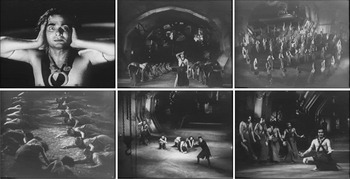
The opening scene of the vision sequence has a row of workers walking heavily with their spines curved while Shankar, playing a lead worker, watches them intently and then feeds coal into a gigantic machine. The scene has striking parallels with Fritz Lang's futuristic and allegorical film Metropolis (1927), in which the machine, embodied in the workers’ dehumanized actions in the Underground City and in the figure of female robot, becomes the film's central image (Gunning Reference Gunning2000, 55). In Kalpana, as the wheel of the machine starts to turn, a clockwork movement is unleashed, and this is soon translated into body movement by Shankar. Through the soot-covered and expressionless faces of the factory workers, their heavy overalls, their staccato movements, and the incessant beating of drums in the background soundscape, Shankar is able to give a striking depiction of mechanized labor through this choreography. Of particular note is a sequence in which the workers, turned as if into automatic machines, move their bodies disjointedly while Shankar as machine worker tries to manipulate them (Photo 8).
Uday Shankar's choreography Labor and Machinery, from his film Kalpana (1948).

Within the choreography, the narrative moves to the workers revolting against the factory owner, being imprisoned by the police, and then collectively breaking off the chains that had shackled them. The scene ends in laughter, and in the narrative of Kalpana, Udayan snaps out of his vision and is recalled back to the raucous behavior of the people at the party. When analyzed carefully, the section from Labor and Machinery seems to occur as a significant event in the film's narrative. From this moment onward, the film follows Udayan's journey as an artist intent on making his creative vision come to life. Udayan procures funds from a generous donor at the party (an Indian businessman who replaces the real-life Elmhirsts of England) and opens his dream institute “Kalakendra” (which replaces Almora) in the Himalayas. The next part of the film serves almost as a documentary on the creative experiment that took place at the Uday Shankar India Culture Centre in Almora.
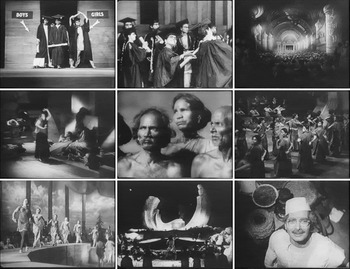
Some of the short dance sequences that feature as part of Kalakendra's creative work are worthy of mention. These succinct choreographic works cover a range of contemporary themes and issues: the short dance snippet that has dancers moving like puppets to a patriotic song penned by the poet Sumitranandan Pant; a brief sequence with dancers in spectacles and graduation gowns that daringly makes a jibe at existing education systems; the sequence in which the image of Bharat Mata (the nation as mother) appears to be distraught with regionalism and bewails the lack of unity among her people. These images are steeped in national consciousness and are deeply political (Photo 9). The reference to conventional education and degrees was both topical and personal to Shankar, given his recent (failed) educational experiment at Almora, while the iconic figure of Bharat Mata, a central trope in Indian nationalist art and literature, underscored the film's (and Shankar's) nationalist sentiments.Footnote 15
Images from Shankar's film Kalpana (1948). The choreographed scenes give an idea of Shankar's set design for the film, and also reflect his commentary on education systems and poverty in India.

The last half-hour of the film is centered on the increasing tension between Shankar (Udayan) and two women (Kamini and Uma) who symbolize the tug-of-war of his loyalties. This occurs simultaneously as a Spring Festival (Vasantotsava) in Kalakendra is planned to generate funds for the center and to raise money for Udayan's next creative venture, (not surprisingly) a film project. Performers and audiences, the rich and the poor are shown to flock to this festival from all parts of India, and the program is launched with the announcement: “Today India is on the brink of Independence. Politicians should help preserve art and work with artists shoulder to shoulder.” From the start of the festival to its abrupt end, Shankar showcases, along with his own choreographies, several dance forms from different parts of India including Manipuri, folk, and tribal dances, as if attempting to situate his work within the nation's cultural repertoire. The flashback ends suddenly when Shankar-as-writer is interrupted by the producer refusing to invest in his story, as it has no romance. Shankar-as-writer with his unfinished story is left voicing his angst about the darkness that engulfs the nation. He questions how long his dream of a culturally rich nation would remain a dream. Couched in the nationalist rhetoric of Shankar's desperate final plea in these closing lines may be read a modern dancer's demand for recognition. Kalpana the film becomes a substitute for Almora—a narrative with an abrupt end.
Conclusion
Kalpana was released in Bombay (present day Mumbai) and across India on February 13, 1948, just six months after India's independence. The launch of the film in such a period in India's political calendar is significant: it may be interpreted symbolically as an event through which both the nation and the artist perhaps attempt to make a clean break from their earlier “oriental” identities and declare their unquestioned independent identity. Through Kalpana, Shankar the citizen of an independent modern India, shows himself through the medium of his art as being acutely aware, conscious, involved, active, and critical within the Indian contemporary way of life.
Kalpana was critically acclaimed but considered a box office failure. It received glowing reviews from some quarters: The Sunday News of India carried a review of the film on February 22, 1948 under the caption “‘Kalpana’ Worthy of Place Among Film Classics” claiming that in the contemporary Indian film industry “there is nothing comparable with ‘Kalpana,’ nothing even mentionable within a dozen breaths of it: it stands alone, bearing the marks of genius, artistic vision and creative faculty”; the review also mentioned that the film was “too subtle to be popular in the way it should be” (Shankar Papers, DHTA, LKE India 196/A: 1947–49). Another article in FilmIndia highlighted Shankar's film as a “devastating satire” challenging the “commercial cinemagnates,” and stating that Kalpana “is a landmark in the history of Indian films […] It breaks completely with all the traditions of Indian cinema, discards all existing formulae, breaks new and virgin ground.”Footnote 16 However, with the budget of the film climbing from the original estimate of Rupees 12 Lakhs to Rupees 22 Lakhs, its commercial fate was not what Shankar had either envisaged or expected. Added to this was the rather harsh criticism it received from southern India.Footnote 17
The 1940s and 1950s are generally regarded as the Golden Age of Indian cinema, but film historians state that even though independent film production meant greater flexibility in film-making, producers generally resorted to the “formula” ingredients such as song and dance, and employed big stars in order to avoid financial failure (Dwyer and Patel Reference Dwyer and Patel2002). The 1940s also saw a series of patriotic films being released, such as Dr. Kotnis Ki Amar Kahani (directed by V. Shantaram, 1946), Shaheed (Martyr, directed by Ramesh Saigal, 1948), Shabman (directed by B. Mitra, 1949), and Samadhi (Monument of Remembrance, directed by Ramesh Saigal, 1950). These were apparently hastily produced but drove home to their audiences the nationalist sentiment that ruled the day (Dwyer and Patel Reference Dwyer and Patel2002, 140). However, there were also the commercial films that inhabited the spaces of popular imagination. Kalpana's release coincided with the arrival of the spectacular in Indian cinema, and the most striking and relevant example is Chandralekha, directed by S. S. Vasan and released in the same year as Kalpana. The irony is that these two films, created in the same studio in Chennai at the very same time, could not have met with more disparate fates.
Chandralekha was a bilingual (Tamil and Hindi) period film that employed magnificent sets and costumes and exuded a “Hollywood-style orientalism,” which became the yardstick against which all mass entertainment spectacular films after Indian independence were measured (Rajadhyaksha and Willemen Reference Rajadhyaksha and Willemen1999, 310). It was an all-India box office hit, and its spectacular climax scene, the dance on the drums, is considered by some to be one of the most extravagant scenes in the history of world cinema (Thoraval Reference Thoraval2000, 102–3). In their nature, the two films belonged to two opposite camps: Chandralekha is considered to be escapist entertainment at its best, a song and dance extravaganza, which, during its time tried to draw attention away from the harsh realities of war and PartitionFootnote 18 (Dwyer and Patel Reference Dwyer and Patel2002, 145). Kalpana attempted the very opposite in its depiction of social problems plaguing India at the time. Kalpana failed perhaps because its social message was too somber and dark, and because it strayed far beyond the accepted formula of popular films. It may have been unable to win over its audience in southern India because its music and dance belonged neither to mainstream film dances, nor to the orthodox classical arts parameter. The film was a misfit, with no precedent and nothing else to compare it to, and hence it paid a price at the box office.
Uday Shankar's Kalpana presents any historian looking at early twentieth century dance in India with an important key that opens a door to an alternative movement in dance performance. This emerged in the nationalist era alongside the Indian “classical” forms. Through Kalpana, Shankar attempted to identify himself as an Indian among Indians and to Indians. What is constantly reiterated through the film's images, scenes, dance sequences, and lyrics is that Shankar as dance-artist is from India, lives and makes work in India, and is acutely aware of and alive to its strengths and weaknesses. Therefore, there is absolutely no doubt about his identity, and analogically, his dance as being truly Indian: This is the political statement and defensive gesture made by Shankar as dancer, storyteller, and film director through his film. Yet, Shankar's choreographies did not truly belong to a local or national Indian camp. I argue that through Kalpana, Shankar only managed to prove even more clearly his transnational otherness, although he tried very hard to identify with nationalist frameworks.
It appears that through Kalpana, Shankar also wished to perpetuate the legacy of his own dance. This attempt to archive his own past as well as the contemporary present is successful to an extent. Shankar is able to document his own life experiences creatively, thus making the film a visual record of his own life and art, which would remain for posterity. One needs to be careful, however, in eulogizing this personal attempt at preserving one's own individual history as well as the national present. Shankar's archive is not a record of his spontaneous memory; he uses, rather, selective and constructed memory. The contents of his archive, the film Kalpana, suggest in my opinion both creativity and compromise.Footnote 19 The film indicates, in more ways than one, that Shankar performs his personal memories as a strategy to belong to the world outside.
Kalpana may be seen as a product of Shankar's individual memory, which performs its otherness and its transnationalism while simultaneously situating itself within the space of Indian nationalism. Through Kalpana, Shankar remakes, reconstructs, and recasts himself to protect himself from the challenges and conflict of nationalism. He does so largely through the medium of his personal memories. Shankar's memories empower him as a remembering subject and provide validity and authenticity to his experiences. The Indian nationalist cultural project in the 1940s was making Shankar and his art redundant. He had to reinvent himself, his career, his identity. This crisis of redundancy, in my opinion, leads to the most modern of his dance works—Kalpana. The film's vein of modernism is defined by this expression of individual crisis and conflict. Kalpana is a dance film that displays a complex interlacing of the global with the local, transcending purist nationalist concerns in favor of a transnational hybrid dialogue. It remains as an invaluable record of the processes of alternative cultural identity formations played out through the medium of dance in twentieth century South Asia.
Acknowledgements
Fieldwork for this research was carried out in India between 2005 and 2007, spanning the cities of Kolkata, New Delhi, and Mumbai. I would like to express my gratitude to staff and personnel at Sangeet Natak Akademi, New Delhi, Sangit Bhavan and Rabindra Bhavan at Visva Bharati University in Shantiniketan. My sincere thanks to Kapila Vatsyayan, the late Narendra Sharma, Shanti Bose, and Mrs. Amala Shankar for participating in conversations and interviews. I am deeply grateful to William Radice, Janet O'Shea, and Larraine Nicholas, and the supervisory team at Roehampton University, London (Alessandra Lopez y Royo, Andrée Grau, and Avanthi Meduri) for their comments on the doctoral thesis (Purkayastha, Reference Purkayastha2008), from which this article has been extracted. My grateful thanks to Dr. Sunil Kothari for giving me permission to use his Uday Shankar images. Finally, my sincere thanks to ex-colleagues Michael Huxley and Prof. Theresa Buckland for their invaluable feedback and advice on drafts of this article.
This paper is a reworked version of a chapter from my 2008 Ph.D. thesis, “Bodies Beyond Borders: Modern Dance in Colonial and Postcolonial India,” Roehampton University, London. In January 2009, a group of final year undergraduate dance history students at De Montfort University (UK) presented their research on Martha Graham (1894–1991), Kurt Jooss (1901–1979), and Uday Shankar (1900–1977) by physically mapping out their global travels in the 1930s and 1940s. The three presenters, dressed respectively as Graham, Jooss, and Shankar, moved between continents marked on the classroom floor. Their historical narratives about the three choreographers embodied and crystallized the flow of travel and migration that these artists embarked on eighty years ago. What became clear through this performance of history was that travel and migration made it possible for dance modernism's complex network and exchange to take shape between various national states. I would, therefore, like to acknowledge here the contribution of my three students, Jade Salter, Hannah Smith, and Lucy Sheppard, whose research inspired me to view Uday Shankar as an artist émigré and revisit his work through the lens of nationalism and transnationalism.