IN the twentieth century, government violence and repression claimed the lives of tens of millions of people by either directly killing them or by placing them in situations where they were likely to starve, fall ill, and die. In its most extreme form—genocide—this repression seeks to “destroy, in whole or in part, a national, ethnical, racial or religious group, as such.”Footnote 1 Since the end of World War II, social scientists have documented over forty cases of genocide and at least one hundred non-genocidal campaigns of mass killing.Footnote 2 The effects of political violence can reverberate beyond immediate pain and suffering and shape political participation,Footnote 3 social cohesion,Footnote 4 identity,Footnote 5 and economic development.Footnote 6 These effects can be incredibly durable and persist across generations.Footnote 7
Although past studies find that exposure to violence hardens attitudes toward the perpetrators and the groups associated with them,Footnote 8 its effect on long-term attitudes toward out-groups in general, including those with no clear link to the historical trauma, is less understood.Footnote 9 How do survivors internalize and pass on political lessons that shape their approach to intergroup relations?
One possibility is that the trauma of violent victimization affects subsequent social and political cognitions. If so, it may heighten perceived threats to the in-group, making survivors myopically focused on protecting their own ethnic or religious group and hypersensitive to any out-group threats.Footnote 10 Thus, survivors and their descendants may be less willing to help victimized out-groups in the future, particularly if they believe these groups also represent a threat.
A second possibility is that experiences of violent victimization help to generate an appreciation for the personal costs of violence. Shared experiences of victimization may create a sense of kinship between otherwise dissimilar ethnic and religious groups, making survivors more likely to support out-groups whose experiences are historically resonant with their ownFootnote 11 and more aware that violence against others can spill over and affect their own safety and well-being.Footnote 12 As such, exposure to violence may engender empathy, increasing survivors’ and their descendants’ support for victimized out-groups.
The level of conviction one attaches to out-group attitudes may depend on the proximity of one's exposure to the traumatic event, whether it is firsthand and intimate or remote and indirect. While survivors may internalize long-term political lessons through their personal experience of victimization, everyone else must acquire these lessons through indirect channels.Footnote 13 Descendants of survivors, for example, may inherit their parents’ attitudes through family socialization—so-called dinner table interactions that foster a convergence in political behaviors and preferences.Footnote 14 Those without survivor relatives may acquire these attitudes through community-level socialization: when violence is a group-level trauma (targeting victims for membership in a community rather than for individual actions), narratives of past victimization may coalesce into a collective memoryFootnote 15 that influences perceptions of political events, regardless of personal or family exposure.Footnote 16 Each degree of exposure—personal, family, or group—implies a different mechanism of attitude formation and transmission.
This article investigates the potentially competing lessons of political violence and their transmission across generations in the context of the Holocaust and the abstract principle of “never again.” Using an original survey of American Jews, including hundreds of Holocaust survivors and their descendants (a very difficult-to-reach population), we analyze variation in attitudes toward a politically salient out-group, Syrian refugees. We examine the association between support for Syrian refugees and histories of personal victimization by comparing baseline attitudes across Jewish Holocaust survivors (survivors), their Jewish descendants (descendants), Jews who are not direct descendants of Holocaust survivors (non-descendant Jews), and non-Jews. We analyze the relative malleability of this support in each population using a randomly assigned experimental treatment that presents the never again imperative as primarily focused on in-group versus out-group protection.Footnote 17
Our evidence suggests that personal-, family-, and group-level exposure to violence is associated with increased support for victimized out-groups, but the extent of this support depends on the level of exposure. We find that Holocaust survivors were much more likely to support accepting Syrian refugees into the United States than all other groups. Descendants expressed similar attitudes, particularly if they grew up in households that frequently discussed the Holocaust. Both groups were more supportive of refugees than respondents with no direct family connection to the Holocaust. Pre-exposure family demographics cannot fully explain these differences, nor can variation in wartime experiences or postexposure factors like educational attainment, income, or partisan politics. Survivors’ and descendants’ views were quite stable: while non-descendants and non-Jews were significantly swayed by an experimental treatment reinterpreting the never again imperative, survivors and descendants were not.
These results are robust to a variety of statistical tests and alternative explanations, including tests for confounders across exposure categories (for example, different immigration histories), multiple adjustments to account for posttreatment bias, and the sensitivity of results to potential biases in survey attrition patterns, among others.
Together, these findings contribute to research on the long-term effects of violence,Footnote 18 the foundations of intergroup prejudice and tolerance,Footnote 19 and public opinion on immigrants and refugees.Footnote 20 We build on this research by showing how countervailing in-group and out-group protective considerations can inform the political attitudes of victimized groups. We also conduct the largest-ever survey of out-group attitudes among Holocaust survivors—an increasingly hard-to-reach population that carries the living memory of one of history's darkest chapters.
Exposure to Violence and Out-Group Attitudes
Out-group attitudes can shape the public's policy preferences on a range of foreign and domestic issues, including support for humanitarian aid,Footnote 21 use of military force,Footnote 22 and immigration.Footnote 23 Yet there is much we do not know about how attitudes toward out-groups come about, why they persist, and how exposure to violence may affect them.
Past research has often highlighted the deleterious role of threat perceptions in intergroup relations.Footnote 24 Groups that have experienced purposeful, violent victimization may be particularly sensitive to new potential threats, developing long-term feelings of vulnerability and seeing other groups as dangerous.Footnote 25 Several studies have shown that exposure to violence increases psychological distressFootnote 26 and anxiety,Footnote 27 negatively impacting intergroup trust and increasing support for separation and exclusion.Footnote 28 This heightened threat sensitivity could make survivors of violence less supportive of out-groups like immigrants and refugees if they also believe these out-groups pose a potential threat.Footnote 29 Indeed, studies of Holocaust survivors and descendants in Israel have found amplified existential threat responses to contemporary political violenceFootnote 30 and a tendency to view the world as hostile.Footnote 31 To the extent that trauma increases threat perceptions, our first hypothesis expects a heightened desire to protect the in-group.
-
—Hypothesis 1 (H1). In-Group Defense: All else equal, Holocaust survivors and their descendants will be less supportive of other vulnerable out-groups than non-survivor populations.
The impact of this trauma may depend on the proximity of one's exposure—whether violence is experienced personally or indirectly through one's family or group. If the in-group defensive impulse is indeed strongest for those most intimately familiar with violence, then we should expect descendants of survivors to exhibit less threat sensitivity and wariness toward aiding out-groups than their parents or grandparents.
-
—Hypothesis 2 (H2). Direct Trauma: All else equal, descendants of Holocaust survivors will be more supportive of other vulnerable out-groups than survivors.
An alternative possibility is that personal (or even family) exposure is less salient in cases of mass violence, where all members of a group are potential targets. To the extent that genocide constitutes political violence directed toward an entire ethnic or religious group, this particular form of victimization may lead all group members (for example, all Jews) to converge in their attitudes. In this case, we would expect all group members to respond similarly to out-groups, irrespective of their personal connection to the original trauma.
-
—Hypothesis 3 (H3). Group Exposure: All Jews, irrespective of familial exposure to the Holocaust, will respond similarly to out-groups (as compared to non-Jews).
But threat sensitivity is not the only psychological response to violence. Survivors can sometimes channel their trauma in more positive directions, exhibiting pro-social attitudes and behaviorsFootnote 32 and experiencing post-traumatic growth.Footnote 33 Recent studies have found that individuals and groups more exposed to discrimination, violence, and displacement tend to be more welcoming of refugees and migrants.Footnote 34 This suggests that empathy, much like threat, can form the basis for out-group attitudes.
A core component of empathy is the ability to not only sympathize with the suffering of others, but also to imagine oneself in their position and identify with their predicament.Footnote 35 Survivors of violence may find it easier to empathize with other victimized peoples whose experiences resonate with their own historical treatment.Footnote 36 Yet this support need not be purely altruistic.Footnote 37 It can emerge for two reasons, both of which are broadly empathetic, but also potentially beneficial to the in-group.
First, violence may reshape survivors’ understanding of their in-group. Instead of viewing their identity as predominantly tied to an ethnic or religious background, survivors’ social identity becomes, in part, rooted in their experience of victimization. As a result, they come to see other victimized populations as similar to themselves and as members of a new “fellow stigmatized” in-group.Footnote 38 Survivors may thus see support for other persecuted groups as support for those who share a piece of their identity.Footnote 39
A second reason why survivors may support other victimized groups is that they have learned firsthand that violence against others tends to spill over, threatening the security of the in-group. In this sense, seemingly empathetic support for out-groups may reflect a reassessment of one's self-interest as dependent on others’ welfare.Footnote 40 Survivors may still see ethnic or religious out-groups as others while recognizing that upholding norms of aiding out-groups and preventing violence may be beneficial to their in-group. In protecting other victimized groups, survivors of mass violence also protect themselves.
In either case, personal histories of victimization would play an important role in shaping support for victimized out-groups, either by aligning survivors’ identities more closely with fellow victims or by bringing potential spillovers of political violence into sharper relief. Our fourth hypothesis thus expects survivors of political violence to be more supportive of ethnic and religious out-groups whose experiences parallel their own.
-
—Hypothesis 4 (H4). Out-Group Protection: All else equal, Holocaust survivors and descendants will be more supportive of vulnerable out-groups than non-survivor populations.
The Holocaust and “Never Again”
The Holocaust is an important context in which to study the impact of violent victimization on long-term political attitudes toward out-groups. Germany's murder of six million European Jews in 1932–1945 has a unique place in Jewish collective memory, forming an essential component of the so-called “civil religion” of modern diaspora Jewry.Footnote 41 In a 2020 Pew study of Jewish Americans for example, 76 percent listed “remembering the Holocaust” as an essential part of their Jewish identity.Footnote 42
The centrality of this experience to contemporary Jewish life and collective memory might make the Holocaust seem a most-likely case for the intergenerational transmission of attitudes. Yet the Holocaust also represents a hard test for the ameliorative role of empathy in intergroup relations. Because of its unique scale and devastation, Holocaust survivors and their descendants may see others’ experiences of victimization as categorically incomparable to their own,Footnote 43 provoking backlash among those who resent the comparisonFootnote 44 and limiting the potential of perspective-taking.Footnote 45
The direction in which Holocaust exposure might affect out-group attitudes is also unclear. The few studies that compare the views of survivors to Jews with no Holocaust background have found modest or insignificant differences across most social and economic issues.Footnote 46 For descendants, the picture is similarly mixed, with researchers finding survivors’ children to be more liberal,Footnote 47 centrist,Footnote 48 and conservativeFootnote 49 than other Jews.
The expression “never again” illustrates the Holocaust's complicated political legacy. While many non-Jewish observers interpret this phrase as a call to prevent future genocides, it carries multiple meanings for the Jewish community, each with different implications for Jews’ interactions with out-groups. In a study of Israeli society, Yechiel Klar and coauthors find that never again has at least four distinct interpretations: (1) never be a passive victim, (2) never forsake your brothers, (3) never be a passive bystander, and (4) never be a perpetrator.Footnote 50 The first two are in-group focused, emphasizing the defense of Jews against external threats. The latter two are out-group focused, stressing the need to protect other victims, regardless of who they are.
These conflicting interpretations—never again allow others to be victimized and never again will we be victimized—convey divergent lessons for the choice between helping others and saving one's group. An in-group focused interpretation calls on Jews to defend themselves and to never again go like lambs to the slaughter. For example, many see Israel's robust defense force as the fulfillment of a promise to defend Jews against those who would harm them. An out-group focused interpretation instead sees never again as a call to prevent violence and injustice wherever and to whomever they occur. The campaign against genocide in Darfur by Jewish World Watch, whose mission statement explicitly invokes the Holocaust, is one such example.
The prevalence of these two competing imperatives—protect the in-group versus protect out-groups—means that the never again lesson may be channeled differently depending how it is framed and applied to a specific out-group. Although these two goals are not mutually exclusive,Footnote 51 they may come into conflict when one victimized group sees another as both victim and potential threat.Footnote 52 Our final hypothesis follows.
-
—Hypothesis 5 (H5). Framing Lessons: Framing the political lessons of exposure to violence differently can shift support toward vulnerable out-groups, such that: (1) inclusive, out-group–protective never again frames will increase support, and (2) exclusive, in-group–protective never again frames will decrease support.
The impact of these competing interpretations may vary by personal and family histories of Holocaust exposure. For example, survivors may find these frames more personally resonant. Alternatively, because survivors have more direct experiences with violence, and more opportunities to share and process these experiences, their views may be more established. Meanwhile, those who hold “shallow” attitudes, having less extensively engaged with the question before receiving the treatment, may be more susceptible to these types of framing effects than those with more settled views.Footnote 53
This tension in interpreting the lesson of never again as in-group versus out-group focused is particularly visible in political discussions over immigrants and refugees, whom the public may perceive as simultaneously threateningFootnote 54 and deserving of sympathy.Footnote 55 Refugees fleeing the Syrian Civil War (2011–) are a prime example. In refugee-receiving states, attitudes have oscillated between a desire to protect victims of state violence and a desire to protect the local population from them. For example, one frequently cited security concern is that extremists or terrorists may hide among the refugees.Footnote 56 For Jewish Americans, an additional source of unease is the possibility that many Syrians may hold anti-Semitic or anti-Israel attitudes.Footnote 57 Prominent organizations like the American Jewish Committee publicly voiced this concern,Footnote 58 while media reports on anti-Semitic attitudes among Syrian refugees in Germany and the “new European anti-Semitism” fueled by waves of Muslim migration further reinforced this narrative.Footnote 59 Thus, American Jews may perceive Syrian refugees as potentially dangerous on multiple fronts, threatening them as Americans, due to the refugees’ perceived association with extremism and terrorism and as Jews, due to their perceived anti-Semitism.
Invocations of the Holocaust and its moral lessons are prevalent among Jewish Americans on both sides of the refugee issue. For example, a widely circulated imageFootnote 60 from protests against President Donald Trump's temporary ban on immigration from several Muslim-majority countries in 2017 showcased a Jewish man and his son alongside a Muslim man and his daughter, holding the sign, “We've seen this before, Never Again.” Yet Jewish Americans opposed to accepting Syrian refugees have also invoked the lessons of the Holocaust. For example, an editorial published in the prominent Jewish magazine, Tablet, asked whether Jews endanger themselves by helping “anti-Semites” immigrate to America, noting that, unlike most Syrian refugees, European Jews were “the objects of genocide rather than the collateral victims of civil war.”Footnote 61
Syrian refugees are thus a particularly salient out-group on which to gauge the relative influence of competing never again imperatives on Jewish political attitudes. An inclusive, out-group focused interpretation would make accepting refugees a moral imperative, even at the risk of harm to the in-group. An exclusionary interpretation would advance a more cautious view, aimed at protecting the in-group against external threats.
Research Design
We examine the potential long-term effects of exposure to genocide on political attitudes with original survey data, including an embedded experiment, conducted from the summer of 2017 to the winter of 2018. We survey individuals from four populations living in the United States: Holocaust survivors (personal exposure), children and grandchildren of survivors (family exposure), Jews with no immediate family connection to the Holocaust (group exposure), and non-Jewish Americans (no exposure).Footnote 62 The survey also includes a framing experiment that randomly manipulates the interpretation of never again as emphasizing in-group versus out-group protection (or neither) before asking subjects about their support for Syrian refugees and other out-groups.
Sample
Our sample includes respondents across four levels of exposure to the Holocaust: Holocaust survivors, descendants of Holocaust survivors, non-descendant Jews, and non-Jews. To recruit this difficult-to-reach sample, we used a combination of three sources: (1) the online survey panel firm, Prime Panels; (2) the national database of survivors on file at the United States Holocaust Memorial Museum; and (3) e-mail listservs from regional Holocaust museums and descendant online community groups.Footnote 63
Our outreach through Prime Panels took place between November 24, 2017, and January 10, 2018.Footnote 64 It yielded a sample of 912 American Jews, 202 of whom reported a direct family tie to the Holocaust (parent or grandparent), and 517 non-Jewish Americans. We recruited an additional 115 descendants (and 8 non-descendant Jews) using regional Holocaust museum listservs, groups within the second- and third-generation survivor communities, and referrals from relatives who took the survey.Footnote 65 Because most American Jews descend from the European diaspora, we restricted our non-Jewish sample to white Americans, allowing us to achieve more balance on respondents’ countries of family origin across the Jewish and non-Jewish samples. This restriction reduces the risk of confounding from exposure to racism, segregation, and other forms of systemic discrimination. Doing so helps us to isolate the effects of one particular group's victimization (Jews and the Holocaust) as compared to groups that have, by and large, not faced a recent history of group victimization (white Americans).
We drew the survivor sample largely from the United States Holocaust Memorial Museum's (ushmm) Registry of Holocaust Survivors, which contains information on over 208,000 Holocaust survivors from around the world, including some two thousand for whom e-mail addresses are available. The registry defines survivors as “any persons, Jewish or non-Jewish, who were displaced, persecuted, or discriminated against due to the racial, religious, ethnic, social, and political policies of the Nazis and their collaborators between 1933 and 1945.” Thus, the ushmm database (and our sample) includes survivors who suffered a variety of forms of victimization at the hands of the Nazis, which is theoretically important. While the popular image of a typical Holocaust survivor centers on survivors of concentration camps, these individuals in fact represent only a small fraction of total survivors.Footnote 66 Through multiple discussions with the museum, we secured their consent to use their registry to invite US-based survivors (with e-mail addresses on file) to participate in a research study. No prior academic study, to our knowledge, has used ushmm's service to reach survivors en masse.Footnote 67
One potential concern with using the ushmm database is that membership in it may be associated with political attitudes. For example, survivors with more leftist political leanings may have been more likely to provide their contact information to a museum whose work involves preventing future genocides. But this is unlikely for several reasons. First, survivors join the database primarily to track down lost relatives. The main goals of the registry are not ideological, but are rather to document all victims of the Holocaust and to help survivors locate lost family and friends using a third-party contact service. If survivors or descendants find a name they believe to be a relative, they forward a request to the museum, which, in turn, notifies the other listed survivor.
Second, our data show no indication that survivors recruited through ushmm are disproportionately likely to identify with the Democratic party. The partisan distribution of our survivor sample is 66 percent Democrat, 17 percent Independent, and 17 percent Republican. According to Pew, the partisan distribution of American Jews is 70 percent Democrat, 8 percent Independent, and 22 percent Republican.Footnote 68 Although it is possible that our respondents are more politically active than other Jews, they are not more liberal or conservative.
Another potential concern with focusing on survivors residing in the United States is that survivors in the US are likely different than those from elsewhere. For example, it is possible that after 1945, survivors who were warier of political violence came to the US, whereas those who were more risk-acceptant immigrated to Israel. Moreover, it is likely that past and present victimization interact to affect political attitudes in distinct ways. Jewish populations living in countries where they are either not a minority (for example, Israel) or are at significant risk of harm from on-going conflicts, repression, or widespread anti-Semitism may internalize the lessons of the Holocaust in quite different ways. We cannot explicitly test these differences using our data, which only includes US respondents, but it is an important scope condition of our study. We restrict our conclusions regarding long-term effects of the Holocaust to victimized communities who fled mass violence and now live as a minority community in a relatively safe country.Footnote 69
Using the ushmm database, we collected surveys from two hundred Holocaust survivors in the US. Of these, 142 reached the experiment and 121 answered the question corresponding to our central dependent variable.Footnote 70 This number provides sufficient power to detect a moderate-to-large size effect, but may miss very small effects (see the power analysis in section A1 of the supplementary material). Nevertheless, it is sufficiently powered to detect our observed effects across nearly all statistical comparisons.Footnote 71
The survivors in our sample ranged in age from seventy-two to ninety-nine (in 2017), with a median of eighty-four, meaning most were children during World War II. This may suggest that survivors’ personal memories of political violence are distant, limiting the long-term attitudinal effects of violence. Nevertheless, past research has demonstrated that childhood exposure to trauma, especially in early childhood, has an enduring impact on personal psychology and politicsFootnote 72 and can even have enduring effects on infants and toddlers.Footnote 73
Measurement
The survey proceeded as follows. Holocaust survivors and descendants, identified by a screener question at the beginning, answered several questions about their (or parents’/grandparents’) prewar, wartime, and postwar experiences. Next, we assigned all respondents to one of three treatment conditions, as described below. After treatment, subjects answered questions about intergroup attitudes, beginning with attitudes about Syrian refugees. The survey concluded with a battery of sociodemographic questions.Footnote 74
Our experimental treatments emphasized two prominent variants of the never again imperative: out-group versus in-group oriented. We compared these two frames to a control condition that had no reference to never again. The out-group–oriented frame reminded subjects of the ill-fated Saint Louis ocean liner, which carried German Jews fleeing the Nazis and which the United States turned away. The survey then told subjects that “advocates of admitting more Syrian refugees cite the imperative to never again turn a blind eye to such slaughter,” invoking the interpretation of never again that emphasizes protecting anyone at risk of violent victimization. In contrast, the in-group–oriented frame reminded subjects of past threats to the in-group—how Hitler stoked anti-Semitic views in Germany, leading to anti-Jewish pogroms and, eventually, to the Holocaust. The survey then stated that “advocates of restricting the entrance of Syrian refugees cite the imperative to never again go like lambs to the slaughter,” invoking a more exclusive interpretation of never again that prioritizes defending fellow Jews.Footnote 75
Although each frame invokes a different lesson from the Holocaust, all three treatment conditions provide the same information and (counter)arguments regarding the current political issue: “Advocates of admitting Syrian refugees worry they may die if not admitted, while advocates of restriction worry that extremists or terrorists may hide among the refugees.”Footnote 76 The control condition presents the same two arguments, but does not mention the Holocaust or never again.Footnote 77 Thus, we can attribute average differences in attitudes across treatment conditions only to the (different) invocations of the Holocaust and the never again imperative, rather than to different information provided about Syrian refugees.
Our central dependent variable is support for admitting Syrian refugees into the United States. Following treatment, subjects were asked, “Do you think the number of Syrian refugees admitted to the United States should be increased or decreased?” We recorded their responses on a seven-point scale. We also asked about policy measures relevant to other out-groups, including support for a travel ban on Muslims entering the US, the US-Mexican border wall, and whether the US has a responsibility to protect civilians in war. Results were substantively similar across these measures, although, likely because these policies were so explicitly tied to Trump's policy agenda, they were more strongly linked to partisan affiliations (see section A4 in the supplementary material).
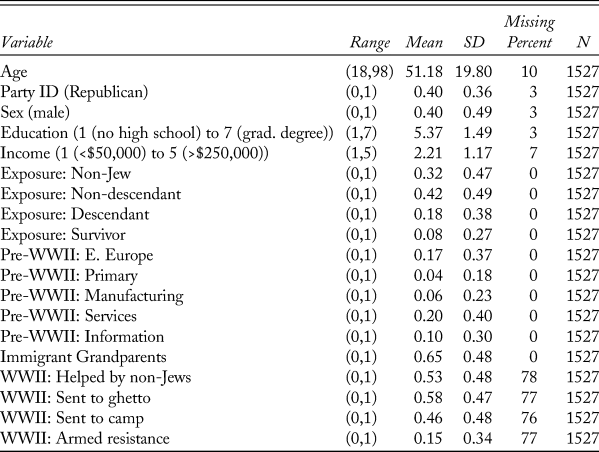
Table 1 reports summary statistics for all respondents who reached our dependent variables. Section A1.4 of the supplementary material reports disaggregated summary statistics across these four communities.
Summary Statistics: Respondent Demographics and Personal/Family Historiesa
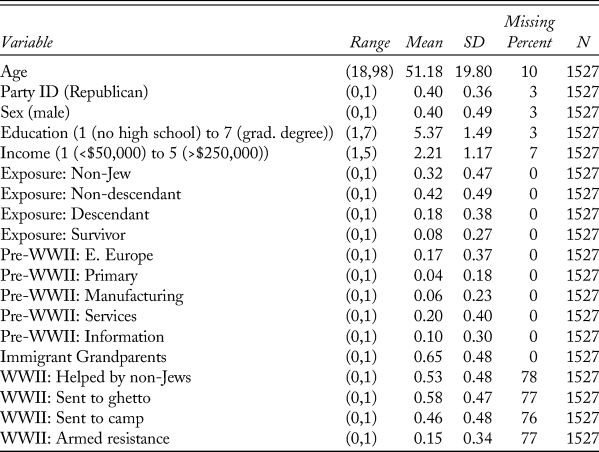
a Includes only respondents who reached our main dependent variable.
Analysis
Our analysis includes observational and experimental components. In the former, we test H1–H4 by exploring differences in attitudes across respondents with personal, family, group, or no exposure to genocide. In the latter, we test H5 by examining the impact of our randomized experimental treatments on out-group attitudes.
Differential Exposure to Genocide and Out-Group Attitudes
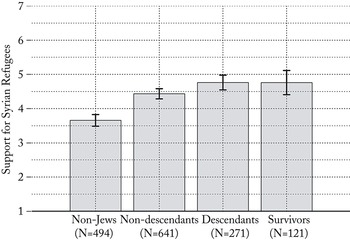
Descriptive statistics indicate a positive relationship between Holocaust exposure and support for out-groups. Figure 1 reports mean levels of support for Syrian refugees among respondents in the four groups.Footnote 78 Support is highest among those with personal and family exposure (that is, survivors or descendants), and lowest for those with no exposure (non-descendant Jews or non-Jews). The average non-Jewish respondent favored a slight decrease in refugees admitted to the United States, with a mean of 3.65. Non-descendant Jews, on average, favored keeping the number of refugees the same, with a mean of 4.43. Descendants and survivors, however, favored a slight increase, both with means of 4.76.Footnote 79 These differences are substantively important, representing a gradual shift from opposition to support as exposure to the Holocaust becomes more direct.
Support for Increasing Admission of Syrian Refugees into USa
a Scale: 1 = greatly decrease, 2 = moderately decrease, 3 = slightly decrease, 4 = keep same, 5 = slightly increase, 6 = moderately increase, 7 = greatly increase. Bar heights represent group-level means, lines are bootstrapped 95 percent confidence intervals.
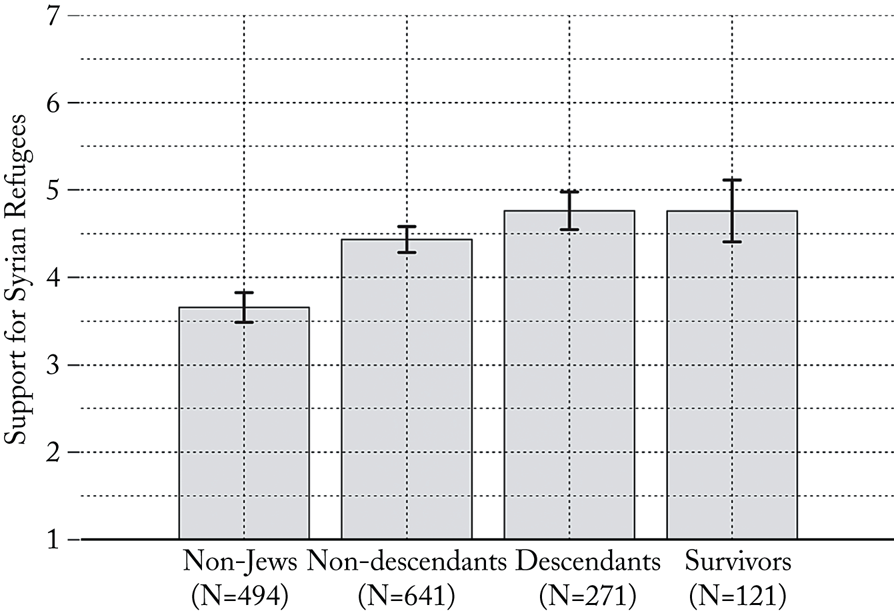
If we dichotomize this variable, with one representing support for at least a slight increase in refugees (score of five or higher), the difference becomes starker. Just 32 percent of non-Jews favor any increase in admitted refugees. The statistics for non-descendant Jews, descendants, and survivors are 49, 55, and 60 percent, respectively. Survivors show the highest mean support for refugees, in line with the out-group protection hypothesis. As one survivor noted in open-ended comments, “My family and I were lucky enough to escape France in June 1940 … Obviously the word ‘refugee’ has a great deal of meaning for me.”
Although these patterns broadly support the idea that exposure to violence increases support for out-groups (H4), caution is warranted. The subgroup means in Figure 1 are conditioned only on exposure level (for example, survivor, descendant, non-descendant Jew, or non-Jew), and do not account for potential confounding factors like partisanship, education, income, age, and family history. For this, we conduct a more rigorous series of tests.
To examine how exposure to genocide might affect out-group attitudes, we first consider a linear model that regresses support for Syrian refugees on respondents’ level of exposure, personal attributes, and family history. Our baseline specification is
 $$\openup-2pt\eqalignb{Attitudes_i &= \theta \cdot Exposure_i + \beta ^{\prime}_1x_i^{( pre) } + \beta ^{\prime}_2x_i^{( post) } + Region_i^{( pre) }\cr &\hskip3.9pc + Region_i^{( post) } + \varepsilon _i_, \;}$$
where the dependent variable is respondent i's out-group Attitudesi, the treatment is i's Exposurei to the Holocaust (survivor, descendant, non-descendant, non-Jew), xi (pre/post) are pre–World War II (age, gender, prewar profession) and post–World War II (education, income, party id, location) covariates, Regioni (pre/post) are fixed effects for pre– and post–World War II family residence locations (in Europe and US, respectively), and ɛi are independent and identically distributed errors.Footnote 80
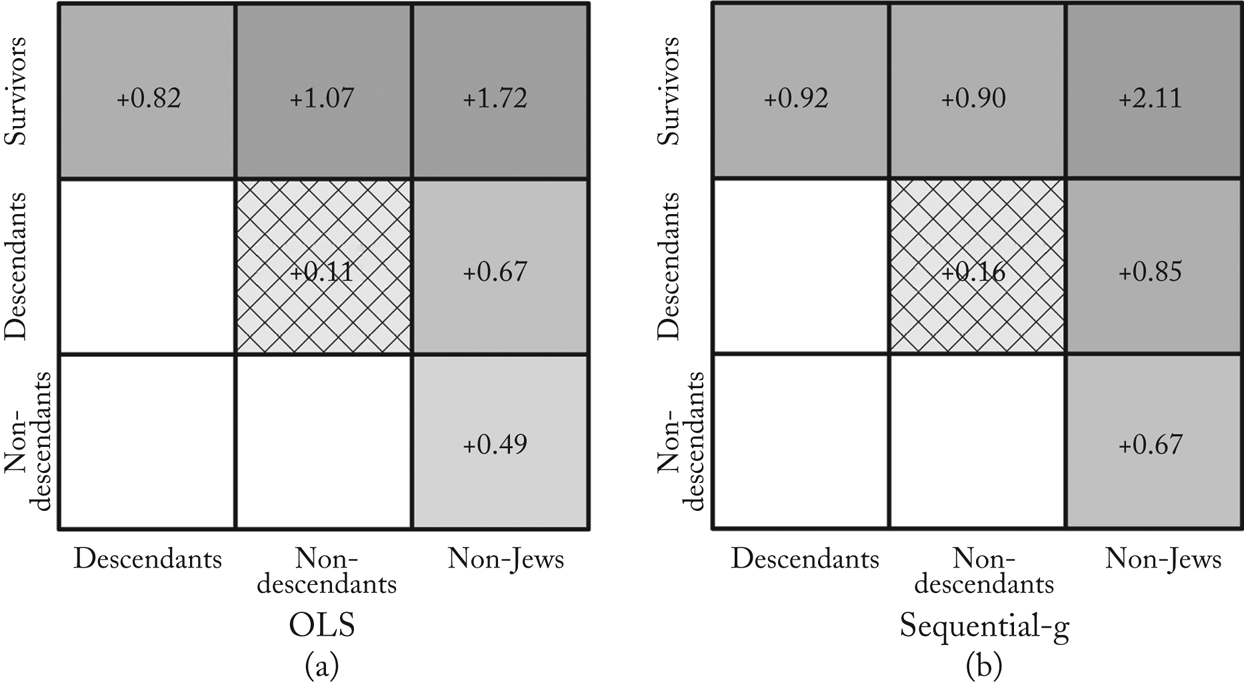
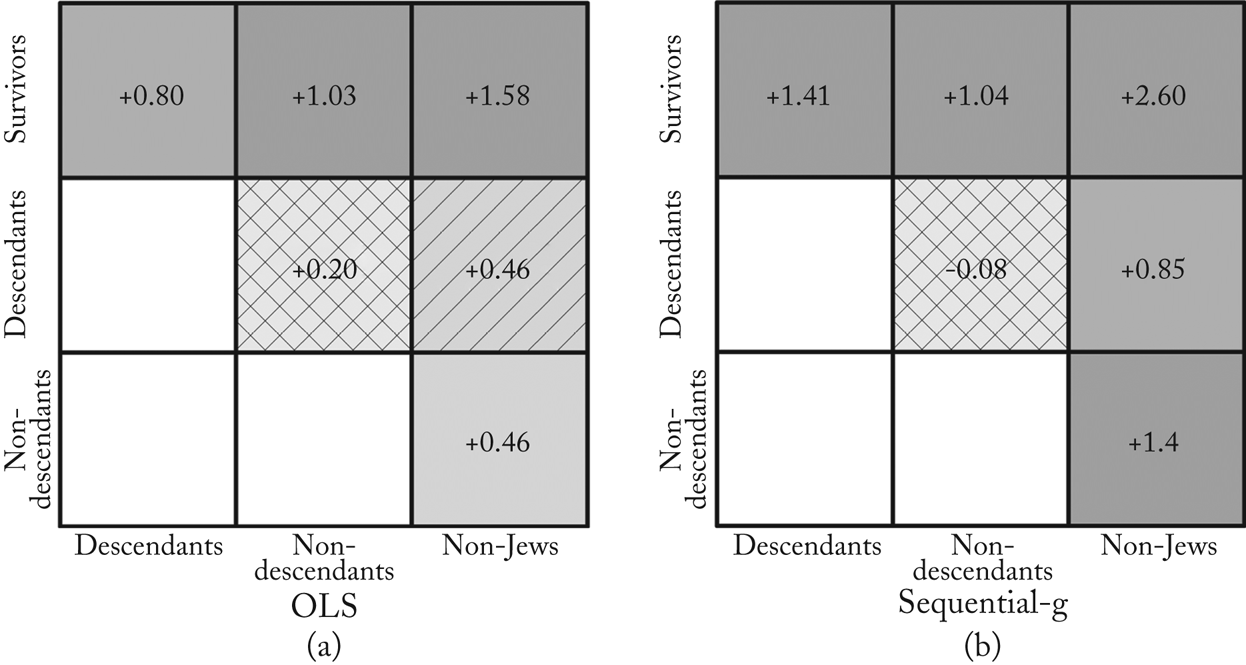
Figure 2 (a) reports average differences in support for refugees across exposure categories, holding other variables constant. For example, the upper-right quantity is
 $$\openup-3.4pt\eqalignb{&\hskip 26ptE[ {Attitudes_i\,\vert\, Exposure_i = survivor} ] \cr&\;\ndash E[ {Attitudes_i\,\vert\, Exposure_i = non\,\hbox{-}Jew} ] = 1.72, \;$$
with conditional expectations based on coefficient estimates from equation 1.
Exposure to Genocide and Out-Group Attitudesa
a Values are average differences in support for admitting more Syrian refugees to US between groups in the rows and columns: θ coefficients for OLS (equation 1) and ϕ (ACDE) coefficients for sequential-g (equation 3). Darker shades indicate larger differences. Diagonal lines indicate that differences are insignificant at the 95 percent (single) or 90 percent confidence level (double).
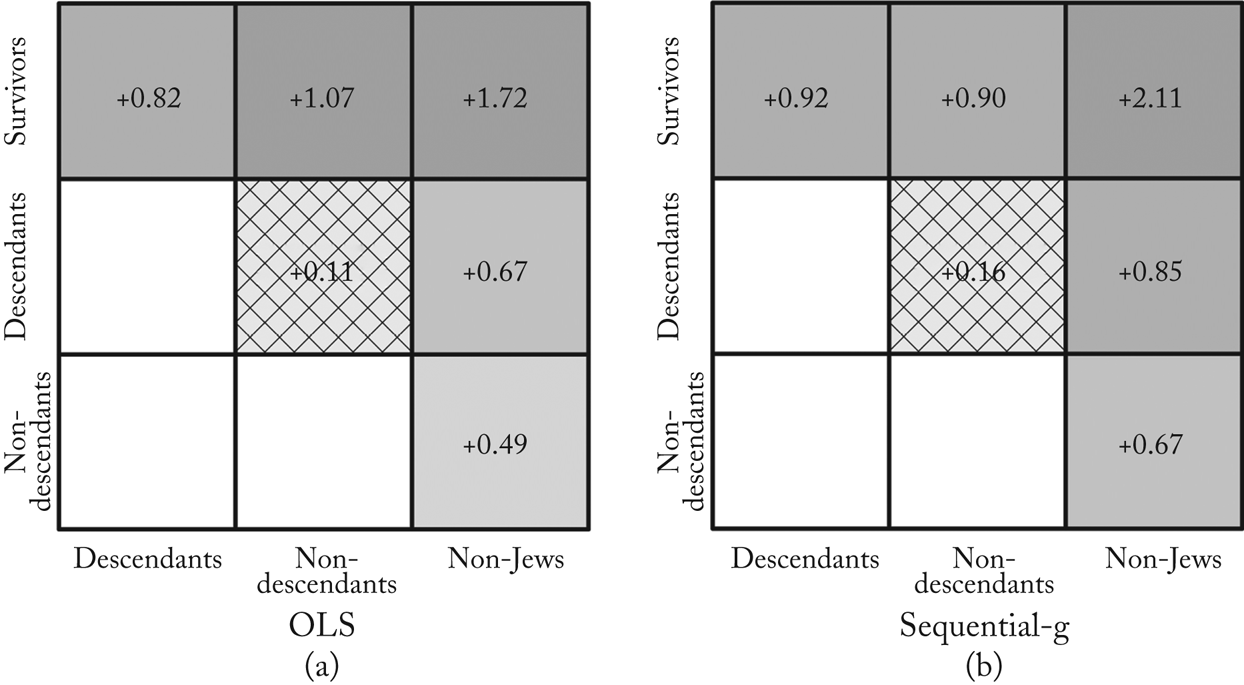
These results confirm that support for Syrian refugees is higher among respondents more directly exposed to the Holocaust, holding a variety of confounding factors constant. The average survivor's expressed support was 1.72 points higher than the average non-Jewish American's, 1.07 higher than for Jews with no survivor relatives, and 0.82 higher than for descendants. Descendant and non-descendant Jews were more supportive than non-Jews, with average differences of 0.67 and 0.49, respectively. Although support among descendants fell between that of survivors and non-descendant Jews, differences between descendants and non-descendants were insignificant at the 95 percent confidence level.
The observed impact of Holocaust exposure on out-group attitudes may depend, in part, on post–World War II developments. Survivors and descendants may have made different educational and professional choices after the war, or they may have become disproportionately more likely to support Democrats or Republicans. The results in Figure 2 (a) hold with and without postexposure variables in the model, but neither approach fully resolves the issue. Conditioning on postexposure covariates can induce posttreatment bias into estimates of direct effects, but excluding them can induce omitted variable bias.
To address this concern, we estimate average controlled direct effects (acde)—the effects of Holocaust exposure when mediating variables are held constant at a particular level. We use two estimation procedures, the results of which are substantively consistent: sequential-g (reported here) and telescopic matching (see section A4.4 of the supplementary material). To facilitate pairwise comparisons across exposure levels, we repeat both procedures for every combination of subsamples (for example, survivors versus descendants and survivors versus non-Jews).
Sequential-g estimation transforms the dependent variable by removing from it the effect of postexposure covariates, and estimates the effect of exposure on this demediated outcome.Footnote 81 In the first-stage model, we use our baseline specification (see equation 1) with the full set of covariates. We then partition the covariates into pre– (family background, age, gender) and post–World War II (everything else), and fit a second-stage model with a demediated outcome and only pre-exposure covariates:
 $$\widetilde{{Attitudes_i}} = \phi \cdot Exposure_i + {\alpha }^{\prime}x_i^{( {\,pre} ) } + Region_i^{( {\,pre} ) } + v_i, \;$$
where  $\widetilde{{Attitudes_i}} = Attitudes_i-\gamma ( Exposure_i, \;x_i^{( {post} ) } , \;Region_i^{( {post} ) } ) $ is the difference between the observed outcome and demediation function γ(⋅), which removes variation due to the mediator's causal effect.Footnote 82 We assess potential violations of this procedure's sequential unconfoundedness assumption through sensitivity analysis (see section A4.3 of the supplementary material). As we show, unmeasured confounding would have to be quite severe to overturn our results, with correlation between mediator and outcome errors nearing –1 or 1.
Figure 2 (b) reports acde estimates from our sequential-g analysis, and they are consistent with Figure 2 (a): the more direct one's exposure to the Holocaust, the greater one's expressed support for refugees. Here, survivors were significantly more supportive than descendants, non-descendant Jews, and non-Jews by 0.92, 0.9, and 2.11, respectively, on a seven-point scale. Descendant and non-descendant Jews were, in turn, significantly more supportive of refugees than non-Jews (0.85 and 0.67, respectively). Although descendants were slightly more supportive than other Jews, this difference was insignificant.
Taken together, our observational analyses indicate strong support for H4 (out-group protection), no support for H1 (in-group defense) or H2 (direct trauma), and mixed support for H3 (group exposure). Interestingly, our estimates suggest that direct trauma does matter (H2), but in the opposite direction than predicted, making survivors more supportive of victimized out-groups than their descendants. Descendants, meanwhile, express views that are more supportive than non-Jews, but not necessarily more supportive than Jews with no family connection. This suggests the Holocaust is, at least partially, a group-level trauma affecting descendants and non-descendants alike.
Mechanisms of Intergenerational Transmission
The results thus far indicate that genocide exposure has an enduring impact on out-group attitudes, affecting not only the views of survivors, but potentially those of their descendants and of non-descendant Jews as well. What explains this convergence of attitudes?
According to social learning theory,Footnote 83 children acquire political attitudes in part by emulating those around them, particularly parents and other relatives. Intergenerational transmission of attitudes becomes more likely when parents see an issue as highly salient and have opportunities to make their opinions known.Footnote 84 Individuals who have more extensively participated in these family conversations are more likely to develop enduring policy views.Footnote 85 If survivors’ attitudes diffuse in part through family socialization, then we should expect descendants whose family members more regularly engaged in discussions about the Holocaust to adopt attitudes more similar to their survivor relatives.Footnote 86
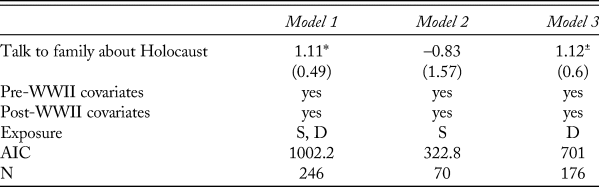
To test this possibility, we asked survivors and descendants how often they had discussed their Holocaust experiences with family, friends, and children after the war. Responses were on a five-point scale, from never to very often (at least once a week). We regressed support for Syrian refugees on responses to this question, using the same sequential-g specifications as before. We ran these models on a combined sample of survivors and descendants, as well as on each group separately.
Households that regularly discussed the Holocaust experiences of their survivor relatives tended to express more supportive out-group attitudes than those who did not (see Table 2). On average, changing the frequency of such conversations from never to very often increased support for refugees by over one point. This relationship was stronger among descendants than survivors, which is unsurprising: those with personal exposure are more likely to be senders than receivers of attitudes in the family.
Family Socialization and Support for Syrian Refugeesa
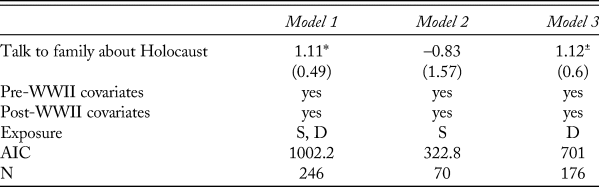
Significance (two-tailed): ±p < .1,*p < .05,**p < .01,***p < .001
a Sequential-g estimates, bootstrapped standard errors in parentheses. Coefficient estimates for control variables not shown. S: survivors, D: descendants.
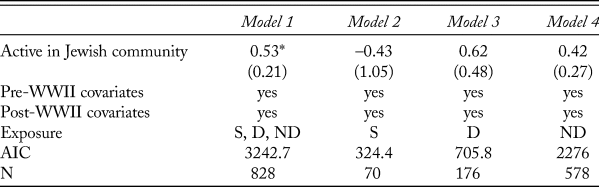
Awareness of family members’ historic experiences during the Holocaust may help to explain the convergence of attitudes between descendants and survivors, but not why Jewish respondents without family exposure were more supportive of refugees than non-Jewish Americans. This difference, as we have shown, is consistent across model specifications and is not attributable to postexposure factors like partisanship or education. As such, it is possible that broader community socialization, including opportunities for social learning in local Jewish education, religious services, and other community events, are responsible for the prevalence of these attitudes.Footnote 87 To explore this pathway, we asked respondents how active they were in their local Jewish community (from extremely active to not at all), and regressed support for refugees on this measure. This community pathway explains at least part of the group exposure effect (see Table 3). Respondents who reported being more active in their community were more likely—by half a point—to hold supportive out-group attitudes.Footnote 88
Community Activism and Support for Syrian Refugeesa
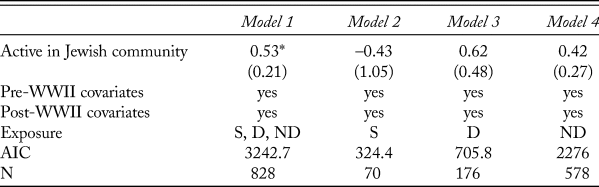
Significance (two-tailed): ±p < .1,*p < .05,**p < .01,***p < .001
a Sequential-g estimates, bootstrapped standard errors in parentheses. Coefficient estimates for control variables not shown. S: survivors, D: descendants, ND: nondescendants.
Open-ended survey responses provide anecdotal support for both family and broader community socialization; they also provide important context and nuance. Many survivors mentioned their own efforts to memorialize the Holocaust and communicate its lessons to future generations, including writing memoirs “dealing with my experiences during the Holocaust and how they shaped my life” and speaking “at many schools and organizations, so never to forget.” Comments from other Jewish respondents indicated that these signals found an attentive audience—both within the family and in the broader community. Descendants recalled how their interactions with survivor relatives “greatly influenced and shaped our family life.” Some descendants also suggested that conversations with parents were not the only conduit for such socialization to take place:
My father didn't discuss the war when I was a child, but after he retired he became very involved in documenting the fate of every Jew in his home town. He also wrote a detailed autobiography and is active in supporting efforts to record the history of the Holocaust in his country.
Open-ended comments from non-descendant Jews indicate that sharing and learning these personal histories were a key part of their education and upbringing as active members of the Jewish community. As one respondent recalled, “My Hebrew teacher was a Holocaust survivor, and has written two books on the Holocaust.” Another went further, linking community socialization to the perceived salience of refugee policy:
Even though I didn't descend from Holocaust survivors, I shared in the collective memory as a conservative Jew growing up … I liked how you connected the Holocaust to the current Syrian (and Iraqi) refugee crisis.
Socialization is not the only potential source of variation in out-group attitudes. Another possibility, also cited in open-ended comments, is that different wartime experiences inform survivors’ and descendants’ attitudes toward out-groups. For example, survivors who joined armed resistance groups may see refugees as more capable of helping themselves. As one survivor noted, “The Jewish Holocaust is not to be compared with Syrian refugees, Syrian militia has weapons to fight.” Similarly, those who received help from non-Jews may be more supportive of aiding out-groups, unlike those who felt personally neglected or abandoned. One such survivor remembered being “on the run from country to country … I was deprived of schooling for 6 years,” but when thinking about current refugees explained, “I came to the US during the Cold War and was thoroughly vetted, a process that took a full year. This after waiting for my quota for 6 years! Current immigrants should also be thoroughly vetted, especially with the threat of terrorism.” As far as we can tell, however, these personal anecdotes did not coalesce into a broader statistical pattern. We found no quantitative evidence that variation in Holocaust experiences affects out-group attitudes, although exploration of these heterogeneous effects is limited by sample power (see section A4.5 of the supplementary material).
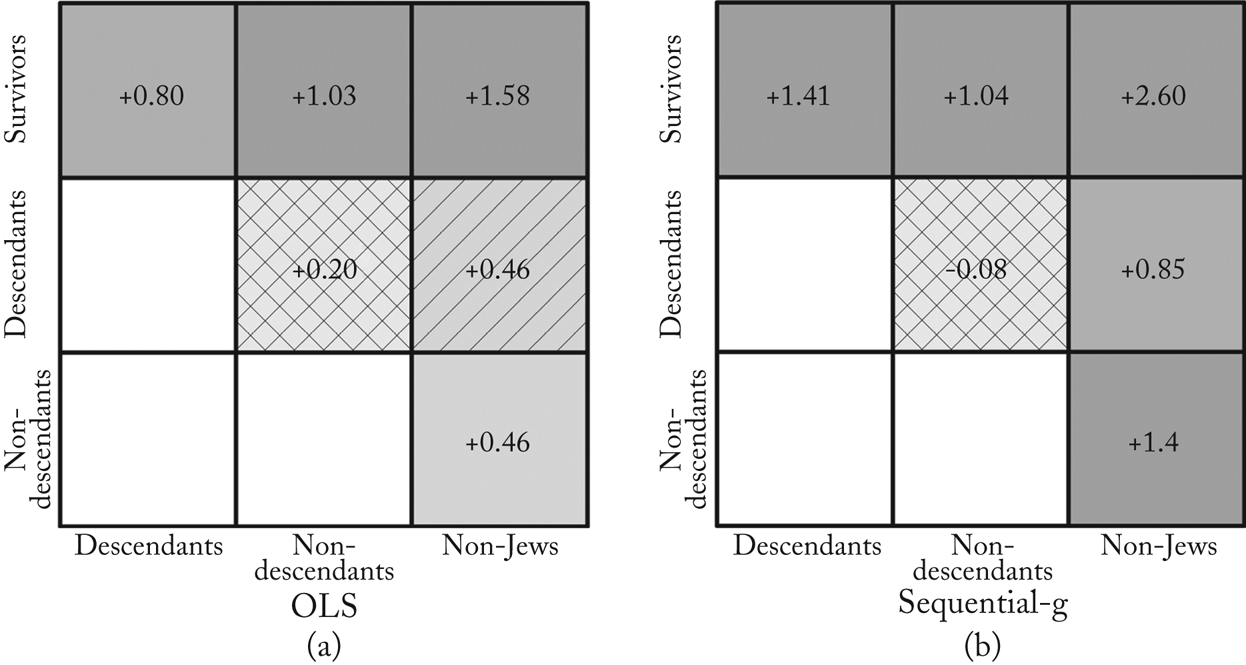
Additionally, as some of these qualitative comments indicate, Holocaust survivors likely hold multiple overlapping and cross-cutting identitiesFootnote 89—as Jews, minorities, refugees, and victims of violence—and these other identities may drive support for other groups seeking refuge in the US. Because we find large and significant differences across subgroups of Jewish respondents, being Jewish or a minority cannot by itself be what drives heterogeneity in this case. But it is possible that Holocaust survivors’ experiences as immigrants shape their attitudes toward Syrian refugees more than their status as survivors of political violence.Footnote 90 To examine this possibility, we augmented our ols and sequential-g specifications to include immigration history as a posttreatment covariate, coded 1 if at least one of the respondent's grandparents were born outside the US, and 0 otherwise. If immigration is what drives the observed patterns of support, then differences between Jewish subgroups (and between Jews and non-Jews) should dissipate after we make this adjustment. Yet these differences remain large and significant, even when accounting for immigrant backgrounds of non-survivor populations (see Figure 3).
Exposure to Genocide and Out-Group Attitudes, Controlling for Immigrationa
a Values are average differences in support for admitting more Syrian refugees to US between groups in the rows and columns: θ coefficients for OLS and ϕ (ACDE) coefficients for sequential-g. Models include family histories of immigration. Darker shades indicate larger differences. Diagonal lines indicate that differences are insignificant at the 95 percent (single) or 90 percent confidence level (double).
Exposure to Violence, Framing, and Attitude Malleability
Although respondents with more direct experiences of violence—and more opportunities to discuss them—tend to hold more supportive views toward out-groups, it is less clear how deeply held and stable these views are.Footnote 91 To examine the malleability of these attitudes, we turn to our experiment, which presented respondents with out-group and in-group oriented never-again frames before asking about support for refugees.
To assess the effect of these frames on out-group attitudes overall, we begin by regressing support for refugees on the experimental treatment each respondent received:
 $$Attitudes_i = {\theta }\cdot T_i + \varepsilon _i, \;$$
where Ti = t is i's treatment assignment, t ∈ {control, out-group, in-group}. Because assignment is random, we do not include covariates in this base specification, but results do not significantly change if we add covariates and regional fixed effects (see section A5 of the supplementary material).
To test potential heterogeneous treatment effects by exposure group, we also considered an expanded model that interacts treatment assignment with Holocaust exposure:
 $$Attitudes_i = \theta \cdot T_i + \phi \cdot Exposure_i + \gamma \cdot T_i \times Exposure_i + \varepsilon _i_, \;$$
where Exposurei = k is i's group. We considered two versions of this model: a 3 × 4 interaction, where k ∈ {survivor, descendant, non-descendant, non-Jew}, and a simplified, 3 × 2 interaction, where k ∈ {survivor or descendant, non-descendant or non-Jew}.Footnote 92
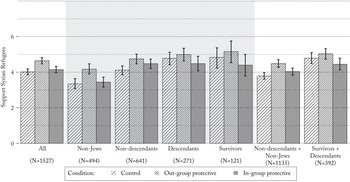
Figure 4 reports estimates from all three models, ordered left to right. The treatment-only model (left set of bars) reveals a significant, positive effect for the out-group protective frame, in line with H5. Overall, respondents who randomly received reminders of the inclusive imperative to “never again allow such slaughter” expressed more support for out-groups than respondents in either the control condition (average difference of 0.6, from 4.0 to 4.6) or the in-group protective condition (difference of 0.5, from 4.1 to 4.6). The in-group protective frame did not significantly shift attitudes relative to the control.
Effect of Out-Group and In-Group Protective Primea
a Bars represent average support for Syrian refugees on a scale from one to seven: 1 = greatly decrease, 2 = moderately decrease, 3 = slightly decrease, 4 = keep same, 5 = slightly increase, 6 = moderately increase, 7 = greatly increase. Lines represent 95 percent confidence intervals. Predicted values based on estimates from three models, from left to right: treatment only (equation 4), 3 × 4 treatment-exposure interaction (equation 5), 3 × 2 treatment-exposure interaction (equation 5).

Breaking down these effects by exposure category, the out-group protective frame appears to have had a particularly strong impact on respondents without personal or family connections to the Holocaust. The 3 × 4 interaction model (the four bar groupings in the shaded area in Figure 4) estimates an effect of 0.8 relative to the control for non-Jews (3.3 to 4.1) and 0.6 for Jews without survivor relatives (4.2 to 4.8). These changes are substantively meaningful, shifting views from opposition to neutrality among non-Jews or from neutrality to support among non-descendant Jews. The 3 × 2 model (last two bar groupings in Figure 4), which combines these two groups into one, estimates an increase of 0.7 relative to the control (3.8 to 4.5). Interestingly, the “lambs to the slaughter” in-group protective frame had little resonance for these two communities, neither of which subsequently become less supportive of Syrians. For these nonexposed communities, support for Syrians, if anything, slightly increased under this treatment, suggesting that less directly exposed communities might interpret this frame as another version of the out-group protective imperative, with Jews as the referenced out-group.
Survivors and descendants responded differently to the experimental treatments. Although the direction of the out-group–oriented frame's effect was the same for survivors and descendants as for less-exposed groups, its magnitude was smaller and more uncertain. The 3 × 4 model indicates (statistically insignificant) increases of 0.4 for survivors (4.8 to 5.2) and 0.2 for descendants (4.8 to 5.0), in contrast to the statistically significant increases of 0.8 and 0.6 for non-Jews and non-descendant Jews, respectively. Coefficient estimates on the multiplicative interaction term  $( {\hat{\gamma }} ) $ indicate that the treatment effect was numerically smaller for all Jewish groups relative to non-Jews and significantly smaller in the case of descendants: the out-group protective effect for descendants was 0.62 points smaller than it was for non-Jews. The 3 × 2 model, which offers greater statistical power by pooling survivors and descendants together, confirms that the out-group protective effect was significantly smaller (by 0.5) for these exposed populations.Footnote 93 The out-group protective effect was 0.7 for non-descendants and non-Jews (3.8 to 4.5), but only 0.2 for survivors and descendants (4.8 to 5.0). Importantly, this is not evidence of a ceiling effect. Survivors and descendants’ mean support for refugees was not at the top of the scale; they could have expressed more support in this treatment condition, but did not.
Notably, we also observe some heterogeneity in exposed versus nonexposed communities’ responses to the in-group protective frame. While non-Jews and non-descendant Jews exposed to this frame exhibited somewhat increased support for Syrian refugees, this frame appeared to slightly decrease descendants’ and survivors’ support relative to the control. In the 3 × 4 model, confidence intervals are too large to permit definitive conclusions, although the point estimates for the effect are negative for both survivors (–0.4, from 4.8 to 4.4) and descendants (–0.3, from 4.8 to 4.5). In the 3 × 2 model, due in part to larger per-condition sample sizes, there is a significant difference (of –0.6) between in-group protective effect estimates for non-descendants and non-Jews (0.2, from 3.8 to 4.0) compared to survivors and descendants (–0.4, from 4.8 to 4.4).
This reduction in support is theoretically interesting, and may indicate that the in-group protective frame has differential resonance for those with personal and family histories of victimization. This treatment sought to tap the Jewish community's concerns about continuing anti-Semitism and the risk it poses to them. Jewish respondents whose families were victimized in the past may therefore interpret this frame in a more threatening way than less-exposed respondents, who might view the text as a weaker version of the out-group protective frame. As one descendant in the in-group protective condition commented, “I want to help refugees but not at the expense of our security.”
By and large, our experimental evidence suggests that those more directly exposed to genocide hold more established views on vulnerable out-groups: they support protecting them. An out-group–oriented frame of never again significantly increased support for refugees, but only among respondents less directly exposed to the Holocaust. The in-group protective frame had more resonance for survivors and descendants, somewhat reducing their support for refugees. Yet even in this condition, survivors and descendants nonetheless remained more supportive of refugees than the less exposed groups. These are important findings, as past research has found that it is difficult to shift attitudes in favor of out-groups but relatively easy to shift attitudes against them.Footnote 94 Here, we find that invoking the Holocaust with an out-group protective interpretation of the never again imperative can shift attitudes in favor of refugees, particularly among those with no personal or family history of victimization. In contrast, evoking an in-group protective interpretation somewhat reduces support for refugees, but only among those who do have personal and family histories of victimization.
External Validity
Our study took place in a specific context: a developed, democratic country (post–World War II US), where Jews are a religious minority and where Holocaust survivors have lived in relative physical security. Each of these factors may affect how formerly victimized populations assess the threat posed by out-groups. As such, there are several dimensions of generalizability or, more accurately, transportability, that are important to consider. Although the nature of our data does not permit a direct statistical probe, past research allows us to posit informed hypotheses regarding the transportability of our findings.Footnote 95
First, we expect our findings to be highly transportable to other time periods. We fielded our study in 2017, when issues of immigration and refugees were politically salient due to the Trump administration's pursuit of a temporary “Muslim ban.” But the centrality of immigration and refugees as political issues is not a new phenomenon in the US,Footnote 96 and research conducted during other presidential administrations has found similar associations between empathy (threat) and support for (opposition to) migrants.Footnote 97 Moreover, recent replication studies examining the validity of surveys conducted during the covid-19 pandemic have found no major differences in effect size or direction of experimental findings compared to studies conducted prior to the pandemic.Footnote 98 This is encouraging for survey research in general and for the temporal robustness of our findings.
Second, we expect our findings to be broadly transportable to other out-groups, beyond Syrian refugees. Anecdotally, the Jewish community has invoked the Holocaust and its lessons when discussing genocide against the Rohingya in Myanmar, the ethnic cleansing of Uighurs in China, and the detention of Hispanic migrants on the US southern border.Footnote 99 This is a dimension of transportability that we can also indirectly examine using our data—we asked respondents about support for the so-called Muslim ban and for a border wall along the US-Mexican border. If the out-group protection hypothesis is broadly transportable across different out-groups, we would expect negative relationships between genocide exposure and support for the border wall and the travel ban. This is, indeed, what we find (see A4.2, Figure A4.6, of the supplementary material). Survivors are less supportive of the Muslim ban than non-descendants and non-Jewish Americans, and marginally less supportive of the border wall. Non-descendants, in turn, are less supportive of the wall and travel ban than non-Jewish Americans. The only deviant result is that descendants are somewhat more supportive of the border wall and travel ban than non-descendant Jews. All other results suggest that more direct exposure to the Holocaust is associated with more support for other vulnerable out-groups.
Third, because the Holocaust is one of the deadliest instances of orchestrated state violence in the modern era, it is useful to think about the transportability of our findings to victims of other genocides and campaigns of mass violence. Researchers studying other historically victimized groups have found congruent results to those presented here: previously victimized communities exhibit a high degree of support for other vulnerable communities. For example, Greeks who were forcibly relocated from Turkey are more likely to support donating to Syrian refugees,Footnote 100 Black and Hispanic Americans are more likely to support civil rights for immigrant detainees in the US,Footnote 101 and Liberians who experienced violence during the civil war exhibit less bias against Ivorian refugees.Footnote 102 These findings suggest that the phenomenon of historically victimized communities supporting other victims is not unique to the Holocaust or to communities living in wealthy, developed democracies like the United States.
One area where we expect our findings to be less transportable, however, is among Jewish communities living in other countries, most notably in Israel, which is home to 46 percent of the global Jewish population.Footnote 103 Our theory suggests that a key mechanism leading victimized groups to support other vulnerable out-groups is the empathy that a history of victimization engenders. But past experiences of bloodshed likely interact with the current threat environment to influence levels of out-group empathy. American Jews face a very different current threat environment than Jews in Israel, where they are the majority and engaged in an active conflict with Arab or Muslim adversaries.Footnote 104 In settings like Israel, “competitive victimhood”—in which belligerents view their own side's suffering as worse than the adversary's—can be a powerful factor shaping political attitudes, potentially limiting the role of empathy and shared victim identities in overcoming intergroup conflict.Footnote 105 In such societies, exclusive lessons of victimization, drawing on heightened perceptions of threat,Footnote 106 may exert greater political power.
Moreover, Holocaust education and remembrance plays a much more central role in Israeli society than they do in the United States. In Israel, high school students take annual trips to Poland, Holocaust Memorial Day is a national day of mourning, and Holocaust survivors receive monetary support from the government. In this setting, it is likely that the entire Israeli-Jewish population shares the trauma of the Holocaust and internalizes its lessons in similar ways.Footnote 107 As such, differences in attitudes between survivors, descendants, and non-descendant Jews are likely to be less profound.
An important future application of our work will be to explore the transportability of American Jewry's lessons from the Holocaust to Israel and other contexts where violent conflicts are still being fought, in an effort to understand whether past histories of victimization interact with present threats to differentially shape intergroup attitudes.
Future studies should also examine the emotional underpinnings of attitudinal shifts among nonexposed populations. Although our study highlights the potential importance of empathy in shaping the out-group attitudes of survivors and descendants, the specific emotional mechanisms underlying attitudinal changes among the nonexposed may be different. For example, an inclusive frame may help respondents imagine themselves in the same situation as refugees, a key component of empathy. But an inclusive frame may induce shame or guilt by reminding nonexposed populations that they escaped victimization while others suffered. Exploring these emotional mechanisms is important because they point to different potential interventions for changing attitudes.
Discussion
Our study demonstrates how experiences of violent victimization become embedded in the historical memory of oppressed peoples, profoundly affecting their future preferences. As we show, one of the long-term effects of exposure to mass violence may be increased support for other vulnerable groups.
This finding advances our understanding of political violence and its enduring effects in several ways. As the first large-scale, quantitative social science survey of Holocaust survivors’ political attitudes, our effort has important descriptive value, providing insight into the long-term political consequences of one of the largest genocides in modern history. Our findings also carry important implications for the long-term effects of violence more broadly. While past research has focused on long-term attitudes toward the historic perpetrators or victims of violence, our study demonstrates that violent victimization can shape attitudes toward groups unrelated to the original trauma.
Our results further show how these lessons may endure across generations. Research on the long-term effects of violence has documented the prevalence of intergenerational political attitudes, but the pathways behind their formation remain opaque. Exploratory analyses indicate support for two transmission mechanisms: family and community socialization. Our findings suggest that historical experiences of victimization shape future generations, in part, through the specific ways in which families and communities discuss and memorialize these experiences after the violence ends.
More generally, our study advances research on intergroup relations and how threat perceptions and empathy might deteriorate or ameliorate them. Past studies have emphasized these two impulses as key determinants of political attitudes,Footnote 108 but rarely examine how abstract lessons drawn from historical victimization shape these impulses.Footnote 109 Using a framing experiment, we show that support for victimized out-groups can indeed be mobilized by presenting the moral lessons of past violence in an inclusive way. Moreover, this shift in framing is most effective among those who have not directly experienced violence. Those who have experienced it or who are related to someone who has, need no additional convincing—their empathy for vulnerable peoples has deeper roots. While reminders of threats to the in-group may somewhat temper this support, they remain firmly more supportive than those without personal or family histories of victimization.
In addition, our findings shed light on public policy challenges surrounding immigrants and refugees around the world. In the past decade, concerns about refugee flows and open borders have sparked fervent debates over immigration in the European Union, the United States, and elsewhere. We find that efforts to reduce hostile out-group attitudes may be most effective among those who have not experienced similar victimization themselves. To this end, mobilizing the empathetic voices of survivors may be an effective tool in activating support for victims of political violence among the broader public.
Supplementary Material
Supplementary material for this article can be found at https://doi.org/10.1017/S0043887122000053.
Data
Replication files for this article can be found at https://doi.org/10.7910/DVN/ZAIGIN.
Acknowledgements
This research has benefitted from discussions with David Carter, Vicky Fouka, Joshua Kertzer, and Nicholas Valentino, among many others. We are grateful for constructive comments received at William & Mary, the University of Michigan, Washington University in St. Louis, and feedback from panelists and attendees at the APSA, Peace Science, Eurasian Peace Science, ISA and ISPP annual conferences.