- HCL
Hereford Cathedral Library
- LPL
Lambeth Palace Library
- WinRS
The register of John de Stratford, bishop of Winchester, 1323–1333, ed. R. M. Haines (Surrey Record Society xlii–xliii, 2010, 2011), cited with folio of the manuscript and edition number of the printed version.
Sexcentis annis confracta est tumba Johannis
Tandem Randallus sic reparavit opus,
Venta prius sedes, nunc Christi copulat aedes
In caelo praesul regnet uterque simul.Footnote 1
A bishopric was the goal of every ambitious career clerk: there can be no doubt that John Stratford is to be included in that category. One could reach such eminence by various means, as is revealed by an analysis of the episcopate of the earlier fourteenth century.Footnote 2 Initially one had to rely on election by a cathedral chapter, which had become comparatively rare. Seven bishops of Winchester were appointed during the fourteenth century, three of whom, Henry Woodlock osb (1304–16) – formerly the cathedral prior – John de Sandale (1316–19) and William de Wykeham (1366–1404) were elected by the chapter. In the last case the see had been reserved by the pope during the lifetime of the previous bishop (Edington), but Wykeham, the royal nominee, received papal assent after some months. The remaining four bishops were provided, initially or by translation from another see. Elections of the Benedictine monks Adam of Winchester (de Wynton) and John Devenish were set aside, in the first case because of Edington's prior provision, in the second due to royal opposition.Footnote 3 Rigaud d'Asserio (1319–23), John Stratford (1323–33), Adam Orleton (1333–45) and William de Edington (1345–66) were all papal provisors. Both Stratford and Orleton (translated from Worcester) notoriously received their promotion despite vehement royal objections.
Provision was dependent upon a variety of factors, one of the most frequent being royal support. Faithful government service regularly ensured a bishopric as its reward. Of the seven men who acted as chancellors in Edward ii's reign only one, Robert Baldock, failed to secure such advancement, and in Baldock's case it was not for lack of royal advocacy.Footnote 4 Finally William Ayrminne or Airmyn, formerly keeper of the privy seal, who was to act as temporary keeper of the great seal under the aegis of Queen Isabella, became bishop of Norwich in 1325. A similar progression is to be observed under Edward iii, although interrupted temporarily by the king's irritation with the Stratford brothers in 1340–1 which precipitated the appointment as chancellor of three knights in succession: Robert Bourchier, Robert Parving and Robert Sadington, chief baron of the Exchequer. Similar use was made of two chief justices towards the end of reign, which closed with the chancellorship of Adam Houghton, bishop of St David's.Footnote 5
Stratford's involvement with the government began with his attendance at royal councils from 1317 and his subsequent employment as a diplomatic envoy.Footnote 6 It was a mission to the papal Curia in 1323 that provided the opportunity for his promotion, and he seized it, although he must have been aware of the likely repercussions. The death of his fellow envoy, Rigaud d'Asserio, at Avignon on 12 April, enabled Pope John xxii to exercise the papal claim to make provision in such circumstances. Stratford had seemingly impressed both him and the college of cardinals. He was duly provided by bulls dated 20 June and consecrated at Avignon on the 26th, the feast of the martyr saints John and Paul.Footnote 7 Edward ii was outraged; he had been determined to advance his loyal but unpopular minister Robert Baldock, who was, however, persona non grata at the Curia, for reasons that were never explicit, and destined to remain so.Footnote 8 Despite previous loyal service Stratford was summoned before the royal justices and accused of having pursued his own interest rather than that of the king, but the pope continued to support his nominee and declined to reverse the process.Footnote 9 It was not until 25 November 1324, the feast of St Catherine, virgin and martyr, that the new bishop was enthroned in his cathedral by the archdeacon of Surrey, William Inge.Footnote 10
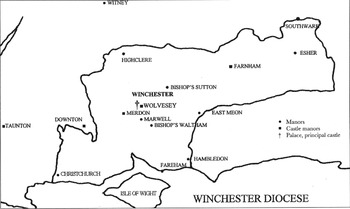
Winchester was one of the wealthiest bishoprics in the land,Footnote 11 but it was not one of the larger ones. It formed a compact area to the south of the River Thames and extended to the coast and beyond (see fig. 1). It was divided into two archdeaconries, Winchester and Surrey. The former, with ten rural deaneries, was more extensive, the latter having only three, excluding Croydon deanery, a peculiar of Canterbury diocese, which also lay partly in London diocese. Croydon was one of the peculiars subject to the archbishop's immediate jurisdiction.Footnote 12 The manor of Southwark provided ready access to London and the seat of government at Westminster, and was to prove especially convenient for one who continued to be occupied, even preocupied, with national affairs, despite the inauspicious nature of his elevation.
The diocese of Winchester, showing the main episcopal estates.

How well equipped was Stratford for the task of governing a diocese? He had studied at Oxford and by 1312 is mentioned as a doctor of civil law, a qualification held by about a fifth of those promoted to bishoprics at this time.Footnote 13 Diocesan administration required legal knowledge, although a bishop could and did delegate this responsibility to iuris periti who constituted his familia. In any case, Stratford had considerable practical experience, first as a legal advisor to the prior of Worcester, and then as Official of Lincoln during John Dalderby's episcopate. Perhaps too he learned something of the less legalistic aspect of diocesan affairs when he forwarded attempts for Dalderby's canonisation.Footnote 14 After Dalderby's death he moved to Canterbury and Archbishop Reynolds's service, becoming advocate and later dean of the Court of Arches.Footnote 15
A conspicuous initial advantage was the availability of an experienced familia, mainly recruited from his native diocese, Worcester, and including Mr Robert de Stratford, his younger brother who, like him, had studied at Oxford but at a slightly later period. Chief among the members of the familia were the magistri Richard de Chaddesley, Richard de Gloucester, Wybert de Littleton, William de Ledbury of Worcester and John de Lecch alias Loveryng of Northleach. Chaddesley and Littleton also acted as diocesan chancellors,Footnote 16 Gloucester and Lecch as diocesan Officials.Footnote 17 Another close associate was William de Mees alias Williams, a notary-public, termed the bishop's secretary, who occurs fairly frequently in the register. This was the man whom Bishop Orleton, in his own defence, was to claim had drawn up a public instrument incorporating articles allegedly devised by Stratford in justification of Edward ii's deposition.Footnote 18
These men formed a loyal group of well qualified clerks with considerable experience. In practical terms they enabled Stratford to leave his diocese many times and for considerable periods. On seven occasions he was in France: in 1326 he joined Queen Isabella at Bristol in pursuit of the Despensers and Edward ii; twice he attended a parliament in York; and in December 1331 he was with the royal chancery in Norfolk.Footnote 19 On each occasion he appointed one or more vicars-general, whose activities fill many folios of his episcopal register.Footnote 20
Owing to the survival at HerefordFootnote 21 of a substantial number of sermons attributed to Stratford, he has been viewed as a dedicated preacher.Footnote 22 Internal evidence suggests that he was indeed responsible for the delivery of some of them, but those that can be reliably ascribed to him appear to date from his tenure of the archbishopric. No ‘Stratford sermon’ from this collection can be ascribed with certainty to a prior date. Moreover, one of the sermons attributed to Stratford is duplicated in a Lambeth manuscript where it is said to have been delivered at Oxford University in 1313/1314 by the chancellor, Mr Henry Harclay.Footnote 23 By contrast there seem to be only some three references in the Winchester register to preaching by the diocesan: in February 1326 at his visitation of the cathedral priory he commenced proceedings with a sermon, a regular practice. He did the same when he visited nearby Hyde Abbey (’proposito per nos primitus verbum Dei’) during his enquiry into the shortcomings of that house, and in 1327[?] he informed the dean of Winchester of his intention to preach on Ash Wednesday.Footnote 24 Six of the Hereford sermons are said to have been preached at times of visitation, while four accompanied ordination ceremonies, on both of which occasions sermons were certainly to be expected. Whether the Winchester register reveals the true position with respect to Stratford's preaching can only be surmised, but so far as the record goes he was far from diligent in this respect.
The arrangement of Winchester episcopal registers in the fourteenth century is varied. Stratford's one-volume register, for instance, is unlike that of his successor Adam Orleton, which is in two volumes and differently arranged. Unusually the latter includes a substantial section devoted to papal bulls and incorporates a useful list of cardinals.Footnote 25 The Stratford register appears businesslike, although occasionally documents slip out of chronological order. There is a clear division into seven sections or quaternions, doubtless kept separate prior to binding: what might be called the main register, followed by sections devoted to institutions, ordinations, legal causes, visitation, temporalities and royal writs. What influence the bishop exercised in this matter cannot be known, but clearly his registrar, who in another manuscript is named as Nicholas de Churchill, called ‘Ystele’, was a methodical man.Footnote 26
The first of these sections – constituting the principal part of the register – is entitled ‘Execuciones diversorum mandatorum et licencie concesse per Johannem Wynton’ episcopum’.Footnote 27 This title is not all-inclusive. Among the documents are details of Stratford's own enthronement and the acts of his vicars-general, Robert de Stratford, Richard de Chaddesley, Wybert de Littleton (Lutulton) and the cathedral prior, Br Alexander Heriard. It concludes with a note of his translation to Canterbury, and that of Adam Orleton from Worcester to Winchester.Footnote 28
The second sectionFootnote 29 begins with a statement recording the date of Stratford's consecration on the feast of SS Peter and Paul at the Roman Curia (19 June 1323), and ends with another explicit recording his translation, and that of Bishop Orleton. Its contents are said to comprise institutions, collations and dispensations for study made by the bishop from the first year of his consecration.Footnote 30 Included also are commendations of benefices and exchanges. At fo. 93r, the bishop being absent in remotis, this business was undertaken by his brother Robert acting as vicar-general. Another commission at this time empowered Mr John (Loveryng) de Lecch (Northleach), one of Stratford's major clerks, to enquire into vacancies and to effect institutions.Footnote 31 This commission is dated 2 December 1324, but the bishop was acting again by 27 January 1325.Footnote 32 By 14 February Robert Stratford was once again deputising for his brother during his absence in France on royal affairs.Footnote 33 The bishop was back at Southwark on 13 April.Footnote 34 A particularly interesting appointment is that of Mr Philip Sapiti as archdeacon of Winchester. He was the son of Mr Andreas Sapiti, who acted as Stratford's proctor at the Curia.Footnote 35
The bishop was again in France from the beginning of July until 17 October 1325. This time Masters Richard de Gloucester and Richard de Chaddesley carried out the institutions as joint vicars-general.Footnote 36 The bishop remained but a few days in his diocese before re-crossing to France, presumably after discussion about the conduct of negotiations. On this occasion he was away for about a month, returning on 22 November. This meant that he missed the parliament summoned to Westminster for the eighteenth of that month. Commissions as vicars-general were reissued to Gloucester and Chaddesley, now designated respectively diocesan Official and chancellor.Footnote 37 The next diplomatic journey came in 1327 when on 9 March he left for Paris. No memorandum among the institutions records his return but we know from an earlier part of the register that he was back in England on 30 May, when he crossed from Wissant to Dover having, so it was claimed, successfully concluded Gascon affairs.Footnote 38
Stratford set out on 19 January to attend the February 1328 parliament at York for important discussion of the relationship with Scotland. Once again his trusted clerks Gloucester and Littleton were deputed as vicars-general. He had returned to his castle-manor of Wolvesey by 9 March.Footnote 39 On 24 April parliament reassembled at Northampton, where the unpopular treaty with the Scots was concluded. This meant that episcopal institutions were again interrupted, Stratford being at East Haddon in Northamptonshire on the 30th. After the parliament closed the bishop returned to Wargrave where on 1 June he was said to be detained by business and gravely ill (‘gravi infirmitate corporis prepediti’).Footnote 40 Recovery ensued quickly; by 11 September he was at Higham Ferrers, the seat of the earl of Lancaster, where one can assume that he was engaged in political discussions prior to the Salisbury parliament where he acted as the earl's mouthpiece, Lancaster having excused his absence, alleging the hostility of Roger Mortimer. Stratford was himself soon obliged to flee for safety and to take refuge in the countryside ‘in nemore de Hordereswode’.Footnote 41 Naturally enough, no inkling of these traumatic events finds its way into the register.
In April 1331 France was once again the bishop's destination, but he was back before the end of the month and although his brother Robert, the cathedral prior, and Littleton were appointed joint vicars-general, a marginal note records that nothing was done during the vicariate.Footnote 42 Shortly thereafter, on 24 May 1331, the court journeyed to Norfolk whither the bishop, royal chancellor since 28 November 1330, next made his way. Yet again brother Robert and Littleton stepped into the breach as vicars-general.Footnote 43 His national duties temporarily concluded, the bishop returned to his Hampshire manor of Highclere on 2 August.Footnote 44
Despite such absences, usually on royal business, and meticulously noted in his register, only four out of some thirty ordinations, some of them very small, were carried out by suffragan bishops Peter of Bologna, bishop of Corbarvia, and Benedict, bishop of Sardica. In 1325 Bishop Peter celebrated two important ordinations: on 2 March (Saturday in Embertide the first week of Lent), and 23 March Sitientes (the eve of Passion Sunday). The bishop was able to hold the third celebration that year on 21 December (Saturday in Embertide). In 1327 Bishop Peter held the Embertide ordinations on 6 June (eve of Trinity). In the final year of the episcopate (1333) Benedict of Sardica held the first of two ordination ceremonies on 29 May (Saturday in Embertide, eve of Trinity). The second, on 18 December, was celebrated by the diocesan in Farnham parish church.Footnote 45
The bishop was available to give substantial attention to the visitation of monasteries including that of his cathedral priory. The registrar devoted some ten folios (170r–180r) to the details.Footnote 46 His visitation of St Thomas's hospital at Southwark on 26 February 1324, many months before his enthronement, is prefaced by an examination and confirmation of its muniments, a customary procedure often detrimental to fragile manuscripts. Visitation in this case seems to have been provoked by common report that all was not well with the house. The subsequent itemised ‘decree of visitation’ is very thorough. In this quaternion are details of the visitation of the Augustinian priories of Breamore and Christchurch Twynham, of the Benedictine nuns of St Mary's Abbey, Winchester, and of New Minster Hyde and the cathedral priory of St Swithun itself. In general it is difficult to assess the spiritual state of religious houses from the numerous practical suggestions made by visitors. In the case of St Mary's, however, there was no question that under the rule of Abbess Matilda (Maud) Pecham, discipline was much relaxed.Footnote 47
The correction of faults at the cathedral priory following Stratford's visitation in 1326 presented an initially intractable problem. The monks, as was the case with other monastic chapters in cathedrals, were resentful of too much interference by the bishop, despite the fact that he was nominally their abbot. His injunctions were thorough, wide-ranging and upheld by specific censures and penalties. The chapter considered that some of them infringed the monks' rights to regulate themselves or were in other ways prejudicial. In response to its representations the bishop agreed to postpone their implementation. Long before, in 1276, Bishop Nicholas of Ely had met with similar resistance and been forced to accept the ruling of papal delegates.Footnote 48 Stratford was more cautious; he had no wish to commence an expensive long-drawn-out lawsuit. For its part the cathedral chapter was anxious to retain the diocesan's goodwill. Br Alexander de Heriard was delegated to come to an amicable settlement and immediately renounced any appeal against the visitation. That, as Stratford suggested, Prior Richard de Eneford had been remiss in disciplining his charge, may account for the fact that some two years later, on 25 June 1328, he voluntarily resigned, and was succeeded by Heriard. Honour was thus upheld on both sides.Footnote 49
The small quaternion devoted to judicial proceedings is unusual, in fact it appears to be unique among the Winchester medieval registers. The cases pertain to the audience court, where they were sometimes heard by the bishop himself, at other times by his special commissaries including Lecch, Chaddesley and Littleton.Footnote 50 Only eight individual cases are recorded though some of them take up considerable space. They concern a dispute over a duplication of wills, the appointment of a prior of Andover – a dependency of the abbey of Saumur – visitation proceedings at Hyde Abbey, an instance of alleged perjury by a rector, a disputed right of presentation to the church of Leckford (Hants) – prebendal to St Mary's Abbey, Winchester (a Benedictine nunnery) – the soi-disant rector of Crondall, and the augmentation of the vicarage of Kingston in Surrey.Footnote 51
The temporalities file begins methodically with various commissions: to receive the homage of the bishop's tenants, secure the episcopal property, and to act as bailiffs.Footnote 52 Here again Stratford relied on his brother Robert whom he appointed as superintendent of the episcopal manors. An important office, the treasurership of Wolvesey, the episcopal castle-manor by Winchester, the site of the episcopal prison, was filled by Thomas de Fulquardeby. He was additionally deputed to receive the stock on the episcopal manors which sede vacante had been under the guardianship of the royal custodians, Richard Ayrminne and William de Pillaunde.Footnote 53 Subsequently, in a petition addressed to the king and council, the bishop complained that – as had been the case in the past – he had found the bishopric in a ruined condition, in houses, woods, ponds, parks, when in the hands of the royal custodians, and asked that the chapter should have the bishopric during vacancies. The endorsement ordered that in future a reasonable fine should be levied.Footnote 54 It was only in 1331 that Edward iii, for the weal of his father's soul and his own, promised to restore £537 13s. 2d., the estimated value of missing stock; the sum was to be advanced by the Bardi of Florence.Footnote 55
Towards the end of the temporalities section are recensions of two important foundations, the Marwell chantry and St Cross hospital, situated a short distance from Winchester, together with Edward ii's confirmation of 4 July 1317 to Bishop John Sandale, his chancellor, of the liberties of the church of Winchester from the time of Edward the Confessor.Footnote 56 Quite why the registrar copied these documents, particularly the last, which is very long, into Stratford's episcopal register is not clear.
Henry de Blois, half-brother of King Stephen, when bishop of Winchester (1129–71) had built Marwell church in honour of the blessed martyrs Stephen, Lawrence, Vincent and Quintinus, and endowed a chantry of four priests to pray for the kings of England, the bishops of Winchester, other benefactors and for the faithful of Christ, both alive and dead. Peter des Roches, bishop between 1205 and 1238, amplified the original foundation in 1227, laying down a detailed set of ordinances.Footnote 57
St Cross hospital, originally a dependency of the Knights Hospitaller, also owed its foundation to Henry de Blois. It provided for thirteen poor impotent men, while an additional hundred were to be provided with dinner daily. In 1185 the latter number was increased to two hundred, but the increment is not recorded in this recension. A possible reason for this entry is that by the mid-fourteenth century the hospital had fallen into decay and its charitable intentions were not being properly observed.Footnote 58
The substantial quaternion of royal writs illustrates the manner in which diocesan bishops were under obligation to assist the crown in the collection of debts and other judicial matters at times when the sheriff was unable to act because the subject had no lay fee by which he could be distrained.Footnote 59 One particularly significant element here was the collection of taxes, which must have proved burdensome for benefice holders. The pope imposed a tenth on the clergy for two years in 1322. This was to be raised to defray the cost of the defence of the realm, but with reservation to John xxii of a quarter of the proceeds. It was to be raised in four instalments, the last of them on 24 May 1324, but Edward iii's officers were still chasing arrears in the diocese in 1329.Footnote 60
When the clergy met at Leicester Abbey on 4 November 1327 they agreed to grant a tenth of ecclesiastical goods and benefices as a subsidy for arduous business concerning the defence of the realm; half to be paid at the Ascension (12 May), the other half at All Saints (1 November). This subsidy was also being claimed from Godalming as late as 1329.Footnote 61 By the time of Edward iii the census of 1,000 marks a year promised by King John for himself and his heirs had fallen into considerable arrears. An embassy led by William Montacute and Bartholomew Burghersh in September 1329, during the regime of Isabella and Mortimer, reached an accommodation. A quadrennial tenth was to be raised from the clergy to defray the financial difficulties of the English government and those of the pope himself and its proceeds halved between pope and king.Footnote 62
Taxation was becoming increasingly onerous. In a bull of 31 August 1329 – prior to the levying of the quadrennial tenth – the pope, on account of the disturbances and threats to the Church in Italy, had reserved for three years the fruits, rents and profits of the first year from all ecclesiastical benefices, with or without cure, as well as dignities, lesser dignities and offices of all churches, monasteries, priories and other places, both secular and regular, exempt or non-exempt, that should fall vacant in the city, diocese and province of Canterbury.Footnote 63
Another matter which generated numerous writs was the money due from John de Heyden and John de Cockermouth, the executors of John de Sandale, bishop of Winchester 1316–19, who had been Edward ii's chancellor between 1314 and 1318.Footnote 64 Pope John xxii in 1317 had granted an annual tenth to Edward ii for ‘the cause of the Holy Land’, for which Sandale became the sole collector. Two instalments were scheduled for 1318, but some payments were deferred to 1319, the year of the bishop's death. In 1324 a writ of venire faciatis concerned the plea of the prior of St Swithun's, Winchester, that the executors owed a thousand marks.Footnote 65
Two developments affecting benefices are regularly to be found in registers of this date: their exchange, and licences for the absence of their rectors, very occasionally of their vicars who by canon law were bound on oath to perpetual residence. Exchanges could take place within or outside the diocese and there were a great many of them in Stratford's register. What is remarkable is that while some sixteen involved only benefices within the diocese, over fifty concerned a benefice in another diocese. These dioceses ranged from York to neighbouring Salisbury, which claimed the greatest number. Exchanges seem to have been arrangements between individual incumbents, in which the bishop played little part, save only routinely to examine the reasons and to approve their legality. Patrons regularly gave their assent and it would be hard to find a case of a bishop refusing to accept an exchange or to query the reasons for it. Clearly, however, the practice diminished the capacity of patrons to promote persons of their choice. One episcopal party conceded his authority to the other, but usually reserved the right of induction to the benefice in his own diocese. Considerable mobility of clergy was a consequence of exchanges, but the motives of those undertaking them are seldom revealed. Possibly there was some financial adjustment when the value of benefices was substantially at variance.
Licences for absence do sometimes mention purely personal reasons: to enable the incumbent to return to the area of his birth, or to take advantage of a more favourable climate. In this register, for instance, the vicar of Portsmouth, Walter de Corf’, was permitted out of compassion to retire temporarily to his birthplace because of the inclemency of the sea air (‘propter aeris intemperiem iuxta mare’), while that of Godalming was allowed three months to travel abroad in pursuance of a vow, one presumes to a place of pilgrimage.Footnote 66
Most licences of absence were, as one would expect, from rectories, but there is one from an archdeaconry in favour of Mr William Inge, the archdeacon of Surrey (1320–47). Inge, who had been at Merton College, Oxford, to which he left a number of books, was already an MA, but in December 1324, somewhat exceptionally, he was licensed to study at a studium generale in England for two years provided that he appointed suitable persons to perform his duties in the archdeaconry.Footnote 67
There were in all five licences in Stratford's register permitting absence from vicarages. These were clearly regarded as exceptional, even legally questionable, in view of the vicars’ oath of perpetual residence. The vicar of Horley ‘for certain reasons’, presumably ill–health, was allowed absence and given a coadjutor. The Portsmouth vicar received a second licence permitting him to be away for fifteen days each quarter for two years. The same concession was made to the vicar of Wymering, doubtless for similar health reasons.Footnote 68
There is considerable information in the register about irregularities, crimes and misdemeanours of various kinds: thefts from churches –candles, ecclesiastical ornaments and offerings – violent assaults on clerics, in one instance by a canon of Christchurch, clandestine matrimony and other breaches of matrimonial law. Some of these involved both clergy and laity and are brought to light more particularly by details of excommunication and subsequent absolution.Footnote 69
Strikingly unusual is the behaviour of the parishioners of Alton. For some unknown reason they objected to the placing of the statue of the church's patron, St Laurence, close to the altar, where it had long been accustomed to stand, refusing to allow it to remain there. Disturbances and irreverence towards the statue became rife. On the vigil of the feast of St Laurence (9 August)Footnote 70 armed miscreants barricaded the church thus preventing the parishioners from bringing their accustomed gifts in honour of the saint. Additionally, someone who had sought sanctuary was deliberately prevented from receiving any sustenance. The bishop reacted strongly against these ‘sons of Belial’ and summoned the prior of Winchester, the abbot of Hyde, and the prior of Selborne, to appear with him and the clergy of the deaneries of Alton and Basing for the solemn publication of sentences of excommunication in Alton church on the Sunday after the Assumption of the Blessed Virgin Mary (19 August 1330). Subsequently, on 6 September, by which time some of the malefactors could be named, though others still remained unknown, the Official of the archdeacon of Winchester was ordered to cite them to appear before the bishop. An undated entry in the register records their submission in person before Stratford.Footnote 71 The items that are condemned at this point as incurring excommunication are nine in number and some of them reflect the constitutions published by Archbishop Mepham in the previous year.Footnote 72
Another unusual entry concerns the popular observance at Easter of receiving unconsecrated bread after mass. According to an episcopal mandate to the Official of the archdeacon of Surrey it had become the practice, after receiving the sacrament, for parishioners to eat unconsecrated bread distributed on behalf of those with cure, sometimes with wine and cider, at other times with ale. This practice, or abuse as it had become, allegedly took place in churches and burial grounds as though in taverns, frequently accompanied by gluttony and with noisesome clamour and congestion. Similarity to the consecrated elements meant that in the minds of simple folk no difference would be discernible. Furthermore such behaviour could well lead to the undermining of praiseworthy customs and infringe the ecclesiastical rights of the clergy.Footnote 73
There are a number of entries in the register, three in particular, which might suggest the personal devotion of the bishop to the Virgin Mary. On 23 May 1324 at Southwark after a lengthy prologue in which Stratford emphasised the deep concern that he felt by reason of his office to provide a remedy against the onslaughts of the evil ones and extolled the virtues of the Mother of God, he issued an indulgence of forty days. This was to be gained by all those who at the time of curfew, if possible, otherwise at the hour of Vespers or about dusk, on bended knee during a three-fold peel of bells, recited the salutation of the Blessed Mary, three times at each pulsation, nine times in all. The archdeacon of Surrey or his Official was instructed to publish the letters of indulgence annually in all churches of the archdeaconry and in convocations so as to be clearly understood by the laity. It was also to be recited in the mother tongue by parochial clergy at all feasts of the Virgin.Footnote 74 Three years later, when Archbishop Reynolds issued a mandate requiring intercession for peace and the suppression of rumours about Isabella's marital relationship, the Angelic Salutation was joined with the Lord's Prayer for the earning of an indulgence of forty days and the bishop was invited to add his own.Footnote 75 Yet as soon thereafter as 1328 a mandate, this time addressed to the archdeacon of Winchester or his Official, lamented the fact that the practice of saying the Angelic Salutation was being increasingly neglected and reiterated the terms of the former indulgence. Two years later yet another indulgence, again of forty days, was offered for those who recited the Lord's Prayer and the Angelic Salutation for favourable weather following some bad harvests.Footnote 76 It may reasonably be claimed that this repeated emphasis on a particular devotion was somewhat special.
The register of the contemporary archbishop of Canterbury, Simon Mepham, has been lost, possibly stolen in the later medieval period,Footnote 77 but Stratford's Winchester one contains a number of his mandates. The difficulties of enforcing moral discipline on the gentry and nobility is emphasised by the unusual and surprisingly detailed case of Ela Payne. In his recent metropolitan visitation Mepham had found that Ela la Payne, wife of the nobleman Robert, son of Pagan [FitzPayne], knight, according to popular report had committed adultery with knights and others, both single and married, and even with clerics in holy orders. For these and other immodest acts clamour had allegedly arisen against her and was growing in volume. This, the archbishop declared, he was unable to overlook without scandal. After her own confession before him and her failure to proceed to purgation on other counts he had pronounced her guilty, whereupon he imposed a many-sided penalty. She was to abstain from eating meat on certain days for the next seven years, unless medical advice intervened, in which case she might receive indulgence. During the seven years she was to travel annually to Salisbury Cathedral around Michaelmas and walk barefoot and alone from the west end carrying a lighted wax candle, four pounds in weight, which she was to offer at the high altar. Other stipulations included payments to the Friars Minor and Preacher (Franciscans and Dominicans), and the distribution of alms to the poor, under supervision of three Salisbury canons.
Mepham insisted further that the penitent should act appropriately and cast aside all vanity. She was therefore prohibited from using precious stones on her head or ornamenting her saddle with them. She was also forbidden to indulge in such deceits as painting her face or colouring her eyebrows as she had been accustomed to do.Footnote 78 She was to cohabit with her husband and to stay by him unless given special licence or by reason of her visit to Salisbury Cathedral. In her chamber she was to have a company of good upright women and was forbidden to admit John de Forde, rector of Okeford Fitzpayne, to her familiar circle because of the scandal arising from too great familiarity.
The penance imposed, the archbishop declared, was by no means sufficient for so many and such great crimes, but he had consideration for her condition and the weakness of her sex. None the less Ela had not complied and the archbishop suspected that she might seek to avoid supervision by passing into the jurisdiction of the bishop of Winchester. If so, by a mandate of 29 January 1332, issued from Wiveliscombe, Bath and Wells diocese, Stratford was requested to pronounce warning of excommunication were she to fail to perform her penance at Salisbury.
Mepham, finding that Ela la Payne had cunningly flouted his attempts to undertake the prescribed penitential regime, proceeded by a further mandate of 14 April 1332, issued from Hinton in Dorset, Salisbury diocese, to warn Stratford that she had been excommunicated but was believed to be gravitating towards his diocese, particularly in the areas of Southwark and Rotherhithe on its northern border. By virtue of his obedience to the archbishop and Church of Canterbury, Stratford was to see that the sentence was promulgated throughout his diocese but especially in those places. What happened next is not revealed by the register.Footnote 79
Less exceptional are the mandates issued by the Canterbury metropolitan against the archbishop of York's raising of his primatial cross in the southern province. This was a long-standing dispute for which a compromise was not reached until the mid-fourteenth century.Footnote 80 It gave rise to political problems when one archbishop was summoned to attend a parliament within the province of the other. Two mandates were addressed to Stratford in 1330 warning him of Archbishop Melton's anticipated passage through the diocese with his metropolitan cross raised. The bishop was warned to resist such intrusion and all subjects were to be prohibited from showing any reverence. In individual cases sentence of suspension from entering a church was to be imposed on the archbishop.Footnote 81 A further mandate of 17 August 1331 reiterated his previous instructions to proceed against Melton were he to stay within or proceed through the diocese by imposing sentences of suspension, excommunication and interdict. Mepham suggested that the bishop had been lukewarm in his actions, a charge that Stratford rebutted by declaring that Melton had neither stayed nor passed through his diocese with cross aloft.Footnote 82 Perhaps a certain irritation is discernible in this response.
Ostensibly the manner in which diocesan bishops were appointed was unlikely to ensure their suitability for ecclesiastical purposes. Stratford, like his successor Orleton, was heavily involved in political and diplomatic life. It would be wrong, perhaps, to suggest that care of his diocese was merely incidental, but one has to admit that his own hand was irregularly in evidence. By the fourteenth century the complex administrative and judicial system of the Church in England was firmly in place. It was possible for a bishop, such as Stratford, to be frequently ‘prevented by various arduous business’ from initiating, continuing or concluding a variety of important matters, pastoral, administrative or judicial, and yet for every facet of diocesan business, including that more directly concerning the cure of souls, a substitute could be employed. ‘Qui facit per alium facit per se’ was a time-honoured saw, but how relevant was it to spiritual as opposed to administrative matters?
Much is known about the university qualifications of such substitutes but little about their personalities or suitability for pastoral rule. Perhaps the same may be said of most bishops; even the preambles to correctional business, such as visitation injunctions, though high-sounding, may be largely conventional. It has to be admitted that it would be difficult to compare the spiritual impact of a bishop who seldom left his diocese, such as Wolstan de Bransford of Worcester, and an absentee bishop like Stratford: their registers provide inadequate assistance for that purpose.Footnote 83 Frequently, however, it is possible to judge whether a diocese was being adequately administered or not. Stratford passes that test triumphantly. He was himself only too well aware, as he came tearfully to acknowledge in a sermon preached in Canterbury Cathedral on Friday 29 December 1340, significantly the feast of St Thomas the Martyr, that he had allowed temporal affairs to absorb the greater portion of his time. On another occasion he declared that he had followed the hard life of a royal servant, both at home and abroad and hoped that this had not imperilled his soul (‘utinam non in periculum animae nostrae’).Footnote 84