



Introduction
The transmission and exchange of innovations such as domesticated species, metallurgical technologies and prestige goods have played a significant role in human history, contributing to diverse local trajectories of social evolution (Bentley Reference Bentley1993; Sherratt Reference Sherratt and Mair2006; Earle Reference Earle2017). The historical ‘Silk Road’, linking the Roman, Parthian and Han empires, has long been understood to reflect the cultural interactions that connected much of Eurasia and Africa by the early first century AD (McLaughlin Reference McLaughlin2016; Cosmo Reference Cosmo, Lerner and Shi2020). In recent years, however, a growing body of archaeological scholarship has focused on evidence of transcontinental cultural exchange stretching back to the Early Bronze Age, c. 2000 BC, seeing it as an early example of globalisation (e.g. Christian 1998; Kuzmina Reference Kuzmina2008; Jones et al. Reference Jones2011).
At the forefront of these archaeological studies of ancient trans-Eurasian exchange is an interest in the movement of domesticated crops and livestock (e.g. Frachetti et al. Reference Frachetti, Spengler, Fritz and Mar'yashev2010; Jones et al. Reference Jones2011; Boivin et al. Reference Boivin, Fuller and Crowther2012; Jones et al. Reference Jones2016; Stevens et al. Reference Stevens2016; Liu et al. Reference Liu2019; Spengler Reference Spengler2020). Domesticated species that originated in the Near East, such as wheat, barley, goat and sheep, as well as metallurgical technologies, were introduced into China during the second millennium BC (Mei Reference Mei2003; Liu et al. Reference Liu2017; Long et al. Reference Long2018). These exotic elements profoundly changed the economic and social conditions of East Asia in the following millennia. Wheat became the most important staple crop for much of northern China by the time of the Han Dynasty (202 BC–AD 220; Hsu Reference Hsu1980), while pastoralism also attained fundamental importance in the economic system of the north and north-west steppe region of China at this time. The introduction of barley and sheep at higher elevations of the Tibetan Plateau facilitated increased population densities in this area after 1600 BC (Chen et al. Reference Chen2015; d'Alpoim Guedes et al. Reference d'Alpoim Guedes, Manning and Bocinsky2016; Tang et al. Reference Tang2021). In terms of new technologies, bronze quickly became central to the ritual system of early states in central China and underpinned the emergence of early Chinese civilisation during the Bronze Age (Linduff & Mei Reference Linduff and Mei2009; Jaang Reference Jaang2015; Zhang et al. Reference Zhang2019).
By contrast, the early history of the east-to-west diffusion of innovations is less secure. Reports of the discovery in Europe of broomcorn millet (Panicum miliaceum) in Neolithic contexts dated as early as the seventh millennium BC would imply either a very early westward transmission of crops from East Asia or a second, alternative origin (Hunt et al. Reference Hunt2008). Concerns over the reliability of the inferred ages of these finds, and the absence of millet from southern and South-west Asia until c. 2000 BC, however, call these claims into doubt (e.g. Fuller & Boivin Reference Fuller and Boivin2009; Boivin et al. Reference Boivin, Fuller and Crowther2012). Recently, direct AMS radiocarbon dating of Panicum from sites in Europe, including from supposed Neolithic contexts, has demonstrated these grains to be intrusive. The earliest evidence for the arrival of millet in Europe is now dated to c. 1600 BC (Motuzaite-Matuzeviciute et al. Reference Motuzaite-Matuzeviciute2013; Filipović et al. Reference Filipović2020), while dates from the Caucasus (Georgia) may go back to as early as 2000 BC (Martin et al. Reference Martin2021). Recent archaeobotanical work in Central Asia has provided growing evidence that Bronze Age agriculture in this region combined summer crops, such as Chinese millets, and winter or spring crops from South-west Asia, such as wheat and barley. Early evidence for the cultivation of both groups of crops in Central Asia includes several sites that have produced wheat or barley and millets (Panicum miliaceum and/or Setaria italica): Tongtian cave in north-west China (Zhou et al. Reference Zhou2020), Begash in Kazakhstan (Frachetti et al. Reference Frachetti, Spengler, Fritz and Mar'yashev2010; Spengler Reference Spengler2015), Adji Kui in Turkmenistan (Spengler et al. Reference Spengler2018) and Pethpuran Teng in the Kashmir Valley (Yatoo et al. Reference Yatoo2020).
Nevertheless, questions remain regarding how far west these crops spread, how early, and what impact they had on agriculture in these regions. Equally, it remains unclear by which routes these crops moved in any particular period, inhibiting assessment of their impacts in space and time. For example, did millets first reach Europe via the steppe to the north of the Caspian Sea, either through the agency of the pastoral societies who were expanding west into Bronze Age Europe (Kristiansen et al. Reference Kristiansen2017), or, through the populations of Armenia and Asia Minor entering Europe through Greece (the ‘Colchis’ route of the classical sources; McLaughlin Reference McLaughlin2016)? Alternatively, did millets pass south of the Caspian Sea on an early version of the classic Silk Route, which traversed the Karakum Desert oases (Turkmenistan) and the Kopet Dagh mountains to northern Iran (later controlled by the Parthians; McLaughlin Reference McLaughlin2016)? Or perhaps there was a route through eastern Iran (Sistan) to the Persian Gulf and lower Mesopotamia. Each of these various routes implies different cultural contexts, with the steppe route occupied by smaller-scale agro-pastoralist communities, while the Kopet Dagh and Sistan routes were mediated by the urban centres of the Bactria-Margiana Archaeological Complex (or Oxus civilisation).
These contexts are relevant to recent debates about whether the westward spread of summer crops such as millets was largely connected to agricultural intensification and summer irrigation (Miller et al. Reference Miller, Spengler and Frachetti2016; Spengler Reference Spengler2020), or whether millets were first established on a small scale as risk-buffering crops in a diversified, multi-resource adaptation (Brite et al. Reference Brite, Kidd, Betts and Negus Cleary2017). The westward spread of rice (Oryza sativa) in the first millennium BC or early centuries AD is more clearly associated with irrigation systems (Spengler et al. Reference Spengler2021). Related archaeobotanical data are still limited, especially from the Iran region. Here, therefore, we present the results of systematic archaeobotanical analyses and direct dating of assemblages from two sites, Ghal e-Ben and Ghal e-Kash, on the southern coast of the Caspian Sea, in northern Iran, which together document a sequence of crop choices spanning c. 3000 BC to AD 200, plus a single medieval sample (c. AD 1000).
Study sites and chronologies
Ghal e-Ben (36°23′18″N, 52°34′13″E) is located on the southern coastal plain of the Caspian Sea, approximately 20km south of the present-day city of Babol, Iran (Figure 1A). Due to the construction of modern roads and houses over parts of the mound, less than 3ha currently survives. To inform management of the site and to begin its detailed investigation, in 2019 four trenches were excavated in the northern and central part of Ghal e-Ben (Figure 1B). In places, cultural deposits exceed 10m in thickness, the majority of which were formed during the Bronze Age (c. 3000–1500 BC; Figure 1C). Prior to this period, evidence of human occupation during the Late Chalcolithic period has also been identified in the lower levels of the site. After the end of the Bronze Age, an oxbow lake formed around the site and possibly lasted for around 300 years, indicating significant environmental changes. Thereafter, the site was reoccupied at around AD 1000, this later activity disturbing earlier cultural deposits, as indicated, for example, by Bronze Age artefacts retrieved from Islamic-period contexts.
Settings and stratigraphy of Ghal e-Ben and Ghal e-Kash: A) locations of the studied sites; B) modern landscape of Ghal e-Ben, with locations of excavated trenches; C) stratigraphic layers and cultural periods of TR X-35 of Ghal e-Ben (photographs by H.F. Nashli).

Ghal e-Kash (36°28′11″N, 52°25′35″E) is a small settlement mound near Ghal e-Ben (Figure 1A). During archaeological survey in 2008, large quantities of ceramic material were collected from the surface of this site, including light- and dark-grey and light-red ceramics of Bronze Age date, as well as a few ceramics from the Islamic period, indicating multiple periods of human occupation. Later, in 2009 and 2012, a trench was opened at the top of this site for systematic archaeological excavation, revealing that cultural deposits in this area are more than 13m thick, encompassing the Bronze and Iron Ages.
To confirm the precise dates of the sites and related contexts, 15 charcoal samples and eight carbonised seeds from Ghal-e-Ben, as well as three carbonised seeds from Ghal e-Kash, were selected for accelerator mass spectrometry (AMS) radiocarbon dating. Nineteen samples from Bronze Age contexts and two from Islamic-period contexts were selected from Ghal e-Ben, and three from historic-period contexts from Ghal e-Kash (Table 1). All dates were calibrated with OxCal v4.4.4 (Bronk Ramsey Reference Bronk Ramsey2009), using the IntCal20 atmospheric curve (Reimer et al. Reference Reimer2020). With the exception of one sample from an Islamic-period context (306) at Ghal e-Ben, which yielded a Bronze Age date and is therefore residual, all of the other dates are compatible with the stratigraphic matrix and associated artefacts of each site. Broadly, the Late Chalcolithic of Ghal e-Ben extends from c. 3300 BC to 3000 BC, and the Bronze Age covers c. 3000–1500 BC. Meanwhile, deposits of Islamic date at Ghal e-Ben formed around the tenth century AD, while the early historic occupation of Ghal e-Kash is much older, dating to between 340 BC and AD 200.
AMS radiocarbon dating results of Ghal e-Ben and Ghal e-Kash (all dates calibrated by Oxcal v4.4.4, using the IntCal20 atmospheric curve; Bronk Ramsey Reference Bronk Ramsey2009; Reimer et al. Reference Reimer2020).

Bronze Age and early historic agricultural systems
For this study, macroscopic plant remains were collected from 18 contexts at Ghal e-Ben and from two at Ghal e-Kash and floated on site. A wide variety of crops and other plant remains attesting ancient agricultural practices are present in nearly all sampled contexts. Details of the plant remains are presented in Table S1 in the online supplementary material (OSM).
Analysis of the 18 samples from Ghal e-Ben indicates that the Bronze Age material resembles that known from elsewhere in the Middle East, being principally based on the cultivation of barley (Hordeum vulgare) and wheats; at Ghal e-Ben, the latter are predominantly free-threshing bread wheat (Triticum aestivum, identified from rachis segments) rather than the more typical glume wheats. Among glume wheats, however, there are three distinct morphotypes: einkorn (T. monococcum), emmer (T. dicoccon) and ‘new type’ glume wheat (T. cf. timopheevii, or Timopheev's wheat; Czajkowska et al. Reference Czajkowska2020). The presence of T. timopheevii is of note, as this species has a distinctive dispersal pattern in the Neolithic, connecting Anatolia (central Turkey) to northern Iran and Turkmenistan (see OSM1). Meanwhile, barley in the Ghal e-Ben assemblage is dominated by asymmetrical grains, suggesting six-row crops, as does the presence of flared rachis fragments. Grain shapes indicate the presence of both hulled and naked barley varieties (Figures 2 & 3).
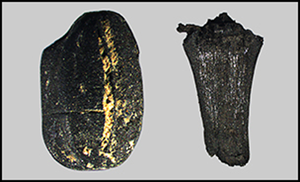
Cereal grains and chaff from Ghal e-Ben and Ghal e-Kash: a) Panicum miliaceum; b) Setaria italica; c) Oryza sativa; d) Hordeum vulgare rachis, six-row, hulled type; e) Triticum cf. timopheevii glume base; f) Triticum aestivum/durum; g) Triticum cf. timopheevii; h) Hordeum vulgare var. coeleste (naked, six-row); i) Triticum aestivum rachis (photographs by Y. Huang).

Compositional analysis of plant remains from Ghal e-Ben and Ghal e-Kash (figure by Z. Deng).

Cultivated large legumes comprise a notable proportion in most of the samples. Lentil (Lens culinaris) is the most common species among all samples, followed by bitter vetch (Vicia ervilia) and grass pea (Lathyrus sativus). The generally rounded shape and relatively large size of the Lathyrus and Vicia material indicate that they are likely to be cultigens. Four examples of pea (Pisum sativum) were also identified; their small size (a mean diameter of 3mm) prevents certainty regarding their domesticated status. Most of the pulses are preserved as complete specimens, with a few of the half seeds showing the concave surface of their inner cotyledon side, which can be used as an indicator that the pulses were processed before being charred (Valamoti et al. Reference Valamoti, Moniaki and Karathanou2011). The remains of fruits and oil/fibre crops are also occasionally present in a few samples, of which Vitis seeds are the most common. In addition, a few examples of possible Vitis fruit flesh were identified in samples of both Bronze and Iron Age date, indicating the consistent importance of Vitis—most likely for winemaking. Linum seeds are present in only two samples of Bronze Age date and in low quantity.
In addition to these Near Eastern cultigens at Ghal e-Ben, a notable finding is the presence of three grains of broomcorn millet (Panicum miliaceum) from two Bronze Age contexts (Figure 2a). Direct dating of two broomcorn millet grains (combined as one sample) from context 114C confirms that they date to the end of the third millennium BC (2141–1951 cal BC, at 95.4% confidence). This suggests that an East Asian millet and the practice of summer cropping were among agricultural innovations in northern Iran at the start of the Middle Bronze Age.
The composition of samples from the Iron Age levels, post-dating 400 BC, indicates that free-threshing wheat, barley and pulses continued to play a significant role in the overall farming system of the historic period; the absence of glume wheats may be explained by the limited number of Iron Age samples available. The diversification of summer agriculture in this period, however, is suggested by the presence of rice (Oryza sativa; Figure 2c). The South Caspian coastal plain of north-western Iran, with its high rainfall and numerous streams flowing from the Alborz and Talesh Mountains, is a significant region for traditional rice production; written sources indicate that the cultivation of rice was established in early historic times (Nesbitt et al. Reference Nesbitt, Simpson, Svanberg and Sharma2010). Two direct dates confirm the antiquity of the rice grains from Ghal e-Kash at 339–46 cal BC and 196 cal BC–cal AD 4 (at 95.4% confidence; Table 1). Continuity of rice cultivation into the Islamic Period (cal AD 892–1023, at 95.4% confidence) is attested by rice grains from context 109 at Ghal-e-Ben. This context also yielded a single specimen of foxtail millet (Setaria italica), another domesticated grain of East Asian origin, which seems to have spread somewhat more selectively and later than Panicum miliaceum.
Broomcorn millet in West Asia: the first wave of globalisation
As the earliest East Asian crop incorporated into West Asian and European farming systems, broomcorn millet has long featured as a key element in discussions of early trans-Eurasian communications and prehistoric food globalisation (Jones et al. Reference Jones2011; Boivin et al. Reference Boivin, Fuller and Crowther2012; Filipović et al. Reference Filipović2020; Martin et al. Reference Martin2021). In the North China plain, broomcorn millet had been fully domesticated and become a staple food crop together with foxtail millet, no later than 6500 BC (Lu et al. Reference Lu2009; Liu et al. Reference Liu, Motuzaite-Matuzeviciute, Hunt, Lightfoot, Liu and Fuller2018). Broomcorn millet subsequently spread widely through northern China, the Korean Peninsula and south into south-west and south-east China by c. 3000–2500 BC (Stevens et al. Reference Stevens2016; Deng et al. Reference Deng2018, Reference Deng2022). The date of dispersal outside of China and into Western Asia and Europe, however, is debated.
It is widely accepted that broomcorn millet was spread into Central Asia through the Hexi Corridor and northern Xinjiang, along the foothills of the Altai, Karakorum and other mountain ranges. Currently, the earliest evidence of broomcorn millet from the Hexi Corridor of north-west China dates to c. 2300 BC (Zhou et al. Reference Zhou, Li, Dodson and Zhao2016), although millet farming communities can be inferred from sedentary settlements in the region as early as 3000 BC (Wang Reference Wang2012).
Moving into Central Asia, the oldest find of broomcorn millet is currently from the Pethpuran Teng site in the Kashmir Valley, where 100 grains have been recovered, along with wheat, barley and lentils (Yatoo et al. Reference Yatoo2020). Three direct dates on the broomcorn millet grains are all older than 2000 BC, and the earliest is 2580–2446 cal BC (at 95.4% confidence). The Pethpuran Teng evidence is slightly earlier than that from Kazakhstan at Begash (2458–2199 cal BC, at 95.4% confidence) (Frachetti et al. Reference Frachetti, Spengler, Fritz and Mar'yashev2010). Somewhat older finds from north-west China are to be expected in the future, as implied by the evidence of the stable isotope data from animal bone for the use of millet crops as fodder at sites in the Dzhungar Mountains (Hermes et al. Reference Hermes2019; Motuzaite Matuzeviciute et al. Reference Motuzaite-Matuzeviciute2022). In consideration of the evidence from Kashmir, a second dispersal route through the foothills of the southern Tibetan Plateau might also be considered. This hypothesis may be supported by the discovery of both foxtail millet and broomcorn millet as early as c. 3000–2500 BC at the Karuo site in south-eastern Tibet and other sites such as Guijiabao and Baiyangcun in the Zang-Yi Corridor (Dal Martello et al. Reference Dal Martello2018; Gao et al. Reference Gao, Dong, Yang and Chen2020; Huan et al. Reference Huan2022).
Either or both routes facilitated the adoption of broomcorn millet cultivation in Central Asia by c. 2200 BC, as attested by discoveries from Adji Kui in Turkmenistan (Spengler et al. Reference Spengler2018), and the evidence from Ghal e-Ben presented here at c. 2050 BC. Finds from the Caucasus are marginally later (Martin et al. Reference Martin2021), while finds from Mesopotamia, the Levant, Turkey and Eastern Europe all indicate increasingly widespread cultivation by c. 1500 BC (Figure 4). Collectively, these data argue against the older idea that broomcorn millet was dispersed along the so-called ‘Steppe Highway’ from Mongolia to Ukraine, an area where there are few finds and no direct dating. In addition, recent stable isotope research on human and animal bones shows no detectable signal of C4 plants, such as millets, contributing to diets before c. 2000 BC on the Eurasian Steppe (Ventresca Miller & Makarewicz Reference Ventresca Miller and Makarewicz2019).
Proposed westward dispersal routes of East Asian crops, along with distribution of sites with early evidence of rice, broomcorn millet and foxtail millet along the routes and important sites mentioned in the text: 1) Tongtian Cave; 2) Karuo; 3) Baiyangcun; 4) Begash; 5) Pethpuran Teng; 6) Khalchayan; 7) Adji Kui. For details of all sites plotted in this map, see Table S2 in the online supplementary material (figure by Z. Deng).

The new finds from Ghal e-Ben provide the first solid evidence of early broomcorn millet in this region, dating to c. 2050 BC, which bridges a gap in the evidence for the dispersal route of broomcorn millet into Western Eurasia. Combined with the results of previous research on south-east Central Asia, we argue that it is likely that the main route for crop exchange prior to 2000 BC was the ‘Inner Asian Mountain Corridor’ (Frachetti Reference Frachetti2012) and its western extension through south of the Caspian Sea, northern Iran.
Rice in West Asia: the second wave of globalisation
Asian rice is a typical monsoon cereal crop with high hydrothermal requirements. While millets may be grown with as few as 2000 Growing Degree Days [GDD] and 250–300mm rainfall per annum, rice requires approximately 3000 GDD (d'Alpoim Guedes et al. Reference d'Alpoim Guedes, Manning and Bocinsky2016) and more than 800mm of annual rainfall (Fuller et al. Reference Fuller2011). Although cultivation of japonica rice began in the Yangtzi River basin by 8000 BC, rice agriculture remained confined to the better-watered parts of China until c. 3000 BC, before spreading primarily southwards to the tropics (Fuller Reference Fuller2011; Silva et al. Reference Silva2015). Rice cultivation in the Ganges River basin also started around 2500–2000 BC; here, it is hypothesised that hybridisation with introduced japonica rice from East Asia after 2000 BC facilitated large-scale agriculture based on indica rice (Fuller Reference Fuller2011; Bates et al. Reference Bates, Petrie and Singh2017), and both indica and japonica forms were widespread throughout the Indian subcontinent by the first millennium BC (Castillo et al. Reference Castillo2016; Rahman et al. Reference Rahman2020).
The spread of rice agriculture further west, to the oases of Central Asia, Iran or the Mediterranean, was hampered by lower levels of rainfall or the need for irrigation. One region with climatic conditions naturally suited to rice cultivation, however, is the South Caspian coastal plain; another is the (irrigated) alluvial plain of Susiana (modern-day Khuzestan province in south-western Iran; Brice Reference Brice1966). The present study establishes by direct dating, for the first time, that rice was present in West Asia, at Ghal e-Kash, by at least c. 339–46 BC—much earlier than any currently available evidence from elsewhere in Central Asia. It is therefore possible that rice was first adopted in the well-watered regions of Iran, before spreading to irrigated oases in Central Asia.
Based on Mesopotamian written sources, some rice cultivation was perhaps established in Syria by c. 1100 BC, while areas of cultivation are indicated in south-western Iran from Achaemenid sources of the sixth or fifth century BC (Muthukumaran Reference Muthukumaran2014). Previously, the earliest widely accepted evidence of rice cultivation in Iran came from Susa, dating to the first century AD (Miller Reference Miller1981; Nesbitt et al. Reference Nesbitt, Simpson, Svanberg and Sharma2010; Spengler et al. Reference Spengler2021). The Susa rice finds are short-grained rice (Miller Reference Miller1981) with a length/width ratio below 2 (mean 1.6), indicative of subspecies japonica (see Castillo et al. Reference Castillo2016). The earliest evidence for rice in Central Asia is from Khalchayan in the Surkhan Darya Basin of Uzbekistan, directly dated to 236–386 cal AD (at 95.4% confidence), and also probably subspecies japonica (Chen et al. Reference Chen2020); this may be regarded as the earliest evidence of irrigated oasis rice cultivation. All these early rice finds from Central Asia are consistent with the rice grain from Ghal e-Ben with a length/width ratio of 1.75, pointing towards the subspecies japonica, a group that includes modern rice varieties such as Iranian gerdeh and berenj loke in Afghanistan (see OSM2). The available evidence therefore suggests that the earliest rice to spread west was of the japonica type, with long-grained indica and aromatic rice arriving later.
A second point to emphasise here is that the geographical dispersal of rice was different from that of broomcorn millet. The latter was cultivated in all areas along its dispersal route, adopted by all communities unconstrained by any climatic or environmental conditions. In this way, the seemingly long-distance dispersal of broomcorn millet was probably accomplished through a series of short-distance, local interactions. This is akin to an ‘infiltration’ model, similar to that proposed by Frachetti (Reference Frachetti2012) in relation to trade and material transfer across South-west and Central Asia in the Bronze Age. By contrast, the spread of rice cultivation followed a ‘leapfrog’ model, in which the adoption of rice farming had to jump across numerous natural barriers (e.g. areas with insufficient rainfall) to arrive at the sparsely distributed habitats suited to its needs. This model is only plausible in the presence of the direct exchange of information between distant places. In other words, the dispersals of broomcorn millet and rice attest to two distinct waves of globalisation based on two different processes. By the time of the second wave, the whole Eurasian continent was much more closely connected, providing the conditions needed for the success of the ‘leapfrog’ model.
Conclusion
Based on the analysis of new archaeobotanical data and direct AMS radiocarbon dating, here, for the first time, we present firm evidence of Bronze Age and historic period farming practices on the southern coast of the Caspian Sea. Crop assemblages from the sites of Ghal e-Ben and Ghal e-Kash are, like at other sites from across the Middle East, dominated by wheat and barley; specifically, free-threshing bread wheat was more important in local farming systems than glume wheats. In addition, the assemblages from these two sites attest to two waves of agricultural change related to the adoption of East Asian crops: broomcorn millet arriving c. 2050 BC and rice arriving c. 120 BC. A single grain of foxtail millet from Ghal-e-Ben may suggest that this crop was introduced alongside rice.
The new evidence presented here bridges a geographical gap in the westward dispersal route of East Asian crops and offers a refined chronology for their adoption. Moreover, these data suggest that crop dispersal events followed two different models: an ‘infiltration’ model for broomcorn millet and a later ‘leapfrog’ model for rice, the feasibility of the latter illustrating the intensification of connectivity and information exchange across Eurasia during the second wave of globalisation some 2000 years ago.
Funding statement
We acknowledge financial support from the National Natural Science Foundation of China (grant nos 41872027 & T2192953), the Strategic Priority Research Program of the Chinese Academy of Sciences (grant no. XDB26000000), and the National Key Research and Development Program of China (grant nos 2020YFC1521603 & 2020YFC1521606).
Supplementary material
To view supplementary material for this article, please visit https://doi.org/10.15184/aqy.2023.42.



