

INTRODUCTION
Organizational justice is broadly defined as people's perceptions of fairness in organizations (Colquitt, Greenberg, & Zapata-Phelan, Reference Colquitt, Greenberg, Zapata-Phelan, Greenberg and Colquitt2005). Research since the 1990s has identified three major forms of organizational justice (Colquitt, Reference Colquitt2001): procedural justice refers to perceptions of fairness of proceduresFootnote [1] involved in decision-making processes (Leventhal, Reference Leventhal, Gergen, Greenberg and Willis1980; Thibault & Walker, Reference Thibaut and Walker1975); distributive justice is defined as perceived fairness in the distribution of resources (Homans, Reference Homans1961); and interactional justice refers to perceived fairness of interpersonal treatment (Bies & Moag, Reference Bies, Moag, Lewicki, Sheppard and Bazerman1986; Greenberg, Reference Greenberg and Cropanzano1993).
Initially a Western concept, Vermunt and Steensma (Reference Vermunt, Steensma, Vermunt and Steensma1991) maintain that organizational justice concerns are common in every human society. However, research (e.g., Giacobbe-Miller, Miller, Zhang, & Victorov, Reference Giacobbe-Miller, Miller, Zhang and Victorov2003; Kim & Leung, Reference Kim and Leung2007; Leung & Bond, Reference Leung and Bond1982; Tse, Francis, & Walls, Reference Tse, Francis and Walls1994) shows that cultural values, such as individualism/collectivism and power distance (Hofstede, Reference Hofstede1980), may create national variations in individuals’ justice judgments and practices. For example, Tse et al. (Reference Tse, Francis and Walls1994) found that in high power distance cultures, the active involvement of a high-status party in a dispute was perceived as fair; in contrast, in lower power distance cultures, people preferred to solve disputes on their own. These cross-cultural organizational justice studies have advanced our understanding of the influence of culture on justice perceptions and individual responses beyond a Western context. However, these studies overly rely on the etic (universal) approach (Schaffer & Riordan, Reference Schaffer and Riordan2003) to make cross-cultural comparisons in ‘the form of imposed-etic surveys’ (Morris, Leung, Ames, & Lickel, Reference Morris, Leung, Ames and Lickel1999: 790) without examining whether the concept of organizational justice in different cultures is comparable in the first place. The measures of organizational justice in most of these studies were adapted from those developed in the West. These studies did not consider whether the meaning of organizational justice is culturally invariant.
Researchers (e.g., Greenberg, Reference Greenberg2001; Kidder & Muller, Reference Kidder, Muller, Vermunt and Steensma1991; Lind, Tyler, & Huo, Reference Lind, Tyler and Huo1997; Zhang, Reference Zhang, Kim, Yang and Hwang2006; Zhang & Yang, Reference Zhang and Yang1998) argue that the meaning of justice is dependent on the social context as well as cultural values that are consensually validated in a society, suggesting the possibility of emic (culturally specific) characteristics of justice judgments. For instance, a study by Kim and Leung (Reference Kim and Leung2007) found that facet justice perceptions predicted only a portion of the variance in overall justice perceptions across four different cultures, giving rise to the possibility that unexplained variance may be due to factors specific to a local context.
Morris and Leung (Reference Morris and Leung2000) provide an excellent example of an indigenous form of fairness in conflict resolution procedures involving Ahimsa in India, which includes the principles of mha-karuna (great compassion) and mha-prajna (great wisdom). These two procedural principles are drastically different from the central procedural justice principle – process control – in the Western literature (Morris & Leung, Reference Morris and Leung2000). In general, we know little about whether the organizational justice construct has the same meaning and dimensions in non-Western cultures, where the assumptions of personhood, social behavior, and interpersonal relationships are different from those in Western cultures. Hence, the initial step of attaining indigenous knowledge of organizational justice is to examine the contextual factors that shape the local understanding and demonstration of this theoretical construct. Without such knowledge, ‘nuances of meaning can be lost in translation’ (Morris et al., Reference Morris, Leung, Ames and Lickel1999: 790) and cross-cultural applications are suspect.
Following Greenberg's (Reference Greenberg2001: 372) call for more inductive analyses aimed at ‘determining precisely what constitutes justice in various cultures’, we explore the meaning and dimensions of the organizational justice construct in the People's Republic of China (China). We address two research questions. First, what is the meaning of organizational justice in China? Second, what are the dimensions of organizational justice in China? To answer these questions, we conducted two studies. The first is an inductive study based on qualitative data from in-depth personal interviews and open-ended surveys used to gain an understanding of the meaning of organizational justice in China and to identify locally meaningful indicators. The second study uses a survey method to validate measures of Chinese organizational justice.
The study makes three contributions to the organizational justice and Chinese management literatures. First, it contributes to the international management literature by developing an organizational justice construct that is meaningful in the Chinese context. We triangulate qualitative and quantitative methods to ensure the new measure is grounded in the existing literature while also being locally relevant. Second, the current research contributes to the building of global knowledge of organizational justice by exploring the differences and similarities between Chinese justice perceptions and Western conceptualizations. These findings extend the organizational justice literature and inform future cross-cultural comparisons. Third, our studies have implications for future indigenous research by highlighting the influence of contextual factors on organizational justice judgments in a collectivist and high-context culture.
THEORETICAL BACKGROUND
Li, Leung, Chen, and Luo (Reference Li, Leung, Chen and Luo2012) suggest that development of indigenous constructs in China requires examination of Chinese traditional culture as well as contemporary phenomena. Additionally, Peng, Lu, Shenkar, and Wang (Reference Peng, Lu, Shenkar and Wang2001) suggest that differences between China and Western industrialized countries in regard to their economic development and institutional environments could lead to different understandings and manifestations of management-related phenomena. Below we provide a theoretical analysis of why and how national culture and institutional environments may shape justice judgments in China.
The Influence of National Culture
Confucianism is the underlying philosophical fabric of Chinese society. Confucian social theory views harmonious human relations as the basis for effective cooperation (Redding, Reference Redding1980, Reference Redding1987; Yang, Reference Yang1994) including relationships between employees and employers (Chow, Inn, & Szalay, Reference Chow, Inn and Szalay1987; Morris & Leung, Reference Morris and Leung2000). Moreover, employees are encouraged to develop a strong sense of belongingness to the organization (Hall & Xu, Reference Hall and Xu1990). In contrast, Western cultures tend to value constructive, interpersonal conflict as fundamental to progress (Farh, Zhong, & Organ, Reference Farh, Zhong and Organ2004). As such, it is not surprising that voice, or the extent to which people contribute their personal opinions to the decision-making process, is found to be central to justice perceptions in the West but is much less valued in collectivist cultures such as China's (Brockner et al., Reference Brockner, Ackerman, Greenberg, Gelfand, Francesco, Chen, Leung, Comez, Kirkman and Shapiro2001). Additionally, China is a high-context culture in which subtlety and the preservation of harmony are the aims of interpersonal communications, as contrasted with low-context cultures, which favor direct and even confrontational communications (Boyacigiller & Adler, Reference Boyacigiller and Adler1991; Singh, Zhao, & Hu, Reference Singh, Zhao and Hu2003). Therefore, in the Chinese context, it is more likely that employees will perceive greater fairness in management practices that promote harmony as opposed to conflict.
Moreover, several key concepts in Confucian social theory generate important implications for what constitutes culturally appropriate interpersonal treatment in China. First, in Confucian accounts, ren (仁), a desired moral virtue, means caring (Tao, Reference Tao2000). Specifically, ren involves being attentive to other people's well-being and being willing to promote it (Tao). Ren goes beyond an attitude of mere concern and respect and directs attention to action (Tao). In diffused cultures such as China’s, where workplace relationships are viewed as extended family relations (Hall & Xu, Reference Hall and Xu1990) and work life is an integral part of an individual's personal life (Tsang, Reference Tsang1994), we expect that justice in interpersonal treatment would require one to be attentive not only to job performance but also to the personal lives of employees.
In addition, Confucian social harmony is found in recognition of others’ value or face-giving as commonly labeled in the literature (e.g., Chia et al., Reference Chia, Egri, Ralston, Fu, Kuo, Lee, Li and Moon2007). Face-giving requires one to be interpersonally sensitive when communicating with others. As noted earlier, high-context cultures such as China place primary emphasis on subtlety, politeness, and demonstrations of respect (Boyacigiller & Adler, Reference Boyacigiller and Adler1991). Direct and candid forms of communications, major principles of informational justice (Colquitt, Reference Colquitt2001), are considered rude and offensive in most East Asian countries (Greenberg, Reference Greenberg2001), where the need for face is high. As such, providing candid feedback may make a manager appear honest and respectful in a North American context, but it may have the opposite effect in Asian culture (Morris & Leung, Reference Morris and Leung2000). Hence, we expect that management practices that address Chinese employees’ face needs by affirming one's social status in a group will be considered fair conduct. Consistent with this idea, Tata, Fu, and Wu (Reference Tata, Fu and Wu2003) found that social sensitivity was perceived as more important to justice judgments in China than in the United States.
The Influence of Institutional Environments
Besides national culture, we expect that the institutional environment may have an impact on how organizational justice is perceived and experienced in China. Tsang (Reference Tsang1994) considers the term ‘institutional’ in a broad sense to include political and economic structures in China. These structures include the political ideology, government policies, and changes associated with China's economic reforms. It is possible that some of these institutional changes created a reactionary emphasis on specific justice components and may be transitory in nature.
Prior to China's economic reform, its economy was dominated by state-owned enterprises (SOEs) whose management practices were based on principles of egalitarianism (Miller, Giacobbe-Miller, & Zhang, Reference Miller, Giacobbe-Miller, Zhang, Cheng and Peterson1998). The introduction of diverse ownership types (e.g., international joint ventures) led to fierce competition for the SOEs. In response, contract-based employment and downsizing practices (Cooke, Reference Cooke2005; Zhang, Reference Zhang, Kim, Yang and Hwang2006), conversion from equality-based to performance-based wage systems (Zhu & Dowling, Reference Zhu and Dowling1994), and implementation of performance appraisal systems (Ngo, Lau, & Foley, Reference Ngo, Lau and Foley2008) were implemented in an effort to make SOEs profitable (Tsui, Schoonhoven, Meyer, Lau, & Milkovich, Reference Tsui, Schoonhoven, Meyer, Lau and Milkovich2004). These reforms represented drastic changes in the institutional environment.
A few studies have demonstrated the influence of institutional environments on Chinese employees’ justice judgments. For example, two studies (Chen, Reference Chen1995; He, Chen, & Zhang, Reference He, Chen and Zhang2004) found that economic goals have made productivity a priority for Chinese employees and greatly enhanced employees’ preferences for differential (equity-based) rewards allocation as opposed to equality-based rewards allocation. Similarly, Leung, Smith, Wang, and Sun (Reference Leung, Smith, Wang and Sun1996) found employees’ comparisons of pay for locals relative to expatriates evolved from an initial sense of fairness to one of unfairness just three years later (Leung, Wang, & Smith, Reference Leung, Wang and Smith2001). Leung et al. (Reference Leung, Wang and Smith2001) explain that knowledge transfer between expatriates and Chinese employees shaped the belief that expatriates did not greatly differ from locals in terms of their level of know-how and, therefore, were relevant comparisons.
The findings of these studies suggest that despite the strong Confucian economic egalitarianism and socialist ideology of reducing income disparity in China (He et al., Reference He, Chen and Zhang2004), performance-based appraisal and differential pay systems are now viewed as fair in the context of the new focus on competitiveness and the changing institutional environment. Collectivists are sensitive to situational contexts (Chen, Meindl, & Hui, Reference Chen, Meindl and Hui1998), and when the situation changes, collectivists are as responsive to environmental contingencies as individualists. Under certain circumstances, the influence of situational conditions could even override the effects of cultural values (Chen, Reference Chen1995).
METHOD
Researchers (e.g., Farh, Early, & Lin, Reference Farh, Earley and Lin1997; Farh et al., Reference Farh, Zhong and Organ2004) have conducted inductive studies to explore the local measures of management concepts in China. These studies provide examples of high-quality, inductive research that meets the standards of rigor in measurement, data quality, and construct validity (Tsui, Reference Tsui2004). While we used these exemplars to guide our research design and data analyses, we diverged somewhat from earlier studies (e.g., Farh et al., Reference Farh, Earley and Lin1997; Farh et al., Reference Farh, Zhong and Organ2004), where the items for the indigenous measures were exclusively generated from structured open-ended surveys in which the definitions of the concepts based on Western literature were presented to the respondents to anchor their thoughts. Although this approach addresses the need for theoretical relevance and construct validity of indigenous measures, it may be over-reliant on Western concepts at the expense of local relevance.
We consider the challenge to be ensuring both theoretical and local relevance when conducting an inductive investigation. In order to fully capture the meaning and content domain of organizational justice in China while preserving the validity and theoretical relevance of the construct, we triangulated two qualitative methods: in-depth interviews and structured open-ended surveys. In the qualitative study, the interviewees were not presented with the Western definition of organizational justice. Instead, they were asked to liberally describe their personal understandings of organizational justice in their respective organizations, hence ensuring local relevance. In the structured open-ended survey, we followed the exemplar of Farh et al. (Reference Farh, Earley and Lin1997, Reference Farh, Zhong and Organ2004) and presented participants with a broad definition of organizational justice based on prior research (e.g., Colquitt et al., Reference Colquitt, Greenberg, Zapata-Phelan, Greenberg and Colquitt2005; Greenberg, Reference Greenberg1987) as individuals’ perceptions of the fairness of treatment received from an organization. We then asked participants to provide specific incidents as demonstration of this concept in the Chinese workplace. The triangulation of these two qualitative methods allows us to identify the common principles and themes that emerge from both data sets in an effort to more fully capture the theoretical domain of organizational justice in the Chinese context.
Based on the findings of the qualitative study, we generated an initial item pool and developed a survey for measuring the organizational justice construct in China. Then we conducted the second, quantitative study in which we first conducted exploratory factor analysis on a sample of 204 employees from four companies. We conducted a confirmatory factor analysis on a second sample of 452 employees from two companies.
Item Generation
Personal interviews
One of the authors of this study (Chun Guo) conducted personal interviews with 22 participants from five SOEs in fall 2008. The selection of SOEs is considered appropriate for two reasons. First, SOEs represent the only ownership type prior to China's economic reform and, therefore, have the most deeply embedded value systems and practices of any organizational type in China. Accordingly, we believe SOEs allow us to assess prevailing justice practices and judgments in the context of dramatic changes in institutional environments and shifting cultural values. Second, the selection of SOEs allows us to control for variations due to different ownership types. All interviews were in Mandarin Chinese. Among these interviewees, 68% were male, 41% were in managerial positions, and 55% had received a college education. The average age of the interviewees was 42.6 years old, and the average tenure with the organization was 17.8 years. Three SOEs were located in a large industrial city in the southwestern part of China, and the other two were in a coastal city in the eastern part of China. Among these five organizations, two were in the metallurgic industry and the other three were in the machinery manufacturing industry. The sizes of the SOEs were between 10,000 and 50,000 employees.
At the beginning of the interviews, participants were assured of confidentiality and then were asked to provide demographic information as well as basic information about their organizations. Interviewees were then asked two open-ended questions: (1) ‘According to your personal understanding, what is the meaning of organizational justice’? (2) ‘Could you please identify specific examples of this concept in your workplace’? On average, each interview lasted about 2 hours. Guo prepared the interview transcripts immediately after each interview, and upon completion, these transcripts were sent to the interviewees for validation. Follow-up phone calls and emails were used when clarification was needed. In order to ensure the accuracy of translation, the interview transcripts were translated into English and back-translated by a professional translator into Chinese (Brislin, Reference Brislin1970).
Open-ended surveys
To complement the interview data, we administered structured surveys containing the two open-ended questions to 120 employees from the same five organizations. These respondents did not participate in the personal interviews. We received 50 usable surveys, for a response rate of 42%. All survey questions were in Chinese. Among these participants, 76% were male, 22% were in managerial positions, and 66% had received a college education. The average age of the participants was 38.9 years old, and the average tenure was 13.6 years. After assurances of confidentiality, the participants were first presented with a broad definition of organizational justice based on the Western literature (Colquitt et al., Reference Colquitt, Greenberg, Zapata-Phelan, Greenberg and Colquitt2005; Greenberg, Reference Greenberg1987), as individuals’ perceptions of the fairness of treatment received from an organization, and then were asked to provide 5–10 specific examples of managerial practices demonstrating this concept in their workplace. All statements generated from the open-ended survey were also translated into English and back-translated into Chinese by a professional translator to ensure translation accuracy (Brislin, Reference Brislin1970).
Item Sorting, Consolidation, and Reduction
For this step, we closely followed the sorting, consolidation, and reduction procedures, as delineated in Farh et al.'s (Reference Farh, Zhong and Organ2004) study. The structured surveys and interviews generated a total of 127 items. We first screened all items using two criteria: (1) the item must have a clear meaning in Chinese and (2) the item must refer to a specific organizational incident/activity or event. Five items were considered unusable and were discarded, resulting in 122 usable items. Then we sorted these items into dimensions based on similarity of the item content.
In order to ensure the inter-rater reliability of the dimensions in our study, we recruited two Chinese doctoral students (one majored in management and the other in a nonmanagement area) studying at a large public university in the northeastern part of the United States as independent judges in addition to Guo. Due to the lack of indigenous knowledge of organizational justice in the Chinese context, prior to sorting, these two independent judges received brief training on the definition of organizational justice and the dimensions identified in Colquitt (Reference Colquitt2001). Upon completion of the training, the judges independently sorted the items into different dimensions based on the similarity of the item content. Statements that had agreements of either three or two judges were kept. The result of this process was that 93 items (76%) had two or more agreements and 29 had zero agreement. We eliminated the latter group from further consideration. As a final step, the three judges went through another round of the reduction process by further eliminating identical items and combining items having similar meanings. A total of 40 statements were retained to design our Chinese organizational justice scale.
Scale Validation
Based on the results of the inductive study, we constructed a 40-item survey and conducted the second study. Following Hui, Lee, and Rousseau's (Reference Hui, Lee and Rousseau2004) suggestion about avoiding central tendency bias common among Chinese respondents, each item was measured on a six-point Likert scale, ranging from 1 (‘strongly disagree’ or ‘not at all’) to 6 (‘strongly agree’ or ‘always’). We used an independent sample of 400 SOE employees from four automobile parts manufacturing companies located in a large industrial city in the southwestern part of China. The sizes of these participating SOEs were between 9,000 and 15,000 employees. The respondents were asked to complete an anonymous questionnaire. Participation was voluntary, and Guo administered the survey during participants’ mid-day break. We collected 204 complete surveys, and the response rate was 51%. We consider the sample size to be fair (above 200), according to Comrey and Lee (Reference Comrey and Lee1992), and it satisfies the ‘Rule of 5,’ which requires the subjects-to-variables ratio to be no lower than 5 for factor analysis (Gorsuch, Reference Gorsuch1983). Among these participants, 50.5% were male and 52% had a college degree or vocational training. The average age was 34.85, and the average company tenure was 12.30 years. The percentage of first-line workers in this sample was 72.1%, and the percentages for lower-level managers (supervisors), midlevel managers, and senior managers were 14.2%, 11.8%, and 2.0%, respectively.
Using SPSS18.0, we first conducted classic item analysis to identify items with low (less than 0.40) or negative item-total correlations. Among the 40 items, the lowest correlation was 0.51 and the highest was 0.77. The average was 0.69. After item analysis, we conducted exploratory factor analyses (EFA) with principle components and varimax rotation. The rotated component matrix was examined to identify major compositional items for each factor. The EFA revealed that there were six factors with eigenvalues greater than 1. Based on the EFA results, we further combined or eliminated items with similar meanings. As a result, the item pool was reduced to 25 items representing six factors.
We used the 25 items from the EFA to design the second survey for the fourth sample – 800 SOE employees from two machine equipment manufacturing companies located in a large industrial city in the southwestern part of China. The survey was administered by two local Chinese coordinators during the employees’ mid-day break. After the completion of the survey, the Chinese coordinators sent the original hard copies of the survey to Guo via air mail. We collected 452 complete surveys, and the response rate was 56.5%.
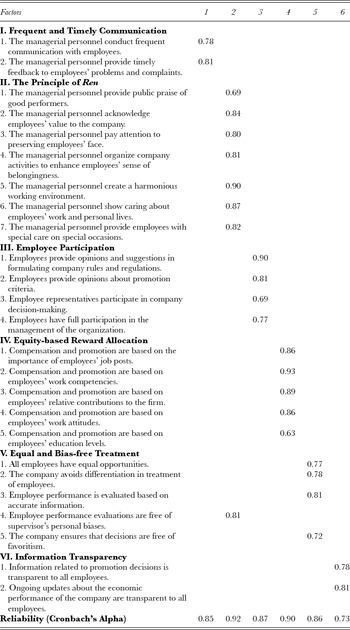
To validate the Chinese justice measures, we performed a confirmatory factor analysis (CFA) using LISREL 8.8 to test the factor structure obtained from EFA on the new sample. Goodness-of-fit statistics, such as comparative fit index (CFI), incremental fit index (IFI), normed fit index (NFI), and standardized root-mean-square residual (SRMR), were examined to check the overall fit of the measurement model. Table 1 reports the results of the confirmatory factor analysis of the 25-item Chinese organizational justice scale. In general, goodness-of-fit indices of this model were quite good: Chi-square (χ 2) = 1123.15, degrees of freedom (df) = 260, CFI = 0.98, IFI = 0.98, NFI = 0.97, and SRMR = 0.05. We labeled these six factors (1) frequent and timely communication, (2) the principle of ren, (3) employee participation, (4) equity-based reward allocation, (5) equal and bias-free treatment, and (6) information transparency. The interpretation of each of these factors is discussed below.
Confirmatory factor analysis results for Chinese organizational justice scale (N = 452)

Chi-square (χ 2) = 1123.15, degrees of freedom (df) = 260, comparative fit index (CFI) = 0.98, incremental fit index (IFI) = 0.98, normed fit index (NFI) = 0.97, and standardized root-mean-square residual (SRMR) = 0.05.
RESULTS
The Meaning of Organizational Justice in China
An initial finding from the interview data was that organizational justice in China was viewed as a social term and was largely derived from the fairness of treatment employees received from the organization in a particular situation. Our interviewees highlighted the importance of the situational factors and social relations involved in making justice judgments. According to the Chinese participants, there is no universal set of justice rules or principles that can govern the behaviors across individuals and situations, but rather fairness judgments are contingent on specific situational cues and reflect individuals’ subjective evaluations of the treatment they receive relative to others. Several interviewees mentioned that the concept of organizational justice is consistent with the cultural norm of heli (in accordance with reason or reasonableness). For example, an interviewee provided the following interesting example:
Fairness refers to the reasonableness of the treatment in a specific situation.. . .For example, a father killed his son for the good of the public, because the son was a local tyrant who bullied his neighbors and parents. . .from a fairness perspective, the father shouldn't deserve a death sentence, because what he did was reasonable and he should not deserve a death sentence in a Chinese society. (Interviewee #4)
In addition, Chinese interviewees indicated that fairness judgments are based on social comparisons among individuals. When the situations and conditions are similar, individuals deserve relatively equal treatment.
I think fairness means, in the same situation, people should receive the same treatment. That is, when the situation or the condition is similar, people should have comparatively equal access to various public and organizational resources and should receive comparatively the same treatment. (Interviewee #2)
Chinese Organizational Justice Dimensions
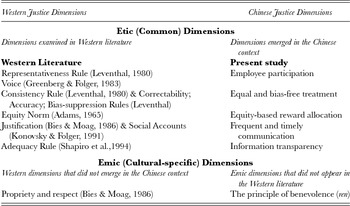
Based on a careful comparison between the six organizational justice dimensions identified in our study and the dimensions commonly accepted in the Western literature (e.g., Colquitt, Reference Colquitt2001; Colquitt et al., Reference Colquitt, Greenberg, Zapata-Phelan, Greenberg and Colquitt2005), we summarize the aspects of Chinese organizational justice dimensions in Table 2, using Colquitt's (Reference Colquitt2001) measures as a baseline model to detect the potential etic (common) dimensions and emic (culture-specific) dimensions of justice from this Chinese study.
Comparison of Western justice dimensions and Chinese justice dimensions

We identify five potential etic (common) organizational justice dimensions, and these dimensions include employee participation, equity-based reward allocation, frequent and timely communication, equal and bias-free treatment, and information transparency. However, we note that these dimensions may not completely replicate the Western conceptualizations, as will be discussed below. We also found one justice dimension that demonstrates a clear distinction from those examined in the Western literature and, hence, is categorized as a potential emic (cultural-specific) dimension. This dimension is the principle of ren.
Potential etic dimension: Frequent and timely communication
The first etic dimension involves explanation and information exchange through communication. We consider this dimension comparable to informational justice in the Western literature. Specifically, our Chinese respondents indicate that it is important for authoritative figures to explain and justify various decisions and company rules, policies, and procedures to all employees. This dimension resembles Bies and Moag's (Reference Bies, Moag, Lewicki, Sheppard and Bazerman1986) justification principle and social accounts examined by Konovsky and Folger (Reference Konovsky and Folger1991). Two items constitute this dimension. One item reads ‘The managerial personnel conduct frequent communication with employees’.
Potential etic dimension: Employee participation
The second etic dimension, employee participation, refers to allowing employees to actively participate in the decision-making process as well as to express opinions and make suggestions regarding management systems. Sample items include: ‘Employees provide opinions and suggestions in formulating company rules and regulations’ and ‘Employee representatives participate in company decision-making’. This dimension is similar to Leventhal's (Reference Leventhal, Gergen, Greenberg and Willis1980) representativeness rule. Four items were identified in this dimension.
Potential etic dimension: Equity-based reward allocation
The third etic dimension, labeled equity-based allocation, suggests that outcomes, such as compensation and promotion, received by employees should be different and in proportion to their contributions. A sample item is: ‘Compensation and promotion are based on employees’ relative contributions to the firm’. While these items demonstrate the equity norm (Adams, Reference Adams and Berkowitz1965), what counts as employees’ contributions are different from those identified in the West. For example, Chinese participants suggest that employee's work attitudes, such as their willingness to work overtime, should be considered an important contribution. Five items were identified in this dimension.
Potential etic dimension: Equal and bias-free treatment
The fourth etic dimension, equal and bias-free treatment, suggests that all employees should be treated equally and that management decisions should be free from personal biases and favoritism. Sample items of this dimension include: ‘All employees have equal opportunities’ and ‘The company ensures that decisions are free of favoritism’. The equality aspect of this dimension is comparable to the consistency rule in Leventhal (Reference Leventhal, Gergen, Greenberg and Willis1980). The neutrality aspect (free of favoritism) is comparable to Leventhal's bias-suppression rule. Five items were classified in this dimension.
Potential etic dimension: Information transparency
This etic dimension suggests that individual and organizational performance information should be kept open and transparent to all employees. This dimension resembles the adequacy rule by Shapiro, Buttner, and Barry (Reference Shapiro, Buttner and Barry1994) of informational justice by sharing sufficient information with employees. A sample item is ‘Ongoing updates about the economic performance of the company are transparent to all employees’. Two items comprise this dimension.
Potential emic dimension: The principle of benevolence (ren)
Our results show that Chinese participants focus on personalized concern and caring as a fair management practice. This represents one of the striking differences in what constitutes fair interpersonal interactions between China and the West. Whereas Western conceptualizations focus on individual employee treatment ensuring an individual employee is treated with dignity and respect, the Chinese conceptualization focuses on fairness in interpersonal interactions through Chinese relationship management practices (face-giving and public recognition) and caring for the personal lives of employees. Several items under this dimension suggest that the authoritative figures should publically recognize employees’ performance and contributions and pay attention to employees’ mianzi (face or public image). Sample items include ‘The managerial personnel publicly praise good performers’ and ‘The managerial personnel pay attention to preserving employees’ face.’ Further, several items suggest that authoritative figures should show that they care not just about their employees’ work but also their personal lives. A sample item is ‘The managerial personnel provide employees with special care on special occasions’. Finally, we identified items suggesting the necessity for the managerial personnel to enhance an individual employee's sense of belongingness by organizing and sponsoring recreational and sports activities for their employees. A sample item reads ‘The managerial personnel organize company activities to enhance employees’ sense of belongingness’. Altogether, seven items were categorized under this dimension. These items are demonstration of the previously discussed Confucius principle of ren, or benevolence, which requires one's attention to other people's well-being in work life as well as personal life and willingness to promote that well-being in culturally appropriate ways.
DISCUSSION
The Meaning of Organizational Justice in China
At first glance, the meaning of organizational justice in China appears to be similar to the organizational justice conceptualization in the Western literature. However, a closer examination suggests notable differences between the two. Specifically, the meaning of organizational justice in China is situation specific and fairness judgments are based primarily on the social relationships involved in the situation. We consider the focus on situations and relations deeply rooted in Confucian values. In Confucian social theory, at the individual level, self is perceived and recognized through differentiated relations with other people in the society (Tsui & Farh, Reference Tsui and Farh1997), such as those between father and son, husband and wife, and elder and younger brothers. At the societal level, lun guides and governs differentiated interpersonal relationships in Chinese societies, and different social relations are guided by different social norms (Bell, Reference Bell2004). Thus, in Chinese society, the behavior of individuals is evaluated by what is ‘reasonable’ (heli) according to the rules governing different social relations in a specific circumstance (Yang, Reference Yang1994).
In contrast, in individualist cultures, self is viewed as an autonomous unit of action and is defined as individual identity instead of relational identity (Bedford & Hwang, Reference Bedford and Hwang2003). The emphasis on self-identity in the individualist culture, thus, gives priority to personal rights, which are defined by objective standards and moral guidelines (Bedford & Hwang). As Bedford and Hwang (Reference Bedford and Hwang2003: 131) note, in individualist cultures, ‘unless values are explicitly formulated into an objective standard, one does not know what they are’. From this perspective and based on our findings, we suggest that compared with the Western conceptualization of organizational justice that is built on personal rights and objective moral standards, organizational justice in China involves a higher level of interpretation and subjectivity with more attention directed to social relations. Both situational cues and types of relations provide the basis for making justice judgments. As discussed earlier, this finding is consistent with theoretical expectations for high-context cultures (Boyacigiller & Adler, Reference Boyacigiller and Adler1991). Furthermore, we consider the subjectivity in justice judgments in the Chinese context to be consistent with the observation that the Chinese culture is high on particularism, a cultural feature indicating that particular circumstances and relationships are more important than abstract universal rules; accordingly, responses can change based on circumstances and people involved (Trompenaars, Reference Trompenaars1996).
Etic Dimensions of Organizational Justice
The present study identified five justice dimensions – employee participation, frequent and timely communication, equal and bias-free treatment, equity-based allocations, and information transparency – that are similar (but not identical) to those in the Western organizational justice literature. These findings suggest that these dimensions may be invariant enough to be potentially comparable between the U.S. and Chinese cultures. However, while the overall meaning of the justice principles may be the same, the manifestation or behavioral indicators (i.e., the items) of each may be different (Tsui, Reference Tsui2007; Tsui, Nifadkar, & Ou, Reference Tsui, Nifadkar and Ou2007). Both the institutional environment in China and features of the national culture may contribute to the specific ways in which these justice principles are manifested.
As we discussed earlier, China's SOE economic reforms have made productivity a priority goal and have required enterprises to adopt the market-oriented management system introduced by the large, foreign-ownership corporations. As such, it is not surprising to find that SOE employees now prefer differential allocations (the equity norm) as a response to these changes. This could be considered an adaptive response, as all employees subordinate their Confucian values of egalitarianism and harmony to the shared societal goal of organizational competitiveness and survival (Chen, Reference Chen1995). To further support the productivity goal, the adoption of the Western mode of human resources management also requires equal, objective evaluations of one's performance and deservedness (e.g., salaries and bonuses). As such, consistency in applying rules and regulations, as well as unbiased decisions, is of critical importance. This finding is in keeping with Chen, Chen, and Xin's (Reference Chen, Chen and Xin2004) finding that as merit and performance criteria gain more acceptance in Chinese enterprises during China's economic reforms, guanxi (personal relations) practices will decline in favorability.
Although we argue that the etic allocation principle based on differentiation may be largely due to institutional environments, we observe that cultural values can also exert influence on specific ‘justice criteria’ (Leung, Reference Leung, Greenberg and Colquitt2005: 558). For example, what constitutes fair contribution in China does not completely overlap with standards found in the Western literature. We speculate that the focus on employees’ work attitudes (e.g., willingness to work overtime) is the demonstration of virtuous behavior advocated by Confucianism – continuous self-improvement through diligence, perseverance, and self-sacrifice for the benefit of the community. Further, work attitudes that would normally be considered extra-role, organizational citizenship behaviors (e.g., willingness to work overtime) are an expected part of in-role, job performance in China. This may be another example of the expectation that employees sacrifice together for the survival of the firm. Based on these findings, we suggest that researchers, when examining reward allocation behavior in non-Western cultures, should be sensitive to these culture-specific values and institutional factors in defining locally relevant justice indicators.
Further, although we consider frequent and timely communication an etic dimension, it should be noted that there seemed to be a strong emphasis on the frequency of communication, an aspect of communication that is not prominent in the Western literature. We believe the emphasis on frequent communication is likely to be a direct reaction to rapid changes in institutional environments as well as previous practices of withholding information that may have been a characteristic of China's high power distance culture. From the institutional perspective, we have discussed that China's rapid economic growth has been achieved in a relatively short period of time. As such, during China's economic reforms, while the rational legal systems are still evolving and change is the only constant, frequent and timely communications serve an instrumental purpose by keeping employees updated about the current situation and company performance so that they can make informed decisions. From the cultural perspective, the frequency and timeliness in communications between the managers and employees also can be a demonstration of the concept ren, or conduct that conveys caring and demonstrates that employees are valued members in the group.
In addition, we identified participation in management as a dimension of justice. This is an unexpected finding, especially because previous research (e.g., Brockner et al., Reference Brockner, Ackerman, Greenberg, Gelfand, Francesco, Chen, Leung, Comez, Kirkman and Shapiro2001) found that voice is much less valued in China where the power distance level is high. Participation in managerial decision-making is a central concept of procedural justice in low power distance cultures such as the United States or the West in general. In China, participatory decision-making may reflect a socialist ideology that has a long history, especially in Chinese SOEs. According to Tsang (Reference Tsang1994), workers are supposed to play an important role in managing SOEs, and workers’ participation in SOEs is carried out through workers’ congresses. Workers’ congresses usually adopt a helping attitude toward management, and joint decision-making is considered a means of sharing responsibility for decisions (Ding, Fields, & Akhtar, Reference Ding, Fields and Akhtar1997). Moreover, Chinese labor laws grant employees the right to exercise their influence through workers’ congresses on issues including long-term planning, income distribution, and management appraisal (Wang, Reference Wang, Triandis, Dunnette and Hough1993). As such, the well-established practice of employee involvement in management is viewed as an important indicator of organizational justice in the participating SOEs in our study.
Finally, we categorized information transparency as an etic dimension similar to the adequacy rule of informational justice dimension in the Western literature. However, we believe this may be superficially comparable in that what constitutes a transparent information system may differ between cultures. In the participant organizations, and indeed throughout China, there is a common practice of publicly posting employee performance information (outputs, absences, salaries, promotions, etc.). Thus, when our participants refer to transparency, it seems to be based on this organizational practice. However, the same conduct might be considered an invasion of privacy in a Western culture, violating Leventhal's (Reference Leventhal, Gergen, Greenberg and Willis1980) ethicality rule and damaging general perceptions of procedural justice and employee satisfaction (Eddy, Stone, & Stone-Romero, Reference Eddy, Stone and Stone-Romero1999; Mossholder, Giles, & Wesolowski, Reference Mossholder, Giles and Wesolowski1991). In fact, there is an assumed right to privacy regarding employment records in the U.S. culture (Henderson & Snyder, Reference Henderson and Snyder1999) that has been codified in a patchwork of laws and recognized in some court cases (Linowes & Spencer, Reference Linowes and Spencer1997). Indeed, in the Western justice literature, perceived invasion of privacy was identified as a potential source of interpersonal justice violations (Bies, Reference Bies, Greenberg and Colquitt2005). We suspect this distinction between private and public disclosure may be related to a larger individualism/collectivism distinction. Similar to other collectivist cultures, the Chinese culture has not been characterized by an individual rights focus that extends to privacy (Kitiyadisai, Reference Kitiyadisai2005). As such, publication of personal information is considered appropriate and important to achieving a transparent information system at the collective level, hence a fair practice.
The Emic Dimension of Organizational Justice
In addition to the common dimensions, the study also identified one emic dimension (the principle of ren in guiding interpersonal interactions) that we consider specific to the Chinese context. We found that management practices involving care, public recognition of employees’ contributions, and value to the organization, as well as practices that facilitate the creation of harmonious working relationships and sense of belongingness, are considered important sources of fairness perceptions in China. The focus on interpersonal relationships and employees’ loyalty to the organization reflects the collectivist cultural value and a strong group orientation and, hence, is drastically different from the focus on fairness in individual employee treatment in the West. Consistent with our expectation, we found that organization-sponsored activities, by providing a means of enhancing the cohesiveness of the workforce and building a common social identity, are viewed to be crucial for increasing cooperation; hence, they are viewed as fair. The word ren is usually translated as ‘benevolence’ or ‘humanly’. It refers to acts of kindness toward others’, especially in-group members’ well-being. Relatedly, benevolence is one of the 10 broad values identified by Schwartz (Reference Schwartz and Zanna1992) that distinguishes among cultures. Therefore, we refer to this dimension as the principle of benevolence (ren) to facilitate future research in other cultural contexts.
In addition, respect and propriety, two interpersonal justice rules examined in the Western literature, did not emerge in our study. It could be that respect and propriety are sine qua non in Chinese society. Instead, caring, or showing genuine concern for and willingness to help others with work and personal problems (the concept of ren), is a more culturally meaningful fairness indicator. Moreover, public recognition and praise, by addressing one's need for face and affirming one's social status in a group, are also considered fair conduct in China and represent another collectivist twist on the concept of treatment with dignity and respect. Therefore, we also consider protection of face and showing respect to one's social status important components of the principle of benevolence (ren) in the Chinese context.
In general, the current study attempts to decipher the intricate nature of organizational justice in a non-Western context, China. The findings suggest that while cultural values can shape the meaning of fair conduct in a local context, the influence of institutional environments is also salient, especially in a rapidly changing economy such as China. Cultural factors and institutional forces interact to shape the meaning and demonstration of organizational justice, creating a crossvergence (Ralston, Reference Ralston2008) of organizational justice principles, practices, and criteria in justice judgment. On the one hand, economic reforms have spurred many Chinese organizations to adopt Western management systems. This might account for the convergence (etic dimensions) of fairness judgments attained through structural means (e.g., compensation and performance appraisal systems). On the other hand, the implementation of these systems and structures involves interpersonal interactions, which require the guidance of local social norms and cultural values. This might account for the divergence (the emic dimension) of fairness judgments attained through social means (e.g., interpersonal interactions).
The results of the current study suggest that the meaning of organizational justice does vary across cultures. Although the identification of the etic dimensions provides initial support for cross-cultural similarity in the structural aspects of the organizational justice construct, justice indicators of these dimensions suggest nuanced differences reflecting underlying cultural values and adaptive responses to a changing institutional environment. Further, our potential emic dimension suggests that local cultural values and traditions can have a strong influence, especially on the social aspects of organizational justice and on what constitutes effective cooperation mechanisms that influence perceptions of fair treatment in the workplace. From this perspective, applying concepts and theories related to the social aspects of organizational justice developed in the Western literature may not ensure valid comparisons in cross-cultural studies. A recent study (Schilpzand, Martins, Kirkman, Lowe, & Chen, Reference Schilpzand, Martins, Kirkman, Lowe and Chen2013) failed to find consistent results on the moderating role of cultural values on how employees in the United States and China may react differently to organizational justice in terms of organizational citizen behavior. It is possible that the nonsignificant and inconsistent findings could be due to different meanings attached to the justice concept by people in the two contexts. Future research should be sensitive not only to differences in meaning at the conceptual level but also to differences in the operational level in terms of behaviors and actions.
Limitations
There are limitations to the present study. First, the results based on a study in China may not be generalizable to other cultures where the cultural, political, and economic milieu is different from that in China. Future research should examine other collectivist cultures under different institutional conditions to investigate whether common justice dimensions can be identified. Second, SOEs represent the only ownership type prior to the economic reform and, therefore, have the most deeply embedded value systems and practices of any organizational type in China. However, the sole focus on SOEs in our study may not fully capture justice perceptions and judgments of employees from organizations under different ownership types, such as domestic private enterprises or foreign-owned enterprises. Future studies should replicate the current study in organizations in China under different ownership types. One difference we expect is that in privately owned companies and joint ventures, where the market orientation is stronger (Wong, Ngo, & Wong, Reference Wong, Ngo and Wong2006), one may find a higher level of convergence of justice perceptions and practices than that in the Western literature.
Third, there are other ways to examine cultural invariance of organizational justice, such as examining measurement equivalence/invariance using multigroup CFA (e.g., Fischer et al., Reference Fischer, Ferreira, Jiang, Cheng, Achoui, Wong, Baris, Mendoza, Meurs, Achmadi, Hassan, Zeytinoglu, Dalyan, Harb, Darwish and Assmar2011; Kim & Leung, Reference Kim and Leung2007). For example, Fischer and his colleagues (Fischer et al.) examined the measurement equivalence of the justice construct based on Colquitt's (Reference Colquitt2001) measures in 13 countries. Although their study did not include a sample from mainland China, Fischer et al. found that the four-dimensional model of justice works well across these samples. However, other research suggests that the four dimensions are deficient in fully explaining all of the variance of overall justice perceptions across cultures (Kim & Leung, Reference Kim and Leung2007). Based on the findings of the present study, we argue that the Fischer et al. finding of cultural equivalence of the organizational justice measures developed in the West does not preclude the possibility that other locally meaningful justice indicators may exist. For instance, in our study, we found that the principle of ren, or benevolence, a justice principle not previously studied in the literature, is a locally relevant justice principle in China.
Another limitation is the lack of evidence on the convergent, discriminant, and predictive validity of this Chinese measure of organizational justice. Future research should ensure that this measure is a meaningful predictor of important organizational outcomes, compared to the existing measure derived in a different cultural context.
Managerial Implications
Our findings suggest that Western companies doing business in China should not assume that fairness practices in their home countries are readily applicable to this new cultural context. While organizational justice has been recognized as a fundamental basis for effective cooperation in Western organizations, the underlying mechanisms may vary in China. In China, where interpersonal interactions are guided by the Confucian value of ren and social harmony, special attention needs to be paid to the interactions with employees and creating social harmony in the workplace. Individuals in managerial positions should not merely rely on rules and regulations when dealing with organizational issues, but rather need to know how to personally relate to employees and be able to create and maintain harmonious relationships in the workplace. In addition, in a collectivist culture, effective cooperation may require group orientation, care, and face-giving practices. The findings of our study suggest that the common Chinese business practices of organizing recreational activities that involve both employees and managers can be one way to enhance group orientation and build mutual trust. Publicly recognizing employees’ value to the organization can satisfy Chinese employees’ need for face and increase their loyalty to, and identification with, the organization.
CONCLUSION
Our study suggests that when applying Western management concepts, theories, and models in non-Western cultures or emerging economies, management researchers not only need to be alert to the cultural relativity of Western theories, but more importantly, efforts should be made to investigate whether a construct is meaningful in a local context in the first place. The current study constitutes an effort to avert the trend of homogenization of management theories and practices toward the North American model.