Recent research supports the notion that some children may be more sensitive to both positive and negative features of the environment (Slagt et al., Reference Slagt, Dubas, Deković and van Aken2016). According to differential susceptibility theory (DST), individual differences in temperament are phenotypic manifestations of this greater plasticity. Thus, for more temperamentally sensitive children, environmental adversity may take a disproportionate toll on their functioning while supportive contexts may confer developmental advantages relative to less malleable children (Belsky & Pluess, Reference Belsky and Pluess2009). However, research guided by DST has highlighted that a dispersive array of temperament traits act as susceptibility factors, obscuring our understanding of which children may be more sensitive to features of the environment than others. For example, traits of negative emotionality, fearfulness, irritability, reactivity, inhibition, and impulsivity have all been designated as potential susceptibility factors in research (Gilissen et al., Reference Gilissen, Bakermans-Kranenburg, van IJzendoorn and van der Veer2008; Hentges et al., Reference Hentges, Madigan, Tough, McDonald and Graham2021). In addition, findings have implicated these temperament × environment interactions in predicting a wide variety of child outcomes, including externalizing problems, internalizing problems, and school difficulties (Rabinowitz & Drabick, Reference Rabinowitz and Drabick2017). Greater consideration of the functional and adaptive significance of individual differences in temperament may allow for greater precision in identifying for whom and under what conditions greater susceptibility to the environment influences specific child outcomes. Thus, the aim of the current paper is to examine whether an evolutionary conceptualization of temperament can enhance our understanding of the precise nature of differential susceptibility to the rearing environment in predicting a diverse set of outcomes (Korte et al., Reference Korte, Koolhaas, Wingfield and McEwen2005).
Differential susceptibility theory
In contrast to the diathesis-stress model of development, which suggests that the risk posed by temperamental traits increases in potency with greater exposure to psychosocial adversity, DST suggests that certain individuals are more susceptible to environmental influence for both better and for worse (Belsky & Pluess, Reference Belsky and Pluess2009). In other words, temperamentally susceptible children, while at risk for poor outcomes in disadvantaged contexts, can actually benefit from supportive environments in a way that enhances fitness. Particularly, DST has suggested that children characterized by “difficult” temperaments or high negative emotionality are more susceptible to environmental input in socialization contexts (Belsky, Reference Belsky, Eliis and Bjorklund2005; Belsky et al., Reference Belsky, Hsieh and Crnic1998). Consistent with this hypothesis, research has shown that children high in negative emotionality evidence poor outcomes in low-quality rearing environments but fare better than children low in negative emotionality in high-quality rearing environments (see Slagt et al., Reference Slagt, Dubas, Deković and van Aken2016 for a meta-analysis).
However, research has generated a list of widely disparate temperamental traits that may reflect greater susceptibility to the environments. For example, both high behavioral inhibition and high disinhibition have been identified as susceptibility factors that confer “for better and for worse” outcomes across supportive and adverse environments (e.g., Barker et al., Reference Barker, Trentacosta and Salekin2011; Essex et al., Reference Essex, Armstrong, Burk, Goldsmith and Boyce2011; Guyer et al., Reference Guyer, Jarcho, Pérez-Edgar, Degnan, Pine, Fox and Nelson2015). In attempts to integrate these findings into the wider DST literature, some researchers have posited that extreme levels on any temperament dimension may reflect greater susceptibility to the environment (Davis et al., Reference Davis, Eivers and Thorpe2012; Sanson et al., Reference Sanson, Hemphill, Smart, Smith and Hart2002). However, other empirical investigations have revealed that high negative emotionality, impulsivity, and behavioral inhibition operate as vulnerability factors, with interactions patterns more closely resembling diathesis-stress than differential susceptibility (Altenburger et al., Reference Altenburger, Lang, Schoppe-Sullivan, Kamp Dush and Johnson2017; Barnett & Scaramella, Reference Barnett and Scaramella2015; Belsky & Pluess, Reference Belsky and Pluess2012; Bush et al., Reference Bush, Lengua and Colder2010; Davies et al., Reference Davies, Cicchetti and Hentges2015; Slagt et al., Reference Slagt, Dubas, Deković and van Aken2016). In addition, composite-based approaches that attempt to classify children as “difficult” based on high levels of several temperament traits, including high negative emotionality, activity, reactivity, and withdrawal, have also resulted in a body of work that sometimes supports diathesis-stress and other times supports differential susceptibility (e.g., Rioux et al., Reference Rioux, Castellanos-Ryan, Parent and Séguin2016; Slagt et al., Reference Slagt, Dubas, Deković and van Aken2016). Inconsistencies in the results are further complicated by reports that low levels of negative emotionality or difficultness may acts as differential susceptibility factors (e.g., Beaver et al., 2015; Hummel & Kiel, Reference Hummel and Kiel2015). Thus, this begs the question: if some children are in fact susceptible to both the positive and negative features of the environment, how do we accurately identify these children?
Evolutionary game theory
With its focus on identifying the form and function of higher order patterns of behavior that encompass multiple temperamental traits, evolutionary game theory (EGT) has the potential to resolve this question (EGT; Korte et al., Reference Korte, Koolhaas, Wingfield and McEwen2005). According to EGT, natural selection conferred individual differences in temperamental traits that are organized around two opposing strategies for processing and responding to environmental input. The first strategy, which is commonly designated as the Hawk temperament, is characterized functionally by bold, quick, and direct strategies for accessing resources and defeating threat (Korte et al., Reference Korte, Koolhaas, Wingfield and McEwen2005). Interpreted within the context of existing temperament taxonomies (e.g., Buss & Plomin, Reference Buss, Plomin, Buss and Plomin1984; Rothbart & Bates, Reference Rothbart, Bates, Eisenberg and Damon2006; Thomas & Chess, Reference Thomas and Chess1977), this higher order, correlated suite of behaviors is expressed through high impulsivity, quick approach, activity, and “dominant” negative affect (i.e., anger, irritability) (Sturge-Apple et al., Reference Sturge-Apple, Davies, Martin, Cicchetti and Hentges2012). Within EGT, traits of high approach and impulsivity are designed to allow for quick access to resources without hesitation, mitigating the possibility of losing resources to a competitor. Likewise, high energy (i.e., activity) is required for competing with rivals for resources (e.g., food, mates), and dominant negative affect (i.e., anger, frustration) promotes forceful, vigorous means for securing resources (Ellis & Bjorklund, Reference Ellis and Bjorklund2012; Korte et al., Reference Korte, Koolhaas, Wingfield and McEwen2005).
As the second phenotypic strategy, the Dove temperament is characterized by greater caution and more reflective processing and reactivity to the environment as a means of avoiding potential harm. To reduce exposure to risk, this strategy operates through increased avoidance and withdrawal in novel or unfamiliar environmental conditions and greater cooperation, scavenging, and exploratory behaviors under familiar and benign settings (Korte et al., Reference Korte, Koolhaas, Wingfield and McEwen2005). In the terminology of psychological models of temperament, the risk management function of the Dove profile is reflected in a constellation of temperamental traits characterized by high behavioral inhibition, avoidance, vulnerable negative affect (i.e., fear, worry), and lower activity levels, particularly within novel contexts (Korte et al., Reference Korte, Koolhaas, Wingfield and McEwen2005).
Although often termed as “Hawk” and “Dove” profiles, these phenotypic strategies are considered to operate on a continuum from more Dove-like strategies (e.g., inhibition, cooperation) to more Hawk-like strategies (e.g., boldness, aggression) (McGill & Brown, Reference McGill and Brown2007). Animal research on temperament has consistently supported the notion of these behavioral syndromes organized along a continuum of boldness-caution in a wide variety of species (Réale et al., Reference Réale, Reader, Sol, McDougall and Dingemanse2007; Sih & Bell, Reference Sih and Bell2008). In addition, emerging research with young children has indicated that individual differences in temperament can be organized into correlated suites of behaviors that correspond with the Hawk and Dove phenotypes (e.g., Davies et al., Reference Davies, Sturge-Apple and Cicchetti2011; Sturge-Apple et al., Reference Sturge-Apple, Davies, Martin, Cicchetti and Hentges2012; Suor et al., Reference Suor, Sturge-Apple, Davies and Cicchetti2017). This research has also revealed that individual differences in Hawk and Dove phenotypic behavior can confer distinct developmental costs within early rearing environments. For example, Sturge-Apple et al. (Reference Sturge-Apple, Davies, Martin, Cicchetti and Hentges2012) found that a Hawk-like temperament predicted increased sympathetic nervous system functioning and behavioral problems among toddlers in contexts of harsh parenting, while toddlers with a Dove-like temperament showed elevated parasympathetic and cortisol activity and increased depressive symptoms in harsh caregiving environments. In another study, interparental aggression was associated with unique developmental costs for children with Hawk and Dove temperamental profiles (Davies et al., Reference Davies, Sturge-Apple and Cicchetti2011). For example, in environments characterized by high interparental conflict, Doves evidenced increased cortisol reactivity, which in turn was associated with increases in internalizing symptoms between the ages of 2 and 3. Conversely, children with a Hawk-like temperament were at risk for dampened cortisol activity in environments characterized by high interparental aggression, and this dampened cortisol reactivity was further associated with greater attention-deficit and hyperactivity symptoms over time.
Thus, there is emerging evidence that these two evolutionarily informed phenotypes show unique patterns of physiological and psychological development in response to similar environmental conditions. However, these prior studies have focused on child development exclusively within risky contexts (e.g., maternal harshness, interparental aggression) and have not directly examined the utility of the Hawk and Dove paradigm when examining child development within environmental conditions that range from the positive to the negative.
Toward an integration of DST and EGT in more precisely identifying susceptibility
In building on this empirical base, EGT may offer a new layer of precision in addressing why disparate temperamental traits may all serve as susceptibility factors. Belsky et al. (Reference Belsky, Bakermans-Kranenburg and Van IJzendoorn2007) have previously questioned whether differential susceptibility may operate in a “domain-general” or “domain-specific” fashion. In other words, “is it the case that some children … are more susceptible both to a wide variety of rearing influences and with respect to a wide variety of developmental outcomes” (i.e., domain-general) or is it possible that “different children are susceptible to different environmental influences … and with respect to different outcomes” (i.e., domain-specific) (Belsky et al., Reference Belsky, Bakermans-Kranenburg and Van IJzendoorn2007, p. 302). Although DST has emphasized the importance of exploring whether the susceptibility of different temperamental traits may be limited to specific domains of environmental input and psychological functioning (Belsky & Pluess, Reference Belsky and Pluess2009), current empirical research has generally explored differential susceptibility from a domain-general approach. In other words, a small group of children (e.g., those high in “difficult” temperaments) are proposed to be differentially susceptible to a range of environmental conditions across different domains of child outcomes. Thus, DST has not offered hypotheses about how specific temperament traits may serve as distinct susceptibility factors in associations between environmental conditions and children’s specific developmental outcomes. Conversely, EGT provides additional guidance for formulating hypotheses on how Hawk and Dove tendencies may produce different developmental costs and benefits, depending on the early rearing context. Thus, integrating EGT within a DST framework may help to address this gap by generating the proposal that the relative disposition to exhibit Hawk or Dove temperamental traits may confer susceptibility to distinctive sets of psychological costs and benefits under different environmental conditions.
While studies have examined differential susceptibility to a range of environmental conditions (e.g., interparental conflict, prenatal stress), the vast majority of work has focused on parenting as the most salient aspect of the early rearing environment (Slagt et al., Reference Slagt, Dubas, Deković and van Aken2016). Likewise, evolutionary theories of development, including EGT, have emphasized the role of parental care in early childhood in establishing predictable environmental cues that are proposed to forecast future environmental conditions (Belsky et al., Reference Belsky, Steinberg and Draper1991; Korte et al., Reference Korte, Koolhaas, Wingfield and McEwen2005). High quality parental care, including increased responsiveness and sensitivity to the child’s needs, is proposed to nurture children’s interpersonal skills and confidence necessary to master their social world (Grusec & Davidov, Reference Grusec and Davidov2010; Sanders, Reference Sanders2003). In contrast, low quality parenting, including harsh, hostile, or neglectful behaviors, disrupts the achievement of stage-salient milestones and increase the risk of behavioral and emotional issues (Rutter & Sroufe, Reference Rutter and Sroufe2000). Indeed, meta-analytic studies have suggested that negative parenting behaviors increase child risk for depression and conduct problems, while high quality parenting behaviors predict lower rates of emotional and behavioral problems (Johnson et al., Reference Johnson, Hawes, Eisenberg, Kohlhoff and Dudeney2017; Loeber & Stouthamer-Loeber, Reference Loeber and Stouthamer-Loeber1986; McLeod et al., Reference McLeod, Wood and Weisz2007). However, effect sizes tend to be small to moderate, suggesting that other factors may contribute to the extent in which parenting predicts later psychopathology. DST proffers that individual markers of susceptibility (i.e., “difficult” temperament, high negative emotionality) increase the risk of psychopathology in contexts of poor-quality parenting while lowering risk of psychopathology in contexts of high-quality parenting relative to peers without these susceptibility markers (Belsky & Pluess, Reference Belsky and Pluess2009).
However, given the amount of susceptibility traits that have been identified in the literature and the contradictory evidence (e.g., both high and low negative emotionality emerging as susceptibility factors in different studies), it seems unlikely that children high in one temperamental trait or profile are susceptible to the environment equally across all developmental outcomes. EGT offers a promising solution to this conundrum because it specifically proffers that children’s susceptibility to develop specific types of psychological outcomes depend on the adaptive fit between the individual’s phenotypic strategy and their early socialization environment (Korte et al., Reference Korte, Koolhaas, Wingfield and McEwen2005). In harsh or impoverished environments, children who are high in Dove temperament are proposed to enact defense mechanisms or strategies that diminish the possibility of harm, including conservation of energy, freeze-hide behaviors, and greater vigilance and attention to social cues (Korte et al., Reference Korte, Koolhaas, Wingfield and McEwen2005). Therefore, children high in the Dove temperament may be particularly susceptible to aspects of parenting quality in predicting depressive symptoms, which are also often regarded to have an evolutionary basis in preserving safety (Gilbert & Allen, Reference Gilbert and Allan1998). In contrast, the Hawk temperament responds to adversity and harshness by adopting riskier and more dominant response strategies, including attack behaviors and territorial styles (Korte et al., Reference Korte, Koolhaas, Wingfield and McEwen2005). Thus, the Hawk temperament may be susceptible to parenting quality when predicting conduct problems, such as hitting, verbal aggression, and stealing.
The current study
In summary, the current study is designed to test the conceptual role of two evolutionary-informed phenotypes of temperament as unique moderators of parental caregiving quality in predicting later depressive symptoms and conduct problems. In adopting this theoretical approach, a key aim is to increase the specificity of the current differential susceptibility framework by specifically testing whether differential susceptibility is domain-general (e.g., susceptible to a broad range of socio-emotional outcomes) or domain-specific (i.e., susceptible to specific developmental outcomes) (Belsky et al., Reference Belsky, Bakermans-Kranenburg and Van IJzendoorn2007). We hypothesize that children high in Hawk-like temperament traits will be differentially susceptible to parenting quality in predicting conduct problems, while those high in Dove-like temperament traits will be differentially susceptible to parenting quality when predicting depressive symptoms.
To rigorously test our hypotheses, we utilized a multimethod longitudinal design to assess change in depressive symptoms and conduct problems during the transition period from preschool to first grade. This developmental period has significant implications for psychological and socio-emotional adjustment, as the transition into formal education marks an important milestone for children that can prove challenging and stressful (Graziano et al., Reference Graziano, Reavis, Keane and Calkins2007; Rimm-Kaufman & Pianta Reference Rimm-Kaufman and Pianta2000). The inability to successfully navigate this transition can be a key influence on the emergence and maintenance of maladjustment (Graber & Brooks-Gunn, Reference Graber and Brooks-Gunn1996; Thijs et al., Reference Thijs, Koomen, de Jong, van der Leij and van Leeuwen2004).
Child temperament was assessed using a pattern-based observational approach to examine individual differences in temperamental phenotype. The Hawk phenotype is characterized by temperamental traits of high approach, activity, irritability, and impulsivity, while the Dove phenotype is characterized by traits of high avoidance, inhibition, and fearfulness in context of novelty (Sturge-Apple et al., Reference Sturge-Apple, Davies, Martin, Cicchetti and Hentges2012). However, EGT proposes the specific combination of traits may vary between individuals. Thus, rather than considering these phenotypes as composites of distinct temperamental traits, the present study employed a novel, pattern-based approach to studying temperament by examining the overall function and confluence of behaviors in a standard observational assessment of temperament.
Consistent with recommendations to examine environmental conditions on a continuum from positive to negative when testing for differential susceptibility (Belsky & Pluess, Reference Belsky and Pluess2009; Del Giudice, Reference Del Giudice2017), we utilized a composite measure of parenting quality that ranged from positive and supportive (e.g., warmth, sensitivity) to negative and adverse (e.g., hostility, disengagement). As an additional strength of the study, we assessed the moderating influence of child temperament on both maternal and paternal parenting. Few studies have assessed the interplay between child temperament and paternal parenting, and research that has been conducted is mixed. Some research has found temperament moderates the effects of maternal parenting only (e.g., Kim & Kochanska, Reference Kim and Kochanska2012) while other studies have found moderating effects for both maternal and paternal parenting (e.g., Karreman et al., Reference Karreman, de Haas, van Tuijl, van Aken and Deković2010; Kochanska et al., Reference Kochanska, Aksan and Joy2007). Thus, we make no specific a priori hypothesis about parental gender effects.
Method
Participants
Participants for this study were drawn from a larger longitudinal study examining the effects of family relationships on child adjustment. Participants included 243 families (i.e., mother, intimate partner, child) drawn from a mid-sized city in the Northeastern United States. In order to recruit a diverse sample, participants were recruited through local preschools, Head Start programs, childcare programs, family-friendly locations (e.g., libraries, farmers’ markets), and internet sites. Criteria for inclusion in the study included: (1) the target child was enrolled in preschool and between the ages of 4 and 5, (2) two primary adult caregivers were in a romantic relationship, were raising the child together and had frequent contact with each other as a family (at least 2–3 days a week for at least a year), (3) at least one of the parents was the biological parent, and (4) the child did not have any significant cognitive, motor, or sensory deficiencies that would impair their ability to perform the tasks and assessments.
The longitudinal design consisted of two measurement occasions spaced two years apart beginning when children were in their last year of preschool (retention rate = 91%). Data collection for the study occurred between 2010 and 2014. At Wave 1 (W1), the average age of the children was 4.6 years (SD = 0.44), with 56% of the sample being girls. Almost all mothers (99%) and 74% of their partners were biological parents. LGBTQ+ status was not an exclusionary factor, and three couples consisted of same-sex female partnerships. In these three cases, the primary maternal caregiver was the biological mother, whereas the partner was a nonbiological romantic partner and parental figure. Since 240 (i.e., 99%) of the romantic partners were male figures, we refer to partner caregiving interchangeably with paternal caregiving. However, we also conducted follow-up sensitivity analyses in which only male partners who were biologically related to the child were included. Parents lived together an average of 3.36 years and had, on average, daily contact with each other and the child (range = 2 or 3 days a week to daily). Almost half of the adults were married (48%), with the remaining couples designating their relationship status as intimate partners (either living together or separately) (42%) or engaged (10%).
Median household employment income of the families was $36,900 per year (range = $2,400–$121,000), with the majority (69%) receiving some form of public assistance (e.g., WIC, subsidized housing, food stamps, cash assistance). Educational levels varied, with the median education level being a high school diploma or GED (range: no high school diploma to Master’s or PhD degree). The sample was fairly evenly split between families who identified their race as Black or African American (48%) and White (43%). Smaller percentages of families identified themselves as multiracial (6%) or other (3%), with 16% of the sample also identifying their ethnicity as Latino.
Procedure
Parents and children participated in two visits to the research center laboratory, spaced approximately 1–2 weeks apart, at each wave of data collection. The Institutional Review Board approved all research procedures prior to conducting the study. All research procedures were approved by the Institutional Review Board at the University of Rochester under the title “Children’s Development in the Family” prior to conducting the study (Approval # 00030261). Parents were compensated approximately $100 for each visit they participated in, and children received small toys at each visit.
Family interaction task
At the first wave of data collection, mothers, fathers, and their children were instructed to work together as a family to build a house out of Legos using a model picture as a guide. They were told they had 10 minutes to complete the task. Since the objective was to create a context that elicits parent–child interaction, the model house was selected to ensure that children could not successfully build the house without parental assistance. No further instructions were provided to maximize the likelihood that parents would adopt characteristic ways of interacting with their children.
Temperament tasks
During the first wave of data collection, children participated in four observational temperament tasks across the two laboratory visits that were designed to elicit individual differences in responsiveness to novel, risky, rewarding, or challenging stimuli at each visit, the child was paired with a trained experimenter who conducted the majority of the tasks with the child, unless stated otherwise. During the first annual visit, children participated in the Scary Mask Task from the Laboratory Temperament Assessment Battery (Lab-TAB; Goldsmith et al., Reference Goldsmith, Reilly, Lemery, Longley and Prescott1999). In this task, an experimenter familiar to the child escorted the child to a room and briefly left them alone. Subsequently, an unfamiliar adult entered the room and attempted to engage the child in a brief conversation. Following this warm-up period, the adult stepped behind a screen in the room and returned from behind the partition wearing a scary bear mask. The stranger kneeled down approximately three feet from the child and stared silently at the child for 30 s. After 30 s, the experimenter removed the disguise, reassured the child that it was only a harmless mask, and proceeded to invite the child to touch the mask and wear it. The second procedure of the visit was adapted from the Lab-TAB Surprise! Task (Goldsmith et al., Reference Goldsmith, Reilly, Lemery, Longley and Prescott1999). In this task, the child experimenter showed the child how to use a trick can of “peanuts” that actually contained a toy, spring-loaded snake that pops out when it is opened. After divulging the plan to surprise a friend, the experimenter reentered the room with another research assistant so that the child could offer the adult the can of peanuts to open. The task ended 60 s after the research assistant first opened the can.
At the second visit of Wave 1, children participated in the Black Boxes and Lab-TAB Lock Box tasks (Goldsmith et al., Reference Goldsmith, Reilly, Lemery, Longley and Prescott1999; van Brakel et al., Reference van Brakel, Muris and Bögels2004). First, in the Black Boxes Task (e.g., van Brakel et al., Reference van Brakel, Muris and Bögels2004), children were asked to identify or guess the objects that were concealed from view in three black boxes based on touch alone. Children were free to approach each box at their own pace and could revisit the boxes, but they were instructed to approach each box in the order they were laid out on the table. The boxes contained, in order, a prickly head of a broom; a plastic pterodactyl that shrieked and moved when touched; and a dish filled with Floam®, a water-soluble, Styrofoam substance that feels slimy. Second, in the Lock Box (Goldsmith et al., Reference Goldsmith, Reilly, Lemery, Longley and Prescott1999), the experimenter prompted the child to retrieve an attractive toy gift locked inside a transparent box. Prior to leaving the room, the experimenter gave the child the wrong set of keys. After four minutes, the experimenter returned to the room to give the child the correct key to open the box. All tasks were videotaped for later coding.
Teacher reports of child adjustment
At both waves, teachers completed the MacArthur Health and Behavior Questionnaire (HBQ; Boyce et al., Reference Boyce, Essex, Woodward, Measelle, Ablow and Kupfer2002; Essex et al., Reference Essex, Boyce, Goldstein, Armstrong, Kraemer and Kupfer2002), a well validated, established measure of child social and psychological adjustment.
Measures
Parenting quality
A composite measure of parenting quality was created using trained observer ratings from the Family Interaction Task using six parenting codes from the Family Interaction Task coding system (Davies et al., Reference Davies, Hentges, Coe, Martin, Sturge-Apple and Cummings2016), a scheme that was adapted from the Iowa Family Interaction Rating Scales (Melby & Conger, Reference Melby and Conger2001). The codes assess the frequency and intensity of parental behaviors on 9-point scales (1 = Not at all characteristic; 9 = Mainly characteristic). Codes that acted as indices of negative parenting quality included: (1) Anger, which included signs of irritation, anger, or frustration expressed via facial expressions, verbalizations (e.g., tone of voice, yelling), or gestures (e.g., tightly folding arms); (2) Aggression, characterized by harmful and critical verbal statements or behaviors (e.g., insults, cruel or demeaning remarks, forcefully grabbing child’s arm); (3) Disengagement, reflected in parental tendencies to distance themselves from the interaction through displays of apathy, unresponsiveness, and withdrawal; and (4) Intrusive controlling, consisting of dominating, oppressive, or controlling behaviors that undermined the ability of the child to act independently (e.g., dictating the child’s involvement in the task, assigning the child menial or unrelated tasks regardless of the child’s expressed desires). Measures of positive parenting were derived from the: (1) Sensitive/Child Centered scale, which included parenting behaviors that demonstrated an awareness of the child’s needs, mood, interests, or capabilities (e.g., acknowledging child distress or frustration, re-directing their attention to developmentally appropriate activities); and (2) Warmth scale, defined as verbal, physical, and facial indications of warmth directed toward the child (e.g., praise, smiles, physical affection).
Maternal and partner parenting behaviors were coded separately by independent coding teams. To establish inter-rater reliability, coders overlapped on 21% of video records. ICCs, indexing interrater reliability, ranged from 0.78 to 0.96 (M = 0.89). Consistent with recommendations that specify that environmental conditions be assessed on a continuum of positive to negative when testing differential susceptibility (Belsky & Pluess, Reference Belsky and Pluess2009; Del Giudice, Reference Del Giudice2017), ratings for the six codes were averaged together to form a single composite of parenting quality after reverse scoring Sensitive/Child Centered and Warmth codes so they were scaled in the same direction, with high scores reflecting negative parenting quality and low scores reflecting positive parenting quality (αs = 0.82 and 0.78 for mothers and partners, respectively). This composite-based approach is also in keeping with prior studies assessing differential susceptibility to parenting, particularly in early childhood (e.g., Pluess & Belsky, Reference Pluess and Belsky2010; Stoltz et al., Reference Stoltz, Beijers, Smeekens and Deković2017; Zhang et al., Reference Zhang, Sayler, Hartman and Belsky2021).
Temperamental phenotype
Based on video records of the four temperament tasks, trained, independent coders rated the correspondence between the children’s behaviors and the Hawk and Dove phenotypes on a molar 9-point scale (1 = “not at all characteristic;” 9 = “highly characteristic”). To ensure independence of assessments, separate coding teams were used for each of the temperament tasks. Each temperament task was designed to elicit individual differences in temperament across a range of contexts and stimuli, including risky, challenging, exploratory, aversive, interpersonal, and rewarding contexts. Thus, coders were instructed to view the child’s behavior holistically and in line with the overall pattern and function of the behaviors when providing ratings on prototypical Hawk and Dove scales.
For example, coders for the Black Boxes task were given the following excerpt of prototypical Hawk behaviors: “The prototypical Hawk is characterized by quick and bold approach behaviors that are exhibited with little or no hesitation. Given the high expectation of reward and relatively low sensitivity to punishment, children with Hawk-like tendencies are often impulsive in approaching objects without reflection and thought. This pattern of behavior can be exhibited through their quick proximity and contact with the Black Boxes and their contents, rapidly approaching other novel or interesting objects unrelated to the Black Boxes, or both. Impulsivity, inattention, and the expectation of reward characterizing Hawks are often further instantiated in broader difficulties of failing to follow the rules of the game (e.g., peeking, trying to pull out the object, approaching the boxes in the incorrect order) … the bold nature of their behaviors may still be evidenced by high levels of expressiveness in the form of anger, frustration, or even displeasure at the challenges posed by the task.”
To assess the Dove phenotype, coders of the Black Boxes task were given the following excerpt of prototypical Dove behaviors: “The prototypical Dove is characterized by initial wariness and caution to novel stimuli. Thus, Doves will be more likely to show higher levels of inhibition behaviors (e.g. slow approach, hanging back against the wall, looking to the experimenter for reassurance) … Although Doves are reticent, this does not reflect a lack of interest in the stimuli. In fact, the Doves who do gain enough familiarity with the novel task and actively participate in the task tend to exhibit thorough exploratory behaviors, persistent and appropriate engagement in the task, enthusiasm (though usually not highly intense or affected in form) with the game, and resourceful problem-solving abilities. As noted above, however, high exploration and problem-solving may be low for some Doves if their characteristically high levels of anxiety and reticence preclude them from engaging in the Black Boxes task.” Prototypical descriptions were similar across the four tasks, although example behaviors were adapted to fit the context of each task.
To establish interrater reliability, a second coder provided ratings on at least 20% of the videotaped observations. ICCs ranged from 0.72 and 0.87 across the four tasks. Due to the high negative correlation between the Hawk and Dove codes (rs = −0.91 to −0.99), the Dove code was reverse scored. The resulting eight codes (four Hawk and four reverse-coded Dove ratings) were averaged together to create a composite scale of temperamental phenotype (i.e., 1 = prototypic Dove phenotype to 9 = prototypic Hawk phenotype) across the four tasks (α = 0.88).
Child adjustment
At both waves, teachers completed the child conduct problems (11 items; e.g., “Destroys things that belong to his/her family or other children”) and depression (7 items; e.g., “Unhappy, sad, or depressed”) scales of the MacArthur HBQ (Boyce et al., Reference Boyce, Essex, Woodward, Measelle, Ablow and Kupfer2002; Essex et al., Reference Essex, Boyce, Goldstein, Armstrong, Kraemer and Kupfer2002). Item responses were on a scale of 0 (“never”) to 2 (“often”) and were summed to create indices of child conduct problems and depressive symptoms. Internal reliabilities were satisfactory, αs ranged from 0.71 and 0.92 across the two scales and measurement occasions.
Demographic covariates
Due to established relations with child adjustment, child sex (1 = girl; 2 = boy) and annual household income were included as covariates in all models.
Analysis plan
Primary data analyses were run using SEM in AMOS 25.0. To test the interplay between parenting quality and child temperament, we created an interaction variable consisting of the multiplicative product of parenting quality and child temperament. Predictors were centered prior to the creation of the interaction. Main effects and interaction effects were estimated simultaneously such that the interaction effects controlled for all main effects (and covariates) and all main effects controlled for covariates and the interaction variable.
Due to the longitudinal design and use of teacher reports in the current study, several of our variables had missing data (Range = 0.00%–28.0%; see Table 1). Results of Little’s MCAR test (Little, Reference Little1988; Schlomer et al., Reference Schlomer, Bauman and Card2010) revealed that data were missing completely at random (MCAR), χ2 = 80.59, df = 62, p = .06. Thus, to retain the full sample, missing data were estimated using FIML for all primary analyses with the maximum likelihood estimator in AMOS 25.0.
Means, standard deviations, and bivariate correlations for the primary variables

Notes. Child gender: 1 = Female; 2 = Male. Parenting quality is measured on a continuum, with higher scores reflecting more negative parenting behaviors. Descriptive information provided in the table are for raw, untransformed variables. The means (and standard deviations) for conduct problems after transformations were 0.20 (0.34) ay Wave 1 and 0.24 (0.36) at Wave 2. *p < .05.
To examine the interplay of child temperament and parenting within a prospective model, changes in child externalizing problems and social inhibition from Wave 1 to Wave 2 were analyzed through LDS analysis (McArdle, Reference McArdle2009). LDS offers a powerful way of testing predictors of interindividual differences in intraindividual changes in psychological functioning (McArdle, Reference McArdle2009). In accord with standard LDS procedures, we specified a latent difference score factor and regressed the T2 outcome measure onto both the T1 assessment of the same variable (i.e., conduct problems, depressive symptoms) and the latent factor, while constraining both paths to 1 (see Burt & Obradović, Reference Burt and Obradović2013; McArdle, Reference McArdle2009). To estimate the proportional change component of the LDS model, we then specified a structural path between the initial level of the variable and its latent growth parameter (for details, see Hawley et al., Reference Hawley, Ho, Zuroff and Blatt2006; Sbarra & Allen, Reference Sbarra and Allen2009). Thus, by integrating the advantages or latent growth curve and autoregressive analyses, the LDS model offers a rigorous way to test for change in levels of psychological adjustment while controlling for the effect of the initial status on change over time.
Maternal and paternal parenting were modeled separately. In each model, correlations were estimated between: (a) all Wave 1 predictors and covariates; (b) Wave 1 child adjustment measures; and (c) the latent change indices of child depressive symptoms and conduct problems. Model fit was evaluated for each model based on the following established criteria: a nonsignificant chi-square significance test (indicating that the fitted covariance matrices do not significantly differ from observed values), root mean square error of approximation (RMSEA) values below 0.06, and CFI values greater than 0.95 (Hu & Bentler, Reference Hu and Bentler1999).
Significant interactions were followed up with simple slopes analyses, conducted utilizing an online interaction utilities calculator designed by R. Chris Fraley (www.yourpersonality.net/interaction/). In accord with key recommendations for testing differential susceptibility (Rosiman et al., Reference Roisman, Newman, Fraley, Haltigan, Groh and Haydon2012), interactions were tested within ± 2 SDs of parenting quality, and simple slopes were calculated for children high and low (± 1 SD) in the temperamental profile, with high scores reflecting a Hawk temperament and low scores reflecting a Dove temperament. However, visual inspection of simple slopes is critiqued as insufficient to provide evidence for differential susceptibility over diathesis-stress (Roisman et al, Reference Roisman, Newman, Fraley, Haltigan, Groh and Haydon2012). Therefore, in accord with procedures outlined by Roisman et al. (Reference Roisman, Newman, Fraley, Haltigan, Groh and Haydon2012), we calculated both the proportion of interaction (PoI) index and proportion affected (PA) index.
The PoI is defined as the ratio of the area of the interaction where children high in the temperament trait of interest (i.e., Dove temperament) evidence better functioning than their counterparts (i.e., Hawk temperament) relative to the overall aggregate of their better and worse functioning. Whereas PoI coefficients below 0.20 support diathesis-stress forms of moderation, PoI values falling between 0.20 and 0.80 are consistent with differential susceptibility (Del Giudice, Reference Del Giudice2017). The PA index determines the proportion of subjects in the sample who could be considered to have differentially better outcomes in regard to the moderator (i.e., high Hawk temperament). Because the PA index is not dependent on sample size or variations in the specified range of the environmental predictor, it is regarded as a particularly robust quantitative analysis of the form of the interaction.
Results
Table 1 provides the means, standard deviations, and correlations among the variables included in the study. Although raw means are depicted in the table, child conduct problems at both waves evidenced significant skewness (i.e., absolute skewness values > 2.0) and were thus log transformed to increase normality in the distribution of scores. After transformation, skewness values were 1.57 and 1.19 for conduct problems at Waves 1 and 2, respectively.
Maternal and paternal parenting were moderately correlated, r = .40, p < .001. Parenting was not associated with W1 child adjustment. However, both maternal and paternal parenting was positively associated with W2 teacher reports of child conduct problems, rs= 0.27, p < .001, with more negative parenting predicting higher conduct problems. Temperament was also associated with conduct problems at both Wave 1, r = .28, p < .001, and Wave 2, r = .21, p = .01. Temperament was not associated with maternal parenting but was associated with paternal parenting, with scores reflecting a Hawk temperament being associated with greater negative paternal parenting, r = .15, p = .02.
Maternal parenting
The model for maternal parenting provided a good representation of the data, χ2(2, N = 243) = 1.19, p = .55, RMSEA = 0.00, CFI = 1.00. There were no main effects of child temperament or maternal parenting on change in depressive symptoms over time (see Table 2). Negative maternal parenting, did, however predict increases in child conduct problems over time, β = 0.16, p = .02. In addition, the interaction between temperament and maternal parenting predicted change in both depressive symptoms, β = −0.21, p = .002, and conduct problems, β = 0.13, p = .048.
Results of the structural paths for the two LDS models of children’s temperament and parenting predicting changes in child adjustment

Note. Parenting quality is measured on a continuum, with higher scores reflecting more negative parenting behaviors. Bolded values represent statistically significant effects; *p < .05.
The simple slopes for the interaction between maternal parenting and temperament predicting change in depressive symptoms are shown in Figure 1. For children with a Hawk-like temperament, maternal parenting quality was not related to changes in depressive symptoms over time, t = −1.91, p = .06. However, for children characterized by Dove-like traits, high maternal negative parenting was associated with greater increases in depressive symptoms over time, t = 2.46, p = .02. In addition, the simple slope plot revealed a disordinal interaction: the Dove temperament profile appeared to have lower depressive symptoms in contexts of positive maternal parenting quality than children with a Hawk temperament profile.
Simple slope plot of interaction between maternal parenting quality (from ± 2 SDs) and temperament predicting changes in depressive symptoms.

The disordinal nature of this interaction is consistent with DST, which suggests that children with susceptible or environmentally sensitive temperamental profiles will have worse outcomes in adverse environments but will actually have better outcomes in supportive environments. The resulting PoI of 0.25 also falls within the bounds of support for differential susceptibility.
To calculate the PA index, the point in which the regression lines cross over was determined as x = −0.55. Next, the sample data set was sorted according to the maternal parenting quality measure and the proportion of subjects who fell below this point was calculated, representing the proportion of children with the Dove temperament who evidenced differentially better outcomes than those with the Hawk temperament. The resulting PA index of 0.30 represents support for differential susceptibility and is above the 0.16 cutoff recommended by Roisman and colleagues for consideration of differential susceptibility (Roisman et al., Reference Roisman, Newman, Fraley, Haltigan, Groh and Haydon2012). The PA index specifically indicates that, on a continuum from positive to negative parenting behaviors, children with a Dove temperament profile are expected to fall below the crossover point and into the “for better” part of the interaction in the 30% of contexts reflecting the most positive maternal parenting behaviors. In contrast, the Dove temperament was associated with greater increases in depressive symptoms compared to the Hawk temperament in the remaining 70% of environments that fell above the cross-over point and represented more benign or negative parenting practices.
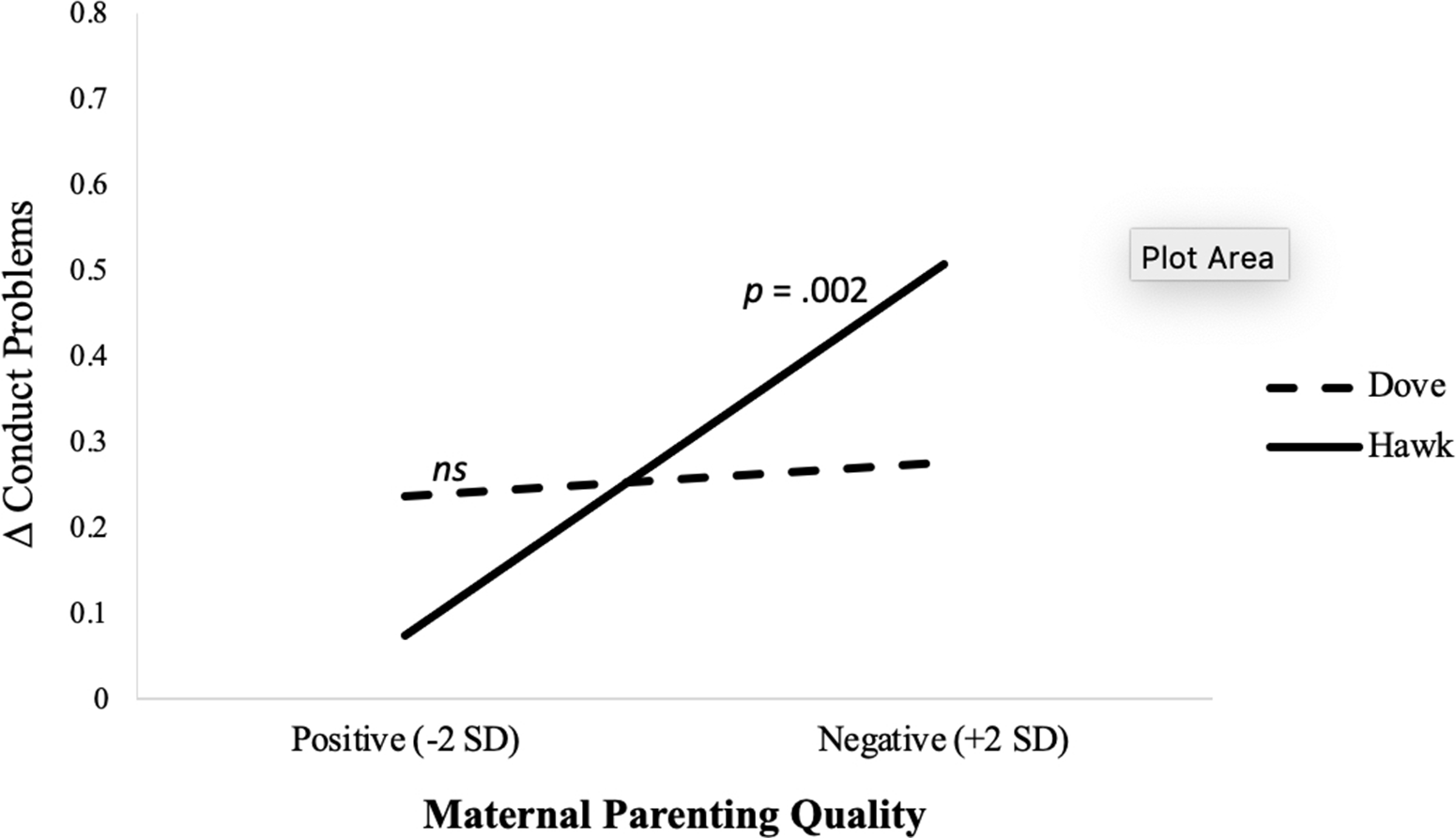
The interaction between temperament and maternal parenting predicting change in conduct problems is plotted in Figure 2. Maternal parenting quality was unrelated to changes in conduct problems for children with a Dove temperament, t = 0.29, p = .77. However, for children with a Hawk temperament, more negative parenting behaviors were associated with increases in conduct problems, t = 3.12, p = .002. Again, the nature of the simple slope plot was disordinal and appeared to suggest support for differential susceptibility. Quantitative analyses provided further support for this interpretation, with a PoI index of 0.33. In addition, the point of cross-over (x = −0.35) resulted in a PA index of 0.40, supporting DST over diathesis-stress (Roisman et al., Reference Roisman, Newman, Fraley, Haltigan, Groh and Haydon2012). Thus, while more negative parenting behaviors predicted increases in conduct problems for those with a Hawk temperament, in the 40% of environments characterized by more positive parenting behaviors, children with a Hawk temperament evidenced less conduct problems from preschool to first grade relative to children with a Dove temperament.
Simple slope plot of interaction between maternal parenting quality (from ± 2 SDs) and temperament predicting changes in conduct problems.

Paternal parenting
The model for paternal parenting also showed satisfactory fit with the data, χ2(2, N = 243) = 1.08, p = .58, RMSEA = 0.00, CFI = 1.00. There were no direct effects of child temperament or paternal parenting quality on changes in depressive symptoms or conduct problems over time (Table 2). However, there was a significant interaction between child temperament and partner parenting in predicting changes in child depression, β = −0.20, p = .002. As shown in Figure 3, partner parenting quality predicted changes in depressive symptoms for children with a Dove temperament (i.e., −1 SD below the mean temperament score), t = 3.47, p = .001. However, partner parenting quality was not associated with changes in depressive symptoms for those with a Hawk temperament, t = 0.62, p = .54. In accord with the findings with maternal parenting and changes in depressive symptoms, the Dove temperament profile appeared to act as a susceptibility factor. Children exposed to high negative paternal parenting evidenced increased depressive symptoms, while those exposed to high positive paternal parenting showed fewer depressive symptoms relative to children with the Hawk temperament. Quantitative metrics further supported DST, PA index = 0.28 and PoI index = 0.20. Contrary to results for maternal parenting, temperament did not moderate the association between partner parenting and changes in conduct problems.
Simple slope plot of interaction between paternal parenting quality (from ± 2 SDs) and temperament predicting changes in depressive symptoms.

Sensitivity analyses
Three of the partners in the current study were females in same-sex relationships with the biological mother of the child. In addition, 26% of male caregivers (n = 64) were not biologically related to the children in the current sample. Given the small sample size of female and nonbiologically related partner caregivers, we were unable to conduct multigroup analyses to determine if findings significantly differed based on biological relatedness of the caregivers. However, we did conduct follow-up sensitivity analyses where we only included the subsample of male caregivers that were related to the child (n = 173), and the pattern of results remained the same. Specifically, the interaction between temperament and parenting quality predicted changes in depressive symptoms, β = −0.23, p = .003, but not conduct problems, β = 0.00, p = .98. Further analyses of the simple slopes revealed that parenting quality was significantly associated with change in depressive symptoms for children with a Dove temperament, t = 2.94, p = .004, but not for children with a Hawk temperament, t = 1.04, p = .30. In accord with DST, the simple slopes evidenced a cross-over pattern, with children with a Dove temperament showing greater depressive symptoms when parenting quality was poor but also showing fewer depressive symptoms relative to children with a Hawk temperament when parenting quality was positive. A PA index of 0.34 and a PoI index of 0.24 further supported DST.
Discussion
Research to date has generally assumed that differential susceptibility to the environment is domain-general, with certain temperament traits being susceptible to broad aspects of adverse and supportive contexts. Yet disparities in research findings implicate a broad range of potential susceptibility factors and offer contradicting results regarding the nature of the interaction between temperament traits and the environment (Rabinowitz & Drabick, Reference Rabinowitz and Drabick2017). Utilizing an evolutionary-informed paradigm for assessing temperament, the current study sought to specifically address whether differential susceptibility operates in a domain-general or domain-specific fashion. According to a domain-general perspective, certain children would be expected to be differentially susceptible to a range of environmental conditions when predicting a wide variety of developmental outcomes (Belsky et al., Reference Belsky, Bakermans-Kranenburg and Van IJzendoorn2007). In other words, some children are susceptible and malleable to environmental circumstances while others are less sensitive to these same environmental conditions. However, a domain-specific approach allows for the possibility that different temperament phenotypes might be susceptible either to different environmental influences or with respect to distinct developmental outcomes (Belsky et al., Reference Belsky, Bakermans-Kranenburg and Van IJzendoorn2007). In other words, differential susceptibility may not be a fixed trait that only some individuals have. Rather, differential susceptibility may be observed across different temperamental traits or phenotypes when examining diverse environmental conditions or distinct developmental outcomes. Results from the current study provides initial support for the idea that differential susceptibility may be domain-specific, with two different evolutionarily informed temperament phenotypes both evidencing differential susceptibility, but to different developmental outcomes. In accord with predictions, children with “Hawk” temperaments were differentially susceptible to parenting when predicting conduct problems but not depressive symptoms. In contrast, “Dove” temperaments were differentially susceptible to parenting quality in predicting changes in depressive symptoms but not conduct problems.
Specifically, children high in the Dove temperament displayed greater increases in depressive symptoms than children with a Hawk temperament when parenting quality was negative. However, in contexts of positive parenting quality, children with the Dove temperament had lower levels of depressive symptoms relative to those with a Hawk temperament. In contrast, children on the “Hawk” end of the temperament continuum were susceptible to maternal parenting quality only when predicting conduct problems. Negative maternal parenting quality predicted greater increases in conduct problems from preschool to first grade among children with a Hawk temperament. However, in contexts of positive maternal parenting, the Hawk temperament displayed fewer conduct problems than children with a Dove temperament. These results highlight that different temperamental phenotypes may be differentially susceptible to different developmental problems. This fits with the long-standing temperament literature, which suggests that children characterized by greater inhibition and fearfulness are at greater risk of depressive symptoms while those with tendencies toward higher approach, impulsivity and fearlessness are more at risk for behavioral problems (Rothbart, Reference Rothbart2011). However, to our knowledge, this is the first empirical test to explicitly examine whether differential susceptibility operates differently across domains of child functioning.
Although findings for mothers consistently supported the hypotheses derived from the synthesis of differential susceptibility and an evolutionary model of temperament, the results only provided partial support for fathers. Specifically, both maternal and partner parenting interacted with the Dove temperament in predicting depressive symptoms. However, the Hawk temperament was only differentially susceptible to conduct problems in the context of maternal parenting quality; partner parenting did not moderate the extent to which children with Hawk temperaments evidenced changes in conduct problems over time. It is presently unclear why “Hawk” children would be susceptible to maternal, but not partner, parenting quality. Research involving fathers is relatively scarce, particularly in the differential susceptibility literature. However, several studies have found that maternal parenting is a stronger predictor of differential susceptibility for behavior problems than paternal parenting (Belsky et al., Reference Belsky, Hsieh and Crnic1998; Kochanska et al., Reference Kochanska, Brock, Chen, Aksan and Anderson2015; Stocker et al., Reference Stocker, Masarik, Widaman, Reeb, Boardman, Smolen and Conger2017). Kochanska et al. (Reference Kochanska, Brock, Chen, Aksan and Anderson2015) suggested that these differences could be the result of lower mean levels of paternal observed discipline and power assertion. However, in our sample, father-figures were slightly more likely to show signs of aggression, anger, and intrusive control during the laboratory task (see Table S1).
One possible explanation is that higher levels of paternal control and lower levels of paternal warmth are more gender normative and thus less likely to be perceived by the child as negative (Winsler et al., Reference Winsler, Madigan and Aquilino2005). Another possibility is that the nature of the observed parenting task, in which parents worked with their children to build a house out of Legos, falls into stereotypical male gender roles (e.g., building). As a result, overt paternal intrusiveness and control could have been perceived as fathers taking lead of the task even as they rejected bids by the child to assist. Finally, several studies have also found that maternal parenting is a stronger direct predictor of child behavior and conduct problems than paternal parenting (Kauser & Pinquart, Reference Kauser and Pinquart2016; Rothbaum & Weisz, Reference Rothbaum and Weisz1994), perhaps because mothers are still considered the primary caregiver and socializing agent in most households. Further, the triadic nature of the task may have contributed to the differential findings as well. While the task was designed to emulate naturalistic family dynamics between the child and both parents, it is possible that the presence of the other parent could have disrupted parenting behaviors that might have occurred in a dyadic context. For example, one study found that, when compared to dyadic parent–child tasks, both mothers and fathers tended to produce fewer words while simultaneously using more complex language skills in triadic tasks with their child (Bingham et al., Reference Bingham, Kwon and Jeon2013), suggesting that the presence of the other parental figure alters parent–child speech and interaction patterns. However, differences in parent language use between dyadic and triadic contexts were particularly pronounced for fathers (Bingham et al., Reference Bingham, Kwon and Jeon2013), indicating that fathers might be more likely to alter interactions with their children in the presence of other caregivers. Therefore, future research should attempt to examine maternal and paternal parenting behaviors in individual dyadic tasks with the child.
Nevertheless, these findings raise the question of why the Hawk temperament may be differentially susceptible to (maternal) parenting quality when predicting conduct problems while the Dove temperament is differentially susceptible to parenting quality when predicting depressive symptoms. A potential explanation for these diverging pathways of susceptibility may lie in the evolutionarily informed phenotypic differences in how the Hawk and Dove temperaments respond to challenge in their environment. For example, the Dove temperament is proposed to respond to challenging or adverse environments by behaviors of withdrawal, appeasement, and passivity (Korte et al., Reference Korte, Koolhaas, Wingfield and McEwen2005), which could be considered markers of depression (American Psychiatric Association, 2013). In contrast, in abundant and peaceful environments, the Dove phenotype engages is curious, engaged, and exploratory, which could be protective against depressive symptoms. On the other hand, the Hawk phenotype responds proactively to challenge and threat, often via risky and aggressive means and dominant posturing (Korte et al., Reference Korte, Koolhaas, Wingfield and McEwen2005), which are hallmark signs of conduct problems (American Psychiatric Association, 2013). Conversely, in resource-rich and abundant environments, the Hawk phenotype tends to engage in routine, predictable behaviors (Korte et al., Reference Korte, Koolhaas, Wingfield and McEwen2005), which could promote better rule following and lower levels of conduct problems in environments characterized by high quality parental caregiving. Indeed, there is some evidence that secure attachments and higher quality parenting predict greater internalization of rules among exuberant or fearless children (characteristics of the Hawk temperament profile) than among the fearful, cautious children (characteristics in line with the Dove temperament profile) (Augustine & Stifter, Reference Augustine and Stifter2019; Kochanska, Reference Kochanska1995).
As an alternative but complementary explanation, recent formulations of DST have proposed that some children are differentially susceptible to the environment due to more sensitive central nervous systems, “which cause environmental influences to register more easily and more deeply” (Pluess, Reference Pluess2015, p. 141). Despite calls for a better understanding of the mechanisms of differential susceptibility (Belsky & Pluss, Reference Belsky and Pluess2009), we are not aware of any studies that have examined central nervous system functioning as an explanatory mechanism of differential susceptibility findings. However, there is some evidence that behavioral manifestations of Hawk and Dove temperamental phenotypes do underlie individual differences in neurobiology (Korte et al., Reference Korte, Koolhaas, Wingfield and McEwen2005). For example, traits characterizing the Dove temperament are associated with greater amygdala reactivity when processing novel stimuli (Schwartz et al., Reference Schwartz, Wright, Shin, Kagan and Rauch2003). The amygdala is thought to be important in evaluating environmental cues and attaching significance to events (LeDoux, Reference LeDoux2007), but sustained amygdala hyperreactivity (e.g., in response to stressful of threatening contexts) has been linked to an increased risk of depression (Frodl et al., Reference Frodl, Meisenzahl, Zetzsche, Bottlender, Born and Groll2002; Sheline et al., Reference Sheline, Barch, Donnelly, Ollinger, Snyder and Mintun2001). In contrast, characteristics of the Hawk phenotype have been associated with hypoactivity of the amygdala, a more sensitive ventral striatum, and increased activity in dopaminergic pathways, particularly during events associated with reward processing and decision making (Flagel et al., Reference Flagel, Waselus, Clinton, Watson and Akil2014; Korte et al., Reference Korte, Koolhaas, Wingfield and McEwen2005; Sweitzer et al., Reference Sweitzer, Donny and Hariri2012). Deficits in amygdala reactivity and dysfunctions in the dopaminergic system have both been associated with conduct problems (Grigorenko et al., Reference Grigorenko, DeYoung, Eastman, Getchell, Haeffel, Klinteberg and Yrigollen2010; Moul et al., Reference Moul, Hawes and Dadds2018; Yanowitch & Coccaro, Reference Yanowitch and Coccaro2011). Thus, Hawks and Doves may evidence differential susceptibility to the environment via different neurobiological mechanisms that may pertain to distinct pathologies.
Limitation and future directions
The current study has several strengths, including the use of a prospective longitudinal cohort, a socio-demographically and racially diverse sample, and a multimethod design. However, several limitations of the current study also warrant discussion. First, although our sample was demographically diverse, our results pertain to a community sample of participants from a mid-sized U.S. city. Thus, findings may not generalize to clinical or atypical samples or to people living in rural or international locations.
Second, our assessment of parenting was derived from single, 10-minute laboratory task. While observational methods of parenting reduce possible informant bias, we cannot out rule the possibility that features of the tasks may have pulled for certain behaviors or responses that would not be evident in different tasks or parental reports. Thus, future research should attempt to replicate our findings using multiple observations over longer periods of time or a multimethod assessment battery. In addition, the current study used a composite measure of parenting, ranging from positive to negative parenting quality. This is consistent with methodological recommendations for testing differential susceptibility and provides a good first test of the hypothesis that different temperament phenotypes might both be differentially susceptible to parenting but predicting different outcomes. Nevertheless, it is possible that results may differ when examining different domains of parenting behavior, as different aspects of parenting (e.g., harshness/hostility vs. disengagement or lack of warmth) may be associated with unique developmental problems. For example, externalizing behaviors, like conduct problems, have been more strongly associated with harsh and controlling dimensions of parenting than warmth or sensitivity (e.g., Hoeve et al., Reference Hoeve, Dubas, Eichelsheim, Van der Laan, Smeenk and Gerris2009; Pinquart, Reference Pinquart2017), while parental rejection is more strongly linked with child depression than parental control (e.g., McLeod et al., Reference McLeod, Wood and Weisz2007).
Therefore, future research should attempt to more fully disentangle how the Hawk and Dove temperaments might be differentially susceptible to subdimensions of parenting quality. Indeed, we would note that the current study focused on examining domain specificity of differential susceptibility with respect to developmental outcomes. However, it has also been theorized that different children may be specific to different environmental influences. Therefore, susceptibility may be conferred across different dimensions of parenting or across different aspects of the rearing environment (e.g., parenting quality vs. interparental conflict). This is an important research question for future studies to address. In addition, different domains of parenting might pose unique challenges for different temperament phenotypes. For example, the impulsive and dominant nature of the Hawk temperament might react to controlling or harsh parenting with escalating and coercive patterns of responding (Patterson, Reference Patterson, Reid, Patterson and Snyder2002), whereas the more submissive and conciliatory Dove temperament may react by withdrawing and showing signs of defeat and depression (Gilbert & Allan, Reference Gilbert and Allan1998). Conversely, in the face of disengaged parenting, the Hawk temperament may exhibit increased behavior problems both due to the lack of constraints and discipline and to garner parental attention. The more cautious nature of the Dove temperament, meanwhile, may result in attempts to elicit parental attention through appeasing, submissive, or conciliatory behaviors. Future research should attempt to examine the underlying developmental processes that might help account for how and why specific domains of parenting may result in distinct developmental outcomes for different temperament profiles.
In addition, child psychological adjustment was based solely on teacher reports. Schools are a salient context for assessing child psychological development, especially during developmental switch points, such as the transition into formal schooling. However, children may exhibit different behaviors in nonschool settings (e.g., home environments) that may not be captured in the current study. Therefore, future research should attempt to include multiple informants of child psychological adjustment. The results of the current study are specific to early childhood, and results may not replicate in samples with younger (e.g., infants. toddlers) and older (e.g., adolescent) samples. Indeed, an important next step in the differential susceptibility literature is to assess whether support for differentially susceptibility is specific to certain developmental periods (Rabinowitz & Drabick, Reference Rabinowitz and Drabick2017). Finally, while the PA and PoI indices supported differential susceptibility in sensitivity analyses that only included biological fathers, in analyses that included all partners (i.e., nonbiologically related paternal caregivers, three females in same-sex partnerships), the PoI index for partner parenting was just within the bounds of support for differential susceptibility. Therefore, future research should attempt to replicate support for differential susceptibility within both paternal figures and caregivers in same-sex relationships.
We would also note that the current study was designed to test individual differences in response to both positive and negative parenting quality with respect to two salient developmental psychological problems – conduct problems and depressive symptoms – in early childhood. As such, we compared results based on assumptions from diathesis-stress and differential susceptibility models. However, as a complimentary approach to differential susceptibility, vantage sensitivity theory suggests that some children are predisposed to be more responsive to positive rearing environments (i.e., the “bright side” of differential susceptibility), particularly with respect to positive developmental outcomes (Pluess & Belsky, Reference Pluess and Belsky2013). Extending the findings from the current study, we might expect that Hawks and Doves would be differentially responsive to positive rearing experiences with respect to different developmental outcomes. For example, some of the trade-offs of the Hawk temperament include greater extraversion, sociability, and leadership qualities. In contrast, the advantageous developmental outcomes of the Dove phenotype include greater self-control and behavioral flexibility. According to EGT, these beneficial trade-offs would be more likely to occur in positive rearing environments (Korte et al., Reference Korte, Koolhaas, Wingfield and McEwen2005). Therefore, exploring individual differences in responsivity to exclusively positive rearing environments (i.e., vantage sensitivity) within this evolutionary paradigm of temperament is an intriguing area for future research.
Conclusions
Despite these limitations, the current study provides an important step in empirically testing whether differential susceptibility operates in a domain-general versus domain-specific fashion during early childhood. Highlighting the potential utility of integrating differential susceptibility within an evolutionary developmental model of temperament, we found that children with both Hawk and Dove temperamental phenotypes were differentially susceptible to the parenting environment regarding different domains of child functioning. While there is conceptual overlap between EGT and existing temperament frameworks (e.g., inhibited vs. uninhibited temperaments), we also believe that this evolutionary approach to temperament provides additional valuable insight into how behavioral phenotypes interact with the early environment in predicting subsequent adjustment. Specifically, EGT provided the framework for examining the novel, testable hypotheses that differential susceptibility operates in a domain-specific fashion and that susceptibility to the environment can be attributed to contrary temperamental phenotypes. Traditional psychological theories have not provided nor tested this hypothesis. In addition, against the backdrop of studies that primarily investigate the link between maternal parenting and child outcomes, the current study also advances our understanding of the interaction between paternal parenting and child temperament in predicting child development. From a clinical perspective, these findings may aid intervention efforts by identifying the specific confluence of child and parental factors that give rise to particular child development problems.
Supplementary material
The supplementary material for this article can be found at https://doi.org/10.1017/S0954579422000256.
Funding statement
This research was conducted at the Mt. Hope Family Center and supported by the Eunice Shriver Kennedy National Institute of Child Health and Human Development (R01 HD065425) awarded to Patrick T. Davies and Melissa L. Sturge-Apple. Rochelle F. Hentges is now at the National Institutes of Health Center for Scientific Review.
Conflicts of interest
None.
Disclaimer
This article was prepared while Rochelle F. Hentges was employed at East Tennessee State University. The opinions expressed in this article are the author’s own and do not reflect the view of the National Institutes of Health, the Department of Health and Human Services, or the United States government.