On August 31 2016, Brazilian president Dilma Rousseff was removed from office, after 22 months of massive mobilizations that divided the country and shook its political structures. Calls for protests came from a loosely tied network of actors, among them self-proclaimed right-wing grassroots organizations, many of which had not existed a few years earlier. These actors launched a successful multitudinous campaign that relied heavily on online social media communication, using framing mechanisms that both tapped into and further polarized Brazilian politics.
These phenomena are not exclusive to Brazil. Around the world there is evidence of the rise of grassroots right-wing activism, as well as of the use of social media by actors across the ideological spectrum to mobilize and polarize. Taken together in a context of political crisis, such as the impeachment of an elected president, these processes can put a significant strain on the political system. We still know little, however, about the characteristics of these emergent actors, their strategies, and their impacts. This article sheds light on these debates by comparing framing tasks and specifying the framing mechanisms used by actors as they engaged in collective action.
To accomplish these goals, this study brings together two strands of theoretical analysis that have evolved with little cross-fertilization: the framing approach in social movement theory, and the debates about populism as a process of collective identity creation (Laclau Reference Laclau2005; Mouffe Reference Mouffe2018; Urbinati Reference Urbinati2019). Based on the framing literature, the analysis identifies and compares three key tasks of signifying work for mobilization: the creation of diagnostic, prognostic, and motivational frames (Ben- ford and Snow 2000).
The literature on populism, in turn, helps us to understand the articulation of seemingly unrelated grievances among different actors. Thus, while the framing literature allows us to specify what actors need to do, the populist literature sheds light on how actors deploy these tasks. By bringing together these contributions, this article shows how actors that are not the typical populist leader or party—such as the civil society organizations analyzed here—use populist framing mechanisms in the context of a mobilization campaign built on a political crisis.
Along with Falleti and Lynch (Reference Falleti and Lynch2009), we understand mechanisms as middle- range arguments about “how things happen” (2009, 1147). In this article, framing mechanisms describe the signifying work developed through the construction of arguments for mobilization. Populist framing mechanisms, more specifically, are middle-range discursive operators deployed by actors to articulate collective identities, through the definition of diagnostics, the identification of targets, and the presentation of prognostics, all of which are based on a virtuous and heroic presentation of the self and on a simplified narrative, which subordinates and subsumes a wide array of grievances to an overarching issue.
We identify two populist framing mechanisms that were at the core of the narratives produced by the right-wing organizations that called for the ousting of Dilma Rousseff. First, antagonism, understood as the establishment of dichotomic boundaries between the virtuous people and its enemies. Second, reductionism, which subsumes grievances into a single signifier, so that the scope of issues is broadened but the demands they represent are subordinated to one overarching grievance.
This article argues that the framing mechanisms of antagonism and reduction- ism enabled actors to build unified diagnostics and targets while at the same time presenting different motivating messages and maintaining contradictory views of the country’s future. The two mechanisms perform different functions: the first establishes a logic of difference between who we are and who we are not, and the second a logic of equivalence among grievances that reduces them to a unity. Nevertheless, the two mechanisms reinforce each other. Therefore they cannot be understood in isolation.
The use of such mechanisms is not new in the rhetoric of contentious politics. However, their use by grassroots right-wing organizations during the impeachment campaign sets them apart from previous protest cycles. It shows a trend toward a rad- icalization of protestors’ discourse, which built on and further fueled feelings of indignation and hatred targeted at specific political actors and unified actors around an anticorruption rhetoric that temporarily subordinated a myriad of other grievances.
This article is organized in five parts. The next section discusses in more detail some of the main concepts and arguments of the framing and populist theoretical debates, then briefly describes the methods and data used in this study and offers a concise historical overview of the rise of right-wing activism in Brazil. The following section presents the content analysis of a sample of 4,574 Facebook posts published by 5 key organizations during the impeachment campaign: Free Brazil Movement (Movimento Brasil Livre), Brazil to the Right Movement (Movimento Endireita Brasil), OnTheStreets (NasRuas), Outraged ON LINE (Revoltados ON LINE), and Come to the Streets (Vem pra Rua). The article concludes by summarizing the main findings of the analysis and discussing an agenda for future research.
Creating Narratives For Political Battles
For the past 30 years, scholars have investigated how social movement actors engage in the dispute of meanings through the analysis of the intersections between culture and politics. In the literature on Latin American social movements, this cultural turn has aimed at showing how social movements’ economic and political demands are entangled with cultural struggles over meanings, even if the latter may be less visible than the former (Álvarez et al. Reference Álvarez, Evelina and Arturo1998). This perspective has broadened and at the same time has shifted the focus of the social movement scholarship toward the analysis of beliefs, values, and ideology, and has demonstrated that social movements’ cultural struggles and contestations are central to mobilization processes (Dagnino Reference Dagnino1998).
Much of the analysis of social movements’ meaning creation has been operationalized in the social movement literature through the concept of frames, inspired by the work of Erving Goffman (Reference Goffman1986). Collective action frames are defined by Benford and Snow (Reference Benford and David.2000, 614) as “action-oriented sets of beliefs and meanings that inspire and legitimate the activities and campaigns of a social movement organization.”
Collective action frames are, in this perspective, intentionally deployed by actors. They are key to the success of social movements because they include and exclude events or characters from a proposed narrative, tie events and actors in specific ways, and change how situations, actors, and objects are understood. To better specify the differences among these functions, Benford and Snow (Reference Benford and David.2000) proposed a typology of frames, based on core tasks: diagnostic, prognostic, and motivational. Diagnostic frames present the key issues and propose who should be held accountable (2000, 616). Prognostic frames emphasize the results expected from taking action. Motivational frames, in turn, promote a “call to arms or rationale for engaging in … collective action” (617), which might invoke cultural references, economic and social status, or the emotions of the audience (Snow Reference Snow2013, 3). Together, these frames define the actor’s point of view about what the problems are and who is to blame for them, identify possible solutions, and put forward arguments to convince and inspire their audiences. The manner in which actors engage in these tasks has, thus, an important impact on movements’ effectiveness. For example, in their analysis of homeless movements in the United States, Cress and Snow (Reference Cress and Snow2000) argue that social movement organizations’ ability to produce and articulate coherent diagnostic and prognostic frames was a key factor in explaining movement outcomes.
This literature has acknowledged the challenges that heterogeneous groups of actors face in creating such common frames by identifying “frame alignment” processes (Snow et al. Reference Snow, Burke Rochford, Steven K and Robert D.1986). Snow et al. define frame alignment as the “linkage of individual and SMO [social movement organizations] interpretive orientations, such that some set of individual interests, values, and beliefs and SMO activities, goals, and ideology are congruent and complementary” (1986, 464). Nevertheless, because of its emphasis on alignment and congruence, the framing approach has been criticized for a tendency to portray frames as a “discrete and clearly bounded map of meanings” (Steinberg Reference Steinberg1999, 741) and “as relatively stable meaning systems, akin to modular texts or maps, which can endure for long periods of time” (Steinberg Reference Steinberg1999, 739).
Framing theorists themselves have recognized that there is a dearth of research on how movements vary in their beliefs and claims across time, actors, and contexts (Snow et al. Reference Snow, Benford and Holly2014; Lindstedt Reference Lindstedt2018). That is, the process of meaning construction may be more disputed, fragmented, or problematic than the conceptual framework put forward by the framing literature suggests. This process is best understood as “a social production among and between actors that involves agreement, dissension, and ambiguity—sometimes minor, but at times considerable” (Steinberg Reference Steinberg1999, 745).
The literature that debates the recent rise of populist politics has focused on actors’ narratives, styles, and communication strategies (e.g., Bos et al. Reference Bos, Wouter and Claes2011; Bracciale and Martella Reference Bracciale and Antonio2017; Engesser et al. Reference Engesser, Nayla and Anders O2017b), but with little dialogue with the social movement debates on framing. We argue in this article, however, that the populism literature helps in analyzing framing processes as intrinsically disputed and problematic and in understanding that dissension and ambiguity are not necessarily adversary to collective action. On the contrary: contradictions are part of the creation of broad political coalitions that do not necessarily want to adopt precise, coherent, or well-defined frames across diagnostic, prognostic, and motivational tasks.
The debates about populism and communication strategies have gained even greater salience in the recent past because of the mainstreaming of digital communication platforms. The literature has highlighted the relevance of social media affor- dances for populist actors: as a direct channel for communication, circumventing traditional media and other gatekeepers, and as an arena to diffuse messages to a fragmented audience, based on broad frames and attention-maximizing content (e.g., Engesser et al. Reference Engesser, Nicole, Frank and Florin2017a; Gerbaudo Reference Gerbaudo2018; Fielitz and Thurston Reference Fielitz and Nick2018). As Engesser et al. have argued, “populism is particularly well suited to be communicated online” (2017b, 1286).
In spite of the relevance of these findings, we do not assume that online communication in social media necessarily has to be based on a populist style of communication, as Engesser et al. themselves recognize (2017a, b). Whether actors use populist framing mechanisms or not, to what extent, and why are key empirical questions, the answers to which vary according to actors’ ideologies and the political context. This article shows that right-wing grassroots organizations that participated in the campaign for the ousting of President Dilma Rousseff in Brazil used two such mechanisms to communicate with their audiences through social media: antagonism and reductionism.
The literature on the rise of populism has argued that at the core of this phenomenon is the discursive reclaiming of the legitimacy of a part of the people (which may be referred to as the patriots or the good citizens, for example), which presents itself as the whole people (populus) (e.g., Müller Reference Müller2016; Norris and Inglehart Reference Norris and Ronald2018). As Laclau has explained, “populism requires the dichotomic division of society into two camps—one presenting itself as a part which claims to be the whole” (Reference Laclau2005, 83). Because the others do not belong to the whole, they must be eliminated. The discursive work of building dichotomic boundaries is performed by what we call in this article the framing mechanism of antagonism. It is different from other boundary-building mechanisms, which recognize the legitimacy of the other and do not imply its exclusion, which is what Mouffe (Reference Mouffe2000) defines as agonism.
The mechanism of reductionism is related to what many authors refer to as thin ideology (e.g., Bracciale and Martella Reference Bracciale and Antonio2017; Elchardus and Spruyt Reference Elchardus and Bram2014; Kriesi Reference Kriesi2014) or fragmented ideology (Engesser et al. Reference Engesser, Nicole, Frank and Florin2017a). Populism, according to this perspective, is made of a small set of elements that “can be enriched with more substantive add-on ideologies, such as nationalism, liberalism, and socialism, which may result in left-wing populism or right-wing populism” (Engesser et al. Reference Engesser, Nayla and Anders O2017b, 1281). It is not the equivalent of the absence of ideology. Quite the contrary, it is a way of creating meaning that allows a broad coalition of actors to present a message that focuses on a key issue that subordinates but does not exclude the others. Because of its inner contradictions, it is also not a congruent process of frame alignment, as the literature on framing would characterize this process (Benford and Snow Reference Benford and David.2000, 624–25).
Antagonism and reductionism thus are mechanisms that interact and reinforce each other. As the analysis of the mobilizations of grassroots right-wing organizations in Brazil shows, actors deployed these mechanisms to build converging diagnostics and targets, while at the same time presenting different motivating messages and maintaining contradictions in terms of views of the country’s future.
Methods And Data
Not every actor who took to the streets against the government of Dilma Rousseff was a right-wing actor, if we define right-wing as a political ideology based on the belief that inequalities among people are natural and outside the purview of the state (Luna and Kaltwasser Reference Luna and Kaltwasser2014, 3). Nor did they all adopt populist framing mechanisms. Many were simply displaying their discontent with the economic and political situation and were not necessarily engaged either in ideological discussions or in supporting specific public policies. However, many of the grassroots organizations calling for protests—and all of those included in this study—openly defined themselves in contrast to the left and as part of the process of creation of a new right-wing field in Brazilian politics.
In order to better understand the framing mechanisms used by right-wing civil society activism, we selected five organizations that were among the main organizers of the protests, all of which were created in or after 2000: Free Brazil Movement (Movimento Brasil Livre), Brazil to the Right (Movimento Endireita Brasil), OnTheStreets (NasRuas), Outraged ON LINE (Revoltados ON LINE) and Come to the Streets (Vem pra Rua). These groups led the calling and organization of multitudinous protests through an intense use of social media platforms, becoming, in practice, the communication front of the campaign (Dias Reference Dias2017; Brazil to the Right 2016).
We retrieved 45,721 posts, published by the managers of the five organizations’ Facebook pages between November 2014 and August 2016. We did so using Netvizz (Rieder Reference Rieder2013), a Facebook app that extracted public posts on the platform.Footnote 1 We used R to randomly draw a stratified sample (by organization) of 10 percent of the whole database (1,418 posts from Outraged ONLINE, 1,282 from Free Brazil Movement, 1,036 from OnTheStreets, 443 from Brazil to the Right, and 395 from Come to the Streets).Footnote 2
The messages were manually coded using the software NVivo10, based on a mix of deductive and inductive coding procedures, following research designs that combine theory-driven and data-driven approaches (e.g., Bardin Reference Bardin2012; Elo et al. Reference Elo, María and Outi2014). The posts were first coded in three broad categories: diagnostic, prognostic, and motivational frames.
The second step was to inductively create subnodes corresponding to the specific arguments presented in each message.Footnote 3 The subnodes were defined in the process of reading and coding, based on themes prevalent in documents and in previous interviews with right-wing activists. The Facebook posts were coded in more than one node when more than one type of frame was identified, resulting in a multiple, nonexclusive coding procedure. Thus a single post could fulfill up to three core framing tasks and could display multiple particular frames at the same time. The coding process was conducted by one coder and took six weeks. To uphold the quality and rigor of the analysis, the coding procedure, the codebook, and the results were validated in a series of presentations and guided discussions with researchers familiar with the topic, who helped to clarify ambiguities and suggested corrections and adjustments.Footnote 4
The empirical analysis of frequency of frames was complemented by other data sources; namely, documents and qualitative interviews with key actors. We conducted nine in-depth interviews with leaders of Students for Liberty, the Free Brazil Movement, Come to the Streets, and Brazil to the Right, in November 2015 and October 2016. We also gathered secondary data that helped us understand the genealogy of the right-wing organizations being studied. We collected activists’ public speeches (e.g., published books and social media videos) and newspaper articles containing leaders’ comments and interviews.
An Emergent Political Field Of Right-Wing Activism
The successful mobilization of grassroots right-wing actors in 2015 and 2016 was unexpected. Although right-wing activism is not new, it had not taken to the streets in massive numbers for fifty years. Furthermore, actors who called for the mobilizations in favor of the impeachment initially did not have clear ties either to established social movement organizations or to political parties. In addition, they created a very heterogeneous coalition around the impeachment campaign. Although many portrayed themselves simply as right-wing, they encompassed various political ideologies, including monarchism, conservatism, libertarianism, and anarchocapi- talism, and they differed strongly in their levels of commitment to democracy. We know little about these differences and about actors’ strategies to overcome them. The highly contentious political context of polarization that has characterized Brazil’s recent history has overshadowed relevant variations among actors.
The strong presence of right-wing organizations in the massive street mobilizations that pushed for Rousseff’s ouster was the result of a slow but continuous process of creation of an emerging field of right-wing activism that dates back to the beginning of the 2000s. Emergent strategic fields of action are, as defined by Fligstein and McAdam, “social spaces where rules do not yet exist, but where actors, by virtue of emerging, dependent interests, are forced increasingly to take one another into account in their actions” (Reference Fligstein and Doug2011, 11). The impeachment campaign was crucial to strengthen ties among groups and to broaden the boundaries of this emergent field.
While right-wing activism has long existed, the human rights atrocities and the lack of popular support in the last period of the Brazilian civil-military dictatorship (1964–85) created a social stigma around the identity of right-wing actors. Throughout the 1980s and 1990s, actors with right-wing preferences struggled not to be publicly identified as such (Power and Zucco Reference Power and Cesar Zucco2009; Madeira and Tarouco Reference Madeira2011). This, however, does not mean that right-wing groups were absent from political life, or that they were powerless. Right-of-center political forces have always had an important role in Latin America, and Brazil is no exception. Even in the context of the “turn to the left” in the region in the 2000s, they remained able to have strong representation in parliament and to influence the agenda, as well as the contents of public policies (Luna and Kaltwasser Reference Luna and Kaltwasser2014, 2).
Right-wing activism is not, therefore, a new phenomenon. However, this emerging field of activism has been purposefully constructed by civil society actors who reclaim the legitimacy of right-wing ideals and pursue political change under those ideals. They have built an organizational structure and constructed common understandings about the country’s political problems and solutions and how to frame them.
Activism is defined in this article in broad terms, as “the pursuit of opportunities to defend contentious causes” (Abers Reference Abers2019, 23). It includes actions by agents within and outside the state, and it includes both digital practices and offline mobilization. We put emphasis, therefore, on the porous, informal, and potentially unstable contours of this field, as well as on its internal heterogeneity. The process of construction of this field can be roughly divided into two phases. The first, the articulation phase, stretches from the beginning of the 2000s to the June 2013 cycle of protests. The second, the mobilization phase, goes from 2013 to the ouster of Dilma Rousseff in 2016.
The first phase is characterized by the creation of new organizations and street protests. The first efforts of articulation of anti-Lula and anti–Workers’ Party groups date from this period. During those years, protests already focused on the alleged corruption of the Workers’ Party. Small protest events were organized during President Luiz Inácio Lula da Silva’s first administration (2003–6), around the so-called Men- salão scandal.Footnote 5 At that time, however, these protests did not become massive. Although at least 26 presidential impeachment requests were filed during Lula’s first term, none of them came even close to threatening his administration (Bragon Reference Bragon2006).
When Lula was re-elected, in October 2006, right-wing groups, such as Nariz de Palhaço (Clown’s Nose), protested on the streets, once more focusing on denouncing the government’s corruption ( Estadão 2006). Among these activists was the pop singer Lobão, who ended up becoming one of the most active celebrities campaigning for the impeachment of Rousseff and was already a vocal supporter of Jair Bolsonaro’s presidential candidacy (von Bülow and Dias Reference Von Bülow and Tayrine2019). That same year, The Movimento Endireita Brasil (Brazil to the Right Movement) was founded (Machado Reference Machado2011). This group wanted to “moralize politics” and “resurrect the rightwing spectrum of Brazilian politics” (Machado Reference Machado2011; Brazil to the Right 2016). In 2007 another opposition group was created by businesspeople, celebrities, employers’ unions, and other civil society groups: the Cansei! (Enough!) Movement (Bertolotto Reference Bertolotto2007; Azevedo Reference Azevedo2007; Tatagiba et al. Reference Tatagiba, Thiago and Teixeira2015). Although anticorruption protests gathered only a few thousand people in the streets of São Paulo in 2007, four years later they brought together about 30,000 people (Nascimento Reference Nascimento2011).
At the same time that middle-class citizens, businesspeople, and celebrities were creating new organizations, young student movement leaders were building transnational ties with right-wing organizations in the United States and other countries (Gobbi Reference Gobbi2016). In 2009, they created the Brazilian branch of the U.S.-based organization Students for Liberty. In 2011, one of its satellite groups, Aliança pela Liberdade (Alliance for Liberty), self-identified as anarchocapitalist and libertarian, was the first right-wing–led group to win the elections for one of the student movement’s most important federations, at the University of Brasília, in the capital city. The victory of this group in Brasília paved the way for strengthening the Students for Liberty organization in other universities and helped in the foundation of other organizations, chief among them the Free Brazil Movement and the think tank Popular Market Institute (Instituto Mercado Popular) (Gobbi Reference Gobbi2016).
These actors were also involved in the creation or renovation of right-wing parties, thus building collaborative bridges beyond civil society organizations. In 2011, they contributed to the founding of the Partido Novo (New Party) and also founded a party faction called Livres (Free) within the Partido Social e Liberal (PSL, Social and Liberal Party). There was no unified strategy on how to participate in party politics, however.
In 2013, two years into Dilma Rousseff’s first administration, a major cycle of protest swept Brazil. The so-called June protests separate the first and second phases of construction of the emergent field of right-wing activism. During this period, right-wing organizations became the most visible forefront of mobilizations against the government, based on a mix of online and offline repertoires of collective action. The June protests were sparked by the rise in public transport fares but quickly escalated to criticisms of the lack of public services, their poor quality, and the high expenditure and corruption scandals related to the 2014 Soccer World Cup—gathering a wide spectrum of grievances that showed deep dissatisfaction with the political system and the government. The right-wing organizations that had been organizing for the past decade were well positioned to take advantage of these general feelings of dissatisfaction. The protests turned increasingly into opposition and right-wing mobilizations, in which a patriotic repertoire (Alonso Reference Alonso2017; Alonso and Mische Reference Alonso and Ann2017) was displayed: the national flag, anthem, and colors were commonly used as rallying symbols, appealing to a sense of nationhood, while political party flags were burned and groups chanted against the Workers’ Party (Arruda Reference Arruda2013). This was a general rehearsal of what would be the impeachment campaign.
In the context of these mobilizations, yet newer right-wing organizations were created, oriented toward protests. Members of the Brazilian branch of Students for Liberty, for example, created the Free Brazil Movement. As one of its founders explained,
We created the Free Brazil Movement in 2013, in fact, because we [Students for Liberty] can’t get involved in activities of a political nature. We can’t demand, for example, that Dilma has to be impeached…. In the context of the 2013 demonstrations, we created another organization to participate in them. (Free Brazil Movement 2016)
In spite of a decline in popularity, Rousseff was re-elected president in 2014 by a narrow margin. That same year, however, her government and the Workers’ Party (along with a dozen other political parties from the left to the right of the political spectrum) were engulfed in a corruption crisis investigated by the judges and prosecutors who spearheaded the so-called Lava Jato (Car Wash) task force.Footnote 6 The president faced a perfect storm: an economic crisis, a political crisis, and a strong opposition (in Congress and on the streets). While the Workers’ Party had become the most popular political party at the beginning of the 2000s, a decade later there was also a strong anti–Workers’ Party feeling, known in Brazil as antipetismo (Samuels and Zucco Reference Samuels and Cesar2018).Footnote 7
The “Dilma Out!” cycle of protests started with the participation of a few thousand people in the streets of São Paulo (Uribe et al. Reference Uribe, Lima and Lima2014). It reached its peak in March 2016, with at least three million participants in hundreds of cities (Estado de São Paulo Reference de São Paulo2016). In August 2016, the Brazilian Senate voted to oust Dilma Rousseff, on the basis of controversial accusations of “creative bookkeeping” in the annual federal budget. On the day of the vote, on the wide lawn that stretches in front of the Brazilian National Congress, the police built a temporary wall, which divided protestors fighting for the impeachment from those who were denouncing a parliamentary coup against the president.
The Big Five
A broad coalition of actors participated in the campaign to impeach Dilma Rousseff. What brought these actors together was the common goal of removing the president and her party from power. Beyond that, the right-wing organizations that called the protests differed in their trajectories, the policies they defended, and their ideas about what the best post-Rousseff scenario would be (Fávero and Reverbel Reference Fávero and Paula2015). Up to August 2015, they still publicly diverged on whether calling for Rousseffs impeachment was the best course of action. While they all explicitly situated themselves on the right of the political spectrum, what that meant was not the same for all organizations.
The organization Outraged ON LINE is the oldest of the five analyzed in this article, having been founded in 2000. As the content analysis of organizations’ posts will show, it is also the one that sponsors the most extreme views on politics (Alonso Reference Alonso2017, 54), often based on moral and religious arguments. In 2010, when Rousseff, Lula, and their party still held strong institutional and popular support, Outraged ON LINE’s leader, Marcello Reis (a former Evangelical minister), created the organization’s Facebook page, which achieved more than two million likes before being removed by the platform in August 2016, days before the impeachment trial in the Senate. This organization was also one of the most vocal supporters of a military intervention as a solution to Brazil’s problems, a demand that was not supported by organizations such as Free Brazil Movement and Come to the Streets.
The organization OnTheStreets was founded in 2011, and in that same year, it participated in anticorruption protests that took place in various Brazilian cities (Nascimento Reference Nascimento2011). Some of its demands were the application of the Ficha Limpa (Clean Slate) Act in the 2012 municipal elections, the end of vote secrecy in the National Congress, and tougher laws against corruption (Rodrigues Reference Rodrigues2011). Along with Outraged ON LINE, this group first demanded the annulment of the 2014 elections, based on illegal financing claims. It also argued in favor of a military intervention to give Brazil a chance “to save itself from a dictatorship such as the Venezuelan one” (Facebook post, November 1, 2014).
The Free Brazil Movement and Come to the Streets were created in 2013 and 2014, respectively. The first gathered young libertarian and conservative leaders who were responsible for a political whirlwind in the student movement years before (Gobbi Reference Gobbi2016), and the second was a group founded by business leaders (Galhardo and Hupsel Filho Reference Galhardo and Valmar2015). Both saw the 2013 June protests as an opportunity to show that right-wing groups could take people to the streets (Chequer and Butterfield Reference Chequer and Colin2016; Gobbi Reference Gobbi2016). They also concurred in their denial of military intervention as the best solution to Brazil’s problems, and were eager to affirm their commitment to democracy and the rule of law.
The last of the five organizations analyzed, Brazil to the Right, was founded in 2006 by five lawyers and businesspeople (Folha de São Paulo Reference de São Paulo2014; Machado Reference Machado2011). This group advocates the reduction of the size of the Brazilian state and tax burdens and the expansion of individual freedom, such as civilian possession of firearms (Brazil to the Right 2016; Folha de São Paulo Reference de São Paulo2014). In 2010, the organization’s founder, Ricardo Salles, ran for state representative in São Paulo but was not elected (Machado Reference Machado2011); in 2018 he became minister of the environment in President Bolsonaro’s cabinet. As another BTTR leader declared in an interview,“Brazil to the Right arose precisely to put right-wing people in politics”(Brazil to the Right 2016). As with the Free Brazil Movement and Come to the Streets, the June protests were also important for Brazil to the Right leaders: “this movement [June protests] showed to the right-wing groups that it was possible to organize demonstrations… It ended up being, in fact, the beginning of the rescue of Brazil” (Brazil to the Right 2016).
In spite of their differences, these groups joined forces and engaged millions of Brazilians protesting in more than one hundred cities to oust Rousseff (Dias Reference Dias2017; Fávero and Reverbel Reference Fávero and Paula2015). Together with smaller organizations, they used WhatsApp groups to coordinate activities, share tasks related to the protests, and confirm their participation in protest events (Brazil to the Right 2016; Chequer and Butterfield Reference Chequer and Colin2016). With the external world, they communicated mainly through their Facebook pages. As the analysis below will show, these organizations successfully built shared diagnostic frames while displaying a variety of prognostic and motivational frames that allowed them to engage a broad audience.
Populist Framing Mechanisms In Action: Encompassing Narratives Of Chaos
A crucial challenge actors faced in the process of constituting this emergent rightwing field was to construct a broad collective identity that set the basis for a joint campaign for the presidential impeachment. The organizations analyzed in this article did so by heavily relying on populist framing mechanisms; namely, reductionism and antagonism. The frame analysis of Facebook posts published during the impeachment campaign shows that actors portrayed a political context of imminent tragedy and chaos, with an emphasis on the common definition of what the problems were and who was to blame.
Diagnostic Frames: Corruption and the Workers’ Party
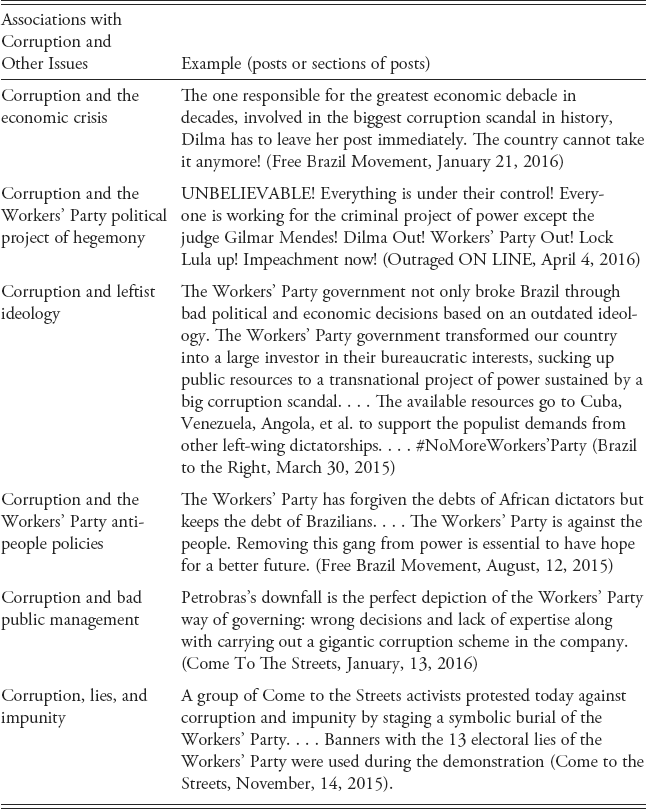
As we have seen, actors use diagnostic frames to point to grievances, as well as to identify whom to blame. Compared to the other types of frame tasks, these were the most recurrent in our database (at least half the posts of each organization presented diagnostic frames), and also the ones that showed less heterogeneity among the five organizations. They focused mainly on one problem—corruption—and one actor responsible for it—the Workers’ Party (see tables 1, 2, and 3).
Diagnostic Frames: Grievances (most frequent percent of posts)

Source: Dias Reference Dias2017, based on content analysis of Facebook messages collected through Netvizz.
Issues Associated with Corruption in Facebook Posts

Source: Elaborated by the authors based on posts collected on the organizations’ Facebook pages, via Netvizz. Posts translated from Portuguese by the authors.
Diagnostic Frames: Blame Attribution (most frequent percent of posts)

Source: Dias Reference Dias2017, based on content analysis of Facebook messages collected through Netvizz.
Table 1 presents the three most common issues outlined by the organizations’ Facebook posts as the country’s key problems. The data show a clear hierarchy in the definition of what is wrong: corruption is the most cited problem by all the actors. Of the 4,574 posts analyzed, approximately 28 percent denounced corruption. Corruption played the role of a key encompassing diagnostic frame that subsumed the other problems. It was not, however, just any kind of corruption, but the corruption perpetrated by a specific actor. In this sense, the organizations’ grievances were reduced but not restricted to corruption, which was resignified as any action from the enemy—the Workers’ Party (see table 2).
That the corruption by the Workers’ Party was exceptional—that is, different from corruption by other actors—is an idea that appears repeatedly in the posts analyzed, as well as in the interviews (e.g. Free Brazil Movement 2015; Gobbi Reference Gobbi2016) and in the public declarations of leaders. Actors claimed that the corruption scheme uncovered by the Lava Jato task force was unprecedented in human history, and moreover, that every political action or project undertaken when the Workers’ Party was in power was corrupt and illegitimate. Joice Hasselmann, former journalist, right-wing activist, and current federal deputy, elected in 2018, explained such reasoning during a radio interview broadcast live on Facebook.
My fight is against corruption. Lots of people ask me, “are you against the Workers’ Party?” I am against it and against all corrupt [parties]. There are corrupt politicians in all parties, I don’t know any party that is 100 percent clean…. The key question is that the Workers’ Party has a criminal political project of power….
The Workers’ Party has to be extinct. (OnTheStreets 2016)
Carla Zambelli, founder of NasRuas, followed Hasselmann and declared, in the same radio interview,
The Workers’ Party is a corrupt party, and among their allies you have corrupt people, the difference is simple…. These people steal for themselves, they steal to get rich, (but) the Workers’ Party steals to remain in power…. This is why we argue that the Workers’ Party should be extinct, and we also argue for people not to vote for their allies.
While the source of corruption zoomed in on the Workers’ Party, its impact was widely spread. As table 2 shows, actors presented the issue of corruption as being the key to understanding the other problems the country faced. The problem of “bad management” encompasses Rousseff’s decisions to cut spending on education, to increase spending on advertising, to allocate resources abroad, and to increase taxes. It also includes discussions about the fiscal improprieties that led to the formal accusations against the president in the Brazilian Congress. Although these became the legal basis for the impeachment process, they were not the primary focus of actors’ diagnostic framing efforts.
For organizations such as the Free Brazil Movement and Outraged ON LINE, posts that referred to “lies, illusions, or manipulation” were often associated with left-wing parties, especially with the Workers’ Party, Rousseff herself, or Lula. In our sample, 522 posts coded with this frame, and about 40 percent mentioned one or more of these actors. The posts sought to deconstruct their images and credibility by portraying them as the enemies of the Brazilian people, who only cared about themselves and their positions, as this post stresses: “Dilma, the Brazilian people do not deserve to go through what they are going through, entirely due to your stubbornness and pride. At least once, have in mind the country and not yourself! Resign!” (Come to the Streets, August 10, 2016).
Throughout the impeachment campaign, the recurrent portrayal, by the media and by judicial authorities, of an “unprecedented” corruption scandal helped fuel the argument that Brazil was going through a situation of extreme jeopardy to the country’s institutions.Footnote 8 In this context, organizations such as OnTheStreets and Come to the Streets highlighted “impunity, delay, or obstruction of justice” as a problem. In the narratives developed by these groups, the politicians indicted for corruption were guilty even before due legal process, so that any strategy, attempt to fight the accusations or to deny them, was reproachable.
The analysis of messages that attributed blame confirms that organizations specifically targeted the Workers’ Party and its main leaders. As table 3 reveals, even though the campaign had the goal of impeaching President Rousseff, the data show that, for the five organizations analyzed, the protests had a broader aim: these were demonstrations against the Workers’ Party. In the specific case of posts published by Brazil to the Right, the Workers’ Party is mentioned more than twice as often as Rousseff herself.
This antagonism built on and contributed to increasing the antipetismo feelings, portraying the Workers’ Party (and its supporters) as enemies of the people. In fact, all five organizations also characterized members and sympathizers of the party as criminals. This logic did not allow any room for a position outside of the anti– and pro–Workers’ Party poles, as the following post by Outraged ON LINE exemplifies: “If you are not against the Workers’ Party, then you are as dirty as they are…. The struggle will not end until we remove this criminal organization from power. Together we are stronger, with God we are unbeatable” (January 3, 2015). This reasoning was also used to put pressure on parliamentarians, combined in the following post with the prognostic frame of impeachment: “You [Congress representative] either vote for the impeachment or you are an enemy of Brazil. Those who do not vote are [also] the enemies” (Free Brazil Movement, April 16, 2016).
Prognostic Frames:Fighting the Enemy
Compared with the results for diagnostic frames, there is greater heterogeneity among organizations when it comes to presenting solutions. These reveal multiple approaches to engage in antagonist politics, ranging from strengthening the penal state to impeaching the president, banning a political party, and imprisoning political opponents. They are different species of the same genre: fighting the enemies of the people as the solution for all their grievances. Moreover, the deployment of populist framing mechanisms does not contradict the notion of economic liberalism as prognostic (see table 4). Instead, it functions as an add-on ideology that follows logics similar to those of previous neopopulist experiences in Latin America. This is not something new, as populism has been used in the region to implement neoliberal politics since the 1990s (Collins Reference Collins2014, 65).
Prognostic Frames (most frequent percent of posts)

Source: Dias Reference Dias2017, based on content analysis of Facebook messages collected through Netvizz.
Not surprisingly, the presidential impeachment was the most cited proposal, presented by the organizations as the first and fundamental step to deal with the chaos, a chaos that had been created by the Workers’ Party. In these messages, the impeachment of Rousseff, the ouster of the Workers’ Party, and the imprisonment of the party’s leader, Lula, became one and the same goal. By separating them in our coding analysis, we are able to show how actors focused on fueling antipetismo feelings. “Workers’ Party Out” appears as the most cited frame for the organization Brazil to the Right and the second in three other cases (see table 4).
Policy proposals for after the impeachment were not among the most relevant topics of discussion on organizations’ Facebook pages. Exceptions are posts by the Free Brazil Movement and Come to the Streets, which hinted at the agendas they sought to pursue: economic liberalism for the former and anticorruption measures for the latter. Both of these were, in fact, widely shared among the right-wing organizations analyzed in this article. Even in those cases, however, the small percentage of posts discussing these policy-related issues shows that this was not important in the online framing of prognostics (see table 4). Differences among the actors were more visible during protests themselves. Organizations such as the Free Brazil Movement and Come to the Streets, which were critical of groups that defended military intervention as a solution to the country’s crisis after the impeachment, sought to position themselves in different places in the streets and when camping in front of the National Congress (Chequer and Butterfield Reference Chequer and Colin2016; Hupsel Filho and Galhardo Reference Hupsel Filho and Galhardo2015).
(Un)Stable Union: A Heterogeneous Emergent Field
The third type of frames, motivational frames, is the most heterogeneous type of frame tasks (see tables 5 and 6). Among the five groups analyzed, there was little convergence on how to “call to arms” (Benford and Snow Reference Benford and David.2000, 617), how to engage the “we” (Gamson Reference Gamson1992), or how to justify the urgency or importance of mobilization, all of which are included in this type of task. Brazil to the Right used humor and sarcasm to motivate its audience and criticize left-wing ideals. As one of its leaders argued, humor is “the most corrosive weapon against bad politicians” (Brazil to the Right 2016). Outraged ON LINE, in turn, often emphasized that it represented the good, fighting against evil to prevent moral debacle and the loss of Christian values. OnTheStreets balanced both the nationalistic imaginary and conservative arguments to galvanize a sense of urgency, in close ideological proximity to Outraged ON LINE.
Motivational Frames (most frequent percent of posts)

Source: Dias, Reference Dias2017, based on content analysis of Facebook messages collected through Netvizz.
Examples of Motivational Frames in Facebook Posts

Source: Elaborated by the authors based on posts collected on the organizations’ Facebook pages, via Netvizz. Posts translated from Portuguese by the authors.
While the Workers’ Party and its allies represented the enemy, the Lava Jato prosecutors were portrayed as national heroes, whose work had to be supported through citizens’ mobilization. All five organizations openly defended the Lava Jato task force, although only Come to the Streets and OnTheStreets used such a motivational frame in more than 10 percent of the posts (13.7 percent and 10.3 percent, respectively). It varied from manifestations like “Full support to the Lava Jato task force, Judge Sergio Moro and the Federal Justice and Police agents” (Come to the Streets, February 10, 2016) to a deified image of them, as in “Heroes! For those who still do not know: the team of the Lava Jato task force Operation Car Wash!” (Outraged ON LINE, December 25, 2016).
Arguments based on morality and religion were also relevant. As tables 5 and 6 show, evoking God, Christianity, and the evils of communism or leftist ideology were prominent features in the framing of motivations, often linked to references to patriotic symbols, as elements associated with the virtuous people. The expression “our flag will never be red,” used extensively in Facebook posts and protest banners, was a call to fight against left-wing ideals, identified in Brazil with the color red, as indicated in the following post: “Don’t let yourself be manipulated, our focus now must be WORKERS’ PARTY OUT!!!!! DILMA OUT!!!! Our flag will never be red!!!!” (Outraged ON LINE, February 27, 2015).
Come to the Streets and the Free Brazil Movement went with different approaches. The first motivated its audience mostly by arguing in favor of publicly supporting politicians and public authorities or putting pressure on them so they would stand against the Workers’ Party and its corruption, while the second tried to bring people to the streets by showing that those were multitudinous, democratic, and popular protests, in which everyone should take part.
The analysis of diagnostic, prognostic, and motivational frames of the five rightwing organizations shows how these actors deployed antagonistic and reductionist frame mechanisms typical of populism across all of these tasks. They successfully united various actors during the impeachment campaign by reducing the diagnosis around the frame of corruption, portraying culprits as enemies, and displaying a myriad of motivational arguments that allowed them to mobilize feelings of fear, rage, and indignation and to engage with a broad audience.
Final Remarks
The ousting of President Dilma Rousseff was a dramatic chapter in Brazil’s democratic history. As this article shows, right-wing civil society organizations carried out a successful 22-month campaign for the impeachment of Rousseff by using populist framing mechanisms to set the focus on one issue and one enemy.
The cross-fertilization between framing analysis in social movement studies and the literature on populism helps in understanding the power of weaving diagnostic, prognostic, and motivational frames through the mechanisms of reductionism and antagonism. The reduction of grievances to a heroic fight of the “good people” against corruption and its perpetrators created a common denominator around which these groups were able to communicate with broad sectors of Brazilian society, in spite of their internal differences. It succeeded first because virtually nobody would identify themselves as a defender of corruption, making every social demand also a grievance against corruption; and second, because corruption can subsume most, if not all problems. It is somewhat easier to claim that public health care services are precarious or the country’s economy is in crisis due to corruption than to discuss specific measures to tackle those issues.
The populist framing mechanisms of reductionism and antagonism describe “how things happened” in the campaign for the impeachment of Dilma Rousseff, but they are also “portable concepts” (Falleti and Lynch Reference Falleti and Lynch2009, 1159). Although determined by the context in which they are deployed, these mechanisms are useful for understanding the rise of right-wing activism in other political arenas and how the activists build broad coalitions among heterogeneous groups. This article has explored the process of constructing an emerging field of right-wing activism, which found, in the impeachment campaign, one of its key moments to set its moving boundaries around antipetismo feelings. This study does not, however, purport to analyze the whole field, which includes many other important actors. Furthermore, the analysis focuses only on the content of Facebook communication, with its specific characteristics. To know more about the values and identities of the right-wing actors requires research that considers not only the narratives but also their actions, which exceeds the goals of this article.
The campaign for Rousseff’s impeachment shows the ability of this emergent field of right-wing activism to mobilize people, online as well as on the streets. It is a phenomenon that cannot be understood without analyzing the step-by-step process of organization of the field that began, more than a decade before the impeachment, in civil society, led by students, celebrities, businesspeople, and clergy without clear ties to political parties. In the aftermath of the impeachment, many of these actors moved to electoral politics, either supporting candidacies or putting forward their own candidates, and often fighting among each other or even regretting the polarization they helped to propel. It remains to be seen, thus, whether antagonism and reductionism will enable these actors to unify again in the future.