Introduction
The global decline of amphibians (Stuart et al., Reference Stuart, Chanson, Cox, Young, Rodrigues, Fischman and Waller2004) and the recording of malformations (Blaustein & Johnson, Reference Blaustein and Johnson2003) have received considerable attention, since members of this group are considered bioindicators of environmental quality. This justifies the intense monitoring of amphibian populations (Esch & Fernández, Reference Esch and Fernández1993; Daszak et al., Reference Daszak, Cunningham and Hyatt2003). Parasites play a central role in ecosystems, affecting the ecology and evolution of their hosts, host population growth, regulation and community biodiversity (Brooks et al., Reference Brooks, León-Regagnon, Perez-Ponce, Hernández, García, Álvarez and Ulloa2001). Evaluating the patterns of abundance of the parasites within the host population and studying their cycles of transmission are considered central points in the study of the host–parasite interaction in wild animals (Bonsall, Reference Bonsall2002).
Several studies with parasite communities of anurans have been conducted, but the vast majority are with species from temperate latitudes (Bolek & Coggins, Reference Bolek and Coggins2000, Reference Bolek and Coggins2001, Reference Bolek and Coggins2003; Paredes-Calderón et al., Reference Paredes-Calderón, León-Regagnon and Gércia-Prieto2004; Luque et al., Reference Luque, Martins and Tavares2005). In Brazil, for the Pantanal region, studies with anurans are rare and fragmentary, limited to species listings and some preliminary comments on reproductive biology (Lutz, Reference Lutz1946; Prado et al., Reference Prado, Uetanabaro and Lopes2000; Gordo & Campos, Reference Gordo and Campos2003).
Among the anurans found in the southern Pantanal, one of the most abundant species of frog is Leptodactylus podicipinus (Cope, 1862) which can be found in Paraguay, Argentina, Bolivia and south-western Brazil. This anuran can be found in forests and on the margins of permanent and temporary ponds (Prado et al., Reference Prado, Uetanabaro and Lopes2000). The only record of endoparasites infecting L. podicipinus is from Baker & Vaucher (Reference Baker and Vaucher1984), describing the species Cosmocerca podicipinus Baker & Vaucher, Reference Baker and Vaucher1984 in specimens collected in Paraguay. In Brazil, despite being fairly abundant in the Pantanal floodplain, there are no records of parasitism in this species.
This study reports the helminth fauna of L. podicipinus from the south-eastern Pantanal, municipality of Corumbá, Mato Grosso do Sul State, Brazil.
Materials and methods
The study was carried out with specimens collected from the riparian forest of the Miranda River (19°34′37″S, 57°00′42″W) at Base de Estudos do Pantanal (BEP), municipality of Corumbá, State of Mato Grosso do Sul, Brazil.
The Miranda River is flooded from January to April and the phytophysiognomy consists of cerrado (savanna-like vegetation), semideciduous and gallery forests, and grassland fields. The average monthly temperature ranges between 23 and 26°C. The region is characterized by a rainy summer season from October to April and dry winter from May to September with average annual rainfall of about 1100 mm (Silva & Abdon, Reference Silva and Abdon1998).
The anurans were collected in February and July 2007, including wet and dry seasons, respectively. All specimens were deposited in the Coleção Zoológica de Referência do Campus de Campo Grande, Seção Herpetologia (CEUCH), of the Universidade Federal de Mato Grossodo Sul, Brazil (accession numbers: CEUCH 3821–3825, 3828–3835, 3843–3851, 4100–4120, 4128). The frogs were hand-captured and then transported to the laboratory where they were euthanatized with sodium thiopental solution. The snout–vent length (SVL) was recorded using digital calipers to the nearest 0.01 mm and body weight by dynamometer to the nearest 0.1 g. Subsequently, the lungs, digestive tract, kidney, bladder, muscle, skin, spleen and liver were examined for helminth parasites. Helminths were fixed in alcohol–formaldehyde–acetic acid and preserved in 70% GL ethyl alcohol. For identification, trematodes were stained with carmine and nematodes cleared with lactophenol. Morphometric analysis of helminths was performed in a computerized system for image analysis (Qwin Lite 3.1, Leica Microsystems, Wetzlar, Germany).
The voucher parasite specimens were deposited in the Coleção Helmintológica (CHIBB) of the Departamento de Parasitologia, Instituto de Biociências, Universidade Estadual Paulista – UNESP, municipality of Botucatu, State of São Paulo, Brazil. The species identifications were based on Travassos et al. (Reference Travassos, Freitas and Kohn1969), Yamaguti (Reference Yamaguti1961, Reference Yamaguti1971), Vicente et al. (Reference Vicente, Rodrigues, Gomes and Pinto1991), Vrcibradic et al. (Reference Vrcibradic, Vicente and Bursey2000) and González & Hamann (Reference González and Hamann2004).
Prevalence (number of hosts infected with one or more individuals of a particular parasite species), mean intensity (average intensity of a particular species of parasite among the infected members of a particular host species) and mean abundance (total number of individuals of a particular parasite species in a sample of a particular host divided by the total number of hosts of that species examined) were analysed according to Bush et al. (Reference Bush, Lafferty, Lotz and Shostak1997). The hosts were classified as young and adults according to the reproductive stage and SVL. According to Prado et al. (Reference Prado, Uetanabaro and Lopes2000), L. podicipinus shows sexual dimorphism. We considered: young males (SVL < 26 mm) and females (SVL < 30 mm); and adult males (SVL >26 mm) and females (SVL >30 mm). These values were adopted based on the smallest male and female which were already reproductively mature. The Shannon Index was used to calculate diversity for the two age groups (young and adults) and Student's t-test was used to examine whether there were significant differences between them, as recommended by Magurran (Reference Magurran1988). The tests were calculated by the software Divers and Divert (Ecolog/Ecosoft).
Results
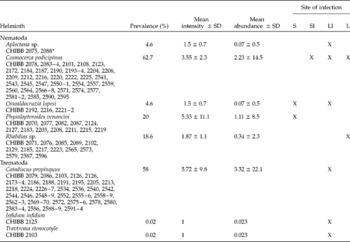
A total of 43 specimens of L. podicipinus were collected, and 40 (93%) were infected by at least one helminth species. Each infected anuran had from one to five endoparasite species. We found a total of 310 helminthes distributed in eight species. The greatest richness of species was found among nematodes (five species), followed by trematodes (three species). Helminths were found in the lungs (Rhabdias sp. Stiles and Hassall, 1905 and Cosmocerca podicipinus), stomach (Physalopteroides venancioi Lent, Freitas and Proença, Reference Lent, Freitas and Proença1946 and Oswaldocruzia lopesi Freitas and Lent, 1938), small intestine (C. podicipinus) and large intestine (C. podicipinus, Aplectana sp. Railliet and Henry, 1916, O. lopesi, Catadiscus propinquus Freitas and Dobbin, 1956, Infidum infidum (Faria, 1910) Travassos, 1916 and Travtrema stenocotyle (Cohn, 1902) Goodman, 1951) (table 1).
Prevalence, intensity, mean abundance and site of infection of helminth parasites of Leptodactylus podicipinus from the riparian forest of the Miranda River, municipality of Corumbá, State of Mato Grosso do Sul, Brazil.

SD, standard deviation. Site of infection: S, stomach; LI, large intestine; SI, small intestine; L, lungs.
* Numbers in the first column are the accession numbers of voucher species in CHIBB – Coleção Helmintológica of the Departamento de Parasitologia, Instituto de Biociências, Universidade Estadual Paulista.
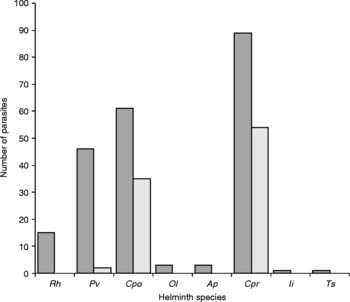
Adult frogs (n = 26) showed higher diversity of parasites than the subadults (n = 17), both in males (H′young = 0.62, H′adult = 1.16, t = 3.47, P = 0.013) and females (H′young = 0.72, H′adult = 1.33, t = 5.86, P < 0.001). A higher richness of parasites in frogs collected in the rainy season was also observed (fig. 1), but in this season a higher number of adults (n = 21) was collected in comparison to the dry season (n = 5).
Helminth species of Leptodactylus podicipinus from the riparian forest of the Miranda River, municipality of Corumbá, State of Mato Grosso do Sul, Brazil collected in the dry and rainy seasons. Dark bars, rainy season; light bars, dry season; Rh, Rhabdias sp.; Pv, Physalopteroides venancioi; Cpo, Cosmocerca podicipinus; Ol, Oswaldocruzia lopesi; Ap, Aplectana sp.; Cpr, Catadiscus propinquus; Ii, Infidum infidum; Ts, Travtrema stenocotyle.

Discussion
The helminth fauna of L. podicipinus from the Miranda River region, municipality of Corumbá, Mato Grosso do Sul State, Brazil was evaluated in the present study. Eight helminth species were found and C. podicipinus and C. propinquus were the most prevalent. Moreover, L. podicipinus is a new host recorded for Aplectana sp., C. propinquus, I. infidum, O. lopesi, P. venancioi, Rhabdias sp., and T. stenocotyle. These data contribute to the knowledge of anuran helminth fauna and geographical distribution of these helminth species.
Cosmocerca podicipinus and Rhabdias sp. were the most prevalent nematode species. The former infects several anuran species and occurs in many countries in South America (Baker & Vaucher, Reference Baker and Vaucher1984; González & Hamann, Reference González and Hamann2004; Goldberg et al., Reference Goldberg, Bursey, Caldwell, Vitt and Costa2007). The infection occurs by penetration of the infective larvae through the host's skin. Similarly, Rhabdias species have a direct life cycle, alternating between free-living and parasite stages, with the host infection also occurring by means of active skin penetration (Anderson, Reference Anderson2000). The genus Aplectana has a direct life-cycle and the infection occurs by ingestion of the larval stage (Goldberg et al., Reference Goldberg, Bursey, Caldwell, Vitt and Costa2007). These data suggest that for L. podicipinus, parasites with a direct life cycle and active mechanism of infection are more likely to find their hosts, which would explain the high prevalence of these nematodes. Similar results were found for other Leptodactylus species in America (Bursey et al., Reference Bursey, Goldberg and Parmelee2001; Goldberg & Bursey, Reference Goldberg and Bursey2002; Goldberg et al., Reference Goldberg, Bursey, Salgado-Maldonado, Báez and Cañeda2002a, Reference Goldberg, Bursey, Trujillo and Kaiserb).
Although the P. venancioi life cycle is unknown, some studies indicate that phisalopterines generally require an intermediate host to complete their life cycle (Anderson, Reference Anderson2000). This nematode has often been reported in lizards (Fabio & Rolas, Reference Fabio and Rolas1974; Vrcibradic et al., Reference Vrcibradic, Vicente and Bursey2000; Bursey et al., Reference Bursey, Goldberg and Paramelee2005). However, there are only two reports on its occurrence in amphibians. Lent et al. (1946) found P. venancioi infecting Rhinella schneideri (Werner, 1894) from Paraguay. Bursey et al. (Reference Bursey, Goldberg and Parmelee2001) reported the occurrence of this nematode species in several anurans, including some Leptodactylus species, but L. podicipinus is a new host recorded for P. venancioi.
Leptodactylus podicipinus is a generalist and opportunistic forager (Rodrigues et al., 2004) and is strongly associated with terrestrial habitat, living in margins of permanent water bodies and ground litter of riparian and gallery forests. Recent studies show that terrestrial frogs are dominated by direct life cycle and generalist parasites (Bolek & Coggins, Reference Bolek and Coggins2003). In fact, most of the helminths found in L. podicipinus are monoxenous and live in other species of frogs (Vicente et al., Reference Vicente, Rodrigues, Gomes and Pinto1991).
This study showed that L. podicipinus presents with a high infection prevalence of C. propinquus. The genus Catadiscus includes several species commonly found in amphibians (Travassos et al., Reference Travassos, Freitas and Kohn1969). However, T. stenocotyle and I. infidum are typically snake parasites (reviewed by Travassos et al., Reference Travassos, Freitas and Kohn1969; Lunaschi & Drago, Reference Lunaschi and Drago2007). Considering that only one sample of each of these species was found in L. podicipinus, these might be cases of accidental parasitism.
The adults showed greater species richness of parasites than the younger ones, both in males and females. This difference between subadults and adults may be related to the fact that adults have greater surface area, which could facilitate the infection of direct life cycle parasites. Moreover, in adulthood, these frogs eat larger amounts of food, with a longer exposure to parasites, and are in the reproductive period, which can potentially increase the chances of infection. Yet, most of the adults were collected in the rainy season and this could have influenced the chances of infection and consequently the prevalence and diversity of the helminth species. Even though the presented data suggest that L. podicipinus has higher richness of parasite species in the rainy season, statistical analysis to confirm this hypothesis could not be performed. Future studies will be conducted to investigate the possible influence of the season in structuring helminth parasite communities.
This study showed that in the region of the Miranda River, Pantanal, L. podicipinus show a high rate of helminth infection and that there is a significant difference in the pattern of infection among young and adults in this anuran. These results reinforce the importance of carrying out further studies in the region to obtain better understanding of the ecological relations of anurans and their helminth parasites.
Acknowledgements
We thank FUNDECT for financial support, Base de Estudos do Pantanal – UFMS, and UNESP for logistic support. We are also grateful to Fernando Paiva, Gustavo Graciolli and Michael Fried for the valuable suggestions, to the colleagues who helped with the fieldwork, and to Jeffrey Himmesltein for the English review of the manuscript.