Introduction: Surface Markings
If you were a nineteenth-century scientist trying to uncover the hidden structures of sound vibrations or electric sparks, here are some of the experimental imaging surfaces you might turn to in order to bring them into view: a metal or glass plate covered in fine powder, the retina of the human eye, or a glass plate covered with a light-sensitive chemical emulsion. Why call these “imaging surfaces”? Generating dust patterns with a sound vibration, analyzing the optical illusions seen when observing an electric spark in a rapidly rotating mirror, or taking a spark-illuminated photograph to improve the instantaneity of the medium might seem like a disparate set of activities. They appear to share only their function of visualizing the invisible. And in fact when these experimental activities have appeared, always separately, in our histories of science, this has usually been the function ascribed to them. They are part of what has been variously called the history of “scientific images,” or “scientific visualization,” or “the visual culture of science.”Footnote 1
This topical issue invites us to look closely at the material conditions that govern knowledge of surfaces, and the knowledge generated by surfaces. In this article I use this focus on surfaces as an opportunity to direct attention to the temporality of experimental image-making. I consider dust figures, ocular figures generated by visual persistence, and photography not simply as a set of visualization techniques, but more specifically as a group of related techniques for the experimental recording of transient events through the markings they leave behind on sensitized surfaces. Thinking of experimental imaging techniques as ways of marking surfaces through time can reorient us away from more general notions of “the image” or “the visual,” towards the materiality and temporality of these traces, and their processes of production. It emphasizes their extension, that is, in time and space. A surface marking is not just an image or a picture to be apprehended visually: it is a process through which the material properties of the surface are changed, a process that occurs through time and produces a pattern distributed through space. For surface markings with an epistemic function, produced in order to establish knowledge about the natural world, the meaning derived from the marking depends in part on how that process of formation is understood. In the case of experimental surface markings used to capture traces of transient processes, as in this essay, a crucial dimension of their meaning comes from how their complex temporality is understood.
Science studies has long called attention to the important role of inscription – graphic or material transformations of things in the world into marks on paper – in the authority of the sciences (Latour and Woolgar Reference Latour and Woolgar1986; Latour Reference Latour, Lynch and Woolgar1990). There have been many fruitful results of this focus on inscriptions and the devices that generate them. For nineteenth-century sciences, for example, we now have a more sophisticated understanding of the role of experimental practices that have been bound up with the production of a graphic trace, most notably in studies of the “graphic method” in experimental physiology, but also in work on the history of scientific photography and cinematography, and of scientific image-making more generally.Footnote 2 In this and other work, historians have begun to piece together how meaning is made and disseminated through visual records, and how this enables locally produced knowledge to travel.
Here I propose considering the production of certain scientific inscriptions as enduring and evolving traces marked on surfaces by a continuous movement through time and space, following recent philosophical, anthropological, and phenomenological approaches to art in the making (Ingold Reference Ingold1993; Ingold Reference Ingold2007; Maynard Reference Maynard1997; Hunter Reference Hunter2015).Footnote 3 A notion of inscription as temporally evolving surface marking might help us to better understand certain epistemic practices normally seen as unrelated: the slow dragging of a stylus across a piece of paper, the rapid movement of dust across a vibrating metal plate, or the gradual gathering and fading of marks left by light on a photosensitive surface.
An unexpected model is to be found in the field of art conservation. Conservators engage even with two-dimensional works of art quite matter-of-factly as three-dimensional surfaces with material properties that undergo transformations over time. One leading handbook of photograph conservation, for example, describes photographs as having a three part structure (Lavedrine Reference Lavedrine2009, 5–6):
1. The support, that is, the surface on which the image appears: usually metal, paper, or glass.
2. The image-forming material applied to that surface: metallic particles (usually silver salts), pigments, or organic dyes.
3. The binder, a transparent layer of substance that holds the image material on the support: usually gelatin, albumen, or collodion.
The resulting analysis treats a photograph as much more than just an image. Instead, it is revealed as “a complex assemblage of materials and layers, which can deteriorate – they can weaken, distort, or break – thus endangering the survival of the image” (Lavedrine Reference Lavedrine2009, 3). The photograph is delaminated, broken apart conceptually into a series of strata with different functions with respect to the image, different material properties, and different processes and rates of disintegration. The photographic surface is revealed to be not merely a two-dimensional surface but a four-dimensional one, with a complex structure not only in three spatial dimensions but also through time. Such an awareness of the four-dimensional dynamics of the image surface has in fact been evident throughout the nearly two-centuries-long history of experimental studies of the photographic surface, in which the recent specialism of photograph conservation – formed in the last decades of the twentieth century from the confluence of photographic science, the rise of technical art conservation, and a growing art market for historical photographs (Maynés and Romer Reference Maynés and Romer2001) – is only a recent chapter.Footnote 4
For conservators, as for many photographic scientists, the purpose of this laminar analysis of the photographic surface has been to enable technical interventions that will help the endangered image survive over time. Our purpose here is different: to understand how the materiality and temporality of experimental imaging techniques shape the kind of scientific knowledge they enable. But we can learn from this attention to the four-dimensionality of the imaging surface, particularly by foregrounding the temporal dimension which is often ignored. Thinking of experimental images as the result of temporally and spatially complex surface marking processes can reveal unfamiliar points of contact between scientific fields that are otherwise rarely connected. Here, it allows us to make sense of intersections among the history of acoustics, the history of electrical physics, the history of optical illusions, and the history of photography. Surface markings were marshaled for seemingly disparate scientific and technical projects: the study of sound vibrations (particularly by the experimental physicists Charles Wheatstone and Michael Faraday), experimentation on electric discharges (by Wheatstone and Faraday), the investigation of the optical illusion of visual persistence (by Wheatstone, Faraday, and the photographic pioneer William Henry Fox Talbot), and technical improvements to photography (by Talbot).Footnote 5 These projects were tied together not only by personal connections among these scientists but also by the preparation of sensitive surfaces, by the purposes to which those surfaces were put, by the scientists’ attention to the temporality of the process by which the surfaces were marked, and by the interpretive strategies used to generate meaning from the markings left on those surfaces. In other words, thinking of these particular scientific inscriptions as patterns marked on surfaces through time means actually thinking of them the way the nineteenth-century scientists making them had to think in order to use and understand them.
Although Faraday, Wheatstone, and Talbot did not describe their work explicitly as an exploration of temporal “surface markings,” analyzing their experimental records with this material and temporal concept of inscription reveals an implicit and shared phenomenology of experimentation among apparently disparate projects. All three of these imaging techniques converted the spatio-temporal complexity of a dynamic event into an apparently static, spatial, two-dimensional representation. Looking at a two-dimensional image or figure, viewers could fantasize about really “seeing” features of complex transient events otherwise inaccessible to the eye. But as we will see below, viewing the image was not enough; to understand its secrets one had to learn to see not only the process by which it was made through time, but also the process by which an apparently static image might actually be evolving through time. By focusing on the entangled histories of these techniques in the practice of experimental physics and early photography, I explore the materiality and temporality of epistemic practices around images said to be “drawn by nature.”
Dust Plate
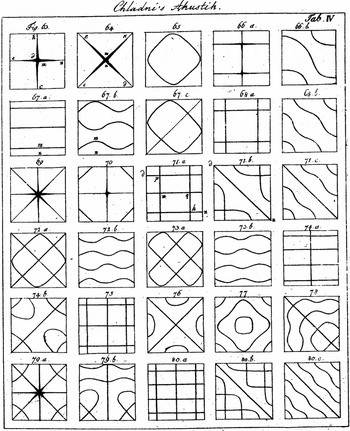
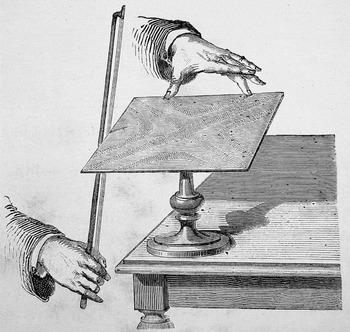
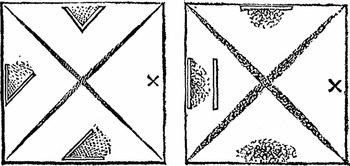
We begin with the dust figure, a popular demonstration technique in the early nineteenth-century science of sound. This was a method for studying transient and complex phenomena through the surprisingly beautiful and often intricate symmetric patterns they left behind when made to act upon a thin layer of fine powder spread evenly across a metal or glass plate. In 1777 the Göttingen savant Georg Christoph Lichtenberg first observed that dust settled on the surfaces of electrically charged plates in peculiar and symmetric patterns (Lichtenberg Reference Lichtenberg and Pupke1956; Pfannkuchen Reference Pfannkuchen2009). A decade later, the Wittenberg acoustician and musical instrument-maker Ernst Chladni applied this technique to produce patterns using the invisible movements composing sound vibrations (fig. 1). It had been known for a long time that sound was caused by vibrating bodies that transmitted their minute and rapid movements to the surrounding air. For simple sounding bodies like a violin string or a column of air, the vibrational movement was relatively simple and could even in many circumstances be seen with the naked eye. In a string, for example, one or more points on the string (“nodes”) stayed at rest while all other portions of the string oscillated up and down in a sinusoidal pattern. But the exact nature of the movements incited in more rigid and complex sounding bodies, was extremely challenging to observe. The vibrations in a surface like the sounding board of a violin took place at such rapid frequencies and over such minute distances that the eye could not distinguish them in any detail. One could not simply look at the surface of a violin or even a simple, flat, square glass plate, and see directly how it was vibrating. Chladni took a square glass plate, clamped it at one end and scattered the entire surface with very fine sand. When he drew a violin bow across an edge of the plate, causing it to vibrate and emit a musical tone, the sand immediately gathered into complex and visually stunning symmetric figures (fig. 2). The sand was shaken away from certain parts of the surface, collecting into intricate patterns. These stationary or “nodal lines” where the sand gathered represented the parts of the plate that were still; the areas of the plate where the sand had cleared away were the most violently agitated (Chladni Reference Chladni1802; Hankins and Silverman Reference Hankins and Silverman1995, 131–133; Jackson Reference Jackson2006, 13–44).
Chladni figures. Plate IV. (From Chladni Reference Chladni1802; courtesy of the Yale University Library.).

Making acoustic figures in dust. (From Stone Reference Stone1879, 25).

The reasons for the form of the figures were not well understood, but their stunning intricacy, beauty, and immediacy enthralled Romantic writers and philosophers, who described them as cryptic, hieroglyphic messages from nature herself. The beautiful, symmetrical forms revealed on a dust-covered surface seemed to confirm the Romantic philosophers’ insistence on the role of aesthetic intuition in natural knowledge, and on the enduring symmetries and hidden connections that appeared when nature was approached as a system of signs and manifestations. They frequently described the technique as one in which sounds or sparks were made to draw their own pictures.
Johann Wilhelm Ritter, a German chemical galvanist and member of the Jena circle, was one of the Romantic scientists inspired by Lichtenberg and Chladni's figures. Ritter saw the figures as carrying nature's own script, the true alphabet of the book of nature. Writing to his friend, the Danish natural philosopher Hans Christian Ørsted on March 31, 1809, he marveled that “each sound has its own immediate letter; and do we not hear writing – read, when we hear – see writing! And is not every sight with the inner eye a hearing, and hearing a seeing from within?” (Harding Reference Harding1920, 223–4; my translation). As did many of his contemporaries, Ritter reveled in the synesthetic pleasure of converting an audible sound into a visible image, and the semiotic promise, never quite fulfilled, of deciphering inscriptions written by nature's own hand. Most importantly, the sound figures bolstered his and Ørsted's insistence on the role of aesthetic intuition in knowledge of nature. They were the material basis and inspiration for Ørsted's “physics of the beautiful” (Daston Reference Galison and Daston2007, 236), his proposal for a new kind of experimental science generated through the cultivation of the scientist's inner aesthetic sense (ibid., 236–241). The dust-covered plate for the Romantics was a surface of perception, an extension of the human sensorium. Ørsted described it as making visible the “inner mechanism” by which perception apprehended sound (Brain Reference Brain, Brain, Cohen and Knudsen2007, 231–233; Daston Reference Galison and Daston2007, 236–238). But the sand-covered plate was also a kind of writing tablet, a surface on which nature could write her script so that humans could attempt to read it (Hankins and Silverman Reference Hankins and Silverman1995). These were signs that were in theory legible, but in practice mysterious.
When Charles Wheatstone began to take a careful look at acoustic figures in dust, in London in the early 1830s, his approach was somewhat different. Although eventually famous as a telegraphic pioneer and physicist, Wheatstone began his career as a musical instrument maker, Frunning his family music shop in London's West End.Footnote 6 As he transformed his career from artisan to man of science, he did so primarily through strategies of visual display, devising striking ways of visualizing sound (Ginn Reference Ginn1991, 93–141; Ramalingam Reference Ramalingam2009, 17–163). Lecturing was one of the central features of scientific life in London. It was a key means to promote and communicate knowledge about nature as well as to establish a scientific career (Hays Reference Hays, Inkster and Morrell1983; Lightman Reference Lightman, Lightman and Fyfe2007). Wheatstone had a keen instinct for showmanship and self-promotion, but this was tempered by an acute terror of public speaking (Bowers Reference Bowers2001, 21). He thus rarely spoke before audiences himself. But he collaborated on a series of lectures with the famous experimental philosopher and lecturer Michael Faraday in 1828–1832. In these lectures, delivered by Faraday at the Royal Institution, he presented the science of acoustics not only as a science of producing and mastering sounds audible to the ear, but as a science of making the processes underlying sound visible to the eye (Ramalingam Reference Ramalingam2009, chap. 1).
This was the context in which Wheatstone turned to the study of the Chladni figures. But unlike his Romantic predecessors he was less concerned with their semiotics than with their phenomenology and their geometry – with how they looked, how they were formed through time, and how their patterns were structured spatially. Wheatstone was a careful reader of Chladni's writings, and devoted much effort to experimenting with the best methods of producing the figures, as well as to figuring out why sensible differences in timbre were heard from different sounding bodies whose dust figures indicated the same structure of mechanical oscillation. This was a practical problem in the construction of musical instruments. But Wheatstone had also experimented on how to produce ever more intricate Chladni figures on surfaces covered in dust, sand, or liquid, and had found that he could produce many more minute “appearances” than ever before visible in a Chladni figure, just as Ørsted had (Wheatstone Reference Wheatstone1823).
Accounts of Wheatstone's lectures with Faraday on acoustic figures at the Royal Institution, along with his own surviving lecture notes from a few years later, show how important the dynamic temporality of the figures was to him (Anon. 1829a, “Royal Institution, Friday May 22” 1829; Anon. 1829b, “Royal Institution, May 22” 1829; Wheatstone Reference Wheatstone1835). He noted how thrilling it was to watch these “elegant and symmetrical figures . . . start into existence, when sand is strewed on a plate of regular form, caused to vibrate, and . . . change with every different sound which is obtained from the plate” (Wheatstone Reference Wheatstone1835, 1). It was their swift, magical appearance from nothing, and their sudden shape-shifting when the originating sound altered, that made them so striking. His lecture notes show that he dwelled in some detail on the meticulous, intricate process required to produce them.
An accurate eye is much more useful [than] any measure, to determine with exactness the most proper places at which the plate should be touched in order to produce each figure, because the thickness, form, and material of a plate are scarcely ever sufficiently exact to agree precisely with the measure . . . If the plate has not been touched exactly at a proper place, so that the figure appears less perfect than it should do, the position of the fingers must be slightly changed to place them at the exact point . . . It frequently happens that the quiescent point where the plate is held, and the vibrating part where it is put in motion, belong to more than one figure; in these cases, to exclude the other motions, it is necessary to touch at the same time, with the extremity of another finger, a place where there is a nodal line belonging to the mode of vibration required to be produced, but which might be in motion in the other modes of vibration. (Wheatstone Reference Wheatstone1835, 8–9)
This description shows how involved the body of the experimenter had to become with the vibrating surface in order to elucidate the full variety of figures (fig. 2). As the experimenter's finger was slowly dragged across the surface of the plate, changing the conditions of its vibration, the sand successively gathered in a series of imperfect figures. Finally, the symmetrical figure sought would appear, when the finger had found the right position. Meanwhile, Wheatstone also expounded upon the properties of different kinds of sands, powders, and metal filings as the figure-forming material (Wheatstone Reference Wheatstone1835, 10, 28–30). Sand and dust were so useful as an imaging material for revealing the elusive patterns underlying sound precisely because they lay on the boundary between the macroscopic and the imperceptibly small. The right material had to be insubstantial enough to be moved by minute vibrational movements, yet still substantial enough to coalesce into visually distinct patterns rather than simply blowing away. A delicate balance thus had to be found between these twin and opposed qualities of heft and weightlessness. Whatever the original Romantic rhetoric around Chladni's sound figures, Wheatstone's lectures made it clear that they did not simply appear of their own accord. They came into being through an embodied engagement with the vibrating surface and the material properties of the powders spread across it. If sound figures were written in script, it was one co-inscribed by nature's hand and the steady hand of the experimenter.
Wheatstone's lectures represented the Chladni figure as a dynamic, evolving form, but his publications for the most part did not. In print Wheatstone portrayed them as converting a transient, three dimensional, spatiotemporal movement into a static, spatial pattern (Wheatstone Reference Wheatstone1833). This was indeed one of the key attractions of the figures: unlike the original sound that produced them, they could be examined at leisure, archived, reproduced, and disseminated on paper through drawings and engravings. Most importantly, once complete, the intricate dust diagrams provided the viewer with a visual, almost physiognomic recognition that one kind of vibration was different from another, much as the ear could recognize instantly the difference between the same musical pitch played on a violin and a trumpet.
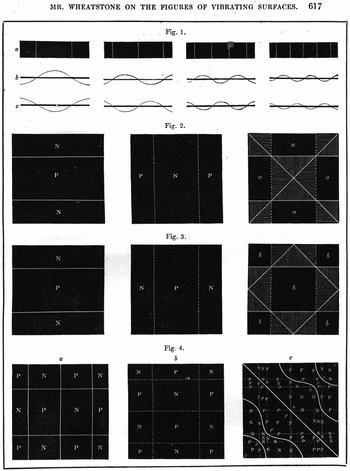
Although the elaborate patterns were of course caused by movement, it was a movement structured by stable, fixed forms. Parts of a vibrating surface were subject to intricate movement at the same time that other parts were completely at rest. The sound vibration drew an image in dust that represented stationary lines on the metal surface, rather than actual movements. The lines thus gave a picture of the unmoving structure underlying the movement. As figures of an enduring structure at rest, they called for a rigorous geometrical, spatial analysis. Wheatstone painstakingly demonstrated that even the most complex of the nodal lines traced in sand could be geometrically constructed by superimposing the simplest patterns (fig. 3). The simplest patterns were the result of the simplest modes of vibration. All modes of vibration of the plate, he then argued, could thus be built up by superposing simpler modes of vibration onto one another. Identifying geometrical relations among the different figures could reveal the physical presence of simpler vibrations combining to produce each complex figure (Wheatstone Reference Wheatstone1833).
Wheatstone's geometrical analysis of acoustic figures. (From Wheatstone Reference Wheatstone1833, 617; courtesy of the Yale University Library).

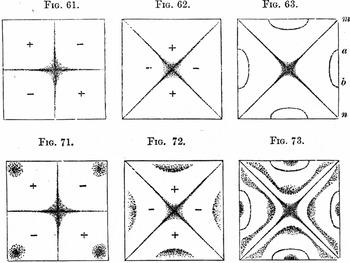
During his collaboration with Wheatstone, Faraday became increasingly interested himself in the formation and temporal evolution of acoustic figures in dust (Faraday Reference Faraday and Martin1932, 1:329–359; Williams Reference Williams1965, 177–180; Tweney Reference Tweney1992, 149–159; Gooding Reference Gooding2006, 52). Where Wheatstone's final stated aim was to explain how the completed dust patterns were structured by a geometry of stasis, Faraday asked a different set of questions: how did the surface and the dust move? How did the pattern form, through time? Faraday's was the most well-equipped chemical and physical laboratory in Britain, and he had a wide variety of substances at his disposal. His diary for early 1831 records a methodical survey of a vast array of fine and coarse powders (including a large number of powdered artist's pigments), metal filings, different kinds of sand, and powder-like organic matter (dried fern-spores, saw-dust, quill shavings) (Faraday Reference Faraday and Martin1932, 1:329–335). Different materials produced very different kinds of acoustic figures. What interested Faraday was that while coarse sand gathered along the nodal lines Chladni had described, certain kinds of extremely fine dust particles formed a distinctly different pattern, gathering instead at the parts of the plate which the physical theory argued were most violently agitated (fig. 4). He suspected that the patterns were the result of an even more complex movement – not of the plate itself but of the air surrounding it. The fine dust, he proposed, was actually moved by tiny, invisible currents of air above the plate, set in motion by its vibration. Moreover, he thought that while the patterns looked stationary – as though the dust fell into the patterns immediately and then remained there throughout the course of the vibration – this was actually an optical illusion. These organized heaps of fine dust were actually continually created and destroyed in a cycle that occurred at such a rapid speed that the eye could not even tell that it wasn't just motionless. While the plate vibrated, the dust was never still, always moving. It only appeared to be gathering in permanent heaps on its surface because of the limitations of the human eye (Faraday Reference Faraday1831a; Faraday Reference Faraday and Martin1932, 1:329–335).
Acoustic figures in coarse sand (top row) and fine dust (bottom row). (From Tyndall Reference Tyndall1867, 141, 150).

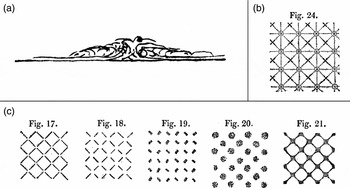
To unmask these hidden air currents moving over the surface of the plate, Faraday showed how the dust figures could be deformed into new shapes by deflecting the air currents with pieces of paper near or on the plate (fig. 5), and by showing that these secondary patterns never appeared if the dust-covered plate vibrated in a vacuum. The ephemeral currents could be rendered perceptible by surrounding the vibrating plate with smoke (which was, of course, just clouds of even finer particles). The smoke was then agitated by the vibrating plate into delicate eddies and whirls (fig. 6 (a)). If the plate were covered by a layer of water or oil instead, and the dust scattered on the liquid surface, the water itself took on visible currents that generated heaps and patterns of dust on its surface (fig. 6 (c)).
Acoustic figures produced by deflecting air currents. (From Faraday Reference Faraday1831a, 321).

(a) Eddies in smoke seen over vibrating plate. (From Faraday Reference Faraday and Martin1932, 1:331). (b) Faraday's alternating heaps. (From Faraday Reference Faraday1831a, 329). (c) Bottom: Dust patterns on liquid surface. (From Faraday Reference Faraday1831a, 326).

Faraday's aim was to give a convincing spatio-temporal account of how these transient three-dimensional currents would produce the observed two-dimensional surface patterns through time. Combining his observations of the whirls and eddies in smoke above the plate and the deflections and deformations of dust patterns, he composed a narrative description of the dynamic state of the heaps of dust themselves during the course of a vibration. The eye might see a static figure, but the truth was that the figure was continually evolving, coming into and out of being. The heaps of sand, he found, were formed by a whirlwind-like action that was repeated over and over again:
When, in the course of a vibration, the part of a plate under a heap rises, it communicates a propelling force upwards to that heap . . . upon receding from the heap . . . in performing the other half of its vibration, it forms a partial vacuum, into which the air round the heap enters . . . ; and as it enters, carries in the powder at the bottom edge of the heap with it. This action is repeated at every vibration, and as they occur in such rapid succession that the eye cannot distinguish them, the centre part of the heap is continually progressing upwards; and as the powder thus accumulates above, whilst the base is continually lessened by what is swept in underneath, the particles necessarily fall over and roll down on every side. (Faraday Reference Faraday1831a, 316–317)
When the plate was covered with a layer of liquid instead of dust, occasionally different sets of heaps of water actually alternated, never existing at the same time. But they appeared to the eye all at once, as a single enduring pattern. In fig. 6 (b), top right, the crosses and the circles indicate points of reflected light appearing on two alternating groups of heaps, perceived together. The problem was that the sluggish human eye prevented the uninitiated observer from seeing that there was motion and constant change in these patterns at all.
Through their mastery of Chladni figures, both Wheatstone and Faraday became powerfully aware that these figures formed of dust and sand and water were not simply static figures but temporally evolving arrangements of material on and around the vibrating surface. They could be analyzed as a final pattern remaining on the surface after the plate was exposed to the vibration over a long period of time. Or, they could be unmasked – reanimated – as dynamic events occurring through time.
Retina
As we saw above, studying the patterns on vibrating surfaces had led Faraday to think about how patterns emerged on another, physiological-psychological surface: the human retina.Footnote 7 It had been known since antiquity that the eye sometimes continued to see the presence of a moving object in a particular position for some time after it had passed (Wade Reference Wade2005, 112–116). The canonical example was what Isaac Newton had famously called the “circle of fire,” in which a burning coal was whirled swiftly in a circle. The entire trajectory of the glowing coal was seen by the eye simultaneously, as an incandescent circle impressed in the air. Newton had explained this appearance as a result of the enduring “impressions” left on the Sensorium by the moving coal (Newton Reference Newton1718, 322, 123). This phenomenon would later be known as “visual persistence,” but writers on vision in the 1820s and 1830s referred to it as “the duration of visual impressions” (Wade Reference Wade2005, 112).
Sometimes they attributed it to the sluggishness of the retinal surface itself, which was understood to retain the succession of visual impressions of the glowing point in each of its positions as it raced around its circular path. The physician and philologist Peter Mark Roget, for example, wrote that “an impression made by a pencil of rays on the retina, if sufficiently vivid, will remain for a certain time after the cause has ceased” (Roget Reference Roget1825, 135). The image here was of a writing tool tracing evanescent curves on the interior surface of the eye. For others, like Wheatstone, the sluggish surface on which impressions were stamped for a time was not the actual retina itself but the mind, whose incapacity to distinguish between impressions made a tiny fraction of a second apart was what fused those impressions together.Footnote 8 Many were deliberately imprecise, referring simply to “the eye” as the seat of these persisting impressions. Faraday, for example, declared that “the eye has the power, as is well known, of retaining visual impressions for a sensible period of time; and in this way, recurring actions, made sufficiently near to each other, are perceptibly connected, and made to appear as a continued impression” (Faraday Reference Faraday1831b, 210).
The language of impressions as Wheatstone, Faraday, and their contemporaries and interlocutors in early nineteenth-century Britain used it implied a sensitive surface on which they were impressed, whether that surface of perception was physiological or psychological. In either case visual perception was roughly conceptualized as occurring through the serial marking of impressions onto the human sensorium, impressions that endured for a short while before inevitably fading. This was not an explicit theory of vision. It was instead an informal conceptual schema that structured not only how these individuals wrote about vision, but also how they turned it to their purposes in carefully directed acts of observation and attempts to control the visual experience of others (in lectures before audiences).Footnote 9 This schema was undoubtedly a legacy of British empiricism and its theorization of the accumulation of sense impressions as the source of all experience. It was not systemically articulated, but it nonetheless furnished these scientists with a unified means by which to consider the problems they faced in making sense of what they saw when looking at things that moved very fast.
For Faraday and Wheatstone, this way of conceiving of vision had important consequences for their work on acoustic figures. As we saw above, for example, trying to generate a temporal narrative out of the seemingly static patterns on dust-covered surfaces had forced Faraday to grapple with the illusion of visual persistence. It was this temporal gathering of visible traces in the eye, he found, that initially prevented viewers from seeing that some acoustic figures were continually evolving, rather than still.
In fact, he had learned his approach to the phenomenology of transient movements from Wheatstone, who had been encountering this illusion for years in his other observations on acoustics, and had embarked upon a systematic investigation of it. From the late 1820s Wheatstone built a series of instruments and demonstration devices to explore and exploit the persistence of visual impressions. These machines were incorporated into both investigative experiments and public lectures in collaboration with Faraday at the Royal Institution, where they were used to generate new visual experiences of movement otherwise inaccessible to the eye (Ramalingam Reference Ramalingam2009, chaps. 1–2). They used visual persistence to make the eye serve a similar purpose to the layer of dust in acoustic figures: it became a sensitive surface, holding and retaining images of rapidly periodic or transient movements, just as the dust on a Chladni plate might retain traces of vibrations.
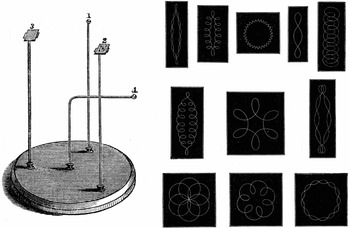
Wheatstone named the first such instrument he invented the kaleidophone (Wheatstone Reference Wheatstone1827) (fig. 7). This was a set of steel rods with silvered glass beads at their end, mounted on a heavy wooden base. When one of the rods was struck with a hammer, or a violin bow was drawn along it, the rod took on complex vibrations and sounded a musical tone. When the beads were illuminated by the nearby presence of a single, bright light source (such as sunlight, or a candle), the path traced by each bead was visible to the eye as a beautiful continuous curved figure, traced in light. Appearing because of visual persistence, these luminous figures were bright and vivid even in full sunlight. In a dark room lit by a single bright lamp, they glowed with an eerie incandescence. The device was inspired by Wheatstone's work on Chladni figures; like the static patterns formed by dust on the surface of the vibrating plate, the “diversified and curvilinear forms” traced by the kaleidophone were temporarily stable figures formed by the vibration of the rod (ibid., 344).
Wheatstone's kaleidophone (left) and kaleidophone figures (right). (From Wheatstone Reference Wheatstone1827, 26).

Although they were pictured in publication as static, stable forms, anyone who used a kaleidophone, or saw the device demonstrated in one of Wheatstone's or Faraday's lectures, would know that kaleidophone figures were ephemeral, evolving forms.Footnote 10 As a rod was initially set into motion, the bead first traced a wild, irregular pattern before gradually settling into the “typical” shape determined by the motion combined with the physical properties of the rod. Then this figure would steadily shrink in size, as the vibration dissipated and the rod's movements gradually diminished to nothing, the luminous figure gradually reducing to a single bright point unless the rod was struck again. The progress from initial striking of the rod to disappearance of the figure might happen over the course of a minute, or as quickly as a few seconds.
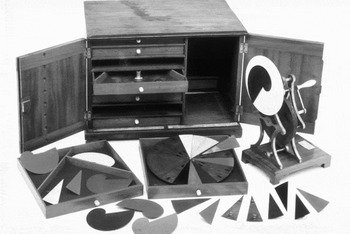
The rest of Wheatstone's visual persistence devices were simpler than the kaleidophone, all based on the circular movements of spinning discs and wheels. Wheatstone's wheel photometer was essentially a pocket-sized version of Newton's “circle of fire.”Footnote 11 A set of silvered beads attached to a disk were made to spin rapidly by a series of multiplying wheels. As with the kaleidophone, the trajectories of the brilliantly reflective beads traced luminous circles of different sizes that were visible in their entirety, all at once. Because the velocity of the whirling beads could be made extremely regular and measured to great precision, this device could demonstrate the quantitative rules governing the intensity and duration of visual impressions in the eye. For example, the faster the wheels turned, the fainter the luminous figure. In another device, Wheatstone mounted a spinning disk with a single narrow sector cut out of it, over a glass disk decorated with a picture drawn in transparent paint, so that the picture could be illuminated from behind, brightly visible to a large audience. At rest, the opaque tin circle obscured most of the painted image, except for the tiny portion exposed by the slit. But when it revolved rapidly over the illuminated image, the picture was seen entire, “formed by the combination of those separately almost imperceptible glimpses” (Anon. 1830, “Lecture at the Royal Institution” 1830).
With instruments such as these, Wheatstone was launching a comprehensive study of the duration of visual impressions. This project was never published, but it left many traces in the writings and correspondence of other scientists interested in vision.Footnote 12 His aim was to investigate the quantitative and qualitative laws governing how long impressions endured in the eye, and how this determined the character of the resulting visual experiences. In a lecture on vision that he delivered at the Royal Institution, he presented some initial findings:
The duration of an impression varies, with the intensity and colour of the luminous object . . . the colours arranged in the order of the permanency of the impressions they produce, are yellow, red, and blue; yellow occasioning the most durable sensation, and blue the least. The combining proportions of different colours, were shown to depend on the relative energies of the sensations they produce; thus it requires four parts of blue to one of red, to form a neutral violet, &c. . . . the rapid alternations of two colours upon the eye, gave rise to very different appearances to those resulting from the material mixture of the same colours . . . the intensity of the line described by the motion of a luminous point, diminishes, as the velocity of the motion increases, and increases with the frequency of recurrence of the generating point. (Anon. 1833a, “Mr. Wheatstone on the Duration of Luminous Impressions on the Organ of Vision”)
From this account of his lecture we can see how Wheatstone's investigation treated the eye as a surface of inscription on which light traced ephemeral patterns that endured for a while before fading away, like a vanishing inscription traced by invisible ink. He explored the properties of these tracings – the length of time they remained before disappearing, the color and intensity of their combinations – as he and Wheatstone had explored the shifting movements and patterns by different powders on the surface of a vibrating plate. Or, perhaps, just as a painter might investigate the material and temporal interactions of a new pigment with a particular kind of canvas support.Footnote 13
Once one understood the peculiar dynamics of these luminous tracings on the surface of the eye, one could use that understanding to begin to unmask hidden movements in nature and in the laboratory that would otherwise be unseeable. Faraday had begun to do this with the dust figures, using his experience with visual persistence to infer the presence of invisible air currents over the surface of the vibrating plate. Wheatstone proposed to develop a series of optical devices that would use visual persistence to
assist the progress of physical philosophy in as great a degree as the Microscope and the Telescope have already. The former instrument shows us spaces and the latter distances invisible to the unassisted eye; while the Chronoscope will render the evanescent portions of duration visible. (Wheatstone Reference Wheatstone1834b, 1)
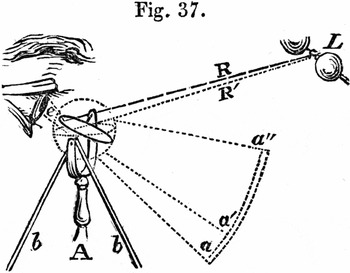
Just as the laws of physical optics might be the basis for the expansion of sight into the miniscule or far away, the duration of impressions could allow the expansion of sight into the domain of the evanescent. By “chronoscope” Wheatstone was referring primarily to another device he invented in 1834, the rotating mirror (fig. 8).Footnote 14 This was a circular mirror attached to a whirling mechanism that allowed it to spin on its axis hundreds of times per second. When a small point of light was held still at the position L in fig. 8 and viewed by reflection in the rotating mirror, its reflected image also moved extremely rapidly, in the plane marked a-a′-a″. Because of visual persistence, the reflected point would be seen not as a single point in motion, but as a continuous, unmoving arc of light. If that point were moving very rapidly with a complex trajectory of its own, the figure traced on the eye would be spread out along a plane by the movement of the mirror. The mirror thus allowed transient phenomena to inscribe their enduring images on the surface of the eye in such a way that their hidden temporality could be read off from them. Suppose, for example, that an electric spark between two electrodes was observed by its reflection in the rotating mirror. To the naked eye the spark looked like an undifferentiated and instantaneous flash of light. But the spark might consist of a truly instantaneous flash at a single point, or a point of light moving backwards and forwards, or a number of points of light moving in opposite directions, or something even more complex. The distorted reflection would look very different in each case. Even though these differences in movement could not be seen directly, the distorted reflection of the spark in the mirror would expose them. The hidden temporal evolution of the spark could be read off from its reflected image, which left an enduring trace in the eye that was transient but remained present just long enough to be observed and interpreted (Wheatstone Reference Wheatstone1834a).
Wheatstone's revolving mirror. (From Tomlinson Reference Tomlinson1859, 149).

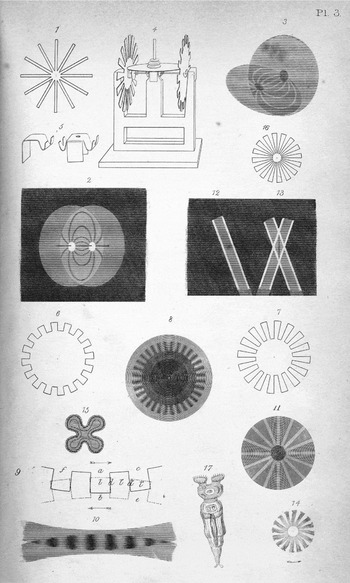
Faraday soon began to navigate his own way into this strange, spectral world of transient, illusory figures impressed by light on the surface of the eye. Shortly after demonstrating Wheatstone's spinning disk devices before his audiences, Faraday devised his own wheeled machinery that could spin pairs of cardboard discs at precisely determined relative speeds, and lectured at the Royal Institution on the optical illusions that resulted due to visual persistence (Faraday Reference Faraday1831b) (fig. 9). He told his audience he was inspired by the apparitions he had seen in carriage wheels on busy London streets, and coordinated cogwheels revolving past each other in the city's lead mills and factories. But he was certainly also stirred by his friend's ingenious visual persistence devices, which he had helped Wheatstone to demonstrate before audiences. In his own lecture, by manipulating the wheels’ shape and their relative and absolute velocities, or visually superimposing a wheel with its own shadow, its reflection in a mirror, or its projection from a magic lantern, he summoned a bewildering variety of shadowy, illusory wheels in the eyes of his viewers. Shadowy phantom wheels appeared from nowhere, floating in front of the real ones. These apparitions might stand stock still, whirl in unexpected directions, or sprout additional cogs or curved spokes. He explained how the appearance of each one of these dynamic, temporally evolving apparitions demonstrated the eye's power of retaining and fusing successive impressions over time into a single composite image. These illusions were not static images. They changed through time. Like Wheatstone's kaleidophone figures these were moving pictures.
Faraday's wheel illusions, Plate 3. (From Faraday Reference Faraday1831b).

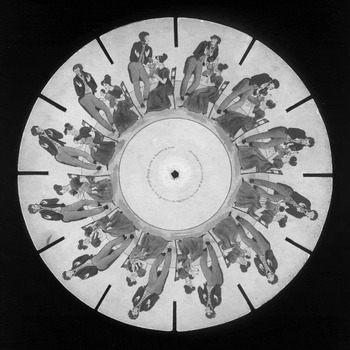
The phrase “moving picture” is not accidental. Faraday's wheel device was an important inspiration for the popular early animation toy eventually known as the phenakistoscope (fig. 10). This was a spinning disk with regularly placed slits, decorated on one side with a series of sequential images. Spinning the disk before a mirror and watching its reflection through the slits, the observer saw a circle of enchanting animated figures. The succession of images seen through the slits was fused by the eye into a visual experience of movement, just as in the ghostly cogwheels in Faraday's device; or, for that matter, as in the gradually shrinking luminous figures of the kaleidophone.Footnote 15 The phenakistiscope and Faraday's wheel are most commonly discussed as part of the “prehistory” of the cinema (Mannoni Reference Mannoni and Crangle2000, 201–222; Chanan Reference Chanan1996); they have also become strongly associated with the notion of a peculiarly “modern” observing subject, whose visual experience was firmly rooted in the physiology of the eye and subject to mechanical deception, embodying the modernist “double effect” of being simultaneously a subject and object of vision (Crary Reference Crary1992; Krauss Reference Krauss and Foster1988). In fact, they were part of a much more open-ended exploration of the kind of moving or still pictures that arose on the surface of perception through the persistence of visual impressions.
Phenakistiscope, National Media Museum, Bradford.

In surveying these peculiar optical instruments – and there were many more besides these – we can begin to recognize that Wheatstone and Faraday, along with many of their contemporaries, were exploring the eye's power to gather and fuse sequential visual impressions into a composite image or an illusion of movement. But they also found that such devices might also allow a very different kind of optical effect. Revolving discs, combined with controlled or sudden illumination, could also be used to break down the visual experience of time into “snapshots” of single instants. Wheatstone had his first accidental taste of this kind of instantaneous vision during his attempt to measure the velocity of electric sparks in his rotating mirror. He noticed, serendipitously, that the light of a spark was so brief in duration that any moving object in the room with him flashed into view as a static image, seemingly frozen in time.
He cited a few examples of what he had seen:
A rapidly moving wheel, or a revolving disc on which any object is painted, seems perfectly stationary . . . Insects on the wing appear, by the same means, fixed in the air. Vibrating strings are seen at rest in their deflected positions. A rapid succession of drops of water, appearing to the eye a continuous stream, is seen to be what it really is, not what it ordinarily appears to be, &c. (Wheatstone Reference Wheatstone1834a, 591)
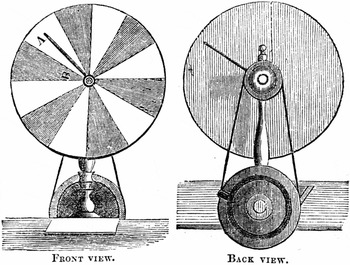
The spinning wheel that headed this catalogue of instantaneous revelations was a demonstration device that came to be known as “Wheatstone's disk.” This was a wheel with alternating sectors of black and white, made to spin rapidly so that the eye saw the entire disc as a uniformly grey blur (fig. 11). By the light of an electric spark the disk flashed into view completely at rest, with all the sectors visible (Quetelet Reference Quetelet1835, 60–61).
Wheatstone's disk.(From Anon. 1841, “Optical Illusions II,” 228.).

Later Wheatstone likened this artificially instantaneous vision to the more familiar visual experience of lightning, observing that “a flash of lightning during a sea storm at night renders all the surrounding objects visible in a state of unnatural tranquility . . . the duration of the impression . . . transforms as it were a stormy sea with its tumultuous objects into a picture of still life” (Wheatstone Reference Wheatstone1834c).
In investigations into vision Wheatstone, along with Faraday, experimented with the temporality of the dynamically evolving “pictures” impressed on the surface of the eye by transient or rapidly periodic movements. These traces of movement, when interpreted via knowledge of the duration of visual impressions, could reveal spatial and temporal information that was otherwise invisible. They were of three kinds. First, the sluggishness of the eye allowed it to gather and accumulate traces of movement over time into composite figures, what we might call “durational” images: the kaleidophone and rotating mirror images. Second, the visual experience of movement could be mechanically decomposed into images that showed the spatial disposition of moving objects frozen at a single instant, what we might call “instantaneous” images, like Wheatstone's spark-lit visions. Third, the durational quality of the retina could be combined with a mechanism for instantaneous exposure, producing images that visually superimposed impressions of multiple instants – what might now be called “stroboscopic” images, like Faraday's wheel illusions. Their visual manipulations of time in the physics laboratory emerged from the interplay between two things: the durational quality of the eye conceived as a sensitive surface which tended to aggregate, accumulate, and fuse; and the control of exposure (whether by the use of spark illumination, slotted discs, or other shutter-like devices) which tended to slice, isolate, and separate. All three of these kinds of picture, whether moving or still, were generated through the persistence and disappearance of impressions in the eye.
Photograph
The language of shutter and exposure brings us to photography. The new medium of photography was yet another system of surface marking whose uses and meanings emerged from a similar rhetorical, technical, and aesthetic interplay between duration and instantaneity (Ramalingam Reference Ramalingam, Baetens, Streitberger and Van Gelder2010). As a family of related techniques for capturing images traced by light on a photosensitive surface, photography was invented independently in a number of different places and settings in the 1820s and 1830s. The two most well-known early photographic surfaces were Talbot's chemically treated papers (first “photogenic drawing paper” and then the calotype), and the silvered plates used to make Louis Jacques Mandé Daguerre's daguerreotypes (Schaaf Reference Schaaf1992; Pinson Reference Pinson2012). Perfecting both Talbot and Daguerre's processes required the mastery of a set of profound temporal challenges.Footnote 16
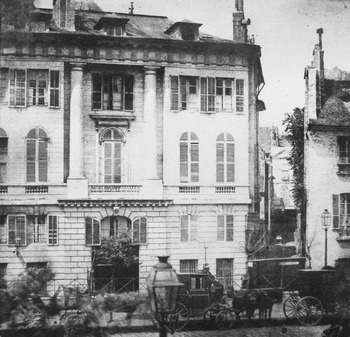
There was, to begin with, exposure time: the time required to form the image. This imposed severe limitations on possible photographic subjects. Until the late 1840s, in order to produce a visually satisfactory image, both Talbot's treated papers and Daguerre's silvered plates required lengthy exposure times in full sunlight, anywhere from a few minutes to a few hours (Braun Reference Braun and Schall2000; Prodger Reference Prodger2003, 24–111; Gunthert Reference Gunthert1999). Like Chladni figures on a plate covered in sand or dust, most early photographs were essentially durational in character. Single instants were buried in the aggregation of impressions over time. Just as the figures traced in sand showed the unmoving forms underlying a sound vibration, what appeared in an early photograph was that which was stable and endured. Photographs of bustling cities like Paris and London exhibited deserted streets, devoid of pedestrians, carriages, and the whole tumult of urban life. Yet early photographs were also haunted by the ghosts of movement, the faint smears and blurred forms left behind by people and things that moved across the field of view (fig. 12).
Talbot, Boulevard des Italiens, 1843. Getty Museum, Los Angeles.

The image marked on the surface had a dynamic temporality of its own. There was the gradual emergence of the image, and the question of the best time to stop the exposure to optimize the quality of the image. Then there was the gradual disintegration of that same image over time. The earliest photochemical images were profoundly unstable, evolving traces. In the 1790s, for example, Thomas Wedgwood, son of the pottery manufacturer Josiah Wedgwood, had succeeded in marking images on chemically treated paper by the action of light. But though they did endure for some time, these images faded rapidly under further exposure to light. They could only be viewed by candlelight, and even this precaution did not stop their eventual disappearance (Davy Reference Davy1802). The long-term “fixing” of the image was thus a key desideratum among early photochemical researchers. As Talbot remembered later, he sought “to cause these natural images [of the camera obscura] to imprint themselves durably, and remain fixed upon the paper” (Talbot Reference Talbot1844). It was not enough for light to leave marks on the paper; those marks had to be durable. This depended upon finding a chemical treatment (known later as a fixer) that stopped or slowed the degeneration of the image after it had formed.
These profound temporal challenges presented by the instability of light's tracings on the photographic surface have led one influential historian of photography to declare that in the medium's early years “the primary subject of every photograph was therefore time itself” (Batchen Reference Batchen1999, 93). The temporality of the photographic surface often seemed poised between two poles of duration and instantaneity (De Duve Reference De Duve1978). In the terms defined at the end of the previous section, long exposure times meant that early photographic images were durational surface markings, gathering and fusing light traces received over the time of exposure. Yet the language of capturing the ephemeral single instant nonetheless permeated the early discourse of photography. In a famous passage from his first official description of his invention in 1839, Talbot marveled that “the most transitory of things, a shadow, the proverbial emblem of all that is fleeting and momentary, may be fettered by the spells of our ‘natural magic,’ and may be fixed for ever in the position which it seemed only destined for a single instant to occupy” (Talbot Reference Talbot and Goldberg1981, 41). Early photographic fantasies of instantaneity such as this one never called for the kind of instantaneity Wheatstone had been experimenting with in the 1830s, a breach of the temporal limits of vision itself. Instead, when early photographers spoke of the capturing of individual instants, this usually reflected the much more modest struggle to wrest a picture of human spontaneity – the ephemerality of a shy smile or a natural, easy posture – from the slowness of the photographic surface (Prodger Reference Prodger2003; Gunthert Reference Gunthert1999).
Early photographic practitioners thus engaged with the photographic surface as scientists did with other experimental imaging surfaces: as a sensitive surface with peculiar material properties that enabled the receiving of marks that undergo transformations over time. They grappled with mastering the temporality not only of photographic tracings but of the process by which they were inscribed, just as Wheatstone and Faraday wrestled with the intricate temporality of the production and interpretation of acoustic figures in dust, or luminous figures in the eye. We can detect the presence of a rich series of shared metaphors of surface marking at work in all three imaging practices. The making of photographs was frequently described as the taking of impressions, which nicely combined the medium's inheritance from the terminology of print-making (a more static notion of impression) with the language of sensory impressions (which carried with it a more complex spatio-temporal aspect). Just as Newton's circle of fire was the result of enduring luminous impressions on the eye, a photograph was the result of enduring luminous impressions imprinting themselves on a photosensitive surface.Footnote 17
Yet the photographic surface's relation to these other sensitive imaging surfaces is not simply located in metaphors that structured how people talked about photography. In the case of Talbot we can trace a historical connection among them that had real consequences for the ways that he materially manipulated the photographic surface. Well known as a photographic pioneer and influential early voice on photographic aesthetics, Talbot was also a Victorian “gentleman of science” with wide-ranging interests (Brusius, Dean, and Ramalingam Reference Brusius, Dean and Ramalingam2013). He was active in the London science community and particularly well-respected as a contributor to mathematics and to experimental physical science. He was friends with Faraday and Wheatstone, and shared their interest in the temporality of experimental surface-markings. It was Talbot who first proposed a radical escape from the durational quality of the photographic surface, and in doing so he drew quite explicitly on techniques for picturing transient events using the unique qualities of the eye as a sensitive surface. Photography was not the only imaging practice Talbot found poised precariously between duration and instantaneity. Numerous proposals for the use of rotating mirrors and rotating disks as optical devices appear in his private research notebooks throughout the 1820s, as did studies of dust figures. He never published on most of these topics, but the notebooks testify to a long-standing interest in visual persistence (Talbot Reference Talbot1822; Talbot Reference Talbot1827; Talbot Reference Talbot1832; Talbot Reference Talbot1834a).Footnote 18
Talbot first learned that Wheatstone and Faraday shared this interest in the fusing of impressions in the eye and the mechanical slicing of instantaneous impressions through controlled exposure in March of 1833, when he was present at a pair of lectures Wheatstone and Faraday gave on visual persistence.Footnote 19 He was inspired to revive his work on the topic, and over the next few months, he pursued two linked projects centered on producing both durational and instantaneous images in the eye through visual persistence. The first was Talbot's disc photometer, an instrument for quantifying the intensity of light sources and color mixtures (Talbot Reference Talbot1834c; Simpson Reference Simpson1996) (fig. 13). As with some of Faraday and Wheatstone's experiments on vision, a disc with sectors cut out of it was rotated rapidly in front of a light source. At high speeds, instead of seeing the periodic interruptions in the light beam, the light would appear continuous but slightly dimmer than when viewed directly. The intensity diminished by a factor that could be calculated from the number of cut sectors, a quantitative relation based on the time of exposure that became known as “Talbot's law.” Colored sectors and spiral shapes could also be mounted on the wheel. The disc photometer used visual persistence to produce aggregate images on the surface of the eye which he argued could then be used as an objective, linear scale for color or light (Talbot Reference Talbot1834c). Just as Wheatstone and Faraday had done with their own spinning disc devices, Talbot's photometer was intended to investigate the dynamics of the ephemeral patterns inscribed on the sensitive surface of the eye.
Photometer for the measurement of the intensity of light and colour, to the design of William Henry Fox Talbot, constructed by W. & S. Jones, London, c. 1830. © Trustees of the National Museums Scotland.

Talbot also played with producing instantaneous and stroboscopic vision through controlled exposure. In a section of a paper on optics titled “A Body in rapid Motion, yet apparently at rest,” he described how a periodic repeating movement like a rotating object or a vibrating rod could be seen frozen in place in an otherwise unseeable position, when viewed under a bright light source made intermittent through reflection in a rotating mirror. Individual, isolated images of single instants were fused by visual persistence into a single enduring image (Talbot Reference Talbot1834b, 113–114). Privately, he experimented with what he called “optically fixing moving bodies”: viewing a succession of static, frozen images of moving objects by observing them under intermittent light produced by hiding a constant light source behind a spinning slotted disc. The images impressed on the eye that he described producing in this way echoed Wheatstone's catalogue of spark-illuminated visions: “‘The immovable drop’ or ‘selfsuspended liquid’. . . . The ‘motionless tetotum’. A swinging pendulum which would have the appearance of 2, 4, or more distinct pendulums. The motionless wheel which nevertheless will not allow anything to be passed between its spokes” (Talbot Reference Talbot1834a).
In June 1833, three months after reawakening his long-dormant interest in the evolving images traced in light on the surface of the eye at Wheatstone and Faraday's lectures, Talbot left London for a long holiday on the continent (Arnold Reference Arnold1977, 63). He later claimed that it was while vacationing in Italy that he first fantasized about the possibility of fixing the evolving images traced in light by the camera obscura onto paper (Talbot Reference Talbot1969). Returning to Britain in early 1834, he immediately threw himself keenly into photochemical research. But as Talbot slowly mastered the art of capturing impressions on light-sensitive papers, he also continued to play with the eye's own power to capture and retain visual impressions. His notes on the instantaneous visions seen through a slotted disc, for example, were recorded in the middle of his most productive period of experimentation on photochemical emulsions (Schaaf Reference Schaaf1992, 39–44). It is tempting to suppose that he might have imagined capturing these instantaneous and stroboscopic images of movement on a photographic surface, but there is no record of such speculation. Even if he had, the frustrating slowness of the available photochemical preparations would have prevented him from planning such an experiment for a long time.
In 1851, over a decade after photography was made public, Talbot developed a newly sensitive chemical preparation for photographs on glass plates that he called the Amphitype, named for the resulting image's quality of appearing both negative when viewed by light transmitted through the glass, and positive by reflected light (Talbot Reference Talbot1851c). Using one of these new plates, he took the first photograph of a rapidly moving object frozen in its position at a truly single instant. The experiment was carried out in Faraday's basement laboratory at the Royal Institution, the site of so many experiments with acoustic figures on dusted plates and light-figures in the eye. He began by fastening a piece of paper printed with text onto a disc attached to a rotating mechanism. Setting the disc in motion, he increased the speed until the disc looked like a mere grey blur. A camera containing one of his new, highly sensitive photographic plates was set up in a suitable position for capturing its image. He closed the shutters of the room, plunging the room into absolute darkness, and then opened the camera to expose the plate. He then discharged a carefully placed Leyden jar, a device for storing and discharging static electricity. The brilliant light of the spark very briefly illuminated the rotating disc, and an image was rendered on the surface of the plate.Footnote 20 The next day he triumphantly reported to Faraday that the photograph of the printed letters thus obtained was “just as sharp as if the disk had been motionless” (Talbot Reference Talbot1851e). It was time to redefine the very notion of photographic instantaneity, he proposed. Now, he declared triumphantly, “we shall be able to arrest and embody the most fugitive phenomena which present themselves to the eye” (Talbot Reference Talbot1851b).
The setup for Talbot's photograph of the spinning disk involved rearranging the elements of the demonstration experiment known as “Wheatstone's disk.” He had simply substituted one sensitive surface for another, inserting the prepared glass plate where the human retina had been. The light from the spark briefly illuminated the rotating disk, and instead of inscribing a momentarily enduring impression of the frozen spinning disk onto the retinal surface as Wheatstone had done, it inscribed a far more enduring impression of the disk onto the photographic plate.
Analogies between the eye and the camera were, of course, commonplace in early writings on photography. When Talbot himself wrote in the text accompanying the first fascicle of his photographic publication The Pencil of Nature in 1844 that “the object glass is the eye of the instrument – the sensitive paper may be compared to the retina” (Talbot Reference Talbot and Schaaf1989, Plate III), such a comparison had already become an unremarkable truism. But for Talbot the actual substitution of the light-sensitive plate for the light-sensitive retina in a controlled experimental setting – revealed the cracks in the eye-camera analogy. The material and temporal features of these two sensitive surfaces and their differing durational responsivity to impressions of light posed problems, belying the easy literary comparisons.
By carrying out the experiment in Faraday's laboratory, Talbot was able to assemble every experimental element used to demonstrate Wheatstone's disk. The rotation device Talbot used to spin the paper disk in Faraday's laboratory was most likely the same one Faraday had used to demonstrate Wheatstone's disk flashing, frozen, into view before an audience five years earlier (Anon. 1846, “Royal Institution”). Faraday's unparalleled collection of electrical equipment put at Talbot's disposal the means to produce reliably bright sparks. But as with Talbot, Wheatstone, and Faraday's explorations of visual persistence illusions and acoustic figures, there were challenging material and temporal issues surrounding the interaction of the illuminating light with the photographic surface. Though his original experiment was a success, Talbot found it difficult to reliably produce sharp, clearly-delineated photographs of the spinning disk stilled by spark light. The experiment was more “delicate” than he had thought (Talbot Reference Talbot1851d). The temporality of the spark itself, first of all, was a problem. There were two important conditions for obtaining a satisfactory instantaneous photograph with his method: “First that the Electric spark be very bright – Secondly, that no second spark shall follow the first immediately. There must be time enough to close the camera before a second spark occurs” (Talbot Reference Talbot1854a). Unfortunately, the devices that could generate the brightest sparks tended to produce a group of sparks in a row, which would produce a confusion of superimposed images of the spinning disc on the plate, rather than the image of a single moment. This was not a problem for visual demonstration of Wheatstone's disk, for the eye could easily distinguish between successive instantaneous spark-lit views of the disk, but the more sluggish photographic plate could not. Talbot's friend, the barrister and electrical expert William Robert Grove, had a powerful Ruhmkorff coil famed for its dazzling sparks, but to Talbot's dismay it simply could not be made to produce the intense, single, instantaneous spark required (Talbot Reference Talbot1854b).
There was also the characteristic light-sensitivity of the prepared plate. The surface of the Amphitype plate was highly sensitive, but only within a much narrower range of light than the range visible to the eye. Thus the visual impressions imprinted by the spark-illuminated disk onto the plate were very different from those that appeared in the eye. Whereas just about any bright spark would result in a vivid instantaneous visual experience of the stilled disk, the light emitted had to be more actinic than the light of most sparks was in order to register vividly in a photograph. Substituting a prepared glass plate for the retina as the sensitive surface was more difficult than Talbot had realized. In the end, with no reliable strategy for turning his single experimental trial into a reliable, generalizable method, Talbot abandoned his ambition to photograph rapidly moving objects by instantaneous illumination. He soon returned to using the phrase “instantaneous photography” to refer to images requiring less than three seconds of exposure (Talbot Reference Talbot1852).
As with the visual forms of instantaneity described in the previous section, Talbot's instantaneous photography experiment of 1851 manipulated the temporal conditions of exposure of a sensitive surface to light, so as to disrupt the surface's durational gathering of traces by generating an image that appeared to depict a single moment in time. But the dynamics of the surface-marking process proved too difficult to master. This was largely because of the limited sensitivity of the prepared plates to the frequency and intensity of the spark-light that executed the exposure. A generalizable form of photographic instantaneity that could reliably and mechanically slice invisible instants from the continuous flow of time would have to wait until the late 1870s. The famous chronophotographs of Eadweard Muybridge and Etienne Jules Marey owed as much to the increased sensitivity of photographic surfaces as it did to the ingenuity of the setups they used to mechanically control exposure.
Conclusion
Making experimental images of transient events, and making sense of them, required not only material work but physiological and psychological work. The sensitive imaging surface had to be prepared: the metal plate cut and its evenness ensured, the fine powder sifted and spread in an even layer, the chemical concoction delicately mixed and applied to the glass plate, the eye situated carefully in a room at just the right level of darkness to maximize its receptiveness to the ephemeral tracings of tiny points of light. The ephemeral phenomenon to be captured had to then be made to leave its visible mark on that sensitive surface, converting its complexity into a two-dimensional trace. The revealed dynamics of the inscriptions’ emergence and gradual disappearance on that surface – whether those traces appeared to be static or in motion – were then used to stabilize them and to establish their meaning. These were images that were used quite explicitly to reflect on the nature of images, through an interrogation of the imaging surface and its temporality.
There were, of course, important differences among the three methods of capturing transient events on sensitive surfaces described here. Whereas dust figures and photographs were patterns that emerged on an actual material support (a vibrating surface or a photographic plate), the light tracings in the eye were phantoms, floating or flashing into view and then vanishing when the ingenious devices generating them were stilled. The nature of the image support in this case was far more ambiguous in its materiality. Was it the retinal surface itself, or the more metaphorical surface of the mind? With attention to the real experimental continuities among Wheatstone, Faraday, and Talbot's techniques for imaging on experimental surfaces, this difference diminishes. The light-figures traced in the eye might seem ephemeral and immaterial in contrast to the permanence and physical presence of photographs and dust figures. But those who worked with these more “material” imaging surfaces knew that the patterns emerging on them were temporally evolving forms that might disappear from view all too quickly too. Early photographs always gradually faded; dust patterns might actually be in continual motion, or might simply blow away. All three kinds of image resulted in temporally evolving patterns on a sensitive surface. And whether visual persistence illusions were generated by the physiological dynamics of the retinal surface or more subtle processes of the mind, Wheatstone, Faraday, and Talbot manipulated and interpreted them as though that ambiguous surface were very real and material. See for example the virtual surface of the image depicted in fig. 10 above.
Perhaps the most significant difference among them is that many photographs, unlike the other experimental imaging practices described here, offered not just visible traces but pictures that might be seen to engage, however uncomfortably and ambiguously, with the codes and conventions of western representational art. Talbot himself grappled with this tension in the way he and others had represented photography simultaneously as part of the history of art, and as a sensitive surface recording chemical tracings of light belonging to the history of science. Dreaming up striking things to photograph with his new spark illumination technique, he reflected that “a child spinning a tetotum would make a pretty little picture, tho’ I am afraid it would be beyond present means of accomplishment – The tetotum alone taken spinning, with the figures legible would be of itself sufficiently curious” (Talbot Reference Talbot1854a).Footnote 21 The material realities of the sensitive surface he was working with simply would not register the kind of picture that might inspire the imaginations of his viewers by referencing sentimental images of children at play. The experimental projects described here were part of a linked history of experimental imaging surfaces, and the variety of temporally evolving images produced by marking those surfaces.
Dust figure, light figure, photograph: these were just three among a great variety of early-nineteenth-century experimental imaging practices that were understood to allow natural phenomena to leave behind self-registered traces and marks. Such traces were often described as “drawn by nature” (or drawn by “nature's pencil”), a trope that is now most commonly associated with nineteenth-century photographyFootnote 22 Recent scholarship in the history of science has emphasized the powerful authenticating function of the “automatic” image. Scientific photographs, for example, were often understood to be more trustworthy by virtue of being made without the hand of an artist, in nineteenth-century contexts where scientists, scholars, and bureaucrats sought methods of visualization, record-keeping, and pedagogy that they could argue were free from intervention by the human hand or mind (Galison and Daston Reference Galison and Daston2007, chap. 3).Footnote 23 The story told here suggests that the image drawn by nature – when considered as a process of surface marking over time, to be managed and interpreted by the scientist in order to generate temporal knowledge of transient phenomena – often might have a more complex epistemic status. For Faraday, Wheastone, and Talbot, the fact of being drawn by nature was less important than the way in which a sensitive surface was marked. The specific temporality of the experimental imaging process was what mattered. Mastering these techniques in the laboratory or lecture hall required foregrounding rather than eradicating the human interventions and perceptual processes that made knowledge of transience possible.
Acknowledgments
I would like to thank the participants of the 2010 workshop “Membranes, Surfaces, Boundaries” for their thought-provoking papers and feedback, and the anonymous reviewers and editors for this journal who provided incisive criticism. I am grateful most of all to the editors of this special issue for organizing such a surprising and stimulating workshop as well as for their heroic patience. Material from the Charles Wheatstone Collection is quoted by permission from King's College London; material from the Talbot Collection in the British Library is quoted by courtesy of the British Library Board and Mrs. Petronella Burnett-Brown. The research for this article was funded by the Paul Mellon Centre for British Art and the Science Museum, London. Some of the historical material discussed here also appears as part of different arguments in (Ramalingam Reference Ramalingam2009), (Ramalingam Reference Ramalingam, Baetens, Streitberger and Van Gelder2010), and (Ramalingam Reference Ramalingam, Brusius, Dean and Ramalingam2013).