1. INTRODUCTION
The concept of affordance is widespread in the design community. The concept has its origins in behavioral science, where it has given rise to active literature in terms of both theory (e.g., Gibson, Reference Gibson1979; Turvey, Reference Turvey1992; Stoffregen, Reference Stoffregen2003) and empirical research (e.g., Warren, Reference Warren1984; Mark, Reference Mark1987). In this article, we describe a relatively new area of affordance research in the behavioral sciences and discuss some possible implications of this research for the design community.
2. AFFORDANCES AND EXPLORATORY ACTIVITY
In this section we briefly review the nature of affordances in general, that is, affordances as they exist outside of (and prior to) artifacts or design. We then discuss how affordances are perceived. We understand perception as being active; it is something that people do, rather than something that happens to them. Laboratory research shows that the perception of affordances is strongly dependent upon movement of the perceiver. We review some of this research as it relates to the perception of affordances outside the laboratory.
2.1. Affordances as emergent, relational properties
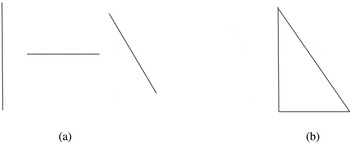
Affordances are opportunities for action: they are the things that a given animal can do in a given environment or situation. In general theory, affordances are not properties of objects, as such, nor are they properties of the environment, as such. Rather, affordances are relational (or emergent) properties of the animal–environment system (Stoffregen, Reference Stoffregen2003). Relational or emergent properties differ qualitatively from the properties of underlying components. As an example, consider Figure 1. In Figure 1a, there are three lines. A scientist might analyze these lines, counting them, measuring their length, color, and so on. A designer might modify the lines, making one longer and another shorter, one lighter and another one darker, and so on. Figure 1b also contains three lines. As lines, the lines in Figure 1b are identical to the lines in Figure 1a. The only difference between the lines in Figures 1a and 1b is their relation to one another. Because of this difference, however, Figure 1b contains something (a triangle) that is not present in Figure 1a. When the lines have a particular arrangement relative to one another, a triangle comes into existence. When that relation is broken, the triangle ceases to exist. Triangularity is not a property of the lines, per se, and it cannot be intuited or even detected by any analysis that is limited to properties of the lines, as such.
The whole often differs from the sum of the parts: (a) lines that do not form an emergent property and (b) the same lines, arranged differently, give rise to an emergent property (a triangle).

The concept of affordances has acquired currency within the design community (e.g., Norman, Reference Norman1988; Vicente & Rasmussen, Reference Vicente and Rasmussen1990; Torenvliet, Reference Torenvliet2003; Stoffregen et al., Reference Stoffregen, Bardy and Mantel2006; Maier & Fadel, Reference Maier and Fadel2009a). In the case of design/engineering, affordances are not properties of the user, as such, nor are they properties of the artifact, as such. Rather, affordances are relational properties of what we call the user–artifact system. Consistent with this description, Maier and Fadel (Reference Maier and Fadel2009b, p. 226) defined affordance as “a relationship between two subsystems in which a potential behavior can occur that would not be possible with either subsystem in isolation.” A potential behavior that would not be possible with either subsystem in isolation is equivalent to the triangle in Figure 1b; the potential behavior is an emergent property of relations between subsystems.
As the above discussion illustrates, affordances as relational properties of user–artifact systems are logically distinct from the properties of users, as such, and from the properties of artifacts, as such. The opportunity to climb a stair emerges out of the relation between the height of the stair and the length of a person's leg (Warren, Reference Warren1984). The distance to which a person can throw a ball emerges out of relations between the size and weight of the ball and the size of a person's hand and the strength of their arm (Bingham et al., Reference Bingham, Schmidt and Rosenblum1989). The opportunity to cross a busy street safely emerges out of relations between the time available (the “time gap” between the passage of successive cars) and the time needed (how long it takes the individual to cross the street; Lee et al., Reference Lee, Young and McLaughlin1984; Plumert et al., Reference Plumert, Kearney and Cremer2004).
As a general concept, affordances exist in animal–environment systems. For example, the affordance for throwing an object to a maximum distance applies to natural objects (e.g., rocks) as well as to artifacts (e.g., balls). As a matter of practice, the majority of scientific research on the perception of affordances has been conducted in the context of user–artifact systems. Warren (Reference Warren1984) asked whether participants could perceive their ability to climb built staircases, rather than (for example) natural ledges in a rock face. For this reason, much of the research on affordance perception is directly relevant to the perception of affordances in user–artifact systems, which is convenient for the present analysis. In reviewing the literature, we distinguish between studies that were intended to illuminate general or basic aspects of affordance perception and studies that were intended to illuminate the perception of affordances in specific user–artifact systems. In many cases, this distinction is arbitrary, and relates more closely to the interests of the reader than to the interests of the scientists who conducted the research.
In the general case, affordances are defined in terms of the animal–environment system. Within the design community, discussions of affordances often substitute the artifact for the environment; an example is the treatment of Maier and Fadel (Reference Maier and Fadel2009b). This formulation can work well for some user–artifact interactions that are relatively self-contained, such as a person editing a text document on a desktop computer. However, in many cases, the phrase user–artifact system does not adequately capture the true nature of the system. We often use artifacts to effect some change on or within the larger environment. Consider braking: the opportunity for braking depends not only on the relation between a driver and an automobile's brakes but also upon the road, on the weather condition, and so on. In addition, we do not use the brakes for their own sake, but rather to control the motion of the automobile relative to the broader environment (e.g., stop signs or other vehicles). For this reason, in this article we sometimes refer to user–artifact–environment systems (Shaw et al., Reference Shaw, Flasher, Kadar, Flach, Hancock, Carid and Vicente1995; Mantel et al., Reference Mantel, Hoppenot and Colle2012). Our formulation parallels the proposal to consider artifact–artifact affordances alongside user–artifact affordances (Maier & Fadel, Reference Maier and Fadel2009b). Our formulation indicates that artifact–artifact pairs are actually user–artifact–artifact triads. As one example, the ability to stack one chair on another chair depends on the user's ability to lift and maneuver the chairs.
2.2. We perceive affordances, as such
How do we know about affordances, that is, how do we know what actions are available to us in a given situation? In principle, we might obtain information about the environment and information about ourselves and perform an internal computation to obtain the relevant self-environment relations. However, another possibility exists. Empirical research in the behavioral science community supports the idea that, rather than computing affordances through internal processing, people can perceive affordances. Effects of this kind have been observed in the context of affordances for an individual's own behavior (e.g., Warren, Reference Warren1984; Ramenzoni et al., Reference Ramenzoni, Riley, Davis and Shockley2008; Yu et al., Reference Yu, Bardy and Stoffregen2011), for the behavior of others (Stoffregen et al., Reference Stoffregen, Gorday, Sheng and Flynn1999; Mark, Reference Mark2007), or for the behavior of pairs or groups of people (e.g., Richardson et al., Reference Richardson, Marsh and Barron2007; Chang et al., Reference Chang, Wade and Stoffregen2009). Children can perceive affordances (e.g., Plumert et al., Reference Plumert, Kearney and Cremer2004; Johnson & Wade, Reference Johnson and Wade2009), as can infants (e.g., Yonas & Hartman, Reference Yonas and Hartman1993; Adolph, Reference Adolph1995).
Of critical importance is the finding that people detect the affordance, as such (analogous to the triangle in Fig. 1b), without needing to detect the underlying subsystems (analogous to the lines in Fig. 1b). Mark (Reference Mark1987) provided a clear example of this effect. Mark asked participants to judge whether a chair was low enough for them to sit upon. He found that people gave accurate judgments; that is, people judged the chair to be “sit-on-able” when the ratio of chair height to leg length was below a critical threshold, and they judged the chair not to be sit-on-able when that ratio exceeded the critical threshold. Then, Mark changed the actual affordance. He did this by attaching wooden blocks to the soles of the feet (more or less equivalent to donning platform shoes). The blocks increased participants’ actual sitting ability (they could now sit on higher chairs). Critically, participants were not permitted to see or look at the blocks at any time and they were not permitted to practice sitting while wearing the blocks. Mark found that participants rapidly adjusted their judgments so that they accurately reflected the changed affordance. Then, Mark asked his participants to indicate the height of the blocks. They could not do this; their estimates of block height were grossly inaccurate (for a similar effect, see Yasuda et al., Reference Yasuda, Wagman and Higuchi2014). They had detected the (changed) relation between themselves and the chair, but they had not detected the metric properties of the underlying subsystems.
In a very different context, Stoffregen et al. (Reference Stoffregen, Gorday, Sheng and Flynn1999) made video recordings of actors moving (walking, or walking in place) next to an experimental chair with a seat pan that moved continuously up or down. Reflective markers were attached to the seat pan and to major joints on the actors’ bodies, and recordings were made in such at way that only these reflective markers were visible (known as a point–light display, or a kinematic display; e.g., Runeson & Frykholm, Reference Runeson and Frykholm1983). Observers who view such displays are exposed only to a pattern of moving dots on the screen, yet they have an immediate and compelling perception of the existence and movement of the human actor. Stoffregen et al. asked observers to view displays in which the actor and the seat pan moved, and to indicate when they judged the seat pan to be either at the maximum sitting height for that actor or at the actor's preferred sitting height. When both the chair apparatus and the actor appeared in the same video (i.e., when they were filmed in the same physical space), judgments of both maximum and preferred sitting height were accurate. In one experiment, each actor was filmed alone (i.e., without the chair apparatus), and that video recording was presented on a display unit that was physically adjacent to the chair apparatus, whose seat pan was raised and lowered in the same way as in the other experiments. In this case, observers had the same information about movements of the actor, and they had the same information about the movement of the seat pan. However, in this experiment judgments of the actor's maximum and preferred sitting height were grossly inaccurate. Taken together, the experiments revealed that being able to see the actor, as such, and the chair, as such, was not sufficient for observers to apprehend the actor's affordances. Being able to see higher order relationships between the actor and the chair (i.e., being able to see the actor–chair system, as such) was sufficient for accurate perception of affordances. Stoffregen et al. (Reference Stoffregen, Bardy and Mantel2006) provided a detailed argument explaining how this study is relevant to the design of displays that facilitate the perception of affordances.
2.3. Active perception of affordances
How is it that we can perceive emergent, relational properties of the animal–environment system, or of user–artifact systems? How does this information get into our heads? Part of the answer lies in the design of information that is available to users. This issue has been addressed at length, both theoretically and empirically, by Vicente in the context of ecological interface design (Vicente & Rasmussen, Reference Vicente and Rasmussen1990; Vicente, Reference Vicente2002; Burns & Hajdukiewicz, Reference Burns and Hajdukiewicz2004; see also Torenvliet, Reference Torenvliet2003). We take Vicente's work as given, that is, we assume that an artifact has certain affordances (for a given user) and those affordances “show up”: these affordances may be perceived from perceptual information that is available to the user (e.g., optics and sound).
Ecological interface design has focused on sit-down, desktop-style human–computer interfaces that are used for the control of large systems, such as power plants or oil refineries (e.g., Vicente, Reference Vicente2002). In such settings, the relevant properties of the user are either trivially simple (e.g., their ability to operate a cursor that permits them to select elements in a given display) or highly abstract (e.g., domain-relevant expertise). A very different set of constraints applies when the artifacts are objects, such as a hammer (Wagman & Carello, Reference Wagman and Carello2003), or when a computer-based system is used to detect physical activity of the user and translate that information into realtime displays of user motion within a virtual world. Common examples of the latter are contemporary gaming systems in which the user's bodily movement (e.g., arm movements or standing on a force plate) are used to control a humanoid avatar within a virtual world (e.g., Stoffregen et al., Reference Stoffregen, Chen and Koslucher2014). In these types of user–artifact systems, opportunities to achieve system-relevant goals, such as driving a nail or scoring points in a video game, emerge out of relations between physical (or virtual) properties of objects and physical properties of the user. In settings such as these, how does the user detect the actions that are afforded?
The existing literature has mainly focused on the anthropometric properties of the user (e.g., leg length in relation to the design of stairs, or arm length in relation to the physical location of switches in a cockpit), or on mental states of the user (e.g., the user's level of expertise or skill). Less attention has been paid to the fact that the user moves and that these movements affect perceptual stimulation. In the ecological approach to perception and action, as founded by Gibson (Reference Gibson1979), the activity of the human is fundamental to his or her ability to perceive affordances.
A critical discovery was made by Mark et al. (Reference Mark, Balliet, Craver, Douglas and Fox1990). Following Mark (Reference Mark1987), they asked participants to judge whether a chair was low enough for sitting, and they manipulated actual sitting ability by asking participants (in some conditions) to wear blocks on their feet. The focus of the study was on how participants learned about whether they could sit on chairs of a given height. The situation was both simple and natural: While standing, people looked at a chair and decided whether it was low enough for them to sit on it. We might assume that this perception would be purely visual. However, Mark et al. found that participants were able to give accurate judgments only when they were able to move while looking at the chair. Looking at the chair while walking around it (their experiment 1) was helpful, but only to a limited extent. The data showed that knowledge of sitting ability was dramatically reduced by a very simple manipulation. In their experiment 5, while looking at the chair and making their judgments, participants leaned against a wall, such that their head and torso were stationary. This simple, natural manipulation yielded an extraordinary result: in this condition, participants’ judgments were degraded to the point of being essentially random. It was as if their eyes were closed and they were simply guessing.
3. PERCEIVING AFFORDANCES THROUGH EXPLORATION
A growing experimental literature suggests that our ability to perceive affordances is naturally, routinely dependent upon our own exploratory activity. In plain English, people who want to know what they can do in a given situation engage in actions (i.e., movements) that generate perceptual information about affordances. Exploratory action can include many types of physical interaction with the environment or artifact, including movements of the entire body (as in locomotion or body sway), movements of limbs (such as the hand in touching an artifact), or even movements of the head and eyes (as in searching a display). The type of movement(s) that will be relevant to exploration will differ across situations, as suggested in the following examples.
3.1. Exploratory activity generates information about affordances
The use of exploratory activity to generate information about affordances has been documented in a wide variety of situations, and with diverse populations. Even before they learn to walk, crawling infants rely on exploratory activity to determine what surfaces are safe for them to cross. Adolph (Reference Adolph1995) presented crawling infants with surfaces that sloped at different angles. Infants were willing to embark upon relatively shallow slopes but refused to cross steeper slopes, even when encouraged by their parents. In making their decisions, infants engaged in systematic exploration of the surfaces, looking at them, then patting them with one hand, and finally using one or both hands to press down upon them (Adolph, 2000). These exploratory actions were used selectively, on slopes that were near the boundary between crossable and uncrossable. When the slope was very shallow, infants perceived its crossability “at a glance” and immediately embarked upon it. When the slope was very steep, infants refused to embark upon it and, after a quick look, often ignored it. The full range of exploratory actions was deployed mainly for slopes near the can/cannot boundary, that is, slopes that might be crossable.
Bingham et al. (Reference Bingham, Schmidt and Rosenblum1989) presented adults with a set of objects and asked them to choose the one that they could throw the farthest. When given the opportunity, participants picked up each object and hefted it, using a characteristic pattern of coordinated movements at the wrist and elbow. When allowed to heft the objects, participants gave highly accurate judgments of which one they could throw the farthest; that is, they perceived the affordance for “throwing an object to maximum distance.” Similarly, when people are allowed to wield a handheld rod (to move the rod by rotating the wrist), they can make extremely accurate judgments about how far they can reach with it, even if they are not allowed to see the rod (e.g., Solomon & Turvey, Reference Solomon and Turvey1988). On the basis of manual wielding, ice hockey players can accurately select hockey sticks that are best for different types of shots (Hove et al., Reference Hove, Riley and Shockley2006; cf. Carello et al., Reference Carello, Thuot, Anderson and Turvey1999).
The above examples illustrate the use of deliberate movements to learn about affordances. Effects of this kind have led to research on more subtle movements that appear to support the perception of affordances.
It is possible to quantify exploratory movement in ways that permit us to distinguish the characteristics of a given movement that lead to the generation of information about specific affordances. Riley et al. (Reference Riley, Wagman, Santana, Carello and Turvey2002) asked participants to wield a handheld (but unseen) rod. In some conditions, they wielded the rod while judging how far they could reach with it. In other conditions, they wielded the rod while judging the location of their grip (i.e., whether they were holding the end of the rod or the middle), or were asked to wield the rod without making any judgment about it. Measurements of the kinematics of wrist movement revealed that participants systematically used different patterns of wrist movement across these conditions; that is, exploratory wielding was “tuned” to different perceptual tasks. In a complimentary fashion, a priori analysis of particular affordances can make it possible to predict movements that will be effective for exploration (e.g., Mantel et al., Reference Mantel, Bardy and Stoffregen2008).
Several studies have shown that the accuracy of affordance perception is related to quantitative details of movements of the head and torso during the process of making affordance judgments (Stoffregen et al., Reference Stoffregen, Yang, Giveans, Flanagan and Bardy2009; Yu et al., Reference Yu, Bardy and Stoffregen2011; Yu & Stoffregen, Reference Yu and Stoffregen2012). We return to this point in Section 3.3.
3.2. Exploration versus performance
Exploratory movements can closely resemble movements used in actual performance. For example, when purchasing an automobile, customers often do a test drive, in which they learn about “how the car drives” by actually driving it. In such cases, exploratory movements can resemble trial and error approaches: if you want to know whether an action is possible, then try it and see what happens. These cases are real, but they are not universal. In many natural situations, exploratory movements are not performance attempts and often do not even resemble movements used in actual performance. Infants who want to know whether a surface will support their weight will look at it, pat it, and lean onto it; none of these are locomotor acts or closely resemble locomotor acts, yet they provide information about whether the surface will support locomotion (Adolph et al., Reference Adolph, Eppler, Marin, Weiss and Clearfield2000). In adults, manual hefting can be used to perceive the throwability of an object, but hefting movements do not resemble throwing movements (Bingham et al., Reference Bingham, Schmidt and Rosenblum1989). Similarly, by wielding a rod using only rotations around the wrist, an adult can perceive how far they can reach with it, but the wrist movements do not resemble actual reaching (e.g., Riley et al., Reference Riley, Wagman, Santana, Carello and Turvey2002). On the basis of manual wielding, people can make functional judgments with remarkable accuracy, such as differentiating hockey sticks that are optimal for different types of shots (Hove et al., Reference Hove, Riley and Shockley2006). In an example from daily life, we often squeeze fruits and vegetables to determine their ripeness, but these exploratory movements bear no resemblance to movements of eating.
3.3. Is exploratory movement necessary?
The existence of these movements and the fact that people choose to use them do not, by themselves, permit the conclusion that the movements are necessary. Researchers have addressed this issue by asking participants to perceive affordances when typical exploratory movements are not available. Mark et al. (Reference Mark, Balliet, Craver, Douglas and Fox1990) asked participants to look at a chair and judge whether the seat pan was low enough that they could sit upon it. Judgments were made while standing, such that judgments were made in the context of whole-body postural sway. In ordinary conditions, judgments were accurate. However, manipulations that affected the nature or availability of body movement strongly affected the accuracy of these judgments. In one experiment, participants were required to adopt an awkward stance while making their judgments (they stood with their heels together and their toes pointing outward). In another experiment, participants could see the chair only by leaning forward and looking through a peephole. As noted in an earlier section, in yet another experiment, participants stood against a wall, such that their back and head remained in contact with the wall. In each of these experiments, participants’ judgments of their ability to sit on the chair were grossly impaired, to the point where their responses were effectively random. Similarly, Mantel et al. (Reference Mantel, Bardy and Stoffregen2008) presented virtual objects through a head-mounted display, and asked participants to judge whether a virtual object was within reach. Judgments were more precise and more accurate when participants were allowed to freely explore the virtual scene (i.e., moving their head and torso to change their viewpoint) than when they remained stationary while being projected the same “movie,” played back from earlier (active) trials.
Other research has addressed related issues. Stoffregen et al. (Reference Stoffregen, Yang, Giveans, Flanagan and Bardy2009) asked healthy adults without prior wheelchair experience to sit in a wheelchair and judge the lowest lintel height under which they could roll. Prior to judgments, one group was given 2 min of practice with the wheelchair. During this practice, participants rolled the chairs up and down a long hallway, but not through any doorways or under any low gaps. After this brief practice, judgments were more accurate than among participants who had no practice. Moreover, during judgments, movements of the head and torso differed between participants with and without practice.
Exploratory movement is important because it generates perceptual information about the animal–environment system (Mantel et al., Reference Mantel, Bardy and Stoffregen2008, Reference Mantel, Bardy and Stoffregen2010). As noted earlier, hefting generates information about how much the object weighs relative to the strength of the arm. A subtler example relates to ordinary body sway, which typically consists of oscillations that are slow (~0.2 Hz) and small (~2 cm). Body sway consists of rotational oscillations around body joints (neck, waist, and ankles). These rotations displace the head, causing changes in stimulation of the eyes, the vestibular system, and other sensory receptors. The nature of these changes is a complimentary function of properties of the body (e.g., the distance of the head from the axis of rotation) and properties of the environment (e.g., the shape, arrangement, and distances of objects, relative to the observer). Contemporary motion sensing technology makes it possible to detect these subtle movements and use them as inputs to human–computer interfaces (e.g., Stoffregen et al., Reference Stoffregen, Bardy and Mantel2006). One implication is that designers can manipulate relations between user movements and system function. For example, to navigate among screens on a smartphone, users can use finger swipes or they can tap on the small icon that represents a particular screen. Another implication is that designers can manipulate relations between user movements and the perceptual consequences of those movements; that is, it is in effect possible to design the exploratory movements that will be effective in obtaining particular types of information about affordances for the user–artifact system. In smartphones, scrolling between screens is tightly coupled to finger movements. A novice user who inadvertently brushed the screen with his fingertips would be able to see that this action caused the screen to scroll. In this way, the novice could learn that finger swiping brings into view a screen that had not been visible. If that particular tight coupling between users’ finger movement and screen scrolling had not been set up, then the user would have had to perform a full swipe to discover that it affords navigating screens.
Many affordances of artifacts are for physical actions, such as whether a tool is within reach, or is too heavy to lift, or whether a pair of gloves will fit. Other affordances are for more cognitive behaviors, such as word processing or other desktop-computer applications, or placing a call using a smart phone. In these situations, people who want to know what they can do with a device, or who want to find a particular function on a device, will engage in exploratory activity through the designed interface. In these cases, the perceptual consequences of exploratory actions can be part of the design. The designer can choose which user actions will generate information (e.g., tapping or swiping a touchscreen, or tilting a mobile device) and, in a logically distinct operation, can choose the nature of the information that will be generated by any given exploratory act.
4. EXPLORATORY ACTIVITY IN USER–ARTIFACT SYSTEMS
In this section, we review examples that illustrate the routine use of exploratory movement in perceiving the affordances of artifacts, using examples drawn from daily life and from the scientific literature. We then discuss some implications that the active character of affordance perception may have for the design of user–artifact systems.
In many cases, users routinely employ exploratory movement to acquire information about the affordances of user–artifact systems. When entering a dark room, individuals routinely elect to feel the wall with the hand to search for a light switch. If the flicking of that switch does not produce light, then the individual may elect to feel elsewhere on the wall for another switch. A user interacting with a computer will move the cursor (by moving the mouse or other input device) to a place of interest on the screen, and will look for changes in the shape of the cursor (to a pointing finger icon, a text entry icon, or a prohibited sign icon) to see whether the current cursor location affords clicking, typing text, or something else. As mentioned earlier, manual hefting and wielding movements routinely are used to obtain information about the actions that are available with handheld objects (e.g., Bingham et al., Reference Bingham, Schmidt and Rosenblum1989; Hove et al., Reference Hove, Riley and Shockley2006). When overtaking a car on a highway, a driver will remove her gaze from the road and look successively at the inside and outside rear-view mirrors, then rotate her head to check the blind spot, to see whether the current traffic situation affords a safe lane change. When test-driving a new car, drivers will lightly tap the brake pedal. The purpose of these “test taps” is not to stop the car, or even to slow it down. Rather, the purpose is to obtain information about the brakes. In effect, the driver is asking, “How hard must I push the brake pedal to get this car to stop in a given situation?” The driver is using exploratory movements to obtain information about an affordance of the driver–car–road system. Similar exploratory actions often are undertaken in a well-known car under adverse driving conditions, such as in the snow. In this case, the implicit question is “What level of braking capability do I have in this car under these driving conditions?” Again, the driver uses exploratory movements to obtain information about an affordance of the driver–car–road system.
Fajen (Reference Fajen2005; see also Fajen, Reference Fajen2007) asked participants to control a simple driving simulator, which showed the driver (the participant) moving at constant speed toward a stop sign. Participants were asked to use a joystick as a handbrake, and to operate it so as to stop just at the stop sign. Fajen varied the properties of the simulated brakes by varying the gain between the angle of the joystick and the magnitude of negative acceleration (visible slowing down) on the screen. Within a few trials, participants successfully detected the change in braking capabilities. Even when their braking capability was changed on a trial-to-trial basis, participants exhibited partial adaptation from one trial to the next. An implication of these results is that during the act of braking, participants were sensitive to relations between their control actions and resulting changes in the on-screen simulation and that they used this information, online and within trials, to adjust their braking behavior.
These examples underline the broad repertoire of exploratory actions that users can deploy to generate information about affordances. At one extreme, users might perform the afforded action itself, either completely (e.g., braking until achieving a complete stop) or in part (e.g., tapping the brake). At the other extreme, users might perform an action that differs qualitatively from the affordance in question (e.g., turning the head toward the car's dead angle to see if changing lane is afforded). Between these two extremes, exploratory actions can bear a great variety of relationships to the relevant affordance. It is worth noting that while some actions can be purely exploratory, the reverse situation of actions being purely performatory is much less likely. Walking toward a door induces continuous changes in viewpoint that generate information about how far the handle is and what shape it has. These changes in viewpoint thereby help to reveal whether the handle can be reached and grasped.
Michaels et al. (Reference Michaels, Weier and Harrison2007) evaluated exploratory actions that were elicited by different tools in the context of manual wielding. They suggested that for some actions, actual performatory movements would tend to produce little or no perceptual information about the relevant affordance. For example, when using a handheld rod to poke something, we tend to move the rod in a more or less linear manner, that is, toward the to-be-poked object. Angular rotation of a handheld rod generates dynamic information (patterns of pressure at the skin) that provides precise, accurate information about rod length through the inertia tensor of the rod (e.g., Solomon & Turvey, Reference Solomon and Turvey1988). By contrast, this information is not generated by actual poking movements, which tend toward linear translation rather than rotation. For other affordances, manual perfomatory movements generate haptic information about affordances. An example is hammering, in which performatory movements tend to be angular (swinging the hammer). Michaels et al. observed that exploratory movement changed not only as a function of the affordance investigated but also as a function of the tool.
4.1. Exploration in relation to known versus unknown affordances
Laboratory research has focused on situations in which the experimental subjects have known in advance the affordance to be perceived. Typically, experimenters tell the participants what affordance is relevant, such as the opportunity to climb stairs (Warren, Reference Warren1984) or to sit (Mark, Reference Mark1987). Similarly, in the previous section, our examples of exploratory movement in user–artifact systems focused on situations in which the users (presumably) knew what affordance they were trying to perceive. In such situations, the question under consideration is of the form “Under current conditions, can I do X?” In many cases, designers can assume that the user knows, in advance, the affordance(s) that they are trying to perceive, but this is not always the case. That is, there are many situations in which the effective question in the mind of the user is “What can I do with this object/device?” Laboratory scientists have only rarely given their participants the freedom (or the responsibility) to “figure out” what affordances were available in a given situation (e.g., Adolph, Reference Adolph1995; Ye et al., Reference Ye, Cardwell and Mark2009). Similarly, theoretical discussions of affordances have rarely addressed the fact that multiple affordances exist in any given situation, such that people can (must) choose among affordances, and may need to differentiate affordances that are compatible with a particular behavioral goal, as opposed to equally available affordances that are not compatible with the goal (e.g., Stoffregen, Reference Stoffregen2003). To the best of our knowledge, few experimental studies have addressed the role of exploratory movement in differentiating among multiple affordances that are available in a given situation, or in allowing users to answer the question “What can I do with this object/device?” We believe that exploratory movement will play critical roles in both of these situations. Given our argument that exploratory movement tends to be task specific (e.g., Riley et al., Reference Riley, Wagman, Santana, Carello and Turvey2002), it seems likely that the type of question being (implicitly) asked by the user will affect the nature of the exploratory movements that will be useful.
5. IMPLICATIONS FOR DESIGN
We have suggested that affordances exist as properties of systems; that is, we have suggested that affordances are emergent properties, as illustrated in Figure 1b. In Figure 1b, we can think of the three sides as the user, including bodily characteristics, sensory systems, and mental characteristics (e.g., domain expertise, training, and experience); the artifact; and the environment. In a literal sense, the designer designs only the artifact. However, the design of the artifact necessarily influences the emergent properties (in Fig. 1b, the existence and nature of the triangle). For this reason, it is logically possible for the designer deliberately to focus on the design of the whole system. This is the first and most fundamental implication of affordances for design.
In the present article, we have focused on the critical role of exploratory activity in users’ understanding of and ability to exploit affordances of user–artifact systems. We have suggested that the design process should take into account the fact that user–artifact systems (or, where relevant, user–artifact–environment systems) will include the user's exploratory activity. A similar point has been made by other scholars (e.g., Schneiderman, Reference Schneiderman1983; see also Norman, Reference Norman1988, p. 183, on “explorable systems”). Designers should take into account the likelihood that users will attempt to explore a system separately from their attempts to use or operate the system. In many cases, exploratory movements will differ from performatory movements. When this is true, it may be relatively easy to separately design for these different types of interactions. For example, some TV remote controls have volume buttons whose texture differs from that of other buttons, such that volume can easily be found by tactile exploration without having to look at the control (and away from the screen). In other cases, exploratory movements may closely resemble performatory movements. In these cases, it will be essential for design to include the opportunity to terminate or even reverse (e.g., undo) actions that have not progressed to completion. This is an important point given the prospective nature of exploratory movements. In both types of cases, design should include the provision of perceptual feedback arising from exploratory movement, feedback that is immediate and intuitive (cf. Vicente & Rasmussen, Reference Vicente and Rasmussen1990).
Exploratory movements that are utilized by a given user in a given situation are influenced by both the nature of the artifact and the particular affordance that is at issue (Riley et al., Reference Riley, Wagman, Santana, Carello and Turvey2002; Michaels et al., Reference Michaels, Weier and Harrison2007). Given this effect, we suggest that designers should aim to create artifacts that elicit not only the movements that would be used to perform actions but also the exploratory movements that reveal the corresponding affordances. In this context, a design that encourages the user to perform an information-generating action can be understood as adding information to the artifact (Mantel et al., Reference Mantel, Hoppenot and Colle2012). An important point is that this type of information is not imposed on the user (in the way that a printed label imposes information). Rather, the artifact is designed in such a way that the information can optimally be generated and obtained by the user. In effect, design enables the user to generate information on demand.
Another recommendation is that designers should provide users with feedback about the consequences of their actions, as these consequences relate to affordances. Hutchins et al. (Reference Hutchins, Hollan and Norman1985) introduced the notions of gulf of execution and gulf of evaluation. The gulf of execution refers to the difference between the actions intended by the user and the actions allowed by the artifact. For example, to connect a new computer to a WiFi network, some Internet systems require not only that a 16 character-long key be entered but also that a tiny button be pushed beforehand on the box itself (otherwise, the box will not accept any new connections). The gulf of evaluation refers to the difference between the current physical state of the artifact and the information available to the user about this state. Consider the checkout process involved in making a purchase online. The checkout process includes a variety of steps, each of which often is presented via a separate screen. One such step/screen is “order confirmation.” Does this screen refer to confirming that the items in question are, truly, what the customer wants to buy? If so, then the order confirmation screen should be followed by another screen that invites the customer to “place order.” In contrast, does this screen refer to confirming that the final order actually is being placed? If this is the case, then the order confirmation screen likely will be followed by a screen offering a receipt. The difference is important because in the former case, the customer retains the ability to change her order, while in the later case she does not. Our approach to perception as an act cuts across the distinction between the gulf of execution and the gulf of evaluation (for a related discussion, see Bennett & Flach, Reference Bennett and Flach2011, p. 114). In our framework, the process by which a user might know what the artifact affords is not a cognitive process but, rather, is a series of actions that generate perceptual information. However, the ease with which a user can perform a given action depends on the gulf of execution. It follows that the effort associated with perceiving what one can do and how to do it depends both on the gulf of evaluation and on the gulf of execution.
As a general consequence, from our perspective, the concept of usability not only concerns the cost associated with performatory or executive actions (McGrenere & Ho, Reference McGrenere and Ho2000) but also includes the cost associated with exploratory actions that reveal affordances (Mantel et al., Reference Mantel, Hoppenot and Colle2012). Designers not only should create products that fulfill some of the users’ needs but also should (simultaneously) design for exploratory actions and the perceptual information that such actions generate.
Designing for exploratory actions may prove particularly useful for making it easy for users to discover properties of user–artifact–environment systems that are dynamic in nature (e.g., that involve forces or velocity; as opposed to being strictly geometric). Designers may also take advantage of the pervasive nature of movement in humans and of the natural exploratory actions elicited by the context of use and/or by the artifact (e.g., through observational study). In all cases, designing for exploratory actions will require balance between adding more information (e.g., on a display), at the risk of overloading the user, and letting the user create or discover information when needed, at the risk that she may not perform the proper information-generating action. In cases in which adding more information would require the designer to resort to the use of symbols, designing instead for exploratory discovery may yield better, more intuitive function. Such cases are consistent with the principle that, where possible, knowledge-based interaction should be replaced with skill-based interaction (e.g., Vicente & Rasmussen, 1992).
6. CONCLUSION
The design community has a good awareness of the existence of affordances and of the fact that it is possible to incorporate specific affordances into the design of user–artifact systems. Designers are aware, also, that affordances can be perceived by users, and that design should be tuned to optimize the perception of an artifact's affordances. It is equally important, we argue, for designers to understand the active, exploratory nature of human perception. Humans are not stationary, passive receivers of information. Rather, we are in constant motion, and that motion is fundamental to our ability to understand the affordances that are available in any given place and time. Some exploratory acts, such as searching through a folder on a desktop interface, are conscious and deliberate. Other exploratory acts are implicit, outside of deliberate awareness. Both are important, and both can influence design.
Thomas Stoffregen received a BA in psychology from Oberlin College and a PhD in psychology from Cornell University. He is the Director of the Affordance Perception–Action Laboratory at the University of Minnesota, where he serves on the graduate faculties of kinesiology, psychology, engineering, human factors, and neuroscience. He is also a member of the University of Minnesota Center for Cognitive Sciences, the Multisensory Perception Laboratory, and the Center for Clinical Movement Studies. His research focuses on theoretical and empirical issues relating to the ecological approach to perception and action.
Bruno Mantel is an Associate Professor in human movement sciences at the Center for Study of Sport and Motor Actions (CesamS), Université de Caen Basse Normandie. Dr. Mantel received a Dipl. Ing. in computer science from EPITA graduate school, Kremlin-Bicêtre, France; a DEA in human motor skills from Université Paris-Sud, Orsay, France; and a PhD in human movement sciences from Montpellier 1 University, Montpellier, France. His research focuses on the intrinsically multimodal, active, and functional nature of perception and on its implications for the design and evaluation of man–machine interfaces.