Introduction
Delirium is a distressing but preventable condition that is common throughout the health and social care system. It is associated with increased morbidity and mortality, functional decline, and significant additional financial costs.Reference Inouye1, Reference Leslie, Marcantonio, Zhang, Leo-Summers and Inouye2 Despite its high prevalence and associated poor outcomes, it is well recognized that delirium is often missed by clinicians.Reference Inouye3
Most research on delirium has focused on high-risk patients in hospitals, but another group also at high risk are residents in care homes for older people. Long-term care facilities have expanded over the last few decades in response to an increasingly older demographic profile in developed countries.Reference Wittenberg4 Data from the 2001 Census of England and Wales reveal that 4.5% of people aged 65 years and over, and 20.4% of people aged 85 years and over, were living in long-term care facilities.Reference Cacchione and Cacchione5 The burden of delirium in these settings is likely to be considerable given the clustering of known delirium risk factors,Reference Bowman and Whistler6, Reference Cunha, Faria, de F Alves and Rigueirinho7 especially the high prevalence of dementia, the major risk factor. Moreover, the environment and systems of care in care homes share many features with hospitals that are likely to increase the risk of delirium. This is borne out by evidence that individuals being admitted to hospital from institutional care settings have higher rates of delirium than people admitted from their own home.Reference Levkoff, Evans, Liptzin, Cleary, Lipsitz and Wetle8, Reference Marcantonio and Flacker9 Investigating delirium in long-term care, therefore, is important, particularly as delirium prevention and treatment are closely linked to quality of care.
There are several types of residential institutions for older people in the UK. Commonly used terms to describe these institutions include long-term care (LTC) facilities, residential homes, nursing homes, post-acute care, intermediate care and Elderly Mentally Infirm (EMI) homes. LTC is the broad, umbrella term. Residential care homes (including residential homes providing dementia care) provide personal care, supervision of medication and meals, and some assistance with activities of daily living. They do not usually have nursing staff, and rely on primary and secondary health care services to provide for any health care needs. Nursing homes, including EMI homes, additionally provide 24-hour nursing care and have staff with specialist skills in nursing particular physical or mental health conditions.Reference Wagner, Van Der Wal, Groenewegen and de Bakker10, Reference Ames11 In England, the Care Standards Act 2000 saw the terms ‘nursing homes’ and ‘residential homes’ replaced by ‘care homes’ for institutions that provide accommodation together with nursing or personal care, respectively. A proportion of LTC facilities are dual registered, with the provision of both residential care and nursing care, enabling residents to transit between the two levels of care without a consequent change to their permanent residence. Residential and nursing homes are considered to be the ‘usual place of residence’ (although a small number of places in these homes may be used for short-term ‘respite’ care).
In addition, there are a growing number of ‘intermediate care’ and ‘continuing care’ beds in care homes. Admissions to these are relatively short-term, and serve as intermediary placements as alternatives to hospital beds. There are also ‘post-acute facilities’, common in the US, which function as rehabilitation and skilled nursing units after discharge from hospital; these are not considered to be the usual place of residence. Post-acute facilities generally have a higher proportion of skilled nursing staff, allowing care of more frail and ill older people than would be expected in most nursing and residential homes in the UK.
This report provides a review of the literature on the occurrence, aetiology, outcomes, prevention and treatment of delirium in LTC facilities. The main focus of the review is on nursing and residential homes for older people in the UK; specialist care homes (apart from those providing dementia care) are not included. Given the paucity of delirium research in general, we judged that too narrow a focus on UK studies would be inappropriately restrictive. Thus although the focus is on homes in the UK, the review is not limited to UK research but draws on studies in any setting that is sufficiently similar to a typical UK nursing or residential home. However, intermediate care, continuing care, and post-acute care settings are not the main focus of this review, and studies in these populations have been appraised and presented separately.
Definition and detection of delirium
The reliable detection of delirium is a prerequisite for research. Yet this is by no means straightforward. The paucity of delirium research, and its under-recognition in clinical practice, are in part a reflection of the difficulties inherent in defining and diagnosing the condition. Operationalized diagnostic criteria for delirium have been formulated in the Diagnostic and Statistical Manual of Mental Disorders12–14 (DSM III, DSM III-R and DSM IV), and in the International Classification of Diseases (10th edition)15 (ICD-10). Although generally good agreement is found between these criteria, there are important disparities between rates of delirium detected using the DSM criteria compared with ICD-10, with DSM IV being the most, and ICD-10 the least, inclusive in hospitalized patients. A study of delirium detection in a mixed population of hospital patients and nursing home residents found the various criteria performed differently in the two settings, with DSMIII-R proving the most inclusive in nursing home residents.Reference Laurila, Pitkala, Strandberg and Tilvis16 Most research studies have adopted DSM rather than ICD-10 criteria for delirium.
There are a number of validated instruments available for detection of delirium in hospitalized patients for use in clinical practice and research. None, however, has been validated in LTC settings. The Confusion Assessment MethodReference Inouye, van Dyck, Alessi, Balkin, Siegal and Horwitz17 (CAM) and the Delirium Rating ScaleReference Trzepacz, Baker and Greenhouse18 are the most commonly used. There are other non-validated methods, which do not distinguish between, for example, delirium and dementia. The Minimum Data Set (MDS) (part of the Resident Assessment Instrument (RAI)) is a tool that is mandated in the US and is also widely used in Canadian LTC facilities.Reference Mentes, Culp, Maas and Rantz19 The MDS captures information about the health status of an individual. Domains of the MDS can be used to provide information about changes in behaviour and cognition and hence can give information that can support a diagnosis of delirium. The MDS, however, has not been validated as a method of delirium detection and relies on secondary analysis of data, with the likely risk of under-reporting.
Methods
Given the broad focus of the objectives, we carried out a structured review of the literature. We identified original studies and review articles relating to the occurrence, aetiology, outcomes, prevention and treatment of delirium (excluding delirium tremens) in LTC settings for older people. To ensure relevance, only studies after 1990 were included as both the definitions of delirium, and the nature of care homes, might differ substantially in earlier studies. As a preliminary examination of the care home delirium literature revealed a paucity of research, it was decided to include all study designs, except for single-case studies. Including poor quality designs, of course, threatens the reliability of conclusions. However, where there is limited research, more rigorous and robust review criteria risk excluding all available evidence.Reference Godfrey and Denby20
The following electronic medical databases were searched from 1990 up to mid-October 2008: MEDLINE; EMBASE; PsychINFO; CINAHL; Cochrane Database of Systematic Reviews (CDSR); ACP Journal Club; Cochrane Controlled Trials Register. A search strategy that included synonyms for delirium and for care homes for older people was used. Reference lists of retrieved articles and bibliographies of relevant chapters in major texts and review articles were also examined.
A bespoke, pragmatic, non-validated study grading tool, based on the validated Newcastle-Ottawa Scale,Reference Wells, Shea, O'Connell, J, Welch and Losos21 was used to assess the quality of epidemiological cohort studies. Studies that used an operationalized definition of delirium (DSM III, III-R, IV or ICD-10), or a diagnostic tool validated against these, were given a higher quality rating. We summarized key findings in the context of the strength of the evidence available.
Delirium occurrence
We identified 14 studies of delirium occurrence in various LTC settings. Findings from studies using a validated method for delirium diagnosis are presented first, followed by those using non-validated methods. As outlined in the introduction, post-acute care facilities, common in the US, receive people discharged early from acute care, and can offer continuing treatment; they have no direct UK comparison model. Findings from post-acute care cannot be easily generalized to care homes in the UK; the two studies from these settings have therefore been grouped and discussed separately. Furthermore, one study assessed delirium rates in residents of LTC when admitted to hospital. This study is also presented separately.
(1) Studies using a validated diagnostic definition of delirium
Five studies examined delirium prevalence in care home settings comparable to the UK, using validated diagnostic criteria.Reference Laurila, Pitkala, Strandberg and Tilvis16, Reference Sandberg, Gustafson, Brannstrom and Bucht22–Reference Cacchione25 Sandberg et al.Reference Sandberg, Gustafson, Brannstrom and Bucht22 used a robust consensus diagnosis based on DSM III-R criteria, to investigate delirium in various care settings in Sweden. They reported a high point prevalence of 57.9% in three nursing homes (202 residents) and 35.2% in five older people's homes (196 residents). The high prevalence of dementia, particularly in nursing homes (66.3%), and co-morbidity, may explain these high estimates.
Pitkala et al.Reference Pitkala, Laurila, Strandberg and Tilvis23 assessed 195 LTC residents using DSM IV criteria and reported a point prevalence of delirium of 15.9%. Laurila and colleagues examined the impact of different diagnostic criteria and reported a delirium point prevalence of 14.4% using DSM III-R in 195 nursing home residents.Reference Laurila, Pitkala, Strandberg and Tilvis16 RovnerReference Rovner, German, Broadhead, Morriss, Brant and Blaustein24 assessed 454 admissions to nursing homes owned by a private corporation in the US. Using DSM III criteria, a delirium point prevalence of 7% was reported. In another cross-sectional point prevalence US study, 39.2% of 74 LTC residents had DSM IV defined delirium.Reference Cacchione25
Point prevalence of delirium ranged from 7 to 57.9% in these studies, with a median estimate of 35.2%. The wide variation is likely to be attributable to differences in case mix and diverse methods and diagnostic tools used to ascertain delirium.
(2) Studies using a non-validated method of delirium diagnosis
Six further studies investigated delirium in settings comparable to UK care homes, but did not use validated methods to detect delirium. Caccione intensively assessed 114 residents in LTC for 28 days and found an incidence of 17.5% for acute confusion.Reference Cacchione, Culp, Dyck and Laing26 In a cross-sectional study, limited by using data from the MDS, Mentes et al.Reference Mentes, Culp, Maas and Rantz19 reported a 14.0% point prevalence of probable acute confusion in a sample of 2318 nursing home residents. Probable confusion was defined as at least one of the five delirium indicators from the MDS, present over the previous 7-day period, and different from the resident's usual functioning. Fries et al. investigated delirium in US nursing homes using Resident Status Measure (RSM) data (a precursor of the MDS).Reference Fries, Mehr, Schneider, Foley and Burke27 Using a definition of at least two of six symptoms of delirium, the prevalence was 12% overall, and 21% in dementia units. However, the authors acknowledge that the RSM lacks the detailed information necessary to make a clinical diagnosis.
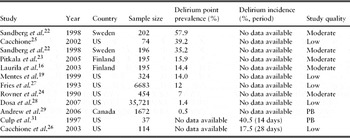
Occurrence of delirium in settings consistent with a UK model of long-term care

PB, potentially biased.
Dosa et al.Reference Dosa, Intrator, McNicoll, Cang and Teno28 aimed to develop a Nursing Home Confusion Assessment Method (NH-CAM) for diagnosing delirium, based on rearrangement of the MDS variables to mimic the well-validated CAM. Data were examined for 35,721 residents returning to nursing homes after acute hospitalization between April and September 2000. Delirium symptoms were present in 11,375 residents (31.8% of the total cohort), with 1.4% identified as having full delirium using the NH-CAM. They did not, however, attempt to estimate sensitivity or specificity of this method for delirium detection.
In contrast to the high rates reported by many studies, the Canadian Study of Health and Aging (CSHA) reported a low (less than 0.5%) point prevalence for delirium outside acute care.Reference Andrew, Freter and Rockwood29 1672 LTC facility residents were included in the survey; prevalence in these individuals did not differ significantly from that in community-dwelling subjects. Although careful sampling and assessment methods were used, these findings need to be interpreted with some caution, and possibly underestimate the true prevalence for a number of reasons. Assessments at a single point in time may miss cases of delirium given its fluctuating nature. Moreover, delirium was only diagnosed in the absence of dementia (if dementia was present, this diagnosis took precedence). Dementia is the most important risk factor for delirium; another study found that 13.3% of community-dwelling older adults with dementia had superimposed delirium.Reference Fick, Kolanowski, Waller and Inouye30 Applying these findings to the CSHA study, where 64% of subjects had dementia, would suggest a delirium prevalence of at least 9.1%.
One US studyReference Culp, Tripp-Reimer, Wadle, Wakefield, Akins and Mobily31 in two large Veteran Affairs LTC facilities using a non-validated method of delirium diagnosis (‘probable acute confusion’) in a cohort of 37 residents reported a 2-week incidence of 40.5%. Residents were assessed daily in the first week and on alternate days in the second week using a behavioural symptom instrument.
Quality grading and summary. Table 1 summarizes studies conducted in LTC settings comparable to nursing and residential care homes for older people in the UK. The majority of studies reported delirium point prevalence. Where delirium incidence was recorded, the period of time over which rates were determined is shown in brackets. Point prevalence of delirium ranged from 0.5 to 57.9%, with a median of 14.2%.
Studies consistent with a UK model of LTC were quality assessed using a grading toolReference Wells, Shea, O'Connell, J, Welch and Losos21 for: representativeness of study cohort, prospective study design, sample size, and use of a validated diagnostic tool. Studies with unrepresentative samples were considered to have potential for bias. Those with a sample size of <100 were downgraded and studies including >500 participants were rated as higher quality. A sensitivity analysis, excluding potentially biased or low-quality studies, gave a median point prevalence estimate for delirium in LTC facilities of 15.9% (range 7–57.9%).
(3) Studies in post-acute care
Kiely et al.Reference Kiely, Bergmann, Murphy, Jones, Orav and Marcantonio32 assessed 2158 patients admitted from hospital to seven post-acute care facilities in the US using robust methods to determine delirium. The prevalence of delirium at admission to post-acute care (using the CAM) was 15.6%, and 39.5% of patients had at least one delirium symptom. These patients had just been discharged from acute care and results cannot, therefore, be generalized to the more medically stable population in UK care homes.
Previous work on delirium by this group used the Minimum Data Set (MDS) collected by care staff in a prospective cohort study in 85 post-acute care facilities (55 rehabilitation hospitals and 30 skilled nursing facilities).Reference Marcantonio, Simon, Bergmann, Jones, Murphy and Morris33 They reported that in residents newly admitted from acute care hospitals, 22.8% (126/551) had at least one of six delirium symptoms at admission using MDS definitions (easily distracted, altered perception, disorganized speech, restlessness, lethargy, fluctuations in mental function). Persistent delirium symptoms remained significantly associated with worse activities of daily living after adjusting for age, co-morbidity, dementia, and baseline functional status. This study was limited by the use of secondary data, and by its reliance on delirium assessments performed by facility staff not specifically trained to detect delirium. Results are also not comparable with the later study because different criteria for delirium were used.
(4) Delirium in LTC residents admitted to hospital
Kelly et al. followed 214 patients transferred to hospital from a nursing home; 28.5% had delirium within 48 hours of admission (DSM III-R criteria).Reference Kelly, Zisselman, Cutillo-Schmitter, Reichard, Payne and Denman34 Of those patients with delirium who returned to the nursing home,50 72.0% still had delirium at time of hospital discharge, and 55.0% of the survivors had delirium at one month; most of these were persistent cases but 7.4% had developed new delirium.
Aetiology
We found no studies with a prospective cohort design (which could establish a causal relationship) in a LTC setting.
CacchioneReference Cacchione, Culp, Laing and Tripp-Reimer35 examined 29 LTC residents with delirium, 25 with dementia, and 20 with no cognitive impairment in a cross-sectional study. Factors found to be associated with acute confusion by chi-squared analysis of the whole sample included pulmonary disorder, electrolyte disturbance, and hearing deficit. During the 3 months follow-up, 14 participants died, and 10 of these were from the group with delirium (P < 0.01). In another study investigating acute confusion in sensory-impaired older people, Cacchione et al.Reference Cacchione25 found that the development of acute confusion was significantly associated with vision impairment (odds ratio (OR) = 3.7; 95% CI: 1.1–11.9), and dual sensory impairment (OR = 2.9; 95% CI: 1.0–8.3) but not hearing impairment.
Culp et al. identified probable causes of delirium in 15 residents.Reference Culp, Tripp-Reimer, Wadle, Wakefield, Akins and Mobily31 More than one condition was thought to be responsible in 13 residents. A urinary tract infection was implicated in seven, medication in seven, hypoxia in six, pain in three, and hypotension and low sodium in two. Mentes et al., analysing case-control study data from the MDS for 2318 nursing home residents, found that men and women were equally likely to develop delirium.Reference Mentes, Culp, Maas and Rantz19 Dementia (OR = 1.4; 95% CI: 1.2–1.7), fall in last 30 days (OR = 1.6; 95% CI: 1.3–2.0), and inadequate fluid intake (OR = 3.4; 95% CI: 3.0–3.8) were associated with delirium in logistic regression analysis. Sensory impairment, age, polypharmacy and co-morbidity were not identified as significant risk factors in this study.
The CSHA study described above reported a high prevalence of urinary incontinence amongst those with delirium (70.0%; 95% CI: 48.0–92.0%).Reference Andrew, Freter and Rockwood29 In the large NH-CAM study, prevalence of delirium was higher in Caucasians and increased with age.Reference Dosa, Intrator, McNicoll, Cang and Teno28 Delirium was more likely in residents with mild to moderate cognitive impairment than in those with no cognitive impairment or severe impairment.
In summary, there is a paucity of reliable studies describing the aetiological factors for delirium in care homes. Based on the evidence available, potential factors are dementia, increased age, dehydration, intercurrent infection, falls, sensory impairment, and metabolic disturbance.
Outcomes
Dosa et al.Reference Dosa, Intrator, McNicoll, Cang and Teno28 reported that delirium in LTC identified using the NH-CAM was associated with increased mortality and re-hospitalization. Mortality for the delirium group was 26.2% at 30 days (95% CI: 22.3–39.6) and 42.3% at 90 days (95% CI: 37.9–46.6), compared with 8.7% (95% CI: 8.4–9.1) at 30 days and 21.1% (95% CI: 20.7–21.8) at 90 days for the group without delirium. Estimates using the Cox model showed that the odds of mortality for delirium, relative to no delirium were 1.96 (95% CI: 1.71–2.26). At 30 days, the rate of re-hospitalization was 19.6% (95% CI: 19.0–20.1) with no delirium and 27.1% (95% CI: 22.9–32.5) with delirium. At 90 days, the rate was 32.8% (95% CI: 32.2–33.5) and 40.1% (95% CI: 34.8–45.3) without and with delirium, respectively.
The prognosis of delirium in a mixed cohort of 230 hospital and 195 nursing home subjects was found to be poor:Reference Laurila, Pitkala, Strandberg and Tilvis36 mortality at 1 year was 34.9 versus 21.6% in non-delirious subjects (P = 0.006), and at 2 years was 58.5 versus 42.6% (P = 0.005). In logistic regression analysis, delirium was an independent predictor for mortality at one year (OR = 1.9; 95% CI: 1.1–3.1), at two years (OR = 1.8; 95% CI: 1.1–2.8), and for new LTC places (OR = 2.5; 95% CI: 1.2–4.9).
The CSHA study also reported a notably poor outcome for delirium.Reference Andrew, Freter and Rockwood29 Five-year survival was lower for those with delirium than for the rest of the cohort (18 versus 70%, P < 0.001). Even in the absence of dementia, delirium was associated with a high mortality, at levels comparable with advanced dementia.
Marcantonio et al.Reference Marcantonio, Kiely, Simon, John Orav, Jones and Murphy37 investigated outcomes of older people admitted to post-acute facilities. Subjects with delirium were more than twice as likely to be re-hospitalized as those without delirium symptoms (30.3 versus 12.8%), and less than half as likely to be discharged to the community (29.7 versus 72.9%). Six-month mortality rate was considerably higher: 25.0% compared with 5.7% in subjects without delirium. Delirium clearly has an impact on morbidity and mortality and affects outcomes beyond the immediate illness period.
Delirium interventions
There is a particular paucity of studies of interventions to prevent or treat delirium in LTC. Bergmann et al. described the development and implementation of a nurse-led, multi-factorial model for the management of delirium in post-acute care – the Delirium Abatement Program (DAP).Reference Bergmann, Murphy, Kiely, Jones and Marcantonio38 However, its effectiveness has not yet been investigated. The DAP focused on four key care processes, of particular relevance to the post-acute setting:
(i) standardized screening for symptoms and signs of delirium at admission to the unit;
(ii) assessment and treatment of possible causes of, and contributors to, delirium;
(iii) prevention and management of common delirium complications, and
(iv) restoration of patient cognitive and self-care function.
A number of challenges to implementation were identified including the need for standardized written materials for assessment and documentation of delirium; systems to develop care plans; the need to improve nurses' knowledge and abilities to assess mental status; detection of delirium superimposed on dementia; and the need for a ‘delirium resource nurse’ to facilitate implementation.
Hydration interventions have been investigated,Reference Mentes and Culp39, Reference Culp, Mentes and Wakefield40 and have not been shown to be effective in reducing delirium in LTC. However, this may have been because the interventions in these studies did not result in improved fluid intake for residents.
Siddiqi et al.Reference Siddiqi, Young, Cheater and Harding41 described a complex intervention targeting delirium prevention in residential and nursing homes. This essentially comprised an enhanced educational intervention delivered by a ‘Delirium Practitioner’ to care home staff. The intervention specifically took account of the barriers to change practice, and engaged care home staff, drawing on their expert knowledge of residents and of the care home environment to identify tailored solutions to improve delirium care through staff ‘working groups’. In a before and after study, feasibility of the intervention was demonstrated in terms of successful implementation, acceptability to care home staff, and improvements in staff self-reported confidence in delirium recognition and management. Moreover, there was evidence of potential effectiveness in increasing cognitive screening of residents, in increasing delirium recognition and recording by staff, and in reducing hospital admissions.
Conclusion
Delirium appears to be common in the LTC facilities with a median point prevalence estimate of 14.2% in studies that reflect the UK model of LTC provision. However, there is a paucity of high-quality epidemiological studies of delirium in LTC facilities and the available data must, therefore, be interpreted with a degree of caution. Much of the limited delirium research outside the hospital setting has been conducted in North American post-acute care facilities; these have important differences from usual UK nursing and residential care that limit between-systems comparisons.
There are no prospective cohort studies available that give reliable information on the aetiology of delirium in a LTC setting. Cross-sectional study data suggest that dementia, older age, urinary tract infection, dehydration, medication, hypoxia, pain, hypotension, electrolyte disturbance and visual impairment may all be associated with the development of delirium in LTC. These high prevalence risk factors would account for the observed frequency of delirium occurrence in LTC. The presence of dementia and advancing age may be fixed risk factors that increase the propensity of LTC residents to develop delirium. However, many of the reported risk factors are potentially modifiable, suggesting more might be done to prevent delirium in these high-risk people. This is eminently desirable as delirium appears to be an independent risk factor for mortality in LTC. Indeed, delirium may increase risk of mortality to the degree seen in individuals with advanced dementia. Hospitalization rates of LTC residents with delirium appear to be increased when compared with those residents without delirium.
The paucity of high-quality studies identified by this review is likely to be a reflection of a general difficulty in conducting research in LTC facilities,Reference Zermansky42 and the particular challenges of investigating delirium. However, addressing delirium more successfully in LTC presents an opportunity to improve care standards and to reduce inequalities in health and social care.Reference Siddiqi, Young, Cheater and Harding41 Further research in LTC settings, with well-designed prospective cohort studies and robust evaluations of interventions to prevent and treat delirium, is clearly needed.