Global governance scholars have, for some time, drawn attention to the range of global regulatory functions carried out by ‘private’ actors (Strange Reference Strange1996; Cutler, Haufler, and Porter Reference Cutler, Haufler and Porter1999; Hall and Biersteker Reference Hall and Biersteker2002). Within the governance literature, this has generated an explosion of interest in ‘multi-stakeholder standardization’ (Tamm Hallström and Boström Reference Tamm Hallström and Boström2010), ‘non-state market-driven’ governance (Cashore Reference Cashore2002), and ‘polycentric regulatory regimes’ (Black Reference Black2008; see also Scholte Reference Scholte2005). These private regulatory regimes are established by corporations, non-governmental organizations (NGOs), or other non-state actors to negotiate and enforce standards for the regulation of some area of social activity (Kell and Ruggie Reference Kell and Ruggie2001).Footnote 1 Although state officials occasionally play a role in these regimes, it is more common for standards to be determined and monitored by non-state actors. In fact, these exercises in private regulation often emerge as a response to a perceived ‘global governance gap’ caused by the failure of multilateral efforts to address issues such as environmental and labour standards (Overdevest Reference Overdevest2010, 49).
The emerging scholarship brings to the fore certain advantages of private governance regimes, such as efficiency and adaptability, but also explores concerns about their capacity to include all relevant stakeholders (Fransen and Kolk Reference Fransen and Kolk2007), the unreliability of their enforcement mechanisms (Koenig-Archibugi Reference Koenig-Archibugi2005, 132), and their problematic relation to broader patterns of neoliberal governance (Higgott, Underhill, and Bieler Reference Higgott, Underhill and Bieler2000; Higgens and Tamm Hallström Reference Higgens and Tamm Hallström2007). These debates illustrate the need to develop theoretical frameworks that can enhance our capacity to evaluate the normative legitimacy of emerging regulatory regimes.
The legitimacy of private regulation falls between two areas of enquiry. On the one hand, the governance literature offers several analyses of the processes through which private regulatory regimes generate acceptance in the eyes of stakeholders, but authors tend not to relate their criticisms of these regimes to a systematic account of normative legitimacy (Cashore Reference Cashore2002; Black Reference Black2008; Bernstein Reference Bernstein2011).Footnote 2 There has been, to be sure, much discussion of the need to address normative questions of global governance, broadly conceived, and a range of excellent studies have identified important institutional agendas and wide-ranging discussions of the (un)democratic nature of global governance (Buchanan and Keohane Reference Buchanan and Keohane2006; Scholte Reference Scholte2011). But, to date, this work has not been directed towards a specific focus on private governance arrangements per se. On the other hand, the political theory literature offers guidelines pertinent to the moral appraisal of non-state actors engaged in quasi-governmental functions, but authors tend not to relate these guidelines to emergent forms of private regulatory regimes (Pogge Reference Pogge2007; Goodin Reference Goodin2008, 155–85; Macdonald Reference Macdonald2008). Indeed, a marked tendency in the analytical political theory literature is that, rather than addressing the normative legitimacy of existing governance practices, authors tend to articulate ‘ideal theoretic’ proposals that best exemplify their own normative position (Altman and Wellman Reference Altman and Wellman2009; Marchetti Reference Marchetti2012).
While neither of these approaches is necessarily exclusive, it is apparent that theoretical bridge-building between critical approaches to the empirical politics of global governance and normative arguments for the ideal-theoretic revision of global governance is faced with certain obstacles. The aim of this article is to attempt to straddle this gap by turning to the theory of ‘experimentalist governance’, which proposes a novel relationship between the empirical formation(s) of governance and the discussion of normative possibility.
Experimentalism is a means of evaluating innovative forms of governance in national, transnational, and global contexts (Cohen and Sabel Reference Cohen and Sabel1997; Gerstenburg and Sabel Reference Gerstenberg and Charles2002; Sabel and Zeitlin Reference Sabel and Zeitlen2012). It specifies a range of processes through which rule-makers can coordinate activity in contexts of uncertainty, including extensive processes of peer review, multi-stakeholder deliberation, and periodic revision of ends and means in policymaking. This framework suggests that the legitimacy of innovative forms of global governance, including private regulatory regimes, might be evaluated in terms of their successes, or failures, in realizing a process of ‘social learning’ through experimentation. The relevance of experimentalism is illustrated in this article by applying it to a prominent example of global standard setting by non-state actors. The idea of experimentalist governance, we argue, can lend much needed theoretical structure to debates about the normative legitimacy of private regulatory regimes.Footnote 3
This argument is pursued through three sections. The first section introduces the challenge of evaluating the legitimacy of private regulatory regimes. It focuses on the problem of determining appropriate standards of normative legitimacy for emerging private regulatory schemes that do not involve participation by state actors. The discussion suggests that a solution to this problem should look to combine normative evaluation and empirical analysis of emergent forms of governance. The second section suggests that the theory of experimentalist governance is ideally placed to provide such a solution. The discussion draws on the work of prominent advocates of this approach in order to elaborate an experimentalist account of normative legitimacy in emergent governance structures. This account, we argue, can be applied to evaluate a range of novel governance structures, including private regulatory regimes. The third section illustrates the practicality of the theory by applying it to the case of primary commodity roundtables. These roundtables are multi-stakeholder forums that subject producers of commodities – like palm oil, soy, and cotton – to certification by independent third-party auditors. The normative legitimacy of these schemes, according to our argument, can be associated with their capacity to approximate the procedural dynamics associated with experimentalist governance. Of particular importance is the capacity of roundtables to engage internal and external critics as part of an ongoing process of adaptation and social learning. The discussion draws to a close by identifying the general implications of our analysis for the further study of private governance regimes.
The legitimacy of private regulatory regimes
The focus of our investigation is the legitimacy of private regulatory regimes. The concept of legitimacy, as interpreted in this article, refers to those properties of an agent that render it an authoritative rule-making body. This concept is typically approached either from a normative perspective, exploring the justification of the claims to authority made by a rule-making body, or a sociological perspective, exploring the acceptance of such claims by relevant stakeholders (Buchanan and Keohane Reference Buchanan and Keohane2006, 405). This article is primarily concerned with the normative dimension of legitimacy, but we also believe that this issue is best approached with at least some reference to the sociological dimension of legitimacy. This is because, as Steven Bernstein notes, ‘as a practical matter, arguments about why members of a community should accept a decision or rule as authoritative includes possible reasons why the decision is accepted and vice versa’ (Bernstein Reference Bernstein2011, 20; see also Brassett and Tsingou Reference Brassett and Tsingou2011). The aim of our analysis is thus to construct an account that can orientate normative appraisals of private governance regimes in global contexts, but which is also sensitive to the processes through which these regimes appear to succeed or fail in generating legitimacy in the eyes of stakeholders.
A major challenge for theorizing the legitimacy of private regulatory regimes relates to the non-participation of the state. This creates legitimacy challenges for several reasons.
First, the state is often taken to be a privileged source of lawful authority. The challenge of private regulatory regimes is that, as their authority does not derive from a legal directive, the basis of their claim to act as appropriate rule-makers is unclear. This issue is discussed by Lars H. Gulbrandsen in relation to non-state initiatives that establish standards for certification and eco-labelling across various industries. The problem, according to him, is that ‘these organizations make rules that responsible companies are expected to follow, but the organizations…neither have a government mandate to make rules nor to represent the general public’ (Gulbrandsen Reference Gulbrandsen2008, 564).Footnote 4 Second, the state has established a range of mechanisms that enhance its claims to legitimacy, many of which appear absent in private regulatory schemes. Julia Black, for instance, points to the familiar range of constitutional mechanisms that contribute to the accountability of government. She identifies some cases where private regulatory regimes have developed analogous mechanisms, but in general there is no clear ‘constitutional framework’ for these schemes (Black Reference Black2008, 143). And third, there are a cluster of issues related to the capacity of these regimes to offer effective governance in the absence of state participation. These include concerns about proliferation of competing private standards (Cohen and Sabel Reference Cohen and Sabel2006, 788), the risks of hijack by powerful stakeholders (Utting Reference Utting2002), and the lack of effective coordination and enforcement mechanisms (Black Reference Black2008, 140–1). Indeed, taken together, these concerns prompt some commentators to consider the comparative advantages of hybrid public–private schemes, which incorporate states or international organizations (Abbott and Snidal Reference Abbott and Snidal2009b).
For all that these are serious challenges we think it would be premature to take such concerns as a basis for outright rejection of the prospects for legitimate private governance. It is, for instance, important not to conflate normative, or indeed sociological, legitimacy with legal authorization (Black Reference Black2008, 144–5). Legitimacy, broadly understood, can rest on a range of qualities and characteristics including law, but also authenticity, responsiveness, and problem-solving capacities (Ansell Reference Ansell2011, 149–50; see also Beetham Reference Beetham1991). It is perhaps the case that, as suggested in recent discussions, different standards are appropriate for evaluating the legitimacy of different rule-making agents or institutional arrangements due to their contrasting features (Buchanan and Keohane Reference Buchanan and Keohane2006). In addition, we would argue that it is equally important not to downplay the legitimacy deficits of governance regimes that incorporate the state as an actor. Such deficits are illustrated by Carolyn Hendriks’ analysis of a public–private governance scheme in the Netherlands, which describes how government involvement is quite compatible with the exclusion of societal interests and domination by corporate actors (Hendriks Reference Hendriks2008; see also Brown Reference Brown2010). And, most importantly, we should not overlook the fact that at least some private regimes appear to succeed in generating a certain degree of acceptance in the eyes of stakeholders (Hall and Biersteker Reference Hall and Biersteker2002, 4).
This process of acceptance occurs in so far as states, international organizations, industry actors, or other stakeholders adopt standards that have been set by private schemes as official benchmarks. One such example is the World Bank, which has incorporated a number of requirements established by private standard-setting bodies into its assessment tool for forest certification (Bernstein Reference Bernstein2011, 39). This lends support for our contention that investigation into the normative legitimacy of these schemes should be sensitive to issues of sociological legitimacy. The capacity of a regime to generate a certain degree of acceptance does not necessarily mean that it should be treated as normatively legitimate, but the mechanisms through which the former is achieved might prove to be highly relevant to reflection about the latter. In other words, sensitivity to processes through which regimes generate acceptance helps to ensure that normative theory retains a connection to the ‘realities’ of the governance schemes that it aims to shape (Macdonald Reference Macdonald2008, 7–8).
The goal of retaining a close link between theory and practice suggests that we should be cautious about prospects for formulating normative principles that could be presented as ex ante standards for the evaluation of private regulatory regimes (Bernstein Reference Bernstein2011, 21–3). This is because approaching the task of theory construction in this way would be a considerable departure from observable practices of private regulatory schemes. The stakeholders that establish such schemes typically have goals that they wish to pursue and at least some conception of how these goals can be advanced through collaboration with others. The difficulty is that these schemes often represent collaborations between participants with quite divergent aspirations operating without the background context of a constitutional framework or sovereign authority. So, for example, in a roundtable certification scheme, an NGO participant may pursue the goal of sustainable production, whereas an industry participant may pursue the goal of brand management. These goals can, of course, overlap sufficiently for cooperation to become viable, but it is a feature of such schemes that there is considerable uncertainty, particularly in its early stages, about its collective goals (Abbott and Snidal Reference Abbott and Snidal2009a, 550). In addition, following Black's analysis of the lack of constitutional mechanisms in private regulation, there is also an absence of ‘principal–agent’ relations, that is, there is no clearly defined ‘principal’ who can set collective ex ante goals and hold specified ‘agents’ to account in the light of these goals (Black Reference Black2008, 143).
These regulatory schemes thus have a provisional and exploratory complexion, such that specified goals held in common by participants tend to emerge, if at all, as an outcome, rather than a presupposition, of their deliberations. This suggests that to achieve greater purchase on current practices, normative analysis must be sensitive to their contingent (and sometimes evolving) purposes. In general, the type of theory we are looking for is one that formulates its normative claims in the light of an empirically informed assessment of the governance schemes that it is designed to evaluate (Smith and Brassett Reference Smith and Brassett2008, 89). To this end, the argument of the remainder of this article is that experimentalist governance – a theoretical framework that combines normative claims with empirical analysis of emergent governance structures – is particularly well placed to make such a contribution. The next section outlines the basic premises of an experimentalist approach to global governance, before we apply it to a case study of primary commodity roundtables in the third section.
The theory of experimentalist governance
The theory of experimentalist governance has been developed by a number of scholars as a framework for analysing innovative forms of rule-making in national (Sabel and Simon Reference Sabel and Simon2011), transnational (Sabel and Zeitlin Reference Sabel and Zeitlen2011), and global (Cohen and Sabel Reference Cohen and Sabel2006) contexts. The empirical dimension of the theory is its detailed analysis of emergent governance techniques, but it also contains resources for reflecting on the normative legitimacy of these new forms of regulation.Footnote 5 The theory reconstructs a complex governance architecture, which can be realized through a number of institutional forms or organizational arrangements (Sabel and Zeitlin Reference Sabel and Zeitlin2008, 274). The core idea of experimentalist governance is that this architecture is a form of legitimate rule-making that retains certain elements of a traditional conception of democracy, but also departs from it in significant ways (Cohen and Sabel Reference Cohen and Sabel1997). The aim of this section is to delineate the key elements of experimentalist governance and to defend its credentials as a theoretical framework for evaluating the legitimacy of emerging non-state global governance schemes.Footnote 6
There are several elements of experimentalist governance, but our discussion will focus on what we take to be three core ideas: deliberative polyarchy, stakeholder inclusion, and democratic destabilization.
The first of these ideas is introduced as a response to the breakdown of the aforementioned ‘principal–agent’ model of accountability in emergent governing structures (Sabel Reference Sabel2004). A characteristic feature of these structures is that rule-makers only have access to loosely specified policy goals, such that ‘actors have to learn what problems they are solving and what solutions they are seeking through the very process of problem solving’ (Cohen and Sabel Reference Cohen and Sabel2006, 774). The idea of deliberative polyarchy is presented as a means of discovering collective goals and monitoring their realization (Cohen and Sabel Reference Cohen and Sabel1997). It is ‘deliberative’ in the sense that ‘questions are decided by argument about the best ways to address problems, not simply exertions of power, expressions of interest, or bargaining from power positions on the basis of interests’ (Cohen and Sabel Reference Cohen and Sabel2006, 779). It is a ‘polyarchy’ because of ‘its use of situated deliberation within decision-making units and deliberative comparisons across those units to enable them to engage in a mutually disciplined and responsive exploration of their particular variant of common problems’ (Cohen and Sabel Reference Cohen and Sabel2006, 780).
The governance architecture recommended by deliberative polyarchy involves ‘central’ and ‘local’ units setting provisional goals and methods to achieve these goals. The local units are given a significant degree of discretion to pursue these goals, but must undergo an ongoing process of peer review, performance auditing, and comparison with agents pursuing similar goals. The goals and methods are then revised in the light of the outcomes of this review process (Sabel and Zeitlin Reference Sabel and Zeitlen2011, 1). The architecture has been identified as an emergent property of a number of governance regimes, including the European Union (EU; Sabel and Zeitlin Reference Sabel and Zeitlen2010). The EU's governance structure is said to depend on formal relations between different units in a chain, each of which has defined responsibilities and is obliged to report progress and achievements to one another. The capacity of experimentalist regimes to generate effective governance is illustrated through the subjection of underperforming units to ‘penalty defaults’. The relationship between the EU Commission and the Florence Electricity Forum is cited as an example of such a penalty. The Commission periodically threatens to invoke its formal powers under EU antitrust, merger control, and state aid rules as a response to intransigence or obstructionist strategies by participants to the Forum. The use of these powers is regarded as sub-optimal by participants and is thus an incentive to reaching agreement within the Forum (Sabel and Zeitlin Reference Sabel and Zeitlin2008, 306–8). The pooling of information between units facilitates a process of social learning, such that governance is reconceptualized by experimentalists as a form of problem solving. The pluralism of its decision-making structures, with multiple units checking, monitoring, and learning from each others’ performance, replaces the ‘principal–agent’ model.
The second idea is that the legitimacy of an experimentalist scheme is enhanced to the extent that effective opportunities are available for stakeholders to participate in its deliberations (Cohen and Sabel Reference Cohen and Sabel1997, 332–3). The participation of stakeholders performs several important functions in experimentalist governance.
It contributes to processes of social learning through the sharing of relevant information and the weighing of competing arguments. The participation of stakeholders is particularly important in local units established to implement policy goals. According to Joshua Cohen and Charles Sabel, ‘direct participation helps because participants can be assumed to possess relevant information about the local contours of the problem and can relatively easily detect both deception by others and unintended consequences of past decisions’ (Cohen and Sabel Reference Cohen and Sabel1997, 326). The participation of stakeholders can also provide at least some protection against the danger that experimentalist regimes are hijacked by powerful interests. This strategy can only succeed if central and local units guarantee more-or-less equal opportunities for agenda setting. According to Sabel and Jonathan Zeitlin, the institutional design of experimentalism should aim for ‘a multi-polar distribution of power [such] that no single actor can impose her own preferred solution without taking into account the views of others’ (Sabel and Zeitlin Reference Sabel and Zeitlen2011, 1). And finally, the availability of opportunities to participate is important because of the communicative significance of a decision not to participate by stakeholders. The decision not to participate might be interpreted as an act of self-interest by a group that stands to lose from the scheme or as an act of protest by a group that contests the legitimacy of the scheme. The non-participation of stakeholders in such cases can thus communicate important information to institutional designers about stakeholder perceptions of emergent governance schemes (Fung Reference Fung2003, 349).
The third idea central to experimentalism is democratic destabilization. This refers to the impacts of the deliberative processes triggered by the interactions between central and local administrative units. The process of peer review has destabilizing effects, as it establishes a contest between competing sources of technocratic authority, which undercuts the threat of rule by a unified corpus of policy elites. This illustrates that, while experimentalists often focus on emergent bureaucracies, the theory is not reducible to technocracy. This is because, as we have just seen, it calls for incorporation of different actors and societal perspectives in the policymaking process. It is thus best seen as a method of refining the open-ended politics of emergent bureaucracies, allowing that technocratic experts can play a part in regulatory functions but only alongside stringent processes of peer review and oversight by other actors. The establishment of new administrative units thus has the democratizing effect of triggering inclusive processes of reason giving between and within affected publics (Cohen and Sabel Reference Cohen and Sabel2006, 780). This process is driven, to a considerable degree, by external actors who publicize or engage with emerging governance structures. The long-term impacts of these destabilizing dynamics can, according to some advocates, be dramatic. Cohen and Sabel suggest that a progressive deepening of global administration across an expansive policy agenda – including trade, security, environment, health, and education – can contribute to the emergence of a ‘global public’, at least if such administrative schemes come to embody features associated with experimentalist governance (Cohen and Sabel Reference Cohen and Sabel2006, 795). The growing awareness of – and, more ambitiously, participation in – this administrative structure on the part of affected publics can trigger a series of destabilizing processes, such that ‘dispersed peoples might come to share a new identity as common members of an organized global populace’ (Cohen and Sabel Reference Cohen and Sabel2006, 796).
The destabilizing dynamic can also trigger a rather more modest, though nonetheless consequential, movement towards institutional reform. This can occur in so far as experimentalist regimes are able to channel the criticisms of internal and external critics as part of an ongoing process of adaptation and change. The language of ‘pathways’ has been introduced in recent experimentalist literature as a means of identifying actual or potential mechanisms through which destabilizations can be translated into improvements in governance. Christine Overdevest and Jonathan Zeitlin, for instance, have argued that, through various experimentalist techniques, private regimes can interact with public ones to form a kind of ‘regulatory assemblage’. This is illustrated through the interactions between the Forest Stewardship Council (FSC) and the EU Forest Law Enforcement Governance and Trade legislation. These are said to have combined to such an extent that they now contribute to ‘the de facto emergence of a joined-up transnational experimentalist regime for sustainable forestry and control of illegal logging, which blurs and may ultimately efface standard distinctions between public and private regulation’ (Overdevest and Zeitlin Reference Overdevest and Zeitlin2012, 9). This introduces a ‘forward-looking’ dimension to the appraisal of emerging regimes, in the sense that the value of a regulatory system is to be assessed, in part, through its potential to improve or integrate with broader developments in governance.
The ideas of deliberative polyarchy, stakeholder participation, and democratic destabilization add up to an experimentalist architecture that can be associated with the pragmatist philosophy of John Dewey, with its emphasis on social learning (Ansell Reference Ansell2011, 5–7). Its governance processes ‘systematically provoke doubt about their own assumptions and practices; treat all solutions as incomplete and corrigible; and produce an ongoing, reciprocal readjustment of ends and means through comparison of different approaches to advancing common general aims’ (Sabel and Zeitlin Reference Sabel and Zeitlen2012, 171). The account of legitimacy recommended by this approach is reducible neither to purely ‘output’ factors, such as the capacity of decision makers to craft innovative solutions to problems, nor to purely ‘input’ factors, such as representation of all relevant perspectives (Sabel and Zeitlin Reference Sabel and Zeitlen2011, 1). It, in fact, combines elements of both in a system of adaptive and collaborative learning between rule-makers and stakeholders (Ansell Reference Ansell2011, 156–8). The value of experimentalism is thus that it offers a distinctive attempt to bring together familiar ideas, such as stakeholder participation, and more innovative elements, such as polyarchy and pathways, in a theoretical framework that allows us to open up the question of whether and how emergent and unfamiliar forms of governance should be treated as legitimate. The extent to which regulatory schemes appear to succeed in realizing procedural dynamics associated with experimentalist governance is, on this account, a key factor in evaluating their claims to legitimacy (Sabel and Zeitlin Reference Sabel and Zeitlen2011, 2).
There are, it should be noted, a number of criticisms of experimentalist governance, which point to its over-reliance on decentralization (Super Reference Super2008), its indifference towards problematic trends in capitalist development (Scheuerman Reference Scheuerman2004), and its lack of clarity about the presuppositions of its arguments (Cohen Reference Cohen2010). A recurring theme is that a willingness to read experimentalism into particular institutional forms or organizational arrangements risks associating this theory of governance with the specific failings and deficiencies of such institutional subjects. This charge is explored in Mark Dawson's critical commentary on the deficiencies of the EU Open Method of Coordination, which is sometimes discussed as an example of experimentalism in practice (Dawson Reference Dawson2010).
A comprehensive defence of experimentalism is beyond the scope of this article, but we note that these objections might be somewhat less troubling in so far as we do not associate its normative aspirations with existing governance schemes. The framework describes a policymaking process that has normatively desirable properties of social learning, inclusivity, and democratic destabilization (Sabel and Zeitlin Reference Sabel and Zeitlen2011, 1). These virtues might, to some degree, be realized in emergent schemes, but the critical dimension of the framework is purchased through its capacity to identify breakdowns in experimentalist practices. This perspective thus treats the experimentalist dimension of, for instance, the EU as a latent potential that is only imperfectly realized, or achieved only to certain degrees, in its governance structures (Gerstenberg, Reference Gerstenburg1997, 355–8). The optimal realization of experimentalist values in practice can, furthermore, be seen as an open question, which should be addressed through analysis of apparent successes and failures of emerging schemes (De Búrca Reference De Búrca2010, 238). In particular, picking up a recurring theme of our discussion, ideas like stakeholder participation and pathways to enhanced governance can often be presented as subjects of deliberation and contestation between actors in experimentalist processes. This entails that the meanings and requirements of experimentalist ideas can be refined in the course of imperfect attempts at their realization. So the reading of experimentalism that we favour here, and which we apply to the case of private regulatory regimes, presents it as an open-ended and revisable framework, rather than a fixed blueprint that can be read in an unproblematic fashion into emerging governance arrangements.Footnote 7
There may, though, be some doubt about whether experimentalist governance is an appropriate frame to reflect on the legitimacy of private regulatory regimes. These doubts stem from the important roles that advocates of experimentalism ascribe to states, or state-sanctioned actors, in goal-setting, delegating authority to different units in the experimentalist chain, and coordinating processes of peer review (Cohen and Sabel Reference Cohen and Sabel1997, 334). The lack of state involvement in private schemes might exacerbate concerns about the challenges of instituting effective processes of peer review, securing stakeholder participation, and preventing a proliferation of competing standard-setting bodies that are vulnerable to capture by powerful interests (Cohen and Sabel Reference Cohen and Sabel2006, 787–8).
A number of considerations are relevant by way of responding to this concern. First, the appropriateness of experimentalism as a framework for evaluating the merits of private regimes should not be questioned merely on the grounds that its evaluations might turn out to be negative. If experimentalism tended to generate broadly sceptical appraisals of these schemes, that would nonetheless constitute an important contribution to theoretical debate about the legitimacy of global private regulation.
Second, it is relevant that the empirical literature on private regulation identifies certain family resemblances between these schemes and the rule-making architecture associated with experimentalist governance. This can be seen in the aforementioned example of the absence of principal–agent models of accountability in private governance regimes (Black Reference Black2008, 143). This at least suggests that it would be worth exploring the extent of the overlap between experimentalist governance and private regulation, both in terms of orientating normative reflection and contributing to empirical understanding of these schemes.
Third, it is important to note that, as mentioned above, advocates of experimentalist governance have already explored the possibility that elements of deliberative polyarchy can be discerned in the regulatory processes of private standard-setting bodies. There are, for example, several studies that examine the potential for private regulation to trigger processes of benchmarking and public comparison of competing standards, which might have beneficial impacts in terms of mutual learning and raising standards (Fung et al. Reference Fung, O'Rourke and Sabel2001; Overdevest Reference Overdevest2010; Overdevest and Zeitlin Reference Overdevest and Zeitlin2012). This emphasizes our key point that experimentalist governance is not an institutional blueprint, but a set of ideas that might be realized through a variety of governance arrangements. The possibility that private regulatory regimes might be part of a ‘pathway’ towards the diffusion of experimentalist governance is, in particular, an idea that is highly relevant to the normative appraisal of these schemes (Sabel and Zeitlin Reference Sabel and Zeitlen2011, 2–3).
A case study of primary commodity roundtables
The claim that experimentalist governance can be applied to the problem of private regulatory regimes could be taken as the basis for an extensive research project. This section has the modest goal of illustrating one way in which experimentalist governance can be applied in evaluating private regimes. It does this through a critical analysis of primary commodity roundtables. As our aim is to illustrate the critical purchase of a normative theory, our discussion does not provide an exhaustive empirical analysis of these schemes. It describes the roundtables in sufficient detail to set up an appraisal of their experimentalist qualities. Our analysis starts with a thumbnail sketch of important features of the roundtables and then offers a tri-partite analysis of the extent to which the roundtables enact the three core ideas of experimentalist governance: deliberative polyarchy, stakeholder inclusion, and democratic destabilization.
The roundtables are made up of businesses and NGOs, though other actors like trade unions, banks, and researchers may also participate. Membership is open to all stakeholders with an interest in the commodity in question, subject to approval by existing members and payment of a fee, making access relatively easy compared with most global governance organizations. Their purpose is to develop voluntary standards that will be adopted by members engaged in the production stage of the supply chain in order to improve their social and environmental impacts. These standards have universal applicability – for example, a soya producer in Brazil must meet the same criteria as one in India – giving the schemes a global reach.Footnote 8
Once standards are agreed, roundtables may evolve into certification systems that accredit independent auditors to visit producer members and verify that they meet the standard.Footnote 9 If they do, members based at the manufacturing end of the supply chain, who source raw materials from that producer, can then claim that their final products are ‘roundtable certified’. Through this particular combination of participants, the roundtables are differentiated from other private regimes such as ‘codes of conduct’ or ‘fair trade’ labelling initiatives that have been led either by industry actors or by NGOs. In explicitly excluding states from membership, roundtables are also distanced from intergovernmental bodies like the International Standards Organization.Footnote 10 This unique make up and positioning has several advantages.
By maintaining de jure autonomy from states, the roundtables are able to project themselves as commercially neutral rather than a neo-protectionist initiative launched by Western governments. Unencumbered by the horse-trading, brinkmanship, and bureaucratic processes common to intergovernmental negotiations – and at the same time dependent upon generating consensus for their very existence – roundtables have also been able to move further and faster in agreeing the standards against which producers will be certified. This stands in marked contrast to the major public regulatory regime in international trade, the World Trade Organization (WTO), where the current Doha Round limped into its second decade of negotiations without conclusion.
In addition, bringing together key industry actors and NGOs simultaneously helps mitigate the issue of standard overlap. As Cohen and Sabel (Reference Cohen and Sabel2006, 787) observe, the forestry sector was afflicted with competing codes of good practice when the precursor to the FSC led major producers to provide their own watered-down imitations. By getting powerful manufacturers and retailers on board from the outset, the post-2000 ‘second generation’ of roundtables has reduced the proliferation of alternative, potentially weaker standards. Moreover, NGO participation helps bolster claims to accountability, credibility, and inclusivity. This is vital since regardless of the precise commercial rationale behind certification – be it targeting an ‘eco-friendly’ market niche, managing reputational risk, or heading off potential political challenges – the achievement of the desired goals ultimately depends on the belief of the target audience that these schemes are more than just corporate ‘greenwash’.
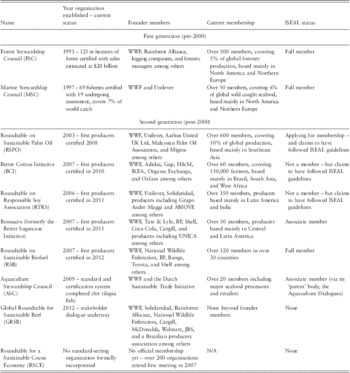
The size and scope of the roundtable system is described in Table 1. The table reveals that all roundtables share a founder member, namely the World Wide Fund for Nature (WWF), an international NGO focused on environmental protection, with many also home to large agri-food businesses such as Cargill and Unilever and biofuel suppliers such as BP and Shell. Likewise, many roundtables are also members of ISEAL – formerly the International Social and Environmental Accreditation and Labelling Alliance – another private organization that acts to codify best practice in standard setting. Through these two organizational networks, the roundtables have come to share a set of decision-making procedures that makes them operationally comparable. These include: equal voting rights among an elected governing body; the organization of the wider membership into issue-based chambers, or a cross-issue stakeholder council, with license to pass recommendations to the governing body; the public disclosure of decisions reached; the periodic review of standards and their implementation; and the provision of meaningful opportunities to participate by those affected by the certification process (Gibbon and Lazaro Reference Gibbon and Lazaro2010, 8).
Primary commodity roundtables as of April 2012

ISEAL = International Social and Environmental Accreditation and Labelling Alliance; WWF = World Wide Fund for Nature.
Source: Roundtables’ own websites.
The shared features of the roundtables suggest that it is possible to approach them either as individual schemes or as components of an informal system that can be evaluated according to the experimentalist framework described above.Footnote 11 This endeavour is complicated by the fact that, while the central ‘unit’ constituted by the multiple memberships of WWF and key multinational companies creates a conduit for comparison, the local units (i.e. the individual roundtables) are constitutionally autonomous and not obliged to undergo processes of learning in the form of peer review. As we go onto show, the centrifugal tendencies enabled by this loose central-local structure lead us to see roundtables as imperfect realizations of experimentalist governance. This means that the schemes collectively approximate, but only to a certain degree, the three core ideas associated with experimentalist governance. This qualified assessment implies that a clear-cut evaluation of the normative legitimacy of these schemes may not be possible, an implication that we return to in the conclusion of this paper. The discussion does, though, enable us to cast light on the strengths and weaknesses of a prominent example of a private regulatory regime. Our analysis also suggests that the prospects for strengthening the claims to legitimacy of schemes like the roundtables turns, at least in part, on the capacity of actors to exploit their destabilizing effects to forge pathways to enhanced global governance.
Deliberative polyarchy: there is social learning, but it is unsystematic
The first core idea, to recall, is deliberative polyarchy, which is associated with a complex process of deliberation, delegation, and accountability between central and local units. It is difficult to discern analogies to ‘central’ and ‘local’ units in this particular case study of private regulation, either in individual roundtables or the system as a whole. There are, nonetheless, certain functional equivalents that allow for legitimacy-enhancing, though ultimately somewhat unsystematic, processes of social learning to occur.
The roundtables have, for instance, fostered an engrained culture of devolving information-gathering and legislative activities to independent experts (Gibbon and Lazaro Reference Gibbon and Lazaro2010, 8). So, for instance, the roundtables covering commodities that might end up as biofuels [Bonsucro, Roundtable on Sustainable Biofuel (RSB), Roundtable on Sustainable Palm Oil (RSPO), and Roundtable on Responsible Soy Association (RTRS)] have had to make sure that these are produced in such a way as to maximize carbon savings, an assurance that requires scientific knowledge of fuel emissions, soil management, plant biology, etc. In the case of the sugarcane roundtable, an ‘Environment Working Group’ was created with industry experts hired to synthesize the valid suggestions on measuring greenhouse gas emissions and ensure that its reporting mechanisms would be recognized as scientifically legitimate by observers.
This use of organizationally neutral consultants to lead technical working groups, or to provide reports for individual roundtable members, both prevents standard-setting from becoming overtly political and also serves to operationalize sustainability by codifying it and making it quantifiable. As such reason giving can proceed in a context where knowledge and expertize are widely favoured/used, while opportunities for protectionism or ‘bullying tactics’ are minimized. The deliberative processes within these schemes allow sustainability standards to ‘evolve’ throughout the lifespan of different roundtables. The standards are subject to periodic revision thanks to the shifting nature of the membership of roundtables, with new members introducing different perspectives to internal deliberations and building upon a growing pool of experience and knowledge about the adequacy and effectiveness of existing standards.
There is also evidence of social learning across the system as a whole through the pooling of information and experience by participants across different roundtables. This is illustrated by the contrast between the FSC's member-driven governance and the Marine Stewardship Council's (MSC) bi-partite governance, which emerged as a result of the WWF's diagnosis of failings in the former and their reluctance to establish another decentralized organization to regulate fishing (Gale and Haward Reference Gale and Haward2004). In the light of subsequent criticism of the MSC for being too exclusive and managerial, the WWF and the standard-setting community at large revised their approach again. In the post-2000 roundtables, attempts have been made to satisfy demands that private regulatory regimes become ‘more cognizant of developing country realities and [be] based on consultative processes that include labour and Southern actors as key participants’ (Utting Reference Utting2002). This concern has stimulated efforts to achieve wider engagement through outreach meetings by founder members, including travelling to a country likely to undertake certification and holding public meetings on the process and/or conducting field tests. This chimes with the idea that experimentalism generates ‘improved understandings of goals and shifts in the content of norms’ among participants (Cohen and Sabel Reference Cohen and Sabel2006, 790).
These elements of social learning are facilitated by the fact that particular organizations, such as Unilever and WWF, are members of a range of commodity roundtables, which places them in an efficacious position to learn from their experiences of roundtables in different areas of commodity production. For example, workshops on the possibility of using certification to reduce rates of land conversion have taken place in response to high-profile debates around the ‘global land grab’ caused by increased biofuel production and rising food prices – a normative goal unforeseen at the outset of these schemes. As a problem common to all commodity sectors, these have been attended by representatives of the various roundtables, their member organizations, and the kind of independent experts identified earlier. The role of ISEAL in providing a set of common standards and a pool of collective knowledge for roundtables is also important here. As Abbott and Snidal (Reference Abbott and Snidal2009a, 553) note, ‘ISEAL and other alliances promote learning and harmonization among like-minded schemes and provide technical assistance to new ones’. There is an element of experimentalist ‘peer-review’ to this system, in that the performance of certification bodies that carry out similar functions across different commodity sectors can be compared and evaluated.
These approximations of experimentalist architecture reflect the impressive capability of the certification system to engage in exploratory and deliberative problem solving. At the same time, it is by no means evident that the element of peer review in the system fully satisfies the normative requirements of experimentalist governance. Sabel and Zeitlin's (Reference Sabel and Zeitlin2008, 305–12) description of peer review in the EU, for instance, is based on complex institutional networks where various rule-making and rule-implementing bodies are formally obliged to justify their decisions to each other and may, in some cases, be subject to ‘penalty defaults’ imposed in the event of perceived failures.
The unsystematic nature of the feedback mechanisms between roundtables and their external critics, and between the roundtables themselves, arguably hinders the capacity of roundtables to instigate and benefit from social learning around issues such as land conversion, complaint resolution and farmer training. In addition, the risk of alienating key stakeholders, whose participation is essential to the commercial plausibility of roundtables, acts as a constraint on penalizing powerful actors and thus jeopardizes genuine deliberation. As Grant Rosaman of Greenpeace argues, ‘when WWF becomes an external assessment body for the companies, the companies become their clients and it gets very difficult for them [the WWF] to stay loyal to their agenda’ (cited in Zhou Reference Zhou2010). This dilemma is recognized by the WWF itself, noting that penalizing free-riders is ‘critical in maintaining credibility in the face of attack by groups that question the compromises that are made during multi-stakeholder negotiations’ (WWF 2010a, 20).Footnote 12 This brief sketch suggests that the reason-giving dimension of the roundtable system approximates experimentalist expectations to a certain degree, but that the important monitoring and accountability mechanisms are less well developed.
Stakeholder inclusion: the lack of adequate representation triggers contestation in civil society
The deficiencies of roundtables also become apparent when we turn to stakeholder inclusion. The roundtables, as noted in our previous discussion, compare strongly to industry-only standards setting bodies, in that their composition allows for representation of important perspectives that would otherwise be excluded. The problem is that major concerns remain about the capacity of roundtables to ensure adequate representation of interests. Roundtables still lack full involvement of groups like farm cooperatives, landless peoples’ organizations, and trade unions (Partzsch, Reference Partzsch2011). These concerns are complemented by worries about the power that dominant Northern industry and NGO stakeholders exercise over the certification process. The contrasting responses of NGOs to this lack of inclusion combine in surprising ways to off-set, but only partially, this deficiency.
There are, broadly speaking, three strategies that are pursued by NGOs to contest the incapacity of roundtables to achieve adequate stakeholder participation. The first approach is reformist participation. This approach, which is exemplified by the WWF, involves efforts to improve the schemes through formal membership of some or all roundtables. For these reform-minded participants, the answer to this lack of engagement by relevant stakeholders is to refine the roundtable process, particularly in relation to outreach and inclusion.
The WWF, for instance, has been particularly concerned that NGO participants to the schemes respond to the charge that roundtables are dominated by a (non-state) ‘club’ mentality, which is reflected in the prominence of large producers, distributors, and Northern NGOs in shaping the scheme. The WWF has recognized that the resource-intensive nature of participation in the roundtables risks them becoming simply a ‘coalition of the active’ (WWF 2010a, 13). Its narrow representation is said to prevent adequate expertize from emerging, particularly about small producers and local communities that typically lack professional advocates (WWF 2010a, 18). The WWF thus identifies reduced barriers to community participation, engagement with small producers, and developing ‘locally appropriate’ standards as important goals in the refinement of the certification process (WWF 2010a, 19).
The second approach is what we might describe as critical engagement. The NGOs that adopt this approach may not be formal members of particular roundtables, but they nonetheless accept the principle of multi-stakeholder certification and engage in systematic criticism of failures to realize this principle in practice.Footnote 13 For example, Greenpeace argues that existing standards developed by the RSPO will not prevent forest and peatland destruction, and that a number of RSPO members are not taking steps to avoid the worst practices of the palm oil industry (Greenpeace 2008). Greenpeace adopts a multi-faceted response to these failings, from demanding that the ‘RSPO must implement and toughen up its existing criteria’ to insisting that ‘voluntary certification alone cannot be sufficient to protect the last forests of South-East Asia’ (Greenpeace 2008, 3). The most active campaign by the organization, however, has been to target the major buyers of palm oil like Unilever to boycott the worst suppliers. In this case, the NGO explicitly used Unilever's status as an RSPO member to leverage pressure on the company to ‘do the right thing’, and has also used the RSPO's audit reports and grievance panel findings to bolster the credibility of their claim that certain producers are not playing by the rules (Greenpeace 2010).
Through this naming and shaming, and consonant with experimentalist governance, there is some safeguard against the complete hijacking of the roundtables by corporate interests. However, this is clearly not based on a multi-polar distribution of power among affected stakeholders, as experimentalism would advocate. Rather, it depends on the ability of large NGOs to mix technical understanding of certification systems and publicity-generating performances – like storming Unilever's headquarters and factories dressed as orangutans, an animal directly threatened by the loss of its habitat to oil palm – to target companies.
The third approach is critical disengagement. This approach rejects the principle of multi-stakeholder certification, favouring instead the use of alternative governance mechanisms to promote sustainability or other desired objectives. The Corporate Europe Observatory (CEO), a campaign group that challenges the privileged access of corporations in policymaking, is representative of a more radical critique of certification that has emerged in some civil society circles. In a report on the sugarcane roundtable, the CEO documents how its membership is comprised mainly of large multinational companies and international NGOs, with poorer stakeholders from the developing world excluded by the high costs of participation (CEO et al. 2007).Footnote 14 Yet the CEO contends that the absence of participation by all affected communities is not some minor institutional flaw that can be remedied, but is instead indicative of the underlying purpose of the roundtables. Their function, it is alleged, is to provide a veneer of credibility to large-scale monoculture production and its use in the nascent biofuels industry (CEO 2009).
NGO critics such as CEO thus do not lobby for tighter standards or more effective enforcement, but instead call for roundtables to be disbanded. The Roundtable for Responsible Soy has been subject to this kind of radical critique, on the grounds that the effect of certification is ultimately to legitimize an objectionable expansion of soy monoculture (Friends of the Earth 2008). This strategy is illustrated in the public rejection by many organizations of certification and their insistence that the problems associated with primary commodity production and its continued expansion are really rooted in the resource-intensive lifestyles of consumers in the Global North. In this instance, NGOs like CEO and Friends of the Earth focus their efforts on lobbying government policymakers to reduce targets for mandatory biofuel consumption and wean the livestock industry off its dependence on imported feedstuffs.
These three strategies illustrate the different ways in which NGO stakeholders have responded to the emergence of various roundtables. They show that roundtables have become focal points for a process of ‘public contestation’, as social critics draw on their knowledge and experience to formulate contrasting appraisals of their merits. In fact, these different strategies often interact in ways that an experimentalist framework can identify as beneficial to the aim of enhanced governance. This is true even of the strategy of critical disengagement. A stance of non-engagement can in itself communicate important information to institutional designers. As noted above, the WWF (2010b) has responded to radical critique by seeking ways to revise certification processes so that they may mitigate the transformation of ever-more land into monoculture plantations and avoid accusations that their schemes ignore land grabbing. Conversely, radical critics have also benefitted from roundtables to the extent that they have raised the profile of public debate over commodity production and created the opportunity for these campaigners to clarify their arguments.
A lesson that we might tease out of this study is that, rather than seeking to adjudicate between NGO strategies of participation, engagement or disengagement, as the normative literature often advises, we can see how the three strategies are interlinked in the expansion of the social argumentative pool (Dryzek Reference Dryzek2006). In general terms, this supports the contention that we should preserve an ‘inside-outside’ role for civil society organizations in private regulatory schemes. In relation to the legitimacy of roundtables, though, the gravity of the criticisms of the scheme advanced by some external critics is deeply troubling. The mere fact that such radical criticisms have been made is not, in itself, a decisive consideration in evaluating the normative legitimacy of these schemes. However, the reasons given to support these criticisms – including concerns about the representativeness, industry-dominance, and overall impacts of certification – appear sufficiently weighty to at least factor in normative evaluation. The failure to include stakeholders, coupled with concerns about power dynamics within the schemes, provides further evidence for the claim that the schemes fall short of experimentalist expectations.
Democratic destabilization: the roundtables as a pathway to improved governance
The analysis so far has offered a balanced, if somewhat inconclusive, appraisal of the roundtables. An important dimension that has yet to be factored into our discussion, though, is the idea of democratic destabilization. The concept of democratic destabilization, to recall, refers to the opportunities created by deliberation surrounding experimentalist schemes for the gradual emergence of new forms of political subjectivity and governance structures. Experimentalist theory treats destabilization as a democratizing opportunity that must be grasped by relevant social actors, rather than a phenomenon that automatically generates benevolent outcomes (Sabel and Zeitlin Reference Sabel and Zeitlin2008, 277). The interaction between actors in public and private regulatory regimes is, we suggest, particularly relevant to the appraisal of roundtables. The identification of mechanisms through which the roundtables might be a ‘pathway’ to the diffusion of governance structures that possess greater claims to legitimacy can be presented as a highly relevant variable in their normative evaluation (Sabel and Zeitlin Reference Sabel and Zeitlen2011, 2).
The focus of our analysis is the relationship between national and intergovernmental organizations on the one hand and the roundtables on the other. In relation to the post-2000 generation of roundtables, we suggest that national- and EU-level legislation in respect to biofuels has been the key mechanism through which roundtables have exercised broader impacts on governance. This took place in two stages.
First, after recognizing the potential of certification schemes to provide commercially plausible and publicly justifiable solutions to the problems of biofuels, the UK, Dutch, and German governments encouraged them to adopt ambitious sustainability standards and robust auditing procedures. They did this by benchmarking existing (private) standards against their own devised ‘meta-standard’, encouraging those certification schemes operating within their borders to meet their minimum criteria and ratchet themselves upward against one another. This was done by forming international policy networks to debate the content of the meta-standards (which thus became aligned across countries) and convincing participants – including those experts and member organizations involved with the roundtables – that to appear credible to the outside world, certification schemes must work proactively with public authorities in response to the prevailing ‘scientific consensus’ (Richardson Reference Richardson2013).
Where this approach was more limited, however, was in getting these certification systems within the various biofuel supply chains. To encourage their uptake, governments had relied on publicly naming and shaming biofuel suppliers for failing to source adequate amounts from certified producers. Since palm oil biofuel was especially contentious, effort was made to encourage use of the RSPO scheme in particular, with the UK government asking companies to state the proportion sourced from RSPO-compliant plantations and the Dutch government even going as far as to make this a national requirement. But ultimately, the voluntary approach taken could only really cajole biofuel producers into agreeing to apply private standards. The key to their widespread adoption was the imminent introduction of binding EU regulation.
The second stage, then, was the addition of sustainability criteria to the 2009 Renewable Energy Directive, which effectively required all biofuels sold in the EU, including those imported from developing countries, to meet minimum environmental standards. It is notable for both applying legal standards to the way a good is produced in domestic and foreign markets, and for the way compliance is monitored. Instead of relying on public inspection or government legislation in third countries, it uses certification systems to provide assurance that the complicated environmental requirements are being met. This led to a significant uptake in the certification of commodity producers: the sugarcane roundtable, Bonsucro, for example, had 12 of Brazil's biggest sugarcane mills certify their output in 2011 alone, all of which undertook this process essentially to rubber-stamp the entry of their biofuel into the EU (Richardson Reference Richardson2013).
The normative appeal of state involvement in the world of private regulatory regimes is that they might off-set the ‘orchestration deficits’ of having multiple certification schemes all targeting the same set of producers (Abbott and Snidal Reference Abbott and Snidal2009a, 558–60). In the case above, we suggest that in fact a rather different, and potentially greater, appeal is the idea that states can find ways to make voluntary standards in effect mandatory and to spread this obligation across more markets. As the European Commission notes, ‘voluntary schemes may have an impact in commodity markets broader than biofuels and bioliquids, potentially enhancing sustainable production of agricultural raw materials as a side-effect’ (Commission of the European Communities (CEC) 2010, 7). In other words, as access to the EU biofuels market now depends on engagement with multi-stakeholder certification schemes, and since certified producers will likely sell into markets beyond just biofuel, this interaction between public and private regimes might usher the process of certification – and its deliberative foundations – into commodity governance more broadly.Footnote 15
There is, though, a risk that greater state involvement might be to the detriment of roundtable plausibility. It is interesting to note the case of the Roundtable for a Sustainable Cocoa Economy, which is unique among roundtables in being born of an intergovernmental body (the International Cocoa Organisation) and retaining the influence of states in its collective. This is also the roundtable where least progress has been made toward codifying a sustainability standard. Both Côte d'Ivoire and Brazil have expressed the view that it should ‘avoid adopting a paternalistic approach in relation to the national sovereign policies of producing countries, through the imposition of certification’ (Roundtable for a Sustainable Cocoa Economy (RSCE) 2009, 3). These kinds of interactions raise complex issues, but perhaps lend support to the thought that governmental engagement with roundtables should remain strictly ‘facilitative’ rather than ‘directive’ (Abbott and Snidal Reference Abbott and Snidal2009a, 564–5). In other words, although there may be benefits to constructive interactions between roundtables and other governance actors, the good of preserving the formal neutrality of roundtables in relation to competing national agendas may recommend the maintenance of a somewhat arms-length relationship with the state. The legitimacy claims of the roundtables do, though, appear to strengthen in so far as we can identify pathway mechanisms between these private regulatory schemes and the emergence of effective and ‘joined up’ experimentalist schemes (Overdevest and Zeitlin Reference Overdevest and Zeitlin2012, 9).
Conclusion
This paper has studied the normative legitimacy of private regulatory regimes through the lens of experimentalist governance. The challenge of evaluating these schemes has been illustrated through considering the case of primary commodity roundtables as imperfect examples of experimentalist governance. We sought to demonstrate the critical purchase of experimentalist governance as a framework for evaluating the limits and potentials of private regulation in global contexts. By way of drawing our discussion to a close, we would like to highlight two general implications of our analysis for the normative analysis of emergent regulatory schemes.
The first observation relates to the application of the experimentalist framework to the legitimacy of private regulatory schemes. The capacity of the framework to orientate evaluations of emergent practices might be questioned on the grounds that our analysis of the roundtables did not generate a clear-cut appraisal of their legitimacy. The characterization of the roundtables as partial or ‘imperfect’ experimentalist regimes suggests that it is uncertain if stakeholders should be thought to have moral reasons to treat these standard-setting bodies as authoritative.
In fact, although a clearer assessment might be desirable, it is not always reasonable to expect black and white evaluations of normative legitimacy. This is particularly true in contexts of pervasive uncertainty about the goals of emergent regulatory schemes in transnational and global contexts. The tensions within civil society, especially among outsider NGOs, over the legitimacy of the roundtables’ very existence illustrates this difficulty. The source of this tension can surely be traced, at least in part, to the difficulty of assessing schemes that are novel, fragile, and continually evolving. The turn to experimentalism suggests that the legitimacy of these schemes might be enhanced through strengthening institutional capacity for learning across roundtables and between roundtables and their critics. This could be achieved through roundtables submitting to an annual ‘sustainability impact review’ overseen by ISEAL, which pulls together some of the points raised by civil society actors engaged in critical dis/engagement, and against which the roundtables are then obliged to publicly respond with a view to revising their sustainability standard or auditing practices. This suggestion illustrates the good of restraining the ambitions of normative analysis to the construction of frameworks that can orientate, rather than dictate, moral evaluation. If the theory helps to fix ideas about the strengths and weaknesses of emergent schemes, as well as furnishing proposals about how they might be improved, it has already made an important contribution to guiding normative evaluation in conditions of uncertainty.
The second observation relates to implications of our analysis for further research into private regulatory regimes in general. There is, as noted towards the end of our discussion, considerable interest in the emergence of hybrid public–private regimes and a ‘joined-up’ approach to global standard setting. This has considerable potential for the development and diffusion of experimentalist governance, because of the resulting opportunities for comparisons across governance schemes, collaborative learning, and pooling of information. It is unlikely, though, that the kind of distinctly private schemes that have been discussed throughout this article will disappear. On the reasonable assumption that these schemes remain part of the broader regulatory landscape, critical analysis of their shortcomings remains an important task. This research agenda must explore possible institutional reforms and radical NGO criticisms of schemes like the roundtables, including their perceived ‘managerial’ mode of operation and their alleged legitimation of production models that contribute to expulsions of rural communities, reduced access to land for traditional food production, and the loss of native habitats (Friends of the Earth 2008). Another dimension must be to explore the accountability of private regulatory regimes, especially given the absence we detected in relation to roundtables of a clear ‘penalty’ sanction wielded by the central units. The capacity of private regulatory schemes to find a ‘pathway’ to greater normative legitimacy will depend upon the solutions that are crafted in response to these kinds of problems, which is likely to require more than merely integrating with public regulatory schemes and using political sovereignty to deflect criticism.
The implications of our analysis for future research can perhaps best be understood by distinguishing between theoretical and empirical dimensions. Theoretically, we anticipate a research agenda on private governance that is not hamstrung by an excessively critical/materialist view of private organizations, or stuck with a state-centric conception of legitimacy, two views that would each tend towards the negative in relation to the legitimacy of private governance. Thus, experimentalism could serve as a via media for political theory and empirical research, a way of bringing together the contested politics of private global governance with normative questions of legitimacy, deliberation, output, etc., in the context of an ongoing yet critical conversation.
Empirically, experimentalism opens up vast areas of actually existing governance to critical analysis. While numerous cases can be located within the experimentalist purview, one salient issue of contemporary concern is the voluntary offset market, in which projects that reduce greenhouse gas emissions are sold to companies and consumers that want to reduce their carbon footprint. Like the primary commodity roundtables, while each ‘local’ scheme goes about its task in a different way, there are a central set of norms – shaped by bureaucrats, consultants, and campaigners – that inform what counts as a credible climate change initiative (Bernstein et al. Reference Bernstein, Betsill, Hoffman and Paterson2010). Also like the roundtables, most critical literature has approached this normatively as a form of global environmental governance that leads to a problematic ‘marketization’ of sustainability. Experimentalism could say something different, perhaps in terms of exploring which carbon reduction projects do genuinely help protect the environment and how society could best transfer resources from polluters to help pay for these. This illustrates the versatility of experimentalism as a framework that recommends, perhaps above all else, a pragmatist ethic towards private governance that is based on doubt, trial-and-error, and contestability.