Introduction
The disease burden caused by disorders affecting mental health is the most disabling of any disorder grouping for communities and individuals (Salomon et al., Reference Salomon, Haagsma, Davis, de Noordhout, Polinder, Havelaar and Vos2015; Vigo, Thornicroft, & Atun, Reference Vigo, Thornicroft and Atun2016), and the associated economic burden results in the largest restriction of productivity of all non-communicable disorders (Bloom, Chen, & McGovern, Reference Bloom, Chen and McGovern2018; Goetzel et al., Reference Goetzel, Long, Ozminkowski, Hawkins, Wang and Lynch2004). The social burden in the form of stigma, discrimination, and caregiver burnout is also widely acknowledged (Lasalvia et al., Reference Lasalvia, Zoppei, Van Bortel, Bonetto, Cristofalo, Wahlbeck and Thornicroft2013; Thornicroft, Brohan, Rose, Sartorius, & Leese, Reference Thornicroft, Brohan, Rose, Sartorius and Leese2009). Hence, societal strategies to mitigate these burdens are of great importance. Cost-effective interventions to treat mental disorders have been tested in countries across income levels and are ready for global scaleup (Patel et al., Reference Patel, Chisholm, Parikh, Charlson, Degenhardt, Dua, Whiteford, Patel, Chisholm, Dua, Laxminarayan and Medina-Mora2016; Patel et al., Reference Patel, Saxena, Lund, Thornicroft, Baingana, Bolton and UnÜtzer2018; Vigo et al., Reference Vigo, Patel, Becker, Bloom, Yip, Raviola and Kleinman2019). Yet an under-spending on mental disorders continues to exist relative to other classes of disorders (Alonso et al., Reference Alonso, Liu, Evans-Lacko, Sadikova, Sampson, Chatterji and Thornicroft2018; Degenhardt et al., Reference Degenhardt, Glantz, Evans-Lacko, Sadikova, Sampson, Thornicroft and Kessler2017; Thornicroft et al., Reference Thornicroft, Chatterji, Evans-Lacko, Gruber, Sampson, Aguilar-Gaxiola and Kessler2017; Vigo, Kestel, Pendakur, Thornicroft, & Atun, Reference Vigo, Kestel, Pendakur, Thornicroft and Atun2019).
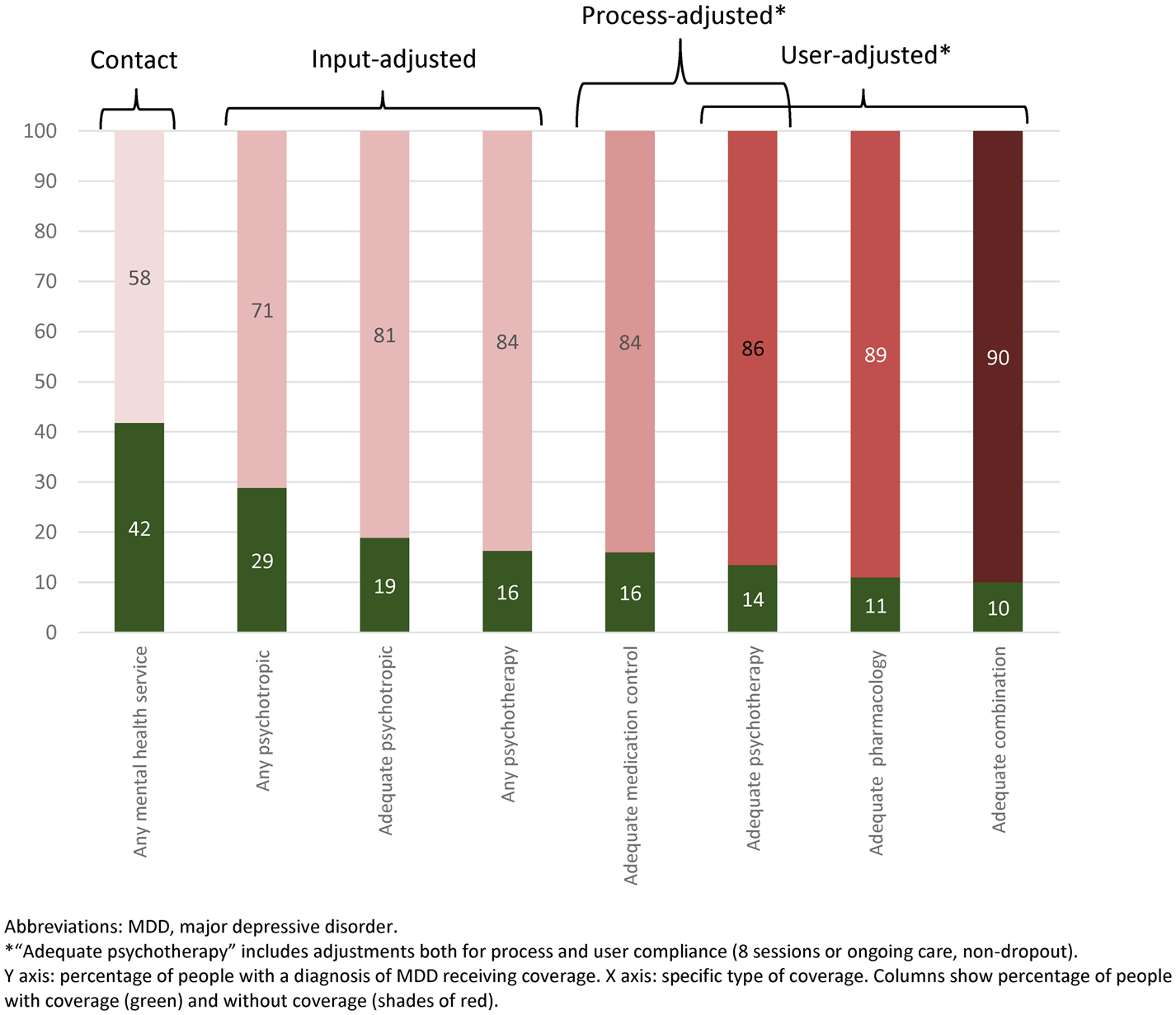
It is important to identify where the gaps in effective coverage occur so that governments can move toward the Sustainable Development Goals (SDGs) (General Assembly of the United Nations, 2015). A well-established model is the effective coverage cascade based on the Tanahashi framework (Amouzou et al., Reference Amouzou, Leslie, Ram, Fox, Jiwani, Requejo and Boerma2019; Larson, Vail, Mbaruku, Mbatia, & Kruk, Reference Larson, Vail, Mbaruku, Mbatia and Kruk2017; Levy-Bruhl et al., Reference Levy-Bruhl, Soucat, Osseni, Ndiaye, Dieng, De Bethune and Knippenberg1997; Tanahashi, Reference Tanahashi1978), which distinguishes between potential and actual coverage. Potential coverage refers to whether services are available (i.e. they exist), whether they are accessible (i.e. whether there are barriers to utilization, such as fees or distance), and whether they are acceptable to users (i.e. provided in a culturally safe and respectful manner). Actual coverage is composed of contact coverage (the percentage of people in need that get any services); and effective coverage (the percentage that get good care and obtain health benefits from it). Effective coverage can be considered a function of quality- and user-adjusted coverage: if people receive good quality care (with the right inputs and following guidelines) and adhere to it, a beneficial outcome can be expected. Figure 1 is a graphic representation of such a coverage cascade. A ‘bottleneck’ in coverage is a large drop between two adjacent columns, and points to a critical deficit in the system.
The effective coverage cascade*.

Thornicroft et al. have examined the rates of ‘minimally adequate treatment’ for major depressive disorder (MDD), defined as either of the following: ⩾1month of pharmacotherapy plus four physician visits, or eight sessions with any mental health provider (Thornicroft et al., Reference Thornicroft, Chatterji, Evans-Lacko, Gruber, Sampson, Aguilar-Gaxiola and Kessler2017). In addition to quantifying utilization, an ‘effective coverage’ indicator requires further adjustments for quality of care (i.e. inputs and process) and user adherence (i.e. to physician indications) (Amouzou et al., Reference Amouzou, Leslie, Ram, Fox, Jiwani, Requejo and Boerma2019; Larson et al., Reference Larson, Vail, Mbaruku, Mbatia and Kruk2017). This paper develops both a quality adjustment by factoring in the adequacy of the human resources and the type of pharmacotherapy used; as well as an adherence adjustment that considers the dose of the drug that the patient acknowledges taking and whether the patient dropped out of psychotherapy before the minimum number sessions or against the advise of the provider. Our results are based on surveys from 15 countries across four continents (Brazil, Colombia, Lebanon, Mexico, Nigeria, Romania, Argentina, Belgium, France, Germany, Italy, the Netherlands, Portugal, Spain, and the USA). Further, we also adjust our coverage indicator to different severity levels. Based on these results, we develop and analyze the effective coverage cascade for MDD, which causes the largest disease burden of all disorders affecting mental health. A granular understanding of the specific ‘bottlenecks’ in coverage and of how they vary by severity will help decision-makers to design evidence-based approaches to health systems improvement, with the goal of achieving universal health coverage.
Methods
Sample
The WHO World Mental Health (WMH) Survey Initiative carried out 17 community surveys with 35 012 adults across the 15 aforementioned countries, including six classified by the World Bank as low- or middle-income countries (LMICs) and nine classified as high-income countries (HICs). All samples were based on multi-stage clustered area probability household designs. Samples were nationally representative in 11 surveys, representative of all urbanized areas in two others, and representative of selected regions or Metropolitan areas in the others (Table 1). Surveys were approved by the review boards of the coordinating organizations, which monitored adherence with procedures for informed consent.
WMH sample characteristics by World Bank income categoriesa

a The World Bank (2012) Data. Accessed 12 May 2012 at: http://data.worldbank.org/country. Some of the WMH countries have moved into new income categories since the surveys were conducted. The income groupings above reflect the status of each country at the time of data collection. The current income category of each country is available at the preceding URL.
b NSMH (The Colombian National Study of Mental Health); MMHHS (Medellín Mental Health Household Study); LEBANON (Lebanese Evaluation of the Burden of Ailments and Needs of the Nation); M-NCS (The Mexico National Comorbidity Survey); NSMHW (The Nigerian Survey of Mental Health and Wellbeing); RMHS (Romania Mental Health Survey); AMHES (Argentina Mental Health Epidemiologic Survey); ESEMeD (The European Study Of The Epidemiology Of Mental Disorders); NMHS (Portugal National Mental Health Survey); PEGASUS-Murcia (Psychiatric Enquiry to General Population in Southeast Spain-Murcia; NCS-R (The US National Comorbidity Survey Replication).
c Most WMH surveys are based on stratified multistage clustered area probability household samples in which samples of areas equivalent to counties or municipalities in the USA were selected in the first stage followed by one or more subsequent stages of geographic sampling (e.g. towns within counties, blocks within towns, households within blocks) to arrive at a sample of households, in each of which a listing of household members was created and one or two people were selected from this listing to be interviewed. No substitution was allowed when the originally sampled household resident could not be interviewed. These household samples were selected from Census area data in all countries other than France (where telephone directories were used to select households) and the Netherlands (where postal registries were used to select households). Several WMH surveys (Belgium, Germany, Italy, Spain-Murcia) used municipal, country resident, or universal health-care registries to select respondents without listing households. Ten of the 17 surveys are based on nationally representative household samples.
d The response rate is calculated as the ratio of the number of households in which an interview was completed to the number of households originally sampled, excluding from the denominator households known not to be eligible either because of being vacant at the time of initial contact or because the residents were unable to speak the designated languages of the survey. The weighted average response rate is 70.3%.
e The following surveys, included in Thornicroft et al. (Reference Thornicroft, Chatterji, Evans-Lacko, Gruber, Sampson, Aguilar-Gaxiola and Kessler2017), were excluded from this study due to lack of data on the specific drug taken and on adherence to prescribed dosage: Beijing/Shanghai, Bulgaria, Iraq, Israel, Japan, and Peru
Interviews were carried out face-to-face in respondents' homes by trained lay interviewers. Field training and quality control procedures are described elsewhere (Pennell et al., Reference Pennell, Mneimneh, Bowers, Chardoul, Wells, Viana, He, Kessler and Ustun2008). Respondents were aged 18+ in all surveys other than one (19+ in Medellin, Colombia) and had unrestricted upper age limits in most surveys. The average response rate weighted by sample size was 70.3% using the American Association for Public Opinion Research RR1w definition (American Association for Public Opinion Research, 2016).
To reduce respondent burden, interviews were divided into two parts. Part I, administered to all respondents, assessed core mental disorders. Part II assessed additional disorders and correlates and was administered to all respondents with any Part I disorder plus a probability subsample of other Part I respondents. Part II data were weighted to adjust for the under-sampling of Part I non-cases, making weighted Part II prevalence estimates identical to Part I estimates (Heeringa et al., Reference Heeringa, Wells, Hubbard, Mneimneh, Chiu, Sampson, Berglund, Kessler and Üstün2008). In total, 71 576 Part I and 35 012 Part II respondents were interviewed. Of these 35 012 respondents, 3341 met DSM-IV criteria for 12-month MDD. The authors assert that all procedures contributing to this work comply with the ethical standards of the relevant national and institutional committees on human experimentation and with the Helsinki Declaration of 1975, as revised in 2008.
Measures and data analysis
The interview schedule used in WMH was the WHO Composite International Diagnostic Interview (CIDI) Version 3.0 (Kessler & Ustün, Reference Kessler and Ustün2004), a fully-structured interview generating lifetime and 12-month prevalence estimates of common DSM-IV disorders that includes stringent protocols of translation, back-translation, adaptation, and harmonization across sites (Harkness et al., Reference Harkness, Pennell, Villar, Gebler, Aguilar-Gaxiola, Bilgen, Kessler and Bedirhan2008). Twelve-month MDD was defined as a major depressive episode among respondents who did not have a lifetime history of bipolar spectrum disorder (Merikangas et al., Reference Merikangas, Jin, He, Kessler, Lee, Sampson and Zarkov2011). Hence, anyone with a major depressive episode that lasted for 2 weeks or longer within the past 12 months was included in this analysis, regardless of when their episode started, or of whether they had depressive episodes in previous years. Blinded clinical reappraisal interviews with the Structured Clinical Interview for DSM-IV had good concordance with diagnoses based on the CIDI (Demyttenaere et al., Reference Demyttenaere, Bruffaerts, Posada-Villa, Gasquet, Kovess, Lepine and Chatterji2004; First, Spitzer, Gibbon, & WIlliams, Reference First, Spitzer, Gibbon and WIlliams2002; Haro et al., Reference Haro, Arbabzadeh-Bouchez, Brugha, de Girolamo, Guyer, Jin and Kessler2006). Respondents with MDD were considered severe either if their depression resulted in severe role impairment (7–10 points) according to the Sheehan Disability Scale (SDS; Sheehan, Harnett-Sheehan, & Raj, Reference Sheehan, Harnett-Sheehan and Raj1996), moderate if they reported moderate role impairment in the SDS (4–6), and mild if they reported no or moderate role impairment (3 or less).
We classified health treatment providers into two categories: (1) specialist mental health (SMH; psychiatrist, psychologist, other mental health professional in any setting, social worker or counselor in a mental health specialized setting); and (2) general medical (GM; primary care doctor, other medical doctor, any other healthcare professional seen in a GM setting). Respondents were asked about number of visits with each type of provider in the past 12 months and, for medical providers, about whether they provided psychotherapy, pharmacotherapy, or both. Specific type, dose, and duration were recorded for each psychotropic medication used in the past 12 months. Further details about the treatment variables are presented elsewhere (Wang et al., Reference Wang, Aguilar-Gaxiola, Alonso, Angermeyer, Borges, Bromet and Wells2007).
A series of summary variables was created from these detailed reports. Contact coverage was defined as any contact with an SMH or GM provider for a mental health condition in the past 12 months. The summary measures about pharmacotherapy included two simple dichotomous measures of any psychotropic medication use and any antidepressant use. Two clinical psychiatrists with expertise in public health (DV, CSW) independently reviewed survey responses about types of medications used (which involved selecting from country-specific medication lists including generic and brand names for all available drugs) and reconciled discrepancies by consensus. Adequate medication control for patients taking psychotropic medications was defined as at least four visits with a physician (Wang et al., Reference Wang, Aguilar-Gaxiola, Alonso, Angermeyer, Borges, Bromet and Wells2007). Medication adherence was defined as missing the prescribed daily dose not more than three out of 30 days (Cramer & Rosenheck, Reference Cramer and Rosenheck1998; Jeon-Slaughter, Reference Jeon-Slaughter2012; Osterberg & Blaschke, Reference Osterberg and Blaschke2005). A summary measure of adequate pharmacotherapy was then defined as taking an antidepressant with adequate medication control and adherence. Given that a small fraction of people with MDD may be prescribed non-antidepressant psychotropics due to antidepressants' side effects, failed trials, or other reasons for off-label non-antidepressant drug use, we also considered interventions adequate if a non-antidepressant psychotropic was prescribed and adequately controlled by a psychiatrist with adequate patient adherence.
Among respondents with contact coverage, any psychotherapy was defined as having two or more visits to any specialty mental health provider (as defined above). This broad definition intends to capture the full range of psychological interventions delivered by a qualified provider. The adequate number of sessions was defined as at least eight sessions (Wang et al., Reference Wang, Aguilar-Gaxiola, Alonso, Angermeyer, Borges, Bromet and Wells2007). Psychotherapy adherence depended on whether the respondent prematurely ended treatment. Adequate psychotherapy was defined as complying with at least eight sessions from an adequate provider or still being in treatment after two visits. Given that psychiatry visits would most likely be for medication control, to be considered as a psychotherapeutic intervention, these visits needed to last 30 min or more.
Given that severity is associated with different service needs (Ten Have, Nuyen, Beekman, & de Graaf, Reference Ten Have, Nuyen, Beekman and de Graaf2013; Wang et al., Reference Wang, Aguilar-Gaxiola, Alonso, Angermeyer, Borges, Bromet and Wells2007), we defined a variable for adequate combination of pharmacotherapy and psychotherapy that required adequate pharmacotherapy and/or adequate psychotherapy for mild and moderate MDD, and a combination of both adequate pharmacotherapy and adequate psychotherapy for severe MDD. These composite variables were based on a review of the April 2018 National Institute for Health and Care Excellence Guidelines (National Institute for Health and Care Excellence, 2009), the 2016 Canadian Network for Mood and Anxiety Treatments guidelines (Kennedy et al., Reference Kennedy, Lam, McIntyre, Tourjman, Bhat, Blier and Uher2016; Parikh et al., Reference Parikh, Quilty, Ravitz, Rosenbluth, Pavlova, Grigoriadis and Uher2016), the 2010 American Psychiatric Association Practice Guideline For The Treatment Of Patients With Major Depressive Disorder (Gelenberg et al., Reference Gelenberg, Freeman, Markowitz, Rosenbaum, Thase, Trivedi and Van Rhoads2010), and the 2016 WHO mhGAP Intervention Guide (World Health Organization, 2016). All the coverage variables were defined before obtaining the results and were not modified afterwards.
Weights were used to adjust for differences in within-household probabilities of selection and residual discrepancies between sample and population distributions on census demographic–geographic variables (Heeringa et al., Reference Heeringa, Wells, Hubbard, Mneimneh, Chiu, Sampson, Berglund, Kessler and Üstün2008). Analyses consisted of nested cross-tabulations designed to estimate the proportions of people with 12-month MDD who received treatment. Standard errors were estimated using the Taylor series linearization method (Wolter, Reference Wolter1985) implemented in the SUDAAN software system (Research Triangle Institute, 2002) to adjust for weighting and geographic clustering of data. The statistical significance of differences in conditional treatment prevalence estimates by disorder severity and country income level was evaluated with logistic regression models pooled across surveys with dummy control variables for the survey. Significance tests for these subgroup differences were based on design-based methods that took into consideration the weighting and clustering of data. Significance was evaluated using 0.05-level two-sided tests.
Results
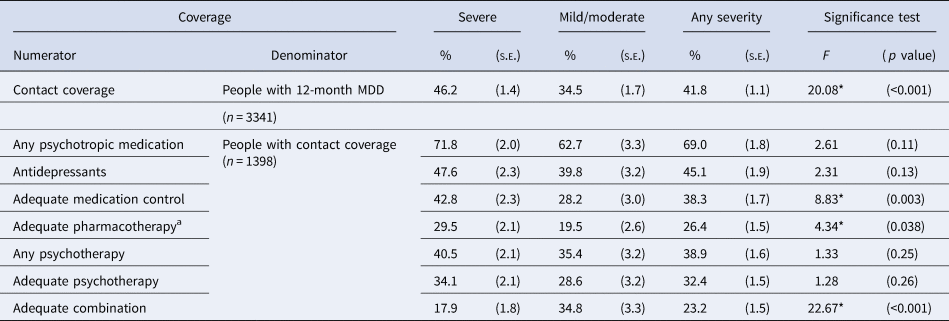
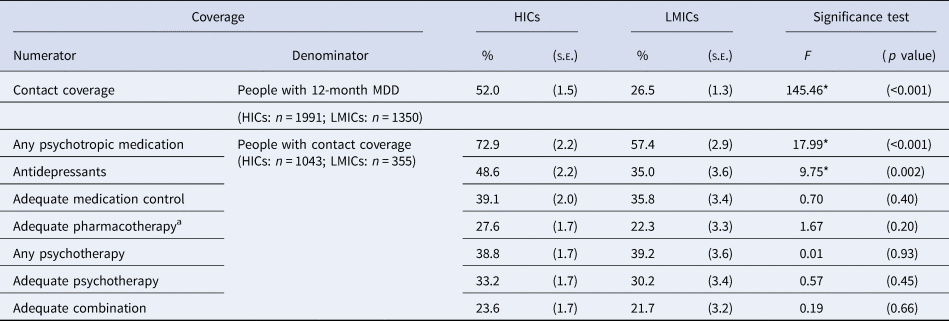
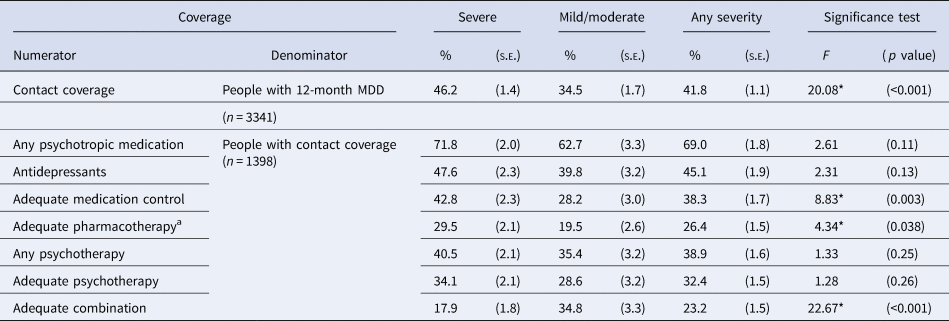
Twelve-month MDD prevalence was 4.8% (s.e., 0.2) across countries. A total of 41.8% (s.e., 1.1) of prevalent cases had contact coverage. Table 2 shows the key components of our three composite variables by severity: adequate pharmacotherapy; adequate psychotherapy; and adequate combination of pharmacotherapy and psychotherapy. Table 3 shows the same components by country-income level.
Coverage for major depressive disorder by severity
MDD, major depressive disorder; s.e., standard error.
*Significant at the 0.05 level, two-sided test.
a Adequate pharmacotherapy: taking an antidepressant with adequate medication control by any physician and adequate adherence; or taking any non-antidepressant psychotropic with adequate medication control by a psychiatrist and adequate patient adherence.
Coverage for major depressive disorder by country income level

HICs, high-income countries; LMICS, low- or middle-income countries; s.e., standard error; MDD, major depressive disorder.
*Significant at the 0.05 level, two-sided test.
a Adequate pharmacotherapy: taking an antidepressant with adequate medication control by any physician and adequate adherence; or taking any non-antidepressant psychotropic with adequate medication control by a psychiatrist and adequate patient adherence.
If we consider all patients with MDD that received contact coverage: (a) 69.0% (s.e., 1.8) received pharmacotherapy, but only 26.4% (s.e.,1.5) received adequate pharmacotherapy; (b) 38.9% (s.e., 1.6) received psychotherapy and slightly less [32.4% (s.e., 1.6)] received adequate psychotherapy; (c) 23.2% (s.e., 1.5) received a severity-adjusted adequate combination of pharmacotherapy and/or psychotherapy.
Impact of severity and country-income level
Of note, the percentage of people with severe depression that received any services is 46.2% (s.e., 1.4), v. 34.5% (s.e., 1.7) of people with mild or moderate presentations (F = 20.08; p < 0.001). The percentage of people that received any services that also received adequate medication control, adequate pharmacotherapy, and an adequate combination of pharmacotherapy and psychotherapy are all significantly different depending on severity (Table 2). People with severe clinical presentations that receive contact coverage tend to receive more adequate pharmacotherapy [29.5% (s.e., 2.1) v. 19.5% (s.e., 2.6); F = 4.34; p = 0.038] than mild to moderate presentations. However, only 17.9% (s.e., 1.8) of severely affected patients receive adequately combined psychotherapy and pharmacotherapy, whereas 34.8% (s.e., 3.3) of mild to moderately affected patients receive adequate care (F = 22.67; p < 0.001).
Higher country-income level is significantly associated with increased contact coverage [52.0% (s.e., 1.5) v. 26.5% (s.e., 1.7)]. Also in HICs, 27.6% (s.e., 1.7) of people with contact coverage for MDD received adequate pharmacotherapy, 33.2% (s.e., 1.7) adequate psychotherapy, and 23.6% (s.e., 1.7) an adequate combination. In LMICs, 22.3% (s.e., 3.3) received adequate pharmacotherapy, 30.2% (s.e., 3.4) adequate psychotherapy, and 21.7% (s.e., 3.1) received an adequate combination.
Main bottlenecks in coverage
How should these shortfalls in specific interventions be interpreted from a health systems perspective? Our modified Tanahashi framework indicates that the main bottleneck is in contact coverage: only 41.8% of people in need are receiving any mental health services (Fig. 2). However, we cannot determine whether this bottleneck is mainly due to a genuine utilization gap (i.e. low demand), or if it is due to upstream service supply gaps in availability, accessibility, or acceptability of services (which is more likely in general, and certain for lower-income contexts).
Contact coverage, quality-adjusted (input and process), and user-adjusted coverage for MDD.
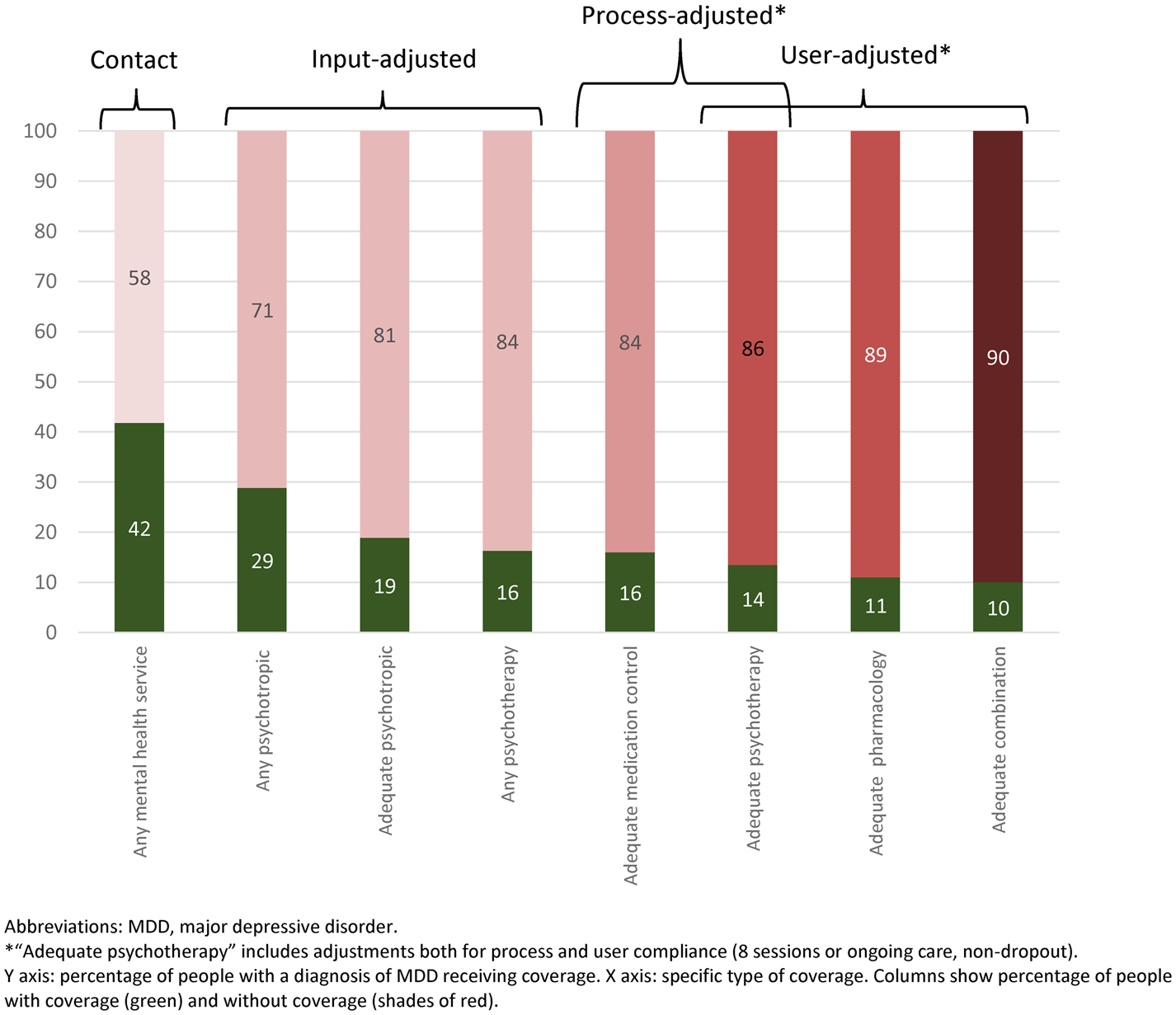
The product of contact coverage and adequate combination treatment (i.e. 0.418 × 0.232) indicates that 10% of MDD cases are receiving quality- and user-adjusted coverage. This represents a 90% treatment gap, which can be decomposed into 58.2% (100–41.8%) due to lack of contact and 32% (90–58%) due to inadequate quality and adherence.
In order to identify critical bottlenecks, we analyze the relative size of each gap in the context of the whole effective coverage cascade, and focus our analysis on gaps that represent a drop of 10 percentage points or more in overall coverage for MDD cases (see Fig. 2).
With respect to psychopharmacology, there are two main bottlenecks: any use of pharmacotherapy and inadequate physician monitoring: only 69% of help-seekers get any pharmacotherapy, and only 55% of the latter are being adequately monitored (which represent a drop of 13 percentage points each in coverage for all prevalent MDD cases). Next in magnitude, 65% of people receiving any pharmacotherapy are receiving an adequate drug, a drop of 10 percentage points in input-adjusted coverage for all MDD cases. The drop in user-adjusted coverage (i.e. lack of adherence) is comparatively minor.
With respect to psychotherapy, the bottleneck emerges at the input-level: of the 41.8% of people with MDD receiving any services, only 38.9% are receiving any psychotherapy, which represents a drop of 26 percentage points in input-adjusted coverage for all MDD cases. In terms of process and adherence, 83% of the psychotherapy provided is adequate, a drop of only 2 percentage points for all MDD cases.
Finally, the relative importance of the largest bottlenecks is significantly different depending on the country-income level. Our key coverage variables in HICs are between 2 and 2.5 times larger than in LMICs: as a percentage of total MDD cases, contact coverage is 52% v. 27% (F = 145.46; p < 0.001); adequate pharmacotherapy 14% v. 6% (F = 26.20; p < 0.001); adequate psychotherapy 17% v. 8% (F = 30.88; p < 0.001); and adequate combination treatment 12% v. 6% (F = 17.95; p < 0.001).
Several country-specific environmental and socio-economic characteristics, as well as health system arrangements and clinical practices may explain these variations: geographic and demographic characteristics; insurance coverage, social security, and other forms of public benefits; the availability and distribution of the mental health workforce and pharmaceuticals; plus, culturally determined health-related attitudes and behaviors. The study of how these variables impact the bottlenecks identified here (which exceeds the scope of this work) can provide additional clarity for policy makers as to where the societal response should be focused. Online Supplementary Appendix Tables 1 and 3 provide additional contextual information about some of these variables at the country and the country-income levels.
Discussion
This is the first attempt, to our knowledge, to assess quality- and user-adjusted, severity-specific coverage of pharmacotherapy and psychotherapy (combined and separately) for a mental disorder, with the goal of identifying actionable bottlenecks in effective coverage. Our analyses are based on data from a diverse sample of 15 countries which, though not representative of the global context, include countries at all income levels from four continents (eight from Europe, five from the Americas, one from Africa, and one from Asia) (see Table 1 and online Supplementary Appendix Table 1 for details). The WMH surveys contain the largest and most granular primary cross-national database on MDD treatment. This allowed us to construct variables of clinical and public health interest about components of treatment. Diagnoses were obtained through a structured diagnostic tool administered by trained interviewers and validated against blinded clinical reappraisal interviews. We found that only one in 10 people with MDD received effective coverage, defined by an adequate combination of (and adherence with) psychotherapy and pharmacotherapy delivered by an adequate provider in adequate amounts. This gap is driven by specific bottlenecks: only 19% of MDD prevalent cases were prescribed an antidepressant; 16% were adequately monitored by a physician; and 16% received any psychotherapy. This picture highlights both the bottlenecks and the potential directions for improving quality of care and effective coverage, in line with the SDG of achieving universal health coverage inclusive of mental health and wellbeing.
Limitations in this approach include that service utilization data relied on self-reports that may be biased. With respect to recall bias, we focused on 12-month treatment rather than over longer recall periods to minimize this risk. Social desirability bias could also affect some measures, such as when respondents are reluctant to acknowledge non-adherence. Despite this possibility, surveys have been widely used given that more stringent methods (e.g. blood samples, pill counts) are impractical for population-level investigations. In total, 80% and 90% have been used in the past as adherence thresholds and a review found that in the US people took an average 65% of the antidepressant dose, with a range of 24–90% (Cramer & Rosenheck, Reference Cramer and Rosenheck1998; Jeon-Slaughter, Reference Jeon-Slaughter2012; Osterberg & Blaschke, Reference Osterberg and Blaschke2005). To compensate for this potential bias, we have used the most stringent threshold (taking the daily dose at least 90% of the time). Additionally, given that our surveys span 15 years (2001–2015) and all income levels, we have not included computer-, peer-, or community provider-delivered interventions due to their inconsistency across time and countries. Since the updated NICE guidelines allow for a fraction of people with mild depression to be sufficiently served by these delivery platforms, we may be overestimating the gap in countries where these services are widespread. Also, with respect to the time-span covered by the surveys, our tests of significance include dummy control variables for the survey. This approach controls for year of the survey because a separate dummy variable existed for each survey, which means that results are pooled within-survey results. With respect to the potential existence of time trends, we re-ran the analyses including a continuous time variable. We found no significant interaction in our effective coverage indicator (online Supplementary Appendix Table 2). We did find a couple of significant interactions of time with substantive results for two of our intermediate indicators, and a closer look showed that they reflect differences in sample composition rather than time. So, for example, the difference between HIC and LMIC was stronger in later than earlier years when surveys were implemented, but this seems to be due to the fact that the few surveys in LIC carried out in recent years were in especially poorly-resourced settings. Since time trends cannot be estimated reliably, we compare pooled within-country analysis results between high- and lower-income countries controlling for, but not interacting with, time. Similarly, with this sample of countries it is not possible to establish the relative importance of the many environmental, socioeconomic, health system, and other variables that determine the utilization patterns we found. Hence, our conclusions result from pooled within-country analyses and their external validity is defined by the kinds of countries in the analysis. Also, national-level analyses could yield relevant results that differ from the current income-level aggregation, though they escape the scope of this publication.
Another limitation is that the diversity of therapeutic practices cannot be fully captured by standardized indicators that include, for example, a single number-of-visits threshold. Some providers of pharmacotherapy and of psychotherapy will deliver effective care in less than the prescribed number of sessions, so interpretation of these results should be cautious. Also, our study did not focus on the difference between care provided in general v. specialist medical settings, nor on the different subtypes of psychotherapy, which are also promising areas of analysis. Similarly, practices vary across countries, which is why we included guidelines intended both for high-income (such as NICE and CANMAT guidelines) and low-income settings (such as the mh-GAP). Finally, it is likely that some respondents qualified for comorbid mental disorders, and it cannot be ruled out that the comorbid disorder was the main focus of the psychotherapy and/or pharmacotherapy. In practice though, clinicians treat people, rather than specific diagnoses. So, CIDI-diagnosed MDD can be expected to be a key component of most comorbid clinical presentations that include it. In order for MDD to be completely overshadowed by the second disorder to the extent that it is excluded from the focus of care, then the comorbid disorder should be extremely severe and/or the care quite deficient. Hence, this study works under the assumption that the type of quality- and adherence-adjusted care we focused on would, in people that screen positive for MDD through a structured interview (WHO-CIDI), address MDD as a meaningful component of comorbid clinical presentations.
Despite these limitations, our findings have policy implications for diverse settings. For our set of HICs, contact coverage reaches more than half the population in need, so accounting for help-seeking behaviors and considering upstream gaps (in availability, accessibility, and acceptability of services), utilization is already high. Indeed, studies indicate that up to 20% of people with MDD recover on their own, indicating that not accessing medical care or seeking alternatives to it may represent rational decisions (Boerema et al., Reference Boerema, Ten Have, Kleiboer, de Graaf, Nuyen, Cuijpers and Beekman2017). This may be especially true of people with mild MDD, and some mental health systems may choose to encourage self-care or other non-clinical services for a fraction of people with MDD. Hence, the key amenable bottlenecks seem to be downstream: nearly 40% of help-seekers with MDD are being prescribed psychotropics, but only half of them are being adequately monitored. Also, only 20% are receiving any psychotherapy. Considering the well-established economic burden of depression (Bloom et al., Reference Bloom, Chen and McGovern2018; Goetzel et al., Reference Goetzel, Long, Ozminkowski, Hawkins, Wang and Lynch2004), as well as the cost-effectiveness of both pharmacotherapy and psychotherapy (Chisholm et al., Reference Chisholm, Sweeny, Sheehan, Rasmussen, Smit, Cuijpers and Saxena2016; Patel et al., Reference Patel, Chisholm, Parikh, Charlson, Degenhardt, Dua, Whiteford, Patel, Chisholm, Dua, Laxminarayan and Medina-Mora2016), HICs should consider available steps to improve the quality of medication control by physicians and increase referral for psychotherapy. Notable efforts to improve the quality of physician services and to scale up psychotherapeutic services have been successfully implemented in the UK and are currently under way in other jurisdictions such as France and Canada (British Columbia Ministry of Mental Health & Addictions, 2019; Clark et al., Reference Clark, Layard, Smithies, Richards, Suckling and Wright2009; Clark et al., Reference Clark, Canvin, Green, Layard, Pilling and Janecka2018).
For our set of LMICs, contact coverage is low at 26.5%, only 15% of people in need are prescribed any medication through the health system, 10% receive any psychotherapy, and one in 20 gets effective coverage. So, the key bottlenecks are upstream in service supply: the lack of available, accessible, and acceptable services imposes a low ceiling on utilization. Furthermore, less than a third of help-seekers receive potentially adequate psychotherapy, and only a fifth adequate pharmacotherapy. Training community members and non-specialists, as well as leveraging telemedicine, have been posited as reasonable and feasible policies to expand capacity in low-income settings (Joshi et al., Reference Joshi, Alim, Kengne, Jan, Maulik, Peiris and Patel2014; Shigekawa, Fix, Corbett, Roby, & Coffman, Reference Shigekawa, Fix, Corbett, Roby and Coffman2018). As part of a task-sharing stepped-care approach, telemedicine would enhance training and supervision; trained community members would raise awareness, decrease stigma and increase utilization; and trained non-specialists would increase availability and accessibility of quality coverage.
In summary: Based on these data, increasing the quantity and improving quality of pharmacotherapy (with a focus on improving medication control) and psychotherapy (with a focus on expanding capacity) appear as high-priority goals for decision-makers. Potentially suitable innovations have been proposed for people with MDD: the use of telehealth for training and supervision; and leveraging community resources and non-specialists to deliver pharmacotherapy and psychotherapy.
Supplementary material
The supplementary material for this article can be found at https://doi.org/10.1017/S0033291720003797
Acknowledgements
The WHO World Mental Health Survey collaborators are Sergio Aguilar-Gaxiola, MD, PhD; Ali Al-Hamzawi, MD; Mohammed Salih Al-Kaisy, MD; Jordi Alonso, MD, PhD; Laura Helena Andrade, MD, PhD; Lukoye Atwoli, MD, PhD; Corina Benjet, PhD; Guilherme Borges, ScD; Evelyn J. Bromet, PhD; Ronny Bruffaerts, PhD; Brendan Bunting, PhD; Jose Miguel Caldas-de-Almeida, MD, PhD; Graça Cardoso, MD, PhD; Somnath Chatterji, MD; Alfredo H. Cia, MD; Louisa Degenhardt, PhD; Koen Demyttenaere, MD, PhD; Silvia Florescu, MD, PhD; Giovanni de Girolamo, MD; Oye Gureje, MD, DSc, FRCPsych; Josep Maria Haro, MD, PhD; Hristo Hinkov, MD, PhD; Chi-yi Hu, MD, PhD; Peter de Jonge, PhD; Aimee Nasser Karam, PhD; Elie G. Karam, MD; Norito Kawakami, MD, DMSc; Ronald C. Kessler, PhD; Andrzej Kiejna, MD, PhD; Viviane Kovess-Masfety, MD, PhD; Sing Lee, MB, BS; Jean-Pierre Lepine, MD; John McGrath, MD, PhD; Maria Elena Medina-Mora, PhD; Zeina Mneimneh, PhD; Jacek Moskalewicz, PhD; Fernando Navarro-Mateu, MD, PhD; Marina Piazza, MPH, ScD; Jose Posada-Villa, MD; Kate M. Scott, PhD; Tim Slade, PhD; Juan Carlos Stagnaro, MD, PhD; Dan J. Stein, FRCPC, PhD; Margreet ten Have, PhD; Yolanda Torres, MPH, Dra.HC; Maria Carmen Viana, MD, PhD; Harvey Whiteford, MBBS, PhD; David R. Williams, MPH, PhD; Bogdan Wojtyniak, ScD.
Author contributions
Kessler had full access to all the data in the study and takes responsibility for the integrity of the data and the accuracy of the data analysis. Concept and design of the study: Vigo, Thornicroft, Kessler. Acquisition of data: Haro, Aguilar-Gaxiola, Alonso, Borges, Bruffaerts, Caldas-de-Almeida, de Girolamo, Florescu, Gureje, Karam, Kovess-Masfety, Lee, Navarro-Mateu, Ojagbemi, Scott, Wu, Chatterji, Cuijpers, Posada-Villa, ten Have, Viana, Kessler. Analysis and interpretation of data: Vigo, Hwang, Sampson, Kessler. Drafting of the manuscript: Vigo, Kessler. Critical revision of the manuscript for important intellectual content: All authors. Statistical analysis: Hwang, Sampson, Kessler. Obtained funding: Haro, Alonso, Borges, Bruffaerts, Caldas-de-Almeida, de Girolamo, Florescu, Gureje, Karam, Kovess-Masfety, Navarro-Mateu, Posada-Villa, ten Have, Viana, Kessler. Administrative, technical, or material support: Sampson, Wu, Kessler. Supervision: Vigo, Sampson, Kessler.
Financial support
The World Health Organization World Mental Health (WMH) Survey Initiative is supported by the United States National Institute of Mental Health (NIMH; R01 MH070884), the John D. and Catherine T. MacArthur Foundation, the Pfizer Foundation, the United States Public Health Service (R13-MH066849, R01-MH069864, and R01 DA016558), the Fogarty International Center (FIRCA R03-TW006481), the Pan American Health Organization, Eli Lilly and Company, Ortho-McNeil Pharmaceutical Inc., GlaxoSmithKline, and Bristol-Myers Squibb. We thank the staff of the WMH Data Collection and Data Analysis Coordination Centres for assistance with instrumentation, fieldwork, and consultation on data analysis. The Argentina survey – Estudio Argentino de Epidemiología en Salud Mental (EASM) – was supported by a grant from the Argentinian Ministry of Health (Ministerio de Salud de la Nación). The São Paulo Megacity Mental Health Survey is supported by the State of São Paulo Research Foundation (FAPESP) Thematic Project Grant 03/00204-3. The Colombian National Study of Mental Health (NSMH) is supported by the Ministry of Social Protection. The Mental Health Study Medellín – Colombia was carried out and supported jointly by the Center for Excellence on Research in Mental Health (CES University) and the Secretary of Health of Medellín. The ESEMeD project is funded by the European Commission (Contracts QLG5-1999-01042; SANCO 2004123, and EAHC 20081308), [the Piedmont Region (Italy)], Fondo de Investigación Sanitaria, Instituto de Salud Carlos III, Spain (FIS 00/0028), Ministerio de Ciencia y Tecnología, Spain (SAF 2000-158-CE), Generalitat de Catalunya (2017 SGR 452; 2014 SGR 748), Instituto de Salud Carlos III (CIBER CB06/02/0046, RETICS RD06/0011 REM-TAP), and other local agencies and by an unrestricted educational grant from GlaxoSmithKline. The Lebanese Evaluation of the Burden of Ailments and Needs Of the Nation (L.E.B.A.N.O.N.) is supported by the Lebanese Ministry of Public Health, the WHO (Lebanon), National Institute of Health/Fogarty International Center (R03 TW006481-01), anonymous private donations to IDRAAC, Lebanon, and unrestricted grants from, Algorithm, AstraZeneca, Benta, Bella Pharma, Eli Lilly, Glaxo Smith Kline, Lundbeck, Novartis, OmniPharma, Pfizer, Phenicia, Servier, UPO. The Mexican National Comorbidity Survey (MNCS) is supported by The National Institute of Psychiatry Ramon de la Fuente (INPRFMDIES 4280) and by the National Council on Science and Technology (CONACyT-G30544- H), with supplemental support from the Pan American Health Organization (PAHO). The Nigerian Survey of Mental Health and Wellbeing (NSMHW) is supported by the WHO (Geneva), the WHO (Nigeria), and the Federal Ministry of Health, Abuja, Nigeria. The Portuguese Mental Health Study was carried out by the Department of Mental Health, Faculty of Medical Sciences, NOVA University of Lisbon, with the collaboration of the Portuguese Catholic University, and was funded by Champalimaud Foundation, Gulbenkian Foundation, Foundation for Science and Technology (FCT) and Ministry of Health. The Romania WMH study projects ‘Policies in Mental Health Area’ and ‘National Study regarding Mental Health and Services Use’ were carried out by the National School of Public Health & Health Services Management (former National Institute for Research & Development in Health), with technical support of Metro Media Transilvania, the National Institute of Statistics-National Centre for Training in Statistics, SC, Cheyenne Services SRL, Statistics Netherlands and were funded by Ministry of Public Health (former Ministry of Health) with supplemental support of Eli Lilly Romania SRL. The Psychiatric Enquiry to General Population in Southeast Spain – Murcia (PEGASUS-Murcia) Project has been financed by the Regional Health Authorities of Murcia (Servicio Murciano de Salud and Consejería de Sanidad y Política Social) and Fundación para la Formación e Investigación Sanitarias (FFIS) of Murcia. The US National Comorbidity Survey Replication (NCS-R) is supported by the National Institute of Mental Health (NIMH; U01-MH60220) with supplemental support from the National Institute of Drug Abuse (NIDA), the Substance Abuse and Mental Health Services Administration (SAMHSA), the Robert Wood Johnson Foundation (RWJF; Grant 044708), and the John W. Alden Trust. A complete list of all within-country and cross-national WMH publications can be found at http://www.hcp.med.harvard.edu/wmh/. Dr Vigo received support from Health Canada, Saint Paul's Hospital Foundation, the Pan-American Health Organization and the World Health Organization, as well as from the University of British Columbia and Harvard Medical School. Dr Thornicroft is supported by the National Institute for Health Research (NIHR) Collaboration for Leadership in Applied Health Research and Care South London at King's College London NHS Foundation Trust, the NIHR Applied Research Collaboration South London, and the NIHR Asset Global Health Unit award. Dr Thornicroft receives support from the National Institute of Mental Health of the National Institutes of Health under award number R01MH100470 (Cobalt study). Dr Thornicroft is supported by the UK Medical Research Council in relation to the Emilia (MR/S001255/1) and Indigo Partnership (MR/R023697/1) awards.
Conflict of interest
In the past 3 years, Dr Kessler received support for his epidemiological studies from Sanofi Aventis; was a consultant for Datastat, Inc., Sage Pharmaceuticals, and Takeda. The remaining authors declare no competing interests.
Role of the funder/sponsor
The funding sources had no role in the design and conduct of the study; collection, management, analysis, and interpretation of the data; preparation, review, or approval of the manuscript; and decision to submit the manuscript for publication.
Disclaimers
The views and opinions expressed in this report are those of the authors and should not be construed to represent the views of the World Health Organization, other sponsoring organizations, agencies, or governments. The views expressed are those of the author(s) and not necessarily those of the NHS, the NIHR or the Department of Health and Social Care.